Proceedings of NAACL-HLT 2018: Demonstrations, pages 1–5
NLP Lean Programming Framework: Developing NLP Applications
More Effectively
Marc Schreiber
FH Aachen J¨ulich, Germany
Bodo Kraft
FH Aachen J¨ulich, Germany
Albert Z¨undorf
University of Kassel Kassel, Germany
Abstract
This paper presents NLP Lean Program-ming framework (NLPf), a new framework for creating custom natural language process-ing (NLP) models and pipelines by utilizprocess-ing common software development build systems. This approach allows developers to train and integrate domain-specific NLP pipelines into their applications seamlessly. Additionally, NLPf provides an annotation tool which im-proves the annotation process significantly by providing a well-designed GUI and sophisti-cated way of using input devices. Due to NLPf’s properties developers and domain ex-perts are able to build domain-specific NLP applications more efficiently. NLPf is Open-source software and available athttps:// gitlab.com/schrieveslaach/NLPf.
1 Introduction
Nowadays more and more business models rely on the processing of natural language data, e. g. companies extract relevant eCommerce data from domain-specific documents. The required eCom-merce data could be related to various domains, e. g. life-science, public utilities, or social media, depending on the companies’ business models.
Furthermore, the World Wide Web (WWW) provides a huge amount of natural language data that provides a wide variety of knowledge to hu-man readers. This amount of knowledge is un-manageable for humans and applications try to make this knowledge more accessible to humans, e. g. Treude and Robillard (2016) make natural language text about software programming more accessible through a natural language processing (NLP) application.
All these approaches have in common that they require domain-specific NLP models that have been trained on a domain-specific and annotated corpus. These models will be trained by using
dif-ferent NLP frameworks and these models have to be evaluated for every annotation layer. For exam-ple, named entity recognition (NER) of Stanford CoreNLP (Manning et al., 2014) might work bet-ter than NER of OpenNLP (Reese, 2015, Chap-ter 1); the chosen segmentation tool, e. g. UD-Pipe (Straka and Strakov´a, 2017), might work bet-ter than Stanford CoreNLP’s segmentation tool, and so on. Existing studies show that domain specific training and evaluation is a common ap-proach in the NLP community to determine the best-performing NLP pipeline (Buyko et al., 2006; Giesbrecht and Evert, 2009; Neunerdt et al., 2013; Omran and Treude, 2017).
Developers of NLP applications are forced to create domain-specific corpora to determine the best-performing NLP pipeline among many NLP frameworks. During this process they face various obstacles:
• The training and evaluation of different NLP frameworks requires a lot of effort of script-ing or programmscript-ing because of incompatible APIs.
• Domain experts who annotate domain-specific documents with a GUI tool struggle with an insufficient user experience.
• There are too many combinations how devel-opers can combine these NLP tools into NLP pipelines.
• The generated NLP models as a build artifact have to be integrated manually into the appli-cation code.
NLP Lean Programming framework (NLPf) ad-dresses these issues. NLPf provides a standardized project structure for domain-specific corpora (see Section 2), an improved user experience for an-notators (see Section 3), a common build pro-cess to train and evaluate NLP models in
tion with the determination of the best-performing NLP pipeline (see Section 4), and a convenient API to integrate the best-performing NLP pipeline into the application code (see Section 5).
2 Annotated Corpus Project Structure
Maven as a build management tool has standard-ized the development process of Java applications by standardizing the build life-cycle, standardiz-ing the project layout, and standardizstandardiz-ing the de-pendency management. These standardization are evolved by utilizing convention over configuration (CoC) as much as possible and developers have to make less decisions while developing software.
Such conventions are missing for the develop-ment of domain-specific NLP applications and de-velopers have to make many decisions and have to write many scripts to build their applications. NLPf provides conventions by utilizing Maven and its project object model (POM). Listing 1 shows the basic project configuration to train and evaluate domain-specific NLP models with NLPf.
<project>
<modelVersion>4.0.0</modelVersion> <groupId>your.company</groupId>
<artifactId>domain-specific-corpus</artifactId> <version>1.0-SNAPSHOT</version>
<packaging>nlp-models</packaging> <build>
<plugins> <plugin>
<groupId>de.schrieveslaach.nlpf</groupId> <artifactId>nlp-maven-plugin</artifactId> <version>1.0.0</version>
<extensions>true</extensions> </plugin>
</plugins> </build> </project>
Listing 1: POM of Annotated Corpus
Unlike standard Java projects this project uses the custom packaging method nlp-models which
configures Maven to use NLPf’s plugin (see
nlp-maven-plugin) which trains and evaluates the
domain-specific models. By convention, each doc-ument stored insrc/main/corpus will be used as an
input document for the training process and each document stored in src/test/corpus will used to
evaluate the derived NLP models.
NLPf supports multiple document formats which need to be configured as Maven depen-dency (see io-odt in Listing 2). Most formats
supported by DKPro Core1 (de Castilho and
1https://dkpro.github.io/dkpro-core/
Gurevych, 2014) are supported by NLPf but we recommend to use ODT documents because de-velopers can just paste natural language text into the ODT documents and then annotate them with-out preparing specific document formats.
<dependency>
<groupId>de.schrieveslaach.nlpf</groupId> <artifactId>io-odt</artifactId>
<version>1.0.0</version> </dependency>
<dependency>
<groupId>de.tudarmstadt.ukp.dkpro.core</groupId> <artifactId>
de.tudarmstadt.ukp.dkpro.core.opennlp-asl
</artifactId>
<version>1.9.0</version> </dependency>
Listing 2: Dependencies of Annotated Corpus
Additionally, NLPf supports
differ-ent NLP frameworks which are also
provided as Maven dependency (see
de.tudarmstadt.ukp.dkpro.core.opennlp-asl in
List-ing 2). NLPf supports all NLP frameworks which provide trainer capabilities of DKPro Core2: Stan-ford CoreNLP, OpenNLP, and LingPipe. When the project has been configured, the annotators can start to annotate the documents.
3 Quick Pad Tagger: Annotate Documents
NLPf provides the annotation tool Quick Pad Tag-ger (QPT) which provides a well-designed GUI, drawing the attention to the essential GUI ele-ments of the annotation task. Figure 1 provides a screenshot of the QPT, showing how the user an-notates named entities (NEs) in a document. At the bottom of the GUI the part of the document will be displayed and at the top of the screen the QPT shows a stream of tokens while the user can select multiple tokens (see blue boxes) to assign a NE type. Through the spinner on top of the stream of tokens the user chooses a type for each of the NEs.
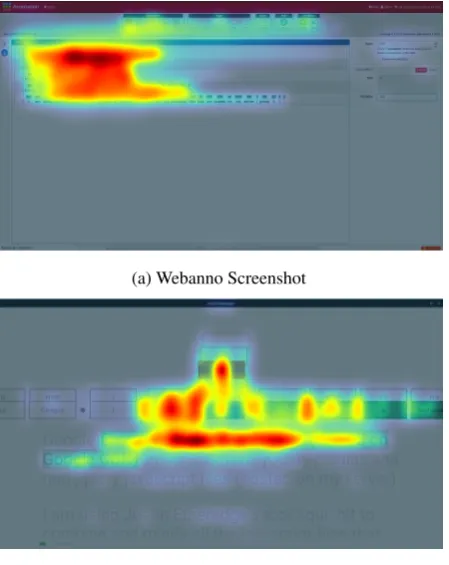
This design has been implemented conse-quently for each annotation layer and the design draws the attention to the actual important annota-tion task, e. g. assign NE types or part-of-speech (POS) tags to tokens. Figure 2 compares for the POS tag annotation layers of the state-of-the-art tool Webanno (Eckart de Castilho et al., 2016) and the QPT, showing that the QPT draws the attention
Figure 1: QPT Screenshot: NE Tagging
to the annotation task and the document text (the relevant parts) whereas Webanno draws the atten-tion to all annotaatten-tions at once.
The user can use a Xbox 360 controller to an-notate the structure of natural language. This type of input device provides a more comfort-able and playful user experience and in conjunc-tion with the GUI design the annotaconjunc-tion process is less painful and less exhausting. Additionally, the QPT provides a semi-automatic annotation pro-cess (Schreiber et al., 2015) which speeds up the annotation process further. In summary, the QPT reduces the required annotation time by half.
4 Install Best-performing NLP Pipeline Artifact
When documents of the corpus project have been annotated by annotators, developers can use a sin-gle command to train all available NLP tools, de-termine the best-performing NLP pipeline, and create an artifact which will be used in an NLP ap-plication (see Section 5). These steps will be per-formed bymvn installand the custom Maven
plu-gin (see nlp-maven-plugin in Listing 1) passes
fol-lowing customized life-cycle:
• At first, the Maven plugin validates the anno-tated documents, for example, it ensures that every or no token of a document have been annotated with a corresponding POS tag. • After that, the Maven plugin looks up
all available NLP trainer classes which are available on the classpath (c. f.
de.tudarmstadt.ukp.dkpro.core.opennlp-asl
in Listing 2). Each discovered trainer class will be used to create a domain-specific NLP model if the required annotations are available and the configuration will be stored in the target directory. The configurations
(a) Webanno Screenshot
[image:3.595.311.536.66.349.2](b) QPT Screenshot
Figure 2: Attention Map of POS Tagging Annota-tion Tools, Obtained Using the EyeQuant Atten-tion Analytics Software (www.eyequant.com)
are stored in a format compatible to the
Unstructured Information Management
Architecture (UIMA) framework (Ferrucci and Lally, 2004).
• If NLP tools do not provide any training, e. g. the segmentation tool of Stanford CoreNLP, developers can provide engine fac-tories which create configurations for these tools (see Listing 3) which will be stored in thetargetdirectory.
• All available configurations will be used to create all possible domain-specific NLP pipeline configurations and each NLP pipeline will be evaluated with F1score by running the pipelines on the test documents and by comparing the results on the provided test annotations. The configuration of the best-performing NLP pipeline will be stored into the target directory.
• Finally, the created JAR artifact can be in-stalled or deployed into any Maven reposi-tory.
public class StanfordCoreNlpEngineFactory {
publicAnalysisEngineDescription
createStanfordSegmenter() throws Exception {
,→
return createEngineDescription(
StanfordSegmenter.class,
StanfordSegmenter.PARAM_LANGUAGE_FALLBACK,
"en");
,→ } }
Listing 3: Engine Factory for NLP Tools Without Training Support
5 API Running the Best-performing NLP Pipeline
When the best-performing NLP pipeline is avail-able as JAR artifact in a Maven repository, devel-opers can integrate this artifact as Maven depen-dency into the NLP application. Therefore, devel-opers insert the project coordinates of the domain specific corpus into the application’s POM, illus-trated by Listing 4. Additionally, developers need to add theplumpinglibrary which provides an API
to execute the best-performing NLP pipeline.
<dependency>
<groupId>your.company</groupId>
<artifactId>domain-specific-corpus</artifactId> <version>1.0-SNAPSHOT</version>
</dependency>
<dependency>
<groupId>de.schrieveslaach.nlpf</groupId> <artifactId>plumbing</artifactId> <version>1.0.0</version>
</dependency>
Listing 4: Dependencies of NLP Application
The provided API integrates seamlessly into the API of the UIMA framework which provides an interface to run NLP components on unstructured data such as natural language text, c. f. method
runPipeline in Listing 5. However, the
best-performing NLP has to be configured manually. NLPf’splumping JAR artifact provides the method createBestPerformingPipelineEngineDescription() which reads the configuration of the JAR that contains the configuration and models of the best-performing NLP pipeline.
CollectionReaderDescription readerDescription =
createReaderDescription(
,→
OdtReader.class,
OdtReader.PARAM_SOURCE_LOCATION, new
File("plain.odt"));
,→
AnalysisEngineDescription writerDescription =
createEngineDescription(
,→
OdtWriter.class,
OdtWriter.PARAM_TARGET_LOCATION, new File("."),
OdtWriter.PARAM_OVERWRITE, true);
runPipeline(readerDescription,
createBestPerformingPipelineEngineDescription(),
// integrate custom engine descriptions here
writerDescription);
Listing 5: Example Application Java Code
The example code provided in Listing 5 per-forms following steps, executed byrunPipeline:
• It reads an ODT file with the nameplain.odt,
c. f.readerDescription.
• Then, it runs the best-performing NLP pipeline which annotates the whole document with the natural language structure.
• Finally, it stores the annotations into an ODT file into the current directory, c. f.
writerDescription.
Developers can integrate custom analyses as they require them (see // integrate custom... in
Listing 5). Therefore, they need to implement UIMA annotators which use the typesystem of DKPro Core. The conjunction of UIMA, DKPro Core, and NLPf allows developers to implement NLP applications effectively.
6 Summary
This paper provides a demonstration of NLP Lean Programming framework (NLPf) which en-ables developers to create domain-specific NLP pipelines more effectively, making less decisions through CoC. NLPf provides a standardized en-vironment and the well-designed annotation tool Quick Pad Tagger (QPT) with an improved in-put mechanism to improve the annotation process. Additionally, the best-performing NLP pipeline will be determine through the convenient build tool Maven and the resulting artifact can be inte-grated as Maven dependency into any application conveniently.
References
Ekaterina Buyko, Joachim Wermter, Michael Poprat, and Udo Hahn. 2006. Automatically adapting an nlp core engine to the biology domain. In Proceed-ings of the Joint BioLINK-Bio-Ontologies Meeting. A Joint Meeting of the ISMB Special Interest Group on Bio-Ontologies and the BioLINK Special Inter-est Group on Text Data M ining in Association with ISMB. pages 65–68.
Richard Eckart de Castilho and Iryna Gurevych. 2014. A broad-coverage collection of portable NLP com-ponents for building shareable analysis pipelines. In Nancy Ide and Jens Grivolla, editors,Proceedings of the Workshop on Open Infrastructures and Analysis Frameworks for HLT at COLING 2014. Association for Computational Linguistics and Dublin City Uni-versity, Dublin, Ireland, pages 1–11.
Richard Eckart de Castilho, ´Eva M´ujdricza-Maydt, Seid Muhie Yimam, Silvana Hartmann, Iryna Gurevych, Anette Frank, and Chris Biemann. 2016. A web-based tool for the integrated annotation of semantic and syntactic structures. In Proceedings of the workshop on Language Technology Resources and Tools for Digital Humanities (LT4DH) at COL-ING 2016. pages 76–84.
David Ferrucci and Adam Lally. 2004. Uima: An architectural approach to unstructured infor-mation processing in the corporate research envi-ronment. Natural Language Engineering 10(3– 4):327–348. https://doi.org/10.1017/ S1351324904003523.
Eugenie Giesbrecht and Stefan Evert. 2009. Is part-of-speech tagging a solved task? an evaluation of pos taggers for the german web as corpus. In Proceed-ings of the 5th Web as Corpus Workshop. WAC5, pages 27–35.
Christopher D. Manning, Mihai Surdeanu, John Bauer, Jenny Finkel, Steven J. Bethard, and David Mc-Closky. 2014. The Stanford CoreNLP natural lan-guage processing toolkit. InAssociation for Compu-tational Linguistics (ACL) System Demonstrations. pages 55–60.
Melanie Neunerdt, Bianka Trevisan, Michael Reyer, and Rudolf Mathar. 2013. Part-of-speech tagging for social media texts. pages
139–150. https://doi.org/10.1007/
978-3-642-40722-2_15.
Fouad Nasser A Al Omran and Christoph Treude. 2017. Choosing an nlp library for analyzing soft-ware documentation: A systematic literature review and a series of experiments. In Proceedings of the 14th International Conference on Mining Software Repositories. IEEE Press, Piscataway, NJ, USA, MSR ’17, pages 187–197. https://doi.org/ 10.1109/MSR.2017.42.
Richard M. Reese. 2015. Natural Language Process-ing with Java. Packt PublishProcess-ing Ltd.
Marc Schreiber, Kai Barkschat, Bodo Kraft, and Al-bert Z¨undorf. 2015. Quick Pad Tagger: An Efficient Graphical User Interface for Building Annotated Corpora with Multiple Annotation Layers. Com-puter Science & Information Technology 4:131– 143. https://doi.org/10.5121/csit. 2015.50413.
Milan Straka and Jana Strakov´a. 2017. Tokenizing, pos tagging, lemmatizing and parsing ud 2.0 with udpipe. Association for Computational Linguistics, Vancouver, Canada, pages 88–99.