Proceedings of the Thirteenth Workshop on Innovative Use of NLP for Building Educational Applications, pages 147–153
Experiments with Universal CEFR Classification
Sowmya Vajjala
Applied Linguistics and Technology Program Iowa State University, USA
Taraka Rama
Department of Informatics University of Oslo, Norway
Abstract
The Common European Framework of Ref-erence (CEFR) guidelines describe language proficiency of learners on a scale of 6 lev-els. While the description of CEFR guide-lines is generic across languages, the devel-opment of automated proficiency classification systems for different languages follow differ-ent approaches. In this paper, we explore universal CEFR classification using domain-specific and domain-agnostic, theory-guided as well as data-driven features. We report the results of our preliminary experiments in monolingual, cross-lingual, and multilingual classification with three languages: German, Czech, and Italian. Our results show that both monolingual and multilingual models achieve similar performance, and cross-lingual classi-fication yields lower, but comparable results to monolingual classification.
1 Introduction
Automated Essay Scoring (AES) refers to the task of automatically grading student essays writ-ten in response to some prompt. Different ap-proaches for AES have been proposed in litera-ture, where it is modeled as a regression, rank-ing or a classification problem (cf. Yannakoudakis et al., 2011; Taghipour and Ng, 2016; Pil´an et al., 2016). To our knowledge, all the previous work described approaches that work with a single lan-guage (mostly English). Feature representations that can work for multiple languages and those that support cross-lingual AES have not been explored. At first thought, using an essay scoring model developed for one language to test on another language seems unacceptable. However, CEFR guidelines are not developed for a specific lan-guage. This leads us to hypothesize about a com-mon model of “proficiency” that can work across languages. The existence of such a model would
also be beneficial for quick prototyping of AES systems for languages that do not have readily available training data.
In this paper, we explore this hypothesis by ex-ploring CEFR-classification for three languages-German, Italian, and Czech, for which CEFR graded data is publicly available. Apart from constructing individual models using generic text classification and AES specific features, we also looked into cross-lingual (i.e., training a model on one language and testing on another) and multi-lingual classification approaches (i.e., building a single classification model trained on all the three languages at once).
Testing our universal CEFR hypothesis would require a common feature representation across languages. We developed such a representation, by employing features based on part-of-speech tags and dependency relations from the Univer-sal Dependencies (UD)(Nivre et al., 2016) project which provides treebanks for over 60 languages.1
Therefore, this approach can be easily extended to other languages with available CEFR graded texts and UD treebanks.
In short, the contributions of this paper are as follows:
1. We study AES for multiple languages for the
firsttime using CEFR scale.
2. We explore, for thefirsttime, the possibility of a Universal CEFR classifier by training a single model consisting of three languages.
3. We also report first results on cross-lingual AES.
The rest of this paper is organized as follows: Section 2 describes related work. Section 3 de-scribes our data and methods. Section 4 discuss
1http://universaldependencies.org/
our experiments and results in detail. Section 5 concludes the paper with pointers to future work.
2 Related Work
AES is a well studied research problem and AES systems are used to automatically grade essays in exams such as GRER and TOEFLR (Attali and Burstein, 2004). There is a considerable amount of work that explored various aspects of AES research such as: dataset development, fea-ture engineering, multi-corpus studies and the role of prompt and task information (Yannakoudakis et al., 2011; Phandi et al., 2015; Zesch et al., 2015; Alikaniotis et al., 2016; Taghipour and Ng, 2016; Vajjala, 2018).
AES models developed for non-English lan-guages, primarily using the CEFR scale (Hancke 2013 for German, Pil´an et al. 2016 for Swedish, Vajjala and L˜oo 2014 for Estonian) employ sev-eral language specific features and show their rel-evance for the task. However, to the best of our knowledge, there is no previous work on develop-ing common models and feature representations that work across languages. Against this back-ground, we set out to address the question: “Is there a universal model for language proficiency classification?”
3 Approach
3.1 Dataset
To test our hypotheses, we need corpora graded with CEFR scale for multiple languages. One such multi-lingual corpus is the freely available MERLIN (Boyd et al., 2014) corpus.2 This
cor-pus consists of 2286 manually graded texts writ-ten by second language learners of German (DE), Italian (IT), and Czech (CZ) as a part of written examinations at authorized test institutions. The aim of these examinations is to test the knowl-edge of the learners on the CEFR scale which consists of six categories – A1, A2, B1, B2, C1, C2 – which indicate improving language abilities. The writing tasks primarily consisted of writing formal/informal letters/emails and essays. MER-LIN corpus has a multi-dimensional annotation of language proficiency covering aspects such as grammatical accuracy, vocabulary range, socio-linguistic awareness etc., and we used the “Over-all CEFR rating” as the label for our experiments
2http://merlin-platform.eu/
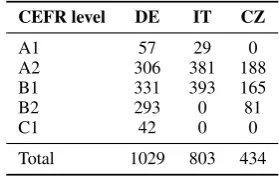
in this paper. Other information provided about the authors included- age, gender, and native lan-guage, and information about the task such as topic, and the CEFR level of the test itself. We did not use these information in the experiments reported in this paper. Further, we removed all Language-CEFR Category combinations that had less than 10 examples in the corpus (German had 5 examples for level C2 and Italian had 2 examples for B2 which were removed from the data). We also removed all the unrated texts from the origi-nal corpus. The fiorigi-nal corpus had 2266 documents covering three languages, and Table 1 shows the distribution of labels in the final corpus.
CEFR level DE IT CZ
A1 57 29 0
A2 306 381 188
B1 331 393 165
B2 293 0 81
C1 42 0 0
[image:2.595.345.485.263.351.2]Total 1029 803 434
Table 1: Composition of MERLIN Corpus
3.2 Features
Our feature set consists of features that are com-monly used in AES systems, as well as others that can be generalized across languages. They are de-scribed below:
1. Word and POS n-grams, which were com-monly used in AES models in the past (Yan-nakoudakis et al., 2011).
2. Task-specific word and character embeddings trained through a softmax layer. Although word embeddings were used in recent neu-ral AES models(Alikaniotis et al., 2016), this paper is the first to explore character embed-dings as a cross-linguistic feature for AES model.
3. Dependency n-grams where each unigram is a triplet consisting of dependency relation, POS tag of the dependent, POS tag of the head. To our knowledge, these features were not used in any of the previous work on AES.
(b) Lexical richness features: Lu (2012) de-scribed several lexical richness and lan-guage proficiency for English, which were used in previous AES systems (Hancke, 2013). In this paper, we used lexical density, lexical variation, and lexical diversity features that are com-monly used in the AES literature. (c) Error features: Total number of errors
and total spelling errors are obtained for German and Italian from an open-source, rule based spelling and grammar checker.3 To the best of our knowledge,
there is no existing tool for Czech gram-mar check, and hence we did not extract error features for Czech.
We will refer to these as domain features in this paper.
We extracted all n-gram features where n ∈
[1,5] and excluded those n-grams that appeared less than 10 times in the corpus. All the POS and dependency relation based features are ex-tracted using the UDPipe parser (Straka et al., 2016) trained on Universal Dependencies tree-banks (Nivre et al., 2016).
Feature Combinations: In addition to the above mentioned features, we also explored the effectiveness of combining n-gram features with domain features. The n-gram features are sparse whereas the domain features are dense; there-fore, we combined them by training a n-gram fea-ture classifier and using the probability distribu-tion over its cross-validated predicdistribu-tions with do-main features to train the final classifier.
3.3 Classification and Evaluation
We compared logistic regression, random forests, multi-layer perceptron, and support vector ma-chines for experiments with non-embedding fea-tures and Neural Network models trained on task-specific embedding representations for other ex-periments. Word embeddings for each language were task-specific are trained only using the MER-LIN corpus. The embeddings are stacked with a softmax layer and trained with categorical cross-entropy loss and Adadelta algorithm. We also ex-perimented by training a softmax classifier with character and word embeddings as input and found
3https://languagetool.org/
that the combined model does not perform as well as a stand-alone word embeddings model.
Considering the space restrictions, we report only the best performing systems in this paper. Due to the unbalanced class distribution across all the three languages in the data, we employed weighted-F1 score to evaluate the performance of our trained models. Weighted F1 is computed as the weighted average of the F1 score for each la-bel, taking label support (i.e., number of instances for each label in the data) into account. For both monolingual and multilingual settings, we report results with 10-fold cross validation. For cross-lingual evaluation, we report results on the test lan-guage’s data.
All our neural network models are implemented using Keras (Chollet et al., 2015) with Tensor-Flow as the backend (Abadi et al., 2015) and other models were implemented using scikit-learn (Pe-dregosa et al., 2011; Buitinck et al., 2013).4
While it is also possible to model AES as a regression task, we report classification results which is common in CEFR classification tasks. Our initial experiments with linear regression gave Pearson and Spearman correlation in the range of0.7−0.9 with gold standard scores, which is comparable with previous results on English AES task obtained using regression models (Alikaniotis et al., 2016).
4 Experiments and Results
For all the experiments, we considered a classifier using only document length (number of words per document) as the feature as the baseline. Unless explicitly stated, all the reported results for non-embedding features are based on Random Forest classifier, which was the best performing classi-fier in our experiments. Numbers with superscript
L indicate performance of results with a Logistic
Regression model.
4.1 Monolingual classification
Our classification results with different feature sets for the three languages are summarized in table 2. All feature representations perform better than the document length baseline, resulting in close to 25% improvement in the macro F1 score in some cases. All the three sets of n-gram features
Features DE IT CZ
Baseline 0.497 0.578L 0.587L
Word ngrams (1) 0.666 0.827 0.721 POS ngrams (2) 0.663 0.825 0.699 Dep. ngrams (3) 0.663 0.813 0.704 Domain features 0.533L 0.653L 0.663
(1) + Domain 0.686 0.837 0.734
[image:4.595.71.291.62.222.2](2) + Domain 0.686 0.816 0.709 (3) + Domain 0.682 0.806 0.712 Word embeddings 0.646 0.794 0.625
Table 2: Weighted F1 scores for Monolingual Clas-sification
form comparably in the case of German and Ital-ian. In the case of Czech, word n-grams turn out be a better predictor of CEFR scale than syntactic features. The domain features, by themselves, do not perform well for any of the languages. How-ever, concatenating the domain features with n-gram features yield slightly better classification re-sults. Word embeddings perform poorly for Czech compared to other non-embedding features, and come close to lexical and syntactic features in the case of German and Italian. Whether using em-beddings pre-trained on a larger corpus will give us better scores is something that needs to be ex-plored in future.
To our knowledge, Hancke (2013) is the only comparable work which explored CEFR classi-fication for German using the same dataset, but with several language specific morphological and syntactic features. Our results are comparable to the reported results of Hancke (2013), although we primarily rely on data-driven features. To our knowledge, there are no existing results for Czech and Italian.
German, which has a larger dataset, seems to perform poorer than the other two languages. One possible explanation for this could be that we are dealing with a 5 class classification for German, where as it is only a 3 class problem for Czech and Italian. It is also possible that these feature representations are not sufficient to model German language proficiency labeling task. Further ex-periments (and possibly with other existing CEFR datasets) are needed to understand why the classi-fication results differ between different languages.
4.2 Multilingual classification
In this setup, we combined all the language texts and trained a single universal CEFR classifier. Ta-ble 3 shows the results. For the non-neural mod-els, we experimented with and without consider-ing language information as a categorical feature. The neural network model is a multitasking model (C¸¨oltekin and Rama, 2016) that consists of char-acter and word embeddings as input. The model learns to predict both the language of the text (lan-guage identification) and the CEFR category si-multaneously. The model is trained using categor-ical cross-entropy and Adadelta algorithm. The ta-ble shows results with and without language iden-tification for neural models.
Features lang (-) lang (+)
Baseline 0.428L
-Word n-grams 0.721 0.719
POS n-grams 0.726 0.724
Dependency n-grams 0.703 0.693 Domain features 0.449L 0.471L
Word + Char embeddings 0.693 0.689
Table 3: Weighted F1 scores for multilingual classification with models trained on combined datasets.
4.3 Cross-lingual classification
In this setup, we trained a CEFR model on one language and tested it on others. We trained the cross-lingual model only on German data since it has examples for all categories in our corpus. Ta-ble 4 summarizes our results. We did not train with word n-grams and word embeddings here as they are lexical and are language specific and are not suitable for this scenario. Table 4 presents the results of the experiments in this setup. The
re-Features Test:IT Test:CZ
Baseline 0.553L 0.487L
POS n-grams 0.758 0.649 Dependency n-grams 0.624 0.653
Domain features 0.63L 0.475
Table 4: Weighted F1 scores for cross-lingual clas-sification model trained on German.
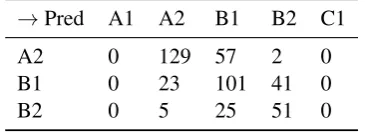
sults show a drop in performance when compared to monolingual models, which is not surprising as the feature weights are tuned to German syntactic features. However, it is interesting to note that the drop is less than 10% in both cases. In the case of Italian, the domain features yield similar results to monolingual results suggesting that there are some possible universal patterns of language use in the progression towards language proficiency. All feature groups perform better than the docu-ment length baseline for Italian, and domain fea-tures perform poorer than the baseline for Czech. The confusion matrices for these experiments (cf. tables 5a and 5b) suggest that most of the misclas-sification occurs only between adjacent levels of proficiency.
The results of this experiment indicate that while cross-lingual classification results in a drop in performance, it still captures the proficiency scale meaningfully. So, the next step in this di-rection would be to explore better representations of the data, and better modeling methods.
5 Conclusion
In this paper, we reported the results of first exper-iments conducted with the aim of exploring a “uni-versal CEFR classifier”. The results so far indicate that cross-lingual and multilingual classifiers yield comparable performance to individual language models. These results provide some evidence for a
→Pred A1 A2 B1 B2 C1
A1 5 24 0 0 0
A2 9 311 56 5 0
B1 1 70 279 44 0
(a) DE-Train:IT-Test setup with POS n-gram features
→Pred A1 A2 B1 B2 C1
A2 0 129 57 2 0
B1 0 23 101 41 0
B2 0 5 25 51 0
[image:5.595.324.507.175.241.2](b) DE-Train:CZ-Test setup with Dependency features Table 5: Confusion matrices for cross-lingual scor-ing with Random Forests by trainscor-ing on German data (DE-train).
universal notion of language proficiency and leave open many questions which need to be explored further in future. Our immediate future plans in-clude a systematic exploration of feature represen-tations which are meaningful for the AES context while being portable across languages. Modeling proficiency classification as a domain adaptation problem (where the domain is another language), and doing multi-task learning by considering other annotation dimensions are other interesting direc-tions to pursue in future. Considering that we have publicly available CEFR graded corpora for other languages such as Estonian, it would be interesting to extend this approach to new languages. This would enable us to investigate questions such as the relationship between genetic/typological simi-larities between languages and cross/multi-lingual CEFR classification task in future.
When it comes to using such methods in real world language testing applications, researchers express concerns about the validity of the chosen feature constructs, and bias and fairness in mod-els. Some recent research (Madnani et al., 2017) in this direction leaves us with some pointers to incorporate these aspects in future research.
Acknowledgments
The second author is supported by BIGMED5, a
Norwegian Research Council funded Lighthouse project, which is gratefully acknowledged.
References
Mart´ın Abadi, Ashish Agarwal, Paul Barham, Eugene Brevdo, Zhifeng Chen, Craig Citro, Greg S. Cor-rado, Andy Davis, Jeffrey Dean, Matthieu Devin, Sanjay Ghemawat, Ian Goodfellow, Andrew Harp, Geoffrey Irving, Michael Isard, Yangqing Jia, Rafal Jozefowicz, Lukasz Kaiser, Manjunath Kudlur, Josh Levenberg, Dan Man´e, Rajat Monga, Sherry Moore, Derek Murray, Chris Olah, Mike Schuster, Jonathon Shlens, Benoit Steiner, Ilya Sutskever, Kunal Tal-war, Paul Tucker, Vincent Vanhoucke, Vijay Va-sudevan, Fernanda Vi´egas, Oriol Vinyals, Pete War-den, Martin Wattenberg, Martin Wicke, Yuan Yu, and Xiaoqiang Zheng. 2015. TensorFlow: Large-scale machine learning on heterogeneous systems. Software available from tensorflow.org. https: //www.tensorflow.org/.
Dimitrios Alikaniotis, Helen Yannakoudakis, and Marek Rei. 2016. Automatic text scoring using neural networks. In Proceedings of the 54th An-nual Meeting of the Association for Computational Linguistics (Volume 1: Long Papers). Association for Computational Linguistics, Berlin, Germany, pages 715–725. http://www.aclweb.org/ anthology/P16-1068.
Yigal Attali and Jill Burstein. 2004. Automated essay scoring with e-raterR v. 2.0. ETS Research Report Series2004(2).
Adriane Boyd, Jirka Hana, Lionel Nicolas, Detmar Meurers, Katrin Wisniewski, Andrea Abel, Karin Sch¨one, Barbora Stindlov´a, and Chiara Vettori. 2014. The merlin corpus: Learner language and the cefr. InLREC. pages 1281–1288.
Lars Buitinck, Gilles Louppe, Mathieu Blondel, Fabian Pedregosa, Andreas Mueller, Olivier Grisel, Vlad Niculae, Peter Prettenhofer, Alexandre Gramfort, Jaques Grobler, Robert Layton, Jake VanderPlas, Arnaud Joly, Brian Holt, and Ga¨el Varoquaux. 2013. API design for machine learning software: experi-ences from the scikit-learn project. InECML PKDD Workshop: Languages for Data Mining and Ma-chine Learning. pages 108–122.
Franc¸ois Chollet et al. 2015. Keras. https:// github.com/keras-team/keras.
C¸a˘grı C¸¨oltekin and Taraka Rama. 2016. Discriminat-ing similar languages with linear svms and neural networks. InProceedings of the Third Workshop on NLP for Similar Languages, Varieties and Dialects (VarDial3). pages 15–24.
Julia Hancke. 2013. Automatic prediction of cefr pro-ficiency levels based on linguistic features of learner language.Master’s thesis, University of T¨ubingen.
Xiaofei Lu. 2012. The relationship of lexical richness to the quality of esl learners’ oral narratives. The Modern Language Journal96(2):190–208.
Nitin Madnani, Anastassia Loukina, Alina von Davier, Jill Burstein, and Aoife Cahill. 2017. Building bet-ter open-source tools to support fairness in auto-mated scoring. In Proceedings of the First ACL Workshop on Ethics in Natural Language Process-ing. pages 41–52.
Joakim Nivre, Marie-Catherine de Marneffe, Filip Ginter, Yoav Goldberg, Jan Hajic, Christopher D Manning, Ryan T McDonald, Slav Petrov, Sampo Pyysalo, Natalia Silveira, Reut Tsarfaty, and Daniel Zeman. 2016. Universal Dependencies v1: A Mul-tilingual Treebank Collection. In Proceedings of the Tenth International Conference on Language Re-sources and Evaluation (LREC 2016). pages 1659– 1666.
F. Pedregosa, G. Varoquaux, A. Gramfort, V. Michel, B. Thirion, O. Grisel, M. Blondel, P. Pretten-hofer, R. Weiss, V. Dubourg, J. Vanderplas, A. Pas-sos, D. Cournapeau, M. Brucher, M. Perrot, and E. Duchesnay. 2011. Scikit-learn: Machine learning in Python. Journal of Machine Learning Research
12:2825–2830.
Peter Phandi, Kian Ming A Chai, and Hwee Tou Ng. 2015. Flexible domain adaptation for automated es-say scoring using correlated linear regression. In
Proceedings of the 2015 Conference on Empirical Methods in Natural Language Processing. pages 431–439.
Ildik´o Pil´an, David Alfter, and Elena Volodina. 2016. Coursebook texts as a helping hand for classifying linguistic complexity in language learners’ writings.
CL4LC 2016page 120.
Milan Straka, Jan Hajic, and Jana Strakov´a. 2016. UD-Pipe: Trainable Pipeline for Processing CoNLL-U Files Performing Tokenization, Morphological Analysis, POS Tagging and Parsing. InLREC. Kaveh Taghipour and Hwee Tou Ng. 2016. A neural
approach to automated essay scoring. In EMNLP. pages 1882–1891.
Sowmya Vajjala. 2018. Automated assessment of non-native learner essays: Investigating the role of lin-guistic features. International Journal of Artificial Intelligence in Education28(1):79–105.
Sowmya Vajjala and Kaidi L˜oo. 2014. Automatic cefr level prediction for estonian learner text. In
Proceedings of the third workshop on NLP for computer-assisted language learning at SLTC 2014, Uppsala University. Link¨oping University Elec-tronic Press, 107.
Torsten Zesch, Michael Wojatzki, and Dirk Scholten-Akoun. 2015. Task-independent features for auto-mated essay grading. InBEA@ NAACL-HLT. pages 224–232.
A Supplemental Material
The code and data relevant for our experi-ments are available at: https://zenodo.