2772
A Dynamic Speaker Model for Conversational Interactions
Hao Cheng Hao Fang Mari Ostendorf University of Washington
{chenghao,hfang,ostendorf}@uw.edu
Abstract
Individual differences in speakers are reflected in their language use as well as in their inter-ests and opinions. Characterizing these differ-ences can be useful in human-computer inter-action, as well as analysis of human-human conversations. In this work, we introduce a neural model for learning a dynamically up-dated speaker embedding in a conversational context. Initial model training is unsuper-vised, using context-sensitive language gen-eration as an objective, with the context be-ing the conversation history. Further fine-tuning can leverage task-dependent supervised training. The learned neural representation of speakers is shown to be useful for content ranking in a socialbot and dialog act prediction in human-human conversations.1
1 Introduction
Representing language in context is key to improv-ing natural language processimprov-ing (NLP). There are a variety of useful contexts, including word his-tory, related documents, author/speaker informa-tion, social context, knowledge graphs, visual or situational grounding, etc. This paper addresses the problem of modeling the speaker. Account-ing for author/speaker variations has been shown to be useful in many NLP tasks, including lan-guage understanding (Hovy and Søgaard, 2015;
Volkova et al.,2013), language generation (Mirkin et al.,2015;Li et al.,2016), human-computer di-alog policy (Bowden et al.,2018), query comple-tion (Jaech and Ostendorf,2018;Shokouhi,2013), comment recommendation (Agarwal et al.,2011) and more. In this work, we specifically focus on dialogs, including both human-computer (social-bot) and human-human conversations.
1The implementation of code is available at https://github.com/hao-cheng/dynamic_ speaker_model.git
While many studies rely only on discrete meta-data and/or demographic information, such infor-mation is not always available. Thus, it is of in-terest to learn about the speaker from the language directly, as it relates to the person’s interests and speaking style. Motivated by the success of un-supervised contextualized representation learning for words and documents (Mikolov et al., 2013;
Kiros et al., 2015; McCann et al., 2017; Peters et al.,2018;Devlin et al.,2019), our approach is to use unsupervised learning with a neural model of a speaker’s dialog history. The model uses latent speaker mode vectors for representing a speaker turn as in (Cheng et al.,2017), which provides a framework for analysis of what the model learns about speaking style. Further, the model is struc-tured to allow a dynamic update of the speaker vector at each turn in a dialog, in order to capture changes over time and improve the speaker repre-sentation with added data.
The speaker embeddings can be used as context in conversational language understanding tasks, e.g., as an additional input in dialog policy predic-tion in human-computer dialogs or in understand-ing dialog acts in human-human dialogs. In the su-pervised training of such tasks, the speaker model can be fine-tuned.
embed-Speaker State Tracker
𝒉1
𝒉0 𝒉𝑡 𝒉𝑡+1
Latent Mode Analyzer
𝒖1
Global Mode Vectors
𝒖𝐾 Attention 𝒖𝑡
𝒔𝑡
𝒘𝑡,𝑁𝑡 𝒘𝑡,1
𝒅𝑡,𝑁𝑡+1 𝒅𝑡,1
𝒅𝑡,0
𝒘𝑡,0
𝒘𝑡,𝑁𝑡
Speaker Language Predictor
𝒆𝑡,1
𝒆𝑡,𝑁𝑡
𝑤𝑡,1
</s>
[image:2.595.76.284.63.217.2]Conversation-Level Turn-Level
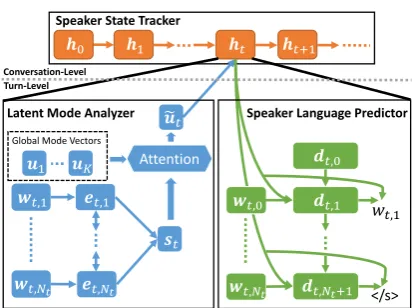
Figure 1: The dynamic speaker model. The speaker state tracker operates at the conversation level. The la-tent model analyzer and speaker language predictor op-erate at the turn level. The figure only shows processes in those two components for the turnt.
dings in two representative tasks in dialogs: pre-dicting user topic decisions in socialbot dialogs, and classifying dialog acts in human-human di-alogs. Empirical results show that using the dy-namic speaker embeddings significantly outper-forms the baselines in both tasks. In the public dialog act classification task, the proposed model achieves the state-of-the-art results.
2 Dynamic Speaker Model
In this section, we start with an overview of the proposed model for learning speaker embeddings that are dynamically refined over the course of a conversation. Details about individual compo-nents are described in subsequent subsections.
The model is based on two motivations. First, a speaker’s utterances reflect intents, speaking style, etc. Thus, we may build speaker embeddings by analyzing latent modes that characterize utter-ances in terms of such characteristics, apart from topic-related interests a user might have. Second, the information about a speaker is accumulated as the conversation evolves, which allows us to grad-ually refine and update the speaker embeddings. The speaker embeddings can be directly used as features or fine-tuned based on the downstream tasks. We design the dynamic speaker model to focus on learning cues from the speaker’s utter-ances, and leave the modeling of different speaker-addressee interactions for supervised downstream tasks.
The model consists of three components as il-lustrated in Fig.1. First, alatent mode analyzer
reads in an utterance and analyzes its latent modes. It processes the speaker’s turns independently of each other and builds a local speaker mode vector for each turn. To accumulate speaker information as the conversation evolves, we build a speaker state trackerthat maintains speaker states at in-dividual turns. At each turn, it takes two input vectors to update the speaker state: 1) the local speaker mode vector for the current turn from the latent mode analyzer, and 2) the speaker state at the previous turn from the tracker itself. Finally, we employ aspeaker language predictorto drive the learning of the latent model analyzer and the speaker state tracker. It reconstructs the utterance using the corresponding speaker state. Intuitively, the speaker language predictor models overall lin-guistic regularities itself and uses the speaker state to supply information related to speaker char-acteristics. For sequence modeling in all three components, we use the long short-term memory (LSTM) recurrent neural network (Hochreiter and Schmidhuber,1997). In our experiments, the three components are trained jointly.
2.1 Latent Mode Analyzer
At each turnt, the latent mode analyzer constructs a local speaker mode vectoru˜t∈Rcthat captures salient characteristics of the speaker’s current ut-terance for use in the dynamic speaker model. First, the utterance word sequencewt,1,· · ·, wt,Nt is mapped to an embedding sequence, wherewt,n is represented withwt,n ∈Rdaccording a lookup with dictionaryW ∈ R|V|×dassociated with vo-cabularyV. Then, the latent mode analyzer goes through two stages to constructu˜t.
In the first stage, a bi-directional LSTM (Bi-LSTM), which consists of a forward LSTM and a backward LSTM, is used to encode the word em-bedding sequence into a fixed-size utterance sum-mary vectorst∈R2m, wheremis the dimension of the hidden layer in the forward and backward LSTMs. Formally, the forward LSTM computes its hidden states aseFt,n=gF(wt,n,eFt,n−1)∈Rm forn= 1, . . . , Nt, wheregF(·,·)denotes the for-ward LSTM function. The backfor-ward LSTM com-putes its hidden stateseBt,n ∈ Rm similarly. The initial hidden stateseFt,0 andeBt,Nt+1 are set to ze-ros. The summary vectorst is the concatenation of the two final hidden states,st= [eFt,Nt,e
u1, . . . ,uK ∈ Rc which are learned as part of the model. The association scoreat,k betweenst and uk is computed using the dot-product atten-tion mechanism (Vaswani et al.,2017) as follows,
at,k =
exp(hPst,Quki)
PK
k0=1exp(hPst,Quk0i)
, (1)
whereP ∈ Rc×2m andQ ∈
Rc×c are learnable weights, andh·,·iindicates the dot-product of two vectors. The local speaker mode vector is then constructed asu˜t=
PK
k=1at,kuk.
2.2 Speaker State Tracker
The speaker state tracker provides a dynamic sum-mary of speaker language features observed in the conversation history, using an LSTM to en-code the sequence of local speaker mode vec-tors u˜t,1,· · ·,u˜t,Nt. At turn t, this LSTM up-dates its hidden state ht ∈ Rm using the local speaker mode vector u˜t and its previous hidden stateht−1 ∈ Rm, i.e.,ht = gS(˜ut,ht−1), where
gS(·,·)is the speaker LSTM function. The hidden statehtprovides the speaker state vector at turnt.
2.3 Speaker Language Predictor
The speaker language predictor is a conditional LSTM language model (LM) that reconstructs the word sequence in the current turn. Language mod-eling is a way to provide a training signal for un-supervised learning that models the conditional probabilityPr(wt,n|wt,<n), wherewt,<ndenotes all preceding words ofwt,nin the turnt.
The speaker language predictor uses the same dictionary W for word embeddings as the latent mode analyzer to represent words at timet. The initial hidden statedt,0 ∈Rm of the LSTM is set
to tanh(Lht), where L ∈ Rm×m is a learnable
matrix andtanh(·)is the hyperbolic tangent func-tion. Subsequent LSTM hidden states are com-puted as
dt,n=gLM(rI(wt,n−1,ht),dt,n−1),
for n = 1, . . . , Nt+ 1, whererI(wt,n−1,ht) =
RIwwt,n−1+RIhhtis a linear transformation with learned parameters RIw ∈ Rm×d and RI
h ∈
Rm×m, gLM(·,·) is a forward LSTM function, andwt,0 is the word embedding for the start-of-sentence token. By injecting the speaker state vec-tor at every time step n in the turn t, the model is more likely to favor directly using the speaker state vector (vs. the word history) for predicting
the speaker language. The conditional probability is then computed as
Pr(wt,n|wt,<n) = softmax(VrO(ht,dt,n)), (2)
where V ∈ R|V|×m is the weight matrix, and
rO(ht,dt,n) = ROhht+ROddt,n is another lin-ear function with llin-earnable parametersROh,ROd ∈
Rm×m. The last wordwt,Nt+1 is always the end-of-sentence token.
2.4 Model Training and Tuning
The training objective for a given conversation is the log-likelihood P
t P
nlog Pr(wt,n|wt,<n),
where the conditional probability is defined in (2). The Adam optimizer (Kingma and Ba, 2015) is used with a configuration of β1 = 0.9 andβ2 =
0.97. The initial learning rate is set to0.002. We halve the learning rate at each epoch once the de-velopment log-likelihood decreases, and terminate the training when it decreases for the second time. This validation protocol is used throughout the pa-per for training the proposed model.
In our experiments, the embedding dictio-nary W is initialized using pre-trained 300-dimensional word embeddings (Bojanowski et al.,
2017) for words within the vocabulary of this resource. The remaining part of W and other model parameters are randomly initialized based onN(0,0.01). The mode vector dimensioncis set to64. We tune the number of global mode vectors
Kfrom{16,32}and the hidden layer sizemfrom
{128,160}. The final model is selected based on the log-likelihood on the development set.
3 User Topic Decision Prediction
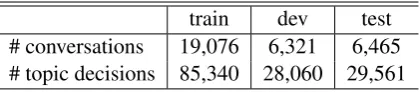
train dev test # conversations 19,076 6,321 6,465 # topic decisions 85,340 28,060 29,561
Table 1: Data statistics of the topic decision dataset.
3.1 Data
Each conversation begins with a greeting and ends when the user makes a stop command. The so-cialbot engages the user in the conversation using a wide range of content indexed by topics, where a topic corresponds to a noun or noun phrase that refers to a named entity (e.g., Google) or a concept (e.g., artificial intelligence). These topics are ex-tracted using both constituency parsing results of the textual content and content meta-information. During the conversation, the socialbot sometimes negotiates the topic with the user using an explicit confirmation turn and records the user’s binary de-cision (accept or reject) on the topic.
In socialbot conversations, a system turn is al-ways followed by a user turn and vice versa. We tag system turns making explicit confirmation about a topic and attach the corresponding binary user decisions with them. To curate the dataset for the topic decision prediction task, we use a total of 31,862 conversations with more than 5 user turns. On average there are around 22 user turns per con-versation. Not every system turn makes a topic suggestion, and the average number of topic deci-sions per conversation is 4.5. We randomly split the conversations into training, development, and test sets by3/1/1. The data statistics are shown in Table1. In our experiments, we directly use the speech recognition output of user utterances. The vocabularyV consists of roughly 11K words that appear at least 5 times in the training set.
3.2 Topic Decision Classifier
We use a feed-forward neural network (FFNN) to make binary predictions (accept vs. reject) for in-dividual topic suggestions. For each topic sugges-tion, the FFNN takes two inputs: 1) an embedding xt0for the suggested topic at system turnt0, and 2)
a user embedding vectorztat user turnt. Note the model does not have information about user turns after the system turnt0 when making the predic-tion, i.e., the user turntappears before the system turnt0.
The topic embeddingxt0’s are looked up from
the embedding dictionary learned by the FFNN.
They are initialized by averaging the embeddings of their component words using the public pre-trained 300-dimensional word embeddings ( Bo-janowski et al.,2017).
For the user embedding vector, we explore two settings that use different numbers of user turns as context. In both settings, topic decisions occurring in the first 5 user turns are not used for evaluations.
Static User Embeddings: Motivated by the find-ings that most user characteristics can be inferred from initial interactions (Ravichander and Black,
2018), we derive a static user embedding vector for a conversation using the first 5 user turns and apply it for predicting topic decisions afterwards.
Dynamic User Embeddings: Alternatively, we build a user embedding vector for user turnt us-ing all previous user turns. Here, a topic decision for system turnt0is aligned with its preceding user turnt.
In our experiments, we compare different un-supervised models with our proposed dynamic speaker model. For both settings, all unsupervised models are pre-trained onalluser turns in training conversations. They are fixed when training the FFNN classifier. The FFNN classifier is trained with the logistic loss using the Adam optimizer (Kingma and Ba,2015). The training protocol is similar to that described in §2.4. We tune the hid-den layer size from {64,128}and the number of hidden layers from{0,1}. The model is selected based on the loss on the development set.
In addition, we use a user-agnostic TopicPrior
baseline. It builds a probability lookup for each topic using its acceptance rate on the training set. We tune a universal probability threshold for all topics based on the development set accuracy.
In all experiments, three evaluation metrics are used: accuracy, area under the receiver operating characteristic curve (AUC), and normalized cross-entropy (N-CE). N-CE is computed as the relative cross-entropy reduction of the model over the Top-icPrior baseline.
3.3 Experiments: Static User Embeddings
As described in §3.2, we use the first 5 user turns to derive the user embedding vector for a conver-sation. We compare our dynamic speaker model with three other unsupervised models.
Model Acc AUC N-CE
TopicPrior 68.8 72.5 0
[image:5.595.72.292.62.149.2]UtteranceLDA 68.8 73.1 12.6 UtteranceAE 68.8 73.4 12.8 TopicDecisionEncoder 68.9 73.8 13.4 DynamicSpeakerModel 69.5 74.2 13.7
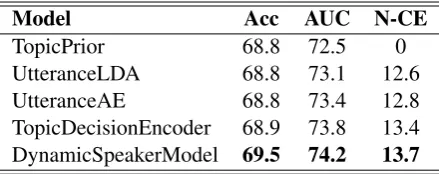
Table 2: Test set results (in %) for topic decision pre-dictions usingstaticuser embeddings.
˜
utfor each of the first 5 user turns. Then, we apply the max-pooling operation over the 5 concatenated vectors to summarize all the information. The re-sulting vectorh˜is used as the user embedding vec-tor.
UtteranceLDA: The latent Dirichlet allocation (LDA) model (Blei et al.,2003) is trained with 16 latent groups by treating all user utterances in a conversation as a document.2 The trained LDA model builds a 16-dimensional probability vector as the user embedding vector by loading the first 5 user turns as a single document.
UtteranceAE: The utterance auto-encoder model is built upon the sequence auto-encoder (Dai and Le, 2015). We replace the original encoder by a BiLSTM that encodes the utterance at user turnt
into a summary vector st in the same way as the first stage of the latent mode analyzer described in §2.1. The auto-encoder is trained on all user ut-terances in the training data, using the same train-ing protocol described in §2.4. We set the hidden layer size to128. The user embedding vector is constructed by applying the max-pooling opera-tion over the summary vectors s1, . . . ,s5 for the first 5 user turns.
TopicDecisionEncoder: This model encodes the topic decisions occurred in the first 5 user turns. The user embedding vector is the concatenation of two vectors. One is max-pooled from the topic embeddings for accepted topics, and the other for rejected topics, both include a dummy topic vector as default. The topic embeddings are composed by averaging the public pre-trained 300-dimensional embeddings (Bojanowski et al.,2017) for words in the topic.
Experiment results are summarized in Table2. The TopicPrior is a very strong predictor, with an
2To allow the LDA model to take into account bi-grams,
we replace the uni-gram tokenwiwith its bi-gram (wi,wi+1)
concatenated as a single token if the bi-gram is among the top 500 frequent bi-grams.
Model Acc AUC N-CE
TopicDecisionLSTM 69.3 74.8 14.6 UtteranceAE + LSTM 69.9 75.4 15.3 DynamicSpeakerModel 72.4 79.0 20.0∗
Table 3: Test set results (in %) for topic decision pre-dictions usingdynamicuser embeddings. ∗: The im-provement of DynamicSpeakerModel over both Top-icDecisionLSTM and UtteranceAE + LSTM is statis-tically significant based on both t-test and McNemar’s test(p < .001).
accuracy on par with other user embeddings. This indicates that the popularity-based approach is a good start for content ranking in socialbots when there is little user information. Nevertheless, we can still observe some improvement over the Top-icPrior in terms of AUC and N-CE, which suggests using information from initial interactions reduces the uncertainty of predictions. The proposed dy-namic speaker model performs the best among the compared models, reducing the cross-entropy by 13.7% over the TopicPrior baseline.
3.4 Experiments: Dynamic User Embeddings
Here, we use all information accumulated before the system turn of suggesting the topic to build the corresponding user embedding vector. Since the UtteranceLDA is not as effective based on static embedding experiments, we only consider extend-ing UtteranceAE and TopicDecisionEncoder mod-els for comparison here.
DynamicSpeakerModel: The speaker state tracker in our model accumulates the user infor-mation as the conversation evolves. Thus, we directly concatenate the speaker state vector ht and the local speaker mode vectoru˜t as the user embedding vector at user turn t. Other than us-ing more turns, this is the same DynamicSpeaker-Model configuration as in §3.3.
UtteranceAE+LSTM: This model uses an LSTM to encode the summary vector sequence derived from the same utterance auto-encoder used in §3.3. The LSTM hidden states are treated as user embedding vectors at individual user turns.
[image:5.595.308.528.63.121.2]decision, the time steps of this LSTM are aligned to a sequence of non-consecutive user turns. The LSTM hidden states are treated as user embedding vectors at corresponding user turns.
For UtteranceAE+LSTM and TopicDecision-LSTM, the hidden layer size of the LSTM is set to 128. While the utterance auto-encoder and topic embeddings are pre-trained, the LSTM compo-nents are jointly learned with the FFNN for com-posing dynamic user embeddings.
Experiment results are shown in Table3. The DynamicSpeakerModel performs the best. Com-paring to results in Table2, all three unsupervised models outperform their static counterparts, which suggests the advantage of using dynamic context for predicting user topic decisions as conversation evolves.
Statistical significance tests of the difference in performance of two systems were conducted un-der both the t-test using the predicted probabilities and McNemar’s test using the binary predictions. Under both tests, the predictions from the Top-icDecisionLSTM and the DynamicSpeakerModel are highly signification (p < .001). Predictions from UtteranceAE + LSTM and DynamicSpeak-erModel are also significantly different based on both tests (p < .001).
3.5 Qualitative Analysis
First, we manually inspect the predictions from the TopicDecisionLSTM and DynamicSpeakerModel used in §3.4 and the static baseline TopicPrior in §3.3. Compared with TopicPrior, we find that Top-icDecisionLSTM is able to utilize the semantic relatedness between neighboring topics and cor-responding user decisions. For example, “Elon Musk” (the CEO) is likely to be rejected if “Tesla” (the company) has been rejected earlier, though both are popular topics with high acceptance rates. In addition, it seems that the DynamicSpeaker-Model is able to make use of user reactions. In the anecdotal example illustrated in Table4, the user accepts the topic “Arnold Schwarzenegger” which is correctly predicted by both TopicDeci-sionLSTM and DynamicSpeakerModel, but only the DynamicSpeakerModel correctly predicts the rejection of “politics” later.
We then analyze what language features are learned by latent modes in our dynamic speaker model. For each mode, we extract top utterances sorted by their association scores as computed in
Bot: Do you like the actor Arnold Schwarzenegger?
User: yeah before he got into politics
Bot: Super, would you like to know a fun fact about Arnold Schwarzenegger?
•TopicDecisionLSTM: accept •DynamicSpeakerModel: accept
User: why not sure . . .
Bot: I’m running out of things to say about him. Do you wanna hear some news about politics?
•TopicDecisionLSTM: accept •DynamicSpeakerModel: reject
User: no
Table 4: A dialog snippet showing topic decision predictions from TopicDecisionLSTM and DynamicS-peakerModel. Topics are shown with underscores.
(1). Examples from the most representative modes are provided in Appendix A. In brief, we find two separate modes related to positive and nega-tive reactions; other modes correspond to classes of dialog acts, such as yes/no answers, topic quests and conversation-closing. Within topic re-quest modes, some involve short topic phrases (e.g., “holidays”) while others use complete re-quests (e.g. “can we talk about cats”). Along this line, some modes are associated with relatively terse users and others with talkative users. These findings indicate that our model cpatures various user characteristics that might be useful for pre-dicting their interaction preferences.
4 Dialog Act Classification
Dialog act analysis is widely used for conversa-tions, which identifies the illocutionary force of a speaker’s utterance following the speech act the-ory (Austin,1975;Searle,1969). In this section, we apply the proposed dynamic speaker model to the dialog act classification task.
4.1 Data
We use the Switchboard Dialog Act Corpus (SwDA), which has dialog act annotations on two-party human-human speech conversations ( Juraf-sky et al., 1997; Stolcke et al., 2000). In total, there are 1155 open-domain conversations with manual transcripts. Following recent work, we use 1115 conversations for training, 19 for test-ing, and the rest 21 for development.3 The
origi-nal fine-grained dialog act labels are mapped to 42
𝒙𝐭 𝒛𝐭−𝟏
𝒙𝐭−𝟏
𝒛𝐭 𝒚t
𝒛𝐭−𝟏
𝒙𝐭−𝟏
Speaker A
𝒉𝛽(𝑡−1)𝐵 𝒉𝛽(𝑡+1)𝐵 𝒉𝛼(𝑡)𝐴
Speaker B
Attention 𝒈1
Dialog
Ac
t
V
ec
tor
s
𝒈𝐿
[image:7.595.76.290.62.197.2] 𝒈𝑡
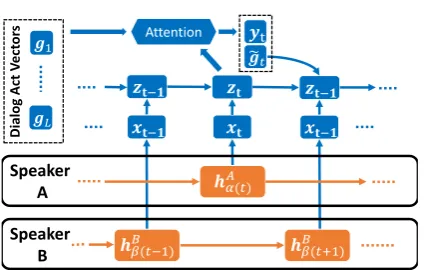
Figure 2: The attention-based LSTM tagging model for dialog act classification. The figure only shows the at-tention operation for turnt. The lower two boxes rep-resent two speaker state trackers.
classes.4 For this set of experiments, we use the golden segmentation and manual transcripts pro-vided in the dataset.
Motivated by the recent success of unsupervised models (Peters et al.,2018;Devlin et al.,2019), we also study whether the dynamic speaker model can benefit from training on external unlabelled data. Thus, we use speech transcripts from 5850 conver-sations from the Fisher English Training Speech Part 1 Transcripts (Cieri et al., 2004), which (like Switchboard) consists of two-party humto-human telephone conversations but without an-notations for dialog acts.
4.2 Dialog Act Tagging Model
We use an attention-based LSTM tagging model for the dialog act classification. As shown in Fig.2, the tagging LSTM is stacked on two speaker state trackers. Note the two trackers share the same parameters as well as the underlying la-tent mode analyzer and speaker language predic-tor. They generate speaker embeddings by track-ing correspondtrack-ing speakers separately.
Letα(t)andβ(t)denote the mappings from the global turn indextto the speaker-specific turn in-dices for speaker A and speaker B, respectively. The mapping returns a null value if the turn t
is not associated with the corresponding speaker. The speaker state vectors are used as the input to the tagging LSTM for corresponding turns, i.e., xt=I(hAα(t),hBβ(t))whereI(·,·)is a switcher that
chooseshAα(t)orhBβ(t)depending on whetherα(t)
4Dialog act labels are mapped using scripts from http://compprag.christopherpotts.net/ swda.html. Utterances labelled as “segment” are merged with corresponding previous utterance by the same speaker.
andβ(t)return a non-null value.
The tagging LSTM also maintains a dictionary ofLdialog act vectorsg1, . . . ,gL. The dialog act probabilitiesyt∈RLat turntare computed using the dot-product attention mechanism, i.e., yt =
f(zt,[g1, . . . ,gL]), where f(·,·) is defined as in (1), andztis the hidden state vector of the LSTM. The tagging LSTM computes hidden states as
zt+1 =gDA rDA(˜gt,xt+1),zt
where g˜t = PLl=1yt,lgl, gDA(·,·) is the LSTM function, and rDA(·,·) is a linear function with learnable parameters. In this way, both the history dialog act predictions and the utterance informa-tion are encoded in the hidden states.
The training objective of the tagging LSTM is the sum of the cross-entropy between the dialog act label and the probabilitiesytat each turn. The training configuration is the same as the topic de-cision classifier described in §3.2. We tune the size of hidden states zt and dialog act embed-dings gl from{64,128} with arbitrary combina-tions, and vary the number of LSTM hidden layers from{1,2}. The best model is selected according to the development set accuracy.
4.3 Experiment Results
In our experiments, we compare three settings for using the dynamic speaker model. In thepre-train
setting, the dynamic speaker model is trained on the SwDA data without the dialog act labels. We then freeze the model when training the tagging LSTM. In contrast, in the pretrain + fine-tune
setting, the dynamic speaker model is fine-tuned together with the tagging LSTM. Finally, in the
pre-train w/Fisher + fine-tune setting, the dy-namic speaker model is pre-trained on the com-bination of SwDA and Fisher datasets, and then fine-tuned together with the tagging LSTM on the SwDA dataset. For all three settings, we use the same vocabulary V of size 21K which combines all tokens from the SwDA training set and those appearing at least 5 time in the Fisher corpus.
Model Acc(%) (Kalchbrenner and Blunsom,2013) 73.9 (Tran et al.,2017a) 74.2 (Tran et al.,2017b) 74.5 (Tran et al.,2017c) 75.6
(Ji et al.,2016) 77.0
pre-train 75.6
pre-train + fine-tune 77.2
[image:8.595.75.289.62.190.2]pre-train w/ Fisher + fine-tune 78.6∗
Table 5: Test set accuracy for SwDA dialog act clas-sification. ∗: The improvement of pre-train w/ Fisher + fine-tune is statistically significant over pre-train + fine-tune based on McNemar’s test(p < .001).
the dialog act as a conditional variable to the LM.
Tran et al. (2017a,b,c) focus on building hierar-chies of RNNs to model the dialog context using previous utterances or dialog act predictions. Re-sults from (Lee and Dernoncourt,2016) and (Liu et al.,2017) are not directly comparable due to dif-ferent experiment settings.
Experiment results are summarized in Table5. Our pre-train setting performs on par with previ-ous state-of-the-art supervised models except (Ji et al., 2016). Fine-tuning significantly improves the performance and allows the model to achieve a similar accuracy as (Ji et al.,2016). The best result is achieved by pre-training the dynamic speaker model with both SwDA and Fisher datasets. The improvement of pre-train w/ Fisher + fine-tune is statistically significant over pre-train + fine-tune based on McNemar’s test(p < .001). This illus-trates the advantage of the unsupervised learning approach for the proposed model as it can exploit a large amount of unlabelled data.
4.4 Qualitative Analysis
We analyze the latent modes learned on SwDA us-ing the same approach as in §3.5. Again, specific examples are included in Appendix A. Overall, there are several modes corresponding to coarse-grained dialog acts, such as statements, questions, agreement, backchannel and conversation-closing. Many modes characterize statements, probably due to their high relative frequency in the corpus. Among the statement modes, there are two dis-tinct groups, one containing multiple filled pauses, such asuh, you know, well, and the other one with
because-clauses. The fact that coarse-grained dia-log act information is partly encoded in the modes
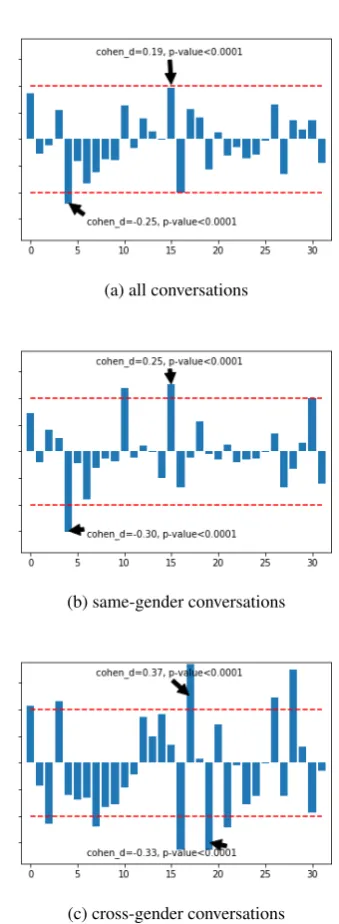
may be helping with recognizing the dialog act. In addition, we use the speaker gender infor-mation available in the SwDA data to determine whether the latent modes in the dynamic speaker model pick up gender-related language variation. Specific examples and statistics are included in AppendixB. The Cohen-d score (Cohen,1988) is used to measure the strength of the difference be-tween association score distributions of male vs. female utterances for individual modes. Based on the Cohen-d score, we identified two modes that have a strong association with male speak-ers, and two with female speakers. All have sig-nificantly different (p < 0.001) distributions of association scores for female vs. male speakers using Mann-Whitney U test. In the top associ-ated utterances for the male modes, we find utter-ances with several filled pauses, which has been found to be indicative of male speakers in pre-vious work on Switchboard (Boulis and Osten-dorf,2005). The female modes are mostly agree-ment, acknowledgement and backchannel, which aligns with a popular sociolinguistic theory that fe-males are more responsive (Coates,1998). Based on this, we conclude that some speaker gender language variations are indeed captured by the learned modes.
5 Related Work
As reviewed by Zukerman and Litman (2001), user modeling for conversational systems has a long history. The research can be tracked back to the GRUNDY system (Rich,1979) which catego-rizes users in terms of hand-crafted sets of user properties for book recommendation. Other sys-tems have focused on different aspects of users, e.g., the expertise level of the user in a specific domain (Chin,1986;Sleeman,1985;Paris,1987;
Hovy, 1987), the user’s intent and plan (Allen and Perrault,1980;Carberry,1983;Litman,1986;
Moore and Paris,1992), and the user’s personality (Mairesse and Walker,2006;DeVault et al.,2014;
et al., 2016), where the model directly learns a dictionary of speaker embeddings. Our unsuper-vised dynamic speaker model differs from previ-ous work in that we build speaker embeddings as a weighted combination of latent modes with weights computed based on the utterance. Thus, the model can construct embeddings for any new users and dynamically update the embeddings as the conversation evolves.
Speaker language variances have been ana-lyzed by previous work and incorporated in NLP models. Preot¸iuc-Pietro et al. (2016) and Jo-hannsen et al. (2015) find that speaker-level lan-guage variance affects lexical choices and even syntactic structure based on psycholinguistic hy-potheses. Speaker demographics are used to im-prove both low-level tasks such as part-of-speech tagging (Hovy and Søgaard,2015) and high-level applications such as sentiment analysis (Volkova et al.,2013) and machine translation (Mirkin et al.,
2015). Lynn et al. (2017) introduce a continu-ous adaptation method to include user age, gender, personality traits and language features for person-alizing several supervised NLP models. Different from previous work, we study the use of speaker embeddings learned from utterances in an unsu-pervised fashion and analyze the possible inter-pretability of the latent modes.
6 Conclusion
In this paper, we address the problem of mod-eling speakers from their language using an un-supervised approach. A dynamic speaker model is proposed to learn speaker embeddings that are updated as the conversation evolves. The model achieves promising results on two representative tasks in dialogs: user topic decision prediction in human-socialbot conversations and dialog act classification in human-human conversations. In particular, we demonstrate that the model can ben-efit from unlabelled data in the dialog act classi-fication task, where we achieve the state-of-the-art results. Finally, we carry out analysis on the learned latent modes on both tasks, and find cues that suggest the model captures speaker character-istics such as intent, speaking style, and gender. For future work, it could be interesting to explore guiding some latent modes with a few examples to pick up specific user features such as personality traits.
Acknowledgements
We thank the anonymous reviewers for their help-ful feedback. We also thank Trang Tran for her feedback on the paper. This research is supported by Amazon Alexa Fellowship and Tencent AI Lab Rhino-Bird Gift Fund. The conclusions and find-ings are those of the authors and do not necessarily reflect the views of sponsors.
References
Deepak Agarwal, Bee-Chung Chen, and Bo Pang. 2011. Personalized recommendation of user com-ments via factor models. InProc. Conf. Empirical Methods Natural Language Process. (EMNLP).
Ali Ahmadvand, Ingyu Choi, Harshita Sahijwani, Jus-tus Schmidt, Mingyang Sun, Sergey Volokhin, Zi-hao Wang, and Eugene Agichtein. 2018. Emory IrisBot: An open-domain conversational bot for per-sonalized information access. InProc. Alexa Prize 2018.
James F. Allen and C. Raymond Perrault. 1980. Ana-lyzing intention in utterances. Artificial Intelligence, 15:143–178.
John L. Austin. 1975. How To Do Things with Words, 2nd edition. Harvard University Press, Cambridge, MA.
David M. Blei, Andrew Y. Ng, and Michael I. Jordan. 2003. Latent dirichlet allocation. J. Machine Learn-ing Research, 3:993–1022.
Piotr Bojanowski, Edouard Grave, Armand Joulin, and Tomas Mikolov. 2017. Enriching word vectors with subword information. Transactions of the Associa-tion for ComputaAssocia-tional Linguistics, 5:135–146.
Constantinos Boulis and Mari Ostendorf. 2005. A quantitative analysis of lexical differences between genders in telephone conversations. In Proc. Annu. Meeting Assoc. for Computational Linguistics (ACL), pages 435–442.
Kevin K. Bowden, Jiaqi Wu, Wen Cui, Juraj Juraska, Vrindavan Harrison, Brian Schwarzmann, Nick San-ter, and Marilyn Walker. 2018. SlugBot: Develop-ing a computational model and framework of a novel dialogue genre. InProc. Alexa Prize 2018.
Sandra Carberry. 1983. Tracking user goals in an information-seeking environment. In Proc. AAAI Conf. Artificial Intelligence, pages 59–63.
David N. Chin. 1986. User modeling in UC, the UNIX consultant. InProc. Computer Human Interactions (CHI), pages 24–28.
Christopher Cieri, David Graff, Owen Kimball, Dave Miller, and Kevin Walker. 2004. Fisher english training speech part 1 transcripts LDC2004T19. Web Download.
Jennifer Coates, editor. 1998.Language and gender: a reader. Wiley-Blackwell.
Jacob Cohen. 1988. Statistical Power Analysis for the Behavioral Sciences. Lawrence Erlbaum Asso-ciates.
Andrew M Dai and Quoc V Le. 2015. Semi-supervised sequence learning. InProc. Annu. Conf. Neural In-form. Process. Syst. (NIPS), pages 3079–3087.
David DeVault, Ron Artstein, Grace Benn, Teresa Dey, Ed Fast, Alesia Gainer, Kallirroi Georgila, Jon Gratch, Arno Hartholt, Margaux Lhommet, et al. 2014. SimSensei kiosk: A virtual human inter-viewer for healthcare decision support. InProc. Int. Conf. Autonomous Agents and Multi-agent Systems, pages 1061–1068.
Jacob Devlin, Ming-Wei Chang, Kenton Lee, and Kristina Toutanova. 2019. Bert: Pre-training of deep bidirectional transformers for language understand-ing. InProc. Conf. North American Chapter Assoc. for Computational Linguistics (NAACL).
Hao Fang. 2019.Building a User-Centric and Content-Driven Socialbot. Ph.D. thesis, University of Wash-ington.
Hao Fang, Hao Cheng, Elizabeth Clark, Ariel Holtz-man, Maarten Sap, Mari Ostendorf, Yejin Choi, and Noah Smith. 2017. Sounding Board – University of Washington’s Alexa Prize submission. InProc. Alexa Prize.
Hao Fang, Hao Cheng, Maarten Sap, Elizabeth Clark, Ariel Holtzman, Yejin Choi, Noah Smith, and Mari Ostendorf. 2018. Sounding Board – a user-centric and content-driven social chatbot. In Proc. Conf. North American Chapter Assoc. for Computational Linguistics (NAACL) (System Demonstrations).
Pascale Fung, Anik Dey, Farhad Bin Siddique, Ruixi Lin, Yang Yang, Yan Wan, and Ricky Ho Yin Chan. 2016. Zara the supergirl: An empathetic personal-ity recognition system. InProc. Conf. North Amer-ican Chapter Assoc. for Computational Linguistics (NAACL) (System Demonstrations).
Sepp Hochreiter and J¨urgen Schmidhuber. 1997. Long short-term memory. Neural Computation, 9(8):1735–1780.
Dirk Hovy and Anders Søgaard. 2015. Tagging per-formance correlates with author age. In Proc. Annu. Meeting Assoc. for Computational Linguistics (ACL), pages 483–488.
Eduard Hovy. 1987. Generating natural language un-der pragmatic constraints. Journal of Pragmatics, 11:689–710.
Aaron Jaech and Mari Ostendorf. 2018. Personalized language model for query auto-completion. InProc. Annu. Meeting Assoc. for Computational Linguistics (ACL), pages 700–705.
Yangfeng Ji, Gholamreza Haffari, and Jacob Eisen-stein. 2016. A latent variable recurrent neural net-work for discourse relation language models. In
Proc. Conf. North American Chapter Assoc. for Computational Linguistics (NAACL), pages 332– 342.
Anders Johannsen, Dirk Hovy, and Anders Søgaard. 2015.Cross-lingual syntactic variation over age and gender. InProc. Conf. Computational Natural Lan-guage Learning (CoNLL), pages 103–112.
Dan Jurafsky, Elizabeth Shriberg, , and Debra Biasca. 1997. Switchboard swbd-damsl shallow-discourse-function annotation coders manual, draft 13. Tech-nical report, University of Colorado, Boulder.
Nal Kalchbrenner and Phil Blunsom. 2013. Recurrent convolutional neural networks for discourse compo-sitionality. InProceedings of the Workshop on Con-tinuous Vector Space Models and their Composition-ality, pages 119–126.
Diederik Kingma and Jimmy Ba. 2015. Adam: A method for stochastic optimization. In Proc. Int. Conf. Learning Representations (ICLR).
Ryan Kiros, Yukun Zhu, Ruslan R Salakhutdinov, Richard Zemel, Raquel Urtasun, Antonio Torralba, and Sanja Fidler. 2015. Skip-thought vectors. In
Proc. Annu. Conf. Neural Inform. Process. Syst. (NIPS), pages 3294–3302.
Ji Young Lee and Franck Dernoncourt. 2016. Sequen-tial short-text classification with recurrent and con-volutional neural networks. In Proc. Conf. North American Chapter Assoc. for Computational Lin-guistics (NAACL), pages 515–520.
Jiwei Li, Michel Galley, Chris Brockett, Georgios P. Spithourakis, Jianfeng Gao, and William B. Dolan. 2016. A persona-based neural conversation model. In Proc. Annu. Meeting Assoc. for Computational Linguistics (ACL), pages 994–1003.
Diane J. Litman. 1986. Linguistic coherence: a plan-based alternative. InProc. Annu. Meeting Assoc. for Computational Linguistics (ACL), pages 215–223.
Veronica Lynn, Youngseo Son, Vivek Kulkarni, Ni-ranjan Balasubramanian, and H. Andrew Schwartz. 2017. Human centered nlp with user-factor adap-tation. In Proc. Conf. Empirical Methods Natural Language Process. (EMNLP), pages 1146–1155.
Franc¸ois Mairesse and Marilyn Walker. 2006. Au-tomatic recognition of personality in conversation. In Proc. Conf. North American Chapter Assoc. for Computational Linguistics (NAACL), pages 85–88.
Bryan McCann, James Bradbury, Caiming Xiong, and Richard Socher. 2017. Learned in translation: Con-textualized word vectors. InProc. Annu. Conf. Neu-ral Inform. Process. Syst. (NIPS), pages 6294–6305.
Tomas Mikolov, Ilya Sutskever, Kai Chen, Greg S Cor-rado, and Jeff Dean. 2013. Distributed representa-tions of words and phrases and their compositional-ity. InProc. Annu. Conf. Neural Inform. Process. Syst. (NIPS), pages 3111–3119.
Shachar Mirkin, Scott Nowson, Caroline Brun, and Julien Perez. 2015. Motivating personality-aware machine translation. InProc. Conf. Empirical Meth-ods Natural Language Process. (EMNLP), pages 1102–1108.
Johanna D. Moore and Cecile Paris. 1992. Exploiting user feedback to compensate for the unreliability of user models. User Modeling and User-Adapted In-teraction, 2:287–330.
C´ecile L. Paris. 1987. The Use of Explicit User Models in a Generation System for Tailoring Answers to the User’s Level of Expertise. Ph.D. thesis, Columbia University.
Matthew Peters, Mark Neumann, Mohit Iyyer, Matt Gardner, Christopher Clark, Kenton Lee, and Luke Zettlemoyer. 2018. Deep contextualized word rep-resentations. InProc. Conf. North American Chap-ter Assoc. for Computational Linguistics (NAACL), pages 2227–2237.
Daniel Preot¸iuc-Pietro, Wei Xu, and Lyle Ungar. 2016. Discovering user attribute stylistic differences via paraphrasing. InProceedings of the Thirtieth AAAI Conference on Artificial Intelligence, pages 3030– 3037.
Ashwin Ram, Rohit Prasad, Chandra Khatri, Anu Venkatesh, Raefer Gabriel, Qing Liu, Jeff Nunn, Behnam Hedayatnia, Ming Cheng, Ashish Nagar, Eric King, Kate Bland, Amanda Wartick, Yi Pan, Han Song, Sk Jayadevan, Gene Hwang, and Art Pet-tigrue. 2017. Conversational AI: The science behind the alexa prize. InProc. Alexa Prize 2017.
Abhilasha Ravichander and Alan Black. 2018.An em-pirical study of self-disclosure in spoken dialogue systems. InProc. SIGdial Meeting Discourse and Dialogue, pages 253–263.
Elaine Rich. 1979. User modeling via stereotypes.
Cognitive Science, 3:329–354.
John R. Searle. 1969. Speech Acts: An Essay in the Philosophy of Language. Cambridge University Press.
Milad Shokouhi. 2013. Learning to personalize query auto-completion. InSIGIR, pages 103–112. ACM.
Derek Sleeman. 1985. UMFE: A user modelling front-end subsystem.Int. J. Man-Machine Studies, 23:71– 88.
Andreas Stolcke, Klaus Ries, Noah Coccaro, Eliza-beth Shriberg, Rebecca Bates, Daniel Jurafsky, Paul Taylor, Rachel Martin, Carol Van Ess-Dykema, and Marie Meteer. 2000. Dialogue act modeling for au-tomatic tagging and recognition of conversational speech.Computational Linguistics, 26(3):339–373.
Quan Hung Tran, Gholamreza Haffari, and Ingrid Zuk-erman. 2017a. A generative attentional neural net-work model for dialogue act classification. InProc. Annu. Meeting Assoc. for Computational Linguistics (ACL), pages 524–529.
Quan Hung Tran, Ingrid Zukerman, and Gholamreza Haffari. 2017b. A hierarchical neural model for learning sequences of dialogue acts. InProc. Euro-pean Chapter Assoc. for Computational Linguistics (EACL), pages 428–437.
Quan Hung Tran, Ingrid Zukerman, and Gholam-reza Haffari. 2017c. Preserving distributional in-formation in dialogue act classification. In Proc. Conf. Empirical Methods Natural Language Pro-cess. (EMNLP), pages 2151–2156.
Ashish Vaswani, Noam Shazeer, Niki Parmar, Jakob Uszkoreit, Llion Jones, Aidan N Gomez, Łukasz Kaiser, and Illia Polosukhin. 2017. Attention is all you need. InProc. Annu. Conf. Neural Inform. Pro-cess. Syst. (NIPS), pages 5998–6008.
Svitlana Volkova, Theresa Wilson, and David Yarowsky. 2013. Exploring demographic language variations to improve multilingual sentiment anal-ysis in social media. In Proc. Conf. Empirical Methods Natural Language Process. (EMNLP), pages 1815–1827.
A Examples for Mode Analysis
For each mode, we list top associated user utter-ances in Table6and Table7for the user topic de-cision corpus and SwDA corpus, respectively.
For modes learned in the user topic decision corpus, mode 4 seems to include positive reac-tions, while mode 2 involves slightly negative re-actions. Modes 0 and 6 are mostly yes/no answers. Utterances associated with mode 3 are mostly con-versation ending. Modes 9, 14, and 10 are mostly set topic commands, differing in style. Mode 10 is associated with complete requests (e.g., “let’s/can we talk about cats),” while mode 9 and Mode 14 involve short topic phrases (e.g., “holidays”). Modes 8 and 11 capture talkative users, whereas modes 1 and 7 capture relatively terse users.
For latent modes learned in the SwDA corpus, there are several modes corresponding to coarse-grained dialog acts, such as statements (modes 2, 4, 6, 16, 19), questions (modes 8, 9), agreement (modes 12, 20), backchannel (modes 0, 28), and conversation-closing (mode 13). Among the state-ment modes, there are two distinct groups, one (modes 4, 6, 16, 19) containing multiple filled pauses, such asuh, you know, well, and the other one (mode 2) withbecause-clauses. The fact that coarse-grained dialog act information is partly en-coded in the modes may be helping with recogniz-ing the dialog act.
B Speaker Gender Analysis
We use the speaker gender information from the SwDA data and analyze whether latent modes unsupervisedly learned in the dynamic speaker model could pick up some gender language vari-ations. First, we gather the latent mode associa-tion scores for each of the 32 modes for all utter-ances as computed in (1). Then we carry out the group mean tests for individual modes to test the associate score distributions of male vs female ut-terances. The Cohen-d score is used to measure the strength of the difference (Cohen,1988). We also compute the p-value using the Mann-Whitney U test. Previous work has observed larger gender language differences when the two speakers have the same gender (Boulis and Ostendorf, 2005). Thus, we carry out the group mean tests on the following three sets: 1) all conversations, 2) con-versations involving only males or females, and 3) conversations involving both genders. The Cohen-d scores for overall, same-genCohen-der anCohen-d cross-genCohen-der
(a) all conversations
(b) same-gender conversations
[image:12.595.328.498.57.520.2](c) cross-gender conversations
Figure 3: Cohen-d scores for gender group tests. The x-axis is the mode index. The y-axis is the Cohen-d score, with a larger magnitude suggesting a large effect size, and a positive value for a more female-like mode. The red dash lines indicate the±0.20 threshold.
Mode-0
• no no no no no no go back to my alexa . . . • no no no no let’s stop talking now goodbye . . . • no let’s chat let’s chat about donald trump . . .
Mode-1
• gotcha • hiya • possibly
Mode-2
• serious • are you serious • that is a paradox
Mode-3
• alexa resume pandora • alexa connect bluetooth • no bye bye alexa
Mode-4
• that is fascinating • whoa
• that that’s cool
Mode-5
• i did not that’s not surprising • i did not i did not knew that • unfortunately
Mode-6
• somewhat • yes yes yes yes yes • yes i did it was on the news
Mode-7
• mhm • ok • fascinating
Mode-8
• yes it was very much was i saw it i i was there i choose to the dark side did you choose that via uh right . . .
• the online selanne jungle the mighty jungle the line the jungle in the jungle the mighty jungle the mighty jungle . . .
• no if your life was narrated by someone and the choice was either
• i was curious if you ’d rather have your life narrated by regis philbin or by morgan freeman • did you know the answer rogers because like a better go bike and probably i just do n’t know it was just a long time ago
• i thought bill murray was very very funny
Mode-9
• meow • award shows • celebrity
Mode-10
• no let’s talk about butterflies • no let’s talk about snakes • can we talk about kardashians
Mode-11
• is king kong real or is he bake but is he awesome or . . .
• that is so true the concept of pencils are really stupid and should i even exist imagine if we have pencil do we wanna be able to write on paper so that makes you stupid
• is this randomly talking to this is the dawning alligators okay so did we get bored i don’t know you somehow or . . .
Mode-12
• do you know alexa how do you how do you know all the stuff you’re an a. i. • what what alexa what how do you talk about
• alexa do you know alexa do you know a joke today
• alexa do you tell me what you know about the new vision nuclear plant
Mode-13
• ten million • thirty percent • what’s p. r.
Mode-14 • dog • dogs • tv
[image:13.595.99.502.106.683.2]Mode-15 • now • not now
Statements
Mode-2
• cause i know there ’s one not too far from from me here in dallas
• because they really had no idea NONVERBAL what was involved once i got home • because like i said i worked with a lot of those
• because he left home at five thirty in the morning
• and then she would like to turn in half of the parents that drop their kids off because of the condition the kids are in you know
Mode-4
• uh some more in interest type topics in in other countries
• uh the uh the credit union has got a deal now where you decide what you want • well it would be lower middle class housing here
• uh the only other thing i have noticed though is that uh it seems that there ’s been a lot of or more empha emphasis at least in what we ’ve been dealing with
Mode-6
• and i know that uh you know it can be freezing cold in the wintertime and hot and uh sticky in the summertime
• it ’s uh it ’s uh it ’s uh plywood uh face i guess
• but i NONVERBAL i i i think you know the biggest causes even then a lot of times are uh uh like when i was up in boston just all the cars you know just all over the place • and so i i it ’s i think i to me i think uh something that ’s going to help our medical uh arena is for um
• you know it ’s like it ’s like a luxury car except that it ’s the dodge aries NONVER-BAL you know
Mode-16
• but uh this last ski trip they took uh she had in contracted chicken pox first • but uh we lived in malaysia for t i in nineteen uh eighty one two three and four • well my uh my sister lives in houston
• i i was only twenty five years old or something
• it ’s uh uh c n n has been a welcome addition to NONVERBAL the t v scene here in the last uh number of years
Mode-19
• uh i traded off an eighty two oldsmobile for the eighty nine mazda
• because i mean after i figured out i was getting eighty cents an hour i said bag it • uh we have a a mazda nine twenty nine and a ford crown victoria and a little two seater c r x.
• and uh you know i i was amazed cause i ’d pick up a local paper and i ’d read about all of these you know really interesting things going on
• well a friend of mine at work here said that he tried it with his dog
Backchannel
Mode-0 • yes
• yes NONVERBAL
Mode-15 • see • probably • like
Mode-17 • uh • um
Mode-18
• oh oh yeah • oh well • oh okay
Mode-28
• uh huh NONVERBAL
• uh huh NONVERBAL NONVERBAL • uh huh ery faint
Agreement
Mode-12 • exactly
Mode-20
• yep ause • definitely • absolutely • i agree
Quesetion
Mode-8
• are you and your roommate a similar size
• did you do the diagnosis or was it just an assumption that that ’s probably the part that failed
• or do you have powered you know a
• NONVERBAL what kind of a car do you have now • did they know that all along
Mode-9
• so what do you think about uh what do you think about what you see on t v about them like in the news or on the ads
• what do you think about what do you think about the the lower grades you know k through seven
• so uh what do you think about our involvement in the middle east • you are talking about p o w s or missing in actions
Conversation-closing Mode-13 • bye • bye bye
[image:14.595.77.522.37.737.2]• appreciation talking to you