Proceedings of NAACL-HLT 2018, pages 861–871
Nested Named Entity Recognition Revisited
Arzoo Katiyar and Claire Cardie
Department of Computer Science Cornell University
Ithaca, NY, 14853, USA
{arzoo, cardie}@cs.cornell.edu
Abstract
We propose a novel recurrent neural network-based approach to simultane-ously handle nested named entity recogni-tion and nested entity menrecogni-tion detecrecogni-tion. The model learns a hypergraph represen-tation for nested entities using features ex-tracted from a recurrent neural network. In evaluations on three standard data sets, we show that our approach significantly outperforms existing state-of-the-art meth-ods, which are feature-based. The ap-proach is also efficient: it operates lin-early in the number of tokens and the num-ber of possible output labels at any token. Finally, we present an extension of our model that jointly learns the head of each entity mention.
1 Introduction
Named entity recognition(or named entity detec-tion) is the task of identifying text spans associated with proper names and classifying them according to their semantic class such as person, organiza-tion, etc. It is related to the task ofmention detec-tion(or entity mention recognition) in which text spans referring to named, nominal or prominal en-tities are identified and classified according to their semantic class (Florian et al.,2004). Both named entity recognition and entity mention detection are fundamental components in information extrac-tion systems: several downstream tasks such as re-lation extraction (Mintz et al.,2009), coreference resolution (Chang et al., 2013) and fine-grained opinion mining (Choi et al.,2006) rely on both.
Many approaches have been successfully em-ployed for the tasks of named entity recognition and mention detection, including linear-chain con-ditional random fields (Lafferty et al., 2001) and
semi-Markov conditional random fields (Sarawagi and Cohen,2005). However, most such methods suffer from an inability to handle nested named entities,nestedentity mentions, or both. As a re-sult, the downstream tasks necessarily ignore these nested entities along with any semantic relations among them. Consider, for example, the excerpts below:
(S1) Employing the [EBV - transformed [human B cell line]CELL LINE ]CELL LINE SKW6.4, we demonstrate. . .
(S2) . . . [the burial site of[Sheikh Abbad]PERSON ]LOCATIONis located. . .
S1 shows a nested named entity from the GENIA dataset (Ohta et al., 2002): “human B cell line” and “EBV - transformed human B cell line” are both considered named entities of typeCELL LINE
where the former is embedded inside the latter. S2, derived from the ACE corpora1, shows a PERSON
named entity (“Sheikh Abbad”) nested in an en-tity mention of type LOCATION (“the burial site
of Sheikh Abbad”). Most existing methods for named entity recognition and entity mention de-tection would miss the nested entity in each sen-tence.
Unfortunately, nested entities can be fairly com-mon: 17% of the entities in the GENIA corpus are embedded within another entity; in the ACE corpora, 30% of sentences contain nested named entities or entity mentions, thus warranting the de-velopment of efficient models to effectively handle these linguistic phenomena.
Feature-based methods are the most common among those proposed for handling nested named entity and entity mention recognition. Alex et al.
1https://catalog.ldc.upenn.edu/
LDC2005T09 (ACE2004) and https://catalog. ldc.upenn.edu/LDC2006T06(ACE2005)
(2007), for example, proposed a cascaded CRF model but it does not identify nested named enti-ties of the same type. Finkel and Manning(2009) proposed building a constituency parser with con-stituents for each named entity in a sentence. Their approach is expensive, i.e., time complexity is cu-bic in the number of words in the sentence.Lu and Roth(2015) later proposed a mention hypergraph model for nested entity detection with linear time complexity. And recently, Muis and Lu (2017) introduced a multigraph representation based on mention separators for this task. All of these mod-els depend on manually crafted features. In ad-dition, they cannot be directly applied to extend current state-of-the-art recurrent neural network-based models — for flat named entity recognition (Lample et al.,2016) or the joint extraction of en-tities and relations (Katiyar and Cardie,2016) — to handle nested entities.
In this paper, we propose a recurrent neural network-based model for nested named entity and nested entity mention recognition. We present a modification to the standard LSTM-based se-quence labeling model (Sutskever et al., 2014) that handles both problems and operates linearly in the number of tokens and the number of pos-sible output labels at any token. The proposed neural network approach additionally jointly mod-els entity mention head2 information, a subtask
found to be useful for many information extrac-tion applicaextrac-tions. Our model significantly outper-forms the previously mentioned hypergraph model ofLu and Roth(2015) andMuis and Lu(2017) on entity mention recognition for the ACE2004 and ACE2005 corpora. It also outperforms their model on joint extraction of nested entity mentions and their heads. Finally, we evaluate our approach on nested named entity recognition using the GENIA dataset and show that our model outperforms the previous state-of-the-art parser-based approach of
Finkel and Manning(2009).
2 Related Work
Several methods have been proposed for named entity recognition in the existing literature as sum-marized byNadeau and Sekine(2007) in their sur-vey paper. Early techniques in the supervised do-main have been based on hidden markov models (e.g., Zhou and Su (2002)) or, later, conditional
2This involves identifying the headword of a named entity
or entity mention.
random fields (CRFs) (e.g.,McDonald and Pereira
(2005)).
Many fewer approaches, however, have ad-dressed the problem of nested entities. Alex et al. (2007) presented several techniques based on CRFs for nested named entity recognition for the GENIA dataset. They obtained their best re-sults from a cascaded approach, where they ap-plied CRFs in a specific order on the entity types, such that each CRF utilizes the output derived from previous CRFs. Their approach could not identify nested entities of the same type. Finkel and Manning(2009) proposed a CRF-based con-stituency parser for nested named entities such that each named entity is a constituent in the parse tree. Their model achieved state-of-the-art results on the GENIA dataset. However, the time complexity of their model isO(n3), wherenis the number of
tokens in the sentence, making inference slow. As a result, we do not adopt their parse tree-based rep-resentation of nested entities and propose instead a linear time directed hypergraph-based model sim-ilar to that ofLu and Roth(2015). Directed hyper-graphs were also introduced for parsing byKlein and Manning(2001).
While most previous efforts for nested entity recognition were limited to named entities, Lu and Roth(2015) addressed the problem of nested entity mention detection where mentions can ei-ther be named, nominal or pronominal. Their hypergraph-based approach is able to represent the potentially exponentially many combinations of nested mentions of different types. They adopted a CRF-like log-linear approach to learn these mention hypergraphs and employed several hand-crafted features defined over the input sen-tence and the output hypergraph structure. Our ap-proach also learns a similar hypergraph represen-tation with differences in the types of nodes and edges in the hypergraph. It does not depend on any manually crafted features. Also, our model learns the hypergraph greedily and significantly outper-forms their approach.
How-ever, we will show that our model also outper-forms their approach on all tasks.
Recently, recurrent neural networks (RNNs) have been widely applied to several sequence labeling tasks achieving state-of-the-art results.
Lample et al. (2016) proposed neural models based on long short term memory networks (LSTMs) and CRFs for named entity recognition and another transition-based approach inspired by shift-reduce parsers. Both models achieve per-formance comparable to a state-of-the-art model (Luo et al., 2015), but neither handles nested named entities.
3 Encoding Scheme
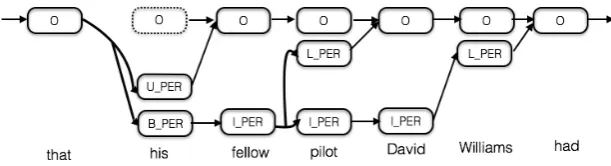
Figure1shows the desired sequence tagging out-put for each of three overlapping PER entities
(“his”, “his fellow pilot” and “his fellow pi-lot David Williams”) according to the standard BILOU tag scheme. Our approach relies on the fact that we can (1) represent these three tag se-quences in the single hypergraph structure of Fig-ure 2 and then (2) design an LSTM-based neu-ral network that produces the correct nested en-tity hypergraph for a given input sentence. In the paragraphs just below we provide a general de-scription of hypergraphs and our task-specific use of them. Sections 3.1 and 3.2 describe the hy-pergraph construction process; Section 4 presents the LSTM-based sequence tagging method for au-tomating hypergraph construction.
We express our structured prediction problem such that it corresponds to building a hypergraph that encodes the toklevel gold labels for all en-tities in the input sentence.3 In particular, we
rep-resent the problem as a directed hypergraph. For those new to this formalism, directed hypergraphs are very much like standard directed graphs except that nodes are connected by hyperarcs that con-nect asetof tail nodes to asetof head nodes. To better explain our desired output structure, we fur-ther distinguish between two types of hyperarcs — normal edges (or arcs) that connect a single tail node to a single head node, andhyperarcsthat contain more than one node either as the head or as the tail. The former are shown as straight lines in Figure2; the latter as curved edges.
3We note that the complete hypergraph for the example
in Figure1would include nodes for all possible label types at each timestep and all possible hyperarcs between them. In this work, however, we only greedily build a sub-hypergraph for the gold labels when training.
In our encoding of nested entities, a hyperarc is introduced when two or more entity mentions re-quiring different label types are present at the same position. In Figure2, for example, the nodes “O” (corresponding to the input token “that”) and the nodes “U PER” and “B PER” (corresponding to the input token “his”) are connected by a hyper-arc because three entity mentions start at this time step from the tail “O” node (two of which share the “B PER” tag).4
3.1 Hypergraph Construction
Let us first discuss how the problem of nested en-tity recognition can be expressed as finding a hy-pergraph. Our goal is to represent the BILOU tag sequences associated with “his”, “his fellow pilot” and “his fellow pilot David Williams” as the single hypergraph structure of Figure2. This is accom-plished by collapsing the shared states (labels) in the output entity label sequences into a single state as shown in Figure2: e.g., the three “O” labels for “that” become a single “O”; the two “B PER” la-bels at “his” are collapsed into one “B PER” node that joins “U PER”, the latter of which represents the entity mention “his”. Thus at any time step, the representation size is bounded by the number of possible output states instead of the potentially exponential number of output sequences. We then also adjust the directed edges such that they have the same type of head node and the same type of tail node as before in Figure1.
If we look closely at Figure 2 then we realise that there is an extra “O” node in the hypergraph corresponding to the token “his” which did not ap-pear in any entity output sequence in Figure 1: in our task-specific hypergraph construction we make sure that there is an “O” node at every timestep to model the possibility of beginning of a new entity. The need for this will become more clear in Section4.
Note that the hypergraph representation of our model is similar toLu and Roth(2015). Also, the expressiveness of our model is exactly the same as
Lu and Roth(2015);Muis and Lu(2017). The ma-jor difference in the two approaches is in learning.
4In contrast, note that the nodes “L PER” and “O”
Figure 1: Nested entity mentions in an unfolded hypergraph. Each row corresponds to an entity mention sequence using the well known B (beginning of mention), I (inside a mention), L (last token of an entity mention), O (outside any entity mention), U (a single-token entity mention) tagging scheme.
Figure 2: Directed hypergraph constructed for the example shown in Figure1. Curved edges represent hyperarcs and straight edges are normal edges.
3.2 Edge Probability
In this section, we discuss our assignment of prob-abilities to all the possible edges from a tail node which helps in the greedy construction of the hy-pergraph. Thus at any timestept, letgt−1 be the
tail node andxbe the current word of the sentence;
then we model probability distribution over all the possible types of head nodes (different output tag types) conditioned on the tail node and the current word token. In our work we use hidden represen-tations learned from an LSTM model as features to learn these probability distributions using a cross-entropy objective.
It is important to note that there are two types of directed edges in this hypergraph – simple edges for which there is only one head node for every tail node which can be learned as in a traditional sequence labeling task, or hyperarcs that connect more than one head node to a tail node. We learn the set of head nodes connected to a tail node by expressing it as a multi-label learning problem as described in Section5.
3.3 Extracting Entity Mentions
As described in Section 3.2, we can assign prob-abilities to the different types of edges in the hy-pergraph and at the time of decoding we choose for each token the (normal) edge(s) with maxi-mum probability and the hyperarcs with probabil-ity above a predefined threshold. Thus, we can extract edges at the time of decoding. Ultimately,
however, we are interested in extracting nested en-tities from the hypergraph. For this, we construct an adjacency matrix from the edges discovered and perform depth-first search from the sentence-initial token to discover the entity mentions. This is described in detail in Section5.1.
4 Method
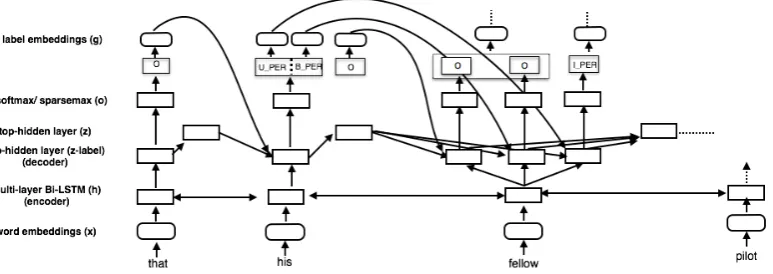
We use a standard LSTM-based sequence label-ing model to learn the nested entity hypergraph structure for an input sentence. Figure 3 shows part of the network structure. It is a standard bi-directional LSTM network except for a difference in the top hidden layer. When computing the rep-resentation of the top hidden layer Lat any time
stept, in addition to making use of the hidden unit
[image:4.595.143.449.191.274.2]computation-Figure 3: Dynamically computed network structure based on bi-LSTMs for nested entity mention ex-traction. We show part of the structure for the entity mentions in the running example in Figure1.
ally less expensive than storing the hidden layer representations for each label sequence.
4.1 Multi-layer Bi-LSTM
We use a multi-layer bi-directional LSTM en-coder, for its strength in capturing long-range de-pendencies between tokens, a useful property for information extraction tasks.
Using LSTMs, we can compute the hidden state −
→
htin the forward direction and←h−tin the backward direction for every token, and use a linear combi-nation of them as the token representation:
− →h(l)
t = LSTM(xt,−→ht−1)
←−
h(tl)= LSTM(xt,←h−t+1)
zt(l)=−→V−→ht(l)+←V−←−h(tl)+bl
4.2 Top Hidden Layer
At the top hidden layer, we have a decoder-style model, with a crucial twist to accommodate the hypergraph structure, which may have multiple gold labels at the previous step. At each tokent
andfor eachgold label at the previous stepgkt−1,
our network takes the hidden representation from the previous layerz(tL−1), the hidden decoder state h(tL−)1, as well as the gold label embedding gk
t−1
from the previous time step, and computes:
h(tL),k = LSTM(z(tL−1),h(tL−)1,gkt−1)
Unlike the encoder LSTM, this decoder LSTM is single-directional and bifurcates when multiple gold labels are present. We use the decoder hidden statesh(tL),k in the output layer for prediction, as explained in Section4.3. However, before passing
the hidden representation to the next time step we averageh(tL),kover all the gold labelsk:
h(tL)= 1 |Gt−1|
X
k
h(tL),k
Thus,h(tL)summarizes the information for all the gold labels from the previous time step.
4.3 Entity Extraction
For each tokentand previous gold labelgtk−1, we
use the decoder stateh(tL),kto predict aprobability
distributionover the possible candidate labels us-ing a linear layer followed by a normalizus-ing trans-form (illustrated below with softmax). The out-puts can be interpreted as conditional probabilities for the next label given the current gold label:
okt =U h(tL),k+b
ˆ
ekt = softmax(okt)
p(yt=c|yt−1 =gtk−1) = (ekt)c
Special care is required, however, since the desired output has hyperarcs. As shown in Figure2, there is an hyperarc between “I PER” corresponding to the token “fellow” and the label set “L PER” and “I PER” corresponding to the token “pilot”. Thus, in our network structure conditioned on the previ-ous label “I PER” in this case, we would like to predict both “L PER” and “I PER” as the next la-bels. To accommodate this, we use a multi-label training objective, as described in Section5.
5 Training
[image:5.595.109.496.70.207.2]ACE2004 ACE2005
Method P R F1 P R F1
MH-F (Lu and Roth,2015) 70.0 59.2 63.8 70.0 56.9 62.8
Muis and Lu(2017) 72.7 58.0 64.5 69.1 58.1 63.1
LSTM-flat 70.3 48.4 57.3 62.4 49.4 55.1
[image:6.595.127.473.61.173.2]LSTM-output layer 72.0 63.3 67.4 66.3 68.2 67.2 Our model (softmax) 72.2 65.2 68.5 70.1 67.9 69.0 Our model (sparsemax) 73.6 71.8 72.7 70.6 70.4 70.5
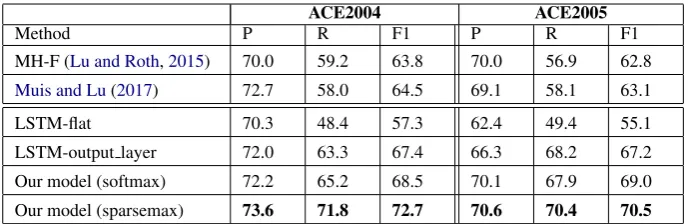
Table 1: Performance on ACE2004 and ACE2005 test set on mention extraction and classification.
gold labels as a distribution over all possible la-bels, encoded as a vector e. Hence, for simple edges, the distribution has a probability of 1 for the unique gold label (eg = 1), and0everywhere else. For hyperarcs, we distribute the probability mass uniformly over all the gold labels in the gold label set (ek
g = |G1| for all k). Thus, for the
exam-ple described earlier in Section4.3, both the labels “L PER” and “I PER” receive a probability of0.5 in the gold label distribution ek
t, conditioned on the label “I PER” from the previous time step.
Softmax. Our first training method uses soft-max to estimate the predicted probabilities, and the KL-divergence multi-label loss between the true distributionek
t and the predicted distribution
ˆ ek
t = softmax(okt):
`kt(softmax)=−X c
ekt clog
ˆ ekt
c
Sparsemax. Our second training method makes use ofsparsemax, recently introduced byMartins and Astudillo(2016) as a sparse drop-in replace-ment to softmax, as well as a loss function. Unlike softmax, which always outputs a nonzero proba-bility for any output, sparsemax outputs zero prob-ability for most of the unlikely classes, leading to good empirical results on multi-label tasks. For our problem, there are only a few nested entities at any timestep in the gold labels thus using a train-ing objective that learns a sparse distribution is more appropriate. Sparsemax can be used to filter part of the output space as in the case for multi-label problems thus leaving non-zero probability on the desired output labels.
Formally, sparsemax returns the euclidean pro-jection of its inputoonto the probability simplex:
ˆ
e= sparsemax(o) := argmin
ˆ
e∈∆ k
o−eˆk2
The corresponding loss, a sparse version of the KL divergence, is (up to a constant):
`kt(sparsemax)=−2ekt>okt+ X
c:(ˆek t)c6=0
(okt)2c−τ2
This function is convex and differentiable, and the quantityτ is a biproduct of the simplex projection,
as described inMartins and Astudillo(2016). For either choice of probability estimation, the total loss of a training sample is the sum of losses for each token and for each previous gold label:
L=X
t
X
k∈Gt−1 `kt.
5.1 Decoding
At the time of inference, we greedily decode our hypergraph from left-to-right to find the most likely sub-hypergraph. During training, at each timestep the most likely label set is learned condi-tioned on a gold label from the previous timestep. However, gold labels are not available at test time. Thus, we use the predicted labels from the previ-ous time step as an input to the current time step to find the most likely label set. We use a hard threshold T to determine the predicted label set Ptk={c: ˆektc> T}
We can get the most likely label set Pc t for any predicted label at the previous time stepc ∈
Ptk−1 using the above decoding strategy. We now
combine these inferences to find the most likely entity mention sequences. We construct an ad-jacency matrix A for each time step, such that A[eˆc
t−1][eˆkt] += 1 for everycin the predicted la-bel setPtkat timesteptconditioned oneˆkt and for everykin predicted labelsPt−1at time stept−1.
5.2 Modeling Entity Heads for ACE datasets
The ACE datasets also have annotations for men-tion heads along with the entity menmen-tions. For example, a sentence with the entity mention “the U.S. embassy” also contains an annotation for its head word which is “embassy” in this case. Thus, we modify our model to also extract the head of the entity mentions for ACE dataset. We jointly model the entity mentions and their heads. To do this, we propose a simple extension to our model by only changing the output label sequence. We introduce new labels starting with “H” to in-dicate that the current token in the entity men-tion is part of its head. Thus, we only change the output label sequence for the entity mentions to include the head label: We train with the la-bel sequence “B ORG I ORG H ORG” instead of “B ORG I ORG L ORG”. Also, for all our entity sequences we predict the “O” tag at the end, hence we can still extract the entity mentions. At decod-ing time, we output the sequence of words with the “H” tag as the head words for a mention.
6 Experiments
We evaluate our model on two tasks – nested entity mention detection for the ACE corpora and nested named entity recognition for the GENIA dataset.
6.1 ACE Experiments 6.1.1 Data
We perform experiments on the English section of the ACE2004 and ACE2005 corpora. There are 7 main entity types — Person (PER),
Organiza-tion (ORG), Geographical Entities (GPE),
Loca-tion (LOC), Facility (FAC), Weapon (WEA) and
Vehicle (VEH). For each entity type, there are
annotations for the entity mention and mention heads.
6.1.2 Evaluation Metrics
We use a strict evaluation metric similar toLu and Roth(2015): an entity mention is considered cor-rect if both the mention span and the mention type are exactly correct. Similarly, for the task of joint extraction of entity mentions and mention heads, the mention span, head span and the entity type should all exactly match the gold label.
6.1.3 Baselines and Previous Models
We compare our model with the feature-based model (MH-F) on hypergraph structure (Lu and
Roth, 2015) on both entity mention detection as well as the joint mention and mention heads ex-traction. We also compare with Muis and Lu
(2017) on entity mention detection only as their model cannot detect head phrases of the entity mentions. Lu and Roth (2015) compare their approach with CRF-based approaches such as a linear-chain CRF, semi-markov CRF and a cas-caded approach (Alex et al.,2007) and show that their model outperforms them. Hence, we do not include those results in our paper.
We also implement several LSTM-based base-lines for comparison. Our first baseline is a stan-dard sequence labeling LSTM model (LSTM-flat). A sequence model is not capable of handling the nested mentions, so we remove the embed-ded entity mention and keep the mention longer in length. Our second baseline is a hypergraph model (LSTM-output layer) except that the de-pendencies are only modeled at the output layer and hence there are no connections to the top-hidden layer from the label embeddings from the previous timestep; instead, these connections are limited to the output layer.
6.1.4 Hyperparameters and Training Details
We use Adadelta (Zeiler, 2012) for training our models. We initialize our word vectors with 300-dimensional word2vec (Mikolov et al.,2013) word embeddings. These word embeddings are tuned during training. We regularize our network using dropout (Srivastava et al., 2014), with the dropout rate tuned on the development set. There are 3 hidden layers in our network and the dimen-sionality of hidden units is 100 in all our experi-ments. And we set the threshold T as 0.3.
6.1.5 Results
pre-ACE2004 ACE2005
Method P R F1 P R F1
[image:8.595.127.471.61.131.2]MH-F (Lu and Roth,2015) 74.4 50.0 59.8 63.4 53.8 58.3 Our model(softmax) 68.2 60.5 64.2 67.5 62.3 64.8 Our model(sparsemax) 72.3 66.8 69.7 70.6 69.8 70.2
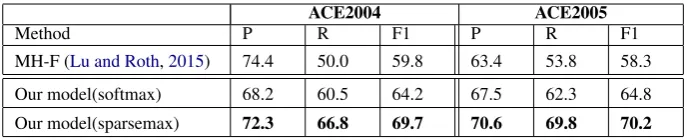
Table 2: Performance on ACE2004 and ACE2005 test set on joint entity mention and its head prediction.
Muis and Lu(2017) do not predict head of the nested entity mentions.
vious timestep as shown in Figure3performs bet-ter than the LSTM-output layer model which only models dependencies at the output layer. Also, as expected, the sparsemax method that produces a sparse probability distribution performs better than the softmax approach for modeling hyper-edges. In summary, our sparsemax model is the best performing model.
Joint Modeling of Heads We report the perfor-mance of our best performing models on the joint modeling of entity mentions and its head in Ta-ble2. We show that our sparsemax model is still the best performing model. We also find that as the total number of possible labels at any timestep increases because of the way we implemented the entity heads, the gains that we get after incorporat-ing sparsemax are significantly higher compared to the results shown in Table1.
6.2 GENIA Experiments 6.2.1 Data
We also evaluate our model on the GENIA dataset (Ohta et al.,2002) for nested named entity recog-nition. We follow the same dataset split asFinkel and Manning(2009);Lu and Roth (2015); Muis and Lu (2017). Thus, the first 90% of the sen-tences were used in training and the remaining 10% were used for evaluation. We also consider five entity types – DNA, RNA, protein, cell line and cell type.
6.2.2 Baselines and Previous Models
We compare our model withFinkel and Manning
(2009) based on a constituency CRF-based parser and the mention hypergraph model byLu and Roth
(2015) and a recent multigraph model byMuis and Lu(2017).
6.2.3 Results
Table 3 shows the performance of our different models compared to the previous models. Interest-ingly, our LSTM-flat model outperforms Lu and
Method P R F1
Finkel and Manning(2009) 75.4 65.9 70.3 MH-F (Lu and Roth,2015) 72.5 65.2 68.7
Muis and Lu(2017) 75.4 66.8 70.8
LSTM-flat 75.5 63.5 68.9
[image:8.595.310.524.182.300.2]LSTM-output layer 78.4 67.9 72.8 Our model (softmax) 76.7 71.1 73.8 Our model (sparsemax) 79.8 68.2 73.6
Table 3: Performance on the GENIA dataset on nested named entity recognition.
Roth(2015). We suspect that it is because we use pretrained word embeddings5trained on PubMed
data (Pyysalo et al., 2013) whereasLu and Roth
(2015) did not have access to them. We again find that our neural network model outperforms the previous state-of-the-art (Finkel and Manning,
2009;Muis and Lu,2017) system. However, we see that both softmax and sparsemax models per-form comparably on this dataset.
7 Error Analysis
Consistent with existing results on the joint model-ing of related tasks in NLP, we find that joint mod-eling of heads and their entity mentions leads to an increase in F-score by 1pt (i.e., 71.4 for the sparse-max model on the ACE2005 dataset) on the per-formance of the entity mentions. The precision on extracting entity mentions is 72.1 (vs. 70.6 in Ta-ble1) for our sparsemax model for the ACE2005 dataset.
Example S1 below compares the output from a softmax vs. a sparsemax model on the joint mod-eling of an entity mention and its head on the ACE2005 dataset. Gold-standard annotations are shown inred.
(S1) [[[ They]]]PERSON don’t abandon [[[[[ their]]]PERSON patients] ]PERSON, except
5Word vectors trained on PubMed data are available at
for the high premiums of a few specialities? Based on the gold standard, the models are re-quired to extract “their” — an entity mention of type PER as well as its head — and “their
pa-tients”, which overlaps with the previous entity mention “their” and has the head word “patients”. This means that the models are required to pre-dict a hyperedge from “O” to “H PER; B PER”. We find that the softmax model shown in blue can only predict the entity mention “their” omit-ting completely the entity mention “their patients” whereas the sparsemax model shown ingreencan
predict both nested entities. Overall then, sparse-max seems to allow the modeling of hyperedges more efficiently compared to the softmax model and performance gains are due to extracting more nested entities with the help of sparsemax model.
7.1 Limitations and Future Directions
We also manually scanned the test set predictions on ACE dataset for our sparsemax model to under-stand its current limitations.
Document Context. Given the following
sen-tence
(S2) [They]VEHICLEroar,[they]VEHICLEscreech. the sparsemax model predicts both entity mentions of “they” as PERentity type. Only if the previous
sentence in the corpus is accessible — “And if you ride inside that tank, it is like riding in the bowels of a dragon” — can we understand that “they” in S2 refers to the tank and hence is a VEH. Thus, our
model can be improved by providing additional context for each sentence rather than making pre-dictions on each sentence in the corpus indepen-dently.
Pronominal Entity Mention (It). Next,
con-sider examples S3 and S4:
(S3) [It]FACILITY also seemed to be [some kind of monitoring station]FACILITY.
(S4) It does not matter to[these people]PERSONthat crime has skyrocketed. . .
In the example sentences, “It” refers to a facility and an event, respectively. Our model does not distinguish between the two cases and always pre-dicts the token “It” as a non-entity. We found this true for all occurrences of the token “It” in our test set. The incorporation of coreference information can potentially overcome this limitation.
Inconsistency in Gold-standard Annotations.
We also identified potential inconsistencies in the gold-standard annotations.
(S5) . . . results may affect what happens to [both of these teams]ORG, but in just . . .
For S5, the gold-standard annotation for “both of these teams” is an ORG entity mention with the
token “teams” as its head word. Our sparsemax model identifies the entity mention correctly but instead predicts the token “both” as the head. It also identifies “these teams” as another nested en-tity mention with the head word “teams”. In con-trast, however, we also found entity mentions such as “all of the victims that get a little money” for which the gold-standard has “all” annotated as its head and another nested mention “the victims that get a little money” with “victims” as the head. We recognize this as an inconsistency in the gold-standard annotation.
8 Conclusion and Future Work
In this paper, we present a novel recurrent network-based model for nested named entity recognition and nested entity mention detection. We propose a hypergraph representation for this problem and learn the structure using an LSTM network in a greedy manner. We show that our model significantly outperforms a feature based mention hypergraph model (Lu and Roth, 2015) and a recent multigraph model (Muis and Lu,
2017) on the ACE dataset. Our model also outper-forms the constituency parser-based approach of
Finkel and Manning(2009) on the GENIA dataset. In future work, it would be interesting to learn global dependencies between the output labels for such a hypergraph structure and training the model globally. We can also experiment with different representations such as the one inFinkel and Man-ning(2009) and use the recent advances in neural network approaches (Vinyals et al.,2015) to learn the constituency parse tree efficiently.
Acknowledgments
interpreted as necessarily representing the official policies or endorsements, either expressed or im-plied, of NSF, DARPA or the U.S. Government.
References
Beatrice Alex, Barry Haddow, and Claire Grover. 2007. Recognising nested named entities in biomedical text. In Proceedings of the Work-shop on BioNLP 2007: Biological, Translational, and Clinical Language Processing. Associa-tion for ComputaAssocia-tional Linguistics, Strouds-burg, PA, USA, BioNLP ’07, pages 65–72.
http://dl.acm.org/citation.cfm?id=1572392.1572404.
Kai-Wei Chang, Rajhans Samdani, and Dan Roth. 2013.A constrained latent variable model for coref-erence resolution. InProceedings of the 2013 Con-ference on Empirical Methods in Natural Language Processing. Association for Computational Linguis-tics, Seattle, Washington, USA, pages 601–612.
http://www.aclweb.org/anthology/D13-1057.
Yejin Choi, Eric Breck, and Claire Cardie. 2006.
Joint extraction of entities and relations for opin-ion recognitopin-ion. In Proceedings of the 2006 Conference on Empirical Methods in Natural Lan-guage Processing. Association for Computational Linguistics, Sydney, Australia, pages 431–439.
http://www.aclweb.org/anthology/W/W06/W06-1651.
Jenny Rose Finkel and Christopher D. Manning. 2009.
Nested named entity recognition. In Proceed-ings of the 2009 Conference on Empirical Methods in Natural Language Processing. Association for Computational Linguistics, Singapore, pages 141– 150. http://www.aclweb.org/anthology/D/D09/D09-1015.
R Florian, H Hassan, A Ittycheriah, H Jing, N Kamb-hatla, X Luo, N Nicolov, and S Roukos. 2004. A statistical model for multilingual entity detection and tracking. In Daniel Marcu Susan Dumais and Salim Roukos, editors, HLT-NAACL 2004: Main Proceedings. Association for Computational Lin-guistics, Boston, Massachusetts, USA, pages 1–8. Arzoo Katiyar and Claire Cardie. 2016.
Investi-gating lstms for joint extraction of opinion enti-ties and relations. In Proceedings of the 54th Annual Meeting of the Association for Com-putational Linguistics, ACL 2016, August 7-12, 2016, Berlin, Germany, Volume 1: Long Papers.
http://aclweb.org/anthology/P/P16/P16-1087.pdf. Dan Klein and Christopher D. Manning. 2001.
Pars-ing and hypergraphs. In Proceedings of the Sev-enth International Workshop on Parsing Technolo-gies (IWPT-2001), 17-19 October 2001, Beijing, China.
John D. Lafferty, Andrew McCallum, and Fernando C. N. Pereira. 2001. Conditional random fields:
Probabilistic models for segmenting and label-ing sequence data. In Proceedings of the Eigh-teenth International Conference on Machine Learn-ing. Morgan Kaufmann Publishers Inc., San Fran-cisco, CA, USA, ICML ’01, pages 282–289.
http://dl.acm.org/citation.cfm?id=645530.655813. Guillaume Lample, Miguel Ballesteros, Sandeep
Sub-ramanian, Kazuya Kawakami, and Chris Dyer. 2016. Neural architectures for named entity recog-nition. In Proceedings of the 2016 Conference of the North American Chapter of the Associa-tion for ComputaAssocia-tional Linguistics: Human Lan-guage Technologies. Association for Computational Linguistics, San Diego, California, pages 260–270.
http://www.aclweb.org/anthology/N16-1030. Wei Lu and Dan Roth. 2015. Joint mention
ex-traction and classification with mention hyper-graphs. In Proceedings of the 2015 Con-ference on Empirical Methods in Natural Lan-guage Processing. Association for Computational Linguistics, Lisbon, Portugal, pages 857–867.
http://aclweb.org/anthology/D15-1102.
Gang Luo, Xiaojiang Huang, Chin-Yew Lin, and Za-iqing Nie. 2015. Joint entity recognition and dis-ambiguation. In Proceedings of the 2015 Con-ference on Empirical Methods in Natural Lan-guage Processing. Association for Computational Linguistics, Lisbon, Portugal, pages 879–888.
https://aclweb.org/anthology/D/D15/D15-1104. Andr´e F. T. Martins and Ram´on F. Astudillo. 2016.
From softmax to sparsemax: A sparse model of attention and multi-label classification. In Pro-ceedings of the 33rd International Conference on International Conference on Machine Learning -Volume 48. JMLR.org, ICML’16, pages 1614–1623.
http://dl.acm.org/citation.cfm?id=3045390.3045561. Ryan McDonald and Fernando Pereira. 2005.
Identi-fying gene and protein mentions in text using condi-tional random fields. BMC Bioinformatics6(1):S6.
https://doi.org/10.1186/1471-2105-6-S1-S6. Tomas Mikolov, Ilya Sutskever, Kai Chen, Greg S
Corrado, and Jeff Dean. 2013. Distributed representations of words and phrases and their compositionality. In C.J.C. Burges, L. Bottou, M. Welling, Z. Ghahramani, and K.Q. Weinberger, editors, Advances in Neural Information Process-ing Systems 26, Curran Associates, Inc., pages 3111–3119. http://papers.nips.cc/paper/5021- distributed-representations-of-words-and-phrases-and-their-compositionality.pdf.
Mike Mintz, Steven Bills, Rion Snow, and Daniel Jurafsky. 2009. Distant supervision for rela-tion extracrela-tion without labeled data. In Pro-ceedings of the Joint Conference of the 47th An-nual Meeting of the ACL and the 4th International Joint Conference on Natural Language Process-ing of the AFNLP. Association for Computational Linguistics, Suntec, Singapore, pages 1003–1011.
Aldrian Obaja Muis and Wei Lu. 2017. Labeling gaps between words: Recognizing overlapping mentions with mention separators. InProceedings of the 2017 Conference on Empirical Methods in Natural Lan-guage Processing. Association for Computational Linguistics, Copenhagen, Denmark, pages 2598– 2608. https://www.aclweb.org/anthology/D17-1275.
David Nadeau and Satoshi Sekine. 2007. A sur-vey of named entity recognition and classification. Linguisticae Investigationes30(1):3–26. Publisher: John Benjamins Publishing Company.
Tomoko Ohta, Yuka Tateisi, and Jin-Dong Kim. 2002. The genia corpus: An annotated research abstract corpus in molecular biology domain. In Proceedings of the Second International Conference on Human Language Technology Research. Morgan Kaufmann Publishers Inc., San Francisco, CA, USA, HLT ’02, pages 82–86.
http://dl.acm.org/citation.cfm?id=1289189.1289260.
S Pyysalo, F Ginter, H Moen, T Salakoski, and S Ana-niadou. 2013. Distributional Semantics Resources for Biomedical Text Processing, pages 39–44.
Sunita Sarawagi and William W Cohen. 2005.
Semi-markov conditional random fields for infor-mation extraction. In L. K. Saul, Y. Weiss, and L. Bottou, editors, Advances in Neural Informa-tion Processing Systems 17, MIT Press, pages 1185–1192. http://papers.nips.cc/paper/2648-semi- markov-conditional-random-fields-for-information-extraction.pdf.
Nitish Srivastava, Geoffrey Hinton, Alex Krizhevsky, Ilya Sutskever, and Ruslan Salakhutdinov. 2014. Dropout: A simple way to prevent neural networks from overfitting. Journal of
Machine Learning Research 15:1929–1958.
http://jmlr.org/papers/v15/srivastava14a.html.
Ilya Sutskever, Oriol Vinyals, and Quoc V. Le. 2014. Sequence to sequence learning with neural networks. In Proceedings of the 27th International Conference on Neural Informa-tion Processing Systems. MIT Press, Cam-bridge, MA, USA, NIPS’14, pages 3104–3112.
http://dl.acm.org/citation.cfm?id=2969033.2969173.
Oriol Vinyals, Lukasz Kaiser, Terry Koo, Slav Petrov, Ilya Sutskever, and Geoffrey Hinton. 2015. Gram-mar as a foreign language. InProceedings of the 28th International Conference on Neural Informa-tion Processing Systems - Volume 2. MIT Press, Cambridge, MA, USA, NIPS’15, pages 2773–2781.
http://dl.acm.org/citation.cfm?id=2969442.2969550.
Matthew D. Zeiler. 2012. ADADELTA: an adap-tive learning rate method. CoRR abs/1212.5701.
http://arxiv.org/abs/1212.5701.
GuoDong Zhou and Jian Su. 2002. Named en-tity recognition using an hmm-based chunk
tag-ger. In Proceedings of the 40th Annual Meet-ing on Association for Computational LMeet-inguis- Linguis-tics. Association for Computational Linguistics, Stroudsburg, PA, USA, ACL ’02, pages 473–480.