Proceedings of NAACL-HLT 2018, pages 1875–1885
Adversarial Example Generation
with Syntactically Controlled Paraphrase Networks
Mohit IyyerF†‡ John WietingF♣ Kevin Gimpel♦ Luke Zettlemoyer♠
Allen Institute of Artificial Intelligence† UMass Amherst‡ Carnegie Mellon University♣
Toyota Technological Institute at Chicago♦ University of Washington♠
[email protected] [email protected] [email protected] [email protected]
Abstract
We propose syntactically controlled
para-phrase networks (SCPNs) and use them to generate adversarial examples. Given a sen-tence and a target syntactic form (e.g., a
con-stituency parse), SCPNs are trained to
pro-duce a paraphrase of the sentence with the de-sired syntax. We show it is possible to create training data for this task by first doing back-translation at a very large scale, and then us-ing a parser to label the syntactic transforma-tions that naturally occur during this process. Such data allows us to train a neural encoder-decoder model with extra inputs to specify the target syntax. A combination of automated
and human evaluations show thatSCPNs
gen-erate paraphrases that follow their target spec-ifications without decreasing paraphrase qual-ity when compared to baseline (uncontrolled) paraphrase systems. Furthermore, they are more capable of generating syntactically ad-versarial examples that both (1) “fool” pre-trained models and (2) improve the robustness of these models to syntactic variation when used to augment their training data.
1 Introduction
Natural language processing datasets often suf-fer from a dearth of linguistic variation, which can hurt the generalization of models trained on them. Recent work has shown it is possible to easily “break” many learned models by evaluating them onadversarial examples(Goodfellow et al.,
2015), which are generated by manually intro-ducing lexical, pragmatic, and syntactic variation not seen in the training set (Ettinger et al.,2017). Robustness to such adversarial examples can po-tentially be improved by augmenting the training data, as shown by prior work that introduces rule-based lexical substitutions (Jia and Liang, 2017;
FAuthors contributed equally.
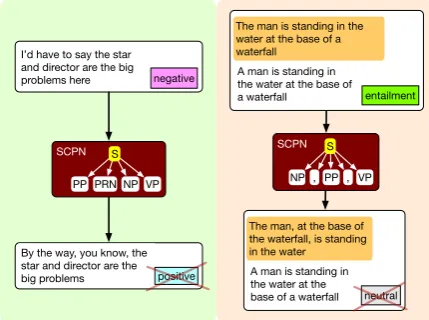
I’d have to say the star and director are the big
problems here negative
The man is standing in the water at the base of a waterfall
entailment A man is standing in the water at the base of a waterfall
By the way, you know, the star and director are the
big problems positive
The man, at the base of the waterfall, is standing in the water A man is standing in the water at the
base of a waterfall neutral S
PP PRN NP VP
SCPN S
NP , PP , VP
[image:1.595.310.525.226.386.2]SCPN
Figure 1: Adversarial examples for sentiment analysis (left) and textual entailment (right) generated by our
syntactically controlled paraphrase network (SCPN)
ac-cording to provided parse templates. In both cases, a pretrained classifier correctly predicts the label of the original sentence but not the corresponding paraphrase.
Liang et al.,2017). However, more complex trans-formations, such as generating syntactically ad-versarial examples, remain an open challenge, as input semantics must be preserved in the face of potentially substantial structural modifications. In this paper, we introduce a new approach for learn-ing to dosyntactically controlled paraphrase gen-eration: given a sentence and a target syntactic form (e.g., a constituency parse), a system must produce a paraphrase of the sentence whose syn-tax conforms to the target.
General purpose syntactically controlled para-phrase generation is a challenging task. Ap-proaches that rely on handcrafted rules and gram-mars, such as the question generation system ofMcKeown(1983), support only a limited num-ber of syntactic targets. We introduce the first learning approach for this problem, building on the generality of neural encoder-decoder models to support a wide range of transformations. In doing
so, we face two new challenges: (1) obtaining a large amount of paraphrase pairs for training, and (2) defining syntactic transformations with which to label these pairs.
Since no large-scale dataset of sentential para-phrases exists publicly, we follow Wieting et al.
(2017) and automatically generate millions of paraphrase pairs using neural backtranslation. Backtranslation naturally injects linguistic varia-tion between the original sentence and its back-translated counterpart. By running the process at a very large scale and testing for the specific vari-ations we want to produce, we can gather ample input-output pairs for a wide range of phenomena. Our focus is on syntactic transformations, which we define using templates derived from linearized constituency parses (§2). Given such parallel data, we can easily train an encoder-decoder model that takes a sentence and target syntactic template as input, and produces the desired paraphrase.1
A combination of automated and human evalu-ations show that the generated paraphrases almost always follow their target specifications, while paraphrase quality does not significantly deteri-orate compared to vanilla neural backtranslation (§4). Our model, the syntactically controlled para-phrase network (SCPN), is capable of generating
adversarial examples for sentiment analysis and textual entailment datasets that significantly im-pact the performance of pretrained models (Fig-ure 1). We also show that augmenting train-ing sets with such examples improves robustness without harming accuracy on the original test sets (§5). Together these results not only establish the first general purpose syntactically controlled para-phrase approach, but also suggest that this general paradigm could be used for controlling many other aspects of the target text.
2 Collecting labeled paraphrase pairs In this section, we describe a general purpose pro-cess for gathering and labeling training data for controlled paraphrase generation.
2.1 Paraphrase data via backtranslation
Inducing paraphrases from bilingual data has long been an effective method to overcome data lim-itations. In particular, bilingual pivoting ( Ban-nard and Callison-Burch,2005) finds quality
para-1Code, labeled data, and pretrained models available at
https://github.com/miyyer/scpn.
phrases by pivoting through a different language.
Mallinson et al.(2017) show that neural machine translation (NMT) systems outperform phrase-based MT on several paraphrase evaluation met-rics.
In this paper, we use the PARANMT-50M
cor-pus from Wieting and Gimpel (2017). This cor-pus consists of over 50 million paraphrases ob-tained by backtranslating the Czech side of the CzEng (Bojar et al., 2016) parallel corpus. The pretrained Czech-English model used for transla-tion came from the Nematus NMT system ( Sen-nrich et al.,2017). The training data of this system includes four sources: Common Crawl, CzEng 1.6, Europarl, and News Commentary. The CzEng corpus is the largest of these four and was found to have significantly more syntactic diversity than the other data sources (Wieting and Gimpel,2017).2
2.2 Automatically labeling paraphrases with syntactic transformations
We need labeled transformations in addition to paraphrase pairs to train a controlled paraphrase model. Manually annotating each of the millions of paraphrase pairs is clearly infeasible. Our key insight is that target transformations can be de-tected (with some noise) simply by parsing these pairs.3
Specifically, we parse the backtranslated para-phrases using the Stanford parser (Manning et al.,
2014),4which yields a pair of constituency parses hp1, p2ifor each sentence pairhs1, s2i, wheres1is
the reference English sentence in the CzEng cor-pus and s2 is its backtranslated counterpart. For
syntactically controlled paraphrasing, we assume
s1 and p2 are inputs, and the model is trained
to produce s2. To overcome learned biases of
the NMT system, we also include reversed pairs hs2, s1iduring training.
2.2.1 Syntactic templates
To provide syntactic control, we lin-earize the bracketed parse structure with-out leaf nodes (i.e., tokens). For exam-ple, the corresponding linearized parse 2Syntactic diversity was measured by the entropy of the top two levels of parse trees in the corpora.
3Similar automated filtering could be used to produce data for many other transformations, such as tense changes, point-of-view shifts, and even stylometric pattern differences (Feng et al.,2012). This is an interesting area for future work.
tree for the sentence “She drove home.” is
(S(NP(PRP))(VP(VBD)(NP(NN)))(.)).
A system that requires a complete linearized target parse at test-time is unwieldy; how do we go about choosing the target parse? To simplify test-time usage, we relax the target syntactic form to a parse template, which we define as the top two levels of the linearized parse tree (the level immediately below the root along with the root); the prior example’s template is S→NP VP. In the next section, we design models such that users can feed in either parse templates or full parses depending on their desired level of control.
3 Syntactically Controlled Paraphrase Networks
The SCPN encoder-decoder architecture is built
from standard neural modules, as we describe in this section.
3.1 Neural controlled paraphrase generation
Given a sentential paraphrase pair hs1, s2i and a
corresponding target syntax tree p2 for s2, we
encode s1 using a bidirectional LSTM ( Hochre-iter and Schmidhuber, 1997), and our decoder is a two-layer LSTM augmented with soft attention over the encoded states (Bahdanau et al., 2014) as well as a copy mechanism (See et al., 2017). Following existing work in NMT (Sennrich et al.,
2015), we preprocesss1ands2into subword units
using byte pair encoding, and we perform decod-ing usdecod-ing beam search. For all attention compu-tations, we use a bilinear product with a learned parameter matrixW: given vectorsu andv, we
score them byuTWv.
We incorporate the target syntaxp2into the
gen-eration process by modifying the inputs to the de-coder. In particular, a standard decoder LSTM re-ceives two inputs at every time step: (1) the em-beddingwt−1 of the ground-truth previous word
ins2, and (2) an attention-weighted averageatof
the encoder’s hidden states. We additionally pro-vide a representationztof the targetp2, so at every
time step the decoder computes
ht=LSTM([wt−1;at;zt]). (1)
Since we preserve bracketed parse structure, our linearized parses can have hundreds of tokens. Forcing all of the relevant information contained by the parse tree into a single fixed representation (i.e., the last hidden state of an LSTM) is difficult
with such large sequences. Intuitively, we want the decoder to focus on portions of the target parse tree that correspond with the current time step. As such, we encodep2using a (unidirectional) LSTM
and compute zt with an attention-weighted
aver-age of the LSTM’s encoded states at every time step. This attention mechanism is conditioned on the decoder’s previous hidden stateht−1.
3.2 From parse templates to full parses
As mentioned in Section2.2.1, user-friendly sys-tems should be able to accept high-level parse tem-plates as input rather than full parses. Preliminary experiments show thatSCPNstruggles to maintain
the semantics of the input sentence when we re-place the full target parse with templates, and fre-quently generates short, formulaic sentences. The paraphrase generation model seems to rely heav-ily on the full syntactic parse to determine out-put length and clausal ordering, making it diffi-cult to see how to modify the SCPN architecture
for template-only target specification.
Instead, we train another model with exactly the same architecture as SCPN to generate complete
parses from parse templates. This allows us to do the prediction in two steps: first predict the full syntactic tree and then use that tree to produce the paraphrase. Concretely, for the first step, assume
t2 is the parse template formed from the top two
levels of the target parsep2. The input to thisparse generator is the input parse p1 and t2, and it is
trained to producep2. We train the parse generator
separately fromSCPN (i.e., no joint optimization)
for efficiency purposes. At test time, a user only has to specify an input sentence and target tem-plate; the template is fed through the parse gener-ator, and its predicted target parse is in turn sent to
SCPNfor paraphrase generation (see Figure2).
3.3 Template selection and post-processing
NMT-The man is standing in the water … +
The man , at the base … The man , at the base of …
( ROOT ( S ( NP ( DT ) ( NN ) ) ( VP ( VBZ ) ( VP ( VBG ) ( PP ( IN ) ( NP ( NP ( DT ) ( NN ) …
+
( ROOT ( S ( NP (NP ( DT ) ( NN ) ) ( , ) ( PP ( IN ) ( NP ( NP ( DT ) ( NN ) ) ( PP ( IN ) …
+
( ROOT ( S ( …
( ROOT ( S ( NP ) ( , ) ( PP ) ( , ) ( VP ) ) )
+
parse generator
paraphrase generator
target template t2
input parse p1
input sentence s1
target sentence s2
[image:4.595.95.506.63.279.2]target parse p2
Figure 2: SCPNimplements parse generation from templates as well as paraphrase generation from full parses as
encoder-decoder architectures (attention depicted with dotted lines, copy mechanism with double stroked lines). While both components are trained separately, at test-time they form a pipelined approach to produce a controlled
paraphrase from an input sentences1, its corresponding parsep1, and a target templatet2.
50M.5
Since we cannot generate a valid paraphrase for every template, we postprocess to remove non-sensical outputs. In particular, we filter gener-ated paraphrases using n-gram overlap and para-phrastic similarity, the latter of which is com-puted using the pretrained WORD,TRIAVG
sen-tence embedding model from Wieting and Gim-pel(2017).6 These paraphrastic sentence embed-dings significantly outperform prior work due to the PARANMT-50M data.
4 Intrinsic Experiments
Before using SCPN to generate adversarial
exam-ples on downstream datasets, we need to make sure that its output paraphrases are valid and gram-matical and that its outputs follow the specified target syntax. In this section, we compareSCPNto
a neural backtranslation baseline (NMT-BT) on the
development set of our PARANMT-50M split
us-ing both human and automated experiments.NMT -BT is the same pretrained Czech-English model
used to create PARANMT-50M; however, here we
use it to generate in both directions (i.e., English-Czech and English-Czech-English).
5However, we do provide some qualitative examples of rare and medium-frequency templates in Table3.
6After qualitatively analyzing the impact of different fil-tering choices, we set minimum n-gram overlap to 0.5 and
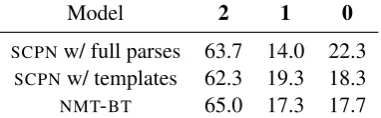
Model 2 1 0
SCPNw/ full parses 63.7 14.0 22.3 SCPNw/ templates 62.3 19.3 18.3 NMT-BT 65.0 17.3 17.7
Table 1: A crowdsourced paraphrase evaluation on a
three-point scale (0= no paraphrase, 1=
ungrammat-ical paraphrase, 2 = grammatical paraphrase) shows
both thatNMT-BTandSCPNproduce mostly
grammat-ical paraphrases. Feeding parse templates toSCPN
in-stead of full parses does not impact its quality.
4.1 Paraphrase quality & grammaticality
To measure paraphrase quality and grammatical-ity, we perform a crowdsourced experiment in which workers are asked to rate a paraphrase pair hs, gion the three-point scale ofKok and Brock-ett(2010), wheresis the source sentence andgis
the generated sentence. A0on this scale indicates no paraphrase relationship, while 1means that g
is an ungrammatical paraphrase ofsand2means
thatgis a grammatical paraphrase ofs. We select 100 paraphrase pairs from the development set of our PARANMT-50M split (after the
postprocess-ing steps detailed in Section 3.3) and have three workers rate each pair.7To focus the evaluation on the effect of syntactic manipulation on quality, we
minimum paraphrastic similarity to 0.7.
[image:4.595.322.513.364.423.2]only select sentences whose top-level parse tem-plates differ (i.e.,ts 6= tg), ensuring that the
out-put of both systems varies syntactically from the source sentences.
The results (Table1) show that the uncontrolled
NMT-BTmodel’s outputs are comparable in
qual-ity and grammaticalqual-ity to those of SCPN; neither
system has a significant edge. More interestingly, we observe no quality drop when feeding tem-plates to SCPN (via the parse generator as
de-scribed in Section3.2) instead of complete parse trees, which suggests that the parse generator is doing a good job of generating plausible parse trees; thus, for all of the adversarial evaluations that follow, we only use the templated variant of
SCPN.
4.2 Do the paraphrases follow the target specification?
We next determine how often SCPN’s generated
paraphrases conform to the target syntax: ifg is
a generated paraphrase andpgis its parse, how
of-ten doespgmatch the ground-truth target parsep2?
We evaluate on our development set using exact template match:gis deemed a syntactic match to s2only if the top two levels of its parsepgmatches
those ofp2. We evaluate twoSCPNconfigurations,
where one is given the full target parse p2 and
the other is given the result of running our parse generator on the target template t2. As a sanity
check, we also evaluate our parse generator using the same metric.
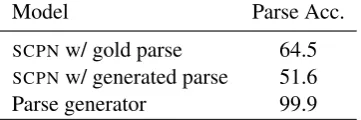
The results (Table 2) show that SCPN does
in-deed achieve syntactic control over the majority of its inputs. Our parse generator produces full parses that almost always match the target tem-plate; however, paraphrases generated using these parses are less syntactically accurate.8 A quali-tative inspection of the generated parses reveals that they can differ from the ground-truth target parse in terms of ordering or existence of lower-level constituents (Table6); we theorize that these differences may throw offSCPN’s decoder.
The NMT-BTsystem produces paraphrases that
tend to be syntactically very similar to the input sentences: 28.7% of these paraphrases have the same template as that of the input sentence s1,
while only 11.1% have the same template as the ground-truth targets2. Even though we trainSCPN
8With that said, exact match is a harsh metric; these para-phrases are more accurate than the table suggests, as often they differ by only a single constituent.
Model Parse Acc.
SCPNw/ gold parse 64.5 SCPNw/ generated parse 51.6
Parse generator 99.9
Table 2: The majority of paraphrases generated by
SCPNconform to the target syntax, but the level of
syn-tactic control decreases when using generated target parses instead of gold parses. Accuracy is measured by exact template match (i.e., how often do the top two levels of the parses match).
on data generated by NMT backtranslation, we avoid this issue by incorporating syntax into our learning process.
5 Adversarial example generation
The intrinsic evaluations show thatSCPNproduces
paraphrases of comparable quality to the uncon-trolledNMT-BTsystem while also adhering to the
specified target specifications. Next, we examine the utility of controlled paraphrases for adversar-ial example generation. To formalize the prob-lem, assume a pretrained model for some down-stream task produces predictionyxgiven test-time
instance x. An adversarial example x0 can be
formed by making label-preserving modifications toxsuch thatyx 6=yx0. Our results demonstrate
that controlled paraphrase generation with appro-priate template selection produces far more valid adversarial examples than backtranslation on sen-timent analysis and entailment tasks.
5.1 Experimental setup
We evaluate our syntactically adversarial paraphrases on the Stanford Sentiment Tree-bank (Socher et al., 2013, SST) and SICK entailment detection (Marelli et al.,2014). While both are relatively small datasets, we select them because they offer different experimental conditions: SST contains complicated sentences with high syntactic variance, while SICK almost exclusively consists of short, simple sentences. As a baseline, we compare the ten most probable beams from NMT-BT to controlled paraphrases
generated bySCPN using ten templates randomly
sampled from the template set described in Section 3.3.9 We also need pretrained models 9We also experimented with the diverse beam search modification proposed byLi et al.(2016b) forNMT-BTbut
[image:5.595.327.508.63.123.2]template paraphrase
original with the help of captain picard , the borg will be prepared for everything . (SBARQ(ADVP)(,)(S)(,)(SQ)) now , the borg will be prepared by picard , will it ?
(S(NP)(ADVP)(VP)) the borg here will be prepared for everything .
(S(S)(,)(CC)(S) (:)(FRAG)) with the help of captain picard , the borg will be prepared , and the borg will be prepared for everything ... for everything .
(FRAG(INTJ)(,)(S)(,)(NP)) oh , come on captain picard , the borg line for everything . original you seem to be an excellent burglar when the time comes . (S(SBAR)(,)(NP)(VP)) when the time comes , you ’ll be a great thief .
(S(‘‘)(UCP)(’’)(NP)(VP)) “ you seem to be a great burglar , when the time comes . ” you said . (SQ(MD)(SBARQ)) can i get a good burglar when the time comes ?
(S(NP)(IN)(NP)(NP)(VP) look at the time the thief comes .
Table 3: Syntactically controlled paraphrases generated by SCPN for two examples from the PARANMT-50M
development set. For each input sentence, we show the outputs of four different templates; the fourth template is a failure case (highlighted in green) exhibiting semantic divergence and/or ungrammaticality, which occurs when the target template is unsuited for the input.
for which to generate adversarial examples; we use the bidirectional LSTM baseline for both SST and SICK outlined inTai et al.(2015) since it is a relatively simple architecture that has proven to work well for a variety of problems.10 Since the SICK task involves characterizing the relationship between two sentences, for simplicity we only generate adversarial examples for the first sentence and keep the second sentence fixed to the ground truth.
5.2 Breaking pretrained models
For each dataset, we generate paraphrases for held-out examples and then run a pretrained model over them.11 We consider a development exam-ple x broken if the original prediction yx is
cor-rect, but the prediction yx0 for at least one
para-phrasex0is incorrect. For SST, we evaluate on the
binary sentiment classification task and ignore all phrase-level labels (because our paraphrase mod-els are trained on only sentences). Table4shows that for both datasets,SCPNbreaks many more
ex-amples than NMT-BT. Moreover, as shown in
Ta-ble5,NMT-BT’s paraphrases differ from the
origi-nal example mainly by lexical substitutions, while
SCPN often produces dramatically different
syn-tactic structures.
5.3 Are the adversarial examples valid?
We have shown that we can break pretrained mod-els with controlled paraphrases, but are these
para-on the three-point scale.
10We initialize both models using pretrained GloVe em-beddings (Pennington et al.,2014) and set the LSTM hidden dimensionality to 300.
11Since the SICK development dataset is tiny, we addition-ally generate adversarial examples on its test set.
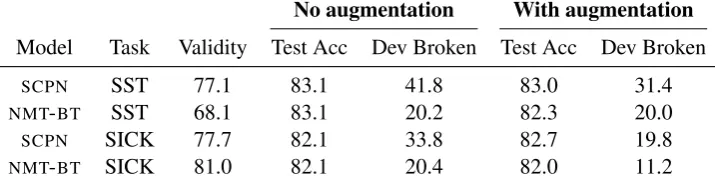
phrases actually valid adversarial examples? After all, it is possible that the syntactic modifications cause informative clauses or words (e.g., nega-tions) to go missing. To measure the validity of our adversarial examples, we turn again to crowd-sourced experiments. We ask workers to choose the appropriate label for a given sentence or sen-tence pair (e.g., positive or negative for SST), and then we compare the worker’s judgment to the original development example’s label. For both models, we randomly select 100 adversarial ex-amples and have three workers annotate each one. The results (Table4) show that on the more com-plex SST data, a higher percentage ofSCPN’s
para-phrases are valid adversarial examples than those ofNMT-BT, which is especially encouraging given
our model also generates significantlymore adver-sarial examples.
5.4 Increasing robustness to adversarial examples
If we additionally augment the training data of both tasks with controlled paraphrases, we can increase a downstream model’s robustness to ad-versarial examples in the development set. To quantify this effect, we generate controlled para-phrases for the training sets of SST and SICK us-ing the same templates as in the previous exper-iments. Then, we include these paraphrases as additional training examples and retrain our biL-STM task models.12 As shown by Table4, train-ing onSCPN’s paraphrases significantly improves
No augmentation With augmentation
Model Task Validity Test Acc Dev Broken Test Acc Dev Broken
SCPN SST 77.1 83.1 41.8 83.0 31.4
NMT-BT SST 68.1 83.1 20.2 82.3 20.0
SCPN SICK 77.7 82.1 33.8 82.7 19.8
[image:7.595.120.478.64.155.2]NMT-BT SICK 81.0 82.1 20.4 82.0 11.2
Table 4: SCPN generates more legitimate adversarial examples thanNMT-BT, shown by the results of a
crowd-sourced validity experiment and the percentage of held-out examples that are broken through paraphrasing. Fur-thermore, we show that by augmenting the training dataset with syntactically-diverse paraphrases, we can improve the robustness of downstream models to syntactic adversaries (see “Dev Broken” before and after augmentation) without harming accuracy on the original test set.
portant caveat is that this experiment only shows robustness to the set of templates used by SCPN;
in real-world applications, careful template selec-tion based on the downstream task, along with using a larger set of templates, is likely to in-crease robustness to less constrained syntactic ad-versaries. Augmentation with NMT-BT’s
para-phrases increases robustness on SICK, but on SST, it degrades test accuracy without any significant gain in robustness; this is likely due to its lack of syntactic variation compared toSCPN.
6 Qualitative Analysis
In the previous section, we quantitatively eval-uated the SCPN’s ability to produce valid
para-phrases and adversarial examples. Here, we take a look at actual sentences generated by the model. In addition to analyzing SCPN’s strengths and
weaknesses compared toNMT-BT, we examine the
differences between paraphrases generated by var-ious configurations of the model to determine the impact of each major design decision (e.g., tem-plates instead of full parses).
Syntactic manipulation: Table3 demonstrates
SCPN’s ability to perform syntactic manipulation,
showing paraphrases for two sentences generated using different templates. Many of the examples exhibit complex transformations while preserving both the input semantics and grammaticality, even when the target syntax is very different from that of the source (e.g., when converting a declarative to question). However, the failure cases demon-strate that not every template results in a valid paraphrase, as nonsensical outputs are sometimes generated when trying to squeeze the input seman-tics into an unsuitable target form.
Adversarial examples: Table 5 shows that
SCPN and NMT-BT differ fundamentally in the
type of adversaries they generate. While SCPN
mostly avoids lexical substitution in favor of mak-ing syntactic changes,NMT-BTdoes the opposite.
These examples reinforce the results of the exper-iment in Section 4.2, which demonstrates NMT -BT’s tendency to stick to the input syntax. While SCPN is able to break more validation examples
thanNMT-BT, it is alarming that even simple
lex-ical substitution can break such a high percentage of both datasets we tested.
Ebrahimi et al. (2017) observe a similar phe-nomenon with HotFlip, their gradient-based sub-stitution method for generating adversarial exam-ples. WhileNMT-BTdoes not receive signal from
the downstream task like HotFlip, it also does not require external constraints to maintain grammat-icality and limit semantic divergence. As future work, it would be interesting to provide this down-stream signal to both NMT-BT andSCPN; for the
latter, perhaps this signal could guide the template selection process, which is currently fixed to a small, finite set.
Templates vs. gold parses: Why does the level of syntactic control decrease when we feedSCPN
parses generated from templates instead of gold parses (Table 2)? The first two examples in Ta-ble 6 demonstrate issues with the templated ap-proach. In the first example, the template is not ex-pressive enough for the parse generator to produce slots for the highlighted clause. A potential way to combat this type of issue is to dynamically define templates based on factors such as the length of the input sentence. In the second example, a pars-ing error results in an inaccurate template which in turn causes SCPN to generate a
template original paraphrase (S(ADVP)(NP)(VP)) moody , heartbreaking , and filmed in
a natural , unforced style that makes its characters seem entirely convincing even when its script is not .
so he ’s filmed in a natural , unforced style that makes his characters seem convincing when his script is not .
(S(PP)(,)(NP)(VP)) there is no pleasure in watching a child
suffer . in watching the child suffer , there is nopleasure . (S(S)(,)(CC)(S)) the characters are interesting and often
very creatively constructed from figure to backstory .
the characters are interesting , and they are often built from memory to back-story .
every nanosecond of the the new guy reminds you that you could be doing something else far more pleasurable .
each nanosecond from the new guy re-minds you that you could do something else much more enjoyable .
harris commands the screen , using his frailty to suggest the ravages of a life of corruption and ruthlessness .
[image:8.595.83.513.62.234.2]harris commands the screen , using his weakness to suggest the ravages of life of corruption and recklessness .
Table 5: Adversarial sentiment examples generated bySCPN(top) andNMT-BT(bottom). The predictions of a
pretrained model on the original sentences are correct (red is negative, blue is positive), while the predictions on
the paraphrases are incorrect. The syntactically controlled paraphrases ofSCPNfeature more syntactic modification
and less lexical substitution thanNMT-BT’s backtranslated outputs.
show instances where the templated model per-forms equally as well as the model with gold parses, displaying the capabilities of our parse generator.
Removing syntactic control: To examine the differences between syntactically controlled and uncontrolled paraphrase generation systems, we train anSCPNwithout includingzt, the
attention-weighted average of the encoded parse, in the de-coder input. This uncontrolled configuration pro-duces outputs that are very similar to its inputs, of-ten identical syntactically with minor lexical sub-stitution. Concretely, the uncontrolledSCPN
pro-duces a paraphrase with the same template as its input 38.6% of the time, compared to NMT-BT’s
28.7% (Section4.2).13
7 Related Work
Paraphrase generation (Androutsopoulos and Malakasiotis, 2010; Madnani and Dorr, 2010) has been tackled using many different meth-ods, including those based on hand-crafted rules (McKeown, 1983), synonym substitu-tion (Bolshakov and Gelbukh, 2004), machine translation (Quirk et al.,2004), and, most recently, deep learning (Prakash et al., 2016; Mallinson et al., 2017; Dong et al., 2017). Our syntacti-cally controlled setting also relates to controlled language generation tasks in which one desires to generate or rewrite a sentence with particular characteristics. We review related work in both 13A configuration without the copy mechanism copies in-put syntax even more, with a 47.7% exact template match.
paraphrase generation and controlled language generation below.
7.1 Data-driven paraphrase generation Madnani and Dorr (2010) review data-driven methods for paraphrase generation, noting two primary families: template-based and translation-based. The first family includes approaches that use hand-crafted rules (McKeown, 1983), thesaurus-based substitution (Bolshakov and Gel-bukh, 2004; Zhang and LeCun, 2015), lattice matching (Barzilay and Lee,2003), and template-based “shake & bake” paraphrasing (Carl et al.,
2005). These methods often yield grammatical outputs but they can be limited in diversity.
The second family includes methods that rewrite the input using methods based on parallel text (Bannard and Callison-Burch,2005), machine translation (Quirk et al., 2004; Napoles et al.,
2016; Suzuki et al., 2017), or related statistical techniques (Zhao et al.,2009). Of particular rel-evance to our work are methods that incorporate syntax to improve fluency of paraphrase output.
Callison-Burch (2008) constrains paraphrases to be the same syntactic type as the input, though he was focused on phrase-level, not sentential, para-phrasing. Pang et al.(2003) learn finite-state au-tomata from translation pairs that generate syn-tactic paraphrases, though this requires multiple translations into the same language and cannot be used to generate paraphrases outside this dataset.
template (S(CC)(S)(,)(NP)(ADVP)(VP))
original damian encouraged me , criticized , he ... he always made me go a little deeper . SCPNparse but damian , he supported me , he told me , he always made me go a little deeper . SCPNtemplate but damian supported me , he always made me go a little deeper .
template (S(S)(,)(NP)(VP))
original zacharias did n’t deserve to die , grishanov thought , and he was aware of the huge irony of his situation SCPNparse zacharias did not deserve to die , grishanov told himself , realizing the greatest irony of all .
SCPNtemplate zacharias did not deserve to die , he was aware of the great irony of his situation .
template S(S)(,)(S))
original give me some water , my lips are dry , and i shall try to tell you . SCPNparse give me some water , i have just a dry mouth .
SCPNtemplate give me some water , my lips are dry .
template (S(NP)(,)(ADVP)(,)(VP))
original in the meantime , the house is weakened , and all its old alliances and deals are thrown into doubt . SCPNparse the house , meanwhile , is weakening , which will be all of its old alliances and business . SCPNtemplate the house , meanwhile , is weakened , and its old alliances and deals are thrown into doubt .
Table 6: Examples from PARANMT-50M comparing the output of twoSCPNconfigurations, one with gold target
parses (SCPNparse) and one with parses generated from templates (SCPNtemplate), where templates are the top
two levels of the gold parses. The first two examples demonstrate issues with missing information caused by inexpressive templates and parsing errors, respectively. The remaining examples, in which both configurations produce syntactically similar paraphrases, showcase the ability of the parse generator to produce viable full parses.
improve grammaticality, which is handled by our decoder language model.
Recent efforts involve neural methods. Iyyer et al. (2014) generate paraphrases with depen-dency tree recursive autoencoders by randomly se-lecting parse trees at test time.Li et al.(2017) gen-erate paraphrases using deep reinforcement learn-ing. Gupta et al. (2017) use variational autoen-coders to generate multiple paraphrases. These methods differ from our approach in that none of-fer fine-grained control over the syntactic form of the paraphrase.
7.2 Controlled language generation
There is growing interest in generating language with the ability to influence the topic, style, or other properties of the output.
Most related to our methods are those based on syntactic transformations, like the tree-to-tree sentence simplification method ofWoodsend and Lapata(2011) based on quasi-synchronous gram-mar (Smith and Eisner, 2006). Our method is more general since we do not require a gram-mar and there are only soft constraints. Perhaps the closest to the proposed method is the con-ditioned recurrent language model of Ficler and Goldberg (2017), which produces language with user-selected properties such as sentence length and formality but is incapable of generating para-phrases.
For machine translation output,Niu et al.(2017)
control the level of formality whileSennrich et al.
(2016) control the level of politeness. For dia-logue, Li et al. (2016a) affect the output using speaker identity, whileWang et al.(2017) develop models to influence topic and style of the out-put. Shen et al. (2017) perform style transfer on non-parallel texts, whileGuu et al.(2017) gener-ate novel sentences from prototypes; again, these methods are not necessarily seeking to gener-ate meaning-preserving paraphrases, merely trans-formed sentences that have an altered style.
8 Conclusion
We propose SCPN, an encoder-decoder model
for syntactically controlled paraphrase generation, and show that it is an effective way of generat-ing adversarial examples. Usgenerat-ing a parser, we la-bel syntactic variation in large backtranslated data, which provides training data forSCPN. The model
exhibits far less lexical variation than existing un-controlled paraphrase generation systems, instead preferring purely syntactic modifications. It is ca-pable of generating adversarial examples that fool pretrained NLP models. Furthermore, by training on such examples, we increase the robustness of these models to syntactic variation.
Acknowledgments
References
Ion Androutsopoulos and Prodromos Malakasiotis. 2010. A survey of paraphrasing and textual
entail-ment methods. Journal of Artificial Intelligence
Re-search38.
Dzmitry Bahdanau, Kyunghyun Cho, and Yoshua Ben-gio. 2014. Neural machine translation by jointly
learning to align and translate. InInternational
Con-ference on Learning Representations.
Colin Bannard and Chris Callison-Burch. 2005.
Para-phrasing with bilingual parallel corpora. In
Pro-ceedings of the Association for Computational Lin-guistics.
Regina Barzilay and Lillian Lee. 2003. Learning
to paraphrase: an unsupervised approach using
multiple-sequence alignment. In Conference of
the North American Chapter of the Association for Computational Linguistics.
Ondˇrej Bojar, Ondˇrej Duˇsek, Tom Kocmi, Jindˇrich Li-bovick´y, Michal Nov´ak, Martin Popel, Roman Su-darikov, and Duˇsan Variˇs. 2016. CzEng 1.6: En-larged Czech-English Parallel Corpus with
Process-ing Tools Dockered. InText, Speech, and Dialogue:
19th International Conference, TSD 2016.
Igor Bolshakov and Alexander Gelbukh. 2004. Syn-onymous paraphrasing using WordNet and Internet.
Natural Language Processing and Information Sys-tems.
Chris Callison-Burch. 2008. Syntactic constraints on
paraphrases extracted from parallel corpora. In
Pro-ceedings of Empirical Methods in Natural Language Processing.
Michel Carl, Paul Schmidt, and J¨org Sch¨utz. 2005. Re-versible template-based shake & bake generation. In
MT Summit X.
Li Dong, Jonathan Mallinson, Siva Reddy, and Mirella Lapata. 2017. Learning to paraphrase for question
answering. InProceedings of Empirical Methods in
Natural Language Processing.
Javid Ebrahimi, Anyi Rao, Daniel Lowd, and Dejing Dou. 2017. Hotflip: White-box adversarial
exam-ples for nlp. arXiv preprint arXiv:1712.06751.
Allyson Ettinger, Sudha Rao, Hal Daum´e III, and Emily M Bender. 2017. Towards linguistically gen-eralizable nlp systems: A workshop and shared task. In Proceedings of the First Workshop on Building Linguistically Generalizable NLP Systems.
Song Feng, Ritwik Banerjee, and Yejin Choi. 2012. Characterizing stylistic elements in syntactic
struc-ture. InProceedings of Empirical Methods in
Natu-ral Language Processing.
Jessica Ficler and Yoav Goldberg. 2017. Controlling linguistic style aspects in neural language
genera-tion. arXiv preprint arXiv:1707.02633.
Ian J Goodfellow, Jonathon Shlens, and Christian Szegedy. 2015. Explaining and harnessing
adver-sarial examples. InProceedings of the International
Conference on Learning Representations.
Ankush Gupta, Arvind Agarwal, Prawaan Singh, and
Piyush Rai. 2017. A deep generative
frame-work for paraphrase generation. arXiv preprint
arXiv:1709.05074.
Kelvin Guu, Tatsunori B Hashimoto, Yonatan
Oren, and Percy Liang. 2017. Generating
sen-tences by editing prototypes. arXiv preprint
arXiv:1709.08878.
Sepp Hochreiter and J¨urgen Schmidhuber. 1997. Long
short-term memory.Neural computation.
Mohit Iyyer, Jordan Boyd-Graber, and Hal Daum´e III. 2014. Generating sentences from semantic vector
space representations. InNIPS Workshop on
Learn-ing Semantics.
Robin Jia and Percy Liang. 2017. Adversarial ex-amples for evaluating reading comprehension
sys-tems. InProceedings of Empirical Methods in
Nat-ural Language Processing.
Stanley Kok and Chris Brockett. 2010. Hitting the
right paraphrases in good time. In Conference of
the North American Chapter of the Association for Computational Linguistics.
Jiwei Li, Michel Galley, Chris Brockett, Georgios Sp-ithourakis, Jianfeng Gao, and Bill Dolan. 2016a. A
persona-based neural conversation model. In
Pro-ceedings of the Association for Computational Lin-guistics.
Jiwei Li, Will Monroe, and Dan Jurafsky. 2016b. A simple, fast diverse decoding algorithm for neural
generation.arXiv preprint arXiv:1611.08562.
Zichao Li, Xin Jiang, Lifeng Shang, and Hang Li. 2017. Paraphrase generation with deep
reinforce-ment learning. arXiv preprint arXiv:1711.00279.
Bin Liang, Hongcheng Li, Miaoqiang Su, Pan Bian,
Xirong Li, and Wenchang Shi. 2017. Deep
text classification can be fooled. arXiv preprint
arXiv:1704.08006.
Nitin Madnani and Bonnie J Dorr. 2010. Generating phrasal and sentential paraphrases: A survey of
data-driven methods.Computational Linguistics36(3).
Jonathan Mallinson, Rico Sennrich, and Mirella Lap-ata. 2017. Paraphrasing revisited with neural
ma-chine translation. InProceedings of the European
Chapter of the Association for Computational Lin-guistics.
Christopher D. Manning, Mihai Surdeanu, John Bauer, Jenny Finkel, Steven J. Bethard, and David Mc-Closky. 2014. The Stanford CoreNLP natural
lan-guage processing toolkit. In Association for
Marco Marelli, Luisa Bentivogli, Marco Baroni, Raf-faella Bernardi, Stefano Menini, and Roberto Zam-parelli. 2014. Semeval-2014 task 1: Evaluation of compositional distributional semantic models on full sentences through semantic relatedness and textual
entailment. SemEval 2014.
Kathleen R McKeown. 1983. Paraphrasing questions
using given and new information. Computational
Linguistics9(1).
Courtney Napoles, Chris Callison-Burch, and Matt Post. 2016. Sentential paraphrasing as black-box
machine translation. In Conference of the North
American Chapter of the Association for Computa-tional Linguistics: Demonstrations.
Xing Niu, Marianna Martindale, and Marine Carpuat. 2017. A study of style in machine translation: Con-trolling the formality of machine translation
out-put. In Proceedings of Empirical Methods in
Nat-ural Language Processing.
Bo Pang, Kevin Knight, and Daniel Marcu. 2003. Syntax-based alignment of multiple translations: Extracting paraphrases and generating new
sen-tences. InConference of the North American
Chap-ter of the Association for Computational Linguistics. Jeffrey Pennington, Richard Socher, and Christopher Manning. 2014. Glove: Global vectors for word
representation. InProceedings of Empirical
Meth-ods in Natural Language Processing.
Aaditya Prakash, Sadid A Hasan, Kathy Lee, Vivek Datla, Ashequl Qadir, Joey Liu, and Oladimeji Farri. 2016. Neural paraphrase generation with stacked
residual LSTM networks. InProceedings of
Inter-national Conference on Computational Linguistics. Chris Quirk, Chris Brockett, and William Dolan.
2004. Monolingual machine translation for
para-phrase generation. In Proceedings of Empirical
Methods in Natural Language Processing.
Abigail See, Peter J Liu, and Christopher D Manning. 2017. Get to the point: Summarization with
pointer-generator networks. InProceedings of the
Associa-tion for ComputaAssocia-tional Linguistics.
Rico Sennrich, Orhan Firat, Kyunghyun Cho, Alexan-dra Birch, Barry Haddow, Julian Hitschler, Marcin Junczys-Dowmunt, Samuel L¨aubli, Antonio Vale-rio Miceli Barone, Jozef Mokry, et al. 2017.
Nema-tus: a toolkit for neural machine translation. arXiv
preprint arXiv:1703.04357.
Rico Sennrich, Barry Haddow, and Alexandra Birch. 2015. Neural machine translation of rare words with
subword units. InProceedings of the Association for
Computational Linguistics.
Rico Sennrich, Barry Haddow, and Alexandra Birch.
2016. Controlling politeness in neural machine
translation via side constraints. In Conference of
the North American Chapter of the Association for Computational Linguistics.
Siwei Shen, Dragomir R Radev, Agam Patel, and G¨unes¸ Erkan. 2006. Adding syntax to dynamic pro-gramming for aligning comparable texts for the
gen-eration of paraphrases. InProceedings of
Interna-tional Conference on ComputaInterna-tional Linguistics. Tianxiao Shen, Tao Lei, Regina Barzilay, and Tommi
Jaakkola. 2017. Style transfer from non-parallel text
by cross-alignment. InProceedings of Advances in
Neural Information Processing Systems.
David A Smith and Jason Eisner. 2006.
Quasi-synchronous grammars: Alignment by soft
projec-tion of syntactic dependencies. In Proceedings of
the Workshop on Statistical Machine Translation.
Richard Socher, Alex Perelygin, Jean Y Wu, Jason Chuang, Christopher D Manning, Andrew Y Ng, and Christopher Potts. 2013. Recursive deep mod-els for semantic compositionality over a sentiment
treebank. In Proceedings of Empirical Methods in
Natural Language Processing.
Yui Suzuki, Tomoyuki Kajiwara, and Mamoru Ko-machi. 2017. Building a non-trivial paraphrase cor-pus using multiple machine translation systems. In
Proceedings of ACL Student Research Workshop.
Kai Sheng Tai, Richard Socher, and Christopher D Manning. 2015. Improved semantic representations from tree-structured long short-term memory
net-works. InProceedings of the Association for
Com-putational Linguistics.
Di Wang, Nebojsa Jojic, Chris Brockett, and Eric Ny-berg. 2017. Steering output style and topic in neural
response generation. In Proceedings of Empirical
Methods in Natural Language Processing.
John Wieting and Kevin Gimpel. 2017. Pushing the limits of paraphrastic sentence embeddings with
millions of machine translations. arXiv preprint
arXiv:1711.05732.
John Wieting, Jonathan Mallinson, and Kevin Gimpel. 2017. Learning paraphrastic sentence embeddings
from back-translated bitext. InProceedings of
Em-pirical Methods in Natural Language Processing. Kristian Woodsend and Mirella Lapata. 2011.
Learn-ing to simplify sentences with quasi-synchronous
grammar and integer programming. InProceedings
of Empirical Methods in Natural Language Process-ing.
Xiang Zhang and Yann LeCun. 2015. Text
understand-ing from scratch. arXiv preprint arXiv:1502.01710
.