SemEval-2010 Task 12: Parser Evaluation using Textual Entailments
Deniz Yuret
Koc¸ University ˙Istanbul, Turkey
Aydın Han
Koc¸ University ˙Istanbul, Turkey
Zehra Turgut
Koc¸ University ˙Istanbul, Turkey
Abstract
Parser Evaluation using Textual Entail-ments (PETE) is a shared task in the SemEval-2010 Evaluation Exercises on Semantic Evaluation. The task involves recognizing textual entailments based on syntactic information alone. PETE intro-duces a new parser evaluation scheme that is formalism independent, less prone to annotation error, and focused on semanti-cally relevant distinctions.
1 Introduction
Parser Evaluation using Textual Entailments (PETE) is a shared task that involves recognizing textual entailments based on syntactic information alone. Given two text fragments called “text” and “hypothesis”, textual entailment recognition is the task of determining whether the meaning of the hypothesis is entailed (can be inferred) from the text. In contrast with general RTE tasks (Dagan et al., 2009) the PETE task focuses on syntactic entailments:
Text:The man with the hat was tired. Hypothesis-1:The man was tired.(yes)
Hypothesis-2:The hat was tired.(no)
PETE is an evaluation scheme based on a natu-ral human linguistic competence (i.e. the ability to comprehend sentences and answer simple yes/no questions about them). We believe systems should try to model natural human linguistic competence rather than their dubious competence in artificial tagging tasks.
ThePARSEVALmeasures introduced nearly two
decades ago (Black et al., 1991) still dominate the field of parser evaluation. These methods com-pare phrase-structure bracketings produced by the parser with bracketings in the annotated corpus, or “treebank”. Parser evaluation using short textual
entailments has the following advantages com-pared to treebank based evaluation.
Consistency: Recognizing syntactic entail-ments is a more natural task for people than treebank annotation. Focusing on a natural human competence makes it practical to collect high quality evaluation data from untrained annotators. The PETE dataset was annotated by untrained Amazon Mechanical Turk workers at an insignificant cost and each annotation is based on the unanimous agreement of at least three workers. In contrast, of the 36306 constituent strings that appear multiple times in the Penn Treebank (Marcus et al., 1994), 5646 (15%) have multiple conflicting annotations. If indicative of the general level of inconsistency, 15% is a very high number given that the state of the art parsers claim f-scores above 90% (Charniak and Johnson, 2005).
Relevance: PETE automatically focuses atten-tion on semantically relevant phenomena rather than differences in annotation style or linguistic convention. Whether a phrase is tagged ADJP vs ADVP rarely affects semantic interpretation.
At-taching the wrong subject to a verb or the wrong prepositional phrase to a noun changes the mean-ing of the sentence. Standard treebank based eval-uation metrics do not distinguish between seman-tically relevant and irrelevant errors (Bonnema et al., 1997). In PETE semantically relevant differ-ences lead to different entailments, semantically irrelevant differences do not.
Framework independence: Entailment recog-nition is a formalism independent task. A com-mon evaluation method for parsers that do not use the Penn Treebank formalism is to automatically convert the Penn Treebank to the appropriate for-malism and to perform treebank based evaluation (Nivre et al., 2007a; Hockenmaier and Steedman,
2007). The inevitable conversion errors compound the already mentioned problems of treebank based evaluation. In addition, manually designed tree-banks do not naturally lend themselves to unsu-pervised parser evaluation. Unlike treebank based evaluation, PETE can compare phrase structure parsers, dependency parsers, unsupervised parsers and other approaches on an equal footing.
PETE was inspired by earlier work on represen-tations of grammatical dependency, proposed for ease of use by end users and suitable for parser evaluation. These include the grammatical rela-tions (GR) by (Carroll et al., 1999), the PARC rep-resentation (King et al., 2003), and Stanford typed dependencies (SD) (De Marneffe et al., 2006) (See (Bos and others, 2008) for other proposals). Each use a set of binary relations between words in a sentence as the primary unit of representation. They share some common motivations: usability by people who are not (computational) linguists and suitability for relation extraction applications. Here is an example sentence and its SD represen-tation (De Marneffe and Manning, 2008):
Bell, based in Los Angeles, makes and dis-tributes electronic, computer and building prod-ucts.
nsubj(makes-8, Bell-1) nsubj(distributes-10, Bell-1) partmod(Bell-1, based-3) nn(Angeles-6, Los-5) prep-in(based-3, Angeles-6) conj-and(makes-8, distributes-10) amod(products-16, electronic-11) conj-and(electronic-11, computer-13) amod(products-16, computer-13) conj-and(electronic-11, building-15) amod(products-16, building-15) dobj(makes-8, products-16)
PETE goes one step further by translating most of these dependencies into natural language entail-ments.
Bell makes something. Bell distributes something. Someone is based in Los Angeles. Someone makes products.
PETE has some advantages over representations based on grammatical relations. For example SD defines 55 relations organized in a hierarchy, and
it may be non-trivial for a non-linguist to under-stand the difference betweenccomp(clausal com-plement with internal subject) andxcomp(clausal complement with external subject) or between
nsubj (nominal subject) and xsubj (controlling subject). In fact it could be argued that proposals like SD replace one artificial annotation formal-ism with another and no two such proposals agree on the ideal set of binary relations to use. In con-trast, untrained annotators have no difficulty unan-imously agreeing on the validity of most PETE type entailments.
However there are also significant challenges associated with an evaluation scheme like PETE. It is not always clear how to convert certain rela-tions into grammatical hypothesis sentences with-out including most of the original sentence in the hypothesis. Including too much of the sentence in the hypothesis would increase the chances of get-ting the right answer with the wrong parse. Gram-matical hypothesis sentences are especially diffi-cult to construct when a (negative) entailment is based on a bad parse of the sentence. Introduc-ing dummy words like “someone” or “somethIntroduc-ing” alleviates part of the problem but does not help in the case of clausal complements. In summary, PETE makes the annotation phase more practical and consistent but shifts the difficulty to the entail-ment creation phase.
PETE gets closer to an extrinsic evaluation by focusing on semantically relevant, application ori-ented differences that can be expressed in natu-ral language sentences. This makes the evaluation procedure indirect: a parser developer has to write an extension that can handle entailment questions. However, given the simplicity of the entailments, the complexity of such an extension is comparable to one that extracts grammatical relations.
The balance of what is being evaluated is also important. A treebank based evaluation scheme may mix semantically relevant and irrelevant mis-takes, but at least it covers every sentence at a uni-form level of detail. In this evaluation, we focused on sentences and relations where state of the art parsers disagree. We hope this methodology will uncover weaknesses that the next generation sys-tems can focus on.
Sec-tion 3 evaluates the baseline systems the task or-ganizers created by implementing simple entail-ment extensions for several state of the art parsers. Section 4 presents the participating systems, their methods and results. Section 5 summarizes our contribution.
2 Dataset
To generate the entailments for the PETE task we followed the following three steps:
1. Identify syntactic dependencies that are chal-lenging to state of the art parsers.
2. Construct short entailment sentences that paraphrase those dependencies.
3. Identify the subset of the entailments with high inter-annotator agreement.
2.1 Identifying Challenging Dependencies To identify syntactic dependencies that are chal-lenging for current state of the art parsers, we used example sentences from the following sources:
• The “Unbounded Dependency Corpus” (Rimell et al., 2009). An unbounded de-pendency construction contains a word or phrase which appears to have been moved, while being interpreted in the position of the resulting “gap”. An unlimited number of clause boundaries may intervene between the moved element and the gap (hence “unbounded”).
• A list of sentences from the Penn Treebank on which the Charniak parser (Charniak and Johnson, 2005) performs poorly1.
• The Brown section of the Penn Treebank. We tested a number of parsers (both phrase structure and dependency) on these sentences and identified the differences in their output. We took sentences where at least one of the parsers gave a different answer than the others or the gold parse. Some of these differences reflected linguistic con-vention rather than semantic disagreement (e.g. representation of coordination) and some did not represent meaningful differences that can be ex-pressed with entailments (e.g. labeling a phrase
ADJP vs ADVP). The remaining differences
typ-ically reflected genuine semantic disagreements 1http://www.cs.brown.edu/˜ec/papers/badPars.txt.gz
that would effect downstream applications. These were chosen to turn into entailments in the next step.
2.2 Constructing Entailments
We tried to make the entailments as targeted as possible by building them around two content words that are syntactically related. When the two content words were not sufficient to construct a grammatical sentence we used one of the follow-ing techniques:
• Complete the mandatory elements using the words “somebody” or “something”. (e.g. To test the subject-verb dependency in “John kissed Mary.” we construct the entailment “John kissed somebody.”)
• Make a passive sentence to avoid using a spu-rious subject. (e.g. To test the verb-object dependency in “John kissed Mary.” we con-struct the entailment “Mary was kissed.”)
• Make a copular sentence or use existen-tial “there” to express noun modification. (e.g. To test the noun-modifier dependency in “The big red boat sank.” we construct the entailment “The boat was big.” or “There was a big boat.”)
2.3 Filtering Entailments
To identify the entailments that are clear to human judgement we used the following procedure:
1. Each entailment was tagged by 5 untrained annotators from the Amazon Mechanical Turk crowdsourcing service.
2. The results from the annotators whose agree-ment with the gold parse fell below 70% were eliminated.
3. The entailments for which there was unani-mous agreement of at least 3 annotators were kept.
The instructions for the annotators were brief and targeted people with no linguistic background:
read both of them carefully and choose “Yes” if the meaning of (H) can be inferred from the meaning of (T). Here is an example:
(T)Any lingering suspicion that this was a trick Al Budd had thought up was dispelled.
(H)The suspicion was dispelled.Answer: YES (H)The suspicion was a trick.Answer: NO You can choose the third option “Not sure” when the (H) statement is unrelated, unclear, ungram-matical or confusing in any other manner.
The “Not sure” answers were grouped with the “No” answers during evaluation. Approximately 50% of the original entailments were retained after the inter-annotator agreement filtering.
2.4 Dataset statistics
The final dataset contained 367 entailments which were randomly divided into a 66 sentence devel-opment test and a 301 sentence test set. 52% of the entailments in the test set were positive.
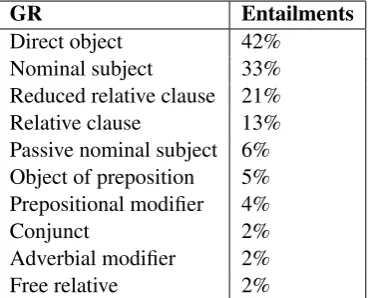
Approximately half of the final entailments were from the Unbounded Dependency Corpus, a third were from the Brown section of the Penn Treebank, and the remaining were from the Char-niak sentences. Table 1 lists the most frequent grammatical relations encountered in the entail-ments.
GR Entailments
Direct object 42% Nominal subject 33% Reduced relative clause 21% Relative clause 13% Passive nominal subject 6% Object of preposition 5% Prepositional modifier 4%
Conjunct 2%
[image:4.595.90.276.427.576.2]Adverbial modifier 2% Free relative 2%
Table 1: Most frequent grammatical relations en-countered in the entailments.
3 Baselines
In order to establish baseline results for this task, we built an entailment decision system for CoNLL format dependency files and tested several pub-licly available parsers. The parsers used were the Berkeley Parser (Petrov and Klein, 2007), Char-niak Parser (CharChar-niak and Johnson, 2005), Collins Parser (Collins, 2003), Malt Parser (Nivre et al., 2007b), MSTParser (McDonald et al., 2005) and
Stanford Parser (Klein and Manning, 2003). Each parser was trained on sections 02-21 of the WSJ section of Penn Treebank. Outputs of phrase structure parsers were automatically annotated with function tags using Blaheta’s function tag-ger (Blaheta and Charniak, 2000) and converted to the dependency structure with LTH Constituent-to-Dependency Conversion Tool (Johansson and Nugues, 2007).
To decide the entailments both the test and hypothesis sentences were parsed. All the con-tent words in the hypothesis sentence were de-termined by using part-of-speech tags and depen-dency relations. After applying some heuristics such as active-passive conversion, the extracted dependency path between the content words was searched in the dependency graph of the test sen-tence. In this search process, same relation types for the direct relations between the content word pairs and isomorphic subgraphs in the test and hy-pothesis sentences were required for the ”YES” answer.
Table 2 lists the baseline results achieved. There are significant differences in the entailment accu-racies of systems that have comparable unlabeled attachment scores. One potential reason for this difference is the composition of the PETE dataset which emphasizes challenging syntactic construc-tions that some parsers may be better at. Another reason is the complete indifference of treebank based measures like UAS to the semantic signif-icance of various dependencies and their impact on potential applications.
System PETE UAS
Berkeley Parser 68.1% 91.2 Stanford Parser 66.1% 90.2 Malt Parser 65.5% 89.8 Charniak Parser 64.5% 93.2 Collins Parser 63.5% 91.6 MST Parser 59.8% 92.0
Table 2: Baseline systems: The second column gives the performance on the PETE test set, the third column gives the unlabeled attachment score on section 23 of the Penn Treebank.
4 Systems
[image:4.595.339.497.521.621.2]sys-System Accuracy Precision Recall F1
360-418-Cambridge 0.7243 0.7967 0.6282 0.7025
459-505-SCHWA 0.7043 0.6831 0.8013 0.7375
473-568-MARS-3 0.6678 0.6591 0.7436 0.6988
372-404-MDParser 0.6545 0.7407 0.5128 0.6061
372-509-MaltParser 0.6512 0.7429 0.5000 0.5977
473-582-MARS-5 0.6346 0.6278 0.7244 0.6726
166-415-JU-CSE-TASK12-2 0.5781 0.5714 0.7436 0.6462
166-370-JU-CSE-TASK12 0.5482 0.5820 0.4551 0.5108
390-433-Berkeley Parser Based 0.5415 0.5425 0.7372 0.6250
473-566-MARS-1 0.5282 0.5547 0.4551 0.5108
473-569-MARS-4 0.5249 0.5419 0.5385 0.5402
390-431-Brown Parser Based 0.5216 0.5349 0.5897 0.5610
473-567-MARS-2 0.5116 0.5328 0.4679 0.4983
363-450-VENSES 0.5083 0.5220 0.6090 0.5621
473-583-MARS-6 0.5050 0.5207 0.5641 0.5415
390-432-Brown Reranker Parser Based 0.5017 0.5217 0.4615 0.4898 390-435-Berkeley Parser with substates 0.5017 0.5395 0.2628 0.3534 390-434-Berkeley Parser with Self Training 0.4983 0.5248 0.3397 0.4125
390-437-Combined 0.4850 0.5050 0.3269 0.3969
[image:5.595.122.479.60.275.2]390-436-Berkeley Parser with Viterbi Decoding 0.4784 0.4964 0.4359 0.4642
Table 3: Participating systems and their scores. The system identifier consists of the participant ID, system ID, and the system name given by the participant. Accuracy gives the percentage of correct entailments. Precision, Recall and F1 are calculated for positive entailments.
tems performed above the “always yes” baseline of 51.83%.
Most systems started the entailment decision process by extracting syntactic dependencies, grammatical relations, or predicates by parsing the text and hypothesis sentences. Several submis-sions, including the top two scoring systems used the C&C Parser (Clark and Curran, 2007) which is based on Combinatory Categorical Grammar (CCG) formalism. Others used dependency struc-tures produced by Malt Parser (Nivre et al., 2007b), MSTParser (McDonald et al., 2005) and Stanford Parser (Klein and Manning, 2003).
After the parsing step, the decision for the en-tailment was based on the comparison of relations, predicates, or dependency paths between the text and the hypothesis. Most systems relied on heuris-tic methods of comparison. A notable exception is the MARS-3 system which used an SVM-based classifier to decide on the entailment using depen-dency path features.
Table 4 lists the frequency of various grammati-cal relations in the instances where the top system made mistakes. A comparison with Table 1 shows the direct objects and reduced relative clauses to be the frequent causes of error.
5 Contributions
We introduced PETE, a new method for parser evaluation using textual entailments. By basing the entailments on dependencies that current state
GR Entailments
[image:5.595.325.510.338.422.2]Direct object 51% Reduced relative clause 36% Nominal subject 20% Object of preposition 7% Passive nominal subject 7%
Table 4: Frequency of grammatical relations in en-tailment instances that got wrong answers from the Cambridge system.
work is needed to automate the entailment gener-ation process and to balance the composition of syntactic phenomena covered in a PETE dataset. Acknowledgments
We would like to thank Laura Rimell, Stephan Oepen and Anna Mac for their careful analysis and valuable suggestions. ¨Onder Eker contributed to the early development of the PETE task.
References
E. Black, S. Abney, D. Flickenger, C. Gdaniec, R. Gr-ishman, P. Harrison, D. Hindle, R. Ingria, F. Jelinek, J. Klavans, et al. 1991. A Procedure for Quanti-tatively Comparing the Syntactic Coverage of
En-glish Grammars. InSpeech and natural language:
proceedings of a workshop, held at Pacific Grove, California, February 19-22, 1991, page 306. Mor-gan Kaufmann Pub.
D. Blaheta and E. Charniak. 2000. Assigning func-tion tags to parsed text. In Proceedings of the 1st North American chapter of the Association for Com-putational Linguistics conference, page 240. Mor-gan Kaufmann Publishers Inc.
R. Bonnema, R. Bod, and R. Scha. 1997. A DOP
model for semantic interpretation. InProceedings
of the eighth conference on European chapter of the Association for Computational Linguistics, pages 159–167. Association for Computational Linguis-tics.
Johan Bos et al., editors. 2008. Proceedings of the
Workshop on Cross-Framework and Cross-Domain Parser Evaluation. In connection with the 22nd In-ternational Conference on Computational Linguis-tics.
J. Carroll, G. Minnen, and T. Briscoe. 1999. Cor-pus annotation for parser evaluation. InProceedings of the EACL workshop on Linguistically Interpreted Corpora (LINC).
E. Charniak and M. Johnson. 2005. Coarse-to-fine n-best parsing and MaxEnt discriminative reranking. In Proceedings of the 43rd Annual Meeting on As-sociation for Computational Linguistics, page 180. Association for Computational Linguistics.
S. Clark and J.R. Curran. 2007. Wide-coverage ef-ficient statistical parsing with CCG and log-linear
models. Computational Linguistics, 33(4):493–552.
M. Collins. 2003. Head-driven statistical models for
natural language parsing. Computational
linguis-tics, 29(4):589–637.
I. Dagan, B. Dolan, B. Magnini, and D. Roth. 2009. Recognizing textual entailment: Rational,
evalua-tion and approaches. Natural Language
Engineer-ing, 15(04).
M.C. De Marneffe and C.D. Manning, 2008. Stanford
typed dependencies manual.
M.C. De Marneffe, B. MacCartney, and C.D. Manning. 2006. Generating typed dependency parses from phrase structure parses. InLREC 2006.
J. Hockenmaier and M. Steedman. 2007. CCGbank: a corpus of CCG derivations and dependency
struc-tures extracted from the Penn Treebank.
Computa-tional Linguistics, 33(3):355–396.
R. Johansson and P. Nugues. 2007. Extended
constituent-to-dependency conversion for English. InProc. of the 16th Nordic Conference on Compu-tational Linguistics (NODALIDA).
T.H. King, R. Crouch, S. Riezler, M. Dalrymple, and R. Kaplan. 2003. The PARC 700 dependency
bank. InProceedings of the EACL03: 4th
Interna-tional Workshop on Linguistically Interpreted Cor-pora (LINC-03), pages 1–8.
D. Klein and C.D. Manning. 2003. Accurate
un-lexicalized parsing. In Proceedings of the 41st
Annual Meeting on Association for Computational Linguistics-Volume 1, pages 423–430. Association for Computational Linguistics.
M.P. Marcus, B. Santorini, and M.A. Marcinkiewicz. 1994. Building a large annotated corpus of
En-glish: The Penn Treebank. Computational
linguis-tics, 19(2):313–330.
R. McDonald, F. Pereira, K. Ribarov, and J. Ha-jic. 2005. Non-projective dependency parsing
us-ing spannus-ing tree algorithms. In Proceedings of
HLT/EMNLP, pages 523–530.
J. Nivre, J. Hall, S. K¨ubler, R. McDonald, J. Nilsson, S. Riedel, and D. Yuret. 2007a. The CoNLL 2007
shared task on dependency parsing. In
Proceed-ings of the CoNLL Shared Task Session of EMNLP-CoNLL, volume 7, pages 915–932.
J. Nivre, J. Hall, J. Nilsson, A. Chanev, G. Eryigit, S. K¨ubler, S. Marinov, and E. Marsi. 2007b. Malt-Parser: A language-independent system for
data-driven dependency parsing. Natural Language
En-gineering, 13(02):95–135.
S. Petrov and D. Klein. 2007. Improved inference
for unlexicalized parsing. InProceedings of NAACL
HLT 2007, pages 404–411.