Proceedings of the 14th International Conference on Finite-State Methods and Natural Language Processing, pages 118–131 118
Transition-Based Coding and Formal Language Theory for
Ordered Digraphs
Anssi Yli-Jyrä
University of Helsinki, P.O. Box 4, FIN-00014, Finland
Abstract
Transition-based parsing of natural lan-guage uses transition systems to build di-rected annotation graphs (digraphs) for sentences. In this paper, we define, for an arbitrary ordered digraph, a unique de-composition and a corresponding linear en-coding that are associated bijectively with each other via a new transition system. These results give us an efficient and suc-cinct representation for digraphs and sets of digraphs. Based on the system and our analysis of its syntactic properties, we give structural bounds under which the set of encoded digraphs is restricted and becomes a context-free or a regular string language. The context-free restriction is essentially a superset of the encodings used previously to characterize properties of noncrossing digraphs and to solve maximal subgraphs problems. The regular restriction with a tight bound is shown to capture the Uni-versal Dependencies v2.4 treebanks in lin-guistics.
1 Introduction
Transition systems have been a widely used mechanism in language understanding, cog-nitive modelling of natural language process-ing and syntactic and semantic parsprocess-ing of sentences. The combination of high parsing speed of transition systems with the accu-racy of the attached statistical models have paved the way for practical applications of parsing and similar data transformations en-abled by these systems (Yamada and Mat-sumoto, 2003; Nivre and Scholz,2004; Zhang and Nivre, 2011; Chen and Manning, 2014; Dyer et al., 2015; Andor et al., 2016; Kiper-wasser and Goldberg, 2016; Shi et al., 2017). Transition systems may also be used to encode dependency trees, DAGs and other ordered
digraphs, and to connect these to the classi-cal formal language theory and to the prob-lems of graph representation (Turán, 1984; Farzan and Munro, 2013; Yli-Jyrä, 2019),
graph enumeration(Pólya,1937;Conte et al.,
2018; Yli-Jyrä, 2019), integer sequence
dis-covery (Hoppe and Petrone, 2016; Yli-Jyrä
and Gómez-Rodríguez, 2017), maximum
sub-graph inference (Conte et al., 2019; Yli-Jyrä
and Gómez-Rodríguez,2017),algebraic
repre-sentations of graph queries (Courcelle, 1990;
Ogawa,2004;Yli-Jyrä and Gómez-Rodríguez, 2017),encoder-decoder parsing (Vinyals et al., 2015; Strzyz et al., 2019) and parsing as
sequence labeling (Gómez-Rodríguez and
Vi-lares,2018).
Choi and McCallum,2013;Pitler and McDon-ald, 2015; Fernández-González and Gómez-Rodríguez, 2018; Gildea et al., 2018; Vilares and Gómez-Rodríguez,2018;Coavoux and Co-hen,2019).
In this paper, we present a transition sys-tem that implements an efficient, invertible function between its action sequences and ar-bitrary ordered digraphs. The action se-quences of the system can also viewed as strings of balanced brackets, constituting for-mal languages that have elegant Chomsky-Schützenberger representations and many de-sirable characteristics of input-driven lan-guages. The transition-based transformation between the relational and sequential repre-sentations of digraphs opens a possibility to apply classical formal language theory of sub-sets of free monoids to the classes of digraphs. Our transition system takes advantage of a new kind of decomposition of a digraph: the
rope decompositionviews the underlying graph
as a union of subgraphs what we call ropes. The longest edge of a rope shares exactly one endpoint with each of the other edges in it.
The theoretical notions of rope decomposi-tions and the new transition system are intro-duced in Sections 3-4. The action sequences of the transition system are related to formal languages in Sections 5-6. Sections 7-8 con-tain corpus-based empirical evaluation and a discussion that argues that the developed en-coding for digraphs contributes to the work in some related and important research areas in graph theory and computer science.
2 Basic Definitions
Denote the empty string withϵ. Denote trans-pose of a binary relation XasXT. Define the composition of two binary relations X, Y as X ◦ Y = {(x, z) | (x, y) ∈ X,(y, z) ∈ Y}. Abbreviate an assignment S ← S ∪ T as S ←∪ T. LetVndenote the finite set of integers
{1, ..., n}. Let the parameter d∈ {<, >, <>} indicate the choice between leftward, right-ward and bidirectional orientation of arcs in actions that produce these arcs.
A (finite ordered) graph is a pair (Vn, E)
where Vn is a finite set of ordered vertices
and E ⊆ {(u, v) ∈ Vn × Vn | u < v} is
a set of edges. For each edge (i, j) ∈ E,
we call i the left index and j the right in-dex of the edge. A (finite ordered) digraph
is a pair (Vn, A) where Vn is a set of
ver-tices and A ⊆ {(u, v) ∈ Vn ×Vn | u ̸= v}
is a set of arcs. The underlying graph of a digraph (Vn, A) is the graph (Vn, EA), where
EA={(i, j)|(i, j)∈A∪AT, i < j}.
3 New Notions
3.1 Rope Cover
Definition 3.1. Let (Vn, E) be an ordered
graph. In this graph, edge(h, k), whereh < k,
is a(properly-longer shared-endpoint) covering
edgefor a shorter edge(i, j)if eitherh=iand i < j < k, or j = k and h < i < j. Denote this situation by (h, k) : (i, j).
Definition 3.2. A subset R ⊆ E is a rope cover of the graph (Vn, E) if, for every edge
e∈E\R, there is an edgec∈Rsuch thatc:e. Moreover,Ris aproper rope cover (PRC)if is there is no edges c1, c2 ∈R s.t. c1:c2.
Proposition 3.1. Any element in a PRC can be identified by specifying either its left index or its right index.
Proposition 3.2. Every graph has a PRC.
Theorem 3.3. The PRC is unique.
Proof. Let (Vn, E) be an arbitrary graph
and let R, R′ ⊆ E be two PRCs of the graph. Assuming that R ̸= R′ and that there is (x0, y0) ∈ R\R′, we show, by
in-duction, that there is an infinite sequence of distinct edges (x0, y0),(x2, y2),(x4, y4), ...∈
R\R′ and (x1, y1),(x3, y3),(x5, y5), ... ∈ R′\R
where (xi+1, yi+1) : (xi, yi) for every i ≥ 0. To prove the required induction steps, there is, by the definition of a PRC, a cov-ering edge (xi+1, yi+1) in R′\R for every edge (xi, yi) ∈ R\R′, and there is a covering edge (xi+1, yi+1) ∈ R\R′ for every edge (xi, yi) ∈
R′\R. Such an infinite sequence of distinct edges requires E to be infinite. By contradic-tion, the PRC of the graph is unique.
Definition 3.3. For graph (Vn, E) with a
PRCR, therope-thickness of a vertexi∈Vn−1
Lemma 3.4. For any graph of n vertices, its PRC is constructed in O(n3).
Proof. Let (Vn, E) be a graph. To construct
the PRC, start with R0 = ∅ and E0 = E.
Given Ri and Ei, i ≥ 0, construct Ri+1 as
the set all edges inEi that do not have a
cov-ering edge in Ei, and Ei+1 as the set of all
edges in Ei that do not have a covering edge
in Ri+1. Each such iteration is computed in
O(n2). Clearly,Ei+1 ⊊Ei unless Ei =∅, and
E⌊n/2⌋ = ∅. The PRC of the graph is the set R=R1∪R2∪...∪R⌊n/2⌋, and it is constructed
inO(n3) time.
Corollary 3.5. The rope thickness of a graph can be computed in cubic time.
Example (4) is a graph ([6],{(1,6),(1,5),
(2,5),(3,5),(4,5)})for which we obtain sets
R0={} E0 =E (1)
R1={(1,6)} E1 ={(2,5),(3,5),(4,5)} (2)
R2={(2,5)} E2 ={} (3)
1 2 3 4 5 6
(4)
Convention 3.4 (“Left Index”). We will sometimes refer to the edges in a PRC by their left indices (see Proposition3.1).
Convention 3.5 (“Indirect Edges”). When an edge(i, j)has a covering edge(h, j), h < i < j, we refer to the edge(i, j)indirectly, via the pair (i, h) where h is theleft index
of the covering edge.
The PRC of the graph (4) comprises the edges{(1,6),(2,5)}, while the remaining edges are covered by these. Edge (1,5) is a usual edge, and there are indirect edges, (3,2)
and (4,2), that we draw under the vertices. The rope thickness of vertices 2 – 4 is two, which is also the maximum for the whole graph.
3.2 Ropes
Definition 3.6. An ordered graph (Vn, E) is
called arope ifn= 1or the PRC of the graph is {(1, n)}. This is complete if E = {(i, n) | 1≤i < n} ∪ {(1, j)|1< j ≤n}.
Ropes can be used in algorithms that con-struct graphs while processing vertices. Ex-ample (5) shows a digraph whose underly-ing graph is a complete rope. Some of its edges would cross one another if the edges were drawn above a line containing the vertices.
1 2 3 4 5
(5)
Two-way algorithms can build a complete
rope in two passes with a vertex counter and one memory unit that contains a reference to one index of the covering edge. After memoriz-ing the left index of the covermemoriz-ing edge to vari-able x, such an algorithm processes vertices 2 to 5 in Example (5) and builds edges (x,2),
(x,3), (x,4) and (x,5). During the backward pass over the vertices, the algorithm saves the right index of the covering edge to variable x and builds edges (4, x),(3, x), and (2, x).
One-way algorithms process each vertex
only once as their output can represent the edges (i, n), 2 ≤ i ≤ n−1, in Example (5) indirectly, by a reference to the left index of the respective covering edge. In the output, the edge (2,5) is represented as an indirect edge (2,1) where 1 identifies the left in-dexof the covering edge(1,5). After process-ing the vertices, the composition of (2,1)and
(1,5) is computed to obtain the actual edge
(2,5).
3.3 Rope Assignment
Theorem 3.6. There are graphs where an edge has two distinct covering edges in the PRC.
Proof. The PRC of the graph of Example (6)
is{(1,3),(2,4)}.
1 2 3 4
(6)
The edge (2,3) is covered by the edge (1,3)
with which it shares the right index, and by the edge (2,4) with which it shares the left index.
Convention 3.7 (“Earliest”). We adopt a convention according to which the ambiguity between two possible covering edges is resolved by assigning the edge to the earliest available covering edge.
By Convention3.7, the arc(2,3)in Example (6) will be assigned to theEarliestcovering edge(1,3), which can be identified by itsleft index 1, by Convention 3.4. The covered arc
(2,3)is thus represented as anindirect edge
(2,1)by Convention3.5.
3.4 Rope Decomposition
This section introduces a new representation for digraphs. The idea is to start from the PRC of the underlying graph, and then assign the remaining arcs to covering edges.
Definition 3.8. A rope decomposition of an (ordered) digraph (Vn, A) is a tuple (Vn, R, A<, A>, I<, I>) satisfying the following
conditions:
1. edges R ⊆ EA constitute a PRC of the
underlying graph (Vn, EA),
2. A
< ⊆ {(i, j)∈A
T|(i, k)∈R, i<j≤k} and
A
> ⊆ {(i, j)∈A|(i, k)∈R, i<j≤k} are,
respectively, left and right arcs whose left index coincides with the left index of the covering edge,
3. I
<⊆{(i, h)|(i, j)∈A
T,(h, j)∈R, h<i<j}
and I
>⊆{(i, h)|(i, j)∈A,(h, j)∈R, h<i<j}
are, respectively, indirect representations for arcs whose right index coincides with the respective covering edge but is represented indirectly, via the left index of the respective covering edge.
4. The four sets of arcs represent together the original set of arcs: A = A
<
T ∪(I
<◦
R)T ∪A
>∪(I>◦R).
Lemma 3.7. Under the “Earliest” conven-tion, the relation between digraphs and rope decompositions is a bijection.
Proof. (⇒): Let G = (Vn, A) be a digraph
and G′ = (Vn, EA) its underlying graph. By
Theorem 3.3, G′ has a unique PRC R ⊆ EA.
By the “Earliest” convention, we choose the
earliest available covering edge for each edge and first construct the sets of indirect arcs
I
< ={(i, h) | (i, j)∈A
T,(h, j)∈R, h<i<j} and
I
> = {(i, h) | (i, j)∈A,(h, j)∈R, h<i<j}.
Af-ter this, we construct the sets of arcs whose left index coincides with the covering edges: A
< =
{(i, j)∈AT\(I
<◦R)|(i, k)∈R, i<j≤k}and A>⊆
{(i, j)∈(A\(I
>◦R)|(i, k)∈R, i<j≤k}.
(⇐): Let(G=Vn, R, A
<, A>, I<, I>) be a rope
decomposition. We obtain the corresponding graph as(Vn, A
<
T∪(I
<◦R)
T∪A
>∪(I>◦R)).
4 A New Transition System
By Lemma 3.7, there is a bijection between (a class of) rope decompositions and digraphs. We complement this result by relating each rope decomposition bijectively to a sequence of actions. The actions are controlled by a transition system.
Our transition system has a buffer β ∈ N,
a main stack σ ∈ N∗ and an auxiliary stack
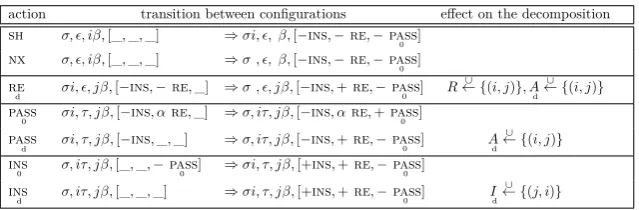
τ ∈ N∗, each containing vertex indices. The tuple (σ, τ, β) of these three structures forms the core of the configurations between which the transition system moves. As aninput, the system takes a sequence of actions that tell how to build a rope decomposition in an incre-mental manner. The possible types of actions of the transition system are listed in Table 1.
Initially, both the stacks are empty and the bufferβconsists of the list of positive integers. The final configurations of the system con-sists of all those configurations (ϵ, ϵ, β) where both stacks are empty, and β contains a suf-fix [n, n + 1, ...] of the list of positive inte-gers. When the system reaches a final con-figuration, it has produced a relational struc-ture (Vn, R, A<, A>, I<, I>) of a rope
decomposi-tion. By doing so, the transition system maps the input sequence of actions to a rope decom-position that represents a digraph. It is not too difficult to define the inverse of this func-tion, but we suppress the details in the interest of space.
4.1 Main Actions
The most important actions of the transition system create the set of edges in the PRC R.
Table 1: Transition system for rope decompositions.
action transition between configurations effect on the decomposition
sh σ, ϵ, iβ,[_,_,_] ⇒σi, ϵ, β,[−ins,−re,−pass 0 ] nx σ, ϵ, iβ,[_,_,_] ⇒σ , ϵ, β,[−ins,−re,−pass
0 ] re
d σi, ϵ, jβ,[−ins,−re,_] ⇒σ , ϵ, jβ,[−ins,+re,−pass0 ] R
∪
← {(i, j)}, A
d
∪
← {(i, j)}
pass
0 σi, τ, jβ,[−ins, αre,_] ⇒σ, iτ, jβ,[−ins, αre,+pass0 ] pass
d σi, τ, jβ,[−ins,_,_] ⇒σ, iτ, jβ,[−ins,+re,−pass0 ] Ad
∪
← {(i, j)}
ins
0 σ, iτ, jβ,[_,_,−pass0 ] ⇒σi, τ, jβ,[+ins,+re,−pass0 ] ins
d σ, iτ, jβ,[_,_,_] ⇒σi, τ, jβ,[+ins,+re,−pass0 ] Id
∪
← {(j, i)}
vertex indexifrom the front of the buffer and places it to the top of the stack in order to prepare for a future situation where the index iis the left index of an edge in the PRC, i.e., ∃j.R(i, j). When the index j becomes avail-able in the front of the buffer, the system cre-ates the edge(i, j)∈Rby areduce(re) action and removes the index i from the stack. The specifier d ∈ {<, >, <>} of the action tells whether the corresponding arc (i, j) is to be added to A
<, A> or both. Only one reduce
ac-tion is allowed in a row. By anext(nx) action, the system removes an index ifrom the front of the buffer to secure the situation where no covering edge has vertexias its left index, i.e., ¬∃j.R(i, j).
Example (7) is a digraph whose underlying graph is a complete graph with an edge be-tween every pair of vertices. The PRC of this graph is {(1,7),(2,6),(3,5)}.
1 2 3 4 5 6 7 (7)
The PRC R, and the corresponding arcs in A
<
and A
> of the rope decomposition of this
di-graph are created by the action sequence:
(ϵ, ϵ,[1..])⇒sh([1], ϵ,[2..])⇒sh([1,2], ϵ,[3..])⇒sh
([1..3], ϵ,[4..])⇒nx([1..3], ϵ,[5..])
re >
⇒([1,2], ϵ,[5..])⇒nx
([1,2], ϵ,[6..])
re >
⇒([1], ϵ,[6..])⇒nx([1], ϵ,[7..])
re >
⇒(ϵ, ϵ,[7..]) (8)
The main actions involved in this example do not use the auxiliary stack. The edges in R and the corresponding arcs are created by the reduce actions as follows:
configuration action effect ([1..3], ϵ,[5..]) re
> R
∪
← {(3,5)}, A
>
∪
← {(3,5)} ([1,2], ϵ,[6..]) re
> R
∪
← {(2,6)}, A
>
∪
← {(2,6)} ([1], ϵ,[7..]) re
> R
∪
← {(1,7)}, A
>
∪
← {(1,7)}
(9)
4.2 Intermediate Actions
In order to create arcs whose underlying edges do not belong to the PRC, some additional, intermediate actions are needed. Such inter-mediate actions allow the front of the buffer to form arcs with non-top elements of the main stack.
For instance, the first visit to configuration
([1..3], ϵ,[4..])allows actions that move the el-ements of the main stack temporarily to the auxiliary stack before restoring the original configuration:
...⇒([1..3], ϵ,[4..])
pass >
⇒ ([1,2],[3],[4..])
pass >
⇒ ([1],[2,3],[4..])
pass >
⇒ (ϵ,[1..3],[4..])
ins >
⇒([1],[2,3],[4..])
ins >
⇒([1,2],[3],[4..])
ins >
⇒([1..3], ϵ,[4..])⇒...
(10)
Thepass(pass) andinsert(ins) actions create arcs whose underlying edges do not belong to the PRC:
configuration action effect ([1..3], ϵ,[4..]) pass
> A>
∪
← {(3,4)} ([1,2],[3],[4..]) pass
> A>
∪
← {(2,4)}
([1],[2,3],[4..]) pass
> A>
∪
← {(1,4)}
(ϵ,[1..3],[4..]) ins
> I>
∪
← {(4,1)}
([1],[2,3],[4..]) ins
> I>
∪
← {(4,2)} ([1,2],[3],[4..]) ins
> I>
∪
← {(4,3)}
(11)
To prevent multiple re-entry to the same con-figuration and repeating the intermediate ac-tions, the detailed configurations of the tran-sition system include control variables that re-strict the available actions in different phases of the transition system. As theinsertactions set +ins, the reduce and pass astions become blocked until the next shift/next action.
the non-top elements of the main stack. Yet the sequence pass
0 ins0 is blocked by the con-trol variable pass
0 as a useless sequence.
A reduce action can be immediately
pre-ceded by several pass
0 actions. Example (6) has a PRC {(1,3),(2,4)} that is created through a sequence that involves intermediate actions. The precedingpass and the following
insert actions allow the first reduce action to
get access to a non-top element of the main stack and to remove it from the stack:
(ϵ, ϵ,[1..])⇒sh([1], ϵ,[2..])⇒sh([1,2], ϵ,[3..])
pass
0
⇒
([1],[2],[3..])
re >
⇒(ϵ,[2],[3..])
ins
0
⇒([2], ϵ,[3..])⇒nx
([2], ϵ,[4..])
re >
⇒(ϵ, ϵ,[4..])
(12)
The configuration([1], ϵ,[2..]) allows a combi-nation of apassandinsertactions. Theinsert
action puts, to I
<, the pair(2,1)representing
the arc(3,2)in Example (6).
...⇒sh([1], ϵ,[2..])
pass
0
⇒ (ϵ,[1],[2..])
ins <
⇒([1], ϵ,[2..])⇒sh... (13)
4.3 Correctness
Lemma 4.1. For every digraph, there is a unique action sequence that creates the edges of its PRC.
Proof sketch. By Proposition 3.1, no ver-tex needs to start or finish more than one edge in the PRC. The transition system allows to start one covering edge per vertex with ashift
action and finish any previously started cover edge with a reduce action. A crossing cover edge can be finished by accessing the non-topmost stack elements with pass
0 and ins0 actions in their appropriate time.
Theorem 4.2. The transition system is able to produce every possible rope decomposition, capturing every digraph.
Proof sketch. By Lemma 4.1, we have a way to create the PRC and the corresponding arcs. The set of arcs is extended to represent the rest of the arcs viapassand insertactions that create the arcs that are properly covered by the edges in the PRC.
5 Linear Encoding
The action sequences of the transition system can be seen as linearisations for the digraphs.
In particular, the undirected graph in Exam-ple (6) is encoded as the action sequence in (14). To make the linearisation more conve-nient for eyes, we replace actions with brackets and other symbols in (15).
sh pass
0 ins<> sh pass0 <>re ins0 nx re<> (14)
[[ • ]
0 [
<> [[
• ]
0 ]]
<> [0
• ]]
<>
(15)
Convention 5.1. By convention, the brack-eting scheme renames the actions of the tran-sition system as follows:
nx sh pass
0 passd ins0 insd red
• [[• ]
0 ]d [0 [d ]]d (16)
The convention improves the readabil-ity of action sequence and gives com-pact action sequences: especially, the digraph in Example (7) is encoded as string [[•]
>[<[[
• ]
>]>[<[<[[
•]
>]>]>[<[<[< •]]
>]>]>[<[< •]]
>]>[< •]]
> .
Example (17) demonstrates how the bracket(s) now correspond almost iconically to the rep-resented arcs.
[[ • ]
>[0[[
• ]
0]]>[0[[
• ]
0]]>[0[[
• ]
0]>[0[0
• ]
0]]>[0
• ]]
> (17)
Convention 5.1 benefits us when we anal-yse the formal, language theoretic properties of such action sequences altough the encoding is not otherwise meant for human inspection and its direct manipulation by hand is prone to errors. The convention borrows ideas from Yli-Jyrä (2017) but differs from it in four im-portant aspects:
1. The vertices are separated with a bullet symbol (•) instead of curly brackets ({}).
2. The left brackets {[[,[,[ 0}
match the
right brackets{]],],] 0}
.
3. Weak brackets may be stacked (like in
]]][[[) in order to deal with stacked
pass and insert actions.
4. A strong closing bracket may occur inside a stack of weak brackets (like in]
0 ]
0 ]][[).
5.1 Syntactic Properties
In order to analyse the formal properties of the transition system, we need to understand how the actions, or the corresponding brack-ets, form strings that correspond to ordered graphs in a bijective manner. We induce the following principles:
1. Each vertex corresponds to a sequence of closing brackets followed by a sequence of opening brackets.
2. Between “]]” and the closest preceding “•”, there can be only “]
0
”-brackets.
This corresponds to the convention 3.7 that always chooses the “earliest” cov-ering edge in the PRC of the underlying graph. We do not need “]”-brackets to produce arcs as we have an opportunity to produce same arcs with “[”-brackets earlier.
3. The unnecessary pair of pass and insert actions, marked with bracket substring “]
0 [
0
” do not occur in the strings.
4. The strong opening bracket “[[” always occurs right before the vertex boundary “•”.
5. The maximum number of brackets per vertex isn−1.
6. Left bracketsBL={[[,[
0
,[
d}
match right
bracketsBR={]] d
,] 0
,]
d}
.
7. The rope thickness of the (di)graph is the maximum number of momentarily open brackets in its encoding.
According to the principles 1-4, the bracket substrings that correspond to different vertices constitute a context-free language W that is generated by the grammar GW:
S → T? | T?[[ T? → T | ϵ
R′ → ]]
< | ]]> | <>]]
L′ →L | [
0
R → ] < |
] > |
]
<>
L → [ < |
[ > |
[
<>
T → R′T? | R T?L′ | ]
0
T?L | ]
0
T[
0
(18)
Lemma 5.1. The action sequences that con-form to the seven principles allow only one way to represent each ordered digraph.
Proof. The strong brackets are crucial for
en-coding all arcs of the digraph and the PRC of its underlying graph in particular. Every di-graph (Vn, A) has a unique PRC, and, due to
the principles 1-4, it is not possible to build the same PRC with the correct arc orientations in two different ways. By the second princi-ple, all non-PRC arcs are assigned to a unique covering edge. There is thus only one moment when the right combination of indices is avail-able in the configuration for constructing each arc, and there is only one action sequence that can construct any given digraph.
We also observe that string concatenation of two action sequences gives an action sequence that produces a digraph concatenation of two ordered digraphs with one shared vertex. Proposition 5.2. The encoding from digraphs to strings is a mapping that preserves the structure of the digraph concatenation monoid and sends it the structure of a string concate-nation monoid.
6 Formal Language Theory
Chomsky-Schützenberger (CS) parsing (Yli-Jyrä, 2005, 2012; Hulden, 2009; Yli-Jyrä and Gómez-Rodríguez, 2017; Ruprecht and Denkinger, 2019) combines a particular kind of language representations with weighted au-tomata techniques. A prototypical CS style language representation h(L ∩ D) involves a homomorphic mapping (h) applied to an inter-section of a a regular language component L and a Dyck languageD. Yli-Jyrä and Gómez-Rodríguez (2017) used this kind of language representations to show that their encoding for the noncrossing digraphs (LNC-DIGRAPH) is a context-free language and admits an ef-ficient algorithm for finding maximal con-strained subdigraphs in a weighted complete digraph.
Lemma 6.1. There is a CS style
representa-tion for the language LDIGRAPH.
Proof. We start by defining a Dyck language
D that checks for balanced bracketing. Let the internal alphabet of the representation be
Σ ={{,}}∪{[(l,r),](l,r)|l∈BL, r∈BR}. Let
D be the language generated by the grammar
S→ϵ|SS|{S}|[(l,r)S](l,r) (19)
where l ∈ BL and r ∈ BR. Let h : Σ∗ → ({ •}∪BL∪BR)∗be a homomorphism defined
in such a way that, for all l∈BL, r∈BR,
h(ab) =h(a)h(b) h(ϵ) =ϵ
h([(l,r)) =l h({) =ϵ
h(](l,r)) =r h(}) = •. (20)
Instead of the usual regular component of CS representations, we use a marked concatena-tion closure of a context-free language: let L be the context-free language W( •W)n−1, whose inverse homomorphimsh−1(L)is also a marked concatenation closure of a context-free language.
The set of encoded digraphs is now given as LDIGRAPH=h(h−1(L)∩ D) =L ∩h(D).
Lemma 6.2. The subset of the encoded
di-graphsLDIGRAPH, where the number of
brack-ets per vertexis bounded by k, is context-free.
Proof. We start from the CS style
representa-tion (the proof of lemma 6.1) for LDIGRAPH and replace the context-free language L, with a regular approximationL<k =W<k( •W<k)∗
where W<k is a finite subset of W restricted
to contain at most k nested brackets in the strings. This gives a more prototypical CS rep-resention LDIGRAPH,k = h(h−1(L<k)∩D) =
L<k∩h(D), which yields a context-free subset
of LDIGRAPH.
Lemma 6.3. The subset of encoded graphs
LDIGRAPH, where the rope thickness of the
en-coded digraphs is bounded by t, is regular.
Proof. As the rope thickness is bounded byt,
the number of brackets per vertex is bounded by 2t. Thus, we start from the CS style rep-resentation (the proof of Lemma 6.2) for en-coded graphs where the number of brackets per vertex is bounded. By the bound t for
the rope thickness, we replace the context-free language D with a regular subset Dt ⊂ D
that can contain t levels of nested brackets. The 2t, t-bounded set of encoded graphs is given byLDIGRAPH,2t,t=h(h−1(L<2t)∩Dt) =
L<2t∩h(Dt).By the closure properties of
reg-ular languages, LDIGRAPH,2t,t is regular.
7 Evidence for Linguistic Relevance
To assess the linguistic relevance of the cur-rently presented encoding, we carried out a small experiment where we computed the rope-thickness of dependency trees in the Uni-versal Dependencies v 2.4 treebanks (Nivre et al., 2019). The compacted results are pre-sented in Table 2. The results indicate that a very high proportion of the observations is captured when rope-thickness is 4 or higher.
According to our preliminary experiments on graph banks, a very similar distribution of rope-thickness is observed in more general an-notation graphs.
8 Discussion
Among the earliest encoding schemes for graphs are the Prüfer sequences for labeled trees (Prüfer,1918) that have been extened to DAGs (Steinsky,2003). More recently,Turán (1984) introduced the problem of graph
rep-resentation given an adjacency matrix. There
language trees rope-thickness 1 2 3 4 5 6 7 8
Arabic 28,402 4.9% 20.5% 63.5% 94.0% 99.64% 99.986% 100.000% 100.000%
Czech 127,507 13.3% 48.3% 89.3% 98.8% 99.91% 99.992% 100.000% 100.000%
Dutch 20,735 21.3% 63.4% 92.9% 98.9% 99.92% 99.986% 100.000% 100.000%
English 34,601 15.6% 54.9% 92.3% 99.3% 99.98% 99.997% 100.000% 100.000% Finnish 34,641 37.0% 78.7% 96.8% 99.6% 99.97% 99.994% 100.000% 100.000% German 191,757 10.1% 49.2% 90.5% 99.2% 99.96% 99.997% 100.000% 100.000%
Hindi 19,545 2.9% 44.4% 85.3% 98.3% 99.87% 99.980% 100.000% 100.000%
Italian 34,057 5.6% 49.9% 90.3% 98.8% 99.89% 99.997% 100.000% 100.000%
Korean 34,702 15.5% 65.6% 94.7% 99.5% 99.95% 99.994% 100.000% 100.000%
Latvian 12,558 12.7% 50.0% 89.8% 98.8% 99.90% 99.992% 99.992% 100.000%
Russian 87,377 15.0% 55.5% 90.7% 98.9% 99.91% 99.994% 99.999% 100.000%
[image:9.595.110.489.61.158.2]Chinese 18,628 46.1% 73.7% 91.9% 98.6% 99.89% 99.989% 100.000% 100.000% all 83 languages 1,232,262 15.1% 54.8% 90.5% 99.0% 99.93% 99.995% 100.000% 100.000%
Table 2: The cumulative coverage of bounded rope-thickness in the UD v2.4 dataset from which we purged the trees containing ellipsis.
The languages of encoded graphs have ap-plications to constrained graph enumeration problems. Hoppe and Petrone (Hoppe and Petrone, 2016) have exhaustively enumerated all simple, connected graphs of a finite order and computed a selection of invariants over the sets in order to discover and add 141 new integer sequences to the Online Encyclope-dia of Integer Sequences (OEIS). Our previ-ous encoding scheme (Yli-Jyrä and Gómez-Rodríguez,2017) gave context-free characteri-sations for some graph properties. This led to the discovery of dozens of known and new in-teger sequences by graph enumeration. These new computational methods complement the research that spans from the “Abzählsatz” of (Pólya, 1937) to more recent work on graph enumeration (Wormald, 1979; Mckay, 1983; Kapoor and Ramesh,2000;Acuña et al.,2012; Conte et al.,2018;Equi et al.,2019).
The languageLDIGRAPHis not only context-sensitive but even an indexed language (Aho, 1968): it is possible to construct an in-dexed grammar that generates the same set of strings. However, the existence of a sim-ple transition system, a finite representation, and a finite indexed grammar for the encoded digraphs should not be confused with condi-tion under which digraphs themselves become finitely generated. Ogawa (2004) has pre-sented a complete, infinite set of generators for the graphs. We also need an infinite set of gen-erators for the language LDIGRAPH, because the the paths that take the transition system from one final configuration to another final configuration constitute an infinite set of code words over which the encoded digraphs are generated. This set remains infinite even for digraphs with bounded rope thickness, but the context-free and regular subsets of LDIGRAPH
may have some other ways to motivate finite algebraic axiomatisations.
9 Conclusion
This paper contributes to the research on graph representations (Turán, 1984) by de-veloping a linear-time decodable encoding for arbitrary labeled digraphs that we pre-ferred to call ordered digraphs. The partic-ular design of our linear encoding is moti-vated by the success of similar representations (Yli-Jyrä, 2005, 2012; Yli-Jyrä and Gómez-Rodríguez, 2017) in the characterisations of several families of noncrossing digraphs and by the effectiveness of the recently improved representation (Yli-Jyrä, 2017, 2019). Evi-dently, both kinds of graph representations have potential applications in graph enumer-ation (Yli-Jyrä and Gómez-Rodríguez, 2017) and weighted Chomsky-Schützenberger pars-ing (Yli-Jyrä, 2005, 2012; Hulden, 2009; Yli-Jyrä and Gómez-Rodríguez, 2017; Ruprecht and Denkinger,2019).
References
Vicente Acuña, Etienne Birmelé, Ludovic Cot-tret, Pierluigi Crescenzi, Fabien Jourdan, Vin-cent Lacroix, Alberto Marchetti-Spaccamela, Andrea Marino, Paulo Vieira Milreu, Marie-France Sagot, and Leen Stougie. 2012. Telling stories: Enumerating maximal directed acyclic graphs with a constrained set of sources and
tar-gets. Theoretical Computer Science, 457:1 – 9.
Alfred V. Aho. 1968. Indexed grammars – an
ex-tension of context-free grammars. Journal of the
ACM, 15(4):647–671.
Daniel Andor, Chris Alberti, David Weiss, Aliaksei Severyn, Alessandro Presta, Kuzman Ganchev, Slav Petrov, and Michael Collins. 2016. Globally
normalized transition-based neural networks. In
Proceedings of the 54th Annual Meeting of the Association for Computational Linguistics
(Vol-ume 1: Long Papers), pages 2442–2452, Berlin,
Germany. Association for Computational Lin-guistics.
Giuseppe Attardi. 2006. Experiments with a
mul-tilanguage non-projective dependency parser. In
Proceedings of the Tenth Conference on
Compu-tational Natural Language Learning, CoNLL-X
’06, pages 166–170. Association for Computa-tional Linguistics.
Jill Burstein, Christy Doran, and Thamar Solorio, editors. 2019. Proceedings of the 2019 Con-ference of the North American Chapter of the Association for Computational Linguistics: Human Language Technologies, NAACL-HLT 2019, Minneapolis, MN, USA, June 2-7, 2019, Volume 1 (Long and Short Papers). Association for Computational Linguistics.
Eugene Charniak, Sharon Goldwater, and Mark Johnson. 1998. Edge-based best-first chart
pars-ing. In Sixth Workshop on Very Large Corpora,
VLC@COLING/ACL 1998, Montreal, Quebec,
Canada, August 15-16, 1998.
Danqi Chen and Christopher Manning. 2014. A fast and accurate dependency parser using
neu-ral networks. InProceedings of the 2014
Confer-ence on Empirical Methods in Natural Language
Processing (EMNLP), pages 740–750, Doha,
Qatar. Association for Computational Linguis-tics.
Jinho D. Choi and Andrew McCallum. 2013.
Transition-based dependency parsing with
se-lectional branching. InProceedings of the 51st
Annual Meeting of the Association for
Compu-tational Linguistics (Volume 1: Long Papers),
pages 1052–1062, Sofia, Bulgaria. Association for Computational Linguistics.
Maximin Coavoux and Shay B. Cohen. 2019. Dis-continuous constituency parsing with a
stack-free transition system and a dynamic oracle.
CoRR, abs/1904.00615.
Alessio Conte, Roberto Grossi, Andrea Marino, and Romeo Rizzi. 2018. Efficient enumeration
of graph orientations with sources. Discrete
Ap-plied Mathematics, 246:22 – 37.
Alessio Conte, Roberto Grossi, Andrea Marino, and Luca Versari. 2019. Listing maximal sub-graphs satisfying strongly accessible
proper-ties. SIAM Journal on Discrete Mathematics,
33(2):587–613.
Bruno Courcelle. 1990. The monadic second-order logic of graphs. I. recognizable sets of
finite graphs. Information and Computation,
85(1):12–75.
Michael A. Covington. 2000. A fundamental algo-rithm for dependency parsing. InIn Proceedings
of the 39th Annual ACM Southeast Conference,
pages 95–102, Athens, GA. Association for Com-puting Machinery.
Brandon Dixon, Monika Rauch, and Robert Endre Tarjan. 1992. Verification and sensitivity
anal-ysis of minimum spanning trees in linear time.
SIAM Journal on Computing, 21(6):1184–1192.
Chris Dyer, Miguel Ballesteros, Wang Ling, Austin Matthews, and Noah A. Smith. 2015.
Transition-based dependency parsing with stack
long short-term memory. In Proceedings of
the 53rd Annual Meeting of the Association for Computational Linguistics and the 7th Interna-tional Joint Conference on Natural Language
Processing (Volume 1: Long Papers), pages 334–
343, Beijing, China. Association for Computa-tional Linguistics.
Massimo Equi, Roberto Grossi, Veli Mäkinen, and Alexandru I. Tomescu. 2019. On the complexity
of string matching for graphs. In46th
Interna-tional Colloquium on Automata, Languages, and Programming, ICALP 2019, July 9-12, 2019,
Patras, Greece., volume 132 of LIPIcs, pages
55:1–55:15. Schloss Dagstuhl - Leibniz-Zentrum fuer Informatik.
Arash Farzan and J. Ian Munro. 2013. Succinct
encoding of arbitrary graphs. Theoretical
Com-puter Science, 513:38 – 52.
Daniel Fernández-González and Carlos Gómez-Rodríguez. 2018. Non-projective dependency
parsing with non-local transitions. In
Proceed-ings of the 2018 Conference of the North Amer-ican Chapter of the Association for Computa-tional Linguistics: Human Language
Technolo-gies, Volume 2 (Short Papers), pages 693–700,
New Orleans, Louisiana. Association for Com-putational Linguistics.
Daniel Gildea, Giorgio Satta, and Xiaochang Peng. 2018. Cache transition systems for graph
Yoav Goldberg and Michael Elhadad. 2010. An efficient algorithm for easy-first non-directional
dependency parsing. InHuman Language
Tech-nologies: The 2010 Annual Conference of the North American Chapter of the Association for
Computational Linguistics, HLT ’10, pages 742–
750. Association for Computational Linguistics.
Dina Q. Goldin, Scott A. Smolka, Paul C. Attie, and Elaine L. Sonderegger. 2004. Turing
ma-chines, transition systems, and interaction.
In-formation and Computation, 194(2):101 – 128.
Special Issue Commemorating the 50th Birth-day Anniversary of Paris C. Kanellakis.
Carlos Gómez-Rodríguez and Joakim Nivre. 2013.
Divisible transition systems and multiplanar
de-pendency parsing. Computational Linguistics,
39(4):799–845.
Carlos Gómez-Rodríguez, Tianze Shi, and Lil-lian Lee. 2018. Global transition-based
non-projective dependency parsing. In
Proceed-ings of the 56th Annual Meeting of the Asso-ciation for Computational Linguistics (Volume
1: Long Papers), pages 2664–2675, Melbourne,
Australia. Association for Computational Lin-guistics.
Carlos Gómez-Rodríguez and David Vilares. 2018.
Constituent parsing as sequence labeling. In
Proceedings of the 2018 Conference on Empirical Methods in Natural Language Processing,
Brus-sels, Belgium, October 31 - November 4, 2018,
pages 1314–1324. Association for Computational Linguistics.
Matthew Honnibal and Mark Johnson. 2015. An improved non-monotonic transition system for
dependency parsing. In Proceedings of the 2015
Conference on Empirical Methods in Natural
Language Processing, pages 1373–1378, Lisbon,
Portugal. Association for Computational Lin-guistics.
Travis Hoppe and Anna Petrone. 2016. Integer
sequence discovery from small graphs. Discrete
Appl. Math., 201(C):172–181.
Mans Hulden. 2009. Parsing CFGs and PCFGs
with a Chomsky-Schützenberger representation.
InHuman Language Technology. Challenges for
Computer Science and Linguistics - 4th Lan-guage and Technology Conference, LTC 2009, Poznan, Poland, November 6-8, 2009, Revised
Selected Papers, volume 6562 of Lecture Notes
in Computer Science, pages 151–160. Springer.
S. Kapoor and H. Ramesh. 2000. An algorithm for enumerating all spanning trees of a directed
graph. Algorithmica, 27(2):120–130.
Eliyahu Kiperwasser and Yoav Goldberg. 2016.
Simple and accurate dependency parsing
us-ing bidirectional LSTM feature representations.
Transactions of the Association for Computa-tional Linguistics, 4:313–327.
András Kornai and Zsolt Tuza. 1992. Narrowness, pathwidth, and their application in natural
lan-guage processing. Discrete Applied
Mathemat-ics, 36(1):87–92.
Marco Kuhlmann, Carlos Gómez-Rodríguez, and Giorgio Satta. 2011. Dynamic program-ming algorithms for transition-based
depen-dency parsers. In Proceedings of the 49th
An-nual Meeting of the Association for Computa-tional Linguistics: Human Language
Technolo-gies - Volume 1, HLT ’11, pages 673–682.
Asso-ciation for Computational Linguistics.
Marco Kuhlmann and Peter Jonsson. 2015.
Pars-ing to noncrossPars-ing dependency graphs. TACL,
3:559–570.
Robin Kurtz and Marco Kuhlmann. 2017. Exploit-ing structure in parsExploit-ing to 1-endpoint-crossExploit-ing
graphs. InProceedings of the 15th International
Conference on Parsing Technologies, pages 78–
87, Pisa, Italy. Association for Computational Linguistics.
Miryam de Lhoneux, Sara Stymne, and Joakim Nivre. 2017. Arc-hybrid non-projective
depen-dency parsing with a static-dynamic oracle. In
Proceedings of the 15th International Conference on Parsing Technologies, IWPT 2017, Pisa,
Italy, September 20-22, 2017, pages 99–104.
As-sociation for Computational Linguistics.
Brendan D. Mckay. 1983. Applications of a tech-nique for labelled enumeration. Congressus
Nu-merantium, 40:207–221.
Moni Naor. 1990. Succinct representation of
gen-eral unlabeled graphs. Discrete Applied
Mathe-matics, 28(3):303 – 307.
Joakim Nivre. 2003. An efficient algorithm for
pro-jective dependency parsing. In Proceedings of
the Eighth International Workshop on Parsing
Technologies (IWPT), pages 149–160.
Joakim Nivre. 2004. Incrementality in
determinis-tic dependency parsing. In Proceedings of the
Workshop on Incremental Parsing: Bringing
Engineering and Cognition Together,
Increment-Parsing ’04, pages 50–57. Association for Com-putational Linguistics.
Joakim Nivre. 2009. Non-projective dependency
parsing in expected linear time. In Proceedings
of the Joint Conference of the 47th Annual Meet-ing of the ACL and the 4th International Joint Conference on Natural Language Processing of
the AFNLP: Volume 1 - Volume 1, ACL ’09,
Joakim Nivre, Mitchell Abrams, Željko Agić, Lars Ahrenberg, Gabrielė Aleksandravičiūtė, Lene Antonsen, Katya Aplonova, Maria Je-sus Aranzabe, Gashaw Arutie, Masayuki Asa-hara, Luma Ateyah, Mohammed Attia, Aitz-iber Atutxa, Liesbeth Augustinus, Elena Bad-maeva, Miguel Ballesteros, Esha Banerjee, Se-bastian Bank, Verginica Barbu Mititelu, Vic-toria Basmov, John Bauer, Sandra Bellato, Kepa Bengoetxea, Yevgeni Berzak, Irshad Ah-mad Bhat, Riyaz AhAh-mad Bhat, Erica Bi-agetti, Eckhard Bick, Agnė Bielinskienė, Ro-gier Blokland, Victoria Bobicev, Loïc Boizou, Emanuel Borges Völker, Carl Börstell, Cristina Bosco, Gosse Bouma, Sam Bowman, Adriane Boyd, Kristina Brokaitė, Aljoscha Burchardt, Marie Candito, Bernard Caron, Gauthier Caron, Gülşen Cebiroğlu Eryiğit, Flavio Massimiliano Cecchini, Giuseppe G. A. Celano, Slavomír Čéplö, Savas Cetin, Fabricio Chalub, Jinho Choi, Yongseok Cho, Jayeol Chun, Silvie Cinková, Aurélie Collomb, Çağrı Çöltekin, Miriam Connor, Marine Courtin, Elizabeth Davidson, Marie-Catherine de Marneffe, Vale-ria de Paiva, Arantza Diaz de Ilarraza, Carly Dickerson, Bamba Dione, Peter Dirix, Kaja Dobrovoljc, Timothy Dozat, Kira Droganova, Puneet Dwivedi, Hanne Eckhoff, Marhaba Eli, Ali Elkahky, Binyam Ephrem, Tomaž Erjavec, Aline Etienne, Richárd Farkas, Hector Fernan-dez Alcalde, Jennifer Foster, Cláudia Freitas, Kazunori Fujita, Katarína Gajdošová, Daniel Galbraith, Marcos Garcia, Moa Gärdenfors, Se-bastian Garza, Kim Gerdes, Filip Ginter, Iakes Goenaga, Koldo Gojenola, Memduh Gökır-mak, Yoav Goldberg, Xavier Gómez Guino-vart, Berta González Saavedra, Matias Grioni, Normunds Grūzītis, Bruno Guillaume, Céline Guillot-Barbance, Nizar Habash, Jan Hajič, Jan Hajič jr., Linh Hà Mỹ, Na-Rae Han, Kim Har-ris, Dag Haug, Johannes Heinecke, Felix Hennig, Barbora Hladká, Jaroslava Hlaváčová, Florinel Hociung, Petter Hohle, Jena Hwang, Takumi Ikeda, Radu Ion, Elena Irimia, Ọlájídé Ishola, Tomáš Jelínek, Anders Johannsen, Fredrik Jør-gensen, Hüner Kaşıkara, Andre Kaasen, Sylvain Kahane, Hiroshi Kanayama, Jenna Kanerva, Boris Katz, Tolga Kayadelen, Jessica Kenney, Václava Kettnerová, Jesse Kirchner, Arne Köhn, Kamil Kopacewicz, Natalia Kotsyba, Jolanta Kovalevskaitė, Simon Krek, Sookyoung Kwak, Veronika Laippala, Lorenzo Lambertino, Lucia Lam, Tatiana Lando, Septina Dian Larasati, Alexei Lavrentiev, John Lee, Phương Lê Hồng, Alessandro Lenci, Saran Lertpradit, Herman Leung, Cheuk Ying Li, Josie Li, Keying Li, KyungTae Lim, Yuan Li, Nikola Ljubešić, Olga Loginova, Olga Lyashevskaya, Teresa Lynn, Vivien Macketanz, Aibek Makazhanov, Michael Mandl, Christopher Manning, Ruli Manurung, Cătălina Mărănduc, David Mareček, Katrin Marheinecke, Héctor Martínez Alonso, André Martins, Jan Mašek, Yuji Matsumoto, Ryan
McDonald, Sarah McGuinness, Gustavo Men-donça, Niko Miekka, Margarita Misirpashayeva, Anna Missilä, Cătălin Mititelu, Yusuke Miyao, Simonetta Montemagni, Amir More, Laura Moreno Romero, Keiko Sophie Mori, Tomohiko Morioka, Shinsuke Mori, Shigeki Moro, Bjartur Mortensen, Bohdan Moskalevskyi, Kadri Muis-chnek, Yugo Murawaki, Kaili Müürisep, Pinkey Nainwani, Juan Ignacio Navarro Horñiacek, Anna Nedoluzhko, Gunta Nešpore-Bērzkalne, Lương Nguyễn Thị, Huyền Nguyễn Thị Minh, Yoshihiro Nikaido, Vitaly Nikolaev, Rattima Nitisaroj, Hanna Nurmi, Stina Ojala, Adé-dayọ̀ Olúòkun, Mai Omura, Petya Osenova, Robert Östling, Lilja Øvrelid, Niko Parta-nen, Elena Pascual, Marco Passarotti, Ag-nieszka Patejuk, Guilherme Paulino-Passos, An-gelika Peljak-Łapińska, Siyao Peng, Cenel-Augusto Perez, Guy Perrier, Daria Petrova, Slav Petrov, Jussi Piitulainen, Tommi A Piri-nen, Emily Pitler, Barbara Plank, Thierry Poibeau, Martin Popel, Lauma Pretkalniņa, Sophie Prévost, Prokopis Prokopidis, Adam Przepiórkowski, Tiina Puolakainen, Sampo Pyysalo, Andriela Rääbis, Alexandre Rade-maker, Loganathan Ramasamy, Taraka Rama, Carlos Ramisch, Vinit Ravishankar, Livy Real, Siva Reddy, Georg Rehm, Michael Rießler, Erika Rimkutė, Larissa Rinaldi, Laura Rituma, Luisa Rocha, Mykhailo Romanenko, Rudolf Rosa, Davide Rovati, Valentin Roșca, Olga Rudina, Jack Rueter, Shoval Sadde, Benoît Sagot, Shadi Saleh, Alessio Salomoni, Tanja Samardžić, Stephanie Samson, Manuela San-guinetti, Dage Särg, Baiba Saulīte, Yanin Sawanakunanon, Nathan Schneider, Sebastian Schuster, Djamé Seddah, Wolfgang Seeker, Moj-gan Seraji, Mo Shen, Atsuko Shimada, Hiroyuki Shirasu, Muh Shohibussirri, Dmitry Sichinava, Natalia Silveira, Maria Simi, Radu Simionescu, Katalin Simkó, Mária Šimková, Kiril Simov, Aaron Smith, Isabela Soares-Bastos, Carolyn Spadine, Antonio Stella, Milan Straka, Jana Str-nadová, Alane Suhr, Umut Sulubacak, Shingo Suzuki, Zsolt Szántó, Dima Taji, Yuta Taka-hashi, Fabio Tamburini, Takaaki Tanaka, Is-abelle Tellier, Guillaume Thomas, Liisi Torga, Trond Trosterud, Anna Trukhina, Reut Tsar-faty, Francis Tyers, Sumire Uematsu, Zdeňka Urešová, Larraitz Uria, Hans Uszkoreit, Sowmya Vajjala, Daniel van Niekerk, Gertjan van Noord, Viktor Varga, Eric Villemonte de la Clergerie, Veronika Vincze, Lars Wallin, Abigail Walsh, Jing Xian Wang, Jonathan North Washington, Maximilan Wendt, Seyi Williams, Mats Wirén, Christian Wittern, Tsegay Woldemariam, Tak-sum Wong, Alina Wróblewska, Mary Yako, Naoki Yamazaki, Chunxiao Yan, Koichi Ya-suoka, Marat M. Yavrumyan, Zhuoran Yu, Zdeněk Žabokrtský, Amir Zeldes, Daniel Ze-man, Manying Zhang, and Hanzhi Zhu. 2019.
Universal Dependencies 2.4. LINDAT/CLARIN
Ap-plied Linguistics (ÚFAL), Faculty of Mathemat-ics and PhysMathemat-ics, Charles University.
Joakim Nivre and Mario Scholz. 2004.
Determin-istic dependency parsing of English text. In
COLING 2004, 20th International Conference on Computational Linguistics, Proceedings of the Conference, 23-27 August 2004, Geneva, Switzerland.
Mizuhito Ogawa. 2004. Complete axiomatization
of an algebraic construction of graphs. In
Func-tional and Logic Programming, pages 163–179,
Berlin, Heidelberg. Springer Berlin Heidelberg.
Emily Pitler, Sampath Kannan, and Mitchell Mar-cus. 2013. Finding optimal 1-endpoint-crossing
trees. TACL, 1:13–24.
Emily Pitler and Ryan McDonald. 2015. A linear-time transition system for crossing interval trees.
In Proceedings of the 2015 Conference of the
North American Chapter of the Association for Computational Linguistics: Human Language
Technologies, pages 662–671, Denver, Colorado.
Association for Computational Linguistics.
Heinz Prüfer. 1918. Neuer Beweis eines Satzes über Permutationen (New proof of a theorem on per-mutations). Archiv der Mathematik und Physik, 27(3):142–144.
G. Pólya. 1937. Kombinatorische Anzahlbestim-mungen für Gruppen, Graphen und chemische
Verbindungen. Acta Math., 68:145–254.
Peng Qi and Christopher D. Manning. 2017. Arc-swift: A novel transition system for dependency
parsing. InProceedings of the 55th Annual
Meet-ing of the Association for Computational Lin-guistics, ACL 2017, Vancouver, Canada, July 30
- August 4, Volume 2: Short Papers, pages 110–
117. Association for Computational Linguistics.
Thomas Ruprecht and Tobias Denkinger. 2019.
Implementation of a Chomsky-Schützenberger
n-best parser for weighted multiple context-free
grammars. In (Burstein et al.,2019), pages 178– 191.
Kenji Sagae and Jun’ichi Tsujii. 2008. Shift-reduce
dependency DAG parsing. In Proceedings of
COLING 2008, the 22nd International
Confer-ence on Computational Linguistics, pages 753–
760, Manchester, UK. Coling 2008 Organizing Committee.
Isao Sasano, Zhenjiang Hu, Masato Takeichi, and Mizuhito Ogawa. 2000. Make it practi-cal: a generic linear-time algorithm for
solv-ing maximum-weightsum problems. In
Pro-ceedings of the Fifth ACM SIGPLAN Interna-tional Conference on FuncInterna-tional Programming (ICFP ’00), Montreal, Canada, September
18-21, 2000., pages 137–149. Association for
Com-puting Machinery.
Tianze Shi, Liang Huang, and Lillian Lee. 2017.
Fast(er) exact decoding and global training for transition-based dependency parsing via a
min-imal feature set. In Proceedings of the 2017
Conference on Empirical Methods in Natural
Language Processing, pages 12–23, Copenhagen,
Denmark. Association for Computational Lin-guistics.
B. Steinsky. 2003. Efficient coding of labeled
directed acyclic graphs. Soft Computing,
7(5):350–356.
Michalina Strzyz, David Vilares, and Carlos Gómez-Rodríguez. 2019. Viable dependency parsing as sequence labeling. In (Burstein et al.,
2019), pages 717–723.
Wolfgang Thomas. 2002. A short introduction to
infinite automata. In Developments in
Lan-guage Theory, pages 130–144, Berlin,
Heidel-berg. Springer Berlin HeidelHeidel-berg.
György Turán. 1984. On the succinct
representa-tion of graphs. Discrete Applied Mathematics,
8(3):289 – 294.
David Vilares and Carlos Gómez-Rodríguez. 2018.
A transition-based algorithm for unrestricted
AMR parsing. In Proceedings of the 2018
Conference of the North American Chapter of the Association for Computational Linguis-tics: Human Language Technologies, Volume 2
(Short Papers), pages 142–149, New Orleans,
Louisiana. Association for Computational Lin-guistics.
Oriol Vinyals, Lukasz Kaiser, Terry Koo, Slav Petrov, Ilya Sutskever, and Geoffrey E. Hinton. 2015. Grammar as a foreign language. In Ad-vances in Neural Information Processing Sys-tems 28: Annual Conference on Neural Informa-tion Processing Systems 2015, December 7-12,
2015, Montreal, Quebec, Canada, pages 2773–
2781.
W. A. Woods. 1970. Transition network grammars
for natural language analysis. Communications
of the ACM, 13(10):591–606.
Nicholas C. Wormald. 1979. Enumeration of la-belled graphs II: Cubic graphs with a given
con-nectivity. Journal of the London Mathematical
Society, s2-20(1):1–7.
H. Yamada and Y. Matsumoto. 2003. Statistical Dependency Analysis with Support Vector ma-chines. In The 8th International Workshop of
Parsing Technologies (IWPT2003).
Anssi Yli-Jyrä. 2005. Approximating dependency grammars through intersection of star-free
reg-ular languages. International Journal of
Anssi Yli-Jyrä. 2012. On dependency analysis via
contractions and weighted FSTs. In Shall We
Play the Festschrift Game?, Essays on the
Oc-casion of Lauri Carlson’s 60th Birthday, pages
133–158. Springer.
Anssi Yli-Jyrä. 2017. Bounded-depth
high-coverage search space for noncrossing parses. In
Proceedings of the 13th International Confer-ence on Finite State Methods and Natural Lan-guage Processing, FSMNLP 2017, Umeå,
Swe-den, September 2017, pages 30–40. Association
for Computational Linguistics.
Anssi Yli-Jyrä. 2019. How to embed noncross-ing trees in Universal Dependencies treebanks in a low-complexity regular language. Journal
of Language Modelling. Forthcoming.
Anssi Yli-Jyrä and Carlos Gómez-Rodríguez. 2017.
Generic axiomatization of families of
noncross-ing graphs in dependency parsnoncross-ing. In
Proceed-ings of the 55th Annual Meeting of the Associa-tion for ComputaAssocia-tional Linguistics, ACL 2017, Vancouver, Canada, July 30 - August 4, Volume
1: Long Papers, pages 1745–1755. Association
for Computational Linguistics.
Yue Zhang and Joakim Nivre. 2011. Transition-based dependency parsing with rich non-local
features. In The 49th Annual Meeting of the
Association for Computational Linguistics: Hu-man Language Technologies, Proceedings of the Conference, 19-24 June, 2011, Portland,
Ore-gon, USA - Short Papers, pages 188–193. The