Ireland
Red List No. 2
Ireland Red List No. 2:
Non-Marine Molluscs
A. Byrne1, E.A. Moorkens2, R. Anderson3, I.J. Killeen2 & E.C. Regan1
1National Biodiversity Data Centre, Beechfield House, WIT West Campus, Carriganore, Waterford
2Charleville Square, Rathfarnham, Dublin 14
3Belvoir View Park, Newtownbreda, Belfast BT8 7BL
Citation:
Byrne, A., Moorkens, E.A., Anderson, R., Killeen, I.J. & Regan, E.C. (2009) Ireland Red List No. 2 –
Non-Marine Molluscs. National Parks and Wildlife Service, Department of the Environment, Heritage and Local Government, Dublin, Ireland.
Cover images from top: Geomalacus maculosus (© Roy Anderson); Cepaea nemoralis (© Liam Lysaght); Sphaerium nucleus (© Ian Killeen); Anisus leucostoma (© Roy Anderson); Vertigo angustior (© Roy Anderson).
Ireland Red list Series Editors: N. Kingston & F. Marnell
©National Parks and Wildlife Service 2009
CONTENTS
ACKNOWLEDGEMENTS...1
EXECUTIVE SUMMARY...2
INTRODUCTION...3
NOMENCLATURE...3
COVERAGE AND DATABASE STRUCTURE...3
SUMMARY OF EVALUATIONS...5
THE MAPS...8
CLASS GASTROPODA...9
CLASS BIVALVIA...26
REFERENCES...31
APPENDIX 1:CHECKLIST OF IRISH NON-MARINE MOLLUSCS...34
1 ACKNOWLEDGEMENTS
Firstly, we would like to thank the Conchological Society of Great Britain and Ireland for making all of
their Irish data available for digitising and amalgamating into the Irish Non-Marine Molluscan Database. Michael Kerney was the driving force behind many of these records and his contribution is gratefully acknowledged.
We are grateful to all those who supported the creation and population of the Irish Non-Marine
Molluscan Database, without which this Red List would not have been possible: Liam Lysaght and all of the staff at the National Biodiversity Data Centre, Julia Nunn, Naomi Kingston, Ferdia Marnell, Cliona O’Brien, Georgina Thurgate, Richard Weyl, and John Lucey.
We are also grateful to Damian McFerran and the staff at CEDaR for releasing the records from the
CEDaR database.
We would like to thank Mary Seddon, Chair of the IUCN Mollusc Specialist Group, for her constructive comments on the first draft of this regional Red List.
This work is underpinned by tens of thousands of records taken by hundreds of recorders. The most prolific of these being: A.W. Stelfox, R.A. Phillips, R.F. Scharff, Welch R.J., Geraldine Holyoak, David Holyoak, Julia Nunn, Michael Kerney, Martin Cawley, Don Cotton, Eugene Ross, John Lucey, Barry
Colville, Adrian Norris, Brian Coles, Martin Bishop, Susan Bishop, June Chatfield, Richard Preece, C.R.C Paul, Peter Tattersfield, N. Thies, E.B. Rands, Adrian Rundle, Helena Ross (nee Chesney), Mary Seddon, Nora McMillan, D. Foltz, G. Visser, Keith Alexander, Marjory Fogan, Dan Minchin, James Hurley, Frances Lucy, Martin McGarrigle, Stella Davies, Elizabeth Platts, R.A.D. Cameron, Anne
Hurst, Mary Pugh, Janice Light and Shelagh Smith – with apologies to any contributors not mentioned.
Funding for this project and the creation and population of the Irish Non-Marine Molluscan Database was provided by the Northern Ireland Environment Agency (NIEA), the Heritage Council, the
National Parks and Wildlife Service (NPWS), and the National Biodiversity Data Centre.
2 EXECUTIVE SUMMARY
Based on almost 80,000 records for Ireland, 150 native species of non-marine mollusc are evaluated for
their conservation status using International Union for the Conservation of Nature (IUCN) criteria (IUCN, 2001, 2003). Two are considered to be regionally extinct, five critically endangered, fourteen endangered, twenty-six vulnerable, six near threatened, and the rest of least concern, or data deficient.
Ireland’s non-marine molluscan fauna is of international importance. Ten species have populations of
significant international worth, having large proportions of their global population in Ireland. Ashfordia granulata and Leisotyla anglica are two examples of such species; both are near endemics to Britain and Ireland, with Ireland having at least a fifth of their global populations. Seven species have been listed on the global IUCN red list, for example Myxas glutinosa and Quickella arenaria, both of
which are endangered species in Ireland. Six species are legally protected under European legislation. Of these legally protected species, only the Kerry slug, Geomalacus maculosus, is not considered threatened in Ireland. However, the Irish population of this species is of particular international
importance as the species is restricted to south-west Ireland and northern Iberia, and the Iberian populations are severely threatened.
Some species are rare in Ireland as they are at the edge of their range or climatic tolerances (e.g. Pomatias elegans). For species that are declining in Ireland there are multiple drivers of population loss.
Species declines are primarily driven by habitat loss (e.g. loss of marginal agricultural wetlands through drainage impacting species such as Vertigo antivertigo), habitat change (e.g. reduced water quality impacting species such as Pisidium pseudosphaerium and Margaritifera margaritifera) and habitat
management (e.g. woodland management practices impacting species such as Spermodea lamellata). To a lesser extent species may be declining due to climate change (e.g. Pisidium conventus, a cold, deep water, montane species) and the impact of invasive species (Anodonta cygnea and A. anatina, the swan and duck mussels, are being severely impacted by the invasive species Dreissena polymorpha, the zebra
mussel).
The importance of water quality and the reduction of habitat loss and change across a spectrum of habitats are identified as important components in conserving the non-marine molluscan fauna on the
3 INTRODUCTION
There has been a long history of recording non-marine molluscs in Britain and Ireland with some of
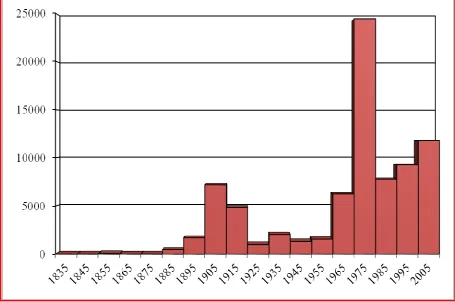
the oldest reliable records dating to the 1830s. There was a period of intense recording activity in Ireland between 1892 and 1914 (Kerney, 1999), with a number of publications in the Irish Naturalist and books cataloguing the species of Ireland (Scharff, 1891, 1892; Stelfox, 1911) (see figure 2 overleaf). The establishment of the Non-Marine Molluscan Database at the National Biodiversity Data Centre
has made it possible to evaluate decline in order to identify species at risk of extinction in Ireland in accordance with the guidelines of the International Union for the Conservation of Nature (IUCN). The IUCN revised its categories and criteria for the red listing of species in 2001 (IUCN, 2001), and in 2003 produced guidelines for using the categories on a regional basis (IUCN, 2003). These were followed
for the production of this Red List.
NOMENCLATURE
The taxonomic checklist (Table 3 in Appendix 1) used here follows Anderson (2005), with the exception of Margaritifera durrovensis. The River Nore population of the pearl mussel has been taxonomically uncertain in the scientific literature (Stelfox, 1929; Chesney et al., 1993; Lucey, 2006)
since its formal description (Phillips, 1928) and has been described as a species (e.g. European Union directive on conservation of natural habitats [92/43/EEC]; Costello et al., 1998), subspecies (e.g. McMillan & Zeissler, 1990; Moorkens et al. 1992), and ecophenotype (e.g. Chesney et al., 1993; Lucey, 2006). We follow the EU Habitats Directive by assigning species to the taxon. Common names follow
Kerney (1999), with the exception of the bivalves, which follow Killeen et al. (2004).
COVERAGE AND DATABASE STRUCTURE
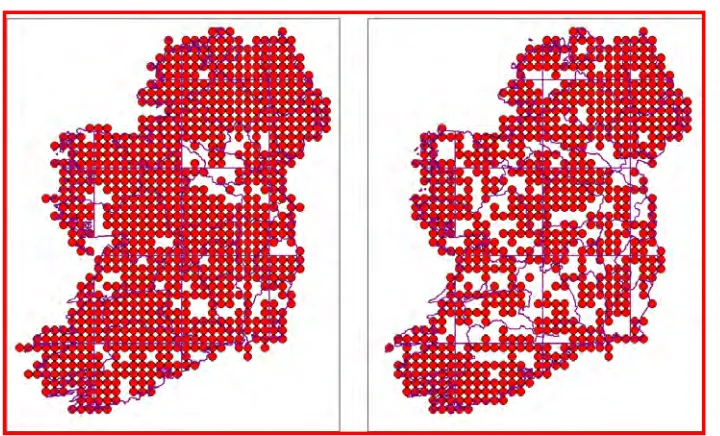
The current Non-Marine Molluscan Database contains approximately 80,000 records and the
[image:7.595.135.495.520.738.2]distribution of these records, pre and post 1980, is shown in Figure 1.
4 The year 1980 was chosen as the point from which to assess decline. However, data is not equally distributed across this time point - 63% of the data is attributed to the earlier recording period and
36% to the more recent period. Despite this, there is reasonable distribution coverage pre- and post-1980, and this year was also used for the Irish bee and water beetle Red Lists (Fitzpatrick et al., 2006; Foster et al., 2009). Coverage at the ten kilometre scale is good for records pre-1980 (up to and including 1979), mainly due to the dedicated efforts of a group of conchologists working at the early
part of the last century and the contributions for the Conchological Society’s mapping scheme which started in 1961. Many of the records post-1980 can again be attributed to the mapping scheme that resulted in the 1999 Atlas of British and Irish Molluscs (Kerney, 1999). Many additional records from species specific projects, publications and consultants’ records were added to the database. Though
there are fewer post-1980 records, the records that do exist are from targeted fieldwork. Thus, rare species, and species of conservation concern, have a good number of records post-1980. Where the recording effort is a problem is with widespread species, where apparent losses may be attributed to
[image:8.595.57.512.334.636.2]the reduced geographic spread of sampling and to the reduced sampling of non-priority habitats.
Figure 2: Distribution of records by decade, excluding the period from 2006 - date. Some records in the database have date ranges spanning more than one decade. These records have been distributed evenly across the date
5 SUMMARY OF EVALUATIONS
The total number of species of non-marine molluscs that have been recorded in Ireland is 177. Of
these, 27 species were considered ‘ineligible for assessment at a regional level’ because they are ‘not a wild population or not within its natural range in the region’, nor are they part of the modern Irish fauna (IUCN, 2003). Eleven are hothouse alien species which are incapable of surviving and reproducing in the wild (Table 3 in Appendix 1) and a further 15 species are considered recent
introductions, one of which is the alien invasive species Dreissena polymorpha. Truncatellina cylindrica was discussed in the Red List workshop, despite the fact that the species is not on the current checklist for Ireland (Anderson, 2005). Kerney (1999) quotes an Irish record from Groomsport, Co. Down, from 1850, however the current consensus among experts is that the specimen is a well preserved subfossil.
Thus, the species is not considered part of the current Irish fauna. All of these species are categorised as ‘Not Applicable’ (na) under IUCN Regional Red List guidelines (Table 3 in Appendix 1).
The remaining 150 species were all evaluated for potential Red List status. Prior to the Red List
workshop held on the 8th of April 2009 at the NPWS offices in Dublin, a list of species qualifying as being of ‘least concern’ was produced. This list was created in a stepwise process:
• A preliminary list was generated initially of species that were
1. widespread, with over 100 10km squares post 1965 in Kerney’s atlas and with records in each of the four provinces of Ireland, and are not declining significantly according to Kerney (1999) and
2. known to be expanding in range.
• This list was then assessed by regional experts (R. Anderson and E. Moorkens); species that the experts considered under threat in Ireland were taken from the least concern list and put forward for evaluation at the workshop, while other species were added to the least concern list.
The least concern list was treated in a conservative fashion and none of the species on the list fulfilled
any of the requirements for an IUCN threat or near threat category. In total, 70 species were considered of least concern. All other species (80) were evaluated during the Red List workshop using maps generated from the non-marine molluscan database of Ireland. The workshop was attended by
Andrew Byrne (National Biodiversity Data Centre), Eugenie Regan (National Biodiversity Data Centre), Ferdia Marnell (NPWS), Naomi Kingston (NPWS), Roy Anderson, Evelyn Moorkens and Ian Killeen.
Six Irish non-marine mollusc species are on the global IUCN Red List of Threatened Species; Vertigo angustior, V. moulinsiana, V. geyeri, Quickella arenaria (= Catinella arenaria), Myxas glutinosa, Margaritifera margaritifera and Margaritifera durrovensis (= M. m. durrovensis) (Mollusc Specialist Group, 1996). The three Vertigo species and Q. arenaria are considered at ‘lower risk’ of global extinction and M. glutinosa
is considered data deficient, although it is worth noting that these species have been considered globally vulnerable in previous assessments (e.g. IUCN, 1990; Groomsbridge, 1994). Margaritifera margaritifera and M. durrovensis (listed as M. margaritifera ssp. durrovensis in the IUCN Red List) are considered endangered and critically endangered respectively. The Vertigo and Margaritifera species
6 regional Red List status of Irish species in other European countries. The Irish populations of ten species are of particular global importance. Of these, the populations of Leiostyla anglica and M. glutinosa make up approximately 50% of estimated global populations, while with Ashfordia granulata
and Zonitoides excavatus Irish populations comprise approximately 20% of a putative global population.
Table 1: Lists of species evaluated as regionally extinct or under threat of regional extinction
Regionally extinct (RE)
Helicigona lapicida (Linnaeus, 1758) Omphiscola glabra (O.F. Müller, 1774)
Critically Endangered (CR)
Pisidium conventus Clessin, 1877 Pomatias elegans (O.F. Müller, 1774)
Margaritifera margaritifera (Linnaeus, 1758) Truncatella subcylindrica (Linnaeus, 1767)
Margaritifera durrovensis Philips, 1928
Endangered (EN)
Gyraulus laevis (Alder, 1838) Pisidium pulchellum Jenyns, 1832
Hydrobia acuta neglecta (Muus, 1963) Pupilla muscorum (Linnaeus, 1758)
Mercuria cf. similis (Draparnaud, 1805) Quickella arenaria (Potiez & Michaud, 1835)
Merdigera obscura (O.F. Müller, 1774) Spermodea lamellata (Jeffreys, 1830)
Myxas glutinosa (O.F. Müller, 1774) Succinella oblonga Draparnaud, 1801
Pisidium moitessierianum Paladilhe, 1866 Vertigo moulinsiana (Dupuy, 1849)
Pisidium pseudosphaerium Schlesch, 1947 Vertigo pusilla Müller, 1774
Vulnerable (VU)
Acicula fusca (Montagu, 1803) Pisidium lilljeborgii Clessin, 1866
Anisus vortex (Linnaeus, 1758) Radix auricularia (Linnaeus, 1758)
Anodonta anatina (Linnaeus, 1758) Sphaerium nucleus (Studer, 1820)
Anodonta cygnea (Linnaeus, 1758) Tandonia rustica (Millet, 1843)
Aplexa hypnorum (Linnaeus, 1758) Testacella haliotidea Draparnaud, 1801
Arianta arbustorum (Linnaeus, 1758) Vallonia pulchella (O.F. Müller, 1774)
Balea perversa (Linnaeus, 1758) Ventrosia ventrosa (Montagu, 1803)
Cecilioides acicula (Müller, 1774) Vertigo angustior Jeffreys, 1830
Cochlodina laminata (Montagu, 1803) Vertigo antivertigo (Draparnaud, 1801)
Helicella itala (Linnaeus, 1758) Vertigo geyeri Lindholm, 1925
Leiostyla anglica (A. Férussac, 1821) Vertigo lilljeborgi (Westerlund, 1871)
Limax cinereoniger Wolf, 1803 Zenobiella subrufescens (J.S. Miller, 1822)
7 Table 1 lists the species evaluated as regionally extinct or under threat of regional extinction in 2009. For this red list, species were considered to be extinct if they had not been recorded since 1979 and
had been specifically searched for in the intervening 30 years. Two species were evaluated as regionally extinct, Helicigona lapicida, which has been searched for but not seen alive since 1968 (Marjory Fogan), and Omphiscola glabra, where the last known population was recorded in 1979 and subsequently lost to habitat destruction (Hurley, 1981). Five were evaluated as critically endangered,
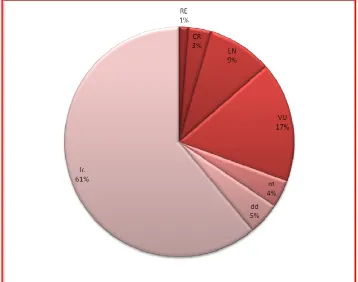
14 as endangered, and 26 as vulnerable. This is a total of 47 out of 150 native species. Therefore almost 30% of the species evaluated had a threat status (Figure 3). A further 6 species (4%) were considered near threatened, and if the current trends of increasing rates of population decline and habitat destruction continue, these species may be elevated to a threatened category in the future.
Figure 3: Percentage of the native Irish non-marine molluscan fauna within each of the IUCN regional Red List categories.
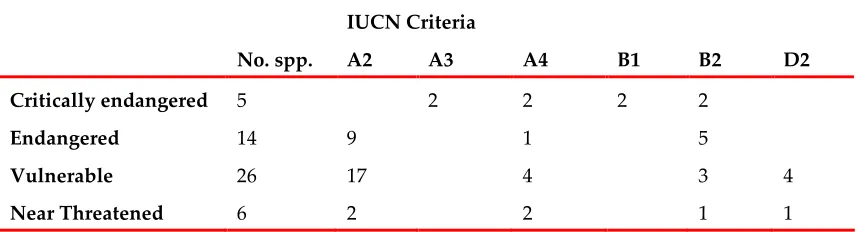
A number of criteria were used as the basis for evaluating species threat category (Table 2). Overall the criterion A2 (a continuing observed or estimated population decline) was used most frequently.
The decline was based on the percentage decline in number of 10km records between pre-1980 and post-1980 taking into account the difference in total number of 10km square records between the two time periods. The final decision, however, was made using expert opinion as well as the data available, for example, whether a lack of records was related to lack of recording effort or an absence
8 presented but, in some cases, experts knew that those sites were no longer suitable. Criteria A1, C, D1 and E were not used as they are based primarily on population counts or quantitative assessments,
[image:12.595.70.500.147.263.2]and are generally not appropriate in assessing invertebrates.
Table 2: Summary of evaluations and breakdown of main IUCN criteria
IUCN Criteria
No. spp. A2 A3 A4 B1 B2 D2
Critically endangered 5 2 2 2 2
Endangered 14 9 1 5
Vulnerable 26 17 4 3 4
Near Threatened 6 2 2 1 1
THE MAPS
The maps cover 56 taxa in alphabetical order. All RE, CR, EN, and NT species are covered, plus a few species of interest from amongst those data-deficient or evaluated of least concern. Two maps are presented for each species - maps on the left represent records from ca. 1835 to 1979; the maps on the
9 CLASS GASTROPODA
Acanthinula aculeata
Prickly Snail IUCN Near Threatened A3c Commoner in the north and west of Ireland. A declining species with 69% decline in records across the island. The species is often
associated with hedgerow and fen margin habitats and may be declining due to habitat loss and lowering of habitat quality.
Acicula fusca
Point Snail IUCN Vulnerable A2c A. fusca is essentially a soil or deep litter
species preferring shaded environments on base-rich strata. A widespread, but declining, species that has had a 55% decline in records
since 1980. A major threat is the loss of rough wet grasslands. This species is a near endemic to Britain and Ireland with small populations in France, Belgium and
10
Anisus vortex
Whirlpool Ram’s Horn IUCN Vulnerable A2c Anisus vortex is found in clear, weedy water
in larger streams, rivers and lakes. It has suffered a 63% distributional decline since 1980. The species is known to be lost from a number of sites where it was previously
recorded. It is a rare species in the major canal systems in Ireland (Royal & Grand Canal) and was rarely encountered in a
recent study (Moorkens & Killeen, 2005). A major factor in its decline is falling water quality.
Aplexa hypnorum
Moss Bladder Snail IUCN Vulnerable A2c
A widespread but declining species in Ireland due to loss of habitat, such as infilling of farm ponds and ditches (Kerney,
1999), and land drainage in general. The species prefers late sucessional habitats, ditches and ephemeral ponds and pools.
Arianta arbustorum
Copse Snail IUCN Vulnerable A2c; B2ab(ii,iii,iv)
A declining species with a fragmented
11 and areas at the base of limestone escarpments.
Ashfordia granulata
Silky Snail IUCN Near Threatened B2ab(ii,iii,iv) This species has suffered a 25% decline in records since 1980, attributed to habitat loss, primarily of lightly wooded habitats and changes in grazing pressures therein. Irish
population is of global importance, supporting >20% of total global population. The species is confined to Britain and Ireland
with outlier populations in north-west France and northern Spain (Kerney, 1999).
Balea perversa
Tree Snail IUCN Vulnerable A4c Despite taxonomic confusion between this
species and Balea heydeni, current knowledge suggests it is a rare and possibly declining species in Ireland. It is vulnerable at the western edge of its global range here, and
may be suffering loss of suitable habitat. The species is especially associated with old, limestone or lime-mortared walls.
Cecilioides acicula
12
Cochlodina laminata
Plaited Door Snail IUCN Vulnerable D2 An arboreal species most frequent in limestone areas, and often seen ascending the
trunks of trees such as beech or ash. The Fermanagh records are considered to comprise a single population, and this species is thus threatened due to the
restricted area of occupancy.
Geomalacus maculosus
Spotted or Kerry Slug IUCN Least Concern Restricted to sandstone areas of Kerry and west Cork. This species has a strong viable population and may be capable of expanding its range with global warming (R. Anderson,
pers. comm.). The Irish population is important in a global context with the Iberian populations being severely threatened. It is protected under European law.
Gyraulus laevis
Smooth Ram’s Horn IUCN Endangered
A2c
A pioneer species frequently occurring in
temporary or new habitats with hard or very slightly saline water, such as farm, coastal and quarry ponds. Severely declining primarily due to the nature of the transitory
13
Helicella itala
Heath Snail IUCN Vulnerable A2c This species has declined by over 60% in
distribution since 1980, primarily within the central limestone plain of Ireland. The species was not assessed as endangered since the coastal populations appear stable.
Habitat loss and changing agricultural practice in grasslands are the major contributing factors in its decline.
Helicigona lapicida
Lapidary Snail IUCN Regionally Extinct Known in Ireland only from limestone bluffs
in the gorge of the River Blackwater, Carrick-a-Brick Castle, Fermoy, East Cork (Phillips, 1914). Its status as a native is questionable
according to Kerney (1972), who failed to find living material during a visit to the site in 1971. No live specimens have been found in recent times. It is known mostly from
limestone rocks and quarries in Britain where it appears to be also declining.
Hydrobia acutaneglecta
IUCN Endangered B2ab(iii,iv) This species occurs in coastal lagoons where incoming freshwaters dilute impounded sea
water and the preferred salinity range has been given as 10-24o/oo (Fretter and Graham, 1978). An extremely rare and declining
14
Leiostyla anglica
English Chrysalis Snail IUCN Vulnerable A2c Common in wet, shaded habitats on neutral
to base-rich soils. Towards the west coast it occupies acid coastal heath and can be found around gorse in rough pasture. A widespread species showing some decline.
Near endemic to Ireland and Britain and more common in Ireland than elsewhere in Europe (Kerney, 1999). The Irish population
accounts for at least 50% of the global population.
Limax cinereoniger
Ash-black Slug IUCN Vulnerable A2c Republic of Ireland: A2c Northern Ireland: LC Mostly recorded from old, minimally disturbed broadleaf woodlands or on cliffs
with relic woodland vegetation on western coasts. Population decline is confined to the Republic of Ireland and may be related to forestry practices there.
Mercuria cf. similis
Swollen Spire Snail IUCN Endangered B2ab(ii,iii) This species has a very limited distribution, with two fragmented populations in the
Suir/Barrow and Shannon estuaries. There is a 33% recorded decline with some historical sites being lost (e.g. Tramore; A. Byrne, pers. comm.). The Irish population is significant
15
Merdigera obscura
Lesser Bulin IUCN Endangered A2c A habitat specialist particularly associated
with calcareous escarpments and calcareous woodlands. Severe declines of 75% in its recorded distribution in Ireland have been noted since 1980, likely due to habitat loss.
Myxas glutinosa
Glutinous Snail IUCN Endangered A2c This is a declining species, primarily due to habitat degradation through eutrophication, with populations in Ireland fragmenting. The Irish population is considered globally
important (up to 50% of the global population (E. Moorkens & I. Killeen, pers. comm.)). A globally threatened species
(IUCN).
Omphiscola glabra
Mud Pond Snail IUCN Regionally Extinct Always one of the rarest of Irish molluscs, its
history in Ireland is reviewed by Hurley (1981). A colony was reported by Roche (1929) from Ballymacar Bridge, Shelmaliere Commons, near New Ross, Co. Wexford.
16
Otina ovata Ear Snail IUCN Least Concern A member of the upper tidal crevice fauna, but extremely localised in Ireland. It can be
regarded as near-endemic to Britain and Ireland. The Irish population is globally important, though not threatened.
Oxyloma sarsi
Slender Amber Snail IUCN Data Deficient Added to the Irish list by Holyoak and
Holyoak (2004). Found on the banks of the R. Shannon north of Portumna, South-east Galway.
Pomatias elegans Round-mouthed Snail IUCN Critically Endangered B2ab(iii) With a very restricted range in Ireland, and found only at one small site near New Quay,
Co. Clare (Platts, 1977). Within the northern part of its range this species is confined to highly calcareous soils. At New Quay it has been found on limestone pavement close to
17
Pupilla muscorum
Moss Chrysalis Snail IUCN Endangered A2 c This species is restricted to dry, calcareous,
inland habitats, coastal dune systems and coastal calcareous rock exposures. It has suffered a 66% distributional decline in Ireland. The severe losses in central areas
may be due to loss of semi-natural calcareous grasslands. The coastal populations are becoming increasingly rare
and local. Under grazing may be a major threat to the species.
Quickella arenaria
Sand-bowl Amber Snail IUCN Endangered B2ab(i,ii,iii,iv) A species of sparsely vegetated dune hollows and grazed, sparsely vegetated
flood plains of larger lakes. The Irish population is globally important, with Dooaghtry in Co. Mayo possibly the most important site in the world (R. Anderson &
E. Moorkens, pers. comm.). It is threatened by habitat destruction, with the three sites in Offaly and North Tipperary shown in the
post-1980 map having been lost recently (E. Moorkens, pers. comm.).
Radix auricularia
Ear Pond Snail IUCN Vulnerable A2c This species has declined in recorded distribution by over 30% since 1980. It is
18
Spermodea lamellata
Plaited Snail IUCN Endangered A2c A classic 'Atlantic' species restricted to the
fringes of north-west Europe. Preferred habitats are older broadleaf woodlands where it inhabits deep, stable leaf litter. It has suffered severe distributional decline in
the last 30 years in Ireland (73% reduction in records). Drier summers and woodland habitat management are two likely drivers of
the loss of this species. Ireland has a significant proportion of the global population.
Succinella oblonga
Small Amber Snail IUCN Endangered A2c A declining species across Ireland with
considerable distributional (68%) and population losses. The species has declined mainly due to habitat destruction. The species requires open sites, often
short-cropped grazed habitats. With the advent of increased eutrophication sward height has increased in a number of sites, making
19
Tandonia rustica Large or Rustic Keeled Slug (also known as
the Bulb-eating slug) IUCN Vulnerable D2 The species is found abundantly in leaf litter
of old semi-natural woods around Blarney Castle to the west of the town, but nowhere else in the vicinity. There is no indication
that it is an introduction, more likely a rare and restricted native (R. Anderson, pers. comm.)
Notes on Testacella spp.
All Testacella species are probably under-recorded due to their subterranean life habits. They are all
carnivorous ‘semi-slugs’ that spend most of their life under the ground in loamy soils hunting earth worms. They are rarely seen unless dug up. The continuing spread of the New Zealand flatworm Arthurdendyus triangulatus, which is a potentially competitive earthworm predator, gives cause for concern. The data and best expert judgement suggests that T. scutulum is not of conservation concern
at present, but the other two species are presented below. All three are possible introductions as remains have not been detected in postglacial deposits.
Testacella maugei
Maugé’s Shield Slug IUCN Near Threatened D2 Like the other species of Testacella, this is an earthworm predator living in deep, friable
20
Testacella haliotidea Common Shield Slug
IUCN Vulnerable D2 Always localised and rare with sites scattered across Ireland. Recent records are
for a wooded site in Cork. Although under-recorded, there appears to be a real decline in this species (R. Anderson, pers. comm.).
Truncatella subcylindrica Looping Snail IUCN Critically Endangered B1ab(i,ii,iii,iv) Recently added to the Irish List from two
sites on inner Galway Bay (M31, M32), Carrowmore lagoon and Rincarna lagoons (coll. S. M. Smith, 2000). The species is at the
northern edge of its geographic range in Ireland but several sites have been added since discovered.
Vallonia pulchella
Beautiful Grass Snail IUCN Vulnerable A2c This species mainly occurs in pasture on the
21
Ventrosia ventrosa
Spire Snail IUCN Vulnerable B2ab(iii) Republic of Ireland: VU B2ab(iii) Northern Ireland: CR B2ab(iii) This is a specialist habitat species inhabiting non-tidal lakes or ponds that are inundated
with saltwater only infrequently. Apart from continuing damage to amphi-saline coastal lagoons, mainly by agricultural activities, the
reasons for its decline are poorly known.
Vertigo antivertigo
Marsh Whorl Snail IUCN Vulnerable A1c Locally frequent across Ireland in fens, marshes, lakeshores and riverbanks. However, it has experienced greater than 30% distributional decline since 1980. This is
22
Vertigo geyeri
Geyer’s Whorl Snail IUCN Vulnerable A2c The principal habitat for this species is relict base-rich flushes within more complex
habitat mosaics that can contain raised bog laggs, transition mires, lake shores, hill or mountain slopes, and wetlands associated with coastal dunes and machair (Moorkens,
2003). Targeted recording of this species has increased the number of 10km square records since 1980. However, this species is
considered to be declining due to habitat loss (E. Moorkens and I. Killeen, pers. comm.). It is very habitat specific and the Irish
population is important in a global context.
Vertigo lilljeborgi
Lilljeborg’s Whorl Snail IUCN Vulnerable A2c V. lilljeborgi is confined to exposed lakeshores
on limestone where it inhabits lakeshore flushes or strand-line jetsam. It has suffered a distributional decline since 1980 due to
23
Vertigo moulinsiana
Des Moulins’ Whorl Snail IUCN Endangered A4c This species mainly inhabits calcareous lowland wetlands, particularly swamps,
fens and marshes with tall vegetation. It appears to have declined due to habitat loss since 1980 and is expected to further decline in the future due to continuing decline in
habitat quality (E. Moorkens & I. Killeen, pers. comm.).
Vertigo pusilla
Wall or Wry-necked Whorl Snail IUCN Endangered A2c Northern Ireland: RE V. pusilla has had a 58% distributional decline
since 1980. Historic sites have been revisited and the species has not been refound. Records mainly relate to sheltered walls in
woodland or fixed dune habitat.
Vertigo pygmaea Common Whorl Snail IUCN Near Threatened A4c A calcareous grassland species that has
24
Vertigo substriata
Striated Whorl Snail IUCN Near Threatened A4c V. substriata is recorded principally from transition mires, but also occupies wet
woodland, particularly in the west. It has suffered similar losses to that of V. pygmaea.
Vertigo angustior
Narrow-mouthed Whorl Snail IUCN Vulnerable A2c This species was widespread in Britain and Ireland in the early Postglacial but is now localised and rare. Its main habitats comprise fixed dunes along the west and north coasts
of Ireland and hydrogeologically stable marshes in the central plain. The Irish population is of global importance.
Zenobiella subrufescens
Brown Snail IUCN Vulnerable A2c This is an old woodland relict species that
25
Zonitoides excavatus
Hollowed Glass Snail IUCN Vulnerable A2c This species is associated with rough acid
habitats, including rough Juncus pasture and old oak woodland margins. The Irish population is considered of global importance, comprising up to 20% of the
world population. The species is a near Britain and Ireland endemic, with other populations only in coastal regions adjacent
26 CLASS BIVALVIA
Order Unionoida
Anodonta anatina
Duck Mussel IUCN Vulnerable A4ce This species is widespread over most of lowland Ireland except the extreme west
and north. It was formerly under-recorded due to confusion with Anodonta cygnea. It has been badly impacted by Dreissena
polymorpha invasion of its habitats and is projected to decline even further as a direct result of continued range expansion by Dreissena, most recently into the Lough
Neagh catchment.
Anodonta cygnea Swan Mussel IUCN Vulnerable A4ce This is a species of stagnant muddy or silty habitats in larger water bodies. Similar to A. anatina, it is being significantly impacted by
27
Margaritifera margaritifera
Freshwater Pearl Mussel IUCN Critically Endangered A3cde+4cde Extensive surveys for this species in recent decades have enhanced our knowledge of its
range in Ireland, at the same time as it continues to decline due to reduced water quality, increased siltation and to physical interference with its habitat. Of the
remaining Irish populations only a handful are recruiting young and at least 90% have such depleted water quality and river bed
conditions that they will probably never breed successfully again (Moorkens, 2006).
Margaritifera durrovensis1 Nore Freshwater Pearl Mussel
IUCN Critically Endangered A3cde+4cde; B1ab(i,ii,iii,iv,v) Margaritifera durrovensis is a unique hard water form of Margaritifera margarifera which
is only known from the Nore River. This population is under threat due to declining river bed and water quality in its habitat (Moorkens, 2006). The reasons for its decline
are therefore similar to those listed for M. margaritifera.
1 The taxonomy of this species is particularly contentious, and debate still continues as to its true taxonomic status. We use
28
Musculium lacustre
Lake (or capped) Orb Mussel IUCN Vulnerable A2c
M. lacustre is a species mainly of small, temporary wetland habitats, including
swamps, ponds, vegetated margins of rivers, and areas subject to seasonal flooding around large lakes. It is highly tolerant of poor water quality and anoxic conditions but
is intolerant of competition from other species and of more permanent conditions. Its decline is probably related to agricultural
drainage activities and consequent habitat loss and deterioration.
Pisidium conventus
Arctic-Alpine Pea Mussel IUCN Critically Endangered B2ab(i,ii,iii,iv) P. conventus is an arctic species that in Ireland is restricted to deep or very cold lakes in the north and west. Both known sites
29
Pisidium hibernicum
Globular Pea Mussel IUCN Near Threatened A2c The decline shown may be as a result of less
surveying for the species. However, the absence of recent records from the south-east merits an assessment as Near Threatened. Specific drivers of decline are unknown, but
it is listed as impacted by continuing climate change in other regions (Hering, 2006). In The Netherlands it is threatened by organic
and chemical pollution (Bruyne et al., 2003).
Pisidium lilljeborgii
Lilljeborg’s Pea Mussel IUCN Vulnerable A4c This is a species of deep, clear lakes in upland areas but also occurs in larger
habitats in low-lying areas of the west and north. The distributional decline is possibly due to changes in lake water quality.
Pisidium moitessierianum Moitessier Pea Shell
IUCN Endangered B2ab(i,iii,iv) Northern Ireland: Regionally Extinct P. moitessierianum is characteristic of slow-flowing, moderately calcareous rivers. Thought to be extinct at one time but
discovered along the Royal and Grand Canals by Moorkens and Killeen (2005). It has since been recorded from Lough Conn,
Co. Mayo (I. Killeen & E. Moorkens, pers. comm.). It is rare and restricted in its distribution, and probably sensitive to
30
Pisidium pseudosphaerium False Orb Pea Mussel
IUCN Endangered B2ab(i,iii,iv) Northern Ireland: Regionally Extinct This species lives in richly vegetated, swampy habitats with clean, standing water and a muddy substrate. Most Irish records
are from sections of the Grand and Royal Canals and their feeders. It is being lost through dredging. The only known Northern Irish population has been lost and it is
considered extinct there (R. Anderson, pers. comm.).
Pisidium pulchellum
Iridescent Pea Mussel IUCN Endangered A2c P. pulchellum has had an apparent 81%
distributional decline since 1980. Confined to low trophic status, calcareous lakes, drains, streams, and canals, decline is due to
eutrophication and habitat loss.
Sphaerium nucleus
Swamp Orb Mussel IUCN Vulnerable D2 S. nucleus was not recognised in Ireland until 2003 (Moorkens 2005) having previously been confused with S. corneum. The species
remains under-recorded but has been found in transition mires (R. Anderson, pers. comm.), swamps and overgrown ditches (I.
Killeen & E. Moorkens, pers. comm.), and also turloughs in the west (R. Anderson & C. Williams, pers. comm). There are ten 10 km
31 REFERENCES
ANDERSON, R. (2005) An Annotated List of the Non-Marine Mollusca of Britain & Ireland, Journal of Conchology, London, 38: 607-638.
ANDERSON, R. (Ed.) (in prep.) The Non-Marine Mollusca of Ireland. National Museums of Northern Ireland, Belfast.
BRATTON, J.H. (1991) British Red Data Books: 3. Invertebrates other than Insects. Joint Nature Conservation Committee. Peterborough.
BRUYNE, R.H. dE, WALLBRINK, H. and GMELIG MEYLING, A.W. (2003) Bedreigde en verdwenen land- en zoetwaterweekdieren in Nederland (Mollusca). – European Invertebrate Survey - Nederland, Leiden and Stichting ANEMOON, Heemstede.
CHESNEY, H.C.G., OLIVER, P.G. and DAVIS, G.M. (1993) Margaritifera durrovensis Phillips, 1928: taxonomic status, ecology and conservation. Journal of Conchology, 34: 267-299.
COSTELLO, M., MOORKENS, E., LARKIN, E., KURZ, M. and DOWSE, J. (1998). Management priorities for the River Nore (Ireland) to conserve the pearl mussel Margaritifera durrovensis. Journal of Conchology Special Publication 2: 257-264.
FITZPATRICK, U. MURRAY, T.E. PAXTON, R.J. and BROWN, M.J.F. (2007). Building on IUCN regional red lists to produce lists of species of conservation priority: A model with Irish bees. Conservation Biology, 21, (5): 1324 – 1332.
FITZPATRICK, U., MURRAY, T.E., BYRNE, A., PAXTON, R.J. and BROWN, M.J.F. (2006) Regional Red List of Irish Bees. Unpublished report to the National Parks & Wildlife Service (Ireland) & Environment & Heritage Service (Northern Ireland).
FOSTER, G. N., NELSON, B. H. and O CONNOR, Á. (2009) Ireland Red List No. 1 – Water beetles. National Parks & Wildlife Service, Department of Environment, Heritage & Local Government, Dublin, Ireland.
FRETTER, V. and GRAHAM, A. (1978) The prosobranch mollusks of Britain & Denmark; Part 3: Neritacea, Viviparacea, Valvatacea, terrestrial & fresh water Littorinacea & Rissoacea. Journal of Molluscan Studies Supplement 5:101-150.
GROOMBRIDGE, B. (ed.) (1994) 1994 IUCN Red List of Threatened Animals. IUCN, Gland, Switzerland.
HERING, D. (2006) Key indicator species of climate change impacts. Report on key deliverables from the Euro-limpacs project (Integrated Project to evaluate the Impacts of Global Change on European Freshwater Ecosystems).
HOLYOAK, G.A. and HOLYOAK, D.T. (2004) Oxyloma sarsi (Esmark) (Gastropoda: Succineidae) living in Ireland.
32 HURLEY, J. (1981) A history of the occurrence of Lymnaea glabra (Gastropoda:Pulmonata) in Ireland. Irish
Naturalist’s Journal. 20: 284-287
IUCN (1990) 1990 IUCN Red List of Threatened Animals. IUCN, Gland, Switzerland & Cambridge, UK.
IUCN (2001) IUCN Red List Categories and Criteria. Version 3.1. IUCN, Gland, Switzerland and Cambridge, UK.
IUCN (2003) Guidelines for Application of IUCN Red List Criteria at Regional Levels: Version 3.0. IUCN Species Survival Commission. IUCN, Gland, Switzerland & Cambridge, UK. ii + 26 pp.
KERNEY, M. (1972) Mapping non-marine Mollusca in south-west Ireland, summer 1971. Irish Naturalists' Journal
17: 182-185.
KERNEY, M. (1999) Atlas of the land & freshwater molluscs of Britain & Ireland. Harley Books, Colchester.
KILLEEN, I., ALDRIDGE, D. and OLIVER, G. (2004) Freshwater Bivalves of Britain & Ireland. Field Studies Council Occasional Publication 82, U.K.
LUCEY, J. (2006) The pearl mussel, Margaritifera margaritifera (L.), in hard water in Ireland. Biology & Environment: Proceedings of the Royal Irish Academy, 106, 143-153.
MCMILLAN, N. and ZEISSLER, H. (1990) Recent & fossil Mollusca of the Rivers Barrow, Nore & Suir, south-east Ireland. Bulletin of the Irish Biogeographical Society 13: 189-199.
MOLLUSC SPECIALIST GROUP (1996) Margaritifera margaritifera ssp. durrovensis. In: IUCN 2008. 2008 IUCN Red List of Threatened Species. <www.iucnredlist.org>. Accessed 14 May 2009.
MOORKENS, E.A. (2003) Final Baseline Report on Molluscan Surveys of Pollardstown Fen 1998-2003. Report to Kildare County Council.
MOORKENS, E.A. (2005) News from Ireland, Mollusc World, 7: 8-9.
MOORKENS, E.A. (2006) Irish non-marine molluscs – an evaluation of species threat status. Bulletin of the Irish Biogeographical Society 30: 348-371.
MOORKENS, E.A. and KILLEEN, I. (2005) The aquatic mollusc fauna of the Grand & Royal Canals, Ireland.
Bulletin of the Irish biogeographical Society. 29: 143-193.
MOORKENS, E.A., COSTELLO, M.J. and SPEIGHT, M.C.D. (1992) Status of the freshwater pearl mussels
Margaritifera margaritifera & M. m. durrovensis in the Nore, Barrow & Suir river tributaries, south-east Ireland. Irish Naturalists’ Journal 24: 127-131.
PHILLIPS, R.A. (1914) Helicigona lapida in Ireland. Irish Naturalist 23: 37-38.
PHILLIPS, R.A. (1928) On Margaritifera durrovensis, a new species of pearl mussel from Ireland. Proceedings of the Malacological Society of London, 18: 69-74.
33 ROCHE, G. (1929) The pond snail, Limnaea glabra, rediscovered in Ireland. Irish Naturalists' Journal 2: 182.
SCHARFF, R.F. (1891) The slugs of Ireland. Royal Dublin Society.
SCHARFF, R.F. (1892) The Irish Land & Freshwater Mollusca. Irish Naturalist, 1: 45-47; 65-67; 87-90; 105-109; 135-138; 149-153; 177-181.
STELFOX, A.W. (1911) A List of the land and freshwater Mollusks of Ireland. Proc. R. Ir. Acad. 29 B: 65–164.
34 APPENDIX 1:CHECKLIST OF IRISH NON-MARINE MOLLUSCS
Table 3: Checklist of Irish non-marine molluscs (following Anderson (2005) except for Margaritifera durrovensis
which follows the EU Habitats Directive). Φ Refers to the number of 10 km squares in which the species has been recorded pre- and post- 1980. RE = regionally extinct, CR = critically endangered, EN = endangered, VU = vulnerable, NT = near threatened, dd = data deficient, lc = least concern, na = not applicable (a taxon is not applicable when evaluation against the criteria is not possible if the species has been introduced, is a vagrant, or
if the species is an immigrant and has been in the country for less than 10 years).
Assessment Criteria Φ Pre-1980 Φ Post-1980
CLASS GASTROPODA ORDER NERITOPSINA
FAMILY NERITIDAE
Theodoxus fluviatilis (Linnaeus, 1758) lc
ORDER ARCHITAENIOGLOSSA
FAMILY ACICULIDAE
Acicula fusca (Montagu, 1803) VU A2c 122 55
FAMILY VIVIPARIDAE
Viviparus viviparus (Linnaeus, 1758) na
ORDER NEOTAENIOGLOSSA
FAMILY ASSIMINEIDAE
Assiminea grayana Fleming, 1828 na FAMILY BITHYNIIDAE
Bithynia tentaculata (Linnaeus, 1758) lc Bithynia leachii (Sheppard, 1823) lc FAMILY HYDROBIIDAE
Hydrobia acuta neglecta (Muus, 1963) EN B2ab (iii, iv) 2 4 Mercuria cf. similis (Draparnaud, 1805) EN B2ab (ii,iii) 9 6 Peringia ulvae (Pennant, 1777) lc
Potamopyrgus antipodarum (J.E. Gray, 1843) na
Ventrosia ventrosa (Montagu, 1803) VU B2ab(iii)† 9 14
FAMILY POMATIIDAE
Pomatias elegans (O.F. Müller, 1774) CR B2ab(iii) 1 1
FAMILY TRUNCATELLIDAE
Truncatella subcylindrica (Linnaeus, 1767) CR B1ab(i-iv) 0 2
ORDER ECTOBRANCHIA
FAMILY VALVATIDAE
Valvata piscinalis (O.F. Müller, 1774) lc Valvata cristata O.F. Müller, 1774 lc
ORDER PULMONATA
FAMILY ACROLOXIDAE
Acroloxus lacustris (Linnaeus, 1758) lc FAMILY AGRIOLIMACIDAE
Deroceras agreste (Linnaeus, 1758) dd 0 1
Deroceras laeve (O.F. Müller, 1774) lc Deroceras panormitanum (Lessona & Pollonera, 1882) na Deroceras reticulatum (O.F. Müller, 1774) lc FAMILY ARIONIDAE
Arion ater (Linnaeus, 1758) lc
Arion flagellus Collinge, 1893 lc Arion rufus (Linnaeus, 1758) lc Arion vulgaris Moquin-Tandon, 1855 na
Arion fuscus (O.F. Müller, 1774) dd 0 2
35 Assessment Criteria Φ Pre-1980 Φ Post-1980 Arion intermedius Normand, 1852 lc
Arion occultus Anderson, 2004 dd 0 2
Arion owenii Davies, 1979 lc
Geomalacus maculosus Allman, 1843 lc FAMILY BOETTGERILLIDAE
Boettgerilla pallens Simroth, 1912 na FAMILY CARYCHIIDAE
Carychium minimum O.F. Müller, 1774 lc Carychium tridentatum (Risso, 1826) lc FAMILY CLAUSILIIDAE
Balea perversa (Linnaeus, 1758) VU A4c 3 13
Balea heydeni Von Maltzan, 1881 lc Clausilia bidentata (Ström, 1765) lc
Cochlodina laminata (Montagu, 1803) VU D2 12 12
FAMILY COCHLICELLIDAE
Cochlicella acuta (O.F. Müller, 1774) lc FAMILY COCHLICOPIDAE
Cochlicopa cf. lubrica (O.F. Müller, 1774) lc Cochlicopa cf. lubricella (Rossmässler, 1834) lc FAMILY DISCIDAE
Discus rotundatus (O.F. Müller, 1774) lc FAMILY ELLOBIIDAE
Leucophytia bidentata (Montagu, 1808) lc
Myosotella denticulata (Montagu, 1803) dd 0 1
Myosotella myosotis (Draparnaud, 1801) lc
Merdigera obscura (O.F. Müller, 1774) EN A2c 49 12
FAMILY EUCONULIDAE
Euconulus cf. alderi (J.E. Gray, 1840) lc Euconulus cf. fulvus (O.F. Müller, 1774) lc FAMILY FERUSSACIIDAE
Cecilioides acicula (O.F. Müller, 1774) VU A2c B2ab(ii-iv) 67 9 FAMILY GASTRODONTIDAE
Zonitoides nitidus (O.F. Müller, 1774) lc
Zonitoides excavatus (Alder, 1830) VU A2c FAMILY HELICIDAE
Arianta arbustorum (Linnaeus, 1758) VU A2c B2 ab (ii-iv) 27 17 Cepaea nemoralis (Linnaeus, 1758) lc
Cepaea hortensis (O.F. Müller, 1774) lc Cornu aspersum (O.F. Müller, 1774) lc
Helicigona lapicida (Linnaeus, 1758) RE 1 0
Theba pisana (O.F. Müller, 1774) na FAMILY HYGROMIIDAE
Ashfordia granulata (Alder, 1830) nt B2ab(ii-iv) 46 36
Candidula gigaxii (L. Pfeiffer, 1850) dd 3 0
Candidula intersecta (Poiret, 1801) lc Cernuella virgata (Da Costa, 1778) lc
Helicella itala (Linnaeus, 1758) VU A2c 350 135
Hygromia cinctella (Draparnaud, 1801) na Trochulus hispidus (Linnaeus, 1758) lc Trochulus striolatus (C. Pfeiffer, 1828) lc
Zenobiella subrufescens (J.S. Miller, 1822) VU A2c 115 43 FAMILY LAURIIDAE
Lauria cylindracea (Da Costa, 1778) lc
Leiostyla anglica (A. Férussac, 1821) VU A2c 398 152
FAMILY LIMACIDAE
36 Assessment Criteria Φ Pre-1980 Φ Post-1980
Limax cinereoniger Wolf, 1803 VU A2c* 36 32
Limax maximus Linnaeus, 1758 lc Malacolimax tenellus (O.F. Müller, 1774)
FAMILY LYMNAEIDAE
Galba truncatula (O.F. Müller, 1774) lc Lymnaea stagnalis (Linnaeus, 1758) lc Lymnaea fuscus (C. Pfeiffer, 1821) lc
Myxas glutinosa (O.F. Müller, 1774) EN A2c 29 18
Omphiscola glabra (O.F. Müller, 1774) RE 3 1
Radix auricularia (Linnaeus, 1758) VU A2c 78 28
Radix balthica (Linnaeus, 1758) lc FAMILY MILACIDAE
Milax gagates (Draparnaud, 1801) lc Tandonia budapestensis (Hazay, 1881) na
Tandonia rustica (Millet, 1843) VU D2 2 2
Tandonia sowerbyi (A. Férussac, 1823) lc FAMILY OTINIDAE
Otina ovata (Brown, 1827) lc
FAMILY OXYCHILIDAE
Aegopinella pura (Alder, 1830) lc Aegopinella nitidula (Draparnaud, 1805) lc Nesovitrea hammonis (Ström, 1765) lc Oxychilus alliarius (J.S. Miller, 1822) lc Oxychilus cellarius (O.F. Müller, 1774) lc Oxychilus draparnaudi (Beck, 1837) lc Oxychilus navarricus (Bouguignat, 1870) na FAMILY PHYSIDAE
Aplexa hypnorum (Linnaeus, 1758) VU A2c
Physa fontinalis (Linnaeus, 1758) lc Physella acuta (Draparnaud, 1805) na
Physella gyrina (Say, 1821) na
FAMILY PLANORBIDAE
Ancylus fluviatilis Müller, 1774 lc Anisus leucostoma (Millet, 1813) lc
Anisus spirorbis (L., 1758) dd 0 2
Anisus vortex (Linnaeus, 1758) VU A2c 88 34
Bathyomphalus contortus (Linnaeus, 1758) lc Ferrissia wautieri (Mirolli, 1860) lc Gyraulus crista (Linnaeus, 1758) lc Gyraulus albus (O.F. Müller, 1774) lc
Gyraulus laevis (Alder, 1838) EN A2c 50 10
Hippeutis complanatus (Linnaeus, 1758) lc Planorbarius corneus (Linnaeus, 1758) lc Planorbis planorbis (Linnaeus, 1758) lc Planorbis carinatus O.F. Müller, 1774 lc FAMILY PRISTILOMATIDAE
Vitrea contracta (Westerlund, 1871) lc Vitrea crystallina (O.F. Müller, 1774) lc FAMILY PUNCTIDAE
Punctum pygmaeum (Draparnaud, 1801) lc FAMILY PUPILLIDAE
Pupilla muscorum (Linnaeus, 1758) EN A2c 140 48
FAMILY PYRAMIDULIDAE
Pyramidula pusilla (Vallot, 1801) lc FAMILY SUCCINEIDAE
Oxyloma elegans (Risso, 1826) lc
Oxyloma sarsii (Esmark, 1886) dd 0 3
37 Assessment Criteria Φ Pre-1980 Φ Post-1980
Succinella oblonga Draparnaud, 1801 EN A2c 40 13
FAMILY TESTACELLIDAE
Testacella haliotidea Draparnaud, 1801 VU D2 10 1
Testacella maugei A. Férussac, 1819 nt D2 6 2
Testacella scutulum Sowerby, 1820 lc FAMILY VALLONIIDAE
Acanthinula aculeata (O.F. Müller, 1774) nt A2c 199 61
Spermodea lamellata (Jeffreys, 1830) EN A2c 171 46
Vallonia costata (O.F. Müller, 1774) lc Vallonia cf. excentrica Sterki, 1893 lc
Vallonia pulchella (O.F. Müller, 1774) VU A2c 217 73
FAMILY VERTIGINIDAE
Columella aspera Waldén, 1966 lc Columella edentula (Draparnaud, 1805) lc Truncatellina cylindrica (A. Férussac, 1807) na
Vertigo antivertigo (Draparnaud, 1801) VU A2c 280 142
Vertigo geyeri Lindholm, 1925 VU A2c 8 26
Vertigo lilljeborgi (Westerlund, 1871) VU A2c 10 17
Vertigo moulinsiana (Dupuy, 1849) EN A4c 29 27
Vertigo pusilla O.F. Müller, 1774 EN A2c♦ 12 5
Vertigo pygmaea (Draparnaud, 1801) nt A4c 337 195
Vertigo substriata (Jeffreys, 1833) nt A4c 188 106
Vertigo angustior Jeffreys, 1830 VU A2c 19 34
FAMILY VITRINIDAE
Semilimax pyrenaicus (A. Férussac, 1821) lc Vitrina pellucida (O.F. Müller, 1774) lc
CLASS BIVALVIA ORDER UNIONOIDA
FAMILY MARGARITIFERIDAE
Margaritifera margaritifera (Linnaeus, 1758) CR A3cde A4cde 71 153 Margaritifera durrovensis Philips 1928 CR A3cde A4cde
B1ab(i-v) 7 3
FAMILY UNIONIDAE
Anodonta anatina (Linnaeus, 1758) VU A4ce 14 36
Anodonta cygnea (Linnaeus, 1758) VU A4ce 54 29
ORDER VENEROIDA
FAMILY DREISSENIDAE
Dreissena polymorpha (Pallas, 1771) na FAMILY SPHAERIIDAE
Musculium lacustre (O.F. Müller, 1774) VU A2c 59 19
Pisidium amnicum (O.F. Müller, 1774) lc Pisidium casertanum (Poli, 1791) lc
Pisidium conventus Clessin, 1877 CR B2ab(i-iv) 2 0
Pisidium henslowanum (Sheppard, 1823) lc
Pisidium hibernicum Westerlund, 1894 nt A2c 128 34
Pisidium lilljeborgii Clessin, 1866 VU A4c 38 19
Pisidium milium Held, 1836 lc
Pisidium moitessierianum Paladilhe, 1866 EN B2ab(i,iii,iv) 6 7 Pisidium nitidum Jenyns, 1832 lc
Pisidium obtusale (Lamarck, 1818) lc Pisidium personatum Malm, 1855 lc
Pisidium pseudosphaerium Schlesch, 1947 EN B2ab(i,iii,iv) 5 6
Pisidium pulchellum Jenyns, 1832 EN A2c 59 11
Pisidium subtruncatum Malm, 1855 lc Sphaerium corneum (Linnaeus, 1758) lc
Sphaerium nucleus (Studer, 1820) VU D2 0 3
38 Assessment Criteria Φ Pre-1980 Φ Post-1980
CLASS GASTROPODA ORDER NEOTAENIOGLOSSA
FAMILY THIARIDAE
Melanoides tuberculatus (O.F. Müller, 1774) na
ORDER PULMONATA
FAMILY GASTRODONTIDAE
Zonitoides arboreus (Say, 1816) na FAMILY HELICODISCIDAE
Helicodiscus parallelus (Say, 1821) na Radix rubiginosa (Michelin, 1831) na FAMILY PLANORBIDAE
Gyraulus chinensis (Dunker, 1848) na Planorbella duryi (Wetherby, 1879) na FAMILY PLEURODISCIDAE
Pleurodiscus balmei (Potiez & Michaud, 1838) na FAMILY SUBULINIDAE
Allopeas clavulinum (Potiez & Michaud, 1838) na Opeas hannensis (Rang, 1831) na Subulina octona (Bruguière, 1789) na FAMILY ZONITIDAE
Hawaiia minuscula (Binney, 1840) na
*Limax cinereoniger has been assessed as VU A2c in the Republic of Ireland and lc in Northern Ireland. The All-Ireland assessment is VU A2c.
†Ventrosia ventrosa has been assessed as VU B2ab(iii) in the Republic of Ireland and CR B2ab(iii) in Northern Ireland. The All-Ireland assessment is VU B2ab(iii).
39 APPENDIX 2:NOTES ON NON-MARINE MOLLUSCAN RED LISTS IN EUROPE
Red list or conservation assessment coverage seems to be better for non-marine molluscs than other
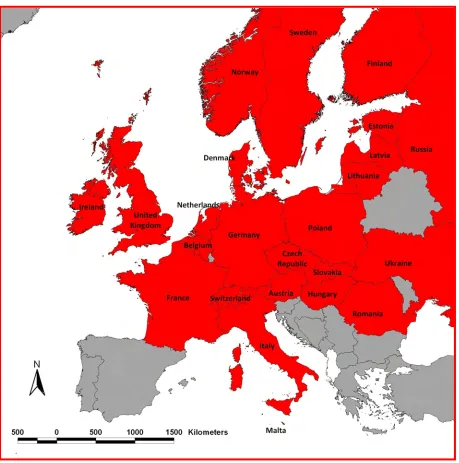
invertebrate groups with assessments from 24 countries assembled here (compared with 13 assessments quoted for bees (Fitzpatrick et al., 2006) and 12 assessments quoted for water beetles (Foster et al., 2009)). In addition to national red lists, detailed subnational (e.g. Alsace) and supranational (e.g. Carpathian region) red lists were assembled. There is a European red list (United
Nations, 1991) in existence, though this list is considered out of date in light of more European countries producing conservation assessments. A new European Red List is being produced for molluscs and is scheduled for release in 2011.
The red data book listing invertebrates, other than insects, for Britain was published in 1991 (Bratton, 1991) by the Joint Nature Conservation Committee (JNCC). The book uses the same criteria as that of the 1983 IUCN Invertebrate Red List (Wells et al., 1983), with K designation representing ‘Insufficiently Known’ species. The molluscan species that also occur in Ireland were evaluated
mainly by Michael Kerney, with additions from D.R. Seaward, J.M. Breeds, M.R. Hughes, M.J. Willing, and with reference to Fretter and Graham (1978). (GB ’91)
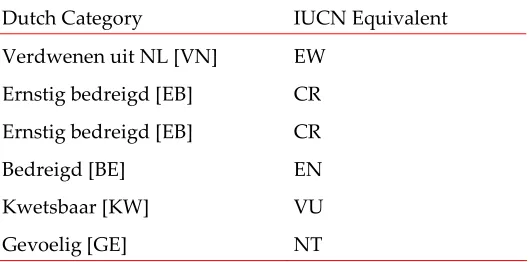
[image:43.595.181.446.409.540.2]The Dutch Red List was completed in 2003 by Bruyne et al. They used a different system to evaluate the species, however they included a guide to convert their assessments into the IUCN format (Table 4). (NL ‘03)
Table 4: The Dutch Red List categories and their IUCN equivalents.
Dutch Category IUCN Equivalent
Verdwenen uit NL [VN] EW
Ernstig bedreigd [EB] CR
Ernstig bedreigd [EB] CR
Bedreigd [BE] EN
Kwetsbaar [KW] VU
Gevoelig [GE] NT
The Red List of the Czech Republic was completed in 2005 by Czech and Slovakian malacologists (Beran et al., 2005) and uses the IUCN criteria (with the exception of using Extinct (EX) for Regionally Extinct (RE)). There is a history of molluscan Red Lists in the Czech Republic and, formerly, Czechoslovakia; this list was used as it is the most up to date list available to the author. (Cz ’05) The Lithuanian Red Book (Raudonąją Knygą) of species was published in 2003 by the Ministry of the Environment. The species are listed according to their evaluation status (numbering and lettering system, Table 5). Despite this being a recent publication, the system is based on the older (pre-1994) IUCN methodology. One of the major differences is the inclusion of a category called indeterminate, which is something equivalent to data deficient. Species in this category may be at risk, although not
40 Table 5: The Lithuanian Red List categories and their IUCN equivalents
Lithuanian Category IUCN Equivalent
Extinct [EX0] Regionally extinct
Endangered [E1] Endangered
Vulnerable [V2] Vulnerable
Rare [R3] Rare
Intermediate [I4] Similar to data deficient
The Polish Red Data Book of Invertebrates was published in 2004 (Głowaciński & Nowacki (eds.), 2004) and is freely available online. The evaluation is based on recent IUCN criterion. (Po ’04)
There are many local and sub-federal Red Lists of molluscs in Germany. The compiled designations given here are mainly from Glöer & Meier-Brook (2003) and are assessments for the whole of Germany. They follow an equivalent system to that of the IUCN and their assessment comparisons are listed below. Added to this, is the assessments taken from the University of Gottingen database
(animal-base, 2005) for Germany (mainly for Vertigo spp.). It should be noted that there are a number of species protected by federal law in Germany, and the species that also occur here, in Ireland, are listed below. (De ’03)
Species protected by German law - Anlage 1 zur Bundesartenschutzverordnung (Federal Species Regulation)
• Streng geschützte Weichtiere (Strongest protection for molluscs): Margaritifera margaritifera.
• Besonders geschützte Weichtiere (Particular protection for molluscs): Anodonta anatina, Anodonta cygnea, and Helix aspersa.
Table 5: The German Red List categories and their IUCN equivalents
The Austrian Red List (Strum, 2000) uses a similar system to that of Germany (see above). (Au ’00)
The Swedish list was published in 2005 (Gärdenfors, 2005) and follows the IUCN categories and criteria. (S ’05)
The Slovakian Red Book lists (Šteffek, 1994; Škapec, 1992) are based mainly on pre-1994 IUCN criteria (see above Table 5 for further explanation). (Sl ’94)
No. German designation Description IUCN equivalent
0 Extinct EX
1 Threatened with extinction CR
2 Highly endangered stark gefährdet EN
3 Endangered gefährdet VU
4 Potentially at risk potentiell gefährdet NT
41 The Flanders (Belgium) Red List was compiled in 1998 (Backeljau & Van Loen, 1998) by a molluscan expert, Dr. Thierry Backeljau. The list only covers the terrestrial species found in Flanders. (Fl ’98) The Red Book of Latvian rare and threatened plants and animals was published through the University of Latvia in 1998 (Spuris, 1998). The Latvian government has also published lists of species for special protection (Cabinet of Ministers 2000, 2004) and annexed species where micro-reserves are established (Cabinet of Ministers 2001, 2005). Also, there is a Key Woodland Indicator species list
(biotope specialists and indicator species) established in Latvia, although the latter assessments are not included here. (La ’98)
The only non-marine molluscan species recorded in Ireland that appears on the Russian red data book (Iliashenko & Iliashenko, 2000) is Margaritifera margaritifera.
The Estonian Red List is published through the Nature Conservation Committee of Estonian Academy of Sciences (1998) and follows the following categories:
0. Extinct or probably extinct - Species whose wild populations have disappeared or probably
disappeared from Estonia. Despite repeated searches they have not been encountered after 1950 (in case of water habitats after 1965), but their occurrence in 1850 – 1949 (1850 – 1964) has been reliably documented.
1. Endangered - Species under strong threat of becoming extinct, whose numbers have declined to a critical level or whose habitats have been so drastically decreased that their survival in Estonia is unlikely if the influence of threat factors continues.
2. Vulnerable - Species whose populations are declining due to overexploitation, or due to
destruction or damaging of habitats, and whose numbers and distribution decrease quickly and which are likely to fall into the category Endangered (1) in the near future if the influence of threat continues.
3. Rare - Species which occur in Estonia within restricted areas or in few habitats, or are very
sparsely, and which do not belong to the categories Endangered (1) or Vulnerable (2), but whose populations are easily threatened.
4. Care demanding - Species which do not belong to the categories Endangered (1), Vulnerable (2),
or Rare (3), but whose status requires attention. Still relatively common species, but their numbers have decreased so drastically that they may fall into the category Vulnerable (2) if the influence of threat factors continues. Also species which belonged earlier to the previous categories but are
now out of danger.
5. Indeterminate - Species known to be Extinct (0), Endangered (1), Vulnerable (2) or Rare (3), but whose degree of being endangered cannot be specified due to insufficient data. (Es ’98)
The Finnish Red List was published in 2001 (Rassi et al., 2001) and follows the IUCN (post -1994) guidelines. (Fi ’01)
Sneli et al. (2006) compiled the Norwegian Red List and follows IUCN guidelines. (No ’06)
42 (FOEN), Switzerland, with the latest update made in 2007. The numbering system is similar to that of the German system. (Sw ’07)
The regional Red List for the Alsace (France) region is included (ODONAT, 2003) This assessment was published in 2003 but does not follow IUCN categories. The species are categorised as follows: Extinct (Disparu), Endangered (En Danger), Vulnerable (Vulnérable), In Decline (En Déclin), Rare (Rare), Local (Localisé), To Clarify (À Préciser). (Al ’03)
There is not a current Red List for Nord– Pas-de-Calais region of France, however there is a recent checklist for the area (Cucherat & Demuynck, 2006). The checklist also contains a status of the species in the region; species that are indicators of Zones Naturelles d’Intérêt Ecologique Faunistique et Floristique (ZNIEFF) are listed: Acicula fusca, Leucophytia bidentata, Oxyloma sarsii, Quickella arenaria, Leiostyla
anglica, Vertigo substriata, V. moulinsiana, V. pusilla, V. angustior, Limax cineroniger, Zenobiella subrufescen and Helicigona lapicida. Collecting of Cornu aspersum is also regulated in the region (escargot).
There are four species in the Red List of metropolitan France (Bouchet, 1994) that co-occur in Ireland. Margaritifera margaritifera, Myxas glutinosa, Pisidium pseudosphaerium and Vertigo moulinsiana are all considered vulnerable in France.
The molluscan part of the red book of Malta (Schembri & Sultana, 1989) was written by Thake, M.A. & Schembri, P.J, and follows the pre-1994 IUCN criteria. Of the species that occurred in Malta and Ireland, Truncatella subcylindrica was considered rare, Galba truncatula, Ventrosia ventrosa and Physella acuta wereconsidered vulnerable, Hydrobia acuta neglecta, Mercuria similis, Pisidium casertanum were endangered and Planorbis planorbis and Radix balthica were believed to be extinct from Malta.
The last Danish Red List is currently being updated, with certain groups to be published in 2009. The 1997 Red List (Stoltze & Pihl, 1998) attempted to evaluate non-marine molluscs (assessed by Michael Stoltz, in collaboration with Pia Baagøe (mussels), Kåre Fog (land snails) and Frank Jensen (mussels)), however there were inadequate data to produce categories. One exception was Margaritifera
margaritifera, which was considered extinct from its only recorded site in Denmark.
The Italian red-list was born out of a project to make an inventory of all of the Italian fauna (FaunaItalia, 2000; Minelli et al., 2003). During this exercise taxon experts were asked to assign a threat
category M ('minacciata' in Italian) to species considered endangered or vulnerable. The assessments were considered ‘largely subjective’ (Stoch, 2000). Three species were listed ‘M’ that also occur in Ireland: Vertigo moulinsiana, V. geyeri and Balea perversa.
The Carpathian List of Endangered Species was published in 2003 by the World Wildlife Fund and the Institute of Nature Conservation (Poland) and encompasses the Carpathian Mountains which straddle a number of countries (Austria, Czech Republic, Romania, Poland, Slovakia, Ukraine and Hungary) (Witkowski et al., 2003). The list includes a number of interesting endemic species but only
the European protected Vertigo angustior (VU), V. geyeri (CR), V. moulinsiana (CR) and Balea perversa (CR) occur on both Irish and Carpathian lists.
The European Red List, an attempt at listing those species in Europe at risk of global extinction was published by the United Nations in 1991. Vertigo angustior, V. geyeri, V. moulinsiana, Balea perversa,