Weighted posets: Learning surface order from dependency trees
William Dyer Oracle Corp
Abstract
This paper presents a novel algorithm for generating a surface word order for a sentence given its dependency tree using a two-stage process. Using dependency-based word embeddings and a Graph Neural Network, the algorithm first learns how to rewrite a dependency tree as a partially ordered set (poset) with edge-weights representing dependency distance. The subsequent topo-logical sort of this poset reflects a surface word order. The algorithm is evaluated against a naive baseline of average dependency distances across 14 languages, performing well in terms of rank correlation and resulting rate of projectivity based on Universal Dependencies corpora.
1 Introduction
In a tradition dating at least back to Tesnière (1959), the words in a phrase or sentence can be thought of as a set of heads and dependents. Each word save the root is a dependent of another word, its head, and heads and dependents exist in a one-to-many relationship (Polguère and Mel’ˇcuk, 2009). This arrangement of heads and their dependents forms a tree, or more formally an unordered directed acyclic graph (DAG), in which words are nodes and edges are the dependency relations. A sentence is one possible linearization or surface order of the DAG.
This paper describes a method for learning how to generate a valid1surface order from a dependency tree. Determining the underlying dependency tree from a surface order is the rather extensively studied task of parsing; this paper concerns the opposite task.
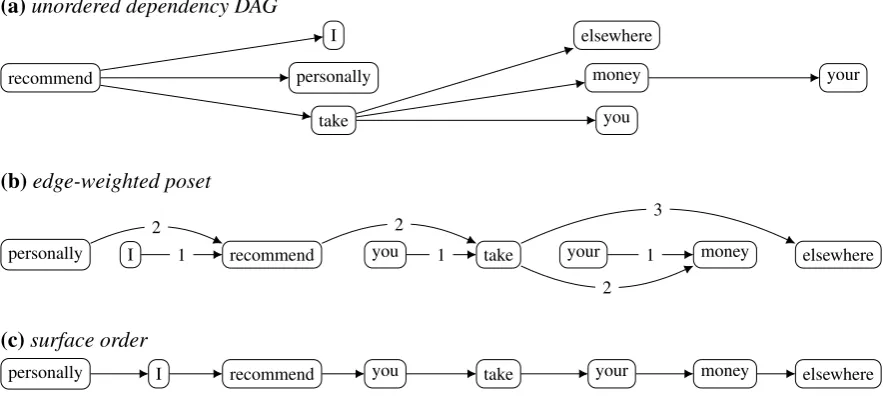
The key insight of the paper is that rather than learning to directly convert a dependency tree to surface order, the target is instead an edge-weighted partially ordered set (poset). The poset’s edge direction represents linear precedence in the surface order, while edge weight represents dependency distance, the number of words intervening between dependent and head in the surface order. The topological sort or linear extension of this poset—performed such that nodes connected by edges with smaller weights are placed closest to each other—reflects the surface order of the dependency tree.
For example, Figure 1 shows (a) the dependency tree, (b) edge-weighted poset, and (c) surface order of the sentence Personally I recommend you take your money elsewhere. Rather than attempting to learn how to convert (a) directly into (c), the approach outlined here rewrites (a) to (b) by learning edge directions and weights, then rewrites (b) to (c) via topological sort. Given examples of dependency trees and their corpus-attested surface orders, a neural network can learn to convert previously unseen dependency trees into surface orders by way of a weighted poset.
Implemented as a Graph Neural Network, the machine-learning algorithm treats inputs, targets, and outputs as directed graphs. Further, by representing words with their dependency-based embed-dings—that is, embeddings trained on syntactic rather than linear contexts—the model generates a lin-earized surface order as the final step only, performing all other analysis within a graph framework. In this way surface order is treated as an emergent consequence of topologically sorting an edge-weighted poset, the weights of which represent learned dependency distances.
1Validity here should be taken neither grammatically nor prescriptively, but rather as a stand-in for attested in a corpus. That
(a)unordered dependency DAG
personally I
recommend
you take
your money
elsewhere
(b)edge-weighted poset
personally I recommend you take your money elsewhere
2 2 3
2
1 1 1
(c)surface order
[image:2.595.78.520.66.269.2]personally I recommend you take your money elsewhere
Figure 1: Three graph-theoretic representations of a sentence. (a)A dependency tree as an unordered directed acyclic graph (DAG).(b)A poset in which edge weight indicates dependency distance in the surface order.(c)A surface order generated by a topological sort of the poset in (b).
2 Background literature 2.1 Related linguistic work
Word order is one of the oldest and most prominent areas in the field of linguistics, and as such a wide variety of models have been advanced seeking to describe and understand word-order variation (Song, 2012). It has been approached from generalist perspectives, as in Behaghel’s “what belongs together semantically is also placed close together” (1932, p. 4) or Uniform Information Density (Jaeger and R. Levy, 2006), as well as from specific constituent types, such as the ordering of adpositions and adver-bials by manner, place and time (Boisson, 1981); demonstratives, numerals, and descriptive adjectives (Greenberg, 1963; Dryer, 2009); or adjectives by size, shape, and so on (Scott, 2002).
Building on principles such as Head Proximity (Rijkhoff, 1986), Early Immediate Constituents (Hawkins, 1994), Dependency Locality Theory (Gibson, 2000), and Minimize Domains (Hawkins, 2004), a recent approach to word order holds that the dependency distance2—the number of words inter-vening between a dependent and its head—should be minimized and long-distance dependencies should be avoided (Hudson, 1995; H. Liu et al., 2017). Dependency Distance Minimization (DDM) proposes that a surface order with a smaller cumulative or mean dependency distance is generally favored over alternatives, a tendency that may be universal (Futrell et al., 2015).
However, DDM alone cannot fully explain word order: it does not distinguish between total mirror orders—the dependency distances ofthe cat purrsare presumably the same aspurrs cat the—or, more plausibly, partial mirror orders such as the swapped adjectives inbig red barnorred big barn. Methods for extending DDM include employing phonemes or syllables as the unit of distance (Ferrer-i-Cancho, 2017), or exploring the relationship between dependents and heads in information-theoretic terms (Dyer, 2018; Hahn et al., 2018). Another avenue is some sort of linear principle that could operate to differen-tiate mirror surface orders, such as “old concepts come before new ones” (Behaghel, 1932, p. 4), or the possibly contradictory “provide the most important information first” (Gundel, 1988, p. 229).
One way to conceive of surface order is as the result of rewriting a dependency graph by modifying its edge directions to reflect linear order. This process represents an intermediate stage between syntactic structure and surface order in which the linear order of certain word pairs is expressed as a series of precedence relations (Gerdes and Kahane, 2001; Kahane and Lareau, 2016). These precedence relations form a partially ordered set (poset) which can be topologically sorted into a non-unique linearization.
2.2 Related NLG work
The field of natural language generation (NLG) seeks to model word order in the service of generating accurate natural language. Contra Harris (1954)3, language is often seen within NLG as a bag of words in which the task of realizing surface order is based on ann-gram language model (Filippova and Strube, 2009). A common implementation follows the bottom-up insights from dependency parsing (Y. Liu et al., 2015), and features such as syntactic category or dependency relations can improve algorithms for linearizing a bag of words (Zhang and Clark, 2015).
The First Multilingual Surface Realisation Shared Task (SR ‘18) brought together nine submissions in a shallow track requiring teams to determine word order and inflections of shuffled and lemmatized Universal Dependencies (UD) data, evaluated by both statistical and human assessment (Mille et al., 2018). For the linearization subtask, of the four submissions with the highest BLEU4scores in at least one of the 10 supported languages: Puzikov and Gurevych (2018) use a bigram language model with binary neural-net classification; Elder and Hokamp (2018) treat the task as a machine-translation problem, using sequence-to-sequence models augmented with synthetic and outside data; Castro Ferreira et al. (2018) sort dependents into preceding and following groups which are then sorted by syntactic category or with a maximum entropy classifier; and King and White (2018) use features such as syntactic category, projectivity, and dependency distance to build a language model to incrementally linearize words.
It has long been noted that a reliance on statisticaln-gram metrics like BLEU for measuring generated language is problematic given their inability to generalize seemingly unimportant word order variation or synonymy (Pastra and Saggion, 2003; Turian et al., 2006), as well as their lack of correlation with human assessment (Novikova et al., 2017). BLEU specifically has been criticized given its understudied technological biases, a sufficient reason to avoid using it alone to report scientific evidence (Reiter, 2018, p. 399). Further, while the target or reference of generated language is not necessarily a single sentence—there may be more than one semantically and syntactically valid surface realization of a given set of words, with context determining appropriateness—limited resources often result in a single human-produced reference being used, usually in the guise of an attested sentence in a corpus.
2.3 Projectivity
Projectivity refers to the constraint that a head and its dependents must occur in a contiguous sequence in the surface order (Marcus, 1965). Violations of projectivity—often referred to as discontinuities in the linguistics literature—are instances when a word occurring between a headhand dependentdis not dominated byhin the dependency tree. In the oft-cited non-projective sentenceThe hearing is scheduled on the issue today, bothisandscheduled occur betweenhearing →issue5, but are not dominated by
hearing. A projective order would beThe hearing on the issue is scheduled today.
It seems that all natural languages contain some amount of non-projective dependency relations, though calculating exact rates of non-projectivity is difficult given design decisions in the original parsing to create corpora. That is, some annotation schemes presuppose projectivity, and as a result corpora pro-duced following those schemes will not exhibit discontinuities (Ferrer-i-Cancho and Gómez-Rodríguez, 2016). Observed percentages of non-projectivity range from single digits to the mid-teens depending on language, though sources disagree, likely due to differences in corpora, genre, and annotation scheme.
Non-projectivity must be accounted for in any model of word order. Parsers have been developed which allow pseudo-projective (Nivre and Nilsson, 2005), projective (Nivre, 2009), and mildly non-projective dependencies (cf. Gómez-Rodríguez, 2016). Similarly, the submissions to SR ‘18 vary with regard to projectivity: of the eight, three explicitly exclude non-projective arcs due to algorithmic design (Basile and Mazzei, 2018; Puzikov and Gurevych, 2018; Sobrevilla Cabezudo and Pardo, 2018), while one follows the tendency toward limited non-projectivity by “encourag[ing] the model to learn that most choices should yield continuous phrases” (King and White, 2018, p. 42).
3“[L]anguage is not merely a bag of words but a tool with particular properties which have been fashioned in the course of
use” (p. 156).
4BLEU, for bilingual evaluation understudy (Papineni et al., 2002), is “the geometric mean of then-gram precisions between
generated text and reference texts and adds a brevity penalty for shorter sentences” (Mille et al., 2018, p. 4).
The causal relationship between Dependency Distance Minimization and projectivity is unsettled. Ninio (2017) concludes that “projectivity appears to be not so much a side-effect of DDM as a mathe-matical requisite for a method to encode a two-dimensional tree in a one-dimensional sentence-string in a way that makes reconstruction possible” (p. 216), appealing to other linguistic structures such as catenae (Osborne et al., 2012) to explain discontinuities. This traditional view—that projectivity exists as a prin-ciple independent of DDM—is largely disproven by an analysis which positively correlates dependency distance and the number of crossing dependencies across a variety of multilingual corpora (Ferrer-i-Cancho and Gómez-Rodríguez, 2016). Park and R. Levy (2009) note that an avoidance of long-distance dependencies can result in non-projective surface orders.
2.4 Syntactic word embeddings
The relationship between words has long been thought of distributionally; as Firth (1957) memorably puts it: “you shall know a word by the company it keeps” (p. 11). The company or context of a word is often conceived in terms of the linear neighbors that commonly occur around that word, a context that can be quantified with a dense vector or series of numbers called an embedding. Algorithms have been developed to learn a word’s embedding in a corpus, such as skip-grams (Mikolov et al., 2013). O. Levy and Goldberg (2014) extend the notion of context beyond linear neighbors in theirword2vecfto use dependency relations in learning syntactic embeddings: a word’s context is based on the heads and dependents it takes in a corpus.
The number of dimensions necessary for a given task is an understudied problem. It is widely accepted that larger dimensions are better, up to a point of diminishing returns; for example, O. Levy and Goldberg (2014) use 300 in their evaluation, mentioning that 600 produces similar results. However, Spirling and Rodriguez (2019) note that very large dimensions relative to corpus size result in greater instability of embeddings, where instability refers to the rate at which the cosine-similar nearest neighbors differ between models (Wendlandt et al., 2018). Patel and Bhattacharyya (2017) explore the lower bound of embedding dimensions, below which performance suffers, providing a rather complicated method for calculating the minimum based on the maximum clique of a cosine-similarity matrix of word co-occurrence. An industry rule-of-thumb6is to use the fourth root of vocabulary size.
2.5 Graph neural networks
While machine-learning algorithms, deep or otherwise, have traditionally operated on data represented in Euclidean space—for example, image data can be represented as a regular grid of pixel values—graph neural networks (GNN) allow the complexity of graph structures to be analyzed (Wu et al., 2019). The Graph Nets (GN) framework relies on a graph-to-graph model called a GN block “which takes a graph as input, performs computations over the structure, and returns a graph as output” (Battaglia et al., 2018, p. 11). In this framework, a graph is composed of nodes and their attributes, edges and their attributes, and a set of global attributes. Input and target graphs may contain different node and edge configurations; only the attributes for nodes and the attributes for edges must be of a consistent form. It is these sets of attributes which form the learned parameters of the neural network.
GN blocks also support message-passing neural networks (MPNN) (Gilmer et al., 2017), a method by which a graph’s node and edge attributes undergo spatial-based graph convolutions and pooling (Wu et al., 2019, p. 8). In this manner a graph’s connected nodes influence each other’s node and edge attributes, passing information along directed edges.
3 Methodology
The approach described in the current study rests on the notion that adding dependency distances as positive or negative edge weights to a dependency tree allows the DAG to be rewritten as a poset whose topological sort reflects a surface order. Edge weights are therefore the number of words intervening between a dependent and its head, where negative weights indicate a dependent that precedes its head and positive a dependent following its head. Learning these edge weights is the core goal of the model.
w
ord2v
ecf (a)[input] conllu file (truncated) (b)[output] syntactic word embeddings
9 for for ADP 11 case
10 your you PRON 11 nmod:poss
11 trip trip NOUN 3 obl
12 to to ADP 13 case
13 Canada Canada PROPN 11 nmod
for|ADP|case [1.69 -0.51 ...]
your|PRON|nmod:poss [0.92 -0.61 ...]
trip|NOUN|obl [0.17 -0.11 ...]
to|ADP|case [1.24 -0.59 ...]
canada|PROPN|nmod [0.05 -0.05 ...]
ADP|case [0.12 -0.80 ...]
ADP [0.10 -0.07 ...]
...
graph
neural
netw
ork
[image:5.595.72.521.55.355.2](c)[input] directed graph of dependency tree (d)[output] directed graph with learned edge attributes
[1.69 ...] for|ADP|case [0.92 ...] your|PRON|nmod:poss [0.17 ...] trip|NOUN|obl [1.24 ...] to|ADP|case [0.05 ...] canada|PROPN|nmod [?] [?] [?] [?] [0.56 ...] for|ADP|case [-0.2 ...] your|PRON|nmod:poss [0.17 ...] trip|NOUN|obl [1.08 ...] to|ADP|case [-0.30 ...] canada|PROPN|nmod [2] [1] [-2] [1] topo sort
(e)[input] edge-weighted poset (f)[output] topological sort
for your trip to Canada 2 1 2 1
for your trip to Canada
1 1
2 2
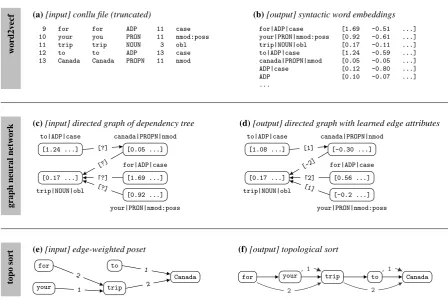
Figure 2: Overview of methodology. (a)A CoNLL-U file is parsed by word2vecf to produce(b) a list of syntactic word embeddings for eachwordform|POS|relation,POS|relation, andPOS. These embeddings form the node attributes for(c) a directed graph of a dependency tree. The graph’s edge attribute is a single-element vector which will contain the learned distance between dependent and head. Note that edge direction is reversed from conventional dependency directions to enable more effective message passing. (d)An output graph isomorphic to (c) with learned node and edge attributes. (e) A poset with edge weights representing the distance between words in the eventual surface order, built from the learned directions and distances in (d). Note the flipped edge direction betweentripandCanadain the DAG (d) versus the poset (e).(f)The unique surface order resulting from a topological sort of (e).
There are three tasks to be undertaken to convert a dependency tree into a surface order: (1) encode words to generalize from training to testing; (2) for a given dependency tree, learn whether each depen-dent precedes or follows its head in the surface order, and by how many words, in order to produce an edge-weighted poset; and (3) perform a topological sort of the poset based on edge weight. The first task is accomplished with word2vecf, the second with a graph neural network and message passing, and the third with a custom algorithm which rewrites a weighted poset to a linear graph such that nodes are connected in ascending order of edge weight. An overview of this process is shown in Figure 2.
3.1 Syntactic embeddings
Word2vecf7 (O. Levy and Goldberg, 2014) is used to generate syntactic word embeddings from a Universal Dependencies CoNLL-U8 file. Embeddings are created for each word|POS|relation, POS|relation, andPOSin order to minimize polysemy and homography effects and to enable words unseen during training to be analyzed based on their syntactic category and/or dependency relation. The dimension of the embedding vector is determined by corpus size: in order to avoid the instability seen in both too-small and too-large dimensions, the industry rule-of-thumb of the fourth root of vocabulary size is used, multiplied by two. These dimensions were found during algorithm design to offer a reasonable balance between performance and generalizability.
3.2 Graph neural network implementation
The machine-learning algorithm is implemented using Graph Nets and Sonnet, two DeepMind libraries9 for building graph neural networks using Google’s Tensorflow (Abadi et al., 2015). The network’s layers contain 18 neurons each and follow an ‘encode-process-decode’ model common to many Graph Nets implementations. Because learned edge weights in the GNN can be positive or negative, loss is calculated as the absolute difference between target and output. An Adam optimizer with a learning rate of 1−3is used, there are 6 message-passing steps, and the network is run through 10,000 iterations.
The input is a series of networkx10directed graphs, one for each sentence in the training and testing sets. In order to effectively utilize message passing, edges are constructed asdependent→head, opposite the usual syntactic dependency-parsing edge direction. Each node has an attribute which is the vector produced byword2vecf’s syntactic embedding. In the GNN, edge weights are used to track dependency distance, both negative and positive. A negative edge weight indicates that a head precedes its dependent, and a positive weight that a dependent precedes its head. Target edge weights are calculated as the difference between the dependent and head location in the original surface order, normalized to [-1,1] by dividing each distance by the maximum dependency distance of a given sentence.
For example, Figure 2 (c) and (d) show the input and output for the phrasefor your trip to Canada. The input to the GNN is the dependency tree, where each node’s attribute is the word’s syntactic embedding. The output is the same dependency tree with learned edge attributes reflecting the distance between dependent and head.
3.3 Weighted topological sort
Performing a topological sort of an edge-weighted poset such that connected nodes are placed in ascend-ing order of edge weight is conceptually quite simple, but implementation is more complicated than it may appear. A straightforward approach of simply merging nodes with the smallest weights before those with larger weights does not properly order the nodes, since the weight of arcs crossing the merged nodes are not necessarily updated to reflect the merge. Instead, as outlined in Algorithm 1, each edge(u,v)from the poset can be added to a new directed graphorder such that the edge’s weight is maintained, even thoughuandvmay not be adjacent inorder.
When inserting edge (u,v) with weight wuv into order, if u is already in order, then traverse the successor nodes ofuuntil the total distance fromu—a value maintained bywsum—exceedswuv. At that
point, insertvand update the weights ofv’s neighbors. This process is shown in lines 5-16. Similarly, as shown in lines 17-28, ifvis already inorder, traverse the predecessor nodes ofvuntilwsum exceeds
wuv, insertu, and updateu’s neighbors’ weights. Finally, if neitherunorvare inorder, add edge(u,v)
with weightwuv toorder, as shown in line 30. When all edges from poset have been added to order, the topological sort oforderis returned as the surface realization. Each edge in poset must be added toorder, and in the worst-case scenario the weight of each existing edge inorder must be examined. Therefore Algorithm 1 runs inO(nlogn)time, wherenis the number of edges inposet.
3.4 Baseline (AVG)
Rather than generating syntactic word embeddings and running the GNN, a naive approach to deter-mining dependency distances is to average the distance between any two words in the training set for use on the testing set. Similar to the set of word embeddings (§3.1), in order to generalize to unseen words in the test set, average distances are created for each pair dependent pair ofword|POS|relation, POS|relation, andPOS. For example, ifthe|DET|dethas an average dependency distance of 1.2 from horse|NOUN|nsubj, andbrown|ADJ|amodhas an average of 0.9 fromhorse|NOUN|subj, then using those two average distances as weights in a poset would result in a surface order ofthe brown horse. If red|ADJ|amodwas unseen during training, then the average of all instances ofADJ|amoddependent on horse|NOUN|subjwould be used—if that average distance were 1.3, then this naive approach would returnred the horse.
Algorithm 1:Given an edge-weightedposet, construct a total order such that nodes with smallest weights are adjacent.
1: functionWEIGHTED_TOPO_SORT(poset)
2: order←/0 ◃empty directed graph to hold totally ordered set 3: for(u,v,wuv)∈posetdo
4: wsum←0 ◃a sum of traversed weights
5: ifu∈orderthen
6: whilewuv>wsumdo ◃traverse successors ofu
7: s←order.u.successor 8: wus←order[u][s].weight
9: wsum←wsum+wus
10: ifwuv<wsumthen
11: u←s ◃ubecomes its successors
12: end if
13: done
14: wvs←wsum−wuv ◃wvsis how muchwsumovershotwuv
15: order.UPDATE_EDGE(u,s,_)← ◃change existing(u,s)...
16: [(u,v,wus−wvs),(v,s,wvs)] ◃... to(u,v)and(v,s)and update weights
17: else ifv∈orderthen
18: whilewuv>wsumdo ◃traverse predecessors ofv
19: p←order.v.predecessor 20: wpv←order[p][v].weight
21: wsum←wsum+wpv
22: ifwuv<wsumthen
23: v←p ◃vbecomes its predecessorp
24: end if
25: done
26: wpu←wsum−wuv ◃wpuis how muchwsumovershotwuv
27: order.UPDATE_EDGE(p,v,_)← ◃change existing(p,v)...
28: [(p,u,wpu),(u,v,wpv−wpu)] ◃... to(p,u)and(u,v)and update weights
29: else
30: order.ADD_EDGE(u,v,wuv)
31: end if
32: done
33: returnTOPO_SORT(order) ◃return topological sort ofordergraph 34: end function
3.5 Evaluation
To evaluate the performance of the GNN algorithm compared to the AVG baseline in an automated way across various languages, we must unfortunately use a single target reference to compare the generated sentences. Thus the reference for each sentence is the attested version in the source UD corpus; the generated sentences from both AVG and GNN will be measured for similarity to the attested version.
The algorithm is attempting to order a set of words as closely as possible to their original surface realization in the corpus. Because words may repeat in the sentence, each order is instead represented by a list of integers, and it is these lists of integers which are compared. For example, assuming a target reference order of[1,2,3]forthe red horse, the generated order ofred the horsewould be[2,1,3]. An obvious way to quantify how similar these integer lists are is with the widely used Spearman’s rank correlation coefficient (Spearman, 1904), also known as Spearman’sρ (rho), which non-parametrically measures the similarity of two rankings. It ranges from -1, indicating that one order is the reverse of the other, to 1, for perfect correlation. The example of[1,2,3] [2,1,3]returns aρ of 0.5, since in the second order 1 and 2 both precede 3, but 1 does not precede 2. This measure tells us which approach, AVG or GNN, generates orders closest to the attested UD order, as well as a loose gauge of overall effectiveness for both the general approach as well as each algorithm.
SPEARMAN’Sρ[-1,1] PROJECTIVITY [0,1]
NTR NTE DV AVG GNN AVG GNN UD
Afrikaans AfriBooms 1315 425 18 0.707 0.773 0.530 0.650 0.939
Armenian ArmTDP 560 470 18 0.628 0.672 0.413 0.585 0.987
Czech CLTT 755 121 18 0.665 0.659 0.359 0.469 0.982
English ParTUT 1781 153 20 0.634 0.775 0.496 0.680 0.995
French ParTUT 803 110 18 0.677 0.729 0.531 0.669 0.998
Greek GDT 1632 450 22 0.731 0.754 0.503 0.651 0.996
Hungarian Szeged 910 449 20 0.635 0.609 0.440 0.598 0.969
Irish IDT 566 452 18 0.674 0.753 0.461 0.603 0.978
Italian ParTUT 1781 153 22 0.657 0.796 0.482 0.651 0.996
Latin Perseus 1334 939 20 0.614 0.582 0.613 0.729 0.855
Maltese MUDT 1119 516 18 0.729 0.750 0.498 0.682 0.995
Slovenian SST 1669 890 18 0.549 0.567 0.663 0.798 0.967
Telugu MTG 1051 146 14 0.916 0.931 0.925 0.971 0.997
[image:8.595.80.524.66.310.2]Uyghur UDT 1656 900 20 0.728 0.727 0.629 0.762 0.976
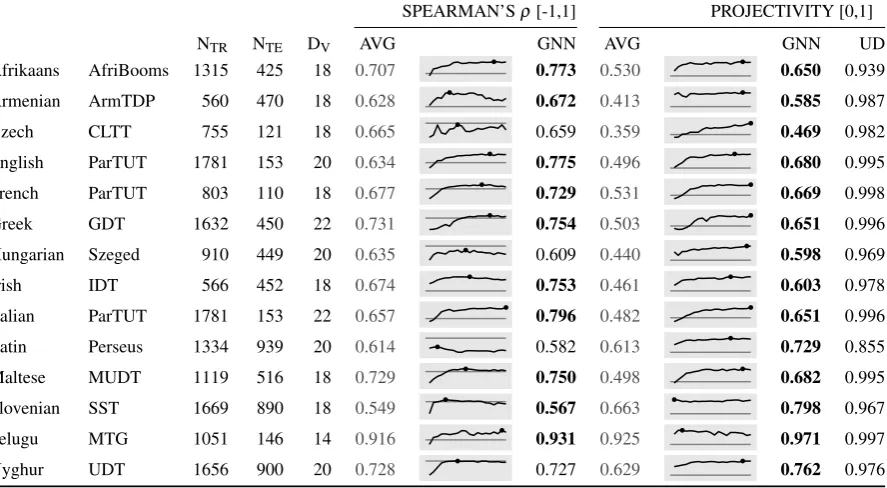
Table 1: Results. Each language is listed by its corpus; number of training and testing sentences; embed-ding dimension; Spearman’sρ rank correlation coefficient for AVG and GNN; and rate of projectivity for AVG, GNN, and as attested in the UD corpus. Boldfaced numbers indicate cases in which GNN per-formed better than AVG. Sparklines show trends over 10K iterations with horizontal gray lines indicating AVG performance and black dots showing peak performance of GNN.
4 Results & Discussion
Table 1 shows the results of running both the AVG baseline and GNN algorithm on 14 v2.4 UD corpora representing a range of language families. These are relatively small corpora—between 500 and 2000 training sentences—and as a consequence their small vocabularies result in embedding vector dimensions between 14 and 22 due to the use of twice the fourth root of vocabulary size (§2.4, §3.1). While smaller than the more usual 50- or 300-element vectors, tying dimensionality to corpus vocabulary size seemed to avoid instability in the embedding space, though perhaps not in every case. Further, experiments with larger dimensions resulted in poor generalization to the testing set, possibly due to a lack of correlation between embeddings seen and unseen during training.
Results from Spearman’s ρ rank correlation show that both AVG and GNN were able to positively correlate surface order with the source UD corpora. Because Spearman’sρ ranges from -1 to 1, positive values are better than chance; values above 0.5 seem rather promising. A large part of surface order can apparently be predicted based on dependency distance, averaged or learned. In all cases the GNN was able to approach AVG, exceeding it 10 out of 14 times. For many languages, the GNN achieved its peak value before training was complete, probably indicating overfitting. In the cases in which the GNN did not best AVG, the sparkline trends for Czech, Hungarian, and Latin suggest problems during training, perhaps due to overzealous learning rates or unstable embeddings, while Uyghur came very close.
(a)target poset (a′)poset generated by GNN
this judge shall be chosen by lot .
2 2
1 1
1
3 3
be shall this judge chosen by lot .
1.1
3
0.7
0.6 0.1
1.9 0.9
(b)target poset (b′)poset generated by GNN
ce juge est désigné par le sort .
2 2 4
1 1 1
3
ce est juge désigné par le sort .
1.6 0.9
4
0.9 0.7
[image:9.595.79.524.63.199.2]3.1 0.8
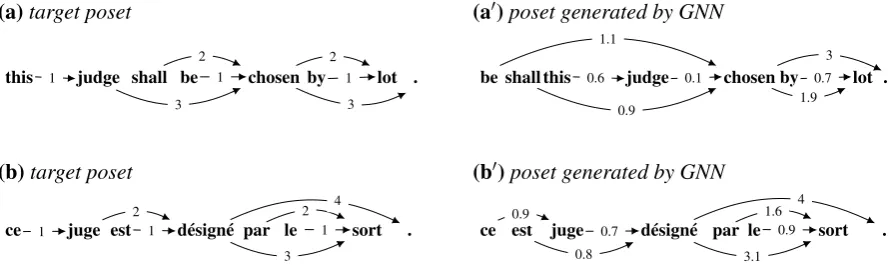
Figure 3: Target and generated posets from English- and French-ParTUT corpora.
Importantly, AVG is a naive approach, not a learning algorithm. As such there is very little room for improvement by adjusting how the averaged dependency distances are determined—employing morpho-logical data or using lemmata instead of wordforms, for example. Conversely, changes to number of iterations, architecture, or hyperparameters of the GNN, especially tailored to each corpus, would almost certainly yield even better results, with a hypothetical upper bound limited only by the irreducible error present in a language’s word-order variation.
The results confirm that dependency distances can be learned from dependency trees by the GNN algo-rithm, usually better than a naive approach. Those distances can be used to generate surface realizations with word orders that positively correlate with attested UD sentences. Because these promising results can be generated from an essentially off-the-shelf GNN with relatively standardized parameters across a wide variety of languages, future endeavors improving the GNN architecture is certainly warranted.
4.1 Error analysis
Delving a bit into the sorts of errors in the surface orders generated by GNN, Figure 3 shows four versions of the same sentence: (a) the poset for a sentence from the UD English-ParTUT corpus; (a′) the poset generated by GNN with a Spearman’sρcoefficient of 0.786—only slightly higher than the averageρfor that corpus, and therefore a typical generation; (b) the poset for the same sentence from French-ParTUT; and (b′) the poset generated by GNN with a non-projective11arc.
Figure 3 (a′) deviates from (a) in that the weight ofbe−→1.1 chosenis larger thanshall−→0.9 chosen, and both those edges have weights larger than the combination ofthis−→0.6 judgeandjudge−→0.1 chosen. The result is a sentence in which the auxiliariesbeandshallare transposed, and both appear in front ofthis judge. Similarly, (b′) deviates from (b) in that the weight ofest−→0.8 désignéis larger than the weight of
juge−→0.7 désigné—though unlike the English not larger than the combined weights ofce−→0.9 juge and
juge−→0.7 désigné. The result is a transposition ofjugeandest, causing a non-projective arc asestappears betweenceandjugebut is not dominated by either.
Aside from the transposition of the auxiliaries in (a′), both generated surface orders suffer from the weight ofjudge/juge→chosen/désignébeing too small. While the offending edge in (a′) is quite small at 0.02, requiring an addition of over 2 to overcome the combined weights of the auxiliariesbeandshall, an addition of just 0.11 to the weight of the edge would resolve (b′). In other words, if the weight of
est−→0.8 désignéwere increased to 0.81, it would be larger thanest−→0.8 désignéand thereforejugewould precedeest, resolving (b′) to (b).
Neither training set for these corpora contains the wordjudge/juge, so the word’s embedding collapses to an average of all nouns acting as passive subjects,NOUN|nsubj:pass. This suggests that insufficient training size, lack of proper generalization from the available training data, and/or problematic embed-ding creation for unseen words is at fault here. These can all be addressed in future research.
11The graphs in Figure 3 are posets, not dependency trees, and therefore the dependency concept of projectivity is not readily
4.2 Dependency distance tolerance & projectivity
What is being learned by the GNN? That is, what do the edge weights, used to create a poset, actually represent? The question is perhaps conceptually a bit easier with AVG: the weights are the average distances between dependents and their heads in a corpus. AVG calculates how far a dependent tends to be from its head, or put another way, how many intervening words tend to be allowed between dependent and head in a collection of surface orders. It is a dependent word’s tolerance for how far it can be placed in front or behind its head in a surface realization. It seems that the GNN is learning this same information about dependency distance tolerance, but in a more subtle and context-sensitive way. Rather than simply an average distance, the GNN is learning how far a dependent can be placed from its head in concert with its syntactically related words12in a given dependency tree.
Dependency distance tolerance is effectively a maximum for how far apart a dependent and head can be in the surface realization of a given dependency tree. What factors determine this tolerance and how it might be encoded in a linguistic system is left for other research. However, dependency distance tolerance is a useful concept for exploring how projectivity might come about.
It was suggested in §2.3 that observed rates of projectivity might emerge from Dependency Distance Minimization (DDM). That is, the desire to minimize cumulative or mean dependency distances results in the high rates of projectivity seen across languages. A further goal within DDM is to avoid long-distance dependencies, though this avoidance may result in non-projective surface orders. The concept of dependency distance tolerance provides a more nuanced view of this second DDM motivation.
The topological sort of a poset whose edge weights correspond to contextual dependency tolerances, at least as implemented here, may place dependents closer to their heads than their tolerance, but not farther. As such, it defines an upper bound for each edge weight in a poset. A surface order can be seen as the result of assembling words such that dependents are placed no farther from their heads than their tolerance. In this way dependency distances in the surface order are not only minimized, but minimized in such a way that each word’s contextual dependency tolerance is taken into account.
Thus the topological sort of a weighted poset implements DDM’s goal of minimizing dependency distances generally, while the learned dependency tolerances provide a contextually sensitive definition of what ‘long distance’ means for each dependent pair in order to avoid generating surface orders with long-distance dependencies. Through this lens both the strong tendency towards projectivity across languages, as well as the occasional instances of non-projectivity, can be seen as an effect of avoiding dependency distances which exceed their contextual tolerances.
5 Summary
This paper describes a novel method for converting dependency trees to surface orders via syntactic word embeddings and edge-weighted posets. The embeddings are learned viaword2vecf, and poset edge directions and weights are learned by a graph neural network (GNN), all trained on Universal Dependencies (UD) corpora. An algorithm is provided for topologically sorting a weighted poset. The output of the GNN is compared to a naive baseline in which average dependency distances are used as poset edge weight, both evaluated against attested word orders in UD corpora representing a variety of language families. The GNN outperforms the baseline on 10 of 14 corpora in terms of rank correlation and in all cases in terms of rate of projectivity.
The main contribution of the paper is the insight that a surface order can be represented by an edge-weighted poset, the weights of which can be learned by a graph neural network. Representing surface order as the result of topologically sorting this poset contributes to our understanding of how a tendency towards projectivity across natural languages might be explained.
Future research directions include improvement of the GNN architecture and hyperparameters; explo-ration of the interaction between word embedding dimension, performance, and generalizability; and the analysis of larger corpora.
12Due to the graph nature of the GNN, message passing, and the use of syntactic embeddings, a word’s context for
References
Martin Abadi et al. (2015). TensorFlow: Large-Scale Machine Learning on Heterogeneous Distributed Systems.
URL:https://static.googleusercontent.com/media/research.google.com/en//pubs/archive/ 45166.pdf.
Valerio Basile and Alessandro Mazzei (2018). The DipInfo-UniTo system for SRST 2018.Proceedings of the First
Workshop on Multilingual Surface Realisation. Melbourne, Australia: Association for Computational
Linguis-tics, pp. 65–71.
Peter W. Battaglia et al. (2018). Relational inductive biases, deep learning, and graph networks.arXiv:1806.01261
[cs, stat].
Otto Behaghel (1932). Deutsche Syntax eine geschichtliche Darstellung. Heidelberg: Carl Winters Unversitäts-buchhandlung.
Claude Boisson (1981). Hiérarchie universelle des spécifications de temps, de lieu, et de manière.Confluents7, pp. 69–124.
Thiago Castro Ferreira, Sander Wubben, and Emiel Krahmer (2018). Surface Realization Shared Task 2018 (SR18): The Tilburg University Approach.Proceedings of the First Workshop on Multilingual Surface
Real-isation. Melbourne, Australia: Association for Computational Linguistics, pp. 35–8.
Matthew S. Dryer (2009). On the order of demonstrative, numeral, adjective, and noun: an alternative to Cinque.
Conference on theoretical approaches to disharmonic word orders.
William Dyer (2018). Integration complexity and the order of cosisters.Proceedings of the Second Workshop on
Universal Dependencies (UDW 2018). Brussels, Belgium: Association for Computational Linguistics, pp. 55–
65.
Henry Elder and Chris Hokamp (2018). Generating High-Quality Surface Realizations Using Data Augmenta-tion and Factored Sequence Models.Proceedings of the First Workshop on Multilingual Surface Realisation. Melbourne, Australia: Association for Computational Linguistics, pp. 49–53.
Ramon Ferrer-i-Cancho (2017). Towards a theory of word order. Comment on" Dependency distance: a new per-spective on syntactic patterns in natural language" by Haitao Liu et al.Physics of Life Reviews.
Ramon Ferrer-i-Cancho and Carlos Gómez-Rodríguez (2016). Crossings as a side effect of dependency lengths.
Complexity21 (S2), pp. 320–328.
Katja Filippova and Michael Strube (2009). Tree Linearization in English: Improving Language Model Based Approaches.Proceedings of Human Language Technologies: The 2009 Annual Conference of the North
Amer-ican Chapter of the Association for Computational Linguistics, Companion Volume: Short Papers. Boulder,
Colorado: Association for Computational Linguistics, pp. 225–8.
John Rupert Firth (1957). A synopsis of linguistic theory 1930-1955.Studies in Linguistic Analysis. Oxford: Philo-logical Society, pp. 1–32.
Richard Futrell, Kyle Mahowald, and Edward Gibson (2015). Large-scale evidence of dependency length mini-mization in 37 languages.Proceedings of the National Academy of Sciences112.33, pp. 10336–41.
Kim Gerdes and Sylvain Kahane (2001). Word Order in German: A Formal Dependency Grammar Using a Topological Hierarchy.Proceedings of 39th Annual Meeting of the Association for Computational Linguistics. Toulouse, France: Association for Computational Linguistics, pp. 220–7.
Edward Gibson (2000). The dependency locality theory: A distance-based theory of linguistic complexity.Image,
language, brain, pp. 95–126.
Justin Gilmer, Samuel S. Schoenholz, Patrick F. Riley, Oriol Vinyals, and George E. Dahl (2017). Neural Message Passing for Quantum Chemistry.arXiv:1704.01212 [cs].
Carlos Gómez-Rodríguez (2016). Restricted Non-Projectivity: Coverage vs. Efficiency.Computational Linguistics
Joseph Greenberg (1963). Some universals of grammar with particular reference to the order of meaningful ele-ments.Universals of Grammar. Ed. by Joseph Greenberg. Cambridge, Massachusetts: MIT Press, pp. 73–113.
Jeanette Gundel (1988). Universals of topic-comment stucture. Studies in Syntactic Typology. Ed. by Michael Hammond, Edith Moravcsik, and Jessica Wirth. Philadelphia: John Benjamins Publishing, pp. 209–39.
Michael Hahn, Judith Degen, Noah Goodman, Dan Jurafsky, and Richard Futrell (2018). An Information-Theoretic Explanation of Adjective Ordering Preferences. Proceedings of the 40th annual conference of the Cognitive
Science Society.London: Cognitive Science Society.
Zellig S. Harris (1954). Distributional Structure.WORD10.2, pp. 146–62.
John A. Hawkins (1994).A Performance Theory of Order and Constituency. Cambridge: Cambridge University Press.
John A. Hawkins (2004).Efficiency and Complexity in Grammars. Oxford: Oxford University Press.
Richard Hudson (1995). Measuring syntactic difficulty. URL: http : / / dickhudson . com / wp - content / uploads/2013/07/Difficulty.pdf.
T. Florian Jaeger and Roger Levy (2006). Speakers optimize information density through syntactic reduction.
Advances in neural information processing systems, pp. 849–56.
Sylvain Kahane and François Lareau (2016). Word Ordering as a Graph Rewriting Process.Formal Grammar. Ed. by Annie Foret, Glyn Morrill, Reinhard Muskens, Rainer Osswald, and Sylvain Pogodalla. Springer Berlin Heidelberg, pp. 216–39.
David King and Michael White (2018). The OSU Realizer for SRST ‘18: Neural Sequence-to-Sequence Inflec-tion and Incremental Locality-Based LinearizaInflec-tion.Proceedings of the First Workshop on Multilingual Surface
Realisation. Melbourne, Australia: Association for Computational Linguistics, pp. 39–48.
Omer Levy and Yoav Goldberg (2014). Dependency-Based Word Embeddings.ACL (2). Citeseer, pp. 302–8.
Haitao Liu, Chunshan Xu, and Junying Liang (2017). Dependency distance: A new perspective on syntactic pat-terns in natural languages.Physics of Life Reviews21, pp. 171–93.
Yijia Liu, Yue Zhang, Wanxiang Che, and Bing Qin (2015). Transition-Based Syntactic Linearization.
HLT-NAACL.
Solomon Marcus (1965). Sur la notion de projectivité.Mathematical Logic Quarterly11.2, pp. 181–92.
Tomas Mikolov, Kai Chen, Greg Corrado, and Jeffrey Dean (2013). Efficient estimation of word representations in vector space.arXiv:1301.3781 [cs].
Simon Mille, Anja Belz, Bernd Bohnet, Yvette Graham, Emily Pitler, and Leo Wanner (2018). The First Multilin-gual Surface Realisation Shared Task (SR’18): Overview and Evaluation Results.Multilingual Surface
Reali-sation: Shared Task and Beyond: Proceedings of the Workshop. Multilingual Surface Realisation: Shared Task
and Beyond. Melbourne, Australia: Association for Computational Linguistics, pp. 1–12.
Anat Ninio (2017). Projectivity is the mathematical code of syntax.Physics of Life Reviews21, pp. 215–7.
Joakim Nivre (2009). Non-projective dependency parsing in expected linear time.Proceedings of the Joint Con-ference of the 47th Annual Meeting of the ACL and the 4th International Joint ConCon-ference on Natural Language
Processing of the AFNLP: Volume 1-Volume 1. Association for Computational Linguistics, pp. 351–9.
Joakim Nivre and Jens Nilsson (2005). Pseudo-projective dependency parsing.Proceedings of the 43rd Annual
Meeting on Association for Computational Linguistics. Association for Computational Linguistics, pp. 99–106.
Jekaterina Novikova, Ondˇrej Dušek, Amanda Cercas Curry, and Verena Rieser (2017). Why We Need New Eval-uation Metrics for NLG. Proceedings of the 2017 Conference on Empirical Methods in Natural Language
Timothy Osborne, Michael Putnam, and Thomas Groß (2012). Catenae: Introducing a Novel Unit of Syntactic Analysis.Syntax15.4, pp. 354–96.
Kishore Papineni, Salim Roukos, Todd Ward, and Wei-Jing Zhu (2002). Bleu: a Method for Automatic Evaluation of Machine Translation.Proceedings of 40th Annual Meeting of the Association for Computational Linguistics. Philadelphia, Pennsylvania, USA: Association for Computational Linguistics, pp. 311–18.
Y. Albert Park and Roger Levy (2009). Minimal-length linearizations for mildly context-sensitive dependency trees. Proceedings of Human Language Technologies: The 2009 Annual Conference of the North American Chapter of the Association for Computational Linguistics, pp. 335–43.
Katerina Pastra and Horacio Saggion (2003). Colouring Summaries BLEU.Proceedings of the EACL 2003 Work-shop on Evaluation Initiatives in Natural Language Processing: Are Evaluation Methods, Metrics and
Re-sources Reusable?Evalinitiatives ’03. event-place: Budapest, Hungary. Stroudsburg, PA, USA: Association for
Computational Linguistics, pp. 35–42.
Kevin Patel and Pushpak Bhattacharyya (2017). Towards Lower Bounds on Number of Dimensions for Word Em-beddings.Proceedings of the Eighth International Joint Conference on Natural Language Processing (Volume
2: Short Papers). Taipei, Taiwan: Asian Federation of Natural Language Processing, pp. 31–6.
Emily Pitler, Sampath Kannan, and Mitchell Marcus (2013). Finding Optimal 1-Endpoint-Crossing Trees.
Trans-actions of the Association for Computational Linguistics1, pp. 13–24.
Alain Polguère and Igor Mel’ˇcuk (2009).Dependency in Linguistic Description. John Benjamins Publishing.
Yevgeniy Puzikov and Iryna Gurevych (2018). BinLin: A Simple Method of Dependency Tree Linearization.
Proceedings of the First Workshop on Multilingual Surface Realisation. Melbourne, Australia: Association for
Computational Linguistics, pp. 13–28.
Ehud Reiter (2018). A Structured Review of the Validity of BLEU.Computational Linguistics44.3, pp. 393–401.
Jan Rijkhoff (1986). Word Order Universals Revisited: The Principle of Head Proximity.Belgian Journal of
Lin-guistics1, pp. 95–125.
Gary-John Scott (2002). Stacked adjectival modification and the structure of nominal phrases.Functional Structure
in DP and IP: The Cartography of Syntactic Structures. Vol. 1. New York: Oxford University Press, pp. 91–120.
Marco Antonio Sobrevilla Cabezudo and Thiago Pardo (2018). NILC-SWORNEMO at the Surface Realization Shared Task: Exploring Syntax-Based Word Ordering using Neural Models.Proceedings of the First Workshop
on Multilingual Surface Realisation. Melbourne, Australia: Association for Computational Linguistics, pp. 58–
64.
Jae Jung Song (2012).Word Order. New York: Cambridge University Press.
Charles Spearman (1904). The Proof and Measurement of Association between Two Things.The American Journal
of Psychology15.1, pp. 72–101.
Arthur Spirling and Pedro L Rodriguez (2019). What works, what doesn’t, and how to tell the difference for applied research.URL:https://www.nyu.edu/projects/spirling/documents/embed.pdf.
Lucien Tesnière (1959).Éléments de syntaxe structural. Paris: Klincksieck.
Joseph P. Turian, Luke Shea, and I. D. Melamed (2006).Evaluation of Machine Translation and its Evaluation:
Fort Belvoir, VA: Defense Technical Information Center.
Laura Wendlandt, Jonathan K. Kummerfeld, and Rada Mihalcea (2018). Factors Influencing the Surprising Insta-bility of Word Embeddings.arXiv:1804.09692 [cs].
Zonghan Wu, Shirui Pan, Fengwen Chen, Guodong Long, Chengqi Zhang, and Philip S. Yu (2019). A Compre-hensive Survey on Graph Neural Networks.arXiv:1901.00596 [cs, stat].
Yue Zhang and Stephen Clark (2015). Discriminative Syntax-Based Word Ordering for Text Generation.