INHIBITORY PROCESSES IN THE MISINFORMATION
EFFECT: NEGATIVE CONSEQUENCES OF AN ADAPTIVE
PROCESS
Jo Saunders
A Thesis Submitted for the Degree of PhD at the
University of St Andrews
2004
Full metadata for this item is available in St Andrews Research Repository
at:
http://research-repository.st-andrews.ac.uk/
Please use this identifier to cite or link to this item: http://hdl.handle.net/10023/13122
INHIBITORY PROCESSES IN THE MISINFORMATION EFFECT:
NEGATIVE CONSEQUENCES OF AN ADAPTIVE PROCESS
Jo Saunders
Submitted in fulfilment for the degree of PhD University of St. Andrews, September 2003
Supei*visor; Professor Malcolm D. MacLeod Second Supemsor; Dr. Gerry Quinn
ProQuest N um ber: 10166878
All rights reserved
INFORMATION TO ALL USERS
The quality of this reproduction is dependent upon the quality of the copy submitted.
In the unlikely event that the author did not send a com plete manuscript and there are missing pages, these will be noted. Also, if material had to be removed,
a note will indicate the deletion.
uest
ProQuest 10166878
Published by ProQuest LLO (2017). Copyright of the Dissertation is held by the Author.
All rights reserved.
This work is protected against unauthorized copying under Title 17, United States C ode Microform Edition © ProQuest LLO.
ProQuest LLO.
789 East Eisenhower Parkway P.Q. Box 1346
v>j4
' i
-r k
. '%r,
. ./
-J; .1 . ' .T
a
■ L%X - ->J
- 'I
P%^ ■
■
■ ■ ft:I, Jo Saunders, hereby certify that this thesis, which is approximately 94,000 words in length, has been written by me, that it is the record of work carried out by me and that it has not been submitted in any previous application for a higher degree.
date signature of candidate
I was admitted as a research student in October 1999 and as a candidate for the degree of PhD in October 2000; the higher study for which this is a record was carried out in the University of St Andrews between 1999 and 2003.
date .0 jilPjy/, signature of candidate .,
I hereby certify that the candidate has fulfilled the conditions of the Resolution and Regulations appropriate for the degree of PhD in the University of St Andrews and that the candidate is qualified to submit this thesis in application for that degree.
signature of supeiwisJ
In submitting this thesis to the University of St Andrews I understand that I am giving permission for it to be made available for use in accordance with the regulations of the University Libraiy for the time being in force, subject to any copyright vested in the work not being affected thereby. I also understand that the title and abstract will be published, and that a copy of the work may be made and supplied to any bona fide
library or research worker.
date . signature of candidate ... .^
INDEX
ABSTRACT 1
I. THE ADAPTIVE SIGNIFICANCE OF FORGETTING THROUGH INHIBITORY CONTROL
Forgetting as an adaptive fonction of memory 5 Inhibition: Describing an empirical phenomenon or asserting the
presence of a mechanism? 7
The evolution of inhibitory processes and their acceptance in theories
of memoiy and cognition 9
Negative consequences of forgetting 13
Unintentional consequences of forgetting: Inhibitory processes in the
reporting of misleading post-event information 15 II. STRENGTH-DEPENDENT COMPETITION MODELS OF
INTERFERENCE AND THE ADVANCEMENT OF RETRIEVAL INHIBITION
Classical interference era 17
The competition assumption 19
Maximising competition: The paired-associate paradigm 21
The strength-dependent assumption 25
Part-set cueing 29
Strength-dependent models and inhibitory accounts of interference 33 Resolving competition through retrieval inhibition 36 Output interference: A case of interference in the absence of competition 46
Conclusions from interference theory 48
III. INHIBITORY PROCESSES IN RETRIEVAL-INDUCED FORGETTING
Retrieval as a memory modifier 49
Retrieval-induced forgetting 51
Resolving competition in the retrieval practice paradigm through
non-inhibitoiy and inhibitoiy processes 53
Inferring inhibitory processes 54
The role of retrieval in inhibitoiy theories of interference 61 Cue-independent forgetting in inhibitoiy theories 63 Retrieval-induced forgetting in recognition tests:
The continuing persistence of inhibition 72
Inhibitory models 74
Pattern suppression: Evidence for a two-factor model 78 Difficulties in the inhibitoiy account of retrieval-induced forgetting:
Theoretical or experimental difficulties? 89 Beyond word lists: Visual materials and retrieval-induced forgetting 94 Temporal boundaries of retrieval-induced forgetting 96 Changing goal states: unintended consequences of prior retrieval 99
Protecting memories from inhibition 106
IV. INVESTIGATING THE UPDATING OF MEMORY THROUGH THE MISINFORMATION EFFECT
Examining memoiy suggestibility through leading questions 113 The E.F. Loftus misinformation paradigm and misinformation effects 116 Boundaiy conditions of the misinformation effect 120 When is misinformation integrated into memory for an event? 126 Interpreting the misinformation effect: trace alteration or coexistence? 131 Trace alteration: destmctive updating 132
Trace coexistence 13 6
Does misinformation really impair memoiy for an event? 156 The non-retention account of misinformation effects 157 Arguments against the non-retention account 166 Is the modified test insensitive to detecting memory impairment? 169
Trace alteration reconsidered 173
A possible role for inhibition in the misinformation effect 192 Selective retrieval in the typical misinformation paradigm 195 Conclusions from the misinformation effect 196 V. EXPERIMENT 1 A: RETRIEVAL-INDUCED FORGETTING AND
MISINFORMATION EFFECTS
A new method of studying misinformation effects:
The modified misinformation paradigm 199
Hypotheses 201
Method 202
Results 209
Manipulation checks: Retrieval-induced forgetting 209
Misinformation effects 212
Additional analysis 216
Discussion 222
EXPERIMENT IB: ENCODING CHECK
Method 224
Results 225
Discussion 225
VI. EXPERIMENT 2A: THE DISSIPATION OF RETRIEVAL-INDUCED FORGETTING WITH DELAYED TESTING
Hypotheses 230
Method 231
Results 232
Retrieval-induced forgetting 233
Additional analysis 234
EXPERIMENT 2B: THE EFFECTS OF DELAYED TESTING AND DELAYED PRACTICE ON THE MISINFORMATION EFFECT
Hypotheses 239
Method 240
Results 242
Manipulation checks: Retrieval-induced forgetting 245
Misinformation effects 247
Additional analysis 248
Discussion 252
VII. EXPERIMENT 3: INHIBITORY PROCESSES IN RETRIEVAL-INDUCED FORGETTING
Hypotheses 258
Method 258
Results 264
Retrieval-induced forgetting 264
Discussion 266
VIII. EXPERIMENT 4: CROSS-CATEGORY AND SECOND-ORDER INHIBITION IN RETRIEVAL-INDUCED FORGETTING
Hypotheses 272
Method 273
Results 281
Retrieval-induced forgetting 283
Discussion 285
IX. EXPERIMENT 5: INHIBITORY PROCESSES AND THE MISINFORMATION EFFECT
The inhibitory account of misinformation effects 293
Hypotheses 295
Method 296
Results 302
Manipulation checks: Retrieval-induced forgetting 303 Manipulation checks: Misinformation effects 307
Discussion 311
X. GENERAL DISCUSSION
Retrieval as a memoiy modifier 318
Retrieval-induced forgetting and the role of competition 320
Competition due to similarity in the NRP baseline measure 322 | Does inhibition control the spread of activation? 323
j
Output interference at final recall 324 |
Addressing the issue of memoiy permanence 341 Non-inhibitory processes in retrieval-induced forgetting and
misinformation effects 347
The role of demand characteristics 348
Applying retrieval-induced forgetting to real-world and other
psychological phenomenon 350
Implications for questioning techniques 353
Conclusions 356
XI. REFERENCES 358
INDEX OF FIGURES
Figure 1 : Competition assumption in non-inhibitoiy theories 20 Figure 2; Measuring retroactive interference in the paired-associate paradigm 24 Figure 3: Measuring proactive interference in the paired-associate paradigm 26 Figure 4: Strength-dependent assumption in non-inhibitory theories 28 Figure 5: Directed forgetting paradigm 38
Figure 6: Retrieval practice paradigm 52
Figure 7: The role of initial exemplar strength in inhibitory theories 56 Figure 8: The role of initial exemplar strength in non-inhibitoiy theories 57
Figure 9: Cue-dependent forgetting 65
Figure 10: Cue-independent forgetting 66 Figure 11: Independent probe method (M.C. Anderson & Spellman, 1995) 67 Figure 12: Second-order inhibition in retrieval-induced forgetting 71 Figure 13: Representations of memoiy traces and internal semantic features
in the pattern suppression model 75
Figure 14: An example of the trade off between activation and inhibition 81 Figure 15: Target-competitor similarity 83 Figure 16: Competitor-competitor similarity 86 Figure 17: The misinformation paradigm 119 Figure 18: Guessing bias inherent to typical misinformation paradigm 161 Figure 19: Demand characteristics inherent to the typical misinformation
paradigm 162
Figure 20: Modified recognition test in the misinformation procedure 165 Figure 21 : Procedure used in Experiment 1 a 203 Figure 22: Percentage of participants choosing the misinformation option
during forced-choice recognition in Experiment la 214 Figure 23 : Procedure for Delayed Test condition 243 Figure 24: Procedure for the Delayed Practice condition 244 Figure 25: Percentage of participants choosing the misinformation option
during forced-choice recognition in Experiment 2b 250 Figure 26: The independent probe method 262 Figure 27: Organisation of implicit categories in the
NRP-Similar to RP+ condition 277
Figure 28: Organisation of implicit categories in the
NRP-Similar to RP- condition 278
Figure 32: Percentage of participants choosing the misinformation option
at forced-choice recognition in Experiment 5 309 INDEX OF TABLES
Table 1 : Mean recall performance as a function of item type (Exp la) 210 Table 2: Likelihood of participants choosing the original item, misinformation,
and new erroneous item at forced-choice recognition (Exp la) 213 Table 3 : Mean performance as a function of item status (Exp 2a) 233 Table 4: Mean recall performance as a function of item type (Exp 2b) 245 Table 5: Likelihood of participants choosing the original item, misinformation,
and new erroneous item at forced-choice recognition (Exp 2b) 249 Table 6: Mean recall performance for retrieval practice and control
(non-relevant practice) conditions (Exp 3) 265 Table 7: Mean recall performance as a function of item types (Exp 4) 284 Table 8: Mean recall performance as a function of item type (Exp 5) 303 Table 9: Likelihood of participants choosing the con ect original item, the
misinformation items, and the new item during forced-choice
recognition (Exp 5) 308
APPENDICES
ABSTRACT
Recent research has suggested the seemingly ironic possibility that in order to be able to remember effectively, we must be able to forget. Despite the fact that forgetting is typically conceived of as a wholly negative experience it may, nonetheless, have adaptive consequences for the efficient updating of memory. Without a method for setting aside out-of-date or unwanted information, we may be unable to satisfy current memorial goals. Recent research suggests that inhibitory processes operating during retrieval may be responsible for the temporary forgetting of unwanted information so that desired memories can be successfully retrieved (referred to as retrieval-induced forgetting^ M.C. Anderson, Bjork & Bjork, 1994).
The present thesis attempts to enhance our understanding of the basic mechanisms that underlie our ability to update our memories by examining the role of inhibitoiy processes in the misinformation effect. The misinformation effect is a form of memory error whereby individuals mistakenly report post-event misleading information rather than information that was originally encoded during an initial study phase (e.g., E.F. Loftus, 1979a). In order to examine whether the underlying mechanisms in the misinformation effect (and more generally in memoiy updating) are inhibitoiy in nature, five theory-driven experiments were conducted and reported in this thesis.
paradigm with that of the misinformation paradigm (cf. E.F. Loftus, Miller & Burns, 1978). In Experiments 1 and 2, the boundary conditions of varying the retrieval status of target items within this new paradigm were explored. More specifically, in Experiment 1, significant misinformation effects were found only when misleading information was presented on items that were subject to retrieval-induced forgetting, i.e., the original information was unavailable to conscious inspection, leaving only the post-event information available for retrieval. A further test of the retrieval-induced forgetting account was examined in Experiment 2 whereby the presence of retrieval- induced forgetting was manipulated through the insertion of a delay. Experiment 2 indicated that the production of misinformation effects was dependent on retrieval- induced forgetting remaining active (i.e., under condition of no delay, or where a delay occurred between study and retrieval practice). In contrast, significant misinformation effects were not found when retrieval-induced forgetting dissipated over a retention inteival (i.e., when a delay was inserted between retrieval practice and final test).
found that inhibitory processes were the primaiy mechanism behind retrieval-induced forgetting, while Experiment 4 demonstrated that any item that competes with target material for retrieval is subject to inhibition (referred to as cross-categoiy and second- order inhibition). Experiment 5 extended the findings of Experiment 3 and 4, and found that inhibitory processes were not only responsible for misinformation effects, but that all inhibited information is susceptible to the effects of post-event information. The present studies suggest that that an adaptive function on inhibition (i.e., the updating of memory) may be responsible for unwanted and undesired effect in memory under certain circumstances (i.e., the production of misinformation effects and eyewitness errors).
Adaptive Forgetting
CHAPTER 1
THE ADAPTIVE SIGNIFICANCE OF FORGETTING THROUGH INHIBITORY CONTROL
It is argued in the current chapter that the psychological enquiiy into how honest errors in memoiy are made has largely ignored the mechanisms that underlie normal memoiy updating. However, the increasing acceptance of inhibitory accounts of retrieval processes has seen a recent proliferation in research examining the possible adaptive benefit of inhibitoiy mechanisms in memoiy updating. Specifically, the present chapter considers the possibility that inhibiting unwanted memories may provide a positive feature to forgetting. However, there are a number of potentially negative consequences associated with material that has been forgotten, and the current chapter briefly considers some of these.
Forgetting as an Adaptive Function of Memory
Adaptive Forgetting
never suffered from the fmstrating and sometimes embarrassing situation of forgetting.
However, in many instances, forgetting is exactly what is needed to keep our memoiy systems up-to-date and to keep the retrieval process ninning optimally. Not only do we need a process for setting aside out-of-date information, but we also need a process that can prevent related, but unwanted, information from interfering with the retrieval of target material (M.D. MacLeod, Bjork & Bjork, 2003). This ability to selectively retrieve a target from a field of similar competitors seems a highly desirable feature of memoiy that would suggest an adaptive role to forgetting. Given this possibility, forgetting may have arisen as an adaptive response to the seemingly limitless storage capacity of memoiy that contrasts with an imperfect and limited retrieval system (R.A. Bjork, 1989; RA. Bjork & Bjork, 1992). While we seem to be adept at storing information, especially that which we can understand in terms of oui' current knowledge and schemas, we often experience difficulties in gaining access to specific information and bringing it into conscious awareness.
Adaptive Forgetting
memories, we would experience difficulties in recalling our desired memoiy. Thus, in effect, we need to be able to forget in order to be able to remember.
Inhibition: Describing an Empirical Phenomenon or asserting the Presence o f a
Mechanism?
While past theories of forgetting have explained retrieval failures through exclusively non-inhibitory processes that exert their influence on retrieval cues and retrieval routes, recent theories suggest that forgetting can also be due to the actions of inhibitory processes acting at the level of the memorial representations. More specifically, an increasing number of researchers have suggested that a specific type of inhibition may be present in memory, namely retrieval inhibition (e.g., M.C. Anderson & Bjork, 1994; E.L. Bjork & Bjork, 1996; E.L. Bjork, Bjork & Anderson, 1998; E.L. Bjork, Bjork & MacLeod, in press; Geiselman, Bjork & Fishman, 1983; Macrae & MacLeod, 1999). It is thought that retrieval inhibition may represent a set of mechanisms that prevents or reduces retrieval access to certain items without affecting the overall availability of those items in memory (Tulving & Pearlstone, 1966). In addition, retrieval inhibition is also thought to control not only intentional forgetting (e.g., M.C. Anderson & Green, 2001; E.L. Bjork & Bjork, 1996), and thus our deliberate attempts to update memoiy, but is also thought to underlie certain types of unintentional forgetting (e.g., E.L. Bjork et al., in press; M.D. MacLeod et al., 2003), allowing it to satisfy the requirements of a flexible and adaptive goal-directed forgetting mechanism.
Adaptive Forgetting
theoretically weakest, retrieval inhibition merely refers to an empirical finding that is the opposite of facilitation (M.C. Anderson & Bjork, 1994; R.A, Bjork, 1989). Similarly C.M. MacLeod, Dodd, Sheard, Wilson & Bibi (2003) have suggested that any empirical finding that demonstrates a decrease in performance compared to the baseline should be considered a theoretically weak form of inhibition. Thus, inhibition is being used as a descriptor of a pattern of memory performance rather than ascribing the presence of inhibitory processes. In fact, empirical findings of such types of ‘inhibition’ can be accounted for exclusively in terms of the strength- dependent competition assumptions of non-inhibitory processes. These non- inhibitoiy theories assume that items that share a common cue compete with one another for retrieval, and strengthening the association between one item and its cue (typically the target item) results in a weakening of the association between that cue and the remaining competing items. This definition of retrieval inhibition can be seen throughout the interference literature, although it is typically referred to as interference or impairment (see also C.M. MacLeod et al., 2003), and appears to be primarily due to impairment occurring at the level of the retrieval cue or the retrieval route. These interference effects, and the non-inhibitory processes that are believed to underlie them, are discussed in more depth in Chapter 2.
Adaptive Forgetting
may represent an item in memory and the inhibition of some of these neurons may produce retrieval inhibition (M.C. Anderson & Bjork, 1994). Similarly, retrieval inhibition may be an example of multiple neurons acting together, producing a collective inhibitory effect. Another possibility is that inhibitory neurons are not just activated once, but are, in fact, activated repeatedly in order to sustain the inhibition of certain representations - perhaps to prevent a rebound effect that would make these unwanted memories become hyperaccessible (see M.C. Anderson & Bjork, 1994, for further discussion on these latter points). The success of applying inhibitory mechanisms to account for forgetting is examined in more depth in Chapter 3.
The Evolution o f Inhibitory Processes and their Acceptance in Theories of Memory
and Cognition
Adaptive Forgetting
ability of humans to inhibit unacceptable behaviours on a voluntary basis. This cycle of influence of social factors on inhibitory control of aggressive behaviours, and vice versa, continued and evolved to allow inhibitory control over other lower- and higher- order social and cognitive behaviours (see Bjorklund & Harnishfeger, 1995, for further discussion).
It is not just inhibitory mechanisms that have evolved, however, but also theorists’ acceptance of their role in human behaviour and cognition. While many researchers accept that inhibitory mechanisms probably play a role in many higher- cognitive actions, empirical demonstrations of inhibition in action remain ambiguous. For example, the prehontal cortex is believed to regulate inhibitory control because damage to the frontal lobes can result in an inability to inhibit unwanted and irrelevant responses to stimuli, called ‘disinhibition’ (Luria, 1966). Disinhibition can result in a variety of cognitive disorders that are collectively known as dysexecutive syndrome (Baddeley, 1986), which are characterised by impairments in planning, monitoring, initiation, organisation, and perseveration. However, while frontal lobe damage can cause disinhibition in cognitive behaviours, the task of pinpointing the role of inhibitoiy neurons, or groups of inhibitory neurons, is a difficult one. Thus, overcoming these difficulties in order to put fomard the possibility that inhibitory mechanisms can be responsible for cognitive behaviours is a complex task.
Adaptive Forgetting
conscious awareness is one of the most basic premises of Freud’s psychoanalytic theoiy (Freud, 1915), although Erdelyi (1993) asserts that Anna Freud argued that repression could also take place at an unconscious level. However, it is interesting to note that confiision over the term repression nicely mirrors that of retrieval inhibition (Erdelyi, 1993).
It has also been suggested that the notion of inhibition in memory was incompatible with the computer metaphor of information processing that was prevalent in psychology from the 1950s through to the end of the 1970s (e.g., Johnson-Laird, 1977). As R.A. Bjork (1989) noted, researchers were poorly served by the computer metaphor, which has led us to think of human memory “in terms of processes like storing, scanning, grouping, erasing, and so forth. Notions like inhibition, suppression, unlearning, and spontaneous recovery are not easily compatible with the computer metaphor” (R.A. Bjork, 1989, p. 310). As such, the human memoiy system has little in common with that of artificial memoiy devices.
The proliferation of facilitatory processes during the 1960s and 1970s also prevented the rise of inhibition as an explanatory account of various cognitive behaviours. This meant that empirical inhibitoiy effects were explained as being the result of more than one facilitatory process making use of the same resources. For example, the fact that the Stroop effect could be explained as the activation of two similar representations in competition against each other made it difficult to choose to argue for a role for inhibition.
Adaptive Forgetting
task switching (e.g., Mayr, 2002) and the stopping of thoughts and behaviours (Logan, 1994). Similarly, as inhibitory mechanisms have been incorporated into models of normal cognition, a loss of inhibitoiy control has also been suggested in clinical disorders, such as obsessive-compulsive disorder (Enright & Beech, 1993), schizophrenia, frontal lobe syndrome (Schacter, Moscovitch, Tulving, McLachlan & Frendman, 1986), hyperactive attention deficit disorder (Schachai* & Logan, 1990), and amnesic syndrome (Bauml, Kissler & Rak, 2002). A gradual loss of inhibition has also been suggested to underlie changes in cognitive abilities in normal ageing (e.g., Hasher, Stoltzfus, Zacks & Rypma, 1991), while a loss of inhibition in the extreme may underlie some of the symptoms associated with Alzheimer’s disease (e.g., Faust, Balota, Duckek, Gernsbacher & Smith, 1997).
«■V
Adaptive Forgetting
information, even if this newer information were blatantly false, leading to an unstable system that would be prone to erratic and extreme changes in storage and retrieval. While there are instances of this latter point, such as reading spelling errors making it difficult to determine the correct spelling (e.g., Jacoby & Hollingshead, 1990), the integration of new semantic information with older information appears to be a much slower process (Dagenbach, Horst & Carr, 1990).
Dagenbach and Carr (1994) suggested that an exclusively facilitatoiy account of new learning in semantic memory might be problematic if this new learning only occurred relatively slowly. This is primarily due to newly learned items being fairly weak compared to the strength of older information. As a result, the retrieval of newer items may be at risk from blocking, which might occur through the spreading of activation from stronger items. Thus, Dagenbach and Carr propose that inhibitory processes may provide a mechanism by which memoiy can be updated, that not only allows the newly encoded information to remain available for retrieval during integration, but also prevents stronger representations from blocking the retrieval of newer items. It achieves this by suppressing similar representations, especially stronger ones, which might interfere with the retrieval of the desired representation (Dagenbach, Carr & Barnhart, 1990).
Negative Consequences o f Forgetting
Adaptive Forgetting
be in a vulnerable position, and be displaced by other information. While information that is deliberately banished from conscious awareness is perhaps less likely to have negative consequences, there is an interesting exception. Wegner and colleagues have found that trying to suppress a thought or memory intentionally can have the opposite effect, that is, the item becomes hyperaccessible (e.g., Wegner & Erber, 1992). Thus, individuals who have attempted to suppress a thought find themselves thinking of it during the episode of suppression as well as afteiwards. Gold and Wegner (1995) have suggested that attempting to inhibit a single thought or memory is an almost impossible task, and “we end up placing a marker on the very thought we are trying to bury” (Gold & Wegner, 1995, p. 1254).
Adaptive Forgetting
Unintentional Consequences o f Forgetting: Inhibitory Processes in the Reporting of
Misleading Post-event Information
As this prior research suggests, there can be numerous negative consequences to both intentional and unintentional forgetting. In the case of unintentional forgetting, these negative consequences can include not only the omission of information, such as in examination situations (M.D. MacLeod & Macrae, 1999, Experiment 2), and eyewitness events (M.D. MacLeod, 2002; Shaw et al., 1995), but also in terms of our thoughts and behaviours via the manipulation of memoiy availability (Dunn & Spellman, 2003). In the latter case, where our ability to access stereotypic and individuating information varies, it would seem that we can report potentially unwanted information in place of more desirable information - and we seem to be unaware of such mistakes.
Adaptive Forgetting
Strength-Dependent Competition
CHAPTER 2
STRENGTH-DEPENDENT COMPETITION MODELS OF INTERFERENCE AND THE ADVANCEMENT OF RETRIEVAL INHIBITION
If asked, many of us would say that the biggest problem with out memory is that we forget, and that we usually forget things that we would rather remember. Whether we forget someone’s name, a telephone number, or where we parked the car, forgetting is typically seen as an irritating and annoying feature of memory. The present chapter considers seminal research, as well as current theories of memory, which suggest that forgetting may actually be a necessary function of memory in order to allow us to retrieve information from long-term memoiy with relative ease and accuracy. Classic studies are considered which suggest that forgetting unwanted or distracting information can help us complete current memorial goals. More recent theories are also examined, which suggest that we can voluntarily set aside unwanted information so that we can retrieve desired memories. Thus, forgetting can be seen as a process that may allow the updating of our memory systems with new information that can be achieved either through the deliberate setting aside of unwanted information, or through more automatic processes.
Classical Interference Era
Strength-Dependent Competition
century still provide the foundation of current and newer conceptions of how we account for the phenomenon of forgetting, such as McGeoch’s (1936, 1942) basic argument that items compete for retrieval access through a shared cue. However, while most accounts of interference agree on key assumptions concerning why retrieval interference occurs, they do differ on how these retrieval failures come about.
Strength-Dependent Competition
cue and a target is weak then the target is less likely to be retrieved, and instead, a related item that is more strongly related to the cue may be mistakenly retrieved.
The Competition Assumption
8
(U
î
1
UI
I
-T3
Î
1
a.
I
I
I
I
.53
i
%
Strength-Dependent Competition
Maximising Competition: The Paired-Associate Pcn adigm
Many of the assumptions concerning the impact of competitors on retrieval of a target come from classic interference paradigms designed to maximise the effects of interference. Interference is maximised thiough manipulating three factors that influence the interference effect: (1) the cues that individuals associate a target to; (2) the cues that individuals use to aid recall; and (3) the number of other items that are associated with that cue. The basic interference paradigm, that of the paired- associated paradigm, manipulates all three of these factors, and has been varied in
different ways in order to study a variety of interference phenomena. : The paired-associate paradigm takes the form of list learning exercises,
whereby participants learn new responses (i.e., items) to stimuli (i.e., cues).
Participants are presented with lists of word pairs, where one word is paired with 1 another unrelated word. These word pairs are studied to such a degree that, when the
first word is presented, it cues the second word. This new learning should foster the encoding of associations between the stimulus and the response, and vice versa, as well as encoding background information (e.g., the association of the word pair to the whole list). Typically, participants learn one list of paired-associates (e.g., A-B), followed by a second list (e.g., A-D), where the responses on this list are related to stimuli from the first list. By associating the stimulus term (i.e., A term) from List 1 with response terms from both the first (i.e., B term) and second list (i.e., D term), the effects of learning a new set of responses on the initial list can be measured.
Strength-Dependent Competition
about competition at retrieval. Other popular paired-associate paradigms include the A-B, C-B paradigm whereby the two lists share responses but differ in stimuli, and the A-B, C-D paradigm where both lists differ in both stimuli and responses. The A- B, A-B paradigm is also used and sees the second list being identical to the first list and is therefore a paradigm that examines repetition effects in memory.
Outside of these manipulations to the stimuli and responses, varying the testing phase can also inform us about competition in memory. Prior to 1959 the most common testing procedure was the modified free recall task (Undeiwood, 1948a), which was not a tine free recall task, but was in fact a cued-recall task. In the modified free recall task, participants were presented with the stimulus and had to write down the first response that came to mind. Only one response was allowed for each stimulus and it was inconsequential which list the item was retrieved from. The modified recall task was superseded by the modified modified free recall task (Barnes & Undeiwood, 1959). Again, this task was actually a cued-recall task whereby participants were presented with the stimulus and asked to recall all the items they could think of from the lists that were associated with the stimulus. This task more accurately measured the contents of conscious awareness than did the modified free recall task.
Reti'oactive Interference
Strength-Dependent Competition
learning is thought to interfere with the retrieval of the original target material (e.g., A-B), leading to impaired recall of responses from List 1.
The magnitude of the retroactive interference effect is dependent on several factors that are manipulated within the paired-associate paradigm. Large retroactive interference effects are typically found when the modified free recall test is employed, as well as when two different responses are associated to the same stimulus, such as in the A-B, A-D paradigm (Undeiwood & Postman, 1960). These two features of the paired-associate design maximise the competition between responses in List 1 and List 2 that share a retrieval cue, and support the competition assumption of interference theoiy. However, small interference effects are still found when two different stimuli are used, such as in the A-B, C-D paradigm (McGovern, 1964), which suggests that competition for retrieval is not always a necessary condition for interference to affect the retrieval of target information.
Retroactive interference effects are also reduced or even eliminated when recognition tests aie used, which suggests that new learning does not permanently erase or alter older information (Postman & Stark, 1969, but see Chandler, 1989, 1993). This reversal of retroactive interference is in stark contrast to the impaired recall performance on the modified free recall and modified modified free recall tests, implying that recognition tests reduce or eliminate the type of competition that occurs at retrieval in these recall tests. Similarly, retroactive interference effects dissipate as the retention interval between List 2 and final recall increases. This recovery fi'om interference takes the form of increased recall of List 1 items and is referred to as
Strength-Dependent Competition
[image:34.613.194.346.230.453.2]test (Barnes & Underwood, 1959; Wheeler, 1995). However, some researchers have failed to find a spontaneous recovery effect (Abra, 1967; Birnbaum, 1965), or only very small effects (Koppenaal, 1963; Slamecka, 1966).
Figure 2: Measuring retroactive interference in the paired-associate pat^adigm
Experimental
List 1
List 2
Control
List 1
Memoiy Test
Note. In the retroactive interference paradigm above, participants in the experimental condition receive two lists before completing a memoiy test, while participants in the control condition receive only the fust list before completing the test. When measuring retroactive interference, recall of items from List 1 is compared with the recall of List 1 items in the control condition.
Proactive Interference
Strength-Dependent Competition
the experimental condition only being tested on paired-associates from List 2 (see Figure 3). Participants demonstrate proactive interference when recall for List 2 responses is poorer than recall for List 2 in the control.
Variations in the paradigm and in the degree of relatedness between the two lists affect the magnitude of proactive interference in a similar manner to that of retroactive interference. Impaired recall of second list responses is greatest when both lists shaie retrieval cues (e.g., A-B, A-D), as well as when recall is tested rather than recognition, and when a long delay occurs between the initial encoding and final recall (Postman, Stark & Fraser, 1968; Underwood, 1948a). Thus, while retroactive interference is typically found at shorter retention intervals, proactive interference is more likely to be found at longer retention inteiwals (e.g., Postman et al., 1968).
Research on both retroactive and proactive interference contributed greatly to our understanding of the influential role that competition at retrieval plays in controlling the content of our memories. Both fields of research support McGeoch’s (1936, 1942) original assumption that interference results from competition for retrieval between items that share a common cue. However, competition between items is not the only factor that influences the retrieval process. The strength of the association between the stimulus and the target response, as well as the strength between that same stimulus and competing responses, also plays a role.
77îe Strength-Dependent Assumption
Strength-Dependent Competition
[image:36.612.199.337.254.460.2]Anderson & Neely, 1996). This assumption asserts that responses that are highly associated to the stimulus will create the most competition at retrieval and, in turn, will create the most interference in the retrieval of the target response. As a result of the increase in strength of association between one stimulus and response pairing, the strength of other responses association to the stimulus will decrease.
Figure 3: Measuring proactive interference in the paired-associate pcu'adigni
Experimental Control List 1
List 2 List 2
Memory Test
Note, hi the proactive interference paradigm, participants in the experimental condition receive two lists before completing a memory test, while participants in the control condition onl)' receive the second list before completing the test. When measuring proactive interference, recall of List 2 items in the experimental condition is compared with recall of List 2 in the control.
Strength-Dependent Competition
In this paradigm, the B and D responses are both associated with the same stimulus, resulting in both responses competing and interfering with each other in an attempt to gain retrieval supremacy. While the response that won this competition would be rewarded with its retrieval, the losing item would be subject to what McGeoch called
reproductive inhibition. The strength-dependent assumption explains retroactive
interference as being the result of strengthening the association between the stimulus i and new responses (i.e., A-D), which leads to a weakening of the association between ? the previously learned A-B stimulus-response pairing. Thus, when memory for the A- f B association is tested, the stronger A-D associations will continually intrude into i ? memory reports. Similarly, strengthening the A-D association through additional J learning will also lead to greater impaired recall of the initial A-B stimulus-response
pairings, see Figure 4.
Strength-dependent assumptions concerning retrieval have not only influenced classical interference accounts of retrieval failures, such as occlusion, but have also
formed the foundation of modern theories of interference as well as models of how ^ memory is organised. These theories and models assume that successful retrieval is » determined by the strength of association between a cue and the desired target relative
to the strength of the associations between that cue and all other competitors. For example, the SAM model (Mensink & Raajimakers, 1988; Raajimakers & Shiffrin,
DO
(D
I
I
I
.
1
-I
1
I
I
I
I
<D
I
Strength-Dependent Comp etition
Part-set Cueing
Another interference phenomenon that is based on the strength-dependent assumption is part-set cueing (e.g., Nickerson, 1984; Rundus, 1973). In the part-set paradigm, participants learn a list of items that belong to various categories, followed by an immediate category-cued recall test. A common finding is that if some of the previously learned items are presented alongside the original category cues at retrieval, then recall of the remaining categoiy members will be impaired. The impairment of the remaining categoiy members compared to controls who only receive the categoiy name as a cue is believed to be due to the operation of pctrt-set cueing inhibition^ (e.g., Mueller & Watkins, 1977; Roediger & Neely, 1982; Slamecka, 1968). Part-set cueing is an unusual interference effect as its occurrence is contraiy to the expectation that presenting retrieval cues will aid the recall of the remaining categoiy members.
Slamecka (1968) unexpectedly demonstrated part-set cueing in an episodic memory task where participants studied word lists composed of items fi'om five semantic categories that were inter-mixed with each other. On the recall test, participants from the experimental condition received some of the categoiy members as cues to help aid recall of the remaining category members, while participants in the control condition received all of the cues. Contraiy to the assumption that the presentation of a category member at retrieval would act as a cue and facilitate recall for the remaining categoiy members, participants who received cues recollected fewer remaining non-cued items that participants who did not receive any cues. Mueller and
Strength-Dependent Competition
Watkins (1977) later named this impairment ‘part-set cueing inhibition’ because utilising some category members as cues appeared to inhibit participant’s recall of the remaining category members. This interpretation of the finding gained strength from various findings that the likelihood of recalling the remaining category members decreased as the number of cues presented for recall increased (Roediger, 1973; Rundus, 1973; Slamecka, 1968, 1972; Watkins, 1975). Thus, part-set cueing would seem to increase as the number of categoiy members remaining to be recalled decreases.
Despite the apparent strength of the part-set cueing effect in recall memory, the effect disappears when recognition tests are used. Slamecka (1975) found no impairment when categoiy members were used as cues in a forced-choice recognition test, regardless of the number of cues presented. Small part-set cueing effects on recognition tasks are typically only found when categoiy exemplars that have not been used in the experiment appear on the forced-choice recognition task (Todres & Watkins, 1981). As recognition memory remains fairly unaffected, it would appear that target memories remain relatively intact, and it is the retrieval access of the desired memory that is impaired by part-set cueing.
Part-sei Cueing as an Example of Interference in Episodic Memory
Strength-Dependent Competition
can still be found when lists of items are used that do not share a semantic categoiy (Slamecka, 1968). The part-set cueing effect has also been found to be independent of variables such as word hequency, rhyme and unrelated cues (the same as the paired-associated paradigms, Mueller & Watkins, 1977), and can occur simply
because the items are presented within the same experimental episode (Roediger, ^ Stellon & Tulving, 1977; Slamecka, 1968). Similarly, it has even been found to i operate for category labels. Roediger (1978) found that participants who were
presented with previously studied category labels were impaired in their recall of non- cued categoiy labels in a free recall task. This intriguing result suggests that not only do the items within a category constitute a set, and thus are susceptible to part-set cueing inhibition, but the category labels also form a set that is subject to inhibition as well.
The Role of Compétition in Part-set Cueing
Strength-Dependent Competition
The Strength-Dependent Assumption and Part-set Cueing
In terms of the strength-dependent assumption, and the competition assumption, part- set cueing predicts that the probability of a categoiy member being retrieved is dependent on the strength of the association between a categoiy label and its target member relative to the strength of that category label to all other competing category members. According to strength-dependent assumptions, strengthening the association between a cue and a specific item will raise the probability of that item being recalled on any subsequent retrieval attempt but decreases the probability of other items located at the same level in the hierarchy from being recalled on that subsequent attempt. This means that the association between the cue and competing items will be weakened through the strengthening of target associations, resulting in the competing items being subject to part-set cueing inhibition.
Strength-Dependent Competition
numbers than strong items from a list composed of exclusively strong members, nor were weak items from a mixed list recalled poorer than items from a list composed only of weak items.
Despite D.R. Basden et al.’s results, the assumptions of part-set cueing are generally upheld by empirical data. In terms of the strength-dependent and competition assumption, increasing the number of cues at test will lead to a coiTesponding decrease in the number of remaining items recalled because an increasing number of competitors have been strengthened through their presentation as cues (Roediger, 1973; Slamecka, 1968, 1972; Watkins, 1975). As a result, part-set cueing should occur tlirough the simple presentation of items from a category or set as cues as this, in itself, is sufficient to increase the strength of these items. Similarly, part-set cueing should be found irrespective of whether the categoiy is semantic or episodic in nature (Mueller & Watkins, 1977; Roediger, Stellon & Tulving, 1977; Tulving, 1977; Slamecka, 1986), as well as occurring within the set of category cues employed at test (Roediger, 1978). Finally, part-set cueing should not be found under conditions where competition is absent, such as in recognition tests where the presentation of all items from the category or set resolves competition among items (Slamecka, 1975; Todres & Watkins, 1981).
Strength-Dependent Models and Inhibitory Accounts of Interference
Strength-Dependent Competition
a tliird assumption called the retrieval-based learning assumption. This third assumption states that the retrieval process in itself is a potent learning event and is sufficient to strengthen items in memoiy which, in turn, results in impaired recall of items that have not been strengthened through the retrieval process. However, there is a substantial body of research that suggests that the prior retrieval of information may not be a necessary condition for strengthening items in memory within strength- dependent competition models. For example, neither the SAM model (Mensink & Raajimakers, 1988), nor part-set cueing (Rundus, 1973), which are both prime examples of strength-dependent competition models, require items to be strengthened through the retrieval process in order to produce interference effects. According to these models, merely allowing extra study time, or re-presenting target items, should be sufficient to strengthen these items and induce interference. The case for presenting items being sufficient to strengthen those items is particularly convincing in part-set cueing, given that the retrieval impairment is due to the presentation of a sub-set of items as cues at test.
Strength-Dependent Competition
As it is the strengthening of the association between the target and the cue that interferes with the retrieval of competing items, this suggests that the focus of interference is along the retrieval route between the shared cue and the memoiy trace of the competing items. Thus, the impairment of these competing items can be reversed through resolving competition for access to the shared cue by simply changing the cues used for recall. More specifically, if recall of competing items is impaired through their use of the same retrieval cue as the strengthened target, then using a novel cue at retrieval should see the competing items being easily recalled.
Finally, these assumptions and predictions of strength-dependent competition models of interference strongly suggest that non~inhihitoiy processes underlie these forms of retrieval interference. The weakening of the associations between the cue and targets does not indicate the presence of any form of retrieval inhibition mechanism or mechanisms that resolves competition through the active suppression or inhibition of unwanted competing items. While inhibitory accounts of interference are in agreement with the assumption concerning the role of competition at retrieval, they differ in their interpretation of strength-dependent and retrieval-based learning assumptions. In contrast to non-inhibitoiy theories, inhibitory accounts assume that it is the initial strength of competing items that has the primaiy influence on the interference effect, rather than the focus being on the strength of the target item. Thus, inhibitoiy theories assume that strong competitors will require much more suppression or inhibition in order to prevent them interfering with the retrieval of the target items than will be required to inhibit weak competitors.
Strength-Dependent Competition
allowing additional time to study those items, creates only minimal competition thereby negating any need to suppress those items. For example, supporters of inhibitoiy theories suggest that interference effects that are found through the presentation of items at recall (e.g., part-set cueing) are not the result of any kind of inhibitory process that reduces interference, but is actually due to a change in strategy from the study phase to that used during recall (D.R. Basden & Basden, 1995; Sloman, Bower & Roher, 1991),
Finally, as inhibitoiy accounts assume that the retrieval strength of competing items has been actively inhibited, they predict that these items will remain unavailable for retrieval even when retrieval cues are used that differ from those used during an episode of strengthening. This prediction differs from non-inhibitory theories as inhibitory accounts place the primary locus of impairment at the level of the memorial representations. If a memorial representation is taily inhibited, then it should be irrelevant whether the retrieval cue is novel or not, the end result is expected to be the same: the competing item remains impaired in memory.
Resolving Competition through Retrieval Inhibition
One of the first areas of interference research that saw the wide spread use of the term retrieval inhibition was that of directed forgetting. The directed forgetting effect, and the paradigm typically used to investigate this type of interference phenomenon, differs markedly from that used in classic and modern interference. While paired- associate and part-set cueing pai adigms measured the effects of implicit cues to forget on subsequent memory performance, directed forgetting research employs explicit cues to forget. Thus, this makes directed forgetting a form of motivated or intentional
Strength-Dependent Competition
thoughts or memories from our conscious awareness. In this way, directed forgetting provides a technique for examining the deliberate updating of our own memories, and for examining the possible role that retrieval inhibition may play in this updating process.
The Directed Forgetting Paradigm
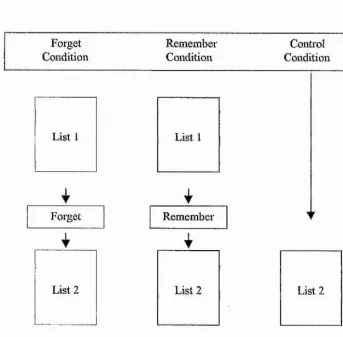
In a typical directed forgetting paradigm, participants are presented with a list of words to study for a later free recall test. However, half way through that list, some participants are asked to forget the previous items but to continue on and try and remember the following items, and these participants form the forget condition.
These instructions to forget or remember certain parts of a list effectively divides the stimuli into two separate lists: the to-be-forgotten list and the to-be-remembered list. In contrast, other participants are not asked to forget the initial list and so have to try to remember all of the items from both of the lists. These participants form the
Strength-Dependent Competition
[image:48.612.77.421.300.638.2]Recall performance and the success of instructions to remember or forget can be measured in various ways. Directed forgetting can be measured by comparing the recall of to-be-remembered items to that of to-be-forgotten items within the forget condition. Directed forgetting can also be measured across conditions by comparing the recall performance for to-be-forgotten items with to-be-remembered items in the remember condition and in the control condition.
Figure 5: Directed forgetting pat adigm
Forget Remember Control
Condition Condition Condition
List 1
Forget
List 1
Remember
List 2 List 2 List 2
I
Memoiy Test
Strength-Dependent Comp etition
Typical Findings from the Directed Forgetting Paradigm
There are three typical findings that have been found across studies using the directed forgetting paradigm suggesting this method of intentional forgetting can produce robust effects. First of all, participants instaicted to forget the initial list typically report more to-be-remembered items than participants who are instmcted to remember both lists in the remember condition (e.g., E.L. Bjork & Bjork, 1996). This is due to recall in the remember condition being impaired thi ough strong proactive interference effects. Thus, the successful forgetting of the initial list reduces, or even eliminates, the proactive interference that typically operates in the second list.
Second, participants asked to forget the first list recall the remember words from the second list equally as well as do participants in a control condition who have completed an unrelated filler task in place of the initial list. Primarily this is due to an absence or reduction in proactive interference during participant’s recall of the to-be- remembered list in both of these conditions. Finally, recall for to-be-forgotten items is worse than for to-be-remembered words suggesting that participants have successfully followed instructions to disregard the first list (see C.M. MacLeod, 1998 for a flill discussion on the basic directed forgetting effects.
Retrieval Inhibition as an Explanation of Directed Forgetting
Strength-Dependent Competition
Instmcting participants to forget a list that has just been presented is thought to trigger retrieval inhibition which, in turn, reduces retrieval access to those items. This loss of retrieval availability to the to-be-forgotten items prevents them from interfering with the retrieval of the new target items - the to-be-remembered items. As the to-be-forgotten items no longer interfere with the retrieval of the tai get items, proactive interference is eliminated, or at least significantly reduced. In contrast, participants who are not instmcted to forget the initial list, and thus do not direct retrieval inhibition at these items, remain susceptible to proactive interference. As these participants are unable to inhibit items on the initial list, the items interfere with the retrieval of items from the second list. As a result, recall of items on the second list is typically impaired in comparison to participants who were instmcted to forget the initial list.
List Method versus Item Method
Strength-Dependent Competition
attention to the uniqueness of each item within the list. In contrast, the presentation of the remember or forget cue after the encoding of a list may encourage participants to process items within that list in relation to each other, as well as various contextual information, such as each item’s temporal location within the list. Thus, retrieval inhibition would be more likely to act as a method of overcoming interference in the list method, where it could impair retrieval access to the list, rather than having to act on each individual item. Instead, a selective rehearsal mechanism has been proposed as the primary mechanism in the directed forgetting effect found with the item method (B.H. Basden & Basden, 1998; B.H. Basden et al., 1993). As such, only the list method, and retrieval inhibitions implied role in it, will be the basis of discussion (but see C.M. MacLeod et al., 2003, for recent discussion on directed forgetting using the list method also being due to differential encoding).
Retrieval Availability and Release fiom Inhibition
Strength-Dependent Competition
While it could be argued that participants are merely re-encoding to-be-forgotten items that have been erased in memoiy tln ough the instmction to forget, the fact that only a sub-set of to-be-forgotten items can reinstate proactive interference, rather than requiring the re-exposure of the complete list, suggests that this assumption is incorrect.
In terms of retrieval inhibition, the finding of intact recognition memory for to-be-forgotten items plus the reinstatement of proactive interference, suggests that re exposure to even a minority of inhibited items is sufficient to result in the ‘release’ of retrieval inhibition. Thus, it would appear that retrieval inhibition is easily elicited and easily overcome. This would allow for a flexible updating process in memory that could quickly adapt to changing goal states. Finally, results from re-learning paradigms further add to the likelihood that the to-be-forgotten items are maintained in memory at full strength, but are only temporarily inaccessible (Geiselman & Bagheri, 1985). To-be-forgotten items are typically re-learned as quickly as to-be- recalled items, suggesting that despite having been inhibited, these items have equally as strong storage strength as to-be-forgotten items.
The Nature ofRetiieval Inhibition: What Exactly is Inhibited?
Sti'ength-Dependent Competition
phase, these types of direct memory tests tell us very little about the nature of the inhibition. In contrast, implicit memory tests provide a way of investigating what level the inhibition operates at by bypassing any episodic memories formed from the study phase and directly accessing the stored memorial representations in long-term memory.
Implicit memory tests have been used in the list method as well as in the item method. While directed forgetting is sometimes found using the item method (e.g., B.H. Basden & Basden, 1996; C.M. MacLeod, 1989; Palier, 1990), impaired recall of to-be-forgotten items has never been found using implicit tests in the list method (e.g., B.H. Basden & Basden, 1996; E.L. Bjork & Bjork, 1996; Palier, 1990). This is despite several different tests being used, such as general knowledge (B.H. Basden & Basden, 1996; B.H. Basden et al., 1993), stem completion (Palier, 1990), and word fiagment completion tasks (E.L. Bjork & Bjork, 1996). B.H. Basden and Basden (1998) have suggested that directed forgetting is not found in implicit tests using the list method because the to-be-remembered list and the to-be-forgotten lists are processed in a relational manner as two integrated units rather than as distinct and unique items. Thus, retrieval inhibition acts on the to-be-forgotten items, not as individual memorial representations, but as a whole list, suggesting that it may be more appropriate to refer to these items as a ‘to-be-forgotten list’.
Strength-Dependent Comp etition
found with implicit memoiy tests using the list method, it would suggest that retrieval inhibition does not inhibit memorial representations that are stored in long-term semantic memoiy.
Continuing Influences of Inhibited Items
Results from various studies appear to suggest that the to-be-forgotten list may be able to continue to influence thoughts and behaviours despite being inhibited. If only the to-be-forgotten items’ retrieval strength is impaired by the actions of retrieval inhibition directed at those items, and to-be-forgotten items remain at full strength in memory, then these inhibited items may continue to influence behaviour in other ways.
Strength-Dependent Comp etition
E.L. Bjork and Bjork (1996) examined this possibility by delaying a final recall task via an implicit memory test. After having demonstrated a directed forgetting effect in conditions where participants were instmcted to forget specific lists, some participants then completed a word fragment test. This test should not require access to the materials learned during the study phase, and should instead require the retrieval of semantically stored material. After having completed this implicit memory test, participants completed a further recall task.
Consistent with previous research, a directed forgetting effect was not found with the intermediate implicit memoiy test. However, a directed forgetting effect was present in the delayed recall test that occurred after the word fragment completion task. This suggests that the recall task and the word fragment task were employing cues that accessed different types of memories, and because of this, the intermediate retrieval task did not release the inhibition of the to-be-forgotten list.
What is of interest, however, is that the prior presentation of the to-be- forgotten items in the study phase primed performance for those items in the word fragment task to the same degree as the to-be-remembered items (see also B.H. Basden et al., 1993). Participants completed more word fragments that referred to items presented during the study phase than for control items that were absent from this initial study phase. This further suggests that, not only may retrieval inhibition act on an episodic memory of the initial study phase rather than on long-term memorial representations, but also that the to-be-forgotten item’s coiresponding representation in semantic memory for the to-be-forgotten items can continue to guide and influence current memorial goals.
Strength-Dependent Competition
decision making following an instmction to disregard certain evidence. While mock juries appear to successfully inhibit disregarded evidence, they are more likely to find the defendant guilty than are control participants who did not receive biasing testimony (e.g., Caretta & Moreland, 1983; J.M. Golding, Fowler, Long & Latta, 1990). Similarly, in real jury trials, the more negative pre-trial publicity that a juiy has been exposed to, the more likely they are to find the defendant guilty, despite the jury members continuing to claim impartiality (Constantin! & King, 1980/1981;
Moran & Cutler, 1991).
Output Interference: A Case o f Interference in the Absence of Competition
Output interference provides an interesting exception to perhaps the most fimdamental arguments of interference theoiy, that of the competition assumption. Output interference refers to the deleterious effects of the earlier retrieval of information on information that is retrieved later. For example, individuals who constmct lists (e.g., lists of things to do, shopping lists) may find that it becomes more difficult to generate items after several examples have already been reported. If important items are missed from such a list then it is likely that they have been omitted due to output interference.
% Strength-Dependent Competition
The retrieval process has been specifically implicated in output interference as the active retrieval of items from memory appears to be a necessary condition to induce impairment in memory. Simply presenting a categoiy label with instaictions to forget the category members appears to be insufficient to produce output interference (Roediger & Schmidt, 1980). This finding suggest that it is the very act of accessing information in memoiy during the retrieval process that leads to forgetting, an observation first made by Roediger earlier in 1974.
Strength-Dependent Competition
Conclusions from Interference Theojy
Studies of interference effects in episodic and semantic memory systems have highlighted and contributed several important findings to our understanding of the mechanisms governing interference effects in long-term memory, and continue to influence current theories. Decades of research into a variety of interference effects suggest that many causes of forgetting can be traced back to the effects of many items sharing a common cue. Under conditions where a single cue is associated to multiple targets, memory impairment is usually found. However, this is not always the case, and output interference has proven to be an interesting exception to the competition assumption. The strength-dependent assumption has also received much support from classical and modern interference research, suggesting that strengthening the association between a cue and a target may weaken the association between that shared cue and competing items.
Retrieval-induced Forgetting
CHAPTER 3
INHIBITORY PROCESSES IN RETRIEVAL-INDUCED FORGETTING
Research into intentional (e.g., directed forgetting) and unintentional forgetting (e.g., output interference, part-set cueing) has highlighted many interesting properties of memoiy, as well as greatly increasing our understanding of updating processes in memory. In the past, interference effects have primarily been explained by non- inhibitoiy theories, although more recently inhibitory processes in episodic memoiy have been inferred (i.e., retrieval inhibition in directed forgetting). Following on from the prior discussion of retrieval inhibition in intentional forgetting, the current chapter considers the evidence for inhibitory processes in unintentional forgetting, and specifically its role in retrieval-induced forgetting. As non-inhibitory theories can provide a more simplistic account of retrieval-induced forgetting, the case for inhibitoiy theories is examined through direct comparisons and tests of the assumptions and predictions of inhibitory versus non-inhibitory theories.
Retrieval as a Memory Modifier