Matteo A. C. Rossi
Quantum Technology Lab, Dipartimento di Fisica, Università degli Studi di Milano, 20133 Milano, Italy
School of Mathematical Sciences, The University of Nottingham, Nottingham NG7 2RD, United Kingdom
Matteo Bina
Quantum Technology Lab, Dipartimento di Fisica, Università degli Studi di Milano, 20133 Milano, Italy
Matteo G. A. Paris
Quantum Technology Lab, Dipartimento di Fisica, Università degli Studi di Milano, 20133 Milano, Italy
INFN, Sezione di Milano, I-20133 Milano, Italy
Marco G. Genoni
Quantum Technology Lab, Dipartimento di Fisica, Università degli Studi di Milano, 20133 Milano, Italy
Department of Physics and Astronomy, University College London, London WC1E 6BT, United Kingdom
Gerardo Adesso
School of Mathematical Sciences, The University of Nottingham, Nottingham NG7 2RD, United Kingdom
Tommaso Tufarelli
School of Mathematical Sciences, The University of Nottingham, Nottingham NG7 2RD, United Kingdom
Abstract. We address the quantum estimation of the diamagnetic, orA2, term in an effective model of light-matter interaction featuring two coupled oscillators. First, we calculate the quantum Fisher information of the diamagnetic parameter in the interacting ground state. Then, we find that typical measurements on the transverse radiation field, such as homodyne detection or photon counting, permit to estimate the diamagnetic coupling constant with near-optimal efficiency in a wide range of model parameters. Should the model admit a critical point, we also find that both measurements would become asymptotically optimal in its vicinity. Finally, we discuss binary discrimination strategies between the two most debated hypotheses involving the diamagnetic term in circuit QED. While we adopt a terminology appropriate to the Coulomb gauge, our results are also relevant for the electric dipole gauge. In that case, our calculations would describe the estimation of the so-called transverseP2term. The derived metrological benchmarks are general and relevant to any implementation of the model, cavity and circuit QED being two relevant examples.
Introduction. The ultra-strong coupling (USC) regime of light-matter interaction has recently attracted much interest, thanks to impressive advances in theory and experiments [1, 2]. A number of interesting phenomena, of fundamental physical appeal and potential impact on future quantum technologies, arise in this regime, including the formation of a nontrivial ground state [3], dynamical Casimir-like effects [4], and the possibility of quantum phase transitions [5, 6].
Loosely speaking, the USC regime is entered when the light-matter coupling constant, sayλ, is a non-negligible fraction of the bare frequencies of light and matter. In this situation the rotating-wave approximation breaks down, and one cannot neglect the so-called “counter-rotating terms" in the interaction Hamiltonian [3, 7]. While this brings about exciting new physics, it results also in formidable computational challenges. Effective models featuring a small number of degrees-of-freedom (modes), such as the Dicke Hamiltonian [5], are extremely useful in this context: they can reveal crucial features of the new regime while keeping computations tractable.
However, there is disagreement in the literature regarding the specific form that these few-degrees-of-freedom models should take, in particular concerning the presence (or otherwise) of the so-called diamagnetic or A2 term. We recall that such a term originates from the general form of the Coulomb gauge minimal coupling Hamiltonian
Hmin=
X
j
( ˆpj−qjAˆ)2
2mj +
V(ˆx1,xˆ2, ...)+HEM, (1)
which describes the interaction of the quantised electromagnetic field with non-relativistic charged particles. In the above equationmj, qj, ˆxj and ˆpj indicate respectively the mass,
charge, position and canonical momentum of the j−th particle, ˆA is the vector potential operator,Vis the instantaneous Coulomb potential energy, whileHEMis the free Hamiltonian of the transverse radiation field [7]. Hminclearly contains a contribution proportional to the squared vector potential ˆA2, i.e. the diamagnetic term.
In cavity QED (and other similar set-ups) many authors derive their effective models by a direct few-mode truncation of Hamiltonian (1), thus explicitly retaining anA2−like term affecting the radiation modes of interest. The importance of such term is well recognized in preventing the Dicke phase transition [8, 9, 10, 11] and in limiting the effectively achievable light-matter coupling [12]. Within such framework, the coupling strength associated with the A2 term obeys precise constraints (see below), whose origin can be traced back to the Thomas-Reiche-Kuhn (TRK) sum rule [5].
In contrast, other authors hold that the few-mode approximation is better carried out in the electric dipole gauge, that is, they apply a canonical transformation to Hamiltonian (1) beforethe derivation of an approximate model. This yields an effective Hamiltonian without diamagnetic term, and seemingly capable of a phase transition [13, 14, 15]. Yet, it has been argued that such derivations neglect the contribution of the so-called transverseP2term, which in the electric dipole gauge plays a role mathematically analogue toA2[10].
In the context of circuit QED, Ref. [5] maintains that the diamagnetic term can be avoided by appropriately tuning the circuit parameters, a claim which has generated further debate [16, 17, 18, 19]. In fact, in circuit QED, there is even disagreement on the most appropriate microscopic description underlying the Dicke model. It is indeed not clear whether the most reliable starting point for the derivation of an effective model should be a minimal coupling Hamiltonian [18] or a direct quantization of macroscopic circuit variables [19].
D-meter
matter mode b
[image:3.612.184.381.97.177.2]cavity mode a
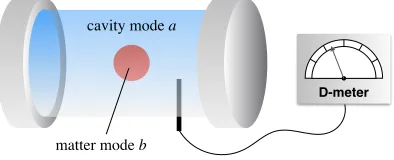
Figure 1. The parameter D, quantifying the strength the diamagnetic term in the Dicke Hamiltonian (2), may be estimated experimentally by performing an appropriate measurement on the coupled light-matter system. Here we find the ultimate bound on the information aboutDthat can be extracted with such a measurement. Our results also suggest that realistic measurements such as homodyne detection or photon counting of the cavity fieldaare well suited to this task in a broad range of the model parameters.
propose that it may be settled experimentally via an appropriate measurement. We note that steps in this direction have been taken in recent theoretical proposals [20, 21]. Moreover, present-day experimental results seem to support the thesis of Nataf and Ciuti [5], i.e. that theA2term may be neglected in some circuit QED systems [22]. In this work we contribute to these efforts by exploiting the tools of quantum metrology. We address the estimation of the A2 coupling constant via measurements on the coupled ground state, thus deriving a theoretical benchmark relevant to any experimental implementation of the model (circuit QED and cavity QED being two relevant special cases). Our work is a first step towards setting precise metrological standards for any experiment probing the diamagnetic parameter. We consider a general Dicke model of two coupled oscillators featuring counter-rotating terms and an A2-like term with unknown coupling constant D. As the establishment of a nontrivial ground state is perhaps the simplest signature of the USC, we find it natural to ask how much information aboutD is contained in this state (i.e., how sensitive the state is to variations in D), and how efficiently such information can be extracted by typical measurements (see Fig. 1 for an illustration). Exploiting the tools of quantum estimation theory [23, 24, 25, 26, 27, 28], we are able to give quantitative answers to these questions.
Besides deriving the ultimate bounds on the estimation precision of D, we find that typical measurements on the transverse cavity field, such as homodyne detection or photon counting, allow for the precise estimation of the diamagnetic term in a wide range of model parameters. Namely, homodyne detection is optimal when the coupling constantλ is vanishing, still providing a close-to-optimal performance forλ . 20% of the bare mode frequencies. This regime of relatively small coupling (yet within the USC) is relevant in both cavity QED [29] and circuit QED experiments [30, 31], and is well described within the two-mode approximation [32]. Moreover, if the Dicke two-model of interest describes a collection of N two-level emitters, this is also a regime in which low-lying excitations are well described by a coupled oscillator model, even for relatively small values ofN: for example, this is the case for a spin-2 Dicke model (N=5) [32].
While we tackle the problem in its full generality, we also obtain compact analytical results for three important limiting cases: (i)D '0; (ii)D' DTRK, whereDTRKis the value
derived from the TRK sum rule [5, 32]; (iii)D ' Dcrit, whereDcrit is the threshold for the Dicke phase transition. In case the model admits a phase transition, we further find that the considered measurements become approximately optimal near the critical point. However we point out that finite-size effects, not included in our model, may become increasingly relevant as criticality is approached [33, 34, 35].
between the choicesD=0 andD=DTRK, which may be relevant in circuit QED [16, 5]. We
then discuss the experimental feasibility of the proposed measurements, and conclude the Letter by providing an outlook of further research questions stemming from our work.
Before proceeding we note that in this Letter we adopt a language appropriate to the Coulomb gauge, such that field operators describe excitations of the transverse (and gauge invariant) radiation field, while what we call “matter mode" in fact describes a combination of matter and field properties [7]. In this form, our results can be used to determine the most appropriate coupling constant of the diamagnetic term. In Appendix C we show that our results can be readily adapted to describe the estimation of theP2term in dipole gauge [10].
The model. Let us start by introducing the Hamiltonian of the system. We denote withathe photonic cavity mode, of bare frequencyωa, and withbthe matter mode, with frequencyωb.
After setting~=1, the Hamiltonian reads
H =ωaa†a+ωbb†b+λ(a+a†)(b+b†)+D(a+a†)2, (2)
whereλis the light-matter coupling strength and the last is the diamagnetic term, with the constantDbeing the object of our discussion.
Being quadratic in the field operators,H is easily diagonalized and can be written, up to an irrelevant constant, asH =ωUp†UpU+ωLp
†
LpL,wherepU,L are bosonic operators for
the upper and lower polaritonic modes. The eigenfrequenciesωU,Lare reported in [32] and in
Appendix A.
If the diamagnetic term is absent, i.e. we setD=0 in Eq. (2), we recover the standard Dicke Hamiltonian, with a quantum phase transition atλ =λcrit ≡
√
ωaωb/2. On the other
hand, if the diamagnetic term is included, it must satisfy the inequality
D≥Dcrit≡λ2/ωb−ωa/4 (3)
in order for the Hamiltonian in Eq. (2) to be bounded from below. IfDassumes the ‘TRK value’ [32],
D=DTRK≡λ
2/ω
b, (4)
then Eq. (3) is always satisfied and the phase transition is suppressed.
The ground state of the Hamiltonian is the vacuum state of the polaritonic modes, i.e. a Gaussian state with zero mean and covariance matrixσ0=I/2. Expressing this state in terms
of the initial modesaandb, we obtain a non-trivial, two-mode squeezed Gaussian state with covariance matrixσ=Sσ0ST, where the suitable symplectic transformationS is reported in Appendix A.
Quantum estimation methods. Let us now address the problem of estimatingD, and in doing so we shall review the basics of quantum estimation theory. In order to determine the value of the unknown parameter, one collects measurement outcomes from experiments and builds an estimator ˆD, i.e. a function of the data that will return our best guess for the value ofD. Assuming that the estimator is unbiased, its precision, in the limit of a large numbern of measurements, is bounded from below by the Cramér-Rao bound [38] Var ˆD ≥ [nF(D)]−1, where F(D) is the Fisher information (FI) of the probability distribution p(x|D), defined as F(D) = R dxp(x|D)[∂Dlnp(x|D)]2. Here p(x|D) is the conditional probability that the
described by positive operator-valued measures (POVMs), we obtain the quantum Cramér-Rao bound, i.e. the ultimate lower bound on the achievable precision in the estimation ofD [28].
The QFI with respect toDcan be evaluated analytically for Gaussian states [39, 40, 34] and for the case at hand is given by
H(D)=Tr[ΩT∂σΩΦ], (5)
where∂denotes the derivative with respect toD,Ω =⊕2
i=1
0 1
−1 0
is the symplectic matrix, and
the matrixΦsatisfies the linear equation∂σ=2σΩΦΩTσ−1
2Φ.The expression for the QFI is quite cumbersome and we report it in Appendix B. In the following we analyse its behavior in the cases of interest for our discussion. We also note that the QFI is a homogeneous function of the parameters of the Hamiltonian:H(αD, αωa, αωb, αλ)=α−2H(D, ωa, ωb, λ).
The QFI for the two-mode ground state is a relevant benchmark for the precision of any measurement on the system. In realistic experiments, however, it will only be possible to measure a limited number of system observables. For definiteness, we shall focus here on typical measurements that can be performed on the transverse radiation fielda. It is thus interesting to compute also the QFIHa(D) for the reduced state of modea, which is a squeezed
thermal state, see Appendix B.
Homodyne detection corresponds to the measurement of the quadrature operator ˆx(φ)= (ae−iφ+a†eiφ)/√2, whereφis an arbitrary angle. For the reduced stateρ
a, the probability
distribution for the outcome ofx(φ) is a normal distribution with zero mean and covariance
σ11cos2φ+σ22sin2φ; the corresponding FI, F(hd) is reported in Appendix B. It is further argued that the FI has a maximum atφ=0: this has the important consequence that the best measurement angle does not depend on the (yet unknown)Dparameter. On the other hand, the FI for photon counting cannot be determined analytically as it involves an infinite sum of the termsp(n)=hn|ρ|ni, i.e. the probabilities of finding a photon in the Fock state|ni[41, 34]; we evaluate it numerically in a truncated Fock space.
Results: Probing the diamagnetic term. The main results of this paper, namely the analytical expressions for the QFI and FI for the homodyne detection (reported in Appendix B) are valid for any values of the model parameters, provided the Hamiltonian (2) admits a ground state. In what follows, we focus on the parameter regimes that are most relevant from a theoretical and from an experimental point of view.
Let us start by focusing on the regime of relatively small coupling within the USC. The QFI has a non vanishing limiting value
H(D)=2(4D+ωa)−2+O(λ2), (6)
showing how, in this regime, smaller values of Dcan be estimated more efficiently, yet a large number of measurements is needed to neutralise the contribution ofωa and obtain a
precise estimation. Remarkably, the FI for the homodyne measurement saturatesH(D) up to second order inλ, indicating that, no matter what the true value of Dis, we can estimate it with optimal efficiency by detecting the quadrature of modeawhenλis sufficiently small. In detail, if we consider the plausible scenarioD.DTRK, the ratio between FI andH(D) is
F(hd)(D.D
TRK)
H(D.DTRK)
=1− 8ω
2
a
(ωa+ωb)4
λ2+O(λ4). (7)
0.0 0.2 0.4 0.6 0.8 1.0 λ/λcrit 0.6
0.7 0.8 0.9 1.0 R
1.0 1.5 2.0 2.5 3.0 D/Dcrit
[image:6.612.155.410.99.196.2]0.2 0.4 0.6 0.8 1.0 R
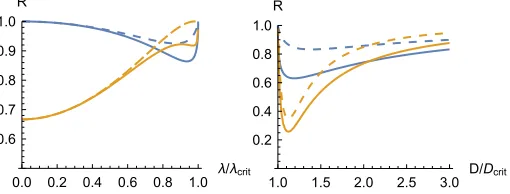
Figure 2.Left: RatioRbetween the FI and the QFI for the two modes (solid) and the photon mode (dashed) forD=0 as functions ofλ. Homodyne detection is highlighted in blue and photon counting in orange. The plot is obtained forωa =ωb =1. Homodyne detection is
optimal for smallλand both measurements saturate the QFI whenλ≈λcrit. Right: Plot of
the same quantities whenDgets close to the critical valueDcrit, forλ=1 andωa=ωb=1.
Both measurements saturate the QFI in the limitD→DcritandD/Dcrit→ ∞, with homodyne
detection reaching generally higher ratios in the region close to the critical value.
point. For the caseD=0 the phase transition appears when the coupling reaches the critical valueλcrit=
√
ωaωb/2. In this case the QFI forDdiverges as
H(D=0)∼ωb/[8ωa(λ−λcrit)2], (8)
and the homodyne and the photon counting measurements both saturate the QFI in this limit, as shown in Fig. 2 (left panel). If Dapproaches the TRK value D ' DTRK [cf. Eq. (4)],
the phase transition is suppressed and there is no criticality in the system. The QFI for the two-mode state (for anyλ) reads
H(DTRK)=
2
ω2
a
− 16λ
2ω
aωb
4λ2ω
a+ωb(ωa+ωb)22
. (9)
H(DTRK) is clearly higher for small frequencies of the radiation mode, whereas it decreases
in the case of high frequencies. With respect to λ, H(DTRK) has a minimum at λ
2 =
ωb(ωa+ωb)2/4ωa and the asymptotic value 2/ω2a for large and smallλ. The ratio between
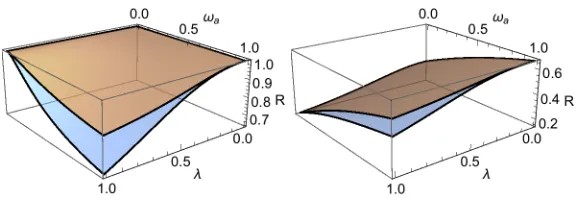
the FI for the two measurements and the QFI is shown in Fig. 3 as a function ofλandωa. One
can also verify that the expansion in Eq. (7) is in fact a good guideline for remarkably large values of λ, implying that homodyne would be an excellent measurement strategy in most experimentally relevant situations. For example, settingD=DTRKandωa=ωb =2λ, we still
get a ratio of 81/92'0.88, while the approximation of Eq. (7) would yield 7/8'0.87. In general, in the vicinity of the critical pointDcrit, the asymptotic behavior of the two-mode QFI is
H(D) ∼ D→Dcrit
1
8 (D−Dcrit)2, (10) that is, the QFI diverges, meaning that the amount of information that can be extracted per measurement increases enormously. This is another confirmation of the role of quantum criticality in the enhancement of estimation [34, 42, 43]. We point out, however, that we neglect finite-size effects which may become relevant near the critical point. Nonetheless, it is reasonable to believe that these effects translate into a smoothing of the QFI, for either the atomic ensemble or the radiation mode (see Ref. [33] for the finite-size case without the diamagnetic term).
Figure 3. Ratios F(hd)(D
TRK)/H(DTRK) (blue) and F(hd)(DTRK)/Ha(DTRK) (orange) for
homodyne detection (left) and photon counting (right), atD=DTRKandωb=1. Homodyne
detection is optimal for smallλ, but allows to extract a relevant amount of information (about 70%), also whenλ'ωa,b. Photon counting is optimal for largeωaand smallλ.
criticality can be achieved by measuring only a part of the system. Moreover, it can effectively be achieved with feasible experiments such as homodyne detection or photon counting (see Fig. 2). The FI for thex-quadrature measurement indeed saturates the QFI asDgets close to the critical valueDcrit,
F(hd)(D) H(D) ∼1−
16λ2ω3/2
a
4λ2ω
aωb+ω4b
(D−Dcrit)1/2. (11)
We further find numerically that the photon counting measurements can also saturate the QFI near the critical point.
Results: Quantum discrimination. We finally tackle the problem of discriminating between the two values ofDthat are most argued in the recent circuit-QED literature: D=0 andDTRK.
By making a measurement on a subsystem, typically the cavity field, we want to decide which of the two hypotheses is correct. Quantum mechanics poses a limit to the discriminating ability, quantified by the Helstrom bound [36, 37]: if we label ρ(0) andρ(TRK), respectively,
the ground state in the two hypotheses, the lowest probability of error in the discrimination between these two states isPe=121−D(ρ(0), ρ(TRK)), whereDdenotes the trace distance. The
Helstrom bound is based on the assumption that the system has the same probability to be in either of the two states, reflecting the lack of anya prioriinformation on which hypothesis is the correct one. The Helstrom bound calculated on the two-mode state can only be used as an ideal benchmark, as it is saturated by a (typically unfeasible) collective measurement on the two modes. A more practical benchmark is given by the Helstrom bound calculated on the reduced state of modea, i.e. in the discrimination betweenρ(0)
a andρ(TRK)a . Being these
states mixed, the trace distance cannot be computed analytically, and a diagonalization of the density operators expanded on a truncated Fock basis is required. The ensuing bound on the probability of error,P(ea), is less stringent than the two-mode bound.
We show the dependence ofPeandP(ea)onλ/λcin Fig. 4: the probability of error is close
to 1/2 for smallλand vanishes whenλ→λc= √
ωaωb/2 in the caseD=0. The dependence
onλin the neighborhood ofλcisPe∼(λc−λ)1/4. ForP(ea)a numerical fit shows an exponent
around 1/5. Thus we find that the discrimination between the two hypotheses is hard in the regime of small coupling, while criticality allows for a great improvement, should the optimal strategy be found.
exploits the fact that the probability distribution of the outcome of the quadrature measurement is a Gaussian with varianceσ11. In the caseD=0, whenλ→λcrit,σ11 ∼(λcrit−λ)−1/2. On the other hand, forD=λ2/ωb,σ11does not depart much from its limit forλ→ 0, which is 1/2. Thus, close to the critical value, the Gaussian distribution forD=λ2/ωbis very narrow
compared to the distribution forD=0.
We can thus set up a readily feasible discrimination experiment as follows: if the outcome of the experiment is|x|<2σ(TRK)
11 ‡then the state of the system isρ
(TRK), otherwise it isρ(0). The
corresponding probability of error is
P(hd)e =
Z 2σ(TRK)11
0
N(0, σ(0)11)dx+
Z ∞
2σ(TRK)11
N(0, σ(TRK)
11 )dx (12)
where the first (second) term is the probability of detectingρ(0)(ρ(TRK)) when the actual state
wasρ(TRK)(ρ(0)), andN(µ, σ) is the normal distribution with meanµand varianceσ.
In a photon counting experiment, we can exploit the fact that, whenD=0, the average photon number diverges near the phase transition [34], while it is close to zero if the phase transition is suppressed by the presence of theA2term. Thus, we can discriminate between the two hypotheses by setting a threshold photon numbernT and assigning any outcome below
that threshold to the hypothesisρ(TRK)and any outcome above toρ(0). The probability of error
in this case would be
P(pc)e =
1 2
nT X
n=0
p0(n)+1− nT X
n=0 pTRK(n)
. (13)
We find that the optimal threshold value is nT = 0, i.e. the discrimination is between
no photons and any number of photons. This is a harder question to settle in a realistic experiment.
The resultingP(hd)e andP
(pc)
e are compared to the Helstrom bounds in Fig. 4. We see that
the homodyne scheme is slightly better than the photon counting one. Interestingly, these two feasible discrimination schemes have the same behavior as the Helstrom bound P(ea) on the
reduced state when approaching the critical point, although neither of them is optimal.
Measuring the cavity field. Before closing, we would like to comment on the feasibility of the proposed measurements, which require access to the cavity modea (see Fig. 1). One possible way to access the intra-cavity field is to suddenly switch offthe couplingλ, a drastic yet experimentally feasible procedure [1]. Allowing one of the cavity mirrors to have a small but finite transmissivity, one may subsequently collect the cavity output field (i.e. the radiation that gradually leaks out into the external world). In absence of light-matter coupling and other losses, the cavity output field can be used to extract the full quantum statistics of modeajust before the switch-off[44]. A crucial open question, however, is how coherent the switching process can be, i.e., how well it can preserve the quantum state of light. Importantly, our results can be generalized in future work to take into account experimental imperfections in the switching process: due to finite transients, losses and other decoherence mechanisms, one would end up measuring a deteriorated version of the original cavity fielda. It is reasonable to assume that the whole process could be modelled as a quantum channel acting on the reduced state of the cavity mode, just before the latter is measured. Insofar as these imperfections can be described by a Gaussian channel, the problem could be attacked by a straightforward generalization of the tools employed here. Importantly, the relevant noise parameters must
‡ The choice of 2σ(TRK)
11 here is arbitrary. The optimal threshold depends on the parameters of the problem. Even
0.0 0.2 0.4 0.6 0.8 1.0
λ
λcrit
0.1 0.2 0.3 0.4 0.5 Pe
10-510-410-310-210-1 100
1-λ
λcrit
[image:9.612.169.394.99.212.2]0.05 0.10 0.20 0.50 Pe
Figure 4.The probabilities of errorPe, given by the Helstrom bound on the two-mode system
(solid blue), P(ea), for the photon mode (dot-dashed orange),P(hd)e for homodyne detection
(dashed yellow) and P(pc)e for photon counting (dotted green) as functions ofλ/λcrit, with
ωa = ωb = 1. In the inset, a log-log plot of the same quantities asλapproachesλcrit.
The probability of error is close to 1/2 for smallλ, vanishing whenλ → λcrit, i.e. when,
forD = 0, the system is close to the quantum phase transition. The Helstrom bound on the modeabehaves differently from the two-mode bound near the critical value. The two proposed discrimination schemes, although not saturating the single-mode bound, have the same behavior in the limitλ→λcrit.
0.0 0.2 0.4 0.6 0.8 1.0 0.6 0.8 1.0 1.2 1.4
η
F
(
hd
)/H
a
0.0 0.5 1.0 1.5
F
(
hd
),H
a
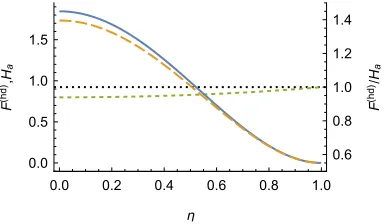
Figure 5. Effect of experimental imperfections on the estimability ofD. Due to non-ideal conditions in the procedure of cavity field extraction, we assume that the cavity modeais affected by a pure-loss channel before the measurement. We plot the single-mode QFI of the field mode (solid blue), FI for homodyne detection (dashed orange), in units of the inverse-square frequency, and their ratio (dotted green, right scale) as functions of the loss parameter η, forωa =ωb =1 andλ=0.2, assuming thatD=λ2/ωb. The estimability ofDinevitably
decreases withη, but the ratio between the FI and the QFI does not decrease and tends to one (dotted black line). This suggests that homodyne detection may be a robust measurement for the estimation ofDin realistic experimental conditions.
be known in advance for this approach to work within the paradigm of single-parameter estimation. As an example, we illustrate the special case of a Gaussian pure-loss channel [45], described by a loss parameterη∈[0,1] quantifying the probability of single-photon loss (withη=1 meaning complete loss, i.e. the output state is always the vacuum). The effect on the estimability ofDis shown in Fig. 5. The QFI and FI inevitably decrease withη, but the ratio does not, signifying that homodyne detection may be a robust measurement to estimate the diamagnetic term in presence of decoherence.
[image:9.612.185.378.324.436.2]estimation or quantum state discrimination. We obtained the ultimate quantum limits to the rate at which information can be extracted from the ground state of the coupled system, and we discussed the performance of two typical measurements on the cavity field, homodyne and photon counting, that allow for efficient estimation of the parameter of interest. This efficiency becomes optimal in experimentally relevant regimes, such as the small-coupling regime in which the coupling is up to 20% of the mode frequencies.
To conclude, we would like to indicate some possible directions for future work. By employing multiparameter quantum estimation theory [28], our study can be expanded to cover more realistic situations in which other parameters of the model, e.g. loss rates or the couplingλ, are not known exactly. The role of finite-size effects could also be explored, in particular near criticality where a coupled-oscillator model might be inaccurate [33] (this, however, will require techniques beyond the Gaussian formalism employed here). The estimability of theA2-term from a thermal state of the coupled system could also be addressed: in this scenario radiation will be continuously emitted by the cavity, without the need to have a fast modulation of the coupling constant.
Finally, we remark that the ideas presented in this Letter may be generalised to test the validity of alternative or more complex models of light-matter interaction; for example, alternative Dicke models for circuit QED such as that proposed in [19], or models with additional terms to describe electrostatic contributions (e.g. dipole-dipole interactions between the atoms), or effective contributions from higher harmonics of the cavity field [32].
Acknowledgments
This work has been supported by EU through the Erasmus+Placement programme, the Marie Skłodowska-Curie Action H2020-MSCA-IF-2015 (project ConAQuMe) and the collaborative Project QuProCS (Grant Agreement 641277), the EPSRC UK (grant No. EP/K026267/1), the European Research Council (ERC StG GQCOP, Grant No. 637352), the Royal Society (Grant No. IE150570), and by UniMI through the H2020 Transition Grant 15-6-3008000-625.
Appendix A. Covariance matrix of the ground state
As is shown in [32], the USC Hamiltonian in Eq. (2) can be cast to the diagonal form of Eq. (2), where the frequenciesωU,ωLare
ω2
U,L= ω2
a+4Dωa+ω2b
2 ± v t ω2
a+4Dωa−ω2b
2 2
+4λ2ω
aωb. (A.1)
The symplectic matrix that transforms the vectora,b,a†,b†of the original-mode creation and annihilation operators into the vector of polaritonic modespU,pL,p
†
U,p
†
L
, is given by
¯ S =
cosθ f+
ω
U
ωa
−sinθ f+
ω
U
ωb
cosθ f−
ω
U
ωa
−sinθ f−
ω
U
ωb
sinθ f+
ω
L
ωa
+cosθ f+
ω
L
ωb
sinθ f−
ω
L
ωa
cosθ f−
ω
L
ωb
cosθ f−
ω
U
ωa
−sinθ f−
ω
U
ωb
cosθ f+
ω
U
ωa
−sinθ f+
ω
U
ωb
sinθ f−
ω
L
ωa
cosθ f−
ω
L
ωb
sinθ f+
ω
L
ωa
+cosθ f+
where
cos 2θ= ω 2
a+4Dωa−ω2b ω2
U−ω
2
L
sin(2θ)=−4λ √
ωaωb ω2
U−ω
2
L
. (A.3)
and we define
f±(x)=
1 2
√
x± √1
x
!
. (A.4)
The ground state of the diagonalized Hamiltonian is the vacuum, i.e. a Gaussian state with no displacement and a covariance matrix σ0 = I/2 in the basis of the quadratures
xU,L=(pU,L+p†U,L)/
√
2,yU,L=−i(pU,L−p†U,L)/
√
2.
To obtain the covariance matrixσin the original modesaandb, transformσ0using a symplectic matrixSthat can easily be obtained from ¯S. After some simplifications, we have
σ=Sσ0ST =
ωa(ω2b+ωLωU)
ωLωU(ωL+ωU) 0 −
2λωaωb
ωLωU(ωL+ωU) 0
0 2(ω
2
a+4Dωa+ωLωU)
2ωaωL+2ωaωU 0
2λ
ωL+ωU −ω 2λωaωb
LωU(ωL+ωU) 0
ωb(ω2a+4Dωa+ωLωU) ωLωU(ωL+ωU) 0
0 ωL+2λω
U 0
ω2 b+ωLωU ωb(ωL+ωU)
(A.5)
Appendix B. Quantum Fisher information and Fisher information for homodyne detection and photon counting
Appendix B.1. QFI for the two-mode state
Givenσ, we can calculate the quantum Fisher information (QFI) using Eq. (5). If the state is pure, the solution of Eq. (6) isΦ =−∂σ. This in turn yields the following expression for the QFI:
H(D)=2(∂σ1,1∂σ2,2+2∂σ2,4∂σ3,1+∂σ3,3∂σ4,4). (B.1)
Here we report the general expression of the QFI (after some manipulations)
H= 2ω 2
aω2b ω4
Lω
4
U(ωL+ωU)4 n
(ω2bh16D2ω2a+8Dωa
ω2
a+3ω
2
b+2ωLωU
+ω4
a+4ωLωU
ω2
a+ω
2
b
+6ω2aω2b+ω4bi
−8λ2ωaωb
4Dωa+ω2a+2ω
2
b
+32λ4ω2ao.
(B.2)
The relevant cases are discussed in the paper.
Appendix B.2. QFI for the reduced state of mode a
The covariance matrixσaof the reduced stateρa of the photonic mode is simply the upper
left diagonal block ofσ. The corresponding state is a squeezed thermal state
ρa =S(r)νthS†(r)=
1 1+N
∞
X
m
N
1+N
m
whereNis the number of thermal photons andris the squeezing parameter:
N= 1 2
s ω2
b+ωLωU
4Dωa+ω2a+ωLωU ωLωU(ωL+ωU)2
−1
(B.4)
r= 1 4log
ωLωU
4Dωa+ω2a+ωLωU
ω2
a(ω2b+ωLωU)
. (B.5)
The QFI for the reduce state can be obtained easily by solving Eq. (6) of the paper forΦ. Beingσadiagonal, we simply find thatΦis diagonal with
Φ11 =2
(∂σa)11+4(σa)211(∂σa)22
16(σa)211(σa)222−1
(B.6)
Φ22=2
(∂σa)22+4(σa)222(∂σa)11
16(σa)211(σa)222−1
. (B.7)
The corresponding QFI is
Ha=
42σ211(∂σ22)2+2σ222(∂σ11)2+∂σ11∂σ22
16σ211σ222−1 . (B.8)
Appendix B.3. Fisher information for the homodyne detection
In a homodyne detection experiment one can measure the field mode quadrature at an arbitrary phase, i.e. the expected value of the operator ˆx(φ)=(ae−iφ+a†eiφ)/
√
2.
The probability density for the outcome of a homodyne measurement is easily obtained from the Wigner function of the reduced state of the photon modeρa = Trb[ρ], which is a
Gaussian distribution with zero mean and covariance matrix diag(σ11, σ22).
The probability pφ(x) of the outcoume x(φ) for the measurement is the marginal distribution of the Wigner function, obtained after a rotation of an angleφin the phase space:
pφ(x)=
Z
dyW[ρa](xcosφ−ysinφ,xsinφ+ycosφ)
=N(0, σ11cos2φ+σ22sin2φ),
(B.9)
that is, a normal distribution with varianceσ11cos2φ+σ22sin2φ. The Fisher information (FI) for this distribution is easily obtained to be
Fφ(D)= Z
dx[∂pφ(x)] 2
pφ(x) =
∂σ11cos2φ+∂σ22sin2φ
2
2σ11cos2φ+σ22sin2φ
2. (B.10)
It is easy to check that the FIFφ(D) has maxima forφ=0, π/2, in which
F0(D)=(∂σ11) 2
2σ11
, Fπ
2(D)=
(∂σ22)2 2σ22
. (B.11)
Numerical analysis indicates thatF0(D)≥Fπ
2(D), thusφ=0 is the optimal angle to perform
Appendix C. Dicke models in the dipole gauge
Our calculations can be readily adapted to the study of Dicke models in the electric dipole gauge. In such a case, our Hamiltonian may be written as
Hdip=ω¯aa†a+ω¯bb†b+λ¯(a+a†)(b+b†)+D(b¯ +b†)2, (C.1)
where ¯ωa,ω¯b, ¯λ, ¯Dare the bare frequencies and light-matter coupling constant relevant to the
new gauge. Note how the coupling parameter ¯Dis now associated with theP2term [10]. In the dipole gauge, the operatorsb,b† describe physical degrees of freedom of matter, thanks to the equivalence between canonical and kinetic momentum. On the other hand, the field operatorsa,a† no longer describe the transverse radiation field, but are “contaminated" by matter properties [7]. From Eq. (C.1) it is evident that the results presented in our manuscript can be easily translated in the dipole gauge, by simply swapping the role of a andb in all calculations. Then, the parameter to be probed becomes the P2 coupling constant ¯D. Specifically, our calculations relative to homodyne detection and photon counting indicate that efficient estimation of the P2 term is achievable through measurements on the matter degree of freedom.
References
[1] Günter G, Anappara A A, Hees J, Sell A, Biasiol G, Sorba L, De Liberato S, Ciuti C, Tredicucci A, Leitenstorfer A and Huber R 2009Nature458178–181
[2] Maissen C, Scalari G, Valmorra F, Beck M, Faist J, Cibella S, Leoni R, Reichl C, Charpentier C and Wegscheider W 2014Phys. Rev. B90205309
[3] Ciuti C, Bastard G and Carusotto I 2005Phys. Rev. B72115303 [4] De Liberato S, Ciuti C and Carusotto I 2007Phys. Rev. Lett.98103602 [5] Nataf P and Ciuti C 2010Nat. Commun.172
[6] Emary C and Brandes T 2004Phys. Rev. A69053804
[7] Cohen-Tannoudji C, Dupont-Roc J and Grynberg G 1997Photons and Atoms(Weinheim, Germany: Wiley-VCH Verlag GmbH) ISBN 9783527618422
[8] Bialynicki-Birula I and Rza¸˙zewski K 1979Phys. Rev. A19301–303 [9] Rza¸ewski K and Wódkiewicz K 1991Phys. Rev. A43593–594 [10] Bamba M and Ogawa T 2014Phys. Rev. A90063825
[11] Chirolli L, Polini M, Giovannetti V and MacDonald A H 2012Phys. Rev. Lett.109267404 [12] De Liberato S 2014Phys. Rev. Lett.112016401
[13] Vukics A, Grießer T and Domokos P 2014Phys. Rev. Lett.112073601 [14] Vukics A and Domokos P 2012Phys. Rev. A86053807
[15] Keeling J 2007J. Phys.: Condens. Matter19295213
[16] Viehmann O, von Delft J and Marquardt F 2011Phys. Rev. Lett.107113602 [17] Ciuti C and Nataf P 2012Phys. Rev. Lett.109179301
[18] Viehmann O, von Delft J and Marquardt F 2012 Reply to Comment on "Superradiant Phase Transitions and the Standard Description of Circuit QED" (Preprint1202.2916)
[19] Jaako T, Xiang Z L, Garcia-Ripoll J J and Rabl P Inhibition of ground-state superradiance and light-matter decoupling in circuit QED (Preprint1602.05756)
[20] García-Ripoll J J, Peropadre B and De Liberato S 2015Sci. Rep.516055
[21] Lolli J, Baksic A, Nagy D, Manucharyan V E and Ciuti C 2015Phys. Rev. Lett.114183601 [22] Yoshihara F, Fuse T, Ashhab S, Kakuyanagi K, Saito S and Semba K 2016Nature Phys.3906 [23] Braunstein S L and Caves C M 1994Phys. Rev. Lett.723439–3443
[24] M G A Paris, J Rehacek (Eds) 2004Quantum State Estimation(Lect. Notes Phys.vol 649) (Springer, Berlin) [25] Amari S and Nagaoka H 2007Methods of Information Geometry(American Mathematical Society) [26] Escher B M, de Matos Filho R L and Davidovich L 2011Nature Phys.7406–411
[27] Brody D C and Hughston L P 1998Proc. Royal Soc. A4542445–2475 [28] Paris M G A 2009Int. J. Quantum Inf.7125–137
[29] Anappara A A, De Liberato S, Tredicucci A, Ciuti C, Biasiol G, Sorba L and Beltram F 2009Phys. Rev. B79
[30] Niemczyk T, Deppe F, Huebl H, Menzel E, Hocke F, Schwarz M, Garcia-Ripoll J, Zueco D, Hümmer T, Solano Eet al.2010Nature Physics6772–776
[31] Forn-Díaz P, Lisenfeld J, Marcos D, García-Ripoll J J, Solano E, Harmans C J P M and Mooij J E 2010Phys. Rev. Lett.105237001
[32] Tufarelli T, McEnery K R, Maier S A and Kim M S 2015Phys. Rev. A91063840 [33] Rodríguez-Lara B M and Lee R K 2010J. Opt. Soc. Am. B272443–2450 [34] Bina M, Amelio I and Paris M G A 2016Phys. Rev. E93052118
[35] Wang T L, Wu L N, Yang W, Jin G R, Lambert N and Nori F 2014New Journal of Physics16063039 [36] Helstrom C W 1976Quantum detection and estimation theory(Academic Press New York) ISBN 0123400503 [37] Bergou J A 2010J. Mod. Opt.57160–180
[38] Cramér H 1946Mathematical Methods of Statistics(Princeton: Princeton Univ. Press) ISBN 0-691-08004-6 [39] Monras A 2013 Phase space formalism for quantum estimation of Gaussian states (Preprint1303.3682) [40] Jiang Z 2014Phys. Rev. A89032128
[41] Marian P and Marian T A 2012Phys. Rev. A86022340
[42] Zanardi P, Giorda P and Cozzini M 2007Phys. Rev. Lett.99100603 [43] Zanardi P, Paris M G A and Campos Venuti L 2008Phys. Rev. A78042105
[44] Gardiner C and Zoller P 2004Quantum Noise: A Handbook of Markovian and Non-Markovian Quantum Stochastic Methods with Applications to Quantum OpticsSpringer Series in Synergetics (Springer) ISBN 9783540223016