Ioannis Kogias,1,∗ Yu Xiang,2 Qiongyi He,2 and Gerardo Adesso1,†
1School of Mathematical Sciences, The University of Nottingham, University Park, Nottingham NG7 2RD, United Kingdom 2State Key Laboratory of Mesoscopic Physics, School of Physics, Peking University,
Collaborative Innovation Center of Quantum Matter, Beijing 100871, China
(Dated: January 16, 2017)
The need for secrecy and security is essential in communication. Secret sharing is a conventional protocol to distribute a secret message to a group of parties, who cannot access it individually but need to cooperate in order to decode it. While several variants of this protocol have been investigated, including realizations using quantum systems, the security of quantum secret sharing schemes still remains unproven almost two decades after their original conception. Here we establish an unconditional security proof for continuous variable entanglement-based quantum secret sharing schemes, in the limit of asymptotic keys and for an arbitrary number of players. We tackle the problem by resorting to the recently developed one-sided device-independent approach to quan-tum key distribution. We demonstrate theoretically the feasibility of our scheme, which can be implemented by Gaussian states and homodyne measurements, with no need for ideal single-photon sources or quantum memo-ries. Our results contribute to validating quantum secret sharing as a viable primitive for quantum technologies.
I. INTRODUCTION
Secret sharing[1,2] is a task where adealersends a secret S to n (possibly, dishonest) playersso that the cooperation of a minimum ofk≤ nplayers is required to decode the se-cret. Protocols that accomplish this are called (k,n)-threshold schemes. The need for such a task appears naturally in many situations, from children’s games and online chats, to banking, industry, and military security: the secret message cannot be entrusted to any individual, but coordinated action is required to decrypt it in order to prevent wrongdoings.
For the classical implementation of the simplest (2, 2)-threshold scheme, Alice, the dealer, encodes her secret into a binary stringS and adds to it a random stringRof the same length, resulting into the coded cypherC=S ⊕R, where “⊕” denotes addition modulo 2. She then sendsRandC respec-tively to the players Bob and Charlie. While the individual partsRandCcarry no information about the secret, only by collaboration the players can recoverS adding their strings to-gether:R⊕C=S. General (k,n)-threshold classical schemes are a bit more involved. Such protocols, however, face the same problem as any other classical key distribution protocol: eavesdropping. An eavesdropper, Eve, or even a dishonest player, can intercept the transmission and copy the parts sent from the dealer to the players, thus accessing the secret.
An obvious way to proceed would be for Alice to first employ standard two-party quantum key distribution (QKD) protocols [3], to establish separate secure secret keys with Bob and Charlie, then implement the classical procedure to split the secretS into parts R andC, and use the obtained secret keys to securely transmit these parts to each player. The advantage of this protocol, which we call parallel-QKD (pQKD), is that it exploits unconditional security offered by the well-studied two-party QKD against eavesdropping and, very importantly, that it can be unconditionally secure against
∗
john k [email protected]
any possible dishonest actions of the players. However, pQKD can be demanding in terms of resources, as for a gen-eral (k,n) scenario it requires the implementation ofndistinct QKD protocols plus the classical procedure to split the secret [1], thus becoming less efficient with increasingn.
An alternative proposal to cope with these difficulties lies in so-calledquantum secret sharing[4] (QSS) — alias quan-tum sharing of a classical secret, distinct from quanquan-tumstate sharing [5,6], in which the secret is a quantum state rather than a classical message — which allows for implementing a (k,n)-threshold scheme supported by asingleclassical post-processing, regardless of the number of playersn. Unfortu-nately, as we shall see below, there exists no provably secure QSS scheme at the moment that enjoys the unconditional se-curity of pQKD against both eavesdropping and dishonesty.
Hillery, Buˇzek, and Berthiaume [4] (HBB, for short) pro-posed the first (2,2)- and (3,3)-threshold QSS schemes that use multipartite entanglement to split the classical secret, and protect it from eavesdropping and dishonest players in a single go. Various other entanglement-based (HBB-type) schemes have been proposed [7–14], some being more economic in the required multipartite entanglement [15,16], while others al-lowing for more general (k,n)-threshold schemes [17–21]. A different entanglement-based QSS scheme has also been pro-posed, where entangled states are directly used as secure car-riers and splitters of information [22]. A few experimental demonstrations have been reported as well [16,23–25]. The security of all current schemes, however, is limited to either plain external eavesdropping unrealistically assuming honest players, or limited types of attacks by eavesdroppers and dis-honest participants, yet sharing ideally pure maximally entan-gled states. Furthermore, all such schemes are vulnerable to participant attack and cheating [7,26,27], and no method is currently known to deal with such conspiracies in general, not even in the ideal case of pure shared states.
Zhang, Li, and Man [28] proposed the first(n,n)-threshold scheme that required no entanglement and was claimed to be unconditionally secure. Although it required perfect single photon sources and quantum memories (rendering it impracti-cal for current technology), it was later shown to be vulnerable
to various participant attacks [29,30]. In the same category of entanglement-free QSS schemes, Schmid et al. proposed a protocol based on a single photon [31]; although originally claimed to be unconditionally secure, it was also shown to be vulnerable to participant attacks [32–35]. Alternative schemes can be devised to deal with particular attacks [29,30,32,33], however there currently exists no rigorous method against ar-bitrary participant attacks.
To sum up, almost two decades after the conception of QSS, no existing scheme (with or without entanglement) has been proven unconditionally secure against cheating of dishonest players. Hence any practical implementation of secure se-cret sharing needs to resort to conventional pQKD, while QSS schemes only served so far as a theoretical curiosity.
In this article, we consider a continuous variable version of an HBB-type scheme. We determine conditions on the extracted key rate for the secret to be unconditionally se-cure against both external eavesdropping and arbitrary cheat-ing strategies of dishonest participants, in the limit of asymp-totic keys, independently of the shared state, and for arbitrary (k,n)-threshold schemes. The central idea in our approach, to rigorously deal with arbitrary cheating strategies, is to treat the measurements announced by the players as an input/output of an uncharacterized measuring device (black box), analogously to how (possibly, hacked) measuring devices are treated in device-independent QKD [36]. In practice, this translates into making no assumption about the origin of the players’ (possi-bly, faked) announced measurements, in contrast to previous QSS approaches that considered the players’ actions as trusted thus suffering from cheating strategies. The dealer, on the other hand, is regarded as a trusted party with trusted devices, which is a natural assumption for this task. At variance with device-independent QKD, where thedevicesare untrusted, for the QSS task we treat theplayersthemselves as untrusted, in-dependently of their devices. Therefore the framework estab-lished in this article, which makes no assumptions about the players’ measurements, allows us to prove security against general attacks of eavesdroppers and/or of dishonest play-ers. This is achieved by making a sharp connection with, and extending all the tools of, the recently developed one-sided device-independent QKD (1sDI-QKD) [37], in particular for continuous variable systems [38], which has been proven un-conditionally secure in the limit of asymptotic keys. However, the approach introduced here is general and can be adapted to derive security proofs for discrete variable QSS schemes as well as in the regime of finite keys [39].
The paper is organized as follows. In SectionIIwe present our continuous variable QSS protocol, focusing on the (2, 2)-threshold case. In SectionIII we provide a proof of its un-conditional security, adopting techniques from the 1sDI-QKD paradigm. In Section IV we present extensions to (k, n)-threshold schemes and analyze the experimental feasibility of our protocol. In SectionVwe summarize our work and dis-cuss some future perspectives.
II. THE PROTOCOL
For illustration, we first focus on the (2,2)-threshold scheme. The trusted dealer Alice prepares a 3-mode con-tinuous variable entangled state, keeps one mode and sends the other modes to the untrusted players, Bob and Charlie, through individual unknown quantum channels. Alice is as-sumed to perform homodyne measurements of two canon-ically conjugate quadratures, ˆxA = (ˆa+aˆ†)/
√
2 and ˆpA =
(ˆa−aˆ†)/i√2, on her mode, with corresponding outcomes XA,PA, satisfying [ ˆxA,pˆA] = i(in natural units with~ = 1).
Bob and Charlie, considered with uncharacterized devices, are entitled to two unspecified measurements each, labelled by xB(C),pB(C), with corresponding outcomesXB(C),PB(C).
Noth-ing is assumed about the origin of these measurements. In our protocol, Alice’s goal is to establish a unique secret key, not with Bob’s or Charlie’s individual measurements (as in standard two-party QKD), but with a collective (non-local) degree of freedom for Bob and Charlie, say ¯X, that strongly correlates with one of Alice’s quadratures, sayXA. The unique
secret key can be accessed only when the players communi-cate their local measurements, i.e., collaborate. For example, if the three parties shared a maximally entangled state and their outcomes were perfectly correlated asXA ' −XB+XC,
one would choose ¯X=−XB+XCas such collective degree of
freedom.
Alice sends additional copies to Bob and Charlie, and each time all parties randomly choose and measure their parts, get-ting outcomesXi,Pirespectively, withi=A,B,C, until they
have a sufficiently long list of correlated data. Afterwards, all parties announce their measurement choice for each copy and keep only the data originating from correlated measurements (depending on the shared state). A random subset of this data, chosen by the dealer, is then publicly revealed and used to es-timate the size of the secret key (parameter estimationstep [40]) that will provide secure QSS (see below). Finally, if the estimated key is non-zero, Alice proceeds to the conven-tional classical post-processing steps ofdirect reconciliation andprivacy amplification[40] to create her final secret key, and sends the encrypted secret to Bob and Charlie. However, only when, and if, Bob and Charlie collaborate to form the joint variable ¯X, can they apply the post-processing instruc-tions on ¯X to acquire Alice’s secret key. In what follows we will derive conditions on the key rate to generate secret bits, from the correlations ofXA and ¯X, that are unconditionally
secure against eavesdropping and dishonest participants.
III. SECURITY PROOF
A. Security against eavesdropping
Devetak-Winter formula [41],
K≥I(XA: ¯X)−χ(XA :E), (1)
which finds many uses in quantum information and commu-nication [36,38,40,42–50]. Here
I(XA: ¯X)=H(XA)−H(XA|X)¯ (2)
is the classical mutual information between Alice’s variable XAand the joint variable ¯X, withH(X)=−
R
dX p(X) logp(X) being the Shannon entropy for a variableX with probability distributionp(X), and
χ(XA:E)=S(E)− Z
dXAp(XA)S(ρXEA) (3)
being the Holevo bound [51], which represents the maximum possible knowledge an eavesdropper can get on the key. The termS(E) = −Tr(ρElogρE) is the von Neumann entropy of
Eve’s reduced stateρE, whereasρXEAdenotes Eve’s state
con-ditioned on Alice’s measurement of ˆxAwith outcomeXA. All
the logarithms in this paper are taken in base 2. All logarithms in this paper are taken in base 2. A positive value of the right-hand side of (1) implies security of the key against collective attacks of the eavesdropper, and by virtue of Ref. [47] also against general coherent attacks.
Defining the conditional von Neumann entropy
S(XA|E)=H(XA)+ Z
dXAp(XA)S(ρEXA)−S(E), (4)
and the conditional Shannon entropy
H(XA|XB)= Z
dXBp(XB)H(XA|xB=XB), (5)
withH(XA|xB = XB) = − R
dXAp(XA|XB) logp(XA|XB), one
can recast the key rate (1) as a balance of conditional en-tropies,
K≥S(XA|E)−H(XA|X)¯ . (6)
We can now use fundamentalentropic uncertainty relations that provide a lower bound to Eve’s uncertainty [45,52–56],
S(XA|E)+S(PA|BC)≥log 2π, (7)
for the derivation of which Alice’s canonical commutation relations have been assumed, while Eve is assumed to pu-rify the state shared by Alice, Bob and Charlie, i.e.,ρABC =
TrE(|ΨABCEihΨABCE|). Substituting the uncertainty relation
(7) back into (6) and recalling thatS(PA|BC) ≤ S(PA|P)¯ =
H(PA|P) (since measurements cannot decrease the entropy),¯
where ¯Pis a joint variable for Bob and Charlie optimally cor-related with Alice’s momentumPA, we get
K≥log 2π−H(XA|X)¯ −H(PA|P)¯ , (8)
i.e., a bound on the key rate (hence, on Eve’s maximal knowl-edge on the keyXA) only involving conditional Shannon
en-tropies, that can be estimated using the announced measure-ment outcomes during the parameter estimation stage.
To make the bound even more accessible, we proceed to express it only in terms of second moments, instead of deal-ing with conditional probability distributions. For this aim, we recall that the Shannon entropy of an arbitrary probabil-ity distribution is maximized by a Gaussian distribution of the same variance. In other words,H(XA|X)¯ ≤ HG(XA|X)¯ =
logp
2πeVXA|X¯, where
VXA|X¯ =
Z
dX p( ¯¯ X)hXA2iX¯ − hXAi2X¯
(9)
is the minimum inference variance of Alice’s position out-come when the joint outout-come ¯X is known; and similarly for H(PA|P). The final key rate is then bounded as follows,
K≥ −log
e
q
VXA|X¯VPA|P¯
. (10)
We see that a nonzero key rate (secure against eavesdropping) can be achieved whenEA|BC ≡VXA|X¯VPA|P¯ <e
−2.
B. Security against dishonesty
We derived conditions such that Alice’s key is secure from eavesdropping and the players can safely obtain the key when-ever they decide to collaborate. Howwhen-ever, one needs to con-sider also the potential cheating strategies of the players them-selves.
Suppose now that Bob is a dishonest player. His goal would be to guess Alice’s key (hence, access the secret) using solely his own local measurementsxB,pB, entirely bypassing the
re-quired collaboration with Charlie. A most general cheating strategy for Bob would be: first, to secretly intercept Charlie’s mode during its transmission using general coherent attacks to increase his knowledge on Alice’s key; and second, to lie about his measurements. A positive key rate in (10) does not guarantee security against such general participant attacks and cheating.
Here we derive additional conditions on the key rate so that Bob cannot cheat or access the secret by himself. Our central observation is to reconsider the Devetak-Winter formula (1) and treat now Bob as an eavesdropper, together with Eve. This means that in the Holevo boundχ(XA :E) defined in (3), that
expresses the knowledge of partyE on the keyXA, we will
include Bob himself. This leads to a modified Devetak-Winter formula,
K≥I(XA : ¯X)−χ(XA:EB), (11)
whereEBrefers now to the unknown joint quantum state of Eve and Bob. A positive key rate in (11) would imply secu-rity of Alice’s key against joint general attacks by Bob and Eve on Charlie’s system. Also, Bob and Eve’s maximum knowledge of the key,χ(XA : EB), can be upper bounded as
seen below using Alice and Charlie’s measurements, indepen-dently of Bob’s (possibly, faked) announced measurements, therefore providing security against Bob’s cheating. The un-certainty relation that we will use to bound Bob and Eve’s knowledge will be a slightly modified version of (7),
Following similar steps as previously described, we thus end up with the following novel bound on the key rate,
K≥ −log
e
q
VXA|X¯VPA|PC
. (13)
Notice that the key rate bound in (13) is smaller than the one in (10) that did not take dishonesty into account, due toVPA|P¯ ≤ VPA|PC, which is expected since the eavesdroppers’ knowledge on the key is increased by including Bob together with Eve.
To intuitively understand why this condition prohibits any cheating from Bob, we recall first that the key is generated solely by theXA,X¯ outcomes. By examination of the
uncer-tainty relation (12), taking into account that logp
2πeVPA|PC ≥ S(PA|C), we see that the better Charlie can estimate Alice’s
momentum (i.e., the smaller S(PA|C)) the larger Bob and
Eve’s ignorance should be on the key elementsXA. The
previ-ous condition (10), not accounting for participant dishonesty, only demanded thatS(PA|BC) is small enough, which can be
true even ifS(PA|C) is arbitrarily large, thus allowing Bob
to reach good knowledge of the key (i.e, small S(XA|EB)),
through (12).
We can also account for Charlie’s dishonesty in an exactly analogous manner (just replaceB↔Cabove), leading us to
K≥ −log
eqVXA|X¯VPA|PB
. (14)
Putting everything together, the final bound on the asymp-totic key rate to provide unconditional security against general attacks of an eavesdropper, and against arbitrary (individual) cheating methods of both Bob and Charlie, which include the announcement of faked measurements and general attacks of Bob on Charlie’s system and of Charlie on Bob’s system, is:
K≥I(XA: ¯X)−max{χ(XA :EB), χ(XA:EC)}
≥ −log
eqVXA|X¯ ·max{VPA|PC,VPA|PB}
, (15)
which is the minimum of the bounds (13) and (14). A positive key rate (15) remarkably provides security against all kinds of attacks that existing QSS protocols suffered from (e.g., fake announced measurements [7], Trojan horse attacks [29], etc.), for the sole reason that the players Bob and Charlie are not assumed to be performing trusted quantum operations but are treated as black boxes, in contrast to all previous schemes.
IV. DISCUSSION AND EXTENSIONS
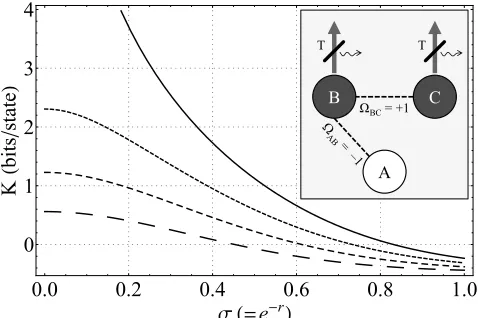
In Fig.1we demonstrate the feasibility of the protocol in a concrete realization, where the key rate (15) is plotted against the squeezing degree of a noisy tripartite entangled Gaus-sian cluster state. Notice that the same key rate can also be achieved by an equivalent protocol that solely requires bipar-tite entanglement (that would represent the so-called prepare-and-measure counterpart to the presented protocol, borrowing a QKD terminology), thus further reducing the technological requirements for the state preparation. More generally, given the recent progress in the generation of large-scale continuous
0.0 0.2 0.4 0.6 0.8 1.0
0 1 2 3 4
K
(
bits
/
stat
e
)
σ(=e-r)
A
B Ω C
BC= +1
[image:4.612.320.559.52.211.2]T T
FIG. 1. The QSS secure key rateK, Eq. (15), is plotted against the squeezingrof a 3-mode noisy Gaussian cluster state, obtained from a pure state [20] ˆUABUBCˆ |riA|riB|riC, with ˆUi j =exp
Ωi jxiˆxjˆ
, after Bob and Charlie’s modes undergo individual pure-loss channels (i.e., quantum-limited attenuating channels), each modelled by a beam splitter with transmissivityT and zero excess noise (see inset). From top to bottom, the curves correspond toT = 1, 0.95, 0.9, 0.85. All parties are assumed to be performing homodyne measurements of ˆxi, ˆpi, with i = A,B,C. The current experimentally accessible squeezing is limited tor . 1.15 (10dB), orσ & 0.32 [57,58], in which regime a nonzeroKis still guaranteed for sufficiently largeT, demonstrating the feasibility of our scheme.
variable entangled states [59–65], we expect our secure pro-tocol to be recognized as a competitive candidate for practical QSS, in alternative to conventional pQKD.
Finally, we show how to generalize the secret key rate bound (15) to any (k,n)-threshold QSS scheme. To start with, let us denote thenplayers asB1,B2, . . . ,Bn. A (k,n)-threshold
scheme has two requirements: first, no collaboration of any k−1 players should be able to access the secret. We incor-porate this requirement into Eq. (15) by considering all pos-sible combinations ofk−1 out of nplayers, the total num-ber of which equals the binomial coefficientk−n1, as poten-tial collaborative eavesdroppers, and choosing the maximum Holevo information over all collaborations to attain the max-imum possible knowledge on the key by any of these groups. Second, any collaboration ofkplayers, known as theaccess structure, should be able to decode the message. Let us at-tribute a joint variable ¯Xito eachk-player collaboration
corre-lated to Alice’sXA, withi=1, . . . , n
k
. This amounts to Alice sending as much error-correction information as needed, such that even thek-player collaboration least correlated to Alice, i.e., with the smallestI(XA : ¯Xi), can access her key. Taking
the above into account, the key rate of the protocol will be,
K≥minI(X
A: ¯X1), . . . ,I(XA : ¯X(n k)) −maxχ(X
A:ES1), . . . , χ(XA :ES(n k−1)),
(16)
whereSidenotes a particular sequence ofk−1 players, e.g.,
strategies of any group ofk−1 potentially dishonest players. This analysis readily extends to arbitrary access structures, where a subset of privileged players can access the key.
V. CONCLUSIONS
We presented a feasible entanglement-based continuous variable QSS scheme, and derived sufficient conditions for the protocol’s secret key rate to provide, for the first time, uncon-ditional security of the dealer’s classical secret against general attacks of an eavesdropper and arbitrary cheating strategies, conspiracies and attacks of the (possibly, dishonest) players, for all (k,n)-threshold schemes, and in the limit of asymptotic keys.
In our approach, we crucially identified the most physically relevant framework for QSS to be the 1sDI setting, treating the dealer as a trusted party with characterized devices and the players’ devices as black boxes. The natural separation of roles between dealer and players renders QSS a well-suited task for the 1sDI setting, even more than two-party QKD itself [66]. At the same time, this observation enables us to adopt and generalize conventional 1sDI-QKD techniques to estab-lish security of entanglement-based QSS, as demonstrated in this paper. Incidentally, while the resource behind 1sDI-QKD is known to be (bipartite)steering [67], a quantum correla-tion stronger than plain entanglement [68] and weaker than Bell-nonlocality [69], one could suspect a similar connection
in the present multiuser scenario. In a companion paper [70], we show in fact thatmultipartitesteering [60,71] empowers secure QSS, providing an operational interpretation for a gen-uine multipartite continuous variable steering measure.
Our work opens many avenues for further exploration. The presented security proof rests on general principles and can be extended from asymptotic to finite keys [39], suitable for con-crete applications, and also to discon-crete variable systems, used in the original QSS definition [4]; this will be the subject of future work. Moreover, although we provided sufficient secu-rity conditions for all (k,n)-threshold schemes, the identifica-tion of optimal families of states maximizing the key rate for each scheme was left open and will be addressed elsewhere.
Finally, our results pave the way for an unconditionally se-cure experimental demonstration of QSS, enabling its use in next-generation quantum communication networks.
ACKNOWLEDGMENTS
I.K. and G.A. acknowledge funding from the European Re-search Council under Grant No. 637352 (ERC StG GQCOP); Q.H. acknowledges the support of the National Natural Sci-ence Foundation of China under Grants No. 11274025 and No. 61475006. We thank A. Winter, N. Walk, E. Woodhead and, particularly, A. Leverrier, for fruitful discussions. I. K. thanks R. Hawkins for proofreading the manuscript.
[1] A. Shamir, Communications of the ACM22, 612 (1979). [2] G. R. Blakley, inafips(IEEE, 1899) p. 313.
[3] N. Gisin, G. Ribordy, W. Tittel, and H. Zbinden,Rev. Mod. Phys.74, 145 (2002).
[4] M. Hillery, V. Buˇzek, and A. Berthiaume,Phys. Rev. A59, 1829 (1999).
[5] R. Cleve, D. Gottesman, and H.-K. Lo,Phys. Rev. Lett.83, 648 (1999).
[6] A. M. Lance, T. Symul, W. P. Bowen, B. C. Sanders, and P. K. Lam,Phys. Rev. Lett.92, 177903 (2004).
[7] A. Karlsson, M. Koashi, and N. Imoto,Phys. Rev. A59, 162 (1999).
[8] L. Xiao, G. Lu Long, F.-G. Deng, and J.-W. Pan,Phys. Rev. A
69, 052307 (2004).
[9] Z.-j. Zhang and Z.-x. Man,Phys. Rev. A72, 022303 (2005). [10] K. Chen and H.-K. Lo,Quant. Inf. & Comput.7, 689 (2007). [11] Y. Wu, J. Zhou, X. Gong, Y. Guo, Z.-M. Zhang, and G. He,
Phys. Rev. A93, 022325 (2016).
[12] D. Gottesman,Phys. Rev. A61, 042311 (2000).
[13] Y. Fu, H.-L. Yin, T.-Y. Chen, and Z.-B. Chen,Phys. Rev. Lett.
114, 090501 (2015).
[14] A. Marin and D. Markham,Phys. Rev. A88, 042332 (2013). [15] F.-G. Deng, G. L. Long, and H.-Y. Zhou,Phys. Lett. A340, 43
(2005).
[16] W. Tittel, H. Zbinden, and N. Gisin,Phys. Rev. A63, 042301 (2001).
[17] A. M. Lance, T. Symul, W. P. Bowen, T. Tyc, B. C. Sanders, and P. K. Lam,New J. Phys.5, 4 (2003).
[18] D. Markham and B. C. Sanders, Phys. Rev. A 78, 042309
(2008).
[19] A. Keet, B. Fortescue, D. Markham, and B. C. Sanders,Phys. Rev. A82, 062315 (2010).
[20] H.-K. Lau and C. Weedbrook,Phys. Rev. A88, 042313 (2013). [21] Y. Wu, R. Cai, G. He, and J. Zhang,Quant. Inf. Proc.13, 1085
(2014).
[22] S. Bagherinezhad and V. Karimipour,Phys. Rev. A67, 044302 (2003).
[23] Y.-A. Chen, A.-N. Zhang, Z. Zhao, X.-Q. Zhou, Y. Lu, C.-Z. Peng, T. Yang, and J.-W. Pan,Phys. Rev. Lett.95, 200502 (2005).
[24] S. Gaertner, C. Kurtsiefer, M. Bourennane, and H. Weinfurter, Phys. Rev. Lett.98, 020503 (2007).
[25] B. A. Bell, D. Markham, D. A. Herrera-Mart´ı, A. Marin, W. J. Wadsworth, J. G. Rarity, and M. S. Tame,Nat. Commun.5
(2014), 10.1038/ncomms6480.
[26] S.-J. Qin, F. Gao, Q.-Y. Wen, and F.-C. Zhu,Phys. Rev. A76, 062324 (2007).
[27] F.-G. Deng, X.-H. Li, and H.-Y. Zhou, arXiv preprint arXiv:0705.0279 (2007).
[28] Z.-j. Zhang, Y. Li, and Z.-x. Man,Phys. Rev. A71, 044301 (2005).
[29] F.-G. Deng, X.-H. Li, H.-Y. Zhou, and Z.-j. Zhang,Phys. Rev. A72, 044302 (2005).
[30] S.-J. Qin, F. Gao, Q.-Y. Wen, and F.-C. Zhu,Phys. Lett. A357, 101 (2006).
[32] G. P. He,Phys. Rev. Lett.98, 028901 (2007).
[33] G. P. He and Z. Wang,Quant. Inf. Comput.10, 28 (2010). [34] V. Karimipour and M. Asoudeh, Phys. Rev. A 92, 030301
(2015).
[35] A. Tavakoli, I. Herbauts, M. ˙Zukowski, and M. Bourennane, Phys. Rev. A92, 030302 (2015).
[36] A. Ac´ın, N. Brunner, N. Gisin, S. Massar, S. Pironio, and V. Scarani,Phys. Rev. Lett.98, 230501 (2007).
[37] M. Tomamichel and R. Renner,Phys. Rev. Lett.106, 110506 (2011).
[38] N. Walk, S. Hosseini, J. Geng, O. Thearle, J. Y. Haw, S. Arm-strong, S. M. Assad, J. Janousek, T. C. Ralph, T. Symul, H. M. Wiseman, and P. K. Lam,Optica3, 634 (2016).
[39] F. Furrer, T. Franz, M. Berta, A. Leverrier, V. B. Scholz, M. Tomamichel, and R. F. Werner, Phys. Rev. Lett. 109, 100502 (2012).
[40] R. Renner,Int. J. Quant. Inf.06, 1 (2008).
[41] I. Devetak and A. Winter,Proceedings of the Royal Society of London A: Mathematical, Physical and Engineering Sciences
461, 207 (2005).
[42] B. Kraus, N. Gisin, and R. Renner,Phys. Rev. Lett.95, 080501 (2005).
[43] K. Horodecki, D. Leung, H.-K. Lo, and J. Oppenheim,Phys. Rev. Lett.96, 070501 (2006).
[44] M. Navascu´es, F. Grosshans, and A. Ac´ın,Phys. Rev. Lett.97, 190502 (2006).
[45] M. Berta, M. Christandl, R. Colbeck, J. M. Renes, and R. Ren-ner,Nat. Phys.6, 659 (2010).
[46] V. Scarani and R. Renner,Phys. Rev. Lett.100, 200501 (2008). [47] R. Renner and J. I. Cirac,Phys. Rev. Lett.102, 110504 (2009). [48] S. L. Braunstein and S. Pirandola,Phys. Rev. Lett.108, 130502
(2012).
[49] M. F. Cornelio, M. C. de Oliveira, and F. F. Fanchini,Phys. Rev. Lett.107, 020502 (2011).
[50] A. Streltsov, S. Lee, and G. Adesso, Phys. Rev. Lett.115, 030505 (2015).
[51] A. S. Holevo, Problemy Peredachi Informatsii9, 3 (1973). [52] J. M. Renes and J.-C. Boileau,Phys. Rev. Lett. 103, 020402
(2009).
[53] F. Furrer, M. Berta, M. Tomamichel, V. B. Scholz, and M.
Chri-standl,J. Math. Phys.55, 122205 (2014).
[54] R. L. Frank and E. H. Lieb,Commun. Math. Phys. 323, 487 (2013).
[55] P. J. Coles, M. Berta, M. Tomamichel, and S. Wehner,arXiv preprint arXiv:1511.04857 (2015).
[56] A. Ferenczi,Security proof methods for quantum key distribu-tion protocols,Ph.D. thesis, University of Waterloo (2013). [57] T. Eberle, S. Steinlechner, J. Bauchrowitz, V. H¨andchen,
H. Vahlbruch, M. Mehmet, H. M¨uller-Ebhardt, and R. Schn-abel,Phys. Rev. Lett.104, 251102 (2010).
[58] T. Eberle, V. H¨andchen, and R. Schnabel,Opt. Express21, 11546 (2013).
[59] X. Su, Y. Zhao, S. Hao, X. Jia, C. Xie, and K. Peng,Opt. Lett.
37, 5178 (2012).
[60] S. Armstrong, M. Wang, R. Y. Teh, Q. Gong, Q. He, J. Janousek, H.-A. Bachor, M. D. Reid, and P. K. Lam,Nat. Phys.11, 167 (2015).
[61] J. Roslund, R. M. Araujo, S. Jiang, C. Fabre, and N. Treps, Nat. Photon.8, 109 (2014).
[62] S. Gerke, J. Sperling, W. Vogel, Y. Cai, J. Roslund, N. Treps, and C. Fabre,Phys. Rev. Lett.114, 050501 (2015).
[63] M. Chen, N. C. Menicucci, and O. Pfister,Phys. Rev. Lett.112, 120505 (2014).
[64] S. Yokoyama, R. Ukai, S. C. Armstrong, C. Sornphiphatphong, T. Kaji, S. Suzuki, J. ichi Yoshikawa, H. Yonezawa, N. C. Menicucci, and A. Furusawa, Nat. Photon.7, 982 (2013). [65] J. Yoshikawa, S. Yokoyama, T. Kaji, C. Sornphiphatphong,
Y. Shiozawa, K. Makino, and A. Furusawa,APL Photon.1, 060801 (2016), 10.1063/1.4962732.
[66] C. Branciard, E. G. Cavalcanti, S. P. Walborn, V. Scarani, and H. M. Wiseman,Phys. Rev. A85, 010301 (2012).
[67] H. M. Wiseman, S. J. Jones, and A. C. Doherty,Phys. Rev. Lett.98, 140402 (2007).
[68] R. Horodecki, P. Horodecki, M. Horodecki, and K. Horodecki, Rev. Mod. Phys.81, 865 (2009).
[69] N. Brunner, D. Cavalcanti, S. Pironio, V. Scarani, and S. Wehner,Rev. Mod. Phys.86, 419 (2014).
[70] Y. Xiang, I. Kogias, G. Adesso, and Q. He,Phys. Rev. A95, 010101(R) (2017).