DOI 10.1007/s00442-016-3780-5
BEHAVIORAL ECOLOGY –ORIGINAL RESEARCH
Bayesian inference supports the host selection hypothesis
in explaining adaptive host specificity by European bitterling
Carl Smith1,2,3
Received: 25 May 2016 / Accepted: 12 November 2016
© The Author(s) 2016. This article is published with open access at Springerlink.com
host mussels differs qualitatively from that of avian brood parasites.
Keywords Brood parasite · Host–parasite co-evolution · Oviposition · Spawning site · Superparasitism
Introduction
The extent to which a parasite exploits different host spe-cies, termed host specificity, can vary at a number of levels. Host specificity may vary spatially and temporally, corre-sponding with morphological, physiological or ecological differences in host and parasite traits or the environments they occupy (Payne 1997; Poulin 2011). Specificity might also reflect previous exposure of hosts to parasitism, para-site prevalence, the availability of intermediate hosts, or the phylogenetic relationships among hosts (Kaltz and Shykoff
1998; Detwiler and Minchella 2009; Poulin 2011; Feeney et al. 2014). Understanding host specificity, both at a proxi-mate and evolutionary scale, is a key question in ecological and evolutionary parasitology and represents a fundamental step in understanding the distribution and spread of para-sites in response to ecological change (Poulin et al. 2011). Despite its significance, the factors that shape host specific-ity are poorly understood, even in well-studied
host–para-site systems (e.g., Smith and Myers-Smith 1998; Giorgi
et al. 2004; Feeney et al. 2014; Mendlová and Šimková
2014).
In avian brood parasites, host specificity has been the focus of much research. Host preferences have been attrib-uted to variables such as host population size, duration of nesting period, nest type, host aggression, ‘superparasitism’ (repeated parasitism of a host by one species of parasite)
and host habitat use (Brooker and Brooker 1990; Payne
Abstract Generalist parasites have the capacity to infect multiple hosts. The temporal pattern of host specificity by generalist parasites is rarely studied, but is critical to under-standing what variables underpin infection and thereby the impact of parasites on host species and the way they impose selection on hosts. Here, the temporal dynamics of infection of four species of freshwater mussel by European
bitterling fish (Rhodeus amarus) was investigated over
three spawning seasons. Bitterling lay their eggs in the gills of freshwater mussels, which suffer reduced growth, oxy-gen stress, gill damage and elevated mortality as a result of parasitism. The temporal pattern of infection of mussels by European bitterling in multiple populations was examined. Using a Bernoulli Generalized Additive Mixed Model with Bayesian inference it was demonstrated that one mussel species, Unio pictorum, was exploited over the entire bit-terling spawning season. As the season progressed, bitter-ling showed a preference for other mussel species, which were inferior hosts. Temporal changes in host use reflected elevated density-dependent mortality in preferred hosts that were already infected. Plasticity in host specificity by bit-terling conformed with the predictions of the host selection hypothesis. The relationship between bitterling and their
Communicated by Joel Trexler.
* Carl Smith
1 School of Biology, University of St Andrews, St Andrews, UK
2 Institute of Vertebrate Biology, Academy of Sciences of the Czech Republic, Brno, Czech Republic
1997; Soler et al. 1999; Honza et al. 2002; Patten et al.
2011; Feeney et al. 2014; Soler 2014). Several hypotheses have been invoked to explain host specificity in avian brood parasites (Smith and Myers-Smith 1998). The parasite den-sity hypothesis is a null hypothesis that predicts that host use is simply a function of parasite abundance, irrespective of host species or habitat features (Hoover and Brittingham
1993). The parasite habitat preference hypothesis predicts that the frequency and intensity of parasitism depends pri-marily on the habitat occupied by hosts (Briskie et al. 1990; Ward and Smith 2000). In contrast, under the host selection hypothesis different host species vary in quality to the par-asite. An additional feature of this hypothesis is that high levels of superparasitism could erode host quality, resulting in switches from preferred host species to previously non-preferred hosts. Finally, the host defence hypothesis pre-dicts that parasites avoid hosts that are effective in defend-ing themselves against parasitism. Host defence may vary interspecifically, but also intra-specifically over the host range through geographic variation in evolved responses to parasitism (Briskie et al. 1992). These explanations for host specificity are not mutually exclusive. Thus, a parasite may express both host and habitat preferences simultaneously and be sensitive to variation in host defences.
Bitterling are freshwater fishes that parasitize freshwa-ter mussels as oviposition sites and share many attributes of avian brood parasites (Karplus 2014; Davies 2015; Woot-ton and Smith 2015). Like avian brood parasites they offer a tractable system for studying coevolution in nature, and have the additional advantage of being amenable to labo-ratory experiments (Smith et al. 2004). Female bitterling use a long ovipositor to place their eggs in the gill chamber
of unionid and margaritiferid mussels (Wiepkema 1961;
Smith et al. 2004), and bitterling embryos show a range
of highly derived adaptations to enable them to develop in mussel gill chambers (Smith et al. 2004). Female European bitterling (Rhodeus amarus) lay multiple small clutches of 2–6 eggs, repeatedly visiting the same or different mus-sels to oviposit (Reichard et al. 2008; Pateman-Jones et al.
2011). Bitterling embryos remain in their host mussel for approximately one month and impose significant costs on the host by competing for oxygen and nutrients (Spence
and Smith 2013), limiting growth and fecundity
(Reich-ard et al. 2006, 2007a) and potentially damaging host gills
(Stadnichenko and Stadnichenko 1980). Mussels have
evolved defences against bitterling parasitism, primarily by ejecting their eggs and developing embryos (Reichard et al. 2006, 2009, 2012, 2015), but also by rapidly closing their siphons to prevent bitterling oviposition and by divert-ing the bitterldivert-ing ovipositor into their mantle cavity rather than their gills (Reichard et al. 2010). Mussel body size appears not to affect bitterling oviposition preference or quality as a host (Smith et al. 2004), though in avian brood
parasites this trait is a strong predictor of host specificity
(Medina and Langmore 2016). There is good evidence for
coevolution between bitterling and host mussels across their respective distributions. For example, host mussels have evolved counteradaptations that enable them to avoid bitterling oviposition, or eject developing bitterling eggs and embryos, while bitterling almost entirely avoid infec-tion by the parasitic glochidia larvae of mussels (Reichard et al. 2006, 2007a, 2010). Notably, these relationships are stronger in regions of ancient bitterling–mussel sympa-try compared with regions where the association is more recent (Reichard et al. 2010, 2012, 2015).
The aims of the present study were to investigate tempo-ral changes in host specificity over the course of a spawn-ing season in the European bitterlspawn-ing, a generalist bitterlspawn-ing capable of exploiting a range of hosts, with the goal of establishing which hypothesis for host specificity best fits observed data across years and among populations.
Materials and methods
Study sites
Fieldwork was conducted in the southeast of the Czech Republic, at the centre of the natural range of European bit-terling in Europe (Van Damme et al. 2007; Zaki et al. 2008; Bryja et al. 2010). Field sites comprised 13 oxbow lakes created during the 1980s situated along a 40-km stretch of the Rivers Morava and Dyje, tributaries of the River Dan-ube. European bitterling and four species of unionid mus-sel (Anodonta anatina, A. cygnea, Unio pictorum and U. tumidus) occur in the region. Oxbow lakes varied in surface area from 6.8 to 22.7 ha. The onset of spawning in bitter-ling is cued by photoperiod (Shimizu et al. 1994). The bit-terling spawning season in these oxbow lakes begins in late April and continues until mid to late June, with a peak in spawning in early May (Smith et al. 2000a). Consequently, for the purposes of this study, a putative start date to the spawning season was designated as the 1st May.
Embryo releases
The presence of early life stages (hereafter termed embryos for simplicity, but including egg, embryo, larval and juve-nile stages) of European bitterling in mussels was esti-mated in the years 1995–1997 from May to August, with day of sampling scored from 1st May. Rather than dissect-ing mussels to detect the presence of bitterldissect-ing embryos, mussels were enclosed in fine mesh bags (mesh size
0.5 × 0.5 mm) measuring approximately 150 × 200 mm
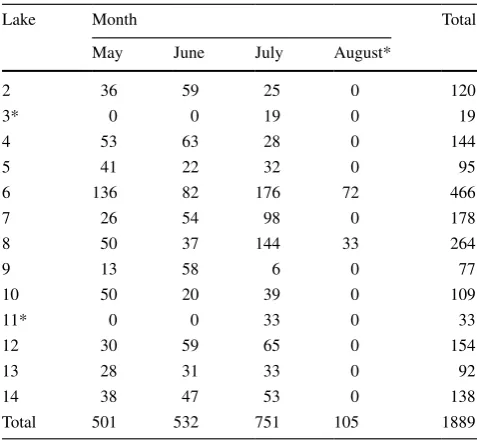
embryos that were released. After sealing in a bag, mussels were placed back in the substrate in the exact location from which they had been taken. The water depth at which the mussel was collected was measured to the nearest 10 mm. Bags were checked after 24 h and the number of bitter-ling embryos that had been released was recorded. Mus-sels were collected by hand by a diver and were selected as they were encountered. Sampling mussels by hand is an efficient method of collection that provides an accurate picture of the mussel assemblage (Miller and Payne 1993; Hornbach and Deneka 1996; Smith et al. 2000a). To avoid sampling the same mussel repeatedly within lakes within years, mussels were collected from different areas of each lake on each sampling occasion within years. Mussel distri-bution within lakes shows a marked depth distridistri-bution pat-tern, but no horizontal pattern (Smith et al. 2000a; Smith, unpublished data). Over the 3-year survey 1889 mussels from 13 populations were scored for the presence of bit-terling embryos (Table 1). Sampling took place on 54 occa-sions on 27 discrete dates after 1st May. The distribution of mussels among species reflected the relative frequency of mussels among the oxbow lakes in the study, with 773
A. anatina, 430 A. cygnea, 371 U. pictorum and 315 U. tumidus recorded. These data were poorly balanced. Thus, there were no releases of embryos from mussels in August, and data from this month were excluded from subsequent analysis (Table 1). Not all mussel species were encountered in two oxbow lakes, which were also not sampled in every month, and data for these sites were also excluded from the analysis (Table 1). In the resulting subset of data, there
were 723 A. anatina of which 202 released embryos, 385
A. cygnea with 20 showing embryo releases, 339 U. pic-torum of which 233 released embryos and 285 U. tumidus
with 82 releasing embryos.
Handling of the mussels within the mesh bags likely led to the emergence of early stages that would have otherwise remained within the host except in the case of well-devel-oped juveniles that would be expected to depart from the mussel gill once they completed absorption of their yolk-sac. Removing and replacing mussels inevitably resulted in the animal attempting to rebury itself and these movements and contractions of the valves can result in the premature ejection of bitterling embryos.
A subset of data from this survey was previously pub-lished in a study by Smith et al. (2000b). In the study by Smith et al. (2000b), only data from nine sites in a single year were considered and only for fully developed juve-nile bitterling, not all early life stages, which was the case here. No hypotheses, analyses or findings from Smith et al. (2000b) are repeated in the current study.
Mussel dissection
Releases of bitterling embryos from mussels served as an indication of the occurrence of spawning by bitterling in a particular mussel. An alternative approach would have been to dissect all mussels collected, but this was consid-ered an unethical approach. However, to establish whether releases reliably reflected the number of developing bit-terling in the gills of a mussel, a subsample of 54 mussels was first placed in mesh bags for 24 h in the way described above, then dissected and the number of bitterling embryos counted. Two models were fitted to these data. A Poisson GLM was fitted as follows:
where PReleasedi is the number of bitterling embryos
released from mussel i assuming a Poisson distribution
with mean μi. Dissectedi is the number of embryos
dis-sected from mussel i. In addition, a Bernoulli distribution was fitted to the same data as follows:
PReleasedi∼Poisson(µi)
E(Releasedi)=µi
log(µi)=1.05+0.01×Dissectedi,
BReleasedi∼Binomial(πi)
E(Releasedi)=πi
var(Releasedi)=πi×(1−πi)
logit(πi)= −2.38+0.26×Dissectedi,
Table 1 Number of mussel samples collected during the study from each study lake and in each month
Data for lakes 3 and 11 and for the month of August (indicated with asterisks) were excluded from the analysis
Lake Month Total
May June July August*
2 36 59 25 0 120
3* 0 0 19 0 19
4 53 63 28 0 144
5 41 22 32 0 95
6 136 82 176 72 466
7 26 54 98 0 178
8 50 37 144 33 264
9 13 58 6 0 77
10 50 20 39 0 109
11* 0 0 33 0 33
12 30 59 65 0 154
13 28 31 33 0 92
14 38 47 53 0 138
[image:3.595.50.289.79.299.2]where BReleasedi is the number of bitterling embryos released from mussel i assuming a Bernoulli distribution with mean πi and variance πi× (1−πi).
While the presence of embryos in mesh bags was accu-rately predicted by the number of bitterling early life stages in mussels (Binomial GLM, generalised R2= 0.58),
the number of bitterling released was not (Poisson GLM, generalised R2
= 0.17). Consequently, embryo releases
from mussels were analysed as binomial data, which best reflected the presence or absence of embryos in a mussel gill.
Statistical analysis
Before applying statistical models a data exploration was undertaken following the protocol described in Ieno and
Zuur (2015). The data were examined for outliers in the
response and explanatory variables, homogeneity and zero inflation in the response variable, collinearity between explanatory variables and the nature of relationships between the response and explanatory variables. Mussel total length and the depth at which mussels were found were collinear with species and were subsequently dropped from the analysis.
The temporal patterns of infection of mussels by bitter-ling embryos were modelled using a Bernoulli Generalized Additive Mixed Model (GAMM), which took the following form:
where Bitterlingijk is the presence or absence of bitterling parasitism in mussel i in oxbow lake j in year k. Speciesijk is a categorical covariate with four levels, correspond-ing with the four species of mussel, while fs (Dayijk) is a smooth function to model non-linear changes in host mus-sel infection by bitterling over the course of a spawning season. Data exploration showed differences in the tem-poral pattern of parasitism among mussel species, so a separate smoother was fitted for each species. Model fit with four smoothers, one for each mussel species, gave a better fit than with a single smoother for all species, and so a model with a separate smoother for each mussel spe-cies was used. Smoothers were estimated using O’Sullivan
Bitterlingijk ∼Binomial(πijk)
E(Bitterlingijk)=πijk
ηijk =β+Speciesijk+fs(Dayijk)+Oxbowj+Yeark
logit (πijk)=ηijk
Oxbowj=N(0,σOxbow2 )
Yeark=N(0,σYear2 ),
splines (Wand and Ormerod 2008). The number of knots
per smoother was fixed at five, with knot position permit-ted to vary. The random intercepts Oxbowj and Yeark were included to introduce a correlation structure between obser-vations for the same oxbow lake and year, respectively.
To make inferences about the parameters in the model a Bayesian approach was used. A Bayesian GAMM is robust in dealing with relatively complex datasets like the one in the present study, specifically unbalanced nested data, dependency due to repeated measures at sampling sites, and a highly varied non-normal response variable (embryo presence). Bayesian models are flexible in allow-ing the estimation of a posterior distribution of differences between parameters and across levels of factors. These are relatively straightforward procedures using Bayesian infer-ence, but extremely problematic in a frequentist frame-work (Zuur et al. 2014; Kruschke 2015). Notwithstanding more general reservations in using frequentist analyses
(Burnham and Anderson 2014), the probabilities for null
hypothesis significance testing are particularly unreliable with mixed models that use smoothing functions (Zuur et al. 2014; Kruschke 2015). In addition, fitting the model in a Bayesian context permitted flexibility in assessing temporal differences in smoothers, and particularly ena-bled statistically important differences in the incidence of parasitism among host species to be identified across the spawning season, which would be unfeasible in a frequen-tist setting.
Diffuse or non-informative univariate priors were put on all parameters. The model was fitted in a Bayesian frame-work using Markov Chain Monte Carlo (MCMC) with the R2jags package (Su and Yajima 2012) in the R
statis-tical environment (R Development Core Team 2016) and
mirrored the modelling approach outlined for cowbird brood parasitism by Zuur et al. (2014). Three independent Markov chains were run simultaneously with a burn-in of 50,000 iterations and then 500,000 iterations for estimates of parameter and 95% credibility intervals. Chains were thinned every 10th iteration, resulting in 50,000 Markov Chain samples for each estimated parameter. Mixing and autocorrelation of chains were checked visually using trace
plots and the Gelman–Rubin statistic (Kruschke 2015).
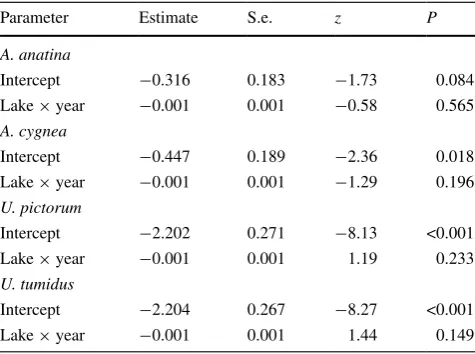
To examine whether there were temporal changes in the relative abundance of host mussels among lakes among years a binomial GLM was fitted to data for the abundance of each host species. The model was fitted as
where Numberi is the abundance of host species i and Totali is the total abundance of all other host species. The model was fitted to a subset of lakes for which there were data for all mussel species in all years, which comprised a data-set from four lakes (lakes 2, 6, 8 and 13) over three years (1995–1997).
Results
Parasitism of mussel hosts by bitterling varied across the spawning season, showing a peak at the end of May.
Numberi∼Binomial(πi, Totali)
E(Numberi)=Totali×πi
var(Numberi)=Totali×πi×(1−πi)
ηi =β+Oxbowi+Yeari
logit(πi)=ηi,
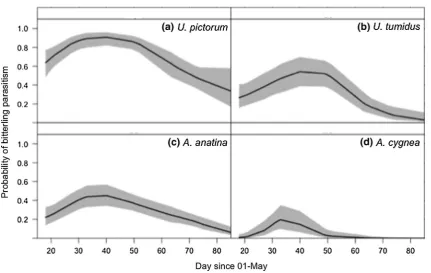
Posterior mean smoothers for all species showed non-linear effects with day that deviated from zero (Fig. 1). Prevalence of bitterling early life stages in all host mussel species was greatest between days 35 and 45 (04 Jun to 14 Jun), though the period over which bitterling embryos were encountered
varied among species, with embryos recovered from A.
cygnea between days 18 and 52 (18 May to 21 Jun), while bitterling were recovered from U. pictorum from day 18 to 92 (18 May to 31 Jul). Early life stages of bitterling were recovered from A. anatina and U. tumidus from day 18 (18 May) to 74 (13 Jul).
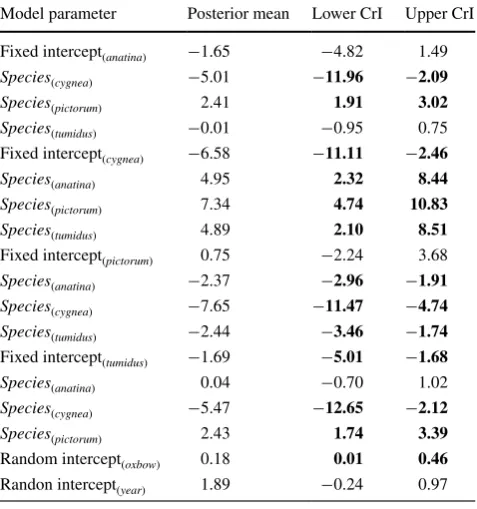
The temporal pattern of parasitism varied among host mussel species (Table 2). U. pictorum was consistently the
most parasitized mussel species, followed by A. anatina
and U. tumidus, while A. cygnea experienced the lowest probability of parasitism (Fig. 2). Posterior mean prob-abilities of bitterling parasitism for U. pictorum were sig-nificantly higher than for A. anatina (Table 2). In contrast, the posterior mean probability of parasitism for A. cygnea
was significantly lower than for A. anatina (Table 2), while there was no evidence for a difference in bitterling preva-lence between U. tumidus and A. anatina (Table 2).
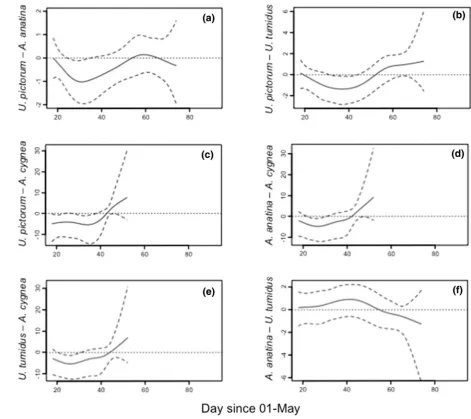
Mean differences between the posterior mean smooth-ers for host mussels identified the periods of the bitterling spawning season when there were changes in the utilisa-tion of host species. U. pictorum was significantly preferred
Fig. 1 Posterior mean smoothers (solid line) and 95% credible intervals (shaded area) of European bitterling (Rhodeus amarus) parasitism of different host mussel species a Anodonta anatina;
bA. cygnea; cUnio pictorum; dU. tumidus, for day since 1st May
[image:5.595.86.514.402.661.2]over A. anatina at the start of the season, but A. anatina
subsequently showed an increase in infection prevalence during the middle part of the spawning season (days 34–65) (Fig. 3a). At the end of the spawning period, A. anatina declined in infection frequency faster than U. pic-torum. This pattern was repeated between U. pictorum and
U. tumidus, with U. pictorum showing a greater increase in bitterling prevalence up until day 34 and with U. tumidus
subsequently showing a greater increase in infection prev-alence between days 53 and 63 (Fig. 3b). In contrast, U. pictorum showed a greater increase in infection frequency
compared with A. cygnea from the onset of data
collec-tion until day 38 (Fig. 3c). From day 43 to 52 U. pictorum
showed a greater decline in bitterling infection than A. cyg-nea. A comparable, but less pronounced, pattern was shown between A. cygnea and A. anatina (Fig. 3d) and U. tumidus
(Fig. 3e). A. anatina and U. tumidus showed no significant difference in the posterior mean of the smoothers (Fig. 3f), indicating no difference in the pattern of preference by bit-terling for the two species over the spawning season.
The relative temporal abundance of host mussels was consistent within lakes among years for all mussel species (Table 3).
Discussion
The distribution of early life stages of bitterling recovered from four host species of mussel revealed a clear-cut pattern. One species, U. pictorum, showed the highest prevalence of infection over the course of the bitterling spawning season while U. tumidus and A. anatina showed a lower level of infection by bitterling, though they did not differ from each other. A fourth host species, A. cygnea, was utilized least. This is the first replicated population-level study to demon-strate this pattern of host specificity by European bitterling.
These changes in host utilization by bitterling reflect adaptive behavioural preferences observed in lab and field experiments. In a previous study (Smith et al. 2000b) it was established that the mortality rate of the early life stages of bitterling during incubation varied among host species.
U. pictorum proved the best host and A. cygnea the worst, with U. tumidus and A. anatina intermediate between these two. Bitterling spawning preferences reflected this varia-tion in host quality, with female bitterling preferentially ovipositing in U. pictorum and avoiding A. cygnea. Why these mussels vary in quality as hosts is not wholly clear, but may reflect differences in oxygen conditions inside the mussel gill chamber which favour embryo development (Spence and Smith 2013). Alternatively, or additionally, the gill structure of different mussel species may better suit embryo development (Liu et al. 2006).
While there are clear differences in host quality, which are mirrored by variation in host preferences by bitterling, host quality declines with the density of bitterling embryos in the mussel gill chamber; bitterling embryo survival is
negatively density-dependent (Smith et al. 2000b). An
outcome is that bitterling reduce the frequency of ovipo-sition in preferred hosts in favour of non-preferred hosts as the former decline in quality through ‘superparasitism’
(sensu van Dijken and Waage 1987). Because
increas-ing embryo density erodes mussel quality, a point can be reached when the preferred host species is comparable in quality to unparasitised individuals of the next preferred species, at which point a shift in host preference is pre-dicted. Using Bayesian inference, plots of posterior mean smoothers in the present analysis permitted the timing of this temporal change in preference to be identified. Thus,
U. pictorum is shown to be preferred to A. anatina and U. tumidus early in the spawning season (Fig. 3a, b), with a subsequent increase in the rate of parasitism of A. anatina
and U. tumidus as bitterling began substituting already parasitized U. pictorum with the next best alternative hosts. Thus the pattern of posterior mean smoothers is a reflection of the dynamic temporal change in host quality as spawn-ing occurs, but with the order of preferred hosts the same over the spawning season.
Table 2 Parameter estimates of mussel infection by European bitter-ling modelled using a Bernoulli GAMM
CrI is the 95% Bayesian credible interval
Parameter estimates are presented for each host species as the base-line category
Credible intervals that do not contain zero in bold to indicate statisti-cal importance
Model parameter Posterior mean Lower CrI Upper CrI Fixed intercept(anatina) −1.65 −4.82 1.49
Species(cygnea) −5.01 −11.96 −2.09 Species(pictorum) 2.41 1.91 3.02
Species(tumidus) −0.01 −0.95 0.75 Fixed intercept(cygnea) −6.58 −11.11 −2.46
Species(anatina) 4.95 2.32 8.44
Species(pictorum) 7.34 4.74 10.83 Species(tumidus) 4.89 2.10 8.51
Fixed intercept(pictorum) 0.75 −2.24 3.68
Species(anatina) −2.37 −2.96 −1.91
Species(cygnea) −7.65 −11.47 −4.74
Species(tumidus) −2.44 −3.46 −1.74 Fixed intercept(tumidus) −1.69 −5.01 −1.68
Species(anatina) 0.04 −0.70 1.02
Species(cygnea) −5.47 −12.65 −2.12 Species(pictorum) 2.43 1.74 3.39
Random intercept(oxbow) 0.18 0.01 0.46
[image:6.595.51.290.82.337.2]The findings of the present study provide support for the
host selection hypothesis, with the preferred host the one that provides the highest quality oviposition site for bit-terling. Erosion of preferred host quality through super-parasitism generates temporal changes in host quality that result in temporal changes in host specificity. The primary determinant of host quality that explains the observed host specificity by bitterling has yet to be conclusively identi-fied, but is probably the dissolved oxygen conditions inside the mussel gill (Smith et al. 2001; Spence and Smith 2013;
Smith and Reichard 2013). Mussel species vary in their
capacity to extract oxygen from water entering their gill cavity (Smith et al. 2001). Notably several cues are used by bitterling in making oviposition decisions, including oph-thalmoception, chemoreception and tactioception (Smith et al. 2001, 2004, 2014). However, female bitterling in par-ticular show a strong response to the dissolved oxygen con-centration of water emerging from the exhalant siphon of a mussel in making oviposition-site decisions (Smith et al.
2001).
The analysis failed to demonstrate support for the para-site habitat preference hypothesis. A habitat variable, water depth, was measured in the study but was collinear with species and was subsequently dropped from the analysis to (Zuur et al. 2010). If collinearity was ignored, and depth
included in the model as a covariate, a significant effect was detected, with greater prevalence of parasitism at shal-low depths. However, caution is needed in the interpreta-tion of this result because A. cygnea occurred at a greater mean depth than the other three host species. Given that
A. cygnea was also the overall least preferred host species, this depth effect is most likely driven by the vertical distri-bution of hosts. If A. cygnea was excluded from the analy-sis the depth effect was not statistically important.
Native unionid mussel populations across much of con-tinental Europe express a limited capacity to eject or avoid bitterling eggs (Reichard et al. 2010, 2012). This situation contrasts with mussel populations in the Pontic region, which show several adaptations to avoid European bitter-ling parasitism (Reichard et al. 2010, 2015). This difference in response is likely due to the shorter duration of
sympa-try and lower encounter rate with R. amarus in west and
central Europe compared with mussels in the Pontic region, where the length of the association may be as much as two million years (Bryja et al. 2010; Reichard et al. 2015). Con-sequently, the host defence hypothesis does not explain the observed host specificity, though this explanation may apply to host specificity elsewhere in the range of the Euro-pean bitterling where the bitterling–mussel association is longer established. In Asia, where there are somewhere
Fig. 2 Mean fitted probability (solid line) of parasitism by European bitterling (Rhodeus amarus) and 95% credible intervals (shaded area) for different host mussel species aAnodonta anatina; bA. cygnea; c Unio pictorum; dU. tumidus, for day since 1st May (the putative start of the bitterling spawning season) for a Bernoulli GAMM estimated
[image:7.595.84.516.52.325.2]in the region of 70 bitterling species (Chang et al. 2014; Kawamura et al. 2014), with long historical associations with freshwater mussels there is good evidence for coevo-lutionary responses between bitterling and host mussels (Liu et al. 2006; Reichard et al. 2007b, 2015; Kitamura et al. 2012), and host responses may play a role in shaping host specificity.
In the case of avian brood parasites, in contrast to the present findings, it is typically the host defence hypothe-sis that best describes patterns of host specificity (Feeney et al. 2014). There is some evidence for the host selection hypothesis for host specificity in cowbirds (Mason 1986;
Smith and Myers-Smith 1998), though this may be an
exception (Briskie et al. 1990). However, attempts to quan-tify host ‘quality’ characteristics, measured in fitness terms, have not been systematically conducted in avian brood par-asites. In addition, in cases where selection for improved host defences means that formerly profitable hosts acquire efficient defences, resulting in reduced parasite fitness, for-merly unprofitable hosts effectively become profitable, with a predicted switch in parasite host preference (Soler 2014). Thus the unstable dynamics of avian brood parasites, driven by evolving host defences, means that a form of host selec-tion must operate, with the implicaselec-tion that host quality is not a fixed property of a host species. Given the known variation in host responses in the bitterling–mussel system
Fig. 3 Pairwise differences in parasitism by European bitterling (Rhodeus amarus) between 50,000 estimated smoothers for mussel hosts. The solid line is the posterior mean of the differences and the
dashed lines the 95% credible intervals for: aU. pictorum vs. A.
[image:8.595.68.540.55.474.2](Reichard et al. 2010, 2012, 2015), the same dynamic pro-cess may operate and warrants investigation.
The present data support the observation that the Euro-pean bitterling is a generalist parasite, able to exploit a range of host mussel species (Smith et al. 2004). A possible expla-nation for its low host specificity is that host taxa are closely related, with specialisation to exploit one species also per-mitting exploitation of other species in the same lineage
(Poulin 2011). However, evidence from a recent
compre-hensive phylogenetic analysis of the unionid mussels dem-onstrated an ancient divergence of the Unioninae (including
U. pictorum and U. tumidus) and Anodontinae (A. anatina
and A. cygnea) (Lopes-Lima et al. 2017). Thus, while Euro-pean bitterling readily exploit both U. pictorum and U. tumi-dus, they also use A. anatina but avoid A. cygnea, a situation that fails to support a macroevolutionary explanation for observed host preferences. A future approach might exam-ine the ‘functional diversity’ of hosts, based on host species traits (sensu Medina and Langmore 2016), perhaps focusing on the internal environment of the mussel gill as a site of incubation or host habitat preferences.
A caveat to the findings of the study is that vulnerabil-ity to premature ejection of bitterling embryos might be host species specific, thereby influencing intra-specific differences in patterns of ejection. However, if the case, a predicted outcome would be a difference in ejection rates between Anodonta spp. and Unio spp. which differ in gill anatomy (Liu et al. 2006). In reality the ejection of embryos varied as much within genera as between genera. Thus
A. anatina differed from A. cygnea, and U. pictorum dif-fered from U. tumidus, while A. anatina did not differ from
U. tumidus. The risk of bias from mussel-specific ejec-tion rates was also mitigated by the dissecejec-tion data, which demonstrated that while ejections did not reliably reflect
the number of embryos on the gills of each species, it did reflect presence of embryos, irrespective of mussel species.
The impact of bitterling on host mussels at the popula-tion level has yet to be investigated. Inhibiting oviposipopula-tion by bitterling significantly enhances mussel growth (Reichard et al. 2006). There is strong evidence across several unio-nid mussel species that mussel size is positively correlated with fecundity (Bauer 1994); thus any reduction in mussel growth will potentially translate into a fitness cost. Further experimental and modelling studies might address the extent to which bitterling regulate unionid mussel populations, a group that is threatened globally (Lopes-Lima et al. 2014).
In conclusion, this study demonstrates a clear tempo-ral shift in host specificity by a genetempo-ralist parasite of its host species. Changes in host specificity reflect temporal changes in host quality as a result of superparasitism and provide support for the host selection hypothesis in the host preferences of European bitterling.
Acknowledgements Thanks to Rowena Spence, Martin Reichard, André Phillips and Daniel Barker for comments and suggestions. Funding came from the Czech Science Foundation (13-05872S).
Author contribution statement CS conceived, designed, and exe-cuted this study and wrote the manuscript. No other person is entitled to authorship.
Open Access This article is distributed under the terms of the Crea-tive Commons Attribution 4.0 International License ( http://crea-tivecommons.org/licenses/by/4.0/), which permits unrestricted use, distribution, and reproduction in any medium, provided you give appropriate credit to the original author(s) and the source, provide a link to the Creative Commons license, and indicate if changes were made.
References
Bauer G (1994) The adaptive value of offspring size among freshwa-ter mussels (Bivalvia; Unionoidea). J Anim Ecol 1:933–944 Briskie JV, Sealy SG, Hobson KA (1990) Differential parasitism of
least flycatchers and yellow warblers by the brown-headed cow-bird. Behav Ecol Sociobiol 27:403–410
Briskie JV, Sealy SG, Hobson KA (1992) Behavioral defenses against avian brood parasitism in sympatric and allopatric host popula-tions. Evolution 46:334–340
Brooker LC, Brooker MG (1990) Why are cuckoos host specific? Oikos 57:301–309
Bryja J, Smith C, Reichard M (2010) Range-wide population genetic structure of the European bitterling based on microsatellites and mtDNA. Mol Ecol 19:4708–4722
Burnham KP, Anderson DR (2014) P values are only an index to evidence: 20th-vs. 21st-century statistical science. Ecology 95:627–630
Chang C-H, Li F, Shao K-T, Lin Y-S, Morosawa T, Kim S, Koo H, Kim W, Lee J-S, He S, Smith C, Reichard M, Miya M, Chen W-J, Mayden RL (2014) Phylogenetic relationships of Achei-lognathidae (Cypriniformes: Cyprinoidea) as revealed from evidence of both nuclear and mitochondrial gene sequence vari-ation: evidence for necessary taxonomic revision in the family
Table 3 Summary of binomial GLM to examine the relative tempo-ral abundance of host mussels within lakes among years for each host species
Parameter Estimate S.e. z P
A. anatina
Intercept −0.316 0.183 −1.73 0.084
Lake × year −0.001 0.001 −0.58 0.565
A. cygnea
Intercept −0.447 0.189 −2.36 0.018
Lake × year −0.001 0.001 −1.29 0.196
U. pictorum
Intercept −2.202 0.271 −8.13 <0.001
Lake × year −0.001 0.001 1.19 0.233
U. tumidus
Intercept −2.204 0.267 −8.27 <0.001
[image:9.595.51.289.90.267.2]and the identification of cryptic species. Mol Phylogenet Evol 81:182–194
Davies N (2015) Cuckoo: cheating by nature. Bloomsbury, London Detwiler JT, Minchella DJ (2009) Intermediate host availability
masks the strength of experimentally-derived colonisation pat-terns in echinostome trematodes. Int J Parasitol 39:585–590 Feeney WE, Welbergen JA, Langmore NE (2014) Advances in the
study of coevolution between avian brood parasites and their hosts. Ann Rev Ecol Evol Syst 45:227–246
Giorgi MS, Arlettaz R, Guillaume F, Nusslé S, Ossola C, Vogel P, Christe P (2004) Causal mechanisms underlying host specificity in bat ectoparasites. Oecologia 138:648–654
Honza M, Taborsky B, Taborsky M, Teuschl Y, Vogl W, Moksnes A, Røskaft E (2002) Behaviour of female common cuckoo Cuculus canorus, in the vicinity of host nests before and during egg lay-ing: a radiotelemetry study. Anim Behav 64:861–868
Hoover JP, Brittingham MC (1993) Regional variation in cowbird par-asitism of wood thrushes. Wilson Bull 105:228–238
Hornbach DJ, Deneka T (1996) A comparison of a qualitative and a quantitative collection method for examining freshwater mussel assemblages. J N Am Benthol Soc 1:587–596
Ieno EN, Zuur AF (2015) Data exploration and visualisation with R. Highland Statistics Ltd, Newburgh
Kaltz O, Shykoff JA (1998) Local adaptation in host–parasite sys-tems. Heredity 81:361–370
Karplus I (2014) Symbiosis in fishes: the biology of interspecific part-nerships. Wiley-Blackwell, Oxford
Kawamura K, Ueda T, Arai R, Smith C (2014) Phylogenetic relation-ships of bitterling fishes (Teleostei: Cypriniformes: Acheilog-nathinae), inferred from mitochondrial cytochrome b sequences. Zool Sci 31:321–341
Kitamura J, Nagata N, Nakajima J, Sota T (2012) Divergence of ovipositor length and egg shape in a brood parasitic bitter-ling fish through the use of different mussel hosts. J Evol Biol 25:566–573
Kruschke JK (2015) Doing Bayesian data analysis. Academic Press, London
Liu H, Yurong Z, Reichard M, Smith C (2006) Evidence of host speci-ficity and congruence between phylogenies of bitterlings and freshwater mussels. Zool Stud 45:428–434
Lopes-Lima M, Teixeira A, Froufe E, Lopes A, Varandas S, Sousa R (2014) Biology and conservation of freshwater bivalves: past, present and future perspectives. Hydrobiologia 735:1–13 Lopes-Lima M, Froufe E, Ghamizi M, Mock KE, Kebapçi Ü, Klishko
O, Kovitvadhi S, Kovitvadhi U, Paulo OS, Pfeiffer JM, Raley M, Riccardi N, S¸ereflis¸an H, Sousa R, Teixeira A, Varandas S, Wu X, Zanatta DT, Zieritz A, Bogan AE (2017) Phylogeny of the most species rich freshwater bivalve family (Bivalvia: Unionida: Unionidae): Defining modern subfamilies and tribes. Mol Phyl Evol 106:174–191
Mason P (1986) Brood parasitism in a host generalist, the shiny cow-bird: II. Host selection. Auk 103:61–69
Medina I, Langmore NE (2016) The evolution of host specialisation in avian brood parasites. Ecol Lett 19:1110–1118
Mendlová M, Šimková A (2014) Evolution of host specificity in mono-geneans parasitizing African cichlid fish. Parasit Vectors 7:69 Miller AC, Payne BS (1993) Qualitative versus quantitative sampling
to evaluate population and community characteristics at a large-river mussel bed. Am Midl Nat 1:133–145
Pateman-Jones C, Rasotto MB, Reichard M, Liao C, Liu H, Zie˛ba G, Smith C (2011) Variation in male reproductive traits among three bitterling fishes (Acheilognathinae: Cyprinidae) in relation to mating system. Biol J Linn Soc 103:622–632
Patten MA, Reinking DL, Wolfe DH (2011) Hierarchical cues in brood parasite nest selection. J Ornithol 152:521–532
Payne RB (1997) Avian brood parasitism. Host-parasite evolution: general principles and avian models. In: Clayton DH, Moore J (eds) Host-parasite evolution: general principles and avian mod-els. Oxford University Press, Oxford, pp 338–369
Poulin R (2011) Evolutionary ecology of parasites. Princeton Univer-sity Press, Princeton
Poulin R, Krasnov BR, Mouillot D (2011) Host specificity in phylo-genetic and geographic space. Trends Parasitol 27:355–361 R Development Core Team (2016) R: a language and environment for
statistical computing. R Foundation for Statistical Computing, Vienna
Reichard M, Ondracˇková M, Przybylski M, Liu H, Smith C (2006) The costs and benefits in an unusual symbiosis: experimental evidence that bitterling fish (Rhodeus sericeus) are parasites of unionid mussels in Europe. J Evol Biol 19:788–796
Reichard M, Liu H, Smith C (2007a) The co-evolutionary relationship between bitterling fishes and freshwater mussels: insights from interspecific comparisons. Evol Ecol Res 9:1–21
Reichard M, Przybylski M, Kaniewska P, Liu H, Smith C (2007b) A possible evolutionary lag in the relationship between freshwater mussels and European bitterling. J Fish Biol 70:709–725 Reichard M, Smith C, Bryja P (2008) Seasonal change in the
opportu-nity for sexual selection. Mol Ecol 17:642–651
Reichard M, Ondracˇová M, Bryjova A, Smith C, Bryja J (2009) Breeding resource distribution affects selection gradients on male phenotypic traits: experimental study on lifetime reproduc-tive success in the bitterling fish (Rhodeus amarus). Evolution 63:377–390
Reichard M, Polacˇik M, Tarkan AS, Spence R, Gaygusuz Ö, Ercan E, Ondracˇková M, Smith C (2010) The bitterling–mussel coevolu-tionary relationship in areas of recent and ancient sympatry. Evo-lution 64:3047–3056
Reichard M, Vrtílek M, Douda K, Smith C (2012) An invasive spe-cies causes role reversal in a host-parasite relationship. Biol Lett 8:601–604
Reichard M, Douda K, Przybylski M, Popa OP, Karbanová E, Matasová K, Rylková K, Polacˇik M, Blažek R, Smith C (2015) Population-specific responses to an invasive species. Proc R Soc Lond B 282:20151063
Shimizu A, Aida K, Hanyu I (1994) Effects of photoperiod and tem-perature on gonadal activity and plasma steroid levels in an autumn-spawning bitterling, Acheilognathus rhombea, during different phases of its annual reproductive cycle. Gen Comp Endocrinol 93:137–150
Smith JN, Myers-Smith IH (1998) Spatial variation in parasitism of song sparrows by brown-headed cowbirds. Oxf Ornithol Ser 9:296–312
Smith C, Reichard M (2013) A sperm competition model for the Euro-pean bitterling (Rhodeus amarus). Behaviour 150:1709–1730 Smith C, Reynolds JD, Sutherland WJ (2000a) Adaptive host choice
and avoidance of superparasitism in the spawning decisions of bitterling (Rhodeus sericeus). Behav Ecol Sociobiol 48:29–35 Smith C, Reynolds JD, Sutherland WJ, Jurajda P (2000b) The
popula-tion consequences of reproductive decisions. Proc R Soc Lond B 267:1327–1334
Smith C, Rippon K, Douglas A, Jurajda P (2001) A proximate cue for oviposition site choice in the bitterling (Rhodeus sericeus). Freshw Biol 46:903–911
Smith C, Reichard M, Jurajda P, Przybylski M (2004) The reproduc-tive ecology of the European bitterling (Rhodeus sericeus). J Zool 262:107–124
Smith C, Warren M, Rouchet R, Reichard M (2014) The function of multiple ejaculations in bitterling. J Evol Biol 27:1819–1829 Soler M (2014) Long-term coevolution between avian brood parasites
Soler JJ, Møller AP, Soler M, Martínez JG (1999) Interactions between a brood parasite and its host in relation to parasitism and immune defence. Evol Ecol Res 1:189–210
Spence R, Smith C (2013) Rose bitterling (Rhodeus ocellatus) embryos parasitise freshwater mussels by competing for nutri-ents and oxygen. Acta Zool 94:113–118
Stadnichenko AP, Stadnichenko YA (1980) On the effect of bitterling larvae on the lamellibranchid mollusc Unio rostratus gentilis
Haas. Gidrobiol Zhurnal 1980:57–61
Su Y-S, Yajima M (2012) R2jags: a package for running JAGS from R. http://CRAN.R-project.org/package=R2jags
Van Damme D, Bogutskaya N, Hoffmann RC, Smith C (2007) The introduction of the European bitterling (Rhodeus amarus) to West and Central Europe. Fish Fish 8:79–106
van Dijken MJ, Waage JK (1987) Self and conspecific superparasit-ism by the egg parasitoid Trichogramma evanescens. Entomol Exp Appl 43:183–192
Wand MP, Ormerod JT (2008) On semiparametric regression with O’Sullivan penalized splines. Aust NZ J Stat 50:179–198 Ward D, Smith JNM (2000) Interhabitat differences in parasitism
frequencies by brown-headed cowbirds in the Okanagan Valley,
British Columbia. In: Smith JNM, Cook TL, Rothstein SI, Rob-inson SK, Sealy SG (eds) Ecology and management of cowbirds and their hosts. University of Texas Press, Austin, pp 210–219 Wiepkema PR (1961) An ethological analysis of the reproductive
behaviour of the bitterling (Rhodeus amarus Bloch). Arch Neerl Zool 14:103–199
Wootton RJ, Smith C (2015) Reproductive biology of teleost fishes. Wiley-Blackwell, Oxford
Zaki SAH, Jordan WC, Reichard M, Przybylski M, Smith C (2008) A morphological and genetic analysis of the European bitterling species complex. Biol J Linn Soc 95:337–347
Zuur A, Ieno EN, Walker N, Saveliev AA, Smith GM (2009) Mixed effects models and extensions in ecology with R. Springer, New York
Zuur AF, Ieno EN, Elphick CS (2010) A protocol for data explora-tion to avoid common statistical problems. Methods Ecol Evol 1:3–14