Articles Section
Journal of Evidence-Based Psychotherapies, Vol. 14, No. 2, September 2014, 149-157.
THE DEVELOPMENT AND EVALUATION OF A
FLEXIBLE TRAINING COURSE
“UNDERSTANDING AND DEVELOPING COMPASSION”
Anita LAIDLAW
1, Jennifer HUNTER
1, Tony TURVEY
1,
Matt STILLMAN
2, Rob WARREN
2, Gozde OZAKINCI
*1School of Medicine, University of St Andrews
1
2
Student Services, University of St Andrews
Abstract
Compassion is becoming a focus for psycho-educational training courses and has been linked to better education and employment outcomes. Higher education can be a stressful period and is often a time when mental wellbeing difficulties develop. The aim of this study was to develop and evaluate a compassion focused therapy training course for use within the higher education context.
The course was evaluated in the short and medium term using self-report questionnaires measuring compassion, criticism, academic self-efficacy, and psychological distress, as well as interviews.
A small sample size (n=9) limited the interpretation of findings. Improvements in compassion, criticism, and academic self-efficacy were observed both immediately, at a six-month follow-up. However, a small increase in psychological distress was also observed. The training course was acceptable to all participants, with practice and feedback from all participants being the elements cited as most useful. Further research, with a larger sample size, which examines the impact of compassion focused training on academic grades and wellbeing is required.
Keywords:compassion-focused therapy; mindfulness; wellbeing; higher education student; intervention.
Introduction
Understanding the role of compassion in society and helping people develop their ability to be compassionate and mindful towards others and themselves is increasingly recognised as an important topic (Gilbert, 2009).
*
Articles Section
Compassion is also becoming a focus for psycho-educational training courses (CFT: Compassion Focussed Therapy) (Germer, 2009; Gilbert, 2010).
The period of higher education is a critical period for most students as they transition towards being adults and it is often during this time that mental wellbeing difficulties emerge (Psychiatrists, 2011; Schulenberg, Sameroff, & Cicchetti, 2004; Viner et al., 2012). The methods used by students to cope with stressors, both academic and personal, whilst studying has previously been shown to significantly predict academic performance (DeBerard, Spielmans, & Julka, 2004).
Within education, improving compassion in individuals has been linked to better educational and employment related outcomes (Hyland, 2011). One of the main aims of CFT is to improve confidence, particularly in relation to coping with stressful situations (Sirois, 2013). Therefore, it is likely that compassion training would assist higher education students in dealing with the stressors in their current academic and personal lives (Sirois, 2013). However, compassion training could also provide students with the building blocks for greater personal resilience to stressors, which will be important for their future careers (Rosenzweig, Reibel, Greeson, Brainard, & Hojat, 2003).
This evidence led us to develop a brief training course in compassion skills for students at our Institution and to evaluate the impact of this course in both the short and medium term. The aim of this report is to describe the content of the course and present results of the evaluation.
Methods
Content of the brief compassion training course
The training comprised an introductory talk followed by four x two-hour psycho-educational workshop-based training course focusing on learning how to build up self-compassion skills (CFT (Gilbert, 2009)). The numbers attending the workshops were limited to 20 per workshop. The materials for the workshop sessions were developed by one of the authors (TT) who had completed clinical training in CFT with Prof. Paul Gilbert (Gilbert, 2010) as part of his work as a Clinical Psychologist. He, along with another of the authors (MS, also trained in CFT) delivered the workshop sessions. All workshops were held between September – November 2013.
Initially, a presentation was offered describing Mindfulness and Compassion and outlining the four workshop training course. The introductory talk also served as a stand-alone presentation for students who might be interested in the topic of compassion but were not be able to attend the workshops.
Articles Section
the discussion sections and references provided for participants to use in their own time (Welford, 2012).
Workshop one – Beginning:
Discussion: Compassionate Intention; Definitions of compassion; Why
self-compassion? Social rank comparisons; Self-esteem v self-compassion; CFT model; Coping and unintended consequences.
Practice: Building capacity for self-care/self-soothing. Mindful soothing
breathing for daily practice. Workshop two - Suffering and Compassion
Discussion: Practice review; Compassion in the world; Early attachment
experiences; Shame and self-images.
Practice: Mindful soothing breathing. Working with imagery; Creating a safe
comfortable space; Loving kindness meditation. Workshop three - Thinking about Compassion
Discussion: Practice review; Compassion in the world around us; Evolutionary
basis of self-compassion; Mindfulness & neuroscience; Mindfulness in psychotherapies; Common humanity.
Practice: Mindful soothing breathing; Compassionate imagery - a compassionate
other; Self-compassion towards all aspects of oneself. Workshop four – Continuing Practice / the pursuit of happiness
Discussion: Practice review; Preparing for continuing after course ends; Actions in the world, self-care and care towards others, Review of compassionate intentions and key ideas; Course review as a group.
Practice: Mindful soothing breathing; loving kindness/self-acceptance practice.
Recruitment.
Sessions were advertised via e-mail announcements to all students and staff within the University. Counsellors and Support Advisers at Student Services assisted in the referral process by noting the programme, its goals and objectives and potential applications to students who presented to Student Services. Individuals wishing to attend were advised to book a place by contacting the research assistant (JH).
Evaluation of the training.
Articles Section
were seeking help for those difficulties and whether they had practised meditation previously. Pre-course questionnaires also asked for expectations of the workshops, whilst post-course questionnaires included a brief evaluation of logistics relating to the running of the workshops.
Consenting workshop participants were contacted by the research assistant (JH) six months after the workshops and asked to complete a further questionnaire (identical to the post-course questionnaire) and to participate in a one-to-one interview regarding the impact the workshop on their mental wellbeing and self-efficacy relating to their academic course. These telephone interviews were audio recorded and transcribed.
Data analysis
The quantitative data collected via questionnaire was uploaded into SPSS v 21(IBM) and descriptive statistics carried out. Scores in the SCS were calculated using the same method as Neff (Neff, 2003) with negative statements reverse coded. FSCRS scores were calculated by separating items into three scales: Inadequate Self (IS), Reassuring Self (RS) and Hated Self (HS) and deriving a mean total score from each (Longe et al., 2010). Scores on the GHQ were calculated using the 0,1,2,3 method; totalling all Likert scores for each participant and deriving the mean score (Goldberg & Williams, 1988). SE scores were calculated by totalling scores of all items for each participant and deriving the overall mean score (Solberg et al., 1993). The interview transcripts were analysed using thematic analysis (Guest, MacQueen, & Namey, 2012). AL initially read through the transcripts and delineated themes; these were then discussed with the other authors who also read the transcripts. Themes were merged or altered following discussion until, through an iterative process, the final themes were decided upon.
This study was scrutinised and approved by the School of Medicine teaching and research ethics committee, University of St Andrews.
Results
Immediate evaluation of the training course
Sixteen participants agreed to complete the evaluation of the training course. However the data of 7 participants was removed due to missing data, leaving 9 student participants with useable pre- and post-course data. Workshop participants’ average age was 25.11years ± 7.85, with 6 females and 3 males.
Articles Section
reported currently seeking help for emotional difficulties (n = 5) compared to the end of the course (n = 3).
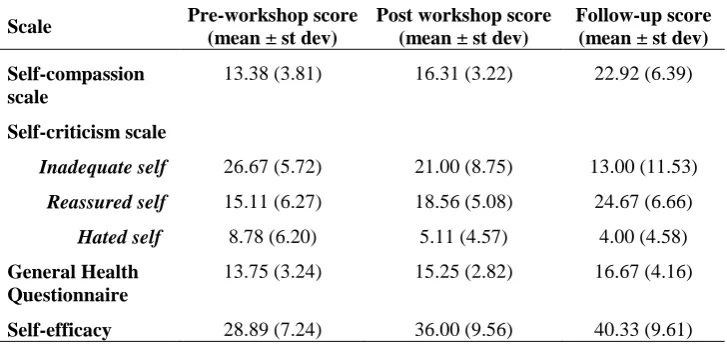
Table 1. Means and standard deviations for total scores on all scales from the pre and post- workshop and follow-up evaluation questionnaires.
Scale Pre-workshop score (mean ± st dev)
Post workshop score (mean ± st dev)
Follow-up score (mean ± st dev)
Self-compassion scale
13.38 (3.81) 16.31 (3.22) 22.92 (6.39)
Self-criticism scale
Inadequate self 26.67 (5.72) 21.00 (8.75) 13.00 (11.53) Reassured self
Hated self
15.11 (6.27) 8.78 (6.20)
18.56 (5.08) 5.11 (4.57)
24.67 (6.66) 4.00 (4.58)
General Health Questionnaire
13.75 (3.24) 15.25 (2.82) 16.67 (4.16)
Self-efficacy 28.89 (7.24) 36.00 (9.56) 40.33 (9.61)
Reported expectations of what participants would gain from the course included that it was part of their help-seeking for emotional difficulties, it would help them feel more accepting of their emotions and, it would assist them in dealing with stress and anxiety. Constructive feedback included the need for a longer course with shorter sessions.
There were improvements in participants’ ability to meditate during sessions. Each week participants were able to engage with exercises for longer time periods, with the penultimate and final group being able to sit and meditate for 20 consecutive minutes. Approximately half of the participants reported making the commitment to practising in between sessions and suggested that they felt regular practice was offering them some benefit.
Six-month follow-up to training
Four participants took part in interviews six months following the training. Participants described various reasons for taking part in the CFT training, including assistance in their supportive roles, experiencing emotional difficulties, or perceiving it to be useful for a potential future counselling role. However, these reasons often did not influence what participants got from the training itself.
[image:5.595.118.482.224.396.2]Articles Section
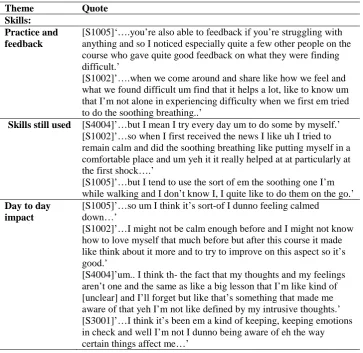
reported that skills such as soothing breathing were not easy when first attempted, particularly when they tried to maintain them for an extended period of time. Discussions amongst workshop participants relating to shared experiences of difficulty practicing these skills and feedback on how to perform them more effectively was viewed as particularly valuable (see Table 2). All those interviewed reported still using some of the skills learnt 6 months following the end of the training. The most common skills still being used was soothing breathing, with participants reporting specific instances when this skill was utilised. Participants often reported that aside from specific instances where skills were practiced, the training had altered their views of themselves and this subtly impacted on their day to day lives.
Table 2. Quotes from interviews with participants six months following the training course.
Theme Quote Skills:
Practice and feedback
[S1005]‘….you’re also able to feedback if you’re struggling with anything and so I noticed especially quite a few other people on the course who gave quite good feedback on what they were finding difficult.’
[S1002]’….when we come around and share like how we feel and what we found difficult um find that it helps a lot, like to know um that I’m not alone in experiencing difficulty when we first em tried to do the soothing breathing..’
Skills still used [S4004]’…but I mean I try every day um to do some by myself.’ [S1002]’…so when I first received the news I like uh I tried to remain calm and did the soothing breathing like putting myself in a comfortable place and um yeh it it really helped at at particularly at the first shock….’
[S1005]’…but I tend to use the sort of em the soothing one I’m while walking and I don’t know I, I quite like to do them on the go.’
Day to day impact
[S1005]’…so um I think it’s sort-of I dunno feeling calmed down…’
[S1002]’…I might not be calm enough before and I might not know how to love myself that much before but after this course it made like think about it more and to try to improve on this aspect so it’s good.’
[image:6.595.117.481.331.684.2]Articles Section
Three of the four participants who took part in the interviews also completed follow-up questionnaires six months following the training which were identical to the post-course questionnaires. These responses showed the changes observed in self-compassion, self-criticism, self-efficacy and the GHQ from the immediate post training evaluation were maintained for up to six months and slightly extended (see Table 1 for the mean scores).
Discussion
Overall, participants in this study showed a positive improvement in self-compassion scores, self-criticism, and self-efficacy by the end of the CFT course and a further improvement at the six-month follow-up, demonstrating the beneficial impact of this brief CFT workshop training course.
The SCS scores in our sample were lower compared to the sample employed in Neff’s study (mean = 18.26, SD = 3.99) (Neff, 2003), even after the CFT course, demonstrating the possibility that this CFT course attracted individuals who had lower self-compassion. Despite this and the brief nature of the training, an improvement in self-compassion was still observed and maintained in the medium term. Participants demonstrated a slight increase in reassurance simultaneously with a reduction in inadequacy and self-hatred following the training. The self-reassurance scores in our sample were still lower than those from Longe et al.’s, (Longe et al., 2010) study (mean = 23.95, SD = 4.44) whilst the inadequate self (IS) and hated self (HS) scores were greater than those in Irons et al.’s study (Irons, Gilbert, Baldwin, Baccus, & Palmer, 2006); again demonstrating that our sample were more likely to be IS and HS dominant than average.
Academic self-efficacy scores also increased following the brief CFT training, demonstrating for the first time that improving self-compassion may potentially impact on academic performance. However, further research needs to be conducted to examine the effect on academic grades as a result of CFT training.
However, the GHQ indicated potential worsening of mental health. Since the course only included 4 workshops, it is uncertain whether this worsening was in relation to the CFT or general fluctuation in mental health. It should be noted, however, that the final workshop of the training occurred just prior to exams, as did the six-month follow-up, therefore, participants may have been experiencing more emotional distress at those times. Participants did report experiencing stress relating to academic work.
There are limitations to the study that should be addressed in relation to
future research on CFT. The sample size was small (n = 9 with usable data),
meaning that analysis was very limited. Missing data is a prevalent issue in this
Articles Section
easily completed at the start of the first session and at the end of the final session; for instance, the 12-item version of the SCS (Raes, Pommier, Neff, & Gucht, 2011) could substitute the original 26-item SCS (Neff, 2003). Participants were also aware of the purpose of the study, therefore this may have biased their responses.
Conclusion
The CFT course was well-received and enjoyed by participants. Scoring indicated the potential benefit of CFT on self-compassion, self-reassurance, and academic efficacy. Future research should investigate the benefits of CFT over a longer period of time with a larger sample and should also examine impact on academic scores.
Acknowledgements
We are grateful for the permission of Professor Paul Gilbert to use a range of his lecture slides and client training resources a core part of these courses and his general encouragement.
The study was funded by a Teaching Development Award from the University of St Andrews.
Details of the course plan are available from TT, email: [email protected]
REFERENCES
DeBerard, S., Spielmans, G., & Julka, D. (2004). Predictors of academic achievement and retention among college freshmen: A longitudinal study. College Student Journal, 38(1), 66 - 80.
Germer, C. (2009). The mindful path to self-compassion: Freeing yourself from destructive thoughts and emotions New York: Guilford Press.
Gilbert, P. (2009). The compassionate mind: A new approach to life's challenges: Constable.
Gilbert, P. (2010). Compassion focused therapy. London: Routledge.
Gilbert, P., Clarke, M., Hempel, S., Miles, J., & Irons, C. (2004). Criticizing and reassuring oneself: An exploration of forms, styles and reasons in female students. British Journal of Clinical Psychology, 43, 31 - 50.
Goldberg, D., & Williams, P. (1988). A User's Guide to the GHQ. Windsor: NFER-Nelson.
Guest, G., MacQueen, K., & Namey, E. (2012). Applied thematic analysis: Sage Publications Inc.
Articles Section
Irons, C., Gilbert, P., Baldwin, M., Baccus, J., & Palmer, M. (2006). Parental recall, attachment relating and self attacking/self reassurance: their relationship with depression. British Journal of Clinical Psychology, 45, 297 - 308.
Longe, O., Maratos, F., Gilbert, P., Evans, G., Volker, F., Rockliff, H., & Rippon, G. (2010). Having a word with yourself: Neural correlates of criticism and self-reassurance. . Neuroimage, 49(2), 1849 - 1856.
Neff, K. (2003). The development and validation of a scale to measure self-compassion. Self and Identity, 2(3), 223 - 250.
Raes, F., Pommier, E., Neff, K., & Gucht, D. V. (2011). Construction and Factorial Validation of a Short Form of the Self-Compassion Scale Clinical Psychology and Psychotherapy, 18(3), 250 - 255.
Rosenzweig, S., Reibel, D., Greeson, J., Brainard, G., & Hojat, M. (2003). Mindfulness-based stress reduction lowers psychological distress in medical students. Teaching and Learning in Medicine, 15(2), 88 - 92.
Royal College of Psychiatrists. (2011). Mental health of students in higher education. London.
Schulenberg, J., Sameroff, A., & Cicchetti, D. (2004). The transition to adulthood as a critical juncture in the course of psychopathology and mental health.
Development and Psychopathology, 16, 799 - 806.
Sirois, F. (2013). Procrastination and stress: Exploring the role of self-compassion. Self and Identity, ahead-of-print, 1 - 18.
Solberg, V., O'Brien, K., Villareal, P., Kennel, R., & Davis, B. (1993). Self-efficacy and Hispanic college students: Validation of the College Self-Efficacy Instrument. Hispanic Journal of Behavioral Sciences, 15, 80 - 95.
SPSS (Version 21). Armonk, New York. IBM
Viner, R., Ozer, E., Denny, S., Marmot, M., Resnick, M., Fatusi, A., & Currie, C. (2012). Adolescence and the social determinants of health. The Lancet, 379, 1641 - 1652. Welford, M. (2012). The compassionate mind approach to building your self-confidence