CONTROL OF CLIENT‐CONTRACTOR COOPERATION
IN MUNICIPAL BEST‐VALUE PROJECTS
A MULTIPLE CASE STUDY
MSc thesis report
MARK KLOOSTERBOER
CONTROL OF CLIENT-CONTRACTOR COOPERATION IN MUNICIPAL
BEST-VALUE PROJECTS
A MULTIPLE CASE STUDY
MSc thesis report
Location Enschede
Date August 25, 2017
Author
Name Ing. M.C. (Mark) Kloosterboer
Student number [hidden in public version]
E‐mail [email protected]
Study
Organisation University of Twente
Faculty Engineering Technology
Programme Construction Management & Engineering (CME)
1st supervisor Dr. J.T. Voordijk
2nd supervisor Drs. Ing. J. Boes
Graduation organization
Organization Vereniging Stadswerk Nederland
Acknowledgements
This report is the final result of my master thesis as part of the MSc programme Construction Management & Engineering at the University of Twente. It forms also the end of my life as a student. First at the Hogeschool Zeeland in Vlissingen and later here in Enschede. In 2012 I decided to continue studying after 4 years in Vlissingen. It was one of those decisions I will never regret. Here, I would like to acknowledge those who helped me with the last phase of my study.
First of all my academic supervisors, Dr. J.T. (Hans) Voordijk and Drs. Ing. J. (Hans) Boes. Thanks for your guidance and suggestions. Due to that I was, at last, able to see the connecting thread between the theory and results. Furthermore, thanks for your patience with a, sometimes, stubborn student who had many other activities besides finalizing his thesis. Furthermore, I would like to thank Stadswerk for enabling this research and connecting me to their impressive network that made this study possible. Maarten Loeffen, thank you for the pleasant cooperation. Of course, I have to thank the employees of the municipalities as well as those from the contractors for their enthusiasm about the projects and their willingness to cooperate in this research. Everyone was proud of the project results and happy to show what they did and how they did it. Thanks for giving me the insights and letting me ask my critical questions.
Last but not least, I would like to thank my parents, friends and Davied. Thanks for your support, patience and faith. Without it I wouldn’t have been able to finish my study.
Abstract
Dutch municipalities are changing their public procurement practice. Where traditional design, bid, build contracts used to be the standard, integrated project delivery methods become more wide‐ spread amongst lower governmental organizations. In the search for new procurement methods by municipalities, Best‐Value is named as a promising method for integrated construction projects and renewed cooperation between client and contractor. In Best‐value procurement, the contractor is seen as expert who knows how to handle and solve the problem of the principal. The principal is therefore required to ‘let go’ and trust the contractor on his expertise and let the contractor take the lead. The principal sets a maximum budget and tries to find the contractor who can solve the problem and delivers the highest value with the most certainty in terms of costs, time and quality. The method assumes the contractor knows best how to solve the problem and therefore aims at giving maximum freedom to the contractor to enable him to do so.
This study identifies how best‐value changes the cooperation between principal and contractor in Dutch municipal construction projects. To do that, the study focusses on control, trust and risk perception as described in the framework for interorganizational cooperation. In a multiple case‐study, three municipal construction projects are studied to see how a best‐value project can work in practice and how parties cooperated in these projects.
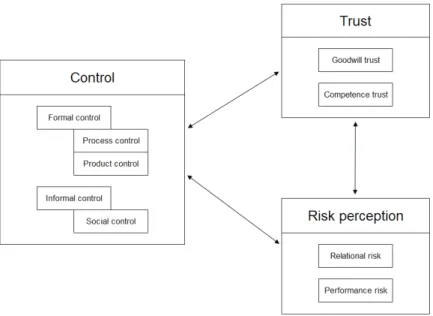
Interorganizational cooperation is explained by Das & Teng (2001) using their model containing underlying aspects of control, trust and risk perception (see Figure 1). Using this model, the influence of different forms of control on trust and control on risk perception can be seen. This allows explanation of how forms of control influenced the cooperation between client and contractor. Literature shows that best‐value adds informal modes of control to the more traditional set of formal control modes used in traditional and standard integrated project approaches. This informal control by itself allows less formal control to be
in place as risk perception lowers and levels of trust rise. Furthermore, the used forms of formal control focus on risk‐based information sharing and the contractual control modes in general are a product of agreement between client and contractor. To do so, best‐value projects include a phase without contractual base where contractor and client work together on the contract and risk dossier. Instead of a classical contract describing the desired product in detail, a more general contract is drawn‐up based on the project goals and the risk dossier aiming at arranging the cooperation between the parties.
Three construction projects were studied to see how Best‐Value changes control and cooperation in practice and what the results are. In all cases, the used method enabled informal control in the projects. The procurement‐phase lowered the perception of risks while levels of trust increased. This
resulted in less formal control and the space for informal control to grow, which allowed dealing with unforeseen circumstances in cooperation between client and contractor. However, when unforeseen circumstances arose parties were seen to be inclined to revert to more traditional forms of formal control, indicating a lack of trust in the other party. Overall, informal forms of control showed to have a positive effect on the interorganizational cooperation. Formal forms of control can have a negative effect on interorganizational cooperation but don’t necessarily do so.
Contents
Acknowledgements ... II Abstract ... III
1 Introduction ... 1
1.1 Changing Governance ... 1
1.2 Defining cooperation ... 2
1.3 Best‐value ... 2
2 Research design ... 4
2.1 Problem definition ... 4
2.2 Research question ... 4
2.3 Method ... 4
2.3.1 Literature study ... 4
2.3.2 Multiple case study ... 4
2.4 Relevance ... 6
3 Theoretical Framework ... 7
3.1 Best‐value ... 7
3.1.1 The Process ... 7
3.1.2 Information measurement theory ... 8
3.1.3 Dominant information ... 9
3.2 Interorganizational cooperation ... 9
3.2.1 Control by Das & Teng ... 9
3.2.2 Control by Williamson ... 11
3.2.3 Trust ... 11
3.2.4 Risk perception ... 12
3.3 Control of cooperation in best‐value projects ... 12
3.3.1 Formal control ... 12
3.3.2 Informal control ... 13
4 Multiple case study ... 15
4.1 Results ... 15
4.1.1 Case Amsterdam ... 15
4.1.2 Case Nijmegen ... 18
4.1.3 Case Schouwen‐Duiveland ... 19
4.2 Cross‐case analysis ... 21
4.2.1 Control modes ... 21
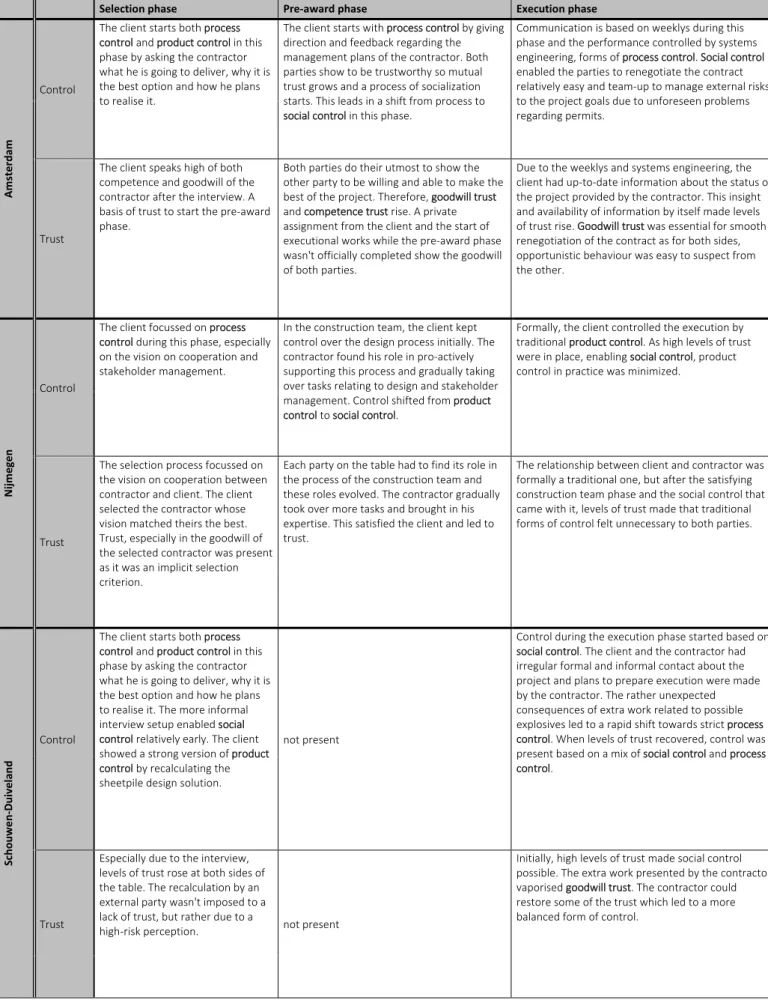
4.2.2 The course of control, trust and risk‐perception ... 24
5 Discussion ... 28
5.1 Social control in best‐value ... 28
5.2 Formal control as a source of trust ... 29
5.3 Steering by the client ... 29
5.4 Limitations and further research ... 30
6 Conclusion ... 31
6.1 Recommendations ... 32
References ... 33
Appendix 1 Translation of specific terms ... 36
Appendix 2 Survey results (in Dutch) ... 37
Appendix 3 Survey Questions (in Dutch) ... 40
Appendix 4 Interview script (in Dutch) ... 47
1
Introduction
Dutch municipalities are changing their public procurement practice. Where traditional design, bid, build contracts used to be the standard, integrated project delivery methods become more wide‐spread amongst lower governmental organizations. In line with changes on‐going on national levels. Several factors contributed to this change. Amongst others: generally bad performance in construction projects, the changed paradigm from awarding a contract based on lowest price to most economically advantageous tender (MEAT), the changing government towards network governance and the ask for cooperation.
There’s a public discontent with the performances of the construction industry for years. Lots of projects are known for overruns in terms of budget and time. Furthermore, the sector is marked as conservative and not‐innovative. Because of this, multiple initiatives tried to change the sector in the past. Examples in the nineties are the Construction Task Force which produced the ‘Egan Report’ Rethinking Construction (Egan, 1998) in the United Kingdom and the ‘Verkenningscommissie Bouw’ [Dutch exploratory committee for the construction industry] in the Netherlands. These initiatives started a change in the industry towards more integrated delivery methods and the shift of focus from awarding on lowest price towards a system that takes quality into account (Dorée, 2001). Awarding on lowest price led to fierce competition in which price had to compete with quality, safety and integrity (Dorée, 2004). This eventually played an important factor for the collusion in the Dutch construction industry that came to light in 2001 (van Waarden, 2003; Dorée, 2004).
The calls from the committees in the nineties and the fact‐finding committee that investigated the collusion led to the instalment of the ‘Regieraad Bouw’ with the task to change the sector and make it ‘healthy, transparent and innovative’ again (Regieraad Bouw, 2006). This board concluded that the used procurement practice was of great influence on the functioning of the sector and advised that the government had to start procuring more professionally. Meaning, the right project delivery method for the right project, to balance the interest of all involved parties.
In the first decade of the 21st‐century Dutch governmental organizations started to experiment
with different integrated project delivery methods and awarding projects based on MEAT (Most Economically Advantageous Tender) to assess both price and quality of the bids. With the ‘Aanbestedingswet 2012’ [public procurement act 2012] all public procuring organizations are obliged to award their projects based on MEAT, unless they can motivate deviation from the rule (Ministerie van Economische Zaken, 2013). Before this act, small and medium sized municipalities mainly used traditional procurement and delivery methods in their construction project (Aanbestedingsinstituut, 2014). With this act, they were pushed to change their practice.
1.1
Changing Governance
municipalities become wider and more complex. Also regarding construction projects, the complexity, uncertainty and time pressure increases. The field of action includes multiple stakeholders, all with their own targets and interests. Projects require a more integrated approach so these targets and interest can be fit in (Beurskens & Korsten, 2007) and traditional governance forms and procurement methods cannot stand (Dubois & Gadde, 2000; Eriksson & Westerberg, 2010). Stakeholder management, citizen participation, outsourcing, integrated contracting and public‐private collaborations are ways of fulfilling these modern requirements.
1.2
Defining cooperation
‘Cooperation’, ‘collaboration’, ‘co‐creation’, and ‘partnering’ are some of the terms often used as the way to improve performance of the construction sector and as answer to changing procurement and governance paradigms. “Co‐creation is the future” (Dronkers, 2013) said Rijkswaterstaat’s director‐general Dronkers. For the Dutch leading principal in infrastructure, cooperation must result in “cost reduction, growth, increased employment, sustainability and safety” (Dronkers, 2013). This vision was further made concrete in the Marktvisie 2016, a set of visions and goals shared by principals and contractors in the sector. This Marktvisie follows various declarations of intent, gentlemen’s agreements and other initiatives between individual parties or sector‐wide (Kamminga & Smits, 2012). Cooperation between public and private parties increasingly attracts attention from scholars for some time (Bresnen & Marshall, 2000). Cooperation has been identified as a critical success factor in construction projects in multiple studies (van Valkenburg, Lenferink, Nijsten, & Arts, 2008; Chan, Ho, & Tam, 2001; Bresnen & Marshall, 2000; Larson, 1995). The term cooperation is a rather vague concept and is used in multiple ways. It is therefore needed to set a clear definition of the term for this research. In a study of Browning, Beyer and Shetler (1995), the authors cite several aspects of cooperation relevant to their research on cooperation in competitive industries. They state that cooperation occurs when “people or groups act together in a coordinated way to pursue shared goals” (Argyle, 1991, p. 4). In addition to that it involves the sharing of the benefits that emerge from cooperation (Deutsch, 1993). An interesting third aspect they added states that cooperation “maximizes both the individual's and others' interests, whether the situation involves correspondent or non‐correspondent interests” (Derlega & Grzelak, J., 1982, p. 3). For this study, the following definition is formulated for cooperation: The process between people or organisations who interact with an attitude and behaviour that supports one or multiple shared goals and interests which itself forms the basis for cooperation, whereas individual people or organisations don’t hinder individual goals or interest of the others involved.
1.3
Best-value
Rijkswaterstaat as principal as well as from the contractors from the 16 reviewed projects. According to the evaluation of the method (Vulperhorst, 2012), best‐value shifted the accent from price to quality and was able to select the best bid in terms of quality while these bids turned out to be amongst the lower priced bids. Also, innovation was stimulated, the total project durations were cut by approximately 6 to 9 months compared to design‐build (DB‐) projects and transaction costs (of the principal) were on average 55% of those of DB projects. Best‐value is named in as promising procurement method and project approach when considering ways to improve and renew cooperation between principal and contractor and can fulfil new requirements imposed by changing governance modes (Kamminga & Smits, 2012; Vulperhorst, 2012; van Duren, 2013; Duren & Dorée, 2008). A survey held for this research showed that 41% of the responding municipalities used the best‐value method in their construction projects and another 33% named best‐value as an interesting method to use in their projects in the future. More details about the survey can be found in attachment 1. This study tries to identify how best‐value changes the cooperation between principal and contractor in Dutch municipal construction projects. To do that, the study focusses on control, trust and risk perception as described in the framework for interorganizational cooperation by Das and Teng (2001) (see paragraph Theoretical Framework). In a multiple case‐study, three municipal construction projects are studied to see how a best‐value project can work in practice and how parties cooperated in these projects.
2
Research design
2.1
Problem definition
Traditional contracts in the construction industry are strongly focussed on formal control of the cooperation between principal and agent by means of a strict description of the obliged result or an extensive tender specification. This form of control can hinder cooperation based on trust in the project phases after the tender. In best‐value, control of the contract is organized differently and leaves room for more informal forms of control.
Other than general information about best‐value and its usage in the construction sector, little is known about how different municipalities apply the method and how this influences cooperation between municipalities and contractors. More specific: how different control‐ modes, made possible by best‐value, change the relationship between principal and agent in municipal construction projects.
2.2
Research question
How do different forms of control, made possible by best‐value, change cooperation between principal and agent in municipal construction projects?
2.3
Method
The research consists of two main‐phases and starts with a literature study into the underlying principles of best‐value and control in interorganizational cooperation. The second phase is a multiple case study to see best‐value projects in practice and assess the usage of control modes and their influence.
2.3.1 Literature study
The first part of the research is a literature study in order to (1) understand the best‐value method and (2) control in interorganizational cooperation. As third part, the literature study considers the available information about control and its effect in best‐value.
2.3.2 Multiple case study
Formal and informal control and their influence on a project can’t be seen without a context. A multiple case study can provide this context and provide insight in best‐value and control in practice.
Case selection
To select cases, the results from the survey were used. First of all, three municipalities who have used best‐value are selected based on the grade of urbanisation provided by the Dutch national bureau of statistics (CBS). Municipalities are classified in a range from highly urbanised to not urbanised. The goal is to select three different sized municipalities. One in the category ‘highly urbanised’, one in ‘moderate‐high’ or ‘moderate’ and one in ‘little’ or ‘not’. See Table 1
Table 1: CBS categorisation of urbanisation of municipalities and typical Dutch examples (Source: CBS, 2015)
Urbanisation Density (addresses per km2) Examples
High >2500 Amsterdam, Groningen, Hilversum Moderate‐high 1500‐2500 Amersfoort, Enschede, Wageningen,
Gouda
Moderate 1000‐1500 Ede, Roermond, Houten
Little 500‐1000 Emmen, Hardenberg, Haaksbergen Not <500 Veere, Ommen, Baarle‐Nassau,
Terschelling
Within a selected municipality, a project will be selected together with the municipality. In order to keep the projects somewhat comparable, all selected projects are preferably finished recently (max 2 years ago) and had a contract price between 0.5 and 1 million euro.
This, because it is assumed that there is a correlation between the contract price and the complexity and, secondly, the complexity and the chances of parties behaving opportunistically. By choosing similar sized projects in terms of contract price, projects are considered more comparable.
Document analysis
First, the municipality was contacted to introduce the study and to check whether they were willing to cooperate. After that, a brief visit followed to meet the contact person of the municipality in person, get basic information and understanding about the project and the organization and to decide which documents were needed to analyse for the first part of the case study. Document analysis should give a basic understanding of each project. Basic information is collected such as: the parties involved, duration, location, used contract, initial problem and delivered product. Furthermore, a timeline is generated in order to get more insight into the process during contracting‐ and realisation phase. Finally, this information forms important input for the interviews in the next phase. Document research identifies key‐ moments and decisions that steered the project and should be explored during the interviews. From each project, a detailed timeline was made from project initialization to completion, including decisions, formal contact between principal and contractor and other details that may be of importance. These timelines then showed moments that needed more clarification and important moments of cooperation between client and contractor. Therefore, the timelines formed the basis of the following semi‐structured interviews.
Interviews
The document analysis forms the basis for the semi‐structured interviews. This phase has several goals: finding context and more in‐depth knowledge into the information found in the documents for one and, secondly, verifying if found information is understood correctly. Therefore, this phase is a form of triangulation and enhances the internal validity.
The interviews are semi‐structured. A list of general questions is made on forehand that consists of questions applicable to all cases and specific questions based on the information form the documents. The goal of the semi‐structured character of the interviews is to leave room for follow‐up questions and to explore possible key‐facts that hadn’t come to light based on the documents. Per case 2 interview moments are planned. One with the principal and one with the contractor. Furthermore, more brief contact is planned at the start of the process to introduce the study. Per municipality the involved head of procurement and the project manager are interviewed. The project manager is interviewed from the side of the contractor. Above all, the preference goes out to someone that has been involved in the project from beginning till end.
Every interview was build up in two parts. First, more general questions about the project, BVP in general and the project‐specific process were asked. In the second part, the project was discussed chronologically, focussing on behaviour of the involved parties in terms of control, risk perception and trust. Each interview, 60‐90 minutes in duration, was recorded digitally and transcribed afterwards. The interview script is available as Appendix 4.
2.4
Relevance
Although studies with subjects as best‐value, cooperation or tendering aren’t unique, this research has the potential to deliver new insights just because of this combination of subjects. Most studies into (new) tendering‐ or cooperation methods in The Netherlands focus on a national level. Although, in two third of the projects on the market, a municipality is principal. At the same time, municipalities struggle to implement changing procurement law and incorporate the need for changing governance structures in their projects (Aanbestedingsinstituut, 2014). Furthermore, the environment and interests a municipality acts in, both social and political, differs from that of a national organization. Therefore, municipal tendering deserves the attention within the field of research in construction management.
This research is conducted in collaboration with Vereniging Stadswerk. This association consist of 190 municipal members (48% of the Dutch municipalities) and tens of other parties and companies working in the field of management of public space together with municipalities (Vereniging Stadswerk Nederland, 2015). Vereniging Stadswerk therefore provides the
3
Theoretical Framework
3.1
Best-value
Best‐value Procurement (BVP) has been developed by Dean Kashiwagi at the Arizona State University. In 2005 Rijkswaterstaat and Heijmans introduced the method in the Netherlands. To do so, the original Best‐Value method had been adjusted to meet European and Dutch (legal) requirements. (Kashigwagi, 2011) In this research, best‐value is applied in this adjusted way as described by Rijt & Santema (2013).
BVP is more than just a procurement procedure, BVP is part of the Best‐Value philosophy. The introducers of Best‐Value Procurement in the Netherlands, Jeroen van Rijt and Sicco Santema, describe BVP as “a philosophy […], a word that means far more than the procurement transaction. […] Best‐Value is not just a method for selecting a supplier. It is rather a philosophy to create and maintain a cooperation” (Rijt & Santema, 2013, p. 28). Because of this philosophy, basing a project on BVP changes not only the procurement process, but the cooperation process during the entire project. Therefore, nowadays the term Best‐Value Approach or Best‐Value is used. In this study ‘Best‐Value’ will be used, meaning the complete method for the project from procurement till delivery.
3.1.1 The Process
Best‐Value is build up around multiple phases: planning, selection, pre‐award and execution (see Figure 2).
Figure 2: Phases of a best‐value project
The selection phase aims at selecting the contractor who can execute the project best and is ‘expert’. The bids are therefore assessed on multiple award criteria; the bid book containing the plans and dossiers, an interview and the price. The Interview is an important criterion and interviews are held with the key officials; the staff that will later execute the project in a key position. The interviews can provide more insight in the submitted plans and the officials are ‘tested’ whether they support the plans and can function as expert and are able to lead the principal through the project. Based on these award criteria, the best contractor is identified. The selected contractor and client start the pre‐award phase of Best‐Value. In this phase, the bid will be made more clear and concrete. The contractor, regarded as expert in solving the problem, takes the lead in this phase. The phase aims at an agreement between client and contractor and the award of the project to the contractor. To do so, details are added to the plan and discussed. During this phase, special attention goes out to the risk dossier as client and contractor agree on most important client risks and their mitigation. During the phase, merely plans are made and further concretized, no actual designing activities should take place here. Upon agreement, the contractor formulates the contract.
By ending the pre‐award phase, the tender process is finished and the project can continue into its execution phase. Best‐Value changes this phase, compared to projects based on other forms of integrated contracts, in the way that contractor and client interact. Best‐Value enables communication in the form of weekly risk‐based reports called weeklys. Communication is therefore based on the client‐risks dossier. Per risk, the actual status is updated on a weekly basis in terms of mitigating measures and quantified impact in terms of time and money. The client has the obligation to respond to the weekly within days by scoring its satisfaction regarding the contractors approach. By this, communication is boiled down to so called dominant information.
An important aspect of Best‐Value is the behaviour the involved parties show. The contractor gets as much freedom as possible to enable him to do what he can do best. That is, solving the problem of the client as offered during the tender phase. The principle is that the client is expert and the procurement phase selected the party with the most expertise. To give the expert the freedom, he takes (gets) the responsibility and leadership role in the project. Steering and leading the project by the client is seen as a risk in Best‐Value.
3.1.2 Information measurement theory
The Best‐Value process is based around the free flow and availability of information (Rijt & Santema, 2013). Information measurement theory (IMT) by Kashiwagi is the core of this process. IMT states that if the capacity of a person to process the available information is insufficient, this person has the (mis)perception that not enough information is available (Kashiwagi & Kashiwagi, 2010). To compensate for this information shortage, the person reverts to his past experiences to create expectations. This leads to decisions based on personal, subjective information and biases. “IMT identifies decision making and bias as the major obstacles to perfectly understanding reality and the source of risk.” (Kashiwagi & Kashiwagi, 2010, p. 1)
the perception that all needed information is available and minimizes the influence of bounded rationality (van Duren, 2013).
3.1.3 Dominant information
Best‐Value relies on dominant information. This means, per Rijt & Santema (Prestatieinkoop, 2013, p. 70): non‐disputable, verifiable, accurate, measurable, high performance and applicable. Dominant information origins from IMT. Kashiwagi describes dominant information as “Dominant information can be understood by almost everyone due to its simplicity and it does not require technical knowledge. Dominant information can be described as a no brainer, common sense, easy to understand, or where there is no requirement to use one’s unique experience to validate a concept.” (Kashiwagi & Kashiwagi, 2010, p. 3). In Best‐Value, parties are required to communicate based on dominant information, for example in the call for tender, the bid and the weeklys. By using dominant information parties have measurable and comparable information and the communication process is more efficient. This makes it possible for the principal to select the best contractor, for example.
3.2
Interorganizational cooperation
A construction project is a temporary cooperation between principal and client (van Duren, 2013). In Best‐Value, the contract is written after the pre‐award phase and forms the basis for cooperation during the realisation of the project. In the tender phase of the project, ex ante, choices are made about the form of cooperation between principal and agent as well as the way this cooperation is controlled.
T.K. Das and Bing‐Sheng Teng (2001) describe how trust, risk perception and control each play an important role and are highly interconnected in interorganizational cooperation (see Figure 3). The model of Das & Teng forms the basis for the theoretical framework.
Figure 3: The interconnected aspects of interorganizational cooperation per Das & Teng (2001).
3.2.1 Control by Das & Teng
Das & Teng describe two forms of control: formal and informal. Formal control “emphasizes the establishment and utilization of formal rules, procedures, and policies to monitor and reward desirable performance” (Das & Teng, 2001, p. 259). Formal control is further dived into product control and process control. Informal control, or social control, is “the establishment of organizational norms, values, culture, and the internalization of goals to encourage desirable behaviour and outcome. Here, control is intended to reduce goal incongruence and preference divergence among organizational members” (Das & Teng, 2001, p. 259). In social control, a shared goal grows over time as the commitment of the members to the cooperation grows over time. Behaviour and outcome aren’t specified in the beginning, but follow from the process of socialization.
The choices made during the procurement phase of the project are about contract types and (their) control modes. Here the underlying control principles are weighted: formal control based or informal trust based. These choices are made based on several factors: the knowledge and measurability of the product and the knowledge and measurability of the process. These factors determine the perception of the relational risk and the perception of the performance risk involved in the cooperation (Das & Teng, 2001). Control mechanisms that naturally follow from these are respectively control/measurement of the product and control/measurement of the process, following the principle that you can’t control what you don’t know or can’t
measure (Figure 4).
Figure 4: Control modes and their relation to knowledge and measurability in the interorganizational cooperation. Based on Das & Teng (2001).
Based on this model, it can be concluded that formal product control is the appropriate control mode if the product measurability is high, while the measurability of the process is low. In that case, there is a perceived performance risk. The opposite is true for formal process control. If both aspects are unknown or hard to measure, social control (as informal control mode) is the preferable control mode.
(mutual) mistrust. “When behaviours and processes are specified in an alliance, the implication is that the partners cannot be trusted with things being done their own way. Their competence is questioned as to whether they have the ability to carry out the job in the best possible way. As such, a sense of mistrust prevails in the alliance” (Das & Teng, 2001, p. 263). Social control, instead, is trust‐breeding as the process of creating shared goals and norms increases mutual understanding. Controlling risks with the right mix of control modes leads to the desired cooperation, behaviour and output.
3.2.2 Control by Williamson
An often‐cited different approach to control is that of Williamson, one of the founding fathers of Transaction cost economics. Williamson described different contract forms (1979) and safeguards (1975) to control cooperation in transactions. The three contract types described by Williamsom (1979) are: classical contracts, neo‐classical contracts and relational contracts. Classical contracts, first, are appropriate for ‘standard’ situations with a predictable and definable character and assumes a perfect market. In this situation, the identity of the contracting parties is not important. Control in these contracts is simple: if a contract party fails its obligation, he won’t get payed. The neo‐classical contracts, secondly, are meant for longer term relationships in more risky situations. In these situations, it is too expensive, if not impossible, to write a complete comprehensive contract covering the complete transaction in detail because of the complexity and uncertainties. This contract type essentially acknowledges the existence of bounded rationality and an imperfect market. This contract type enables the trade, e.g. a product for money, and provides control mechanisms to be able to respond to unforeseen circumstances. Relational contracts, as third, are applicable in situations where the complexity is too high and the duration too long to write a neo‐classical contract. In this case, there’s a need to arrange the relationship and cooperation but to a lesser extent the need to arrange the content of the transaction. The contract focusses on the longer‐ term relationship between the parties and its values and norms to make the transaction possible.
Furthermore, Williamson (1975) described safeguards: (1) connecting bonusses and penalties to performances, (2) an organization structure in which disputes can be settled, e.g. by an arbitration board and (3) supporting continuity by shared goals, norms and values; e.g. by promising future projects in case of good cooperation.
3.2.3 Trust
Trust is a crucial element in cooperative relationships. If parties must cooperate for a certain time, they have to be aware of the trustworthiness of the other party (Ring & Van De Ven, 1992). Researchers use different interpretations of trust. The definition suggested by Das & Teng (2001) based on these different interpretations: “trust is about positive expectations regarding the other in a risky situation” (…) “a subjective state of positive expectations” (2001, p. 255)
Das & Teng (2001), furthermore, give a broad overview of different scholars describing different dimensions of trust. They conclude to adopt the definition by Nooteboom (1996, p. 990): “Trust may concern a partner’s ability to perform according to agreements“ (competence trust), “or his intentions to do so” (goodwill trust).
reduce its perceived relational risk in an alliance, but not its perceived performance risk.” (Das & Teng, 2001, p. 257). In the same way, competence trust is related to perceived relational risk and vice‐versa.
The other way around, control affects trust. Formal control undermines trust, because “employment of strict rules and objectives means that members do not have the autonomy to decide what works best. Member’s goodwill is thrown in doubt. As a result, an atmosphere of mistrust is created. Informal control influences people’s behaviour through creating shared goals and norms. This process increases mutual understanding and is thus trust‐breeding” (Das & Teng, 2001, p. 263). See Table 2 for the effects of control on trust.
3.2.4 Risk perception
Cooperation between client and contractor is characterized by risks (Das & Teng, 2001). Das & Teng, distinguish relational risks and performance risks in their model, like the dimensions of trust distinguished by Nooteboom. Relational risk is the possibility and consequence of unwillingness to cooperate, in particular the risk of opportunistic behaviour from one of the parties. In this case, the party’s own interests prevail over that of the cooperation. Performance risks are the possibility and consequence that goals of the cooperation cannot be made. A source of this risk can be changing external circumstances outside the range of influence of the participants or incompetence of one the parties. In relation to control, Das & Teng state e.g. that the more is known about the desired behaviour of the other party instead of about the desired output, the higher the perceived relational risk will be. In those cases, behaviour control, for example explicit clauses about information exchange, will reduce the perceived relational risk. The other way around, perceived performance risk will be reduced by output control. Table 2 gives an overview of the effects of control on risk perception. Table 2: The effects of control on risk perception and trust Control Relation with risk perception Relation with trust Formal Product Lowers perception of performance risk Lowers competence trust Lowers goodwill trust Process Lowers perception of relational risk Lowers competence trust Lowers goodwill trust Info rm al Social Lowers perception of relational risk Goodwill trust breeding Lowers perception of performance risk Competence trust breeding
3.3
Control of cooperation in best-value projects
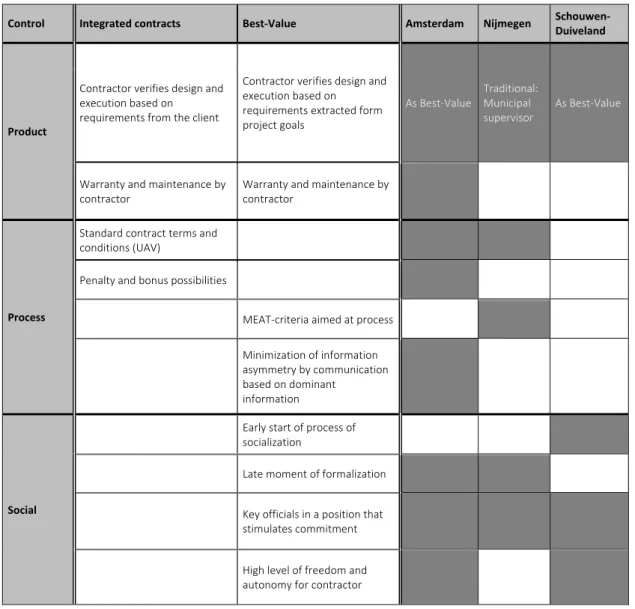
This paragraph explores how best‐value changes the control mode in construction projects, based on the two dimensions of control; formal and informal. Table 3 sums up these control modes in best‐value projects and integrated contracts as reference.
3.3.1 Formal control
neo‐classical contracts are more appropriate, according to Transaction cost economics (van Duren, 2013). Predictability and definability are essential in the deals made based on classical contracts. As these characteristics are not present in construction projects, writing complete and comprehensive contracts is impossible. The inevitable deficiencies in classical contracts in construction projects can therefore be exploited by parties involved, as a form of opportunistic behaviour (Das & Teng, 2001; van Duren, 2013). An example is the search for gaps in the traditional building specifications [Dutch: bestek]. Also modern integrated contract forms make use of a classical contract approach. E.g. by attempting to write a complete tender specification and complete list of functional requirements. After the call for tender, the principal has minimal ability to influence these requirements or the project based on these specifications in general (Eriksson & Westerberg, 2010). One of the risks that follows is the requirements and specifications turning out to be incomplete or interpretation differs between client and contractor.
In best‐value, the principal specifies the tender based on a description of the problem and project goals, the contractor leads the further specification and design process. Although, a brief set of requirements and tender specifications can be given, but rather by means of a framework or set of boundaries. The final contract is written in cooperation between client and contractor, based on the framework given in the tender specification and after the contractor made concrete plans in the pre‐award phase. Therefore, a greater amount of freedom and autonomy is given to the contractor to come with a suitable solution and design compared to other tender procedures.
Best‐value tries to find the best party to solve the client’s problem. In that process, the selected contractor proves to be expert in the field of the project. This lowers the perception of performance risk at the start of the project. By specifying the tender in terms of problems and goals, the contractor has the ability to specify a solution that he can deliver and provide best. Trust in the contractor’s performance is present due to the nature of the selection process, although knowledge of the offered product is thereby low. The pre‐award phase focusses on getting more knowledge about the process. This should lower the perception of relational risk. For example, by agreeing on allocation and management of risks or setting up a standard for communication and reporting. These agreements on the process, made concrete in the contract, form formal control and direction form the client towards a desired project result (desired performance and desired behaviour/relationship). By this, the (perceived) risk that comes with tendering (“buying a promise” (van Duren, 2013; Dorée, 2001)) is reduced by the creation of a (neo‐classical) contract in cooperation between client and contractor.
3.3.2 Informal control
By using classical contracts in the construction industry, parties can be tempted to look for deficiencies and exploit them, as described before. The more appropriate neo‐classical contracts, like used in Best‐Value, are able to control this. These contracts, at the same time, create an uncertainty as the actual product isn’t described in detail. At awarding, the process (how) is agreed upon, but the product (what) is still unclear. The design process is part of the execution phase of the project, after awarding. Therefore, client and contractor need to find some form of cooperation. Each based on their own expertise and based on their own risks and responsibilities.
commitment from the contractor for delivering the right product. This, because of the tender specification in terms of problem and goals. Therefore, the designed solution an actual design is fully made by the contractor. It’s is their own product. Furthermore, the design and execution process isn’t made ‘anonymously’ by some contractor. Instead, it is directly connected to the key‐ official because he has to ‘defend’ the plan in person during the interview and in the pre‐award phase (van Duren, 2013). Furthermore, the method stimulates that this key‐official is involved in the project from very beginning till end. This, in contrast with other contracts that are drawn‐up and signed by procurement officials, tender‐ and contract managers, where designers have a relatively anonymous desk job and officials concerned with the execution receive the designed project after the contract is signed. Because of the interviews, key‐officials meet relatively early in the project, enabling the start of a process of socialization early (van Duren, 2013).
In best‐value projects, formalization of the cooperation takes place relatively late in the process. Parties need to work together during the pre‐award phase without a contractual base. Instead, their cooperation is based on intentions. This cooperation based on intentions and expectations is called a psychological contract by Ring & Van de Ven (1994). They stated that processes like socialization and consensus‐making are more likely to succeed in situations
4
Multiple case study
4.1
Results
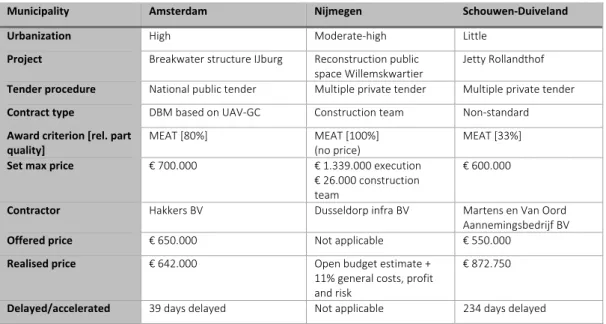
The results of multiple case study are described below in two parts: general information and description per case and a cross‐case analysis. Roughly, general information is the result from the document study and the description provides more insight based on the interviews. The cases are compared and further analysed in the cross‐case analysis. The results of the case study are available as attachment in more detail in Dutch. Furthermore, Table 4 gives an overview of the basic facts of the three cases.
4.1.1 Case Amsterdam
The project in the city of Amsterdam is about a new breakwater structure in front of the marina harbour of IJburg. The goal of the project is to make the harbour accessible during wind forces up to 6 Bft.
The municipality chooses for a best‐value project because they lack specific knowledge to determine the optimal type of structure for this specific situation. Furthermore, they intend to speed‐up the project and aim at a more efficient process compared to more traditional methods. As third, the contractor will be responsible for the maintenance for 15 years. Maximum design freedom for the contractor should lead to an optimal design that incorporates maintenance requirements and wishes, is what they hope.
The procedure for the DBM‐contract based on UAV‐GC follows the national public tender. The contract is awarded based on most economically advantageous tender (MEAT). Contractors can earn a virtual discount up to 80% on the set max price of € 700.000.
Planning phase
The municipality publishes a call for tender based on dominant information. This involves a clear goal and scope of the project, available budget and time frame. The contractor is requested to present the plans in maximum 5 pages. A set of requirements is included and contain mostly legal obligations towards other authorities.
Table 4: Overview of the three cases
Municipality Amsterdam Nijmegen Schouwen‐Duiveland
Urbanization High Moderate‐high Little
Project Breakwater structure IJburg Reconstruction public space Willemskwartier
Jetty Rollandthof
Tender procedure National public tender Multiple private tender Multiple private tender
Contract type DBM based on UAV‐GC Construction team Non‐standard
Award criterion [rel. part quality]
MEAT [80%] MEAT [100%] (no price)
MEAT [33%]
Set max price € 700.000 € 1.339.000 execution € 26.000 construction team
€ 600.000
Contractor Hakkers BV Dusseldorp infra BV Martens en Van Oord Aannemingsbedrijf BV
Offered price € 650.000 Not applicable € 550.000
Realised price € 642.000 Open budget estimate + 11% general costs, profit and risk
€ 872.750
It became clear from the interviews that the municipality was willing to give the contractor maximum freedom and autonomy. Furthermore, by setting clear goals during the planning phase the municipality was forced to prioritize goals and agree on them internally. The process stimulated the internal organization to discuss goals and interests in an early stage of the project. This helped to align these goals and prevent internal disputes and conflicting information towards external parties in later stages.
Selection phase
De principal receives only one bid from the market. Both the municipality and the contractor blame the tight set maximum tender price as well as the fact that a good bid required an extensive preparatory study into water flows, waves motion and ice related forces. Furthermore, contractors had to prepare their bid during the holiday period.
In the performance plan, the contractor states which products he wants to deliver and why it meets the requirements and solves the problem. Process related, he states that he can manage interfaces and stakeholders well. The risk dossier is more product oriented. Only one stated risk aims at the process (possible resistance from external stakeholders). The chances dossier also aims at the product.
During the interviews, the interviewee was assessed on more deep knowledge of the project, his commitment to the project goals and the (his) plan, and on showing ambition to make the project a success. During the interview, the principal sets a very formal atmosphere in the eyes of the contractor. In such a way that a conversation was not possible, hindering the process of socialisation. During the interview, the key official of the contractor explains why the set maximum tender price was very tight and how they managed to make a bid. The principal appreciates the way the contractor explains this and the creative thinking to make it possible. Therefore, he generates trust amongst the key officials of the principal.
This one interview with one official from the side of the contractor lays a big pressure on his shoulders to succeed. In general, the contractor was eager to win the tender as investments had to be made to make the bid. Furthermore, the project formed an opportunity to get a foothold in the city of Amsterdam.
Pre-award phase
To start the design process, more information is needed about the soil composition and conditions. During the pre‐award phase, the contractor receives a private assignment to execute this field study.
Client and contractor discussed the assumptions regarding forces generated by ice. He wants to ignore norms and instead make assumptions based on conditions present in the last 50 years. Within the maximum set price, a design based on the strict norm is not possible, the contractor states.
Execution phase
The execution phase starts in January 2014, although official awarding of the contract takes another month. This phase starts with getting permits and writing more detailed plans. During the execution phase, unforeseen problems arise regarding the permissions needed. The client said that an execution plan regarding flora and fauna would be sufficient. Instead, the authorities state that a full permit is needed. Furthermore, the city of Amsterdam extends the period for decision for the environmental permit from six to twelve weeks. Also, the commission that decides on the external appearance of buildings and structures doesn’t agree on the proposed design and the contractual maintenance period can’t stand for a temporary construction in order to get a building permit.
First, the contractor requests to change the contract and postpone the completion date. There was high pressure to arrange this, because of the penalty in the contract. Both client and contractor state afterwards that this penalty hinders cooperation in the process as interest are driven apart by this clause.
A second request to change the contract considers the needed appearance change and the shorter maintenance term. The principal wanted to cut the budget because of the shorter maintenance term as extra costs due to the appearance change are the risk of the contractor, they state. The contractor proposes to set the extra costs against the saved costs with the sum of zero. The parties agree after some negotiation to meet each other in the middle. The saved costs are for the benefit of the client while the extra costs are split between client and contractor. From the interviews, officials from both sides state that the trust they build in the earlier stages of the project pays out in this dispute. This made it possible to discuss interests, setbacks and unexpected luck openly. At some points in the process the contractor helped the client and vice‐versa.
Communication takes place formally based on weeklys. During the execution phase, no meetings were planned as execution only took some weeks. In the time before execution, informal communication was present. If needed, a formal meeting was scheduled. Such a meeting took place two times to discuss the setbacks regarding the permits and the requested change of contract. Overall, the open transparent and pro‐active communication of the contractor, both formal as informal, was trust‐breeding.
4.1.2 Case Nijmegen
The project in the city of Nijmegen is about the reconstruction of the public space of the Willemskwartier neighbourhood.
Best‐Value was used to form a construction team with the contractor who can cooperate best with all stakeholders involved and can improve the plans and design with his construction experience and knowledge. The procedure follows that of a multiple private tender with awarding of the contract based on MEAT. No price is included in this part of the procedure and awarding is purely based on quality.
Planning phase
Information about the project is publicised in the call for tender. Here the project is described in terms of problem definition, goals and result. Remarkable is the difference in project goals: from “the public space is improved” to “the Tollenstraat becomes a cycling street with red pavement”. In the construction team, the municipality want to be responsible for the work description, budget, scheduling and phasing of the execution. The contractor will be responsible for the executional phase and communication with public utility companies and some stakeholders.
The plans that are part of the bid focus mainly on the cooperation within the construction team and the view of the contractor on this. In the changes dossier, the contractor had the possibility to suggest additionalities to improve the positive impact of the project.
The multiple private tender was send out to 5 contractors. This procedure allows the municipality to invite contractors they trust and support local or regional parties. Furthermore, the contractor is more eager to keep the client satisfied so he will receive in invitation in the future.
Selection phase
Price is no part of the bids of the contractors. The municipality wishes to leave the price aspect out of these phases of the project and focus on cooperation and quality. In a later stage parties work based on an open budget estimate with a fixed surcharge for general costs, profit and risk.
An interview is part of the selection phase. During the interview, the key official of the selected contractor showed commitment toward the bid and cooperation in a construction team focussing on open and transparent communication. Also, he proved to have gained specific knowledge of the neighbourhood in order to improve the bid. In the interviews, the officials of the municipality state to be pleased with the interviews. “With the interviews, you know in 10 minutes if he gets it, the bottlenecks and solutions in the project, and is the right person to do it. The interview is very useful as part of the selection.”
Pre-award phase
In this project, the construction team can be seen as the pre‐award phase. In this case, this phase stated with the construction team contract.
design becomes more concrete, the contribution of the contractor becomes bigger. The contractor designs alternatives and makes budget estimates. Furthermore, he takes the lead in surveying the current situation and advices on the recycling of current material.
Execution phase
This project knows multiple moments of formalization and shift of responsibilities from client to contractor: with the construction team contract and with the building contract following form each phase of the construction team.
At multiple moments in the project, the parties cooperated both in the construction team as well as on the project site. This was the case as the project was split up in multiple stages. Therefore, a really fundamental change with the end of the pre‐award phase and the start of the execution phase was not present. Execution of a certain phase of the project only stated after ‘each and every question was answered’. The parties aimed at a seamless change form construction team phase to execution phase and this worked well. As the contract and design was the product from both parties, problems of during the execution were handled smoothly and in good cooperation. Both parties felt responsibility.
Communication is open and transparent in both the construction team phase as the execution phase. The approach of the project demands this attitude of both parties. There wasn’t specific communication based on dominant information. In general, formal communication was present in the form of meetings. Moreover, informal communication took place as the parties cooperated closely together.
During the executional phase, a supervisor from the client was present on site. He functioned as contact person for the client if needed. Both for the contractor as the stakeholders.
4.1.3 Case Schouwen-Duiveland
The case of the municipality Schouwen‐Duiveland is about delivering a jetty in the harbour of Zierikzee and make it accessible. Therefore, dredging activity should take place and as a result a sheetpile wall needs to be reinforced.
By using a best‐value the municipality aims at a more efficient and quicker process. They don’t have the specific knowledge and by using a Best‐Value procedure, they don’t have to involve an external bureau in the process.
Planning phase
The call for tenders starts with the goal and ambition of the principal. In the set of requirements, it’s clearly stated which jetty the municipality wants, including brand and type. The other parts of the project, dredging and reinforcement of the sheetpile wall are left to the expertise of the contractor. The contractor gets maximum freedom on these parts of the project.
The tender follows a multiple private tender procedure and three contractors are invited to bid.
Selection phase
into possible WWII explosives resting in the harbour. This study and possible salvage activities are not part of the bid. The other contractor doesn’t say a word about a study like that. Second, one contractor proposes to reinforce de sheetpile wall, as expected by the municipality. The other proposes a solution where adjustments to the wall aren’t necessary. Both parties base their conclusions on the same current and future situation. This raises questions and the municipality lack then knowledge to assess both proposals. Therefore, the municipality involves a consultant for a second‐opinion and postpones the selection. The bureau concludes that both contractors made a right calculation. One contractor approached the calculations more conservative than the other. The highest scoring contractor, based on MEAT, proposes the explosives study and no reinforcement of the wall while having the highest price.
In the interviews the official from the contractor states that he can understand why the municipality asked for a second‐opinion, although it is a form of distrust. He points out that the municipality planned the project for over a year and had the idea the wall had to be reinforced all this time. It would be too easy to just let this idea go when one contractor states that it is not needed. They didn’t felt distrusted by the time.
The municipality chooses to interview two officials from the contractor. During the interview, they sit together at one table with the involved persons from the municipality to make a dialogue possible in a less strictly formal setting. The municipality looks for the ‘drive’, ‘passion’ and knowledge showed by the contractor. Although, this is not explicitly assessed during the interview. They conclude that this contractor has the knowledge, insight and motivation for the project and see discriminating added value.
The bid is made by the two interviewed persons and they saw the chance to come up with a smart solution to prevent reinforcing the wall. This made the key officials extra motivated to get the project awarded and stimulates commitment. The official of the contractor states in the interview that Best‐Value requires a different view on the tender procedure and stimulates to come up with creative and new ideas to discriminate from other contractors.
Pre-award phase
The contract is directly awarded after the selection phase. Therefore, no real pre‐award phase existed in this project. Formalization of the project took place at the traditional moment after selection. The formal contract is an official letter including the call for tender, bid and interview. Secondary, they refer to the UAV ’89 if needed. The principal chooses to not use a standardized contract. They trust that their call for tender and the bid from the contractor will lead to the solution they need.
Execution phase
Because the second‐opinion delayed the projects by some weeks, both parties start this phase by trying to find a way to meet the initial schedule. The municipality has the interest in doing so as political promises were made to complete the project in time.