University of Warwick institutional repository: http://go.warwick.ac.uk/wrap
A Thesis Submitted for the Degree of PhD at the University of Warwick
http://go.warwick.ac.uk/wrap/1217
This thesis is made available online and is protected by original copyright. Please scroll down to view the document itself.
Changing Public Representations of Mental Illness in
Britain 1870 - 1970
by
Vicky Long
A thesis submitted in fulfillment of the requirements for the degree of
Doctor of Philosophy in History
University of Warwick, Department of History, Centre for the History of
Medicine
I II vii
VII' x
XI
Table of Contents
Title Page
Table of Contents List of Figures
Acknowledgments and Declaration of Material Included From a Prior Thesis
Abstract
Abbreviations
Introduction
1: The Public Sphere, Professionalisation and Mental Health Groups
2: Government Inquiries into Mental Illness
3: Representation and Mental Disorder
3.1: Representing Public Representations of Mental illness?
4: Mental Illness and Society, 1870-1970
5: Organisation and Objectives
Chapter One: Psychiatry and the Medico-Psychological Association
1: Introduction
2: A Brief History of Psychiatric Organisations in Britain
1
1
7
12
15
17
23
29
29
3: Mental Illness, Stigma and the Public 37 4: Monitoring Media Representations: The Royal Edinburgh Asylum
Press Cuttings Books 45
4.1: Areas of General Concern to Psychiatrists 46
4.2: Articles Reflecting the Personal Interests and Concerns of
Clouston and Robertson 51
5: Writing for the Public: Popular Psychiatry Books, 192 1-70 54
6: Conclusion 71
Chapter Two: The National Asylum Workers' Union 75
1: A Brief History of the NAWU 76
2: Using the Journal as a Source 79
3: Patients Viewed from Male Nurses' Perspective 83 4: Representing the Interests of Staff or Representing Patient Interests? 98
4.1: Representing Mental Deficiency 98
4.2: The Emergence of the Patient Voice 108
5: Towards a Model of General Nursing and a Patient-Centred View 110
6: Professional Crisis and a New Stigmatisation of the Psychiatric Patient 122
Chapter Three: Psychiatric Social Workers 131
1: Who PSWs Were: Background Information and Professional Ideals 132
1.1: History of Psychiatric Social Work 132
1.2: The Work of PSWs and their Professional Identity 136 2: Internal Debate: From Representing the Mentally Ill as Maladjusted
Individuals to a Social View of Mental Illness 140
2.1: Forums for Internal Debate 140
2.2: Maladjusted Individuals 142
2.3: A Social View of Mental Illness and Psychiatric Treatment 144
2.4: Psychiatric Social Treatment 148
2.5: Using Casework to Treat Sick Middle-Class Families 155
2.6: Adaptation, Individual and Society 157
3: External Representations 160
3.1: The PSW as a Representative of Mental Health in the Community 160
3.2: The Public Relations Sub-Committee 161
3.3: Ignorance of the Press and Public 164
3.4: Selling Psychiatric Social Work 166
3.5: Debating with or Informing the Public? 172
Chapter Four: The Mental After Care Association 178
1: History of the MACA 179
2: Creating and Publicising a 'Suitable Case' for Aid in the Late
Nineteenth and Early Twentieth Centuries 185
3: State Intervention and its Impact on Voluntary Organisations 192
4: A 'Social' / Community Approach 206
5: Not 'Educating the Public' 215
6: Conclusion 227
Chapter Five: Patients and the Representation of Mental Illness 233
1: Introduction: Mental Illness, Texts, Reality and Representation 233
2: Internal Debate 241
2.1: Background Research on the Morningside Mirror 241
2.2: Purposes of the Mirror: A Place in Which to Vent Grievances 243
2.3: A Forum in Which to Fashion an Alternative Identity 248
2.4: The Secret Society of Certified Lunatics 252
3: Patient Narratives not Intended for a Public Audience 261
3.1: Letters Written by Patients at the REA 261
4: Public Narratives: Using Narratives to Rework Identity 271
4.1: Narratives Written to Attack the Asylum System 273
4.2: Using Narratives to Describe Experiences of Mental Illness as a
Product of Life 276
5: Conclusion: Dialogues and Silences 286
Chapter Six: Representations of Mental Illness in the General Media:
The BBC 296
1: Introduction: Is the Media an Expression of or
Hindrance to the Public Sphere? 296
2: The BBC: Representing Mental Illness and Educating the Public 1950-1970 305
2.1: Purposes of Mental Health Broadcasting 311
2.2: Interactions of the BBC and Mental Health Organisations/ Professions 314
2.3: The Hurt Mind 323
3: Conclusion 344
Conclusion 349
1: Sub-Public Spheres and Democratic Representation 349
2: Representing the Public 356
List of Figures
Figure 1: Barlow, 'The Shadow Over England and Wales', MHI WU Journal,
24 (July, 1935), P. 9. 101
Figure 2: Craig Dunain Hospital, Health Services Journal, 14
(September—October, 1961), pp. 12-13. 121
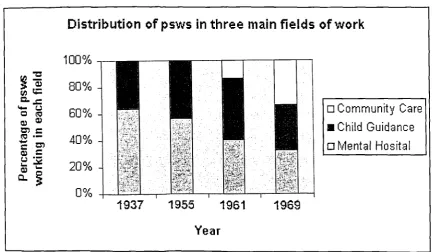
Figure 3: Distribution of PSWs in Three Main Fields of Work, 1937-69. Figures for the years 1937, 1955 and 1961 are drawn from data in N. Timms,
Psychiatric Social Work in Great Britain (1939-1962) (London, 1962),
pp. 69-70. The figures for the year 1969 are drawn from
Acknowledgements
The ideas for this thesis began while I was studying for an MA in the Social History of Medicine at Warwick University, and I would like to thank Hilary Marland and Mathew
Thomson, who supervised both my MA and my PhD theses for their encouragement and
support. I also wish to thank the Arts and Humanities Research Board for providing the
financial support that enabled me undertake the research both for my MA and for this
thesis. A Warwick Humanities Research Centre Doctoral Fellowship also contributed
towards my research costs. My research has been assisted by the helpful archivists and librarians at the University of Warwick Library, the Modem Records Centre at the
University of Warwick, the BBC Written Archives Centre at Caversham, the
Contemporary Medical Archives Centre at the Welicome Library for the History of Medicine in London, the British Library, Birmingham Central and University Libraries
and the Lothian Health Service Archives in Edinburgh. The Research Forum for
postgraduate students has offered support over the last few years, and I'd like to thank
Sheryl Root, Brooke Whitelaw and Dan O'Connor for their encouragement. My friends and family have also offered help and assistance over the past few years, and I'd like to
specially thank Andy for help with my aged computer, my Dad for financial assistance and Harry for the necessary encouragement and support that enabled me to finish my
Declaration of Material Included From a Prior Thesis
Chapters Four and Five of this thesis incorporate small sections of my MA dissertation.
These inclusions have been indicated in the footnotes where they occur. This thesis is my
Abstract
Abbreviations
AGM Annual General Meeting
APSW Association of Psychiatric Social Workers
BBC British Broadcasting Corporation
BJPSW British Journal of Psychiatric Social Work
CGC Child Guidance Clinic
COHSE JMS MACA MHIWU Mirror MPA MRC NAMH NAWU NEC NHS PRS C PSW REA SSCL WAC
Confederation of Health Service Employees Journal of Mental Science
Mental After Care Association
Mental Hospital and Institution Workers' Union Morningside Mirror
Medico-Psychological Association
Modem Records Centre, Warwick University National Association of Mental Health
National Asylum Workers' Union National Executive Council National Health Service
Public Relations Sub-Committee Psychiatric Social Worker Royal Edinburgh Asylum
Changing Public Representations of Mental Illness in Britain, 1870 - 1970
Introduction
1: The Public Sphere, Professionalisation and Mental Health Groups
Speaking to an audience of fellow psychiatrists, John Charles Bucknill mused on the
problem of the public. 'There are two kinds of public opinion', he informed his fellow listeners, 'the one morbid and irrational, the other sound and intelligent. The latter is
based, indeed, upon the efforts made by scientific men themselves to create enlightened
public opinion on this subject." This statement summarises several beliefs frequently expressed by individuals who belonged to mental health groups. First, Bucknill asserted
that public opinion, if left to itself, was morbid and irrational. This situation could only be
remedied if the public submitted to the guidance of professional experts, who were
implicitly not part of the public. Thus, enlightened public opinion was not to be achieved
by open debate and the free and equal exchange of ideas, but through a top down process
of didactic education. A more enlightened public, it was often suggested, would benefit
not just the mentally ill but also those professional groups and organisations whose fate
was intimately bound up with them, which suggests that the motivations of those who
sought to change public opinion should be examined. The quote also suggests a problem
encountered by the historian who attempts to study public representations of mental
illness from the records of professional organisations. What is in fact being represented here is a psychiatrist's opinion about the public, not public opinion.
In this study, I have set out to examine the processes that led to certain ideas
about mental illness being circulated, and whether these ideas can be designated as
public. In part, this study also hopes to examine Habermas' concept of the public sphere through using mental disorder as a case study. 2 Habermas suggests that the growth of
capitalism in the seventeenth and eighteenth centuries led to new forms of domestic
privacy amongst the middle class, enabling new forms of sociability. Within the spheres
of the coffee house or the popular press, private people could debate issues of public interest in an atmosphere of equality, using reasoned, critical debates to settle arguments
in the common interest. The state, in turn, increasingly acted upon the opinions of the
public, formed in this sphere, to legitimate its actions.
However, Habermas suggests that through the course of the nineteenth century, this public sphere paradoxically became eroded as it became more inclusive. The public
became divided and polarised as capital, and subsequently social power, became
concentrated in the hands of a few. Social historian Pat Thane has noted that in the early
years of the twentieth century, 'the practice... of firmly governing an unequal but stable
society through a process of negotiation among the major social factors, by an apparently
2
• Habermas, The Structural Transformation of the Public Sphere (1962, translation by T. Burger 1989,
neutral state means... was under pressure'.3 As the working classes lobbied the state to settle some of these inequalities, the state started to intervene in the affairs of private
people to settle conflicts of interest that grew out of the private sphere. This led to the
emergence of the welfare state. Subsequently, the social sphere became repoliticised as
private institutions assumed a semi-public character. Habermas argues that these changes were accompanied by a shift from a culture debating to a culture consuming society. As
the public and private realms became integrated, the public sphere became redundant.
Institutions that arose from the private sphere, such as special interest associations, and
those that had emerged from the public sphere, such as political parties, began to exercise power in co-operation with the state apparatus. Public opinion, Habermas claimed, was
now brought in only to contribute approval.
Recently, a volume edited by Steve Sturdy has sought to apply the concept of the public sphere to analyse areas of medical history.4 Largely discarding Habermas' concept
of a once unified public sphere that subsequently decayed, Sturdy's contributors chose to
focus upon the institutions around which multiple medical publics developed, rather than
analysing public discourse. Although many of these institutions have since been
privatised, Sturdy argues that the continual formation of local publics, which participate collectively to encourage government activity through both debate and forms of
collective action, discourages the notion that the public have been reduced to passive
P. Thane, 'Government and Society in England and Wales, 1750-1950', in F. M. L. Thomson (ed.), The
Cambridge Social History of Britain 1750-1950 Volume Three: Social Agencies and Institutions
(Cambridge, 1990), pp. 1-6 1. Quoted pp. 60-61.
consumers. 5 'We impoverish our understanding of the public and its functions', Sturdy warns, 'if we confine ourselves to thinking solely in terms of discourse, and thereby
neglect the role of instiutionalized action in the constitution of the public sphere.'6
Through the course of this thesis, I have found Nancy Fraser's reformulation of
the public sphere, in particular her concept of counter-publics, a helpful way to examine
how and why particular ideas were formulated and circulated about mental illness in the
period 1870-1 970. Noting that historically, members of subordinated social groups have found it helpful to constitute their own alternative publics, Fraser developed the concept of 'subaltern counterpublics', parallel discursive arenas that enabled members to
formulate counter identities and discourses. 8 However, in the field of mental health, many
of these alternative publics were often not in open conflict and perhaps are best thought
of as sub- rather than counter-publics (with the exception perhaps of the internal sphere
of the mentally ill discussed in Chapter Five). The concept of a counter-public also suggests the existence of a main public, which seems problematic. Fraser, like other
scholars, has argued persuasively that Habermas' concept of the eighteenth-century
public sphere was from the outset exclusionary and undemocratic, being defined as white,
privileged, and male. She suggests that the participation of sub-publics, far from
Ibid., p. 20.
6 Ibid.
N. Fraser, 'Rethinking the Public Sphere: A Contribution to the Critique of Actually Existing
Democracy', in C. Calhoun (ed.), Habermas and the Public Sphere (1992, Cambridge, Massachusetts,
1999), pp. 109-42.
circumventing the democracy of the public sphere, help to contribute to it by enabling a broader cross section of people to participate in debate. Fraser does, however, note that
such 'counter-publics' were not always democratic, as some operated their own methods
of exclusion. Organisations seemed keener to inculcate correct opinions than to
encourage genuine debate about the issues surrounding mental illness amongst the public. This appears to confirm Habermas' argument regarding the engineering of public consent by the intervention of pressure groups in the media.
These sub-public mental health groups need to be examined against the backdrop of what Harold Perkins has described as the rise of a professional society. 9 He suggests
that the earlier organisation of society around capital and class conflict gave way in the
late-Victorian era to a society structured around career hierarchy and competition for resources between rival occupations with their own interests. Professions emerged which
offered trained, expert, specialised services to society, seeking in return status, income
and authority. As different professional groups competed for public resources, charitable
organisations petitioned the state for funding for deserving causes and trade unions sought to protect their conditions of employment, the state become the mediator for
disputes of interest.' 0 Eliot Freidson's work has examined how occupations sought
security by attempting to gain the support of the state for the right to have their sphere of
work protected from competition." Gaining recognition as a 'profession', Freidson
H. Perkins, The Rise of Professional Society. England Since 1880 (London, 1990). '°Ibid., pp. 1-17.
E. Freidson, 'The Theory of Professions: State of the Art', in R. Dingwafl and P. Lewis (eds), The
argued,
Was important to occupations not only because it was associated with traditional gentry status, but also because its traditional connotations of disinterested
dedication and learning legitimated the effort to gain protection from competition
in the labour market.. .The ideologies of special expertise and moral probity provided by the traditional concept of status profession.. .provided just such a
basis for legitimating protection.'2
Freidson also reminds us that the term profession can be defined and used in a variety of ways by people with different purposes: by occupations which are prestigious and widely
recognised as professions, holding exclusive control over a specific area of work for
example, but also by those occupations which seek to tackle their poor economic conditions and lack of status by describing themselves as professions.' 3 The mental health
occupations in this study need to be considered in light of the interactions between
competing occupations and the state in this period.
This competition was also structured around gendered notions of what constituted
suitable work for women. Charlotte MacKenzie, for example, has examined how the
professionalisation and medicalisation of care of the mentally disordered marginalised female practitioners. By the early twentieth century, Mackenzie argued, 'women had
regained some of the ground lost through professionalisation of the treatment of the
insane. Yet they worked within a profession, and body of psychiatric theory, which had
been constructed by men, and from which it was difficult to deviate at a time when their professional status and respectability were so newly acquired." 4 In her analysis of
American psychiatric practice in the early twentieth century, Elizabeth Lunbeck has
discussed the impact that gender could have on the relative power of different sub-publics.' 5 Not only does Lunbeck describe how the delineation of gender roles fell within
the scope of psychiatry within this period, but she also examines the interactions of
psychiatry with the emerging profession of psychiatric social work, a profession
dominated by women. The gender balance within professions and the struggles that
ensued to maintain these had a significant impact on the types of representations of mental illness that different organisations sought to promote.
2: Government Inquiries into Mental Illness
In Habermas' account, the public sphere in its golden age stood as a counter weight to the
state apparatus, communicating the wishes of the public to the government. Yet, if
Habermas is correct to suggest that increasing state intervention in the lives of its citizens
circumvented the public sphere and gave government institutions a quasi-public
character, perhaps state representations of mental illness should be examined as a form of
public representation. Throughout the period I have chosen to study, the mechanisms for
'' C. MacKenzie, 'Women and Psychiatric Professionalisation, 1780-1914', in London Feminist History
Group, The Sexual Dynamics of History: Men's Power, Women's Resistance (London, 1983), pp. 107-19.
Quoted on p. 119.
' E. Lunbeck, The Psychiatric Persuasion: Knowledge, Gender and Power in Modern America (Princeton,
treating the insane were questioned and revised, through Acts passed in 1890, 1930 and
1959. A brief examination of the reports of government committees in this era points to
the interactions between the government and interested parties, and also suggests that the public, and public opinion, became a more central issue over time when the laws were
examined. However, whom exactly the public were and how their opinion was to be measured was left somewhat vague within the reports.
The 1877 Select Committee Report on the Operation of the Lunacy Law was
concerned primarily with the protection afforded by the legislation against wrongful confinement. In an index to the report, which spanned 117 pages, only two citations were
given for the public, or public opinion. In one of these instances, the Earl of Shaftesbury
attributed the improved quality of many private asylums in part to public opinion:
Public opinion is very much alive to these things.. .It was utterly dead; and even as far back as 1859 people were not easily moved to consider these matters, but of
late years it is astonishing to what an extent they have been inquiring into it. All
that movement acts upon the minds of the superintendents and others...L6
The issue of the public had become more important by the 1926 Report of the Royal
Commission on Lunacy and Mental Disorder, established to enquire into the existing law
and to examine if provision for treatment without certification should be instituted. The
Committee wanted the public to believe that certification was not a source of stigma, but
6
The Earl of Shaftesbury (12 July 1877), British Parliamentary Papers, 1877 [373] XIII, Operation of the
Lunacy Laws: Select Committee Report with Minutes of Evidence, Appendix and Index (1877), paragraph
also felt that the rights of a public should be safeguarded against the potential threat
posed by the mentally ill.' 7 The difficulties experienced by the Committee when trying to
balance patient and public interest resurfaced when the problems posed by the isolation of mental hospitals from the community were examined. While isolation might be
detrimental to patients, it was felt that 'the general public can hardly be expected to visit
these places', and that subsequently, 'mental hospitals can hardly be made more accessible to the public than they are at present'.'8
By the time of the 1957 Report of the Royal Commission on the Law Relating to
Mental Illness and Mental Disorder, the relevance of the issue was posited not on the
conflicting needs of the public and the mentally ill, but the belief that the mentally ill
were part of the general public. 'The proper treatment of people suffering from disorders
of the mind, and any restrictions on the liberty of individual citizens which this may
involve', the report argued, 'are matters of public interest which may at any time become of immediate personal importance to anyone living in this country' In a section entitled
'the public attitude today and our own general approach', the Committee stated their
belief that the public were more knowledgeable about mental illness and were more
sympathetic than they had been in earlier eras, citing the impact of first hand knowledge,
hospital open days, media coverage and popular books on the topic. They still felt,
17
HMSO, Report of the Royal Commission on Lunacy and Mental Disorder [Cmd 27001, (London, 1926),
paragraphs 92 and 168, pp. 43, 88.
18 Ibid., paragraph 185, pp. 97-98.
19
HMSO, Report of the Royal Commission on the Law Relating to Mental illness and Mental Disorder
however, that on some issues prejudice and ignorance continued to predominate,
especially regarding the relationship between crime and mental illness, and also mental deficiency, which was seldom the topic of media coverage. 20 The small place accorded in this thesis to the representation of what was termed mental deficiency derives from the
fact that many people perceived and represented the topic as different from mental
illness. It also reflects the more general avoidance and low status of mental deficiency in this period. Fortunately, this neglect has been addressed by recent literature, as historians
have examined how categories of mental deficiency were constructed, problematised and
visually represented through photography. 2 ' However, it is important to recognise that the
term mental illness is also somewhat problematic, given that other terms with slightly
different meanings such as insanity and lunacy were also in use to varying degrees during
the period under study. The term mental illness represents mental disorder as an illness
amenable to medical management and treatment in a way that insanity and lunacy do not. 22 Thus I am artificially imposing a sense of conformity that did not exist.
20
Ibid., paragraphs 67-73, PP. 22-24.
21
See, for example, M. Thomson, The Problem of Mental Deficiency: Eugenics, Democracy, and Social
Policy in Britain, c. 1870-1959 (Oxford, 1998); M. Jackson, The Borderland of Imbecility: Medicine, Society and the Fabrication of the Feeble Mind in Late Victorian and Edwardian England (Manchester,
2000).
22
As can be seen, for example, in Chapter Six, when the majority of respondents to a BBC questionnaire in
1957 continued to differentiate mental illness from insanity. BBC/WAC T32/846/l The Hurt Mind. BBC,
What these government committees all had in common was their heavy reliance
on the evidence of what might be termed the professions or sub-public groups involved in the mental health field. As the twentieth century drew on, the newly emerging professions and organisations also sought to make their voices heard. The 1877
committee took evidence from psychiatrists and former patients, generally on an
individual basis. By 1926, these two groups also competed with charitable organisations, such as the Mental After Care Association, the Central Association for Mental Welfare
and the National Council for Mental Hygiene. More doctors gave evidence under the
auspices of organisations such as the Medico-Psychological Association, the British
Medical Association and the Mental Hospitals Association, as well as in an individual capacity. The National Asylum Workers' Union submitted evidence on behalf of mental
nurses while former patients were represented by the National Society for Lunacy
Reform. By the 1957 Report, other organisations such as the Association of Psychiatric
Social Workers competed to persuade the Committee to incorporate their views. Thus the reports of successive government committees might be seen as balancing and
adjudicating on the differing and sometimes competing views of an ever increasing
number of specialised organisations and professions, all seeking to persuade the government to protect their views, work and beliefs. Even the Committees were partially
constituted by members of these different organisations. Like Kathleen Jones' work,
which has been structured around the legal changes in the field of mental illness, I could
have planned my thesis around the interactions of different organisations surrounding legal developments. 23 However, I have chosen to focus on specific sub-public
23
organisations to enable me to examine their sphere of influence and work outside of legislation.
3: Representation and Mental Disorder
Previous studies of the representation of mental illness have largely examined how
mental disorder has been depicted visually and fictionally. Sander Gilman, for example,
examined how visual representations of mental illness that focused on distinct types of physical appearance, mannerisms and dress have helped to separate the mentally ill from
the world of the sane observer. 24 These representations, Gilman argued, are projections of
the fear experienced by sane members of society that they too could collapse into
madness. By representing the mentally ill as instantly recognisable and distinct, society is
able to maintain its boundaries between sane and insane. Elaine Showalter, meanwhile,
sought to undertake a feminist history of psychiatry by examining how madness was
represented as a female malady, arguing that to understand psychiatric discourse in the
nineteenth and twentieth centuries, we need consider the broader cultural framework
Century to the 1990s (London, 1993).
24
S. L. Oilman, Disease and Representation: Images of Illness From Madness to AIDS (1988, London,
1994); S. L. Gilman, The Face of Madness: Hugh W. Diamond and the Origins of Psychiatric Photography
(New York, 1976). In a similar vein, Mark Jackson has examined how photography was used to represent
the mentally deficient as visibly distinct, and the social and political purposes this served. See M. Jackson,
'Images of Deviance: Visual Representations of Mental Defectives in Early Twentieth-Century Medical
within which ideas about femininity and insanity were formed. 25 Gilman and Showalter drew their material from the world of fine art, literature and the writings of psychiatrists,
which, while yielding interesting results, focus upon a rather narrow, elite section of
society.
Lindsay Prior's study of the social organisation of mental illness examines the extent to which mental health professionals have been involved in the creation of
representations and the impact these have had on the organisation of mental illness. Prior
argued that representations of mental illness are created by people who have been
involved in describing and treating mental disorder, who in the course of their labours produced beliefs and things such as buildings, disease classifications, textbooks and legal
measures, that defined the nature of mental distress and led to mental illness being
organised in a particular way. 26 These organisational structures then reinforced the
representations that created them in the first place, and helped to define the experience of
being ill. Prior's work provides an interesting way to think about the relationship between representation and the actual system through which mental illness is managed and
experienced. However Prior, who based his work on an examination of professional
25
E. Showalter, The Female Malady: Women, Madness and English Culture, 1830-1980 (1985, London,
2001).
26
L. Prior, The Social Organisation of Mental Illness (London, 1996). Prior defines his use of
representation pp. 5-12 and 193-4. Research on the significance of asylum architecture, one of the 'things'
created by mental health workers which served to define the nature of mental illness, was recently
presented at a conference in Oxford Brookes: 'Space, Psyche and Psychiatry: Mental Health / Illness and
representations, acknowledged that different types of representation might be generated
from other sources, such as the mentally ill and the lay public.
All these works use representation as a term to connote 'an image, likeness or
reproduction of a thing, e.g. a painting or a drawing'. 27 However, my thesis focuses on
two different definitions. As this is a study of public debate and the representation of people's concerns, it will investigate whose interests groups represented when they
created specific images of mental disorder, and whether mental health service users were enabled to represent their own interests without the intervention of a third party. 28 The
thesis also examines representation as 'a statement made by way of allegation or to
convey opinion', by which I shall illustrate how specific groups represented mental
illness to other groups within society, and the motivations that underpinned these
representations. 29 Occupational or professional motivations need to be considered as they
might lead groups to focus on their own personal concerns; at other times individuals
might be motivated by a professional ethic to work for and represent the interests of those
they served. Julian Le Grand has recently suggested that while the welfare state was built on the assumption that the individuals who worked within it were driven by a
professional ethic to serve only the interests of their patients, it was later recognised that
many workers had their own agendas that were sometimes linked to their personal
' This is the second definition of the word 'representation' given in J. Pearsall and B. Trumble (eds), The
Oxford English Reference Dictionary (Oxford 1996). Quoted on p. 1223.
28
This is taken from the first definition of the word 'representation' given in ibid. 'The act or an instance of
representing or being represented'.
29
conditions, and sometimes in opposition to government policy. Later governments have
assumed that workers would be driven essentially by selfish motivations, a view which
may obscure workers' concerns with patient welfare. Assumptions that workers might be
driven solely either by selfish or altruistic motivations, he argues, can be equally
misleading.3°
3.1: Representing Public Representations of Mental Illness?
It became clear to me as I started to research the records of groups involved in mental
health, that all believed in the existence of a public which had definite ideas about the
nature of mental illness. However, it was far less certain where this public could be
located. To complicate matters further, organisations' ideas about who constituted the
public and what the public believed changed over time. 'While I contest the existence of
'the public' as an entity in the period 1870-1970, the sub-public organisations examined
in this thesis were convinced of its existence and wrote frequently about what they
believed the public felt or did regarding mental illness. It is important, however, not to
read these views of the sub-public groups regarding public opinion at face value as
reflections of public opinion.
David Cantor, in an article about the Empire Research Council, focused his
examination not on the public as described by the charity, but on how the charity
30 •
Le Grand, 'So You Think Public Sector Staff are Knights not Knaves? Think Again', Guardian,
perceived and represented the idea of the public. 3 ' Cantor explained how the charity in
the l930s depicted the public as a mass single entity, prone to emotionalism and easily
distracted, who held inaccurate beliefs regarding rheumatic diseases and remained
apathetic about the issue. This image served to define the Empire Research Council in
relation to the emotional, apathetic public as rational, enlightened people who sought to
lead the public and manage their emotions for the general good. The representation of the
public was subject to some modifications in the 1960s, as the decline of large donations
from businessmen led the charity to pitch their fundraising at increasingly differentiated
groups, reconceptualising working-class individuals who donated as rational and
occasionally enlightened. To appeal to a broader base, the charity used statistics to
suggest that everyone was at risk from rheumatic diseases, deploying volunteers and
individuals suffering from the disease to campaign against what they saw as continuing
public ignorance and apathy. The old concept of the public as an undifferentiated mass
gradually gave way to the notion of a community or people who were all potentially at
risk from the disease. However, despite these changes, Cantor argued, the Empire
Research Council continued to talk about the public as a singular category, which
remained ignorant and apathetic, although for a variety of reasons. Cantor reminds us that
the Empire Research Council was only one of many organisations that sought to define
public ignorance and apathy in a style that advanced their own interests, that 'they might
portray themselves as representing the public and its interests, but they also represented
31
D. Cantor, 'Representing "the Public": Medicine, Charity and Emotion in Twentieth-Century Britain', in
their own interests through the public'.32
Perhaps then, this thesis is less a study of public representations, and more a study
of how mental health groups represented public representations of mental illness.
However, as I argue that the public sphere in the era 1870-1970 was largely centred
round such sub—public groups, it is perhaps here that we find the closest thing
approximating to public representations of mental illness. By default, because these
groups had (to varying degrees) the ability and desire to access the media, these
representations of the public were often accepted as public representations of mental
illness. If the sub-public groups examined in this thesis shared the Empire Research
Council's view of the public as ignorant and apathetic, one might expect this to inhibit
their efforts to enable the public to participate. After all, how could ignorant people,
whose reasoning was subject to their emotions, be expected to participate in a rational
critical discussion. Cantor's article also reminds us that the way in which sub-public
groups conceptualised the public might change significantly over time. This could lead to
broader (or indeed narrower) groups of people being judged fit to participate in decisions.
It is also worth considering if, in the field of mental illness, sub-public organisations
slowly began to conceptualise everyone as belonging to a community affected by mental
ill health, rather than seeing the population divided between an enlightened professional
community of mental health workers, the mentally ill, and an ignorant public.
4: Mental Illness and Society, 1870-1970
Reasons for examining the era 1870 to 1970 become more apparent if it is asked whether
it would have been possible to undertake a study into changing public representations of
mental illness in the era 1770 to 1870. Mental disturbance was more likely to be viewed
in this earlier time as a private matter coming under the jurisdiction of families or perhaps local communities rather than a public matter requiring public solutions.33 It could then be argued that a public sphere or sub-public spheres interested in debating mental illness as a
matter of public rather than private concern only arose in the nineteenth century. Indeed,
the term mental illness would be an anachronism if applied back to the era 1770-1870,
when mental disturbance, although still recognised, was not necessarily seen as a condition requiring medical attention. A specialised profession of doctors with expertise
in mental disorders was struggling to be acknowledged as the rightful custodian of the
mad in 1870, let alone in an earlier era. 34 While private mad houses began to emerge in the eighteenth century, 35 treatment within an asylum on the basis that mental disturbance
was an illness amenable to medical intervention only became the primary course of
action in the nineteenth century, when a series of legal measures culminated in the
u For details of systems of pre-asylum care, see G. N. Grob, The Mad Among Us: A History of the Care of
America's Mentally Ill (Cambridge, Massachusetts, 1994), PP. 5-21.
A. Scull, C. MacKenzie and N. Hervey, Masters of Bedlam: The Transformation of the Mad-Doctoring Trade (Chichester, 1996). See Chapter One, 'the Transformation of the Mad-Doctoring Trade', pp. 3-9.
Lunatics Act of 1845 36 The idea of a community of mental patients with a shared
experience of confinement within an asylum that is explored in Chapter Five cannot
really be projected back on to earlier individuals, even if their behaviour did lead them to be controlled.37
Mad people, Andrew Scull argued, were seen in the mid-eighteenth century as
part of a larger group of indigent individuals whose problems could be managed within
family and community settings. By the mid-nineteenth century, he suggested, the mad
had been demarcated, diagnosed and segregated within asylums. 38 This argument has
been moderated by historians who have examined how forms of care in the community persisted throughout the era of the asylum, often made possible by the willingness of
families to provide care.39 However, more individuals would have experienced mental
36 For a thorough account of lunacy legislation in the nineteenth century, Kathleen Jones' work is
particularly helpful. See Jones, Asylums and After.
Allan Ingram's edited volume of four eighteenth-century pamphlets written by individuals who
experienced mental distress suggests that they experienced their mental disturbance differently from
individuals in the nineteenth century. This is discussed in further detail in Chapter Five. A. Ingram (ed.),
Voices of Madness: Four Pamphlets, 1683—i 796 (Stroud, 1997). 38 This is the line of argument put forward in A. Scull, Museums
of Madness: The Social Organisation of Insanity in Nineteenth-Century England (1979, London, 1982). Scull moderated his argument in later
works in light of later research that stressed the continuing importance of family care and intervention. See
A. Scull, Rethinking the History of Asylumdom', in J. Melling and B. Forsythe (eds), Insanity, Institutions
and Society, 1800-1914: A Social History of Madness in Comparative Perspective (London, 1999), pp. 295
-315.
disturbance from within the walls of the asylum, while emerging organisations such as
charities, psychiatric social workers and psychiatric nurses began to supplement familial
provision.
I have chosen to use 1870 as the beginning point of my examination. By 1870,
according to Habermas' account, the public sphere of rational-critical debate had
collapsed. The professionalisation of society was underway and the relationship between
citizen and state was about to undergo major transformations. Medical historians and
sociologists such as Andrew Scull, meanwhile, have argued that the early therapeutic
promise of asylums was being questioned by this time, as psychiatry and the popular
press began to register concern at the growth of insanity and the warehousing of incurable
cases. 4° During the period in which this study takes place, the treatment of the mentally ill
became the domain of growing numbers of professional groups and organisations. 4 ' The
Walls of the Asylum. The History of Care in the Community 1 750-2000 (London, 1999). David Wright has
drawn historians' attention to the role played by families in securing the discharge of their relatives from
asylums and providing care in the nineteenth-century: See D. Wright, 'The Discharge of Pauper Lunatics
from County Asylums in Mid-Victorian England: the Case of Buckinghamshire', in Mefling and Forsythe,
Insanity, Institutions and Society, pp. 93-1 12. Meanwhile, Louise Westwood's research suggested that
forms of non-institutional care continued to be pioneered in the first half of the twentieth century,
particularly for cases labelled as borderline or mentally defective: L. Westwood, 'Avoiding the Asylum:
Pioneering Work in Mental Health Care, 1890-1939' (PhD thesis, Sussex University, 1999)
40
Scull, Museums of Madness, pp. 186-253.
41
For an account of twentieth-century developments within the mental health services, see Jones, Asylums
and After. Phil Fennell has also analysed developments in psychiatry in the twentieth century from the
management of public asylums, which had initially fallen under the control of local
authorities, was later redesignated a concern of the Ministry of Health and was
transferred to the National Health Service (hereafter NHS). Many psychiatrists sought a
closer alignment to general medicine, seeking to assimilate their work by developing
physical methods of treatment. Other psychiatrists drew on psychoanalytical ideas to
explain and treat mental disturbance. Moreover, the focus began to shift from the
mentally ill treated within the asylum to efforts to improve the mental health of the
general population. In the work of child guidance, psychiatric social work, social
psychiatry and anti-psychiatry, professionals began to turn their attention from the
disturbed individual to their familial and social networks.
My examination ends in 1970, as the system of hospital care and treatment was on
the decline and new ways of managing the mentally disordered were being implemented.
Thus, my study takes place against the backdrop of the asylum, although the thesis
explores the ideas of groups situated outside as well as inside the asylum. This era also
Consent. Law Psychiatry and the Treatment of Mentally Disordered People Since 1845 (1996, London,
2001). Edward Shorter's account discusses the new treatments developed by psychiatrists through the
nineteenth and twentieth centuries: see E. Shorter, A History of Psychiatry: From the Era of the Asylum to the Age of Prozac (New York, 1997). Several essays in Bartlett and Wright (eds) Outside the Walls of the Asylum discuss the development of community care in Britain and the impact it had for different groups of
patients. For an account of developments within asylums, and the effects these had on patients and staff,
see D. Gittins, Madness in its Place: Narratives of Severalls Hospital, 1913-1997 (London, 1998). A comparative analysis of post war British and Netherlands developments in the fields of mental health,
psychiatry and anti-psychiatry can be found in M. Gijswijt-Hofstra and R. Porter (eds), Cultures of
falls within the period examined by Showalter, enabling me to explore her contention that mental illness was represented as a feminine disorder. The changes in the representation
of the mentally ill which took place once the process of hospital closure was underway
would perhaps require a thesis in themselves. Moreover, some useful work on the representation of mental health service users in the post-asylum era and the impact these
representations have had on users, their families and service providers has already been
undertaken. Peter Barham has illustrated that the shift from institutional to community
care has not been accompanied by a shift in the status of mental health service users from patient to citizen.42 Indeed, the shift from hospital to community care, Matt Muijen has
argued, was accompanied by a shift from stories of the abuse suffered by patients in
institutions to stories of the violence perpetrated by such users once in the community.43
Media representations of people affected by mental illness as violent in the 1 990s
have been examined by Greg Philo and other researchers in the Glasgow media group, who noted that such depictions were highly compelling and had a negative impact on
users, who experienced ostracisation as a result. The Glasgow group also noted that
mental health service users continued to experience difficulties in gaining access to the
media in order to represent themselves.44 Sarah Payne, meanwhile, has argued that
government policy regarding people affected by mental disorder has been shaped in
recent times not by perceptions of the needs of the mentally ill but by perceptions of the
42
P. Barham, Closing the Asylum. The Mental Patient in Modern Society (London, 1997).
'13
M. Muijen, 'Scare in the Community: Britain in Moral Panic', in T. Hefler, J. Reynolds, R. Gomm, R.
Muston and S. Pattison (eds), Mental Health Matters: A Reader (London, 1996), pp. 143-55.
risk posed by such individuals to the community. Thus, young men are more likely to be
referred to hospital-based psychiatric services while women were more likely to be the recipients of community based services. 45 As risk management became the primary
concern of government policy, Trevor Turner argues, the private madhouse re-emerged
as the (expensive) solution to contain dangerous people in the absence of the asylum.46
The representation of the mentally ill as violent and disturbed - and usually male - is not, however, an entirely post 1970 phenomena, as is suggested in this thesis.
5: Organisation and Objectives
Starting from the perspective that in the late nineteenth and twentieth centuries, the public
sphere if it existed at all was constituted in multiple publics, I have chosen to base my
thesis around an examination of several sub-public groups who were involved in the
mental health system, to see what kinds of representations of mental illness they sought
to promote and why. This thesis has drawn mainly on English records, although records from Scotland have been studied where relevant. 47 By focussing on several groups, I hope
to show the diversity of representations which circulated at any given moment, the
S. Payne, 'Outside the Walls of the Asylum? Psychiatric Treatment in the 1980s and 1990s', in Bartlett
and Wright, Outside the Walls of the Asylum, pp. 244-65.
46
T. Turner, 'The Return of the Private Madhouse: The Rise and Fall of Community Care in Britain over
the Last 50 Years', paper given at the Anglo-Dutch-German Workshop, 'Social Psychiatry and Ambulant
Care in the Twentieth Century', 4-6 July, 2002.
' For a recent analysis of care for the mentally ill in Wales, see P. Michael, Care and Treatment of the
interrelationships between the groups and the impact this had on representations of
mental illness, and the reasons for the varying success different groups achieved when
trying to promote their views. The representations that circulated at any particular time
were linked to the given situation within the mental health field. In a series of recent
articles, Nick Crossley has sought to explain how change within the field of mental health
occurred. Crossley has examined three different phases within the post-war mental health
movements: the development of the National Association for Mental Health (hereafter
NAMH), the growth of the anti-psychiatry movement and the emergence of the mental
health user movements.48 Crossley argued that these movements emerged in specific
contexts, altering and developing in relation to broader social structures and changes,
often as a legacy having changed the mental health services or created the intellectual
space for a later movement to develop. Drawing on Pierre Bourdieu's work on social
movements, Crossley argued that mental health movements fought their battles in a
number of different fields - psychiatry, law, parliament and media - in order to achieve
their goals. Mental health movements, Crossley argued, might have the skills required to
play the game in one field, but not another. Crossley also applied Bourdieu's notion of
symbolic violence - the ability of one group to impose ideas upon another without
discussion, by grounding their arguments in indisputable fact. For Crossley, the varying
levels of social power wielded by mental health movements, or the sub-public groups,
48
N. Crossley, 'Transforming the Mental Health Field: The Early History of the National Association for
Mental Health', Sociology of Health and Illness, 20 (1998), pp. 458-88; N. Crossley, 'R. D. Laing and the
British Anti-Psychiatry Movement: A Socio-Historical Analysis', Social Science and Medicine, 47 (1998),
pp. 877-89; N. Crossley, 'Fish, Field, Habitus and Madness: The First Wave Mental Health Users
who sought to achieve their goals, circumvented the democratic potential of full
participation and debate.
This study could have been expanded enormously by a consideration of more
sub-public groups, such as the Board of Control, psychologists, or the National Council for
Lunacy Reform. However, I have chosen to focus in this study not on the totality of
representations that circulated about mental illness, but why a select group of
organisations, chosen as case studies, might have sought to promote a particular
representation, and the factors that could have aided or impeded the wider diffusion of
these representations. Some organisations, such as the National Council for Lunacy
Reform, were ruled out because the remaining records were insufficient to shed light on
the motivations that led them to represent mental illness in a particular fashion. Other
organisations, which would have made interesting case studies, have been left out
because they were already the subject of existing research and considerations of space
limited what could be examined.49
My examination begins within the space of the asylum and gradually disperses
outwards towards the more general community, the people most likely to be viewed by
the sub-public groups as the general public. The thesis commences by examining
For example, Nicholas Hervey's Phi) thesis has examined the motivations and beliefs that under laid the
actions of the Board of Control. See N. Hervey, 'The Lunacy Commission 1845-60: With Special
Reference to the Implementation of Policy in Kent and Surrey' (PhD thesis, University of Bristol, 1987).
Surviving organisational records for The National Society for Lunacy Reform, an organisation that
psychiatrists, the group whom historians have examined most frequently with regard to
the public, and also the group who achieved most recognition as a profession. The
research for the first chapter has been based upon the Journal of Mental Science,
established by the Medico-Psychological Association to represent the interests of
psychiatrists. I have also examined how individual psychiatrists sought to promote their
own interests to a public audience in popular books. Psychiatry was a largely
male-dominated occupation, which based its demands for a protected sphere of work on its
claims to a specific, medically based knowledge, and frequently sought to expand its
sphere of influence. Even so, as we shall see in Chapter One, they habitually encountered
opposition and challenges that blocked their ambitions from other groups within society.
In the second Chapter, I consider the representations of mental illness put forward by the
National Asylum Workers' Union (hereafter NAWU). 5° Mental nursing has been
examined in a few books, although these works had the aim of filling a gap in the
historiography rather than relating the occupations to any broader issues. 51 I have used
both the NAWU Magazine, a publication largely intended for union members, and
internal records of the organisation, to describe the representations of mental illness put
forward, and whose interests they represented. This organisation represented an
occupation that was often split between its female and male members, which vacillated
° Subsequently becoming the Mental Hospital and Institutional Worker's Union (hereafter MHIWU) in
1931, and later the Confederation of Health Service Employees (hereafter COHSE) in 1946, following a
merger with the Hospital and Welfare Services Union.
P. Nolan, A History of Mental Health Nursing (London, 1993). A different approach is adopted by Mick
Carpenter, who examined the unionisation of psychiatric nurses: M. Carpenter, Workingfor Health: The
between promoting itself as a nursing profession or the keepers of dangerous inmates,
that sometimes empathised and promoted the interests of the patients, but at other times
focused solely on its economic concerns. Attendants, or nurses as they were later known,
had to bargain from the position of a low status, insecure and stigmatising occupation.
Psychiatric social workers (hereafter PSWs), the subject of my third chapter, had
more of a claim to expert knowledge and professional status than psychiatric nurses, and
forged a link between the patient in hospital and the broader community. 52 I have
compared the ideas about mental illness and its treatment that they expressed in their
journal, the British Journal of Psychiatric Social Work, with the difficulties experienced by their Public Relations Sub-Committee in sharing their ideas with the public. Arguably
they may have been hindered in their professional aims by the predominantly female.
composition of their occupation. In Chapter Four, the representations emanating from a
charity, the MACA, are examined. The internal records of the MACA have been studied
so that the diverse motivations generated by the disparate membership of the charity
might be taken into account. I have also considered the particular remit of this
organisation and what concerns might have prompted the charity's particular
representations of mental illness as put forward in their promotional and public literature.
The representations of mental disorder advanced by mental health service users
are considered in Chapter Five. The Morningside Mirror, a newspaper largely written by
52
An outline of the development of the occupation can be found in N. Timms, Psychiatric Social Work in
patients at the Morningside Asylum in Edinburgh, was compared to retrospectively
written published accounts by former asylum patients to illustrate how questions of
audience, identity, health service care structure and the purpose of narrative all interacted
to affect the types of stories users might tell about their experiences. I had initially
planned to include a chapter on representations of mental illness that had occurred in the
general, non-specialised press. However, as the research progressed, it appeared that
many mental health stories that emerged in the general media in fact sprang from
interested sub-public organisations that sought to by-pass any genuine debate by
appealing directly to the government for action under the guise of public opinion. These
stories are discussed in the chapters dealing with the sub-public groups, as they illustrate
the operations and impacts of these organisations. Instead, I turn in Chapter Six to
consider what factors underpinned the BBC coverage (or non-coverage) of mental health
issues, by examining the BBC written archives. This chapter also examined the
substantial impact that some sub-public groups could have on BBC coverage, such as the
NAMH and psychiatry, while other groups, such as PSWs, had less power to get their
opinion transmitted. It is hoped that by examining these different sub-public groups, the
reasons why particular representations of mental illness were generated and circulated
Chapter One: Psychiatry and the Medico-Psychological Association
1: Introduction
Historians writing about psychiatry in this era tend to depict it as the profession most able
to define ideas about mental disorder in the public mind. Thus Andrew Scull, Charlotte
MacKenzie and Nicholas Hervey argued that by 1900, psychiatrists had
Successfully constituted themselves as the public arbiters of mental disorder, the
experts in its diagnosis and disposal. They created a professional organisation to
defend and advance their interests and edited journals and wrote monographs to
provide a forum for transmitting (and giving visible evidence of) the body of
expert knowledge to which they laid claim. During Victoria's long reign, they
increasingly dominated public discourse about insanity.1
German Berrios and Hugh Freeman have also argued that the Medico-Psychological
Association (hereafter the MPA) was an influential voice in the nineteenth-century debate
regarding mental illness, acting as a broker between popular and official sentiments. 2 It is
important to recognise, however, that psychiatry faced constraints from both within and
outside the profession when it attempted to popularise its views. These constraints will be
explored in this chapter.
A. Scull, C. MacKenzie and N. Hervey, Masters of Bedlam: The Transformation of the Mad-Doctoring Trade (Princeton, 1996). Quoted on p. 7.
2
This chapter will examine the type of forum the MPA provided for a public
debate about the nature of mental illness, a subject that can only be understood if
psychiatrists' perceptions of the public are considered. It is thus necessary to examine
what views psychiatrists believed the public harboured about the profession and the
mentally ill, and whether efforts were made to destigmatise mental illness, or psychiatry;
in other words, to explore whether the MPA sought to represent their own interests or
those of the mentally ill. To examine the success of the MPA as a sub-public sphere with
democratic potential, the chapter will also ask if the MPA sought to create an open debate
with the public, where individuals could participate on an equal footing, and if not, to
suggest what factors inhibited the MPA. The chapter will examine the role that
psychiatrists believed the public could play in mental health and whether the MPA hoped
to rouse public opinion to lobby for reform. The activities of the MPA will then be
compared with the records of individual psychiatrists to see if their efforts to monitor and
exploit the media for their own ends evolved from a belief that the MPA had failed to
communicate with the public. This section will examine how the public were depicted,
whose interests the individual psychiatrists sought to represent in their activities, and
what role they envisaged for the public. In addition to works by Montagu Lomax and R.
D. Laing that urged the public to challenge the psychiatric establishment, 3 this section
R. D. Laing, The Divided Self (1960, reprinted with new preface, 1965, London); M. Lomax, The
Experiences of an Asylum Doctor: With Suggestions for Asylum and Lunacy Law Reform (London, 1921).
The impact of Lomax's book is described in K. Jones, Asylums and Afler: A Revised History of the Mental
Health Services: From the Early J8th Century to the 1990s (London, 1993), pp. 128-30. Laing's influence on the anti-psychiatry movement is described in D. Tantam, 'R. D. Laing and Anti-Psychiatry', in I-i.
will also consider some of the less controversial books published in England in the 1950s
and I 960s, which sought to reassure their readers about the nature of mental illness.4
These books were specifically written and published for the general public, with the aim of describing what mental illness was and how the psychiatric profession sought to treat it.
2: A Brief History of Psychiatric Organisations in Britain
The first professional association of psychiatrists, the Association of Medical Officers of
Asylums for the Insane, was formed in 1841, becoming the MPA in 1865. In 1926, the
MPA became the Royal Medico-Psychological Association, finally becoming the Royal College of Psychiatrists in 1971 6 The question of membership was raised as early as
P. Hays, New Horizons in Psychiatry (1964, London, 1967); D. Stafford—Clarke, Psychiatry To-day
(1952, London, 1963); H. Yellowlees, To Define True Madness: Commonsense Psychi atly for Lay People (1953, London, 1955).
For a detailed account of the establishment of the Association of Medical Officers of Asylums and
Hospitals for the Insane, and its transformation into the MPA, see E. Renvoize, 'The Association of
Medical Officers of Asylums and Hospitals for the Insane, the Medico-Psychological Association, and their
Presidents', in Berrios and Freeman (eds), 150 Years of British Psychiatry, pp. 29-78. 6
To simplify matters, the MPA/RIvIPA has been referred to throughout this chapter as the MPA as the
change in title does not appear to have marked a radical transformation of the organisation. The
transformation from the RMPA to the Royal College was not easy, as John Howells, who helped establish
the College and has since written about his experiences, discovered. The Royal College of Physicians
claimed to represent all doctors, including psychiatrists, and thus did not see the need for a Royal College
1871 when propositions put forward at the general meeting sought to challenge the
existing regulations that limited membership to those practising psychiatry. J. Batty
Tuke's proposition would have enabled non-specialist medical practitioners, legal
practitioners and possibly even the lay public to join the MPA. Tuke hoped his motion
would challenge the stigma attached to the treatment of mental illness within asylums and
establish support for psychiatry amongst the general medical profession
By increasing our membership from the ranks of the medical public, we should
secure most important sympathy and co-operation in our work, and by drawing
towards us members of the general public, we would help to dissipate the
superstitions which still hang about lunacy and lunatic asylums. Through the
influence of our Journal, we would diffuse a knowledge of the dire diseases we
are called on specially to treat.7
Tuke's proposition to widen membership and increase interaction with the public sphere
was rejected by the AGM.
The Asylum Journal of Mental Science (hereafter the JMS) was established in
1853. Its functions were twofold. On the one hand, the JMS was envisaged as a forum for the debate and exchange of ideas within a dispersed profession: 'a medium for the
the stigma still attached to the mentally ill, which was projected onto the psychiatrist by association. See J.
G. Howells, 'The Establishment of the Royal College of Psychiatrists' in Berrios and Freeman (eds), 150
Years of British Psychiatry, pp. 117-34. '
'Proceedings of the 26th AGM of the MPA', Journal of Mental Science (hereafter the JMS), 17 (1871-72),
publication of its results, for the interchange of thought amongst those engaged in it'.8
Simultaneously, the JMS was thought to communicate the ideas of the profession to a
wider audience, to 'make an otherwise clapperless bell articulate'.9 However, despite
these ideals, which conformed to Nancy Fraser's ideal of a sub-public sphere,'° debate
often took second place to a didactic defence of psychiatric practice. Editors of the JMS
often believed they should use their position to protect the profession from unjust
criticism. In 1878, Thomas Clouston claimed 'the JMS would fail in its duty to the
members of the MPA, and to the public, were it not to defend these great hospitals,
provided by the charity of the nation, from charges calculated to do them and their
unfortunate inmates great harm in the eyes of the public'." Clouston was referring to
evidence given by Harrington Tuke, himself President of the MPA in 1873, to the Dilwyn
Committee in which Tuke had claimed the rate of recovery was much better in private
than public asylums. The JMS had struck back by pointing to a suicide and the low rates
of recovery in Tuke's own private asylum. This illustrates well that, in its early years, the
8
j Crichton-Brown, 'Presidential Address', JMS, 24 (1878-79), PP. 350-72. Quoted on p. 369.
D. Hack Tuke, 'Presidential Address', JMS, 27 (188 1-82), PP. 305-42. Quoted on p. 342.
10
See N. Fraser, 'Rethinking the Public Sphere: A Contribution to the Critique of Actually Existing
Democracy', in C. Calhoun (ed.), Habermas and the Public Sphere (Cambridge, Massachusetts, 1999), Pp.
109-42. Sub-public spheres on the one hand 'function as spaces of withdrawal and regroupment; on the
other hand, they also function as bases and training grounds for agitational activities directed towards wider
publics'. Quoted on P. 124. The idea of the sub-public sphere is discussed in the introduction.
T. Clouston, open letter in reply to Han-ington Tuke's complaints that the JMS had dealt unfairly with the
JMS was just as often a site of inter-professional strife as a united voice for professional development, a fact noted by Crichton-Brown in his presidential address of 1878.
Our speciality has been in the din of battle from its beginnings. It has had to
protect itself against assailants on all hands. Beset by jealousy and suspicion from
without, and perturbed by internecine feuds, it has had to fight out the great
battles of non-restraint, of moral treatment and of medical supremacy.'2
Crichton-Brown was echoing the pleas of Thomas Lawes Rogers, President in
1874, who told fellow members that 'isolated more or less as we are, often viewed with
unfriendly eyes by the public, and criticised by hostile press, there is more necessity for
unity amongst ourselves. Let there be no jealousy between ourselves'.' 3 This correlates
well with Trevor Turner's research on the public profile of the MPA between 1851 and
1914. Turner depicted an association with no clear role, laden with stigma and in constant
danger of being swallowed up or rendered irrelevant by the British Medical Association,
which had its own psychological section. Examining the criticism emanating from within
the profession, Turner concluded that up until 1914, the MPA was 'an introverted body,
whose members only gave it partial allegiance'.' 4 Faced with internal dispute and
overshadowed by more traditional and respectable organisations, Turner argued that the
MPA played no role as an association in campaigning on issues such as alcoholism. In his
view, the MPA failed to enter into a public debate or adopt a reformist approach.
12
Crichton-Brown, 'Presidential Address', p. 350.
T. L. Rogers, 'Presidential Address', JMS, 20 (1874-75), pp. 337-51. Quoted on p.351.
' T. Turner, "Not Worth Powder and Shot": The Public Profile of the Medico-Psychological Association,