Competition only an
Innovation away?!
- a data-driven approach
Katharina Elisabeth Lange
s1730827
Bachelor Thesis
06
thof July 2017
Faculty of Behavioural, Management and Social
Science (BMS)
Supervisors: Dr. Victoria Daskalova LL.M. Dr. Paul Benneworth
European Public Administration (Joint Degree Track) Faculty of Behavioural, Management and Social Science University of Twente
ABSTRACT
Increasing parts of the everyday lives of many people are determined by data-driven innovations and the service improvements they provide. This generates a great power to the leading innovators. A power stretching from the influence over the consumers’ lives to determining the market structures. Especially fast growing markets like the data-driven one are determined by competition and innovations driving each another. This necessitates a protection of both, the level of competition and the innovative potential. Yet, the question arising in this context is whether there are effective regulations to sufficiently support the potential for data-driven innovations.
This question leads to the research question of the thesis, discussing the possible influence of competition law on data-driven innovations.
Locating the setting within the Federal Republic of Germany, the thesis examines the existing academic literature as well as the present domestic and European Union’s legislations. The results of the apart examination are combined in the analysis, to predict the influence of competition law on data-driven innovations.
This combination delivers a clear conclusion to the research question – by appropriately applying the present legislation, the competition authorities can have an at least preservative, if not positive influence on data-driven innovations.
Table of Contents
ABSTRACT ... i
I List of Graphs ... iv
II List of Figures ... iv
III List of Abbreviations ... iv
1. Introduction ... 1
2. Theory ... 4
2.1 Innovations ... 4
2.1.1 Drivers of Innovations ... 5
2.1.2 Barriers of Innovations ... 8
2.1.3 Graphical Summary ... 11
2.1.4 Regulation and Innovation ... 12
2.1.4.1 Ex-Ante vs. Ex-Post Regulation ... 12
2.1.4.2 Aspects determining the Influence between Regulation and Innovation ... 13
2.1.4.3 Standardisation as a type of Regulation... 15
2.1.4.4 Overview of the Relationship between Competition Regulation and Innovation ... 15
2.2 Data-driven Innovations ... 16
2.2.1 Drivers and Barriers of data-driven Innovations ... 16
2.2.1.1 Essential Feature: Data & Technical Know-How ... 17
2.2.1.2 Entry Barriers as Barriers of data-driven Innovations ... 17
2.2.1.3 Special Role for Start-Ups ... 18
2.2.2 Summary ... 18
2.3 Summary and Graphical Framework ... 18
3. Data and Documents – The Methodology ... 20
3.1 Competition Law ... 20
3.2 Data-driven Innovations ... 21
3.3 Influence of Competition Law on data-driven Innovations ... 22
3.4 Data and Documents ... 23
3.5 Limitations ... 23
4. Analysis ... 25
4.1 Legal Framework ... 25
4.1.1 European Level Framework ... 25
4.2 Merger Control ... 27
4.2.1 Distribution of Competences ... 27
4.2.2 General Indications for the Influence of Merger Control on data-driven Innovations ... 28
4.2.2.1 Relation of Consumer Benefits identified by the Union and data-driven Innovations... 28
4.2.2.2 Influence of further Factors identified by the BKartA on data-driven Innovations ... 28
4.2.2.3 Summary ... 29
4.2.3 Influence of the Prevention Tool of Merger Control on data-driven Innovations ... 30
4.2.3.1 Impact of considered Harms to Competition on data-driven Innovations ... 30
4.2.3.2 Influence of enhanced Entry Barriers on data-driven Innovations ... 35
4.2.3.3 Results... 38
4.2.4 Influence of the Commitment Tool on data-driven Innovations ... 39
4.2.4.1 Influence of Divestments on data-driven Innovations ... 40
4.2.4.2 Influence of the Removal of Links with Competitors on data-driven Innovations ... 42
4.2.4.3 Influence of Market Access and other behavioural Remedies on data-driven Innovations ... 42
4.2.4.4 Influence of Ancillary Measures on data-driven Innovation ... 44
4.2.4.5 Results... 45
4.2.5 The Influence of Merger Control on data-driven Innovations... 46
5. Discussion ... 47
5.1 Information added to existing Knowledge on the Topic ... 47
5.2 Implications for further Research ... 48
6. Conclusion ... 50
I List of Graphs
Graph 1:
Illustration of the relationship between the intensity of competition and the
incentives for innovations (illustrating the work of Aghion et al. (2002))
... 6
II List of Figures
Figure 1:
Graphical illustration of the drivers of innovations
... 7
Figure 2:
Graphical illustration of the barriers of innovations
... 10
Figure 3:
Graphical illustration of the factors influencing the innovative potential
... 11
Figure 4:
Influence of regulation on innovation (illustrating the work by Pelkman & Renda,
2014)
... 15
Figure 5:
Overall Graphical Framework
... 19
III List of Abbreviations
BKartA Bundeskartellamt
EU European Union
GWB Gesetz gegen Wettbewerbsbeschränkungen TEU Treaty on European Union
1. Introduction
The data-driven industry has experienced a great rise in importance over the last decade, with Google, Facebook and smartphones conquering and increasingly determining our world. The industry is fast growing and at the same time seems to be ever changing with innovations popping up daily. Innovations aimed at making life better and easier – today we are able to video-call people via Skype, message them on WhatsApp or write a tweet to let the world know how we are feeling. Yet, data driven innovations are not limited to social networking systems or consumer communication services - it includes a wide variety of services, comprising online maps, search engines, mobile applications and many others. However, in the last years the matter of innovation seems to be limited to a small number of competitors outpacing the rest of the industry. Once a small, uprising, novel start-up succeeds in gaining attention and competitive potential with an innovative idea, their services are soon copied by the big companies or their businesses are acquired by the market leaders (Pontius, 2017).
Such phenomena are in large parts due to the prevailing power of the leading companies and the high concentration of the essential facility of the market, i.e. the data. This market structure allows great advantages to the big companies, which leaves the smaller, uprising businesses at a greatly disadvantaged position (Argenton & Prüfer, 2012). Yet, the unequal distribution of access to data only constitutes a starting point that leads to many other connected disadvantages in the long-run.
The heroes of our times are no longer movie stars or politicians, but more increasingly the college drop-outs Bill Gates, Steve Jobs, Larry Page or Mark Zuckerberg. Many young people strive to become the newest member to this enumeration with their start-ups and novel, innovative ideas. Yet, they face great barriers, erected by their heroes. While some find their services copied and implemented into the services of the big ones, others are faced with acquisition offers hard to reject (Pontius, 2017). Moreover, many companies are shut-down soon after a merger, with only the innovative ideas and engineers recruited by the buying companies (Shontell, 2011). Many of those young people end-up finding themselves stuck in lost promises of a world-wide-web, acquired and robbed of their ideas by the leading companies – their heroes and role-models.
Plus, the mentioned persons are not only the heroes of our times, but have also managed to gain more and more influence over our lives in general. The recently published 2017 Forbes List on the world’s most powerful people does not only list politicians and federal reserve bank chairs as the ten most
influential people, but seat number 7, 8 and 10 are reserved for Bill Gates (Microsoft), Larry Page (Google) and Mark Zuckerberg (Facebook) (Forbes Media LLC, 2017).
attention by presenting their newest innovation (cf. Case COMP/M.7217, 2014). Innovations aimed at making our lives better and easier.
This constitutes a relevance for social science to investigate the happenings. On the one hand the overwhelming influence and powerful position of companies like Facebook are greatly discussed in the public discourse. Yet, on the other hand about 1,65 Billion people world-wide use Facebook and more than 3 trillion search request we placed on Google in 2016 (Roth, 2016; Statista, 2017), which makes them and their potential for data-driven innovations a great part of our everyday-lives. This combined forms an even greater demand for social science to investigate the influences possible.
Nevertheless, the authorities have practiced a rather hands-off approach towards the data-driven processes and innovations. For years, the only company that has exceedingly been faced with major competition investigations has been Microsoft. Since 2010, Google has become the target of investigations by the European Union, with the first decision been failed only recently. Facebook on the other hand is only now appearing on the radars of the competition authorities – suggesting the demand for legal control on the actions of the companies (Weber, 2013).
The need for regulations and control is given, it only requires investigations into which legislations are present and whether those are sufficient to turn the current trends into a desirable direction. Especially the described uncompetitive behaviour and acquisitions naturally call upon competition law as a promising tool for such a control. Not only merger control constitutes a great aspect of competition legislation, but also consumer protection plays a great role for the competition authorities. Among others, consumer protection involves the preservation of innovations. Innovations constitute an important contribution to public welfare, leading to their protection and fostering by the competition authorities. Correspondingly, competition law could be a tool to stop the far-reaching practice of the mentioned companies and thereby enhance the innovative potential of the market to ensure the steady increase of public welfare. It also requires investigations into the driving forces behind those life-improving innovations and whether the mentioned practices hinder data-driven innovations or support them.
Therefore, there is the necessity to examine the possibilities competition law can have and whether their present tools are sufficient to influence and stabilise these improvements for social welfare, i.e. the data-driven innovations.
Research Question
The overarching, predictive research question of this thesis is:
In what way can competition law affect the data-driven innovations?
The answering of such a complex question requires various sub-questions, that define the variables and their interrelations. Therefore, the following sub-questions are included in order to find a profound answer to the research question.
1. What are data-driven innovations? – This first sub-questions should deliver a definition about
the dependent variable of this research and illuminate the major requirements and essential facilities for data-driven innovations.
2. What are the drivers of driven innovations? – In order to analyse the influence on data-driven innovations, one has to determine the general influences on data-data-driven innovations. This question should provide an overview of those aspects that enhance data-driven innovations and create an environment of intensive innovative potential.
3. What are the barriers of data-driven innovations? – When looking at those factors enhancing innovations and the developments, one also needs to look into the other side, i.e. the barriers to innovation. This question is included to deliver an overview on the factors hindering the potential for data-driven innovations.
4. What is the present competition law, especially concerning merger control? – This question specifies the independent variable of this research and illustrates the tools of competition law for the authorities to apply.
5. What is the influence of the identified tools of merger control on the drivers and barriers of
data-driven innovations? – This final sub-question creates the link between the previous four
questions and thereby deliver results that allow for the answering of the overarching research question.
2. Theory
The following section will scrutinise and present the existing academic literature on the topic of the research question. In doing so, the thesis will evaluate the academic landscape concerning innovations, their drivers and barriers as well as the influence of regulation in this sector. The assessed concepts are chosen as they present the basic concepts of the research question and therefore require examination prior to the analysis. Accordingly, this section should therefore not only outline definitions, but also present he components of investigation in the analysis. Combining those two aspects, the section will conclude with presenting the graphical framework of the thesis, which will include the relevant concepts discussed.
The selection of articles and studies is based on their relevance to the thesis, which includes their content but also the reputation of their authors in the field of research as well as the importance of the theories presented in the articles.
2.1 Innovations
Before discussing the factors that influence innovations, one has to start with defining what innovations themselves are. Deriving from the Latin word ‘innovare’, the verb ‘to innovate’ literally means ‘to make new’(Oxford Dictionary, 2017).
Starting with this general explanation, academic literature furthermore defines innovations as “the creation of new (or the efficient reallocation of existing) resources, which contribute to progress” (Pelkmans & Renda, 2014 p. 2). However, to be considered an innovation instead of a simple modernisation or invention, innovations also need to constitute a long-term improvement for social welfare and not deprive resources that could have been used more efficiently elsewhere. Furthermore, in an economic setting they need to have market relevance and market acceptance – the higher a given item or feature scores on those aspects, the more likely it is to be called an innovation (Kusiak, 2009). This addition identifies the demand and satisfaction of customers’ needs as the most important driver of innovations. Yet companies have to balance the needs to fulfil those needs and adapt to the market environment in order to meet the innovative potential (Kusiak, 2009).
much higher than the ones of the incremental innovations. These, in turn, are described as ‘follow-ons’, which rather deliver small improvements to the status quo (Pelkmans & Renda, 2014 p. 2).
This general definition of innovations should provide the basis for the upcoming sections. The importance of variance among innovations should have become apparent and is of great consideration when following the upcoming sections – being an overview of the various drivers and barriers of innovations, as well as the influence of regulation on the latter.
2.1.1 Drivers of Innovations
One of the factors in this context named frequently across the academic literature and economic theories is capital or financial capacity. Investments in research and development (R&D) provide the basis for innovations in many companies, which accordingly require a certain amount of monetary resources to be allocated to this department. Expanding on this idea, Austrian economist Schumpeter created the equation that the more financial resources a company has, the more it is able to invest in R&D and is therefore able to make use of its innovative potential (Blind, 2011).This is in accordance with the findings of Pelkmans & Renda (2014), which define availability of funds as one of the main drivers of innovation. In their article they have also identified appropriation as another important driver. The more demand there is for innovations, the more likely companies are to engage in the process. Concurring with Motta (2004, p. 64) the authors also mention legal protection and patent law in this context, as a way to solve potential issues. They highlight the importance of these factors in this context, as there would be no incentives for a company to innovate if its competitors can easily copy and simultaneously apply its innovative ideas. However, there is no consistent picture regarding patents as innovation drivers across the academic literature. While the mentioned two studies consider them important, Blind (2011) has a more nuanced view on the topic. He highlights the positive influence of weaker protection regulations, as those might encourage diffusion and variety. Those aspects can also lead to innovations. A way out of this dilemma is considered to be an appropriate implementation of patent law according to the demands of the market (Blind, 2011, p. 394).
firms are facing, being competitive on different markets with different demands. Especially export activities on the European market seem to have a positive influence on the innovative potential (Blind et al., 2016). Having defined export activities as a driver in more detail, one arrives at demand and competition as the essential factors in this context. Considering demand, this is also in line with the research done by Kusiak (2009), who considers customers’ needs and demands as a major incentive to innovate. An examination of the demand is presented as essential, yet unsatisfactory if considered as the only source of evaluation.
When discussing competition as an incentive for innovation, we arrive at one of the most discussed topics in the literature and one with great importance to this thesis. Being the main focus of the thesis, the influence of competition on innovations needs to be carefully examined. Following the earlier mentioned theory of Schumpeter, innovations are considered a way of ‘creative destruction’ (Kusiak, 2009). They are used to reach market dominance, which makes competition not necessarily an incentive for innovation but more the strive to become the dominant undertaking. The example given in the literature is Polaroid, which managed to emerge as a leading company for instant photography but lost its status due to the rising innovations in the photography industry (Kusiak, 2009). Focusing a little more on Schumpeter, he did not only present the theory about creative destruction, but directed most of his work towards the role of monopolies and arrived at the conclusion that not competition but monopoly is the driver of innovations. His conclusions reveal that monopoly power increases the R&D efforts much more than competition does. However, other authors presented competition as one of the main incentives to innovate (D’Este, Iammarino, Savona, von Tunzelmann, 2011). This lead Aghion, Bloom, Blundell, Griffith & Howitt, P. (2002) to investigate the relationship of competition and innovation in more detail. They concluded their investigations with an inverted u-shape to best describe the relationship between the intensity of competition and the incentives for companies to invest in innovations.
Consequently, the
environment best suited for an innovation requires a certain level of competition and market power, yet no monopolies or too dominant market position.
in ce nt iv es f o r in no v ati o ns
intensity of competition
Inverted u-shape relationship between the intensity of competition and the incentives for innovations
Controversially, this equation only works if the market power derives from innovative activities – this reveals the possibilities of innovations for the others companies on the market (Kusiak, 2009; Motta, 2004, p. 57).
Graphical Display
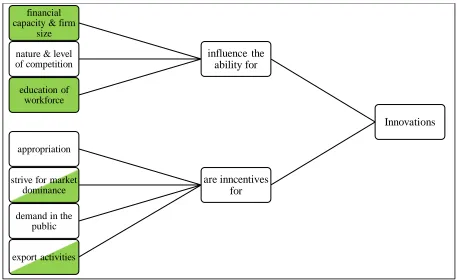
[image:12.595.68.525.326.606.2]The figure included should summarise the aspects mentioned in the section above. As some aspects influence the ability to innovate and some present incentives to innovate, the aspects are differentiated accordingly. Another categorisation possible is the level on which they influence innovations, being either the company specific one of a general market influence. The attached colour reveals the respective level of influence, i.e. green for company specific and white for market. Half coloured boxes indicate that the aspects can be considered market and company level influences1 at the same time.
Figure 1: Graphical illustration of the drivers of innovations
1 ‚Strive to market dominance’ can be considered a company specific incentive, yet it is highly dependent on the level of
competition, which is a market factor. ‚Export activities’ of an individual company can increase the incentives for this company to innovate – usually however the entire market is involved in such activities, therefore it can also be considered a market level
Innovations influence the
ability for
financial capacity & firm
size
nature & level of competition
education of workforce
are inncentives for
appropriation
strive for market dominance
demand in the public
2.1.2 Barriers of Innovations
As the end of the previous section has hinted at, there are not only drivers to innovation but also barriers decreasing the innovative potential of a particular company or market.
When discussing these barriers, one finds various distinctions in theories and the academic literature. One has to differentiate between intrinsic, company-specific, and general market factors; another distinction has to be made between revealing and deterring barriers to innovations. The latter distinction marks the difference between those barriers which ‘reveal themselves’ during the process of innovating to companies engaged in the process, and those which ‘deter’ companies from engaging in the process in the first place.
Considering revealing barriers, the more a company is involved in innovating, the more it is faced with such barriers and the more it pays attention to them. The barriers represent problems, which are not effectively encountered until firms face them (D’Este, et al., 2011, p. 483) during the process. Therefore, the more a company is involved in the process of innovating, the more it is likely to face them. Such barriers tend to slow the process but usually do not stop companies from engaging in such activities. They are more likely to be considered mistakes to learn from (D’Este et al., 2011). Allowing for this disclosing and learning effect, such barriers rather present obstacles companies are able to overcome but not hindrances that influence the ability to innovate. The barriers can be company-specific as well as general market factors, depending on the situation in which they occur (D’Este, et al., 2011, p. 486f.). As the attribute assigned to the second type already indicates, deterring barriers are those that prevent companies from engaging in innovating at all (D’Este et al., 2011).
Having explained this distinction in more detail, there is also the distinction to be made amongst barriers that affect large, established firms and those that tend to impact smaller, new firms. Obstacles that the former are most likely to face are ‘path-dependency’ and ‘lock in’ (D’Este, et al., 2011, p. 484). Loosely based on the saying ‘never change a winning horse’, both of these barriers lead to a reluctance to innovate as the status quo is considered a fair, efficient way of running things. For many of the established organisations processes become routines, which are difficult to be changed. Also, those routines hinder the employees from thinking outside of the box in order to identify new chances for an increased efficiency in the first place. Furthermore, those established companies weigh the efficiency improvements against the cost of innovating, where the latter factor is usually higher (D’Este et al., 2011, p. 484). Many organisations are therefore ‘locked into’ their routines and hardly deviate from their paths.
yet is lacking the financial means that bigger and more established competitors have. Likewise, expertise and knowledge are needed during the phase of implementing an innovation, where newer companies might run into problems due to a lack of experience.
Market structure instead concerns the idea of competition, firm size, and appropriation conditions as specific barriers (D’Este et al., 2011, p. 484; Pelkmans & Renda, 2014). Many of those market structure obstacles are not easily feasible for new enterprises and therefore provide a great barrier to innovations for them. This is the point where competition and competition regulations become important again. Having mentioned them as a driver, it can also be barrier to innovation. Following the outlined argumentation, the settings of rather large, competitive markets in general are the hardest to adapt to and innovate within (D’Este, et al, 2011, p. 484). Those obstacles “present reasons for withdrawal and failure without learning” (D’Este, et al., 2011, p. 487) for many of the new enterprises.
Dwelling a little more on the issue of competition, one has to refer back to the theories mentioned under 2.2. While creative destruction can be a driver of innovation for one company, it is also likely to be a barrier for others on the market to engage in innovations, as it can lead to anti-competitive innovations. While aiming at becoming a market leader can be a great incentive to innovate for many companies, failure or being outcompeted generates frustration and discouragement for others (Kusiak, 2009). Once being successful with an innovation and having gained the market power, companies are tempted to imply measures preserving this market power. Such measures can be anti-competitive innovation. Those include placing new products on the market which do not improve a previous one but are purely aimed at depriving market shares from competitors, by this also enhancing the entry barriers for others. Such actions can take various shapes, such as new products where the consumer cannot differentiate between the technologies at hand or where a dominant undertaking on an upstream market uses its power to influence the competition and promote its own services on a downstream market. Possible influencing factors in those cases are especially licensing and interoperability (Devlin & Jacobs, 2012).
Another aspect identifiable as barriers to innovations are market response and risks. Many companies refrain from innovating because they are afraid to miss the demand of the market and therefore fail with their innovation (D’Este et al., 2011).
Concluding, there are various aspects influencing and hindering the innovative potential of a company or market. The similarity between some of the drivers and barriers can be explained by the extent to which they are present.
Graphical Display
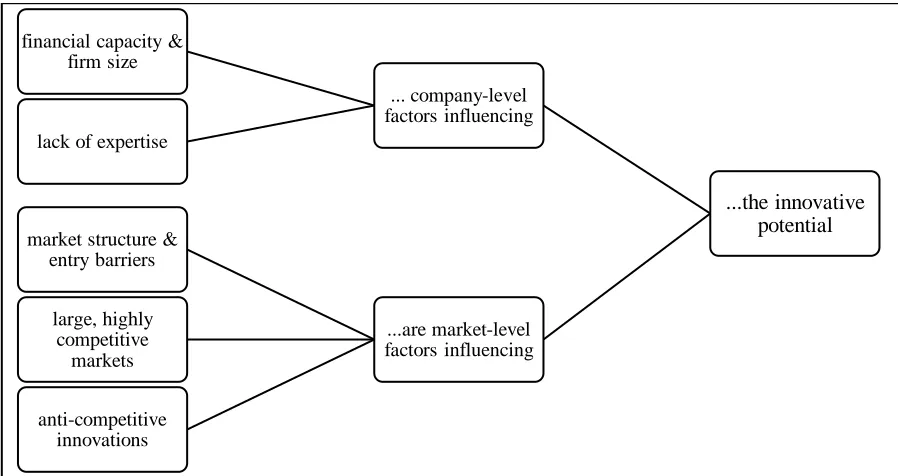
[image:15.595.70.519.278.516.2]This figure should again present a summary, yet this time to illustrate the barriers of innovations. Similar to the graph presented in section 2.2., the factors hindering innovations are categorised according to the level of their influence. A differentiation between incentives and ability is not included.
Figure 2: Graphical illustration of the barriers of innovations
...the innovative potential
... company-level factors influencing financial capacity &
firm size
lack of expertise
...are market-level factors influencing market structure &
entry barriers
large, highly competitive
markets
2.1.3 Graphical Summary
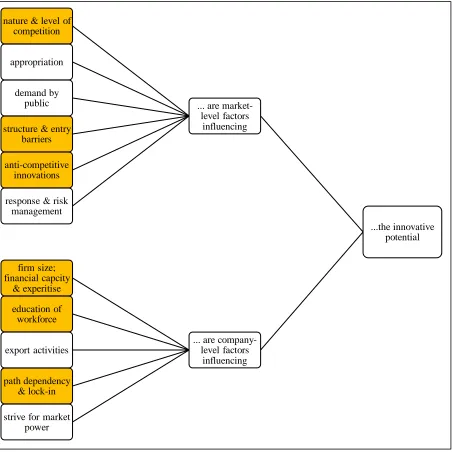
[image:16.595.74.526.283.736.2]This figure should illustrate the various possible influences on innovations identified in the previous two sections, i.e. the drivers and barriers. The influences are again differentiated according to their level of influence. The attached colour indicates, whether the factor can be considered an incentive to innovate or rather influences the ability to innovate. As the two previous graphs and sections have shown, it is not always easy to clearly categorise influences as either barriers or drivers of innovations. In order to avoid too many considerations in the graph and avoid the problematic categorisation into driver or barriers, the graph only includes the mentioned differentiations into levels as well as incentive and ability as a second criterion.
Figure 3: Graphical illustration of the factors influencing the innovative potential
...the innovative potential ... are
market-level factors influencing nature & level of
competition
appropriation
demand by public
structure & entry barriers
anti-competitive innovations
response & risk management
... are company-level factors
influencing firm size;
financial capcity & experitise
education of workforce
export activities
path dependency & lock-in
2.1.4 Regulation and Innovation
As the previous chapters have already alluded to and discussed, regulations can be drivers as well as barriers to data-driven innovations (Blind, 2011; Motta, 2004; Pelkmans & Renda, 2014). Considering that this thesis is precisely concerned with predicting the effect of competition regulation on innovation, this specific sub-chapter will discuss the relationship between regulation on the one hand and innovation on the other in more depth.
Which kind of influence it will have depends ultimately on the type of regulation as well as on its implementation, as this final part will uncover. A well designed regulation can increase the incentives to innovate, as it encourages changes or demands adaptions in order to meet its requirements (Blind et al., 2016). Yet, compliance with the legal framework can also constitute a burden in terms of innovation. Taxation for example draws monetary resources that could have otherwise been invested in R&D (Blind et al., 2016).
2.1.4.1 Ex-Ante vs. Ex-Post Regulation
When assessing the relationship between regulations and innovations, one has to pay attention to the differentiation between ex-ante and ex-post efficiency and regulations (Motta, 2004). Governments usually have to evaluate their interests, whether to enhance innovations in ex-ante regulations and their goal of enriching society through the availability of such innovations to everyone through ex-post regulations. To generate innovations in less innovative markets, law-makers employ regulations in order to increase the innovative potential. Such regulations are usually connected to advantages for innovative firms, such as funding or legal protection. As those regulations are employed to get companies engaged in the innovative process and therefore before the innovations have actually taken place, they are considered to increase the ex-ante efficiency (Motta, 2004, p. 65). The advantages granted in the regulations however might hinder the sharing of the innovations and therefore hinder the greatest possible increase of public welfare. The most common example for ex-ante regulations enhancing innovations are patents, as they grant the innovative companies exclusive rights to produce and distribute their innovations. However, exclusivity is usually connected with high demand and low competition, leading to price increases. Another problem arising is a possible incompatibility with competitors’ products, which demands the users to buy whole product lines from a single producer, further decreasing competition.
changes for their own benefit (Motta, 2004, p. 65). The increase of the ex-post efficiency therefore creates problems of its own. On the whole, it leaves one with the conclusion that regulations effecting the ex-ante efficiency often increase the innovative potential and can be considered a driver, while targeting the ex-post efficiency bares the risk of generating disincentives to innovate.
2.1.4.2 Aspects determining the Influence between Regulation and Innovation
Pelkmans and Renda (2014) have investigated the influence of regulation on innovation to a great extent and have identified five different aspects of regulation, which determine the relationship.
1 Administrative regulation
The first one they discuss are administrative regulations, which are largely considered as burdensome. Especially the creation of red-tape takes up a lot of resources and time that could have been used more effectively elsewhere. Such regulations also intensify entry barriers. If new companies are faced with too great amounts of administrative work, they might lose interest to further develop their idea and see red-tape as too great of a burden to deal with (Pelkmans & Renda, 2014).
2 Compliance
As mentioned above, a regulation can be an encouragement to innovate, if it demands changes from the companies in their working-processes or outputs in order to comply with the requirements of the regulation. However, if the requirements are too high it can erect entry barriers and or even force competitors out of the market because they cannot meet the requirements. This in turn will obviously decrease the innovative potential of the market (Pelkmans & Renda, 2014).
3 Timing
4 Flexibility
The fourth characteristic identified is flexibility, which when used right can increase the potential of the market but also kill the alternatives if applied imperfectly. Outcome-based, flexible regulations tend to increase the innovative potential of the companies as it requires them to come up with their individual ideas to meet a target set by the government or authorities. This usually enhances the creativity of the companies. Too strict regulations in turn destroy alternatives and therefore hinder innovations from developing (Pelkmans & Renda, 2014).
5 Uncertainty
The final characteristic identified by the authors is legal uncertainty. Uncertainty can enhance the creativity of companies, as the introduction of innovative practices can be a way to prevent further regulations by the governments. However, long-term developments need a fixed and stable regulatory framework to advance (Pelkmans & Renda, 2014).
Summary
Figure 4: Influence of regulation on innovation (illustrating the work by Pelkman & Renda, 2014)
2.1.4.3 Standardisation as a type of Regulation
Another aspect of regulation is standardisation, which is discussed to a great extent in Blind et al. (2016). Publically demanded or privately initiated, a self-regulation of the market in general seems to erect lower barriers than its top-down governmental regulation-counterpart. However, especially with standardisation one has to keep in mind influences such as regulatory capture and asymmetry. Standards are usually highly influenced by the leading companies and will therefore rather benefit them instead of the smaller ones (Blind et al., 2016). Another thing to consider in this regard is that such standards might also destroy alternatives if they are set to early or lead toward disruptive innovations, which do not increase the public welfare but rather damage it (Pelkmans & Renda, 2014).
Summing up, this overview presents the mentioned ambiguity, whether regulations are drivers of or barriers to innovations. A way out seems to be the close and extensive examination of the context in which a specific regulation is to be placed in order to avoid the creation of barriers.
2.1.4.4 Overview of the Relationship between Competition Regulation and Innovation
be innovation-encouraging, policies need to aim at creating the “‘right’ level of competition” (Motta, 2004, p.57), which are hard to generate and implement. At the same time, they are needed as “competition enhancing and securing policies increase incentives for companies to invest in innovation” (Blind et al., 2016, p. 393). Therefore, the need to pay special attention to the context might even be of greater important when it comes to competition policies than when considering the general relationship of regulations and innovations.
2.2 Data-driven Innovations
One of the major disruptive innovation was placed with the internet and the possibility to use data to provide services and target the public’s needs. Since then data-driven innovations have played a major role and have become one the driving forces of the economies in the twenty-first century (OECD, 2015). Such innovations distinguish themselves from others through the use of data, generated mainly through information and communication technologies. The need for data has since generated an exceptional increase in data collection and the persistent power of analytics is by now available not only to the big players but also to small and medium sized enterprises. By extracting value from information and being able to process this information, companies across various sectors have become involved in the technological development and have used the generation and collection of data to improve their respective services and products (OECD, 2015). The most prominent examples are internet companies such as Facebook or Google, yet also companies from the ‘offline-world’ such as sports goods producer Adidas have presented innovations involving the usage of data.
Coming from this development, the OECD has settled with the following definition for data-driven innovations: “[D]ata-driven innovations refer to the [usage] of data and analytics to improve or foster new products, processes, organisational methods and markets” (OECD, 2015).
2.2.1 Drivers and Barriers of data-driven Innovations
data-driven innovations, the following aspects are mainly theorised from the previous sections and various articles relating to the data-driven market in general.
2.2.1.1 Essential Feature: Data & Technical Know-How
The most obvious aspect of consideration for the innovative potential on the data-driven market is the access to its essential feature, namely the data: Simply put, in order to generate innovations, one needs to have access to data (OECD, 2014; OECD, 2015). Yet, the access to data requires the free flow of data on the internet and therefore incentives for consumers to share information (OECD, 2014, p. 42). The free flow of data and access to data therefore most prominently determine the ability of a company to engage in the development of data-driven innovations. Furthermore, factors such as technical expertise and know-how of how to effectively use the acquired data, influence the ability in the next steps. This includes for example the development of efficient algorithms for search engines or the ability to integrate information gained with the help of the data into the functioning of a company’s service (OECD, 2014). This, in turn, requires greater financial capacities for development and construction of those abilities as well as the training of the employees (Weber, 2013).
2.2.1.2 Entry Barriers as Barriers of data-driven Innovations
All of these aspects combined create relatively high entry barriers into the data-driven market, which are further increased by other tendencies. Those tendencies mainly hinder the free flow of data on the market, especially between companies, such as single-homing in some segments of the market and network effects (Gebicka & Heinemann, 2014). This includes factors such as data-portability and switching-costs (Weber, 2013; Yoo, 2012), which are greatly discussed in the academic literature applied in this thesis2 and highly influential for the market and new, potential competitors. Another aspect with great influence is the fact that many of the data-driven services are free of charge. While other markets are determined by price competition the data-driven market mainly focuses on quality and features, requiring the companies to invest more into research and development to keep up with ongoing innovations. Competition on the data-driven market is therefore driven by innovations and the other way around, making the combination an essential feature of the market (Weber, 2013). This feature also calls upon patents and intellectual property rights to regulate the innovations. Yet another aspect considering the ability to innovate and to meet the demands generated in the public are the organisational changes required to create innovative ideas, which are comparable to the barriers defined above as locked-in (OECD, 2014).
2.2.1.3 Special Role for Start-Ups
A factor requiring a little more attention as well as a slightly different approach from the one above is company size: While innovations in general are more likely to be implemented by the bigger companies, data-driven innovations sometimes require smaller firms. Start-ups are usually much more agile and flexible concerning demands formulated in the public. This characteristic allows them to react faster and present better fitted innovations to satisfy public needs than larger companies. Start-ups and not necessarily the big companies are therefore a driver of data-driven innovation (Kusiak, 2009; OECD, 2014).
2.2.2 Summary
This section should have highlighted the specific influences impacting data-driven innovations. Some aspects identified show great correspondence with the ones acknowledged in the previous section. However, there are some specifications feasible for data-driven innovations, which need to be taken into account.
2.3 Summary and Graphical Framework
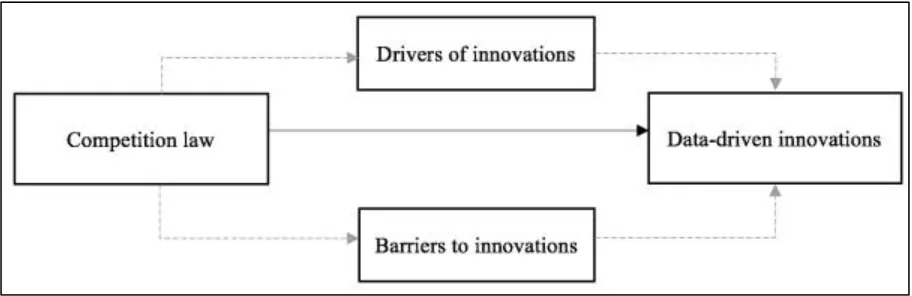
Summing up, this chapter has attempted to provide an overview of the most influential drivers of and barriers to innovations identified in the academic literature. As the research topic of this thesis discusses the influence of competition law, special attention needs to be paid to this facet. Discussing the influence of competition legislation on data-driven innovations, one needs to investigate the various influences of competition in the first place, including the types of competition which include among other economic and product competition. The latter has been identified as an inverted-u shape, which allows for the conclusion of a positive relationship between (‘a right level’) competition and innovations. Yet, the research question of this thesis discusses the influence of competition law and not competition itself, calling for the importance of section 2.4. Having presented the overview of the general influence of regulation on innovation and of competition regulation more specifically, one can draw an ambivalent conclusion. The nature of the relationship highly depends on the context and implementation of the regulation. To draw a profound conclusion about this nature will be the core feature of the analysis. Therefore, this section will end with the following graphical framework.
evaluate this overall influence, by determining the extent to which competition legislation can enhance the drivers and demolish the barriers at the same time.
3. Data and Documents – The Methodology
In order to conduct a reasonable analysis and find profound answers to the earlier proposed research and sub-questions, the variables of the research need to be fully defined. This includes limiting the concepts to those aspects needed for the thesis. The following chapter will do precisely this limitation of the variables at hand, being competition legislation and data-driven innovations.
3.1 Competition Law
Before going into detail on how to the variable of competition regulation is measured in this thesis, a little more specified conceptualisation is required.
The variable has two decisive limitations in this thesis, the first concerns the setting of the thesis and the second the type of competition regulations examined in this thesis.
Setting of the Thesis
The setting of the thesis is limited to the Federal Republic of Germany. The selection for this setting has various reasons. On the one hand the convergence of German Legislation with the superior, supranational European Law, which allows for a narrow but at the same time broad, international examination of the topic. This should provide the analysis with an extensive set of regulations and legislations concerning prohibited practices and interventions. On the other hand, the selection is highly influenced by the relative proactiveness of the country in the field of competition law and especially when tackling the new, upcoming issue of data-driven innovations. Facebook provides one of the recent examples of companies from the data-driven industry which are facing investigations in Germany.
Type of Legislation examined
Competition legislation comprises the various types of regulations and tools. The aspect of closer consideration in this thesis is merger control. The limitation of the concept to merger control also has its reasons.
The first reasons to settle for merger control is the ex-ante approach of the instruments. While others only come into the picture once the harm is already caused in order to repair damages and limit the extent of future ones, does merger control act before any harms is done. The authorities debate and investigate possible harms to competition before the merger has taken place. This approach allows for a prevention of harms in the first place.
happenings and take actions – if only the direct clearance without any further investigations. This also allows the authorities take an active role.
This active role marks the third reason. The possibility of taking this active role in the merger process provides a much greater regulatory function for the authorities than their other instruments. Furthermore, the focus of the investigations and allowance of commitments, especially their extent, offers the authorities the possibility to actively regulate the market and implement policies and structures they consider important and efficiency enhancing. The other instruments of competition law, as mentioned, are more concerned with restoring a previous order than implementing new concepts.
The academic literature also provides various reasons for an in-depth investigation of merger control. One is the definition of comprehensive practices as the way to the future for the data-driven industry (cf. Weber, 2013). This rises the importance of merger control as a tool for intervention. Another reason is the problematic concentration arising by the many acquisitions taking place on the market. This further strengthens the role of merger control as an important tool, which requires in-depth analysis concerning its influence.
Operationalisation
Having made and defined the necessarily limitation for the concept of competition legislation, this section should also give insights into how the thesis has operationalised competition regulation or merger control, to measure their influence on data-driven innovations.
The legislation is made measureable by considering the tools of merger control available to the authorities – the prevention tool and the commitment tool. Those involve the various aspects, such as an investigation of the harms of competition caused by merger or market structures. A closer definition of the concepts will be made in the analysis.
3.2 Data-driven Innovations
Another limitation to be included at this point is limiting the wide scope of data-driven innovations. Data-driven innovations nowadays are developed and launched by a great variety of companies, which are part of the online and offline world. Due to time and capacity issues, the investigations have been limited to mainly data-driven innovations taking place on the online-markets.
Accordingly, data-driven innovations are operationalised as the likelihood of market access, the conditions of start-ups, the extent of data-accumulation, access to essential facilities, which include data and technologies, and the level of competition.
3.3 Influence of Competition Law on data-driven Innovations
As the previous section of this chapter and also the graphical framework in section 2.2 haven given away, the influence of competition regulation on data-drive innovations will be measured by applying the tools of merger control on the drivers and barriers of data-driven innovations. As the thesis is conducted as a desk-based, predictive research, the influence is not measured via a regression analysis or by running interviews and surveys. However, the analysis is conducted by creating a theoretical connection between the tools of merger control and the drivers and barriers identified in the theory chapter (2). The analysis flows along the lines of the guidelines of the authorities on the application of the tools of merger control and thereby examines the theoretical influence of those on the drivers and barriers of data-driven innovations. In doing so, the thesis identifies the explicit tools and aspects of merger control and how those can have an impact on data-driven innovations. Especially the prevention tool is specified as harms caused by merger to the current state of the market and the entry barriers. This requires the analysis to examine the influence of those harms on the potential for data-driven innovations and to conclude with an evaluation, whether the harms caused by mergers consider the influences on data-driven innovations. The results of those evaluations allow for a prediction, whether the reasons to prevent a merger consider the potential for data-driven innovations and therefore can have an influence on data-driven innovations by preventing merger – essentially, whether the tools of merger control theoretically consider the innovative potential sufficiently. The same procedure is done for the commitment tool, considering the extent to which the allowed commitments are able to sufficiently remedy the harms to potential for data-driven innovations. Thereby the thesis can constitute the theoretical influence of the commitment tool on data-driven innovations.
This combined allows for profound predictions on the theoretical influences of competition law on data-driven innovations.
3.4 Data and Documents
The data and documents needed for thesis are those that constitute the legal framework and those that reveal the drivers and barriers of competition law.
This includes, on the one hand, the available law of both levels of legislation, i.e. the EU and German levels ones. Those are found in the treaties of the European Union and in the German ‘Gesetz gegen Wettbewerbsbeschränkungen’ ( GWB)3. However, also further leading guidelines and guidance papers are of consideration, that define the application of the identified legislation. Those provide detailed information about the approach of the authorities towards merger cases. This delivers the basic structure of the analysis, as mentioned in the previous section (3.3).
On the other hand, the academic literature plays an important role. This includes the wide landscape of articles and books on both variable, the drivers and barriers of data-driven innovations and on possible influence of competition regulation on data-driven innovations. Most of the academic literature has already been used to establish the theoretical framework and is re-applied in the analysis, but also further leading articles are included at the analysis stage to underline the argumentation concerning the influence of merger tools on data-driven innovations.
Of further consideration are also official publications and previous merger decisions. Those provide additional information about the variables and their interplay. Especially merger decisions reveal the structure of the decision-making process and provide definitions used by the authorities. However, the thesis is mainly of predictive, theoretical character, which sets the focus more on the legislation than on past decisions.
Those documents combined allow for a profound analysis and thereby to draw profound conclusions to answer the research question.
3.5 Limitations
Every study has its limitations that hinder the answering of the research question to a full extent – and this thesis is no exception to the rule. Even though trying to rule out and decrease them to a minimum, some limitations have remained.
A first limitation to the profoundness of the conclusion drawn arises from the limitations made concerning the variable of competition legislation. Out of the various tools of competition law, only merger control is considered in depth in this thesis, making the results only fully applicable to cases involving merger control. The other tools might have different influences as well as different extents to which they can influence the potential for data-driven innovations.
Hence, the predictions drawn for the influence of competition regulation regulations on data-driven innovations are limited to merger control.
However, those predictions are further limited by the theoretical, predictive character of the thesis and its research question. The thesis only examines the possible, theoretical influences, yet lacks an evaluation of the practical approaches taken by the authorities. As theory and practices do not always necessarily go hand-in-hand, but might differentiate to great extent on the various aspects, the results of this thesis are limited to their theoretical applicability and do not necessarily hold in the same extent for actual influences on data-driven innovations.
Furthermore, the thesis only considers the legal framework, present academic literature and official reports on the topic and does not collect further information through surveys or interviews. This limits the analysis to the information already available and bears the threat of on the one hand omitting articles of importance due to time capacities and on the other hand omitting aspects of great influence due to a lack of mentioning the considered literature. This combined can lead to an over- or underestimation of important aspects. Those aspects can include influences on the potential for data-driven innovations, i.e. an important driver or barriers, or an aspect of merger control, which influences the applicability of the identified tools. Such an omission and therefore over- or underestimation could sufficiently alter or even distort the conclusion drawn in this thesis.
4. Analysis
Referring back to the research question and sub-questions proposed earlier, two of the sub-questions have been answered in the theory section. This requires the analysis to answer the missing two questions in order to answer the overarching research question concerning the influence of competition regulation on data-driven innovations. Accordingly, the analysis will define the legal framework of competition regulations applicable in this thesis and examine the influence of those regulations defined on the drivers and barriers of data-driven innovations.
4.1 Legal Framework
Before going into depth with answering the research questions, one needs to define the applicable legal framework of competition. As the setting of the thesis evolves around the Federal Republic of Germany, the legal framework of consideration for this thesis consists of the domestic level as well as the hierarchically superior supranational European Union law.
The upcoming section will provide the general overview of the legislation and applicable guidelines and regulations on how to apply the legislation. This will deliver the definition of the tools of competition law and merger control in particular.
4.1.1 European Level Framework
Starting with the hierarchically higher, supranational framework, the primary sources to consider are the articles of the treaties of the European Union – ‘Treaty on the European Union’ (henceforth TEU) and the ‘Treaty on the Functioning of the European Union’ (henceforth TFEU). The article of consideration from the TEU is Article 3(3) TEU, which discusses the creation of an internal market characterised by competition and promotion of advances. It highlights the necessity of competition on the internal market of the Union and the concurrent importance of innovations and their fostering. Article 3(1)(b) TFEU is in line with this description and spells out the “establishing of the competition rules necessary for the functioning of the internal market” (TFEU, 2007)4. Those provide the general provisions defining the importance of competition within the internal market. The more specific regulations concerning the preservation and impediments of competition are laid out in Articles 101 and 102 TFEU. While Article 101 deliberates the influence of cartel offences, 102 TFEU considers the abuse of dominant market positions. The latter will be the main focus of this thesis, as it delineates distinctive actions incompatible with the internal market due to market powers deemed too high.
The more defined approaches of the Union against such actions and to prevent them in the first place are laid out in the regulations of the European Council. The first regulation to consider is Council Regulation (EC) No 1/2003 of December 16, 2002, defining the approaches towards the abuse of dominant positions. The other regulation of consideration is Council Regulation (EC) 139/2004 of January 20, 2004, which discusses the control of concentration within the Union and how the obtainment of dominant positions can be prevented in the first place. Both regulations were implemented before the signing of the Lisbon treaty and therefore refer to Articles 81 and 82 EC, which are direct predecessors of Articles 101 and 102 TFEU and therefore continued in their applicability. These articles and regulations mentioned define the four types of tools applicable by the Union – merger control, behavioural remedies structural remedies and fines. As laid out in the third chapter, the control of concentration will be the focus of this thesis.
Given this limitation, Commission Regulation (EC) No 802/2004 of April 2004 also on the implementation of the Merger Regulation, and the Guidelines on the assessment of horizontal mergers under the Council Regulation on the control of concentrations between undertakings of 2004 are of
importance. Those guidelines and notices define the impacts of mergers and how merger control can prevent market dominance or comparable harmful effects on competition. In doing so, they define the tools of merger control, being the prevention of a merger primarily and commitments to remedies harms preventing a merger clearance.
4.1.2 German Level Framework
Having defined the legal framework regarding competition law within the European Union, the same is necessary for the Federal Republic of Germany. The German competition law can be found in the ‘Gesetz gegen Wettbewerbsbeschränkungen’ (henceforce GWB)5. Paragraphs 18-20 GWB discuss dominant positions and prohibited practices concerning such undertakings. The general tools to terminate such practices are laid out in Paragraph 32, allowing for any “necessary conduct-related or structural remedies” considered appropriate (GWB, P. 32). These are comparable to the behavioural and structural remedies identified in the European framework. The further application of those remedies are discussed in Paragraphs 32a to 34 GWB. The German Act against Restraints on Competition also considers merger control and administrative fines as appropriate tools to prevent or hinder abuses of dominance. Merger control is discussed in detail in the seventh chapter of the legislation, especially in Paragraphs 36 and 37 GWB, and the according fines in Paragraph 81 GWB. The Bundeskartellamt, as an independent federal agency for competition issues, is responsible for investigations and the implementation of guidelines on how to asses any impediments or concentrations in the market.
The mentioned focus on merger control also has the Leitfaden zur Marktbeherrschung in der Fusionskontrolle6 of March, 2012 as well as the Guidance of Remedies in Merger Control of May, 2017
as part of the legal framework in question. Both documents discuss the possible influences that concentrations can have on the domestic market, and how those can be targeted. Again, the same tools of merger control can be identified as for the European Framework, however a more detailed guideline on the commitments is available on this level of legislation.
All mentioned articles, paragraphs, and regulations provide the legal framework for and define the tools of competition law. They will be investigated in the following analysis.
4.2 Merger Control
As stated above, mergers and joint ventures have been identified as the way to the future for the online
and data-driven businesses (Weber, 2013). Such projections call upon authorities to carefully examine
the influence of concentration control on the data-driven market and how it can prevent any harm to
competition and in the long-run also on data-driven innovations.
4.2.1 Distribution of Competences
Depending on the dimension of the merging companies’ turnover, a merger needs to be announced either to the European Commission or the national competition authorities. Generally speaking, those concentrations, where the combined aggregated worldwide turnover is more than EUR 5 000 million and the aggregated turnover of each party is higher than EUR 250 million within the Union, are considered to have a community dimension and can be assessed under EU law (Merger Regulation, Art. 1, 2004). There are a few other scenarios where a merger can reach community dimension laid out in Art. 1 (3) of the Merger Regulation (2004), yet the mentioned conditions above are the most applicable ones. Any other merger needs to be assessed under domestic legislation or passes without investigations due to the low potential of impact.
4.2.2 General Indications for the Influence of Merger Control on data-driven Innovations
Most mergers, no matter if they occur on European or on German level, are cleared by the authorities and only a few out of many are investigated and even fewer are rejected. Those rejected are considered problematic because they would impose serious threats to competition and allow for too powerful market positions. As a result, competition authorities essentially investigate the extent to which the market power of the merging parties is increased, up to a dominant market position (Bundeskartellamt, 2014). Hence, “a concentration shall be deemed to arise where a change of control on a lasting basis” occurs (Merger Regulation, Art. 3, 2004). Any changes in the control7 leading towards more market dominance tend to harm effective competition and therefore lower consumer benefits.
4.2.2.1 Relation of Consumer Benefits identified by the Union and data-driven Innovations
Benefits for consumers gained from competition are usually low prices, high quality products, wide selection of goods and services and innovations. Market dominance thus can have a depriving effect on those benefits and hence lower the social welfare outcome (Guidelines on horizontal mergers, 2004). This definition already presents the first indication on how merger control as a tool of competition law can have an impact on data-driven innovations. Innovations in general are considered an essential part of a competitive market and consumer benefits, which in turn are protected under EU merger control. Other aspects are high quality and variety of products, which are also considered part of the influences on data-driven innovations. Most market are driven by price competition, though not the data-driven one. The products and services are usually offered free of monetary charge to the consumers as they pay with their data (Prüfer & Schottmuller, 2017), which degrades price to an irrelevant measure. The major factors driving competition on this market are quality and innovations, hence competition and innovations are deeper interrelated on the data-driven market than on others (Weber, 2013). This requires closer attention to be paid to quality and innovations during the merger investigations, than on price differences.
4.2.2.2 Influence of further Factors identified by the BKartA on data-driven Innovations
The German BKartA has specified further factors of consideration regarding the determination of market power, which among others are market entry barriers, financial strength, competition from outside the
7 “Control shall be constituted by the right, contract or any other means which {...} confer the possibility of exercising decisive
scope of the legislation, cost of changing and consumer loyality and know-how8 (Leitfaden Marktbeherrschung in der Fusionskontrolle, 2012, B (I,2),(II,2). Those factors also appear in the Union’s legislations, though not as detailed as in the German one. Referring back to the theory chapter (2) and the analysis above, those aspects are all of high influence when discussing data-driven innovations. Market entry barriers have been discussed to a great extent highlighting the access and previous accumulation of data as main barriers for new competitors (OECD, 2014). Financial strength has not been discussed to a great extent in the analysis of the European legislations. However, it constitutes a great influence on data-driven innovations, as those require great and costly investments in the beginning (Blind, 2011; Weber, 2013). The consideration of this factor during the investigations of merger control concerning data-driven innovations is advantageous.
The competition from outside the context of legislation looks at export and import capacities of a market and the companies on the market, which also determines data-driven innovations: The incentive for companies to engage in innovations is increased when exporting and competing on different markets with different demands (Blind, 2011). Switching costs and consumer loyality have also been discussed greatly revealing their influence on strengthening network effects and thereby possibly hindering data-driven innovations (Gebicka & Heinemann, 2014; Weber, 2013; Yoo, 2012). Finally, know-how is another one of the major factors influencing the ability to innovate, especially in the data-driven sector. Being a creative innovator requires the know-how and expertise on how to analyse and effectively make use of the data available (OECD, 2014; Blind, 2011).
Considering the explicit mentioning of those factors in the competition act and further defining guidelines underpins the importance of those factors and hints at the possible influence German merger control can have on the potential for data-driven innovations.
4.2.2.3 Summary
The examination of those general implications hints towards the tendency of concluding with an impact of merger control on data-driven innovations. It requires a competent deliberation of those factors and their identified possible relevance for data-driven innovations, for this tendency to fulfil its capacities. In order to confirm the hinted tendency, the following sections will take a deeper look into the reasons for the competition authorities to prevent mergers and their influence on the potential for data-driven innovations.