S.B. (Sophia) Steuter s1003143
University of Twente Enschede
BMS-CMC
Graduation Committee S. (Suzanne) Janssen, PhD S. (Susanne) Barth, MSc
Master thesis
From Listening to Team Commitment:
Individual and group level processes and outcomes shaped by active
empathic listening behavior within self-managing work teams
3
From Listening to Team Commitment:
Individual and group level processes and outcomes shaped by active
empathic listening behavior within self-managing work teams
S.B. Steuter
Faculty of Behavioral, Management and Social Science Communication Studies
University of Twente
Abstract – This study adds relevant insights to the listening literature as (1) it investigates a team based listening context rather than a dyadic one, and (2) it examines qualitatively the processes which arise based on perceived listening in teams rather than measuring effects quantitatively. Both individual level and group level outcomes and processes of perceived team listening were examined. The aim of the study was to show how listening plays a role in creating team commitment. Based on qualitative interviews (n=26) and observations within 3 self-managing work teams of the health care sector, five positive (pleasant feelings, positive regard, trust, mutuality and team spirit) as well as five negative (unmet expectations, unpleasant feelings, angry feelings, resistance and distance) individual level outcomes and processes related to perceived listening are described. (Inter-)Relationships between these processes and outcomes are presented. A trust giving listening environment is fundamental to mutuality, by which it is able to come up with more than the sum of their individual ideas. A lack of listening in turn, can create a distance between team members.
Keywords: active empathic listening, team commitment, team listening environment, team support
1 Introduction
Listening is a crucial part of the communication process. Listening could even be a better term for what most people use to call ‘communication’ (Purdy, 2000). Not surprisingly, researchers within various academic disciplines are interested in listening (Bodie, Worthington, Imhof, & Cooper, 2008) and demonstrated the importance of listening as an influential construct. Scientists have investigated listening from different approaches, some focusing on the listening capacities of students to process information (Bodie, 2011), others look for the benefits of listening skills within business contexts (Brownell, 2010; Drollinger, et al., 2006; Johnston et al., 2007), and there are also scientists investigating the effects of listening within organizations (Johnston et al., 2007; Levine, 1994). Listening skills are important for professionals, since they take a great advantage from their good listening skills, as for example salesman (Drollinger, et al., 2006), managers (Lobdell, Sonoda, & Arnold, 1993), and work teams (Levine, 1994) do. Furthermore, listening proved to affect well being (Llyod et al., 2015), employee commitment (Helms & Haynes, 1992), organizational citizenship behavior,
4 Researchers already know a lot about the constructs listening matters to. Nevertheless, the team-level based listening context is not commonly investigated. Johnston et al. (2007) suggested that listening matters to team performance by shaping group processes. This could be the case, since listening demonstrated to be relevant to a feeling of being valued (Senecal & Burke, 1962) and understood (Johnston et al., 2011). Within a team context this can affect group processes, since the feeling of being valued and understood by team mates is a crucial part of perceived team support (Bishop et al., 2000). Perceived team support (PTS), in turn, influences team commitment (Bishop et al., 2011; Van Kippenberg & Sleebos, 2006) which is crucial for team performance (Johnston et al., 2007).
Most previous research concerning listening is conducted in an individual and dyadic context (Floyd, 2014; Johnson et al., 2006; Lloyd, 2014; Weger et al., 2010). For example, Lloyd et al. (2015) obtained data based on an experimental setting, where student dyads were formed. The narrator told a personal story while the other listened. The dyadic setting differs to the more complex setting of a team, with several interaction partners. Also, Weger et al. (2010) formed dyads in an experimental setting to measure the effects of active listening. Effects measured in this studies could vary to the effects listening could have in a team based setting, since several persons are listening and talking to each other within teams. Thus, research is needed to be able to describe the way listening matters to team level outcomes. Therefore, the current study investigated the individual as well as group level processes and outcomes, shaped by perceived listening within teams, which contribute to perceived team support (PTS). The leading research question was: What are the individual as well as group level processes and outcomes shaped by active empathic listening behavior within teams
which contribute to perceive team support?
This study aims to extend previous listening research in two ways. First, by examining a team based listening context, instead of a dyadic one. Second, while the majority of listening research knows a quantitative nature (Drollinger et al., 2006; Floyd, 2014; Johnston et al., 2007; Llyod et al., 2015), this study gives important qualitative insights, into the processes shaped by listening activities within teams. The current study, consequently provides unique process-oriented insights within teams which contribute to our understanding of how perceived listening matters to team commitment.
The constructs of listening and team commitment will be discussed, after which the suggested relations between them will be explained. To address the research question and give insights in individual as well as group level processes and outcomes shaped by perceived listening, a qualitative study among three self managing teams was performed.
2 Theoretical Background
5 attending, receiving, interpreting and responding to messages presented orally (ILA, 2008). Besides that, one has to be distinguish between listening and hearing. Hearing belongs to the anatomical and physiological processes within us (Schnell, 1995). Listening in turn, is an intersubjective and consciously perceived process (Kagan, 2008).
Next to the different definitions of listening, one also finds different approaches to listening. These types are defined in different ways. Different types of listening, for example are; active listening (Weger et al., 2010), supportive listening (Jones, 2011), effective listening (Fedesco, 2014), empathic listening (Flyod, 2014) or collective listening (Levine, 1994). They mainly differ in the amount the listener is emotional involved to the speaker, or in the way the listener responds to the speaker.
2.1 Active Empathic Listening (AEL)
Since the aim of the present study is to describe the processes created by listening in teams, which matter to team commitment, the definition of active empathic listening was used. Based on the combination of active listening and empathic listening this type of listening is, in the eyes of the researcher, most relevant to group processes. AEL combines two forms of listening; active listening and empathic listening (Bodie, 2011). The active way of responding is observable, so it can impact group processes. The empatheticway of being involved could create the connection between team members, which is important for team commitment. The two constructs of active listening and empathic listening are related anyway (Drollinger et al., 2006; Levitt, 2002). Active listening has roots in the concept of empathic listening, first introduced by Rogers’ (1951). AEL as a micro skill provides its owner with the ability to listen attentively and respond empathically (Levitt, 2002). There are three elements within the listening literature defining the expressions of active listening; 1) expressing interest by demonstrating nonverbal involvement, 2) refraining from judgement and reflecting the speakers’ massage by verbally paraphrasing, 3) and asking questions to encourage the speaker to elaborate on his or her experience, feeling or belief (Weger et al., 2014). Weger et al. (2014) mentionsempathic listening as another word for active listening, describing the same construct.
However, active and empathic listening also can be seen separately. Floyd (2014), for instance, cites Rogers (1951) whose definition of empathic listening was guided by his work as a psychologist. He defined empathic listening as a therapeutic technique which shows unconditional acceptance and objective reflection of the experiences the client describes (Drollinger et al., 2006). However, also empathic listeners react actively (Bodie, 2011; Rogers, 1951). It would even be hard to be perceived as an empathic listener but not being actively involved in the conversation (Bodie, 2011). AEL therefore, is seen as the traditional form of active listening combined with empathy, resulting in a higher form of listening (Drollinger et al., 2006).
6 speaking. This includes the implicit and explicit aspects of the message (Bodie et al., 2013). During the second stage, AEL can be identified when the listener remembers what is said, when he or she asks appropriate questions to better understand the speaker and when the listener connects different parts of the speakers story to a coherent whole. In the last stage, the response stage, AEL is demonstrated by paraphrasing, asking questions or nonverbal response signals as for example head shaking or facial expressions (Bodie, 2011). The response stage is what is typically labeled as AEL (Bodie, 2011).
Since AEL is characterized by the involvement of the listener with the speaker, the current research suggests AEL to be able to create a connection between team members. This ‘connection’ is crucial for team commitment.
2.2 Team Commitment
Team commitment describes a psychological state which binds an individual to the party of interest (Van Vuuren et al., 2007). Team commitment consists out of three basic dimensions; normative, continuance and affective commitment (Allen & Meyer, 1990), which makes team commitment a multidimensional construct (Van Vuuren, et al., 2007). This study focuses on the affective part of commitment, which is defined as the emotional attachment to, the identification with and involvement in the party of interest (Allen & Meyer, 1990; Bishop et al., 2000).
Team commitment is associated with beneficial outcomes like extra role behavior (Becker & Billings, 1993) and team performance (Bishop et al., 1997). Besides this, research proved that commitment within teams influences organizational citizenship behavior and job performance (Bishop et al., 2000). In general, team commitment is fundamental to the majority of benefits that teams can have for organizations (Bishop et al., 2000). Commitment therefore is a powerful variable related to various outcomes leading to team success. Mainly for employees working primarily in teams, team commitment is important to support positive employee outcomes (De Lara & Rodriguez, 2007; Foote & La-Ping Tang, 2008). Thus, particularly within a self-directed team environment, it is essential that the interactions between team members is perceived as positive and supportive (Bishop et al., 2000).
2.3 From Listening to Team Commitment
Listening seems to express co-workers’ support (Senecal & Burke, 1992). When employees feel others are listening they feel valued (Helms & Haynes, 1992; Senecal & Burke, 1992). Weger et al. (2014) found that participants who are engaged in interactions and perceived active listening responses felt more understood, were more satisfied and perceived the conversation partner as more socially attractive, than participants who received simple acknowledgements. By providing recognition and giving the speaker a feeling of being a valued group member, the listener seems to gain co-workers’ support (Senecal & Burke, 1992). Listening therefore creates sympathy, a specific positive feeling between conversation partners.
7 (2006) also confirm this relationship. They found that higher perceived team support results in stronger team commitment. This means that listening indeed could matter to team commitment, by creating a connection between team mates. What is crucial for this, is that individuals perceive team members to listen to them and that they feel valued and supported.
What counts for AEL behavior to be able to make a difference, is if individuals perceive the team members to listen. Johnston et al. (2011) call this the team listening environment (TLE). TLE is defined as an individuals’ perception of each team member, concerning behavior that gives a feeling of honest attention and understanding (Johnston et al., 2011). This study aimed to describe the individual (as well as group) level processes and outcomes which are shaped by the availability of listening behavior in teams and matter to team commitment. Figure 1 illustrates the connection between listening and team commitment, via TLE and PTS. The sub research question resulting from Figure 1 was SRQ 1 What are individual level processes and outcomes of (not) perceiving TLE?
Figure 1: From Listening to Team Commitment
Having explained and connected the constructs in Figure 1, it is important to keep in mind that this study aimed to also qualitatively describe the group level processes and outcomes, which are shaped by AEL behavior in a team based context. Figure 1 shows how listening could affect team commitment, via TLE and PTS on an individual level. The current study aimed to give an overview about the group processes, which develop based on the availability, and unavailability of AEL behavior, that contribute to team commitment.
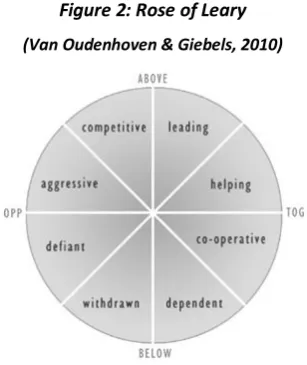
Leary (1957) states, that the reaction of a person during an interaction depends on the behavior of his or her interaction partner. In his model, called Rose of Leary (Figure 2), he divides all interaction behavior by two axes; horizontal and vertical. The horizontal axis distinguishes behavior that is ‘above’ (dominant) or ‘below’ (obedient). The vertical axis distinguishes between ‘against’ (personal interest) or ‘together’ (group interest) behavioral patterns. The group interest is the connection between all team members. Therefore, together behavioral patterns seem to be crucial for team commitment. The right sided ‘together’-part of the model is characterized by respectful, helpful and grateful patterns. Behavior belonging on the left sided ‘against’-part of the model is expressed by skeptical, critical an independent behavior. Personal interest gets a central position, which could mean that one does not listen (to another’s opinion) anymore. Based on this, together behavioral patterns seem to represent interaction behavior, where people show AEL, whereas against behavioral patterns seem to be marked by a lack of AEL. Having categorized the interaction behavior by the two axes, Leary (1957) states, that together behavior predicts together behavior, as well as against behavior predicts against behavior. Contrary, above behavior evokes below behavior, and below behavior evokes above behavior.
8 framework to categorize and describe interactional group processes (Van Oudenhoven & Giebel, 2010). If listening creates together behavioral patterns, this would mean that by listening, one can actively support team commitment, since together behavioral patterns create a connection in terms of the group interest.
[image:8.595.221.375.219.402.2]Based on the explanation above, and in order to investigate the group level processes and outcomes shaped by listening and promoting team commitment, the second sub research question was formulated as follows SRQ 2 What behavioral patterns (in terms of against and together behavioral patterns) are created by (lacking) AEL behavior?
Figure 2: Rose of Leary (Van Oudenhoven & Giebels, 2010)
3 Method
This researchaimed to provide qualitative insights in the team level based listening context by exploring individual as well as group level processes and outcomes provoke by the availability of AEL behavior within teams. Consequently, a qualitative research method was applied. Interviews gave the possibility to explore individual processes and outcomes. Observations enabled the exploration of group processes which were shaped by AEL behavior or a lack of AEL behavior.
3.1 Participants
Three work teams of a Dutch health care institution located in the eastern Netherlands participated in the study. The teams were approached via a team advisor of the health care institution. The investigator got in touch with the advisor via her network. The advisor was given the research information, which was then distributed through email to 10 teams within the institution asking if there were teams which would be interested to participate in a research focused on communication and group dynamics. Three teams replied on this email and a willingness to want to participate. The participants were not rewarded for their participation.
9 3.2 Observation
Observation is useful to study communication as it happens in real context (Cunliffe, 2010). Therefore, to answer the second sub research question, team meetings were observed. It was also necessary to observe the teams before interviewing them. Otherwise participants could get influenced in their listening behavior based on the interview questions. Meetings of the teams were audio and video taped with permission. The researcher physically joined the meeting by introducing herself as a student interested in communication and group processes. Appointments for the observation were coordinated with a team member which was assigned to be a contact person. The researcher joined a regular meeting which is held monthly. Two cameras were installed to be able to videotape all group members facial expressions and body language. The researcher was situated outside the group, to not disturb the group processes. The research method was approved by the ethical committee of the University of Twente.
3.2.1 Data analysis procedure
The meeting of the first team had a duration of 1 hour and 59 minutes. The second team permitted the researcher to join only the first part of the meeting, which was 1 hour and 9 minutes. The third team had a short meeting of 49 minutes. Decision-making parts of the meetings, where communication was relevant, were transcribed verbatim, and also body language was shortly described in this document. Finally, there were four relevant situations transcribed. Two situations where decision-making went harmoniously (within team 2 and 3) and also two parts where decision-making caused some conflicts (within team 1 and 2). The duration of the shortest situation was 9 minutes 45 seconds and the longest situation had a duration of 20 minutes. In total about 54 minutes of the meetings were relevant and transcribed.
The interactions were analyzed with the help of an observation schema based on the Rose of Leary, (see Appendix 4). This schema consists of 4 types of behavior, distinguished by two axes; against-together or above-below. The relevant axis for this research was against-together. Behavior which is characterized by against behavioral patterns also provokes against behavioral patterns, which means arguing (not listening). Together behavioral patterns provoke together behavioral patterns, which should lead to fruitful teamwork and listening. Based on this, during data analysis two codes were used: ‘against’ and ‘together’.
In a first coding round the researcher watched the videotaped meetings and linked the codes to the relevant behavioral patterns of the meeting. This was done manually, on the printed documents. In a second coding round a second independent coder watched in total 20 minutes of the relevant videotaped parts of the meetings (37% of the data) and also linked the codes ‘against’ or ‘together’ to the fragments. Both coding rounds resulted in the same codes for behavioral patterns.
3.2.1.1 Fragment samples
10 explained that this would mean that the new colleague needs a certain amount of hours. Colleagues reacted positive and elaborated on this thought; “Holiday is coming soon, which also could be very stressful”. During the whole decision making process the team discussed friendly and openly and group interest stood central.
A situation where the ‘against’ behavioral pattern was linked, was during a decision making process of team 2. The situation was characterized by closed and defiant communication. Team mates did not agree and were not willing to find a compromise. “Alright, I’m thinking… how could I say?! For me this just isn’t enough!” The concerned colleague, based on this strict statement, also started communicating aggressively “What do you want to hear now!?! I have not thought about it before!” The discussion got an unproductive twist. The two team mates did not find a compromise. The discussion was stagnated. During this fragment participants were closed, not willing to understand and hostile.
3.3 Semi-structured Interview
In order to answer SRQ 1, after the observations, individual interviews were conducted. Interviews were audiotaped with permission. Participants were informed that the data would be processed anonymously. Interviews took place in the locations within the health care institution. The longest interview had a duration of 1 hour and 4 minutes. The shortest interview was finished after 28 minutes. The average duration of an interview was 40 minutes. The research method was approved by the ethical committee of the University of Twente.
11 what this communication makes them feel like. Again, effects were gathered openly, with a focus on the sub constructs of PTS. This part of the interview was followed up by some questions about the meeting the researcher joined. The aim was to reflect on crucial parts of the meeting as well as perceived listening in general. The interview was closed by questions concerning the team commitment of the individual and in what way he or she experiences team commitment within the team. Topics of interest where identification with and involvement in the team (Allen & Meyer, 1990; Bishop et al., 2000),
3.3.1 Data analysis procedure
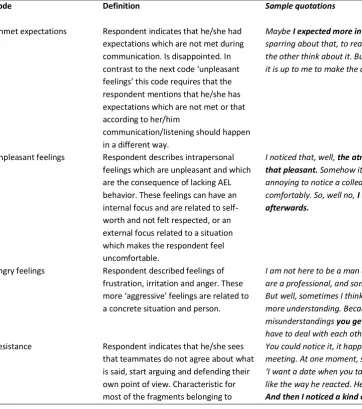
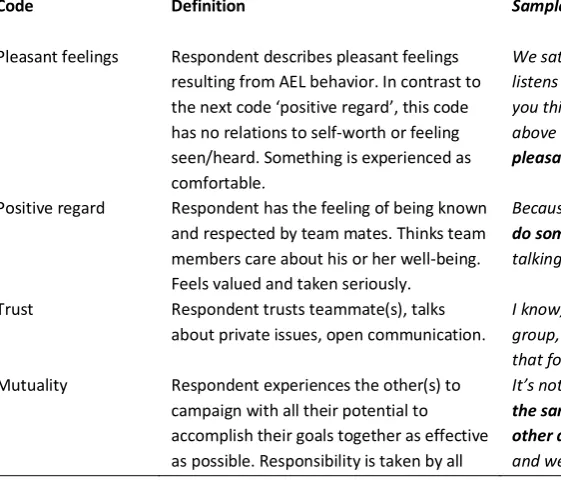
The interviews were transcribed verbatim, resulting in 239 transcribed pages, which were analyzed with the help of Atlas.ti software of tracking code creation. The data was analyzed by multiple steps. During the first round data was openly coded. Afterwards, relevant units were coded by the four general themes; TLE, team commitment, positive effects and negative effects. These four themes were based on the themes of the theoretical background of the research questions. The second coding round was meant to create subcategories of the fragments belonging to the positive and negative effects. This coding round resulted in five subcategories belonging to the superordinated code ‘negative effects’, namely: unmet expectations, unpleasant feelings, angry feelings, resistance and distance. Also five categories belonging to the super code ‘positive effects’ were defined: pleasant feelings, positive regard, trust, mutuality and team spirit (see appendix 3 for codebook). Definitions of these codes were discussed and improved. In a third step the codebook was given to a second coder. This coder was independent and not involved in earlier discussions or coding rounds. There were three quotations of all codes selected and mixed up. The coder had to put the right code to the right fragments. Based on this coding round Cohen’s kappa was calculated and in resulted a total kappa of .72, with a kappa of .78 for positive feelings and .59 for negative feelings. The researcher discussed the definitions of the codebook with the second coder. Based on this feedback, final changes of the definitions (of distance, unmet expectations, distance and pleasant feelings) were made. Finally, the whole data was analyzed and coded based on the upgraded codebook.
4 Results
4.1 Individual level processes and outcomes
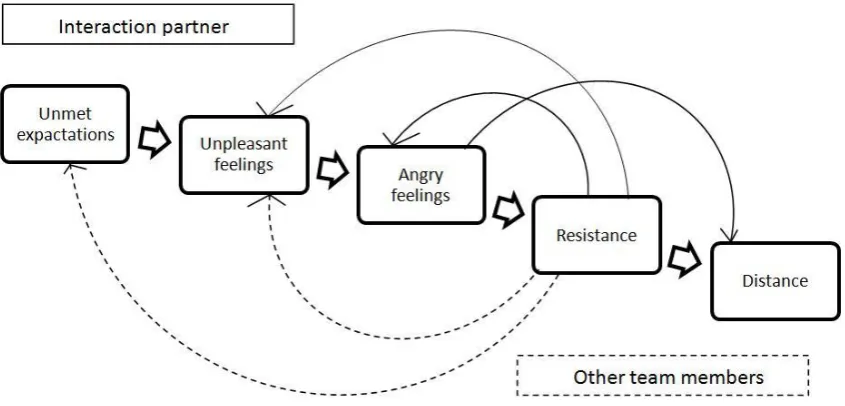
12 Figure 3: Reinforcing interrelationship of negative individual level processes and outcomes
4.1.1 Negative effects and processes
4.1.1.1 Unmet expectations
9 of the 26 respondents mentioned that they had expectations which were not met during an interaction. For example Respondent (R) 9 mentioned during a meeting with her team, that she would like to add specific information on the medication note of a client. The team mates thought this was not necessary since this information is reported in the digital patient record. R9 afterwards tells in the interview “I missed some support of my team. [...] I had hoped that I would gain some more recognition on this point.” Sometimes respondents have specific expectations during a conversation. The interviews show that when this expectations are not met, participants are disappointed with the result of an interaction.
It is also possible that one has expectations or ideas about the way another team member should have communicated in a specific situation, which are not met. R7 reflects during the interview on a situation of the meeting which was observed. She explains that she perceived the way his colleague reacted to something another colleague said as disappointing. R7 “Nobody likes to receive negative feedback. But, anyway, you should listen to it. Analyze it yourself, reflect on it and maybe respond to it at another point in time. Maybe the
feedback is not properly. But do not immediately start defending yourself. And never take revenge on someone
else. I really did not like the way it worked out. He has to improve this.“ This is, where one can find a relation between ‘Resistance’ and ‘Unmet expectations’, which is described in the paragraph of ‘Resistance’ below.
4.1.1.2 Unpleasant feeling
13 mates do not listen to each other (and start arguing ‘Resistance’), also can provoke unpleasant feelings by the rest of the team. R14 says “Yes, I am very uncomfortable with that. But anyway I do not like conflicts.” Another respondent (R12) describes to experience an internal conflict in such a situation “I feel like should I help out or not?!”. Thus, unpleasant feelings can be caused by unheard or unseen, but also by the communication of others which is not harmonious and makes one feel uncomfortable. However, unpleasant feelings are always experienced personally, and not visible for team mates, until someone expresses this feelings.
4.1.1.3 Angry feelings
Some respondents (n=11) described that they get irritated, angry or frustrated when interaction partners did not listen. It is important to say, that it seems that one does not immediately get angry feelings when perceiving a lack of listening. The research suggests that this has to happen more often until one starts getting frustrated, as R19 states “Look, in the beginning… I mean, it depends. If it happens once, I am okay with it, it can happen. But if it stays the same, I can get irritated.” In contrast to unpleasant feelings, angry feelings
can also become visible for teammates. Participants describe that they also can get harsh themselves. R8
“Well, it does something to my personal attitude. I start responding more shortly and probably more bluntly.”
However, one does not have to show his or her irritation, frustration or anger.
In the long term, if angry feelings stay and people keep getting irritated and frustrated by a team mate, this can affect the relationship in a negative way. R15 states “But well, sometimes I think it is good to have more understanding. Because with misunderstandings you get irritated and you have to deal with each other
for a long time.” If one does not express the angry feelings, but still feels irritated or frustrated, it can happen that this team mate takes distance or resigns, without anyone else noticing this. R2 explains “It was an subject which we already wanted to talk about in the meeting two weeks ago. But it wasn’t addressed then. And on
Thursday, I did not want to talk about it anymore. I was like, if you don’t mind, fine! I don’t say anything
anymore... But that’s also my personal issue, I efface myself quiet often. ” In Figure 3, therefore, there is also a direct relation implied, form ‘Angry feelings’ to ‘Distance’.
4.1.1.4 Resistance
Resistance is a process provoked by lack of AEL, which is visible for team members. 10 Respondents mentioned resistance as a consequence of lacking AEL behavior. Characteristic for fragments of resistance is that respondents describe behavior which they observe at other team members, like arguing, defending or discussing. R7 “My colleague asked him for a date when he starts taking action, since he did not in the past. The way he reacted, wasn’t okay. He did not received the message. And I could feel that he kind of started attacking
14 4.1.1.5 Distance
Distance as a result of lacking AEL was mentioned by 16 respondents. There seem to be two forms of distance as a consequence of no listening. First, respondents described to choose to take some distance and not telling everything to a person which seems not to understand them. R9 “Look, I would not choose him to ask for advice in the first place and I would not tell him if anything is going on in my private life. I have just the
necessary conversations with him.” This seems to be a more long-term effect of lacking listening competence. Second, respondents describe another form of distance; resignation. This is a more situation based effect. When AEL is lacking one can lose motivation to talk about, as R2 describes “And I am asking myself, do you hear me, do you really understand what I am saying? While he were looking on his cell phone for another time… And
[image:14.595.78.441.367.777.2]then I completely lost interest and motivation to further talk about it.” Also the quotation of R2, mentioned under ‘Angry feelings’ is a good example for resignation. Resignation appears to suggest stagnation of an interaction which consequently creates distance. While during resistance people still have an interaction, when it comes to resignation as a consequence of no listening, it seems that people lose motivation or hope to find a way out together.
Table 1 Results of the analysis of team members’ negative individual level outcomes and processes
Code Definition Sample quotations
Unmet expectations Respondent indicates that he/she had
expectations which are not met during communication. Is disappointed. In contrast to the next code ‘unpleasant feelings’ this code requires that the respondent mentions that he/she has expectations which are not met or that according to her/him
communication/listening should happen in a different way.
Maybe I expected more interaction and some sparring about that, to really get to know what the other think about it. But in the end they said it is up to me to make the decision.
Unpleasant feelings Respondent describes intrapersonal
feelings which are unpleasant and which are the consequence of lacking AEL behavior. These feelings can have an internal focus and are related to self-worth and not felt respected, or an external focus related to a situation which makes the respondent feel uncomfortable.
I noticed that, well, the atmosphere was not that pleasant. Somehow it was effective, but it is annoying to notice a colleague is not feeling comfortably. So, well no, I did not felt happy afterwards.
Angry feelings Respondent described feelings of
frustration, irritation and anger. These more ‘aggressive’ feelings are related to a concrete situation and person.
I am not here to be a man of feelings. Here you are a professional, and somehow that is okay. But well, sometimes I think it is good to have more understanding. Because with
misunderstandings you get irritated and you have to deal with each other for a long time.
Resistance Respondent indicates that he/she sees
that teammates do not agree about what is said, start arguing and defending their own point of view. Characteristic for most of the fragments belonging to
15 resistance is that the respondent
observes the behavior at anyone else.
client can also do so. And why I have to do so, and she does not. And then there developed a kind of discussion.
Distance Respondent describes wanting to (1) take
distance of the team/team mate or (2) feels resignation and is not motivated to discuss/talk about the issue anymore. Participant starts working on his/her own. Does not talk about everything with team/team mate. More formal/closed. Distrust.
Then, people go their own way. On a certain moment you think no one listens to you, I will do my own thing. I will go arrange it on my own and do my own work. Then you miss a little bit solidarity to each other. You miss a piece of loyalty. That.
4.1.2 Positive effects and processes
4.1.2.1 Pleasant feelings
A pleasant feeling was the most mentioned effect of perceived AEL behavior (n=17). Respondents explained that when they perceive others to listen, this makes them feel comfortable. Respondents experience a “relaxed atmosphere” (R3) and “rest” (R1). Also these interactions where listening is perceived are described as a “nice conversation” (R6) and leaving a “good feeling” afterwards (R5).
4.1.2.2 Positive regard
One step further comes an interaction when respondents experience positive regard. Positive regard describes a feeling of being heard and understood. It also includes the feeling that one can be his-/herself and is respected and appreciated. 12 respondent described to ever have felt positive regard when people were listening to them. For example R14 describes “Very understanding, and so I can just be myself. I can say what I think. And it is also appreciated. But also if another person thinks differently, he or she says so. Or maybe says
‘you could do it like this or think about that’.”
4.1.2.3 Trust
As the choice to take distance, seems to be a result of lacking listening competence, trust seems to be a result of good listening skills. Trust develops after positive conversations, leaving pleasant feelings and positive regard. For example R17 explains that she trusts one of her colleagues most. “I can be very open to her because I know that she really listens to me. She knows me, I trust her.” In total 7 respondents mentioned trust as a result of perceived listening.
4.1.2.4 Mutuality
When team mates are open to each other’s opinions and approaches it seems that this generates a positive feeling of productive team work. Whereas the first three positive outcomes are intrapersonal feelings, mutuality is a concept based on visible conversation (which is similar to ‘Resistance’). As a result of this open communication, 15 respondents described to experience everyone to campaign actively to the team goals and the team was able to improve quality and come up with new ideas. Mutuality seems to include different aspects. (1) It seems to support better solutions (quality) as R13 says “Because you appreciate when people come up with ideas. And if you can discuss them you can generate better solutions. Based on that, I get the
16 shows that (2) team members feel that they together take care for the team goals and that decisions are supported by all team members (shared responsibility). Besides this, mutuality seems to (3) facilitate learning from each other (improvement).R7 describes “It’s not perfect yet, but you can feel that we all have the same intention. We want to learn from each other and do a good job. We have different opinions, and we talk about
them.” Last but not least, mutuality also appears to come together with (4) good teamwork, as R26 explains “I can tell what bothers me, I can ask my questions and everyone else can ask questions to me. We just work
together, and that definitely feels great!” Mutuality is an interactional state that supports fruitful team work and a lot of positive team level outcomes. Teams that want to be successful should aspire to reach the state of mutuality. This is the state where teams are able to come up with more than the sum of their individual ideas.
4.1.2.5 Team spirit
[image:16.595.76.479.412.492.2]A team can achieve a feeling of team spirit. 8 respondents described to feel a connection with all team members after an interaction where listening (mutuality) was perceived. R19 “So you really feel like a team, because your opinion is heard and we together as a team have decided to stop.” Another respondent says “I think it pays off. I think when everyone is involved, it creates a connection.” (R22). Overall, when it comes to decision making and people listen to each other, decisions are supported by all team members afterwards, which again creates a feeling of being a unity.
Figure 4: Reinforcing relation between positive individual level processes and outcomes
Table 2: Results of the analysis of team members’ positive individual level outcomes and processes. Code Definition Sample quotations
Pleasant feelings Respondent describes pleasant feelings resulting from AEL behavior. In contrast to the next code ‘positive regard’, this code has no relations to self-worth or feeling seen/heard. Something is experienced as comfortable.
We sat here to discuss some thinks often. She really listens to what you say and asks questions that make you think about it. It does not happen that she rises above you, she stays very equal. Yes, it is really pleasant.
Positive regard Respondent has the feeling of being known
and respected by team mates. Thinks team members care about his or her well-being. Feels valued and taken seriously.
Because it is nice if people give confirmation when I do something right. And you can only do that by talking to each other.
Trust Respondent trusts teammate(s), talks
about private issues, open communication.
I know, for example, that if I ask something in this group, I am 100 percent sure it will happen. I know that for 100 percent sure!
Mutuality Respondent experiences the other(s) to
campaign with all their potential to accomplish their goals together as effective as possible. Responsibility is taken by all
[image:16.595.73.354.539.779.2]17 team members. Productive teamwork,
good consultation/feedback. Learning from each other.
Team spirit Respondent describes to feel/experience
connectedness, conformity, to be oneness/having one vision/opinion. Team spirit, in contrast to mutuality, goes further. It is a more intense feeling of being one.
I think it pays off. I think when everyone is involved, it creates a connection.
4.2 Group level processes and outcomes
4.2.1.1 Together behavioral patterns
During the interviews respondents were generally positive about the TLE. The observations are in line with this. During the four selected parts of the data most of the time team mates demonstrated together behavioral patterns. Nearly all interactions of the team is coded by together behavioral patterns. The team interest has a central position during decision making. Team members elaborate the point of discussion, listen to each other and stand open for each other’s point of view to come up with the best solution.
An example of together behavioral patterns is to find during the decision making process of team 1. Team 1 had to evaluate the amount of hours which one of the two residential care assistants had worked during the last three month. The team had to decide if she should work more or less during the upcoming month. Based on this discussion a new work contract should be handed out. The team member, responsible for human resource management (HRM), introduced the point of discussion. After that, team members brought in different aspects relevant to this point of discussion. Some examples; “She also works one day at another location. So we have to keep in mind that this hours are subtracted of the total amount of hours.” Other team members agreed by shaking their heads. The residential care assistants explained “I would not be able to work at that location every week if I would reduce my hours. It would mean that I wouldn’t be here often enough to
keep involved in what happens.” Some minutes lateranother team member reminds the group that when the colleague starts working more hours, the days she should be free would be very limited, since she also works in the weekends. Another teammate asks the residential care assistant “If you could choose, what would you do?”. The residential care assistant answers that she would like to work more hours than before. Some team members agree. Another team member has some doubts. “I’m not sure if it is doable for you two on long-term. If it’s not, we have to hire another residential care assistants, than we have to divide the hours. He or she of
course, has to have a minimum amount of hours, too.” There is some discussion about it. Another team member later on agrees “I think it is good to look future-oriented.” He explains that there are some external factors which also could become relevant an which would mean that the team has to hire a new team member. The final decision of the team was to go on with the same amount of hours. After three months they agreed to discuss this point again, because they thought that up to that point the relevant external factors and the amount of work to do would be clearer to make a well grounded decision.
18 4.2.1.2 Against behavioral patterns
Only a few minutes of the selected decision making processes were coded by against behavioral patterns. In particular, team 1 it took 1 minute until the behavior switched back to together behavioral patterns. And in team 2 it took 2 minutes until another team member interrupted the two arguing team members and returned the conversation back to a group level. When it comes to against behavioral patterns, clearly the dynamic of the interaction changes. Team mates are not open to each other’s point of view and do not listen anymore. Their own opinion or goal gets a central position. The atmosphere gets tense and the conversations gets stuck. To give an example the situation of team 2 will be discussed.
Team 2 had to choose someone to fulfill the HRM function within the team. One of the teammates said that he is interested to do so. Another team mate asked about the motives to choose for HRM. The interested team mate explains that he has not thought about it yet. And says slightly irritated “What do you want to hear from me know?” His team mate seems to be indignant. She personally seemed to need a well-grounded motivation to get permission to fulfill the function. She laughs cynically. The interested team mate starts to defend himself “I have not been thinking about it yet. The team asks what I am interested in and that’s it. I am interested in HRM. I have not thought about my underlying motives and visions yet. If you had asked to do so
before, it would have done that.” This answer is not acceptable for the team mate “Well, I think that you should choose for a function because you already have good, innovating ideas about it. And you think you're the right
person. So, I just ask you why you think you should become HRM…” Another team member tries to interrupt and explains to the team mate who wants underlying motives there is work which no one wants to do, and that motives and reasons to chose someone for a specific function, for that reason, also can develop during the conversation. The asking team mate gives up irritated, lies back in her chair, crosses her arms before her and says irritated “If you think that the right way, go ahead…”
While it was characteristic of together behavioral patterns, that participants listen to each other, based on the above example one can see that during against behavioral patterns team mates are focused on their own point of view or opinion. They seem not to give any space to the others opinions anymore. They do not listen or try to understand the other. During the interviews this situations also was discussed. Respondents confirmed the interpretations of the researchers. Team mates, who were not directly involved, experienced this situation as unpleasant and they missed listening behavior R14 “I think, they did not try to understand each other. Another colleague also tried to defend him.” R11 “I noticed some tensions. I realized that everyone has his/her own interest. There is also a group interest but also personal interests. And I think that there was a very tensed
atmosphere, because people were fighting for their own interest.” R12 “Yes, I think that she overreacted. And I
sometimes got the impression that they do not understand what they are saying. They did not really listen to
19 1, where some parts of the meeting were coded by against behavioral patterns too, gave similar reactions and statements during the interviews.
5 Discussion
This study aimed to (1) provide qualitative insights in the team level based listening context, by (2) exploring individual as well as group level processes and outcomes shaped by the (un)availability of AEL behavior within teams. Results show five positive individual level outcomes shaped by team listening (pleasant feelings, positive regard, trust, mutuality and team spirit). Also five negative individual level outcomes were found, which are the consequences of the lack of team listening (unmet expectations, unpleasant feelings, angry feelings, resistance and distance). The results also show that a team-level based listening context differs to dyadic listening contexts. Based on the results, the current study adds important insights to previous literature in several ways.
First, this study suggests a reinforcing relation between the positive individual and group level outcomes shaped by TLE. The positive individual level outcomes found in the present study, are in line with previous research. Weger et al. (2014) and Senecal and Burke (1992) demonstrated that listening results in a feeling of being understood and valued, which in line with what the current researcher defined as positive regard. Drollinger et al. (2006) and Lloyd et al. (2015) demonstrated that listening results in trust, which this study also confirms. Levine (1994) observed that when team members honestly listen to each other, they are able to come up with more than the sum of their individual ideas, which is similar to the outcome of mutuality. Finally, team spirit, as the emotional attachment to the team, is part of team commitment, which previous research proved to be related to listening (Johnston et al. 2007; 2011). Nonetheless, previous studies could not demonstrate the reinforcing relationship between all these constructs. The qualitative nature of this study made it possible to show that all constructs depend on each other. This means outcomes should not be treated and measured separately, since they could be mediated by other constructs. Johnston et al. (2011) measured the relation of listening and commitment directly. Based on the results of this study, it seems listening is not directly related to team commitment or but mediated by other constructs. However, based on the more explorative nature of this research, it is not possible to say if the constructs have a causal relationship. Future research is needed, proving the relations between the individual and group level outcomes. For teams, these results mean that listening indeed can create fruitful group processes and team spirit. However, pleasant feelings and trust seem to be fundamental to create a positive communication atmosphere. This atmosphere in turn, supports fruitful group communication (mutuality), that can result in team spirit.
20 listening, during the interviews it became clear that team members on an individual level also suffered being involved in this communication. Thus, it becomes clear that in the context of a team, listening (or a lack of listening) impacts the team in several ways. On the one hand, it has consequences to the directly involved team member. On the other hand, it also influences the team members who are indirectly involved. Additionally, it affects group processes as well as individual level processes and outcomes. Consequently, this study shows that a team based listening context asks for different research methods, since it differs to a dyadic based listening context. To measure how listening as well as a lack of listening matters within teams, research has to take into account the group as well as individual level processes and outcomes, especially since it became clear that individual level outcomes such as trust can be mediating to group level outcomes.
Thirdly, the results demonstrate that a lack of listening can be toxic for teams. Lack of listening can result in distance between team members, which would create the opposite of team commitment. Previous researchers mainly focused on the benefits of listening in teams (Ala-Kortesmaa and Isotalus, 2014; Johnston et al., 2007; 2011; Levine, 1994; Stewart and Thomas, 1995). Based on the knowledge of the current researcher, no study gave insights in the individual and group level processes and outcomes occurring when listening is lacking yet. However, since this study shows that a lack of listening can be harmful to individual and group level processes and outcomes, it is important to further explore how a lack of listening can be toxic. First, it is important to know when lacking AEL behavior becomes harmful, since participants mentioned that when a team members does not listen once, this does not directly have harmful effects (“it can happen” R19). Future research is needed to provide more insights about relevant factors influencing when and how lacking AEL behavior becomes harmful. Second, it would be interesting to better understand how a team can escape from harmful processes, once a lack of listening shaped these negative individual or group level processes. For example, resistance demonstrated to strengthen negative individual and group level outcomes. Thus, negative processes shaped by a lack of listening again can reinforce negative outcomes; a vicious circle. However, it would be interesting to investigate if there is a way out. It would be possible to look if and how team members are able to escape harmful processes and take the interaction process back to a fruitful interaction level. If so, this would mean that the figures with positive and negative outcomes presented separately in the results section actually have to be integrated. Future research should investigate this.
21 listen anymore. Unfortunately, based on the analysis it is hard to say if a lack of listening caused against behavioral patterns. Future research could investigate this. Nonetheless, for teams this means, that team members actively can promote listening in their teams based on their own behavior.
6 Limitations
There are certain limitations of this study which have to be mentioned. First, the findings are based on a small number of teams (n=3). Notwithstanding that there were 26 respondents participating, the fact that the research took place in the context of only one health care institution and in only three teams, makes generalizing the results to a wider population problematic. Teams differ, depending on certain criteria. For instance the industry were the team is working in matters to the way a team works together. Also the history of a team as well as team goals and main activities could be a reason that the results of this research are not fitting to other teams. Context and main activities determine the work processes and communication processes of a team. This also determined the results of this research. Therefore, the effects of listening in teams which are located in different contexts and have different main activities could differ to the results shown in this study. Furthermore, since the teams selected themselves to join the research, there is reason to talk about a sample bias. Teams were chosen by availability and interest to participate in the research. Since the participating teams had to deal with communication issues, this could have been a reason to join the research, which also could falsify the data.
Secondly, since the researcher physically joint the meetings to videotape them, and data was gathered by face-to-face interviews, there may be a social desirability bias in the results. For example, some respondents mentioned that usually meetings are more chaotic and people interrupt others more often. However, some situations during the meetings where quite tense and conflicts arouse, which suggests that participants were not that sensible to the camera and the availability of the researcher. However, during the interviews, no respondent said to ever have felt ignored or not listened to, which seems unrealistic, since during the interviews almost all respondents mentioned that dependent on time and topic, sometimes listening is lacking within the team. For future research, researchers should be aware of social desirability biases and, if possible, use methods which are less sensitive to this bias. For example, to observe teams, researchers could place cameras, but not physically join the meeting. Also more meetings should be observed to minimize this bias.
22 7 Practical implications
AEL behavior within teams shapes fruitful and productive group processes and positive individual level outcomes whereas a lack of listening is harmful to group processes and individual level outcomes.
Results show that trust is crucial to improve mutuality which can result in team spirit. As figure 3 shows, trust develops based on positive listening experiences (pleasant feelings and positive regard). Thus, it is recommended to improve listening within teams. Therefore, (1) awareness should be created about the importance of listening and (2) listening has to be implemented and improved in daily activities. First, it is important to make team members aware of their listening behavior and how important listening is. Team members who are responsible for communication, such as the team manager or leader, should discuss the topic of listening with team members. The benefits of listening should be pointed out as well as the harmful effects lack of listening can have. Next to that, it should become clear what listening exactly means. Good listening means listening without judging or interrupting, it is purely about understanding what the team members wants to tell and what this means to him (Levine, 1994). Also, team members should reflect on their own listening behavior to get aware of their listening skills. The Rose of Leary (1957) could help team members doing this. Listening takes place in together behavioral patterns where the group interest is central. Therefore, one can reflect on the own listening behavior by being aware of the group interest and reflecting on how often one puts this to centre and when personal interest becomes central and why. Second, after having explained what listening means and why it is important, the team has to improve listening in daily activities. Rules could be set or rituals could be used to support listening and create time and space for every team member to bring in ideas during meetings. For instance, when team members start interrupting or judging another team member during meetings, others could make them aware of this lacking listening behavior. Based on the Rose of Leary, when personal interest comes to centre, and one demonstrates against behavioral patterns, team members can friendly remind that person to keep the group interest in mind. Besides that, teams could make use of a ritual helping to remember them to listen. For example, a stick or any other object can serve as symbol for who’s turn it is to talk, while others have to listen. The use of such a symbol could help to ensure conditions of respect and acceptance and to promote a place and process in which team members can practice listening skills, empathy and understanding. This is helpful to improve the overall listening skills (Wilburg et al., 2001).
23 partner again. By holding on, reflecting and choosing for together behavioral patterns instead (thus, putting the group interest back to centre) a team member can actively bring the conversation back to a positive level.
8 Conclusion
24 References
Ala-Kortesmaa, S. & Isotalusa, P. (2014). Professional Listening Competence Promoting Well-Being at Work in the Legal Context. International Journal of Listening,29(1), 30-49. DOI:
10.1080/10904018.2014.937529
Allen, N. J., & Meyer, J. P. (1990). The measurement and antecedents of affective, continuance, and normative commitment to the organization. Journal of Occupational Psychology, 63, 1–18.
Ashforth, B. E. & Mael, F. (1989). Social identity theory and the organization. Academy of Management Review, 14, 20–39.
Bal, P. M., & Vink, R. (2011). Ideological currency in psychological contracts: The role of team relationships in a reciprocity perspective. The International Journal of Human Resource Management, 22, 2794-2817.
Becker, T. E., & Billings, R. S. 1993. Profiles of commitment: An empirical test. Journal of Organizational Behavior, 14, 177–190.
Bishop et al., 1997 Bishop, J. W., Scott, K. D., & Casino, L. S. (1997). The differential effects of team commitment and organizational commitment on job performance and intention to quit. Paper presented at the Annual Meeting of the Academy of Management, Boston.
Bishop, J. W. & Scott, K. W. (2000). An examination of organizational and team commitment in a self-directed team environment. Journal of Applied Psychology, (85)3, 439-450.
Bishop, J. W., Scott, K. W. & Burroughs, S. M. (2000). Support, commitment, and employee outcomes in a team environment. Journal of Management, (26)6, 1113–1132.
Bligh, M., Pearce, C. L., & Kohles, J. C. (2006). The importance of self- and shared leadership in
team based knowledge work: A meso-level model of leadership dynamics. Journal of Managerial Psychology, 21(4), 296-318.
Bodie, G. D. (2011). The active-empathic listening scale (AELS): Conceptualization and Evidence of validity within the interpersonal domain. Communication Quarterly, (59)3, 277-295. DOI:
10.1080/01463373.2011.583495
Bodie, G. D. (2011). The understudied nature of listening in interpersonal communication: Introduction to a special issue. International Journal of Listening, 25(1-2), 1-9. doi: 10.1080/10904018.2011.536462
Bodie, G. D. Cyr, K. S., Pence, M., Rold, M. & Honeycutt, J. (2012). Listening competence in initial interactions: Distinguishing between what listening is and what listeners do. International Journal of Listening, 26(1), 1-28. doi: 10.1080/10904018.2012.639645
25 Brownell, J. (2010). The skills of listening-centered communication. Listening and human communication in the
21st century, 141–157. In A. D. Wolvin (Ed.), Oxford, England: Blackwell.
Carmeli, A., M. Yitzhak‐Halevy and J. Weisberg, 2009.The relationship between emotional intelligence and
psychological wellbeing. J. Managerial Psychol., 248: 66-78
Coopman, S. J. (2001). Democracy, performance, and outcomes in interdisciplinary health care teams. The Journal of Business Communication, 38(3), 261-284.
Cunliffe, A. L. (2010). Retelling tales of the field: In search of organizational ethnography 20 years on. Organizational Research Methods, 13(2), 224-239. doi:10.1177/1094428109340041
De Lara, P. Z. M. & Rodriguez, T. F. E. (2007). Organizational anomie as of the relationship between an unfavorable attitudinal environment and citizenship behavior (OCB) – an empirical study among university administration and services personnel. Personnel Review, 36(5/6), 843-66.
Drollinger, T., Comer, L. B., & Warrington, P. T. (2006). Development and validation of the active empathetic listening scale. Psychology and Marketing, 23, 161–180.
Dutton, J. E., & Heaphy, E. D. (2003). The power of high-quality connections. Positive organizational scholarship: Foundations of a new discipline, 3, 263-278.
Fedesco, H. N. (2015). The Impact of (In) effective Listening on Interpersonal Interactions. International Journal of Listening, 29(2), 103-106.
Flyod, K. (2014). Empathic listening as an expression of interpersonal affection. The International Journal of Listening, 28, 1–12. Doi: 10.1080/10904018.2014.861293
Foote, D. A. & Tang, T. L. P. (2008). Job satisfaction and organizational citizenship behavior (OCB) Does team commitment make a difference in self-directed teams? Management Decision, (46)6, 933-947. DOI 10.1108/00251740810882680
Hecht, M. L. (1978). The conceptualization and measurement of interpersonal communication Satisfaction. Human Communication Research, 4, 253-264.
Helms, M. M., & Haynes, P. J. (1992). Are you really listening? The benefit of effective intraorganizational listening. Journal of Managerial Psychology, 7(6), 17–21.
ILA (2008). WhitePaper http://www.listen.org/WhitePaper
Johnston, M. K. & Reed, K. (2014). Listening Environment and the bottom line. How a positive environment can improve financial outcomes. International Journal of Listening, 1-9. DOI:
10.1080/10904018.2014.965391
Johnston, M. K. , Weaver, J. B., Watson, K. W. & Barker, L. B. (2000). Listening Styles: Biological or Psychological Differences? International Journal of Listening, 14(1), 32-46. doi: 10.1080/10904018.2000.10499034
26 Johnston, M. K., Reed, K., Lawrence, K. & Onken, M. (2007). The Link between Communication and Financial
Performance in Simulated Organizational Teams. Journal of Managerial Issues, 4, 536-553.
Jones, S. M. (2011). Supportive Listening, International Journal of Listening, 25(1/2), 85-103. doi: 10.1080/10904018.2011.536475
Kagan, P. N. (2008). Listening: Selected perspectives in theory and research. Nursing science quarterly, 21(2), 105-110.
Killumets, E., D’Innocenzo, L. Maynard, M. T. & Mathieu, J. E. (2015). A multilevel examination of the impact of team interpersonal processes. Small Group Research, 46(2), 227–259. Doi:
10.1177/1046496415573631
Leary, T. (1957). Interpersonal diagnosis of personality. New York: Ronald Press Cy.
Levine, L. (1994). Listening with spirit and the art of team dialogue. Journal of Organizational Change Management, 7(1), 61-73.
Levitt, D. H. 2001. Active listening and counselor self-efficacy: Emphasis on one micro-skill in beginning
counselor training. The Clinical Supervisor, 20: 101–115. doi:10.1300/J001v20n02_09
Lloyd, K. J., Boer, D., Keller, J. W. & Voelpel, S. (2014). Is My Boss Really Listening to Me? The Impact of Perceived Supervisor Listening on Emotional Exhaustion, Turnover Intention, and Organizational Citizenship Behavior. Journal of Business Ethics, 6, DOI: 10.1007/s10551-014-2242-4
Lloyd, K. J., Boer, D., Kluger, A. N., & Voelpel, S. C. (2015). Building Trust and Feeling Well: ExaminingIntraindividual and Interpersonal Outcomes and Underlying Mechanisms of Listening. International Journal of Listening, 29(1), 12-29.
Llyod et al., (2014) Building Trust and Feeling Well: Examining Intraindividual and Interpersonal Outcomes and Underlying Mechanisms of Listening The Intl. Journal of Listening, 29: 12–29. doi:
10.1080/10904018.2014.928211
Lobdell, C. L., Sonoda, K. T., & Arnold, W. E. (1993). The influence of perceived supervisor listening behavior on employee commitment. International Listening Association. Journal, 7(1), 92-110.
Margarete Imhof (2004) Who are We as We Listen? Individual Listening Profiles in Varying Contexts, International Journal of Listening, 18(1), 36-45. DOI: 10.1080/10904018.2004.10499061
Michelle E. Pence & Andrea J. Vickery (2012). The roles of personality and trait emotional intelligence in the active-empathic listening process: evidence from correlational and regression analyses. International Journal of Listening, 26(3), 159-174. doi: 10.1080/10904018.2012.712810
Purdy, M. W. (2000) Listening, Culture and Structures of Consciousness: Ways of Studying Listening. International Journal of Listening, (14)1, 47-68. DOI: 10.1080/10904018.2000.10499035
27 Schnell, J. (1995). Effective listening: More than just hearing. Retrieved January 6, 2008, from the Educational
Resources Information Center (ERIC # ED379691) Website: www.eric.ed.gov
Senecal, P., & Burke, E. (1992). Learning to listen. Occupational Hazards, 1, 37-39.
Sheng, C. W., Y.F. Tian & Chen, M. C. (2010). Relationships among teamwork behavior, trust, perceived team support, and team commitment. Social behavior and personality, 38(10), 1297-1306. doi:
10.2224/sbp.2010.38.10.1297
Stewart, J., & Thomas, M. (1995). Dialogic listening: Sculpting mutual meanings. In J. Stewart (Ed.), Bridges not walls: A book about interpersonal communication (pp. 184-201). New York: McGraw-Hill, Inc
Stine, M., Thompson, T., & Cusella, L. (1995). The impact of organizational structure and supervisory listening indicators on subordinate support, trust, intrinsic motivation, and performance. International Journal of Listening, 9, 84–105.
Van Knippenberg, D. & Sleebos, E. (2006). Organizational identification versus organizational commitment: Self-definition, social exchange, and job attitudes. Journal of Organizational Behavior, (27), 571–584. doi: 10.1002/job.359
Van Vuuren, M., Veldkamp, B. P., De Jong, M. D. T. & Seydel, E. R. (2007). Why work? : Aligning foci and dimensions of commitment along the axes of the competing values framework. Personnel Review, 37(1), 47-65.
Weger H., Castle G. R. & Emmett, M.C. (2010). Active Listening in Peer Interviews: The Influence of Message Paraphrasing on Perceptions of Listening Skill. International Journal of Listening, 24(1), 34-49. Doi:: 10.1080/10904010903466311
Weger, H. , Bell, G. C., Minei,E. M & Robinson, M. C. (2014). The relative effectiveness of active listening in initial interactions. International Journal of Listening, (28)1, 13-31. doi:
10.1080/10904018.2013.813234
28 9 Appendix
29 9.2 Appendix 2: Dutch interview topic list
Interview script
Huidige baan
- Hoe lang in de zorg - Functie
- Voorheen andere teams? Team
- Hoe belangrijk vind je de relatie met je teamgenoten? - Ben je tevreden met je team?
- Plus en min punten / Waar zijn jullie als team goed in, en waar zijn jullie niet zo goed in? Rollen
- Hoe zou je je rol binnen het team omschrijven Communicatie (TLE)
Hoe tevreden ben je over het algemeen met de communicatie binnen je team? - Aandacht & Begrepen voelen
o je mening kunnen laten horen (besluitvorming, meningsverschil)
o wil om je te begrijpen/aandacht te schenken
- Aandacht & Begrepen voelen bij anderen
- Voorbeeld communicatie
o Situatie tevreden (voorbeeld) Positive regard Trust
Mutuality
o Situatie niet tevreden (voorbeeld) Zie boven.
- Luisteren
In hoeverre wordt er geluisterd naar elkaar?
Effecten van communicatie
- Communicatiecirkel
!ACTIE: Kwaliteit communicatie met collega’s laten rangschikken via cirkel
Kaartjes rangschikken naar tevredenheid met communicatie van collega
30
o Waarom kan je goed communiceren met diegene?
o Wat doet dit met jullie relatie? Voorkeur voor samenwerken
Attitude en gevoelens tegenover collega’s Motivatie om te blijven werken
betrokkenheid
Luisteren naar die ander Begrepen worden Vertrouwen in de ander Commitment naar de ander toe
- communicatiepartner buitenkant van cirkel Rol luistergedrag achterhalen
o Wat maakt de communicatie lastiger?
o Wat doet dit met jullie relatie? Zie boven.
Bijeenkomst
- Hoe vond je de communicatie gaan? voorbeeld
- Ben je tevreden met wat er toen is besproken? (waar nodig een besluit uit vergadering aanhalen) - Kon je vertellen wat je wou vertellen?
- Voelde je je gehoord en begrepen? (wellicht kritische situatie aanhalen) - Werd er goed naar elkaar geluisterd?
- Is dit een typische bijeenkomst voor jullie team? Verloopt het meestal zo? Waarom wel/niet?
Team Committent
Hoe belangrijk is het team voor jou? - Identificatie
o onderdeel van het team
o overeenkomsten / hoe passen jullie bij elkaar?
o trots
- Inspanning voor team doelen/team leden