Nuclear energy: A nuclear topic
Abstract
Global climate change forces us to change the ways in which we produce energy. Nuclear power may contribute to achieving goals of the global climate treaty; however, the power source is highly controversial, leading to low levels of public support. Because public opinion is one of the most important aspect of nuclear energy, this study tries to analyze the Dutch media coverage on nuclear energy. Based on agenda-setting theory and framing theory, it assumes that media representations have an important influence on public opinion. By conducting a quantitative media analysis this study analyzed the sentiments and themes (frames) in which nuclear energy was reported in two Dutch newspapers: De Telegraaf and De Volkskrant from 2015 to 2018. Results show that the topic of nuclear energy is getting increased attention. Furthermore, since 2018 a pro-nuclear sentiment seems to dominate the media coverage. The most dominant themes are ‘environmental benefits’, ‘efficiency benefits’, and ‘safety and health risks’. This study also found that most of the articles are published in the opinion section of newspapers. These findings indicate that a debate on nuclear energy is already occurring and seems to be shifting towards a pro-nuclear stand. Based on these findings, this study makes some communication recommendation for organizations that are involved in the nuclear industry.
1 Introduction
1.1 Nuclear energy and global climate change
With the scientific community reaching consensus about men’s influence on climate change (Cook et al., 2013), the energy debate seems to be hitting a peak. As it becomes more obvious that humans have to change their behavior in order to stop global climate change, 195 countries adopted the world’s first legally binding global climate treaty. In the treaty countries agreed to limit global warming to a maximum of 2 degrees Celsius above pre-industrial levels, even aiming for a maximum of 1.5 degrees (United Nations, 2016). This should avoid dangerous consequences as a result of global climate change. Key-point in the battle against global climate change is to decrease the amount of CO2 that is
emitted into the air (Hansen, Sato, & Ruedy, 2012). This goal asks for a radical change as the world’s economies are largely based on fossil fueled energy consumption. With 87 percent, fossil fuels are the dominant source of human induced CO2 emissions (IPCC, 2014). While renewable energy sources are
often claimed to be a suitable alternative (Aspergis, Payne, Menyah, & Wolde-Rufael, 2010; Ozbugday, & Erbas, 2015), they represent only 3.1 percent of the world’s energy consumption (British Petroleum, 2013). It could therefore be argued that chances are relatively small that renewable energies will replace fossil fuels in the near future. Furthermore, it is highly unlikely that focusing on energy savings will be sufficient to decrease CO2 emissions (Tajudeen, Wossink, & Banerjee, 2018). Hence, some researchers
argue to switch to less harming fossil fuels, such as natural gas (Valadkhani, Smyth, & Nguyen, 2019), or to nuclear energy (Colvin, 2005; Dellano-Paz, Calvo-Silvosa, Antelo, & Soares, 2015; Lau, Choong, Ng, Liew, & Ching, 2019; Paska, & Surma, 2014; Teräväinen, Lehtonen, & Martiskainen, 2011), instead of focusing on ‘unrealistic’ goals for the near future. According to some authors, nuclear power is viable technology to improve energy security and efficiency, and to drastically reduce pollutions and CO2
emissions (Dellano-Paz, Calvo-Silvosa, Antelo, & Soares, 2015).
The Netherlands is one of the 195 countries that signed the Paris Climate Agreement, meaning that the government has to actively work towards the reduction of CO2 emissions. In that mission, new policies
are currently being developed. One important aspect of this is the so called ‘energy transition’. The definition of this term shifts over time (Araújo, 2014), but is currently focused on replacing high CO2
source of house heating in the Netherlands. Combined with an expected increase of energy demand by the move towards electric vehicles, nuclear energy could be a viable solution to meet the increasing energy demand while drastically decreasing carbon emissions, necessary to achieve the goals of the Paris Climate Agreement.
Though nuclear energy offers many benefits, the energy source is highly controversial. Economic, security, health, environmental and ethical concerns are often raised when it comes to nuclear energy (Culley, Oliver, Carton, & Street, 2010). These and other concerns lead to a lack of widespread public support. Public support and public opinion are major determinants for the future of nuclear energy. Even before the notorious nuclear accidents of Chernobyl and Fukusjima, it was alreadt considered to be the most critical aspect for the future of nuclear energy (Weinberg, 1995).
Although the public has historically been critical towards nuclear energy, it seems that people are getting more accepting to it. Under the threat of global climate change, focus seems to be shifting towards aspects on which nuclear energy scores better, such as reducing carbon emissions and energy costs (Ansolabehere, & Konisky, 2009). Considering the complexity of global climate change, and the urgency to take action, a public debate on energy policy is necessary (Pidgeon, Lorenzoni, & Poortinga, 2008; Devitt et al, 2019). Especially when it comes to nuclear energy, media can play an important role in facilitating and influencing this debate (Prati, & Zani, 2012).
1.2 Research goal and aim
Goal of this research is to analyze the media coverage of nuclear energy in the Netherlands. It tends to do so by analyzing the how nuclear energy is framed in Dutch media. Research is lacking on the topic, especially since the issue became relevant in the current discussion on global climate change and the energy transition. This research has two purposes: (1) to contribute to the academic literature on the media coverage of nuclear energy, and (2) to give organizations that communicate about nuclear energy insights in how nuclear energy is represented by the Dutch media and give them tools to influence this. The central research question for this research is: How is nuclear energy represented in the media coverage in the Netherlands, especially in context of global climate change?
For this purpose, the following issues were addressed:
1. Which sentiments towards nuclear-energy are presented in the media reporting of nuclear energy?
2. Which themes (frames) are used in the media coverage of nuclear energy? 3. What are the most important sources for the themes (frames)?
4. Which trends are visible in the media reporting of nuclear energy?
2 Literature review
2.1 Nuclear energy and public support
Although nuclear energy may offer many benefits, its safety, security, economic and environmental risks could lead to low levels of public support (Culley et al., 2010). According to agenda setting and framing theory, media play an important role in the formation of public support. They can facilitate public support by enhancing understanding, or by critically focusing on negative stereotypes (Culley et al., 2010). In other words, media have the power to shape public discourse in favor or against issues such as nuclear energy (Hodgetts, & Chamberlain, 2007).
2.2 Agenda-setting and framing theory
those issues. The theory explains how mass media have the ability to transfer the salience of items on their news agendas to the public agenda. A process which is often called the agenda-setting function of the mass media (Weiss, 2009). This means that priorities of the mass media, influence the priorities of the public. The media do so by their choice of which items to cover, how much to cover them, and where to place the items on their medium (prominent on the frontpage, or in the back). Although, during the time, more authors claimed that media dictates what the public thinks about (McCombs, 2005), McCombs and Shaw (1972) were the first who provided empirical evidence for the claim. According to the authors, the public does not only learn about issues from the media, but also learn how much importance to attach to those issues.
Although the authors claimed that mass media have the power to decide what the public thinks about, it is important to state that the authors originally did not argue that the mass media can control how people think about topics. The mass media can merely make issues more salient. This is in line with an earlier conclusion from Cohen (1963) who stated: “[the press] may not be successful in telling its readers what to think, but it is stunningly successful in telling its readers what to think about” (p. 13). As the scientific view on agenda-setting theory changed during the 80’s and 90’s, this process is often referred to as the basic agenda-setting effect (McCombs, 2005).
By the mid 90’s, the original Agenda-setting theory evolved. A study by Salma Ghanem (1996, cited by McCombs, 2005) found that the salience of crime on the public agenda was even more related to the theme (i.e. frame) in which the topic was described, than the frequency that the item appeared in the media. This showed that mass media not only decide what people think about, but also how people think about issues. They do so by a process called framing (McCombs, 2005). Framing is described by Entman (1993) as: “select[ing] some aspects of a perceived reality and make them more salient in a communicating text, in such a way as to promote a particular problem definition, causal interpretation, moral evaluation and/or treatment recommendation for the item described.” (p. 52). This resulted in framing theory.
Framing theory is aimed at identifying schemes which people use to interpret the world. The term frame was first introduced by the sociologist Erving Goffman (1974) who found that people use interpretive designs (frames) that constituted elements of cultural believe systems to make sense of the world. According to him, frames function to interpret and reconstruct reality by helping to reduce the complexity of information. In that sense, meaning of the world is perceived by people based on their beliefs, knowledge and experience (e.g. their frame). As the public became more exposed to constant information streams by the media in the 70’s, framing theory began to play a role in media research (McCombs, 2005).
As an addition to the basic agenda-setting effect, framing theory was used to study the themes in which media coverage was conducted. It was found that these themes had a big impact on how people form their opinion about subjects (McCombs, 2005). In other words, journalists not only decide what to cover, as discussed in the original agenda-setting theory, but also “how they think and talk about issues in the news” (Pan, & Kosicki, 1993, p. 70). These decisions and frames than influence the public opinion about those issues. The Attribute agenda-setting theory combines the agenda setting-theory with framing theory (McCombs, 2005). After its first introduction, many studies have confirmed that the combined process of agenda-setting and framing indeed not only determines what issues people think about, but also how they think about those issues (McCombs 2005; Semetko, 2000).
2.3 Media coverage of nuclear energy
News coverage and framing of nuclear energy has been studied by several researchers in recent years. Depending on their focus they found different results (table 1).
media coverage on proposed nuclear power plants in Georgia (US), Culley et al. (2010) found that print media appeared to be balanced in pro and anti-nuclear statements. Roughly half of the articles they found were balanced, and the other half represented a mix of both pro and anti-nuclear articles. Devitt et al. (2019) found the same prevalence of balanced articles in the Irish media representations of nuclear energy. Based on their findings in Ireland, the authors concluded that “in some extent, an open debate is already occurring” (p. 260). However, as the authors found that the frames didn’t change much in the last 25 years, it remains the question whether this debate seems to be reaching an outcome soon. In contrast to a balanced media representation on nuclear energy in the West, Wang et al. (2014) found that news articles in China represented a clear pro-nuclear stand. Not only did the media largely made pro-nuclear statements, also, the in first sight neutral informational statements seemed to predominantly provide a favorable representation of nuclear energy. In contrast to western media, Chinese media seem to be report predominantly in favor of nuclear energy. Based on this finding the authors concluded that the Chinese government must have “had a significant impact on the content reported by the mainstream media” (p. 214).
Furthermore, it was found that the same frames seem to appear in the discussion on nuclear energy. These frames often take the form of risks and benefits. This includes environmental, economic (Perko et al., 2012; Culley et al., 2010), and safety (Perko et al., 2012; Culley et al., 2010; Wang et al, 2014) benefits and risks, and eco-efficiency (Mercado-Sáez et al., 2019). Safety risks can be further divided in the topics of public health and safety (Devitt et al., 2019).
Contrary to the media discourse on nuclear energy, nuclear incidents are primarily framed in a negative way. Perko et al. (2010) found that even minor incidents with low levels of emergency attract enormous media attention (contrary to other energy sources). This was especially prominent in countries where nuclear energy is high on the public or political agenda. The authors found that a minor nuclear incident in Slovenia triggered even more attention in Germany and Italy (countries in which nuclear energy is a topic of political discussion) than in Slovenia itself. Additionally, Koerner (2014) found that media coverage on nuclear incidents in international newspapers is primarily negative. She found that “70 percent of the article headlines [on nuclear incidents] had a negative undertone, of which 50 percent was focused on safety, health, the environment, or uncertainty about the outcome of the incident” (p. 246). Furthermore, she concluded that media coverage on accidents overwhelm scientific reporting stating the safety of nuclear energy. This is an important aspect as Perko et al. (2012) and Lazic (2013) both concluded that nuclear incidents are often framed in the broader discussion on nuclear energy and influence the debate on nuclear energy. These findings suggest that nuclear incidents are a major concern when it comes to the discussion on nuclear energy, no matter the nature or size of the incident.
Table 1:
Overview of media framing analysis studies on nuclear energy.
Authors Focus Results
Culley et al. 2010,
Local media framing of proposed nuclear power plants in Georgia (US)
Print media was found to be largely balanced in pro and anti-nuclear statements. Most used frames were that of environmental and economic risks and benefits. Furthermore, neutral texts often consisted of information that benefited pro nuclear statements.
Perko et al., 2012
Media coverage of a minor not catastrophic nuclear event in Slovenia in spoken and printed media.
Even minor nuclear incidents generate enormous media response and political debates. Especially in countries with nuclear energy high on the public or political agenda, or countries with a strong opposition from environmental organizations. Media reports were primarily negative and often linked to other nuclear accidents.
Lazic, 2013
Media framing of the Fukushima nuclear accident in three US newspapers
The Fukushima accident was primarily framed as a ‘conflict’ of experts and other stakeholders’ opinions. Additionally, the frames ‘responsibility’ and ‘economic interest’ were most used. Furthermore, the accident was discussed in the broader context of the debate on nuclear energy (safety, costs, and benefits).
Wang et al., 2014
Media portrayal of nuclear energy in two national Chinese newspapers
The majority of articles represented pro-nuclear or informational statements. Safety and environmental benefits were most mentioned. Moreover, informational statements appeared to be neutral but primarily provided a favorable representation of nuclear energy. In line with the Chinese government’s policies, almost no anti-nuclear statements were found.
Koerner, 2014
Media coverage of three nuclear incidents (Three Mile Island, Chernobyl, and Fukushima) in international newspapers
Media coverage of nuclear incidents affects perception of nuclear energy. Headlines define nuclear energy as “a very risky technology” (p. 246) as most of the articles were negative. Results show that “70% of headlines have a negative undertone, and over 50% of those mention fear for safety, health, the environment, or uncertainty of the outcome of the incident.” (p. 246).
Devitt et al., 2019
Framing of nuclear power generation in the Irish print media with a perspective to global climate change
In the 25-year time period between major nuclear incidents, there has been no significant change in how nuclear power is framed in the Irish media. There was a prevalence of balanced articles. Health and safety concerns seem to be the dominant frames in which nuclear energy is discussed. Discussion of the environmental frame was limited (in less than 5% of the total articles in 2011).
Mercado-Sáez et al., 2019
Framing of nuclear energy from an environmental point of view
An environmental perspective on nuclear energy appeared to be unusual. The most used frame is that of ‘eco-efficient’, defining it as a clean source of energy. Nuclear coverage appeared to primarily serve the views of interest groups.
3 Method
This study attempts to analyze the news coverage on nuclear energy in the Netherlands. Although alternative media, such as social media networks and blogging websites, are increasing in popularity, newspapers remain an important source of information. They have a substantial impact on the information input of citizens, and still serve as the dominant gatekeepers of news and information (Welbers, Atteveldt, Kleinnijenhuis, & Ruigrok, 2016). Moreover, print media usually have a bigger impact on policy than other media (Carvalho and Burguess, 2005). Therefore, two newspapers were analyzed using a quantitative media content analysis.
3.1 Sample
newspaper in the Netherlands(NRC Handelsblad, 2017), and de Volkskrant, the third most read newspaper in the Netherlands (Novum, 2012). Another reason for the selection of both newspapers is their opposite position on the political spectrum, with De Telegraaf considered to be slightly right-oriented, and De Volkskrant to be slightly left-oriented (Bosman, & Dhaenens, 2008). Moreover, De Volkskrant is considered to be a ‘quality newspaper’ while De Telegraaf is considered to be more of a ‘popular’ newspaper (Hijmans, Pleijter, & Wester, 2003). By selecting both newspapers this study tried to aim for a diverse and representative selection of news articles on nuclear energy.
To include the influence of global climate change discourse in the news coverage of nuclear energy, this study analyzed media articles published in the period of 2015 to 2018, containing both 2015 and 2018. This period includes 2017 in which a raise of global climate change reporting was seen in international newspapers (Simon, 2019), indicating a peak in awareness on the topic. By selecting multiple years, it is possible to find trends in the reporting. Furthermore, media reporting in these years is not directly affected by nuclear incidents such as the Chernobyl disaster of 1986, or the Fukushima disaster of March 2011, which would have had a major influence on the discourse of nuclear energy (Perko et al., 2012).
3.2 Corpus
Newspaper articles were gathered based on a search inquiry on LexisNexis. This is a historical database of newspaper publications. The search inquiry consisted of the keywords ‘kernenergie’ OR ‘atoomenergie’ (both Dutch words for nuclear energy) OR ‘kerncentrale’ (Dutch for nuclear power plant). The keyword ‘Iran’ was excluded because this resulted in a high number of irrelevant articles, as they described the nuclear program of Iran, rather than having a relevant contribution to the discourse on nuclear energy. The results were further filtered to the two newspapers (de Volkskrant and de Telegraaf) and the discussed time period (2015, 2016, 2017, and 2018). The study was not limited to news articles but included all types of articles that can be found in newspapers, like editorials and comments from the commentary section, as they are also part of the media discourse. The search resulted in an initial sample of 500 articles. After close reading of these articles, 355 were removed from the sample because they didn’t discuss nuclear energy itself, but only mentioned it in passing. For example, one article discussed a movie that was filmed in the setting of a nuclear power plant, or in an interview it was mentioned that the person grew up next to a nuclear power plant. The final corpus consisted of 145 articles of which 79 were published in de Volkskrant and 64 were published in de Telegraaf. These articles were fully downloaded and loaded into the coding software program ATLAS.ti. This program was further used to code and analyze the articles.
3.3 Analysis and coding
This study conducted a media content analysis to analyze the media discourse and framing of nuclear energy. Content analysis is described by Neuman (2014) as: “a technique for examining the content or information … contained in written documents or other communication media … [that] let us discover and document specific features ... that might otherwise go unnoticed.” (p. 49). In this study the two newspapers formed the media to be analyzed. Aim of the study is what Macnamara (2005) describes as the basic role of content analysis; “providing insights into the messages and images in discourse and popular culture represented in mass media.” (p. 4).
numerical data like frequency of themes or words or phrases used in describing a topic (Devitt et al., 2019). A qualitative approach “goes beyond merely counting words … for the purpose of classifying large amount of text into [categories].” (Hsieh, & Shannon, 2005, p. 1278). Unlike the quantitative approach, it is more open to the researcher’s subjective interpretation of the content of text in identifying themes or patterns, allowing for the identification of inferred as well as explicit meaning. This study conducted a quantitative media analysis by analyzing the frequency of sentiments and themes that were used in the news coverage of nuclear energy.
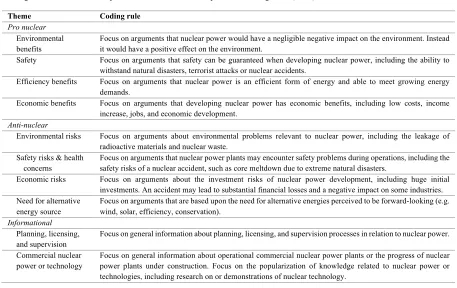
This study followed a combination of deductive and inductive coding in which an existing framework (deductive) was adapted from Wang et al.’s (2004) study on media framing of nuclear energy in China (table 4). This was further enhanced by inductive coding. The framework of Wang is useful as it already identified ‘issue-specific frames’ (de Vreese, 2005) in which nuclear energy is often described. Other researchers that used the same framework also concluded that it is a suitable guide as it “put forward robust, succinct themes to describe media reporting [in the media discourse on nuclear energy].” (Devit et al., 2019, p. 264). Furthermore, this study coded for general characteristics such as the newspaper, section, and year in which the article was published, and the main source that expressed the themes featured in the articles. Adapted from Mercado-Sáez et al. (2019), the main source was the actor that presented the frame in which nuclear energy was discussed. In informational texts this was primarily deducted from the title or lead paragraph, and for opinion texts, it was the one who spoke, or for who the author spoke. As a final step in the coding process the sentiment towards nuclear energy of the entire article was coded with one of the following codes: pro-nuclear, anti-nuclear, balanced/neutral, or informational (table 3).
Based on inductive coding some changes were made to the framework. The codes health risks and safety risks were combined, as analysis showed that these codes were interchangeably used.
To achieve reliable results, a sub-sample of the articles was independently coded by two researchers to estimate the reliability of the coding process. This is in line with the agreed to method for media content analysis (Macnamara, 2005). The following procedure was followed: (1) both researchers discussed the codebook, (2) a subsample of the corpus was randomly selected, consisting of 23 articles (15 percent of the corpus), (3) both coders independently coded the articles, (4) as a final step intercoder reliability was calculated (see table 2). Calculation was based on Cohen’s Kappa, a reliable measurement to determine intercoder reliability (Neuendorf, 2002). Cohen’s Kappa was calculated for the different frames, and all fell above 0.75, indicating excellent agreement beyond change (Banarjee, Capozzoli, Mcsweeney, & Sinha, 1999).
Table 2:
Intercoder reliability coefficients (Cohen's Kappa) per code
Code Cohen’s Kappa coefficient
Newspaper section 1.000
Sentiment 0.933
Dominant frame 0.785
Source 0.892
Table 3:
Codes for the sentiment towards nuclear energy of the entire articles (Adapted from Devitt et al., 2019).
Sentiment Coding rule
Balanced/Neutral The article appears to be balanced when it comes to nuclear energy
[image:8.595.69.526.131.419.2]Informational The article appears to be purely informational and lacking any pro or anti-nuclear claims.
Table 4:
Coding themes and rules for specific frames in text as adapted from Wang et al. (2014).
Theme Coding rule
Pro nuclear
Environmental benefits
Focus on arguments that nuclear power would have a negligible negative impact on the environment. Instead it would have a positive effect on the environment.
Safety Focus on arguments that safety can be guaranteed when developing nuclear power, including the ability to withstand natural disasters, terrorist attacks or nuclear accidents.
Efficiency benefits Focus on arguments that nuclear power is an efficient form of energy and able to meet growing energy demands.
Economic benefits Focus on arguments that developing nuclear power has economic benefits, including low costs, income increase, jobs, and economic development.
Anti-nuclear
Environmental risks Focus on arguments about environmental problems relevant to nuclear power, including the leakage of radioactive materials and nuclear waste.
Safety risks & health concerns
Focus on arguments that nuclear power plants may encounter safety problems during operations, including the safety risks of a nuclear accident, such as core meltdown due to extreme natural disasters.
Economic risks Focus on arguments about the investment risks of nuclear power development, including huge initial investments. An accident may lead to substantial financial losses and a negative impact on some industries. Need for alternative
energy source
Focus on arguments that are based upon the need for alternative energies perceived to be forward-looking (e.g. wind, solar, efficiency, conservation).
Informational
Planning, licensing, and supervision
Focus on general information about planning, licensing, and supervision processes in relation to nuclear power.
Commercial nuclear power or technology
Focus on general information about operational commercial nuclear power plants or the progress of nuclear power plants under construction. Focus on the popularization of knowledge related to nuclear power or technologies, including research on or demonstrations of nuclear technology.
4 Results
4.1 General description
Analysis shows that with 42.5 percent (60 articles), the greatest number of articles represented an
informational sentiment (see table 5). These articles focused on presenting general information about nuclear energy, with limited or anti-nuclear spin. The second most prevalent sentiment was pro-nuclear (34.7% or 49 articles), followed by a shared third place for the anti-nuclear and balanced
sentiment, both found in 11.3 percent of the articles. Of the 79 articles in De Volkskrant, an
informational sentiment was also most prevalent (43.0%), followed by a pro-nuclear sentiment (29.1%),
balanced sentiment (15.2%), and anti-nuclear sentiment (11.4%). The informational sentiment was also most prevalent in De Telegraaf. Of the 62 articles in that newspaper, it was represented in 41.9 percent of the articles, followed by a pro-nuclear sentiment (40.3%), an anti-nuclear sentiment (11.3%), and a
balanced sentiment (6.4%).
The newspapers show similar results. An informational sentiment is dominant in both newspapers. Also, in both newspapers, the number of articles representing a pro-nuclear sentiment is greater than the number of articles representing an anti-nuclear sentiment. However, the percentage of
pro-nuclear articles was higher in De Telegraaf (40.3%) than in De Volkskrant (29.1%). Articles with an anti-nuclear sentiment were identically represented in both newspapers (around 11%), but a balanced sentiment was more present in De Volkskrant (15.2%) than in De Telegraaf (6.4%).
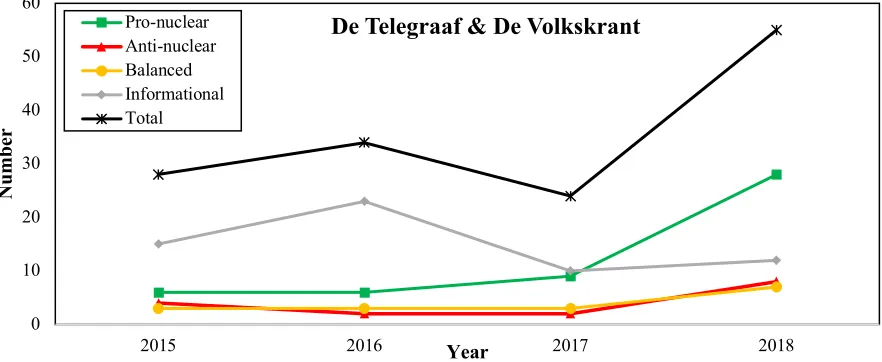
roughly score the same and were the least mentioned sentiments through the years. The informational
sentiment was the dominant sentiment in 2015 and 2016, followed by a pro-nuclear sentiment. These frequencies changed in 2017, when the informational sentiment decreased to roughly the same level as the pro-nuclear sentiment. After an spectacular grow un 2018, the pro-nuclear sentiment surpassed the
informational sentiment and became the most frequently represented (50.9%), leaving the informational
[image:9.595.77.490.203.254.2](21.8%), anti-nuclear (14.5%), and balanced (12.7%) sentiment behind.
Table 5:
Number of articles representing pro-nuclear, anti-nuclear, balanced, and informational sentiments per newspaper
Newspaper Pro-nuclear Anti-nuclear Balanced Informational Total
De Volkskrant 29.1% (n = 24) 11.4% (n = 9) 15.2% (n = 12) 43.0% (n = 34) 79
De Telegraaf 40.3% (n = 25) 11.3% (n = 7) 6.4% (n = 4) 41.9% (n = 26) 62
Total 34.7% (n = 49) 11.3% (n = 16) 11.3% (n = 16) 42.5% (n = 60) 141
Figure 2 and 3 show the number of articles representing the different sentiments for De Telegraaf and
De Volkskrant from 2015 to 2018. These figures roughly display the same trend as figure 1; both newspapers show an increase in number of articles discussing nuclear energy, the informational
[image:9.595.77.518.418.599.2]sentiment dominates in 2015 and 2016, and the environmental sentiment dominates in 2018. However, the 2018 increase of articles with a pro-nuclear sentiment is much higher in de Telegraaf, than in De Volkskrant (64.2% versus 37.0% of the articles in 2018). Moreover, in 2018 the balanced sentiment was more expressed in De Volkskrant than in De Telegraaf (respectively 22.1% versus 3.6% in 2018).
Fig. 1. Total number of articles (in both De Volkskrant and De Telegraaf) representing a pro-nuclear, anti-nuclear, balanced, or informational sentiment.
0 10 20 30 40 50 60
2015 2016 2017 2018
Nu
m
be
r
Year
De Telegraaf & De Volkskrant
Fig. 2. Number of articles in De Telegraaf representing a pro- Fig. 3. Number of articles in De Volkskrant representing nuclear anti-nuclear, balanced, or informational sentiment. a pro-, anti-, balanced, or informational sentiment
4.2 Thematic description
4.2.1 Pro-nuclear themes
Table 6 shows the number of articles with pro-nuclear themes for both newspapers. The total number of articles with a positive theme is 55. With 67.3 percent, environmental benefits is the dominant pro-nuclear theme, followed by safety and security (16.4%), efficiency (9.1%), and economic benefits
(7.3%). De Volkskrant included 30 articles with a pro-nuclear theme. The majority of these articles (70.0%) was dedicated to discussing environmental benefits of nuclear energy. This was followed by the theme’s safety and security (16.6%), and economic benefits (10.0%). Only one article had efficiency
as the dominant theme (3.3%). Likewise, environmental benefits was the dominant pro-nuclear theme in De Telegraaf (64.0%). This was followed by safety and security and efficiency (both 16.0 percent), and economic benefits (3.3% or 1 article).
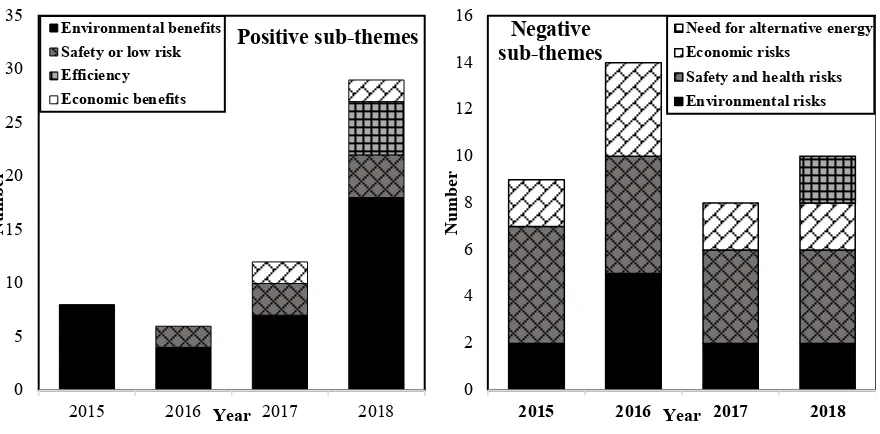
[image:10.595.79.521.71.256.2]Figure 4 shows the use of positive subthemes for both newspapers from 2015 to 2018. For all four years, environmental benefits was the most mentioned pro-nuclear theme. Moreover, it was the only positive theme in 2015. In later years, more pro-nuclear themes were added to the media discourse, with safety or low risk appearing in 2016, economic benefits in 2017 and efficiency benefits in 2018.
Table 6
Numbers and percentages of articles representing pro-nuclear themes in both newspapers 0
5 10 15 20 25 30
2015 2016 2017 2018
Nu
m
be
r
Year
De Telegraaf
Pro-nuclear Anti-nuclear Balanced Informational Total
0 5 10 15 20 25 30
2015 2016 2017 2018
Nu
m
be
r
Year
De Volkskrant
Pro-nuclear Anti-nuclear Balanced Informational Total
Newspaper Number of articles presenting pro-nuclear themes
Environmental Safety and Efficiency Economic Total
benefits security benefits
De Volkskrant 70.0% (n = 21) 16.7% (n = 5) 3.3% (n = 1) 10.0% (n = 3) 30
De Telegraaf 64.0% (n = 16) 16|.0% (n =4) 16.0% (n = 4) 3.3% (n = 1) 25
[image:10.595.111.483.581.684.2]Fig. 4 Fig. 5
Number of articles in De Volkskrant and De Telegraaf that pre- Number of articles in De Volkskrant and De Telegraaf sent pro-nuclear themes in the period 2015-2018 that present anti-nuclear themes in the period 2015-2018
4.2.2 Anti-nuclear themes
Table 7 shows the number of articles representing an anti-nuclear theme for both newspapers. The total number of articles with an anti-nuclear theme is 41. With 43.9 percent, safety and healthconcerns is the dominant negative theme, followed by environmental risks (26.8%), economic risks (24.4%), and need for alternative energy (4.9%). De Volkskrant contained 25 articles with an anti-nuclear theme. Most of these articles focused on safety and health risks and economic risks of nuclear energy (both 32.0%). The theme environmental risk was used in 28.0 percent of the anti-nuclear themes, followed by the need for alternative energy (8.0%).
Figure 5 shows the number of articles with an anti-nuclear theme for both newspapers from 2015 to 2018. The representation of the environmental risks, safety and health risks, and economic risks
[image:11.595.111.485.598.698.2]appears to be stable over time. In 2016 there was a slight increase in the use of the economic risk theme, but this was probably due to financial problems of Delta, the company that owns the only nuclear power plant in The Netherlands. The subtheme need for alternative energy appeared only in 2018. The introduction of this theme could be explained by the increased reporting and discussion about the Dutch climate bill in 2018.
Table 7
Numbers and percentages of articles representing anti-nuclear themes in both newspapers
4.2.3 Informational themes
Table 8 shows the representation of informational themes in De Telegraaf and De Volkskrant. In total, 46 articles reported on nuclear energy with an informational theme. The majority of these articles
0 5 10 15 20 25 30 35
2015 2016 2017 2018
Nu
m
be
r
Year
Positive sub-themes Environmental benefits
Safety or low risk Efficiency Economic benefits
0 2 4 6 8 10 12 14 16
2015 2016 2017 2018
Nu
m
be
r
Year Negative
sub-themes
Need for alternative energy Economic risks
Safety and health risks Environmental risks
Newspaper Number of articles presenting anti-nuclear subthemes
Environmental Safety and Economic Need for Total
risks health risks risks alternative energy
De Volkskrant 28.0% (n = 7) 32.0% (n = 8) 32.0% (n = 8) 8.0% (n = 2) 25
De Telegraaf 25.0% (n = 4) 62.5% (n = 10) 12.5% (n = 2) 0.0% (n = 0) 16
focused on commercial nuclear power and technology (71.7%), the rest (31.8 percent) focused on
[image:12.595.115.484.153.249.2]planning, licensing and supervision.
Table 8
Numbers and percentages of articles representing informational themes in both newspapers
Newspaper Number of articles presenting informational subthemes
Planning, licensing Commercial nuclear Total
and supervision power and technology
de Volkskrant 25% (n = 6) 75% (n = 18) 24
de Telegraaf 31.8% (n = 7) 68.2% (n = 15) 22
Total 28.3% (n = 13) 71.7% (n = 33) 46
4.3 Sources for the themes
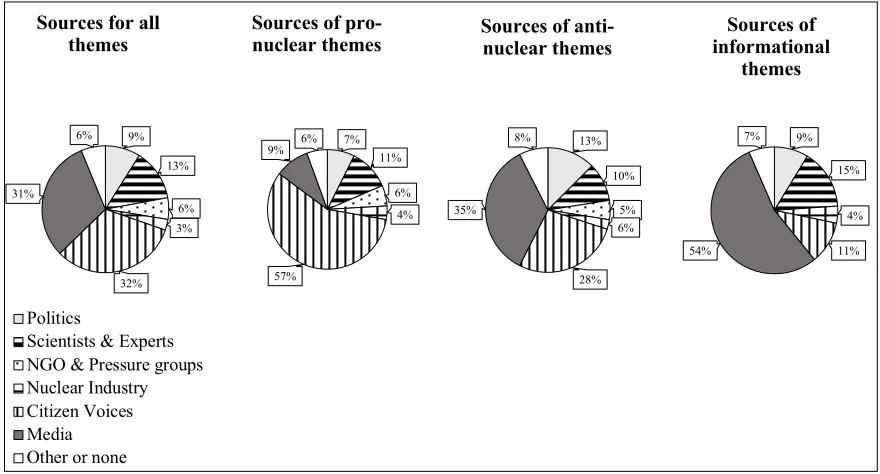
Figure 6 shows the main sources for the nuclear-themes that appeared in the media discourse on nuclear energy. With 32.0 percent, citizen voices are the most represented source. They also are the dominant source for discussion of positive themes (57%). This is probably due to the high number of articles in the opinion and debate section of the newspapers and to columnists speaking for the general public. The second most represented actor is the media (31%). They also dominate as the source for informational themes, as could be expected from a newspaper. However, media are the biggest source of negative themes (35%), much higher than their share in positive themes (9%). This is probably due to the media’s function as to report on incidents, which are by nature negative.
4.4 Salience
4.4 Article placement
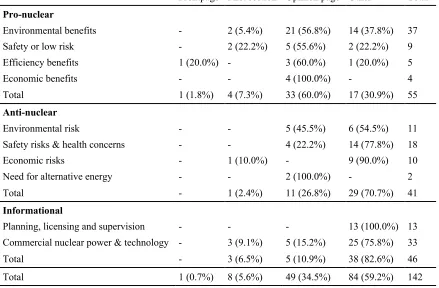
Table 9 shows the newspaper sections in which articles were placed. It is notable that 34.5 percent of the articles appeared in the opinion section of the newspaper. This is even higher for the pro-nuclear theme (60.0%). Only one article (0.7%) got published on the front-page and represented the pro-nuclear
efficiency benefits theme. Eight articles (5.6%) appeared in the first section of the newspapers (page 2 9%
13%
6% 3%
32% 31%
6%
Sources for all themes
Politics
Scientists & Experts NGO & Pressure groups Nuclear Industry Citizen Voices Media Other or none
7% 11%
6% 4%
57%
9% 6%
Sources of pro-nuclear themes
13%
10%
5% 6%
28% 35%
8%
Sources of anti-nuclear themes
9%
15%
4%
11% 54%
7%
Sources of informational
themes
Fig. 6
[image:12.595.77.517.406.643.2]or 3), four of them representing a pro-nuclear theme (environmental benefits and safety or low risk), one an anti-nuclear theme (economic risks), and three an informational theme (commercial nuclear power and technology.
Table 9:
Newspaper sections in which themes appeared for both newspapers
Frontpage First section Opinion page Other Total
Pro-nuclear
Environmental benefits - 2 (5.4%) 21 (56.8%) 14 (37.8%) 37
Safety or low risk - 2 (22.2%) 5 (55.6%) 2 (22.2%) 9
Efficiency benefits 1 (20.0%) - 3 (60.0%) 1 (20.0%) 5
Economic benefits - - 4 (100.0%) - 4
Total 1 (1.8%) 4 (7.3%) 33 (60.0%) 17 (30.9%) 55
Anti-nuclear
Environmental risk - - 5 (45.5%) 6 (54.5%) 11
Safety risks & health concerns - - 4 (22.2%) 14 (77.8%) 18
Economic risks - 1 (10.0%) - 9 (90.0%) 10
Need for alternative energy - - 2 (100.0%) - 2
Total - 1 (2.4%) 11 (26.8%) 29 (70.7%) 41
Informational
Planning, licensing and supervision - - - 13 (100.0%) 13
Commercial nuclear power & technology - 3 (9.1%) 5 (15.2%) 25 (75.8%) 33
Total - 3 (6.5%) 5 (10.9%) 38 (82.6%) 46
Total 1 (0.7%) 8 (5.6%) 49 (34.5%) 84 (59.2%) 142
5 Discussion
5.1 Discussion of main findings
This study examined the news coverage of nuclear energy in the Netherlands. To the researcher’s knowledge, this is the first study that examines the media portrayal of nuclear energy in the Netherlands in times of the global climate change debate. Findings of this study shows that the media discourse on nuclear energy is evolving. Where informational reporting on nuclear energy dominated in 2015, 2016, and possibly before (Devitt, et. al., 2019), a breaking point occurred in 2018 when a pro-nuclear sentiment became dominant in the reporting of nuclear energy. These results were found for both newspapers, indicating the shift is occurring in both left- and right-leaning media. However, De Telegraaf showed a bigger shift towards pro-nuclear sentiments than De Volkskrant. The latter also showed an increase of reporting with a balanced and anti-nuclear sentiment. The move from informational reporting towards pro-nuclear, anti-nuclear, and balanced sentiments could indicate that newspapers are moving away from objective reporting and are looking for a stance on the topic of nuclear energy. So far, this appears to be in favor of nuclear energy. The shift is possibly influenced by the urgency of global climate change, for which nuclear energy could be a key part of decreasing CO2
emissions.
diverse. Where environmental benefits was the only pro-nuclear theme in 2015, more themes were added every year. This trend continued till the last year of this study, in which media reporting included all four pro-nuclear themes (environmental benefits, safety and low risk, efficiency, and economic benefits), indicating a more diversified discussion on the benefits of nuclear energy. A slightly similar result has been found for the anti-nuclear themes. The representation of these themes has been relatively balanced and stable throughout the years, focusing primarily on environmental risks, safety and health risks, and
economic risks of nuclear energy. However, just as the pro-nuclear themes, the extra anti-nuclear theme
need for alternative energy was added in 2018. These shifts are possibly a result of the threats of global climate change, that make people focus more on the pro-nuclear themes (such as low costs and environmental benefits) compared to the anti-nuclear themes (Ansolabehere, & Konisky, 2009). This is in line with a survey in the UK that found that people are willing to accept nuclear energy in order to fight climate change (Pidgeon, Lorenzoni, & Poortinga, 2008).
A third finding is that the same pro-nuclear and anti-nuclear themes have been leading the media representation of nuclear energy throughout the years. The environmental benefits theme has been the dominant pro-nuclear theme, and the safety and health risks has been the dominant anti-nuclear theme.
A fourth finding of this study is that citizen voices and the media are the main sources for the themes in which nuclear energy is discussed. Citizen voices are primarily responsible for the expression of pro-nuclear themes, while the media is primarily responsible for the expression of informational and anti-nuclear themes. Considering the media’s job to represent the news, it come to no surprise that media are the dominant source of informational themes. However, it is unclear why the media is the dominant source of anti-nuclear themes. Although this study did not look into that, it could be due to the fact that even minor nuclear incidents receive enormous amount of media attention (Perko et al., 2010). It is also unclear why citizens are the dominant source of pro-nuclear themes. This study did not look into that, but an explanation could be that citizens are concerned about the consequences of renewable energies and see nuclear energy as a better alternative in the fight against global climate change. It is for example found that the costs of renewable energies (Blazquez, Fuentes-Bracamontes, Bollino, & Nezamuddin, 2018), or consequences such as environmental pollutions from building windmills in the environment are consequences that people find hard to accept (Langer, Deckerm Roosen, & Menrad, 2018). This explanation would also fit our finding that 34.5 percent of articles, and even 60.0% of the pro-nuclear articles were published on the opinion page of the newspapers.
Considering the urgency of global climate change, and the development of new energy policies, it comes as a surprise that politicians are just a minor source for nuclear themes (only in 9% of the articles). On such a controversial topic it would be expected that political parties take a stance and communicate this to the public.
5.2 Limitations
provided a good structure to analyze media coverage. In order to ensure reliability, two-raters were used, and interrater reliability was calculated as more than sufficient, which ensures the reliability of this study.
This study aims to be generalizable toward the entire media coverage of nuclear energy in the Netherlands. It did so by focusing on two big newspapers that are on different sides of the political spectrum and serve different readers. By doing so, the author of this study is confident that the results can be generalized and are representative for the news coverage on nuclear energy in general.
This study was conducted in the theoretical context of agenda-setting theory and framing theory. Agenda-setting theory states that media can influence the public opinion by transferring salience from the media agenda to the public agenda (McCombs, & Shar, 1972). Framing theory would state that the themes in which nuclear energy is framed, could influence how people think about nuclear energy (McCombs, 2005). This study measured the media coverage of nuclear energy, but it is limited as it does not know in what way it influenced the public opinion. Survey research, or panel discussion could be directions for future research to link media discourse and its influence on public opinion. However, based on the theories, the researcher believes this study gives a first indication of how public opinion is shaped and how it is evolving.
6 Conclusion & practical implications 6.1 Conclusion
This study showed that there is increased media attention to the topic of nuclear energy. Media reporting on the topic increased and the themes in which they were reported got more diverse. Additionally, the high number of articles published in de opinion and debate section of newspapers show that an open debate on nuclear energy is already occurring. This study found that global climate change has shifted the way in which nuclear energy is reported by the media. While media tended to report about the topic in an informational way in the past, it seems like media are moving towards taking a position in the debate on nuclear energy. This movement is currently in favor of nuclear energy. In both newspaper pro-nuclear frames dominated the news coverage in 2018. However, this result was more significant in
De Telegraaf than in De Volkskrant. The most important frames in which media report nuclear energy are environmental benefits and health and risk concerns of nuclear energy.
6.2 Practical implications
Literature
Ansolabehere, S., & Konisky, D. M. (2009). Public attitudes toward construction of new power plants. Public Opinion Quarterly,73(3), 566-577. doi:10.1093/poq/nfp041
Apergis, N., Payne, J.E., Menyah, K., Wolde-Rufael, Y., (2010). On the causal dynamics between emissions, nuclear energy. Renewable energy and economic growth. Ecological Economics, 69(1), 2255–2269.
Araújo, K. (2014). The emerging field of energy transitions: progress, challenges, and
opportunities. Energy Research & Social Science, 1(1), 112-121. doi:10.1016/j.erss.2014.03.002
Banerjee, M., Capozzoli, M., Mcsweeney, L., & Sinha, D. (1999). Beyond kappa: A review of interrater agreement measures. Canadian Journal of Statistics, 27(1), 3-23. doi:10.2307/3315487
British Petroleum. (2017). Statistical Review of World Energy June 2017. Retrieved on April 20, 2019 from https://www.bp.com/en/global/corporate/energy-economics/statistical-review-of-world-energy.html
Carvalho, A., & Burgess, J. (2005). Cultural circuits of climate change in U.K. broadsheet
newspapers, 1985-2003. Risk Analysis, 25(6), 1457-1469. doi:10.1111/j.1539-6924.2005.00692.x
Cohen, B. C. (1963). The press and foreign policy. Princeton, NJ: Princeton University Press.
Colvin, J. (2005). Dawn of a new era. Nuclear Power Plant Journal, 1(1), 42-46.
Cook, J., Nuccitelli, D., Green, S. A., Richardson, M., Winkler, B., Painting, R., . . . Skuce, A. (2013). Quantifying the consensus on anthropogenic global warming in the scientific
literature. Environmental Research Letters,8(2), 024-024. doi:10.1088/1748-9326/8/2/024024
Culley, M. R., Ogley‐Oliver, E. , Carton, A. D., & Street, J. C. (2010), Media framing of proposed nuclear reactors: An analysis of print media. Journal of Applied Social Psychology. 20(1), 497-512. doi:10.1002/casp.1056
Devitt, C., Brereton, F., Mooney, S., Conway, D., & Oneill, E. (2019). Nuclear frames in the Irish media: Implications for conversations on nuclear power generation in the age of climate change. Progress in Nuclear Energy, 110, 260-273. doi:10.1016/j.pnucene.2018.09.024
Dellano-Paz, F., Calvo-Silvosa, A., Antelo, S. I., & Soares, I. (2015). The European low-carbon mix for 2030: The role of renewable energy sources in an environmentally and socially efficient approach. Renewable and Sustainable Energy Reviews, 48, 49-61. doi:10.1016/j.rser.2015.03.032
Entman, R. (1993). Framing: Toward clarification of a fractured paradigm, Journal of Communication, 43(4), 51-8. doi:10.1111/j.1460-2466.1993.tb01304.x
Goffman, E. (1974). Frame analysis: An essay on the organization of experience. Cambridge, MA: Harvard University Press.
Hansen, J., M. Sato, and R. Ruedy, (2012): Perception of climate change. Proceedings of the National Academy of Sciences of the United States of America, 109, 14726-14727.
doi:10.1073/pnas.1205276109.
Hijmans, E., Pleijter, A., & Wester, F. (2003). Covering scientific research in Dutch
Hodgetts, D., & Chamberlain, K. (2007). Mediated communities: Considerations for applied social psychology. Journal of Community & Applied Social Psychology, 17(6), 411-414.
doi:10.1002/casp.940
Hsieh, H., & Shannon, S. E. (2005). Three approaches to qualitative content analysis. Qualitative Health Research, 15(9), 1277-1288. doi:10.1177/1049732305276687
Intergovernmental Panel on Climate Change. (2014). Climate Change 2014: Mitigation of Climate Change. Retrieved on April 22, 2019, from https://www.ipcc.ch/report/ar5/wg3/
Koerner, C. L. (2014). Media, fear, and nuclear energy: A case study. The Social Science Journal, 51(2), 240-249. doi:10.1016/j.soscij.2013.07.011
Lau, L. S., Choong, C. K., Ng, C. F., Liew, F. M., & Ching, S. L. (2019). Is nuclear energy clean? Revisit of environmental Kuznets Curve hypothesis in OECD countries. Economic Modelling, 77.
12-20. https://doi.org/10.1016/j.econmod.2018.09.015.
Macnamara, J. (2005). Media content analysis: Its uses; benefits and best practice methodology. Asia Pacific Public Relations Journal, 6(1), 1-34.
McCombs, M. (2005). A look at agenda-setting: Past, present and future. Journalism Studies, 6(4), 543-557. doi:10.1080/14616700500250438
McCombs, M., & Shaw, D. (1972). The agenda-setting function of mass media. Public Opinion Quarterly, 36(2), 176-187. https://doi.org/10.1086/267990
Neuman, W. L. (2014). Social Research Methods Qualitative and Quantitative Approaches (7th ed.). Essex: Pearson.
Neuendorf, K. (2002). The content analysis guidebook. Thousand Oaks, CA: Saga Publications.
Novum. (2012, January 7). Dagbladen trekken minder lezers. NU.nl. Retrieved from https://www.nu.nl/media/2706304/dagbladen-trekken-minder-lezers.html
NRC Handelsblad. (2017, March 30). Dagbladen verliezen papieren abonnees, maar winnen digitale lezers. NRC Handelsblad. Retrieved from https://www.nrc.nl/nieuws/2017/03/30/dagbladen-
verliezen-papieren-abonnees-maar-winnen-digitale-lezers-7774116-a1552566#/handelsblad/2017/03/31/%23202
Pan, Z., & Kosicki, G. M. (1993). Framing analysis: An approach to news discourse. Political Communication, 10(1), 59–79. doi: 10.1080/10584609.1993.9962963
Paska, J., & Surma, T. (2014). Electricity generation from renewable energy sources in Poland. Renewable Energy, 71, 286-294. doi:10.1016/j.renene.2014.05.011
Pidgeon, N. F., Lorenzoni, I., & Poortinga, W. (2008). Climate change or nuclear power—No thanks! A quantitative study of public perceptions and risk framing in Britain, Global Environmental Change, 18 (1),69-85. https://doi.org/10.1016/j.gloenvcha.2007.09.005
Prati, G., & Zani, B. (2013). The effect of the Fukushima nuclear accident on risk perception, antinuclear behavioral intentions, attitude, trust, environmental beliefs, and values. Environment and Behavior, 45(6), 782–798. https://doi.org/10.1177/0013916512444286
Simon, M. (2019). An analysis of trends of print media coverage on climate change in the Trump era
(doctoral dissertation). Retrieved on April 20, 2019, from
https://repository.upenn.edu/cgi/viewcontent.cgi?article=1077&context=mes_capstones
Teräväinen, T., Lehtonen, M., & Martiskainen, M. (2011). Climate change, energy security, and risk—debating nuclear new build in Finland, France and the UK. Energy Policy, 39(6), 3434-3442. doi:10.1016/j.enpol.2011.03.041
United Nations. (1992). United Nations Framework Convention on Climate Change. Paris: United Nations, General Assembly.
Wang, Y., Li, N., & Li, J. (2014). Media coverage and government policy of nuclear power in the Peoples Republic of China. Progress in Nuclear Energy, 77, 214-223.
doi:10.1016/j.pnucene.2014.07.007
Vreese, C. D. (2005). News framing: Theory and typology. Information Design Journal,13(1), 51-62. doi:10.1075/idjdd.13.1.06vre
Weinberg, A. M. (1995). Social institutions and nuclear energy-II. Journal of Nuclear Science and Technology, 32(11), 1071-1080. doi:10.1080/18811248.1995.9731821
Weiss, D. (2009). Agenda-setting theory, in Encyclopedia of Communication Theory, edited by Littlejohn S.W. and Foss, K. A. 31-33.