Implementation in Mixed Nash Equilibrium
∗
Claudio Mezzetti & Ludovic Renou
No 902
WARWICK ECONOMIC RESEARCH PAPERS
Implementation in Mixed Nash Equilibrium
∗
Claudio Mezzetti
†& Ludovic Renou
‡April 28, 2009
Abstract
A mechanism implements a social choice correspondencef in mixed Nash equi-librium if at any preference profile, the set ofall pure and mixed Nash equilibrium outcomes coincides with the set of f-optimal alternatives at that preference
pro-file. This definition generalizes Maskin’s definition of Nash implementation in that it does not require each optimal alternative to be the outcome of apureNash
equilibrium. We show that the condition of weak set-monotonicity, a weakening of Maskin’s monotonicity, is necessary for implementation. We provide sufficient con-ditions for implementation and show that important social choice correspondences
that are not Maskin monotonic can be implemented in mixed Nash equilibrium.
Keywords: implementation, Maskin monotonicity, pure and mixed Nash equi-librium, weak set-monotonicity, social choice correspondence.
JEL Classification Numbers: C72; D71
∗We thank Olivier Bochet and Jean-Marc Tallon.
†Department of Economics, Warwick University, Coventry CV4 7AL, United Kingdom.
‡Department of Economics, University of Leicester, Leicester LE1 7RH, United Kingdom.
1
Introduction
This paper studies the problem of implementation in mixed Nash equilibrium. According to our definition, a mechanism implements a social choice correspondence f in mixed Nash equilibrium if the set of all pure and mixed equilibrium outcomes corresponds to the set of f-optimal alternatives at each preference profile. Crucially, and unlike the classical definition of implementation, this definition of implementation does not give a predominant role to pure equilibria: an optimal alternative does not have to be the outcome of a pure Nash equilibrium. This sharply contrasts with most of the literature on Nash implementation, which does not consider equilibria in mixed strategies. Two notable exceptions are Maskin (1999) for Nash implementation and Serrano and Vohra (2007) for Bayesian implementation. These authors do consider mixed equilibria, but still require each f-optimal alternative to be the outcome of a pure equilibrium. Pure equilibria are yet again given a special status.
Perhaps, the emphasis on pure equilibria expresses a discomfort with the classical view of mixing as deliberate randomizations on the part of the players. However, it is now accepted that even if players do not randomize but choose definite actions, a mixed strategy may be viewed as a representation of the other players’ uncertainty about a player’s choice (e.g., see Aumann and Brandenburger, 1995). Additionally, almost all mixed equilibria can be viewed as pure Bayesian equilibria of nearby games of incom-plete information, in which every player is uncertain about the exact preferences of the other players, as first suggested in the seminal work of Harsanyi (1973). This view ac-knowledges that games with commonly known preferences are an idealization, a limit of near-complete information games. This interpretation is particularly important for the theory of implementation in Nash equilibrium, whereby the assumption of common knowledge of preferences, especially on large domains, is at best a simplifying assump-tion.1 Furthermore, recent evidence in the experimental literature suggest that equilibria
1
in mixed strategies are good predictors of behavior in some classes of games e.g., coor-dination games and chicken games (see chapters 3 and 7 of Camerer, 2003). Since, for some preference profiles, a mechanism can induce one of those games, paying attention to mixed equilibria is important if we want to describe or predict players’ behavior. In sum, we believe that there are no compelling reasons to give pure Nash equilibria a special status and modify the definition of implementation accordingly.
Our definition of mixed Nash implementation yields surprising results. We demon-strate that the condition of Maskin monotonicity is not necessary for full implementation in mixed Nash equilibrium. Intuitively, consider a profile of preferences and an alter-native, say a, that is f-optimal at that profile of preferences. According to Maskin’s definition of implementation, there must exist a pure Nash equilibrium with equilibrium outcome a. This implies that any alternative a player can trigger by unilateral devia-tions is less preferred than a. Thus, if we move to another profile of preferences where
a does not fall down in the players’ ranking, then a remains an equilibrium outcome and must be optimal at that new profile of preferences. Unlike Maskin’s definition of implementation, our definition does not requireato be a pure equilibrium outcome. So, suppose that there exists a mixed equilibrium with a as an equilibrium outcome.2 The
key observation to make is that the mixed equilibrium induces a lottery over optimal alternatives. Thus, when we move to another profile of preferences where a does not fall down in the players’ ranking, the original profile of strategies does not have to be an equilibrium at the new state. In fact, we show that a much weaker condition, weak set-monotonicity, is necessary for implementation in mixed Nash equilibrium. Weak set-monotonicity states that the set of optimal alternatives f(θ) at state θ is included in the set of optimal alternatives f(θ′) at state θ′, whenever the weak and strict lower
contour sets at state θ of all alternatives in f(θ) are included in their respective weak and strict lower contour sets at state θ′, for all players.
Weak set-monotonicity is a substantially weaker requirement than Maskin mono-tonicity. For instance, on the unrestricted domain of preferences, the strong Pareto and the strong core correspondences are weak set-monotonic, while they are not Maskin monotonic. Similarly, on the domain of strict preferences, the top-cycle and the
uncov-monotonicity is necessary for implementation in pure Nash equilibrium.
2
More precisely, letσ∗ be the mixed Nash equilibrium andP
σ∗,g the distribution over alternatives
induced by the strategy profileσ∗ and the allocation rule g. Thenabelongs to the support ofP
ered set correspondences are weak set-monotonic, but not Maskin monotonic.
Furthermore, we show that weak set-monotonicity and no-veto power are sufficient for implementation on the domain of strict preferences. However, and somewhat sur-prisingly, the condition of weak set-monotonicity even coupled with the no-veto power condition is not sufficient for implementation in mixed Nash equilibrium in general. A mild strengthening of weak set-monotonicity that we call weak* set-monotonicity is re-quired. Since no-veto power is not satisfied by important social choice correspondences like the strong Pareto and the strong core, we also present sufficient conditions that dispense with the no-veto power condition. (See Benoˆıt and Ok, 2008, and Bochet, 2007.)
An important feature of our sufficiency proofs is the use of randomized mechanisms. Since we consider implementation in mixed Nash equilibrium, the use of randomized mechanisms seems natural. As for the players, the designer’s randomization can be interpreted as the players’ beliefs about the choice of alternatives. In the literature on (exact) Nash implementation, randomized mechanisms have been studied by Benoˆıt and Ok (2008) and Bochet (2007). These authors restrict attention to mechanisms in which randomization by the designer can only occur out of equilibrium, and do not attempt to rule out mixed strategy equilibria with undesirable outcomes. On the contrary, we allow randomization among f-optimal alternatives at equilibrium and rule out mixed equilibria with outcomes that are not f-optimal. Our approach also differs from the use of randomized mechanisms in the literature on virtual implementation (e.g., see Matsushima, 1998, and Abreu and Sen, 1991), which heavily exploits the possibility of selecting undesirable alternatives with positive probability in equilibrium.
2
A Simple Example
This section illustrates our notion of mixed Nash implementation with the help of a simple example.
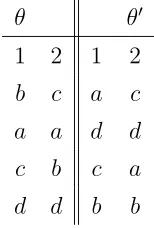
Example 1 There are two players, 1 and 2, two states of the world, θ and θ′, and four
[image:6.612.263.340.232.346.2]alternatives, a,b,c, and d. Players have state-dependent preferences represented in the table below. Preferences are strict. For instance, player 1 ranks b first anda second in state θ, while a is ranked first and b last in state θ′.
θ θ′
1 2 1 2
b c a c
a a d d
c b c a
d d b b
The designer aims to implement the social choice correspondencef withf(θ) ={a}and
f(θ′) ={a, b, c, d}. We say that an alternative x isf-optimal at state θ if x∈f(θ).
We first argue that the social choice correspondence f is not implementable in the sense of Maskin (1999). Maskin’s definition of Nash implementation requires that for eachf-optimal alternative at a given state, there exists a pure Nash equilibrium (of the game induced by the mechanism) corresponding to that alternative. So, for instance, at state θ′, there must exist a pure Nash equilibrium with b as equilibrium outcome.
Maskin requires furthermore that no such equilibrium must exist at state θ. However, if there exists a pure equilibrium with b as equilibrium outcome at state θ′, then b will
also be an equilibrium outcome at state θ, since b moves up in every players’ ranking when going from stateθ′ to state θ. The correspondence f is thus not implementable in
the sense of Maskin. In other words, the social choice correspondencef violates Maskin monotonicity, a necessary condition for implementation in the sense of Maskin.
In contrast with Maskin, we do not require that for each f-optimal alternative at a given state, there exists a pure Nash equilibrium corresponding to that alternative. We require instead that the set off-optimal alternatives coincides with the set ofmixed
Nash equilibrium outcomes. So, at stateθ′, there must exist a mixed Nash equilibrium
We now argue that with our definition of implementation, the correspondence f is implementable. To see this, consider the mechanism where each player has two messages
m1 and m2, and the allocation rule is represented in the table below.
m1 m2
m1 a b
m2 d c
For example, if both players announce m1, the chosen alternative is a. Now, at state θ,
(m1, m1) is the unique Nash equilibrium, with outcome a. At state θ′, both (m1, m1)
and (m2, m2) are pure Nash equilibria, with outcomes a and c. Moreover, there exists
a mixed Nash equilibrium that puts strictly positive probability on each action profile (since preferences are strict), hence on each outcome. Therefore, f is implementable in mixed Nash equilibrium, although it is not implementable in the sense of Maskin.
We conclude this section with two important observations. First, our notion of im-plementation in mixed Nash equilibrium isordinal: the social choice correspondencef is implementable regardless of the cardinal representations chosen for the two players. Sec-ond, alternativedisf-optimal at stateθ′, and it moves down in player 1’s ranking when
moving from θ′ to θ. This preference reversal guarantees the weak set-monotonicity of
the correspondencef, which, as we shall see, is a necessary condition for implementation in mixed Nash equilibrium.
3
Preliminaries
An environment is a triplet hN, X,Θi where N := {1, . . . , n} is a set of n players, X
a finite set of alternatives, and Θ a finite set of states of the world. Associated with each state θ is a preference profile <θ:= (<θ1, . . . ,<θn), where <θi is player i’s preference relation over X at state θ. The asymmetric and symmetric parts of <θi are denoted≻θ i
and ∼θ
i, respectively.
We denote with Li(x, θ) := {y ∈ X : x <θi y} player i’s lower contour set of x at
state θ, and SLi(x, θ) :={y ∈X :x≻θi y}the strict lower contour set. For any (i, θ) in
N ×Θ andY ⊆X, define maxθ
i Y as {x∈Y :x<θi yfor ally∈Y}.
We assume that any preference relation <θi is representable by a utility function
with Uθ
i the set of all possible cardinal representations ui(·, θ) of <θi at state θ, and let Uθ :=×
i∈NUiθ.
A social choice correspondence f : Θ → 2X \ {∅} associates with each state of the
world θ, a non-empty subset of alternatives f(θ)⊆X. Two classic conditions for Nash implementation are Maskin monotonicity and no-veto power. A social choice correspon-dence f is Maskin monotonic if for all (x, θ, θ′) in X×Θ×Θ with x ∈ f(θ), we have x ∈ f(θ′) whenever Li(x, θ) ⊆ Li(x, θ′) for all i ∈ N. Maskin monotonicity is a
neces-sary condition for Nash implementation (`a la Maskin). A social choice correspondence
f satisfies no-veto power if for all θ ∈ Θ, we have x ∈ f(θ) whenever x ∈ maxθ i X for
all but at most one player i∈N. Maskin monotonicity and no-veto power are sufficient conditions for Nash implemetation (in the sense of Maskin).
Let ∆(X) be the set of all probability measures overX. A mechanism (or game form) is a pair h(Mi)i∈N, gi with Mi the set of messages of player i, and g :×i∈NMi →∆(X)
the allocation rule. LetM :=×j∈NMj andM−i :=×j∈N\{i}Mj, withmandm−i generic
elements.
A mechanismh(Mi)i∈N, gi, a stateθand a profile of cardinal representations (ui(·, θ))i∈N
of (<θ
i)i∈N induce a strategic-form game as follows. There is a set N of n players. The
set of pure actions of player i is Mi, and player i’s expected payoff when he plays mi
and his opponents playm−i is
Ui(g(mi, m−i), θ) := X
x∈X
g(mi, m−i)(x)ui(x, θ),
where g(mi, m−i)(x) is the probability that x is chosen by the mechanism when the
profile of messages (mi, m−i) is announced. The induced strategic-form game is thus
G(θ, u) := hN,(Mi, Ui(g(·), θ))i∈Ni. Let σ be a profile of mixed strategies. We denote
with Pσ,g the probability distribution over alternatives in X induced by the allocation
rule g and the profile of mixed strategiesσ.3
Definition 1 The mechanismh(Mi)i∈N, giimplements the social choice correspondence
f in mixed Nash equilibrium if for allθ ∈Θ, for all cardinal representationsu(·, θ)∈ Uθ
of <θ, the following two conditions hold:
(i) For each x ∈f(θ), there exists a Nash equilibrium σ∗ of G(θ, u) such that x is in
the support of Pσ∗,g, and
3
(ii) if σ is a Nash equilibrium ofG(θ, u), then the support of Pσ,g is included in f(θ).
Before proceeding, it is important to contrast our definition of implementation in mixed Nash equilibrium with Maskin (1999) definition of Nash implementation.
First, part (i) of Maskin’s definition requires that for each x ∈ f(θ), there is a pure Nash equilibrium m∗ of G(θ, u) with equilibrium outcome x, while part (ii) of his
definition is identical to ours. In contrast with Maskin, we allow for mixed strategy Nash equilibria in part (i) and, thus, restore a natural symmetry between parts (i) and (ii). Yet, our definition respects the spirit of full implementation in that only optimal outcomes can be observed by the designer as equilibrium outcomes.
Second, as in Maskin, our concept of implementation is ordinal as all equilibrium outcomes have to be optimal, regardless of the cardinal representation chosen.
Third, we allow the designer to use randomized mechanisms. This is a natural as-sumption given that players can use mixed strategies. Indeed, although a randomized mechanism introduces some uncertainty about the alternative to be chosen, the concept of a mixed Nash equilibrium already encapsulates the idea that players are uncertain about the messages sent to the designer and, consequently, about the alternative to be chosen. We also stress that the randomization can only be among optimal alternatives in equilibrium. In the context of (exact) Nash implementation, Benoˆıt and Ok (2008) and Bochet (2007) have already considered randomized mechanisms.4 There are two
impor-tant differences with our work. First, these authors restrict attention to mechanisms in which randomization only occurs out of equilibrium, while randomization can occur in equilibrium in our work, albeit only among optimal alternatives. Second, unlike us, they do not attempt to rule out mixed strategy equilibria with undesirable outcomes. Also, our work contrasts with the literature on virtual implementation (e.g., see Matsushima, 1998, and Abreu and Sen, 1991), which heavily exploits randomized mechanisms that select undesirable alternatives with positive probability in equilibrium. Unlike this liter-ature, we focus on exact implementation: onlyf-optimal alternatives can be equilibrium outcomes.
Finally, from our definition of mixed Nash implementation, it is immediate to see that if a social choice correspondence is Nash implementable (i.e., `a la Maskin), then
4
it is implementable in mixed Nash equilibrium. The converse is false, as shown by Example 1 in Section 2. The goal of this paper is to characterize the social choice correspondences implementable in mixed Nash equilibrium. The next section provides a necessary condition.
4
A Necessary Condition
This section introduces a new condition, called weak set-monotonicity, which we show to be necessary for the implementation of social choice correspondences in mixed Nash equilibrium.
Definition 2 A social choice correspondence f is weak set-monotonic if for all pairs
(θ, θ′) ∈ Θ×Θ, we have f(θ) ⊆ f(θ′) whenever for all x ∈ f(θ), for all i ∈ N : (i) Li(x, θ)⊆Li(x, θ′)and (ii) SLi(x, θ)⊆SLi(x, θ′).5
Weak set-monotonicity is a weakening of Maskin monotonicity. It requires that if for all players, the lower and strict lower contour sets of all alternatives in f(θ) do not shrink in moving fromθ toθ′, then the set of optimal alternatives f(θ′) at θ′ must
be a superset of the set of optimal alternatives f(θ) at θ. As we shall see in Section 7, important correspondences, like the strong Pareto correspondence, the strong core correspondence, the top-cycle set and the uncovered set, are weak-set monotonic, while they fail to be Maskin monotonic.
Theorem 1 If the social choice correspondencef is implementable in mixed Nash
equi-librium, then it satisfies the weak set-monotonicity condition.
Proof The proof is by contradiction on the contrapositive. Assume that the social
choice correspondence f does not satisfy weak set-monotonicity and yet it is imple-mentable in mixed Nash equilibrium by the mechanism hM, gi.
Since f does not satisfy weak set-monotonicity, there exist x∗, θ, and θ′ such that x∗ ∈ f(θ)\f(θ′), while L
i(x, θ) ⊆ Li(x, θ′) and SLi(x, θ) ⊆ SLi(x, θ′) for all x ∈ f(θ),
for all i∈N.
5
Alternatively, a social choice correspondence f is weak set-monotonic ifx∗ ∈ f(θ)\f(θ′) implies that there exists a pair (x, y) in f(θ)×X and a playeri∈N such that either (1)x<θi y andy≻θ
′
i x,
or (2)x≻θ
i y andy< θ′
Claim. For each playeri∈N, fix a cardinal representation ui(·, θ) of <θi. We claim
that there exists a cardinal representation ui(·, θ′) of <θ
′
i such that ui(x, θ′) ≤ ui(x, θ)
for all x∈X, ui(x, θ′) =ui(x, θ) for all x∈f(θ).
To prove our claim, consider any pair (x, x′) ∈ f(θ)×f(θ) with x <θ
i x′. Since
Li(x, θ)⊆Li(x, θ′) for allx∈f(θ), we have thatx<θ
′
i x′. Hence, we can associate with
each alternative inf(θ) the same utility atθ′ as atθ. Now, fix anx∈f(θ) and consider y ∈ Li(x, θ). Since Li(x, θ) ⊆ Li(x, θ′), we must have ui(y, θ′) ≤ ui(x, θ′) = ui(x, θ). If
x∼θ
i y, then we can choose ui(y, θ′) ≤ui(y, θ) =ui(x, θ). Ifx ≻θi y, then we must have
x ≻θ′
i y since SLi(x, θ) ⊆ SLi(x, θ′); we can therefore choose ui(y, θ′) in the open set
(−∞, ui(y, θ)) and still represent <θ
′
i by ui(·, θ′). Finally, ify /∈ ∪x∈f(θ)Li(x, θ), we have
that ui(y, θ)> ui(x, θ) for all x∈ f(θ). If y ∈Li(x, θ′) for some x ∈f(θ), then we can
set ui(y, θ′) ≤ ui(x, θ′) = ui(x, θ) ≤maxx∈f(θ)ui(x, θ) < ui(y, θ). If y /∈ ∪x∈f(θ)Li(x, θ′),
then we can choose ui(y, θ′) in the open set (maxx∈f(θ)ui(x, θ), ui(y, θ)). This concludes
the proof of our claim.
Before proceeding, we should stress the importance of the nestedness of the strict lower-contour sets in part (ii) of the definition of weak set-monotonicity. Let x ∈f(θ) and assume that x∼θ
i y≻θi z at state θ and x∼θ
′
i z ≻θ
′
i y at stateθ′. Both alternatives
z and y are in the lower contour set of x at θ and θ′, but the strict lower-contour sets
are not nested. Clearly, we cannot assign the same utility to x at θ and θ′ and weakly
decrease the utility of both y and z when moving from θ to θ′; the claim does not hold.
Since f is implementable and x∗ ∈ f(θ), for any cardinal representation u(·, θ) of
<θ, there exists an equilibrium σ∗ of the game G(θ, u) with x∗ in the support of P
σ∗,g.
Furthermore, since x∗ ∈/ f(θ′), for all cardinal representations u(·, θ′) of <θ′
, for all equilibria σ of G(θ′, u), x∗ does not belong to the support of P
σ,g. In particular, this
implies that σ∗ is not an equilibrium atθ′ for all cardinal representation u(·, θ′). Thus,
there exist a player i, a message m∗
i in the support of σi∗, and a message m′i such that
X
m−i
[Ui(g(m∗i, m−i), θ)−Ui(g(mi′, m−i), θ)]σ−∗i(m−i)≥0
and
0>X
m−i
It follows that
X
m−i
[Ui(g(m∗i, m−i), θ)−Ui(g(m∗i, m−i), θ′)]σ−∗i(m−i) (1)
> X
m−i
[Ui(g(m′i, m−i), θ)−Ui(g(m′i, m−i), θ′)]σ−∗i(m−i)
Let us now consider the cardinal representations presented in the proof of the claim above; that is, where for all i ∈ N, ui(x, θ′) ≤ ui(x, θ) for all x ∈ X and ui(x, θ) =
ui(x, θ′) for all x ∈ f(θ). Since f is implementable, we have that the support of Pσ∗,g
is included in f(θ). Therefore, Ui(g(m∗i, m−i), θ) =Ui(g(m∗i, m−i), θ′) for all m−i in the
support of σ∗
−i. Hence, the left-hand side of the inequality (1) is zero. Furthermore, we
have that Ui(g(m′i, m−i), θ)≥Ui(g(m′i, m−i), θ′) for allm−i. Hence, the right-hand side
of (1) is non-negative, a contradiction. This completes the proof.
Several remarks are worth making. First, Theorem 1 remains valid if we restrict ourself to deterministic mechanisms, so that weak-set monotonicity is a necessary con-dition for implementation in mixed Nash equilibrium, regardless of whether we consider deterministic or randomized mechanisms. Second, it is easy to verify that weak-set monotonicity is also a necessary condition for implementation in Nash equilibrium (`a la Maskin) with randomized mechanisms. Third, while we have restricted attention to von Neumann-Morgenstern preferences, the condition of weak set-monotonicity remains necessary if we consider larger classes of preferences that include the von Neumann-Morgenstern preferences. Furthermore, if players have non-additive beliefs about the play of their opponents (modelled as simple capacities) and their preferences are rep-resented as Choquet integral of Bernoulli utilities over capacities (as in the concept of
equilibrium under uncertainty introduced by Eichberger and Kelsey, 2000), then our re-sult also remains valid.6 This suggests that our necessary condition does not critically
depend on the restriction to von Neumann-Morgenstern preferences.
As customary in the large literature on implementation (see Jackson, 2001, and Maskin and Sj¨ostr¨om, 2002, for excellent surveys), it is natural to ask whether the con-dition of weak set-monotonicity is “almost” sufficient for implementation. The following example shows that this is not the case.
6
This follows from Lemma 3.3 of Eichberger and Kelsey (2000) and the fact that the Choquet integral of (σ∗
Example 2 There are three players, 1, 2 and 3, two states of the world, θ and θ′, and three alternatives a,b and c. Preferences are represented in the table below.
θ θ′
1 2 3 1 2 3
b a c b a∼b c
c b a c a
a c b a c b
The social choice correspondence is f(θ) = {a} and f(θ′) = {b}. It is weak
set-monotonic since SL2(a, θ) 6⊆ SL2(a, θ′) and L2(b, θ′) 6⊆ L2(b, θ). However, it is
not implementable in mixed Nash equilibrium. If it were implementable, then for any cardinal representation of <θ, there would exist an equilibrium σ∗ at θ such that
the support of Pσ∗,g is {a}. Then, σ∗ would also be an equilibrium at θ′ for some
cardinal representation of <θ′
, a contradiction. For instance, fix a cardinal repre-sentation u(·, θ) at θ. Since players 1 and 3’s preferences do not change from θ to
θ′, we can use the same cardinal representations at θ′. As for player 2, we can use u2(a, θ′) = u2(a, θ) = u2(b, θ′) > u2(b, θ) > u2(c, θ) = u2(c, θ′). The intuition is clear.
Since players 1 and 3’s preferences do not change from θ to θ′ and a is top-ranked for
player 2 at both states, any equilibrium at θ with outcome a remains an equilibrium at
θ′. At stateθ′, there is no alternative that can be used to generate a profitable deviation
for player 2.
Note, furthermore, that the social choice correspondence f in Example 2 satisfies the no-veto power condition. Hence, no-veto power together with weak set-monotonicity are not sufficient for Nash implementation. The next section provide sufficient conditions: a strengthening of weak-set monotonicity will be needed.
5
Sufficient Conditions
Before stating the main result of this section, we need to introduce two additional definitions. The first definition strengthens the notion of weak set-monotonicity.
Definition 3 A social choice correspondence f is weak* set-monotonic if for all pairs
(θ, θ′) ∈ Θ×Θ, we have f(θ) ⊆ f(θ′) whenever for all x ∈ f(θ), for all i ∈ N : (i) Li(x, θ)⊆Li(x, θ′)and (ii) either SLi(x, θ)⊆SLi(x, θ′) or x∈maxθ
′
In Example 2, the social choice correspondence f is not weak* set-monotonic since
L2(a, θ)⊆L2(a, θ′), a∈maxθ
′
2{a, b, c}, and yet a /∈f(θ′).
Clearly, if a social choice correspondence is Maskin monotonic, then it is weak* set-monotonic, and if it is weak* set-set-monotonic, then it is weak set-monotonic. Moreover, weak* set-monotonicity coincides with weak set-monotonicity if maxθ
i X is a singleton
for each i∈N, for each θ∈Θ. We refer to this domain of preferences as the single-top preferences. This mild domain restriction will prove useful in applications (see Section 7). Furthermore, on the domain of strict preferences (a subset of single-top preferences)
SLi(x, θ) =Li(x, θ)\ {x}for allxand θ, and weak* set-monotonicity is then equivalent
to weak set-monotonicity.
The second condition we need is a restriction on the set of cardinal representations at each state. We assume that for each player i ∈ N, for each state θ ∈ Θ, the set of admissible cardinal representations is a compact subset Uθi of Uiθ. It follows that there
existsε >0 such that for alli∈N, for allθ,for each pair (x, y)∈X×Xwithx≻θ
i y, and
for all ui(·, θ)∈ U θ
i : ui(x, θ)≥(1−ε)ui(y, θ) +εmaxz∈Xui(z, θ). Accordingly, we have
to modify Definition 1 of mixed Nash implementation so as to include this restriction on the set of cardinal representations. We call this new notion of implementation, mixed Nash C-implementation.
Naturally, withC-implementation, the condition of weak set-monotonicity might fail to be necessary. For instance, consider the following example.
Example 3 There are two players, 1 and 2, two states of the world, θ and θ′, and a
unique cardinal representation at each state, indicated below:
θ θ′
1 2 1 2
d : 2
c : 1.5
a : 1
b : −1
d : 5
c : 2
a : 1
b : 0
d : 5
a : 1
c : 0.5
b : −1
c∼d : 2
a : 1
b : 0
yet it is implementable by the following mechanism, where (1/2)a+ (1/2)b denotes a 50-50 lottery on a and b.
m1 m2
m1 a (1/2)a+ (1/2)b
m2 (1/2)d+ (1/2)b c
For “large” enough compact sets of cardinal representations, however, the condition of weak-set monotonicity remains necessary. For instance, fix δ > 0, and let Uθi :=
{ui(x, θ) ∈ [−K, K] for all x ∈ X : x ≻iθ y ⇔ ui(x, θ) ≥ ui(y, θ) +δ} with K large
enough but finite. The set Uθi of cardinal representations is clearly compact, and the proof of Theorem 1 carries over if δ <2K/(|X|2).7
We are now ready to present the main result of this section, which states that in any environment with at least three players, weak* set-monotonicity and no veto-power are sufficient conditions for implementation in mixed Nash equilibrium. The mechanism constructed in the proof is partly inspired by the mechanism in the appendix of Maskin (1999).8
Theorem 2 LethN, X,Θibe an environment withn ≥3. If the social choice
correspon-dence f is weak* set-monotonic and satisfies no-veto power, then it is C-implementable in mixed Nash equilibrium.
Proof Consider the following mechanism hM, gi. For each player i ∈N, the message
space Mi is Θ× {αi : αi :X×Θ2 →X} ×X ×Z++. In words, each player announces
a state of the world, a function from alternatives and pairs of states into alternatives, an alternative, and a strictly positive integer. A typical message mi for player i is
7
To see this, fix the following cardinal representation of <θi : ui(x, θ) = K for all x ∈ maxθi X, ui(x, θ) =K−δ|X|for allx∈maxθ
i(X\max θ
iX), etc. This cardinal representation is clearly admissible
and the difference in utilities between any two alternatives that are not indifferent is at leastδ|X|. It is then easy to see that, as required by the claim in the proof of Theorem 1, if we move to a state θ′ where Li(x, θ)⊆Li(x, θ′) and SLi(x, θ)⊆SLi(x, θ′) for allx∈f(θ), for all i∈N, then there exists a cardinal representationui(·, θ′) withui(x, θ′)≤ui(x, θ) for allx∈X, andui(x, θ′) =ui(x, θ) for all
x∈f(θ). That is all we need for the proof of Theorem 1 to go through.
8
(θi, αi, xi,zi). (Note that we denote any integer z in bold.) Let M := ×
i∈NMi with
typical element m.
Let {f1(θ), . . . , fKθ(θ)}=f(θ) be the set of f-optimal alternatives at state θ ; note
that Kθ = |f(θ)|. Let 1 > ε > 0 be such that for all i ∈ N, for all θ ∈ Θ, for
each pair (x, y) ∈ X ×X with x ≻θ
i y, and for all ui(·, θ) ∈ U θ
i, we have ui(x, θ) ≥
(1−ε)ui(y, θ) +εmaxw∈Xui(w, θ). Since U θ
i is a compact subset ofUiθ, such anε exists.
The allocation rule g is defined as follows.
Rule 1: Ifmi = (θ, α, x,1) for alli∈N (i.e., all agents make the same announcement
mi) and α(fk(θ), θ, θ) =fk(θ) for all fk(θ) ∈f(θ), then g(m) is the “uniform” lottery
over alternatives in f(θ); that is,
g(m) = 1
Kθ Kθ X
k=1
fk(θ).
Rule 2: If there exists j ∈ N such that mi = (θ, α, x,1) for all i ∈ N \ {j}, with
α(fk(θ), θ, θ) =fk(θ) for all fk(θ)∈ f(θ), and mj = (θj, αj, xj,zj)6=mi, then g(m) is
the lottery: 1 Kθ Kθ X k=1
δk(m)
(1−εk(m))αj(fk(θ), θ, θj) +εk(m)xj
+ (1−δk(m))fk(θ) ,
with
δk(m) =
δ ifαj(f
k(θ), θ, θj)∈Lj(fk(θ), θ)
0 ifαj(f
k(θ), θ, θj)6∈Lj(fk(θ), θ)
for 1> δ >0, and
εk(m) =
ε ifαj(f
k(θ), θ, θj)∈SLj(fk(θ), θ)
0 ifαj(f
k(θ), θ, θj)6∈SLj(fk(θ), θ)
.
That is, suppose all players but playerjsend the same message (θ, α, x,1) withα(fk(θ), θ, θ)
=fk(θ) for all k ∈ {1, . . . , Kθ}. Let mj = (θj, αj, xj,zj) be the message sent by player
j. If αj(f
k(θ), θ, θj) selects an alternative x in the strict lower-contour setSLj(fk(θ), θ)
of player j at state θ, then the designer replaces the outcome fk(θ) from the uniform
lottery with the lottery δ[(1−ε)x+εxj] + (1− δ)f
k(θ). If αj(fk(θ), θ, θj) selects an
fk(θ) at stateθ), then the designer replaces the outcomefk(θ) from the uniform lottery
with the lotteryδx+ (1−δ)fk(θ). Otherwise, the designer does not replace the outcome
fk(θ) from the uniform lottery.
Rule 3: If neither rule 1 nor rule 2 applies, theng (θi, αi, xi,zi) i∈N
=xi∗
,withi∗ a
player announcing the highest integerzi∗
. (If more than one player iselects the highest integer, then g randomizes uniformly among their selected xi).
Fix a stateθ∗, and a cardinal representationu
i ∈ U θ∗
i of <θ
∗
i for each player i. Letu
be the vector of cardinal representations.
We first show that for any x∈f(θ∗), there exists a Nash equilibrium σ∗ of G(θ∗, u)
such thatx belongs to the support ofPσ∗,g. Consider a profile of strategies σ∗ such that σ∗
i = (θ∗, α, x,1) for all i ∈N, so that rule 1 applies. The (pure strategy) profile σ∗ is
clearly a Nash equilibrium at state θ∗. By deviating, each player i can trigger rule 2,
but none of these possible deviations are profitable. Any deviation can either induce a probability shift in the uniform lottery from fk(θ∗) to a lottery with mass (1−ε) on an
alternative inSLi(fk(θ∗), θ∗) and massεonxj,or shiftδprobability mass fromfk(θ∗) to
an alternative indifferent tofk(θ∗) (i.e., an alternative inLi(fk(θ∗), θ∗)\SLi(fk(θ∗), θ∗)).
By definition of ε, the former type of deviation is not profitable. Moreover, under σ∗,
the support of Pσ∗,g isf(θ∗). Hence, for any x∈f(θ∗), there exists an equilibrium that
implements x.
Conversely, we need to show that ifσ∗ is a mixed Nash equilibrium of G(θ∗, u), then
the the support of Pσ∗,g is included in f(θ∗). Let m be a message profile and denote
with gO(m) the set of alternatives that occur with strictly positive probability when m
is played: gO(m) = {x ∈ X : g(m)(x) > 0}. Let us partition the set of messages M
into three subsets corresponding to the three allocation rules. First, letR1 be the set of
message profiles such that rule 1 applies, i.e.,R1 ={m :mj = (θ, α, x,1) for all j ∈ N,
with α(fk(θ), θ, θ) = fk(θ) for all fk(θ) ∈ f(θ)}. Second, if all agents j 6=i send some
message mj = (θ, α, x,1) with α(fk(θ), θ, θ) = fk(θ) for all fk(θ) ∈ f(θ), while agent
i sends a different message mi = (θi, αi, xi,zi), then rule 2 applies and agent i is the
only agent differentiating his message. Let Ri
2 be the set of these message profiles. Let
R2 =∪i∈NRi2. Third, let R3 be the set of message profiles such that rule 3 applies.
Consider an equilibrium σ∗ of G(θ∗, u), and let M∗
i be the set of message profiles
that occur with positive probability under σ∗
for all m∗ ∈M∗ :=×i∈NMi∗.
For any playeri∈N, for allm∗
i = (θi, αi, xi,zi)∈Mi∗,define the (deviation) message
mD
i (m∗i) = (θi, αD, xD,zD), where: 1) αD differs from αi in at most the alternative
associated with elements (fk(θ), θ, θi) for all θ ∈ Θ, for all k ∈ {1, . . . , Kθ}, 2) xD ∈
maxθ∗
i X, and 3)zD >zi and for 1> µ≥0,the integer zD is chosen strictly larger than
the integerszj selected by all the other playersj 6=i in all messagesm∗
−i ∈M−∗i, except
possibly a set of message profiles M−µi ⊆M∗
−i having probability of being sent less than
µ. (Note that µ can be chosen arbitrarily small, but not necessarily zero because other players may randomize over an infinite number of messages.) Consider the following deviationσD
i for player i from the equilibrium strategy σi∗:
σD
i (mi) =
σ∗
i(m∗i) ifmi =mDi (m∗i) for some m∗i ∈Mi∗
0 otherwise
.
First, note that under (σD
i , σ∗−i), the set of messages sent is a subset ofRi2∪R3: either
rule 2 applies and all players but playerisend the same message or rule 3 applies. Second, whenever rule 3 applies, playerigets his preferred alternative at stateθ∗ with arbitrarily
high probability (1−µ). Third, suppose that underσ∗, there existsm∗ ∈Rj
2 with j 6=i.
Under (σD
i , σ∗−i), with the same probability that m∗ is played, (mDi (m∗i), m∗−i) ∈ R3 is
played (rule 3 applies) and with probability at most µ, the lottery g((mD
i (m∗i), m∗−i))
under (mD
i (m∗i), m∗−i) might be less preferred by player i than the lotteryg(m∗). (With
probability 1−µ, g((mD
i (m∗i), m∗−i)) = maxθ
∗
i X.) Yet, sinceµ can be made arbitrarily
small and utilities are bounded, the loss can be made arbitrarily small. Consequently, by setting αD(f
k(θ), θ, θi)<θ
∗
i αi(fk(θ), θ, θi) for all θ and allk ∈ {1, . . . , Kθ}, player i can
guarantee himself a maximal loss of ¯u, arbitrarily small, in the event that m∗ ∈ ∪
j6=iRj2
underσ∗.
Let us now suppose that there exists (m∗
i, m∗−i)∈R1; that is, for allj 6=i, m∗j =m∗i =
(θ, α, x,1).In the event the message sent by all others ism∗
j =m∗i,player istrictly gains
from the deviation ifαD(f
k(θ), θ, θ)∈Li(fk(θ), θ) and either (1)αD(fk(θ), θ, θ)≻θ
∗
i fk(θ)
or (2) αD(f
k(θ), θ, θ) ∈ SLi(fk(θ), θ), αD(fk(θ), θ, θ) <θ
∗
i fk(θ) and fk(θ) 6∈ maxθ
∗
i X.
or fk(θ) ∈ maxθ
∗
i X. Therefore, by the weak* set-monotonicity of f, we must have
f(θ)⊆f(θ∗). This shows that gO(m∗
i, m∗−i)⊆f(θ∗) for all (m∗i, m∗−i)∈R1.
Let us now suppose that there exists (m∗
i, m∗−i) ∈ R2i; that is, for all j 6= i, m∗j =
(θ, α, x,1) 6= m∗
i. In this case, any player j 6= i strictly gains from the deviation
σD
j whenever zD is the largest integer, which occurs with probability of at least 1−
µ, unless gO(m∗
i, m∗−i) ⊆ maxθ
∗
j X. Since µ can be made arbitrarily small, it must
be gO(m∗
i, m∗−i) ⊆ maxθ
∗
j X for all j 6= i. Therefore, by no-veto power, it must be
gO(m∗
i, m∗−i)⊆f(θ∗) for all (m∗i, m∗−i)∈R2i.
It only remains to consider messages (m∗
i, m∗−i)∈R3.For such messages the argument
is analogous to messages in Ri
2. For no player i to be able to profit from the deviation
σD
i , it must begO(m∗i, m∗−i)⊆maxθ
∗
i X for alli∈N. Therefore, the condition of no-veto
power implies gO(m∗
i, m∗−i)⊆f(θ∗) for all (m∗i, m∗−i)∈R3.
Some remarks are in order. First, our mechanism is a randomized mechanism. As we have already explained, we believe this is natural given that we consider the problem of implementation in mixed Nash equilibrium.
Second, our construction uses integer games. While we agree that integer games are not entirely satisfactory (see Jackson, 2001, for persuasive arguments), we are no different from the large literature on Nash implementation in having to resort to integer games in order to rule out unwanted (notf-optimal) mixed Nash equilibria.9
Third, Theorem 2 strongly relies on the condition of weak* set-monotonicity, a weak-ening of Maskin monotonicity, which is relatively easy to check in applications. We have not tried to look for necessary and sufficient conditions for mixed Nash implementation. We suspect that such a characterization will involve conditions that are hard to check in practice, as it is the case for Maskin’s Nash implementation (e.g., conditionµ of Moore and Repullo, 1990, condition M of Sj¨ostr¨om, 1991, condition β of Dutta and Sen, or strong monotonicity of Danilov, 1992). We do know, however, as the example below shows, that weak* set-monotonicity is not necessary for Nash implementation.
9
Example 4 There are three players, 1, 2 and 3, three alternatives a, b and c, and two admissible profiles of preferences θ and θ′. Preferences are given in the table below.
θ θ′
1 2 3 1 2 3
a b b a ∼c b ∼c b
c c a a
b a c b a c
The social choice correspondence is f(θ) = {a, b, c} and f(θ′) = {b, c}. It is not weak*
set-monotonic, but it is implementable in mixed Nash equilibrium. To see thatf is not weak* set-monotonic, note thata /∈f(θ′) and yet: L
i(x, θ)⊆Li(x, θ′) for allx∈ {a, b, c},
for all i ∈ {1,2,3}; SL3(x, θ) ⊆ SL3(x, θ′) for all x ∈ {a, b, c}; SL1(c, θ) ⊆ SL1(c, θ′),
SL1(b, θ) ⊆ SL1(b, θ′), and SL1(a, θ) 6⊆ SL1(a, θ′), but a ∈ maxθ
′
1 X; SL2(a, θ) ⊆
SL2(a, θ′), SL2(c, θ) ⊆ SL2(c, θ′), and SL2(b, θ) 6⊆ SL1(b, θ′), but b ∈ maxθ
′
2 X. To
show that f is implementable in mixed Nash equilibrium, consider the mechanism in which players 1 and 2 have two messages each, m1 and m2, player 3 has no messages,
and the allocation rule is represented below (player 1 is the row player):
m1 m2
m1 b c
m2 a b
If the profile of preferences is θ′, (m
1, m2) is the unique pure Nash equilibrium of the
game, with outcome c. There is also an equilibrium in which player 1 chooses m1 and
player 2 (appropriately) mixes over m1 and m2. There is no equilibrium in which both
players mix. (Note that m2 is weakly dominant for player 2 at state θ′.) On the other
hand, it is clear that if the profile of preferences is θ, then there is an equilibrium in which both players totally mix between m1 and m2. Therefore, f is implementable in
Nash equilibrium, although it is not weak* set-monotonic.
We now claim that the restriction to compact sets of cardinal representations and mixed Nash C-implementation in Theorem 2 can be relaxed (to mixed Nash imple-mentation) if we strengthen the condition of weak* set-monotonicity to strong set-monotonicity. Theorem 3 formally states this result without proof.10
10
Definition 4 A social choice correspondence f is strong set-monotonic if for all pairs
(θ, θ′) ∈ Θ×Θ, we have f(θ) ⊆ f(θ′) whenever for all x ∈ f(θ), for all i ∈ N, it is Li(x, θ)⊆Li(x, θ′).
Note that on the domain of strict preferences, strong set-monotonicity coincides with weak and weak* set-monotonicity. Moreover, if a social choice correspondence is Maskin monotonic, then it is strong set-monotonic, and if it is strong set-monotonic, then it is weak-set monotonic.
Theorem 3 LethN, X,Θibe an environment withn ≥3. If the social choice
correspon-dence f is strong set-monotonic and satisfies no-veto power, then it is implementable in mixed Nash equilibrium.
6
Dispensing with No-Veto Power
As pointed out by Benoˆıt and Ok (2008) and Bochet (2007), the appeal of the no-veto power condition may be questioned in settings with a small number of agents. In the context of pure Nash implementation, and allowing for out-of-equilibrium randomness in the mechanism, they showed that no-veto power can be dispensed with, provided that some mild domain restrictions are imposed.11 We now show that similar results can be
obtained in the context of mixed Nash implementation.
Definition 5 (Bochet, 2007) An environmenthN, X,Θisatisfies top-strict-difference
if for any θ ∈Θ andx∈X such that x∈ ∩i∈Imaxθi X forI ⊆N with|I|=n−1, there
exist j, k ∈N such thatmaxθ
jX = maxθkX ={x}.
Top strict difference requires that if n−1 agents rankxat the top, then at least two agents must rank x strictly at the top.
11
Definition 6 (Benoˆıt and Ok, 2008) An environment hN, X,Θi satisfies the top-coincidence condition if for any θ ∈ Θ and any I ⊆ N with |I| = n − 1, the set
∩i∈Imaxθi X is either empty or a singleton.
Clearly, the top-coincidence condition is satisfied on the domain of single-top prefer-ences. (Remember that on the domain of single-top preferences, each player has a single most preferred alternative at each state.)
Definition 7 A social choice correspondence f is weakly unanimous if for all θ ∈ Θ,
we have x∈f(θ) whenever {x}=∩i∈Nmaxθi X.
As argued by Benoˆıt and Ok (2008), the top-coincidence condition is a fairly mild domain restriction, while weak unanimity is a much weaker condition than no-veto power. Clearly, iffsatisfies no-veto power, then it is weakly unanimous, but the converse does not hold.
Theorem 4 Let hN, X,Θi be an environment with n ≥ 3. If the social choice
corre-spondence f is weak* set-monotonic and either (a) the environment satisfies the top-coincidence condition and f is weakly unanimous, or (b) the environment satisfies the top-strict-difference condition, then f is C-implementable in mixed Nash equilibrium.12
Proof For part (a) we use the same mechanism as in the proof of Theorem 2. For
part (b) we slightly modify rule 3, replacing it with the following.
Rule 3’: Leti∗ be a player announcing the highest integer zi∗
.If neither rule 1 nor rule 2 applies, then g (θi, αi, xi,zi)
i∈N
is the random lottery that assigns probability 1− 1
zi∗
to xi∗
and probability z1i∗ to the uniform lottery over all alternatives in X.
The proof of both parts is very similar to the proof of Theorem 2; only two changes are needed.
The first, more substantial, change is for the case of a message realization m∗ ∈Ri 2.
As in the proof of Theorem 2, we may conclude that all the alternatives in the support ofPm∗,g must belong to maxθ
∗
j X for allj ∈N\ {i}. (Recall thatm∗j = (θ, α, x,1) for all
12
j ∈N \ {i}, with α(fk(θ), θ, θ) = fk(θ) for all fk(θ)∈f(θ), and m∗i = (θi, αi, xi,zi) 6=
m∗
j.)
(a) By the top-coincidence condition, the support of Pm∗,g must then consist of a
single alternative x∗. Hence it must be x∗ = f(θ). Player i may deviate and send the
messagemD
i = (θi, αD, xD,zi), withxD ∈maxθ
∗
j Xand withαD differing fromαi only in
the component αD(f
k(θ), θ, θi)∈Li(fk(θ), θ). For such a deviation not to be profitable
it must be: (i) x∗ =fk(θ)<θ
∗
i αD(fk(θ), θ, θi) and (ii) if αD(fk(θ), θ, θi)∈ SLi(fk(θ), θ)
then x∗ ≻θ∗
i αD(fk(θ), θ, θi) or x∗ ∈ maxθ
∗
i X. We can conclude that: (1) Li(x∗, θ) ⊆
Li(x∗, θ∗) and (2) either SLi(x∗, θ)⊆ SLi(x∗, θ∗) or x∗ ∈ maxθi∗X. Furthermore, since
x∗ ∈maxθ∗
j X for all j ∈ N\{i}, (1) and (2) hold for all j. Consequently, f(θ) = x∗ ⊆
f(θ∗) by the weak* set-monotonicity of f.
(b) By the top-strict-difference condition, there must be at least a j ∈ N\{i} such that maxθ∗
j X is a singleton. Hence the support of Pm∗,g must consist of a single
alter-native x∗ and it must bex∗ =f(θ).The rest of the proof of this case is as the proof of
part (a).
The second, minor, change in the proof is for the case of a message realization m∗
such that rule 3 (rule 3’) applies. Let i∗ be a player announcing the highest integer zi∗ .
Since no player must be able to profitably gain from a deviation, it must be the case that xi∗
∈maxθ∗
i X for all i∈N. (a) It follows from the top-coincidence condition and
weak unanimity that x ∈ f(θ∗). (b) It follows from the top-strict-difference condition
that for at least one agent j, we have maxθ∗
j X={xi
∗
},then, by rule 3’, settingzj >zi∗
and xj =xi∗
is a profitable message deviation for agent j.
7
Applications
This section contains a series of remarks in which we provide applications of our results to some important social choice rules.
Remark 1 The strong Pareto correspondence is defined as follows: fP O(θ) := {x∈X :
there is no y ∈ X such that x ∈ Li(y, θ) for all i ∈ N and x ∈ SLi(y, θ) for at least
one i∈N}. The correspondence fP O is weak set-monotonic, while it fails to be Maskin
for all i∈ N, for all x ∈fP O(θ), (i) L
i(x, θ) ⊆Li(x, θ′) and (ii) SLi(x, θ) ⊆SLi(x, θ′).
Suppose that x∗ ∈fP O(θ), but x∗ ∈/ fP O(θ′). At state θ′, there must then exists y∈X
such that y /∈ SLi(x∗, θ′) for all i ∈ N and y /∈ Li(x∗, θ′) for at least one i ∈ N. It
follows that y /∈ SLi(x∗, θ) for all i ∈ N and y /∈ Li(x∗, θ) for at least one i ∈ N, a
contradiction withx∗ ∈fP O(θ). Consequently, fP O(θ)⊆fP O(θ′) andfP O is weak
set-monotonic. Therefore, on the domain of single-top preferences, fP O satisfies weak*
set-monotonicity.13 Moreover, while it violates no-veto power,fP O satisfies weak unanimity.
Hence, if we restrict attention to the domain of single-top preferences, Theorem 4 applies and fP O is C-implementable in mixed Nash equilibrium. To see that fP O fails no-veto
power, suppose that at θ all players but one are indifferent between a and b, while the remaining player strictly prefersaoverb. Suppose also thataandbare strictly preferred by all players to all other alternatives. Then, no-veto power requires b to be f-optimal whileb6∈fP O(θ). To see that the strong Pareto correspondence is not Maskin monotonic
on the domain of single-top preferences, consider the following example. There are three players, 1, 2 and 3, and two states of the world θ and θ′. Preferences are given in the
table below.
θ θ′
1 2 3 1 2 3
d d b d d b
b a a b a∼b a
c b c c c
a c d a c d
The strong Pareto correspondence is: fP O(θ) = {a, b, d} and fP O(θ′) = {b, d}. Maskin
monotonicity does not hold since L2(a, θ)⊆L2(a, θ′) and yet a6∈fP O(θ′).14
Remark 2 A coalitional game is a quadruplehN, X, θ, vi,whereN is the set of players,
X is the finite set of alternatives,θ is a profile of preference relations, andv : 2N\ {∅} →
2X. An alternativexis weakly blocked by the coalitionS⊆ N\{∅}if there is ay∈v(S)
13
Recall that on the domain of single-top preferences, maxθ
iX is a singleton for eachi∈N, forθ∈Θ.
14
In the unrestricted domain of preferencesfP O is not weak* set-monotonic. To see this, suppose
alternativedis not available in the example. The strong Pareto correspondence is then f(θ) = {a, b}
andf(θ′) ={b}.Weak* set-monotonicity fails, since it isL
2(a, θ)⊆L2(a, θ′), a∈maxθ
′
2{a, b, c}and yet
a6∈fP O(θ′). In fact, following the reasoning in Example 2, we can see thatfP Ois notC-implementable
such that x ∈ Li(y, θ) for all i ∈ S and x ∈ SLi(y, θ) for at least one i ∈ S. If there is
an alternative that is not weakly blocked by any coalition in 2N \ {∅}, thenhN, X, θ, vi
is a game with a non-empty strong core. A coalitional environment with non-empty strong core is a quadruplehN, X,Θ, vi,where Θ is a set of preference relations such that
hN, X, θ, vi has a non-empty strong core for all θ ∈Θ. The strong core correspondence
fSC is defined for all coalitional environments with non-empty strong core as follows:
fSC(θ) := {x∈v(N) : xis not weakly blocked by any ∅ 6=S ⊆N}. Using arguments
that parallel the ones used for the strong Pareto correspondence, it can be verified that on the unrestricted domain of preferences the strong core correspondence fSC is weak
set-monotonic. If we restrict attention to the domain of single-top preferences fSC also
satisfies weak* monotonicity, while it is not Maskin monotonic on either domain of preferences. LikefP O,the strong core correspondence violates no-veto power. However,
fSC satisfies weak unanimity and hence, by Theorem 4, is C-implementable in mixed
Nash equilibrium in the domain of single-top preferences.
Remark 3 On the unrestricted domain of preferences, a Maskin monotonic social choice
function - that is a correspondence f such that f(θ) is a singleton for all θ - must be constant (Saijo, 1988). This needs not be the case for a weak set-monotonic social choice function. To see this, define a partition {Θ1, . . . ,ΘK} of Θ with Θ1 := {θ ∈ Θ : x1 ∈
maxθ
iX} and Θk :={θ∈Θ\(∪k′<kΘk′) :xk ∈maxθi X} for allk > 1 and let f(θ) =xk
for allθ∈Θk, for allk. The social choice functionf is a selection of playeri’s dictatorial
social choice correspondence and is not constant. Yet, it is weak set-monotonic.15
Remark 4 On the domain of strict preferences, the top-cycle correspondence, an
im-portant voting rule, is weak set-monotonic, while it is not Maskin monotonic. At each stateθ,the top-cycle correspondence selects the smallest subsetf(θ) of alternatives such that no alternative outside the set is (strictly) preferred by a strict majority of players to any alternative inside the set. Formally, we say that alternativex defeats alternative
15
To get some intuition, consider two statesθandθ′ such that for all players but playeri, preferences are the same atθ andθ′, playeri’s preferences differ only betweenx
2 andx1: x2∈maxiθX,x2≻θi x1,
x1∈maxθ
′
i X andx1∼θ
′
i x2. Letf(θ) =x2 andf(θ′) =x1. Maskin monotonicity andf(θ) =x2would
imply that x2 ∈ f(θ′); hence f is not Maskin monotonic. However, weak set-monotonicity does not
imply thatx2 ∈f(θ′) since the strict lower contour sets of playeri are not nested;f does not violate
yat stateθ, writtenx≫θ y,if the number of players who preferxtoyis strictly greater
than the number of players who prefer y to x. The top-cycle correspondence is defined as:
fT C(θ) :=∩{X′ ⊆X :x′ ∈X′, x∈X\X′ impliesx′ ≫θ x}.
Note that if at state θ the alternative x is a Condorcet winner, then fT C(θ) = {x}.
To prove that the top-cycle correspondence is weak set-monotonic, assume that x∗ ∈ fT C(θ)\ fT C(θ′) while L
i(x, θ) ⊆ Li(x, θ′) for all x ∈ fT C(θ), for all i ∈ N.
(Re-call that when preferences are strict Li(x, θ)\ {x} = SLi(x, θ) and, therefore, strong
set-monotonicity coincides with weak set-monotonicity and weak* set-monotonicity.) Clearly, if x∗ is a Condorcet winner at θ and, hence, fT C(θ) = {x∗}, then x∗ is also a
Condorcet winner atθ′, hence x∗ ∈fT C(θ′), a contradiction. So, assume that x∗ is not
a Condorcet winner. There must then exist another z ∈ fT C(θ) such that it is not the
case that z ≫θ x∗. Since L
i(x∗, θ) ⊆ Li(x∗, θ′) and Li(z, θ) ⊆ Li(z, θ′) for all i ∈ N,
the ranking between x∗ and z has not changed when moving from θ toθ′, hence it must
be z /∈fT C(θ′). Iterating the argument (with x∗ =z), it follows that fT C(θ)∩fT C(θ′)
must be empty. Finally, since for anyx∈fT C(θ),x≫θ y for ally∈X\fT C(θ), it must
be that x≫θ′
y for all y∈X \fT C(θ) as the lower contour sets are nested. Therefore,
fT C(θ′) must be empty, a contradiction with the non-emptyness of the top-cycle set at
each state. Since fT C satisfies no-veto power, it follows that Theorem 3 applies: on
the domain of strict preferences the top-cycle correspondence is implementable in mixed Nash equilibrium. To see that fT C is not Maskin monotonic, consider the following
example with two states, three alternatives and three players.
θ θ′
1 2 3 1 2 3
a c b a c c
b a c b a b
c b a c b a
We have that fT C(θ) = {a, b, c} and fT C(θ′) = {c}. Since L
i(a, θ) ⊆ Li(a, θ′) for all
i∈N, Maskin monotonicity andfT C(θ) ={a, b, c} would require a∈fT C(θ′).
Remark 5 Another voting rule, the uncovered-set correspondence, is weak set-monotonic
fT C and fP O that fU S is weak set-monotone and, hence, by Theorem 3, implementable
in mixed Nash equilibrium.
Remark 6 The Borda and the Kramer voting rules fail to satisfy weak set-monotonicity.16
It is simple to see that the example in Maskin (1999, page 30) shows that the Borda rule fails to satisfy not only Maskin monotonicity, but also weak set-monotonicity. For the Kramer rule, consider the example in the table below with five players, three alternatives and two states θ and θ′.
θ θ′
1 2 3 4 5 1 2 3 4 5
a a a a c a a a a b
b b c c b b b b b c
c c b b a c c c c a
The Kramer rule selectsaat stateθandbat stateθ′, a violation of weak set-monotonicity.
So, our results are not so permissive so as to imply that all “reasonable” social choice correspondences are implementable in mixed Nash equilibrium.
8
Conclusions
In this paper, we have introduced the concept of mixed Nash implementation. According to our definition, a mechanism implements a social choice correspondence f in mixed Nash equilibrium if the set of all pure and mixed Nash equilibrium outcomes corresponds to the set off-optimal alternatives at each preference profile. We have shown that weak set-monotonicity, a weakening of Maskin’s monotonicity, is necessary for implementa-tion in mixed Nash equilibrium. Moreover, we have provided several sets of sufficient conditions for implementation, which involve either mild domain restrictions and weak unanimity or no-veto power. Importantly, we have shown that important social choice correspondences that are not Maskin monotonic, like the strong Pareto, the strong core, the top-cycle and the uncovered set, may be implemented in mixed Nash equilibrium. Several open problems are left for future research. A first issue is to provide necessary
16
The Kramer score of alternativexat stateθis maxy6=x|{i∈N :x≻θi y}|. The Kramer rule selects
and sufficient conditions for implementation in mixed Nash equilibrium. A second prob-lem is to find sufficient conditions for the case of two players. A third probprob-lem is to provide sufficient conditions which do not rely on randomized mechanism. Yet another issue is to extend the analysis to incomplete information, and study implementation in mixed Bayesian equilibrium.
References
[1] Dilip Abreu and Arunava Sen, 1991, “Virtual Implementation in Nash Equilibrium,” Econometrica, 59, pp. 997-1022.
[2] Robert J. Aumann and Adam Brandenburger, 1995, “Epistemic Condition for Nash Equilibrium”, Econometrica, 64, pp. 1161-1180.
[3] Jean-Pierre Benoˆıt and Efe Ok, 2008, “Nash Implementation Without No-Veto Power,” Games and Economic Behavior, 64, pp. 51-67.
[4] Olivier Bochet, 2007, “Nash Implementation with Lottery Mechanisms,” Social Choice and Welfare, 28, pp. 111-125.
[5] Colin Camerer, 2003, “Behavioral Game Theory: Experiments on Strategic Inter-action,” Princeton: Princeton University Press.
[6] Kim-Sau Chung and Jeffrey C. Ely, 2003, ”Implementation with Near-Complete Information,” Econometrica, 71, pp. 857-871.
[7] Vladimir Danilov, 1992, “Implementation via Nash Equilibria,” Econometrica, 60, pp. 43-56.
[8] Bhaskar Dutta, and Arunava Sen, 1991, “A Necessary and Sufficient Condition for Two-Person Nash Implementation,” Review of Economic Studies, 58, pp. 121-28.
[9] J¨urgen Eichberger and David Kelsey, 2000, “Non-Additive Beliefs and Strategic Equilibria,” Games and Economic Behavior, 30, pp. 183-215.
[11] Matthew O. Jackson, 2001, “A Crash Course in Implementation Theory,” Social Choice and Welfare, 18, pp. 655-708.
[12] Eric Maskin, 1999, “Nash Equilibrium and Welfare Optimality,” Review of Eco-nomic Studies, 66, pp. 23-38.
[13] Eric Maskin and Tomas Sj¨ostr¨om, 2002, “Implementation Theory,” in Amartya Sen and Kotaro Suzumura (eds), Handbook of Social Choice and Welfare, vol. 1, Amsterdam: North Holland, pp. 237-288.
[14] John Moore and Rafael Repullo, 1990, “Nash Implementation: A Full Characteri-zation,” Econometrica, 58, pp. 1083–1099.
[15] Hitoshi Matsushima, 1998, “A New Approach to the Implementation Problem,” Journal of Economic Theory, 45, pp. 128-144.
[16] Thomas R. Palfrey and Sanjay Srivastava, 1991, “Nash Implementation Using Un-dominated Strategies,” Econometrica, 59, pp. 479-502.
[17] Marion Oury and Olivier Tercieux, 2007, “Continuous Implementation,” Mimeo, Paris School of Economics.
[18] Tatsuyoshi Saijo, 1987, “On Constant Maskin Monotonic Social Choice Functions,” Journal of Economic Theory, 42, pp. 382-386.
[19] Roberto Serrano and Rajiv Vohra, 2007, “Multiplicity of Mixed Equilibria in Mech-anisms: a Unified Approach to Exact and Approximate Implementation,” mimeo, Brown University.
[20] Tomas Sj¨ostr¨om, 1991, “On the Necessary and Sufficient Conditions for Nash Im-plementation,” Social Choice and Welfare, 8, pp. 333-340.