University of Warwick institutional repository: http://go.warwick.ac.uk/wrap
This paper is made available online in accordance with publisher policies. Please scroll down to view the document itself. Please refer to the repository record for this item and our policy information available from the repository home page for further information.
To see the final version of this paper please visit the publisher’s website. Access to the published version may require a subscription.
Author(s): Watson, Derrick G.; Kunar, Melina A.
Article Title: Visual marking and change blindness: Moving occluders and transient masks neutralize shape changes to ignored objects. Year of publication: 2010
Link to published article:
http://dx.doi.org/10.1037/a0020565
Running head: Visual marking and change blindness
Visual marking and change blindness: Moving occluders and transient masks neutralize shape changes to ignored objects
Derrick G. Watson and
Melina A. Kunar
University of Warwick, UK
Address for correspondence: Dr Derrick G. Watson Department of Psychology University of Warwick Coventry CV4 7AL UK
Telephone: +44(0)2476 522763 Email: [email protected]
Abstract
Introduction
Humans are usually faced with much more visual information than they can process in one go. Given this potential overload of input, for behavior to be efficient, we need to be able to focus on the most relevant visual information at any given time and ignore less relevant or distracting stimuli. It is well known that we can enhance or prioritize the processing of stimuli by orienting or focusing our attention at that location (e.g., Downing & Pinker, 1985; Eriksen & St. James, 1986; Posner, 1980). However, it is also the case that in many situations the relevant information might not have yet appeared. Furthermore, the possible location(s) of the anticipated new items might be unknown. Clearly, if the locations of future information cannot be specified then spatial selection will be ineffective at providing a method of prioritizing the newly appearing information. Instead what is required is a more general mechanism that allows new stimuli to be prioritized, wherever they may appear, at the expense of irrelevant older stimuli already in the field of view.
Intentionally prioritizing new stimuli
stimuli appeared simultaneously (as in a standard visual search task) and a half-element (‘single feature’) baseline (HEB) in which only the new (i.e., blue) items from the preview condition were presented. If newly appearing items can be
prioritized then search in the preview condition should be more efficient than in the FEB, in which all items appear simultaneously and thus does not provide an
opportunity to ignore any of the stimuli. In terms of search slope efficiency, the results showed that search in the preview condition was more efficient than in the FEB and matched that of the HEB, consistent with observers being able to prioritize newly appearing items. Watson and Humphreys (1997, 1998) proposed that such time-based selection was achieved by the active and intentional inhibition of old items already in the field (the previewed stimuli) which then led to a selection advantage for any new stimuli when they appeared. It was proposed that the inhibition was applied via the setup, development and maintenance of a spatial and / or feature-based template which coordinated the inhibition of the old items. They termed this active stimulus suppression mechanism Visual Marking (see also Emrich et al., 2008;
Gibson & Jiang, 2001; Herrero, Crawley, van Leeuwen & Raffone, 2007; Jiang, Chun & Marks, 2002a; Kramer & Atchley, 2000; Olds & McMurtry, 2003; Osugi, Kumada & Kawahara, 2009; Theeuwes, Kramer & Atchley, 1998; for an overview see Watson, Humphreys & Olivers, 2003).
absence of luminance onsets, if the preview period is extended to 3 seconds
(Braithwaite et al., 2006). A purely attentional capture account by luminance onsets cannot explain these data. Furthermore, it has been shown that even when the
presentation of the old and new items is asynchronous, a full preview effect does not occur unless there is a prior opportunity to encode a ‘top-up’ representation of the old items (Kunar et al., 2003a). Thus, simply grouping the distractors into old and new based on temporal differences is not enough for efficient preview search (see Watson, Braithwaite & Humphreys, 2008 for further discussion).
What happens when old items change?
Watson and Humphreys (2002) examined the effects of changes to the old objects when the new items were added. From an ecological point of view it would be adaptive if significant changes to old objects caused their suppression to be removed allowing them to re-compete for attention once again. Three basic types of changes were examined, shape, luminance and color. The shape change condition consisted of a preview of green right-angle brackets which changed into green Hs by the addition of 3 line segments, when the new blue stimuli (blue A distractors with a blue H target) were added. In the color and luminance change conditions the preview items changed either their color or luminance when the new items were added. The results showed that a shape change was sufficient to abolish the preview benefit with search
Watson and Humphreys (2002) argued that the removal of the preview benefit with a shape change was consistent with the mechanisms of temporal selection possessing ecologically adaptive properties. For example, shape changes might indicate a change in the heading or gaze direction of a threat. Similarly a shape change might be the result of the appearance of a previously camouflaged or hidden predator. From an adaptive point of view it would be desirable if such changes caused discounted items to re-compete for attention even if they were being actively
suppressed. In contrast, surface changes in luminance or color, perhaps as a result of a change in environmental lighting conditions, are likely to be of much less relevance and it would be adaptive to continue to ignore those objects. In short, it is often important to attend to shape changes, and as such our visual system has intrinsic mechanisms to effectively detect these changes. However, despite this reasoning, change blindness studies have also shown that when shape changes are masked by a transient, the visual system is often impaired at noticing them.
Change blindness
One of the most effective demonstrations of the limitations of the visual system is provided by change blindness studies (e.g., Simons & Levin, 1997; Cole, Kentridge & Heywood, 2004; O’Regan, Rensink & Clark, 1999; Rensink, 2000a). Such studies show that it can be incredibly difficult to notice even large changes occurring in a scene if the natural visual transients usually associated with such changes are masked. This masking is typically achieved by presenting the changes during a simulated (Cole, Kentridge & Heywood, 2004) or a real eye blink (O’Regan, Deubel, Clark & Rensink, 2000), or whilst additional masking transients
(‘mudspashes’, O’Regan, Rensink & Clark, 1999) are presented in the display.
are developed or maintained and that in the absence of associated luminance transients, changes will only be noticed if attention is focused at the location of the change.
As described earlier, shape changes to old ignored stimuli have been found to abolish the preview benefit with search efficiency in the preview condition being statistically equivalent to that of the FEB. From a visual marking standpoint, it has been proposed that such changes feedback to the inhibitory template in order to reset the inhibition at those locations (Watson & Humphreys, 1997, 2002). In previous work, the changes to the old stimuli have always been visible to the observer and thus accompanied by a noticeable transient. In the present work we examine whether changes to preview stimuli that occur at the same time as other (sometimes occluding) irrelevant transients in the display also re-capture attention or whether the changed stimuli continue to be suppressed. One prediction, based on change blindness findings, is that the changes will go unnoticed because the transients normally associated with them will be masked. In this case, the changes should not reset any inhibition and a reliable preview benefit will be obtained.
Alternatively, the proposed visual marking template used to co-ordinate
inhibition to the old items might provide a direct link to the old stimuli resulting in the detection of change even if it occurs during occlusion or when other masking
this paper, both theories show top-down links between the active cognitive processes (i.e., the nexus and the inhibitory template) and the visual representation of the scene.
If the active links between the visual representation and the cognitive processes are the same in both change blindness and visual marking (as previously speculated, Watson & Humphreys, 2002, 2005) then one would predict that even masked changes to the preview items would be detected, as their representations are being actively monitored. Furthermore, some change blindness studies have suggested that participants might be able to sense (or have implicit knowledge of) the presence of a change even when they cannot explicitly detect it (e.g., Fernandez-Duque & Thornton, 2000; Laloyaux, Destrebecqz & Cleeremans, 2006; Rensink, 2004; Simons, Nevarez & Boot, 2005). Thus, it is possible that even changes that are not visibly perceived could still be effective in disrupting the preview benefit, perhaps via the suggested links between the inhibited objects and the inhibitory marking template.
Accordingly in the current work, we presented observers with preview displays which changed when the new stimuli were added; however, the changes occurred whilst the old items were masked by the movement of irrelevant ‘occluding’ blocks. In some conditions the blocks occluded the preview stimuli so that the object changes were not directly visible. In other conditions the occluding blocks passed behind the preview stimuli so that the preview item shape change was visible, yet the change might still be masked by the movement (akin to the ‘mud splashes’ in change blindness experiments). Note that previous work has shown that the preview benefit survives when old (unchanging) items are temporarily occluded by moving
distractors. Kunar, Humphreys, Smith and Watson (2003c) presented preview
positions at which time the new stimuli appeared. In brief, the results showed that a preview benefit, relative to the FEB, still occurred when the old stimuli reappeared with the new, provided that the re-appearance of the old was associated with them being occluded and then unoccluded (if the stimuli simply blinked off and then on then the preview benefit was abolished, Watson & Humphreys, 1997). Thus, in the present work our use of moving occluders per se cannot account for any elimination of the preview effect that might be found.
To overview the results in Experiment 1, we found that when accompanied by a visual transient, changes to the previewed items did not abolish the preview benefit. Experiment 2 investigated whether participants had inhibited features of the
‘occluding’ items, which then carried their inhibition over to the shape-changed previewed items. Experiment 3, investigated whether any inhibition applied to the ‘occluding’ items, spread to neighboring regions, thus preventing new items appearing there from competing for attention. Experiment 4 showed that newly appearing items that had been revealed by the occluding transients were not
prioritized for selection. Finally, Experiment 5 showed that a robust preview benefit still occurred when old item shape changes were masked via non-moving luminance transients.
Experiment 1: The effect of visible and occluded shape changes
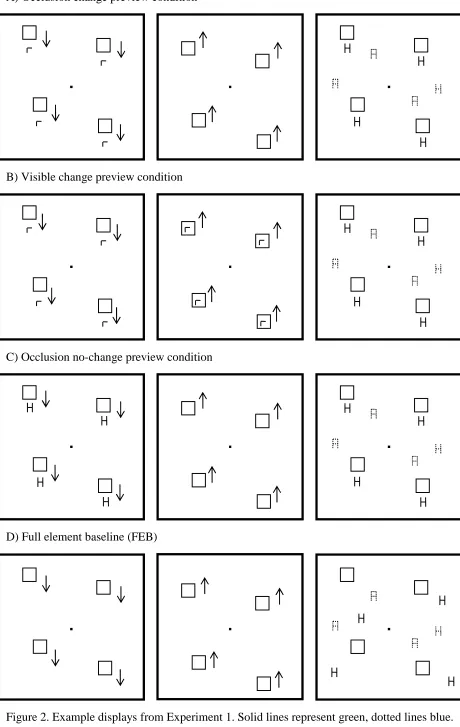
brackets) and at the same time the new blue items were added to the display. In the visible change previewcondition, the boxes moved behind the green right angles, and when they moved back the right angles changed to green Hs and at the same time the blue items were added. In theocclusion no-change previewcondition the initial stimuli were green Hs which were then occluded by the boxes and then reappeared when the boxes moved back to their starting points and blue items arrived (replicating the conditions of Kunar et al., 2003c, which showed that a preview effect occurs in these conditions). These preview conditions were compared with aFull-element baseline(FEB) in which all the search items appeared simultaneously. This condition also contained moving blocks, placed randomly in the field, prior to the final search display in order to match the movement characteristics of the three preview
conditions.
In this study we determined the presence of a preview benefit by comparing preview search with an appropriate FEB. There was no HEB for several reasons. Firstly, previous work has shown that an unmasked visible shape change totally abolishes the preview benefit so that the preview condition is indistinguishable from the FEB (Watson & Humphreys, 1997, 2002). As such this is the important
to determine whether a shape change disrupts the preview effect a more suitable comparison is between the shape change preview and the non-shape change preview. If the masked shape change abolishes the preview effect then search in these two conditions should differ (see also Braithwaite & Humphreys, 2007; Donk, Agter & Pratt, 2009; Donk & Theeuwes, 2001; Donk & Verberg, 2004; Emrich et al., 2008; Fenske et al., 2004; Jiang, Chun & Marks, 2002, Kunar et al., 2003a, Kunar et al., 2003d, Kunar, Shapiro & Humphreys, 2006; Osugi, Kumada, Kawahara, 2009, for examples of other preview experiments which do not include a HEB).
Method
Participants.Sixteen participants (8 male), aged 18 to 28 years (M = 21.3) took part for payment or course credits. All were undergraduate students at the University of Warwick and reported normal or corrected-to-normal visual acuity.
the four cells directly surrounding the fixation dot. The distractor stimuli were positioned randomly with the constraint that there was an equal number of blue and green stimuli on each side of the display. Some trials contained no target (catch trials) which ensured that participants could not respond by searching only one side of the display. Search displays consisted of 4, 8 or 16 items (plus the occluders). The target, when present, took the place of one of the blue items.
Participants indicated whether the target was on the left or right side of the display by pressing key Z or M (respectively). On catch trials they made no response and 4s later the next trial began automatically. Error feedback consisted of a 1000Hz tone for 500ms. The preview benefit has been replicated on a number of occasions using this or other similar forced-choice response procedures (e.g., Watson,
Braithwaite & Humphreys, 2008; Allen, Humphreys & Matthews, 2008). Moreover, this type of localization task removes the need to present target absent trials which are much more problematic to interpret than target present trials (e.g., Chun & Wolfe, 1996).
to indicate the target location or until 4s had elapsed. In this condition the right-angle stimuli changed to green Hs whilst occluded. The visible change preview condition was similar except that the rectangle occluders moved behind the green right-angle distractors and thus the change from right-angle to green Hs was perceptually visible in this condition. In the occlusion no-change preview condition, Hg distractors were initially presented, they were then occluded and re-appeared when the rectangles moved back to their starting points and the new blue items were added. Kunar et al. (2003c) found a reliable preview effect occurred in this condition. The FEB was the same as the occlusion preview condition except that no green Hs were presented in the initial display. Thus white outline rectangles appeared first, moved down and then back up. Once the white outline rectangles returned to their initial positions the green Hs and blue stimuli also appeared at random locations in the field (similar to the ‘conjunction’ condition of Kunar et al., 2003c).
Each participant completed one block of trials for each of the four conditions with block order randomized across participants in a single session lasting no more than 1hr. Each block consisted of 99 search trials with an equal number of left and right targets for each of the display sizes (to give 30 trials per cell). In addition to the search trials there were 9 catch trials (3 at each display size) in which no target was presented. Participants completed a short block of practice trials directly before each full block.
Results
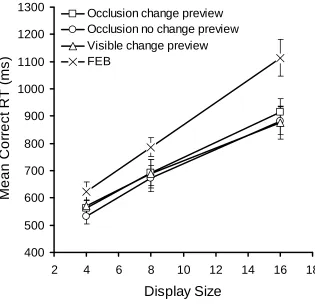
participant. The average of those means is shown in Figure 3 and search slopes in Table 2. Error rates are presented in Table 3.
Reaction times.A 4 (condition) x 3 (display size) ANOVA revealed a significant main
effect of condition,F(3,42) = 7.82,MSE= 13654.31,p<.001,p2= .358, display size,
F(2,28) = 242.03,MSE= 11630.3,p<.001,p2= .945 and a significant condition x
display size interaction,F(6,84) = 2.88,MSE= 3240.68,p<.05,p2= .171. As shown
in Figure 3, RTs were longer overall in the FEB and increased with display size. As expected, this increase was greatest in the FEB. Considering just the preview conditions, there remained a main effect of display size,F(2,28) = 188.66,MSE=
10161.36,p<.001,p2= .931, however, neither the main effect of condition,F(2,28) =
1.84,MSE= 15723.44,p= .177,p2= .116, nor the condition x display size
interaction,F(4,56) = 1.16,MSE= 3427.81,p=.340,p2= .076, approached
significance.
Errors.Error rates on search trials (<1%) and catch trials (8.33%) were low overall and were not analyzed further.
Discussion
There were two main findings. First, search in the FEB was less efficient than in the preview conditions, and second, there was no difference between any of the preview conditions. Under these conditions neither visible nor non-visible changes disrupted time-based selection. Interestingly, even visible changes appeared to be ignored when associated with a nearby moving block. This is in direct contrast to previous findings showing that visible shape changes removed the preview benefit (e.g., Watson & Humphreys, 1997, 2002). The crucial difference between the
Why do the moving occluders allow the preservation of the preview benefit when the old stimuli undergo a shape change? Firstly, perhaps changes to the old items were masked by the movement of the blocks. This masking could occur at either a low or high level. For example, changes to the previewed items could be missed due to the low level visual transients, provided by the moving blocks, (akin to ‘mudsplashes’ in change blindness studies). However, it is also possible that any inhibition which followed or surrounded the blocks also prevented changes to nearby objects being registered, irrespective of whether or not the changes were directly visible. This possibility is returned to in Experiments 3 and 5.
Alternatively, the changed items might not have re-captured attention because of feature-based inhibition carrying over from the occluders. Previous work has shown that feature-based inhibition within a preview display can spread to new stimuli when they appear. This spread then impairs the detection and processing of new stimuli which share those inhibited features (e.g., Braithwaite, Humphreys & Hodsoll, 2003, 2004; for a review see Olivers, Humphreys & Braithwaite, 2006). Similarly, in some situations, feature/object based representations can be used to help suppress old stimuli even if they ‘jump’ to new locations in the field when the new items are added (Kunar & Humphreys, 2006). Of relevance here is that the rectangle shaped occluders shared both horizontal and vertical line features with the green H stimuli that they revealed. It is possible that feature-based inhibition related to ignoring the occluding blocks might spread to the common features of the green H distractors when they appeared, effectively suppressing those stimuli.
inhibition might act together with location-based inhibition applied to the occluder locations during the preview period in order to amplify the suppression of stimuli that appear there.
An alternative view is that the rectangular occluders might actually hinder rather than help performance in the preview conditions. This is because the moving occluders also contain similar features to the target item. If participants hold an anticipatory set for the target then the moving occluders might capture attention because they too contain the relevant features (see also Folk, Remington & Johnston, 1992). Consistent with this possibility, in preview search conditions, Watson and Humphreys (2005) found that irrelevant dynamic onsets only interfered with the preview benefit when they shared features (in their case color) with the new stimuli.
Either way the use of occluders that share features with the old and new elements has the potential to create a number of possible interactions between the stimuli. This in turn could well reduce the consistency of observer’s responses and add noise to the results. Accordingly, in Experiment 2, to address the above issues and provide a converging operation we provide a replication of Experiment 1 which used round occluding stimuli rather than rectangular ones. Now the occluders shared neither color nor shape features with any of the search related stimulus letters. Experiment 2: Reducing occluder-search stimulus feature similarity
Experiment 2 was the same as Experiment 1 except that we used circular rather than rectangular occluders. This removed any common shape features between the letter search stimuli and the occluding stimuli.
Stimuli & Apparatus.These were the same as Experiment 1, except that the occluders now consisted of white outline circles (12 mm in diameter) instead of rectangles.
Design & Procedure.The design and procedure was identical to that of Experiment 1.
Results
RTs less than 200ms were discarded and treated as errors (this led to the removal of 0.1% of the data). Mean RTs were then calculated for each cell of the design individually for each participant. The average of those means is shown in Figure 4 and search slopes in Table 2. Error rates are presented in Table 3.
Reaction times.A 4 (condition) x 3 (display size) ANOVA revealed a
significant main effect of conditionF(3,33) = 9.38,MSE= 16953.33,p<.001,p2=
.460, display size,F(2,22) = 165.91,MSE= 10376.31,p<.001,p2= .938 and a
significant condition x display size interaction,F(6,66) = 5.00,MSE= 4225.78, p<.001,p2= .312. As shown in Figure 4, RTs were longer overall in the FEB,
increased with display size, and this increase was greatest in the FEB. Considering just the preview conditions, there remained a main effect of display size,F(2,22) =
121.50,MSE= 8506.05,p<.001,p2= .917, however, neither the main effect of
condition nor the condition x display size interaction approached significance, both Fs < 1.
Errors.Error rates on search trials (<1%) and catch trials (6.94%) were low overall and were not analyzed further.
Discussion
Despite this change the results were the same as in Experiment 1 suggesting that the basic findings are strong, reliable and replicable. The FEB condition produced the least efficient search and search efficiency did not differ between any of the preview conditions. Of note, and again unlike the findings of Watson and Humphreys (2002), due to the presence of the moving occluders, the preview benefit was equivalent irrespective of whether the occluders revealed unchanged distractors or distractors that had changed their shape.
One possible account for the preview benefit observed in Experiment 1 is that feature-based inhibition applied to the horizontal and vertical line segments of the old occluders might have spread to the locally revealed stimuli, effectively suppressing them from future search (Olivers & Humphreys, 2002; Braithwaite et al., 2003, 2004). The present data rule out this account because here the occluders and the letter search stimuli did not share any common features.
totally abolished the preview benefit (Watson & Humphreys, 1997, 2002). However, in those previous studies a right angle change to a green H was created by adding 3 line segments to 2 already existing line segments. In contrast, in the present work, if the right angle brackets group with their associated occluders (on the basis of
proximity), then the relative shape change produced by adding 3 line segments would be smaller (i.e. adding 3 line segments to two line segments and a circle). In turn, this reduction in relative change might not be enough to allow the changed preview items to re-capture attention (see Rauschenberger, 2003). Similarly the appearance of a newly revealed object might also be perceived as a smaller change compared with when a new object appears in an otherwise empty location. In Experiment 3 we assess the possibility of locally spreading spatial inhibition.
Experiment 3: Spreading of location-based inhibition
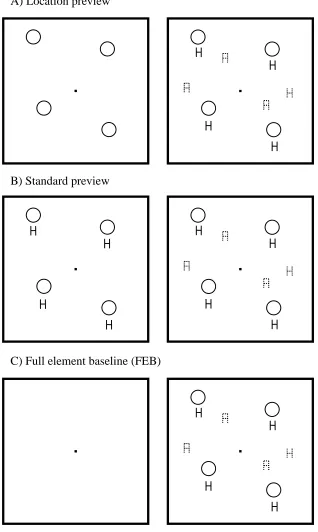
and the blue H target) appeared simultaneously, giving no opportunity to select on the basis of time of appearance.
Method
Participants.Twelve participants (5 male), aged 19 to 28 years (M = 21.9) took part for payment or course credits. All were undergraduate students at the University of Warwick and reported normal or corrected-to-normal visual acuity.
Stimuli & Apparatus.These were similar to Experiment 2.
Design & Procedure.There were three conditions: location preview, standard preview and FEB. A trial in the location preview condition consisted of a fixation dot, followed by a 1000ms preview of black (white outline) circles. The search display was then added which consisted of Hg and Ab distractors with an Hb target (when present). The Hg distractors appeared directly below each of the previewed circles (as in the final displays of the previous experiments). In the standard preview condition, green Hg distractors with outline discs above them were previewed for 1000ms after which the new blue stimuli (Ab and Hb target, when present) were added. In the FEB all stimuli appeared simultaneously and thus these displays matched the final displays of the two preview conditions.
Results
RTs less than 200ms were discarded and treated as errors (this led to the removal of less than 0.3% of the data). Mean RTs were then calculated for each cell of the design individually for each participant. The average of those means is shown in Figure 6 and search slopes in Table 2. Error rates are presented in Table 3.
Reaction times.A 3 (condition) x 3 (display size) ANOVA revealed a
significant main effect of conditionF(2,22) = 18.28,MSE= 15274.57,p<.001,p2=
significant condition x display size interaction,F(4,44) = 9.23,MSE= 2934.27,
p<.001,p2= .456. As shown in Figure 6, the standard preview condition produced
the shortest RTs which increased least with display size. This was confirmed via two additional ANOVAs comparing the two preview conditions with the FEB
individually.
Comparing the location preview with the FEB revealed a significant main effect of display size,F(2,22) = 263.05,MSE= 4156.38,p<.001,p2= .960.
However, neither the main effect of condition nor the condition x display size
interaction approached significance, both Fs < 1. In contrast, comparing the standard preview with the FEB produced a significant main effect of condition,F(1,11) =
34.11,MSE= 10233.81,p<.001,p2= .756, display size,F(2,22) = 150.47,MSE=
4607.11,p<.001,p2= .932 and a significant condition x display size interaction,
F(2,22) = 12.03,MSE= 2784.81,p<.001,p2= .522. RTs were shorter in the standard
preview condition and increased less with display size than in the FEB.
Errors.Error rates on search trials (<1%) and catch trials (7.72%) were low overall and were not analyzed further.
Discussion
contrast, previewing both circles and green H distractors (the standard preview condition) led to a reliable preview benefit.
It follows that the preview benefits, observed in Experiments 1 and 2, were unlikely to be due to a spreading of inhibition from the occluding items to nearby locations. Alternatively, it might be that any such spread of inhibition is sufficient to suppress changes to old objects but is insufficient to suppress the appearance of a completely new object (as was presented here in Experiment 3). Furthermore, it might also be that what is important is not a local spread of inhibition but rather the fact that the changed items were associated with a movement of the occluders (irrespective of whether the change was made during occlusion or whether it was visible to the observer as in Experiments 1 and 2). This movement itself might be sufficient to allow the revealed items to be excluded and / or the proposed inhibition of the
occluders might spread and remain at the locations occupied by the moving occluders. These possibilities were explored further in Experiment 4.
Experiment 4: Presenting distractors via occlusion
time the new blue items were added. Thus, all the letter stimuli appeared
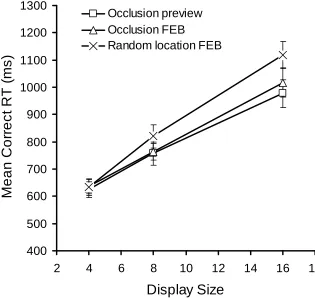
simultaneously except that the green Hs were revealed by the occluders. If the motion of the occluders acts to suppress the presentation of the revealed distractors then search in this condition should be relatively efficient despite the fact that the green H distractors are effectively new perceptual stimuli. Therandom location FEB
condition was the same as theocclusion FEBcondition except that the green H distractors appeared at random locations and so they were not revealed by the movement of the occluders (as in the FEB conditions of Experiment 1 and 2). We would thus expect this condition to produce the least efficient search. See Figure 7 for example displays.
Method
Participants.Sixteen participants (4 male), aged 19 to 30 years (M = 22.9) took part for payment or course credits. All were undergraduate students at the University of Warwick and reported normal or corrected-to-normal visual acuity.
positions with respect to the moving occluders (i.e. the occluders did not reveal the Hg distractors).
Results
RTs less than 200ms were discarded and treated as errors (this led to the removal of 0.15% of the data). Mean RTs were then calculated for each cell of the design individually for each participant. The average of those means is shown in Figure 8 and search slopes in Table 2. Error rates are presented in Table 3.
Reaction times.A 3 (condition) x 3 (display size) ANOVA revealed a borderline significant main effect of conditionF(2,30) = 3.24,MSE= 19940.07, p=.053,p2= .178 and a significant main effect of display size,F(2,30) = 322.29,
MSE= 6287.66,p<.001,p2= .956. However, of most interest was a significant
condition x display size interaction,F(4,60) = 4.11,MSE= 4915.71,p<.01,p2=
.215. As shown in Figure 8, search was least efficient in the random FEB condition but equivalent in the occlusion preview and occlusion FEB conditions. Comparing the occlusion preview and occlusion FEB conditions revealed a significant main effect of display size,F(2,30) = 167.95,MSE= 6584.64,p<.001,p2= .918, however, neither
the main effect of condition nor the condition x display size interaction approached significance, bothFs < 1.
Errors.Error rates on search trials (<1.5%) and catch trials (6.94%) were low overall and were not analyzed further.
Discussion
appear that new distractors can be effectively ignored if they are revealed by moving occluders compared with when they appear at random locations within a display.
The results thus far suggest that the moving occluders prevent shape changes (or newly appearing preview items) from competing for attention. This could be because the motion of the occluding items mask changes made to the preview items and can also mask the appearance of new items. However, an alternative account could be that the occluding items are suppressed when they first arrive and that this suppression then spreads to new locations when the occluders move. Experiment 5 investigates which of these accounts prevent shape changes from being prioritized by using stationary transient masks instead of moving occluders. If the moving occluders purely act as a mask then other transient masks should also prevent shape changes from being prioritized for search. In contrast, if the previous results are due to inhibition being applied to and then ‘following’ the moving occluders then without the initial presence of these occluders the preview benefit should be abolished. Experiment 5: Motion-based spreading of inhibition versus transient masking accounts
In Experiment 5 we compared the effectiveness of moving occluders and stationary transient masks on changes to previewed items.
Participants.Sixteen participants (5 male), aged 18 to 26 years (M = 20.4) took part for payment or course credits. All were taken from the University of
occlusion change preview and FEB were the same as those reported in Experiments 1 and 2.
In the masked change preview condition green right-angle distractors were presented for 750 ms, they were then masked for 300 ms by a box-figure eight, after which the figure-eights offset to reveal Hg distracters in the place of the green right-angles and at the same time blue stimuli (As and a blue H target when present) appeared.
In the masked change FEB condition green right-angle distractors were presented for 750 ms, they were then masked for 300 ms by a figure-eight. At this point the figure-eights completely offset and Hg distracters were presented in new locations so that their onsets were not masked. Blue stimuli were also added to the display at this point. Individual FEB baseline conditions ensured that the final displays were matched to the final displays of the corresponding preview conditions. Figure 7 shows examples of the masked change preview condition and its associated FEB.
Results
RTs less than 200ms were discarded and treated as errors (this led to the removal of <0.14% of the data). Mean correct RTs were then calculated for each cell of the design individually for each participant. The average of those means is shown in Figure 10 and search slopes in Table 2. Error rates are presented in Table 3.
Reaction times.A 2 (condition: FEB, Preview) x 2 (change type: occluded, masked change) x 3 (display size: 4, 8, 16) ANOVA revealed a significant main effect
of condition,F(1,15) = 4.59,MSE= 24051.98,p<.05,p2= .234, change type,
F(1,15) = 9.51,MSE= 20179.60,p<.01,p2= .388, and display size,F(2,30) =
overall shortest in the preview conditions compared with the FEB conditions and in the masked changed, compared with the occluded change, version of the task. RTs also increased with display size.
There was also a significant condition x display size,F(2,30) = 14.74,MSE=
2513.81,p<.001,p2= .496 and change type x display sizeF(2,30) = 6.62,MSE=
2830.70,p<.005,p2= .306 interaction. RTs increased less with display size in the
preview conditions than in the FEB conditions, indicating a robust preview benefit. Also, overall RTs increased less with display size in the masked change versions of the task. Of most interest, neither the change type x condition nor the three-way interaction approached significance, both Fs<1. Thus the preview benefit was both robust and statistically equivalent for both the occlusion and masked versions of the task.
To explore the results further, we compared each preview condition with its associated FEB individually. For the occlusion conditions there was no main effect of condition,F(1,15) = 3.04,MSE= 16466.57,p=.102,p2= .168, however, RTs
increased with display size,F(2,30) = 221.84,MSE= 7640.61, p<.001,p2= .937,
and of most importance, RTs increased less with display size in the preview condition
than in the FEB,F(2,30) = 5.23,MSE= 4913.85,p<.05,p2= .258, indicating a
robust preview benefit. Similarly, for the masked changed conditions, there was no overall difference between the Preview and FEB conditions,F(1,15) = 2.21,MSE=
27561.04,p=.158,p2= .128, however, again RTs increased with display size,
F(2,30) = 108.10, MSE= 12447.52,p<.001,p2= .878, and search was more efficient
in the preview condition than in the FEB,F(2,30) = 5.75, MSE= 2391.74,p<.01,p2
Errors. Error rates on search trials (<1%) and catch trials (5.03%) were low
overall and were not analyzed further. Discussion
As expected, a preview effect occurred in the occlusion change preview condition (replicating the results of Experiments 1 and 2). More importantly, a robust preview benefit was also observed in the masked change preview condition. In this condition there were no moving occluders presented initially to spread any inhibition to the preview locations. Instead the shape change from right-angles to Hs was masked by the addition of a transient figure-eight. Thus a transient stationary mask appears to be as effective as a moving occluder in terms of preventing changes to old items from capturing attention in preview conditions.
One might argue that the difference between the preview and FEB conditions in this experiment mainly occurred at the larger display sizes with little evidence of a benefit at the smaller display sizes (especially in the case of the masked change condition). Consistent with this, when the analysis was restricted to display sizes of 8 and 16 items, there remained a significant condition x display size interaction,F(1,15)
= 21.14,MSE= 2306.24,p<.001,p2= .585, indicating the presence of a strong
preview benefit (the three-way, condition x display size x change type interaction was not significant,F<1). However, for display sizes of 4 and 8 items, neither the
condition x display size,F<1, nor the three-way interaction,F(1,15) = 1.73,MSE
=1900.15,p=.208,p2= .103, were reliable.
These data suggest that the preview benefit might have only survived occluded or masked changes at the larger display sizes, which may reflect a capacity limit in the number of changes that can be detected simultaneously. For example, Rensink
an average of approximately 5.5 items (see also Emrich, Ruppel, Al-Aidroos, Pratt & Ferber, 2008, for evidence of capacity limits in some visual marking conditions). If this capacity limit is applied to the present data, it is possible that changes to the old items could be detected at the small display sizes as the number of changes fell below the capacity limit. In this case, object changes when the set size was low might compete for selection and disrupt the preview benefit.
In contrast, at the larger display sizes the changes may go unnoticed and thus have little or no impact on the preview benefit. This is because the number of changes would exceed the proposed capacity limit for change detection. Although this is a possibility we are cautious in drawing this conclusion. Let us examine Figure 10. Comparing performance at the smaller display sizes, the preview benefit seems to be ‘disrupted’ the most at display size 8 in the masked conditions. If the preview benefit was disrupted at the small but not the large display sizes then we would expect the search slope for the preview condition to be relatively steep for the range of smaller set sizes (4 to 8). Conversely we would expect the search slope to be relatively shallow at the larger display sizes (8 to 16 items) where a preview benefit would be present. This would lead to a bilinear search slope in the preview condition with a steep slope between display sizes 4 and 8 and a shallow slope between display sizes 8 and 16. However, this was not the case (indeed, numerically the opposite was true in the masked condition with preview slopes of 28.7 ms / item and 31.2 ms / item for the small and large set sizes, respectively). Thus the preview search slope in this
experiment (and in earlier experiments which showed a robust preview benefit) showed no signs of bilinearity.
which it was not. Instead, the apparent lack of a preview benefit at the small display sizes appears to be caused primarily by a relatively fast RT in the masked FEB condition at display size 8. Any non-linearity appears to be in the standard FEB baseline condition rather than in the preview condition. Thus the overall pattern of data is not consistent with a selective disruption to the preview benefit at small display sizes. In addition, detecting a preview benefit at the smaller display sizes is likely to have less power than at the larger display sizes where the difference across conditions is larger.
General Discussion
Our results produced a number of new findings. Experiment 1 showed that masked shape changes by occluding items were no more disruptive than visible shape changes and both were equivalent to a no-shape change condition. Based on previous work (Watson & Humphreys, 1997, 2002) we might have expected the visible shape change to totally abolish the preview benefit, which it did not.
3. In Experiment 4 we showed that perceptually new distractors that were revealed by the movement of an occluder could be excluded from other new search elements presented away from the moving occluders. Finally, Experiment 5 showed that static luminance transients were as effective as moving occluders in terms of preventing preview changes from recapturing attention. Overall the findings suggest that moving occluders and luminance transients can neutralize the effects of object changes to previewed old items, resulting in a robust preview benefit across all the relevant experiments.
The present work suggests that changes to old previewed items, which under other circumstances abolish the preview effect, are missed when there is an associated transient masking them. In other words, the mechanisms responsible for the preview benefit appear to be insensitive to masked changes that occur in a scene. Watson and Humphreys (2002, 2005) have suggested that the inhibitory template involved in visual marking may be similar to the nexus representation, proposed to be involved in detecting changes - in change blindness conditions (Rensink, 2000a,b). Both theories propose an active link between the cognitive state and the visual representation of items in the field (Figure 1). One could be forgiven for assuming that similar change blindness processes are occurring in the experiments presented above, as participants seem to be blind to the changes made to the preview items. However, on closer examination, although both might share a common representation, how that
representation is used in change detection and visual marking situations is likely to be very different.
Detecting changes in change blindness studies is proposed to require
any differences. Similarly it has been proposed that the intentional suppression of previewed items requires the development and maintenance of a temporary, top-down representation coordinating the inhibition of multiple locations (and sometimes
stimulus features; Watson & Humphreys, 1997, 1998; Watson, Olivers & Humphreys. 2003, Humphreys, Watson & Joleicouer, 2002; Kunar & Humphreys, 2006;
Braithwaite, Humphreys & Hodsoll, 2003; Watson, 2001). However, one difference is that the representation (the nexus; Rensink, 2000a, b, 2002) used to intentionally detect changes is presumably excitatory in nature. It is actively processing and holding information from the stimuli in order to detect any subsequent changes over time. The nexus is linked to earlier less stable object representations (proto objects) in order to stabilize these early object representations for further attentive processing. Importantly, the proto-object-nexus link is bi-directional in that it provides i) upward information concerning the properties and features of the objects, and ii) a downward flow of information that acts to stabilize the early object representations. It is also proposed that the nexus can link to several proto-objects simultaneously (Rensink, 2000a,b, 2002; see also Pylyshyn & Storm, 1988; Pylyshyn, 1989, 2000, 2001).
The representation proposed to operate in inhibitory visual marking shares some of these features. It is dynamic, resource limited and consists of one or more bi-directional links to numerous objects (previewed items) within the field (Watson & Humphreys, 1997). However, in contrast, the representation proposed to operate in preview search is inhibitory in nature. That is, the downward link is used to supply inhibition to those stimuli rather than to stabilize or strengthen them. Thus although it represents the locations (and/or features) of the previewed items it uses this
blindness and inhibitory visual marking have in common a similar temporary online representation of items in the field, however, the function of this representation appears to differ. The current study provides direct behavioral evidence for such a difference.
The results from our experiments show that while in change blindness studies, participants can detect changes if they fall within the nexus and coherence field, participants remain blind to changes in visual marking if they fall within the actively attended inhibitory field. This inhibition remains intact even if the item in the
inhibitory field changes shape, as long as there is a temporary visual transient
accompanying the shape change. Thus the data provide two new findings: first change blindness can occur in time-based visual selection conditions and second, the
inhibitory visual marking links are functionally different to the links of the nexus and coherence field proposed to explain change blindness.
One possibility is that in preview search conditions an excitatory
Interestingly, our data also showed that the presentation of perceptually new objects via occlusion failed to compete with other new search objects. This finding bears some resemblance to that of Franconeri, Hollingsworth and Simons (2005). They showed that a single new object did not capture attention if it was revealed via a moving occluding annulus. However, in contrast, Davoli, Suszko & Abrams (2007) found that a new object could capture attention when presented whilst an occluding mask was presentprovidedthat the mask did not move. They argued that the lack of a new object capture effect in the Franconeri et al., study was due to the motion of the moving occluder disrupting the memory for the locations of the old stimuli (by itself capturing attention). This then weakened the distinction between perceptually old compared with new objects.
However, of side interest, in the present work it is most unlikely that the moving occluder items fully captured attention (Davoli, Suszko & Abrams, 2007) because if they did then attention would have been drawn to the locations of the previewed distractors causing them to compete for selection with the new elements. This would have the effect of abolishing the preview benefit – which it did not. In addition, moving occluders were no less effective in masking changes to previewed items than were non-moving visual transients. If motion was particularly special in capturing attention then we would have expected to find a difference between the effectiveness of the moving and stationary masking transients in Experiment 5 – again we did not.
Implications for theories of time-based selection
luminance transients at their locations which automatically attract attention. For example, they argue that without luminance onsets then a preview benefit does not occur (but see Braithwaite, Humphreys, Watson & Hulleman, 2005; Braithwaite, Hulleman, Watson & Humphreys, 2006, for the opposite finding).
However, this account has difficulty explaining some of the current findings. For example, we obtained a robust preview benefit when old distractors were
temporarily occluded and then unoccluded. The rapid onset in luminance as a result of the old items becoming unoccluded (i.e. the onset of green pixels onto a previously black background) should have attracted attention in the same way as the changes associated with the presentation of the new elements. Thus a preview benefit should not have been obtained (see also Kunar et al, 2003c, for further arguments). In addition, the rapid changes in luminance as a result of the moving occluders
themselves should also have competed with the luminance changes at the locations of the new items again eliminating a preview benefit - but they did not (see also Watson, Braithwaite & Humphreys, 2008 for related arguments using luminance increments in the old items). Finally, if the motion of an occluder is sufficient to abolish purely automatic attentional capture by new objects (see Davoli, Suszko & Abrams, 2007, above), then by the onset account, we should not have obtained a preview benefit in the current work (or at the very least a substantial difference between the moving and stationary masking conditions of Experiment 5).
the temporal asynchrony between the old and the new items should disrupt the ability to selectively process either group. However, we showed that changing the shape of items when the new were added (or having motion at those locations), which should have reduced their temporal asynchrony, still resulted in a robust preview benefit. Also, presenting perceptually new distractors via occlusion simultaneously with the new items (which would actually make the two sets of distractors, and target,
perfectly synchronous), still allowed one set to be excluded from search resulting in a robust preview benefit.
The inhibitory visual marking account
We have described the data as broadly consistent with the inhibitory marking account. An interesting issue relates to the nature and representation of the proposed inhibitory mechanism. One possibility is that inhibition is applied to the locations (Watson & Humphreys, 1997) and features (here the color green; Braithwaite,
Humphreys & Hodsoll, 2003, 2004) of old items. Another possibility is that inhibition is applied to the object templates of the previewed items (Kunar & Humphreys, 2006). It has been suggested that the visual system can apply inhibition in a flexible manner by differentially weighting different inhibitory types depending on the situation (Kunar & Humphreys, 2006). If so, in these experiments the more likely form of inhibition would be to the locations and features of the preview items, which on the whole remained stable. Here any loss of object-based inhibition applied to the previewed items would be offset by the location and feature based inhibitory
components.
could neither be inhibited via their location, nor color. One account may suggest that inhibition tended to spread around the locations of the occluders thus suppressing any subsequent items that appeared near to them (hence within the inhibited zone). A strong version of this explanation appears to be ruled out by the findings from
Experiment 3 in which new distractors appearing below previewed occluders were not suppressed themselves. It does, however, remain possible that in this condition, the spreading inhibition was simply too weak to suppress the presentation of a new item.
In contrast, a stronger suppression may occur if the occluders moved, carrying and spreading their inhibition to new areas that they pass over (see also Osugi,
Kumada & Kawahara, 2009, for evidence that inhibition can spread between two collinear items). New items appearing in these suppressed areas will subsequently be inhibited and not compete for attention (Experiment 4). Also as suggested earlier, the revealing of a new item via occlusion might allow that item to become more easily grouped with the distractor (and inhibited as a common single object), compared with when a single new object simply appears alongside it. Current findings suggest that inhibition within time based selection conditions can be applied flexibly to locations, stimulus features or at the level of object representations depending upon task
demands (see earlier). Clearly determining the exact representations and their interactions underlying the effects uncovered here will be a valuable goal for future research.
has been suggested that prioritizing changes to old items is highly adaptive because those changes could signify important behavioral events (e.g., a change in heading or gaze of a predator, the emergence of a camouflaged object; Watson & Humphreys, 2002; Watson, Humphreys & Braithwaite, 2008). Such ecological properties have thus far appeared robust. However, the present work suggests that, as in other areas of visual cognition, such ecologically adaptive properties can be lost under certain circumstances.
Summary
The main finding of the present work is that changes to old previewed items are ineffective when they are masked either by a moving occluder or via a transient stationary mask. More generally, the work shows that even changes to stimuli which are proposed to be maintained in a resource demanding temporary online
References
Allen, H.A., Humphreys, G.W., & Matthews, P.M. (2008). A neural marker of content-specific active ignoring.Journal of Experimental Psychology: Human Perception & Performance, 34,286-297.
Braithwaite, J.J., & Humphreys, G.W. (2007) Filtering Items of Mass Distraction: Top-down Biases against distractors are Necessary for the Feature-based Carry-over to Occur.Vision Research, 47,1570-1583.
Braithwaite, J.J., Hulleman, J., Watson, D.G. & Humphreys, G.W. (2006). Is it impossible to inhibit isoluminant items or does it simply take longer? Evidence from preview search.Perception & Psychophysics, 68,290-300.
Braithwaite, J.J., Humphreys, G.W., & Hodsoll, J. (2004). Effects of colour on
preview search: Anticipatory and inhibitory biases for colour.Spatial Vision, 17, 389-425.
Braithwaite, J.J., Humphreys, G.W., Watson, D.G., & Hulleman, J. (2005). Revisiting preview search benefits at isoluminance: New onsets are not necessary for the preview advantage.Perception & Psychophysics, 67,1214-1228.
Braithwaite, J.J., Humphreys., G.W., Hodsoll, J. (2003). Color grouping in space and time: Evidence from negative color-based carryover effects in preview search. Journal of Experimental Psychology: Human Perception & Performance, 29,
758-778.
Chun, M.M., & Wolfe, J.M. (1996). Just say no: How are visual searches terminated when there is no target present?Cognitive Psychology, 30,39-78.
Cole, G. C., Kentridge, R. W., & Heywood, C. A. (2004). Visual salience in the change detection paradigm: The special role of object onset.Journal of
Davoli, C.C., Suszko, J.W., & Abrams, R.A. (2007). New objects can capture
attention without a unique luminance transient.Psychonomic Bulletin & Review, 14,338-343.
Donk, M. (2005). Prioritizing selection of new elements: On the time course of the preview effect.Journal of Experimental Psychology: Human Perception and Performance, 10,601-621.Visual Cognition, 12,1373-1385.
Donk, M. (2006). The preview benefit: Visual marking, feature-based inhibition, temporal segregation, or onset capture?Visual Cognition, 14,736-748. Donk, M., & Theeuwes, J. (2001). Visual marking beside the mark: Prioritizing
selection by abrupt onsets.Perception & Psychophysics, 63,891-900.
Donk, M., & Theeuwes, J. (2003). Prioritizing selection of new elements: Bottom-up versus top-down control.Perception and Psychophysics, 65,1231-1242. Donk, M., & Verburg, R. C. (2004) Prioritizing new elements with a brief preview
period: Evidence against visual marking.Psychonomic Bulletin & Review, 11, 282-288.
Donk, M., Agter, F., Pratt, J. (2009) Effects of luminance change in preview search: Offsets and onsets can be concurrently prioritized but not in isolation.Acta Psychologica, 130 260-267
Downing, C. J., & Pinker, S. (1985). The spatial structure of visual attention. In M. I. Posner & O. S. M. Marin (Eds.),Attention and performance XI(pp. 171-188). Hillsdale, NJ: Erlbaum.
Eriksen, C. W., & St James, J. D. (1986). Visual attention within and around the field of focal attention: A zoom lens model.Perception & Psychophysics, 40, 225-240.
Fenske, M.J., Raymond, J.E. & Kunar, M.A. (2004). The Affective Consequences of Visual Marking.Psychonomic Bulletin & Review, 11,1034-1040.
Fernandez-Duque, D. & Thornton, I.M. (2000). Change detection without awareness: Do explicit reports underestimate the representation of change in the visual system?Visual Cognition, 7,323-344.
Folk, C. L., Remington, R., & Johnson, J. C. (1992). Involuntary covert orienting is contingent on attentional control settings.Journal of Experimental Psychology: Human Perception and Performance, 18,1030–1044.
Franconeri, S.L., Hollingworth, A., & Simons, D.J. (2005). Do new objects capture attention?Psychological Science, 16,275-281.
Gibson, B.S., & Jiang, Y.H. (2001). Visual marking and the perception of salience in visual search.Perception & Psychophysics, 63,59-73.
Herrero, J.L., Crawley, R., van Leeuwen, C., & Raffone, A. (2007). Visual marking and change detection,Cognitive Processing, 8,233-244.
Humphreys, G.W., Watson, D.G., & Jolicoeur, P. (2002). Fractionating the preview benefit: Dual-task decomposition by timing and modality.Journal of
Experimental Psychology: Human Perception and Performance, 28,640-660. Jiang, Y. H. & Wang, S.W. (2004). What kind of memory supports visual marking? Journal of Experimental Psychology: Human Perception and Performance, 30,
Jiang, Y.H., Chun, M.M., & Marks, L.E. (2002a). Visual marking: dissociating effects of new and old set size.Journal of Experimental Psychology: Learning, Memory and Cognition, 28,293-302.
Jiang, Y.H., Chun, M.M., & Marks, L.E. (2002b). Visual marking: Selective attention to asynchronous temporal groups.Journal of Experimental Psychology: Human Perception and Performance, 28,717-730.
Kahneman, D., Treisman, A., & Burkell, J. (1983). The cost of visual filtering. Journal of Experimental Psychology: Human Perception and Performance, 9,
510-522.
Kramer, A.F., & Atchley, P. (2000). Age-related effects in the marking of old objects in visual search.Psychology & Aging, 15,286-296.
Kunar, M.A. & Humphreys, G.W. (2006). Object-based inhibitory priming in preview search: Evidence from the ‘top-up’ procedure.Memory & Cognition, 34, 459-474.
Kunar, M.A., Humphreys, G.W., & Smith, K.J. (2003a). History matters: The preview benefit in search is not onset capture.Psychological Science, 14,181-185. Kunar, M.A., Humphreys, G.W., & Smith, K.J. (2003b). Visual change with moving
displays: More evidence for color feature map inhibition during preview search. Journal of Experimental Psychology: Human Perception and Performance, 29, 779 – 792.
Kunar, M.A., Humphreys, G.W., Smith, K.J., & Hulleman, J. (2003d). What is marked in visual marking?: Evidence for effects of configuration in preview search.Perception and Psychophysics, 65,982-996.
Experimental Psychology: Human Perception & Performance, 29,185-198. Kunar, M.A., Shapiro, K.L. & Humphreys, G.W. (2006). Top-up search and the
attentional blink: A two-stage account of the preview effect in search.Visual Cognition, 13,677-699.
Laloyaux, C., Destrebecqz, A., & Cleeremans, A. (2006). Implicit change
identification: A replication of Fernandez-Deque and Thornton (2003).Journal of Experimental Psychology: Human Perception and Performance, 32, 1366-1379.
O’Regan, J.K., Deubel, H., Clark, J.J., & Rensink, R.A. (2000). Picture changes during blinks: Looking without seeing and seeing without looking,Visual Cognition, 7,191-211.
Olds, E.S., & McMurtry, C.M. (2003). Search of jumping items: Visual marking and discrete motion.Perception, 32,449-462.
Olivers, C.N.L., & Humphreys, G.W. (2002). When visual marking meets the attentional blink: More evidence for top-down, limited-capacity inhibition. Journal of Experimental Psychology: Human Perception and Performance, 28,
22-42.
Olivers, C.N.L., Humphreys, G.W., & Braithwaite, J.J. (2006). The preview search task: Evidence for visual marking,Visual Cognition, 14,716-735.
O'Regan, J. K., Rensink, R. A., Clark, J. J. (1999). Change-blindness as a result of 'mudsplashes'.Nature, 398,34-34.
Osugi, T., Kumada, T., & Kawahara, J. (2009). The spatial distribution of inhibition in preview search.Vision Research, 49,851-861.
Pylyshyn, Z.W. (1989). The role of location indexes in spatial perception: A sketch of the FINST spatial-index model.Cognition, 32,65-97.
Pylyshyn, Z.W. (2000). Situating vision in the real world.Trends in Cognitive Sciences, 4,197-207.
Pylyshyn, Z.W. (2001) Visual indexes, preconceptual objects, and situated vision, Cognition, 80,127-158.
Pylyshyn, Z.W., & Strom, R.W. (1988). Tracking multiple independent targets: Evidence for a parallel tracking mechanism.Spatial Vision, 3,179-197. Rauschenberger, R. (2003). When something old becomes something new:
Spatiotemporal object continuity and attentional capture.Journal of
Experimental Psychology: Human Perception and Performance, 29,600-615. Rensink, R. A. (2000a). The dynamic representation of scenes.Visual Cognition, 7,
17-42.
Rensink, R. A. (2002). Change Detection.Annual Review of Psychology, 53,245-277. Rensink, R.A. (2000b). Visual search for change: A probe into the nature of
attentional processing.Visual Cognition, 7, 345-376,
Rensink, R.A. (2004). Visual sensing without seeing.Psychological Science, 15, 27-32.
Shim, W.M., Alvarez, G.A., & Jiang, Y.V. (2008). Spatial separation between targets constrains maintenance of attention on multiple objects.Psychonomic Bulletin & Review, 15(2), 390-397.
Simons, D. J., & Levin, D. T. (1997). Change blindness.Trends in Cognitive Sciences, 1,261-267.
Theeuwes J., Kramer A. F., Atchley P. (1998). Visual marking of old objects. Psychonomic Bulletin & Review, 5,130-134.
Treisman, A. M., & Gelade, G. (1980). A feature-integration theory of attention. Cognitive Psychology, 12,97-136.
Watson, D. G., Humphreys, G. W., & Olivers, C. N. L. (2003). Visual marking: Using time in visual selection.Trends in Cognitive Sciences, 7,180-186.
Watson, D.G. & Humphreys, G.W. (1997). Visual Marking: Prioritizing selection for new objects by top-down attentional inhibition of old objects.Psychological Review, 104,90-122.
Watson, D.G. & Humphreys, G.W. (1998). Visual marking of moving objects: A role for top-down feature based inhibition in selection.Journal of Experimental Psychology: Human Perception and Performance, 24,946-962.
Watson, D.G. & Humphreys, G.W. (2005). Visual Marking: The effects of irrelevant changes on preview search.Perception & Psychophysics, 67,418-434.
Watson, D.G. (2001). Visual marking in moving displays: Feature-based inhibition is not necessary.Perception & Psychophysics, 63,74-84.
Watson, D.G., & Humphreys, G.W. (2002). Visual marking and visual change. Journal of Experimental Psychology: Human Perception and Performance, 28,
379-395.
Watson, D.G., Braithwaite, J.J., & Humphreys, G.W. (2008). Resisting change: The influence of luminance changes on visual marking and the preview benefit. Perception & Psychophysics, 70,1526-1539.
Acknowledgements
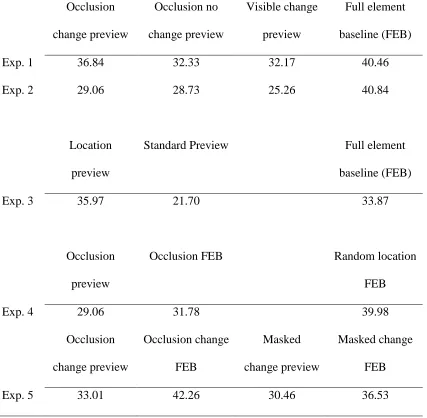
Table 1. Search slopes (ms/item) for Experiments 1 to 5. Condition Occlusion
change preview
Occlusion no change preview
Visible change preview
Full element baseline (FEB)
Exp. 1 36.84 32.33 32.17 40.46
Exp. 2 29.06 28.73 25.26 40.84
Location preview
Standard Preview Full element
baseline (FEB)
Exp. 3 35.97 21.70 33.87
Occlusion preview
Occlusion FEB Random location
FEB
Exp. 4 29.06 31.78 39.98
Occlusion change preview
Occlusion change FEB
Masked change preview
Masked change FEB
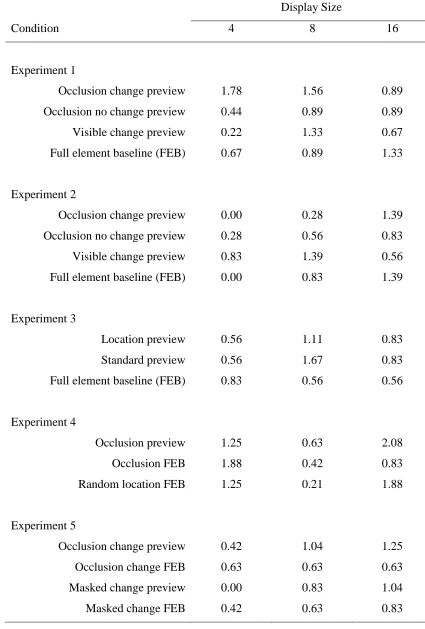
Table 2. Mean percentage error rates for experiments 1 to 5 as a function of condition and display size
Display Size
Condition 4 8 16
Experiment 1
Occlusion change preview 1.78 1.56 0.89
Occlusion no change preview 0.44 0.89 0.89
Visible change preview 0.22 1.33 0.67
Full element baseline (FEB) 0.67 0.89 1.33
Experiment 2
Occlusion change preview 0.00 0.28 1.39
Occlusion no change preview 0.28 0.56 0.83
Visible change preview 0.83 1.39 0.56
Full element baseline (FEB) 0.00 0.83 1.39
Experiment 3
Location preview 0.56 1.11 0.83
Standard preview 0.56 1.67 0.83
Full element baseline (FEB) 0.83 0.56 0.56
Experiment 4
Occlusion preview 1.25 0.63 2.08
Occlusion FEB 1.88 0.42 0.83
Random location FEB 1.25 0.21 1.88
Experiment 5
Occlusion change preview 0.42 1.04 1.25
Occlusion change FEB 0.63 0.63 0.63
Masked change preview 0.00 0.83 1.04
Figure 1. Comparison between the representation proposed to underlay the detection of visual changes over time (Rensink, 2000, 2002) and that proposed to coordinate inhibitory visual marking (Watson & Humphreys, 1997).
Nexus Inhibitory
Template
Change Blindness Visual Marking
Temporary representation
Links
Visual representation
Inhibition actively applied and maintained at these locations Changes here
missed Changes here
A) Occlusion change preview condition
B) Visible change preview condition
C) Occlusion no-change preview condition
[image:51.595.109.569.86.813.2]D) Full element baseline (FEB)
Figure 3. Mean correct RTs as a function of condition and display size for Experiment 1. Error bars indicate ±1 standard error.
400 500 600 700 800 900 1000 1100 1200 1300
2 4 6 8 10 12 14 16 18
Display Size
M
e
a
n
C
o
rr
e
c
t
R
T
(m
s
)
Figure 4. Mean correct RTs as a function of condition and display size for Experiment 2. Error bars indicate ±1 standard error.
400 500 600 700 800 900 1000 1100 1200 1300
2 4 6 8 10 12 14 16 18
Display Size
M
e
a
n
C
o
rr
e
c
t
R
T
(m
s
)
A) Location preview
B) Standard preview
[image:54.595.111.429.82.614.2]C) Full element baseline (FEB)
Figure 6. Mean correct RTs as a function of condition and display size for Experiment 3. Error bars indicate ±1 standard error.
400 500 600 700 800 900 1000 1100 1200 1300
2 4 6 8 10 12 14 16 18
Display Size
M
e
a
n
C
o
rr
e
c
t
R
T
(m
s
)
Figure 7. Example displays from Experiment 4. Solid lines represent green, dotted lines blue. B) Occlusion full element baseline (FEB)
Figure 8. Mean correct RTs as a function of condition and display size for Experiment 4. Error bars indicate ±1 standard error.
400 500 600 700 800 900 1000 1100 1200 1300
2 4 6 8 10 12 14 16 18
Display Size
M
e
a
n
C
o
rr
e
c
t
R
T
(m
s
)
Occlusion preview Occlusion FEB
A) Masked change preview condition
[image:58.595.108.570.96.442.2]B) Masked change FEB condition
Figure 10. Mean correct RTs as a function of condition and display size for Experiment 5. Error bars indicate ±1 standard error.
400 500 600 700 800 900 1000 1100 1200 1300
2 4 6 8 10 12 14 16 18
M
ea
n
Co
rr
ec
tR
T
(m
s)
Display Size
Occlusion Change Preview Occlusion Change FEB400 500 600 700 800 900 1000 1100 1200 1300
2 4 6 8 10 12 14 16 18