1
Planning first-line services
on NS service stations
an exact approach
M.Sc. Thesis Evelien H.R. Huizingh
(s1364472) May 9, 2018
Preface
Dear reader,
In the past nine months I wrote this thesis. This thesis is the final assignment that needs to be fulfilled to graduate the master Industrial Engineering and Management with the track Production and Logistics Management at the University of Twente.
First, I thank my supervisor Marco Schutten from the University of Twente for his guidedance to help me succesfully complete this project. The meetings we had every few weeks always gave me more than enough tips and starting points to continue my research. Second, I thank my second supervisor Leo van der Wegen of the University of Twente for also critically reading report.
This research project is part of a bigger research conducted by different teams at NS Techniek, a department within the NS Group. I am grateful for NS Group for providing me the opportunity to do a research internship at the Maintenance Development depart-ment. I thank my company supervisor Bob Huisman for taking me on in his team and giving me the opportunity to conduct my master thesis at his department. Finally, I thank my colleagues, fellow interns, and Gerjanne Dekker for their input, feedback, and help on my project during this time, and of course for the nice lunches every day.
I hope that you enjoy reading this thesis and that it is helpful for future NS projects or other research projects.
- Evelien Huizingh, May 2018
Summary
This thesis develops a model to plan first-line services at a service station of NS group (NS), the largest Dutch railroad company. First-line services include inspections, inter-nal and exterinter-nal cleaning of trains, and small maintenance tasks. Currently, this plan is created manually but NS wants to automate this to support their planners. NS is ex-panding its fleet, and it is already difficult to find good first-line services plans. This becomes even more difficult in the future, hence this research.
Planning the first-line services is a subproblem of the service station planning prob-lem that also includes the routing of trains, the (de)coupling of train units, the parking, and the personnel planning. However, we focus solely on finding a first-line services plan and leave the other subproblems out of scope.
The model is an Integer Linear Programming (ILP) model, solved in AIMMS Opti-mization software with the Cplex 12.8 solver. At service stationKleine Binckhorstthe internal cleaning machines are regarded as the bottleneck of the first-line services plan. The model can find optimal plans up 16 train units that require three to six first-line ser-vices per job within a few minutes. All train units include the internal cleaning first-line service, which is regarded to be bottleneck at SB Kleine Binckhorst. In these plans the jobs are completed before their due date, and within a time window of one day. Adding more first-line services to jobs decreases number the problem instances for which a plan can be found without tardiness. Tardiness in a first-line services plan is caused by tight release and due dates of train units, and waiting time caused by the sequence in which the operations of train units are processed.
For future research, we recommend NS to continue to explore the exact method for solving the service station planning problem. The model can be integrated with other subproblems and extended such that it can be applied to service stations with another layout.
Abbreviations and definitions
Table 1: Abbreviations and definitions (Part I)
Abbreviation / term Definition / Explanation
Carousel layout Service station layout at which (most) tracks are free tracks,
meaning that a train unit can enter and depart the track at both sides, creating a carousel route over the SB.
First-line services Services provided at a service station
Flexible flow shop problem An extended variant of the classical flow shop problem. A scheduling problem in which groups of identical machines are classified into stages and all jobs need to be processed in the same order.
HIP An algorithm for solving the service station planning problem, based on heuristics (Hybride Integrale Planmethode).
Jobs The train units on the service station
Machines The tracks on the service station
ILP Integer Lineair Programming, the model form of how the model in this thesis is defined.
Material number Unique number of a train unit.
NSR The department concerning the timetable for passenger transport (NS Reizigers)
OB Largest, and most extensive maintenance station (Onderhoudsbedrijf)
Operations The operations are planned in the model and consist of the
processing times of one or more fist-line services.
Planner There are two types of planners (werkvoorbereiders). One is
the Logistics-Planner who is concerned with assigning tracks to a train unit, and the other, the Task-Planner who is
concerned with assigning tasks to train units, and personnel to the tasks.
SB Service station on which the first-line services are executed. (Service Bedrijf)
vi
Table 1: Abbreviations and definitions (Part II)
Abbreviation/term Definition/Explanation
Service station planning problem The whole planning problem that NS needs to solve
and consists of different subproblems. One of the subproblems is the first-line services planning problem that we solve in this thesis
Shuffleboard layout Service station layout at which most tracks are LIFO
(Last In First Out). Train units may only enter and depart the tracks from one side.
TC Maintenance station, a little more extensive than a
service station (Technische Centrum) but less than an OB.
TDL Train operator (Treindienstleider). The TDL determines if it is safe for a train unit to drive.
Contents
Preface . . . i
Management summary . . . iii
List of Abbreviations v 1 Introduction 1 1.1 Background NS and problem statement . . . 1
1.2 Research goal and research questions . . . 3
1.2.1 Main research question . . . 3
1.2.2 Sub-research questions . . . 3
2 Context Analysis 5 2.1 Rolling stock and maintenance stations introduction . . . 5
2.2 First-line services . . . 6
2.3 Service station lay-out . . . 8
2.4 Planning process . . . 12
3 Literature review 17 3.1 Rolling stock planning . . . 17
3.2 Train Unit Shunting Problem . . . 19
3.2.1 Matching problem . . . 20
3.2.2 Parking problem . . . 20
3.3 Crew scheduling . . . 21
3.4 Resource planning . . . 22
3.4.1 Flexible Flow Shop Problem . . . 22
3.5 Solution procedures . . . 24
3.6 Literature study conclusions . . . 25
4 Problem description 27 4.1 Goal and scope of the research . . . 27
4.1.1 Goal . . . 27
4.1.2 Scope . . . 28
4.2 Modeling approach . . . 28
4.3 Data . . . 33
viii CONTENTS
4.4 Overview, assumptions, and constraints . . . 33
4.5 Model description . . . 36
4.6 Mathematical model . . . 39
4.6.1 Running example . . . 39
4.6.2 Model . . . 43
4.7 Model conclusion . . . 49
5 Results 51 5.1 Experiment 1 . . . 51
5.2 Experiment 2 . . . 58
5.3 Result conclusions . . . 63
6 Conclusion & discussion 65 6.1 Conclusion . . . 65
6.2 Discussion . . . 66
6.3 Recommendations and future research . . . 68
Appendices
A Overview of travel times between machines 71
B input Experiment 1 73
C input Experiment 2 75
1
|
Introduction
An increasing number of people use train transport daily. NS Group, in Dutch often abbreviated and used in this report as NS, is the largest Dutch railroad company. NS is responsible for transporting more than 1.1 million passengers per day (Nederlandse Spoorwegen, 2016). To maintain a reliable and customer satisfying service, trains need to perform well and need to be clean. To do that, the trains need to be inspected, cleaned and minor maintenance tasks need to be executed often. This happens during night hours, when trains are not needed for passenger transport. In this thesis, the inspection, the cleaning, and the minor maintenance tasks are referred to asfirst-line services. This thesis focuses on the planning of the first-line services.
This chapter is structured as follows: Section 1.1 briefly introduces NS and provides the problem statement. Section 1.2 elaborates on the research goal and states the research questions.
1.1
Background NS and problem statement
Train transport was first possible in the Netherlands in 1839 (Nederlandse Spoorwe-gen, 2017a). Since then, several companies were responsible for the Dutch train trans-port. In 1937, almost a century after the introduction of the train in the Netherlands, NS was established (Nederlandse Spoorwegen, 2017b). The number of passengers that use train transport have increased immensely over the last decades. Currently, a few different companies provide train transport in the Netherlands. Daily, together the com-panies transport almost 2 million passengers over 3000 kilometers railway network in the Netherlands (Kroon et al., 2008), resulting in the Dutch railroads being among the busiest railroad networks in the world (Gestrelius et al., 2017).
NS is the backbone of the Dutch public transport by providing transport from a door-to-door perspective (Nederlandse Spoorwegen, 2016). NS is a service organization with a clear emphasis on passengers. The NS slogan is ‘passengers on first, second and third place’. To implement this vision, NS has three core focus points: a good train journey, transport from door to door, and world leading train stations. Within the core focus ‘a good train journey’, NS increases the reliability of on time departure of trains, enough seating for passengers, and clean trains. To achieve this core focus, the first-line services on trains are important to guarantee the continuous and reliable deployment of trains, and the cleanness of trains.
Two major planning topics for NS are passenger transport and the maintenance of
2 CHAPTER 1. INTRODUCTION
trains. The departmentNS Operatieis concerned with the planning of passenger trains. Roughly stated, they deploy the trains during the day over the main Dutch railroads. Planning of major and minor train maintenance is the responsibility of NS Techniek
(formerNedTrain). NS Techniektakes over the planning of the train as soon as the last passengers have left the train in the evening. Major maintenance tasks are performed on large maintenance stations and are planned far in advance. First-line services, the minor maintenance tasks, are executed at service stations. Service stations provide less services than the larger maintenance stations. These tasks are planned maximum one day in advance. In addition to the first-line services, service stations also facilitate the parking of trains during the night. This thesis focuses on the planning of the first-line services at service stations. In this thesis we abbreviateservice stationtoSB, referring to the Dutch termservice bedrijf.
The many SB locations are scattered throughout the Netherlands. All SBs have a differ-ent railway track layout and differ in the services they provide. The first-line services provided by an SB depend on the SB’s facilities. For example, for the external cleaning of trains a special external cleaning facility is needed. These are not present at all SBs.
Some services, for example the inspection of a train, can be executed at all tracks. The necessity of the special facilities for certain first-line services complicates the service plan, because the trains need to arrive at the right track for the service. Compared to other vehicles, trains are very limited in their movements, because they drive on tracks. This means that the first-line service plan and the routing plan of the train units are highly interdependent.
The planning of first-line services is done by planners and superintendents in planning centers. Most of the planning is done manually, and based on logical thinking and previous experience. For now this works, but the number of passengers that use train transport is expected to continue to increase in the future. To cope with this increase of passengers, NS is expanding its fleet with three new train types (NS, 2015). This creates an even more complex planning situation, because more tasks need to be planned and executed with the same resource capacity.
To deal with these planning difficulties, NS currently develops two planning methods for their service station planning problem to support the planners. One system that NS develops to solve these problems is HIP (Hybride Integrale Planmethode), which is based on a heuristic. The other system that NS develops is OPG (OPstelPlan Gen-erator), which approaches the problem in an exact way. Both systems use a different approach to find a feasible plan for the service station planning problem and are not used in practice yet. Furthermore, NS conducts ex
1.2. RESEARCH GOAL AND RESEARCH QUESTIONS 3
first-line services plan. HIP considers in its plan creating the right train combinations, routing and parking the trains, and the first-line services. Since HIP uses a heuristic to create a plan, this plan does not have to be optimal. Therefore, the need arises for an exact method to find an optimal plan. NS realizes that developing planning methods is a major and complex task, thus multiple employees and scholars work together to improve and extend the planning methods. The exact planning approach that NS is developing currently, only deals with the routing of the trains. The first-line services plan is not considered in this method. Therefore, this thesis focuses on planning of first-line services at service stations to contribute to the overall development of the exact first-line services planning method at NS.
1.2
Research goal and research questions
Section 1.2.1 discusses the research goal and addresses the main research question. Section 1.2.2 provides the sub-questions and explains the approach for answering the sub-questions.
1.2.1
Main research question
The goal of this research is to contribute to the development of methods for the NS service station planning problem. We do this by planning the daily inspections, cleaning, and the minor maintenance tasks. Therefore, the research question of this study is:
How can first-line services at NS service
stations be planned, using an exact approach?
As described before, the SBs vary a lot in track lay-out and in the services they provide. Since multiple studies focus on different subproblems of the service station planning problem, NS decided that all studies should be applied to the same SB. This is for integrating the subproblems and comparing solutions. Therefore, this study also focuses on this service stationKleine Binckhorst.
1.2.2
Sub-research questions
4 CHAPTER 1. INTRODUCTION
The first step is to get a clear understanding of the current planning process of the first-line services at NS. Therefore, the first sub-question is:
1. How are the first-line services currently planned at a service station?
To map the current process of planning the first-line services at service stations, we shadow a superintendent on his shift, have multiple meetings with other planners and analyze company documents. Chapter 2 describes the planning process in the current situation.
After the current situation is clear, a literature study provides insight in framing the prob-lem in the current literature. Then, we deduce approaches for solving such a probprob-lem from the literature. The related subquestion is:
2. What does the literature say about planning services and what exact approaches can be used for this?
The literature review consists of an analysis of academic articles, PhD theses and books. See Chapter 3.
The third step is defining the problem clearly, and describing the model for planning the first-line services. Chapter 4 provides this, and describes the input data. The corre-sponding sub-question is therefore:
3. How can we model the first-line services planning problem?
The fourth step is to analyze results of the model on service stationKleine Binckhorst. Chapter 5 answers this sub-question:
4. For which problem instances can we find a first-line services plan, using the model?
2
|
Context Analysis
This chapter answers the first subquestion: How are the first-line services currently planned at a service station? This thesis takes SB Kleine Binckhorst as its case, as described in Section 1.2.1. Therefore, this chapter focusses on this SB.
Section 2.1 provides a short introduction on rolling stock, explains relevant railway sector terms and presents a short overview of the various NS maintenance stations. Section 2.2 describes the tasks that need to be planned at SB Kleine Binckhorst and Section 2.3 presents an overview of the layout of SBKleine Binckhorst. Finally, Section 2.4 discusses the planning process.
[image:15.595.133.427.400.618.2]2.1
Rolling stock and maintenance stations introduction
Figure 2.1 displays a picture of a train. A train is divided into subparts called train units.
Figure 2.1: train of train type VIRM
Rolling stockis used in the railway industry for all vehicles moving over railways. This term includes; trams, subways and trains. Trains can be divided into subparts, as just described, and these are called train units. Single train units or combinations of train units are deployed by NS for passenger transport. Single train units all have a unique train unit number. Train units can be further classified into parts (bakken), which is a
6 CHAPTER 2. CONTEXT ANALYSIS
measuring unit of length equaling 27.2 meter. This measuring unit is sometimes used to define the length of a track.
Furthermore, trains are of different types. Examples are: SLT (Sprinter LightTrain) and VIRM (Verlengd InterRegio Materieel). The VIRM can be viewed in Figure 2.1. Only train units of the same train type can be combined. The different train types all require different first-line services in different time intervals. For example one train type may need to be inspected every single day and another every two days, because of its technical features.
To perform the first-line services, there are different types of stations. The largest, and the most extensive station in providing maintenance services, is the refurbishment sta-tion (onderhoudsbedrijf (OB)). Here, train units come for large, planned maintenance. These maintenance tasks have a duration between two days to a week, depending on the train type and the required maintenance. Another reason for a train unit to enter ans OB is when unexpected failures occur, and repairs are needed. Less extensive versions of the OB are the technical centres (technisch centrum (TC)). These focus on providing quick repairs on frequent occuring train unit failures. The service station (service bedrijf (SB)) is the least extensive maintenance station. An SB provides the first-line services: the inspections, cleaning and small maintenance tasks (e.g. replacing a light bulb). SBs consist of maintenance tracks (behandelsporen) and stabling tracks (opstelsporen). The maintenance tracks have special features, for example a platform next to the track to facilitate internal cleaning tasks. The stabling tracks are for parking the trains during the night and the inspections. Finally, NS has also parks that consist of only stabling tracks. At these parks no services are provided; trains can only be parked for the night. In this thesis we focus on the SBs, because here the first-line services are executed.
2.2
First-line services
Train unit first-line services are documented in a system called Maximo. Maximo keeps track of the tasks that are performed on the individual train units, and determines the deadlines for the next (periodical) first-line services. When unexpected services are needed, train drivers and planners can manually insert a work-order in Maximo.
2.2. FIRST-LINE SERVICES 7
can still be deployed for passenger transport. It gets a high priority to be cleaned at the next SB that the train unit enters. When an inspection A or B is not performed in time, the train unit is not allowed to leave the SB before the inspection is completed.
The next paragraphs describe the services that can be performed at Kleine Binckhorst
more elaborately .
Inspection A and B
There are two inspections that can be executed at service stationkleine Binckhorst; in-spection A and inin-spection B. Inin-spection A is the larger inin-spection of the two and takes about an hour to execute, inspection B takes about 20 minutes. Inspection A needs to take place, approximately once every 12 days and inspection B once every two days. The exact durations and time intervals differ per train type. Also the content of the inspections vary per train type. We explain the inspections for the SLT (Sprinter Light-Train). We describe Inspection B first, because Inspection A is an extensive variant of inspection B. Inspection B consists of inspection preparation proceedings, brake test-ing proceedtest-ings, and external checks on the streamers (stroomafnemers) of the train unit (NT Operations, 2015a). Inspection A consists of the proceedings of inspection B, and a train driver cabin & passengers cabin check on interior, safety doors and other safety measures, and lightning. Finally, the bogies (draaistellen) are checked, as are the outside walls and the entry step (NT Operations, 2015b).
Internal cleaning
8 CHAPTER 2. CONTEXT ANALYSIS
External cleaning
Train units need to be cleaned externally approximately every 12 days. To do this, there are washing stations, through which the train unit slowly drives. There are two cleaning treatment for the train units at the SB: a soap and an oxalic treatment. An oxalic treatment is more thorough than a soap treatment and also takes more time. The treatments are applied during two different cleaning programs. One is cleaning the train unit walls and the other cleans the front of the train unit (kopwasbeurt compleet).
Small repairs
Small repairs are repairs that do not need any special conditions to be executed. Exam-ples include door repairs, or changing a bolt or light bulb. These repairs can be executed on the stabling tracks.
2.3
Service station lay-out
Service station Kleine Binckhorst is located near The Hague and is part of a bigger service station location. This location consists of SBKleine Binckhorst and SB Grote Binckhorst. Because these two location are divided by main rail road tracks they are treated as separate service stations. Both SBs have a very different layout.
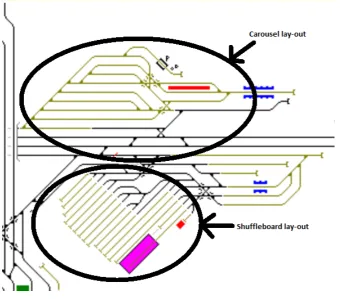
The layout of NS SBs can roughly be divided into two categories: shuffleboard-layout (sjoelbak-layout) and carousel-layout. Figure 2.2 shows the two layouts of which the top part is SBKleine Binckhorst and the bottom part is SBGrote Binckhorst:
o At acarousel-layout, the tracks arefree tracks, which means that trains may enter and depart the track at both sides. At a carousel layout a train units drive a round trip over the SB. A train may enter a track from one side, leaves on the other side of the track, and drives back to its starting point using a second track. These circle routes create the carousel-structure. However, train units may enter and depart from the same side of the track when this is required.
2.3. SERVICE STATION LAY-OUT 9
Figure 2.2: Shuffleboard- and carousel-layout
Figure 2.3 shows a map of SB Kleine Binckhorst. As can be seen in this figure, SB
Kleine Binckhorstcontains mostly free tracks. Only tracks 64 and 63 are tracks that can only be entered and departed from one side. Therefore, this layout corresponds with a carousel-layout.
10 CHAPTER 2. CONTEXT ANALYSIS
Figure 2.3: Layout of service station Kleine Binckhorst
[image:20.595.87.546.443.673.2]2.3. SERVICE STATION LAY-OUT 11
12 CHAPTER 2. CONTEXT ANALYSIS
From tracks 51a and 906a, train units can reach all other SB tracks. However, not all tracks can be reached directly from all other tracks. The tracks in the SB layout that are connected to other tracks with an angle less than 90 degrees, cannot be reached directly by train units. In such a situation, a third track is needed. For example, if a train unit needs to drive from track 58 to track 53, it needs other tracks to reach track 53. One route is by using track 60, another route can be by using track 104a. The latter route is displayed in Figure 2.5 and explained in the next paragraph.
[image:22.595.105.525.379.551.2]To come from track 58, the train unit crosses seven crossings before reaching track 51b. Because that is a very small track, the train unit likely needs to cross crossing 425 to enter track 104a. Here, the train unit is parked, because the direction of the train unit needs to change. The front of the train unit becomes the back, and vice versa. This process is calledkopmaken. The train driver shuts off the train unit, walks to the other side of the train unit and starst the engine before crossing 425 is crossed again. Subsequently, the train unit passes track 51b and four crossings before the train can be parked on track 53. This drive takes a lot of time, because all crossings need to be adjusted to guide the train unit to the right track.
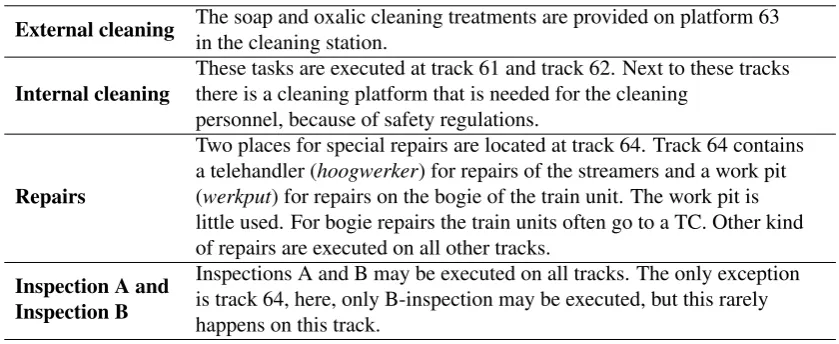
Table 2.1: Location of services at SBKleine Binckhorst
External cleaning The soap and oxalic cleaning treatments are provided on platform 63
in the cleaning station.
Internal cleaning
These tasks are executed at track 61 and track 62. Next to these tracks there is a cleaning platform that is needed for the cleaning
personnel, because of safety regulations.
Repairs
Two places for special repairs are located at track 64. Track 64 contains a telehandler (hoogwerker) for repairs of the streamers and a work pit (werkput) for repairs on the bogie of the train unit. The work pit is little used. For bogie repairs the train units often go to a TC. Other kind of repairs are executed on all other tracks.
Inspection A and Inspection B
Inspections A and B may be executed on all tracks. The only exception is track 64, here, only B-inspection may be executed, but this rarely happens on this track.
2.4
Planning process
2.4. PLANNING PROCESS 13
lateshift (14:00-22:00) of that day. During the day, the capacity is large enough to do without a plan. The planner monitors the incoming and outgoing train units real-time. The late shift planner plans for the end of the late shift, when it starts to get busy with incoming train units, and plans for thenightshift (22:00-06:00). During the night shift, the planner is busy with monitoring whether everything goes according to plan. Figure 2.6 visualizes a simple case of the SB planning process.
There are two types of planners:
- The logistics-planner is responsible for assigning train units to tracks.
- The services-planner is responsible for creating the services plan, and assigning personnel to the services on train units.
In the planning process of parking train units and executing the required services, multi-ple parties and steps are involved and needed. First, when a train unit needs to enter the SB that evening, the logistics planner gets a notification. He checks if the train unit is defect and what the defect is. Based on the defects of the train unit and the availability of the tracks, the planner assigns a train unit to a track. He documents this decision in an overview of the track-train unit combinations. The services-planner can also ac-cess this overview and based on the unique train number of the train unit that has just been matched to a track, he searches in Maximo what the first-line services are that are required for this train unit.
The services-planner assigns a mechanic to the train unit-service combination, and up-dates this decision in another overview. When the train arrives at the SB, the train driver needs to stop before, so called, an S-sign, and needs permission of the train operator (treindienstleider) to enter the SB. The train operator has also access to the system with the train unit-track combinations overview. The train operator communicates to the train driver to which track he needs to drive, and whether it is safe to drive. Subsequently, when a first-line service is done, a sign that the service is completed is communicated both to the logistics- and the services-planner. The logistics-planner now decides to what track the train needs to be driven. Again, permission of the train operator is needed before moving the train unit. When all services are completed, the train unit is driven to a departure track from which it can leave the SB. This is in general the process that is executed for every incoming train unit.
14 CHAPTER 2. CONTEXT ANALYSIS
the SB and currently all decisions are made on the planners experience. In addition to the general process that we just described, there are deviant scenarios that may occur. For example, there can be an extra, unexpected train needing to enter the SB, resulting in a more crowded SB.
Moreover, another train unit of the expected train type than expected may show up in front of the S-sign wanting to enter this SB. This train unit may have a totally different combination of services that are required. These changes in train units happen, because
2.4. PLANNING PROCESS 15
Figure
2.6:
Planning
process
of
train
units
at
service
station
Kleine
Binc
khor
3
|
Literature review
This chapter frames the first-line services planning problem in the literature and dis-cusses approaches for solving such a problem. Hereby, answering the second subques-tion as described in Secsubques-tion 1.2.1: What does the literature say about planning services and what exact approaches can be used for this?
This chapter is structured as follows: First, Section 3.1 provides an introduction on planning rolling stock. Section 3.2, Section 3.3 and Section 3.4 describe the three pillars for creating an NS service station plan: the routing of train units, crew scheduling, the planning the first-line services on non-human resources. Section 3.2 describes the first pillar, the routing of trains, also called the Train Unit Shunting Problem.
Section 3.3 describes the difficulties related to the second pillar, crew scheduling. The third pillar is the planning of first-line services on the available, non-human resources. Section 3.4, describes approaches for planning resource capacity. Subsequently, Section 3.5 describes solution approaches for planning problems. Finally, Section 3.6 provides the conclusion of this chapter.
3.1
Rolling stock planning
Rolling stock planning problems are extensively researched. Studies on planning are conducted in the fields of creating passenger transport timetables (Yang et al., 2009), routing of rolling stock (Cadarso and Marín, 2010; Fioole et al., 2006; Wagenaar et al., 2017), and the railway maintenance of rolling stock (Albrecht et al., 2009; Peng and Ouyang, 2014). For the planning of rolling stock maintenance Sriskandarajah et al. (1998) present a genetic algorithm. This algorithm optimizes the maintenance over-haul, Cheng and Tsao (2010) extend this algorithm by also taking into account the spare parts that are needed for maintenance tasks. Penicka et al. (2003) create a formal model of the train maintenance routing problem. Corman et al. (2017) study and use preven-tive maintenance to determine the optimal maintenance policy for a light rail rolling stock system in terms of reliability, maintenance costs, and availability. So, many as-pects in the field of rolling stock planning problems are research. However, not many studies are conducted on planning the first-line services of rolling stock. Giacco et al. (2014) present an optimization framework for rolling stock rostering and maintenance scheduling. These studies on solving rolling stock maintenance take maintenance tasks in account that can be described as planned maintenance. The first-line services plan cannot be made far in advance and has little flexibility in which services to execute and which not. Therefore, the plan needs to include as many required services as possible.
18 CHAPTER 3. LITERATURE REVIEW
The first-line services planning problem, is on the level of offline and online operational planning. Plans on offline operational level are plans that are made short in advance and online operational plans are made based on reactive decision making (Hans et al., 2012). As described in Section 2.4, the NS first-line services plans are made in advance and are adjusted real time, when needed.
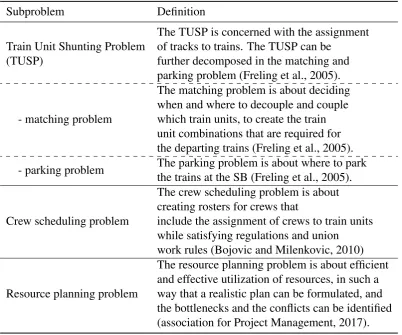
[image:28.595.116.519.302.637.2]Service station planning problem is a very complex problem in terms of size. Therefore, this problem is by scholars often divided into subproblems. These subproblems are subsequently solved independently. Table 3.1 presents the different subproblems that are defined in the planning of daily maintenance on service stations.
Table 3.1: Subproblems of the service station planning problem
Subproblem Definition
Train Unit Shunting Problem (TUSP)
The TUSP is concerned with the assignment of tracks to trains. The TUSP can be
further decomposed in the matching and parking problem (Freling et al., 2005).
- matching problem
The matching problem is about deciding when and where to decouple and couple which train units, to create the train unit combinations that are required for the departing trains (Freling et al., 2005).
- parking problem The parking problem is about where to park the trains at the SB (Freling et al., 2005).
Crew scheduling problem
The crew scheduling problem is about creating rosters for crews that
include the assignment of crews to train units while satisfying regulations and union
work rules (Bojovic and Milenkovic, 2010)
Resource planning problem
The resource planning problem is about efficient and effective utilization of resources, in such a way that a realistic plan can be formulated, and the bottlenecks and the conflicts can be identified (association for Project Management, 2017).
3.2. TRAIN UNIT SHUNTING PROBLEM 19
3.2
Train Unit Shunting Problem
A service station can also be called’shunting yard’and provides the first-line services. It contains tracks over which the trains drive. The movement of a train from one track to another on a service station is called shunting. The shunting problem tries to minimize the number of movements in a shunting yard. One of the first works on this shunting problem is by Blasum et al. (1999). They focused on the parking and the dispatching of trams with minimum shunting movements. Gallo and Miele (2001) apply the shunting problem to a bus depot, and try to minimize the movements of buses in a small and crowded depot. The buses may not arrive in the planned order and decisions have to be made with incomplete information. Varying the length of buses that need to be dispatched is the solution that Winter and Zimmermann (2000) propose to make the solution of Gallo and Miele (2001) more realistic.
The train unit shunting problem (TUSP) is a special kind of shunting problem. The difficulty with vehicles that drive on tracks is that they are bounded by the tracks in the possible directions that the vehicles can move. It means that rolling stock can only drive in one direction in a two-dimensional plane. Cars or trucks, opposed to rolling stock, are much more flexible in the directions that they can drive. They can drive in any direction in the two dimensional plane. Another difficulty with rolling stock is that trains cannot bypass other trains. For example, to change the order in which they are parked, also because they drive on tracks. Finally, trains have large turn angles. This may prohibit trains to directly reach certain track from its current position on the SB. Therefore, to reach this track, a third track is needed, as described in the example provided in Section 2.3. All this factors complicate the routing of trains extremely.
20 CHAPTER 3. LITERATURE REVIEW
3.2.1
Matching problem
Trains arrive at an NS SB as a single train unit or in a combination of two or more train units. These train units are of the same train type. The required compositions of depart-ing trains the next day, may be different than the compositions of the arrivdepart-ing trains. An example: two trains arrive, both consisting of two VIRM train units. For the departing trains, one train consisting of three VIRM train units and one train consisting of a single VIRM train unit are required. To change from the arriving train unit compositions to the required departing compositions, one of the two VIRM train unit combinations needs to decouple into two single train units. The other VIRM train unit combination needs to couple to one of the two single train unit.
Transforming the arriving train unit combinations into the required departing train unit combinations is called the matching problem. To facilitate this transformation, deci-sions need to be made on which train unit combinations to decouple, which to couple, and when and where to execute these actions. These decouple and couple movements may take place on every track and each moment during the stay of the train unit on an SB. Fioole et al. (2006) solve this problem while considering multiple objectives as operational costs, service quality and reliability of the railway system. Also Peeters and Kroon (2008) solve this problem by developing a branch-and-price algorithm that is performs well on the objectives ’service to the passengers’, ’robustness’, and ’cost of the circulation’.
In making these decisions, the first-line services plan needs to be considered. It might be more efficient to process certain operations on the whole arriving train, and to split then, or the other way around. Also, in matching train units, the track length needs to be taken into account, to make sure the combination of train units fits the track. Since the tracks are not of equal lengths, this leads to the parking problem, described in Section 3.2.2.
3.2.2
Parking problem
3.3. CREW SCHEDULING 21
The matching and parking problems have been integrated by different scholars. Lentink et al. (2006) created a 2-opt heuristic to improve the route that was found by sequentially solving the subproblems. Haijema et al. (2006) present a dynamic programming based heuristic for integrating the matching and parking problem. Kroon et al. (2008) use an NS case to solve the matching and parking problem, hereby focusing on reducing the computational time for generating an acceptable solution.
For every shunting movement that needs to be made, train drivers need to be available which complicates the feasibility even further. In Section 3.3 we elaborate on crew scheduling.
3.3
Crew scheduling
Crew scheduling is about assigning the human resources to the first-line services. For both inspection A and inspection B, mechanics are needed to execute these services. Furthermore, a cleaning crew is needed for internal cleaning. In addition to the employ-ees that are needed for the first-line services, also train drivers are needed for driving the trains to, on, and from the SB. Train drivers have different authorizations, so different employees need to be scheduled for different driving tasks.
The employees work in shifts and have different skills, availabilities, and authorizations. All these factors need to be taken into account when planning the human resources. Furthermore, the train units change position in the SB during their stay. Therefore, the planning of the personnel is complicated by traveling time of the personnel from one service to another.
22 CHAPTER 3. LITERATURE REVIEW
3.4
Resource planning
Another important part of the service station planning problem is the scheduling of the resources. Every service that needs to be performed requires resources, e.g., a cleaning machine, personnel, or a platform. These resources need to be used as efficiently as possible to minimize costs and to maximize productivity. In this section, we focus on the non-human resources.
All services that need to be performed during one night on a train unit can be viewed as a project. The different train units that enter the SB on the same day are all projects that consists of activities. Therefore, the planning of these activities can be defined as a Project Scheduling Problem (PSP). Al-Fawzan and Haouari (2005) define project scheduling as dealing with "the allocation of scarce resources to a set of interrelated activities that are usually directed toward some major output and require a significant period of time to perform". PSPs contain activities that can be planned simultaneously or sequentially, depending on the available resources and the completion of predecessor activities. PSPs are widely studied problems.
Another way of regarding the planning problem is as a job shop scheduling problem. These are a special case of machine scheduling problems, and are found in the produc-tion environment. These problems are already a long time a popular area of research in the operations research literature and production literature (Schutten, 1996) and still are Wang (2005). The operations research studies on job shop scheduling mostly focus on achieving a high level of algorithmic design and analysis, and studies in the pro-duction area emphases the problem formulation and providing practical solutions. Job shop problems can be a way to model rolling stock problems according to Samà et al. (2016). They used the job shop problem for finding a lower bound for a train routing problem. The flexible flow shop problem is a specific variant of the job shop problem, which is used by (van Dommelen, 2015) to model the cleaning facilities on an SB. The next section elaborates on this.
3.4.1
Flexible Flow Shop Problem
Before describing the classical job shop problem and its extensions and variants, we need to point out that in the terminology used in job shop problems and PSPs, different terms are used for the same concept. In job shop problems a PSPproject is defined as ajob. In job shop problem literature anoperationequals the PSPactivity. In this thesis we use the termsjobandoperation. So, one job consists of one or more operations.
3.4. RESOURCE PLANNING 23
of the classical job shop problem is to minimize makespan (Schutten, 1996). Because in reality many more factors need to be taken into account, extensions are developed.
Figure 3.1: Order of operations
One special case of a job shop problem is the flow shop problem. The difference be-tween these problems is in the order in which operations need to be processed. In a job shop problem the order of processing of operations may differ per job, but within a job the order of processing operations is set in advance. In a flow shop problem the order of processing the operations is the same for all jobs. These differences are visualized in Figure 3.1. In the example in Figure 3.1, both the job shop and the flow shop prob-lem have two jobs consisting of four operations. In the job shop scenario, job 1 has to process the operations in the order 1-2-4-3 and job 2 in order 1-4-3-2. Of both jobs all operations need to be processed before the jobs are finished, but the order of processing is different. In the flow shop problem scenario, the order of operations of both job 1 and job 2 are equal.
Within the flow shop problem different variants can be distinguished. One variant is theflexible flow shop problem. Flexible flow shops are also calledcompound,hybridor
multiprocessor flow shops. In a flow shop problem, all jobs have operations in multiple, consecutive stages, that all need to be processed in a fixed order. Just like a job shop problem, only one machine is available per stage. In a flow shop problem every job only has one operation per stage. The flexible flow shop problem comprises a more elaborated problem. A job goes through multiple stages and there are one or more identical machines available at every stage. These machines are set in parallel. A given job has only one operation per stage that needs to be processed on one of the parallel machines in that stage. Every machine processes at most one operation at the time and the processing time is assumed to be deterministic and integer. All machines are ready from time zero onwards (Haouari et al., 2006).
24 CHAPTER 3. LITERATURE REVIEW
not all jobs always need to be processed at all stages (Ruiz et al., 2008). Furthermore, in the flexible flow shop problem there is unlimited buffer capacity between the stages. Since in reality there are situations where no buffer capacity is present, or the jobs needs to be processed directly on the next machine, the no-wait flow shop is developed (Ruiz and Vázquez-Rodríguez, 2010). In the no-wait flow shop, the jobs need to be continuously processed until all jobs are finished, without interruptions. This means that the total processing time of a job is equal to the sum of the processing times of all the stages that that job has operations at (Jafarzadeh et al., 2017). For example in the food industry, food products need to be bottled or canned right after cooking so that the products are hot and fresh (Jafarzadeh et al., 2017). Also release and due dates can be taken into account as is the recirculation of jobs, meaning that they revisit a stage (Ahonen and de Alvarenga, 2017).
3.5
Solution procedures
Project scheduling problems and job shop problems can be solved by either an exact method or using a heuristic. RCPSPs are NP hard problems. Therefore exact solving is possible according to Brˇci´c et al. (2012), but only for small to medium instances. They propose branch and bound as the most commonly used, and appropriate method for solving RCPSPs in an exact way. Still heuristics are needed to obtain an upper bound; the lower bound can be determined using mathematical programming (Bellenguez and Néron, 2004). Mixed Integer Programming is an approach to model the RCPSP and the job shop problem and can subsequently be solved using the branch and bound ap-proach, or branch-and-price or branch-and-cut approach for example. Finally Constraint Programming and Satisfiability Testing are methods for solving the RCPSP. The com-bination of the two methods have proven to be very effective (Schutt et al., 2011).
We just described that RCPSPs can be solved exactly, however, heuristic methods for solving the RCPSP dominate the RCPSP research field (Brˇci´c et al., 2012). Heuris-tic methods do not find the optimal solution but can approximate the solution quickly. The simplest methods use constructive heuristics that contain a priority list, for example serial or parallel schemes, but these heuristics find bad solutions (Trautmann and Bau-mann, 2009). More clever heuristics as the heuristic developed by Kolisch and Drexl (1996) find very good solutions, and dominate other heuristics that are developed for the RCPSP. Their heuristic uses a combination of priority rules and random search tech-niques. Newest approaches to solve PSPs incorporate machine learning (J˛edrzejowicz and Ratajczak-Ropel, 2014).
3.6. LITERATURE STUDY CONCLUSIONS 25
3.6
Literature study conclusions
Answering the subquestion of this chapter, we conclude from the literature study that rolling stock is a theme that is highly researched. The emphasis of most studies is on routing problems and not much research is conducted on the first-line services planning problem. Because all problem are interrelated this is an important aspect of the service station planning problem. Focusing on the service station planning problem of rolling stock, the literature shows that this problem is often decomposed in different subprob-lems. These subproblems are solved independently, because they are all so complex.
4
|
Problem description
Chapter 2 explains how the first-line services plan is created currently, and Chapter 3 describes studies on the subproblems of the service station planning problem, and which solution approaches have been developed in previous research. These two chapters answer the first two subquestions. This chapter answers the third subquestion: How can we model the first-line services planning problem? It describes how we model the first-line services planning problem applied to SB Kleine Binckhorst, and how we can describe this problem mathematically.
This chapter is structured as follows: Section 4.1 describes the goal and scope of the thesis in more detail. Section 4.2 describes the modeling approach, and Section 4.3 states the input data. Subsequently, Section 4.4 provides an overview of the problem statement and describes the assumptions and constraints that are made to create the model. Section 4.5 presents the indexes, parameters and variables of the model, and Section 4.6 presents the constraints of the model. We describe Section 4.6 by using a running example. Finally, Section 4.7 provides the conclusions on this chapter and some remarks on the running example.
4.1
Goal and scope of the research
This section elaborates on the goal and scope of the model that develops a first-line service plan. Section 4.1.1 clarifies how the model helps to reach this goal and Section 4.1.2 elaborates on what we include and exclude in the model.
4.1.1
Goal
The overall goal of this research is to plan the first-line services for an NS service station using an exact approach. Currently, all tasks are planned manually, see Section 2.4. Often, not all tasks can be executed in one night. In the future the SBs will get even busier, because NS expands its fleet by over 250 train units. By modeling the situation of SBKleine Binckhorstusing an exact approach, we find (optimal) plans for the first-line services for different instances on this SB, within the assumptions and constraints that Section 4.4 describes. An exact approach can provide optimal plans, which HIP, as Section 1.1 describes, cannot. Optimal plans provide the best way of processing train units with their required first-line services, which is what NS want to achieve. In addition to this, the optimal solutions can provide insights in the quality of the solutions
28 CHAPTER 4. PROBLEM DESCRIPTION
of HIP
4.1.2
Scope
From the different subproblems of the service station planning problem, we focus on the resource planning problem and leave all other subproblems out of scope. We assume all trains that enter the SB are single train units, because of this, we do not include the matching problem. However, the routing of train units on an SB is such an important and integrated subproblem that we do not want to disregard it totally. Wolfhagen (2017) developed a model to solve the TUSP-R for NS, but integrating this model with the first-line services model that is developed, is out of scope of this research project. This is because of the complexity of developing just the first-line services planning problem, and the time limit related to this research project. We choose to include the travel times between the different machines on which the operations are processed. This way, time for traveling between the machines is included in the first-line services plan. This is a step towards implementing the first-line service planning model with the routing planning model. In practice, the route of the train unit is reserved for the whole travel time for that train unit, for safety reasons. In our model, we leave this out of scope.
Also, the parking problem is a subproblem of the SB planning problem. We take one aspect of this subproblem into account, meaning, we assign tracks to train units in our plan. However, we do not consider the sequence of train units on tracks, because we simplified the model by restricting the tracks to contain at most one train unit at all times. For the crew scheduling subproblem, only one cleaning crew is available for internally cleaning the train units. We also include this in our model.
4.2
Modeling approach
4.2. MODELING APPROACH 29
problem, the sequence in which the jobs visit the groups of machines is equal for all jobs.
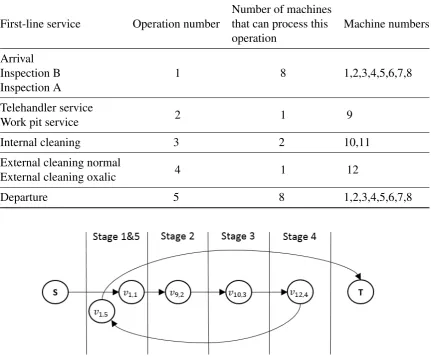
We refer to the groups of machines as stages. Furthermore, we aggregate the first-line services that can be processed on the same machine into one operation. This way the stages relate one-on-one with the operations. At SB Kleine Binckhorst, there are five operations, and thus five stages. Since in the service station planning problem, the shunting movements are minimized, it is very unlikely that first-line services that can be processed on the same machine, will be processed on different machines. More-over, merging the first-line services into fewer operations makes the model easier to solve. Note that, it means that all bundled first-line services in one operation, need to be processed continuously on the machine, without interruptions of other jobs.
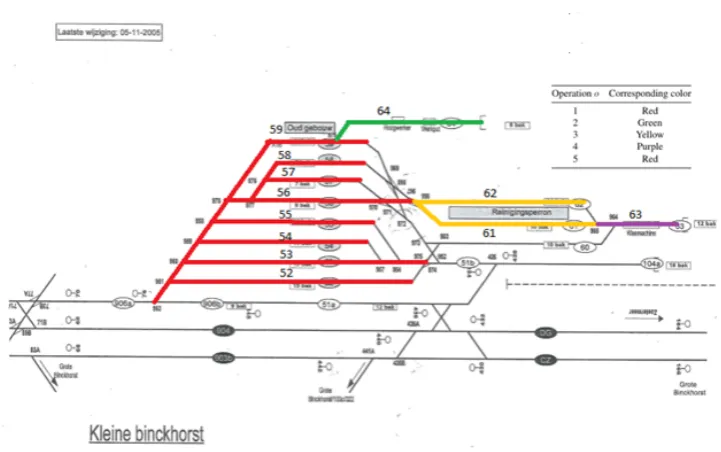
At SBKleine Binckhorst, nine line services can be processed. Of these nine first-line services, a train unit requires at most seven, because only one of the two the inspec-tions, and one of the two external cleaning services are required at a time. We aggregate these nine first-line services into five operations. Table 4.1 displays the operations and of which first-line services they consist. The table also shows the number of machines on which that operation can be processed and what the machine numbers are of the ma-chines that can process that operation. These machine numbers help in understanding the next Figure 4.1, which is explained in the next paragraph.
In our model, not all jobs require seven out of nine first-line services. Jobs may require only 3 or 4 first-line services. Two first-line services is the minimum number of first-line services that a train unit requires, because the arrival and departure operations always take place. For the first-line services that are not required for the job, a processing time of zero is assigned to that first-line service. The processing time of an operation is the sum of the processing times of the first-line services that this operation contains. If the operation has a total processing time of zero, the train unit still visits this stage with machines, because of the carousel layout. This is because the stages are located in a sequence at the SB. Most stages cannot be skipped in order to reach the stage after that. Therefore, for simplicity we assume a job needs to visit all stages, even though the job is not processed at that stage.
The fixed sequence in which jobs visit the stages, and thus the sequence of processing the operations of a job, is a result of modeling the problem as a flexible flow shop prob-lem. Having this fixed sequence limits the number of different plans that are considered by the model. This choice is a realistic limitation for SBKleine Binckhorst, because SB
30 CHAPTER 4. PROBLEM DESCRIPTION
of shunting movements. The limitation that train units cannot overtake each other on a track also needs to be kept in mind. This makes traveling over the carousel layout in the opposite direction very difficult. Finally, by using the fixed route over the SB, the planners recognize the planning approach of the model, which helps in accepting the model, making it easier to implement the model. Based on these reasons, we choose to include the fixed order of processing operations.
[image:40.595.107.539.349.706.2]Table 4.1 displays an overview of which first-line services that are aggregated into which operation and which machines process these operations. Figure 4.1 graphically visual-izes the stages, the groups of machines, and the assigned sequence in which the jobs visit the stages. In the horizontal direction the different stages are displayed. Stage 1 and stage 5 are merged in the figure, because they consist of the same machines. Stage 1 and 5 contain the stabling tracks on which the train units arrive, the inspections take
Table 4.1: Overview of which the first-line services form the operations and which machines process which operation
First-line service Operation number
Number of machines that can process this operation
Machine numbers
Arrival
1 8 1,2,3,4,5,6,7,8
Inspection B Inspection A Telehandler service
2 1 9
Work pit service
Internal cleaning 3 2 10,11
External cleaning normal
4 1 12
External cleaning oxalic
Departure 5 8 1,2,3,4,5,6,7,8
4.2. MODELING APPROACH 31
place (operation 1), and the train units depart (operation 5), hence the merging of the two stages. The nodes in the graph in Figure 4.1 represent the events of this instance. Thesandtin the first and last node represent the start and end event.
The nodes in the stages represent one machine per stage. We do this to make the figure easier to understand, even though in practice there may be more machines per stage, as Table 4.1 shows. The nodes are described asvk,o nodes of which the k stands for the
[image:41.595.100.461.363.589.2]machine number and theo for the operation number that is processed. The machines all have unique numbers. In the model thekrepresents the first machine number in that stage. So, for stage 1 that is machine 1, and for stage 2, it is machine 9. Stage 1 consists of eight machines, so machine 9 is the next machine number. Figure 4.2 displays the location of the different stages on the map of SBKleine Binckhorst. In the right corner of the figure the legend is located. The legend relates the operation with the color of the stage. Since the operations and stages correlate one-on-one, the operation number equals the stage number. The operation in the figure is the aggregated form of the first-line services. From now on, we make a distinction between operation and first-line service. When we mean the first-line services, we will usefirst-line services. When we use the aggregated form of first-line services, we useoperation.
Figure 4.2: Tracks classified in stages
The following paragraphs describe the number of machines in every stage and the oper-ation that is processed in that stage, according to the situoper-ation of SBKleine Binckhorst.
32 CHAPTER 4. PROBLEM DESCRIPTION
Stage 2 contains only one machine and processes operation 2 which consists of the first-line services: telehandler service and work pit service.
Stage 3contains two machines, representing the tracks on both sides of the platform on which train units can be cleaned internally (operation 3). There is only one cleaning crew available at the time. Therefore, only one train unit on one of the two tracks can be cleaned at a time. Another train unit can be parked on the track but it has to wait on being cleaned, until the train unit at the other track is finished. In our model a train unit can stay on the track after being processed, but cannot arrive early. Section 4.6.2 describes how we model this.
Stage 4contains the machine that externally clean the train units. Operation 4 is pro-cessed in this stage. Operation 4 consists of either the external cleaning normal, or the external cleaning oxalic service. This is because at most one of the two external cleaning options is required for a train unit per visit at an SB.
Stage 5 contains the same machines as stage 1, because the train units need to depart from the same tracks as the train units arrive and are inspected on. So, the capacity of the tracks need to be divided between operation 1 and operation 5.
TO answer the subquestion that we answer in this chapter, we formulate our problem as a Integer Linear Programming (ILP) problem. Integer linear problems are of the form:
maximize cTx
subject to:
Ax≤b
x≥0
(4.1)
We choose this formulation, because the values of the variables are integer. we cannot assign fractions of a train to a track. Furthermore, all constraints need to be, and are, linear. This reduces the solving time of the model compared to a non-linear model.
4.3. DATA 33
4.3
Data
The input data for the model are the following:
1 A table that contains which operation can be processed on which set of machines at SBKleine Binckhorst.
2 A table that contains the processing time of every operation for each job, based on the required first-line services and the train type of the job. The train type is important, because the processing times of the first-line services are different for all train types.
3 As described in Section 4.1.2, we include the travel time between all machines. The input for the model is a table that contains the travel times between all ma-chines. Since we use a fixed sequence in which the machines visit the stages, not all travel times are needed. However, if the model is to be extended and these are needed in the future, these are already included. The processing times are given in minutes. In practice these travel times differ slightly for the different train types. For simplicity we use a fixed travel time between two machines that is equal for all train types. These travel times are based on the shortest routes, hereby assuming that tracks are long enough, so that there is always enough space to let a train unit change direction on that track. This is a reasonable assumption since we assume all train units that enter the SB are single train units. However, we make sure that train units do not need to overtake each other on their routes. An overview of the travel times can be found in Appendix A.
4 A table with the release dates (the arrival time of a job at the SB), and the due dates (the time that a job needs to depart from the SB) for all jobs. These times are all given in minutes. One day contains 1440 minutes. Most jobs arrive on day one, and leave in the night hours of day two. To cope with this, in our model, day one starts at 08:00. So, 08:00 on day one equals 0 minutes, and for example 13:00 on day one equals 300 minutes. 07:59 on day two equals 1439 minutes.
4.4
Overview, assumptions, and constraints
We can now formulate the problem as follows:
Given:
- The layout of service stationKleine Binckhorst, - a set of the available machines, grouped into stages, - an overview of jobs,
- an overview of the processing time for every operation for every job, - a sequence in which the operations need to be processed,
34 CHAPTER 4. PROBLEM DESCRIPTION
- the travel times between all machines at the SB, based on the shortest path.
We need to:
- Plan all operations of the jobs such that the total tardiness of all jobs is minimized. Section 4.6.2 clarifies this objective.
Such that:
- All assumptions and constraints hold, these are described in the next paragraphs.
The next paragraphs provide an overview the assumptions and constraints that are made for creating the model. The assumptions and constraints are classified in categories related to the operations, jobs, machines and SB layout.
Operation-related Assumptions
1. There are five operations that together contain all nine first-line services that are provided at SBKleine Binckhorst. The processing time of an operation is equal to the total processing times of the first-line services that, that operation consists of.
2. If a job does not require one or more first-line services, that service gets a pro-cessing time of zero, instead of its normal propro-cessing time. However, a job always contains the first and last first-line services, the arrival and departure of the SB.
Constraints
1. All operations of every job are assigned to exactly one machine.
2. Operations are processed on the machines that can process these operations. 3. All operations are processed in the defined sequence.
Machine-related Assumptions
1. All machines are available at all times, including the internal cleaning machines. 2. All machines that can process the same operation are uniform.
Constraints
1. Every machine can process only one operation at the time.
Job-related Constraints
1. Jobs leave the SB either at their due date, or after they have received all operations, when its completion time exceeds its due date.
4.4. OVERVIEW, ASSUMPTIONS, AND CONSTRAINTS 35
3. The order of visiting the stages is equal for all jobs. 4. A job cannot start being processed before its release date.
SB layout-related Assumptions
1. The SB is empty at the start of the plan, and after the plan has ended.
2. Enough mechanics, train drivers, and other personnel that is needed to process the services, are available in excess at all times. We only included the limited cleaning personnel as is explained in the next constraint.
Constraints
1. Only one cleaning crew is available at a time, meaning that only one job can be processed on one of the two cleaning machines at the time.
2. There are no buffers between the different stages, meaning that a job keeps the machine that it is currently located on, occupied until it moves to the next ma-chine. This means that if the next machine is still occupied by another job, the job on the previous machine has to wait before it can travel to its next machine. It also implies that a job cannot be parked between operations, so all operations are processed continuously. The processing of operations is only interrupted by travel and waiting times. Because there are no buffers, jobs cannot overtake each other if there is only one machine for that operation available.
3. Only one job can occupy a machine at the time, this means processing and wait-ing at the machine. However, for the calculation of the travel times between the machines it is assumed that there is always enough space for train units to use that track for traveling to the next machine. Train units do not need to pass a train unit that is being processed to reach their next machine, they need to use the track for changing directions.
The assumptions are made to simplify the model. Some assumptions are made because of the scope of our research. For example, by assuming that all personnel is available at all times, we can disregard the crew scheduling problem. Other assumptions simplify modeling the first-line services planning problem, but do compromise the solution qual-ity much. For example, the assumption that all jobs visit all machines, even though the processing time of that operation may be zero. This is because of the carousel layout, as explained in Section 4.2. Also, the assumptions that the machines are uniform and always available, allow the model to be simplified a lot and at the same time do not compromise on the solution quality.
36 CHAPTER 4. PROBLEM DESCRIPTION
4.5
Model description
This section presents the indexes, the parameters and the decision variables that are used in the model.
Inspiration for our model is deduced from Jain and Grossmann (2001). The model they propose is a MIP model. Since we use a ILP model we need to make sure that the constrains are linear, which is not important for Jain and Grossmann (2001). In their model, jobs need to be assigned to a machine and the sequence of the jobs on the machines needs to be determined. Furthermore, the model takes into account the different release and due dates of the jobs. In our model we also include these features, but we extend it in the following ways:
- We extend the model by adding the complexity layer of operations. In our model every job consists of a set of operations. Every operation of a job needs to be assigned to a machine. The order of the operations that are assigned to the same machine, also needs to be determined. moreover, no overlap of operations on a machine may occur or overlap in processing operations of the same job at the same time.
- We extend the model of by including travel times, based on the approach used by Ahonen and de Alvarenga (2017).
Gupta (1988) proves that the flow shop problem with multiple machines at each stage is an NP-Hard problem. This also holds when one of the two stages contains only one machine. The flexible flow shop problem is a specific case of the flow shop problem. Therefore, we conclude that our problem is also a NP-Hard problem. This means that the problem cannot be solved in polynomial time. Michalewicz and Fogel (2004) ex-plain that ’an algorithm with rational input is said to run in polynomial time if there is an integerk such that it runs inO(nk)time, wherenis the input size, and all numbers intermediate computations can be stored withO(nk)bits. For an NP hard problem this
is not true.
4.5. MODEL DESCRIPTION 37
Table 4.2: Indexes, Parameters & Decision variables (Part I)
Indexes
o Operation
j, v, g Job
k1,k2 Machine
Parameters
a A job containsaoperations, i.e.ais not the
cumulative number of all operations of all jobs, but the last operation of every Jobj. All sets of operations start at
Operation 1 and end with operationa. At SBKleine Binckhorst
there are five operations. Thereforeaequals 5, (o= 1,2,...,a).
n Number of jobs, (j = 1,2,...,n;v = 1,2,...,n;g= 1,2,...,n).
so, eo Start and end number of machines on which operationocan be
processed. In Section 4.2, we referred to these groups of machines asstages. Since the stages and operations correlate one to one, we model the groups of machines subject to the operations. There are in total twelve machines at SBKleine Binckhorst. Operations can only be processed on certain machines, for example operation1can be processed on the first eight machines at the SB, and operation 2 only on machine 9. We choose to make subsets of the machines per operation, to keep the model small. This way, less options for, for example, the travel times need to be calculated in Equation 4.15 in Section 4.6.2. So, for operation 1,s1=1 ande1=8; for operation 2,
s2 =9 ande2=9;s3=10 ande3=11;s4 =12 ande4=12;s5=1 ande5=8.
Rj Release date of jobj, (j=1,2,...n).
Dj Due date of jobj, (j=1,2,...n).
M Big-M, large integer.
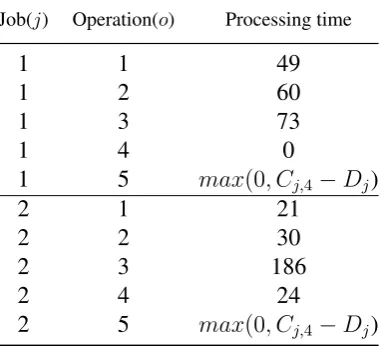
Pj,o Processing time of operationoof jobj. The processing time of
operation 5 is represented by the decision variableP Pj due to its
dynamic nature, (o= 1,2,...,a−1;j=1,2,...n).
38 CHAPTER 4. PROBLEM DESCRIPTION
Table 4.2: Indexes, Parameters & Decision variables (Part II)
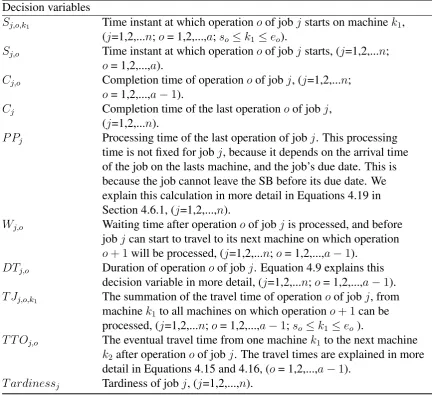
Decision variables
Sj,o,k1 Time instant at which operationoof jobj starts on machinek1,
(j=1,2,...n;o= 1,2,...,a;so ≤k1 ≤eo).
Sj,o Time instant at which operationoof jobj starts, (j=1,2,...n;
o= 1,2,...,a).
Cj,o Completion time of operationoof jobj, (j=1,2,...n;
o= 1,2,...,a−1).
Cj Completion time of the last operationoof jobj,
(j=1,2,...n).
P Pj Processing time of the last operation of jobj. This processing
time is not fixed for jobj, because it depends on the arrival time of the job on the lasts machine, and the job’s due date. This is because the job cannot leave the SB before its due date. We explain this calculation in more detail in Equations 4.19 in Section 4.6.1, (j=1,2,...,n).
Wj,o Waiting time after operationoof jobjis processed, and before
jobjcan start to travel to its next machine on which operation
o+ 1will be processed, (j=1,2,...n;o= 1,2,...,a−1).
DTj,o Duration of operationoof jobj. Equation 4.9 explains this
decision variable in more detail, (j=1,2,...n;o= 1,2,...,a−1).
T Jj,o,k1 The summation of the travel time of operationoof jobj, from
machinek1to all machines on which operationo+ 1can be
processed, (j=1,2,...n;o= 1,2,...,a−1;so≤k1 ≤eo).
T T Oj,o The eventual travel time from one machinek1 to the next machine
k2 after operationoof jobj. The travel times are explained in more
detail in Equations 4.15 and 4.16, (o= 1,2,...,a−1).