Analysis of Technology Value-in-use
and the Impact of Service Quality
Master Thesis
Sybille Elfrich
Business Administration
Supervisors:
Dr. K. Zalewska-Kurek
Analysis of technology value-in-use and the impact of service quality
Author: Sybille Elfrich Student number: s1571869
Education institution: University of Twente, School of Management and Governance Study Program: Business Administration
Exam committee: Dr. K. Zalewska-Kurek,Dr. R.P.A. Loohuis
Abstract
The goal of this research is to assess the impact of service quality on technology value-in-use. The challenge with value is that companies are not certain about what brings value and therefore they don’t meet customer expectations. S-D logic provides an alternative view on value, which is created in customer’s processes and/or jointly between the customer and the service provider. Technology businesses are commonly considered as service organisations embedded in goods dominant logic. However, it is important to develop further value concepts in perspective of value-in-use because it can offer technology service providers new insights for business opportunities and improved value propositions. The application of current S-D logic and value-in-use concepts are not valid for technology because it has certain features that set it apart from common goods and services. Value of technology is dependent on interpretive schemes and user abilities whereas value for common goods and services depends on the beneficiary application of operand resources. Therefore, a reformulation of the common concepts is required. This research raised and analysed the information content of ten interviews with technology users. Four service expectation categories emerged based on the insights of the interview transcripts, namely responsiveness, interactions, core competences and technology. In addition, two value-in-use categories emerged: Time and cost reduction.From the analysis of the data it can be stated that there are some gaps between service expectation and value-in-use experience.
Table of Content
1. INTRODUCTION ___________________________________________________________________________ 5
2. THEORETICAL FRAMEWORK ___________________________________________________________ 8
2.1 SERVICE DOMINANT LOGIC ________________________________________________________________ 8
2.2VALUE-IN-USE CONCEPT AND ASSESSMENT ___________________________________________________ 9
2.2 DIFFERENCE BETWEEN COMMON VALUE-IN-USE AND TECHNOLOGY VALUE-IN-USE _________ 10
2.5THEORETICAL FRAMEWORK FOR SERVICE QUALITY IN S-D LOGIC ____________________________ 13 3 METHODOLOGY _________________________________________________________________________ 15
3.1RESEARCH DESIGN _________________________________________________________________________ 15
3.2SAMPLING _________________________________________________________________________________ 15
3.3.DATA COLLECTION ________________________________________________________________________ 16 3.3.2 Observations ________________________________________________________________________ 16 3.3.1 Semi-structured Interviews ________________________________________________________ 16 3.3.2 Development of Interview Questions ______________________________________________ 17 3.5.1 Reaching Validity of Data __________________________________________________________ 18
3.5DATA ANALYSIS ___________________________________________________________________________ 20 4 RESULTS __________________________________________________________________________________ 21
4.3NO GAP BETWEEN SERVICE EXPECTATION AND VALUE-IN-USE EXPERIENCE __________________ 21 4.3.1 Technical knowledge, Branch knowledge and Knowledge of Customer Processes ____________________________________________________________________________________________ 21 4.3.2 Flexibility in regard to customer needs ___________________________________________ 22 4.3.3 Reliability, User-friendliness, Capacity Planning, Flexibility _____________________ 23 4.3.4 Efficiency ___________________________________________________________________________ 24 4.3.5 Data Transparency _________________________________________________________________ 24 4.4.3 Capacity Planning __________________________________________________________________ 25
4.4GAP BETWEEN SERVICE EXPECTATION AND VALUE-IN-USE EXPERIENCE ______________________ 25 4.4.1 Response and Speed of Implementation __________________________________________ 25 4.4.2 Speed of Technology _______________________________________________________________ 27
5 DISCUSSION AND CONCLUSION _______________________________________________________ 29
5.1 KEY FINDINGSA __________________________________________________________________________ 29
5.2 THEORETICAL CONTRIBUTION ___________________________________________________________ 30
5.3 PRACTICAL CONTRIBUTION ______________________________________________________________ 32
5.4 CONCLUSION ____________________________________________________________________________ 32
5.5 LIMITATIONS AND FUTURE RESEARCH ___________________________________________________ 34 REFERENCES __________________________________________________________________________________ 35
APPENDIX I: SEMI STRUCTURED INTERVIEW ___________________________________________ 39
APPENDIX II: FIELD NOTES ________________________________________________________________ 39
1.
Introduction
Finding ways to create value and differentiate service offerings to attract and keep customers is the foremost objective of profit organisations (Shaw and Ivins, 2002). Parasuraman et al. (1991) even argues that to deliver superior value the first step is to understand customer service expectations. Other scholars have extensively addressed value and service quality in separation of one another (Woodruff, 1997; Holbrook, 1996). Grönroos (2006, p.322) noticed that current literature only vaguely illustrates perceived service quality in relation to customer expectations. This research makes an attempt to further understand service quality with marketing and extend it to technology research. Value of technology has been debated for a number of years (Hitt, 1996) and according to Rifkin (1989), technology chief executives believe they don’t receive enough from their technology investment and therefore, value from technology service providers needs to be justified. The specialty with technology is that it is assumed to be unproblematic once installed (Orlikowski and Iacono, 2001). Nonetheless the ability of technology to result in value is influenced by social structures, users’ technical knowledge and the interactions with technology.
This research looked at technology value from S-D logic, which is contrasted with G-D logic and different in terms of exchange and value (Lusch et al., 2007). In S-D logic, the unit of exchange is service and the customer determines value whereas in G-D logic, exchange is based on output and value is added in the manufacturing process. Another distinction is that in S-D logic the focus is on intangible resources, value co-creation and relationships (Vargo & Lusch, 2004). The underlying idea in S-D logic is that customers and service providers nowadays jointly create value (Vargo & Lusch, 2004, 2008).
and service perception (Parasuraman, et al., 1988; Grönroos, 1984). Service perception is the customer’s judgements, which narrate to the superiority of a service (Parasuramen et al., 1988). Grönroos (2011) adds that value and service quality emerges or destroys throughout the service process.
Technology features demand a reformulation of the value-in-use concept that also considers user experiences with technology.Orlikowski (1991) looked at technology value in relation to organisational structures but away from factors outside of the organisation that might impact technology value. One problem that was noted by Orlikowski and Gash (1994) is that different interpretations of technology result in difficulties and conflicts around technology use. Still, this is only one aspect that may affect technology value. It was already claimed that technology research considered technology in isolation of the organisational structure (Orlikowski and Robey, 1991) and also in isolation of service quality, which we claim to have an impact on technology value, too. A tremendous part of service in technology consists of value-supporting activities through customer support. This enables users to work more efficiently and effectively with technology and therefore, it can be assumed that service quality has an impact on technology value.
The overall goal of this research is to determine how service quality of technology providers has an impact on the perceived value-in-use. In order to reach this goal, this research hasfour objectives. First, we develop an understanding of the application of value-in-use and S-D logic in common goods and services as it is already presented in the literature. The next step is to understand technology features and its impact in context of value-in-use and S-D logic. Then a big part of the research is to gather information through observations and interviewing embedded in ethnographic research to develop a deeper understanding of technology value-in-use and service quality in the cultural context. The final step is to analyse gaps between service expectation and value experience.
customer and other stakeholders. Second of all, technology suppliers can improve customer value and therewith keep customer satisfaction high.
We formulated one central research question and four additional sub-questions to reach the goal.
Central research question:
What is the impact of service quality on technology value-in-use?
Sub-questions:
1) What is value-in-use?
2) What is value-in-use for technology and why is it different from the common goods and services?
3) What do technology users expect from service and what do they experience as value-in-use?
4) Are there discrepancies between service expectation and value-in-use experience?
2.
Theoretical Framework
The purpose of this chapter is to introduce and illustrate the theoretical concepts and variables. First we will further explain S-D logic and value-in-use. Following this, we will describe different approaches of assessing use and explain how technology value-in-use is different from common goods and services. This chapter will conclude with a theoretical framework of assessing technology value-in-use.
2.1
Service Dominant Logic
“Over the past several decades, new perspectives have emerged that have a revised logic focused on intangible resources, co-creation of value, and relationships” (Vargo & Lusch, 2004, p.1). Changes in economic exchange are subject to this changing perspective. One of these economic changes is illustrated in higher specialisation among market members. This makes organisations more dependent on external resources resulting in increased outsourcing and networking. Marketing is a continuous series of social and economic processes that focuses on operant resources, which the firm is constantly trying to make better value propositions than competitors (Vargo & Lusch, 2004). Overall in S-D logic, the customer is an operant resource and co-producer of value and therefore, a sense and response strategy is prior to make-and-sell (Vargo & Lusch, 2004).
customers’ main motivation to buy an offering is that they want to render the needed service to create value. The service provider has to develop core competences and to identify entities that could benefit from those competences (Vargo & Lusch, 2004). Collaboration and learning with the customer and willingness to adapt to customers’ dynamic needs are keys for delivering value-supporting activities (Vargo & Lusch, 2004; Grönroos, 2000).
2.2 Value-in-use Concept and Assessment
Value and value-creation have been two of the most addressed topics in theoretical discussions within B2B marketing (Sharma, Krishnan and Grewal, 2001). In value-in-use concept, or in other words the value of the whole process (Vargo & Lusch, 2004), the customer determines the actual usefulness of an offering in the moment of usage (Vargo & Lusch, 2004). This is based on the perception that goods and services only have value to the extent to which they meet customer needs (Ballantyne & Varey, 2006). Value perception is therefore influenced by the experiences, learning and evaluation of processes and interactions with a firm (Ballantyne & Varey, 2006). In value-in-use, the focus of value is on processes that integrate resources rather than on units of firm output (Vargo et al., 2008).
Grönroos (2009) identified three core steps in the value-creation process. First, the service provider facilitates resources or potential value through its value proposition that ideally connects with the customer’s value proposition. Secondly, value co-creation where service provider and the customer are both engaged as operant resources in the processes of the other party. Third, the customer is the sole creator of value.
Certain aspects influence the assessment such as individual and situational factors (Sandström et al., 2008), the quality of interaction and the knowledge gained prior to sale (Ballantyne et al., 2011).
Ballantyne et al. (2011) propose three steps of value assessment. The assessment of the quality of reciprocal value propositions; coordinating reciprocal value proposition and continue until the sequences of proposals and essential detail is seen to make sense from their respective points of view. Interactions are one key determinant of service experience assessment and it has become the basis for value-in-use (Vargo and Lusch, 2008). This does not include just the interactions between customer and service provider but also between customer and object (Holbrook, 1994). Companies have to integrate favourable service experiences in their value propositions to keep and attract customers (Sandström et al., 2008). Payne et al. (2008) add that creating customer experience is less about products and more about relationships and the total offering.
2.2
Difference between Common value-in-use and Technology value-in-use
In this section, we elaborate on the value-in-use concept in context of common goods and services and explain why the application is different for technology.
Technology is defined as “a bundle of material and symbolic properties embedded in hardware, software and techniques” (Orlikowski & Robey, 1991). It consists of hardware and the generic tasks, techniques and knowledge utilized by humans to achieve a productive activity (Orlikowski, 1992). In S-D logic, common goods and services are types of operant resources or transmitters of operant resources (Vargo & Lusch, 2004). Economic exchange is based on service or the application of knowledge and skills. In S-D logic, technology is one type of operant resource. However, technology as operant resource has to be combined with other operand resources (as defined in S-D logic) to reach organisational goals. For example, companies have software but also a server to store and centralise data. Technology properties are dependent on one another and inseparable because hardware and software are useless without the other component. S-D logic for common goods and services neglects that service may consist of multiple, interrelated properties because this is usually not the case with common goods and services.
repeated use, while actual value is influenced by multiple factors (Orlikowski, 2000). Value of operant resources emerges from the beneficiary use of those resources (Vargo & Lusch, 2004). This means that a customer has to combine obtained resources with own resources and find ways to integrate the resource in processes to be effective. In technology however, the value is dependent on actions and motives of designers, implementers and the institutional context as well as the autonomy and capability of particular users (Orlikowski & Baroudi, 1991). Since technology is embedded in organisational structures, value cannot be determined in isolation from technology practices and actual human actions, whereas in common goods and services the value-in-use is determined by the consumer apart from contextual conditions (Vargo & Lusch, 2004).
relationship continues over time” (Mcdonald et al., 2011, p.672). However in technology this assumption is extended with the user-experience of technology.
2.5 Theoretical Framework for Service Quality in S-D logic
In this section, we introduce the theoretical framework for service quality in S-D logic. Therefore, we use Orlikowski’s original view on technology value and combine it with the service quality adapted to S-D logic. We deliver explanation about why we chose the variables and state how variables are connected.
How structural and institutionalised properties influences technology-in-practice and vice-versa
“Social structures represent the knowledge of the automated work resources in action and the organisational sanctioned way of executing work” (Orlikowski, 1992, p.410). Users adapt their practices and form new structures through technology changes. The regular knowledgeable use of technology results in standardised practices. Norms are one part of social structure and a way of controlling processes and human actions. For instance, norms are embedded in technology such as in accounting systems. “Users can and do redefine and modify the meanings, properties and applications of technology” (Orlikowski, 2000, p.405). Rules and regulations are additional properties that encourage the technology acceptance in organisations. Organisational acceptance of technology and the way of using technology determines the perceived value.
How technology-in-practice result in value
Impact of service quality on value
We refer to Zeithaml et al. (1988) who define service quality as discrepancy between service expectation and service experience. Since value-in-use emerges in the customer’s sphere we propose that in S-D logic service quality can be theorised as the discrepency between custmer expectations toward service and experienced value-in-use. Service expectation is what customers would perceive from companies delivering excellent services (Lee et. al, 1996). The analysis indicates if there are issues with the service quality. Knowing this helps service providers to improve their service and increase customer value. Technology-in-practice is not only influenced by internal, structural and organisational properties but also by the service provider’s core competences and the embedded knowlege in technology. The quality of the service offering shapes practices because when it delivers a poor service offering, customers may not be able to work with technology. For example, customers have to take alternative ways to fulfil their job if technology has a technical defect and they cannot approach it. Over time, approaching alternative programs and revoking from organisational rules reshapes properties and the negative effect on value.
Illustration 1: Technology value-in-use and service quality
Technology value Technology-in-practice/
Human action Structural, norms and
institutionalized properties
Expected service
Experienced value-in-use
Orlikowski’s view on technology value
3
Methodology
3.1 Research design
The choices of methodology for this exploratory research aim to deliver the best option to answer the main research question in effective and efficient frames. Ethnographic research enables us to study the participant’s world and their subculture and make it an efficient way to study the phenomenon (Krane and Baird, 2005). Ethnography research is a method in qualitative research that has received increasing interest of scholars in technology research due to its focus on the social and organisational context (Myers, 1999). It builds theories of cultures, explanations of how people think, believe and behave in time and space (Lecompte & Schensul, 1999). Since the goal of the research is to analyse the impact of service quality on technology value-in-use, we will explore the phenomenon from the user’s point-of-view in an in-depth manner. This includes the consideration of organisational structures and technology practices and therefore ethnographic research is a suitable method. We observed technology users and then applied interviews with them. This type of instrument is suitable for the research because we can explore the phenomenon while at the same time, leaving room for additional, unexpected discussions. Interview transcripts delivered the main source of data analysis. To develop meaningful data we shifted through pieces of data to detect similarities and sorted them to interpret thematic categorisations. Then, we looked for inconsistencies and contradictions, and generated conclusions about what is happening and why. Validity is an important aspect in qualitative research and to ensure it, we back-checked with each participant after the interviews were scripted. Additional questions that arose throughout the data analysis process were also discussed with the participants. As for validity issues, the interview guide was first prepared in German and then translated into English to make sure that we measure exactly what we want to measure.
3.2 Sampling
service provider because then they are likely to provide the desired information. Additionally, participants have to directly work with the system and they have to know how the system is used in organisational processes. Another criteria is that the size of the customer should range somewhere between 10 and 50 licenses. Smaller companies have different processes and technology practices than large companies. They also differentiate in their way of structures, norms and regulations of using technology. Ultimately, customer needs are different and therefore we hope to receive a range of experiences.
From experiences it can be assumed that the ideal participant is an either owner of a business or an IT specialist. When companies are smaller, the business owner is often in charge of the technology and therefore interacts with the service provider. However, if the company is larger, then it is likely that they have their own IT department that is in charge of the structure and the interactions with the technology service provider.
3.3. Data collection
3.3.2 Observations
Lecompte and Schensul (1999, p.91) defined participant observation as “a process of learning through exposure to or involvement in the day-to-day activities of participants in the research setting.” We applied observations in combination with interviews because we wanted to make sure that we understand participant’s routines with technology and then we wanted to ensure that what participants communicate in interviews is also how they really acted with technology. Observing participants in the first place furthermore helped to understand the phenomenon from the participant’s point-of-view. Observations were carried out at the participant’s working environment typically the office. In particular we observed the participant from a distance to observe his actions and activities we did not actively participate in the situation. Participant observation requires thoroughly listening to the participants and understanding the meaning of language. Field notes were made during the observation process containing notes regarding participants’ behaviours, quotes and uncertainties. Right after the observations, interviews gave us the opportunity to discuss uncertainties or to deepen the discussed on certain behaviours. An example of the field notes can be found in Appendix III.
3.3.1 Semi-structured Interviews
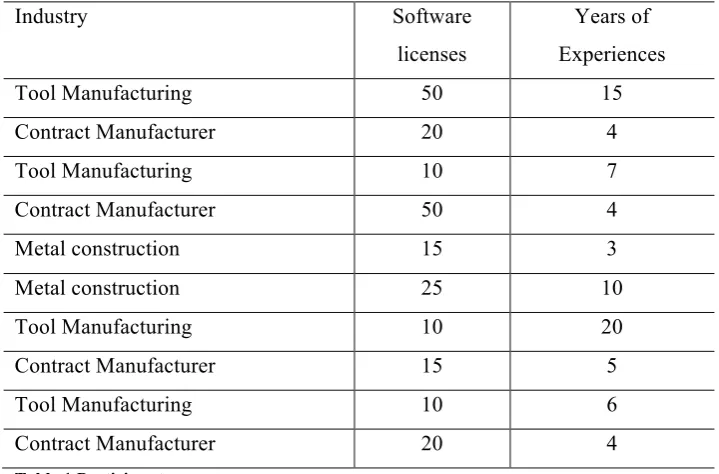
we wanted to have the freedom to discuss further themes and also in regard to the structure of the interview. We prepared eight questions in relation to the theoretical framework and the research questions. The interview questions were such that allowed the participants to give a thorough response. In agreement with participants we recorded each interview and transcribed them afterwards. Table 1 Participants indicate the industry, the number of software licenses and the number of experiences with the service provider.
Industry Software
licenses
Years of Experiences
Tool Manufacturing 50 15
Contract Manufacturer 20 4
Tool Manufacturing 10 7
Contract Manufacturer 50 4
Metal construction 15 3
Metal construction 25 10
Tool Manufacturing 10 20
Contract Manufacturer 15 5
Tool Manufacturing 10 6
[image:18.595.64.424.195.432.2]Contract Manufacturer 20 4
Table 1 Participants
3.3.2 Development of Interview Questions
The development of interview questions is mainly based on value-in-use and S-D logic literature. We used the components of the framework in chapter 2 as main themes (organisational structures, technology practices, value-in-use and service quality). Also, we used interactions between service provider and customer as an additional theme because this is an important aspect in the literature (Vargo & Lusch, 2008; Grönroos, 2004). To develop leading questions for each theme we approached major scholars and their opinion about one theme and translated that into questions.
Customer’s general service experience
Structures, practices and value-in-use
Technology value is one theme and questions are based on chapter 2.2. Differences between common value-in-use and technology value-in-use. It was said that technology is embedded in organisational structures and that value is dependent on user practices. One leading question is about the organisational structures to gather information about norms, rules and regulations that either encourage or distract technology use. Then a question for technology practices aims to understand how participants apply technology in daily practices. This question is important to reflect field notes and ask why a participant used technology in the particular way. The third leading question in this theme is about technology value. Ideally participants talk about value emerging throughout individual processes.
Service expectations and service quality
Since we are interested in the service expectations this has become one leading question in this theme. We asked directly for the service expectation and everything that the customer had in mind was discussed. Another question is related to service quality and the impact on technology value. The question we used was: How does the service quality influence perceived value of technology?
Value co-creation through interactions
As already discussed in chapter 2, the interactions between customers and service providers are core to value co-creation and therefore, one important theme for the interviews. One question is about the criteria of good interaction. This question is open and provides opportunities for additional questions. Another aspect includes core competences, the skills and the knowledge that helps customers to create value. This question helped us to learn more about the service provider’s role in the value process.
3.5.1 Reaching Validity of Data
implementation to ensure congruence among question formulation, literature, recruitment, data collection strategies and analysis. This he attains through checking, confirming, making sure and being certain of the data. Several authors identified procedures for establishing validity in qualitative projects (e.g., Lincoln & Guba, 1985). To ensure validity of data we applied member checking, which is one of the accepted validity strategies (Creswell and Miller, 2010). According to Lincoln and Guba (1985), member checking is the most significant technique in attaining validity in a study. In member checking, we turned the viewpoint to the participants. Particularly, we had participants view transcripts and allowed them to comment on their accuracy.
3.5 Data Analysis
Strategies of data analysis are used to order and manage interview transcripts and then to systematically analyse the information content. We use an iterative process to transform cultural ideas obtained from data collection into a written document (Thorne, 2000). Coding is a process whereas raw data is transformed into standardized form (Babbie, 2013). Two types of coding were applied: the first one included open coding and the second one dealt with axial coding. In vivo coding and summarised coding are two methods of open coding (Thomas, 2006). In vivo coding means that actual words are taken as codes whereas summarised coding means that small sections of data are transformed into a code. In axial coding, codes that belonged together were assigned to a category. Categories in qualitative research represent a group of content that were common (Krippendorff, 1980). The specialty with categories is that no data related to the purpose should be excluded due to suitable lack of category and no data should fall between two categories. Category decisions were based on interpretation of the researcher as to which contents refer to the same category. Those codes that could not clearly be categorised were not used, as well as data that was not relevant to answering the research question. Table 2 illustrated four categories of service expectations with the corresponding codes and categories of technology value-in-use with the corresponding codes. The data are the results of the first interview transcript and serve as
codes for the analysis.
Table 2: Codes
Service expectation Category
Technical knowledge - Branch specific knowledge - Customer processes - 100% Software competences
Core competences
Availability - Response (email, telephone) – Feedback - Speed of implementation Responsiveness
Friendliness - Preferential treatment in special cases - Willingness to compromise - Flexibility in regard to customer needs – Correct problem record – customer orientation – Co-creation
Interaction
Illustration of whole organisation - Coverage of departments - User friendliness - Flexibility of Software - Reliable system
Technology
Value-in-use experience
System speed - Organised data - Processes are more comprehensible - Structuration of working processes - Data transparency - Access from different work places - Central data – automated processes
Time saving
4
Results
We will review all findings in this chapter. We conducted observations of technology users and semi-structured interviews to reveal how service quality impact value-in-use.
4.3 No gap between Service Expectation and value-in-use Experience
4.3.1 Technical knowledge, Branch knowledge and Knowledge of Customer Processes The service provider needs to have software knowledge and she or he has to know how customers use technology in their working processes. Respondents clearly stated what type of competences the service provider needs to deliver value-supporting offerings. One type of competence is that service providers have to know how the industry works and also customer processes.
Participants stated, “we have developed technical interfaced in co-operation with the technology service provider (between the software and other machinery) in our company where we had to connect machinery with the software. The service provider has to know how the industry works and also how our internal processes are organised. It would make no sense if someone was sitting in front of me who had no clue about the industry” (R1).
This indicates that technology service providers don’t only need technical knowledge of programming and the structure of the own software, but they also need to understand customer needs in the whole context in order to deliver value supporting activities This also includes branch specific knowledge, technical knowledge, working processes and of course software skills to further support customer processes. When customer support is competent, they can help quickly and they make customers feel good. In fact and with most questions, support staff can help immediately. However sometimes they need to ask a programmer who better understands the technical context of technology. This requires that customer support is well trained and that representatives understand the software processes and functions in-depth.
engineering companies have complex processes, which can be difficult to understand for someone who is not engaged in the daily process. However, customers value when they interact with employees who have the knowledge from engineering because then they are able to know what is happening and the service provider can provide more value-adding activities. In the same place, the service provider ties the customer with the company because the more the customer processes are aligned with the software the more difficult it is for the customer to implement new software.
The analysis revealed that participants are satisfied with the level of technical knowledge of the service provider, which results in the development of valuable service activities that provide the technical solutions to operational problems. Participants were especially satisfied when it came to branch-specific knowledge and customer processes. “Service provider knows how the industry works and he also understands our working processes” (R8). The knowledge of the industry creates the co-creation opportunities between customer and service provider because the service provider knows how the industry is working and can therefore apply its technical knowledge to provide the best solutions that will result in superior value for the customer. The development of a surface helps the customer to increase effectiveness of processes and therefore to gain competitive edge. The service provider understands customer needs in the whole context and therefore, they can make valuable technology improvements in co-operation with the customer. Another quote was, (…) it is a complex topic but I don’t have any worries when it comes to the capabilities of the provider. They understand our processes and the conditions” (R9).
4.3.2 Flexibility in regard to customer needs
The customer value can be concluded in the following way. When service providers take time for customers and when they show sincere interest in the customer’s needs then this brings value to the customer because then they know that his interest is also the interest of the service provider. What makes personalised service especially important in technology is that all customers have different processes and ways of working with technology. Customers value when service providers deal with the individual needs, which typically is an adapted or new-programmed function in the software to simplify the technology practices for the customer. With some needs it is difficult to implement the need as wanted in the software. However, customers value when service providers deal with the individual needs and when they make an effort to compromise or to find alternative solutions.
4.3.3 Reliability, User-friendliness, Capacity Planning, Flexibility
The experienced value in-use includes effectiveness of processes. For example capacity planning of the software turned out to be reliable and users were satisfied. Reliable calculations result in reliable capacity planning, delivery on time, ordering on time and sufficient inventory levels. Flexibility of technology is another important aspect for users since processers differ and users need a technology that fits individual requirements and needs. Technology can be adapted to the customer’s specific needs and requirements, which results in higher effectiveness. Furthermore it is possible to manage all departments of a manufacturing company, which results in smooth working processes and transparency of data because cross-functional access to the data is ensured. Employees know where a production part is at the moment and when there is free capacity to produce.
it can be adapted to the individual requirements. “We want to remain flexible because we want to have to opportunity to develop in the one or the other direction”(R10).
It is important that technology is capable of supporting each process and department within a company. A respondent who pointed out the importance of a holistic system stated the following.
“The system is a holistic system this means that from the point in time when we receive an order everything will be carried out through the system. We do not have any quality issues with the system. It does not shut down nor has it any other system errors. When it comes to the detailed production planning than it is not always easy for the supplier to illustrate everything in detail. However, we are a company that has different requirements than other companies. Not only machinery occupation but also labor utilization has to be illustrated cross days and shifts. There is always potential for improvements”(R9).
4.3.4 Efficiency
Technology grants certain functions that increase the efficiently of processes. For example, offers can be made out of bill of material with the right calculations and manufacturing times. Those parameters don’t have to be calculated separately. When post-calculations don’t meet pre-calculations than post-calculation and bill of materials will be taken as a standard for the next process. “We don’t have to be concise with the parameters, which makes the post calculations not too precise but we can live with that and we are more flexible and can react quickly what is very important in our industry”(R6). Technology is efficient because “software processes data automatically we don’t have to hire someone who insert the data new” (R3). Additionally, technology provides real-time data “when the customer orders too much then the system calculates when we are able to deliver”(R5).
4.3.5 Data Transparency
Another discussed value is that data is accessible at any time, any work place and simultaneously. This highly contributes to the customer’s efficiency. In sales activities the software has a module to track any interaction with customers.
4.4.3 Capacity Planning
Production managers know machine occupancy and personnel labor utilization. “Knowledge about my capacity and ability to produce is helpful because we always know when we are capable of delivering”(R1).
4.4 Gap between Service Expectation and value-in-use Experience
4.4.1 Response and Speed of Implementation
One of the major perceived values comes from employees’ response to customer requests. Customers clearly don’t request immediate solutions. Technology users know and accept that when they call customer support, representatives cannot answer every question or solve problems immediately because some issues require deeper knowledge of the software. However, one thing that the customer support has to do immediately is to respond to requests, which is highly demanded by customers. “(…) I want to know that people take notice of my problems and that I can be certain that someone takes care of it” (R8).
Technology users value when employees take notice of requests and a simple response with an acknowledgement. When customer support responds, customers feel valued, especially since they know that people will take care of the issue. It can be the case with customer requests when they are more complex that the service provider has to work some days on it until a solution can be provided. Again the customer is willing to accept it as long as he can be certain that someone takes care of it.
“I can imagine that sometimes it takes a bit more time to solve problems however when I don’t hear anything in days then I am disappointed. When however I know the solution is in progress I will be much more patient” (R5).
When it really takes some time due to programming efforts than acknowledgement of the problem is not enough. Customers appreciate when employees keep them updated about the process. They want to know the status of the process and they want to see progress.
Overall, it can be stated that we rarely receive distinct information from the customer support about when a problem will be solved” (R10).
Participants were dissatisfied with the response and stated their dispute in the following way.
“When I finally receive my call back, then I am probably in another part of the company taking care of other technical issue then I have to recall the problem, which is annoying. I understand when it takes time to solve a problem, but if people don’t tell me that it will take some days then I don’t know what is going on and I don’t feel good about it”(R6).
In terms of the significance of response from the customer support one participant stated, “(…) the second most important criteria of service is the speed of response”(R1).
Overall, the impression from the data is that when customers have problems with the technology, then they don’t expect that support staff can help immediately. They understand that some technological problems require consideration of a programmer. “It is not about helping immediately that cannot be the essence of the process, but I want to know that people take notice of my problems and that I can be certain that someone takes care of it”(R9). However, it is important for customers to communicate their requests because that makes them feel calm, as they know someone is taking care of it. As a result, they are also willing to wait for a few days until they receive a solution. This was stated as the following “even if it is just a question that I communicate via telephone or e-mail, I require at least feedback because then I know someone takes care of it and I am more patient” (R7).
repeatedly state his or her problem. Users found that sometimes they have to wait for some minutes until the technology requests progresses e.g. when they are searching for a specific article or if they carry out calculations. Obviously the lack is on technology efficiency and processes take more time to fulfil.
“Generally problems are solved and also in an agreeable time frame however it still takes one or more days or even longer when it is a little bit more complicated”(R6).
Value emerges when customer support and other employees can give customers a feeling of significance. Customers find it valuable when employees simply talk to them. One participant stated, “if you knew that sometimes I don’t hear anything from the support in days, then you can understand how the communication goes”(R8).
4.4.2 Speed of Technology
Another aspect is speed of technology in order to work efficiently with it. “Software should not be slowly and you have to illustrate the whole organisation with the software it is extensive but it works”(R7). On the other hand customers value when technology works fast i.e. the access time.
“The access times of the prior system had different dimensions compared to the actual system. Secondly, the maintenance requirements in terms of system customisation jobs are much higher with the new system. However, the old system was too expensive and the new system is suitable for our firm size” (R2).
4.5 Substantial Gap between Service Expectation and value-in-use
Experience
4.5.1 Availability of Customer Support
enough get to hear that no employee is available and that someone will call back. What makes it especially annoying for the customer is when they have to recall their problems more than once when for example they receive a call back from an employee. When the customer is asked to explain their problems than it should be clear and the customer should not have to recall it. This again shows the customer that there is a sincere interest in the customer and that employees have to knowledge and abilities to understand customer wants. A general valid response from interview respondents was that:
“Sometimes people tell me that there is no employee available at the moment but when we have a problem with the system e.g. we cannot fulfil bills or packing slips then we have a problem and we need to fix it immediately. Otherwise processes are disturbed and employees cannot work”(R7).
5
Discussion and Conclusion
In this section we discuss theoretical, practical contributions, limitations and discussions of future research.
5.1
Key findings
1. What is value-in-use?
Value-in-use is a concept in S-D logic and states that value can only be determined by the user of a product or service. Generally, value emerges when the user can meet certain goal with a product or service. Value creation can be described in three steps. First, the service provider develops a value propositions that focus on the service experience. Secondly, service provider and customer act as operant resources that co-create value. However, the ultimate value-in-use can only be determined by the customer.
2. What is value-in-use for technology and why is it different from the common goods and services?
Value-in-use of common goods and services is different for technology because the definition and perception of technology is more complex. In order to understand technology value, one has to understand that technology is embedded in organisational structures and that those structures determine technology practices. The ultimate user of technology is always a mediator between technology practices and value-in-use. The user has several alternative ways to approach technology depending on the prior technology experiences and abilities. Technology users develop their own experiences which over time build practices that either facilitate or restrict value.
3. What do technology users expect from service and what do they experience as value-in-use?
Technology users expect a certain degree of knowledge beyond technical knowledge that includes knowledge about the industry and customer processes. Often, the technology provider has to develop customer specific requirements in cooperation with the customer and therefore he has to understand the processes in a context. Technology users expect a certain degree of customer orientation and the ability of the supplier to think in terms of the customer and provide the solution. In terms of the technology itself it needs to be capable of covering the whole organisation. Then, it needs to be user friendly and flexibly. Most importantly technology has to be reliable. Technology value-in-use is related to cost savings and efficiency. Users achieve costs savings by adopting reliable capacity planning and calculations. Efficiency is mainly achieved from transparency of data and the fact that data are stored in one central place. All employees have quickly access to the data. Technology processes the data quickly and there is no need to hire additional staff to enter data.
4. Are there discrepancies between service expectation and value-in-use experience? Three categories emerged between service expectation and value-in-use experience. The first category is that there is no gap, the second category is that there is a small gap and the third category is that a substantial gap. Each category contains different items of service expectation and value-in-use experience. Any gap illustrates a slight issue in the service quality and a substantial gap illustrates a huge issue in service quality. Therefore, a gap was illustrated between response, speed of implementation and post-calculations whereas a substantial gap was identified as availability of customer support.
5.2
Theoretical Contribution
expertise influences how technologies are used. We agree that to understand technology value one has to consider the context of the organisational norms and the interactions with human agent. This research shows there are more factors to technology value.
The service provider takes an equally important role in the value process as internal structures and practices. The results of this research indicate that technology service providers can influence practices with technology, which is not indicated by Orlikowski. Especially in the software industry technology practices don’t only emerge from structures but also from the service quality of the service provider. This includes software trainings, close interactions and customer support. Without service technology users can only use a smaller portion of technology and with service the effectiveness of technology increases. Therefore value increases remarkably. Especially in service logic the interactions between customers and service providers become more important and interactions are an additional source of value.
While value-in-use and S-D logic give interesting perspectives on value and service, the concepts so far are not working for technology. We combined information technology literature with the current use of the concepts to adjust the concepts to technology. Current S-D logic neglects customer experiences with an offering, but Orlikowski and Baroudi (1991) point out that user experience with technology influences how they approach technology and its influence on value. Therefore the current S-D logic has to be adapted with consumer experience.
Secondly, for common goods and services in S-D logic, the consumer has to combine the resource with his knowledge and skills to receive value-in-use. In technology the user has certain knowledge and skills, which are dependent on certain interpretive schemes, which again are dependent on a certain time and context. Different interpretive schemes among users result in different practices and thus value. On the other hand, knowledge and skills are not limited to the technology user. They also include the skills and the knowledge of the technology designer and programmer. Therefore, to gain competitive advantage technology, users not only have to refer to their own operant resources but further use service provider’s operant resources. This can be achieved though technology trainings.
sufficient. Viewing technology from structuration theory, one has to take organisational structures and the interrelationship between technology and user into account to measure value. The common concepts have to be extended with structures and user experiences with technology to understand how value emerges though the customer and/or with the service provider.
5.3
Practical Contribution
Service providers can capture additional business opportunities and improve their value propositions. Since this study considers technology in S-D logic it gives service providers a different perspective on customer relations and interactions. New businesses and value-creating opportunities emerge from collaborations and value-creation from customised, co-produced offerings (Payne et al., 2008). Service providers can improve their value propositions when they incorporate customer’s determination of value; these in turn result in greater co-creation opportunities and higher revenues, profits and referrals (Payne et al., 2008). Many companies are not certain about what brings value for the customers and therefore. They cannot meet expectations when it comes to delivering value (van Riel and Lievens, 2004). S-D logic and value-in-use concepts have been applied to various common goods and service sectors e.g. banking, insurance, hospital. We adapt common S-D logic and value-in-use to the specific features of technology and deliver a new perspective for service providers on value.
5.4
Conclusion
This research used S-D logic to analyse technology value. Specifically, the research applied value-in-use concept to technology to analyse what value emerged from the usage of technology. The central research question was:
What is the impact of service quality on technology value-in-use?
The results in the previous chapter indicate that there are several gaps between service expectation and value-in-use-experience.
On the other hand, there are simple actions that technology providers can do to make the customer feel valuable. For instance, take notice of requests and response with an acknowledgement. In this way, customers can be certain that their request is heard and the person takes care of it. The willingness of customers to be patient until a solution is available is higher when the technology supplier informs the customer about the process. Also, taking time for each customer and showing sincere interest in his needs brings value to the customer because then they know that his interest is also the interest of the service provider. Another way to value the customer is to deal with personal needs. Especially since customers are different and technology is applied differently in organisations. Customers value when service providers deal with the individual needs, which typically is an adapted or new-programmed function in the software to simplify the technology practices for the customer. However, customers value when they interact with employees who have the knowledge from engineering because then they are able to know what is happening and the service provider can provide more value-adding activities.
5.5
Limitations and Future Research
References
1. Altheide, D. L. (1987). Reflections: Ethnographic content analysis. Qual Sociol, 10(1), 65-77. doi:10.1007/bf00988269
2. Anderson, J. C., Narus, J. A., & Rossum, W. V. (2006). Customer value proposition in business markets. Harvard business review. Retrieved from https://hbr.org/2006/03/customer-value-propositions-in-business-markets
3. Anderson, J. C., Chintagunta, P. K., & Jain, D. C. (1993). Customer Value Assessment in Business Markets. Business to Business marketing, 1(1). Retrieved from
http://citeseerx.ist.psu.edu/viewdoc/download?doi=10.1.1.202.4320&rep=rep1&type=pdf
4. Babbie, E. R. (2013). The practice of social research. Belmont, CA: Wadsworth Cengage Learning.
5. Ballantyne, D., & Carey, R. J. (2006). Creating value-in-use through marketing interaction: the exchange logic of relating, communicating and knowing. Marketing Theory, 6(3), 335-348. doi:10.1177/1470593106066795
6. Ballantyne, D., Frow, P., Varey, R. J., & Payne, A. (2011). Value propositions as
communication practice: Taking a wider view. Industrial Marketing Management, 40(2), 202-210. doi:10.1016/j.indmarman.2010.06.032
7. Constantin, James A. and Robert F. Lusch (1994), Understanding Resource Management. Oxford, OH: The Planning Forum.
8. Creswell, J. W., & Miller, D. L. (2000). Determining Validity in Qualitative Inquiry. Theory Into Practice, 39(3), 124-130. doi:10.1207/s15430421tip3903_2
9. Dey, I. (1993). Qualitative data analysis: A user-friendly guide for social scientists. London: New York, NY.
10. Diewert, W. E., Smith, A. M., & National Bureau of Economic Research. (1994). Productivity measurement for a distribution firm. Cambridge, MA: National Bureau of Economic Research.
11. Easton, K. L., McComish, J. F., & Greenberg, R. (2000). Avoiding Common Pitfalls in Qualitative Data Collection and Transcription. Qualitative Health Research, 10(5), 703-707. doi:10.1177/104973200129118651
12. Giddens, A. (1979). Central problems in social theory: Action, structure, and contradiction in social analysis. Berkeley, CA: University of California Press.
13. Grönroos, C. (1984). A Service Quality Model and its Marketing Implications. European
Journal of Marketing, 18(4). doi:10.1108/EUM0000000004784
14. Grönroos, C. (1988). Service Quality: The Six Criteria Of Good Perceived Service. Review of
business, 9(3). Retrieved from
http://search.proquest.com/openview/a4947917a28900d240398317bd492ac9/1?pq-origsite=gscholar
15. Grönroos, C. (2011). Value co creation in service logic: A critical analysis. Marketing theory,
16. Grönroos, C. (2006). Adopting a service logic for marketing. Marketing Theory, 6(3), 317-333. doi:10.1177/1470593106066794
17. Grönroos, C. (2006). On defining marketing: finding a new roadmap for marketing. Marketing
Theory, 6(4), 395-417. doi:10.1177/1470593106069930
18. Grönroos, C., & Voima, P. (2013). Critical service logic: making sense of and co-creation. J. of the Acad. Mark. Sci, 41(2), 133-150. doi:10.1007/s11747-012-0308-3
19. Holbrook, M. B. (1996). Customer Value -- A Framework For Analysis and Research. Advances in Consumer Research, 23(1), 138-142. Retrieved from
http://web.a.ebscohost.com/ehost/detail/detail?sid=52c94f88-8682-4b7a-bf5a-9b941d458931%40sessionmgr4005&vid=0&hid=4112&bdata=JnNpdGU9ZWhvc3QtbGl2Z Q%3d%3d&preview=false#AN=83431872&db=bsh
20. Krane, V., & Baird, S. M. (2005). Using Ethnography in Applied Sport Psychology. Journal of Applied Sport Psychology, 17(2), 87-107. doi:10.1080/10413200590932371
21. Krippendorff, K. (1980). Content analysis: An introduction to its methodology. Beverly Hills: Sage Publications.
22. LeCompte, M. D., & Schensul, J. J. (1999). Designing & conducting ethnographic research.
23. Lee, H., Lee, Y., & Yoo, D. (2000). The determinants of perceived service quality and its relationship with satisfaction. Journal of Services Marketing, 14(3), 217-231.
doi:10.1108/08876040010327220
24. Lincoln, Y.S., & Guba, E.G. (1985). Naturalistic inquiry. Newbury Park, CA: Sage
25. Lusch, R. F., Vargo, S. L., & O’Brien, M. (2007). Competing through service: Insights from service-dominant logic. Journal of Retailing, 83(1), 5-18. doi:10.1016/j.jretai.2006.10.002
26. Macdonald, E. K., Wilson, H., Martinez, V., & Toossi, A. (2011). Assessing value-in-use: A conceptual framework and exploratory study. Industrial Marketing Management, 40(5), 671-682. doi:10.1016/j.indmarman.2011.05.006
27. Morse, J. M., Barrett, M., Mayan, M., Olson, K., & Spiers, J. (2002). Verification Strategies for Establishing Reliability and Validity in Qualitative Research. International Journal of qualitative research, 1(2), 13-22. doi:10.1177/160940690200100202
28. Myers, M. D. (1997). Qualitative research in information systems. Management information system quarterly, 21(2), 241-242. Retrieved from
http://www.misq.org/discovery/MISQD_isworld/
29. Orlikowski, W. J., & Baroudi, J. J. (1991). Studying Information Technology in
Organizations: Research Approaches and Assumptions. Information Systems Research, 2(1), 1-28. doi:10.1287/isre.2.1.1
30. Orlikowski, W. J. (1992). The Duality of Technology: Rethinking the Concept of Technology in Organizations. Organization Science, 3(3), 398-427. doi:10.1287/orsc.3.3.398
31. Orlikowski, W. J., & Iacono, C. S. (2001). Research Commentary: Desperately Seeking the
“IT” in IT Research—A Call to Theorizing the IT Artifact. Information Systems Research,
32. Orlikowski, W. J. (2000). Using Technology and Constituting Structures: A Practice Lens for
Studying Technology in Organizations. Computer Supported Cooperative Work, 11(4),
404-428. Retrieved from http://dx.doi.org/10.1287/orsc.11.4.404.14600
33. Orlikowski, W. J., & Gash, D. C. (1994). Technological frames: making sense of information technology in organizations. ACM Transactions on Information Systems, 12(2), 174-207. doi:10.1145/196734.196745
34. Orlikowski, W. J. (1991). The Duality of Technology: Rethinking the Concept of Technology in Organizations. Organization Science, 3(3), 398-427. doi:10.1287/orsc.3.3.398
35. Orlikowski, W. J., & Robey, D. (1991). Information technology and the structuring of organizations. Information systems research, 2(2), 143-169. Retrieved from
http://dx.doi.org/10.1287/isre.2.2.143
36. Ostrom, Amy L., Mary Jo Bitner, Stephen W. Brown, Kevin A. Burkhard, Michael Goul, Vicki Smith- Daniels, Haluk Demirkan & Elliot Rabinovich (2010). Moving Forward and Making a Difference: Research Priorities for the Science of Service. Journal of Service Research, 13(1), 4-36.
37. Parasuraman, A., Berry, L. L., & Zeithaml, V. A. (1991). understanding customer
expectations of customer expectations of service. The SAGE Encyclopedia of Quality and the Service Economy, 32(3), 39-48. doi:10.4135/9781483346366.n38
38. Payne, A. F., Storbacka, K., & Frow, P. (2008). Managing the co creation of value. Academy of Marketing science, 36(1), 83-96. Retrieved from
http://link.springer.com/article/10.1007/s11747-007-0070-0
39. Prahalad, C.K. and Gary Hamel (1990), “The Core Competence of the Corporation,” Harvard Business Review, 68 (May–June), 79–91.
40. Sandström, S., Edvardsson, B., Kristensson, P., & Magnusson, P. (2008). Value-in-use through service experience. Managing Service Quality, 18(2), 112-126.
doi:10.1108/09604520810859184
41. Sharma, A., Kishnan, R., & Grewal, D. (2001). Value creation in markets: A critical area of focus for business-to-business markets. Industrial Marketing Management, 30(4), 391–402. doi:10.1016/S0019-8501(01)00153-5
42. Shaw, C. and Ivins, J. (2002), Building Great Customer Experiences, Palgrave, London
43. Thorne, S. (2000). Data analysis in qualitative research. evidence based nursing, 3, 68-70.
doi:10.1136/ebn.3.3.68
44. Thomas, D. R. (2006). A General Inductive Approach for Analyzing Qualitative Evaluation Data. american journal of evaluation, 27(2), 237-246. doi:10.1177/1098214005283748
45. Van Riel, A. C., & Lievens, A. (2004). New service development in high tech sectors. Int J of Service Industry Mgmt, 15(1), 72-101. doi:10.1108/09564230410523349
46. Vargo, S. L., & Lusch, R. F. (2004). Evolving to a New Dominant Logic for Marketing. Journal of Marketing, 68(1), 1-17. doi:10.1509/jmkg.68.1.1.24036
48. Vargo, S. L., Maglio, P. P., & Archpru Akara, M. (2008). On value and value co-creation: A service systems and service logic perspective. European management, 26, 145-152.
doi:10.1016/j.emj.2008.04.003
49. Vargo, S. L., & Lusch, R. F. (2008). Service-dominant logic: continuing the evolution. J. of the Acad. Mark. Sci, 36(1), 1-10. doi:10.1007/s11747-007-0069-6
50. Walter, A., Ritter, T., & Gemünden, H. G. (2001). Value Creation in Buyer–Seller Relationships. Industrial Marketing Management, 30(4), 365-377. doi:10.1016/s0019-8501(01)00156-0
51. Woodruff, R. B. (1997). Customer value: The next source for competitive advantage. J. of the Acad. Mark. Sci, 25(2), 139-153. doi:10.1007/bf02894350
Appendix
Appendix I: Semi Structured Interview
1) What are your overall experiences with the service offering of the technology service provider?
2) What are your expectations of the service offering?
3) What are expectations of the core competences and how do they help in creating value?
4) What are the criteria of good interactions and communication? 5) How do you use technology in daily practices?
6) How does the service quality influence perceived value of technology? 7) Which structures and norms form practices with technology and vice-versa? 8) What is the value of technology in each process?
Appendix II: Field notes
Place/ Date/Time
Field researcher’s comments
Appendix III: Coding
Open codingObtained from the first interview transcript and taken as codes. 1) Service expectation
Technical know-how Branch specific know-how
Technical know-how (building requirements into software) Customer processes
100% Software competences Competences
Friendliness
Preferential treatment in special cases Willingness to compromise
Flexibility in regard to customer needs Availability
Reachability of support Response (email, telephone) Fast feedback
Feedback Fast call back
Speed of implementation Quick implementation (2h) Illustration of whole organisation Coverage of departments
User friendliness Flexibility of Software Reliable system
Co-creation
Correct problem record
2) Technology value in use Delivery in time
Organised data
Processes are more comprehensible Structuration of working processes Data transparency
Automated processes
Access from different work places Central data
Cost, Cost/Benefit
Axial Coding
Technical knowledge Branch specific knowledge
Technical knowledge (building requirements into software) Customer processes
100% Software competences Friendliness
Preferential treatment in special cases Willingness to compromise
Co-creation
Flexibility in regard to customer needs Availability
Response (email, telephone) Feedback
Speed of implementation
Illustration of whole organisation Coverage of departments
User friendliness Flexibility of Software Reliable system
Correct problem record
3) Technology value in use Delivery in time
Automated processes System speed
Organised data
Processes are more comprehensible Structuration of working processes Data transparency
Access from different work places Central data
Cost, Cost/Benefit
Service expectation Category
Technical knowledge - Branch specific knowledge - Customer processes - 100% Software competences
Core competences
Availability - Response (email, telephone) – Feedback - Speed of implementation
Responsiveness
Friendliness - Preferential treatment in special cases - Willingness to compromise - Flexibility in regard to customer needs – Correct problem record – customer orientation – co-creation
Interaction
Illustration of whole organisation - Coverage of departments - User friendliness - Flexibility of Software - Reliable system
Technology
Value-in-use experience
System speed - Organised data - Processes are more comprehensible - Structuration of working processes - Data transparency - Access from different work places - Central data – automated processes
Time saving
[image:43.595.62.520.296.615.2]