MASTER THESIS
Measuring the effectiveness of Inside Automotive, BASF’s first cross-‐divisional talent development program.
Jacco den Hartog S1020366
Supervisor:
DR. P.C. Schuur PROF.DR.IR. O.A.M. Fisscher
Executive Summary
In the framework of completing the master studies Business Administration, this thesis focuses on BASF’s global talent development program Inside Automotive. BASF is the largest chemical producer in the world that has its business subdivided into 13 operational divisions. With four of these divisions (Coatings, Catalysts, Performance Materials and Fuel and Lubricant Solutions) supplying the automotive industry, BASF is the industries’ number one chemical supplier. In their strategy for 2025, BASF wants to put more focus on the industry group Automotive and enforce a ‘one company’ approach. Meaning the company wishes to act as one entity towards customers, not as different division entities. For this reason ‘Inside Automotive’ was initiated. Inside Automotive is a global talent development program for graduates or young professionals, with a focus on marketing and sales. Over the course of two years, candidates get to see three to four different divisions, as they do an assignment there for six to eight months. One of these rotations is international, allocating the candidate to another continent to have a global experience. In 2016, the pilot phase of the program will be completed and the question is raised by BASF on how effective the program is and how this effectiveness can be measured. This translates into the main research question of this thesis; what tool can be developed to measure the effectiveness of BASF’s talent development program Inside Automotive?
Based on theory, effectiveness in the context of this research is defined as the accomplishment of objectives that satisfy all important stakeholders, which are identified as the organizational, divisional and individual candidate level of the program. A common set of objectives as well as a clear program communication structure are also prerequisites for an effective and successful program. To measure the extent to which the objectives are being accomplished, indicators can be used. In this research, a distinction based on literature is made between:
• Key performance indicators, which focus on how essential program
components are performing individually and show management (coordinator of the program) what can be done to improve these individual aspects and thereby ultimately the overall performance reflected through the result indicators.
• Key result indicators, which measure objective outcomes after the program, are
the consequence of a number of actions and are useful for the board of the ‘Automotive’ industry group (Global Automotive Steering Committee) to evaluate the program.
important, and thus key, a multi-‐criteria decision making (MCDM) analysis is performed with a focus group of four participants from the interview population. In this focus group, all three involved levels are again represented. Finally, a sensitivity analysis is conducted to validate which of the top indicators from the MCDM analysis can be recommended to BASF as key (performance and result) indicators.
From the interviews a number of five overall objectives that satisfy all stakeholders are distilled for Inside Automotive:
• To create new talents with a helicopter perspective of the whole value chain of
automotive products, allowing an enhanced industry focus and cross-‐divisional thinking.
• To make the company a more attractive employer in the automotive industry. • To have suitable target positions (entry position after program) available and
good development paths for the candidates after the program.
• To create internationally oriented talents.
• To strengthen the ‘one company’ approach through creation of organizational
awareness and the network built up during the program.
Based on the MCDM method and the sensitivity analysis a total of ten key result indicators and eight key performance indicators are identified. Examples of key result indicators are “retention rate” or “number of qualified program applicants”. Examples of key performance indicators are “number of divisions rotated in” and “number of key projects worked on”. The key (result and performance) indicators that result from this approach are suggested to BASF in a plan of action to be instated for the evaluation of the effectiveness of the Inside Automotive program, thereby delivering an answer to the main research question.
Effectiveness however, is an external standard applied to the output of activities and for it to be measured, the necessary prerequisites need to be in place. Before BASF is able to gain insight into the effectiveness of Inside Automotive through a set of indicators, key prerequisites for a compatible and successful program need to be addressed:
• A common set of objectives is addressed in this research. It is needed to align all
stakeholders internally and externally on a global scale to support the business strategy and global operations of Inside Automotive. Without this alignment the program cannot be effective because a missing alignment of objectives leads to inconsistencies in the program implementation.
• A well-‐patterned communication structure is also a prerequisite, which is
Besides endorsing literature on the need for these prerequisites, transparency and
equal global acceptance are added to the prerequisite spectrum for successful cross-‐ divisional global talent development programs.
• Currently it is not clear to the involved stakeholders who all the other
stakeholders are. For example, the supervisor in division two is often not aware who the candidate’s supervisor was in division one. A lack of transparency within the program contributes to a poor communication structure; transparency is therefore a prerequisite for an effective program.
• Inside Automotive does not receive an equal level of acceptance in every
region. In North America, the acceptance of the program is much lower in comparison to for example Europe or Asia. In order to develop candidates and provide them with the full overview of the global BASF value chain to the automotive industry, an equal global acceptance is a prerequisite.
Furthermore, it appears that the program structure could also be improved as it is still too silo based. The homeport division (division where a candidate starts and returns after the program to fulfil a predetermined target position), who is responsible for the headcount of its candidates in the program, has too much influence in the candidate’s development path. This impedes a true cross-‐divisional industry focus. A centrally arranged and controlled budget by the Global Automotive Steering Committee and open target positions for the candidates could help improve the overall objective of a cross-‐divisional ‘one company’ approach.
Based on these results, a plan of action to implement the objectives, corresponding key indicators, a better communication structure and increased transparency is designed and the following recommendation are made:
• We recommend BASF to instate the five objectives for both current and future
stakeholder alignment as well as the ten key result and eight key performance indicators to measure the effectiveness of Inside Automotive.
• We recommend BASF to use the plan of action as it provides crucial first steps
in the implementation of the objectives, key indicators and the improvement of both the communication structure and transparency of Inside Automotive.
• We recommend the BASF to investigate the possible solution of a centrally
controlled budget to the problem found with the structure of the program.
• We recommend BASF to increase the internal and external promotion activities
of the program in its North American region, as candidates currently experience the lowest level of acceptance compared to other regions.
creates a challenge for organizations and academics to define appropriate program designs and related measures. This research adds to the existing talent management literature by providing another insight into the design and the challenges related to the structure, frequency and flows of communications, (budget) coordination and responsibilities of a global talent development program, as well as providing an example for the development of a measurement framework to monitor effectiveness.
For navigation through this thesis, a reader guide is provided.
Chapter: BASF GASC
Global+coordinator+ Inside+Autmotive
(thesis+supervisor) Practitioners Academics
Introduction
✓
✓
✓
✓
✓
Research+design
✓
✓
Business+context+&+ the+Inside+
Automotive+program
✓
✓
Literature+review
✓
✓
Methodology
✓
✓
Findings
✓
✓
✓
✓
Plan+of+action
✓
✓
✓
✓
Conclusions+&+
Recommendations
✓
✓
✓
✓
✓
Index
1. INTRODUCTION ... 1
2. RESEARCH DESIGN ... 5
2.1 Research question(s) ... 5
2.2 Deliverables ... 6
3. BUSINESS CONTEXT & THE INSIDE AUTOMOTIVE PROGRAM ... 7
3.1 BASF and Automotive ... 7
3.2 The Inside Automotive Program ... 8
3.2.1 The Candidate profile ... 9
3.2.2 The Program ... 9
3.2.3 Strategic objectives ... 12
3.3 Chapter summary ... 13
4. LITERATURE REVIEW ... 15
4.1 Talent management ... 15
4.2 Effectiveness ... 17
4.3 Value focused thinking ... 18
4.4 Performance measurements ... 21
4.5 Conceptual Framework ... 23
5. METHODOLOGY ... 27
5.1 Research Approach ... 27
5.2 Data Collection and Analysis ... 30
5.2.1 Interviews ... 30
5.2.2 Analysis and Diagnoses ... 31
5.2.3 Multi Criteria Decision Making and Prioritization ... 32
5.2.4 Sensitivity Analysis ... 35
5.3 Chapter summary ... 35
6. FINDINGS ... 37
6.1 Objectives of the program ... 37
6.2 Indicator framework ... 41
6.3 Organizational and Divisional Challenges ... 53
6.4 Chapter Summary ... 57
7. PLAN OF ACTION ... 59
8. CONCLUSIONS AND RECOMMENDATIONS ... 61
8.1 Conclusions ... 61
8.2 Recommendations ... 64
8.3 Limitations and Future Research ... 65
9. ACKNOWLEDGMENTS ... 67
BIBLIOGRAPHY ... 68
APPENDIX ... 71
A. TABLES AND FIGURES ... 71
A.1 Multi Criteria decision making – Result indicators ... 71
A.2 Multi criteria decision making – Performance indicators ... 75
A.3 Prioritization based on MCDM – Result indicators ... 83
A.4 Prioritization based on MCDM – Performance indicators ... 85
A.5 Sensitivity Analysis ... 89
B. ADDITIONAL INFORMATION ... 92
B.1 Multi criteria decision making process ... 92
B.2 Glossary ... 95
1. Introduction
In the framework of completing the business administration master study at the University of Twente, this thesis focuses on how the effectiveness of a talent development program, which has a cross-‐divisional set-‐up, can be measured. The research is based on a case study conducted within the business context of BASF, a large listed chemical multinational that is based in Germany. The case specifically focuses on BASF’s cross-‐divisional talent development program ‘Inside Automotive’. BASF, founded in 1865 as the “Badische Anilin-‐ & Soda Fabrik” in Mannheim, has its business divided into 5 different segments. These segments are subdivided into 13 operational divisions (ODs), or business units (BUs), which provide chemical solutions to almost every industry worldwide, generating over €70 billion in sales in 2015. One of these industries where BASF is currently the number one chemical supplier is the automotive industry. This industry makes up for €12.3 billion in sales worldwide (17.5% of the total sales), making it a strategically important industry to BASF. Four of the operational divisions supply the automotive industry with products like coatings, foams and polymers to every major player in the industry such as Daimler, BMW, General Motors and VW.
Within BASF strategy for 2025, the importance of BASF’s industry group ‘Automotive’ is specifically emphasized, aiming for more focus on the automotive industry while at the same time enforcing a ‘one company’ approach. The ‘one company’ approach relates to BASF’s ODs being represented and recognized as one entity, as one BASF. This approach translates into a more cross-‐divisional value proposition. The divisions’ large globalizing customers, who demand a more unified approach and standard from BASF, also strengthen the need for this proposition. For this reason the Global Automotive Steering Committee (GASC), the overarching board for the industry group ‘Automotive’ within BASF, initiated a new global talent development program in February 2014 called Inside Automotive, which is the subject of this very research.
target position. Inside Automotive currently has ten active candidates with the first one soon to finish meaning that the program is nearing the end of its pilot phase.
The Inside Automotive program is unique to BASF as it is their first global cross-‐ divisional talent development program, meaning that the company has no previous experience concerning the management and other related challenges of such a program. Every operational division has its own working culture and (possibly) own objectives for the Inside Automotive program, already providing a huge challenge to realize the set up in the first place. The pilot phase of Inside Automotive ends this year, 2016, and the BASF wants to know:
• Are the different stakeholders’ objectives for the program aligned? • How effective is the program?
• How can this effectiveness be measured to further improve the program and
thereby its strategic objectives?
Many different angles and definitions on the concept of effectiveness exist within the scientific literature. In the essence however, the key element of the effectiveness concept is about the extent to which the objectives of the different stakeholders are met (Hines et al., 2000; Jokela et al., 2003; Pfeffer & Salancik, 2003; Borgström, 2005; Blash et al., 2010). Even though the general roll-‐out and coordination of Inside Automotive is going considerably well, as they currently do not face major problems, the program still raises many challenges on a variety of levels. The objectives of the different stakeholders involved are not well understood consequently leading to a missing clear common set of objectives for the program. (1) Such a common set of objectives as well as (2) a clear understanding of these objectives are both prerequisites to a program’s success (Kerzner, 2015). The objectives of the different stakeholders, which in the case of Inside Automotive are the organizational level (BASF), the different divisions and the candidates, should be clear in order to organize assignments and related objectives accordingly. To continuously monitor and improve the program and thereby its effectiveness, indicators reflecting these objectives are needed. These indicators will enhance the understanding of the effectiveness of the Inside Automotive program and its contribution to BASF’s strategic objective of a more unified approach to the automotive industry. Therefore, the research objective of this master thesis is to “identify objectives and indicators reflecting the objectives from the organizational, divisional and candidate level, to measure the effectiveness of the cross-‐divisional talent development program Inside Automotive”.
become increasingly common in recent years as it allows the researcher to directly focus on an individual organization and a specific business problem (Van Aken & Romme, 2009), which is the case in this research. The method of Van Aken et al. (2012) focuses on designing a solution based on theory that is specific for a business case, allowing for a complete focus on the business problem at hand. Based on the work of Van Aken et al. (2012), this
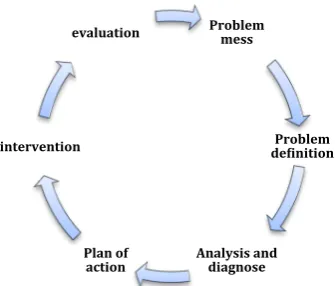
thesis uses a classical problem solving cycle elaborated in the regulative cycle by Van Strien (1997), which is shown in the figure 1. The scope of this master thesis does not extend further than the first four phases:
1. In the first phase the business context of BASF and the Inside Automotive program in relation to the three aforementioned questions are investigated to create a problem mess.
2. The initial problem, or in this case the request by BASF, is placed in the context of the problem mess to provide a problem definition. This problem definition translates into the main research question, related sub questions and serves as the guideline for this research.
3. To analyze the problem, we closely work together with the program coordinator and take over an observing role through a 6 month internal master thesis position. Within this position a literature review on talent management, effectiveness, objective setting and indicators is conducted alongside with 17 semi-‐structured interviews with participants from the organizational, divisional and candidate level. Based on this information the problem is diagnosed providing an overview of objectives, related indicators and the organizational and divisional challenges that the Inside Automotive program faces. Using a multi-‐criteria decision making method, the indicators are prioritized based on criteria derived from literature and the business context of BASF.
4. Based on the findings a plan of action is designed to implement the objectives and corresponding indicators so that the effectiveness of Inside Automotive can be measured. Furthermore, recommendations on found organizational and divisional challenges are elaborated upon.
The final two phases, intervention and evaluation, are out of scope due to the time and resource constraint of this research. A follow up and possible implementation remains the responsibility of BASF.
Problem mess
Problem de9inition
Analysis and diagnose Plan of
action intervention
evaluation
[image:11.595.309.477.83.226.2]2. Research Design
In this chapter, the research design of the thesis is discussed. The main research question is explained in 2.1 and is subsequently broken down into sub questions including a brief explanation on how the question will be answered. In section 2.2, the deliverables of this research are specified.
2.1 Research question(s)
As explained in the introduction of this thesis (chapter 1), the research objective of this thesis is to identify objectives and indicators reflecting the objectives from the organizational, divisional and candidate level, to measure the effectiveness of the cross-‐divisional talent development program Inside Automotive. This research objective translates into the following main research question:
What tool can be developed to measure the effectiveness of BASF’s talent development program Inside Automotive?
To answer to the main research question, the question is split up into the following four sub questions:
1. What are the business context and the set-‐up of the Inside Automotive program?
To comprehend what BASF wants to achieve with Inside Automotive, the business context of BASF, their relation to the automotive industry and how BASF’s strategy translates into the set-‐up of the Inside Automotive program are researched. The answer to sub question 1 is provided in chapter 3.
2. How is effectiveness defined within the scope of this research?
To define effectiveness within the context of this research, a literature review is conducted. A theoretical framework is created as a fundament for evaluating the effectiveness of Inside Automotive. Sub question 2 is answered in chapter 4.
3. What are the objectives from the organizational, divisional and individual candidate level for the Inside Automotive program?
A common understanding of a set of objectives is a prerequisite to a programs success (Kerzner, 2015). Therefore, objectives of the different levels involved in the program need to be understood and are determined using qualitative semi structured interviews. Sub question 3 is answered in section 6.1.
4. What indicators express the objectives of all levels so that the effectiveness of the Inside Automotive program can be measured?
To monitor the effectiveness of the program, indicators to measure the program objectives are needed. Based on the information from sub question two, involving input from all levels on the objectives and indicators, these indicators are created. Sub question 4 will be answered in section 6.2.
5. What organizational and divisional challenges impede the effectiveness the Inside Automotive program?
To increase the effectiveness of the Inside Automotive, possible organizational and (inter)divisional challenges are investigated during the interviews. Participant are asked about the possible organizational and (inter)divisional challenges that the Inside Automotive faces and what improvements can be made. The answer to sub question 4 can be found in chapter and 6.3.
2.2 Deliverables
In light of this research, we aim for the following deliverables:
• Provide an understanding of effectiveness in the context of a cross-‐divisional
program like Inside Automotive.
• Provide a grounded understanding of the objectives for the Inside Automotive
program from different levels of perspective.
• Uncover possible organizational cross-‐divisional issues in talent development
programs, using Inside Automotive as an example.
• Provide a tool to measure the effectiveness of the Inside Automotive program. • A business case example of the application of the business problem solving
method of Van Aken et al. (2012).
The proposed deliverables can be, when answered at the end of this thesis, used by practitioners who have to deal with similar challenges but also by academics that want to gain more theoretical background knowledge into measuring the objectives and thereby the effectiveness of similar talent development programs.
3. Business Context & the Inside Automotive program
In this chapter we provide an answer to sub question 1 by explaining the business context of BASF and the Inside Automotive program. An insight in the business context is needed in order to understand the environment in which Inside Automotive is active. The topics are explained in two parts. In section 3.1, the business environment of BASF and its affiliation with the automotive industry is described. In section 3.2, the set-‐up of Inside Automotive is illustrated based on the candidate profile, a program description and the program’s strategic objectives. A summary of chapter 3 is provided in section 3.3
3.1 BASF and Automotive
BASF was founded on April 6, 1865 as the “Badische Anilin-‐ & Soda Fabrik” in Mannheim. The company was initially founded to produces dyes and inorganic materials needed to do so. Now, over 150 years later, BASF is the number one chemical manufacturer worldwide, is active in close to every chemical segment and caries the slogan ‘we create chemistry’. With close to 380 production facilities worldwide and over 100.000 employees, BASF had over €70 billion in sales in 2015. The company’s business is divided into five segments: Oil & Gas, Agricultural solutions, Chemicals, Performance products and Functional Materials and Solutions. These segments are subdivided into 13 different operational divisions, which all have a personal working culture and business model. BASF group lives by four guiding principles:
• We add value as one company.
• We innovate to make our customers more successful. • We drive sustainable solutions.
• We form the best team.
BASF is the number one supplier to the automotive industry worldwide, with four operational divisions who manufacture for close to every major car manufacturer like BMW, Daimler, Toyota, General Motors, Ford and many more. The four operational divisions are Coatings (EC), Catalysts (CC), Performance Materials (PM) and Fuel and Lubricant Solutions (EV) and they provide products like plastics, foams, coatings, catalysts, battery and brake fluids, leather and textiles. The full range of BASF automotive product portfolio categories are depicted in figure 2.
BASF and this also applies to its automotive products. With over €200 million in expenditures on R&D related to Automotive in 2015, BASF innovates on topics as weight reduction, heat management, fuel efficiency, quality, comfort and safety.
Figure 2. BASF product portfolio for the automotive industry
In its strategy for 2025, BASF emphasizes a strong focus on the internal industry group Automotive using a ‘one company’ approach due to the industry becoming increasingly important for the company. For that reason, the Inside Automotive talent development program was initiated. Its main purpose is to attract talent, allow candidates to get to know the diverse automotive industry and provide a complete overview to of the company’s product and service portfolio to the industry from a marketing and sales perspective.
3.2 The Inside Automotive Program
Inside Automotive is a global talent development program to create talents that are highly equipped with the knowledge of the company’s automotive portfolio with a specific focus on business-‐to-‐business marketing and sales. The four divisions of BASF that are active in the automotive segment all participate in the program. The intention is to provide the candidates with a good understanding of the respective products, technologies, business models and practices from these divisions with regard to key account, sales and marketing activities. A brief description of the candidate profile and the program are given.
[image:16.595.68.479.138.380.2]3.2.1 The Candidate profile
The Inside Automotive program targets university graduates and young professionals who have a passion for marketing and sales as well as affinity with the automotive industry. The following prerequisites are set by BASF for a candidate profile:
• The candidate needs to possess a university degree, masters or higher, with
above average results in (industrial) engineering or business administration/economics, preferably with a technical background.
• Automotive affiliation, demonstrated through relevant experience with a global
player in the automotive industry.
• An international as well as customer oriented mind-‐set and approach.
Currently, there are ten candidates in the program who all have a background in either engineering or marketing/economics and have worked in either automotive firms or suppliers to the industry. The first candidate will finish in May 2016.
3.2.2 The Program
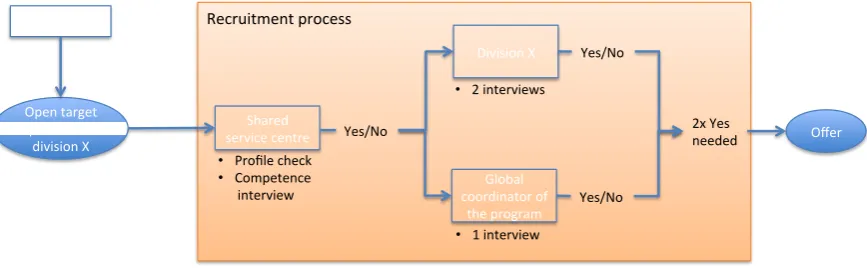
The Inside Automotive program is a 24-‐month global talent development program that is initiated by the Global Automotive Steering Committee in February 2014. A candidate is recruited for a target position in one of the four participating division where he/she will start with her first assignment. This division is called the homeport division and is also the place where the candidate will end up after the program in the aforementioned target position. The recruitment process exists of two rounds. First, the shared service centre of BASF checks the candidate’s profile and motivation for a match with the Inside Automotive profile. If a match exists, the shared service centre will conduct a competence interview with the applicant. Based on these two aspects, considering hard-‐ and soft skills of a candidate, a positive or negative reply is given to the applicant. When positive, the second step consists of three interviews, two interviews with the division where the target position is open (one with HR and one with Sales & Marketing) and one interview with the global coordinator of the program. Both the coordinator and the division have to decide unanimously in favour of the candidate for him/her to get the offer. To provide an overview and a better understanding of the recruiting part of Inside Automotive, the process is illustrated in figure 3.
infrastructure exists. From the total number of rotations, one rotation is international, bringing the candidate to another continent than the homeport location. It is important to know that the program has no stage gate structure where the candidate gets a go/no go decision after each rotation. Feedback is given to the candidate solely by the direct supervisor on assignment and shared with the coordinator of the program.
Figure 3 Recruitment process Inside Automotive
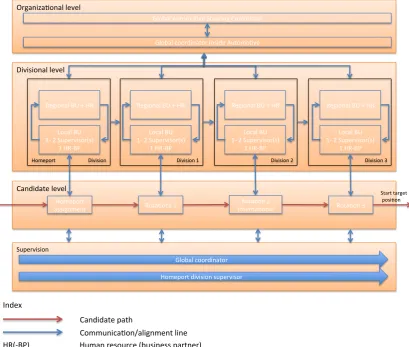
A lot of actors and stakeholders are involved in the global set-‐up of the Inside Automotive program. These actors can be categorised in the organizational, divisional and individual level. On the organizational level, the Global Automotive Steering Committee (GASC) and the global coordinator are active. On the divisional level the four involved operational units are considered on both a regional and local level. On the individual level, the candidates in the program are considered. These different levels make for a large number of stakeholders that are involved in a single rotation:
• The coordinator of the program;
• The regional business unit including a regional HR business partner/manager; • The local business unit consistent of one or two supervisors and a local HR
business partner;
• The candidate.
This number of stakeholders, times four rotations, creates a highly complex program coordination structure where good alignment and communication is key to the program success. To increase the understanding of the complexity of the program, a stakeholder flowchart is illustrated in figure 4.
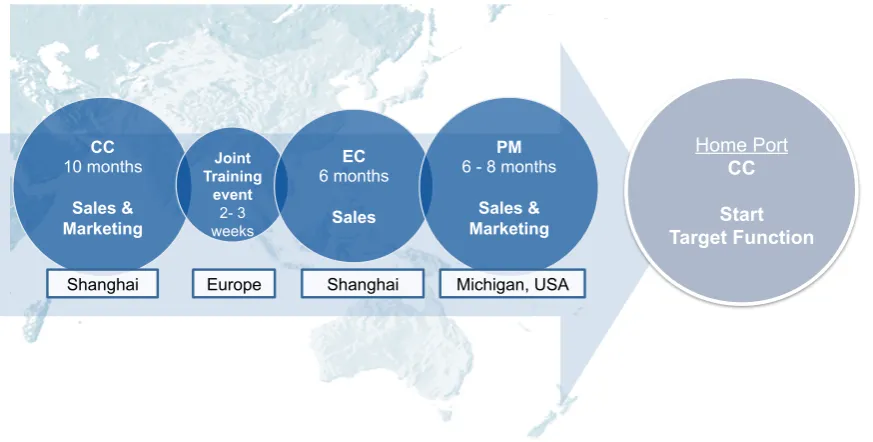
To create more relation to and understanding of Inside Automotive, a candidate’s personal program path is illustrated with the use of a persona. The persona is here referred to as Bas F and his story is told in italic. Bas F. is 24 years old and graduated cum laude from his master industrial engineering at the University of Hong Kong. During his studies, Bas worked as a working student in the marketing department of VW and did an internship at Toyota for almost to six months. Bas is recruited right after his studies by BASF Catalysts, which produces catalysts and is situated in Shanghai. Having overcome the recruitment process for a target position as junior sales manager, Bas
Recruitment*process*
Open*target* posi1on*at* division*X* Applicant*
Shared* service*centre*
• Profile*check*
• Competence* *interview*
Division*X*
Global* coordinator*of*
the*program*
Yes/No*
• 2*interviews*
• 1*interview*
2x*Yes** needed* Yes/No*
Yes/No*
[image:18.595.70.504.186.320.2]Figure 4 Stakeholder flowchart Inside Automotive
starts on his first ten-‐month assignment with the sales team of his homeport. In his assignment, Bas learns all about the market and added value of Catalysts. Ten months within the program, Bas finishes his first assignment and is flown to Europe for a two and a half week joint face and training with all the Inside Automotive candidates to strengthen the relationship between candidates, which is important for future (interdivisional) cooperation. After the training, Bas starts his second assignment as part of BASF Coatings in Shanghai where he operates similar markets and customers as at Catalyst but from a different product angle, namely automotive coatings. During this assignment, Bas starts to understand the magnitude of the BASF and more importantly, its strong relation with the automotive industry. His six-‐month period at Coatings is completed successfully and Bas looks back at a good learning experience and development of his sales skills. For his international and also final rotation, Bas is delegated for seven months to the US headquarters of BASF Performance Materials in Detroit, Michigan. Here he fulfils an important role as he supports the key account manager who is responsible for Ford in the USA. The role involves a combination of marketing and sales while at the same time gaining insights in the importance of customer relations. Bas is surprised mainly by the different way of working compared to what he is used to in Shanghai as he is granted more responsibility. The way the market functions in the USA and how BASF tackles business problems are also different, which
Supervision+ Candidate+level+ Divisional+level+ Organiza5onal+level+
Homeport+
assignment+ Rota5ons+1+ interna5onal+Rota5on+2+ Rota5on+3+ Regional+BU+++HR+
Global+coordinator+ Local+BU+
1C+2+Supervisor(s)+ 1+HRCBP+
Regional+BU+++HR+
Local+BU+ 1C+2+Supervisor(s)+
1+HRCBP+
Regional+BU+++HR+
Local+BU+ 1C+2+Supervisor(s)+
1+HRCBP+
Regional+BU+++HR+
Local+BU+ 1C+2+Supervisor(s)+
1+HRCBP+ Homeport+ +++++++++++++Division+ Division+1+ Division+2+ Division+3+
Global+Automo5ve+Steering+CommiHee+
Global+coordinator+Inside+Automo5ve+
Homeport+division+supervisor+
Start+target+ +posi5on+
Candidate(path(
Communica/on/alignment(line(
HR(6BP) ( (Human(resource((business(partner)(
[image:19.595.67.477.74.421.2]inspires Bas to take with some key learnings. Over the course of almost 24 months, Bas has gained insights in the wide range of products that BASF offers to the automotive industry, understanding what kind of business models are used and also what best practices he can take with him as he starts on his junior sales manager position back at his homeport Catalysts in Shanghai. All in all, a great learning experience that inspired Bas to tackle his target function with a solid set of sales and marketing skills. A flowchart of Bas’ Inside Automotive path is illustrated in figure 5.
Figure 5 Inside Automotive program example
3.2.3 Strategic objectives
The Global Automotive Steering Committee initiated the program with a set of strategic objectives, compliant with the company’s 2025 strategy. The main strategic objectives of Inside Automotive are:
• To attract, recruit and retain outstanding external candidates with a strong
focus on sales and marketing for the industry group Automotive.
• To develop cross-‐BU competence and knowledge to strengthen BASF its
strategic objective of a ‘one company’ approach.
These objectives are further specified in the following three parts:
• Have a pipeline of well-‐trained candidates with a cross-‐divisional customer
understanding of the automotive value chain.
• Get access to applicants who never thought of BASF before as a potential
employer.
• Strengthen the company’s role as one of the key suppliers to the automotive
industry.
CC
10 months
Sales & Marketing
Joint Training
event 2- 3 weeks
EC
6 months
Sales
PM
6 - 8 months
Sales & Marketing
Home Port
CC
Start Target Function
[image:20.595.65.502.200.421.2]Cross BU competences and knowledge have a high priority within BASF and the Inside Automotive program is a translation of this ‘one company’ objective. To illustrate this ‘one company’ approach, the current and aspired company picture for the automotive group is visualized in figure 6. The current company picture on the left shows how the different ODs interact with the automotive industry independently. Each division has its own product portfolio and contacts within the industry, meaning a lot of double work is currently done.
Figure 6. Essential strategic objective of Inside Automotive
The strategic ‘one company’ objective for Inside Automotive, illustrated on the right hand side, shows interdivisional cooperation and a unified approach to BASF’s customers. The new set-‐up allows for best practice sharing, optimizing of processes and a ‘one company’ approach, which is considered to be a major advantage and unique selling point. It does need to be noted that the picture is somewhat ‘black and white’ as interdivisional cooperation already exist. This, however, occurs on a low scale, meaning that progress still can and needs to be made.
The initial overall strategic targets of the Inside Automotive program have been pre set from a BASF perspective. In the set up of this program however, no indicators have been developed to monitor these objectives. The same holds for the more technical development programs that exist within every automotive division at BASF, the same conclusion applies, as no indicators exist to specifically measure program performance.
3.3 Chapter summary
[image:21.595.67.505.204.417.2]
worldwide, is increasingly active in the automotive industry. Currently the number one chemical supplier, the company has four divisions active in the industry group “Automotive”, providing products like plastics, textiles and coatings. Within the company’s strategy for 2025, a strong focus on the automotive industry is emphasized where the BASF wants to act as ‘one company’ to its customers. For this reason the Inside Automotive, a talent development program with focus on marketing and sales, was initiated in 2014. The program structure allows its candidates, graduates or young professionals with an engineering or business background, to get a complete overview of the company’s automotive value chain by rotating through the four automotive divisions in a timeframe of 24 months. The program is highly complex, having many stakeholders involved on a global, regional and local level. The purposes of the program are:
• To attract, recruit and retain outstanding external candidates with a strong
focus on sales and marketing for the industry group Automotive and
• To develop cross-‐BU competence and knowledge to strengthen BASF its
strategic objective of a ‘one company’ approach.
The first candidate of the program finishes in 2016, ending the pilot phase of the Inside Automotive program.
4. Literature review
So far the research design containing the research questions for this thesis has been discussed in chapter 2, followed by the business context of BASF and the Inside Automotive program in chapter 3. In this chapter the conceptual theoretical framework to understand and measure effectiveness is discussed. In section 4.1 we start with discussing the topic of talent management and its relevance in the modern business environment to provide an understanding of the importance of talent development programs like Inside Automotive. Consecutively in section 4.2, relevant literature on effectiveness is reviewed to provide a definition on the topic within the context of this research and, by doing so, answering sub question 2. In short, effectiveness is defined as accomplishing objectives that satisfy all stakeholders. In 4.3, the concept of value-‐focused thinking is explained. This concept is used to extract relevant information on the program objectives during the interviews conducted in this research. To be able to measure these objectives, relevant literature on indicators, indicator characteristics and appropriate number of indicators is reviewed in section 4.4. Based on the adopted literature, a conceptual framework is created in section 4.5 to serve as a research set-‐up used in the methodology in chapter 5.
4.1 Talent management
developing new capabilities and globalizing their operations (Stahl et al., 2012). Moreover, the traditional way of career development, which was mainly driven by the employer through promoting the individual employee and providing lifetime employment security, has been replaced by new career development approaches characterized by employee pro-‐activism, motivation and career responsibility (Boselie, 2010; Garavan, et al., 2012). Thus, the responsibility for career development has shifted from the employer to the individual employee. The downside to this development is that, even though providing development opportunities is an essential prerequisite to enhance pro-‐activism and motivation, moving the responsibility to the employees reduces the predictability and structure of careers, lowers employee trust and thereby increases fluctuation especially of highly skilled talents (Crawshaw et al., 2012). Moreover, filling the talent pipeline and enabling continuous development is of strategic importance to ensure effective economic performance (Boselie, 2010; Crawshaw et al., 2012). Therefore, employers increasingly have to balance the degree of career development responsibility and consider new approaches to retain and manage talent through different approaches that can be categorised as (Boselie, 2010; Garavan, et al., 2012; Church et al., 2015):
• Formal programmes;
• Relationship based developmental experiences; • Job-‐based developmental experiences;
• Informal/non-‐formal developmental activities.
Falling into the formal programs category, talent or leadership development programs, represented by the Inside Automotive program, are the focus area of this research. These programs have a strong focus on talents or “high potentials” and cover the critical elements from attracting and selecting to developing and retaining talents (Stahl et al., 2012). Companies achieve a competitive advantage through such programs by guaranteeing their talent management systems are aligned internally and externally on a global scale to support their business strategy, operating model and global operations (Evans, 2002). Moreover, prerequisites for a program to not only be competitive but also effective and successful are a well-‐patterned program and communication structure as well as a clear set of objectives (Kerzner, 2015).
Applying the discussed theory to the case of BASF and Inside Automotive, it means that for the program to be compatible and successful, all stakeholders of the program need to be aligned to support their 2025 strategy objectives and the program needs a well patterned communication structure as well as a clear set of objectives.
thinking”, hindering job rotation as an effective talent and career development tool. The study by Guthtidge et al. (2006) state that over 50% of the CEOs, HR executives and business unit leaders who participated thought that silo thinking and a lack of collaboration across the organization prevented their talent development programs from delivering added value to the business. The described development tool discussion emphasizes the importance and effectiveness of the cross-‐divisional set-‐up of the Inside Automotive. To allow talent to be of added value to BASF, fostering cross-‐ divisional competences should receive high priority.
Finally, although programs as Inside Automotive are important and suitable tools for talent development, the study by Stahl et al. (2012) considers sophisticated training programs, tools and practices alone as insufficient. For a company, in this case BASF, it needs to make leadership development an integral part of its culture by actively involving their senior leaders in the process in order to excel and exploit all benefits of their talent management. Thereby the organisation ensures the effectiveness of its talent management and its positive impact on the overall business performance (Boselie, 2010; Crawshaw et al., 2012).
4.2 Effectiveness
standard for judging the program’s effectiveness. As the organizational effectiveness, or in this case the program’s effectiveness, is a construct that consists of values and preferences of the evaluator, no single definition exists. Several models and definitions appear in the literature addressing organizational effectiveness, which include (Cameron, 2015):
• The natural systems model where effectiveness means obtaining the needed
resources.
• The objective model where effectiveness is about accomplishing objectives. • The abundance model where effectiveness refers to producing flourishing and
virtuousness.
• The bureaucratic model where effectiveness means matching the ideal
characteristics of the organization.
• The strategic constituencies model where effectiveness relates to satisfying
important stakeholders.
• The internal process model where effectiveness is about achieving a high
quality of internal processes.
• The paradox model where effectiveness concerns the presence of simultaneous
opposites.
For effectiveness within the scope of this thesis, the objective and strategic constituencies models are adopted as the two approaches fit the requirements of the research purpose best and are therefore identified as most important. Effectiveness for the Inside Automotive program is defined as accomplishing objectives that satisfy the important stakeholders, identified as the organizational, divisional and individual level. To monitor how well these objectives are being accomplished, indicators reflecting these objectives need to be developed.
4.3 Value focused thinking
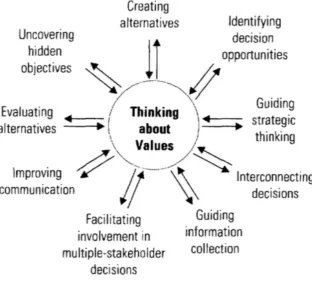
solving the actual decision problem; zoom in on the essential activities that must occur. Thus more appealing alternatives can be generated, so that better decision situations can be identified which finally enable uncovering hidden objectives (Keeney, 1994, 1996). How central the role of values is here, is depicted in figure 7.
Figure 7. Thinking about values: The basis for quality decision making (Keeney, 1994)
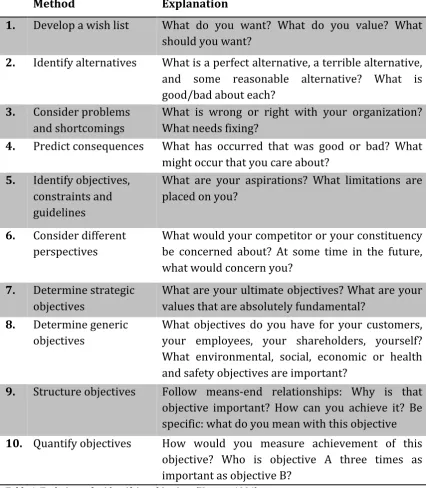
Values are often integrated in mission statements and objectives but need to be made more explicit for evaluation and should be clarified with a specific statement of objectives (Keeney, 1996). In the case of this research, finding the program objectives is crucial for setting up a framework for performance measurements. Identifying and structuring objectives is, according to experts however, a difficult task (Keeney, 1994). The process of identifying these objectives is included in the method of value-‐focused thinking, which involves discussion with relevant decision makers and stakeholders. Within the framework of this research this is realized through conducting the semi-‐ structured interviews with the involved levels. Several different techniques can be used to stimulate the creativity in identifying possible relevant objectives. Possible techniques are depicted in table 1. According to Keeney (1994) an objective is defined as a statement one wants to strive towards and is built up in relation to a decision context, object and a direction of preference.
[image:27.595.127.440.165.447.2]