Risk management in
infrastructural projects
MSc in Business Administration
B.G. (Bart) Kuipers
15-01-2016
II
COLOPHON
Author B.G. (Bart) Kuipers Student number 1014412
E-mail [email protected] Education Business Administration
Service and Change Management Institute University of Twente
School of Management and Governance Enschede, the Netherlands
Company Reef Infra B.V.
Oldenzaal, the Netherlands Project reference Summary master thesis in English
Date 15th of January 2016
Version 1.0
Status Final version
Number of words 4171 Supervisors University of Twente
1st supervisor Dr.ir. Erwin Hofman
School of Management and Governance 2nd supervisor Prof.dr.ir. Johannes (Joop) I.M. Halman
Faculty of Engineering Technology Supervisors Reef Infra B.V.
Company supervisor Erwin Meijberg Project leader Company supervisor Jan Hendrik Fischer
III
CONTENTS
1 Introduction ... 1
2 Research design ... 2
3 Theoretical framework ... 5
3.1 Developments risk management in the construction industry ... 5
3.2 Effective risk management process ... 5
3.3 Influencing factors on implementation of risk management ... 7
4 Current application of risk management ... 8
5 Desired application of risk management ... 9
6 Improved application of risk management ... 10
7 Conclusions & recommendations ... 16
7.1 Conclusions ... 16
7.2 Recommendations ... 16
8 Discussion ... 17
1
1
INTRODUCTION
In recent years risk management has become more important in infrastructural projects. The changes in the Dutch procurement law in 2013 led to an increase in the use of economically most
advantageous tender (EMAT) and qualitatively better procurement. Consequently risk management has been given a greater role. Additionally, the variety of innovative forms of contracts used in the construction sector shifts the responsibility in projects increasingly towards the contractor. This increased responsibility regarding risk management has led to contractors who realize that it is required to apply risk management in an active way.
Reef Infra is a national company which works together with her clients on future mobility solutions. In this graduation project about risk management within Reef Infra the focus will be on rayon east, which is located in Oldenzaal.
2
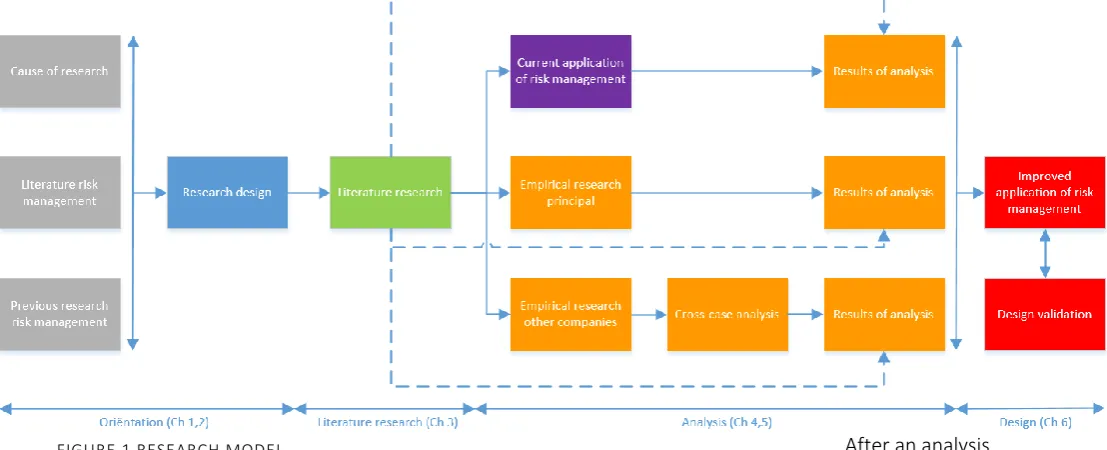
FIGURE 1 RESEARCH MODEL
2
RESEARCH DESIGN
The research design of the project first describes the problem statement and the objective of the research. This is followed by the research model and the research questions associated with the research strategy.
The problem statement is based on the developments described in the previous chapter and is defined as:
In the organization of Reef Infra (Region East) is not controlled on risk sufficiently in a structural and explicit way in order to manage projects better.
Based on Verschuren, Doorewaard, and Mellion (2010) the objective of a research consists of two parts, namely the objective of the research (external objective) and the objective in the research (internal objective). The objective of the research describes the contribution of the research project to the solution of the problem and the objective in the research describes the way in which this
contribution is made.
The objective of the research for Reef Infra region east is as follows: Improving the application of risk management in projects.
The objective in the research is as follows:
Providing insight in the current application of risk management within projects and design an effective process for the application of risk management.
A research model is a schematic presentation of the research goal and includes the appropriate steps to be taken in order to achieve the objective (Verschuren et al., 2010). Figure 1 shows the schematic representation of the research model, in which the different chapters are marked with different colors. The reason and background (Chapter 1) of the graduation project serve as input for the research design (Chapter 2). Then there is extensive literature research (Chapter 3) performed serving as the basis in further research. In this, there will be first given attention to the current application of risk management within Reef Infra (Chapter 4).
3 of the current application there will be an analysis conducted regarding the desired situation (Chapter 5), in which also an external analysis will be applied next to an internal analysis. This external analysis includes interviews with principals and three similar companies to provide a complete picture which requirements are important in a future risk management process. The results of the analysis, supported by the scientific literature, must lead to the design of an improved process for risk management (Chapter 6) in the organization.
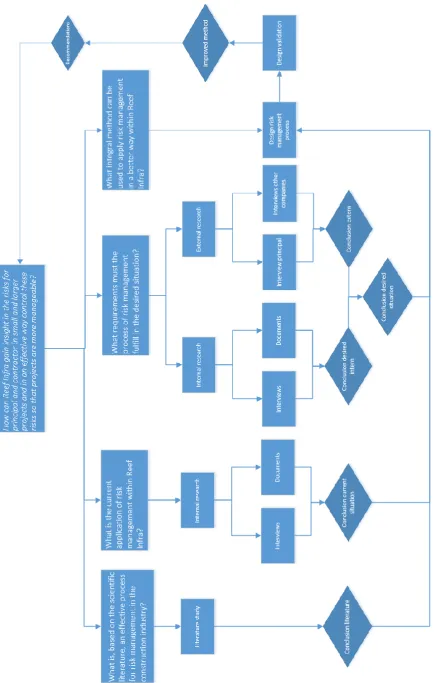
The central question in this research is based on the objective of the research and has been divided into sub-questions. To answer these questions both theoretical and practical research has to be conducted. The central question in this research is the following:
How can Reef Infra gain insight in the risks for principal and contractor in small and larger projects and in an effective way control these risks so that projects are more manageable?
To ultimately answer these question, there are some sub-questions derived from the central question. 1. What is, based on the scientific literature, an effective process for risk management in the
construction industry?
1.1. What developments are taking place in the field of risk management in the construction industry?
1.2. What are the essential concepts, steps and success factors for the application of risk management in the construction industry?
1.3. What factors influence the process of effective implementation of risk management in the construction industry?
2. What is the current application of risk management within Reef Infra? 2.1. How is risk management generally applied?
2.2. How are projects performing in connection with risk management?
2.3. How does the department of Concrete and Hydraulic Engineering apply risk management? 3. What requirements must the process of risk management fulfill in the desired situation? (Based
on the internal/external research and the scientific literature)?
3.1. What requirements, preconditions and assumptions serving risk management emerge in the various project phases from the organization?
3.2. What are frequent requirements from the client in the area of risk management?
3.3. How do companies in the same sector (Tauw/Antea/Avivas) apply risk management in the various project phases and what requirements emerge from this?
4. What integral method can be used to apply risk management in a better way within Reef Infra? 4.1. What will the process of risk management be after implementing the improvements and
after validation of the design?
4
F
IG
U
R
E
2
R
E
S
E
A
R
C
H
S
T
R
A
T
E
G
[image:7.595.81.526.74.758.2]5
3
THEORETICAL FRAMEWORK
This chapter describes the theoretical framework of the research project. First of all, the
developments of risk management in the construction industry are described. An effective design for a risk management process is the following part in this framework and last section are the factors that are influencing the implementation of risk management within an organization.
3.1
DEVELOPMENTS RISK MANAGEMENT IN THE CONSTRUCTION INDUSTRY
The difference between the two award mechanisms, lowest price and economically most
advantageous tender (EMAT), is clear. EMAT procurement contains multiple award mechanisms which will determine the final ranking of the bids (Dreschler, 2009). Hazen (2014) distinguishes several criteria that can be assessed, including the risk management component. When the request for tender requires the risk management component to be described in a Plan of Approach, bidders will score a certain value on risk management. The better the risk component is applied and described, the higher one scores and the higher the chance of winning the tender.
The application of integrated contracts is seen as a form of innovative procurement in the construction industry. Key element in the application of integrated contracts is the fact that the contractor is responsible for more design work than in a traditional procurement. The increased design responsibility brings a greater degree of risk, which increases the demand for active application of risk management within an organization (Dreschler, 2009).
3.2
EFFECTIVE RISK MANAGEMENT PROCESS
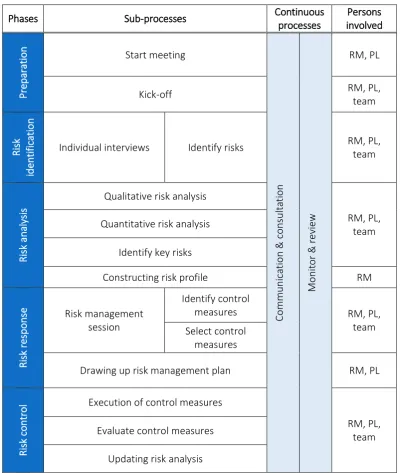
Table 1 shows an effective process for risk management based on the scientific literature. Table 1 also indicates which persons are involved in the various sub-processes (RM = risk manager, PL = project leader & team = other project members). In the design of the definitive risk management process based on the literature and the field research these phases will serve again as a guide.
Choosing a start meeting is based on the fact that the project team will get a clear image in the early stages of a project in the area of risk management. During the start meeting the project leader and risk manager discuss about project specific information (such as purpose, scope and stakeholders) and give substance to the risk management process based on this. The kick-off meeting has been
introduced to ensure that all project members know what they can expect from the risk process and their part in it.
Based on the scientific literature, identifying the risks in a project will be done by individual interviews between the risk manager and project members. This method of identification is time consuming but outweighs the numerous disadvantages of identifying risks through group sessions. It is possible that the project leader and risk manager in the start meeting decide that individual interviews to identify risks are too extensive in the project concerned. If so, the alternative method of identification will be determined directly.
6 manager creates the risk profile of the project, which is a register with the main risks. This risk register serves as input for the risk management session.
During the session in the response phase, risk management measures will be selected for the
identified risks and an action holder will be determined for each risk. This information is aggregated by the project leader and the risk manager into a risk management plan.
In the control phase, the chosen control measures will be executed and it will be evaluated if they had the desired effect. The measures that are not yet executed must be analyzed to determine if they are still sufficient to manage the risk. Updating the risk analysis is necessary when changes occur from the environment or the stakeholders.
[image:9.595.63.464.283.757.2]Applying continuous communication & consultation and monitoring & review ensures continuous improvement of the process and ultimately leads to quality improvement within the organization.
TABLE 1 DESIGN RISK MANAGEMENT PROCESS
Phases Sub-processes Continuous
processes
Persons involved
Pr
eparat
ion Start meeting
Comm u nica ti on & con sult ati on Mo nit or & rev ie w RM, PL
Kick-off RM, PL,
team Ri sk ide nti fi ca ti on
Individual interviews Identify risks RM, PL,
team Ri sk ana ly si s
Qualitative risk analysis
RM, PL, team Quantitative risk analysis
Identify key risks
Constructing risk profile RM
Ri
sk
resp
on
se Risk management session
Identify control
measures RM, PL,
team Select control
measures
Drawing up risk management plan RM, PL
Ri
sk
co
ntrol
Execution of control measures
RM, PL, team Evaluate control measures
7
3.3
INFLUENCING FACTORS ON IMPLEMENTATION OF RISK MANAGEMENT
The task to adapt to changing goals and requirements is a timeless challenge for organizations, but increasingly a more important one (Piderit, 2000). Changing customer requirements is an important driver for change within the organization from the contextual background (Kuipers et al., 2014). The requirements in the area of risk management are becoming stricter in the business world and in government (Smorenberg & Reuser, 2007). This means that more and more is being required in the field of risk management.
Halman (2008) identifies a number of factors that determine the adoption of risk management by users:
Relative advantage of applying risk management;
The degree of complexity of the proposed approach to risk management;
Extent to which the proposed approach of risk management connect to the current procedure of the user;
8
4
CURRENT APPLICATION OF RISK MANAGEMENT
This chapter describes the current application of risk management within Reef Infra. To get a complete picture of the current situation, different sections concerning risk management were studied. First, the current process for risk management is examined and there are interviews conducted with the people involved within Reef Infra Region East. The following research aspect in the current situation is that seven projects are assessed on their performance and the importance of risk management. A digression in the research to the current situation is made to the department of Concrete and Hydraulic Engineering.
A general point of attention arising from the interviews is that there is no standard method for the application of risk management in the current situation. There is no method available that guides you from start to finish through a project in the area of risk management. The general conclusion based on the interviews is the absence of structure for the application of risk management. This part should be integrated as a process into the organization to carry out projects in a risk-controlled way in the future.
The project analysis shows also that there is no structural method available for risk management within a project. A process of risk management should be applied structurally in projects to create value for the organization, also when the application of risk management is not asked by the client. In some projects the risk management component is very extensively (through quantification) processed in a risk register, an indication of good control of the main risks. There is a direct relationship
identifiable between the complexity of a project and the application of risk management. The projects in which comprehensive risk management is applied are more complex than the projects in which the application is limited. The project analysis indicates that learning from previous projects is an
important step in the risk process. Information from previous projects can serve as input in future projects. Actualization of the risk register is an important step in the successful application of risk management, so an update of the risk register is necessary for the project team to have actual information in the field of risks.
9
5
DESIRED APPLICATION OF RISK MANAGEMENT
This chapter describes the desired application of risk management, based on internal and external research. The internal investigation is conducted through the interviews and the project analysis within Reef Infra. In addition to the internal research, external research is conducted by interviews with a specialist on risk management from a principal and three peer companies.
In the conversations, shortcomings were addressed to get possible requirements for the future application of risk management. The internal field research also concerned the project related research, in which seven projects were analyzed for their project performance in terms of time and money and the importance of risk management before and during the execution of the project. The external research conducts of two parts, the first part concerns the province of Overijssel with the aim to clarify the picture in terms of functional requirements from the client. To identify the
requirements of the client, an interview has taken place with a risk manager of the unit roads and canals from the province of Overijssel.
10
6
IMPROVED APPLICATION OF RISK MANAGEMENT
In this chapter, the definitive design of the risk management process for infrastructural projects will be presented. In the design of the process, a distinction is made based on the contract form of a project. First of all, the different processes for risk management are presented with their specific
characteristics.
DESIGN OF RISK MANAGEMENT PROCESS
6.1.1
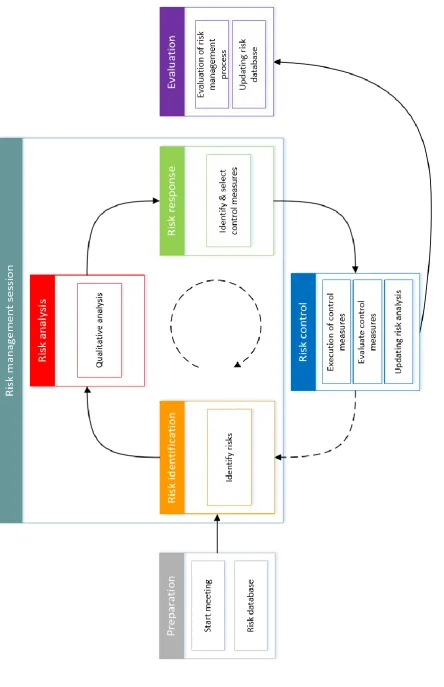
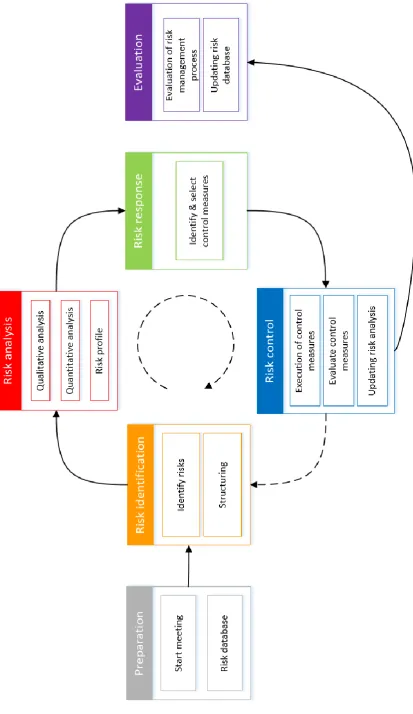
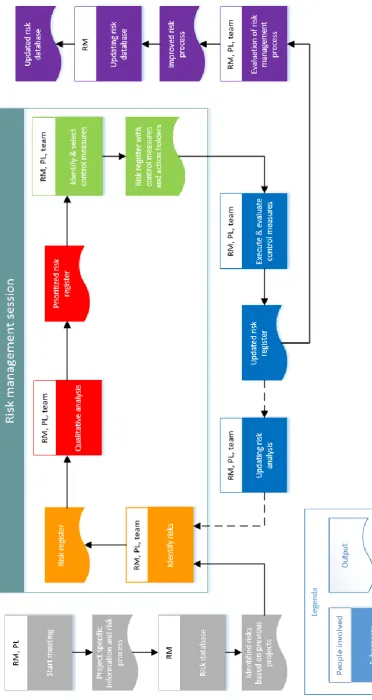
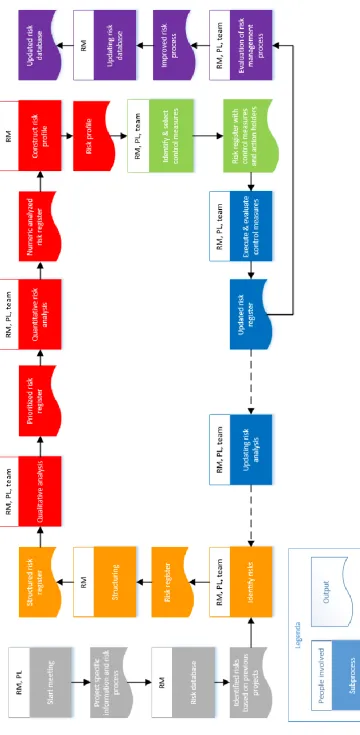
Based on the scientific literature, the field research (internal & external) and the validation of the original design two definitive risk management models are created, one for projects based on a RAW-contract and one for UAV-gc projects. Multiple existing models are used for the design of the future models, namely the RISMAN-model (Van Well-Stam, van Kinderen, & van den Bunt, 2013), the risk management process based on ISO 31000 (Purdy, 2010), the Risk Diagnosing Methodology (Keizer, Halman, & Song, 2002) and the risk model of the Project Management Institute (2008). The phases of the future process are preparation, risk identification, risk analysis, risk response, risk control and evaluation. The phase of risk identification as a separate phase is based on the fact that the
identification of risks in the early stages of a project is seen as one of the most important steps in the risk process (El-Sayegh, 2008). Adding an evaluation phase at the end of a project should serve as a learning aspect in the whole process, something that is lacking in the current situation (Dikmen, Birgonul, Anac, Tah, & Aouad, 2008). The preparation phase takes place in the tender phase, after which the cyclical process of identifying, analyzing, response and control is put into operation. This cyclical process will be repeated in the following project phases to provide up-to-date information in the area of risk management.
Figure 3 shows the process of risk management for RAW-projects and Figure 4 the process for UAV-gc projects. These figures clearly show that the application of risk management concerns a cyclical process from the identification until the control phase. Table 2 shows which persons are involved in the different steps in both processes (RM = risk manager, PL = project leader & team = other project members).
11
F
IG
U
R
E
3
R
IS
K
M
A
N
A
G
E
M
E
N
T
P
R
O
C
E
S
S
R
A
W
-C
O
N
T
R
A
C
[image:14.595.75.520.86.774.2]12
F
IG
U
R
E
4
R
IS
K
M
A
N
A
G
E
M
E
N
T
P
R
O
C
E
S
S
U
A
V
-G
C
C
O
N
T
R
A
C
[image:15.595.78.492.73.788.2]13
TABLE 2 PROCESS STEPS RISK MANAGEMENT
Phases Sub-processes Aspects sub-process Continuous processes
Persons
involved RAW
UAV-gc
Pr
eparat
ion Start meeting
Contractual risks Comm u nica ti on & con sult ati on Mo nit or & rev ie w
RM, PL
Purpose
Filling in risk process
Risk database RM
Ri sk ide nti fi ca ti
on Identify risks RM, PL, team
Merge d in ris k mana ge men t s es si o n
Structuring CategorizeRM
Filtering Ri sk ana ly si
s Qualitative analysis
RM, PL, team
Quantitative analysis
Construct risk profile RM
Ri
sk
resp
on
se Identify control
measures
Responsible person
per risk RM, PL, team
Select control measures
Ri
sk
co
ntrol
Execution of control measures
RM, PL, team
Evaluate control
measures
Updating risk analysis
Ev
al
uat
ion
Evaluation of risk
management process RM, PL, team
14
F
IG
U
R
E
5
W
O
R
K
F
LO
W
R
IS
K
M
A
N
A
G
E
M
E
N
T
P
R
O
C
E
S
S
R
A
W
-C
O
N
T
R
A
C
[image:17.595.81.454.71.772.2]15
F
IG
U
R
E
6
W
O
R
K
F
LO
W
R
IS
K
M
A
N
A
G
E
M
E
N
T
P
R
O
C
E
S
S
U
A
V
-G
C
C
O
N
T
R
A
C
[image:18.595.76.437.66.803.2]16
7
CONCLUSIONS & RECOMMENDATIONS
This chapter describes the conclusions and recommendations of the research project. The conclusion answers the central research question and the recommendations describe important aspects for the future risk processes.
7.1
CONCLUSIONS
The goal of this graduation project was to gain insight in the current application of risk management and design an effective risk management process for Reef Infra. Based on this objective a central research question has been defined:
How can Reef Infra gain insight in the risks for principal and contractor in small and larger projects and in an effective way control these risks so that projects are more manageable?
The models created in chapter 6, shown in Figure 3 and Figure 4, can be used in the future as a process for the application of risk management, respectively in RAW- and UAV-gc projects. The application of risk management based on both models leads to a more structured process in the different projects, which leads to more recognition among employees.
A structural application of the described risk models reduces the likelihood and extent of failure costs in future projects.
The implementation of the new risk processes should be integrated into existing business processes and must fit with the culture within the organization. Integration of the processes increases the support within an organization, which leads to a higher acceptance of the developed process.
7.2
RECOMMENDATIONS
Recommendations based on the research are:
Giving substance to the risk management process in a start meeting based on the specifications of the project.
Training of the employees in the field of risk management in order to increase knowledge within the organization.
Linking the identified risks to the system with the software program ‘relatics’.
Apply risk management on the basis of a tool, in RAW-projects an excel-tool and in UAV-gc projects the software of RiskID.
Link the identified risks to the planning of a project. This enables recognition of the risks in a particular phase of a project in a minimum amount of time.
17
8
DISCUSSION
The discussion describes the scientific and practical contribution of the research project. Other aspects mentioned in this chapter are the limitations of the research and recommendations for future research on this subject.
An important contribution to the scientific literature of risk management is that there is not one process that is applicable in every infrastructural project. It is project specific which process fits best to the specifications of the project.
The practical contribution of the research for Reef Infra is considerable; Reef Infra can use the created models for risk management in future projects. It is valuable that Reef Infra has access to a manual that outlines the future application of risk management within projects based on the different contract forms.
The most important limitation of the research project is the limited number of internal and external interviews conducted with employees and specialists in the field of risk management.
18
9
REFERENCES
Dikmen, I., Birgonul, M., Anac, C., Tah, J., & Aouad, G. (2008). Learning from risks: A tool for
post-project risk assessment. Automation in construction, 18(1), 42-50.
Dreschler, M. (2009). Fair competition: how to apply the ‘economically most advantageous
tender’(EMAT) award mechanism in the Dutch construction industry: TU Delft, Delft University of Technology.
El-Sayegh, S. M. (2008). Risk assessment and allocation in the UAE construction industry.
International Journal of project management, 26(4), 431-438.
Halman, J. (2008). Risicomanagement in de bouw: nieuwe ontwikkelingen bij een aantal koplopers.
Boxtel: Aeneas.
Hazen, S. S. (2014). Economisch meest voordelige inschrijving.
Hopkinson, M. M. (2012). The project risk maturity model: measuring and improving risk
management capability: Gower Publishing, Ltd.
Keizer, J. A., Halman, J. I., & Song, M. (2002). From experience: applying the risk diagnosing
methodology. Journal of Product Innovation Management, 19(3), 213-232.
Kuipers, B. S., Higgs, M., Kickert, W., Tummers, L., Grandia, J., & Van der Voet, J. (2014). The
management of change in public organizations: A literature review. Public Administration,
92(1), 1-20.
Piderit, S. K. (2000). Rethinking resistance and recognizing ambivalence: A multidimensional view of
attitudes toward an organizational change. Academy of management review, 25(4), 783-794.
Project Management Institute. (2008). A guide to the Project Management Body of Knowledge
(PMBOK® GUIDE). Paper presented at the Project Management Institute.
Purdy, G. (2010). ISO 31000: 2009—setting a new standard for risk management. Risk analysis, 30(6),
881-886.
Smorenberg, D. A. G., & Reuser, R. F. J. (2007). Risicomanagement en DBFMO-projecten.
Van Well-Stam, D., van Kinderen, S., & van den Bunt, B. (2013). Risicomanagement voor projecten:
Spectrum.
Verschuren, P., Doorewaard, H., & Mellion, M. (2010). Designing a research project: Eleven