Detection of Quotations and Inserted Clauses and its Application
to Dependency Structure Analysis in Spontaneous Japanese
Ryoji HamabeÝ
Kiyotaka UchimotoÞ
Ý
School of Informatics, Kyoto University Yoshida-honmachi, Sakyo-ku,
Kyoto 606-8501, Japan
Tatsuya KawaharaÝ
Hitoshi IsaharaÞ
Þ
National Institute of Information and Communications Technology 3-5 Hikari-dai, Seika-cho, Soraku-gun,
Kyoto 619-0289, Japan
Abstract
Japanese dependency structure is usu-ally represented by relationships between phrasal units called bunsetsus. One of the biggest problems with dependency struc-ture analysis in spontaneous speech is that clause boundaries are ambiguous. This paper describes a method for detecting the boundaries of quotations and inserted clauses and that for improving the depen-dency accuracy by applying the detected boundaries to dependency structure anal-ysis. The quotations and inserted clauses are determined by using an SVM-based text chunking method that considers in-formation on morphemes, pauses, fillers, etc. The information on automatically an-alyzed dependency structure is also used to detect the beginning of the clauses. Our evaluation experiment using Corpus of Spontaneous Japanese (CSJ) showed that the automatically estimated bound-aries of quotations and inserted clauses helped to improve the accuracy of depen-dency structure analysis.
1 Introduction
The “Spontaneous Speech: Corpus and Pro-cessing Technology” project sponsored the con-struction of the Corpus of Spontaneous Japanese (CSJ) (Maekawa et al., 2000). The CSJ is the biggest spontaneous speech corpus in the world, consisting of roughly 7M words with the total speech length of 700 hours, and is a collection of monologues such as academic presentations and simulated public speeches. The CSJ includes tran-scriptions of the speeches as well as audio record-ings of them. Approximately one tenth of the
speeches in the CSJ were manually annotated with various kinds of information such as morphemes, sentence boundaries, dependency structures, and discourse structures.
In Japanese sentences, word order is rather free, and subjects or objects are often omitted. In Japanese, therefore, the syntactic structure of a sentence is generally represented by the re-lationships between phrasal units, or bunsetsus in Japanese, based on a dependency grammar, as represented in the Kyoto University text cor-pus (Kurohashi and Nagao, 1997). In the same way, the syntactic structure of a sentence is repre-sented by dependency relationships between bun-setsus in the CSJ. For example, the sentence “彼は ゆっくり歩いている” (He is walking slowly) can be divided into three bunsetsus, “彼は, kare-wa” (he), “ゆっくり, yukkuri” (slowly), and “歩いて いる, arui-te-iru” (is walking). In this sentence, the first and second bunsetsus depend on the third one. The dependency structure is described as fol-lows.
彼は─────┐ (he)
│
ゆっくり─┤ (slowly)
歩いている (is walking)
In this paper, we first describe the problems with dependency structure analysis of spontaneous speech. We focus on ambiguous clause boundaries as the biggest problem and present a solution.
2 Problems with Dependency Structure Analysis in Spontaneous Japanese
There are many differences between written text and spontaneous speech, and consequently, prob-lems peculiar to spontaneous speech arise in
pendency structure analysis, such as ambiguous clause boundaries, independent bunsetsus, crossed dependencies, self-corrections, and inversions. In this study, we address the problem of ambiguous clause boundaries in dependency structure analy-sis in spontaneous speech. We treated the other problems in the same way as Shitaoka et al. (Shi-taoka et al., 2004). For example, inversions are represented as dependency relationships going in the direction from right to left in the CSJ, and their direction was changed to that from left to right in our experiments. In this paper, therefore, all the dependency relationships were assumed to go in the direction from left to right (Uchimoto et al., 2006).
There are several types of clause boundaries such as sentence boundaries, boundaries of quo-tations and inserted clauses. In the CSJ, clause boundaries were automatically detected by using surface information (Maruyama et al., 2003), and sentence boundaries were manually selected from them (Takanashi et al., 2003). Boundaries of quotations and inserted clauses were also defined and detected manually. Dependency relationships between bunsetsus were annotated within sen-tences (Uchimoto et al., 2006). Our definition of clause boundaries follows the definition used in the CSJ.
Shitaoka et al. worked on automatic sen-tence boundary detection by using SVM-based text chunking. However, quotations and inserted clauses were not considered. In this paper, we fo-cus on these problems in a context of ambiguous clause boundaries.
Quotations
In written text, quotations are often bracketed by 「」(angle brackets), but no brackets are inserted in
spontaneous speech.
ex) “一度でもいいから行ってみたい” (I want to go there at any rate) is a quotation. In the CSJ, quotations were manually annotated as follows.
ここは──────────┐ (here)
昔から─────────┤ (since early times)
{一度でも──┐ │ (once)
いいから─┤ │ (at any rate)
行ってみたい}と─┤ (want to go)
思っていたところです (is the place I think)
Inserted Clauses
In spontaneous speech, speakers insert clauses in the middle of other clauses. This occurs when speakers change their speech plans while
produc-Detection of Sentence Boundary
Dependency Structure Analysis (Baseline)
Detection of Quotations and Inserted Clauses
Dependency Structure Analysis (Enhanced)
word information filler existence pause duration speaking rate
information of dependencies word information
distance between bunsetsus
(A) + boundaries of quotations and inserted clauses
[image:2.595.306.517.60.222.2]...(A)
Figure 1: Outline of proposed processes
ing utterances, which results in supplements, an-notations, or paraphrases of main clauses.
ex) “夜着いたんですけども” (where I arrived at night) is an inserted clause.
ホテルの┐ (hotel)
部屋の┐ (room)
中も─────────┐ (inside)
早速─────────┤ (without delay)
(夜┐ │ (at night)
着いたんですけども)│ (arrived)
チェックしました (I checked)
Dependency relationships are closed within a quotation or an inserted clause. Therefore, de-pendencies except the rightmost bunsetsu in each clause do not cross boundaries of the same clause, meaning no dependency exists between the bun-setsu inside a clause and that outside the clause. However, automatically detected dependencies of-ten cross clause boundaries erroneously because sentences including quotations or inserted clauses can have complicated clause structures. This is one of the reasons dependency structure analysis of spontaneous speech has more errors than that of written texts. We propose a method for improving dependency structure analysis based on automatic detection of quotations and inserted clauses.
3 Dependency Structure Analysis and Detection of Quotations and Inserted Clauses
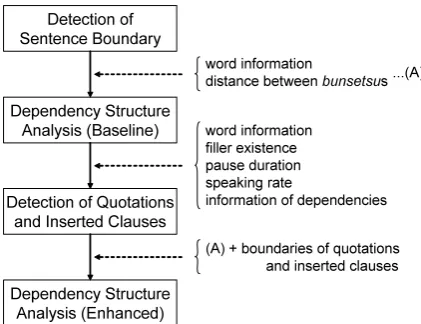
The outline of the proposed processes is shown in Figure 1. Here, we use “clause” to describe a quo-tation and an inserted clause.
3.1 Dependency Structure Analysis
ana-lyze dependency structures. This method is a two-step procedure, and the first two-step is preparation of a dependency matrix in which each element repre-sents the likelihood that one bunsetsu depends on another. The second step of the analysis is find-ing an optimal set of dependencies for the entire sentence. The likelihood of dependency is repre-sented by a probability, using a dependency proba-bility model. The model in this study (Uchimoto et al., 2000) takes into account not only the ship between two bunsetsus but also the relation-ship between the left bunsetsu and all the bunsetsu to its right.
We implemented this model within a maximum entropy modeling framework. The features used in the model were basically attributes related to the target two bunsetsus: attributes of a bunsetsu itself, such as character strings, parts of speech, and inflection types of a bunsetsu together with at-tributes between bunsetsus, such as the distance between bunsetsus, etc. Combinations of these features were also used. In this work, we added to the features whether there is a boundary of quo-tations or inserted clauses between the target setsus. If there is, the probability that the left bun-setsu depends on the right bunbun-setsu is estimated to be low.
In the CSJ, some bunsetsus are defined to have no modifiee. In our experiments, we defined their dependencies as follows.
¯ The rightmost bunsetsu in a quotation or an inserted clause depends on the rightmost one in the sentence.
¯ If a sentence boundary is included in a quo-tation or an inserted clause, the bunsetsu to the immediate left of the boundary depends on the rightmost bunsetsu in the quotation or the inserted clause.
¯ Other bunsetsus that have no modifiee de-pend on the next one.
3.2 Detection of Quotations and Inserted Clauses
[image:3.595.326.504.74.146.2]We regard the problem of clause boundary de-tection as a text chunking task. We used Yam-Cha (Kudo and Matsumoto, 2001) as a text chun-ker, which is based on Support Vector Machine (SVM). We used the chunk labels consisting of three tags which correspond to sentence bound-aries, boundaries of quotations, and boundaries of inserted clauses, respectively. The tag for sentence
Table 1: Tag categories used for chunking Tag Explanation of tag
B Beginning of a clause E End of a clause
I Interior of a clause (except B and E) O Exterior of a clause
S Clause consisting of one bunsetsu
boundaries can be either E (the rightmost bunsetsu in a sentence) or I (the others). The tags for the boundaries of quotations and inserted clauses are shown in Table 1. An example of chunk labels as-signed to each bunsetsu in a sentence is as follows. ex) “予算の関係だ” (It is because of the budget) is a quotation, and “予算の関係だと思いますが” (which I think is because of the budget) is an in-serted clause. For a chunk label, for example, the bunsetsu that the chunk label (I, B, B) is assigned to means that it is not related to a sentence bound-ary but is related to the beginning of a quotation and an inserted clause.
(I,O,O)今は────────────┐(now) (I,B,B)({予算の┐ │(budget) (I,E,I) 関係だ}と┐ │(because of) (I,O,E) 思いますが) │(I think) (I,O,O) 一夏に─┐ │(in summer) (I,O,O) 三回ぐらいしか──┤(three times) (E,O,O) やりません(they do it)
The three tags of each chunk label are simulta-neously estimated. Therefore, the relationships between sentence boundaries, quotations, and serted clauses are considered in this model. For in-stance, quotations and inserted clauses should not cross the sentence boundaries, and the chunk label such as (E,I,O) is never estimated because this la-bel means that a sentence boundary exists within a quotation.
We used the following parameters for YamCha.
¯ Degree of polynomial kernel: 3rd
¯ Analysis direction: Right to left
¯ Dynamic features: Following three chunk la-bels
¯ Multi-class method: Pairwise
The chunk label is estimated for each bunsetsu, The features used to estimate the chunk labels are as follows.
B
「
E
(1) No
bunsetsuto left of B
depends on
bunsetsubetween B and E
」
B
「
E
(2) B
unsetsuto immediate left of B
depends on
bunsetsuto right of E
」
×
Figure 2: Dependency structures of bunsetsus to left of beginning of quotations or inserted clauses
For instance, “と思う, to-omou” (think) and “って言う, tte-iu” (say) are used at the ends of quotations. Expressions such as “です
が, desu-ga” and “けれども, keredo-mo” are
used at the ends of inserted clauses.
(2) fillers and pauses Fillers and pauses are often inserted just before or after quotations and in-serted clauses. Pause duration is normalized in a talk with its mean and variance.
(3) speaking rate Inside inserted clauses, speak-ers tend to speak fast. The speaking rate is also normalized in a talk.
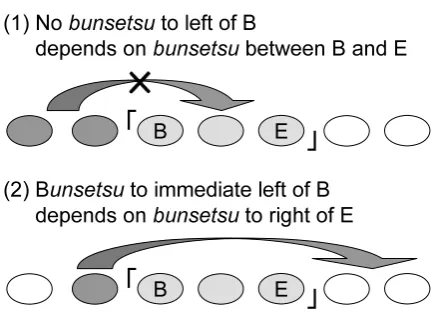
Detecting the ends of clauses appears easy be-cause specific expressions are frequently used at the ends of clauses as previously mentioned. How-ever, determining the beginnings of clauses is dif-ficult in a single process because all features men-tioned above are local information. Therefore, the global information is also used to detect the begin-ning of the clauses. If the end of a clause is given, the bunsetsus to the left of the clause should sat-isfy the two conditions described in Figure 2. Our method uses the constraint as global information. They are considered as additional features based on dependency probabilities estimated for the bun-setsus to the left of the clause. Thus, our chunk-ing method has two steps. First, clause boundaries are detected based on the three types of features itemized above. Second, the beginnings of clauses are determined after adding to the features the fol-lowing probabilities obtained by automatic depen-dency structure analysis.
(4) probability that bunsetsu to left of target de-pends on bunsetsu inside clause
[image:4.595.74.290.60.220.2](5) probability that bunsetsu to immediate left of target depends on bunsetsu to right of clause
Figure 2 shows that the target bunsetsu is likely to be the beginning of the clause if probability (4) is low and probability (5) is high. For instance, the following example sentence has an inserted clause. In the first chunking step, the bunsetsu “話なんですけど” (which is a story) is found to be the end of the inserted clause.
ex) “父から聞いた話なんですけど” (which is a story that I heard from my father) is an inserted clause.
この─┐ (this)
辺りは─────────┐ (area)
(父から┐ │ (from my father)
聞いた─┐ │ (heard)
話なんですけど)│ (story)
昔──────┤ (in the old days)
たんぼだったんです (was a rice field)
The three bunsetsus “辺りは, atari-wa”, “聞い た, kii-ta”, and “話なんですけど, hanashi-na-ndesu-kedo” are less likely to be the beginning of the inserted clause because in the three cases the bunsetsu to the immediate left depends on the target bunsetsu. On the other hand, the bunsetsu “父から, chichi-kara” is the most likely to be the beginning since the bunsetsu to its immediate left “辺りは, atari-wa” depends on the bunsetsu to the right of the inserted clause “田んぼだったんです, tanbo-datta-ndesu”.
4 Experiments and Discussion
For experimental evaluation, we used the tran-scriptions of 188 talks in the CSJ, which contain 6,255 quotations and 818 inserted clauses. We used 20 talks for testing. The test data included 643 quotations and 76 inserted clauses. For train-ing, we used 168 talks excluding the test data to conduct the open test and all the 188 talks to con-duct the closed test.
(a) Results of clause boundary detection
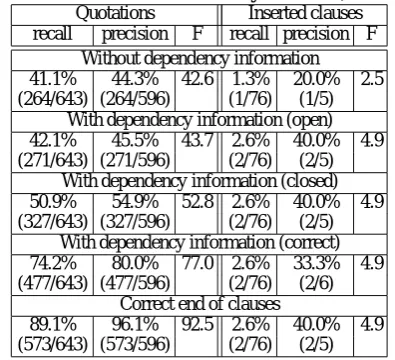
The results obtained by the method described in Section 3.2 are shown in Table 2. The table shows five kinds of results:
¯ results obtained without dependency struc-ture (in the first chunking step)
¯ results obtained with dependency structure analyzed for the open test (in the second chunking step)
¯ results obtained with dependency structure analyzed for the closed test (in the second chunking step)
¯ results obtained with manually annotated de-pendency structure (in the second chunking step)
¯ the rate that the ends of clauses are detected correctly
These results indicate that around 90% of quo-tations were detected correctly, and the boundary detection accuracy of quotations was improved by using automatically analyzed dependency struc-ture. We found that features (4) and (5) in Section 3.2 obtained from automatically analyzed depen-dency structure contributed to the improvement. In the following example, a part of the quotation “自分のいい長所じゃないか” (my good virtue) was erroneously detected as a quotation in the first chunking step. But, in the second chunking step, automatically analyzed dependency structure con-tributed to detection of the correct part “これは自 分のいい長所じゃないか” (this is my good virtue) as a quotation.
{これは─────┐ (this)
自分の────┤ (my)
いい────┤ (good)
長所じゃないか}と─┐ (virtue)
私は─┤ (I)
思います (think)
We also found that the boundary detection accu-racy of quotations was significantly improved by using manually annotated dependency structure. This indicates that the boundary detection accu-racy of quotations improves as the accuaccu-racy of de-pendency structure analysis improves.
By contrast, only a few inserted clauses were detected even if dependency structures were used. Most of the ends of the inserted clauses were de-tected incorrectly as sentence boundaries. The main reason for this is our method could not distin-guish between the ends of the inserted clauses and those of the sentences, since the same words often appeared at the ends of both, and it was difficult
Table 2: Clause boundary detection results (sen-tence boundaries automatically detected)
Quotations Inserted clauses recall precision F recall precision F
Without dependency information 41.1% 44.3% 42.6 1.3% 20.0% 2.5 (264/643) (264/596) (1/76) (1/5)
With dependency information (open) 42.1% 45.5% 43.7 2.6% 40.0% 4.9 (271/643) (271/596) (2/76) (2/5)
With dependency information (closed) 50.9% 54.9% 52.8 2.6% 40.0% 4.9 (327/643) (327/596) (2/76) (2/5)
With dependency information (correct) 74.2% 80.0% 77.0 2.6% 33.3% 4.9 (477/643) (477/596) (2/76) (2/6)
Correct end of clauses
[image:5.595.313.511.95.275.2]89.1% 96.1% 92.5 2.6% 40.0% 4.9 (573/643) (573/596) (2/76) (2/5)
Table 3: Dependency structure analysis results ob-tained with clause boundaries (sentence bound-aries automatically detected)
Without boundaries of quotations open 77.7% and inserted clauses closed 86.5% With boundaries of quotations and open 78.5% inserted clauses (automatically detected) closed 86.6% With boundaries of quotations and open 79.4% inserted clauses (correct) closed 87.4%
to learn the difference between them even though our method used features based on acoustic infor-mation.
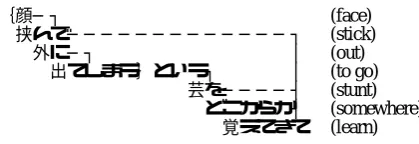
(b) Dependency structure analysis results
{顔─┐ (face)
挟んで─────────────┐ (stick)
外に─┐ │ (out)
出てしまう}という┐ │ (to go)
芸を────┤ (stunt)
どこからか┤ (somewhere)
覚えてきて (learn)
(c) Results obtained when correct sentence boundaries are given
We investigated the clause boundary detection accuracy of quotations and inserted clauses and the dependency accuracy when correct sentence boundaries were given manually. The results are shown in Tables 4 and 5, respectively.
When correct sentence boundaries were given, the accuracy of clause detection and dependency structure analysis was improved significantly. Ta-ble 4 shows that the boundary detection accuracy of inserted clauses as well as that of quotations was significantly improved by using information of dependencies. Table 5 indicates that when us-ing automatically detected clause boundaries, the accuracy of dependency structure analysis was im-proved by 0.7% for the open test, and it was further improved by using correct clause boundaries.
These experimental results show that detecting the boundaries of quotations and inserted clauses as well as sentence boundaries is sensitive to the accuracy of dependency structure analysis and the improvements of the boundary detection of quo-tations and inserted clauses contribute to improve-ment of dependency structure analysis. Especially, the difference between Table3 and 5 shows that the sentence boundary detection accuracy is more sensitive to the accuracy of dependency structure analysis than the boundary detection accuracy of quotations and inserted clauses. This indicates that sentence boundaries rather than quotations and in-serted clauses should be manually examined first to effectively improve the accuracy of dependency structure analysis in a semi-automatic way.
5 Conclusion
[image:6.595.73.283.63.135.2]This paper described the method for detecting the boundaries of quotations and inserted clauses and that for applying it to dependency structure analy-sis. The experiment results showed that the auto-matically estimated boundaries of quotations and inserted clauses contributed to improvement of de-pendency structure analysis. In the future, we plan to solve the problems found in the experiments and investigate the robustness of our method when the
Table 4: Clause boundary detection results (sen-tence boundaries given)
Quotations Inserted clauses recall precision F recall precision F
Without dependency information
46.0% 50.8% 48.3 22.4% 23.6% 23.0 (296/643) (296/583) (17/76) (17/72)
With dependency information (open) 46.7% 53.3% 49.8 30.3% 38.3% 33.8 (300/643) (300/563) (23/76) (23/60)
With dependency information (closed) 55.1% 62.9% 58.7 30.3% 39.0% 34.1 (354/643) (354/563) (23/76) (23/59)
With dependency information (correct) 75.3% 86.0% 80.3 46.1% 60.3% 52.2 (484/643) (484/563) (35/76) (35/58)
Correct end of clauses
[image:6.595.310.514.92.275.2]86.5% 95.4% 90.7 64.5% 68.1% 66.2 (556/643) (556/583) (49/76) (49/72)
Table 5: Dependency structure analysis results ob-tained with clause boundaries (sentence bound-aries given)
Without boundaries of quotations open 81.0% and inserted clauses closed 90.3% With boundaries of quotations and open 81.7% inserted clauses (automatically detected) closed 90.3% With boundaries of quotations open 82.8% and inserted clauses (correct) closed 91.3%
results of automatic speech recognition are given as the inputs. We will also study use of informa-tion on quotainforma-tions and inserted clauses to text for-matting, such as text summarization.
References
Taku Kudo and Yuji Matsumoto. 2001. Chunking with support vector machines. In Proceedings of the
NAACL.
Sadao Kurohashi and Makoto Nagao. 1997. Building a Japanese Parsed Corpus while Improving the Pars-ing System. In ProceedPars-ings of the NLPRS, pages 451–456.
Kikuo Maekawa, Hanae Koiso, Sadaoki Furui, and Hi-toshi Isahara. 2000. Spontaneous Speech Corpus of Japanese. In Proceedings of the LREC2000, pages 947–952.
Takehiko Maruyama, Hideki Kashioka, Tadashi Ku-mano, and Hideki Tanaka. 2003. Rules for Auto-matic Clause Boundary Detection and Their Evalu-ation. In Proceedings of the Nineth Annual Meeting
of the Association for Natural Language proceeding,
pages 517–520. (in Japanese).
Japanese — Detection and Modification of Clause Boundaries —. In Proceedings of the ISCA & IEEE
Workshop on Spontaneous Speech Processing and Recognition, pages 183–186.
Kiyotaka Uchimoto, Masaki Murata, Satoshi Sekine, and Hitoshi Isahara. 2000. Dependency Model Us-ing Posterior Context. In ProceedUs-ings of the IWPT, pages 321–322.
Kiyotaka Uchimoto, Ryoji Hamabe, Take-hiko Maruyama, Katsuya Takanashi, Tatsuya Kawa-hara, and Hitoshi Isahara. 2006. Dependency-structure Annotation to Corpus of Spontaneous Japanese. In Proceedings of the LREC2006, pages 635-638.
Kazuya Shitaoka, Kiyotaka Uchimoto, Tatsuya Kawa-hara, and Hitoshi Isahara. 2004. Dependency Struc-ture Analysis and Sentence Boundary Detection in Spontaneous Japanese. In Proceedings of the