G e n e r a t i o n in the L a m b e k Calculus F r a m e w o r k : an A p p r o a c h with
S e m a n t i c P r o o f Nets
Sylvain Pogodalla
sylvain.pogodalla @ xrce.xerox.comXerox Researce Centre Europe 6, chemin de Maupertuis 38240 Meylan - - France
1 Introduction
Thc lincar logic (Girard, 1987) provides a power- ful framcwork to cxprcss categorial gt'ammars (Aj- dukicwicx, 1935) and Lambek calculus (Lambek, 1958), and a lot of work has presented proof nets uses for lin- guistic purposcs, with a special look at proof nets for Lambek calculus (Roorda, 1991; Lamarche and Retor6, 1996). But they have mainly explored the syntactic ca- pabilities of proof nets, describing parsing processes.
This paper wants to focus on the generation capa- bilities of proof nets thanks to their semantic readings as expressed in (de Groote and Retor6, 1996). The main features of our proposal consist in the use of proof nets lot Lambek calculus, of the Curry-Howard iso- morplaisna (Howard, 1980; Girard et al., 1988), of se- mantic proof nets with semantic expressions ?t la Mon- tagu¢ (Montague, 1974; Dowry et al., 1981), and in an algorithm for proof search with a target proof net.
Unlike a previous proposal for generation in the Lam- bek calculus framework (Merenciano and Mort'ill, 1997), this point of view avoids the use of the A-term unification to lead the generation process. And the algorithmic un- decidability of this latter mechanism (from second order unification) does not occur any more.
In this work, we do not consider the choice of lexi- cal items from a given semantic expression the syntactic rcalization of which we want to generate, but rather tile way we can associate given lexical entries to fit the given semantic expression and generate a syntactically correct cxpression. For this purpose, we express our problem as a proof search one in (multiplicative) linear logic which is decidable. Moreover, we characterize the semantic recipes of lexical items that provide a polynomial solu- tion for the generation process.
2 Multi Usage Proof Nets
2.1 P r o o f Nets(Girard, 1987) introduced proof nets formalism as the natural deduction syntax for linear logic, also studied in (Retor6, 1993). They represent proofs in linear logic with more accuracy than sequential proofs: on one hand they are more compact, on the other hand they identify unessentially different sequential proofs (for instance in the order of the rules introduction).
From a one-sided sequent and a sequential proof of it, we obtain a proof net by unfolding every formula as a tree (whose nodes are the binary connectives and the leaves are formulas, e.g. atomic ones) and linking to- gether the formulas occurring in the same axiom rule of tile sequent calculus.
But proof nets have a more intrinsic definition that pre- vents us to come back every time to sequential proofs. They can be defined as graphs with a certain property (i.e. verifying a correctness criterion) such that every proof net with this property corresponds to a sequential proof and such that every proof net built from a sequen- tial proof has this property. So that we do not present the sequent calculus but only the proof net calculus.
In this paper, we do not consider all the proof nets, but a part of the multiplicative ones: those of the intuition- istic implicative linear logic. In this case, sequents are made of several antecedent [brmulas, but only one succe- dent formula. To deal with tile intuitionistic notion with proof nets (since we consider one-sided sequents), we use the notion of polarities with the input (,: negative) and the output (o: positive) (Danos, 1990; Lamarche, 1995) to decorate formulas. Positive ones correspond to succedent formulas and negative ones to antecedent for- mulas.
Given the links of table 1, we define proof structures as graphs made of these links such that:
1. any premise of any link is connected to exactly one conclusion of some other link;
2. any conclusion of any link is connected to at most one premise of some other link;
3. input (resp. output) premises are connected to input (resp. output) conclusions of the same type.
Note that the two links for tile negative and positive implications correspond to the two connectives of the lin- ear logic: Tensor and Par, so that we name these links after these latter connectives. But in the following, only the graphical forms of the links play a role.
Proof nets are proof structures that respect the correct- ness criterion.
Table 1: Links
Name Axiom Tensor Par Cut
Link
CI
C2~
2
C
~ ,
g 2
" ' \ l / /
C
P , ' c m i s e s n o n e t)1, P2 P l , P2 P l , P2
C o n c l u s i o n s c l , c2 c n o n e
C 1 : A + o , : A -
Pl : ,4-
P2 : B + e : (A - o B ) +C
Pl : A + P2 : / 3 - c : ( A ---0 B ) -
,,O I : A - P2 : A + Types
Table 2: Cut-elimination rewriting rules
x x y y
i ... ! ...
Y Y x x
,l' 1
./3 2Y
Yi Y2
Y
xl x:) Yl Y2
L
J
pie rewriting process described in table 2 (in case o f com- plex formulas as in the third rewriting rule, those rules can apply again on the result and propagate until reach- ing atoms).
2.2 Syntactic Proof Nets
Definitions o f proof nets tbr Lambek calculus first ap- peared in (Roorda, 1991 ). They naturally raised as Lam- bek calculus is an intuitionistic fragment o f non commu- tative linar logic (with two linear implications: "'\" on the left and " / " on tile right), and the consequences on the p r o o f net calculus we presented in section 2.1 are:
. we get two tensor links: one for the formulas ( B / A ) - (the one in table 1) and one lbr the for- mula ( B \ A ) - (just inverse the polarities of the premises). And two par links : one for the lbrmula ( A \ B ) + and one for ( A / B ) + (idem);
• formulas in L a m b e k ' s sequents are ordered, so that conclusions of the proof nets are cyclically ordered and axiom links may not cross.
If T v is the set o f basic types (e.g. S, N P . . . ), the set T o f syntactic types ~bllows T ::= ~ [ T \ T [ T / T .
Note that from a syntactic category, we can untbld the formula to obtain a graph which only lacks axiom links to become a proof structure. So that the parsing process in this framework is, given the syntactic categories of the items and their order, to put non crossing axiom links such that the proof structure is a proof net. It means there is a proof o f .b' given types in a certain order. For tech-
nical reasons, the order o f the conclusions (i.e. the types used) in the proof net to prove S is the reverse order o f the words associated to these types.
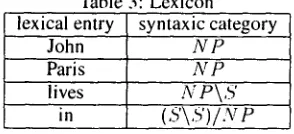
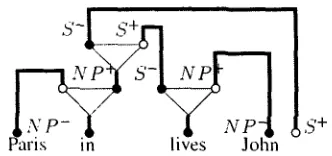
As an example, with the lexicon o f table 3, proving that John lives in Paris is a correct sentence leads to find axiom links between the atoms in the figure l(a). Fig- ure I(b) shows it actually happens and proves the syn- tactic correctness o f the sentence.
Table 3: Lexicon lexical entry s y n t a x i c c a t e g o r y
John N P
Paris N P
lives N P\,b' in
(,S'\,S') / N P
2.3 Semantic Proof Nets
In this section, we present how (de Groote and RetortL 1996) propose to use proof nets as semantic recipes. As a slight difference with this work, we only deal in this paper with semantic recipes that correspond to linear A- terms in the Montague's semantics framework.
[image:2.612.146.484.70.362.2] [image:2.612.363.510.475.542.2].S'- ,q'+ II<~---.i- o
~
,5'- .,¥~+• .V P - ], N P i
Paris in 1" Ives " John
(a) Unfolding of the syntactic types o S+
Figure I: Parsing
Rotor6, 1996), based on (Lamarche, 1995)'s dependency paths), wc can obtain a A-term.
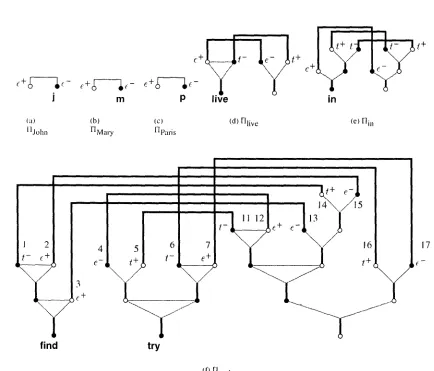
Then, instead o f associating a A-term to a [exical entry, wc can associate a proof net. For instance, on the seman- tic side, we can use the Montagovian types e and t and typed constants. Of course, we want to keep the compo- sitionalily principle of Montague's semantics that maps any syntactic association rule with a semantic associa- tion rule. We express it in a straightforward way with the ft~llowing homomorphism (for as many basic categories as required):
" H ( . : V P ) = e 7 ¢ ( A \ B ) = " K ( A ) ~ "H(B) "H(,~') = t " H ( A / B ) = "H(B) --o "H(A)
And for a lexical item, given its syntactic type, we as- SUlne its semantic proof net to verify:
• the type of its unique output conclusion is the ho- momorplaic image of the syntactic type:
• its input conclusions (if any) are decorated with typed constants.
An example of such a lexicon is given in table 4.
Figure 2: Syntactic proof net for John lives in Paris Let us illustrate the process on a short example. We use the lexicon of table 4 to parse the sentence John lives in Paris. The first thing is to define with the syntactic cat- egories of the different lexical items the syntactic proof net of figure 2. It provides the way we should compose the semantic recipes of each lexical item: we take its ho- momorphic image as in figure 4(a), and we substitute to every input its semantic definition with cut-links.
Then the cut-elimination on the resulting proof net gives a new proof net (on figure 4(b)) we can use as the semantic analysis of Jolm lives in Paris. If necessary, we can come back to the A-term expression:(in p ) ( l i v e j).
i
(b) Matching the dual atoms to obtain a proof net
of John lives in Paris
3 Generation: Stating the Problem
Let us now consider the problem of generation. We have a given semantic proof net (like the one in figure 4(b)) and we want to gather syntactic entries with axiom links such that:
I. this yields a correct (syntactic) proof net;
2. the meaning of the resulting proof net matches the given semantic expression.
As we already said it, we assume that we have some lex- ical entries, and we try to make the generation with these entries, each one used once and only once.
Thus, if we define:
* I/0 the semantic proof net of the expression we want to generate;
* IIi the semantic proof nets associated to the given lexical entries i we use;
* Ti the unfolding in proof structure of the syntactic formula of the lexical item i;
• F the forest made of the syntactic trees of all the considered lexical entries plus the output (the type we want to derive).
The generation problem (see figure 5) is to find a match- ing M of atomic formulas of F such that:
1. F endowed with M (let us call this proof structure F ' ) is a correct proof net;
2. when cut-linking H ( F ' ) with the Hi, and eliminat- ing these cuts, we obtain H0.
This problem is not an original one: making proof search with proof nets always leads to look for match- ing between atomic formulas of opposite polarities. So that an answer to this problem would consist in taking f ' and try every possible matching. This brute-force tech- nique would of course appear essentially inefficient, and our purpose is to use everything we know to prune tile search domain.
[image:3.612.171.515.81.179.2] [image:3.612.138.304.485.563.2]Table 4: Lexicon lexical entry syntaxic category
Jo h n N P
Mary N P m
Pa,is p
Lives In Seeks
XP
mP\S
(,5'\,s')/:vP
(.VP'~,S')/(((NP\,S')/XP)\(Xp\,b'))
associated A-term
J
A a : . l i v e x
A~..A~/.(in .r).q A.r.(try(xfind))
semantic proof net IIjohn (cf. figure 3(a)) [IMary (cf. figure 3(b))
IIPari s (cf. figure 3(c)) [Iliv¢ (cf. figure 3(d))
g i n (cf. figure 3(e)) (cf. figure 3(t))
(a) 1 ljohn
, , i i
1 9
,L<- <%
,p- ~+;
i
m
,,!o y
<+~~nl~ -
' W
(b) (c) (d) Fllive (e) Flin
FIMary 1-!. Paris
find
i
. . .
<-1
]
,
4 5 6 16 17
, - _ I Y )
,+try
(f) Hseek s
Figure 3: Semantic proof nets of the lexicon of table 4
4
C u t - e l i m i n a t i o n a s M a t r i x C o m p u t a t i o n
This section first establishes some equivalent relations between cut-elimination on proof nets and matrix equa- lions. We then show how to use these equations in the generation process and how we can solve them. It en- ables us to characterize the properties required by the se- mantic proof nets to have a polynomial resolution of the generation process.
4.1 Principles
First, as expressed in (Girard, 1989) and refornmlated in (Retord, 1990: Girard, 1993; Girard, 1995), we state
the algebraic representation of cuFeliminalion on
proof
nets. Due to lack of space, we can not develop it, but tile principle is to express cut-elimination between axioms with incidence matrices and paths in graphs. [image:4.612.107.526.74.163.2] [image:4.612.96.530.167.538.2]1 llJohn
I t - t +
L - - - • ...
[IParis 6 -
iiii iii
I t
(a) Before cut-elimination (b) After cut-elimination
Figure 4: Semantic proof nets tor (in p ) ( l i v e ])
M a t c h i n g : 1 1
-
! ,,,
Figure 5: The generation problem
Then we have (Girard, 1989):
I1 = (1 - o . a ) U ( l + ~ - " ( o . U ) k ) ( 1 - o. :') (1)
1
~ 1 (e/~) ) i s U = Moreover, s i n c e ( c r U ) i s n i l p o t e n t , ( l + ~ ~ k
inversible, and its inverse is (1 - crU). The next section make explicit the relation ( I ) with a special choice o f the base (~ i
).
4.2 Matrix Relation for Cut Elimination
In tile problem we are dealing with, we know II and some of the axiom links in/~'. Let us assume that Vi E [1,p], both ¢ i and 13(ei ) i are not cut-linked in L; (this assump- tion entails no loss o f generality).
4.3 Expressing the Reduction of U into II
In this section, we want to give a relation equivalent to ( I ) which focuses on some axiom links we are interested in. As mentioned in section 4.2, we can consider the (ei) such that in ~" :
• Vi E [1,p], ei is not cut-linked (then, because o f the hypothesis made in section 4.2, B ( e i ) is cut- linked);
• '7'i E [ p + 1. p + m], ei is cut-linked but B ( e i ) is not cut-linked;
• Vi E [p + m + 1, p + 1~ + n], both e.i and B(ei ) are cut-linked.
Note: R e m e m b e r we assume that there is no axiom link
such that both its conclusions are not cut-linked. So p = I I I .
I B(e ) is the atom in [7 such that there is an axiom link between e and
BIe).
I
cul -elilninal~,~n lit,
I
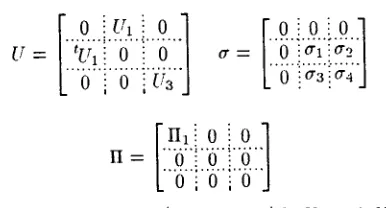
Then in this base, we express tile matrices (every ax- iom link of t--7 has at least one o f its conclusion involved in a cut link):
0
U j !0
]
6 ]
6 ... 6
r o : : o i o ~
o.= / ::ai il
[rl~:: o ::o ]
n = / 6 i 6 7 6 i i
LO:,O ioJ
If we define A = ( t U l I I 1 - o . l t U l ) ( - r l and X = Uz(1 - o'4U3) - 1 , we can state the theorem:
Theorem 1 Let -U be a correct proof net reducing in
Res(cr, U) after cut elimination. These relations are equivalent:
• Res(cr, U) = (1 - o:-')U(1 - o . U ) - l ( 1 - o "2) • ( tUlII1 - o.1 tLil)U1 = o.=,~,h(1 - o'4t'3) - 1 to.._,
• A = tcr,_Xcr'., arrd U3 = X - 1 -~ 0"4. O f course, all tire terms are defined.
We base the proof search algorithm corresponding to the generation process we are dealing with on this third rela- tion, as explained in the next sections.
4.4 Solving the Equations
[image:5.612.118.564.77.325.2] [image:5.612.365.558.373.477.2]by equivalence, solving the equation (1) correponds to solving the equation
.4 = ¢r,.Y tcr._, (2)
in .Y with X inversible. Then, we have to solve
( r 3 : X - 1 + 0 " 4
such that tU3 = (ra and U a = 1.
Let 0"._, ¢ .~,,,,,,(1R), X = (xi,j) E A 4 , + ( I R ) a n d .1 E .XA,,(LR). Let the two sequences 1 < it < . . . < i/ < m and 1 < Ji < . . . < j/ < m be such that with
( ( , , 6 ) ¢ [ i ,
,1l]
× [ [ , l l ] , Eab = (5iaSjb)i,jEtl,m]x[1,,1] 2<,
:E,,j,
:),,+
I l
In other words, 0.'-uj = 1 ca> Ell E [1,1] A i = i h A j =
i l l
•Then
l /
cr.,X tcr.-_, = ( E EittJq ) * X *
t( E
Ei,.+j,.., )/ t = l /-,=1 l /
= E E (aiill+t>JqJ+2OJila)l<-i'JSrn
l l = 1 lz=l
It follows that i f A =
(aij)i,j
= o'2-'~-" to2 thenV(11,12)
E [1,1]'+',xj,,j,~ = aiqi,2.
(3)A consequence of this result is that if o4 = 0, then / = n and we determine X completely with relation (3), and then the same f o r Ua. This configuration correspond to the fact that in the (given) semantic p r o o f nets, no out- put contains the two conclusions o f a same axiom link. In this latter case, the computation is not so simple and should be mixed with word o,'der constraints.
5 E x a m p l e
Let us process on an example the previous results. We still use the lexicon o f table 4, and we want to generate (if possible) a sentence whose meaning is given by the
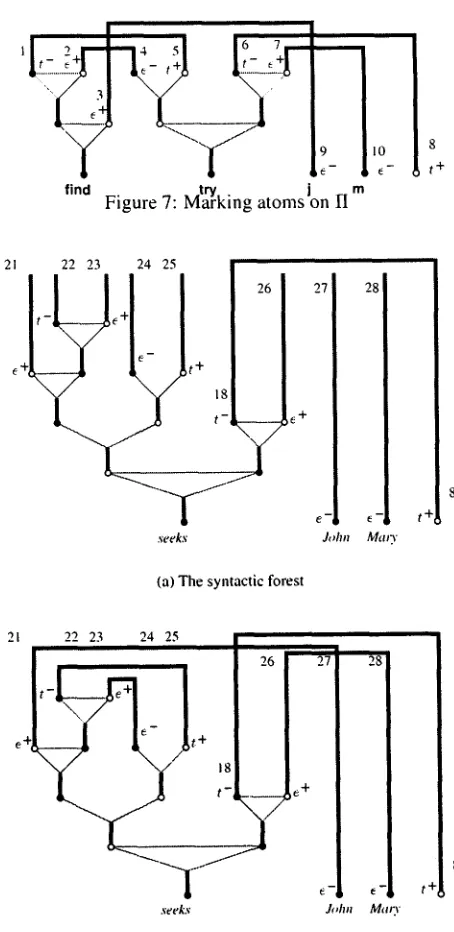
proof net of ligure 7: (try(find j ) ) m .
We first need to associate every atom with all index (in the figures, we only indicate a number i beside the atom to express it is el). Of course, we have to know how to recognize the ei that are the same in U (figure 6) and in 11 (figure 7). This can be done by looking at the typed constants decorating the input conclusions (for the mo- ment. we don't have a general procedure in the complex cases).
We also assume in this numbering that we know which o f the atoms in H ( F ) are linked to t + (the unique out- put). In our case where 0.4 = 0, it is not a problem to
, { l i f i = j - 5 , j = O i f i # j
make such a statement. In other cases, tile complexity would increase polynomially.
Then, the given matrices are:
" 0 0 0 1 0 0 0 0 0 0 0 0 1 0 0 0 0 0 1 0 0 0 0 0 0 1 0 0 0 0 0 0 1 0 0 0 0 0 0 0 0 0 0 0 0 1 0 0 0 0 0 0 0 0 1 0 0 0 0 0 0 0 0 1 0 0 0 0 0 0 0 0 - 0 0 0 0 0 0 0 0
0 0 " 0 0 0 0 0 0 0 0 H i = O0 O0 O0 1 0 O1
0 0 0 0 1 0 0 0 0 ~ 0 0 0 1 0 0 0 0 0 0 0 0 0 0 0 0 0 1 0 0 1 0 0 0 0 0 0 0 0 1 0 0 0 0 0 0 0 0 0 0 0 0 0 0 0 0 1 0 0 0 0 0 0 0 0 0 0 0 1 0 0 0 0 0 1 0 0 0 0 0 0 1 0 0 0 0 0 0 0 0 0 0 0 0 1 0 0
0" 1 _~_
So
0 0 0 0 0 0 0 0 0 0 " 0 0 0 0 0 0 0 0 0 0 0 0 0 0 0 0 0 0 0 0 0 0 0 0 0 0 0 0 0 0 0 0 0 0 0 0 0 0 0 0 0 0 0 0 0 0 0 1 0 0 0 0 0 0 0 0 0 0 0 0 0 0 0 0 0 1 0 0 0 0 0 0 0 0 0 0 0 0 0 0 0 0 0 0 0 0 0 0 0 0 .
0" 2 =
0 0 0 0 1 0 0 0 - 0 0 0 1 0 0 0 0 1 0 0 0 0 0 0 0 0 1 0 0 0 0 0 0 0 0 1 0 0 0 0 0 0 0 0 0 0 0 0 0 0 O 0 O 0 1 0 0 0 0 0 0 0 0 0 0 0 0 0 0 0 0 1 0 0 0 0 0 0 0 0 1
. 4 = ( U - 1 1 I I 1 - o" 1 tu1) t U l l =
0 0 0 1 0 0 0 0 0 0 0 0 0 0 1 0 0 0 0 0 0 0 0 0 0 0 0 0 1 0 1 0 0 0 0 0 0 0 0 0 0 1 0 0 0 0 0 0 0 0
0 0 0 0 0 0 0 0 0 0 0 0 0 0 0 0 0 0 0 1 0 0 0 0 0 0 0 0 0 0
0 0 1 0 0 0 0 0 0 0 - 0 0 0 0 0 0 1 0 0
According to the definition o f the (it) and tile (jr) fami- lies such that 0.2 = E l
El+j+,
w e have:; 4 + 2
,o I
2 3 4 5 6 7 8
Then
.1;5,2 - - 1 - - a l , 4 .1~3,4 - - 1 - - a 5 , 2 ah:;,8 ~ 1 ~ a 7 , 1 0
./?2, 5 -= 1 --~ a 4 , 1 ./.'i, 7 ~ 1 - a 3 , 9 ;l~8, 6 ~-- 1 --~ a l o , 7
X4, 3 -= I = a2, 5
397,1 = 1 = ag, 3
and in this case 0"4 = 0, so according to tile preceeding notes . \ is completely determined and
X = Ua =
i ooooo il
0 0 0 1 0 0 ~ 0 0 1 0 0 00 1 0 0 0 0
0 0 0 0 0 0
oooooo
C 0 0 0 0 1 0 3
~ L m
B
- ! i
rl
+
%
+- \ i/
/" /"
+
\
\ /
/
" \
i ;
=~
i , /
+ t*'.
e -
c
t " -
21
i
,1
51
16
7Y
' " C
: :
try j m find F i g u r e 7: Marking atoms on I I
8
t +
t!
22 23
24 25
; ~ _ ~
26
e+
t+
t- ~.---
seeks
e + 27
(a) The syntactic forest
e -
J~4m
28
e - ~ t 4
Mao"
21 22 23 24 25
26
e i ~ 5 "1"
seeks
27 ~ I
1
28
J~,hn Mary
8 t ÷
(b) The syntactic forest endowed with the matching described by
Figure 8: Applying the matching on the syntactic forest
We still have to ensure the correctness of this proof net (because we add all the tensor and par links), but it has a quadratic complexity (less than the matrix computation). In this case, it is correct.
Note:
[image:7.612.345.572.64.530.2]the
John
item on the left would achieve the result ofMary seeks John,
• The choice of
seeks
and its high order type (for in-tcnsionnality) shows there is no limitation on the or- der of the A-term.
6 C o n c l u s i o n
We took advantage of proof nets on the semantic point of view and we expressed the generation process as a guided proof search. On top of keeping the decidability property of this framework, we characterized the seman- tic proof nets that enable a polynomial time process.
Such properties are crucial because it is the central part of the generation process (considering Lambek calculus). But there are other things left to look at. As the very next steps, we should work on the atoms numbering and the choice of the lexical items. Appropriate interactions be- tween word order contraints and matrix resolution in the hard case should also be considered. Moreover, another point is to benefit from the power of linear logic and deal with non linear A-terms.
Finally. since different extensions of Lambek calcu- lus based on proof nets (Moortgat, 1996; Lecomte and Retor6, 1995) have been considered, we hope our pro- posal and its good properties to apply to other linguistic approaches.
A c k n o w l e d g m e n t s
I would like to thank Christian Retor6 who pointed out to me Girard's algebraic interpretation of the cut elimi- nation.
R e f e r e n c e s
Kazimierz Ajdukiewicz. 1935. Die syntaktische Kon-
nexitat.
Studia Philosophica,
1:1-27. English trans-lation in Storrs McCall (ed),
Polish Logic 1920-1939,
Oxford University Press, pp. 207-231.
Vincent Danos. 1990.
Une Application de la Logique
Lin6aire fs I'F.tude des Processus de Normalisation
(principalement du A-calcul).
Ph.D. thesis, Universit6 Paris VII, June.Philippe de Groote and Chritian Retor& 1996. On the semantic readings of proof-nets. In Glyn Morrill
Gccrt-Jaal Kruijff and Dick Oehrle, editors,
Formal
Grammar,
pages 57-70, Prague, August. FoLLI. David R. Dowty, Robert E. Wall, and Stanley Peters.1981.
hztroduction to Montague Semantics.
KluwerAcademic Publishers.
Jean-Yves Girard, Yves Lafont, and P. Taylor. 1988.
Proofs" and Tyl?es.
Cambridge Tracts in Theoretical Computer Science 7. Cambridge University Press.Jean-Yves Girard. 1987. Linear logic.
Theoretical
Computer Science,
50: I - 102.Jean-Yves Girard. 1989. Geometry of interaction I: In- terpretation of system F. In C. Bonotto, R. Ferro,
S. Valentini, and A. Zanardo, editors,
Logic Collo-
quium '88,
pages 221-260. North-Holland.Jean-Yves Girard. 1993. Linear logic: Its syntax and se- mantics. In J.-Y. Girard NS Y. Latont and L. Regnier.
editors,
Advances in Linear Logic,
Ithaca, New York,June,
Jean-Yves Girard. 1995. Geometry of interaction III: The general case. In J.-Y. Girard, Y. Lafont, and
L. Regnier, editors,
Advances in Linear Logic,
pages329-389. Cambridge University Press. Proceedings of the Workshop on Linear Logic, Ithaca, New York, June 1993.
W. A. Howard, 1980.
To H. B. Curry: Essays on combi-
natory logic, Lambda Calculus and Formalism,
chap- ter The Formula~-as-Types Notion of Construction, pages 479-490. Academic Press,Franqois Lamarche and Christian Retor6. 1996. Proof- nets for the lambek calculus - an overview. In V. Michele Abrusci and Claudio Casadio, editors,
Proceedings 1996 Roma Workshop. Proofs and Lin-
guistic Categories,
pages 241-262. Editrice CLUEB, Bologna, April.Franqois Lamarche. 1995. Games semantics for full
propositional linear logic. In
Proceedings, Tenth An-
nual IEEE Symposium on Logic in Computer Science,
pages 464-473, San Diego, California, 26-29 June.
IEEE Computer Society Press.
Joachim Lambek. 1958. The mathematics of sen-
tence structure.
American Mathematical Monthly,
65(3):! 54-170.
Alain Lecomte and Christian Retor6. 1995. Pomset
logic as an alternative categorial grammar. In
Formal
Grammar,
Barcelona.Josep M. Merenciano and Glyn Morrill. 1997. Genera- tion as deduction on labelled proof nets. In Christian
Retor6, editor,
Proceedings of the 1st International
Conference on Logical Aspects of Computational Lin-
guistics ( LACL-96),
volume 1328of LNAI,
pages 310- 328, Berlin, September23-25. Springer.Richard Montague. 1974.
Formal Philosophy: Selected
Papers of Richard Montague.
Yale University Press, New Haven, CT.Michael Moortgat. 1996. Categorial type logics. In Jo-
han van Benthem and Alice ter Meulen, editors,
Hand-
book of Logic attd Language,
pages 5-91. Elsevier Science Publishers, Amsterdam.Christian Retor6. 1990. A note on turbo cut elimination. Manuscript, September.
Christian Retor6. 1993.
R~seaux
et s~quentsordonn~s.
Ph.D. thesis, University of Paris VII.
Dirk Roorda. 1991.
Resource Logics: Proof-theoretical