P r o b a b i l i s t i c a n d R u l e - B a s e d T a g g e r o f a n I n f l e c t i v e
L a n g u a g e - a C o m p a r i s o n
Jan Haji~
a n d B a r b o r a H l a d k ~ iInstitute of Formal and Applied Linguistics
F a c u l t y o f M a t h e m a t i c s a n d P h y s i c s M a l o s t r a n s k ~ n £ m . 25
C Z - 1 1 8 00 P r a g u e 1
e - m a i h ( h a j i c , h l a d k a } ~ u f a l . m f f . c u n i . c z
A b s t r a c t
We present results of probabilistic tag- ging of Czech texts in order to show how these techniques work for one of the highly morphologically ambiguous inflective lan- guages. After description of the tag system used, we show the results of four experi- ments using a simple probabilistic model to tag Czech texts (unigram, two bigram experiments, and a t r i g r a m one). For com- parison, we have applied the s a m e code and settings to tag an English text (another four experiments) using the same size of training and test d a t a in the e x p e r i m e n t s in order to avoid any d o u b t concerning the va- lidity of the comparison. T h e experiments use the source channel model and maxi- m u m likelihood training on a Czech hand- tagged corpus and on tagged Wall Street Journal (WSJ) from the LDC collection. The e x p e r i m e n t s show (not surprisingly) t h a t the more training d a t a , the b e t t e r is the success rate. T h e results also indicate t h a t for inflective languages with 1000+ tags we have to develop a more sophisti- cated approach in order to get closer to an acceptable error rate. In order to c o m p a r e two different approaches to text tagging - - statistical a n d rule-based - - we modified Eric Brill's rule-based p a r t of speech tag- ger and carried out two more e x p e r i m e n t s on the Czech data, obtaining similar results in t e r m s of the error rate. We have also run three more e x p e r i m e n t s with greatly reduced tagset to get a n o t h e r comparison based on similar tagset size.
1 I N T R O D U C T I O N
Languages with rich inflection like Czech pose a special problem for morphological disambiguation
(which is usually called tagging1). For example, the ending "-u" is not only highly ambiguous, but at the same time it carries complex information: it corre- sponds to the genitive, the dative and the locative singular for i n a n i m a t e nouns, or the dative singu- lar for a n i m a t e nouns, or the accusative singular for feminine nouns, or the first person singular present tense active participle for certain verbs. T h e r e are two different techniques for t e x t tagging: a stochas- tic technique and a rule-based technique. Each ap- proach has some advantages - - for stochastic tech- niques there exists a good theoretical framework, probabilities provide a straightforward way how to disambiguate tags for each word and probabilities can be acquired a u t o m a t i c a l l y from the data; for rule-based techniques the set of meaningful rules is a u t o m a t i c a l l y acquired and there exists an easy way how to find and implement i m p r o v e m e n t s of the tag- ger. Small set of rules can be used, in contrast to the large statistical tables. Given the success of statis- tical m e t h o d s in different areas, including text tag- ging, given the very positive results of English statis- tical taggers and given the fact t h a t there existed no statistical tagger for any Slavic language we wanted to apply statistical m e t h o d s even for the Czech lan- guage although it exhibits a rich inflection accom- panied by a high degree of ambiguity. Originally, we expected t h a t the result would be plain negative, getting no more t h a n a b o u t two thirds of the tags correct. However, as we show below, we got bet- ter results t h a n we had expected. We used the same statistical approach to tag b o t h the English text and the Czech text. For English, we obtained results c o m p a r a b l e with the results presented in (Merialdo, 1992) as well as in (Church, 1992). For Czech, we ob- tained results which are less satisfactory t h a n those for English. Given the c o m p a r a b i l i t y of the accu- racy of the rule-based part-of-speech (POS) tagger (Brill, 1992) with the accuracy of the stochastic tag-
ger and given the fact t h a t a rule-based POS tagger has never been used for a Slavic language we have tried to apply rule-based m e t h o d s even for Czech.
2 S T A T I S T I C A L E X P E R I M E N T S
2.1 C Z E C H E X P E R I M E N T S
2.1.1 C Z E C H T A G S E T
Czech experiment is based upon ten basic POS classes and the tags describe the possible combina- tions of morphological categories for each POS class. In most cases, the first letter of the tag denotes the part-of-speech; the letters and numbers which follow it describe combinations of morphological categories (for a detailed description, see Table 2.1 and Table
Cat. Var.
see Tab. 2.2) g 2.2).
Morph. Categ.
Poss. Description Val.
gender M masc. anim.
I masc. inanim. N neuter F feminine
number n S singular
P plural
tense t M past
P present F future
m o o d m O indicative
R imperative
case c 1 nominative
2 genitive 3 dative 4 accusative 5 vocative 6 locative 7 instrumental
voice s A active voice
P passive voice
polarity a N negative
A affirmative deg. of comp. d 1 base form
2 comparative 3 superlative
person p 1 1st
2 2nd
3 3rd
Table 2.1
Note especially, t h a t Czech nouns are divided into four classes according to gender (Sgall, 1967) and into seven classes according to ease.
POS Class nouns
noun, abbreviations adjectives
Ngnc
NZAgncda
verbs, infinitives V T a verbs, transgressivesVWntsga
verbs, common
Vpnstmga
pronouns, personal
PPpnc
pronouns, 3rd personPP3gnc
pronouns, possessivePRgncpgn
"svfij" - - " h i s " referring toPSgnc
subjectreflexive particle "se" P E c pronouns, demonstrative
PDgnca
adverbs Od a
conjunctions S
numerals
C gnc
prepositions Rpreposition
interjections F
particles K
sentence boundaries T_SB p u n c t u a t i o n T_IP
unknown tag X
Table 2.2
Not all possible combinations of morphological categories are meaningful, however. In addition to these usual tags we have used special tags for sen- tence boundaries, p u n c t u a t i o n and a so called "un- known tag". In the experiments, we used only those tags which occurred at least once in the training cor- pus. To illustrate the form of the tagged text, we present here the following examples from our train- ing data, with comments:
word Itag # c o m m e n t s doIRdo # " t o "
(prepositions have their own individuals tags) oddflulNIS2 # " u n i t "
(noun, masculine inani- mate, singular, genitive)
kiRk
snfdanilNFS3
pou#,ijeIV3SAPOMA
prolRpro
n£s[PP1P4
~:" for" (preposition) ~ " breakfast"
(noun, feminine, singular, dative)
~" uses"
(verb, 3rd person, singular, active,
present, indicative, masc. animate, affirmative) # " f o r "
(preposition)
~" US"
(pronoun, personal, 1st person, plural, accusative)
2.1.2 C Z E C H T R A I N I N G D A T A
For training, we used the corpus collected dur- ing the 1960's and 1970's in the I n s t i t u t e for Czech Language at the Czechoslovak A c a d e m y of Sciences. T h e corpus was originally hand-tagged, including the l e m m a t i z a t i o n and syntactic tags. We had to do some cleaning, which m e a n s t h a t we have disre- garded the l e m m a t i z a t i o n information and the syn- tactic tag, as we were interested in words and tags only. Tags used in this corpus were different from our suggested tags: n u m b e r of morphological cate- gories was higher in the original sample and the no- tation was also different. Thus we had to carry out conversions of the original d a t a into the f o r m a t pre- sented above, which resulted in the so-called Czech "modified" corpus, with the following features:
tokens 621 015
words 72 445
tags 1 171
average n u m b e r of tags per token 3.65
Table 2.3
V~Te used the complete "modified" corpus (621015 tokens) in the e x p e r i m e n t s No. 1, No. 3, No. 4 and a small p a r t of this corpus in the experi- ment No. 2, as indicated in Table 2.4.
tokens 110 874
words 22 530
tags 882
average n u m b e r of tags per token 2.36
Table 2.4
2.2 E N G L I S H E X P E R I M E N T S
2.2.1 E N G L I S H T A G S E T
For the tagging of English texts, we used the Penn T r e e b a n k tagset which contains 36 P O S tags and 12 other tags (for p u n c t u a t i o n and the currency symbol). A detailed description is available in (San- torini, 1990).
2 . 2 . 2 E N G L I S H T R A I N I N G D A T A
For training in the English experiments, we used W S J (Marcus et al., 1993). We had to change the f o r m a t of W S J to prepare it for our tagging soft- ware. V~e used a small (100k tokens) p a r t of W S J in the experiment No. 6 and the complete corpus (1M tokens) in the e x p e r i m e n t s No. 5, No. 7 and No. 8. Table 2.5 contains the basic characteristics of the training data.
tokens
words tags
average n u m b e r of tags per token
E x p e r i m e n t E x p e r i m e n t s No. 6 No. 5, No. 7,
No. 8
110 530 1 287 749 13 582 51 433
45 45
1.72 2.34
Table 2.5
2.3 C Z E C H V S E N G L I S H
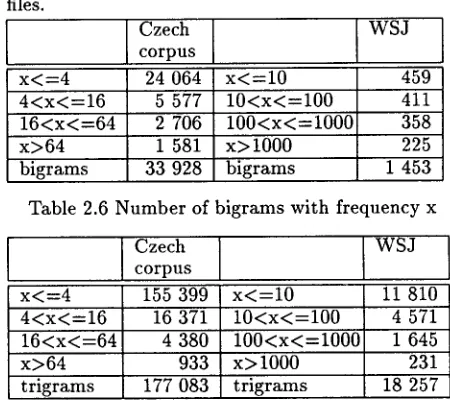
Differences between Czech as a morphologically am- biguous inflective language and English as language with p o o r inflection are also reflected in the n u m b e r of tag bigrams and tag trigrams. T h e figures given in Table 2.6 and 2.7 were obtained from the training files.
Czech W S J
corpus
x < = 4 24 064 x < - - 1 0 459 4 < x < = 1 6 5 577 1 0 < x < - - 1 0 0 411 1 6 < x < = 6 4 2 706 1 0 0 < x < = 1 0 0 0 358 x > 6 4 1 581 x>1000 225 bigrams 33 928 b i g r a m s 1 453
Table 2.6 N u m b e r of b i g r a m s with frequency x
x<----4 4 < x < = 1 6
Czech corpus
155 399 16 371
x < = l O 1 0 < x < = 1 0 0
W S J
11 810 4 571 1 6 < x < = 6 4 4 380 1 0 0 < x < = 1 0 0 0 1 645 x > 6 4 933 x > 1000 231 trigrams 177 083 t r i g r a m s 18 257
Table 2.7 N u m b e r of t r i g r a m s with frequency x
It is interesting to note the frequencies of the most ambiguous tokens encountered in the whole "modified" corpus and to c o m p a r e t h e m with the English data. Table 2.8 and Table 2.9 contain the first tokens with the highest n u m b e r of possible tags in the complete Czech "modified" corpus and in the complete W S J .
Token Frequency # t a g s
in train, d a t a in train, d a t a
jejich 1 087 51
jeho 1 087 46
jeho~ 163 35
jejich~ 150 25
vedoucl 193 22
Table 2.8
[image:3.612.97.308.273.322.2] [image:3.612.333.558.281.488.2]for noun. The token " v e d o u c f ' means either: "lead- ing" (adjective) or " m a n a g e r " or "boss" (noun). The following columns represent the tags for the token "vedouc/" and their frequencies in the training data; for example " v e d o u c f ' was tagged twice as adjective, feminine, plural, nominative, first degree, affirma- tive.
2 4 6 11 1 4 5 2 11 3 12 2 2
vedouci[AFPllA vedouci[AFP41A vedoucl A F S l l A vedouci AFS21A vedouci AFS31A vedoue~ AFS41A vedouci AFS71A vedoucl A I P l l A vedoucl A M P 11A vedouc{ AMP41A vedoucl AMSllA vedoucl A N P l l A vedoucl ANS41A
10 vedouci
1 vedouci
1 vedouci
1 vedoud
2 vedoucl
34 vedouci
17 vedouci
61 vedouc~
1 vedouci
NFS1 NFS2 NFS3 NFS4 NFS7 NMP1 NMP4 NMS1 NMS5
Token Frequency # t a g s
in train, d a t a in train, d a t a
a 25 791 7
down 1 052 7
put 380 6
set 362 6
t h a t 10 902 6
the 56 265 6
Table 2.9
It is clear from these figures t h a t the two lan- guages in question have quite different properties and t h a t nothing can be said without really going through an experiment.
2 . 4 T H E A L G O R I T H M
We have used the basic source channel model (de- scribed e.g. in (Merialdo, 1992)). The tagging pro- cedure ¢ selects a sequence of tags T for the sentence
W: ¢ : PV --+ T . In this case the optimal tagging
procedure is
¢ ( W ) -- a r g m a x T P r ( T [ W ) = : a r g m a x T P r ( T l W ) * P r ( W ) = = a r g r n a x T P r ( W , T ) =
-- a r g m a x T P r ( W [ T ) * P r ( T ) .
Our implementation is based on generating the (W,T) pairs by means of a probabilistic model using approximations of probability distributions
P r ( W I T ) and P r ( T ) . The P r ( T ) is based on tag bi- grams and trigrams, and P r ( W I T ) is approximated as the p r o d u c t of Pr(wi[tl). The parameters have been estimated by the usual m a x i m u m likelihood training m e t h o d , i.e. we approximated them as the relative frequencies found in the training d a t a with smoothing based on estimated unigram probability and uniform distributions.
2.5 T H E R E S U L T S
The results of the Czech experiments are displayed in Table 2.10.
No. 1 No. 2 No. 3 No. 4
test d a t a 1 294 1 294 1 294 1 294
(tokens)
prob. unigram bigram bigram trigram
model incorrect tags tagging accuracy
444
65.70%
334
74.19%
239
81.53%
Table 2.10
244
81.14%
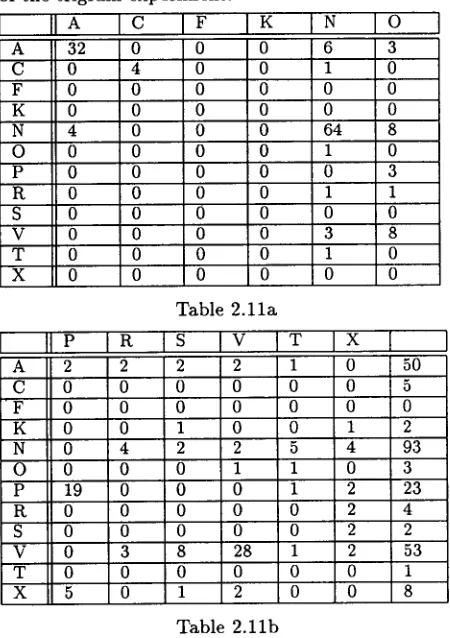
These results show, not surprisingly, of course, t h a t the more data, the better (results experiments of No.2 vs. No.3), but in order to get better results for a trigram tag prediction model, we would need far more data. Clearly, if 88% trigrams occur four times or less, then the statistics is not reliable. The following tables show a detailed analysis of the errors of the trigram experiment.
[
[[A
IC
[F
]K
IN
lO
A 32 0 0 0 6 3
C 0 4 0 0 1 0
F 0 0 0 0 0 0
K 0 0 0 0 0 0
N 4 0 0 0 64 8
O 0 0 0 0 1 0
P 0 0 0 0 0 3
R 0 0 0 0 1 1
S 0 0 0 0 0 0
V 0 0 0 0 3 8
T 0 0 0 0 1 0
X 0 0 0 0 0 0
Table 2.11a
I] P
[ R
I s
I V
I T
I X
I
A 2 2 2 2 1 0 50
C 0 0 0 0 0 0 5
F 0 0 0 0 0 0 0
K 0 0 1 0 0 1 2
N 0 4 2 2 5 4 93
O 0 0 0 1 1 0 3
P 19 0 0 0 1 2 23
R 0 0 0 0 0 2 4
S 0 0 0 0 0 2 2
V 0 3 8 28 1 2 53
T 0 0 0 0 0 0 1
X 5 0 1 2 0 0 8
Table 2.11b
The letters in the first column and row denote P O S classes, the interpunction (T) and the "un- known tag" (X). The numbers show how many times the tagger assigned an incorrect P O S tag to a to- ken in the test file. The total number of errors was 244. Altogether, fifty times the adjectives (A) were
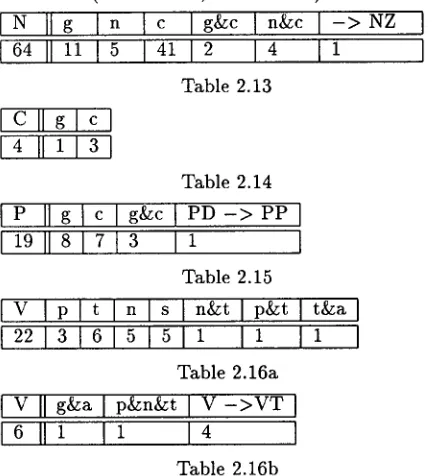
[image:4.612.339.571.112.239.2] [image:4.612.341.566.330.649.2]tagged incorrectly, nouns (N) 93 times, numbers (C) 5 times and etc. (see the last unmarked column in Table 2.11b); to provide a better insight, we should add that in 32 cases, when the adjective was cor- rectly tagged as an adjective, but the mistakes ap- peared in the assignment of morphological categories (see Table 2.12), 6 times the adjective was tagged as a noun, twice as a pronoun, 3 times as an adverb and so on (see the second row in Table 2.11a). A detailed look at Table 2.12 reveals that for 32 cor- rectly marked adjectives the mistakes was 17 times in gender, once in number, three times in gender and case simultaneously and so on.
[ A[[ g [ n [ c I g&~ g&:~ c&:~ g&n~zc[ g~zc&:d[
1321117]1161 3 I 2 I 1 I 1
I 1
I
Table 2.12
Similar tables can be provided for nouns (Table 2.13), numerals (Table 2.14), pronouns(Table 2.15) and verbs (Table 2.16a, Table 2.16b).
N l[ g I n t c I g&c [ n&c I - > N Z ] 64 [[ 11 [ 5 [ 41 [ 2 [ 4 [ 1 ]
Table 2.13
C l l g
c
4 [[1 3
Table 2.14
P
Ilg
c g & c l V D - > P V1 9 l l 8
7 3
I 1
Table 2.15
V I P t n I s I n&t I p&t t&a I
2 2 ] 3
65 1 5 1 1
I 1
1
I
Table 2.16a
v II gt~a I pan~t I v - > V T
6
II 1
I1
]4
Table 2.16b
The results of our experiments with English are displayed in Table 2.17.
test d a t a (tokens)
I N o 5
1 294
No. 6 1 294
INo. 7
1 294
No. 8 1 294
prob. unigram bigram bigram trigram model
136
89.5% incorrect
tags
41
96.83% tagging
accuracy
81
93.74%
37
97.14%
Table 2.17
To illustrate the results of our tagging experi- ments, we present here short examples taken from
the test data. Cases of incorrect tag assignment are in boldface.
- - Czech
word[hand tag exp. exp. exp. exp. No.4 No.3 No.2 No.12
na[Rna Rna Rna
pfid~[NFS6 NFS6 NFS6 vlasti[NFS2 NFS2 NFS2 rady[NFS2 NFS2 NFS2
~en[NFP2 NFP2 NFP2
Gusta[NFS1 T_SB T _ S B F u ~ o v £ [ N F S 1 NFS1 NFS1
a[SS SS SS
p~edseda[NMS1 NMS1 NMS1
dv[NZ NZ NZ
ssm[NZ NZ NZ
Juraj[NMS1 NMS1 NMS1 Varhol~[NMS1 NMS1 NMS1
- - English word [ hand tag
R n a Rna
NFS6 NFS6
NFS2 NFS2
NFS2 NFS2
NFP2 NFP2
A F P 2 1 A X X N F P 2 NFS1
SS SS
NMS1 NMS1
NZ NZ
NZ NZ
NMS1 X X
NMS1 NMS1
exp. exp. exp. exp. No.8 No.7 No.6 No.5
With[IN IN IN IN IN
stock[NN NN NN NN NN
prices[NNS NNS NNS NNS NNS
hovering[VBG VBG VBG I N VBG
near[IN IN IN J J IN
record[NN NN NN NN NN
levels[NNS NNS NNS NNS NNS
,[,
alDT
fiT
fiT
DT DTnumber[NN NN NN NN NN
of[IN IN IN IN IN
companieslNNS NNS NNS NNS NNS
have[VBP VBP VBP VBP VBP
been[VBN VBN VBN VBN VBN
announcing[VBG VBG VBG I N VBG
stock[NN NN NN NN NN
splits]NNS NNS V B Z N N V B Z .[.
2.6 A P R O T O T Y P E O F R A N K X E R O X P O S T A G G E R F O R C Z E C H
(Schiller, 1996) describes the general architecture of the tool for noun phrase mark-up based on finite- state techniques and statistical part-of-speech dis- ambiguation for seven European languages. For Czech, we created a prototype of the first step of this process - - the part-of-speech (POS) tagger - - using Rank Xerox tools (Tapanainen, 1995), (Cut- ting et al., 1992).
2.6.1 P O S T A G S E T
The first step of POS tagging is obviously a def- inition of the POS tags. We performed three ex-
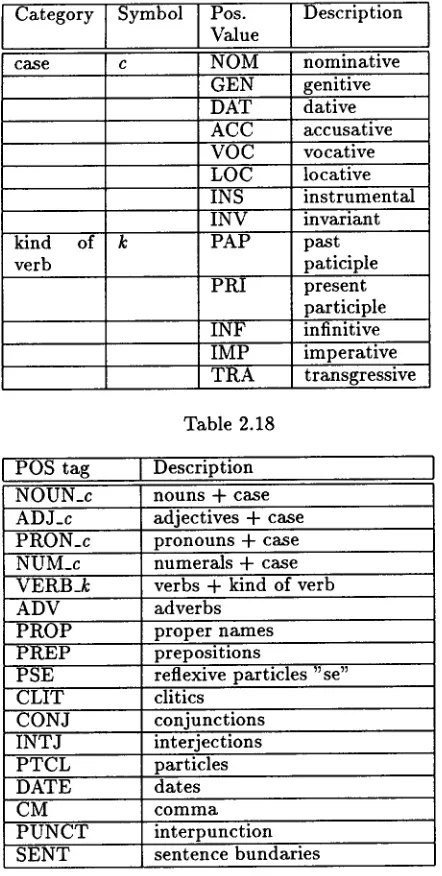
[image:5.612.329.555.111.564.2] [image:5.612.87.304.311.549.2] [image:5.612.88.316.574.699.2]periments. These experiments differ in the POS tagset. During the first experiment we designed tagset which contains 47 tags. T h e POS tagset can be described as follows:
Category Symbol Pos.
Value
Description
case c NOM nominative
GEN genitive b A T dative ACC accusative VOC vocative
locative
kind verb
LOC INS INV P A P
P R I
INF IMP T R A
N m
instrumental invariant past paticiple present participle infinitive imperative transgressive
2 . 6 . 2 R E S U L T S
Figures representing the results of all experi- ments are presented in the following table. We have also included the results of English tagging using the same Xerox tools.
language tags
Czech 47
Czech 43
Czech 34
English _[ 76
ambiguity ~
39% 36% 14% 36%
tagging accuracy 91.7% 93.0% 96.2% 97.8%
Table 2.20
T h e results show t h a t the more radical reduction of Czech tags (from 1171 to 34) the higher accuracy of the results and the more comparable are the Czech and English results. However, the difference in the error rate is still more than visible - - here we can speculate t h a t the reason is t h a t Czech is "free" word order language, whereas English is not.
Table 2.18
POS tag Description NOUN_c nouns + case ADJ_c adjectives + case PRON_c pronouns + case NUM_c numerals + case VERB_k verbs + kind of verb
ADV adverbs
P R O P P R E P
proper names prepositions
P S E reflexive particles "se" C L I T clitics
CONJ I N T J
conjunctions interjections P T C L particles
DATE dates
CM c o m m a
P U N C T interpunction S E N T sentence bundaries
Table 2.19
T h e analysis of the results of the first experiment showed very high ambiguity between the nominative and accusative cases of nouns, adjectives, pronouns and numerals. T h a t is why we replaced the tags for nominative and accusative of nouns, adjectives, pronouns and numerals by new tags NOUNANA, ADJANA, PRONANA and NUMANA (meaning nom- inative or accusative, undistinguished). T h e rest of the tags stayed unchanged. This led 43 POS tags. In the third experiment we deleted the morphologi- cal information for nouns and adjectives alltogether. This process resulted in the final 34 POS tags.
3 A R U L E - B A S E D E X P E R I M E N T
F O R C Z E C H
A simple rule-based part of speech (RBPOS) tag- ger is introduced in (Brill, 1992). T h e accuracy of this tagger for English is comparable to a stochas- tic English POS tagger. From our point of view, it is very interesting to compare the results of Czech stochastic P O S (SPOS) tagger and a modified RB- P O S tagger for Czech.
3.1 T R A I N I N G D A T A
We used the same corpus used in the case of the SPOS tagger for Czech. R B P O S requires different input format; we thus converted the whole corpus into this format, preserving the original contents.
3.2 L E A R N I N G
It is an obvious fact t h a t the Czech tagset is totally different from the English tagset. Therefore, we had to modify the m e t h o d for the initial guess. For Czech the algorithm is: "If the word is W_SB (sentence b o u n d a r y ) assign the tag T_SB, otherwise assign the tag NNSI."
3.2.1 L E A R N I N G R U L E S T O P R E D I C T
T H E M O S T L I K E L Y T A G F O R U N K N O W N W O R D S
T h e first stage of training is learning rules to predict the most likely tag for unknown words. These rules operate on word types; for example, if
3The percentage of ambiguous word forms in the test file.
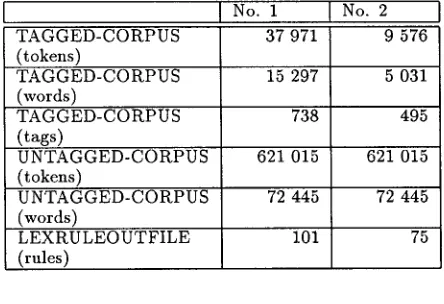
[image:6.612.95.316.123.561.2] [image:6.612.340.557.137.230.2]a word ends by "d37;, it is probably a masculine ad- jective. To compare the influence of the size of the training files on the accuracy of the tagger we per- formed two subexperiments4:
TAGGED-CORPUS (tokens)
TAGGED-CORPUS (words)
TAGGED-CORPUS (tags)
No. 1 No. 2
15 297 5 031
738 495
UNTAGGED-CORPUS 621 015 621 015
(tokens)
72 445 72 445
UNTAGGED-CORPUS (words)
101 LEXRULEOUTFILE
(rules)
75
Table 3.1
We present here an example of rules taken from L E X R U L E O U T F I L E from the exp. No. 1:
u hassuf 1 NIS2 # change the tag to NIS2
if the suffix is "u"
y hassuf 1 NFS2 # change the tag to NFS2
if the suffix is "y"
ho hassuf 2 AIS21A # change the tag to AIS21A
if the suffix is "ho"
£ch hassuf 3 N F P 6 # change the tag to N F P 6 if the suffix is "£ch"
nej addpref 3 O2A # change the tag to O2A
if adding the prefix "nej" results in a word
3 . 2 . 2 L E A R N I N G C O N T E X T U A L C U E S
The second stage of training is learning rules to improve tagging accuracy based on contextual cues. These rules operate on individual word tokens.
4 W e u s e the same names of files and variables as Eric Brill in the rule-based POS tagger's documenta- tion. TAGGED-CORPUS - - manually tagged train- ing corpus, UNTAGGED-CORPUS - - collection of all untagged texts, LEXRULEOUTFILE - - the list of transformations to determine the most likely tag for unknown words, TAGGED-CORPUS-2 - - manually tagged training corpus, TAGGED-CORPUS-ENTIRE
- - Czech "modified" corpus (the entire manually tagged corpus), CONTEXT-RULEFILE - - the list of transfor- mations to improve accuracy based on contextual cues.
No. 1 No. 2
TAGGED-CORPUS-2 37 892 9 989
(tokens)
TAGGED-CORPUS-2 12 676 4 635
(words)
TAGGED-CORPUS-2 717 479
(tags)
TAGGED-ENTIRE-CORPUS 621 015 621 015
(tokens)
TAGGED-ENTIRE-CORPUS 72 445 72 445
(words)
TAGGED-ENTIRE-CORPUS 1 171 1 171
(tags)
CONTEXT-RULEFILE 487 61
(rules)
Table 3.2
We present here an example of the rules taken from C O N T E X T - R U L E F I L E from the exp. No. 1:
A F P 2 1 A A I P 2 1 A # change the tag
A F P 2 1 A to A I P 2 1 A
N E X T 1 O R 2 T A G if the following tag is
NIP2 NIP2
NIS2 NIS6
P R E V 1 O R 2 O R 3 T A G Rv
# change the tag NIS2 to NIS6
if the preceding tag is Rv
NIS1 NIS4 # change the tag NIS1
to NIS4
P R E V I O R 2 T A G if the preceding tag is
R n a R n a
3.2.3 R E S U L T S
The tagger was tested on the same test file as for the statistical experiments. We obtained the fol- lowing results:
I
T E S T - F I L E errors
tagging accuracy
II No. 1 No. 2
1 294 1 294
262 294
79.75% 77.28%
Table 3. 3
4 C O N C L U S I O N
[image:7.612.338.567.83.452.2] [image:7.612.93.315.130.282.2]token will increase after a morphological analyzer is added. Success should be guaranteed, however, by certain tagset reductions, as the original tagset (even after the reductions mentioned above) is still too detailed. This is especially true when comparing it to English, where some tags represent, in fact, a set of tags to be discriminated later (if ever). For ex- ample, the tag VB used in the WSJ corpus actually means "one of the (five different) tags for 1st person sg., 2nd person sg., 1st person pl., etc.". First, we will reduce the tagset to correspond to our morpho- logical analyzer which already uses a reduced one. Then, the tagset will be reduced even further, but nevertheless, not as much as we did for the Xerox- tools-based experiment, because that tagset is too "rough" for many applications, even though the re- sults are good.
Regarding tagset reduction, we should note that we haven't performed a "combined" experiment, i.e. using the full (1100+) tagset for (thus) "interme- diate" tagging, but only the reduced tagset for the final results. However, it can be quite simply derived from the tables 2.10, 2.11a and 2.11b, that the error rate would not drop much: it will remain high at about 6.5070 (based on the results of experiment No. 4) using the very small tagset of 12 (= number or lines in table 2.11a) tags used for part of speech iden- tification. This is even much higher than the error rate reported here for the smallest tagset used in the 'pure' experiment (sect. 2.6, table 2.20), which was at 3.8~0. This suggests that maybe the pure meth- ods (which are obviously also simple to implement) are in general better than the "combined" methods. Another possibility of an improvement is to add more data to allow for more reliable trigram esti- mates. We will also add contemporary newspaper texts to our training data in order to account for recent language development. Hedging against fail- ure of all these simple improvements, we are also working on a different model using independent pre- dictions for certain grammatical categories (and the lemma itself), but the final shape of the model has not yet been determined. This would mean to intro- duce constraints on possible combinations of mor- phological categories and take them into account when "assembling" the final tag.
A C K N O W L E D G M E N T S : The authors wish to thank Eva Hajidovd for her comments and sugges- tions and Eric BriU, Jean-Pierre Chanod and Anne Schiller who made their software tools available.
Eric Brill. 1993. A Corpus Based Approach To Lan- guage Learning. PhD Dissertation, Department of Computer and Information Science, Univer- sity of Pennsylvania.
Eric Brill. 1994. Some Advances in Transformation- -Based Part of Speech Tagging. In: Proceedings of the Twelfth National Conference on Artificial Intelligence.
Jan Haji~. 1994. Unification Morphology Gram- mar. PhD Dissertation, Institute of Formal and Applied Linguistics, Charles University, Prague, Czech Republic.
Kenneth W. Church. 1992. Current Practice In Part Of Speech Tagging And Suggestions For The Future. For Henry Ku~era, Studies in Slavic Philology and Computational Linguistics, Michi- gan Slavic Publications, Ann Arbor.
Doug Cutting, Julian Kupiec, Jan Pedersen and Penelope Sibun 1992. A Practical Part-of- Speech Tagger. In: Proceedings of the Third Conference on Applied Natural Language Pro- cessing , Trento, Italy.
Mitchell P. Marcus, Beatrice Santorini, and Mary- Ann Marcinkiewicz 1993. Building A Large Annotated Corpus Of English: The Penn Tree- bank. Computational Linguistics, 19(2):313-- 330.
Bernard Merialdo. 1992. Tagging Text With A Probabilistie Model. Computational Linguis- tics, 20(2):155--171
Beatrice Santorini. 1990. Part Of Speech Tag- ging Guidelines For The Penn Treebank Project. Technical report MS-CIS-90-47, Department of Computer and Information Science, University of Pennsylvania.
Anne Schiller. 1996. Multilingual Finite-State Noun Phrase Extraction. ECAI'96, Budapest, Hun- gary.
Petr Sgall. 1967. The Generative Description of a Language and the Czech Declension (In Czech). Studie a prdce lingvistickd, 6. Prague.
Pasi Tapanalnen. 1995. RXRC Finite-State Com- piler. Technical Report MLTT-20, Rank Xerox Research Center, Meylen, France.
R e f e r e n c e s
Eric Brill. 1992. A Simple Rule-Based Part of Speech Tagger. In: Proceedings of the Third Conference on Applied Natural Language Pro- cessing, Trento, Italy.