Optimization in Multimodal Interpretation
Joyce Y. Chai
*Pengyu Hong
+Michelle
X.
Zhou
‡Zahar
Prasov
**Computer Science and Engineering
Michigan State University East Lansing, MI 48824
{[email protected], [email protected]}
+Department of Statistics
Harvard University Cambridge, MA 02138 [email protected]
‡Intelligent Multimedia Interaction
IBM T. J. Watson Research Ctr. Hawthorne, NY 10532
Abstract
In a multimodal conversation, the way users communicate with a system depends on the available interaction channels and the situated context (e.g., conversation focus, visual feedback). These dependencies form a rich set of constraints from various perspectives such as temporal alignments between different modalities, coherence of conversation, and the domain semantics. There is strong evidence that competition and ranking of these constraints is important to achieve an optimal interpretation. Thus, we have developed an optimization approach for multimodal interpretation, particularly for interpreting multimodal references. A preliminary evaluation indicates the effectiveness of this approach, especially for complex user inputs that involve multiple referring expressions in a speech utterance and multiple gestures.
1 Introduction
Multimodal systems provide a natural and effective way for users to interact with computers through multiple modalities such as speech, gesture, and gaze (Oviatt 1996). Since the first appearance of “Put-That-There” system (Bolt 1980), a variety of multimodal systems have emerged, from early systems that combine speech, pointing (Neal et al., 1991), and gaze (Koons et al, 1993), to systems that integrate speech with pen inputs (e.g., drawn graphics) (Cohen et al., 1996; Wahlster 1998; Wu et al., 1999), and systems that engage users in intelligent conversation (Cassell et al., 1999; Stent et al., 1999; Gustafson et al., 2000; Chai et al., 2002; Johnston et al., 2002).
One important aspect of building multimodal systems is multimodal interpretation, which is a process that identifies the meanings of user inputs.
In a multimodal conversation, the way users communicate with a system depends on the available interaction channels and the situated context (e.g., conversation focus, visual feedback). These dependencies form a rich set of constraints from various aspects (e.g., semantic, temporal, and contextual). A correct interpretation can only be attained by simultaneously considering these constraints. In this process, two issues are important: first, a mechanism to combine information from various sources to form an overall interpretation given a set of constraints; and second, a mechanism that achieves the best interpretation among all the possible alternatives given a set of constraints. The first issue focuses on the fusion aspect, which has been well studied in earlier work, for example, through unification-based approaches (Johnston 1998) or finite state approaches (Johnston and Bangalore, 2000). This paper focuses on the second issue of optimization.
2 Necessities for Optimization in
Multimodal Interpretation
In a multimodal conversation, the way a user interacts with a system is dependent not only on the available input channels (e.g., speech and gesture), but also upon his/her conversation goals, the state of the conversation, and the multimedia feedback from the system. In other words, there is a rich context that involves dependencies from many different aspects established during the interaction. Interpreting user inputs can only be situated in this rich context. For example, the temporal relations between speech and gesture are important criteria that determine how the information from these two modalities can be combined. The focus of attention from the prior conversation shapes how users refer to those objects, and thus, influences the interpretation of referring expressions. Therefore, we need to simultaneously consider the temporal relations between the referring expressions and the gestures, the semantic constraints specified by the referring expressions, and the contextual constraints from the prior conversation. It is important to have a mechanism that supports competition and ranking among these constraints to achieve an optimal interpretation, in particular, a mechanism to allow constraint violation and support soft constraints.
We use temporal constraints as an example to illustrate this viewpoint1. The temporal constraints
specify whether multiple modalities can be combined based on their temporal alignment. In earlier work, the temporal constraints are empirically determined based on user studies (Oviatt 1996). For example, in the unification-based approach (Johnston 1998), one temporal constraint indicates that speech and gesture can be combined only when the speech either overlaps with gesture or follows the gesture within a certain time frame. This is a hard constraint that has to be satisfied in order for the unification to take place. If a given input does not satisfy these hard constraints, the unification fails.
In our user studies, we found that, although the majority of user temporal alignment behavior may satisfy pre-defined temporal constraints, there are
1 We implemented a system using real estate as an application domain. The user can interact with a map using both speech and gestures to retrieve information. All the user studies men-tioned in this paper were conducted using this system.
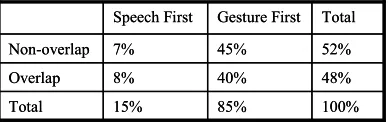
some exceptions. Table 1 shows the percentage of different temporal relations collected from our user studies. The rows indicate whether there is an overlap between speech referring expressions and their accompanied gestures. The columns indicate whether the speech (more precisely, the referring expressions) or the gesture occurred first. Consistent with the previous findings (Oviatt et al, 1997), in most cases (85% of time), gestures occurred before the referring expressions were uttered. However, in 15% of the cases the speech referring expressions were uttered before the gesture occurred. Among those cases, 8% had an overlap between the referring expressions and the gesture and 7% had no overlap.
Furthermore, as shown in (Oviatt et al., 2003), although multimodal behaviors such as sequential (i.e., non-overlap) or simultaneous (e.g., overlap) integration are quite consistent during the course of interaction, there are still some exceptions. Figure 1 shows the temporal alignments from seven individual users in our study. User 2 and User 6
maintained a consistent behavior in that User 2’s
speech referring expressions always overlapped with gestures and User 6’s gesture always occurred
ahead of the speech expressions. The other five users exhibited varied temporal alignment between speech and gesture during the interaction. It will be difficult for a system using pre-defined temporal constraints to anticipate and accommodate all these different behaviors. Therefore, it is desirable to have a mechanism that
0 0.2 0.4 0.6 0.8 1
1 2 3 4 5 6 7
User
P
e
rcen
tag
e
[image:2.612.328.522.67.128.2]Non-overlap Speech First Non-overlap Gesture First Overlap Speech First Overlap Gesture First
Figure 1: Temporal relations between speech and gesture for individual users
100% 85%
15% Total
48% 40%
8% Overlap
52% 45%
7% Non-overlap
Total Gesture First Speech First
100% 85%
15% Total
48% 40%
8% Overlap
52% 45%
7% Non-overlap
[image:2.612.328.530.163.275.2]Total Gesture First Speech First
allows violation of these constraints and support soft or graded constraints.
3 A Graph-based Optimization Approach
To address the necessities described above, we developed an optimization approach for interpreting multimodal references using graph matching. The graph representation captures both salient entities and their inter-relations. The graph matching is an optimization process that finds the best matching between two graphs based on constraints modeled as links or nodes in these graphs. This type of structure and process is especially useful for interpreting multimodal references. One graph can represent all the referring expressions and their inter-relations, and the other graph can represent all the potential referents. The question is how to match them together to achieve a maximum compatibility given a particular context.
3.1 Overview
Graph-based Representation
Attribute Relation Graph (ARG) (Tsai and Fu, 1979) is used to represent information in our approach. An ARG consists of a set of nodes that are connected by a set of edges. Each node represents an entity, which in our case is either a referring expression to be resolved or a potential referent.
Each node encodes the properties of the corresponding entity including:
• Semantic information that indicates the
semantic type, the number of potential referents, and the specific attributes related to the
corresponding entity (e.g., extracted from the referring expressions).
• Temporal information that indicates the time when the corresponding entity is introduced into the discourse (e.g., uttered or gestured).
Each edge represents a set of relations between two entities. Currently we capture temporal relations and semantic type relations. A temporal relation indicates the temporal order between two related entities during an interaction, which may have one of the following values:
• Precede: Node A precedes Node B if the entity represented by Node A is introduced into the discourse before the entity represented by Node B.
• Concurrent: Node A is concurrent with Node B if the entities represented by them are referred to or mentioned simultaneously.
• Non-concurrent: Node A is non-concurrent with
Node B if their corresponding objects/references cannot be referred/mentioned simultaneously.
• Unknown: The temporal order between two entities is unknown. It may take the value of any of the above.
A semantic type relation indicates whether two related entities share the same semantic type. It currently takes the following discrete values: Same,
Different, and Unknown. It could be beneficial in the future to consider a continuous function measuring the rate of compatibility instead.
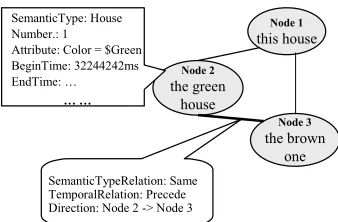
Specially, two graphs are generated. One graph, called the referring graph, captures referring expressions from speech utterances. For example, suppose a user says Compare this house, the green house, and the brown one. Figure 2 show a referring graph that represents three referring expressions from this speech input. Each node captures the semantic information such as the semantic type (i.e., Semantic Type), the attribute (Color), the number (Number) of the potential referents, as well as the temporal information about when this referring expression is uttered (BeginTime and EndTime). Each edge captures the semantic (e.g., SemanticTypeRelation) and temporal relations (e.g., TemporalRelation) between the referring expressions. In this case, since the green house is uttered before the brown one, there is a temporal Precede relationship between these two expressions. Furthermore, according to our heuristic that objects-to-be-compared should share the same semantic type, therefore, the SemanticTypeRelation between two nodes is set to Same.
Node 1
this house
Node 2
the green house
Node 3
the brown one
SemanticType: House Number.: 1
Attribute: Color = $Green BeginTime: 32244242ms EndTime: …
… …
SemanticTypeRelation: Same TemporalRelation: Precede Direction: Node 2 -> Node 3
[image:3.612.88.257.578.689.2]Speech:Compare this house, the green house and the brown one
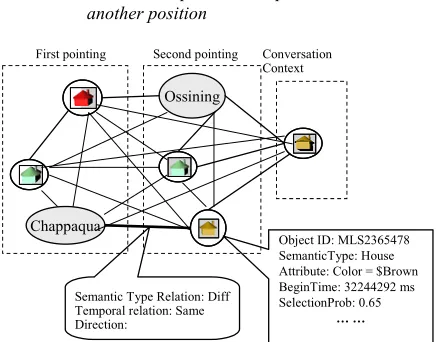
Similarly, the second graph, called the referent graph, represents all potential referents from multiple sources (e.g., from the last conversation, gestured by the user, etc). Each node captures the semantic and temporal information about a potential referent (e.g., the time when the potential referent is selected by a gesture). Each edge captures the semantic and temporal relations between two potential referents. For instance, suppose the user points to one position and then points to another position. The corresponding referent graph is shown in Figure 3. The objects inside the first dashed rectangle correspond to the potential referents selected by the first pointing gesture and those inside the second dashed rectangle correspond to the second pointing gesture. Each node also contains a probability that indicates the likelihood of its corresponding object being selected by the gesture. Furthermore, the salient objects from the prior conversation are also included in the referent graph since they could also be the potential referents (e.g., the rightmost dashed rectangle in Figure 32).
To create these graphs, we apply a grammar-based natural language parser to process speech inputs and a gesture recognition component to process gestures. The details are described in (Chai et al. 2004a).
2 Each node from the conversation context is linked to every node corresponding to the first pointing and the second point-ing.
Graph-matching Process
Given these graph representations, interpreting multimodal references becomes a graph-matching problem. The goal is to find the best match between a referring graph (Gs) and a referent graph
(Gr). Suppose
• A referring graph Gs = 〈{αm}, {γmn}〉, where {αm} are
nodes and {γmn} are edges connecting nodes αm and
αn. Nodes in Gs are named referring nodes.
• A referent graph Gr = 〈{ax}, {rxy}〉, where {ax} are
nodes and {rxy} are edges connecting nodes ax and ay.
Nodes in Gr are named referent nodes.
The following equation finds a match that achieves the maximum compatibility between Gr
and Gs:
) , ( )
, ( ) , (
) , ( )
, ( )
, (
mn xy n
y m x
x y m n
m x m
x
x m
s r
r EdgeSim a
P a P
a NodeSim a
P G
G Q
γ α
α
α α
∑ ∑ ∑ ∑
∑ ∑
+ =
(1)
In Equation (1), Q(Gr,Gs) measures the degree of
the overall match between the referent graph and the referring graph. P(ax,αm) is the matching
probability between a node ax in the referent graph
and a node αm in the referring graph. The overall
compatibility depends on the similarities between nodes (NodeSim) and the similarities between edges (EdgeSim). The function NodeSim(ax,αm)
measures the similarity between a referent node ax
and a referring node αm by combining semantic
constraints and temporal constraints. The function
EdgeSim(rxy,γmn) measures the similarity between rxy and γmn, which depends on the semantic and
temporal constraints of the corresponding edges. These functions are described in detail in the next section.
We use the graduated assignment algorithm (Gold and Rangarajan, 1996) to maximize Q(Gr,Gs)
in Equation (1). The algorithm first initializes
P(ax,αm) and then iteratively updates the values of P(ax,αm) until it converges. When the algorithm
converges, P(ax,αm) gives the matching
probabilities between the referent node ax and the
referring node αm that maximizes the overall
compatibility function. Given this probability matrix, the system is able to assign the most probable referent(s) to each referring expression.
3.2 Similarity Functions
As shown in Equation (1), the overall compatibility between a referring graph and a referent graph depends on the node similarity Ossining
Chappaqua
Object ID: MLS2365478 SemanticType: House Attribute: Color = $Brown BeginTime: 32244292 ms SelectionProb: 0.65
… …
Semantic Type Relation: Diff Temporal relation: Same Direction:
Gesture:Point to one position and point to another position
[image:4.612.75.293.95.266.2]First pointing Second pointing Conversation Context
function and the edge similarity function. Next we give a detailed account of how we defined these functions. Our focus here is not on the actual definitions of those functions (since they may vary for different applications), but rather a mechanism that leads to competition and ranking of constraints.
Node Similarity Function
Given a referring expression (represented as αm
in the referring graph) and a potential referent (represented as ax in the referent graph), the node
similarity function is defined based on the semantic and temporal information captured in ax
and αm through a set of individual compatibility
functions:
NodeSim(ax,αm) = Id(ax,αm) SemType(ax,αm)
Πk Attrk(ax,αm) Temp(ax,αm)
Currently, in our system, the specific return values for these functions are empirically determined through iterative regression tests.
Id(ax,αm) captures the constraint of the compatibilities between identifiers specified in ax
and αm. It indicates that the identifier of the
potential referent, as expressed in a referring expression, should match the identifier of the true referent. This is particularly useful for resolving proper nouns. For example, if the referring expression is house number eight, then the correct
referent should have the identifier number eight.
We currently define this constraint as follows:
Id(ax,αm) = 0 if the object identities of ax and αm
are different. Id(ax,αm) = 100 if they are the same. Id(ax,αm) = 1 if at least one of the identities of ax
and αm is unknown. The different return values
enforce that a large reward is given to the case where the identifiers from the referring expressions match the identifiers from the potential referents.
SemType(ax,αm) captures the constraint of
semantic type compatibility between ax and αm. It
indicates that the semantic type of a potential referent as expressed in the referring expression should match the semantic type of the correct referent. We define the following: SemType(ax,αm)
= 0 if the semantic types of ax and αm are different. SemType(ax,αm) = 1 if they are the same. SemType(ax,αm) = 0.5 if at least one of the
semantic types of ax and αm is unknown. Note that
the return value given to the case where semantic
types are the same (i.e., “1”) is much lower than that given to the case where identifiers are the same (i.e., “100”). This was designed to support constraint ranking. Our assumption is that the constraint on identifiers is more important than the constraint on semantic types. Because identifiers are usually unique, the corresponding constraint is a greater indicator of node matching if the identifier expressed from a referring expression matches the identifier of a potential referent.
Attrk(ax,αm) captures the domain specific constraint concerning a particular semantic feature (indicated by the subscription k). This constraint indicates that the expected features of a potential referent as expressed in a referring expression should be compatible with features associated with the true referent. For example, in the referring expression the Victorian house, the style feature is
Victorian. Therefore, an object can only be a
possible referent if the style of that object is
Victorian. Thus, we define the following: Ak(ax,αm)
= 1 if both ax and αm share the kth feature with the
same value. Ak(ax,αm) = 0 if both ax and αm have
the feature k and the values of the feature k are not equal. Otherwise, when the kth feature is not present in either ax or αm, then Ak (ax,αm) = 0.1.
Note that these feature constraints are dependent on the specific domain model for a particular application.
Temp(ax,αm) captures the temporal constraint between a referring expression αm and a potential
referent ax. As discussed in Section 2, a hard
constraint concerning temporal relations between referring expressions and gestures will be incapable of handling the flexibility of user temporal alignment behavior. Thus the temporal constraint in our approach is a graded constraint, which is defined as follows:
) 2000
| ) ( )
( |
exp( ) ,
( x m
m
x BeginTimea BeginTime
a
Temp α = − − α
This constraint indicates that the closer a referring expression and a potential referent in terms of their temporal alignment (regardless of the absolute precedence relationship), the more compatible they are.
Edge Similarity Function
and relations between the potential referents (i.e., an edge rxy in the referent graph). It is defined by
two individual compatibility functions as follows:
EdgeSim(rxy, γmn) = SemType(rxy, γmn) Temp(rxy, γmn)
SemType(rxy, γmn) encodes the semantic type
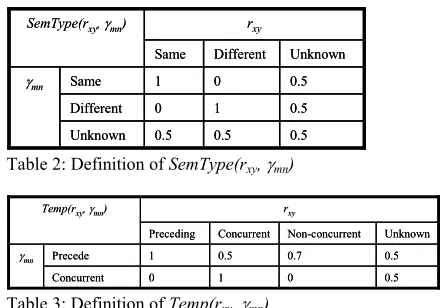
compatibility between an edge in the referring graph and an edge in the referent graph. It is defined in Table 2. This constraint indicates that the relation held between referring expressions should be compatible with the relation held between two correct referents. For example, consider the utterance How much is this green house and this blue house. This utterance indicates that the referent to the first expression this green house should share the same semantic type as the referent to the second expression this blue house. As shown in Table 2, if the semantic type relations of rxy and
γmn are the same, SemType(rxy, γmn) returns 1. If
they are different, SemType(rxy, γmn) returns zero. If
either rxyorγmn is unknown, then it returns 0.5.
Temp(rxy, γmn) captures the temporal
compatibility between an edge in the referring graph and an edge in the referent graph. It is defined in Table 3. This constraint indicates that the temporal relationship between two referring expressions (in one utterance) should be compatible with the relations of their corresponding referents as they are introduced into the context (e.g., through gesture). The temporal relation between referring expressions (i.e., γmn) is
either Precede or Concurrent. If the temporal relations of rxyandγmnare the same, then Temp(rxy,
γmn) returns 1. Because potential references could
come from prior conversation, even if rxy and γmn
are not the same, the function does not return zero when γmn is Precede.
Next, we discuss how these definitions and the process of graph matching address optimization, in particular, with respect to key principles of Optimality Theory for natural language interpretation.
3.3 Optimality Theory
Optimality Theory (OT) is a theory of language and grammar, developed by Alan Prince and Paul Smolensky (Prince and Smolensky, 1993). In Optimality Theory, a grammar consists of a set of well-formed constraints. These constraints are applied simultaneously to identify linguistic
structures. Optimality Theory does not restrict the content of the constraints (Eisner 1997). An innovation of Optimality Theory is the conception of these constraints as soft, which means violable and conflicting. The interpretation that arises for an utterance within a certain context maximizes the degree of constraint satisfaction and is consequently the best alternative (hence, optimal interpretation) among the set of possible interpretations.
The key principles or components of Optimality Theory can be summarized as the following three components (Blutner 1998): 1) Given a set of input, Generator creates a set of possible outputs for each input. 2) From the set of candidate output, Evaluator selects the optimal output for that input. 3) There is a strict dominance in term of the ranking of constraints. Constraints are absolute and the ranking of the constraints is strict in the sense that outputs that have at least one violation of a higher ranked constraint outrank outputs that have arbitrarily many violations of lower ranked constraints. Although Optimality Theory is a grammar-based framework for natural language processing, its key principles can be applied to other representations. At a surface level, our approach addresses these main principles.
First, in our approach, the matching matrix
P(ax,αm) captures the probabilities of all the
possible matches between a referring node αm and
a referent node ax. The matching process updates
these probabilities iteratively. This process corresponds to the Generator component in Optimality Theory.
Second, in our approach, the satisfaction or violation of constraints is implemented via return values of compatibility functions. These
0.5 0.5
0.5 Unknown
0.5 1
0 Different
0.5 0
1 Same
γmn
Unknown Different
Same
rxy
SemType(rxy, γmn)
0.5 0.5
0.5 Unknown
0.5 1
0 Different
0.5 0
1 Same
γmn
Unknown Different
Same
rxy
SemType(rxy, γmn)
Table 2: Definition of SemType(rxy,γmn)
0.5 0
1 0
Concurrent
0.5 0.7
0.5 1
Precede γmn
Unknown Non-concurrent
Concurrent Preceding
rxy
Temp(rxy, γmn)
0.5 0
1 0
Concurrent
0.5 0.7
0.5 1
Precede γmn
Unknown Non-concurrent
Concurrent Preceding
rxy
[image:6.612.314.536.76.230.2]Temp(rxy, γmn)
constraints can be violated during the matching process. For example, functions Id(ax,αm), SemType(ax,αm), and Attrk(ax,αm) return zero if the
corresponding intended constraints are violated. In this case, the overall similarity function will return zero. However, because of the iterative updating nature of the matching algorithm, the system will still find the most optimal match as a result of the matching process even some constraints are violated. Furthermore, A function that never returns zero such as Temp(ax,αm) in the node
similarity function implements a gradient constraint in Optimality Theory. Given these compatibility functions, the graph-matching algorithm provides an optimization process to find the best match between two graphs. This process corresponds to the Evaluator component of Optimality Theory.
Third, in our approach, different compatibility functions return different values to address the ConstraintRanking component in Optimality Theory. For example, as discussed earlier, once ax and αm
share the same identifier, Id(ax,αm) returns 100. If ax and αm share the same semantic type, SemType(ax,αm) returns 1. Here, we consider the
compatibility between identifiers is more important than the compatibility between semantic types. However, currently we have not yet addressed the strict dominance aspect of Optimality Theory.
3.4 Evaluation
[image:7.612.75.284.75.182.2]We conducted several user studies to evaluate the performance of this approach. Users could interact with our system using both speech and deictic gestures. Each subject was asked to complete five tasks. For example, one task was to find the cheapest house in the most populated town. Data from eleven subjects was collected and analyzed.
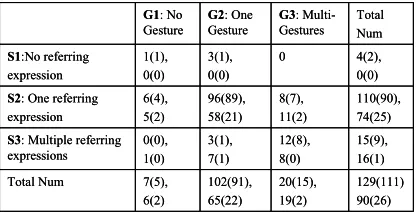
Table 4 shows the evaluation results of 219 inputs. These inputs were categorized in terms of the number of referring expressions in the speech input and the number of gestures in the gesture inputs. Out of the total 219 inputs, 137 inputs had their referents correctly interpreted. For the remaining 82 inputs in which the referents were not correctly identified, the problem did not come from the approach itself, but rather from other sources such as speech recognition and language understanding errors. These were two major error sources, which were accounted for 55% and 20% of total errors respectively (Chai et al. 2004b).
In our studies, the majority of user references were simple in that they involved only one referring expression and one gesture as in earlier findings (Kehler 2000). It is trivial for our approach to handle these simple inputs since the size of the graph is usually very small and there is only one node in the referring graph. However, we did find 23% complex inputs (the row S3 and the column G3 in Table 4), which involved multiple referring expressions from speech utterances and/or multiple gestures. Our optimization approach is particularly effective to interpret these complex inputs by simultaneously considering semantic, temporal, and contextual constraints.
4 Conclusion
As in natural language interpretation addressed by Optimality Theory, the idea of optimizing constraints is beneficial and there is evidence in favor of competition and constraint ranking in multimodal language interpretation. We developed a graph-based approach to address optimization for multimodal interpretation; in particular, interpreting multimodal references. Our approach simultaneously applies temporal, semantic, and contextual constraints together and achieves the best interpretation among all alternatives. Although currently the referent graph corresponds to gesture
129(111) 90(26) 20(15),
19(2) 102(91), 65(22) 7(5),
6(2) Total Num
15(9), 16(1) 12(8),
8(0) 3(1),
7(1) 0(0), 1(0)
S3: Multiple referring expressions
110(90), 74(25) 8(7),
11(2) 96(89), 58(21) 6(4),
5(2)
S2: One referring expression
4(2), 0(0) 0
3(1), 0(0) 1(1), 0(0)
S1:No referring expression
Total Num
G3: Multi-Gestures
G2: One Gesture
G1: No Gesture
129(111) 90(26) 20(15),
19(2) 102(91), 65(22) 7(5),
6(2) Total Num
15(9), 16(1) 12(8),
8(0) 3(1),
7(1) 0(0), 1(0)
S3: Multiple referring expressions
110(90), 74(25) 8(7),
11(2) 96(89), 58(21) 6(4),
5(2)
S2: One referring expression
4(2), 0(0) 0
3(1), 0(0) 1(1), 0(0)
S1:No referring expression
Total Num
G3: Multi-Gestures
G2: One Gesture
G1: No Gesture
input and conversation context, it can be easily extended to incorporate other modalities such as gaze inputs.
We have only taken an initial step to investigate optimization for multimodal language processing. Although preliminary studies have shown the effectiveness of the optimization approach based on graph matching, this approach also has its limitations. The graph-matching problem is a NP complete problem and it can become intractable once the size of the graph is increased. However, we have not experienced the delay of system responses during real-time user studies. This is because most user inputs were relatively concise (they contained no more than four referring expressions). This brevity limited the size of the graphs and thus provided an opportunity for such an approach to be effective. Our future work will address how to extend this approach to optimize the overall interpretation of user multimodal inputs.
Acknowledgements
This work was partially supported by grant IIS-0347548 from the National Science Foundation and grant IRGP-03-42111 from Michigan State University. The authors would like to thank John Hale and anonymous reviewers for their helpful comments and suggestions.
References
Bolt, R.A. 1980. Put that there: Voice and Gesture at the Graphics Interface. Computer Graphics, 14(3): 262-270. Blutner, R., 1998. Some Aspects of Optimality In Natural
Language Interpretation. Journal of Semantics, 17, 189-216. Cassell, J., Bickmore, T., Billinghurst, M., Campbell, L., Chang, K., Vilhjalmsson, H. and Yan, H. 1999. Embodi-ment in Conversational Interfaces: Rea. In Proceedings of the CHI'99 Conference, 520-527.
Chai, J., Prasov, Z, and Hong, P. 2004b. Performance Evalua-tion and Error Analysis for Multimodal Reference Resolu-tion in a ConversaResolu-tional System. Proceedings of HLT-NAACL 2004 (Companion Volumn).
Chai, J. Y., Hong, P., and Zhou, M. X. 2004a. A Probabilistic Approach to Reference Resolution in Multimodal User In-terfaces, Proceedings of 9th International Conference on Intelligent User Interfaces (IUI): 70-77.
Chai, J., Pan, S., Zhou, M., and Houck, K. 2002. Context-based Multimodal Interpretation in Conversational Systems.
Fourth International Conference on Multimodal Interfaces. Cohen, P., Johnston, M., McGee, D., Oviatt, S., Pittman, J.,
Smith, I., Chen, L., and Clow, J. 1996. Quickset: Multimo-dal Interaction for Distributed Applications. Proceedings of ACM Multimedia.
Eisner, Jason. 1997. Efficient Generation in Primitive Opti-mality Theory. Proceedings of ACL’97.
Gold, S. and Rangarajan, A. 1996. A Graduated Assignment Algorithm for Graph-matching. IEEE Trans. Pattern Analysis and Machine Intelligence, vol. 18, no. 4.
Gustafson, J., Bell, L., Beskow, J., Boye J., Carlson, R., Ed-lund, J., Granstrom, B., House D., and Wiren, M. 2000. AdApt – a Multimodal Conversational Dialogue System in an Apartment Domain. Proceedings of 6th International Conference on Spoken Language Processing (ICSLP). Johnston, M, Cohen, P., McGee, D., Oviatt, S., Pittman, J. and
Smith, I. 1997. Unification-based Multimodal Integration,
Proceedings of ACL’97.
Johnston, M. 1998. Unification-based Multimodal Parsing,
Proceedings of COLING-ACL’98.
Johnston, M. and Bangalore, S. 2000. Finite-state Multimodal Parsing and Understanding. Proceedings of COLING’00. Johnston, M., Bangalore, S., Visireddy G., Stent, A., Ehlen,
P., Walker, M., Whittaker, S., and Maloor, P. 2002. MATCH: An Architecture for Multimodal Dialog Systems,
Proceedings of ACL’02, Philadelphia, 376-383.
Kehler, A. 2000. Cognitive Status and Form of Reference in Multimodal Human-Computer Interaction, Proceedings of AAAI’01, 685-689.
Koons, D. B., Sparrell, C. J. and Thorisson, K. R. 1993. Inte-grating Simultaneous Input from Speech, Gaze, and Hand Gestures. In Intelligent Multimedia Interfaces, M. Maybury, Ed. MIT Press: Menlo Park, CA.
Neal, J. G., and Shapiro, S. C. 1991. Intelligent Multimedia Interface Technology. In Intelligent User Interfaces, J. Sul-livan & S. Tyler, Eds. ACM: New York.
Oviatt, S. L. 1996. Multimodal Interfaces for Dynamic Inter-active Maps. In Proceedings of Conference on Human Fac-tors in Computing Systems: CHI '96, 95-102.
Oviatt, S., DeAngeli, A., and Kuhn, K., 1997. Integration and Synchronization of Input Modes during Multimodal Hu-man-Computer Interaction, In Proceedings of Conference on Human Factors in Computing Systems: CHI '97. Oviatt, S., Coulston, R., Tomko, S., Xiao, B., Bunsford, R.
Wesson, M., and Carmichael, L. 2003. Toward a Theory of Organized Multimodal Integration Patterns during Human-Computer Interaction. In Proceedings of Fifth International Conference on Multimodal Interfaces, 44-51.
Prince, A. and Smolensky, P. 1993. Optimality Theory. Con-straint Interaction in Generative Grammar. ROA 537.
http://roa.rutgers.edu/view.php3?id=845.
Stent, A., J. Dowding, J. M. Gawron, E. O. Bratt, and R. Moore. 1999. The Commandtalk Spoken Dialog System.
Proceedings of ACL’99, 183–190.
Tsai, W.H. and Fu, K.S. 1979. Error-correcting Isomorphism of Attributed Relational Graphs for Pattern Analysis. IEEE Transactions on Systems, Man and Cybernetics., vol. 9. Wahlster, W., 1998. User and Discourse Models for
Multimo-dal Communication. Intelligent User Interfaces, M. Maybury and W. Wahlster (eds.), 359-370.