Munich Personal RePEc Archive
Is there a crowding-out effect in the
Moroccan context ? Evidence from
structural VAR Analysis
BOUNADER, Lahcen
Mohammed V-Agdal University, Economic Department, Rabat,
Morocco
18 January 2016
Online at
https://mpra.ub.uni-muenchen.de/69357/
Is there a crowding-out effect in the Moroccan context ?
Evidence from structural VAR Analysis
Abstract
This paper investigates the crowding out effect hypothesis in Morocco. Accordingly, the interest rate reacts to the change of the level of government spending. The Empirical results obtained from the impulse response analysis of the structural VAR model indicate the absence of such an effect. Spending in infrastructure, in communication and in welfare seem to build the basis of modern economy that will attract private investments, and the result will not be materialized in the immediat
short term.
1
Introduction
The present paper investigates the dynamic effects of shocks in government expen-diture on the behavior of long term interest rate in Morocco during the period 1990-2015. Our methodolgy is based on the structural VAR modeling that seemed appropriate to this study, taking into account the purpose of the research and the nature of the data.
The rationale behind this study is the fact that this type of study has not been done for the case of Morocco and any consensus was found about the crowding out effect. During the eighties, Morocco has experienced a structural adjustment program that was intended for debt restructuring, which has attained record levels following the surge in commodity prices on the international market.
The program mainly consisted of the privatization of companies held at the time by the government. As a result, we witnessed an artificial increase in government’s revenue which reduced public deficit. In addition, public debt had a shift towards internal debt instead of external debt. Which raises the question of the impact of the government interventions on macroeconomic aggregates, including the interest rate.
of Egypt that debt-financed deficits crowds out the private investment by reducing the available volume of credits to the economy. More older paper of Benjamin M. Friedman (1978) emphasized the effect of public spending by arguing that the di-rection of the effect depend on the relative substituabilities among the instruments for financing the deficit.
As the empirical litterature does not found any consensus about the effect of public spending on the private investment, one would not think that this task would be easy. In fact, the structural VAR modeling must include some fiscal variables that occur with annual frequency which is limiting in term of the number of obser-vation. Moreover, in order to test our basic assumption we do not have to include only the government spending in our model. Once the government spending and revenue are presumably not independent, to estimate the effect of one it is necessary to include the other. One more challenge is related to the step of identification of our SVAR. When we are dealing with annual data, the fiscal variables have time to react to the changes of the interest rate, which imply that we have to proceed to the estimation of elasticities of fiscal variables with respect to interest rate. Fi-nally, it should be noted that the fiscal variables are cyclical, that suggests some treatment before the modeling step. The method of dynamic factor model (DFM) was used to deal with such pattern. The real interest rate used in this study are those of 10 years bond yields, the real interest rate is calculated based on this nomi-nal rate minus a trend of inflation considered as a proxy for the anticipated inflation.
This paper proposes then to empirically examine the effect of government spend-ing on real interest rate. The rest of the paper is organized as follows, section two discusses the main theories concerned with the effect of government actions on the interest rate and the crowding out effect. Section 3 then proposes to conduct an empirical investigation to validate or reject our basic assumption. A final section concludes.
2
Theoretical background
The issue of government spending and its effects over the economy is largely de-bated. And there is no consensus yet about its impacts on the consumption, saving or capital formation decisions.
Most economists and policymakers are in line with the story of the conventional view, maybe it describes the real world well. According to this theory, we suppose that government indebtedness increases because of some reasons, say a high spending policy. This policy affect the economy through different mechanisms. In the short run, household’s current disposable income increases in response to this fiscal policy. Household’s spending on consumption goods will increase, and thus the aggregate demand. Following the Keynesian analysis, we can conclude that this mechanism will lead to higher national income. This analysis constitutes a justification for such a policy of increasing spending when the economy suffers from recession. In this context, higher demand will create an inflationary pressure that will modify expec-tations of inflation in the future. Such modification has an important consequences on the real rates of interest.
The analysis of the impact of government debt in the long run need to appeal some accounting identities :
Starting by the private budget constraint :
Y =C+S+T (1)
Where Y is the national revenue, C is the consumption, S is the saving and T refers to tax payments net from transfers.
This identity (1) tells us that the revenue is allowed, after payment of taxes, for consumption and saving. Another way to have the national income is by the demand side view :
Y =C+I+G+N X (2)
Where I is the capital formation, G is the government expenditure and NX is the exports net of imports.
Combining the two previous identities (1) and (2) yield to the following expres-sion :
S+ (T −G) = I+N X (3)
The term NXrepresents the current account balance, which must equal the negative of the capital account balance in order to have the balance of payment equilibrium. Then, we have the identity : N X = CAB where the CAB is the capital account balance.
By replacing this identity in (3) found previously, we obtain :
S+ (T −G) =I+CAB (4)
We suppose that government creates a deficit by cutting taxes (which imply higher debt to finance it) for some reasons. Then, the government savingT −Gwill
fall down. In this case, the identity may hold in several ways : (i) the private saving will increase by the same amount, (ii) domestic investment will fall, that causes a decline in output and an increase in the interest rates (iii) abroad investment will fall, that imply a deterioration of the trade deficit.
The case (i) will be discussed in detail later in this section. For the case (ii), it is a clear case of the crowding out effect1
. And the latter case (iii) is about the hypothesis of the “ twin deficit”, which is out the scope of this study.
Out of this framework, there exists other effects of government spending over the economy. Large spending may alter the monetary policy, in such an environment interest rates will be higher and monetary policy can act in an expansionary way to reduce this rates. This policy may be proof to be effective in the short run, but in the long run real rates return to the natural level, inflation and nominal rates will be higher. Moreover, with a large spending a country may finance their ongoing deficit by “monetizing debt”, in this case the inflation will not be a monetary phenomena as Milton Friedman stated but it will be a fiscal one.
From the previous discussion, the conventional view of government spending and its impacts on the economy highlight some evidence on the relationship that can ex-ist between public intervention and interest rates.
In contrast, Ricardian Equivalence2
asserts that the choice between financing deficit by issuing debt or by collecting taxes is irrelevant. The policy of indebt-edness to finance tax cut will not alter consumption, capital formation or growth. This analysis is based on the simple argument that lower taxes today will generate higher taxes tomorrow, thus cutting taxes and financing deficit by debt represents some form of postponement of taxes and not a reduction on it. If agents are forward looking, this policy will not affect their consumption decisions but it will have an impact on their saving decisions because they will look ahead to the future taxes implied by government debt. Two fundamental ideas are behind this theory ; the first idea is the government budget constraint. Lowering tax today must lead to higher taxes in the future in order to respect the inter temporal budget constraint. The second idea is the permanent income hypothesis. That is to say that household bases their consumption decisions on the permanent income.
This neutrality proposition “Ricardian Equivalence” deny all sort of impact that can be produced by government indebtedness. Even if this theory may be proved wrong, it provides an important benchmark.
1
See Spencer, R. W., & Yohe, W. P. (1970). The” crowding out” of private expenditures by fiscal policy actions. Federal Reserve Bank of St. Louis Review, (October 1970).
2
3
Empirical investigation
[image:6.595.171.428.265.460.2]The data used in this empirical analysis are the government’s spending and revenue and the real interest rate of 10 years bonds. The data for fiscal variables are cor-rected for the inflation by deflating them with a GDP deflator. Moreover, as this data are cyclical we use a dynamic factor model (DFM) to correct for cyclical factors and the model used for this purpose is explained in the first appendix. For the real interest rate, we calculate it as the nominal rate minus a trend of inflation taken as a proxy for the expected inflation. The data are expressed in annual frequency and it covers the period 1990-2015.3
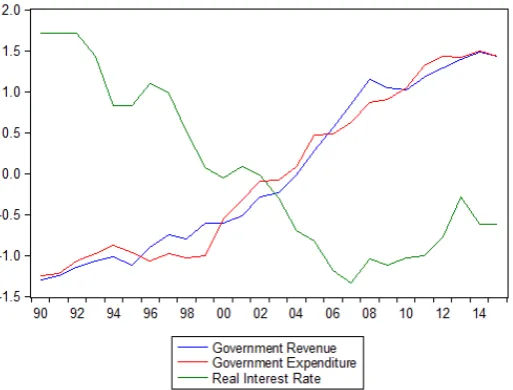
Figure 1: Fiscal variables and real interest rate trajectories (Normalized data) Source : IMF, Ministery of Finance
The review of the evolution of fiscal variables and real interest rate reveals two distinct phases. The first phase covers the period 1990-2004, it is characterized by a downward trend for the interest rate and slowing upward trend for government spending and revenue. Several reasons explain those patterns. Firstly, the down-ward trend of interest rate is related to the development of the market bonds. As markets develop, the interest rate is declining to be in line with the monetary policy stance. Secondly, fiscal variables are growing slowly since the moroccan government had experienced an adjustment program and it must keep the budget deficit at a low level with respect to international obligations. The second phase is that of 2004-2015 which shows that both government spending and revenues are increasing while the level of the interest rate is much more moderated and slowly increasing.
3
Government revenue reacts to the faster growth known in this period, and the pub-lic expenditure was oriented into financing lot of sectoral programs and some social allocations in response to the Global Financial Crisis of 2008. The deterioration in terms of trade, the decline in external demand addressed to Morocco and soaring energy prices were all factors weighing heavy on public finances and therefore have led to an increase in public spending.
According to the figure 1, we cannot distinguish any relationship between govern-ment spending and real interest rate. In order to test the existence of such a rela-tionship, more techniques are needed. This is what will be shown in the next two subsections.
3.1
The VAR
As a notation, we takert for the real interest rate,st for government spending and
Tt for government revenue.
We construct the vector yt defined by : yt= [Ttst rt]′ and our basic VAR will be :
yt=β0+β1yt−1+...+βt−pyt−p+et
With : et= [eTt est ert]′ is the vector of error forecasts.
We define a vector of structural shocksut= [uTt ust urt]′ and the identification
prob-lem will consist of specifying a linear relationship betweenut and et.
We aknowledge that we are using annual data4
. They are expressed in real term and cyclically adjusted by dynamic factor model (DFM)5
.
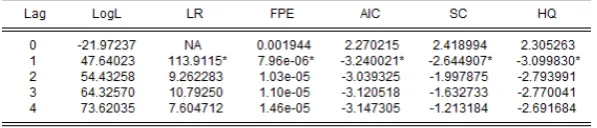
By examining the lag length of the VAR, we find thatp= 1, and all the propreties are validated for the specification proposed6
.
3.2
Identification
We follow the methodology of Blanchard and Perotti 7
for the identification of our structural shocksut,since the errors et does not have any economic interpretation.
We have to set three equtions that link the structural shocks with the error forecasts.
eTt =a1ert +a2ust+uTt (5)
est =b1ert +b2uTt +ust (6)
ert =c1eTt +c2est+urt (7)
The first equation states that unexpected movements in government revenue are due to unexpected movement in interest rate, structural shock in government
4
Fiscal variables for the case of Morocco exist only in an annual frequency.
5
Presentation of the DFM is shown in the appendix 1.
6
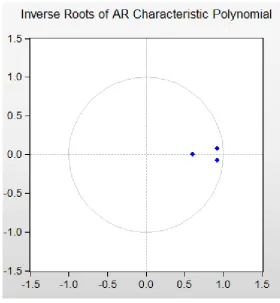
Appendix 2 presents the results for the validation tests of our model.
7
spending and structural shock to government revenue. The second equation can be inerpreted in the same way. And the third equation allows unexpected movements in real interest rates in respect with movements in government revenue and expen-diture as well as a structural shock of the interest rate.
Now we turn to estimate our coefficients a1, b1, c1 and c2 in order to identify
our structural VAR. Moreover,a1 is interpreted as the semi-elasticity of government
revenue to real interest rate, b1 is the semi-elasticity of public spending to rela
in-terest rate. c1 and c2 will be estimated by a simple regression of etr on eTt and est.
As fiscal variables exclude debt and property income, and according to Perotti (2004) and Parkyn and Vehbi (2013) we set : a1 = 0 andb1 = 0. For the estimation
of c1 and c2 we find that 8
: c1 =−0.38 and c2 = 0.06
Fianlly, our indentification is presented as follows :
1 0 0
0 1 0
−c1 −c2 1 eT t es t er t =
1 a2 0
b2 1 0
0 0 1
uT t us t ur t
3.3
Impulse Response Analysis
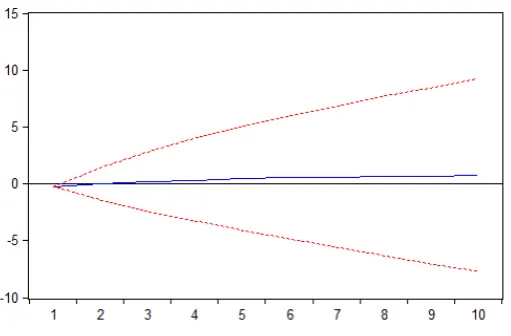
[image:8.595.166.422.480.648.2]The results from the impulse response functions are plotted in the figure below. It shows the reaction of real interest rate to a structural shock on the government expenditure.
Figure 2: Impact of structural shock of government spending on real interest rate
Figure 2 shows the response of the long real interest rate (maturity of 10 years) to a structural shock of govrnment spending. Overall, the figure illustrates the real
8
interest rate constancy facing such a shock. The conclusion that arises is the absence of the crowding out effect.
[image:9.595.168.425.194.365.2]On the revenue side of government, the impact of structural shock of government revenue on real interest rate is shown in Figure 3.
Figure 3: Impact of structural shock of government revenue on real interest rate
As figure 3 shows, the impact of structural shock of government revenue on real interest rate is not significant. In both cases, the real interest rate seems not reacting to an increase in government spending which suggests that the Moroccan economy does not experience the crowding out phenomena.
Public spending in Morocco covers mainly critical infrastructures in order to build a modern economy. These spending includes investments in transportation networks, communications and sectoral programs. Which constitutes a necessary precondition for deployment of private investment. In contrast, in developed coun-tries, public investment becomes a competitor to private investment; it creates pres-sure on liquidity and imply then higher interest rates that discourage private invest-ment.
In Morocco, the weight of public administration in the effort of national invest-ment accounted for 11 percent in the old System of National Accounts. The overhaul of the system has raised the share of public investment to 15 percent due to the in-tegration of military equipment following the international recommendations. This share may seem modest, particularly, relative to government announcements at an-nual budget of the State. Note that this is due to two factors; the first is that the data of the annual budget class in terms of investment expenses that are not considered as such by the System of National Accounts. The second reason is that the public sector according to the System of National Accounts does not include all the public entrerises.
From another perspective, we see that before the crisis, in 2004-2008, the growth of public investment was higher than private investment and when public expendi-ture on capital goods was accelerating, private investment seems to react. Similarly, after the crisis, at first public investment tried to play a countercyclical role, it grows from 9 percent to 15 percent, responding to a total collapse of private investment, which declined from 16 percent to -1.2 percent. Then, in a second step, and follow-ing the deterioration of budget deficits, public investment has collapsed too.
Taking into account all this considerations, the results found from the structural VAR seems very well explained and the crowding out effect is far from being a preoccupation in the Moroccan context.
4
Conclusion
The present paper has studied the impact of an increase in public spending on real interest rate, in order to state about the crowding-out effect hypothesis. The analy-sis was performed through a SVAR model and it leads to reject our basic hypotheanaly-sis .
Bibliography
Atukeren, E. (2005). Interactions between public and private investment: Evidence from developing countries. Kyklos, 58(3), 307-330.
Barro, R. J. (1988). The Ricardian approach to budget deficits (No. w2685). National Bureau of Economic Research.
Barro, R., and Barro, R. (1989). The neoclassical approach to fiscal policy. Modern business cycle theory.
Blanchard, O., and Perotti, R. (1999). An empirical characterization of the dy-namic effects of changes in government spending and taxes on output (No. w7269). National bureau of economic research.
Easterly, W., and Schmidt-Hebbel, K. (1993). Fiscal deficits and macroeconomic performance in developing countries. The World Bank Research Observer, 8(2), 211-237.
Edo, S. E. (2002). The External Debt Problem in Africa: A Comparative Study of Nigeria and Morocco. African Development Review, 14(2), 221-236.
Elmendorf, D. W., and Mankiw, N. G. (1999). Government debt. Handbook of macroeconomics, 1, 1615-1669.
Engen, E. M., and Hubbard, R. G. (2005). Federal government debt and interest rates. In NBER Macroeconomics Annual 2004, Volume 19 (pp. 83-160). MIT Press.
Friedman, B.M. (1978). Crowding out or crowding in ? the economic conse-quences of financing government deficits.
Laubach, T. (2009). New evidence on the interest rate effects of budget deficits and debt. Journal of the European Economic Association, 7(4), 858-885.
Parkyn, O., and Vehbi,T. (2014). The effects of fiscl policy in New Zeland : Evi-dence from a VAR model with debt constraints. Economic Record, 90(290), 345-364.
Perotti, R. (2005). Estimating the effects of fiscal policy in OECD countries.
Sims, C. A. (1994). A simple model for study of the determination of the price level and the interaction of monetary and fiscal policy. Economic theory, 4(3), 381-399.
Appendices
Appendix 1 : Dynamic Facotr Model `
a la Stock, Watson
(1991)
The model consists of two blocks of equations : Measurement equations and Tran-sition equations.
We include the GDP because this variable is the best related to cyclical fluctu-ations. And St will be our latent variable that is driving the cycle.
Measurement Equations
log(GDPt) = c1St+ǫGDP,t
Tt=c2St+ǫT,t
st=c3St+ǫs,t
Transition Equations
St=ρSSt−1+ηS,t
ǫi,t =φiǫi,t−1+ηi,t
With i=log(GDPt), Tt, st
[image:12.595.149.448.583.647.2]Appendix 2 : Validation of the VAR
Figure 5: Residuals autocorrelation