Munich Personal RePEc Archive
Estimating Egypt’s Potential Output: A
Production Function Approach
El-Baz, Osama
Economist, [email protected]
20 May 2016
Online at https://mpra.ub.uni-muenchen.de/71652/
Estimating Egypt
’s Potential Output:
A Production Function Approach
Osama El-Baz
Abstract
The Egyptian economy has witnessed deterioration in its main macroeconomic indicators over the period (2008-2014). The main purpose of the paper was to estimate Egypt's potential output and identify the factors that might be responsible for the divergence of actual and potential output from each other. We used the production function approach to derive estimates of potential output and output gap over the period (1990-2014). The results of the analysis revealed that capital stock was the dominant factor contributing to GDP growth in Egypt, while the share of both labor and total factor productivity in GDP growth rate has been fluctuating over time. Intellectual property protection, efficiency of legal framework in settling disputes, strength of investor protection, and other factors exhibited a strong positive relationship with output gap in Egypt over the period (2010-2014).
1.
Introduction
Potential output is defined as the level of output or productive capacity
that an economy can reach without triggering either upside or downside
pressures on inflation under full employment. The output gap is an
important concept which refers to as the difference between the actual
and potential output in percent of potential output (Blagrave et al. 2015).
When the output gap is zero, it means that there is no either upward or
downward pressure on inflation, as actual demand coincides with
positive, it means that actual output level "demand" exceeds the potential
level and this would build upside inflation pressures.
Output gap and potential output estimates are important for policymakers
and Economists as it shades light on the economic performance of the
country; as it indicates the relative deviation of actual output from its
potential level and the availability of spare capacity in the economy.
Also, it is an indicator regarding the success of government economic
policies in stimulating economic activity and adopting a business friendly
environment.
This paper consists of seven sections as follows: First: Introduction.
Second: The Egyptian Economy: Challenges and Stylized Facts. Third:
Empirical Methodologies to Estimate Potential Output. Fourth:
Econometric Analysis: The Production Function Approach. Fifth:
Contributions to Potential GDP Growth Rates in Egypt. Sixth: Factors
Affecting Egypt's Output Gap. Seventh: Conclusion and policy
implications.
2.
The Egyptian Economy: Challenges and Stylized
Facts
The Egyptian economy has witnessed deterioration in its main
macroeconomic indicators over the period (2008-2014). Real GDP
growth rates over this period recorded an average of about 3.6 percent,
while growth rates exhibited a significant fall starting from 2011 as the
average real GDP growth rate during (2008-2010) was around 5.7 percent
(Figure 1), also real GDP per capita declined after 2011(Figure 2). Both
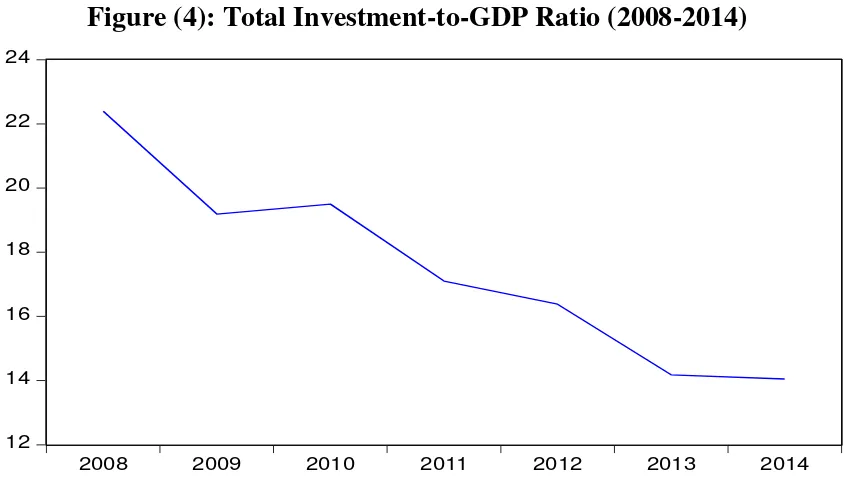
after 2011 and recoded around 13.2 percent and 14 percent in 2014,
respectively (Figures 3 & 4). In tandem with a significant increase in
structural budget deficit-to- potential GDP ratio, which increased from
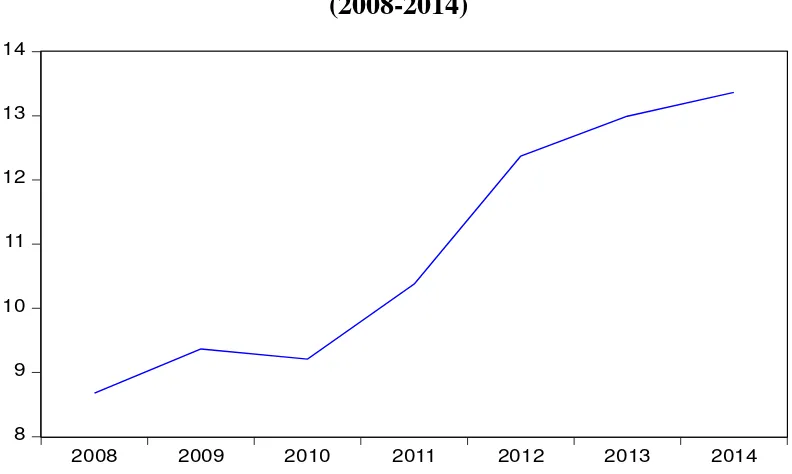
8.3 percent in 2010 to 13 percent in 2014 (Figure 5). Unemployment rate
has also increased from 8.3 percent in 2010 to 13 percent in 2014. To sum
up, the Egyptian economy suffers problems in its macroeconomic
fundamentals and structural reforms needs to be undertaken to put the
economy on a sustainable growth path.
Figure (1): Real GDP Growth Rates (2008-2014)
Source: International Monetary Fund. World Economic Outlook.
Figure (2): Real GDP Per Capita (1000 LE) (2008-2014)
Source: International Monetary Fund. World Economic Outlook.
1 2 3 4 5 6 7 8
2008 2009 2010 2011 2012 2013 2014
18.2 18.4 18.6 18.8 19.0 19.2 19.4
[image:4.595.103.494.278.485.2] [image:4.595.99.500.534.744.2]Figure (3): National Saving-to- GDP Ratio (2008-2014)
Source: International Monetary Fund. World Economic Outlook.
Figure (4): Total Investment-to-GDP Ratio (2008-2014)
Source: International Monetary Fund. World Economic Outlook.
10 12 14 16 18 20 22 24
2008 2009 2010 2011 2012 2013 2014
12 14 16 18 20 22 24
[image:5.595.92.510.106.357.2] [image:5.595.89.516.424.665.2]Figure (5): Structural Government Budget Balance-to-potential GDP Ratio (2008-2014)
Source: International Monetary Fund. World Economic Outlook.
Figure (6): Unemployment Rate in the Egyptian Economy
(2008-2014)
Source: International Monetary Fund. World Economic Outlook.
-14 -13 -12 -11 -10 -9 -8 -7 -6
2008 2009 2010 2011 2012 2013 2014
8 9 10 11 12 13 14
[image:6.595.92.499.116.336.2] [image:6.595.100.496.437.674.2]3.
Empirical Methodologies to Estimate Potential
Output
All commonly used methodologies to estimate the potential output
involve filtering of the macroeconomic time series to extract the
unobservable underlying potential output level from cyclical variations in
the output series. There are three main methodologies which are
commonly used to estimate potential output, which are singlevariate,
multivariate, and hybrid methods.
Singlevariate Statistical Methods:
Hodrick Prescott (HP) filter has become the most commonly used
statistical method to estimate potential output due to its flexibility in
tracking the fluctuations of trend output and decomposing the aggregate
output into both trend and cyclical components. The HP filter estimates
potential output by minimizing the sum, over the sample period, of
squared distances between actual and potential output at each point in
time, subject to a restriction on the variation of potential output. The
restriction parameter λ captures the importance of cyclical shocks to
output relative to trend output shocks, and thereby controls the
smoothness of the series of potential output; a smaller value of λ indicates a smaller weight of cyclical shocks and leads to a more volatile series of
potential output.
The singlevariate (SV) methods provide an easy tool to estimate potential
output. However, these methods are purely statistical techniques, which
filter the actual GDP data to extract the trend component as its estimate of
potential output. The most common SV filter is the Hodrick-Prescott
series (output). However, the HP filter does not take into consideration
the information available from other economic indicators such as
inflation or labor market indicators, to guide its estimate of potential
output.
Hybrid Methods:
The Production Function (PF) approach is better than a SV filter
because it allows for more detailed examination of the drivers of potential
output. A downside of this approach is that it assumes capital is always at
its potential. The hybrid approach also suffers from the end of-sample
problems. This approach takes into consideration the contribution of
labor, capital, and total factor productivity to potential output. This
approach will be used in this paper to estimate Egypt's potential output.
Multivariate Methods:
Multivariate (MV) filtering methodologies are used in the literature to
estimate potential output. Some examples are models of Laxton and
Tetlow (1992), Kuttner (1994), Benes and others (2010), Fleischman and
Roberts (2011), and Blagrave and others (2015). MV filtering involves
separating potential output from cyclical fluctuations, through the use of
data and relationships between output and other macroeconomic
variables, such as inflation, labor market indicators, capital formation
indicators, etc. This approach adds economic structure to estimates by
conditioning them on some basic theoretical relationships, such as the
Phillip’s curve equation which expresses the relationship between inflation and output gap. MV filtering methodologies are more
complicated than SV filtering methodologies and require more data, but
are at the same time more reliable because they use more information
The MV filtering approach needs a long time series data. However it
provides the advantage of imposing well-known empirical relationships.
4.
Econometric Analysis
The Production Function Approach
Methodology:
Following a standard application in the literature (Konuki. 2008) and
(Epstein and Macchiarelli. 2010).the Egyptian economy is assumed to be
characterized by a Cobb-Douglas production function with constant
returns to scale (CRS) (α+β =1).
Y
t= A
tL
tαK
t β(1)
where Y t is output and Lt, Kt and
A
t are labor and capital, and totalfactor productivity (TFP), respectively; and the output elasticities sum up
to one under the assumption of constant returns to scale (CRS).
The Terms on the right hand side of equation (1) are defined as follows: The labor input: it is defined as the number of people employed
in the economy.
The capital stock: this series is constructed from total investment assuming perpetual inventories, hence:
K
t= K
t-1(1-µ)+ I
t(2)
capital stock in each period is estimated using the previous-period
stock (net of depreciation) augmented with new investment flows.
Consistent with previous studies, the depreciation rate (
µ)
rangesstock an initial value is needed for a reference year, which could be
estimated by the following formula:
K
t= K
t/ (µ + i) (3)
Where (i) is the average growth rate of investment over the sample
period included in the analysis.
The total factor productivity term is obtained from equation (1) as a Solow residual as expressed by equations (4) and (5).
A
t= Y
t/ (L
tαK
tβ), where:
α= 1
-
β
(4)
Ln At= Ln Yt – (
1-
β
) Ln L
t–
β Ln K
t(5)
Output elasticities to inputs of labor and capital are needed to estimate total factor productivity (TFP), we will estimate them
using the following OLS regression models:
Ln Yt= Ln At +
(1-
β
) Ln L
t+
β Ln K
t (6)(LnYt – Ln Lt)= Ln At
+β (Ln K
t -Ln L
t) (7)Equation (7) could be estimated by an OLS regression model to
estimate
β
andα
, where(α= 1
-
β
). Potential Values of K, A, and L: potential values of capital, labor, and total factor productivity are needed in order to estimate
potential output using the following equation:
Y
* t= A
*t
L
*tα
K
t β(8)
As for the potential utilization of the capital stock, a capacity
utilization series is not available. In this regard, and consistent with
capital. Such a simplification mostly relies on the assumption that,
given the perpetual inventories rule, the capital stock can be
regarded as an indicator for the overall capacity of the economy.
Potential values of both total factor productivity and labor could be
estimated by Hodrick Prescott (HP) filter to derive their trend
components from their actual values.
Data and Variables:
o Real GDP (Real Output): real gross domestic product was
estimated using data for gross domestic product at market prices
deflated by the GDP deflator.
o Employed People (Labor): employed people in millions.
o Real Investment: total investment was deflated by the GDP
deflator.
All data used are from the IMF World Economic Outlook database and
covering the period (1990-2014).
Model Estimation:
o The elasticities of output to labor and capital inputs could be
estimated using the following regression model:
(LnYt
–
Ln Lt)= Ln At
+β (Ln K
t–
Ln L
t) (1)
Both the dependent and the explanatory variables were tested
for stationarity using Augmented Dickey Fuller (ADF) unit root
test, they were found to be integrated of order one (Table 1).
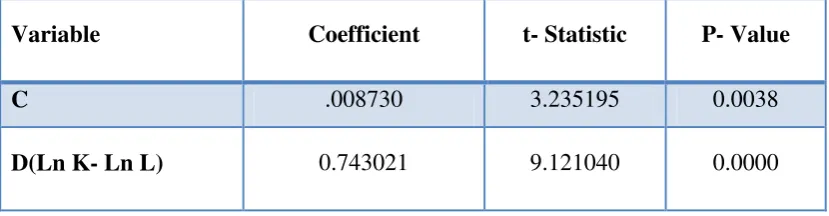
The output of the regression model is summarized by (Table 2),
and diagnostic tests were used and it was found that the model
does not suffer any serial correlation, hetroscedsaticity, and
diagnostic tests are in the appendix. The elasticities of output to
capital and labor inputs were found to equal 0.74 and 0.26,
respectively.
Table (1): ADF Unit Root Test for Variables of Equation (1)
Variable t-Statistic P- Value Order of Integration
(LnY – Ln L) -4.241 .0174 I(1)
(Ln K- Ln L) -3.60 .0569 I(1)
Source: Researcher's calculations
Table (2): Elasticity of Output to Capital and Labor Inputs
Variable Coefficient t- Statistic P- Value
C .008730 3.235195 0.0038
D(Ln K- Ln L) 0.743021 9.121040 0.0000
Source: Researcher's calculations
Table (3): Results of Diagnostic Tests
Variable Test Statistic P- Value
Jarque Bera Test of Normality 0.2715 0.8730
Breusch-Godfrey Serial
Correlation LM Test 2.167666 0.1406
Heteroskedasticity Test:
Breusch-Pagan-Godfrey 3.143538 0.0901
[image:12.595.89.510.205.319.2] [image:12.595.91.506.408.516.2] [image:12.595.91.508.579.753.2]o Capital Stock was estimated according to equations (2 &3)
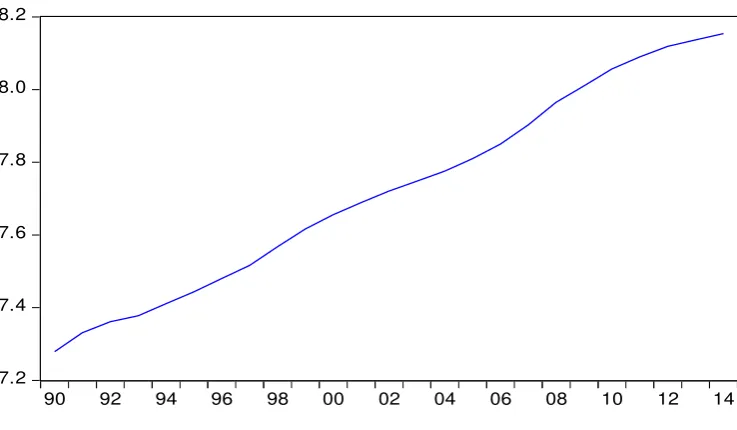
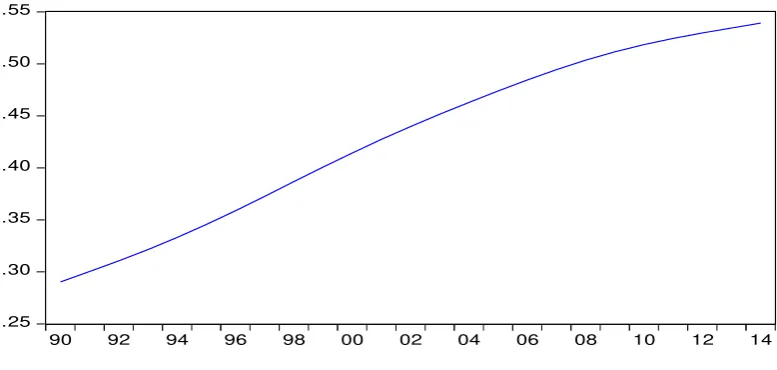
(Figure 7), and total factor productivity was calculated as a solow residual using the following equation (Figure 8):
Ln A
t= Ln Y
t–
(1-
β
) Ln L
t–
β Ln K
t(2)
Figure (7): The Natural Logarithm of Estimated Capital Stock
(1990-2014)
Source: Researcher's calculations
Figure (8): The Natural Logarithm of Estimated Total Factor
Productivity (1990-2014)
Source: Researcher's calculations
7.2 7.4 7.6 7.8 8.0 8.2
90 92 94 96 98 00 02 04 06 08 10 12 14
.25 .30 .35 .40 .45 .50 .55
[image:13.595.113.482.247.462.2] [image:13.595.117.478.550.751.2]o In order to estimate potential output level (Y*), the potential
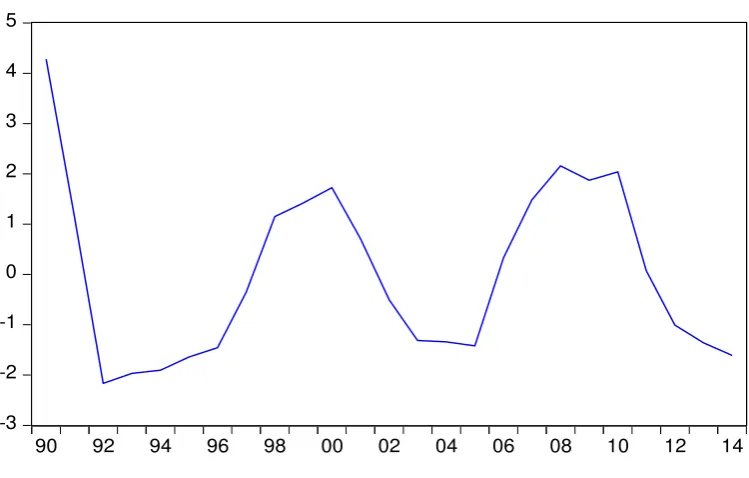
levels of both labor employed (L*) and total factor productivity (A*) were derived as the Hodrick Prescott filtered series of the aggregate series of actual labor and TFP (Figures 9&10). Potential output was estimated using the production function approach (Y*) and was compared to potential output level estimated by the HP filter (YHP*) (Figure 11). Output gap was also estimated, it is important to mention that the Egyptian economy exhibited negative output gaps starting from 2012 (Figure 12).
Figure (9): The Natural Logarithm of Potential Employment
(1990-2014)
Source: Researcher's calculations
Figure (10): The Natural Logarithm of Potential Total Factor Productivity (1990-2014)
Source: Researcher's calculations
2.6 2.7 2.8 2.9 3.0 3.1 3.2 3.3
90 92 94 96 98 00 02 04 06 08 10 12 14
.25 .30 .35 .40 .45 .50 .55
[image:14.595.106.490.319.501.2] [image:14.595.103.492.554.739.2]Figure (11): Potential Output Estimates for the Egyptian Economy (1990-2014)
Source: Researcher's calculations
Figure (12): Output Gap Estimates for the Egyptian Economy
(1990-2014)
Source: Researcher's calculations
6.2 6.4 6.6 6.8 7.0 7.2 7.4 7.6
90 92 94 96 98 00 02 04 06 08 10 12 14
Y* YHP*
-3 -2 -1 0 1 2 3 4 5
[image:15.595.98.500.118.369.2] [image:15.595.111.486.488.727.2]5.
Contributions to Potential GDP Growth Rates in
Egypt
The production function framework enables us to estimate the
contribution of each factor of production to potential GDP growth.
Changes in these contributions can be assessed as a signal for structural
changes in the economy. The contributions of labor and capital inputs to
potential GDP growth rate were estimated, accounting for their respective
shares in output. Contributions are computed as year-on-year percentage
changes (Epstein and Macchiarelli, 2010). Labor, capital and TFP
contributions sum up to potential GDP growth rates, as according to
equation (1) it is accepted that the sum of percentage changes in labor,
capital , and total factor productivity equals the percentage change in
output "GDP Growth".
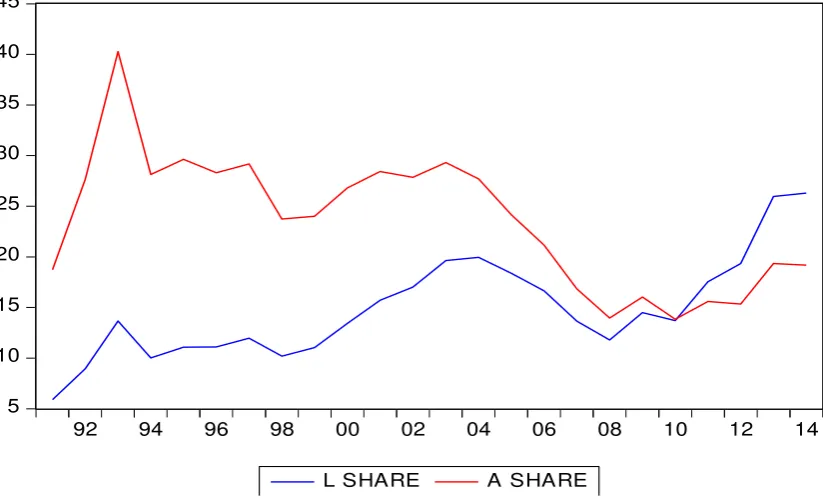
The contributions of Labor, capital and TFP to potential GDP growth
rates were estimated (Figure 13). It could be easily visualized that capital
stock was the dominant factor contributing to GDP growth in Egypt over
the period (1991-2014), while the share of both labor and total factor
productivity in GDP growth rate has been fluctuating over time. As for
labor and TFP, it is noticed that the relative importance of both of them in
GDP potential growth rate has changed over the period (1991-2014); the
contribution of TFP to potential GDP growth rate over the period
(1991-2010) has been outweighing that of labor, while starting from 2011 the
contribution of labor to potential GDP growth rate exceeded that of TFP
(Figure 14). The average share of labor and TFP in potential GDP growth
rate over the period (2011-2014) recorded 22.3% and 17.4%,
Figure (13): Contributions to Potential GDP Growth Rates in Egypt (1991-2014)
Source: Researcher's calculation
Figure (14): The Relative Share of Labor and TFP's Contributions to Potential GDP Growth Rates in Egypt (1991-2014)
Source: Researcher's calculations
0 1 2 3 4 5 6 7
92 94 96 98 00 02 04 06 08 10 12 14
L Share K Share A Share
5 10 15 20 25 30 35 40 45
92 94 96 98 00 02 04 06 08 10 12 14
[image:17.595.92.507.120.366.2] [image:17.595.94.506.474.723.2]6.
Factors Affecting Egypt's Output Gap
In order to identify the economic factors that might affect output gap in
the Egyptian economy, we will depend on selected sub indices which
falls under the umbrella of the Global Competitiveness Index, and Egypt's
rankings in them were used to identify their relationship with output gap.
The indices used were intellectual property protection, efficiency of legal
framework in settling disputes, strength of investor protection, quality of
overall infrastructure, government budget balance-to-GDP ratio, quality
of the education system, intensity of local competition, pay and
productivity in labor market, availability of financial services and
capacity for innovation.
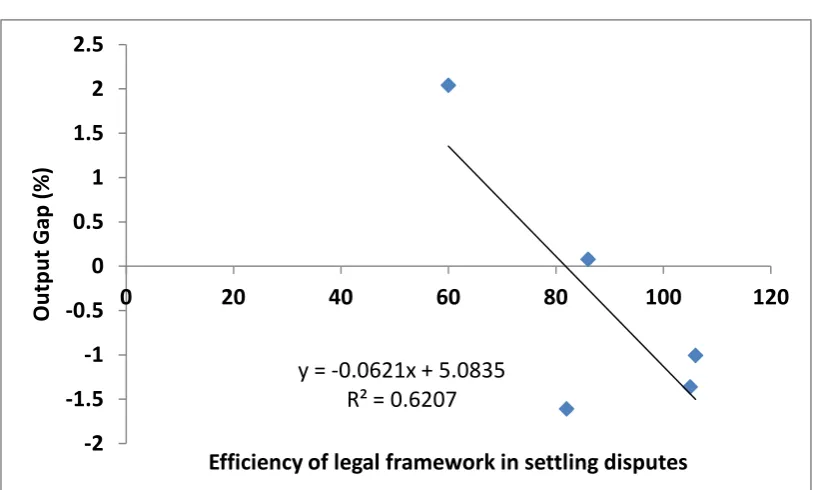
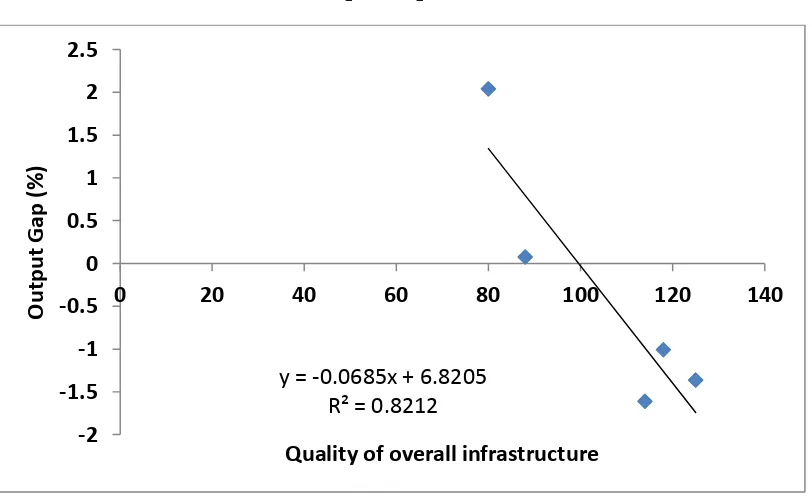
Data used for these indices are covering the period (2010-2014), and
output gap estimates for the same period were derived from the
production function analysis conducted in section four. It could be
visualized that the rankings of Egypt in all the variables mentioned
earlier are inversely related to output gap; which means that better
rankings of the Egyptian economy in these sub indices implies the
convergence of actual output to potential output or exceeding it with the
Figure (15): Relationship between Intellectual Property Protection and Output
Gap (2010-2014)
Source: Researchers' Calculations.
Figure (16): Relationship between Efficiency of Legal Framework in Settling Disputes and Output Gap (2010-2014)
Source: Researchers' Calculations.
y = -0.0941x + 8.5658 R² = 0.7567 -2
-1.5 -1 -0.5 0 0.5 1 1.5 2 2.5
0 20 40 60 80 100 120
O
u
tp
u
t
Gap
(%)
Intellectual property protection
y = -0.0621x + 5.0835 R² = 0.6207
-2 -1.5 -1 -0.5 0 0.5 1 1.5 2 2.5
0 20 40 60 80 100 120
O
u
tp
u
t
Gap
(%)
[image:19.595.92.500.123.337.2] [image:19.595.91.501.432.677.2]Figure (17): Relationship between Strength of Investor Protection and Output Gap (2010-2014)
Source: Researchers' Calculations.
Figure (18): Relationship between Quality of Overall Infrastructure
and Output Gap (2010-2014)
Source: Researchers' Calculations.
y = -0.0445x + 3.5848 R² = 0.5773
-2 -1.5 -1 -0.5 0 0.5 1 1.5 2 2.5
0 20 40 60 80 100 120 140
O
u
tp
u
t
Gap
(%)
Strength of investor protection
y = -0.0685x + 6.8205 R² = 0.8212
-2 -1.5 -1 -0.5 0 0.5 1 1.5 2 2.5
0 20 40 60 80 100 120 140
O
u
tp
u
t
Gap
(%)
[image:20.595.93.501.108.359.2] [image:20.595.94.500.457.705.2]Figure (19): Relationship between Government budget balance/GDP (%)
and Output Gap (2010-2014)
Source: Researchers' Calculations.
Figure (20): Relationship between Quality of the Education System
and Output Gap (2010-2014)
Source: Researchers' Calculations.
y = -0.211x + 29.204 R² = 0.5418
-2 -1.5 -1 -0.5 0 0.5 1 1.5 2 2.5
130 132 134 136 138 140 142 144 146 148
O
u
tp
u
t
Gap
(%)
Government budget balance/GDP (%)
y = -0.2924x + 40.502 R² = 0.5051 -2.5
-2 -1.5 -1 -0.5 0 0.5 1 1.5 2 2.5
134 136 138 140 142 144 146
O
u
tp
u
t
Gap
(%)
[image:21.595.93.497.115.370.2] [image:21.595.90.503.470.706.2]Figure (21): Relationship between Intensity of Local Competition
and Output Gap (2010-2014)
Source: Researchers' Calculations.
Figure (22): Relationship between Pay and Productivity
and Output Gap (2010-2014)
Source: Researchers' Calculations.
y = -0.1785x + 22.014 R² = 0.8745 -2
-1.5 -1 -0.5 0 0.5 1 1.5 2 2.5
110 115 120 125 130 135
O
u
tp
u
t
Gap
(%)
Intensity of local competition
y = -0.0949x + 10.937 R² = 0.9214
-2 -1.5 -1 -0.5 0 0.5 1 1.5 2 2.5
0 20 40 60 80 100 120 140
O
u
tp
u
t
Gap
(%)
[image:22.595.95.503.134.376.2] [image:22.595.97.500.459.722.2]Figure (23): Relationship between Availability of Financial Services
and Output Gap (2010-2014)
Source: Researchers' Calculations.
Figure (24): Relationship between Capacity for Innovation
and Output Gap (2010-2014)
Source: Researchers' Calculations.
y = -0.06x + 6.0735 R² = 0.8614
-2 -1.5 -1 -0.5 0 0.5 1 1.5 2 2.5
0 20 40 60 80 100 120 140
O
u
tp
u
t
Gap
(%)
Availability of financial services
y = -0.0494x + 4.9583 R² = 0.7165
-2 -1.5 -1 -0.5 0 0.5 1 1.5 2 2.5
0 20 40 60 80 100 120 140
O
u
tp
u
t
Gap
(%)
[image:23.595.92.503.136.387.2] [image:23.595.90.504.474.707.2]According to the global competitiveness report (2015/2016), the factors
adversely affecting doing business in Egypt include policy instability,
inefficient government bureaucracy, poor work ethics in labor force,
inadequately educated work force, access to finance, inadequate supply of
infrastructure, foreign currency regulations, government instability,
inflation, and other factors (Figure 25).
Figure (25): Factors Negatively Affecting Doing Business in Egypt
Source: World Economic Forum. "Global Competitiveness Report: (2015-2016)".
7.
Conclusion
The Egyptian economy has witnessed deterioration in its main
macroeconomic indicators over the period (2008-2014), including real
GDP growth rate, GDP per capita, saving-to-GDP ratio,
investment-to-GDP ratio, unemployment rate and structural government budget
balances. Under these conditions, it is crucial to stimulate investment in
order to allow actual output to converge to its potential level and avoid
the existence of spare capacity in the economy. 1
1.5 3.2
3.9 4.1
4.4 4.5 5
6.1 7
7.2 9.2
10.1 10.4
10.5 11.8
0 2 4 6 8 10 12 14
Poor Public Health Insufficient Capacity to Innovate Tax Rates Complexity of Tax Regulations Corruption Restrictive Labor Regulations Crime and Theft Inflation Government Instability Foreign Currency Regulations Inadequate Supply of Infrastructure Access to Finance Inadequately Educated Work Force Poor Work Ethics in Labor Force Inefficient Government Bureaucracy Policy Instability
[image:24.595.90.507.240.527.2]The main purpose of the paper was to estimate Egypt's potential output
and identify the relationship between selected economic variables and the
estimated output gap, trying to identify the factors that might be
responsible for the existence of negative output gaps witnessed in Egypt
starting from 2012.
The paper shaded light on different methodologies used in the literature
to estimate potential output, and focused on the production function
approach which was used to estimate potential output. The contributions
of labor, capital stock and total factor productivity to potential GDP
growth rates in Egypt over the period (1991-2014) were calculated.
Output gap estimates were also derived and used to visualize their
relationship with selected economic indicators.
The results of the analysis revealed that capital stock was the dominant
factor contributing to GDP growth in Egypt over the period (1991-2014),
while the share of both labor and total factor productivity in GDP growth
rate has been fluctuating over time. The relative importance of labor and
TFP in contributing to GDP potential growth rate has changed over the
period (1991-2014); the contribution of TFP to potential GDP growth rate
over the period (1991-2010) has been outweighing that of labor, while
starting from 2011 the contribution of labor to potential GDP growth rate
exceeded that of TFP.
Intellectual property protection, efficiency of legal framework in settling
disputes, strength of investor protection, quality of overall infrastructure,
government budget balance-to-GDP ratio, quality of the education
system, intensity of local competition, pay and productivity in labor
exhibited a strong positive relationship with output gap in Egypt over the
period (2010-2014).
It is important for the Egyptian government to exert efforts to promote
investment and facilitate doing business to allow actual output to
approach its potential levels. It is important to promote intellectual
property protection, improve the efficiency of the legal system in settling
disputes, improve the quality of overall infrastructure with more
government expenditure on infrastructural projects, ensuring fiscal
consolidation and low structural budget deficits, improving the quality of
the education system with policies targeting the education- occupation
mismatch problem, ensuring competition in the domestic market and
curbing monopoly practices, improving the skills of the labor force in
order to improve the link between wages and productivity levels,
promoting capital market development to attract foreign direct investment
References
Epstein,N. and Macchiarelli, C.,2010, "Estimating Poland’s Potential Output: A Production Function Approach". IMF Working Paper No.10/15.
KonukiT., 2008, "ESTIMATING POTENTIAL OUTPUT AND THE OUTPUT GAP IN SLOVAKIA ". IMF Working Paper No. 8/275.
Blagrave, b., R. Garcia-Saltos, D. Laxton, and F. Zhang, 2015, " A Simple Multivariate Filter for Estimating Potential Output". IMF Working Paper No. 15/79.
Laxton, D., and R. Tetlow, 1992, “A Simple Multivariate Filter for the
Measurement of Potential Output,” Technical Report no. 59 (Ottawa: Bank of
Canada).
Kuttner, K. N., 1994, “Estimating Potential Output as a Latent Variable”
Journal of Business and Economic Statistics, Vol. 12, pp. 361–68.
Appendix
ADF test for (Ln K- Ln L):
Null Hypothesis: LN_K__LN_L has a unit root Exogenous: Constant, Linear Trend
Lag Length: 5 (Automatic - based on SIC, maxlag=5)
t-Statistic Prob.*
Augmented Dickey-Fuller test statistic -3.364543
0.0862
Test critical values: 1% level -4.532598 5% level -3.673616 10% level -3.277364
*MacKinnon (1996) one-sided p-values.
Warning: Probabilities and critical values calculated for 20 observations and may not be accurate for a sample size of 19
Augmented Dickey-Fuller Test Equation Dependent Variable: D(LN_K__LN_L)
Method: Least Squares Date: 05/18/16 Time: 17:09 Sample (adjusted): 1996 2014 Included observations: 19 after adjustments
Variable Coefficient Std. Error t-Statistic Prob. LN_K__LN_L(-1) -1.113173 0.330854 -3.364543 0.0063 D(LN_K__LN_L(-1)) 0.664965 0.252684 2.631609 0.0233 D(LN_K__LN_L(-2)) 0.509315 0.239396 2.127501 0.0568 D(LN_K__LN_L(-3)) 0.621437 0.270473 2.297592 0.0422 D(LN_K__LN_L(-4)) 0.339400 0.207679 1.634253 0.1305 D(LN_K__LN_L(-5)) -0.360083 0.161029 -2.236134 0.0470 C 5.187647 1.530806 3.388833 0.0060 @TREND(1990) 0.010417 0.003507 2.970479 0.0127 R-squared 0.709832
Mean dependent var 0.010094
Adjusted R-squared 0.525179
S.D. dependent var 0.024385
S.E. of regression 0.016803
Akaike info criterion
-5.038943
ADF test for the first differenced series of (Ln K- Ln L):
Null Hypothesis: D(LN_K__LN_L) has a unit root Exogenous: Constant, Linear Trend Lag Length: 4 (Automatic - based on SIC, maxlag=5)
t-Statistic Prob.*
Augmented Dickey-Fuller test statistic -3.601270
0.0569
Test critical values: 1% level -4.532598 5% level -3.673616 10% level -3.277364
*MacKinnon (1996) one-sided p-values.
Warning: Probabilities and critical values calculated for 20 observations and may not be accurate for a sample size of 19
Augmented Dickey-Fuller Test Equation Dependent Variable: D(LN_K__LN_L,2) Method: Least Squares Date: 05/18/16 Time: 17:10 Sample (adjusted): 1996 2014 Included observations: 19 after adjustments
Variable Coefficient Std. Error t-Statistic Prob. D(LN_K__LN_L(-1)) -1.731597 0.480829 -3.601270 0.0036 D(LN_K__LN_L(-1),2) 0.776825 0.395853 1.962406 0.0733 D(LN_K__LN_L(-2),2) 0.709977 0.354013 2.005512 0.0680 D(LN_K__LN_L(-3),2) 0.634470 0.257250 2.466351 0.0297 D(LN_K__LN_L(-4),2) 0.504041 0.211721 2.380689 0.0347 C 0.037389 0.018635 2.006435 0.0679 @TREND(1990) -0.001074 0.001085 -0.990036 0.3417 R-squared 0.637934
Mean dependent var -0.000580
Adjusted R-squared 0.456901
S.D. dependent var 0.031096
S.E. of regression 0.022916
Akaike info criterion -4.436612
ADF test for (Ln Y- Ln L):
Null Hypothesis: LN_Y__LN_L has a unit root Exogenous: Constant, Linear Trend
Lag Length: 0 (Automatic - based on SIC, maxlag=5)
t-Statistic Prob.*
Augmented Dickey-Fuller test statistic -2.118020
0.5105
Test critical values: 1% level -4.394309 5% level -3.612199 10% level -3.243079
*MacKinnon (1996) one-sided p-values.
Augmented Dickey-Fuller Test Equation Dependent Variable: D(LN_Y__LN_L)
Method: Least Squares Date: 05/18/16 Time: 17:11 Sample (adjusted): 1991 2014 Included observations: 24 after adjustments
Variable Coefficient Std. Error t-Statistic Prob. LN_Y__LN_L(-1) -0.342989 0.161938 -2.118020 0.0463 C 1.303880 0.599595 2.174600 0.0412 @TREND(1990) 0.005945 0.003399 1.749210 0.0949 R-squared 0.257577
Mean dependent var 0.020159
Adjusted R-squared 0.186870
S.D. dependent var 0.025039
S.E. of regression 0.022579
Akaike info criterion -4.627121
ADF test for the first differenced series of (Ln Y- Ln L):
Null Hypothesis: D(LN_Y__LN_L) has a unit root Exogenous: Constant, Linear Trend Lag Length: 4 (Automatic - based on SIC, maxlag=5)
t-Statistic Prob.*
Augmented Dickey-Fuller test statistic -4.241842
0.0174
Test critical values: 1% level -4.532598 5% level -3.673616 10% level -3.277364
*MacKinnon (1996) one-sided p-values.
Warning: Probabilities and critical values calculated for 20 observations and may not be accurate for a sample size of 19
Augmented Dickey-Fuller Test Equation Dependent Variable: D(LN_Y__LN_L,2) Method: Least Squares Date: 05/18/16 Time: 17:11 Sample (adjusted): 1996 2014 Included observations: 19 after adjustments
Variable Coefficient Std. Error t-Statistic Prob. D(LN_Y__LN_L(-1)) -2.257717 0.532249 -4.241842 0.0011 D(LN_Y__LN_L(-1),2) 1.181528 0.454856 2.597584 0.0233 D(LN_Y__LN_L(-2),2) 1.057122 0.400820 2.637396 0.0217 D(LN_Y__LN_L(-3),2) 1.009124 0.323499 3.119401 0.0089 D(LN_Y__LN_L(-4),2) 0.806991 0.249072 3.239992 0.0071 C 0.075820 0.021173 3.580948 0.0038 @TREND(1990) -0.002029 0.000983 -2.064062 0.0613 R-squared 0.727947
Mean dependent var -0.000966
Adjusted R-squared 0.591921
S.D. dependent var 0.033107
S.E. of regression 0.021149
Akaike info criterion -4.597136
Regression Model
Dependent Variable: D(LN_Y-LN_L,1) Method: Least Squares Date: 05/18/16 Time: 17:13 Sample (adjusted): 1991 2014 Included observations: 24 after adjustments
Variable Coefficient Std. Error t-Statistic Prob. C 0.008730 0.002699 3.235195 0.0038 D(LN_K-LN_L,1) 0.743021 0.081462 9.121040 0.0000 R-squared 0.790861
Mean dependent var 0.020159
Adjusted R-squared 0.781355
S.D. dependent var 0.025039
S.E. of regression 0.011708
Akaike info criterion -5.977376
Sum squared resid 0.003016 Schwarz criterion -5.879204 Log likelihood 73.72851 Hannan-Quinn criter. -5.951331 F-statistic 83.19337 Durbin-Watson stat 1.081988 Prob(F-statistic) 0.000000
Diagnostic Tests for the Regression Model
Normality Test 0 1 2 3 4 5 6 7
-0.02 -0.01 0.00 0.01 0.02
Series: Residuals Sample 1991 2014 Observations 24
Mean -1.81e-18
Median 0.000665
Maximum 0.024707
Minimum -0.021824
Std. Dev. 0.011451
Skewness -0.218889
Kurtosis 2.717390
Serial Correlation Test
Breusch-Godfrey Serial Correlation LM Test:
F-statistic 2.167666 Prob. F(2,20) 0.1406 Obs*R-squared 4.275593 Prob. Chi-Square(2) 0.1179 Test Equation: Dependent Variable: RESID Method: Least Squares Date: 05/18/16 Time: 17:14 Sample: 1991 2014
Included observations: 24 Presample missing value lagged residuals set to zero.
Variable Coefficient Std. Error t-Statistic Prob. C 0.000420 0.002574 0.163115 0.8721 D(LN_K-LN_L,1) -0.031964 0.079382 -0.402654 0.6915 RESID(-1) 0.438141 0.225180 1.945733 0.0659 RESID(-2) -0.016571 0.225023 -0.073639 0.9420 R-squared 0.178150
Mean dependent var -1.81E-18
Adjusted R-squared 0.054872
S.D. dependent var 0.011451
S.E. of regression 0.011132
Akaike info criterion -6.006906
Hetroscedasticity Test
Heteroskedasticity Test: Breusch-Pagan-Godfrey
F-statistic 3.143538 Prob. F(1,22) 0.0901 Obs*R-squared 3.000569 Prob. Chi-Square(1) 0.0832
Scaled explained SS 2.165037
Prob. Chi-Square(1) 0.1412
Test Equation: Dependent Variable: RESID^2 Method: Least Squares Date: 05/18/16 Time: 17:15 Sample: 1991 2014
Included observations: 24
Variable Coefficient Std. Error t-Statistic Prob. C 9.51E-05 3.71E-05 2.565518 0.0176 D(LN_K-LN_L,1) 0.001985 0.001119 1.773002 0.0901 R-squared 0.125024
Mean dependent var 0.000126
Adjusted R-squared 0.085252
S.D. dependent var 0.000168
S.E. of regression 0.000161
Akaike info criterion -14.55205