Electron Irradiation Induced Crystallization
of Supercooled Liquid in Zr Based Alloys
Takeshi Nagase and Yukichi Umakoshi
*Division of Materials and Manufacturing Science, Graduate School of Engineering, Osaka University, Suita 565-0871, Japan
Effect of electron irradiation on supercooled liquid in Zr66:7Cu33:3, Zr65Al7:5Cu27:5and Zr60Al15Ni25metallic glasses was investigated by
in situTEM observation. The electron irradiation induced crystallization occurred in the supercooled liquid with nucleation and growth mode similar to that by thermal annealing. The electron irradiation accelerated crystallization resulting in different size and morphology of precipitates from those by thermal annealing. There was no significant difference in phase selection and crystallization mode of supercooled liquid between thermal annealing and electron irradiation, while electron irradiation induced crystallization behavior of an amorphous phase was different from that of thermal crystallization. [doi:10.2320/matertrans.48.151]
(Received October 16, 2006; Accepted December 27, 2006; Published January 25, 2007)
Keywords: metallic glass, supercooled liquid, crystallization, electron irradiation, in situ observation, Zirconium based alloy
1. Introduction
Thermal crystallization from an amorphous phase is known to be an effective method to obtain a nano structure. Recently, electron irradiation was found to induce not only amorphization of a crystalline phase1–4)but also crystalliza-tion of an amorphous phase.5–9) The electron irradiation induced crystallization of metallic glasses is expected to be a new method to control phase selection and nano structure to improve the mechanical and functional properties.
Metallic glasses are known to show glass-to-supercooled liquid transition and the supercooled liquid exists in the temperature range between the glass transition temperature (Tg) and the onset of crystallization temperature (Tx). In metallic glasses, crystal-to-supercooled liquid (C-SCL) tran-sition or supercooled liquid-to-crystal (SCL-C) trantran-sition may occur under electron irradiation. But few experimental reports about SCL-C and C-SCL transitions aboveTg were reported to date,10–12) although electron irradiation induced amorphization and crystallization in metallic materials below Tg were investigated in various alloy systems.
In the present study, electron irradiation induced crystal-lization of supercooled liquid were investigated in Zr-based binary Zr66:7Cu33:3 and ternary Zr65Al7:5Cu27:5 and Zr60 -Al15Ni25 metallic glasses focusing on phase selection, size and morphology of precipitates compared with those by thermal annealing.
2. Experimental Procedure
Master ingots of Zr66:7Cu33:3, Zr65Al7:5Cu27:5 and Zr60 -Al15Ni25 (at%) alloys were prepared by arc melting under highly purified Ar atmosphere. Zr65Al7:5Cu27:5 and Zr60 -Al15Ni25 were chosen because of their widest supercooled liquid region in ternary Zr–Al–Cu and Zr–Al–Ni alloys.13,14) Rapidly quenched ribbon was produced from the ingots by a single roller melt-spinning method at a roll surface velocity of 42 ms 1 in the Ar atmosphere. Amorphous single phase
with no crystallinity was confirmed by X-ray diffraction (XRD) analysis, transmission electron microscopy (TEM) observation and high resolution transmission electron mi-croscopy (HREM) image.12,15–18) Thermal properties were evaluated by DSC analysis at a heating rate of 0.67 Ks 1. Thin foils for electron irradiation were prepared from the ribbon by twin jet polishing in a solution of 30% nitric acid and 70% methanol at about 243 K. The foils were electron irradiated by an ultra-high voltage electron microscope (UHVEM) H-3000 in Osaka University. The acceleration voltage was 2.0 MV and the applied dose rate was between
1:51024 and1:11025m 2s 1 for an amorphous phase and supercooled liquid. Electron irradiation was performed at the temperature between 552 and 743 K using a special holder for high temperature electron irradiation. In situ
observation of the bright field (BF) image and selected area diffraction (SAD) pattern during electron irradiation was performed by UHVEM at 2.0 MV. Effect of additional electron irradiation during in situ TEM observation was negligible because of the low dose rate. Structure of the ribbon was also examined by X-ray diffractometry using Cu-Kradiation, conventional TEM at the acceleration voltage of 300 kV and HREM at the acceleration voltage of 200 kV.
3. Results
3.1 Crystallization of supercooled liquid during thermal annealing
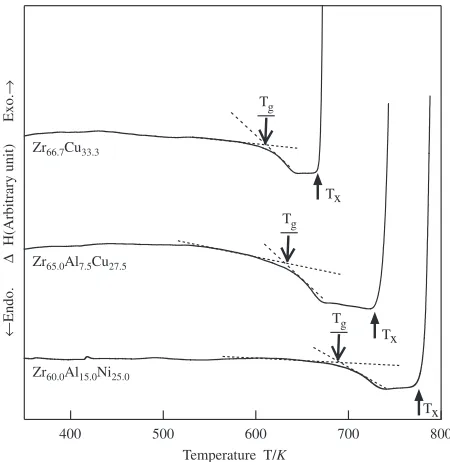
Figure 1 shows DSC curves of melt-spun Zr66:7Cu33:3, Zr65Al7:5Cu27:5 and Zr60Al15Ni25 specimens. The onset temperature of the crystallization (Tx) is indicated by an arrow. An endothermic reaction corresponding to glass transition is observed atTg beforeTx.
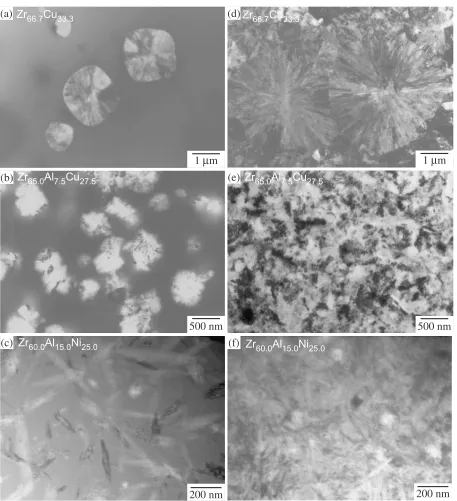
To examine change in microstructure of supercooled liquid during thermal crystallization, partially and fully crystallized specimens were prepared by thermal annealing in an evacuated quartz capsule. Figure 2 shows TEM microstruc-tures of partially and fully crystallized specimens annealed at the temperature higher than Tg by about 20 K. In partially crystallized specimen in Zr66:7Cu33:3 alloy (a), C11b–Zr2Cu
precipitates with average grain size of 2mmare embedded in an amorphous matrix. The fully crystallized structure with micro-meter order C11b–Zr2Cu precipitates is shown in Fig. 2(d). There is no significant difference in thermal crystallization behavior between the supercooled liquid and amorphous phase; (1) phase selection, (2) crystallization mode of nucleation and crystal growth and (3) coarse polycrystalline structure formation.16–18) Precipitation of C11b–Zr2Cu(Al) crystalline phase from supercooled liquid is observed in Zr65Al7:5Cu27:5(b) as well as Zr66:7Cu33:3alloy (a). The size of precipitates in Zr65Al7:5Cu27:5 (b) and (e) is smaller than that in Zr66:7Cu33:3 alloy (a) and (d) in partially and fully crystallized specimens, respectively. Redistribution of solute element of Al is considered to reduce the growth rate of C11b–Zr2Cu crystalline precipitates. Needle-like precipitates are formed in partially crystallized Zr60Al15Ni25 alloy (c). The crystalline phase was identified as hexagonal-Zr6Al2Ni phase.12,15) In fully crystallized specimen (f), mixture of Zr6Al2Ni and Zr5AlNi4 crystalline phases is observed. Crystalline structure obtained by thermal crystal-lization of supercooled liquid in Zr–Al–Ni alloy is greatly different from that in Zr–Cu and Zr–Al–Cu alloys based on the difference in phase selection. The nano-crystalline structure was hardly obtained by thermal crystallization in Zr66:7Cu33:3, Zr65Al7:5Cu27:5and Zr60Al15Ni25 alloys.
3.2 Electron irradiation induced crystallization of su-percooled liquid
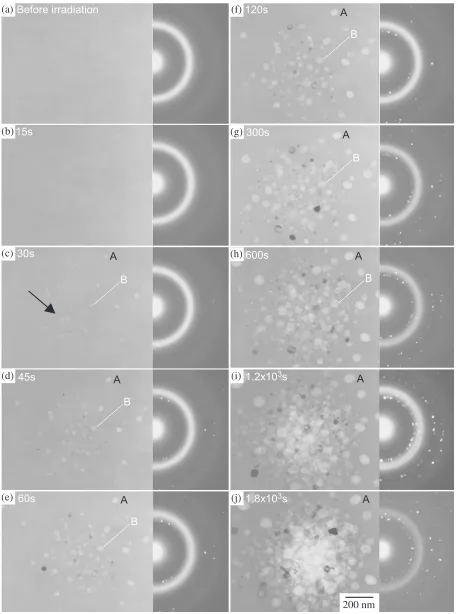
Electron irradiation induced crystallization and change in microstructures of supercooled liquid and amorphous phase were examined by in situ UHVEM observation. Figure 3 shows changes in BF images and corresponding SAD patterns of supercooled liquid in Zr66:7Cu33:3 alloy during 2.0 MV electron irradiation (a)–(j) at 635 K higher thanTgby about 20 K. Before irradiation (a) and after irradiation for 15 s
[image:2.595.56.281.71.302.2](b), there are no significant changes in BF image with featureless contrast and broad halo rings. After 30 s (c), spherical precipitates appear from the supercooled liquid as indicated by a black arrow in BF image. Concurrently, crystalline diffraction spots are seen together with broad halo rings. The supercooled liquid can not maintain the original liquid structure under electron irradiation resulting in enhancing the crystallization of the supercooled liquid. The result of in situ observation clearly shows that electron irradiation induced crystallization occurs with the nucleation and growth process. The incubation time for crystallization is in the range between about 15 s and 30 s. The index A in Fig. 3(c)–(j) is the marker for the same precipitate. Growth of a crystalline precipitate indexed by B under electron irradiation was confirmed. The number and size of crystalline precipitates increase with increasing irradiation time. The precipitates were identified as C11b–Zr2Cu phase which was obtained during thermal annealing.10)
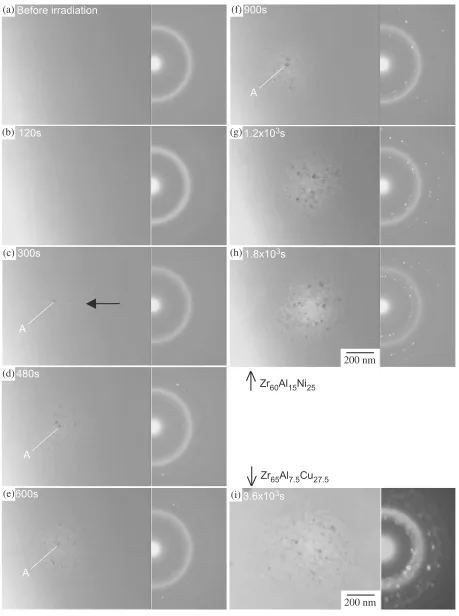
Figure 4 shows changes in BF image and corresponding SAD patterns of supercooled liquid in Zr6Al2Ni former-type Zr60Al15Ni25 alloy during 2.0 MV electron irradiation at 720 K higher thanTg by about 20 K. After 300 s (b), nano-crystalline precipitates appear from the supercooled liquid. Electron irradiation induced crystallization was confirmed in ternary Zr-based metallic glass as well as binary alloy. The size of crystalline precipitate indexed by A increases with increasing irradiation time. The precipitate A was hardly distinguished at 1:2103s (g) because a large number of precipitates were formed. The size of crystalline precipitates is much smaller than that obtained by thermal annealing in Zr60Al15Ni25 alloy shown in Fig. 2(c) and (f), and that obtained electron irradiation induced crystallization in Zr66:7 -Cu33:3 alloy shown in Fig. 3. The crystalline precipitates were identified as Zr6Al2Ni and metastable f.c.c.-solid solution phases in the present study, which is same as those at 743 K in the previous study.12)The precipitates formed by thermal annealing and electron irradiation show different morphology, namely, needle-like morphology by thermal annealing and spherical morphology by electron irradiation. It should be noticed that electron irradiation induced crystallization behavior of supercooled liquid is nucleation and growth mode in Zr60Al15Ni25 alloy.
The temperature dependence of electron irradiation in-duced crystallization of an amorphous phase and supercooled liquid at the temperature nearTgwas investigated in Zr66:7 -Cu33:3 alloy in detail.10)The crystalline size decreased with decreasing irradiation temperature, while there was no difference between the phase selection and crystallization mode at around Tg. Such tendency was also observed in Zr65Al7:5Cu27:5 and Zr60Al15Ni25 metallic glasses in the present study. For a typical example, Fig. 4(i) shows TEM microstructure and corresponding SAD pattern of an amor-phous phase in Zr65Al7:5Cu27:5alloy during 2.0 MV electron irradiation at 626 K lower than Tg by about 20 K. Nano-crystalline structure was similar to that obtained by electron irradiation induced crystallization of supercooled liquid.
Table 1 summarized the electron irradiation induced crystallization of supercooled liquid and an amorphous phase at the temperature neat Tg reported to date. The electron irradiation can introduce the crystallization of supercooled
∆
←
Endo.
←
H(Arbitrary unit) Exo.
800 700
600 500
400
Temperature T/K
Zr65.0Al7.5Cu27.5
Zr60.0Al15.0Ni25.0 Zr66.7Cu33.3
Tg Tg Tg Tx Tx Tx
Fig. 1 DSC curves of melt-spun amorphous specimen in Zr66:7Cu33:3,
Zr66:7Ni33:3, Zr65Al7:5Cu27:5and Zr60Al15Ni25alloys at a heating rate of
liquid as well as an amorphous phase in Zr-based metallic glasses.
4. Discussion
Electron irradiation induced crystallization of supercooled liquid was observed in Zr66:7Cu33:3, Zr65Al7:5Cu27:5 and Zr60Al15Ni25 alloys. The origin of electron irradiation induced crystallization of an amorphous phase and super-cooled liquid region in binary Zr66:7Cu33:3 alloy was discussed in the previous study based on two factors; (1)
promotion of atomic diffusion by mechanical atomic dis-placement introduced by electron knock-on effect enough for phase transition, and (2) high phase stability of crystalline phase enough to maintain the original structure against electron irradiation.10,11)In Zr
65Al7:5Cu27:5and Zr60Al15Ni25 alloys, thermal equilibrium crystalline phases of C11b– Zr2Cu(Al) and Zr6Al2Ni crystalline phase were formed through electron irradiation induced crystallization of an amorphous phase and supercooled liquid at the temperature at around Tg. The satisfaction of the above two factors is considered to be the origin of electron irradiation induced
(a)
500 nm
1
µ
m
500 nm
1
µ
m
200 nm
200 nm
(b)
(c)
(d)
(e)
(f)
Fig. 2 Change in TEM microstructures of supercooled liquid of Zr66:7Cu33:3, Zr65Al7:5Cu27:5 and Zr60Al15Ni25 alloys during thermal
annealing. (a)(b)(c) partially crystallized state, (d)(e)(f) fully crystallized state. (a)(d) Zr66:7Cu33:3, (b)(e) Zr65Al7:5Cu27:5, (c)(f)
Zr60Al15Ni25. (a) Zr66:7Cu33:3annealed at 633 K for 500 s, (d) Zr66:7Cu33:3annealed at 633 K for1:0103s, (b) Zr65Al7:5Cu27:5annealed
at 663 K for3:6103s, (e) Zr
65Al7:5Cu27:5 annealed at 663 K for7:2103s, (c) Zr60Al15Ni25 annealed at 733 K for3:8103s,
[image:3.595.71.528.67.568.2]200 nm
(a)
(b)
(c)
(d)
(e)
(f)
(g)
(h)
(i)
(j)
Fig. 3 In-situobservation of change in TEM microstructure and corresponding SAD patterns of supercooled liquid in Zr66:7Cu33:3alloy by
UHVEM. Supercooled liquid was electron irradiated at 635 K higher than Tg by about 20 K. (a) before irradiation, (b) 15 s at 6:51025m 2, (c) 30 s at1:31026m 2, (d) 45 s at2:01026m 2, (e) 60 s at2:61026m 2, (f) 120 s at5:21026m 2, (g) 300 s at
[image:4.595.70.528.70.684.2](b)
(c)
(d)
(g) (a)
(e)
(f)
(h)
(i)
200 nm
200 nm
Fig. 4 In-situobservation of change in TEM microstructure and corresponding SAD patterns of supercooled liquid by UHVEM in Zr60Al15Ni25alloy (a to g), together with these of an amorphous phase in Zr65Al7:5Cu27:5alloy (h). Supercooled liquid in Zr60Al15Ni25
alloy was electron irradiated at 720 K higher thanTgby about 20 K. An amorphous phase in Zr65Al7:5Cu27:5alloy was electron irradiated
at 626 K at the temperature betweenTgandTC. (a) before irradiation in Zr60Al15Ni25alloy, (b) 120 s at1:31027m 2in Zr60Al15Ni25
alloy, (c) 300 s at3:31027m 2in Zr
60Al15Ni25alloy, (d) 480 s at5:31027m 2in Zr60Al15Ni25alloy, (e) 600 s at6:61027m 2in
Zr60Al15Ni25 alloy, (f) 900 s at 9:91027m 2 in Zr60Al15Ni25 alloy, (g) 1:2103s at 1:31028m 2 in Zr60Al15Ni25 alloy,
(h)1:8103s at2:01028m 2in Zr
[image:5.595.69.528.70.686.2]crystallization in Zr65Al7:5Cu27:5 and Zr60Al15Ni25 alloys as well as Zr66:7Cu33:3alloy.
The characteristics of thermal crystallization and electron irradiation induced crystallization of supercooled liquid are summarized in Table 2, together with those of an amorphous phase. From the viewpoint of phase selection (a), nano-crystalline structure formation (b) and crystallization mode (c), there is no significant difference in crystallization behavior of supercooled liquid between thermal annealing and electron irradiation. In-situTEM observation in Figs. 3 and 4 clearly indicates that electron irradiation promotes the crystallization of supercooled liquid and induces different size and morphology of precipitates from those by thermal crystallization. At the temperature aboveTg, thermal recov-ery of lattice defects in a crystalline phase is high enough to maintain its original structure under electron irradiation. In supercooled liquid, the irradiation introduce free volume which may promote atomic diffusion. Electron irradiation
only accelerates the thermal crystallization of supercooled liquid, while there is a great difference in crystallization behavior of an amorphous phase between thermal annealing and electron irradiation.
5. Conclusion
Electron irradiation induced crystallization behavior of supercooled liquid in Zr-based metallic glasses of binary Zr66:7Cu33:3 and ternary Zr65Al7:5Cu27:5 and Zr60Al15Ni25 alloys was examined. The results were summarized and the following conclusions were reached:
(1) Electron irradiation induced crystallization of super-cooled liquid in Zr66:7Cu33:3, Zr65Al7:5Cu27:5 and Zr60 -Al15Ni25 alloys occurs with nucleation and growth mode.
(2) Although size and morphology of precipitates obtained by electron irradiation induced crystallization of super-Table 1 Occurrence of electron irradiation induced crystallization of supercooled liquid and an amorphous phase at the temperature
neatTg.
Alloy
Electron irradiation data
Ref. A. V. Temp. Occurrence of Phase selection
Tg Tx Tx
Phase selection
[MV] [K] crystallization (Electron irradiation) (Thermal crystallization)
2.0 635 Yes C11b-Zr2Cu 10), 11)
Zr66:7Cu33:3 2.0 602 Yes C11b-Zr2Cu 614 668 54 C11b-Zr2Cu 10), 11)
2.0 552 Yes C11b-Zr2Cu 10), 11)
Zr65:0Al7:5Cu27:5 2.0 626 Yes C11b-Zr2Cu 645 733 88 C11b-Zr2Cu present study
2.0 743 Yes Zr6Al2Ni + F.c.c. solid solution 12)
Zr60Al15Ni25 2.0 720 Yes Zr6Al2Ni + F.c.c. solid solution 701 784 83 Zr6Al2Ni present study
2.0 670 Yes Zr6Al2Ni + F.c.c. solid solution present study
Fe50Cu20Zr10B20() 2.0 860 No — 887 964 77 — 19)
[image:6.595.50.552.94.239.2]() Not an amorphous single phase but a composit structure composed of Fe–Zr–B amorphous matrix and Cu crystalline precipitates A.V.: Acceleration voltage Temp.: Temperature
Table 2 Characteristics of crystallization behaviors of an amorphous phase and supercooled liquid by thermal annealing and electron irradiation; (a) phase selection, (b) nano-crystalline structure formation, and (c) crystallization mode.
(a) phase selection
Thermal crystallization Irradiation induced crystallization
Super cooled liquid T.S. (minor M.S.) T.S.
Amorphous T.S. M.S.
T.S.: Thermally stable crystalline phase M.S.: Thermally metastable crystalline phase
(b) microstructure
Thermal crystallization Irradiation induced crystallization
Super cooled liquid Conv. Conv.
Amorphous Conv. N.C.
Conv.: Conventional sub-micrometer order poly-crystalline crystalline structure N.C.: Nano-crystalline structure
(c) crystallization mode
Thermal crystallization Irradiation induced crystallization
Super cooled liquid Nucleation and growth Nucleation and growth
cooled liquid are different from those by thermal crystallization, there is no significant difference in phase selection between electron irradiation and ther-mal annealing.
Acknowledgements
A part of the present experiments was carried out by using a facility in the Research Center for Ultrahigh Voltage Electron Microscopy, Osaka University. The authors are grateful to Prof. H. Mori and Dr. T. Sakata of the Research Center for Ultrahigh Voltage Electron Microscopy, Osaka University for operating the H-3000 UHVEM. This work was supported by a Grant-in-Aid for Scientific Research and ‘‘Priority Assistance of the Formation of Worldwide Re-nowned Centers of Research-The 21st Century COE Program (Project: Center of Excellence for Advanced Structural and Functional Materials Design)’’ from the Ministry of Educa-tion, Culture, Sports, Science and Technology of Japan.
REFERENCES
1) G. Thomas, H. Mori, H. Fujita and R. Sinclair: Scripta Mater.16(1982) 589–592.
2) H. Mori and H. Fujita: Jpn. J. Appl. Phys.21(1982) L494–L496.
3) H. Mori: in Current Topics in Amorphous Materials: Physics and Technology, eds. by Y. Sakurai, Y. Hamakawa, T. Masumoto, K. Shirac and K. Suzuki (Elsevier Science Publishers, Amsterdam 1997), pp. 120–126.
4) P. R. Okamoto, N. Q. Lam and L. E. Rein:Physics of Crystal-to-glass transformations, in: solid state physics, vol. 52, eds. H. Ehrenreich and F. Spaepen (Academic Press, San Diego, 1999).
5) M. Doi and T. Imura: J. of Mater. Sci.15(1980) 2867–2874. 6) J. L. Brimhall: J. of Mater. Sci.19(1984) 1818–1826.
7) T. Nagase Y. Umakoshi and N. Sumida: Mater. Sci. Eng., A323(2002) 218–225.
8) T. Nagase Y. Umakoshi and N. Sumida: Sci. Tech. Adv. Mater. 3
(2002) 119–128.
9) T. Nagase and Y. Umakoshi: Mater. Sci. Eng., A347(2003) 136–144. 10) T. Nagase and Y. Umakoshi: Mater. Trans.47(2006) 1469–1479. 11) Y. Umakoshi and T. Nagase: Mater. Sci. Eng., A, in press.
12) T. Nagase, M. Nakamura and Y. Umakoshi: Intermetallics15(2007) 211–224.
13) A. Inoue, D. Kawase, A. P. Tsai, T. Zhang and T. Masumoto: Mater. Sci. Eng., A178(1994) 255–263.
14) A. Inoue, T. Zhang and T. Masumoto: Mater. Trans., JIM31(1990) 177–183.
15) Y. Umakoshi, T. Nagase and M. Nakamura: Intermetallics14(2006) 1079–1084.
16) T. Nagase and Y. Umakoshi: J. Appl. Phys.93(2003) 912–918. 17) T. Nagase and Y. Umakoshi: Mater. Sci. Eng.352(2003) 251–260. 18) T. Nagase and Y. Umakoshi: Mater. Trans.45(2004) 13–23. 19) T. Nagase, A. Yokoyama and Y. Umakoshi: Collected Abstracts of