DKPro Similarity: An Open Source Framework for Text Similarity
Daniel B¨ar†, Torsten Zesch†‡, and Iryna Gurevych†‡ †Ubiquitous Knowledge Processing Lab (UKP-TUDA)
Department of Computer Science, Technische Universit¨at Darmstadt
‡Ubiquitous Knowledge Processing Lab (UKP-DIPF)
German Institute for Educational Research and Educational Information www.ukp.tu-darmstadt.de
Abstract
We present DKPro Similarity, an open source framework for text similarity. Our goal is to provide a comprehensive repos-itory of text similarity measures which are implemented using standardized inter-faces. DKPro Similarity comprises a wide variety of measures ranging from ones based on simple n-grams and common
subsequences to high-dimensional vector comparisons and structural, stylistic, and phonetic measures. In order to promote the reproducibility of experimental results and to provide reliable, permanent ex-perimental conditions for future studies, DKPro Similarity additionally comes with a set of full-featured experimental setups which can be run out-of-the-box and be used for future systems to built upon.
1 Introduction
Computing text similarity is key to several natu-ral language processing applications such as au-tomatic essay grading, paraphrase recognition, or plagiarism detection. However, only a few text similarity measures proposed in the literature are released publicly, and those then typically do not comply with any standardization. We are currently not aware of any designated text similarity frame-work which goes beyond simple lexical similarity or contains more than a small number of measures, even though related frameworks exist, which we discuss in Section 6. This fact was also realized by the organizers of the pilot Semantic Textual Similarity Task at SemEval-2012 (see Section 5), as they argue for the creation of an open source framework for text similarity (Agirre et al., 2012). In order to fill this gap, we present DKPro Sim-ilarity, an open source framework for text simi-larity. DKPro Similarity is designed to
comple-ment DKPro Core1, a collection of software com-ponents for natural language processing based on the Apache UIMA framework (Ferrucci and Lally, 2004). Our goal is to provide a comprehensive repository of text similarity measures which are implemented in a common framework using stan-dardized interfaces. Besides the already available measures, DKPro Similarity is easily extensible and intended to allow for custom implementations, for which it offers various templates and exam-ples. The Java implementation is publicly avail-able at Google Code2under the Apache Software License v2 and partly under GNU GPL v3.
2 Architecture
DKPro Similarity is designed to operate in ei-ther of two modes: The stand-alone mode al-lows to use text similarity measures as indepen-dent components in any experimental setup, but does not offer means for further language process-ing, e.g. lemmatization. TheUIMA-coupled mode
tightly integrates similarity computation with full-fledgedApache UIMA-based language processing pipelines. That way, it allows to perform any num-ber of languge processing steps, e.g. coreference or named-entitiy resolution, along with the text similarity computation.
Stand-alone Mode In this mode, text similarity measures can be used independently of any lan-guage processing pipeline just by passing them a pair of texts as (i) two strings, or (ii) two lists of strings (e.g. already lemmatized texts). We there-fore provide an API module, which contains Java interfaces and abstract base classes for the mea-sures. That way, DKPro Similarity allows for a maximum flexibility in experimental design, as the text similarity measures can easily be integrated with any existing experimental setup:
1code.google.com/p/dkpro-core-asl 2code.google.com/p/dkpro-similarity-asl
1 TextSimilarityMeasure m =
new GreedyStringTiling();
2 double similarity =
m.getSimilarity(text1, text2);
The above code snippet instantiates the Greedy String Tilingmeasure (Wise, 1996) and then com-putes the text similarity between the given pair of texts. The resulting similarity score is normal-ized into [0,1]where 0 meansnot similar at all, and 1 corresponds to perfectly similar.3 By
us-ing the common TextSimilarityMeasure
interface, it is easy to replace Greedy String Tiling with any measure of choice, such as Latent Se-mantic Analysis(Landauer et al., 1998) orExplicit Semantic Analysis (Gabrilovich and Markovitch, 2007). We give an overview of measures available in DKPro Similarity in Section 3.
UIMA-coupled Mode In this mode, DKPro Similarity allows text similarity computation to be directly integrated with any UIMA-based lan-guage processing pipeline. That way, it is easy to use text similarity components in addition to other UIMA-based components in the same pipeline. For example, an experimental setup may require to first compute text similarity scores and then to run a classification algorithm on the resulting scores.
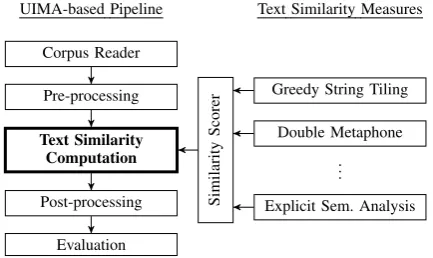
In Figure 1, we show a graphical overview of the integration of text similarity measures (right) with a UIMA-based pipeline (left). The pipeline starts by reading a given dataset, then performs any number of pre-processing steps such as to-kenization, sentence splitting, lemmatization, or stopword filtering, then runs the text similar-ity computation, before executing any subsequent post-processing steps and finally returning the pro-cessed texts in a suitable format for evaluation or manual inspection. As all text similarity measures in DKPro Similarity conform to standardized in-terfaces, they can be easily exchanged in the text similarity computation step.
With DKPro Similarity, we offer various sub-classes of the generic UIMA components which are specifically tailored towards text similarity ex-periments, e.g. corpus readers for standard eval-uation datasets as well as evaleval-uation components for running typical evaluation metrics. By lever-aging UIMA’s architecture, we also define an
3Some string distance measures such as theLevenshtein
distance (Levenshtein, 1966) return a raw distance score where less distance corresponds to higher similarity. How-ever, the score can easily be normalized, e.g. by text length.
UIMA-based Pipeline
Corpus Reader
Pre-processing
Text Similarity Computation
Post-processing
Evaluation
Similarity
Scorer
Text Similarity Measures
Greedy String Tiling
Double Metaphone
..
.
[image:2.595.309.526.64.193.2]Explicit Sem. Analysis
Figure 1: DKPro Similarity allows to integrate any text similarity measure (right) which conforms to standardized interfaces into a UIMA-based lan-guage processing pipeline (left) by means of a dedicatedSimilarity Scorercomponent (middle).
additional interface to text similarity measures: TheJCasTextSimilarityMeasureinherits from TextSimilarityMeasure, and adds a method for twoJCastext representations:4
double getSimilarity
(JCas text1, JCas text2);
The additional interface allows to implement mea-sures which have full access to UIMA’s document structure. That way, it is possible to create text similarity measures which can use any piece of in-formation that has been annotated in the processed documents, such as dependency trees or morpho-logical information. We detail the new set of com-ponents offered by DKPro Similarity in Section 4.
3 Text Similarity Measures
In this section, we give an overview of the text similarity measures which are already available in DKPro Similarity. While we provide new imple-mentations for a multitude of measures, we rely on specialized libraries such as theS-Space Package
(see Section 6) if available. Due to space limi-tations and due to the fact that the framework is actively under development, we do not provide an exhaustive list here, but rather mention the most interesting and most popular measures.
3.1 Simple String-based Measures
DKPro Similarity includes text similarity mea-sures which operate on string sequences and determine, for example, the longest common
4TheJCas is an object-oriented Java interface to the
(non-)contiguous sequence of characters. It also containsGreedy String Tiling(Wise, 1996), a mea-sure which allows to compare strings if parts have been reordered. The framework also offers mea-sures which compute sets of character and word
n-grams and compare them using different overlap
coefficients, e.g. the Jaccard index. It further in-cludes popular string distance metrics such as the
Jaro-Winkler (Winkler, 1990), Monge and Elkan (1997)andLevenshtein (1966)distance measures.
3.2 Semantic Similarity Measures
DKPro Similarity also contains several measures which go beyond simple character sequences and compute text similarity on a semantic level.
Pairwise Word Similarity These measures are based on pairwise word similarity computations which are then aggregated for the complete texts. The measures typically operate on a graph-based representation of words and the semantic relations among them within a lexical-semantic resource. DKPro Similarity therefore contains adapters for WordNet, Wiktionary5, and Wikipedia, while the framework can easily be extended to other data sources that conform to a common interface (Garoufi et al., 2008). Pairwise similarity mea-sures in DKPro Similarity includeJiang and Con-rath (1997)orResnik (1995). The aggregation for the complete texts can for example be done using the strategy by Mihalcea et al. (2006).
Vector Space Models These text similarity measures project texts onto high-dimensional vec-tors which are then compared. Cosine similar-ity, a basic measure often used in information re-trieval, weights words according to their term fre-quencies or tf-idf scores, and computes the co-sine between two text vectors. Latent Seman-tic Analysis(Landauer et al., 1998) alleviates the inherent sparseness of a high-dimensional term-document matrix by reducing it to one of reduced rank.Explicit Semantic Analysis(Gabrilovich and Markovitch, 2007) constructs the vector space on corpora where the documents are assumed to de-scribe natural concepts such ascat ordog. Orig-inally, Wikipedia was proposed as the document collection of choice.
DKPro Similarity goes beyond a single im-plementation of these measures and comes with highly customizable code which allows to set
var-5http://www.wiktionary.org
ious parameters for the construction of the vector space and the comparison of the document vectors, and further allows to construct the vector space for arbitrary collections, e.g. domain-specific corpora.
3.3 Further Measures
Previous research (B¨ar et al., 2012b) has shown promising results for the inclusion of measures which go beyond textual content and compute similarity along other text characteristics. Thus, DKPro Similarity also includes measures for structural, stylistic, and phonetic similarity.
Structural Similarity Structural similarity be-tween texts can be computed, for example, by comparing sets ofstopwordn-grams(Stamatatos,
2011). The idea here is that similar texts may pre-serve syntactic similarity while exchanging only content words. Other measures in DKPro Simi-larity allow to compare texts bypart-of-speechn -grams, andorderanddistance featuresfor pairs of words (Hatzivassiloglou et al., 1999).
Stylistic Similarity DKPro Similarity includes, for example, a measure which comparesfunction word frequencies (Dinu and Popescu, 2009) be-tween two texts. The framework also includes a set of measures which capture statistical properties of texts such as thetype-token ratio(TTR) and the
sequential TTR(McCarthy and Jarvis, 2010).
Phonetic Similarity DKPro Similarity also al-lows to compute text similarity based on pair-wise phonetic comparisons of words. It therefore contains implementations of well-known phonetic algorithms such as Double Metaphone (Philips, 2000) andSoundex(Knuth, 1973), which also con-form to the common text similarity interface.
4 UIMA Components
In addition to a rich set of text similarity mea-sures as partly described above, DKPro Similar-ity includes components which allow to integrate text similarity measures with any UIMA-based pipeline, as outlined in Figure 1. In the following, we introduce these components along with their resources.
Readers & Datasets DKPro Similarity includes corpus readers specifically tailored towards com-bining the input texts in a number of ways, e.g. all possible combinations, or each text paired with
readers come pre-packaged include, among oth-ers, the SemEval-2012 STS data (Agirre et al., 2012), the METER corpus (Clough et al., 2002), or the RTE1–5data (Dagan et al., 2006). As far as license terms allow redistribution, the datasets themselves are integrated into the framework.
Similarity Scorer TheSimilarity Scorer allows to integrate any text similarity measure (which is decoupled from UIMA by default) into a UIMA-based pipeline. It builds upon the standardized text similarity interfaces and thus allows to easily ex-change the text similarity measure as well as to specify the data types the measure should operate on, e.g. tokens or lemmas.
Machine Learning Previous research (Agirre et al., 2012) has shown that different text similarity measures can be combined using machine learning classifiers. Such a combination shows improve-ments over single measures due to the fact that dif-ferent measures capture difdif-ferent text characteris-tics. DKPro Similarity thus provides adapters for the Weka framework (Hall et al., 2009) and allows to first pre-compute sets of text similarity scores which can then be used as features for various ma-chine learning classifiers.
Evaluation Metrics In the final step of a UIMA pipeline, the processed data is read by a dedicated evaluation component. DKPro Similarity ships with a set of components which for example com-pute Pearson or Spearman correlation with human judgments, or apply task-specific metrics such as average precision as used in the RTE challenges.
5 Experimental Setups
DKPro Similarity further encourages the creation and publication of complete experimental setups. That way, we promote the reproducibility of ex-perimental results, and provide reliable, perma-nent experimental conditions which can benefit fu-ture studies and help to stimulate the reuse of par-ticular experimental steps and software modules.
The experimental setups are instantiations of the generic UIMA-based language processing pipeline depicted in Figure 1 and are designed to precisely match the particular task at hand. They thus come pre-configured with corpus readers for the relevant input data, with a set of pre- and post-processing as well as evaluation components, and with a set of text similarity measures which are
well-suited for the particular task. The experimen-tal setups are self-contained systems and can be run out-of-the-box without further configuration.6 DKPro Similarity contains two major types of experimental setups: (i) those for anintrinsic eval-uationallow to evaluate the system performance in an isolated setting by comparing the system results with a human gold standard, and (ii) those for an
extrinsic evaluationallow to evaluate the system with respect to a particular task at hand, where text similarity is a means for solving a concrete prob-lem, e.g. recognizing textual entailment.
Intrinsic Evaluation DKPro Similarity con-tains the setup (B¨ar et al., 2012a) which partic-ipated in the Semantic Textual Similarity (STS) Task at SemEval-2012 (Agirre et al., 2012) and which has become one of the recommended base-line systems for the second task of this series.7 The system combines a multitude of text similar-ity measures of varying complexsimilar-ity using a simple log-linear regression model. The provided setup allows to evaluate how well the system output re-sembles human similarity judgments on short texts which are taken from five different sources, e.g. paraphrases of news texts or video descriptions.
Extrinsic Evaluation Our framework includes two setups for an extrinsic evaluation: detecting text reuse, and recognizing textual entailment.
For detecting text reuse (Clough et al., 2002), the setup we provide (B¨ar et al., 2012b) combines a multitude of text similarity measures along dif-ferent text characteristics. Thereby, it not only combines simple string-based and semantic sim-ilarity measures (see Sections 3.1 and 3.2), but makes extensive use of measures along structural and stylistic text characteristics (see Section 3.3). Across three standard evaluation datasets, the sys-tem consistently outperforms all previous work.
For recognizing textual entailment, we provide a setup which is similar in configuration to the one described above, but contains corpus readers and evaluation components precisely tailored towards the RTE challenge series (Dagan et al., 2006). We believe that our setup can be used for filtering those text pairs which need further analysis by a dedicated textual entailment system.
6A one-time setup of local lexical-semantic resources such as WordNet may be necessary, though.
7In 2013, the STS Task is a shared task of the Second Joint Conference on Lexical and Computational Semantics,
6 Related Frameworks
To the best of our knowledge, only a few general-ized similarity frameworks exist at all. In the fol-lowing, we discuss them and give insights where DKPro Similarity uses implementations of these existing libraries. That way, DKPro Similarity brings together the scattered efforts by offering ac-cess to all measures through common interfaces. It goes far beyond the functionality of the original li-braries as it generalizes the resources used, allows a tight integration with any UIMA-based pipeline, and comes with full-featured experimental setups which are pre-configured stand-alone text similar-ity systems that can be run out-of-the-box.
S-Space Package Even though no designated text similarity library, the S-Space Package (Jur-gens and Stevens, 2010)8contains some text sim-ilarity measures such as Latent Semantic Analysis (LSA) and Explicit Semantic Analysis (see Sec-tion 3.2). However, it is primarily focused on word space models which operate on word distri-butions in text. Besides such algorithms, it offers a variety of interfaces, data structures, evaluation datasets and metrics, and global operation utili-ties e.g. for dimension reduction using Singular Value Decomposition or randomized projections, which are particularly useful with such distribu-tional word space models. DKPro Similarity inte-grates LSA based on the S-Space Package.
Semantic Vectors The Semantic Vectors pack-age is a packpack-age for distributional semantics (Wid-dows and Cohen, 2010)9 that contains measures such as LSA and allows for comparing documents within a given vector space. The main focus lies on word space models with a number of dimension reduction techniques, and applications on word spaces such as automatic thesaurus generation.
WordNet::Similarity The open source package by Pedersen et al. (2004)10 is a popular Perl li-brary for the similarity computation on WordNet. It comprises six word similarity measures that op-erate on WordNet, e.g.Jiang and Conrath (1997)
or Resnik (1995). Unfortunately, no strategies have been added to the package yet which aggre-gate the word similarity scores for complete texts in a similar manner as described in Section 3.2.
8code.google.com/p/airhead-research 9code.google.com/p/semanticvectors 10sourceforge.net/projects/wn-similarity
In DKPro Similarity, we offer native Java imple-mentations of all measures contained in Word-Net::Similarity, and allow to go beyond WordNet and use the measures with any lexical-semantic re-source of choice, e.g. Wiktionary or Wikipedia.
SimMetrics Library The Java library by Chap-man et al. (2005)11exclusively comprises text sim-ilarity measures which compute lexical similar-ity on string sequences and compare texts with-out any semantic processing. It contains mea-sures such as theLevenshtein (1966)orMonge and Elkan (1997)distance metrics. In DKPro Similar-ity, some string-based measures (see Section 3.1) are based on implementations from this library.
SecondString Toolkit The freely available li-brary by Cohen et al. (2003)12 is similar to Sim-Metrics, and also implemented in Java. It also con-tains several well-known text similarity measures on string sequences, and includes many of the measures which are also part of the SimMetrics Library. Some string-based measures in DKPro Similarity are based on the SecondString Toolkit.
7 Conclusions
We presented DKPro Similarity, an open source framework designed to streamline the develop-ment of text similarity measures. All measures conform to standardized interfaces and can either be used as stand-alone components in any ex-perimental setup (e.g. an already existing system which is not based on Apache UIMA), or can be tightly coupled with a full-featured UIMA-based language processing pipeline in order to allow for advanced processing capabilities.
We would like to encourage other researchers to participate in our efforts and invite them to ex-plore our existing experimental setups as outlined in Section 5, run modified versions of our setups, and contribute own text similarity measures to the framework. For that, DKPro Similarity also comes with an example module for getting started, which guides first-time users through both the stand-alone and the UIMA-coupled modes.
Acknowledgements This work has been supported by the Volkswagen Foundation as part of the Lichtenberg Profes-sorship Program under grant No. I/82806, and by the Klaus Tschira Foundation under project No. 00.133.2008. We thank Richard Eckart de Castilho and all other contributors.
References
Eneko Agirre, Daniel Cer, Mona Diab, and Aitor Gonzalez-Agirre. 2012. SemEval-2012 Task 6: A Pilot on Semantic Textual Similarity. InProc. of the 6th Int’l Works. on Semantic Eval., pages 385–393. Daniel B¨ar, Chris Biemann, Iryna Gurevych, and
Torsten Zesch. 2012a. UKP: Computing Semantic Textual Similarity by Combining Multiple Content Similarity Measures. InProc. of the 6th Int’l Work-shop on Semantic Evaluation, pages 435–440. Daniel B¨ar, Torsten Zesch, and Iryna Gurevych. 2012b.
Text Reuse Detection Using a Composition of Text Similarity Measures. InProc. of the 24th Int’l Conf. on Computational Linguistics, pages 167–184. Sam Chapman, Barry Norton, and Fabio Ciravegna.
2005. Armadillo: Integrating Knowledge for the
Se-mantic Web. InProceedings of the Dagstuhl
Semi-nar in Machine Learning for the Semantic Web. Paul Clough, Robert Gaizauskas, Scott S.L. Piao, and
Yorick Wilks. 2002. METER: MEasuring TExt
Reuse. InProceedings of ACL, pages 152–159.
William W. Cohen, Pradeep Ravikumar, and Stephen Fienberg. 2003. A Comparison of String Metrics
for Matching Names and Records. InProc. of KDD
Works. on Data Cleaning and Object Consolidation. Ido Dagan, Oren Glickman, and Bernardo Magnini. 2006. The PASCAL Recognising Textual
Entail-ment Challenge. InMachine Learning Challenges,
Lecture Notes in Computer Science, pages 177–190. Liviu P. Dinu and Marius Popescu. 2009. Ordinal mea-sures in authorship identification. InProceedings of the 3rd PAN Workshop. Uncovering Plagiarism, Au-thorship and Social Software Misuse, pages 62–66. David Ferrucci and Adam Lally. 2004. UIMA: An
Architectural Approach to Unstructured Information Processing in the Corporate Research Environment.
Natural Language Engineering, 10(3-4):327–348. Evgeniy Gabrilovich and Shaul Markovitch. 2007.
Computing Semantic Relatedness using
Wikipedia-based Explicit Semantic Analysis. InProceedings
of IJCAI, pages 1606–1611, Hyderabad, India. Konstantina Garoufi, Torsten Zesch, and Iryna
Gurevych. 2008. Representational Interoperability of Linguistic and Collaborative Knowledge Bases. In Proceedings of the KONVENS Workshop on Lexical-Semantic and Ontological Resources. Mark Hall, Eibe Frank, Geoffrey Holmes, Bernhard
Pfahringer, Peter Reutemann, and Ian H. Witten. 2009. The WEKA Data Mining Software: An
Up-date.SIGKDD Explorations, 11(1):10–18.
Vasileios Hatzivassiloglou, Judith L. Klavans, and Eleazar Eskin. 1999. Detecting text similarity over short passages: Exploring linguistic feature
com-binations via machine learning. InProceedings of
EMNLP/VLC, pages 203–212.
Jay J. Jiang and David W. Conrath. 1997. Semantic similarity based on corpus statistics and lexical
tax-onomy. InProceedings of ROCLING, pages 19–33.
David Jurgens and Keith Stevens. 2010. The S-Space Package: An Open Source Package for Word Space
Models. In Proceedings of the ACL 2010 System
Demonstrations, pages 30–35, Uppsala, Sweden.
Donald E. Knuth. 1973. The Art of Computer
Programming: Volume 3, Sorting and Searching. Addison-Wesley.
Thomas K. Landauer, Peter W. Foltz, and Darrell La-ham. 1998. An Introduction to Latent Semantic
Analysis. Discourse Processes, 25(2):259–284.
Vladimir I. Levenshtein. 1966. Binary codes capa-ble of correcting deletions, insertions, and reversals.
Soviet Physics Doklady, 10(8):707–710.
Philip M. McCarthy and Scott Jarvis. 2010. MTLD, vocd-D, and HD-D: A validation study of sophis-ticated approaches to lexical diversity assessment.
Behavior research methods, 42(2):381–392. Rada Mihalcea, Courtney Corley, and Carlo
Strappa-rava. 2006. Corpus-based and Knowledge-based
Measures of Text Semantic Similarity. In
Proceed-ings of AAAI-06, pages 775–780, Boston, MA, USA. Alvaro Monge and Charles Elkan. 1997. An ef-ficient domain-independent algorithm for detecting
approximately duplicate database records. In
Pro-ceedings of the SIGMOD Workshop on Data Mining and Knowledge Discovery, pages 23–29.
Ted Pedersen, Siddharth Patwardhan, and Jason Miche-lizzi. 2004. WordNet::Similarity - Measuring the
Relatedness of Concepts. In Proceedings of the
HLT-NAACL: Demonstration Papers, pages 38–41.
Lawrence Philips. 2000. The double metaphone
search algorithm.C/C++ Users Jour., 18(6):38–43.
Philip Resnik. 1995. Using Information Content to Evaluate Semantic Similarity in a Taxonomy. In
Proceedings of the IJCAI, pages 448–453.
Efstathios Stamatatos. 2011. Plagiarism detection
using stopword n-grams. Journal of the
Ameri-can Society for Information Science and Technology, 62(12):2512–2527.
Dominic Widdows and Trevor Cohen. 2010. The Se-mantic Vectors Package: New Algorithms and Pub-lic Tools for Distributional Semantics. In Proceed-ings of IEEE-ICSC, pages 9–15.
William E. Winkler. 1990. String Comparator Metrics and Enhanced Decision Rules in the Fellegi-Sunter
Model of Record Linkage. In Proceedings of the
Survey Research Methods Section, pages 354–359. Michael J. Wise. 1996. YAP3: Improved detection of
similarities in computer program and other texts. In