A Nonparametric Bayesian Approach to Acoustic Model Discovery
Chia-ying Lee and James Glass
Computer Science and Artificial Intelligence Laboratory Massachusetts Institute of Technology
Cambridge, MA 02139, USA
{chiaying,jrg}@csail.mit.edu
Abstract
We investigate the problem of acoustic mod-eling in which prior language-specific knowl-edge and transcribed data are unavailable. We present an unsupervised model that simultane-ously segments the speech, discovers a proper set of sub-word units (e.g., phones) and learns a Hidden Markov Model (HMM) for each in-duced acoustic unit. Our approach is formu-lated as a Dirichlet process mixture model in which each mixture is an HMM that repre-sents a sub-word unit. We apply our model to the TIMIT corpus, and the results demon-strate that our model discovers sub-word units that are highly correlated with English phones and also produces better segmentation than the state-of-the-art unsupervised baseline. We test the quality of the learned acoustic models on a spoken term detection task. Compared to the baselines, our model improves the relative pre-cision of top hits by at least 22.1% and outper-forms a language-mismatched acoustic model.
1 Introduction
Acoustic models are an indispensable component of speech recognizers. However, the standard pro-cess of training acoustic models is expensive, and requires not only language-specific knowledge, e.g., the phone set of the language, a pronunciation dic-tionary, but also a large amount of transcribed data. Unfortunately, these necessary data are only avail-able for a very small number of languages in the world. Therefore, a procedure for training acous-tic models without annotated data would not only be a breakthrough from the traditional approach, but
would also allow us to build speech recognizers for any language efficiently.
In this paper, we investigate the problem of unsu-pervised acoustic modeling with only spoken utter-ances as training data. As suggested in Garcia and Gish (2006), unsupervised acoustic modeling can be broken down to three sub-tasks: segmentation, clustering segments, and modeling the sound pattern of each cluster. In previous work, the three sub-problems were often approached sequentially and independently in which initial steps are not related to later ones (Lee et al., 1988; Garcia and Gish, 2006; Chan and Lee, 2011). For example, the speech data was usually segmented regardless of the clustering results and the learned acoustic models.
In contrast to the previous methods, we approach the problem by modeling the three sub-problems as well as the unknown set of sub-word units as la-tent variables in one nonparametric Bayesian model. More specifically, we formulate a Dirichlet pro-cess mixture model where each mixture is a Hid-den Markov Model (HMM) used to model a sub-word unit and to generate observed segments of that unit. Our model seeks the set of sub-word units, segmentation, clustering and HMMs that best repre-sent the observed data through an iterative inference process. We implement the inference process using Gibbs sampling.
We test the effectiveness of our model on the TIMIT database (Garofolo et al., 1993). Our model shows its ability to discover sub-word units that are highly correlated with standard English phones and to capture acoustic context information. For the seg-mentation task, our model outperforms the
the-art unsupervised method and improves the rel-ative F-score by 18.8 points (Dusan and Rabiner, 2006). Finally, we test the quality of the learned acoustic models through a keyword spotting task. Compared to the state-of-the-art unsupervised meth-ods (Zhang and Glass, 2009; Zhang et al., 2012), our model yields a relative improvement in precision of top hits by at least 22.1% with only some degra-dation in equal error rate (EER), and outperforms a language-mismatched acoustic model trained with supervised data.
2 Related Work
Unsupervised Sub-word Modeling We follow the general guideline used in (Lee et al., 1988; Gar-cia and Gish, 2006; Chan and Lee, 2011) and ap-proach the problem of unsupervised acoustic mod-eling by solving three sub-problems of the task: segmentation, clustering and modeling each cluster. The key difference, however, is that our model does not assume independence among the three aspects of the problem, which allows our model to refine its so-lution to one sub-problem by exploiting what it has learned about other parts of the problem. Second, unlike (Lee et al., 1988; Garcia and Gish, 2006) in which the number of sub-word units to be learned is assumed to be known, our model learns the proper size from the training data directly.
Instead of segmenting utterances, the authors of (Varadarajan et al., 2008) trained a single state HMM using all data at first, and then iteratively split the HMM states based on objective functions. This method achieved high performance in a phone recognition task using a label-to-phone transducer trained from some transcriptions. However, the per-formance seemed to rely on the quality of the trans-ducer. For our work, we assume no transcriptions are available and measure the quality of the learned acoustic units via a spoken query detection task as in Jansen and Church (2011).
Jansen and Church (2011) approached the task of unsupervised acoustic modeling by first discovering repetitive patterns in the data, and then learned a whole-word HMM for each found pattern, where the state number of each HMM depends on the average length of the pattern. The states of the whole-word HMMs were then collapsed and used to represent
acoustic units. Instead of discovering repetitive pat-terns first, our model is able to learn from any given data.
Unsupervised Speech Segmentation One goal of our model is to segment speech data into small sub-word (e.g., phone) segments. Most un-supervised speech segmentation methods rely on acoustic change for hypothesizing phone bound-aries (Scharenborg et al., 2010; Qiao et al., 2008; Dusan and Rabiner, 2006; Estevan et al., 2007). Even though the overall approaches differ, these al-gorithms are all one-stage and bottom-up segmenta-tion methods (Scharenborg et al., 2010). Our model does not make a single one-stage decision; instead, it infers the segmentation through an iterative process and exploits the learned sub-word models to guide its hypotheses on phone boundaries.
Bayesian Model for Segmentation Our model is inspired by previous applications of nonparametric Bayesian models to segmentation problems in NLP and speaker diarization (Goldwater, 2009; Fox et al., 2011); particularly, we adapt the inference method used in (Goldwater, 2009) to our segmentation task. Our problem is, in principle, similar to the word seg-mentation problem discussed in (Goldwater, 2009). The main difference, however, is that our model is under the continuous real value domain, and the problem of (Goldwater, 2009) is under the discrete symbolic domain. For the domain our problem is ap-plied to, our model has to include more latent vari-ables and is more complex.
3 Problem Formulation
The goal of our model, given a set of spoken utter-ances, is to jointly learn the following:
• Segmentation: To find the phonetic boundaries within each utterance.
• Nonparametric clustering: To find a proper set of clusters and group acoustically similar seg-ments into the same cluster.
• Sub-word modeling: To learn a HMM to model each sub-word acoustic unit.
€ x2 i € x3 i € x4 i € x5 i € x6 i € x7 i € x8 i € x9 i € x10 i € x11 i € x1 i
b a n a n a
€
(xt i
)
€
(t) 1 2 3 4 5 6 7 8 9 10 11
€
(bt i
)
€
(gq i) € g0 i € g1 i € g2 i € g3 i € g4 i € g5 i € g6 i €
(pj,k i ) € p1,1 i € p2,4 i € p5,6 i € p7,8i € p9,9 i € p10,11 i €
(cj,k i ) € c1,1 i € c2,4 i € c5,6 i € c7,8 i € c9,9 i € c10,11 i €
(θc)
€ θ1 € θ2 € θ3 € θ4 € θ3 € θ2 €
(st i)
1 1 2 3 1 3 1 3 1 1 3 Frame index Speech feature Boundary variable Boundary index Segment Cluster label HMM Hidden state
[b] [ax] [n] [ae] [n] [ax] Pronunciation
1 0 0 1 0 1 0 1 1 0 1
Duration
€
(dj,k i
) 1 3 2 2 1 2
[image:3.612.100.277.63.233.2]1 1 6 8 3 7 5 2 8 2 8 Mixture ID
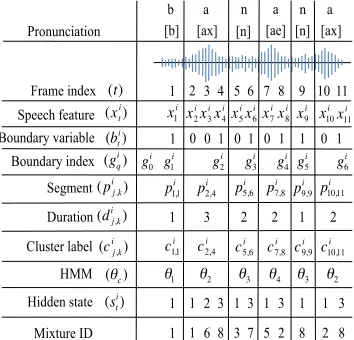
Figure 1: An example of the observed data and hidden variables of the problem for the wordbanana. See Sec-tion 3 for a detailed explanaSec-tion.
of the problem and show an example in Fig. 1. In the next section, we show the generative process our model uses to generate the observed data.
Speech Feature (xit) The only observed data for our problem are a set of spoken utterances, which are converted to a series of 25 ms 13-dimensional Mel-Frequency Cepstral Coefficients (MFCCs) (Davis and Mermelstein, 1980) and their first- and second-order time derivatives at a 10 ms analysis rate. We usexit ∈ R39to denote thetthfeature frame of the ithutterance. Fig. 1 illustrates how the speech signal
of a single word utterancebananais converted to a sequence of feature vectorsxi1toxi11.
Boundary (bit) We use a binary variable bitto in-dicate whether a phone boundary exists betweenxi t
andxit+1. If our model hypothesizesxitto be the last frame of a sub-word unit, which is called aboundary framein this paper,bitis assigned with value1; or0
otherwise. Fig. 1 shows an example of the boundary variables where the values correspond to the true an-swers. We use an auxiliary variablegiqto denote the index of theqth boundary frame in utterancei. To make the derivation of posterior distributions easier in Section 5, we define gi0 to be the beginning of an utterance, andLi to be the number of boundary frames in an utterance. For the example shown in Fig. 1,Li is equal to 6.
Segment (pij,k) We define a segment to be com-posed of feature vectors between two boundary frames. We usepij,k to denote a segment that con-sists ofxij, xij+1· · ·xikanddij,kto denote the length ofpij,k. See Fig. 1 for more examples.
Cluster Label (cij,k) We use cij,k to specify the cluster label ofpi
j,k. We assume segmentpij,kis
gen-erated by the sub-word HMM with labelcij,k. HMM (θc) In our model, each HMM has three
emission states, which correspond to the beginning, middle and end of a sub-word unit (Jelinek, 1976). A traversal of each HMM must start from the first state, and only left-to-right transitions are allowed even though we allow skipping of the middle and the last state for segments shorter than three frames. The emission probability of each state is modeled by a diagonal Gaussian Mixture Model (GMM) with 8 mixtures. We useθc to represent the set of
param-eters that define thecthHMM, which includes state transition probabilityaj,kc , and the GMM parameters
of each state emission probability. We usewc,sm ∈R,
µmc,s ∈ R39 and λm
c,s ∈ R39 to denote the weight,
mean vector and the diagonal of the inverse covari-ance matrix of themthmixture in the GMM for the
sthstate in thecthHMM.
Hidden State (sit) Since we assume the observed data are generated by HMMs, each feature vector,
xit, has an associated hidden state index. We denote the hidden state ofxitassit.
Mixture ID (mit) Similarly, each feature vector is assumed to be emitted by the state GMM it belongs to. We usemitto identify the Gaussian mixture that generatesxi
t.
4 Model
parameter of Bernoulli distribution
€ αb
€
γ
€ θ0
concentration parameter of DP base distribution of DP
€
π prior distribution for cluster labels
€
bt boundary variable
€
dj,k duration of a segment
€
cj,k cluster label
€
θc HMM parameters
€
st hidden state
€
mt Gaussian mixture id
€
xt observed feature vector
deterministic relation €
γ
€
T
€ ∞
€
dj,k
€ π
€
αb
€ θ0
€
cj,k
€
st
€
j,k=gq+1,gq+1
€
xt
€
dj,k
€
mt
€
bt
€ θc
€
0≤q<L
€
T total number of
observed features frames
€
L total number of segments
determined by
€
bt
€
gq the index of the boundary variable with value 1
€
[image:4.612.84.521.61.238.2]qth
Figure 2: The graphical model for our approach. The shaded circle denotes the observed feature vectors, and the squares denote the hyperparameters of the priors used in our model. The dotted arrows indicate deterministic relations. Note that the Markov chain structure over thestvariables is not shown here due to limited space.
to model sub-word units. We assume each spoken segment is generated by one of the clusters in this DP mixture model. Here, we describe the genera-tive process our model uses to generate the observed utterances and present the corresponding graphical model. For clarity, we assume that the values of the boundary variables bit are given in the genera-tive process. In the next section, we explain how to infer their values.
Letpigi q+1,giq+1
for 0 ≤ q ≤ Li −1 be the
seg-ments of theithutterance. Our model assumes each
segment is generated as follows: 1. Choose a cluster labelci
gi q+1,giq+1
forpi gi
q+1,giq+1
. This cluster label can be either an existing la-bel or a new one. Note that the cluster lala-bel determines which HMM is used to generate the segment.
2. Given the cluster label, choose a hidden state for each feature vectorxitin the segment. 3. For eachxit, based on its hidden state, choose a
mixture from the GMM of the chosen state. 4. Use the chosen Gaussian mixture to generate
the observed feature vectorxit.
The generative process indicates that our model ignores utterance boundaries and views the entire data as concatenated spoken segments. Given this
viewpoint, we discard the utterance index,i, of all variables in the rest of the paper.
The graphical model representing this generative process is shown in Fig. 2, where the shaded circle denotes the observed feature vectors, and the squares denote the hyperparameters of the priors used in our model. Specifically, we use a Bernoulli distribution as the prior of the boundary variables and impose a Dirichlet process prior on the cluster labels and the HMM parameters. The dotted arrows represent deterministic relations. For example, the boundary variables deterministically construct the duration of each segment, d, which in turn sets the number of feature vectors that should be generated for a seg-ment. In the next section, we show how to infer the value of each of the latent variables in Fig. 21.
5 Inference
We employ Gibbs sampling (Gelman et al., 2004) to approximate the posterior distribution of the hid-den variables in our model. To apply Gibbs sam-pling to our problem, we need to derive the condi-tional posterior distributions of each hidden variable of the model. In the following sections, we first de-rive the sampling equations for each hidden variable and then describe how we incorporate acoustic cues to reduce the sampling load at the end.
1
5.1 Sampling Equations
Here we present the sampling equations for each hidden variable defined in Section 3. We use
P(·| · · ·)to denote a conditional posterior probabil-ity given observed data, all the other variables, and hyperparameters for the model.
Cluster Label (cj,k) LetCbe the set of distinctive label values inc−j,k, which represents all the cluster
labels exceptcj,k. The conditional posterior
proba-bility ofcj,k forc∈Cis:
P(cj,k =c| · · ·)∝P(cj,k=c|c−j,k;γ)P(pj,k|θc)
= n
(c)
N −1 +γP(pj,k|θc) (1)
whereγis a parameter of the DP prior. The first line of Eq. 1 follows Bayes’ rule. The first term is the conditional prior, which is a result of the DP prior imposed on the cluster labels2. The second term is the conditional likelihood, which reflects how likely the segmentpj,kis generated by HMMc. We usen(c)
to represent the number of cluster labels inc−j,k
tak-ing the valuecandN to represent the total number of segments in current segmentation.
In addition to existing cluster labels,cj,k can also take a new cluster label, which corresponds to a new sub-word unit. The corresponding conditional pos-terior probability is:
P(cj,k 6=c, c∈C| · · ·)∝ γ
N −1 +γ
Z
θ
P(pj,k|θ)dθ
(2) To deal with the integral in Eq. 2, we follow the suggestions in (Rasmussen, 2000; Neal, 2000). We sample an HMM from the prior and compute the likelihood of the segment given the new HMM to approximate the integral.
Finally, by normalizing Eq. 1 and Eq. 2, the Gibbs sampler can draw a new value forcj,k by sampling from the normalized distribution.
Hidden State (st) To enforce the assumption that
a traversal of an HMM must start from the first state and end at the last state3, we do not sample hidden state indices for the first and the last frame of a seg-ment. For each of the remaining feature vectors in
2
See (Neal, 2000) for an overview on Dirichlet process mix-ture models and the inference methods.
3
If a segment has only1frame, we assign the first state to it.
a segmentpj,k, we sample a hidden state index
ac-cording to the conditional posterior probability:
P(st=s| · · ·)∝
P(st=s|st−1)P(xt|θcj,k, st=s)P(st+1|st=s)
=ast−1,s
cj,k P(xt|θcj,k, st=s)a s,st+1
cj,k (3)
where the first term and the third term are the condi-tional prior – the transition probability of the HMM that pj,k belongs to. The second term is the like-lihood ofxt being emitted by state sof HMMcj,k. Note for initialization, st is sampled from the first prior term in Eq. 3.
Mixture ID (mt) For each feature vector in a seg-ment, given the cluster labelcj,kand the hidden state indexst, the derivation of the conditional posterior probability of its mixture ID is straightforward:
P(mt=m| · · ·)
∝P(mt=m|θcj,k, st)P(xt|θcj,k, st, mt=m)
=wmc
j,k,stP(xt|µ m cj,k,st, λ
m
cj,k,st) (4)
where1 ≤ m ≤ 8. The conditional posterior con-sists of two terms: 1) the mixing weight of themth
Gaussian in the state GMM indexed bycj,k and st
and 2) the likelihood ofxtgiven the Gaussian
mix-ture. The sampler draws a value for mt from the
normalized distribution of Eq. 4.
HMM Parameters (θc) Each θc consists of two
sets of variables that define an HMM: the state emis-sion probabilitieswmc,s, µmc,s, λmc,sand the state transi-tion probabilitiesaj,kc . In the following, we derive
the conditional posteriors of these variables.
Mixture Weightwc,sm: We usewc,s = {wc,sm|1 ≤
m ≤8}to denote the mixing weights of the Gaus-sian mixtures of state sof HMM c. We choose a symmetric Dirichlet distribution with a positive hy-perparameterβ as its prior. The conditional poste-rior probability ofwc,sis:
P(wc,s| · · ·)∝P(wc,s;β)P(mc,s|wc,s)
∝Dir(wc,s;β)M ul(mc,s;wc,s)
∝Dir(wc,s;β0) (5) wheremc,s is the set of mixture IDs of feature
vec-tors that belong to statesof HMMc. Themthentry ofβ0 isβ+P
P(pl,t, pt+1,r|c−,θ) =P(pl,t|c−,θ)P(pt+1,r|c−, cl,t,θ)
= "
X
c∈C n(c)
N−+γP(pl,t|θc) + γ N−+γ
Z
θ
P(pl,t|θ)dθ
#
×
"
X
c∈C
n(c)+δ(cl,t, c)
N−+ 1 +γ P(pt+1,r|θc) +
γ
N−+ 1 +γ
Z
θ
P(pt+1,r|θ)dθ
#
P(pl,r|c−,θ) =X
c∈C n(c)
N−+γP(pl,r|θc) + γ N−+γ
Z
θ
[image:6.612.123.487.76.200.2]P(pl,r|θ)dθ
Figure 3: The full derivation of the relative conditional posterior probabilities of a boundary variable.
to denote the discrete Kronecker delta. The last line of Eq. 5 comes from the fact that Dirichlet tions are a conjugate prior for multinomial distribu-tions. This property allows us to derive the update rule analytically.
Gaussian Mixture µm
c,s, λmc,s: We assume the
di-mensions in the feature space are independent. This assumption allows us to derive the conditional pos-terior probability for a single-dimensional Gaussian and generalize the results to other dimensions.
Let the dth entry of µmc,s and λmc,s be µm,dc,s and λm,dc,s . The conjugate prior we use for the two
vari-ables is a normal-Gamma distribution with hyperpa-rametersµ0,κ0,α0andβ0(Murphy, 2007).
P(µm,dc,s , λm,dc,s |µ0, κ0, α0, β0)
=N(µm,dc,s |µ0,(κ0λc,sm,d)−1)Ga(λm,dc,s |α0, β0)
By tracking thedth dimension of feature vectors
x ∈ {xt|mt = m, st = s, cj,k =c, xt ∈ pj,k}, we can derive the conditional posterior distribution of
µm,dc,s andλm,dc,s analytically following the procedures
shown in (Murphy, 2007). Due to limited space, we encourage interested readers to find more details in (Murphy, 2007).
Transition Probabilities aj,kc : We represent the
transition probabilities at statejin HMMcusingajc.
If we viewajc as mixing weights for states reachable from state j, we can simply apply the update rule derived for the mixing weights of Gaussian mixtures shown in Eq. 5 toajc. Assume we use a symmetric
Dirichlet distribution with a positive hyperparameter
ηas the prior, the conditional posterior forajc is: P(ajc| · · ·)∝Dir(ajc;η0)
where the kth entry of η0 is η +nj,kc , the number
of occurrences of the state transition pair(j, k) in segments that belong to HMMc.
Boundary Variable (bt) To derive the conditional posterior probability for bt, we introduce two
vari-ables:
l= (arg max
gq
gq< t) + 1
r= arg min
gq
t < gq
wherelis the index of the closest turned-on bound-ary variable that precedesbtplus1, whileris the in-dex of the closest turned-on boundary variable that followsbt. Note that becauseg0andgLare defined,
landralways exist for anybt.
Note that the value ofbtonly affects segmentation
betweenxlandxr. Ifbtis turned on, the sampler
hy-pothesizes two segmentspl,t andpt+1,r betweenxl
andxr. Otherwise, only one segmentpl,ris
hypoth-esized. Since the segmentation on the rest of the data remains the same no matter what valuebttakes, the conditional posterior probability ofbtis:
P(bt= 1| · · ·)∝P(pl,t, pt+1,r|c−,θ) (6) P(bt= 0| · · ·)∝P(pl,r|c−,θ) (7)
where we assume that the prior probabilities for
bt= 1andbt = 0are equal;c−is the set of cluster
labels of all segments except those betweenxl and xr ; andθindicates the set of HMMs that have
as-sociated segments. Our Gibbs sampler hypothesizes
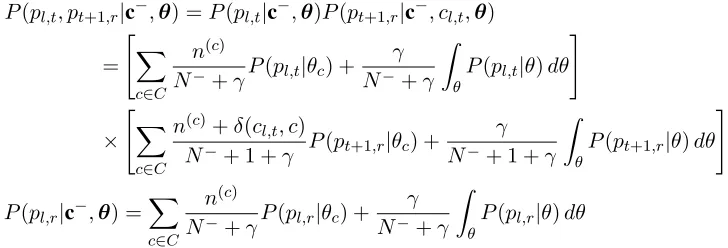
bt’s value by sampling from the normalized distribu-tion of Eq. 6 and Eq. 7. The full derivadistribu-tions of Eq. 6 and Eq. 7 are shown in Fig. 3.
Forbt = 1, to account the fact that when the model
generatespt+1,r,pl,t is already generated and owns
a cluster label, we sample a cluster label forpl,tthat is reflected in the Kronecker delta function. To han-dle the integral in Fig. 3, we sample one HMM from the prior and compute the likelihood using the new HMM to approximate the integral as suggested in (Rasmussen, 2000; Neal, 2000).
5.2 Heuristic Boundary Elimination
To reduce the inference load on the boundary vari-ablesbt, we exploit acoustic cues in the feature space
to eliminate bt’s that are unlikely to be phonetic
boundaries. We follow the pre-segmentation method described in Glass (2003) to achieve the goal. For the rest of the boundary variables that are proposed by the heuristic algorithm, we randomly initialize their values and proceed with the sampling process described above.
6 Experimental Setup
To the best of our knowledge, there are no stan-dard corpora for evaluating unsupervised methods for acoustic modeling. However, numerous related studies have reported performance on the TIMIT corpus (Dusan and Rabiner, 2006; Estevan et al., 2007; Qiao et al., 2008; Zhang and Glass, 2009; Zhang et al., 2012), which creates a set of strong baselines for us to compare against. Therefore, the TIMIT corpus is chosen as the evaluation set for our model. In this section, we describe the methods used to measure the performance of our model on the following three tasks: sub-word acoustic model-ing, segmentation and nonparametric clustering. Unsupervised Segmentation We compare the phonetic boundaries proposed by our model to the manual labels provided in the TIMIT dataset. We follow the suggestion of (Scharenborg et al., 2010) and use a 20-ms tolerance window to compute re-call, precision rates and F-score of the segmentation our model proposed for TIMIT’s training set. We compare our model against the state-of-the-art un-supervised and semi-un-supervised segmentation meth-ods that were also evaluated on the TIMIT training set (Dusan and Rabiner, 2006; Qiao et al., 2008). Nonparametric Clustering Our model automat-ically groups speech segments into different
clus-ters. One question we are interested in answering is whether these learned clusters correlate to En-glish phones. To answer the question, we develop a method to map cluster labels to the phone set in a dataset. We align each cluster label in an utter-ance to the phone(s) it overlaps with in time by using the boundaries proposed by our model and the manually-labeled ones. When a cluster label overlaps with more than one phone, we align it to the phone with the largest overlap.4 We com-pile the alignment results for 3696 training utter-ances5 and present a confusion matrix between the learned cluster labels and the 48 phonetic units used in TIMIT (Lee and Hon, 1989).
Sub-word Acoustic Modeling Finally, and most importantly, we need to gauge the quality of the learned sub-word acoustic models. In previous work, Varadarajan et al. (2008) and Garcia and Gish (2006) tested their models on a phone recog-nition task and a term detection task respectively. These two tasks are fair measuring methods, but per-formance on these tasks depends not only on the learned acoustic models, but also other components such as the label-to-phone transducer in (Varadara-jan et al., 2008) and the graphone model in (Garcia and Gish, 2006). To reduce performance dependen-cies on components other than the acoustic model, we turn to the task of spoken term detection, which is also the measuring method used in (Jansen and Church, 2011).
We compare our unsupervised acoustic model with three supervised ones: 1) an English triphone model, 2) an English monophone model and 3) a Thai monophone model. The first two were trained on TIMIT, while the Thai monophone model was trained with 32 hour clean read Thai speech from the LOTUS corpus (Kasuriya et al., 2003). All of the three models, as well as ours, used three-state HMMs to model phonetic units. To conduct spoken term detection experiments on the TIMIT dataset, we computed a posteriorgram representa-tion for both training and test feature frames over the
4Except when a cluster label is mapped to /vcl/ /b/, /vcl/ /g/
and /vcl/ /d/, where the duration of the release /b/, /g/, /d/ is almost always shorter than the closure /vcl/. In this case, we align the cluster label to both the closure and the release.
5
γ αb β η µ0 κ0 α0 β0
[image:8.612.96.279.61.90.2]1 0.5 3 3 µd 5 3 3/λd Table 1: The values of the hyperparameters of our model, whereµdand λdare thedth entry of the mean and the diagonal of the inverse covariance matrix of training data.
HMM states for each of the four models. Ten key-words were randomly selected for the task. For ev-ery keyword, spoken examples were extracted from the training set and were searched for in the test set using segmental dynamic time warping (Zhang and Glass, 2009).
In addition to the supervised acoustic models, we also compare our model against the state-of-the-art unsupervised methods for this task (Zhang and Glass, 2009; Zhang et al., 2012). Zhang and Glass (2009) trained a GMM with 50 components to decode posteriorgrams for the feature frames, and Zhang et al. (2012) used a deep Boltzmann machine (DBM) trained with pseudo phone labels generated from an unsupervised GMM to produce a posteri-orgram representation. The evaluation metrics they used were: 1) P@N, the average precision of the top N hits, where N is the number of occurrences of each keyword in the test set; 2) EER: the average equal er-ror rate at which the false acceptance rate is equal to the false rejection rate. We also report experimental results using the P@N and EER metrics.
Hyperparameters and Training Iterations The values of the hyperparameters of our model are shown in Table 1, whereµd and λd are thedth en-try of the mean and the diagonal of the inverse co-variance matrix computed from training data. We pick these values to impose weak priors on our model.6 We run our sampler for 20,000 iterations,
after which the evaluation metrics for our model all converged. In Section 7, we report the performance of our model using the sample from the last iteration.
7 Results
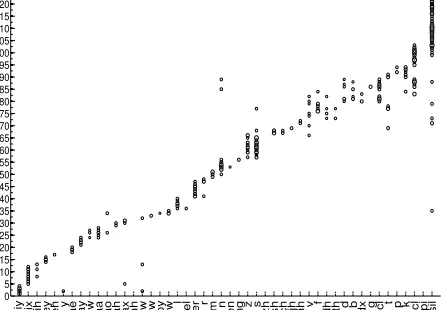
Fig. 4 shows a confusion matrix of the 48 phones used in TIMIT and the sub-word units learned from 3696 TIMIT utterances. Each circle represents a mapping pair for a cluster label and an English phone. The confusion matrix demonstrates a strong
6
In the future, we plan to extend the model and infer the values of these hyperparameters from data directly.
0 5 10 15 20 25 30 35 40 45 50 55 60 65 70 75 80 85 90 95 100 105 110 115 120
iy ix ih ey eh y
ae ay aw aa ao ah ax uh uw ow oy w
l
el er r m n en ng z s zh sh ch jh hh v f dh th d b dx g vcl t p k cl epi sil
Figure 4: A confusion matrix of the learned cluster labels from the TIMIT training set excluding the sa type utter-ances and the 48 phones used in TIMIT. Note that for clarity, we show only pairs that occurred more than200 times in the alignment results. The average co-occurrence frequency of the mapping pairs in this figure is431.
correlation between the cluster labels and individ-ual English phones. For example, clusters 19, 20 and 21 are mapped exclusively to the vowel /ae/. A more careful examination on the alignment results shows that the three clusters are mapped to the same vowel in a different acoustic context. For example, cluster 19 is mapped to /ae/ followed by stop conso-nants, while cluster 20 corresponds to /ae/ followed by nasal consonants. This context-dependent rela-tionship is also observed in other English phones and their corresponding sets of clusters. Fig. 4 also shows that a cluster may be mapped to multiple En-glish phones. For instance, clusters 85 and 89 are mapped to more than one phone; nevertheless, a closer look reveals that these clusters are mapped to /n/, /d/ and /b/, which are sounds with a similar place of articulation (i.e. labial and dental). These corre-lations indicate that our model is able to discover the phonetic composition of a set of speech data without any language-specific knowledge.
[image:8.612.316.538.65.220.2]unit(%) P@N EER English triphone 75.9 11.7 English monophone 74.0 11.8 Thai monophone 56.6 14.9 Our model 63.0 16.9
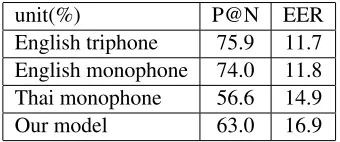
Table 2: The performance of our model and three super-vised acoustic models on the spoken term detection task.
acoustic models, it generates a comparable EER and a more accurate detection performance for top hits than the Thai monophone model. This indicates that even without supervision, our model captures and learns the acoustic characteristics of a language au-tomatically and is able to produce an acoustic model that outperforms a language-mismatched acoustic model trained with high supervision.
Table 3 shows that our model improves P@N by a large margin and generates only a slightly worse EER than the GMM baseline on the spoken term detection task. At the end of the training process, our model induced 169 HMMs, which were used to compute posteriorgrams. This seems unfair at first glance because Zhang and Glass (2009) only used 50 Gaussians for decoding, and the better result of our model could be a natural outcome of the higher complexity of our model. However, Zhang and Glass (2009) pointed out that using more Gaussian mixtures for their model did not improve their model performance. This indicates that the key reason for the improvement is our joint modeling method in-stead of simply the higher complexity of our model. Compared to the DBM baseline, our model pro-duces a higher EER; however, it improves the rel-ative detection precision of top hits by 24.3%. As indicated in (Zhang et al., 2012), the hierarchical structure of DBM allows the model to provide a descent posterior representation of phonetic units. Even though our model only contains simple HMMs and Gaussians, it still achieves a comparable, if not better, performance as the DBM baseline. This demonstrates that even with just a simple model structure, the proposed learning algorithm is able to acquire rich phonetic knowledge from data and generate a fine posterior representation for phonetic units.
Table 4 summarizes the segmentation perfor-mance of the baselines, our model and the heuristic
unit(%) P@N EER
GMM (Zhang and Glass, 2009) 52.5 16.4 DBM (Zhang et al., 2012) 51.1 14.7
[image:9.612.102.272.60.131.2]Our model 63.0 16.9
Table 3: The performance of our model and the GMM and DBM baselines on the spoken term detection task.
unit(%) Recall Precision F-score Dusan (2006) 75.2 66.8 70.8 Qiao et al. (2008)* 77.5 76.3 76.9
Our model 76.2 76.4 76.3
Pre-seg 87.0 50.6 64.0
Table 4: The segmentation performance of the baselines, our model and the heuristic pre-segmentation on TIMIT training set. *The number of phone boundaries in each utterance was assumed to be known in this model.
pre-segmentation (pre-seg) method. The language-independent pre-seg method is suitable for seeding our model. It eliminates most unlikely boundaries while retaining about 87% true boundaries. Even though this indicates that at best our model only recalls 87% of the true boundaries, the pseg re-duces the search space significantly. In addition, it also allows the model to capture proper phone durations, which compensates the fact that we do not include any explicit duration modeling mecha-nisms in our approach. In the best semi-supervised baseline model (Qiao et al., 2008), the number of phone boundaries in an utterance was assumed to be known. Although our model does not incorpo-rate this information, it still achieves a very close F-score. When compared to the baseline in which the number of phone boundaries in each utterance was also unknown (Dusan and Rabiner, 2006), our model outperforms in both recall and precision, im-proving the relative F-score by 18.8%. The key dif-ference between the two baselines and our method is that our model does not treat segmentation as a stand-alone problem; instead, it jointly learns seg-mentation, clustering and acoustic units from data. The improvement on the segmentation task shown by our model further supports the strength of the joint learning scheme proposed in this paper.
8 Conclusion
knowledge, this method is able to discover phonetic units that are closely related to English phones, im-prove upon state-of-the-art unsupervised segmenta-tion method and generate more precise spoken term detection performance on the TIMIT dataset. In the future, we plan to explore phonological context and use more flexible topological structures to model acoustic units within our framework.
Acknowledgements
The authors would like to thank Hung-an Chang and Ekapol Chuangsuwanich for training the English and Thai acoustic models. Thanks to Matthew John-son, Ramesh Sridharan, Finale Doshi, S.R.K. Brana-van, the MIT Spoken Language Systems group and the anonymous reviewers for helpful comments.
References
Chun-An Chan and Lin-Shan Lee. 2011. Unsupervised hidden Markov modeling of spoken queries for spo-ken term detection without speech recognition. In
Pro-ceedings of INTERSPEECH, pages 2141 – 2144.
Steven B. Davis and Paul Mermelstein. 1980. Com-parison of parametric representations for monosyllabic word recognition in continuously spoken sentences.
IEEE Trans. on Acoustics, Speech, and Signal
Pro-cessing, 28(4):357–366.
Sorin Dusan and Lawrence Rabiner. 2006. On the re-lation between maximum spectral transition positions
and phone boundaries. In Proceedings of
INTER-SPEECH, pages 1317 – 1320.
Yago Pereiro Estevan, Vincent Wan, and Odette Scharen-borg. 2007. Finding maximum margin segments in speech. InProceedings of ICASSP, pages 937 – 940. Emily Fox, Erik B. Sudderth, Michael I. Jordan, and
Alan S. Willsky. 2011. A sticky HDP-HMM with application to speaker diarization. Annals of Applied
Statistics.
Alvin Garcia and Herbert Gish. 2006. Keyword spotting of arbitrary words using minimal speech resources. In
Proceedings of ICASSP, pages 949–952.
John S. Garofolo, Lori F. Lamel, William M. Fisher, Jonathan G. Fiscus, David S. Pallet, Nancy L.
Dahlgren, and Victor Zue. 1993. Timit
acoustic-phonetic continuous speech corpus.
Andrew Gelman, John B. Carlin, Hal S. Stern, and
Don-ald B. Rubin. 2004. Bayesian Data Analysis. Texts
in Statistical Science. Chapman & Hall/CRC, second edition.
James Glass. 2003. A probabilistic framework for
segment-based speech recognition. Computer Speech
and Language, 17:137 – 152.
Sharon Goldwater. 2009. A Bayesian framework for word segmentation: exploring the effects of context.
Cognition, 112:21–54.
Aren Jansen and Kenneth Church. 2011. Towards un-supervised training of speaker independent acoustic
models. In Proceedings of INTERSPEECH, pages
1693 – 1696.
Frederick Jelinek. 1976. Continuous speech recogni-tion by statistical methods. Proceedings of the IEEE, 64:532 – 556.
Sawit Kasuriya, Virach Sornlertlamvanich, Patcharika Cotsomrong, Supphanat Kanokphara, and Nattanun Thatphithakkul. 2003. Thai speech corpus for Thai
speech recognition. InProceedings of Oriental
CO-COSDA, pages 54–61.
Kai-Fu Lee and Hsiao-Wuen Hon. 1989.
Speaker-independent phone recognition using hidden Markov
models. IEEE Trans. on Acoustics, Speech, and
Sig-nal Processing, 37:1641 – 1648.
Chin-Hui Lee, Frank Soong, and Biing-Hwang Juang.
1988. A segment model based approach to speech
recognition. InProceedings of ICASSP, pages 501–
504.
Kevin P. Murphy. 2007. Conjugate Bayesian analysis of the Gaussian distribution. Technical report, University of British Columbia.
Radford M. Neal. 2000. Markov chain sampling
meth-ods for Dirichlet process mixture models. Journal
of Computational and Graphical Statistics, 9(2):249–
265.
Yu Qiao, Naoya Shimomura, and Nobuaki Minematsu. 2008. Unsupervised optimal phoeme segmentation: Objectives, algorithms and comparisons. In
Proceed-ings of ICASSP, pages 3989 – 3992.
Carl Edward Rasmussen. 2000. The infinite Gaussian
mixture model. In Advances in Neural Information
Processing Systems, 12:554–560.
Odette Scharenborg, Vincent Wan, and Mirjam Ernestus. 2010. Unsupervised speech segmentation: An analy-sis of the hypothesized phone boundaries. Journal of
the Acoustical Society of America, 127:1084–1095.
Balakrishnan Varadarajan, Sanjeev Khudanpur, and
Em-manuel Dupoux. 2008. Unsupervised learning of
acoustic sub-word units. InProceedings of ACL-08:
HLT, Short Papers, pages 165–168.
Yaodong Zhang and James Glass. 2009.
Unsuper-vised spoken keyword spotting via segmental DTW on Gaussian posteriorgrams. InProceedings of ASRU, pages 398 – 403.
Yaodong Zhang, Ruslan Salakhutdinov, Hung-An Chang, and James Glass. 2012. Resource configurable spoken query detection using deep Boltzmann machines. In