Coordination Structures in Dependency Treebanks
Martin Popel, David Mareˇcek, Jan ˇStˇep´anek, Daniel Zeman, Zdenˇek ˇZabokrtsk´y Charles University in Prague, Faculty of Mathematics and Physics
Institute of Formal and Applied Linguistics ( ´UFAL) Malostransk´e n´amˇest´ı 25, CZ-11800 Praha, Czechia
{popel|marecek|stepanek|zeman|zabokrtsky}@ufal.mff.cuni.cz
Abstract
Paratactic syntactic structures are noto-riously difficult to represent in depen-dency formalisms. This has painful con-sequences such as high frequency of pars-ing errors related to coordination. In other words, coordination is a pending prob-lem in dependency analysis of natural lan-guages. This paper tries to shed some light on this area by bringing a system-atizing view of various formal means de-veloped for encoding coordination struc-tures. We introduce a novel taxonomy of such approaches and apply it to treebanks across a typologically diverse range of 26 languages. In addition, empirical obser-vations on convertibility between selected styles of representations are shown too.
1 Introduction
In the last decade, dependency parsing has grad-ually been receiving visible attention. One of the reasons is the increased availability of dency treebanks, be they results of genuine depen-dency annotation projects or converted automat-ically from previously existing phrase-structure treebanks.
In both cases, a number of decisions have to be made during the construction or conversion of a dependency treebank. The traditional notion of dependency does not always provide unambiguous solutions, e.g. when it comes to attaching func-tional words. Worse, dependency representation is at a loss when it comes to representing paratactic linguistic phenomena such as coordination, whose nature is symmetric (two or more conjuncts play the same role), as opposed to the head-modifier asymmetry of dependencies.1
1We use the termmodifier(orchild) for all types of
de-pendent nodes includingarguments.
The dominating solution in treebank design is to introduce artificial rules for the encoding of coor-dination structures within dependency trees using the same means that express dependencies, i.e., by using edges and by labeling of nodes or edges. Ob-viously, any tree-shaped representation of a coor-dination structure (CS) must be perceived only as a “shortcut” since relations present in coordination structures form an undirected cycle, as illustrated already by Tesni`ere (1959). For example, if a noun is modified by two coordinated adjectives, there is a (symmetric) coordination relation between the two conjuncts and two (asymmetric) dependency relations between the conjuncts and the noun.
However, as there is no obvious linguistic in-tuition telling us which tree-shaped CS encoding is better and since the degree of freedom has sev-eral dimensions, one can find a number of distinct conventions introduced in particular dependency treebanks. Variations exist both in topology (tree shape) and labeling. The main goal of this pa-per is to give a systematic survey of the solutions adopted in these treebanks.
Naturally, the interplay of dependency and co-ordination links in a single tree leads to serious parsing issues.2 The present study does not try to
decide which coordination style is the best from the parsing point of view.3 However, we believe
that our survey will substantially facilitate experi-ments in this direction in the future, at least by ex-ploring and describing the space of possible can-didates.
2CSs have been reported to be one of the most frequent
sources of parsing errors (Green and ˇZabokrtsk´y, 2012; Mc-Donald and Nivre, 2007; K¨ubler et al., 2009; Collins, 2003). Their impact on quality of dependency-based machine trans-lation can also be substantial; as documented on an English-to-Czech dependency-based translation system (Popel and ˇZabokrtsk´y, 2009), 39% of serious translation errors which are caused by wrong parsing have to do with coordination.
3There might be no such answer, as different CS
conven-tions might serve best for different applicaconven-tions or for differ-ent parser architectures.
The rest of the paper is structured as follows. Section 2 describes some known problems related to CS. Section 3 shows possible “styles” for rep-resenting CS. Section 4 lists treebanks whose CS conventions we studied. Section 5 presents empir-ical observations on CS convertibility. Section 6 concludes the paper.
2 Related work
Let us first recall the basic well-known character-istics of CSs.
In the simplest case of a CS, a coordinating conjunction joins two (usually syntactically and semantically compatible) words or phrases called conjuncts. Even this simplest case is difficult to represent within a dependency tree because, in the words of Lombardo and Lesmo (1998): Depen-dency paradigms exhibit obvious difficulties with coordination because, differently from most lin-guistic structures, it is not possible to characterize the coordination construct with a general schema involving a head and some modifiers of it.
Proper formal representation of CSs is further complicated by the following facts:
• CSs with more than two conjuncts (multi-conjunct CSs) exist and are frequent.
• Besides “private” modifiers of individual conjuncts, there are modifiers shared by all conjuncts, such as in “Mary came and cried”. Shared modifiers may appear along-side with private modifiers of particular con-juncts.
• Shared modifiers can be coordinated, too: “big and cheap apples and oranges”. • Nested (embedded) coordinations are
possi-ble:“John and Mary or Sam and Lisa”. • Punctuation (commas, semicolons, three
dots) is frequently used in CSs, mostly with multi-conjunct coordinations or juxtaposi-tions which can be interpreted as CSs with-out conjunctions (e.g. “Don’t worry, be happy!”).
• In many languages, comma or other punctu-ation mark may play the role of the main co-ordinating conjunction.
• The coordinating conjunction may be a mul-tiword expression (“as well as”).
• Deficient CSs with a single conjunct exist. • Abbreviations like“etc.” comprise both the
conjunction and the last conjunct.
• Coordination may form very intricate struc-tures when combined with ellipsis. For ex-ample, a conjunct can be elided while its ar-guments remain in the sentence, such as in the following traditional example: “I gave the books to Mary and the records to Sue.” • The border between paratactic and hypotactic
surface means of expressing coordination re-lations is fuzzy. Some languages can use en-clitics instead of conjunctions/prepositions, e.g. Latin“Senatus PopulusqueRomanus”. Purely hypotactic surface means such as the preposition in“John with Mary”occur too.4
• Careful semantic analysis of CSs discloses additional complications: if a node is mod-ified by a CS, it might happen that it is the node itself (and not its modifiers) what should be semantically considered as a con-junct. Note the difference between“red and white wine” (which is synonymous to “red wine and white wine”) and “red and white flag of Poland”. Similarly, “five dogs and cats”has a different meaning than“five dogs and five cats”.
Some of these issues were recognized already by Tesni`ere (1959). In his solution, conjuncts are connected by vertical edges directly to the head and by horizontal edges to the conjunction (which constitutes a cycle in every CS). Many different models have been proposed since, out of which the following are the most frequently used ones:
• MS = Mel’ˇcuk style used in the Meaning-Text Theory (MTT): the first conjunct is the head of the CS, with the second conjunct at-tached as a dependent of the first one, third conjunct under the second one, etc. Coor-dinating conjunction is attached under the penultimate conjunct, and the last conjunct is attached under the conjunction (Mel’ˇcuk, 1988),
• PS = Prague Dependency Treebank (PDT) style: all conjuncts are attached under the coordinating conjunction (along with shared modifiers, which are distinguished by a spe-cial attribute) (Hajiˇc et al., 2006),
4As discussed by Stassen (2000), all languages seem to
• SS = Stanford parser style:5the first conjunct
is the head and the remaining conjuncts (as well as conjunctions) are attached under it.
One can find various arguments supporting the particular choices. MTT possesses a complex set of linguistic criteria for identifying the gov-ernor of a relation (see Mazziotta (2011) for an overview), which lead to MS. MS is preferred in a rule-based dependency parsing system of Lom-bardo and Lesmo (1998). PS is advocated by ˇStˇep´anek (2006) who claims that it can represent shared modifiers using a single additional binary attribute, while MS would require a more complex co-indexing attribute. An argumentation of Tratz and Hovy (2011) follows a similar direction: We would like to change our [MS] handling of coordi-nating conjunctions to treat the coordicoordi-nating con-junction as the head [PS] because this has fewer ambiguities than [MS]. . .
We conclude that the influence of the choice of coordination style is a well-known problem in de-pendency syntax. Nevertheless, published works usually focus only on a narrow ad-hoc selection of few coordination styles, without giving any sys-tematic perspective.
Choosing a file format presents a different prob-lem. Despite various efforts to standardize lin-guistic annotation,6 no commonly accepted
stan-dard exists. The primitive format used for CoNLL shared tasks is widely used in dependency parsing, but its weaknesses have already been pointed out (cf. Straˇn´ak and ˇStˇep´anek (2010)). Moreover, par-ticular treebanks vary in their contents even more than in their format, i.e. each treebank has its own way of representing prepositions or different gran-ularity of syntactic labels.
3 Variations in representing coordination structures
Our analysis of variations in representing coordi-nation structures is based on observations from a set of dependency treebanks for 26 languages.7
5We use the already established MS-PS-SS distinction to
facilitate literature overview; as shown in Section 3, the space of possible coordination styles is much richer.
6For example, TEI (TEI Consortium, 2013), PML (Hana
and ˇStˇep´anek, 2012), SynAF (ISO 24615, 2010).
7The primary data sources are the following: Ancient Greek: Ancient Greek Dependency Treebank (Bamman and Crane, 2011), Arabic: Prague Arabic Dependency Tree-bank 1.0 (Smrˇz et al., 2008),Basque: Basque Dependency Treebank (larger version than CoNLL 2007 generously
pro-In accordance with the usual conventions, we as-sume that each sentence is represented by one de-pendency tree, in which each node corresponds to one token (word or punctuation mark). Apart from that, we deliberately limit ourselves to CS representations that have shapes of connected sub-graphs of dependency trees.
We limit our inventory of means of expressing CSs within dependency trees to (i) tree topology (presence or absence of a directed edge between two nodes, Section 3.1), and (ii) node labeling (additional attributes stored insided nodes, Sec-tion 3.2).8 Further, we expect that the set of
pos-sible variations can be structured along several di-mensions, each of which corresponds to a certain simple characteristic (such as choosing the left-most conjunct as the CS head, or attaching shared modifiers below the nearest conjunct). Even if it does not make sense to create the full Cartesian product of all dimensions because some values cannot be combined, it allows to explore the space of possible CS styles systematically.9
3.1 Topological variations
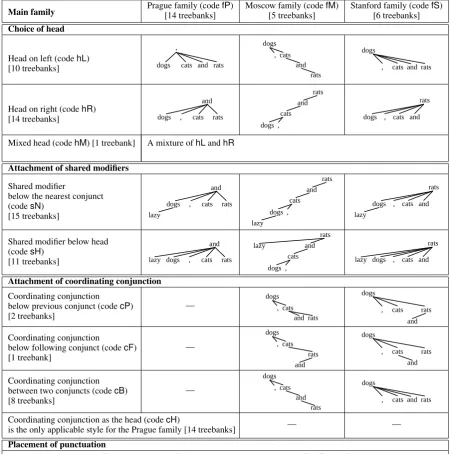
We distinguish the following dimensions of topo-logical variations of CS styles (see Figure 1):
Family – configuration of conjuncts. We di-vide the topological variations into three main groups, labeled as Prague (fP), Moscow (fM), and
vided by IXA Group) (Aduriz and others, 2003),Bulgarian: BulTreeBank (Simov and Osenova, 2005), Czech: Prague Dependency Treebank 2.0 (Hajiˇc et al., 2006),Danish: Dan-ish Dependency Treebank (Kromann et al., 2004), Dutch: Alpino Treebank (van der Beek and others, 2002),English: Penn TreeBank 3 (Marcus et al., 1993),Finnish: Turku De-pendency Treebank (Haverinen et al., 2010),German: Tiger Treebank (Brants et al., 2002),Greek (modern): Greek De-pendency Treebank (Prokopidis et al., 2005), Hindi, Ben-gali and Telugu: Hyderabad Dependency Treebank (Husain et al., 2010),Hungarian: Szeged Treebank (Csendes et al., 2005),Italian: Italian Syntactic-Semantic Treebank (Mon-temagni and others, 2003),Latin: Latin Dependency Tree-bank (Bamman and Crane, 2011),Persian: Persian Depen-dency Treebank (Rasooli et al., 2011),Portuguese: Floresta sint´a(c)tica (Afonso et al., 2002),Romanian: Romanian De-pendency Treebank (C˘al˘acean, 2008), Russian: Syntagrus (Boguslavsky et al., 2000), Slovene: Slovene Dependency Treebank (Dˇzeroski et al., 2006),Spanish: AnCora (Taul´e et al., 2008),Swedish: Talbanken05 (Nilsson et al., 2005),
Tamil: TamilTB (Ramasamy and ˇZabokrtsk´y, 2012), Turk-ish: METU-Sabanci Turkish Treebank (Atalay et al., 2003).
8Edge labeling can be trivially converted to node labeling
in tree structures.
9The full Cartesian product of variants in Figure 1 would
Main family Prague family (code[14 treebanks] fP) Moscow family (code[5 treebanks] fM) Stanford family (code[6 treebanks] fS) Choice of head
Head on left (codehL) [10 treebanks]
dogs
and , cats
rats , cats and rats
dogs
Head on right (codehR) [14 treebanks]
Mixed head (codehM) [1 treebank] A mixture ofhLandhR
Attachment of shared modifiers
Shared modifier
below the nearest conjunct (codesN)
[15 treebanks]
Shared modifier below head (codesH)
[11 treebanks]
lazy
lazy dogs , cats rats and
lazy
dogs , la
lazy
dogs , and cats
rats
lazy dogs , cats and rats
Attachment of coordinating conjunction
Coordinating conjunction below previous conjunct (codecP)
[2 treebanks] —
dogs
and rats
, cats , cats rats
dogs
and
Coordinating conjunction
[image:4.595.70.522.63.518.2]below following conjunct (codecF)
[1 treebank] —
and rats
dogs
rats , cats
and
, cats rats dogs
and
Coordinating conjunction between two conjuncts (codecB) [8 treebanks]
—
dogs
and , cats
rats , cats and rats
dogs
Coordinating conjunction as the head (codecH)
is the only applicable style for the Prague family [14 treebanks] — —
Placement of punctuation
valuespP[7 treebanks],pF[1 treebank] andpB[15 treebanks] are analogous tocP,cFandcB (but applicable also to the Prague family)
Figure 1: Different coordination styles, variations in tree topology. Example phrase: “(lazy) dogs, cats and rats”. Style codes are described in Section 3.1.
Stanford (fS) families.10 This first dimension
dis-tinguishes the configuration of conjuncts: in the Prague family, all the conjuncts are siblings gov-erned by one of the conjunctions (or a punctuation fulfilling its role); in the Moscow family, the con-juncts form a chain where each node in the chain depends on the previous (or following) node; in the Stanford family, the conjuncts are siblings ex-cept for the first (or last) conjunct, which is the
10Names are chosen purely as a mnemonic device, so that
Prague Dependency Treebank belongs to the Prague family, Mel’ˇcuk style belongs to the Moscow family, and Stanford parser style belongs to the Stanford family.
head.11
Choice of head – leftmost or rightmost. In the Prague family, the head can be either the left-most12(hL) or the rightmost (hR) conjunction or
punctuation. Similarly, in the Moscow and Stan-ford families, the head can be either the leftmost (hL) or the rightmost (hR) conjunct. A third
op-11Note that for CSs with just two conjuncts, fMand fS
may look exactly the same (depending on the attachment of conjunctions and punctuation as described below).
12For simplicity, we use the terms left and right even if
tion (hM) is to mixhLandhRbased on some cri-terion, e.g. the Persian treebank useshRfor coor-dination of verbs andhLotherwise. For the exper-iments in Section 5, we choose the head which is closer to the parent of the whole CS, with the mo-tivation to make the edge between CS head and its parent shorter, which may improve parser training. Attachment of shared modifiers.Shared mod-ifiers may appear before the first conjunct or after the last one. Therefore, it seems reasonable to at-tach shared modifiers either to the CS head (sH), or to the nearest (i.e. first or last) conjunct (sN).
Attachment of coordinating conjunctions. In the Moscow family, conjunctions may be either part of the chain of conjuncts (cB), or they may be put outside of the chain and attached to the previ-ous (cP) or following (cF) conjunct. In the Stan-ford family, conjunctions may be either attached to the CS head (and thereforebetweenconjuncts) (cB), or they may be attached to the previous (cP) or the following (cF) conjunct. ThecBoption in both Moscow and Stanford families, treats con-junctions in the same way as conjuncts (with re-spect to topology only). In the Prague family, there is just one option available (cH) – one of the con-junctions is the CS head while the others are at-tached to it.
Attachment of punctuation. Punctuation to-kens separating conjuncts (commas, semicolons etc.) could be treated the same way as conjunc-tions. However, in most treebanks it is treated differently, so we consider it as well. The val-uespP, pFand pBare analogous tocP,cF and
cB except that punctuation may be also attached to the conjunction in case of pP and pF (other-wise, a comma before the conjunction would be non-projectively attached to the member follow-ing the conjunction).
The three established styles mentioned in Sec-tion 2 can be defined in terms of the newly intro-duced abbreviations: PS =fPhRsHcHpB, MS =
fMhLsNcBp?, and SS =fShLsNcBp?.13
3.2 Labeling variations
Most state-of-the-art dependency parsers can pro-duce labeled edges. However, the parsers propro-duce only one label per edge. To fully capture CSs, we need more than one label, because there are several aspects involved (see the initial
assump-13The question marks indicate that the original Mel’ˇcuk
and Stanford parser styles ignore punctuation.
tions in Section 3): We need to identify the co-ordinating conjunction (its POS tag might not be enough), conjuncts, shared modifiers, and punctu-ation that separates conjuncts. Besides that, there should be a label classifying the dependency rela-tion between the CS and its parent.
Some of the information can be retrieved from the topology of the tree and the “main label” of each node, but not everything. The additional in-formation can be attached to the main label, but such approach obscures the logical structure.
In the Prague family, there are two possible ways to label a conjunction and conjuncts:
Code dU (“dependency labeled at the upper level of the CS”). The dependency relation of the whole CS to its parent is represented by the label of the conjunction, while the conjuncts are marked with a special label for conjuncts (e.g.ccofin the Hyderabad Dependency Treebank).
CodedL(“lower level”). The CS is represented by a coordinating conjunction (or punctuation if there is no conjunction) with a special label (e.g.
Coordin PDT). Subsequently, each conjunct has its own label that reflects the dependency relation towards the parent of the whole CS, therefore, con-juncts of the same CS can have different labels, e.g.“Who[SUBJ] and why[ADV] did it?”
Most Prague family treebanks use sH, i.e. shared modifiers are attached to the head (coor-dinating conjunction). Each child of the head has to belong to one of three sets: conjuncts, shared modifiers, and punctuation or additional conjunc-tions. In PDT, conjuncts, punctuation and addi-tional conjunctions are recognized by specific la-bels. Any other children of the head are shared modifiers.
In theStanford and Moscow families, one of the conjuncts is the head. In practice, it is never la-beled as a conjunct explicitly, because the fact that it is a conjunct can be deduced from the presence of conjuncts among its children. Usually, the other conjuncts are labeled as conjuncts; conjunctions and punctuation also have a special label. This type of labeling corresponds to thedUtype.
Alternatively (as found in the Turkish treebank,
dL), all conjuncts in the Moscow chain have their own dependency labels and the fact that they are conjuncts follows from theCOORDINATION la-bels of the conjunction and punctuation nodes be-tween them.
Stan-ford and Moscow families, an additional label is needed again to distinguish between private and shared modifiers since they cannot be distin-guished topologically. Moreover, if nested CSs are allowed, a binary label is not sufficient (i.e. “shared” versus “private”) because it also has to indicate which conjuncts the shared modifier be-longs to.14
We use the following binary flag codes for cap-turing which CS participants are distinguished in the annotation: m01 = shared modifiers anno-tated; m10 = conjuncts annotated; m11 = both annotated;m00= neither annotated.
4 Coordination Structures in Treebanks
In this section, we identify the CS styles defined in the previous section as used in the primary tree-bank data sources; statistical observations (such as the amount of annotated shared modifiers) pre-sented here, as well as experiments on CS-style convertibility presented in Section 5.2, are based on the normalized shapes of the treebanks as con-tained in the HamleDT 1.0 treebank collection (Zeman et al., 2012).15
Some of the treebanks were downloaded indi-vidually from the web, but most of them came from previously published collections for depen-dency parsing campaigns: six languages from CoNLL-2006 (Buchholz and Marsi, 2006), seven languages from CoNLL-2007 (Nivre et al., 2007), two languages from CoNLL-2009 (Hajiˇc and oth-ers, 2009), three languages from ICON-2010 (Hu-sain et al., 2010). Obviously, there is a certain risk that the CS-related information contained in the source treebanks was slightly biased by the properties of the CoNLL format upon conversion. In addition, many of the treebanks were natively dependency-based (cf. the 2nd column of Table 1), but some were originally based on constituents and thus specific converters to the CoNLL for-mat had to be created (for instance, the Span-ish phrase-structure trees were converted to de-pendencies using a procedure described by Civit et al. (2006); similarly, treebank-specific convert-ers have been used for other languages). Again,
14This is not needed in Prague family where shared
modi-fiers are attached to the conjunction provided that each shared modifier is shared by conjuncts that form a full subtree to-gether with their coordinating conjunctions; no exceptions were found during the annotation process of the PDT.
15A subset of the treebanks whose license
terms permit redistribution is available directly at http://ufal.mff.cuni.cz/hamledt/.
Danish Romanian
hunde
rotter , katte og c
tter
câini şi
pisici şobolani
Hungarian
[image:6.595.310.515.64.165.2]kutyák , macskák és patkányok
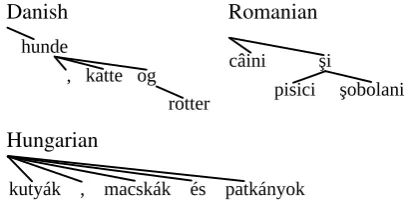
Figure 2: Annotation styles of a few treebanks do not fit well into the multidimensional space de-fined in Section 3.1.
there is some risk that the CS-related information contained in treebanks resulting from such conver-sions is slightly different from what was intended in the very primary annotation.
There are several other languages (e.g. Esto-nian or Chinese) which are not included in our study, despite of the fact that constituency tree-banks do exist for them. The reason is that the choice of their CS style would be biased, because no independent converters exist – we would have to convert them to dependencies ourselves. We also know about several more dependency tree-banks that we have not processed yet.
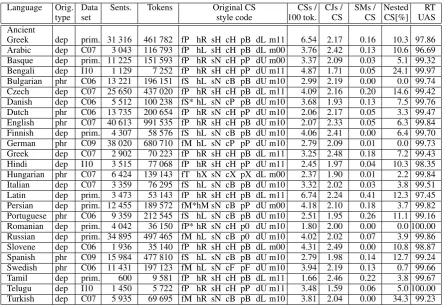
Table 1 shows 26 languages whose treebanks we have studied from the viewpoint of their CS styles. It gives the basic quantitative properties of the treebanks, their CS style in terms of the tax-onomy introduced in Section 3, as well as statis-tics related to CSs: the average number of CSs per 100 tokens, the average number of conjuncts per one CS, the average number of shared modifiers per one CS,16 and the percentage of nested CSs
among all CSs. The reader can return to Figure 1 to see the basic statistics on the “popularity” of individual design decisions among the developers of dependency treebanks or constituency treebank converters.
CS styles of most treebanks are easily classifi-able using the codes introduced in Section 3, plus a few additional codes:
• p0= punctuation was removed from the tree-bank.
16All non-Prague family treebanks are marked sN and
Language Orig. Data Sents. Tokens Original CS CSs / CJs / SMs / Nested RT
type set style code 100 tok. CS CS CS[%] UAS
Ancient
[image:7.595.76.521.60.367.2]Greek dep prim. 31 316 461 782 fP hR sH cH pB dL m11 6.54 2.17 0.16 10.3 97.86 Arabic dep C07 3 043 116 793 fP hL sH cH pB dL m00 3.76 2.42 0.13 10.6 96.69 Basque dep prim. 11 225 151 593 fP hR sN cH pP dU m00 3.37 2.09 0.03 5.1 99.32 Bengali dep I10 1 129 7 252 fP hR sH cH pP dU m11 4.87 1.71 0.05 24.1 99.97 Bulgarian phr C06 13 221 196 151 fS hL sN cB pB dU m10 2.99 2.19 0.00 0.0 99.74 Czech dep C07 25 650 437 020 fP hR sH cH pB dL m11 4.09 2.16 0.20 14.6 99.42 Danish dep C06 5 512 100 238 fS* hL sN cP pB dU m10 3.68 1.93 0.13 7.5 99.76 Dutch phr C06 13 735 200 654 fP hR sN cH pP dU m10 2.06 2.17 0.05 3.3 99.47 English phr C07 40 613 991 535 fP hR sH cH pB dU m10 2.07 2.33 0.05 6.3 99.84 Finnish dep prim. 4 307 58 576 fS hL sN cB pB dU m10 4.06 2.41 0.00 6.4 99.70 German phr C09 38 020 680 710 fM hL sN cP pP dU m10 2.79 2.09 0.01 0.0 99.73 Greek dep C07 2 902 70 223 fP hR sH cH pB dL m11 3.25 2.48 0.18 7.2 99.43 Hindi dep I10 3 515 77 068 fP hR sH cH pP dU m11 2.45 1.97 0.04 10.3 98.35 Hungarian phr C07 6 424 139 143 fT hX sN cX pX dL m00 2.37 1.90 0.01 2.2 99.84 Italian dep C07 3 359 76 295 fS hL sN cB pB dU m10 3.32 2.02 0.03 3.8 99.51 Latin dep prim. 3 473 53 143 fP hR sH cH pB dL m11 6.74 2.24 0.41 12.3 97.45 Persian dep prim. 12 455 189 572 fM*hM sN cB pP dU m00 4.18 2.10 0.18 3.7 99.82 Portuguese phr C06 9 359 212 545 fS hL sN cB pB dU m10 2.51 1.95 0.26 11.1 99.16 Romanian dep prim. 4 042 36 150 fP* hR sN cH p0 dU m10 1.80 2.00 0.00 0.0 100.00 Russian dep prim. 34 895 497 465 fM hL sN cB p0 dU m10 4.02 2.02 0.07 3.9 99.86 Slovene dep C06 1 936 35 140 fP hR sH cH pB dL m00 4.31 2.49 0.00 10.8 98.87 Spanish phr C09 15 984 477 810 fS hL sN cB pB dU m10 2.79 1.98 0.14 12.7 99.24 Swedish phr C06 11 431 197 123 fM hL sN cF pF dU m10 3.94 2.19 0.13 0.7 99.66 Tamil dep prim. 600 9 581 fP hR sH cH pB dL m11 1.66 2.46 0.22 3.8 99.67 Telugu dep I10 1 450 5 722 fP hR sH cH pP dU m11 3.48 1.59 0.06 5.0 100.00 Turkish dep C07 5 935 69 695 fM hR sN cB pB dL m10 3.81 2.04 0.00 34.3 99.23 Table 1: Overview of analyzed treebanks. prim. = primary source; C06–C09 = CoNLL 2006–2009; I10 = ICON 2010; SM = shared modifier; CJ = conjunct; Nested CS = portion of CSs participating in nested CSs (both as the inner and outer CS); RT UAS = unlabeled attachment score of the roundtrip experiment described in Section 5. Style codes are defined in Sections 3 and 4.
• fM*= Persian treebank uses a mix offMand
[image:7.595.78.518.62.367.2]fS:fSfor coordination of verbs and fM oth-erwise.
Figure 2 shows three other anomalies:
• fS*= Danish treebank employs a mixture of
fSandfM, where the last conjunct is attached indirectly via the conjunction.
• fP*= Romanian treebank omits punctuation tokens and multi-conjunct coordinations get split.
• fT = Hungarian Szeged treebank uses “Tesni`ere family” – disconnected graphs for CSs where conjuncts (and conjunction and punctuation) are attached directly to the par-ent of CS, and so the other style dimensions are not applicable (hX,cX,pX).
5 Empirical Observations on
Convertibility of Coordination Styles
The various styles cannot represent the CS-related information to the same extent. For example,
it is not possible to represent nested CSs in the Moscow and Stanford families without signifi-cantly changing the number of possible labels.17
The dL style (which is most easily applicable to the Prague family) can represent coordination of different dependency relations. This is again not possible in the other styles without adding e.g. a special “prefix” denoting the relations.
We can see that the Prague family has a greater expressive power than the other two families: it can represent complex CSs using just one addi-tional binary label, distinguishing between shared modifiers and conjuncts. A similar additional label is needed in the other styles to distinguish between shared and private modifiers.
Because of the different expressive power, con-verting a CS from one style to another may lead to a loss of information. For example, as
17Mel’ˇcuk uses “grouping” to nest CSs – cf. related
there is no way of representing shared modifiers in the Moscow family without an additional at-tribute, converting a CS with shared modifiers from Prague to Moscow family makes the modi-fiers private. When converting back, one can use certain heuristics to handle the most obvious cases, but sometimes the modifiers will stay private (very often, the nature of a modifier depends on context or is debatable even for humans, e.g.“Young boys and girls”).
5.1 Transformation algorithm
We developed an algorithm to transform one CS style to another. Two subtasks must be solved by the algorithm: identification of individual CSs and their participants, and transforming of the individ-ual CSs.
Obviously, the individual CSs cannot be trans-formed independently because of coordination nesting. For instance, when transforming a nested coordination from the Prague style to the Moscow style (e.g. tofMhL), the leftmost conjunct in the inner (lower) coordination must climb up to be-come the head of the inner CS, but then it must climb up once again to become the head of the outer (upper) CS too. This shows that inner CSs must be transformed first.
We tackle this problem by a depth-first recur-sion. When going down the tree, we only recog-nize all the participants of the CSs, classify them and gather them in a separate data structure (one for each visited CS). The following four types of CS participants are distinguished: coordinat-ing conjunctions, conjuncts, shared modifiers, and punctuations that separate conjuncts.18No change
of the tree is performed during these descent steps. When returning back from the recursion (i.e., when climbing from a node back up to its par-ent), we test whether the abandoned node is the topmost node of some CS. If so, then this CS is transformed, which means that its participants are rehanged and relabelled according the the target CS style.
This procedure naturally guarantees that the
in-18Conjuncts are explicitly marked in most styles.
Coordi-nating conjunctions can be usually identified with the help of dependency labels and POS tags. Punctuation separating con-juncts can be detected with high accuracy using simple rules. If shared modifiers are not annotated (codem00orm10), one can imagine rule-based heuristics or special classifiers trained to distinguish shared modifiers. For the experiments in this section, we use the HamleDT gold annotation attribute
is shared modifier.
ner CSs are transformed first and that all CSs are transformed when the recursions returns to the root.
5.2 Roundtrip experiment
The number of possible conversion directions ob-viously grows quadratically with the number of styles. So far, we limited ourselves only to con-versions from/to the style of the HamleDT tree-bank collection, which contains all the treetree-banks under our study already converted into a com-mon scheme. The common scheme is based on the conventions of PDT, whose CS style is
fPhRsHcHpB.19
We selected nine styles (3 families times 3 head choices) and transformed all the HamleDT scheme treebanks to these nine styles and back, which we call aroundtrip. Resulting averaged unlabeled at-tachment scores (UAS, evaluated against the Ham-leDT scheme) in the last column of Table 1 indi-cate that the percentage of transformation errors (i.e. tokens attached to a different parent after the roundtrip) is lower than 1% for 20 out of the 26 languages.20 A manual inspection revealed two
main error sources. First, as noted above, the Stan-ford and Moscow families have lower expressive power than the Prague family, so naturally, the in-verse transformation was ambiguous and the trans-formation heuristics were not capable of identify-ing the correct variant every time. Second, we also encountered inconsistencies in the original tree-banks (which we were not trying to fix in Ham-leDT for now).
6 Conclusions and Future Work
We described a (theoretically very large) space of possible representations of CSs within the depen-dency framework. We pointed out a range of de-tails that make CSs a really complex phenomenon; anyone dealing with CSs in treebanking should take these observations into account.
We proposed a taxonomy of those approaches
19As documented in Zeman et al. (2012), the normalization
procedures used in HamleDT embrace many other phenom-ena as well (not only those related to coordination), and in-volve both structural transformation and dependency relation relabeling.
20Table 1 shows that Latin and Ancient Greek treebanks
that have been argued for in literature or employed in real treebanks.
We studied 26 existing treebanks of different languages. For each value of each dimension in Figure 1, we found at least one treebank where the value is used; even so, several treebanks take their own unique path that cannot be clearly classified under the taxonomy (the taxonomy could indeed be extended, for the price of being less clearly ar-ranged).
We discussed the convertibility between the var-ious styles and implemented a universal tool that transforms between any two styles of the taxon-omy. The tool achieves a roundtrip accuracy close to 100%. This is important because it opens the door to easily switching coordination styles for parsing experiments, phrase-to-dependency con-version etc.
While the focus of this paper is to explore and describe the expressive power of various annota-tion styles, we did not address the learnability of the styles by parsers. That will be a complemen-tary point of view, and thus a natural direction of future work for us.
Acknowledgments
We thank the providers of the primary data re-sources. The work on this project was sup-ported by the Czech Science Foundation grants no. P406/11/1499 and P406/2010/0875, and by research resources of the Charles University in Prague (PRVOUK). This work has been using lan-guage resources developed and/or stored and/or distributed by the LINDAT-Clarin project of the Ministry of Education of the Czech Republic (project LM2010013). Further, we would like to thank Jan Hajiˇc, Ondˇrej Duˇsek and four anony-mous reviewers for many useful comments on the manuscript of this paper.
References
Itzair Aduriz et al. 2003. Construction of a Basque de-pendency treebank. InProceedings of the 2nd Work-shop on Treebanks and Linguistic Theories.
Susana Afonso, Eckhard Bick, Renato Haber, and Di-ana Santos. 2002. “Floresta sint´a(c)tica”: a tree-bank for Portuguese. InLREC, pages 1968–1703. Nart B. Atalay, Kemal Oflazer, and Bilge Say. 2003.
The annotation process in the Turkish treebank. In
Proceedings of the 4th Intern. Workshop on Linguis-tically Interpreteted Corpora (LINC).
David Bamman and Gregory Crane. 2011. The An-cient Greek and Latin dependency treebanks. In
Language Technology for Cultural Heritage, Theory and Applications of Natural Language Processing, pages 79–98. Springer Berlin Heidelberg.
Igor Boguslavsky, Svetlana Grigorieva, Nikolai Grig-oriev, Leonid Kreidlin, and Nadezhda Frid. 2000. Dependency treebank for Russian: Concept, tools, types of information. In Proceedings of the 18th conference on Computational linguistics-Volume 2, pages 987–991. Association for Computational Lin-guistics Morristown, NJ, USA.
Sabine Brants, Stefanie Dipper, Silvia Hansen, Wolf-gang Lezius, and George Smith. 2002. The TIGER treebank. InProceedings of the Workshop on Tree-banks and Linguistic Theories, Sozopol.
Sabine Buchholz and Erwin Marsi. 2006. CoNLL-X shared task on multilingual dependency parsing. In
Proceedings of CoNLL, pages 149–164.
Montserrat Civit, Maria Ant`onia Mart´ı, and N´uria Buf´ı. 2006. Cat3LB and Cast3LB: From constituents to dependencies. In FinTAL, volume 4139 of Lec-ture Notes in Computer Science, pages 141–152. Springer.
Michael Collins. 2003. Head-driven statistical mod-els for natural language parsing.Computational lin-guistics, 29(4):589–637.
D´ora Csendes, J´anos Csirik, Tibor Gyim´othy, and Andr´as Kocsor. 2005. The Szeged treebank. In
TSD, volume 3658 of Lecture Notes in Computer Science, pages 123–131. Springer.
Mihaela C˘al˘acean. 2008. Data-driven dependency parsing for Romanian. Master’s thesis, Uppsala University, August.
Saˇso Dˇzeroski, Tomaˇz Erjavec, Nina Ledinek, Petr Pa-jas, Zdenˇek ˇZabokrtsk´y, and Andreja ˇZele. 2006. Towards a Slovene dependency treebank. InLREC 2006, pages 1388–1391, Genova, Italy. European Language Resources Association (ELRA).
Nathan Green and Zdenˇek ˇZabokrtsk´y. 2012. Hy-brid combination of constituency and dependency trees into an ensemble dependency parser. In Pro-ceedings of the Workshop on Innovative Hybrid Ap-proaches to the Processing of Textual Data, pages 19–26, Avignon, France. Association for Computa-tional Linguistics.
Jan Hajiˇc et al. 2009. The CoNLL-2009 shared task: Syntactic and semantic dependencies in mul-tiple languages. InProceedings of the 13th Confer-ence on Computational Natural Language Learning (CoNLL-2009), June 4-5, Boulder, Colorado, USA.
Jirka Hana and Jan ˇStˇep´anek. 2012. Prague markup language framework. InProceedings of the Sixth Linguistic Annotation Workshop, pages 12– 21, Stroudsburg, PA, USA. Association for Compu-tational Linguistics, Association for CompuCompu-tational Linguistics.
Katri Haverinen, Timo Viljanen, Veronika Laippala, Samuel Kohonen, Filip Ginter, and Tapio Salakoski. 2010. Treebanking Finnish. In Proceedings of the Ninth International Workshop on Treebanks and Linguistic Theories (TLT9), pages 79–90.
Samar Husain, Prashanth Mannem, Bharat Ambati, and Phani Gadde. 2010. The ICON-2010 tools contest on Indian language dependency parsing. In
Proceedings of ICON-2010 Tools Contest on Indian Language Dependency Parsing, Kharagpur, India.
ISO 24615. 2010. Language resource management – Syntactic annotation framework (SynAF).
Sylvain Kahane. 1997. Bubble trees and syntactic representations. InProceedings of the 5th Meeting of the Mathematics of the Language, DFKI, Saar-brucken.
Matthias T. Kromann, Line Mikkelsen, and Stine Kern Lynge. 2004. Danish dependency treebank.
Sandra K¨ubler, Erhard Hinrichs, Wolfgang Maier, and Eva Klett. 2009. Parsing coordinations. In Pro-ceedings of the 12th Conference of the European Chapter of the ACL (EACL 2009), pages 406–414, Athens, Greece, March. Association for Computa-tional Linguistics.
Vincenzo Lombardo and Leonardo Lesmo. 1998. Unit coordination and gapping in dependency theory. In
Processing of Dependency-Based Grammars; pro-ceedings of the workshop. COLING-ACL, Montreal.
Mitchell Marcus, Beatrice Santorini, and Mary Ann Marcinkiewicz. 1993. Building a large annotated corpus of English: the Penn Treebank. Computa-tional Linguistics, 19:313–330.
Nicolar Mazziotta. 2011. Coordination of verbal de-pendents in Old French: Coordination as a specified juxtaposition or apposition. In Proceedings of In-ternational Conference on Dependency Linguistics (DepLing 2011).
Ryan McDonald and Joakim Nivre. 2007. Charac-terizing the errors of data-driven dependency pars-ing models. InProceedings of the 2007 Joint Con-ference on Empirical Methods in Natural Language Processing and Computational Natural Language Learning (EMNLP-CoNLL), pages 122–131.
Igor A. Mel’ˇcuk. 1988. Dependency Syntax: Theory and Practice. State University of New York Press.
Simonetta Montemagni et al. 2003. Building the Ital-ian syntactic-semantic treebank. InBuilding and us-ing Parsed Corpora, Language and Speech series, pages 189–210, Dordrecht. Kluwer.
Jens Nilsson, Johan Hall, and Joakim Nivre. 2005. MAMBA meets TIGER: Reconstructing a Swedish treebank from antiquity. In Proceedings of the NODALIDA Special Session on Treebanks.
Joakim Nivre, Johan Hall, Sandra K¨ubler, Ryan Mc-Donald, Jens Nilsson, Sebastian Riedel, and Deniz Yuret. 2007. The CoNLL 2007 shared task on de-pendency parsing. In Proceedings of the CoNLL 2007 Shared Task. EMNLP-CoNLL, June.
Martin Popel and Zdenˇek ˇZabokrtsk´y. 2009. Improving English-Czech Tectogrammatical MT.
The Prague Bulletin of Mathematical Linguistics, (92):1–20.
Prokopis Prokopidis, Elina Desipri, Maria Koutsom-bogera, Harris Papageorgiou, and Stelios Piperidis. 2005. Theoretical and practical issues in the con-struction of a Greek dependency treebank. In Pro-ceedings of the 4th Workshop on Treebanks and Lin-guistic Theories (TLT), pages 149–160.
Loganathan Ramasamy and Zdenˇek ˇZabokrtsk´y. 2012. Prague dependency style treebank for Tamil. In
Proceedings of LREC 2012, pages 23–25, ˙Istanbul, Turkey. European Language Resources Association. Mohammad Sadegh Rasooli, Amirsaeid Moloodi, Manouchehr Kouhestani, and Behrouz Minaei-Bidgoli. 2011. A syntactic valency lexicon for Persian verbs: The first steps towards Persian de-pendency treebank. In5th Language & Technology Conference (LTC): Human Language Technologies as a Challenge for Computer Science and Linguis-tics, pages 227–231, Pozna´n, Poland.
Kiril Simov and Petya Osenova. 2005. Extending the annotation of BulTreeBank: Phase 2. In The Fourth Workshop on Treebanks and Linguistic Theo-ries (TLT 2005), pages 173–184, Barcelona, Decem-ber.
Otakar Smrˇz, Viktor Bielick´y, Iveta Kouˇrilov´a, Jakub Kr´aˇcmar, Jan Hajiˇc, and Petr Zem´anek. 2008. Prague Arabic dependency treebank: A word on the million words. InProceedings of the Workshop on Arabic and Local Languages (LREC) 2008, pages 16–23, Marrakech, Morocco. European Language Resources Association.
Leon Stassen. 2000. And-languages and with-languages. Linguistic Typology, 4(1):1–54.
Univer-sity in Prague, Faculty of Mathematics and Physics, Prague, Czech Republic.
Pavel Straˇn´ak and Jan ˇStˇep´anek. 2010. Represent-ing layered and structured data in the CoNLL-ST format. In Alex Fang, Nancy Ide, and Jonathan Webster, editors, Proceedings of the Second Inter-national Conference on Global Interoperability for Language Resources, pages 143–152, Hong Kong, China. City University of Hong Kong, City Univer-sity of Hong Kong.
Mariona Taul´e, Maria Ant`onia Mart´ı, and Marta Re-casens. 2008. AnCora: Multilevel annotated cor-pora for Catalan and Spanish. InLREC. European Language Resources Association.
TEI Consortium. 2013. TEI P5: Guidelines for Elec-tronic Text Encoding and Interchange.
Lucien Tesni`ere. 1959. El´ements de syntaxe struc-turale. Paris.
Stephen Tratz and Eduard Hovy. 2011. A fast, ac-curate, non-projective, semantically-enriched parser. InProceedings of EMNLP, pages 1257–1268, Edin-burgh, Scotland, UK, July. Association for Compu-tational Linguistics.
Leonoor van der Beek et al. 2002. Chapter 5. The Alpino dependency treebank. InAlgorithms for Lin-guistic Processing NWO PIONIER Progress Report, Groningen, The Netherlands.