Social Text Normalization using Contextual Graph Random Walks
Hany Hassan Microsoft Research
Redmond, WA
Arul Menezes Microsoft Research
Redmond, WA
Abstract
We introduce a social media text normal-ization system that can be deployed as a preprocessing step for Machine Transla-tion and various NLP applicaTransla-tions to han-dle social media text. The proposed sys-tem is based on unsupervised learning of the normalization equivalences from unla-beled text. The proposed approach uses Random Walks on a contextual similarity bipartite graph constructed from n-gram sequences on large unlabeled text corpus. We show that the proposed approach has a very high precision of (92.43) and a rea-sonable recall of (56.4). When used as a preprocessing step for a state-of-the-art machine translation system, the translation quality on social media text improved by 6%. The proposed approach is domain and language independent and can be deployed as a preprocessing step for any NLP appli-cation to handle social media text.
1 Introduction
Social Media text is usually very noisy and con-tains a lot of typos, ad-hoc abbreviations, pho-netic substitutions, customized abbreviations and slang language. The social media text is evolving with new entities, words and expressions. Natural language processing and understanding systems such as Machine Translation, Information Extrac-tion and Text-to-Speech are usually trained and optimized for clean data; therefore such systems would face a challenging problem with social me-dia text.
Various social media genres developed distinct characteristics. For example, SMS developed a nature of shortening messages to avoid multiple keystrokes. On the other hand, Facebook and in-stant messaging developed another genre where
more emotional expressions and different abbre-viations are very common. Somewhere in be-tween, Twitter’s statuses come with some brevity similar to SMS along with the social aspect of Facebook. On the same time, various social me-dia genres share many characteristics and typo styles. For example, repeating letters or punctu-ation for emphasizing and emotional expression such as ”‘goooood morniiing”’. Using phonetic spelling in a generalized way or to reflect a lo-cal accent; such as ”‘wuz up bro”’ (what is up brother). Eliminating vowels such as ”‘cm to c my luv”’. Substituting numbers for letters such as
”‘4get”’ (forget) , ”‘2morrow”’ (tomorrow), and ”‘b4”’ (before). Substituting phonetically sim-ilar letters such as ”‘phone”’ (fon). Slang ab-breviations which usually abbreviates multi-word expression such as ”‘LMS”’ (like my status) , ”‘idk”’ (i do not know), ”‘rofl”’ (rolling on floor laughing).
While social media genres share many charac-teristics, they have significant differences as well. It is crucial to have a solution for text normaliza-tion that can adapt to such varianormaliza-tions automati-cally. We propose a text normalization approach using an unsupervised method to induce normal-ization equivalences from noisy data which can adapt to any genre of social media.
In this paper, we focus on providing a solu-tion for social media text normalizasolu-tion as a pre-processing step for NLP applications. However, this is a challenging problem for several reasons. First, it is not straightforward to define the Out-of-Vocabulary (OOV) words. Traditionally, an OOV word is defined as a word that does not exist in the vocabulary of a given system. However, this definition is not adequate for the social media text which has a very dynamic nature. Many words and named entities that do not exist in a given vo-cabulary should not be considered for normaliza-tion. Second, same OOV word may have many
appropriate normalization depending on the con-text and on the domain. Third, con-text normalization as a preprocessing step should have very high pre-cision; in other words, it should provide conser-vative and confident normalization and not over-correct. Moreover, the text normalization should have high recall, as well, to have a good impact on the NLP applications.
In this paper, we introduce a social media text normalization system which addresses the chal-lenges mentioned above. The proposed system is based on constructing a lattice from possible nor-malization candidates and finding the best normal-ization sequence according to an n-gram language model using a Viterbi decoder. We propose an unsupervised approach to learn the normalization candidates from unlabeled text data. The proposed approach uses Random Walks on a contextual sim-ilarity graph constructed form n-gram sequences on large unlabeled text corpus. The proposed ap-proach is very scalable, accurate and adaptive to any domain and language. We evaluate the ap-proach on the normalization task as well as ma-chine translation task.
The rest of this paper is organized as follows: Section(2) discusses the related work, Section(3) introduces the text normalization system and the baseline candidate generators, Section(4) intro-duces the proposed graph-based lexicon induction approach, Section(5) discusses the experiments and output analysis, and finally Section(6) con-cludes and discusses future work.
2 Related Work
Early work handled the text normalization prob-lem as a noisy channel model where the normal-ized words go through a noisy channel to produce the noisy text. (Brill and Moore, 2000) introduced an approach for modeling the spelling errors as a noisy channel model based on string to string edits. Using this model gives significant perfor-mance improvements compared to previously pro-posed models. (Toutanova and Moore, 2002) im-proved the string to string edits model by mod-eling pronunciation similarities between words. (Choudhury et al., 2007) introduced a supervised HMM channel model for text normalization which has been expanded by (Cook and Stevenson, 2009) to introduce unsupervised noisy channel model using probabilistic models for common abbrevi-ation and various spelling errors types. Some
researchers used Statistical Machine Translation approach for text normalization; formalizing the problem as a translation from the noisy forms to the normalized forms. (Aw et al., 2006) proposed an approach for normalizing Short Messaging Ser-vice (SMS) texts by translating it into normal-ized forms using Phrase-based SMT techniques on character level. The main drawback of these ap-proaches is that the noisy channel model cannot accurately represent the errors types without con-textual information.
More recent approaches tried to handle the text normalization problem using normalization lexi-cons which map the noisy form of the word to a normalized form. For example, (Han et al., 2011) proposed an approach using a classifier to identify the noisy words candidate for normalization; then using some rules to generate lexical variants and a small normalization lexicon. (Gouws et al., 2011) proposed an approach using an impoverished nor-malization lexicon based on string and distribu-tional similarity along with a dictionary lookup approach to detect noisy words. More recently, (Han et al., 2012) introduced a similar approach by generating a normalization lexicon based on distributional similarity and string similarity. This approach uses pairwise similarity where any two words that share the same context are considered as normalization equivalences. The pairwise ap-proach has a number of limitations. First, it does not take into account the relative frequencies of the normalization equivalences that might share different contexts. Therefore, the selection of the normalization equivalences is performed on pair-wise basis only and is not optimized over the whole data. Secondly, the normalization equiva-lences must appear in the exact same context to be considered as a normalization candidate. These limitations affect the accuracy and the coverage of the produced lexicon.
normaliza-tion lexicon acquired form unlabeled data using distributional and string similarities. However, our approach is significantly different since we acquire the lexicon using random walks on a contextual similarity graph which has a number of advantages over the pairwise similarity approach used in (Han et al., 2012). Namely, the acquired normalization equivalence are optimized globally over the whole data, the rare equivalences are not considered as good candidates unless there is a strong statistical evidence across the data, and finally the normal-ization equivalences may not share the same con-text. Those are clear advantages over the pairwise similarity approach and result in a lexicon with higher accuracy as well as wider coverage. Those advantages will be clearer when we describe the proposed approach in details and during evalua-tion and comparison to the pairwise approach.
3 Text Normalization System
In this paper, we handle text normalization as a lattice scoring approach, where the translation is performed from noisy text as the source side to the normalized text as the target side. Unlike con-ventional MT systems, the translation table is not learned from parallel aligned data; instead it is modeled by the graph-based approach of lexicon generation as we will describe later. We construct a lattice from possible normalization candidates and find the best normalization sequence accord-ing to an n-gram language model usaccord-ing a Viterbi decoder.
In this paper, we restrict the normalization lexi-con to one-to-one word mappings, we do not lexi- con-sider multi words mapping for the lexicon induc-tion. To identify OOV candidates for normaliza-tion; we restrict proposing normalization candi-dates to the words that we have in our induced normalization lexicon only. This way, the system would provide more confident and conservative normalization. We move the problem of identi-fying OOV words to training time; at training time we use soft criteria to identify OOV words.
3.1 Baseline Normalization Candidates Generation
We experimented with two normalization candi-date generators as baseline systems. The first is a dictionary based spelling correction similar to As-pell1. In this experiment we used the spell checker
1http://aspell.net/
to generate all possible candidates for OOV words and then applied the Viterbi decoder on the con-structed lattice to score the best correction candi-dates using a language model.
Our second candidates generator is based on a trie approximate string matching with K errors similar to the approach proposed in (Chang et al., 2010), where K errors can be caused by substi-tution, insertion, or deletion operations. In our implementation, we customized the errors opera-tions to accommodate the nature of the social me-dia text. Such as lengthening, letter substitution, letter-number substitution and phonetic substitu-tion. This approach overcomes the main problem of the dictionary-based approach which is provid-ing inappropriate normalization candidates to the errors styles in the social media text.
As we will show in the experiments in Section(5), dictionary-based normalization meth-ods proved to be inadequate for social media do-main normalization for many reasons. First, they provide generic corrections which are inappropri-ate for social media text. Second, they usually pro-vide corrections with the minimal edit distance for any word or named entity regardless of the nature of the words. Finally, the previous approaches do not take into account the dynamics of the social media text where new terms can be introduced on a daily basis.
4 Normalization Lexicons using Graph-based Random Walks
4.1 Bipartite Graph Representation
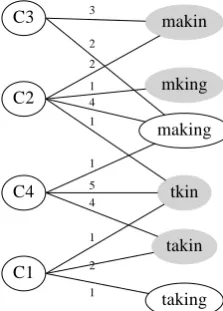
The main motivation of this approach is that normalization equivalences share similar context; which we call contextual similarity. For instance, assume 5-gram sequences of words, two words may be normalization equivalences if their n-gram context shares the same two words on the left and the same two words on the right. In other words, they are sharing a wild card pattern such as(word
1word2* word4word5).
iden-C2
making
4
makin
2
mking
1
tkin
1
C3
2 3
C1
taking
1
takin
2 1
C4
1
4 5
Figure 1: Bipartite Graph Representation, left nodes represent contexts, gray right nodes repre-sent the noisy words and white right nodes rep-resent the normalized words. Edge weight is the co-occurrence count of a word and its context.
tifying noisy words. A vocabulary is constructed from a large clean corpus. Any word that does not appear in this vocabulary more than a predefined threshold (i.e. 10 times) is considered as a can-didate for normalization (noisy word). Figure(1) shows a sample of the bipartite graphG(W, C, E),
where noisy words are shown as gray nodes.
Algorithm 4.1: CONSTRUCTBIPARTITE(text)
comment:Construct Bipartite Graph
output(G(W, C, E))
comment:Extract alln-gramsequences N grams←EXTRACTNGRAMS(T extCorpus)
for eachn∈N grams
do
comment: Check for center word
ifISNOISY(CenterW ord)
W ←ADDSOURCENODE(CenterW ord)
else
W ←ADDABSORBINGNODE(CenterW ord)
comment:add the context pattern C←ADD(Context)
comment:edge weight
E←ADD(Context, W ord, count)
The bipartite graph, G(W, C, E), is composed
ofW which includes all nodes representing
nor-malized words and noisy words,Cwhich includes
all nodes representing shared context, and finally
E which represents the edges of the graph
con-necting word nodes and context nodes. The weight on the edge is simply the number of occurrences of a given word in a context. While construct-ing the graph, we identify if a node represents a
noisy word(N)(called source node) or a normal-ized word (M) (called absorbing node). The bi-partite graph is constructed using the procedure in Algorithm(4.1).
4.2 Lexicon generation using Random Walks
Our proposed approach uses Markov Random Walks on the bipartite graph in Figure(1) as de-fined in (Norris, 1997). The main objective is to identify pairs of noisy and normalized words that can be considered as normalization equivalences. In principal, this is similar to using random walks for semi-supervised label propagation which has been introduced in (Szummer and Jaakkola, 2002) and then used in many other applications. For example, (Hughes and Ramage, 2007) used ran-dom walks on Wordnet graph to measure lexical semantic relatedness between words. (Das and Petrov, 2011) used graph-based label propagation for cross-lingual knowledge transfers to induce POS tags between two languages. (Minkov and Cohen, 2012) introduced a path constrained graph walk algorithm given a small number of labeled examples to assess nodes relatedness in the graph. In this paper, we apply the label propagation ap-proach to the text normalization problem.
Consider a random walk on the bipartite graph
G(W, C, E) starting at a noisy word (source node) and ending at a normalized word (absorb-ing node). The walker starts from any source nodeNi belonging to the noisy words then move to any other connected nodeMj with probability
Pij. The transition between each pair of nodes is defined by a transition probability Pij which represents the normalized probability of the co-occurrence counts of the word and the correspond-ing context. Though the counts are symmetric, the probability is not symmetric. This is due to the probability normalization which is done according to the nodes connectivity. Therefore, the transition probability between any two nodesi, jis defined
as:
Pij=Wij/
∑
∀k
Wik (1)
[image:4.595.123.235.63.219.2]The algorithm repeats independent random walks for K times where the walks traverse the graph randomly according to the transition prob-ability distribution in Eqn(1); each walk starts from the source noisy node and ends at an absorb-ing normalized node, or consumes the maximum number of steps without hitting an absorbing node. For any random walk the number of steps taken to traverse between any two nodes is called the hitting time (Norris, 1997). Therefore, the hit-ting time between a noisy and a normalized pair of nodes (n, m) with a walk r is hr(n, m). We define the cost between the two nodes as the aver-age hitting timeH(n, m)of all walks that connect those two nodes:
H(n, m) =∑ ∀r
hr(n, m)/R (2)
Consider the bipartite graph in Figure(1), as-sume a random walk starting at the source node representing the noisy word”tkin”then moves to the context node C1 then to the absorbing node representing the normalized word”taking”. This random walk will associate”tkin”with”taking”
with a walk of two steps (hits). Another random walk that can connect the two words is [”tkin”
→C4→”takin”→C1→”taking”], which has 4 steps (hits). In this case, the cost of this pair of nodes is the average number of hits connecting them which is 3.
It is worth noting that the random walks are selected according to the transition probability in Eqn(1); therefore, the more probable paths will be picked more frequently. The same pair of nodes can be connected with many walks of various steps (hits), and the same noisy word can be connected to many other normalized words.
We define the contextual similarity probabil-ity of a normalization equivalence pair n, m as L(n, m). Which is the relative frequency of the average hitting of those two nodes,H(n, m), and
all other normalized nodes linked to that noisy word. ThusL(n, m), is calculated as:
L(n, m) =H(n, m)/∑ i
H(n, mi) (3)
Furthermore, we add another similarity cost be-tween a noisy word and a normalized word based on the lexical similarity cost, SimCost(n, m),
which we will describe in the next section. The final cost associated with a pair is:
Cost(n, m) =λ1L(n, m) +λ2SimCost(n, m) (4)
Algorithm 4.2: INDUCELEXICON(G)
output(Lexicon)
INIT((Lexicon))
for eachn∈W ∈G(W, C, E)
do
comment:for noisy nodes only
ifISNOISY(n)
INIT(Rn)
comment:do K random walks
fori←0toK
do
Rn←RANDOMWALK(n)
comment:Calculate Avg. hits and normalize Ln←NORMALIZE(Rn)
comment:Calculate Lexical Sim Cost Ln←SIMCOST(Ln)
Ln←PRUNE(Ln)
Lexicon←ADD(Ln)
We used uniform interpolation, bothλ1andλ2 equals 1. The final Lexicon is constructed using those entries and if needed we prune the list to take top N according to the cost above. The algorithm is outlined in 4.2.
4.3 Lexical Similarity Cost
We use a similarity function proposed in (Con-tractor et al., 2010) which is based on Longest Common Subsequence Ratio (LCSR) (Melamed, 1999). This cost function is defined as the ratio of LCSR and Edit distance between two strings as follows:
SimCost(n, m) =LCSR(n, m)/ED(n, m) (5)
LCSR(n, m) =LCS(n, m)/M axLenght(n, m) (6)
We have modified the Edit Distance calculation
ED(n,m)to be more adequate for social media text. The edit distance is calculated between the conso-nant skeleton of the two words; by removing all vowels, we used Editex edit distance as proposed in (Zobel and Philip, 1996), repetition is reduced to a single letter before calculating the edit dis-tance, and numbers in the middle of words are sub-stituted by their equivalent letters.
5 Experiments
5.1 Training and Evaluation Data
ran-dom walk approach. The data consists of 73 mil-lion Twitter statuses. All tweets were collected from March/April 2012 using the Twitter Stream-ing APIs2. We augmented this data with 50 mil-lion sentences of clean data from English LDC Gi-gaword corpus3. We combined both data, noisy and clean, together to induce the normalization dictionary from them. While the Gigaword clean data was used to train the language model to score the normalized lattice.
We constructed a test set of 1000 sentences of social media which had been corrected by a na-tive human annotator, the main guidelines were to normalize noisy words to its corresponding clean words in a consistent way according to the evi-dences in the context. We will refer to this test set as SM-Test. Furthermore, we developed a test set for evaluating the effect of the normalization system when used as a preprocessing step for Ma-chine translation. The maMa-chine translation test set is composed of 500 sentences of social media En-glish text translated to normalized Spanish text by a bi-lingual translator.
5.2 Evaluating Normalization Lexicon Generation
We extracted 5-gram sequences from the com-bined noisy and clean data; then we limited the space of noisy 5-gram sequences to those which contain only one noisy word as the center word and all other words, representing the context, are not noisy. As we mentioned before, we identify whether the word is noisy or not by looking up a vocabulary list constructed from clean data. In these experiments, the vocabulary is constructed from the Language Model data (50M sentences of the English Gigaword corpus). Any word that ap-pears less than 10 times in this vocabulary is con-sidered noisy and candidate for normalization dur-ing the lexicon induction process. It is worth not-ing that our notion of noisy word does not mean it is an OOV that has to be corrected; instead it in-dicates that it is candidate for correction but may be opted not to be normalized if there is no con-fident normalization for it. This helps to maintain the approach as a high precision text normaliza-tion system which is highly preferable as an NLP preprocessing step.
We constructed a lattice using normalization
2https://dev.twitter.com/docs/streaming-apis 3http://www.ldc.upenn.edu/Catalog/LDC2011T07
candidates and score the best Viterbi path with 5-gram language model. We experimented with two candidate generators as baseline systems, namely the dictionary-based spelling correction and the trie approximate match withKerrors; whereK=3. For both candidate generators the cost function for a given candidate is calculated using the lexical similarity cost in Eqn(5). We compared those ap-proaches with our newly proposed unsupervised normalization lexicon induction; for this case the cost for a candidate is the combined cost of the contextual similarity probability and the lexical similarity cost as defined in Eqn(4). We examine the effect of data size and the steps of the random walks on the accuracy and the coverage of the in-duced dictionary.
We constructed the bipartite graph with the n-gram sequences as described in Algorithm 4.1. Then the Random Walks Algorithm in 4.2 is ap-plied with 100 walks. The total number of word nodes is about 7M nodes and the total number of context nodes is about 480M nodes. We used MapReduce framework to implement the pro-posed technique to handle such large graph. We experimented with the maximum number of ran-dom walk steps of 2, 4 and 6; and with different portions of the data as well. Finally, we pruned the lexicon to keep the top 5 candidates per noisy word.
Table(1) shows the resulting lexicons from dif-ferent experiments.
Lexicon Lexicon Data Steps
Lex1 123K 20M 4
Lex2 281K 73 M 2
Lex3 327K 73M 4
Lex4 363K 73M 6
Table 1: Generated Lexicons, steps are the Ran-dom Walks maximum steps.
[image:6.595.309.444.519.572.2]5.3 Text Normalization Evaluation
We experimented different candidate generators and compared it to the unsupervised lexicon ap-proach. Table(2) shows the precision and recall on a the SM-Test set.
System Candidates Precision Recall F-Measure
Base1 Dict 33.9 15.1 20.98
Base2 Trie 26.64 27.65 27.13
RW1 Lex1 88.76 59.23 71.06
RW2 Lex2 90.66 54.06 67.73
RW3 Lex3 92.43 56.4 70.05
RW4 Lex4 90.87 60.73 72.8
Table 2: Text Normalization with different lexi-cons
In Table(2), the first baseline is using a dictio-nary based spell checker; which gets low precision and very low recall. Similarly the trie approximate string match is doing a similar job with better re-call though the precision is worst. Both of the baseline approaches are inadequate for social me-dia text since both will try to correct any word that is similar to a word in the dictionary. The Trie ap-proximate match is doing better job on the recall since the approximate match is based on phonetic and lexical similarities.
On the other hand, the induced normalization lexicon approach is doing much better even with a small amount of data as we can see with sys-tem RW1 which uses Lex1 generated from 20M sentences and has 123K lexicon entry. Increas-ing the amount of trainIncreas-ing data does impact the performance positively especially the recall. On the other hand, increasing the number of steps has a good impact on the recall as well; but with a considerable impact on the precision. It is clear that increasing the amount of data and keeping the steps limit at ”‘4”’ gives better precision and cov-erage as well. This is a preferred setting since the main objective of this approach is to have better precision to serve as a reliable preprocessing step for Machine Translation and other NLP applica-tions.
5.4 Comparison with Pairwise Similarity
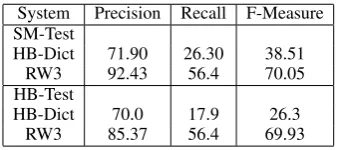
We present experimental results to compare our proposed approach with (Han et al., 2012) which used pairwise contextual similarity to induce a normalization lexicon of 40K entries, we will refer to this lexicon as HB-Dict. We compare the per-formance of HB-Dict and our induced dictionary (system RW3). We evaluate both system on
SM-Test test set and on (Han et al., 2012) test set of 548 sentences which we call here HB-Test.
System Precision Recall F-Measure SM-Test
HB-Dict 71.90 26.30 38.51
RW3 92.43 56.4 70.05
HB-Test
HB-Dict 70.0 17.9 26.3
[image:7.595.332.501.99.174.2]RW3 85.37 56.4 69.93
Table 3: Text Normalization Results
As shown in Table(3), RW3 system signifi-cantly outperforms HB-Dict system with the lex-icon from (Han et al., 2012) on both test sets for both precision and recall. The contextual graph random walks approach helps in providing high precision lexicon since the sampling nature of the approach helps in filtering out unreliable normal-ization equivalences. The random walks will tra-verse more frequent paths; which would lead to more probable normalization equivalence. On the other hand, the proposed approach provides high recall as well which is hard to achieve with higher precision. Since the proposed approach deploys random walks to sample paths that can traverse many steps, this relaxes the constraints that the normalization equivalences have to share the same context. Instead a noisy word may share a con-text with another noisy word which in turn shares a context with a clean equivalent normalization word. Therefore, we end up with a lexicon that have much higher recall than the pairwise simi-larity approach since it explores equivalences be-yond the pairwise relation. Moreover, the random walk sampling emphasis the more frequent paths and hence provides high precision lexicon.
5.5 Output Analysis
dancing and should not be corrected to ”‘tweet-ing”’.
Noisy Clean Remarks tnght tonight Vowels restored darlin darling g restored urung orange phonetic similarity viewablity visibility good correction unrecycled recycled negation ignored
[image:8.595.89.275.108.182.2]tutting tweeting tutting is dancing type Table 4: Lexicon Samples
Table 5 lists a number of examples and their normalization using bothBaseline1andRW3. At the first example,RW3got the correct normaliza-tion as”interesting” which apparently is not the one with the shortest edit distance, though it is the most frequent candidate at the generated lex-icon. The baseline system did not get it right; it got a wrong normalization with shorter edit dis-tance. Example(2) shows the same effect by get-ting ”cuz” normalized to ”because”. At Exam-ple(3), both the baseline and RW3 did not get the correct normalization of ”yur” to ”you are”
which is currently a limitation in our system since we only allow one-to-one word mapping in the generated lexicons not one-to-many or many-to-many. At Example(4), RW3 did not normalize
”dure”to ”sure”; however the baseline normal-ized it by mistake to”dare”. This shows a char-acteristic of the proposed approach; it is very con-servative in proposing normalization which is de-sirable as a preprocessing step for NLP applica-tions. This limitation can be marginalized by pro-viding more data for generating the lexicon. Fi-nally, Example 4 shows also that the system nor-malize”gr8”which is mainly due to having a flex-ible similarity cost during the normalization lexi-con lexi-construction.
1. Source:Mad abt dt so mch intesting Baseline1:Mad at do so much ingesting RW3:Mad about that so much interesting 2. Source:i’l do cuz ma parnts r ma lyf Baseline1:I’ll do cut ma parents r ma life RW3:I’ll do because my parents are my life 3. Source:yur cuuuuute
Baseline1:yur cuuuuute RW3:your cute
[image:8.595.329.501.331.385.2]4. Source:I’m dure u will get a gr8 score Baseline1:I’m dare you will get a gr8 score RW3:I’m dure you will get a great score
Table 5: Normalization Examples
5.6 Machine Translation Task Evaluation
The final evaluation of the text normalization sys-tem is an extrinsic evaluation where we evaluate the effect of the text normalization task on a so-cial media text translating from English to Span-ish using a large scale translation system trained on general domain data. The system is trained on English-Spanish parallel data from WMT 2012 evaluation4. The data consists of about 5M paral-lel sentences on news, europal and UN data. The system is a state of the art phrase based system similar to Moses (Hoang et al., 2007). We used The BLEU score (Papineni et al., 2002) to evaluate the translation accuracy with and without the nor-malization. Table(6) shows the translation evalua-tion with different systems. The translaevalua-tion with normalization was improved by about 6% from 29.02 to 30.87 using RW3 as a preprocessing step.
System BLEU Impreovemnet No Normalization 29.02 0%
Baseline1 29.13 0.37% HB-Dict 29.76 3.69%
RW3 30.87 6.37%
Table 6: Translation Results
6 Conclusion and Future Work
We introduced a social media text normalization system that can be deployed as a preprocessor for MT and various NLP applications to han-dle social media text. The proposed approach is very scalable, adaptive to any domain and lan-guage. We show that the proposed unsupervised approach provides a normalization system with very high precision and a reasonable recall. We compared the system with conventional correction approaches and with recent previous work; and we showed that it highly outperforms other systems. Finally, we have used the system as a preprocess-ing step for a machine translation system which improved the translation quality by 6%.
As an extension to this work, we will extend the approach to handle many-to-many normalization pairs; also we plan to apply the approach to more languages. Furthermore, the approach can be eas-ily extended to handle similar problems such as ac-cent restoration and generic entity normalization.
[image:8.595.97.269.603.726.2]Acknowledgments
We would like to thank Lee Schwartz and Will Lewis for their help in constructing the test sets and in the error analysis. We would also like to thank the anonymous reviewers for their helpful and constructive comments.
References
AiTi Aw, Min Zhang, Juan Xiao, and Jian Su. 2006. A phrase-based statistical model for SMS text nor-malization. In Proceedings of the 21st International Conference on Computational Linguistics and 44th Annual Meeting of the Association for Computa-tional Linguistics, pages 3340, Sydney, Australia.
Eric Brill and Robert C. Moore. 2000. An improved er-ror model for noisy channel spelling correction, In ACL 2000: Proceedings of the 38th Annual Meeting on Association for Computational Linguistics, En-glewood Cliffs, NJ, USA.
Ye-In Chang and Jiun-Rung Chen and Min-Tze Hsu 2010. A hash trie filter method for approximate string matching in genomic databases Applied In-telligence, 33:1, pages 21:38, Springer US.
Monojit Choudhury, Rahul Saraf, Vijit Jain, Animesh Mukherjee, Sudeshna Sarkar, and Anupam Basu 2007. Investigation and modeling of the structure of texting language. International Journal of Document Analysis and Recognition, vol. 10, pp. 157:174.
Danish Contractor and Tanveer Faruquie and Venkata Subramaniam 2010. Unsupervised cleansing of noisy text. In COLING ’10 Proceedings of the 23rd International Conference on Computational Linguis-tics, pages 189:196.
Paul Cook and Suzanne Stevenson. 2009. An unsu-pervised model for text message normalization.. In CALC 09: Proceedings of the Workshop on Compu-tational Approaches to Linguistic Creativity, pages 71:78, Boulder, USA.
Dipanjan Das and Slav Petrov 2011 Unsuper-vised part-of-speech tagging with bilingual graph-based projections Proceedings of the 49th An-nual Meeting of the Association for Computational Linguistics: Human Language Technologies, pages 600:609, Portland, Oregon
Stephan Gouws, Dirk Hovy, and Donald Metzler. 2011. Unsupervised mining of lexical variants from noisy text. In Proceedings of the First workshop on Unsupervised Learning in NLP, pages 82:90, Edin-burgh, Scotland.
Bo Han and Timothy Baldwin. 2011. Lexical normal-isation of short text messages: Makn sens a twit-ter. In Proceedings of the 49th Annual Meeting of the Association for Computational Linguistics:
Human Language Technologies (ACL-HLT 2011), pages 368:378, Portland, Oregon, USA.
Bo Han and Paul Cook and Timothy Baldwin 2012. Automatically Constructing a Normalisation Dic-tionary for Microblogs. Proceedings of the 2012 Joint Conference on Empirical Methods in Natu-ral Language Processing and Computational NatuNatu-ral Language Learning (EMNLP-CoNLL 2012), pages 421:432, Jeju Island, Korea.
Hieu Hoang and Alexandra Birch and Chris Callison-burch and Richard Zens and Rwth Aachen and Alexandra Constantin and Marcello Federico and Nicola Bertoldi and Chris Dyer and Brooke Cowan and Wade Shen and Christine Moran and Ondrej Bo-jar 2007. Moses: Open source toolkit for statistical machine translation.
Thad Hughes and Daniel Ramage 2007. Lexical se-mantic relatedness with random graph walks Pro-ceedings of Conference on Empirical Methods in Natural Language Processing EMNLP, pp. 581589, Prague
Fei Liu and Fuliang Weng and Bingqing Wang and Yang Liu 2011. Insertion, Deletion, or Substi-tution? Normalizing Text Messages without Pre-categorization nor Supervision Proceedings of the 49th Annual Meeting of the Association for Com-putational Linguistics: Human Language Technolo-gies, pages 19:24, Portland, Oregon
Dan Melamed 1999. Bitext Maps and Alignment via Pattern Recognition. In Computational Linguistics, 25, pages 107:130.
Einat Minkov and William Cohen Graph Based Similarity Measures for Synonym Extraction from Parsed Text In Proceedings of the TextGraphs work-shop 2012
J. Norris 1997. Markov Chains. Cambridge Univer-sity Press.
Kishore Papineni and Salim Roukos and Todd Ward and Wei-jing Zhu 2002. BLEU: a Method for Au-tomatic Evaluation of Machine Translation. in Pro-ceedings of ACL-2002: 40th Annual meeting of the Association for Computational Linguistics. , pages 311:318.
Richard Sproat, Alan W. Black, Stanley Chen, Shankar Kumar, Mari Ostendorf, and Christopher Richards. Normalization of non-standard words. 2001.
Xu Sun and Jianfeng Gao and Daniel Micol and Chris Quirk 2010. Learning Phrase-Based Spelling Error Models from Clickthrough Data. Proceedings of the 48th Annual Meeting of the Association for Compu-tational Linguistics, pages 266:274, Sweeden. Martin Szummer and Tommi 2002. Partially labeled
Kristina Toutanova and Robert C. Moore. Pronunci-ation modeling for improved spelling correction.. 2002. In Proceedings of the 40th Annual Meeting on Association for Computational Linguistics, ACL , pages 144151, Philadelphia, USA.