Grammatical Error Correction Using Integer Linear Programming
Yuanbin Wu
Department of Computer Science National University of Singapore
13 Computing Drive Singapore 117417 [email protected]
Hwee Tou Ng
Department of Computer Science National University of Singapore
13 Computing Drive Singapore 117417 [email protected]
Abstract
We propose a joint inference algorithm for grammatical error correction. Different from most previous work where different error types are corrected independently, our proposed inference process considers all possible errors in a unied framework. We use integer linear programming (ILP) to model the inference process, which can easily incorporate both the power of exist-ing error classiers and prior knowledge on grammatical error correction. Exper-imental results on the Helping Our Own shared task show that our method is com-petitive with state-of-the-art systems.
1 Introduction
Grammatical error correction is an important task of natural language processing (NLP). It has many potential applications and may help millions of people who learn English as a second language (ESL). As a research eld, it faces the challenge of processing ungrammatical language, which is dif-ferent from other NLP tasks. The task has received much attention in recent years, and was the focus of two shared tasks on grammatical error correc-tion in 2011 and 2012 (Dale and Kilgarriff, 2011; Dale et al., 2012).
To detect and correct grammatical errors, two different approaches are typically used knowl-edge engineering or machine learning. The rst relies on handcrafting a set of rules. For exam-ple, the superlative adjective best is preceded by the article the. In contrast, the machine learn-ing approach formulates the task as a classication problem based on learning from training data. For example, an article classier takes a noun phrase (NP) as input and predicts its article using class labels a/an, the, orɛ(no article).
Both approaches have their advantages and dis-advantages. One can readily handcraft a set of
rules to incorporate various prior knowledge from grammar books and dictionaries, but rules often have exceptions and it is difcult to build rules for all grammatical errors. On the other hand, the machine learning approach can learn from texts written by ESL learners where grammatical errors have been annotated. However, training data may be noisy and classiers may need prior knowledge to guide their predictions.
Another consideration in grammatical error cor-rection is how to deal with multiple errors in an input sentence. Most previous work deals with errors individually: different classiers (or rules) are developed for different types of errors (article classier, preposition classier, etc). Classiers are then deployed independently. An example is a pipeline system, where each classier takes the output of the previous classier as its input and proposes corrections of one error type.
One problem of this pipeline approach is that the relations between errors are ignored. For ex-ample, assume that an input sentence contains a cats. An article classier may propose to delete a, while a noun number classier may propose to change cats to cat. A pipeline approach will choose one of the two corrections based purely on which error classier is applied rst. Another problem is that when applying a classier, the sur-rounding words in the context are assumed to be correct, which is not true if grammatical errors ap-pear close to each other in a sentence.
In this paper, we formulate grammatical er-ror correction as a task suited for joint inference. Given an input sentence, different types of errors are jointly corrected as follows. For every possi-ble error correction, we assign a score which mea-sures how grammatical the resulting sentence is if the correction is accepted. We then choose a set of corrections which will result in a corrected sen-tence that is judged to be the most grammatical.
The inference problem is solved by integer
ear programming (ILP). Variables of ILP are indi-cators of possible grammatical error corrections, the objective function aims to select the best set of corrections, and the constraints help to enforce a valid and grammatical output. Furthermore, ILP not only provides a method to solve the inference problem, but also allows for a natural integration of grammatical constraints into a machine learn-ing approach. We will show that ILP fully utilizes individual error classiers, while prior knowledge on grammatical error correction can be easily ex-pressed using linear constraints. We evaluate our proposed ILP approach on the test data from the Helping Our Own (HOO) 2011 shared task (Dale and Kilgarriff, 2011). Experimental results show that the ILP formulation is competitive with state-of-the-art grammatical error correction systems.
The remainder of this paper is organized as fol-lows. Section 2 gives the related work. Section 3 introduces a basic ILP formulation. Sections 4 and 5 improve the basic ILP formulation with more constraints and second order variables, spectively. Section 6 presents the experimental re-sults. Section 7 concludes the paper.
2 Related Work
The knowledge engineering approach has been used in early grammatical error correction systems (Murata and Nagao, 1993; Bond et al., 1995; Bond and Ikehara, 1996; Heine, 1998). However, as noted by (Han et al., 2006), rules usually have ex-ceptions, and it is hard to utilize corpus statistics in handcrafted rules. As such, the machine learn-ing approach has become the dominant approach in grammatical error correction.
Previous work in the machine learning approach typically formulates the task as a classication problem. Article and preposition errors are the two main research topics (Knight and Chander, 1994; Han et al., 2006; Tetreault and Chodorow, 2008; Dahlmeier and Ng, 2011). Features used in classi-cation include surrounding words, part-of-speech tags, language model scores (Gamon, 2010), and parse tree structures (Tetreault et al., 2010). Learn-ing algorithms used include maximum entropy (Han et al., 2006; Tetreault and Chodorow, 2008), averaged perceptron, na¨ve Bayes (Rozovskaya and Roth, 2011), etc. Besides article and prepo-sition errors, verb form errors also attract some attention recently (Liu et al., 2010; Tajiri et al., 2012).
Several research efforts have started to deal with correcting different errors in an integrated manner (Gamon, 2011; Park and Levy, 2011; Dahlmeier and Ng, 2012a). Gamon (2011) uses a high-order sequential labeling model to detect various errors. Park and Levy (2011) models grammatical error correction using a noisy channel model, where a predened generative model produces correct sen-tences and errors are added through a noise model. The work of (Dahlmeier and Ng, 2012a) is proba-bly the closest to our current work. It uses a beam-search decoder, which iteratively corrects an in-put sentence to arrive at the best corrected outin-put. The difference between their work and our ILP approach is that the beam-search decoder returns an approximate solution to the original inference problem, while ILP returns an exact solution to an approximate inference problem.
Integer linear programming has been success-fully applied to many NLP tasks, such as depen-dency parsing (Riedel and Clarke, 2006; Martins et al., 2009), semantic role labeling (Punyakanok et al., 2005), and event extraction (Riedel and Mc-Callum, 2011).
3 Inference with First Order Variables
The inference problem for grammatical error cor-rection can be stated as follows: Given an input sentence, choose a set of corrections which results in the best output sentence. In this paper, this problem will be expressed and solved by integer linear programming (ILP).
To express an NLP task in the framework of ILP requires the following steps:
1. Encode the output space of the NLP task us-ing integer variables;
2. Express the inference objective as a linear objective function; and
3. Introduce problem-specic constraints to re-ne the feasible output space.
3.1 First Order Variables
Given an input sentence, the main question that a grammatical error correction system needs to an-swer is: What corrections at which positions? For example, is it reasonable to change the word cats to cat in the sentence A cats sat on the mat? Given the corrections at various positions in a sentence, the system can readily come up with the corrected sentence. Thus, a natural way to encode the output space of grammatical error correction requires in-formation about sentence position, error type (e.g., noun number error), and correction (e.g., cat).
Suppose s is an input sentence, and |s| is its length (i.e., the number of words ins). Dene rst order variables:
Zl,pk ∈ {0,1}, (1)
where
p∈ {1,2, . . . ,|s|}is a position in a sentence, l∈Lis an error type,
k∈ {1,2, . . . , C(l)}is a correction of typel. L: the set of error types,
C(l): the number of corrections for error typel.
IfZk
l,p = 1, the word at positionpshould be cor-rected tokthat is of error type l. Otherwise, the word at positionpis not applicable for this correc-tion. Deletion of a word is represented ask = ɛ. For example, ZArt,a 1 = 1 means that the article
(Art) at position1of the sentence should be a. If
ZArt,a 1 = 0, then the article should not be a.
Ta-ble 1 contains the error types handled in this work, their possible corrections and applicable positions in a sentence.
3.2 The Objective Function
The objective of the inference problem is to nd the best output sentence. However, there are expo-nentially many different combinations of correc-tions, and it is not possible to consider all com-binations. Therefore, instead of solving the orig-inal inference problem, we will solve an approx-imate inference problem by introducing the fol-lowing decomposable assumption: Measuring the output quality of multiple corrections can be de-composed into measuring the quality of the indi-vidual corrections.
Lets0be the resulting sentence if the correction Zk
l,p is accepted fors, or for simplicity denoting
it as s Z
k l,p
−−→ s0. Let wl,p,k ∈ R, measure how grammaticals0is. Dene the objective function as
max ∑
l,p,k
wl,p,kZl,pk .
This linear objective function aims to select a set ofZl,pk , such that the sum of their weights is the largest among all possible candidate corrections, which in turn gives the most grammatical sentence under the decomposable assumption.
Although the decomposable assumption is a strong assumption, it performs well in practice, and one can relax the assumption by using higher order variables (see Section 5).
For an individual correction Zl,pk , we measure the quality ofs0based on three factors:
1. The language model score h(s0,LM) of s0 based on a large web corpus;
2. The condence scoresf(s0, t)of classiers,
wheret∈EandEis the set of classiers. For ex-ample, an article classier trained on well-written documents will score every article ins0, and mea-sure the quality ofs0 from the perspective of an article expert.
3. The disagreement scores g(s0, t) of
classi-ers, where t ∈ E. A disagreement score mea-sures how ungrammatical s0 is from the perspec-tive of a classier. Take the article classier as an example. For each article instance ins0, the clas-sier computes the difference between the maxi-mum condence score among all possible choices of articles, and the condence score of the ob-served article. This difference represents the dis-agreement on the observed article by the article classier or expert. Dene the maximum differ-ence over all article instances ins0to be the article classier disagreement score ofs0. In general, this score is large if the sentences0 is more ungram-matical.
The weight wl,p,k is a combination of these scores:
wl,p,k = νLMh(s0,LM) + ∑
t∈E
λtf(s0, t)
+∑
t∈E
µtg(s0, t), (2)
whereνLM, λt, andµtare the coefcients. 3.3 Constraints
Typel Correctionk C(l) Applicable Variables
article a, the,ɛ 3 article or NP ZArta ,p,ZArtthe,p,ZArtɛ ,p
preposition on, at, in, . . . |confusion set| preposition ZPrepon ,p,ZPrepat ,p,ZPrep,pin , . . . noun number singular, plural 2 noun ZNounsingular,p,ZNounplural,p
punctuation punctuation symbols |candidates| determined by rules ZPunct,poriginal,ZPunct,pcand1 ,ZPunct,pcand2 ,. . . spelling correctly spelled |candidates| determined by a ZSpell,poriginal,ZSpell,pcand1,ZSpell,pcand2,. . .
words spell checker
Table 1: Error types and corrections. The Applicable column indicates which parts of a sentence are applicable to an error type. In the rst row,ɛmeans deleting an article.
ZArtthe,p= 1, which means there are two corrections
a and the for the same sentence positionp, but ob-viously only one article is allowed.
A simple constraint to avoid these conicts is ∑
k
Zl,pk = 1, ∀applicablel, p
It reads as follows: for each error typel, only one output k is allowed at any applicable position p (note thatZl,pk is a Boolean variable).
Putting the variables, objective function, and constraints together, the ILP problem with respect to rst order variables is as follows:
max ∑
l,p,k
wl,p,kZl,pk (3)
s.t. ∑
k
Zl,pk = 1, ∀applicablel, p (4)
Zl,pk ∈ {0,1} (5)
The ILP problem is solved using lp solve1, an integer linear programming solver based on the re-vised simplex method and the branch-and-bound method for integers.
3.4 An Illustrating Example
To illustrate the ILP formulation, consider an ex-ample input sentences:
A cats sat on the mat . (6)
First, the constraint (4) at position 1 is:
ZArta ,1+ZArtthe,1+ZArtɛ ,1 = 1,
which means only one article in{a, the,ɛ}is se-lected.
1http://lpsolve.sourceforge.net/
Next, to compute wl,p,k, we collect language model score and condence scores from the arti-cle (ART), preposition (PREP), and noun number (NOUN) classier, i.e.,E ={ART,PREP,NOUN}.
The weight forZNoun,singular2 is:
wNoun,2,singular=νLMh(s0,LM)+
λARTf(s0,ART) +λPREPf(s0,PREP) +λNOUNf(s0,NOUN)+
µARTg(s0,ART) +µPREPg(s0,PREP) +µNOUNg(s0,NOUN).
wheres Z
singular Noun,2
−−−−→s0 =A cat sat on the mat .
The condence score f(s0, t) of classier t is the average of the condence scores of t on the applicable instances ins0.
For example, there are two article instances in s0, located at position1and5respectively, hence,
f(s0,ART)= 1 2 f(s
0[1],1,ART) +f(s0[5],5,ART)
=1
2 f(a,1,ART) +f(the,5,ART)
.
Here, the symbol ft(s0[p], p,ART) refers to the condence score of the article classier at position p, ands0[p]is the word at positionpofs0.
Similarly, the disagreement scoreg(s0,ART)of
the article classier is
g(s0,ART) = max(g1, g2) g1= arg max
k f(k,1,ART)−f(a,1,ART)
g2= arg max
k f(k,5,ART)−f(the,5,ART)
Putting them together, the weight forZNounsingular,2 is:
wNoun,2,singular=νLMh(s0,LM)
+λART
2 f(a,1,ART) +f(the,5,ART)
+λPREPf(on,4,PREP)
+λNOUN
2 f(cat,2,NOUN) +f(mat,6,NOUN)
+µARTg(s0,ART)
+µPREPg(s0,PREP)
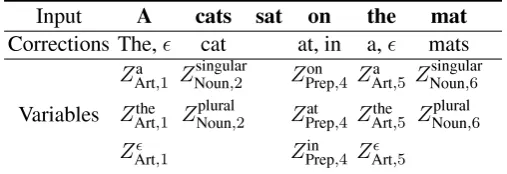
Input A cats sat on the mat
Corrections The,ɛ cat at, in a,ɛ mats
ZArta ,1 ZNounsingular,2 ZPrepon ,4 ZArta ,5 ZNounsingular,6
[image:5.595.172.426.63.150.2]Variables ZArtthe,1 ZNounplural,2 ZPrepat ,4 ZArtthe,5 ZNounplural,6 ZArt,ɛ 1 ZPrep,in 4 ZArt,ɛ 5
Table 2: The possible corrections on example (6).
3.5 Complexity
The time complexity of ILP is determined by the number of variables and constraints. Assume that for each sentence position, at mostK classi-ers are applicable2. The number of variables is O(K|s|C(l∗)), wherel∗ = arg maxl∈LC(l). The number of constraints isO(K|s|).
4 Constraints for Prior Knowledge
4.1 Modication Count Constraints
In practice, we usually have some rough gauge of the quality of an input sentence. If an input sentence is mostly grammatical, the system is ex-pected to make few corrections. This require-ment can be easily satised by adding modica-tion count constraints.
In this work, we constrain the number of modi-cations according to error types. For the error type l, a parameterNl controls the number of modi-cations allowed for typel. For example, the mod-ication count constraint for article corrections is
∑
p,k
ZArtk ,p ≤NArt, wherek6=s[p]. (7)
The condition ensures that the correctionkis dif-ferent from the original word in the input sentence. Hence, the summation only counts real modica-tions. There are similar constraints for preposi-tion, noun number, and spelling corrections:
∑
p,k
ZPrepk ,p≤NPrep, wherek6=s[p], (8)
∑
p,k
ZNoun,p≤k NNoun, wherek6=s[p], (9)
∑
p,k
ZSpellk ,p≤NSpell, wherek6=s[p]. (10)
2In most cases,K= 1. An example ofK >1is a noun that requires changing the word form (between singular and plural) and inserting an article, for whichK= 2.
4.2 Article-Noun Agreement Constraints An advantage of the ILP formulation is that it is relatively easy to incorporate prior linguistic knowledge. We now take article-noun agreement as an example to illustrate how to encode such prior knowledge using linear constraints.
A noun in plural form cannot have a (or an) as its article. That two Boolean variablesZ1 and
Z2 are mutually exclusive can be handled using a
simple inequality Z1 +Z2 ≤ 1. Thus, the
fol-lowing inequality correctly enforces article-noun agreement:
ZArta ,p1 +ZNounplural,p2 ≤1, (11)
where the article atp1modies the noun atp2.
4.3 Dependency Relation Constraints
Another set of constraints involves dependency relations, including subject-verb relation and determiner-noun relation. Specically, for a noun nat positionp, we check the wordwrelated ton via a child-parent or parent-child relation. Ifw be-longs to a set of verbs or determiners (are, were, these, all) that takes a plural noun, then the noun n is required to be in plural form by adding the following constraint:
ZNounplural,p= 1. (12)
Similarly, if a nounnat positionp is required to be in singular form due to subject-verb relation or determiner-noun relation, we add the following constraint:
ZNoun,psingular= 1. (13)
5 Inference with Second Order Variables
5.1 Motivation and Denition
Consider the sentence A cat sat on the mat. When measuring the gain due to ZNounplural,2 = 1
(change cat to cats), the weight wNoun,2,plural is likely to be small since A cats will get a low lan-guage model score, a low article classier con-dence score, and a low noun number classier condence score. Similarly, the weightwArt,1,ɛof ZArt,ɛ 1 (delete article A) is also likely to be small because of the missing article. Thus, if one con-siders the two corrections separately, they are both unlikely to appear in the nal corrected output.
However, the correction from A cat sat on the mat. to Cats sat on the mat. should be a reasonable candidate, especially if the context indicates that there are many cats (more than one) on the mat. Due to treating corrections separately, it is difcult to deal with multiple interacting corrections with only rst order variables.
In order to include the correction ɛ Cats, one can use a new set of variables, second order vari-ables. To keep symbols clear, letZ ={Zu|Zu = Zl,pk ,∀l, p, k}be the set of rst order variables, and wu =wl,p,k be the weight ofZu =Zl,pk . Dene a second order variableXu,v:
Xu,v =Zu∧Zv, (14)
whereZuandZv are rst order variables:
Zu ,Zlk11,p1, Zv ,Zlk22,p2. (15)
The denition ofXu,vstates that a second order variable is set to 1 if and only if its two
compo-nent rst order variables are both set to1. Thus, it
combines two corrections into a single correction. In the above example, a second order variable is introduced:
Xu,v =ZArt,ɛ 1∧ZNounplural,2,
s−−−→Xu,v s0 =Cats sat on the mat .
Similar to rst order variables, let wu,v be the weight of Xu,v. Note that denition (2) only de-pends on the output sentences0, and the weight of the second order variablewu,v can be dened in the same way:
wu,v = νLMh(s0,LM) +∑ t∈E
λtf(s0, t)
+∑
t∈E
µtg(s0, t). (16)
5.2 ILP with Second Order Variables
A set of new constraints is needed to enforce con-sistency between the rst and second order vari-ables. These constraints are the linearization of denition (14) ofXu,v:
Xu,v =Zu∧Zv ⇔
Xu,v≤ Zu Xu,v≤ Zv
Xu,v≥ Zu+Zv−1 (17) A new objective function combines the weights from both rst and second order variables:
max ∑
l,p,k
wl,p,kZl,pk + ∑
u,v
wu,vXu,v. (18)
In our experiments, due to noisy data, some weights of second order variables are small, even if both of its rst order variables have large weights and satisfy all prior knowledge con-straints. They will affect ILP proposing good cor-rections. We nd that the performance will be bet-ter if we change the weights of second order vari-ables towu,v0 , where
wu,v0 ,max{wu,v, wu, wv}. (19)
Putting them together, (20)-(25) is an ILP for-mulation using second order variables, whereXis the set of all second order variables which will be explained in the next subsection.
max ∑
l,p,k
wl,p,kZl,pk + ∑
u,v
wu,v0 Xu,v (20)
s.t. ∑
k
Zl,pk = 1, ∀applicablel, p (21)
Xu,v ≤Zu, (22)
Xu,v ≤Zv, (23)
Xu,v ≥Zu+Zv−1,∀Xu,v ∈X(24) Xu,v, Zl,pk ∈ {0,1} (25)
5.3 Complexity and Variable Selection Using the notation in section 3.5, the num-ber of second order variables is O(|Z|2) =
O(K2|s|2C(l∗)2)and the number of constraints is
O(K2|s|2C(l∗)2). More generally, for variables
with higher orderh ≥2, the number of variables
(and constraints) isO(Kh|s|hC(l∗)h).
Data set Sentences Words Edits
Dev set 939 22,808 1,264
Test set 722 18,790 1,057
Table 3: Overview of the HOO 2011 data sets. Corrections are called edits in the HOO 2011 shared task.
achieve good performance. For example, noun number corrections are only coupled with nearby article corrections, and have no connection with distant or other types of corrections.
In this work, we only introduce second or-der variables that combine article corrections and noun number corrections. Furthermore, we re-quire that the article and the noun be in the same noun phrase. The setXof second order variables in Equation (24) is dened as follows:
X ={Xu,v =Zu∧Zv|l1=Art, l2=Noun,
s[p1], s[p2]are in the same noun phrase},
wherel1, l2, p1, p2 are taken from Equation (15).
6 Experiments
Our experiments mainly focus on two aspects: how our ILP approach performs compared to other grammatical error correction systems; and how the different constraints and the second order vari-ables affect the ILP performance.
6.1 Evaluation Corpus and Metric
We follow the evaluation setup in the HOO 2011 shared task on grammatical error correction (Dale and Kilgarriff, 2011). The development set and test set in the shared task consist of conference and workshop papers taken from the Association for Computational Linguistics (ACL). Table 3 gives an overview of the data sets.
System performance is measured by precision, recall, andF measure:
P= # true edits
# system edits, R=
# true edits # gold edits, F =
2P R P+R.
(26)
The difculty lies in how to generate the system edits from the system output. In the HOO 2011 shared task, participants can submit system edits directly or the corrected plain-text system output. In the latter case, the ofcial HOO scorer will ex-tract system edits based on the original
(ungram-matical) input text and the corrected system output text, using GNU Wdiff3.
Consider an input sentence The data is simi-lar with test set. taken from (Dahlmeier and Ng, 2012a). The gold-standard edits are with→to and ɛ → the. That is, the grammatically correct sen-tence should be The data is similar to the test set. Suppose the corrected output of a system to be evaluated is exactly this perfectly corrected sen-tence The data is similar to the test set. However, the ofcial HOO scorer using GNU Wdiff will au-tomatically extract only one system edit with→to the for this system output. Since this single system edit does not match any of the two gold-standard edits, the HOO scorer returns an F measure of0,
even though the system output is perfectly correct. In order to overcome this problem, the Max-Match (M2) scorer was proposed in (Dahlmeier and Ng, 2012b). Given a set of gold-standard ed-its, the original (ungrammatical) input text, and the corrected system output text, the M2 scorer searches for the system edits that have the largest overlap with the gold-standard edits. For the above example, the system edits automatically deter-mined by theM2 scorer are identical to the
gold-standard edits, resulting in an F measure of1as we
would expect. We will use the M2 scorer in this paper to determine the best system edits. Once the system edits are found,P,R, andF are computed using the standard denition (26).
6.2 ILP Conguration 6.2.1 Variables
The rst order variables are given in Table 1. If the indenite article correction a is chosen, then the nal choice between a and an is decided by a rule-based post-processing step. For each prepo-sition error variableZPrep,pk , the correctionkis re-stricted to a pre-dened confusion set of prepo-sitions which depends on the observed preposi-tion at posipreposi-tion p. For example, the confusion set of on is {at, for, in, of }. The list of prepo-sitions corrected by our system is about, among, at, by, for, in, into, of, on, over, to, under, with, and within. Only selected positions in a sentence (determined by rules) undergo punctuation correc-tion. The spelling correction candidates are given by a spell checker. We used GNU Aspell4 in our work.
6.2.2 Weights
As described in Section 3.2, the weight of each variable is a linear combination of the language model score, three classier condence scores, and three classier disagreement scores. We use the Web 1T 5-gram corpus (Brants and Franz, 2006) to compute the language model score for a sentence. Each of the three classiers (article, preposition, and noun number) is trained with the multi-class condence weighted algorithm (Cram-mer et al., 2009). The training data consists of all non-OCR papers in the ACL Anthology5, minus the documents that overlap with the HOO 2011 data set. The features used for the classiers fol-low those in (Dahlmeier and Ng, 2012a), which include lexical and part-of-speech n-grams, lexi-cal head words, web-slexi-cale n-gram counts, depen-dency heads and children, etc. Over 5 million training examples are extracted from the ACL An-thology for use as training data for the article and noun number classiers, and over 1 million train-ing examples for the preposition classier.
Finally, the language model score, classier condence scores, and classier disagreement scores are normalized to take values in [0,1],
based on the HOO 2011 development data. We use the following values for the coefcients: νLM = 1
(language model); λt = 1(classier condence); andµt=−1(classier disagreement).
6.2.3 Constraints
In Section 4, three sets of constraints are in-troduced: modication count (MC), article-noun agreement (ANA), and dependency relation (DR) constraints. The values for the modication count parameters are set as follows: NArt = 3, NPrep = 2, NNoun= 2,andNSpell= 1.
6.3 Experimental Results
We compare our ILP approach with two other sys-tems: the beam search decoder of (Dahlmeier and Ng, 2012a) which achieves the best published per-formance to date on the HOO 2011 data set, and UI Run1 (Rozovskaya et al., 2011) which achieves the best performance among all participating sys-tems at the HOO 2011 shared task. The results are given in Table 4.
The HOO 2011 shared task provides two sets of gold-standard edits: the original gold-standard ed-its produced by the annotator, and the ofcial
gold-5http://aclweb.org/anthology-new/
[image:8.595.315.522.62.116.2]System Original Ofcial P R F P R F UI Run1 40.86 11.21 17.59 54.61 14.57 23.00 Beam search 30.28 19.17 23.48 33.59 20.53 25.48 ILP 20.54 27.93 23.67 21.99 29.04 25.03
Table 4: Comparison of three grammatical error correction systems.
standard edits which incorporated corrections pro-posed by the HOO 2011 shared task participants. All three systems listed in Table 4 use the M2
scorer to extract system edits. The results of the beam search decoder and UI Run1 are taken from Table 2 of (Dahlmeier and Ng, 2012a).
Overall, ILP inference outperforms UI Run1 on both the original and ofcial gold-standard edits, and the improvements are statistically signicant at the level of signicance 0.01. The performance of ILP inference is also competitive with the beam search decoder. The results indicate that a gram-matical error correction system benets from cor-rections made at a whole sentence level, and that joint correction of multiple error types achieves state-of-the-art performance.
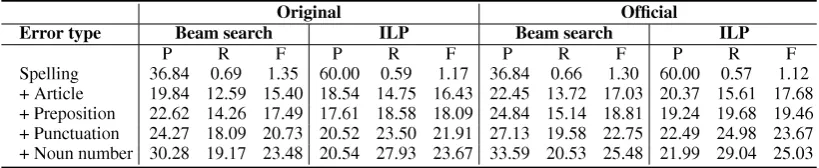
Table 5 provides the comparison of the beam search decoder and ILP inference in detail. The main difference between the two is that, except for spelling errors, ILP inference gives higher recall than the beam search decoder, while its precision is lower. This indicates that ILP inference is more aggressive in proposing corrections.
Next, we evaluate ILP inference in different congurations. We only focus on article and noun number error types. Table 6 shows the perfor-mance of ILP in different congurations. From the results, MC and DR constraints improve pre-cision, indicating that the two constraints can help to restrict the number of erroneous corrections. In-cluding second order variables gives the best F measure, which supports our motivation for intro-ducing higher order variables.
Original Ofcial
Error type Beam search ILP Beam search ILP P R F P R F P R F P R F Spelling 36.84 0.69 1.35 60.00 0.59 1.17 36.84 0.66 1.30 60.00 0.57 1.12 + Article 19.84 12.59 15.40 18.54 14.75 16.43 22.45 13.72 17.03 20.37 15.61 17.68 + Preposition 22.62 14.26 17.49 17.61 18.58 18.09 24.84 15.14 18.81 19.24 19.68 19.46 + Punctuation 24.27 18.09 20.73 20.52 23.50 21.91 27.13 19.58 22.75 22.49 24.98 23.67 + Noun number 30.28 19.17 23.48 20.54 27.93 23.67 33.59 20.53 25.48 21.99 29.04 25.03
Table 5: Comparison of the beam search decoder and ILP inference. ILP is equipped with all constraints (MC, ANA, DR) and default parameters. Second order variables related to article and noun number error types are also used in the last row.
Setting Original Ofcial
P R F P R F
Art+Nn,1st ord. 17.19 19.37 18.22 18.59 20.44 19.47
+ MC 17.87 18.49 18.17 19.23 19.39 19.31
+ ANA 17.78 18.39 18.08 19.04 19.11 19.07
+ DR 17.95 18.58 18.26 19.23 19.30 19.26
[image:9.595.94.504.63.147.2]+2ndord. 18.75 18.88 18.81 20.04 19.58 19.81
Table 6: The effects of different constraints and second order variables.
7 Conclusion
In this paper, we model grammatical error correc-tion as a joint inference problem. The inference problem is solved using integer linear program-ming. We provide three sets of constraints to corporate additional linguistic knowledge, and in-troduce a further extension with second order vari-ables. Experiments on the HOO 2011 shared task show that ILP inference achieves state-of-the-art performance on grammatical error correction.
Acknowledgments
This research is supported by the Singapore Na-tional Research Foundation under its InternaNa-tional Research Centre @ Singapore Funding Initiative and administered by the IDM Programme Ofce.
References
Francis Bond and Satoru Ikehara. 1996. When and how to disambiguate? countability in machine trans-lation. In Proceedings of the International Seminar on Multimodal Interactive Disambiguation.
Francis Bond, Kentaro Ogura, and Tsukasa Kawaoka. 1995. Noun phrase reference in Japanese-to-English machine translation. In Proceedings of the 6th In-ternational Conference on Theoretical and Method-ological Issues in Machine Translation.
Thorsten Brants and Alex Franz. 2006. Web 1T 5-gram corpus version 1.1. Technical report, Google Research.
Koby Crammer, Mark Dredze, and Alex Kulesza. 2009. Multi-class condence weighted algorithms. In Proceedings of EMNLP.
Daniel Dahlmeier and Hwee Tou Ng. 2011. Grammat-ical error correction with alternating structure opti-mization. In Proceedings of ACL.
Daniel Dahlmeier and Hwee Tou Ng. 2012a. A beam-search decoder for grammatical error correction. In Proceedings of EMNLP.
Daniel Dahlmeier and Hwee Tou Ng. 2012b. Better evaluation for grammatical error correction. In Pro-ceedings of NAACL.
Robert Dale and Adam Kilgarriff. 2011. Helping Our Own: The HOO 2011 pilot shared task. In Proceed-ings of the 13th European Workshop on Natural Lan-guage Generation.
Robert Dale, Ilya Anisimoff, and George Narroway. 2012. HOO 2012: A report on the preposition and determiner error correction shared task. In Proceed-ings of the Seventh Workshop on Innovative Use of NLP for Building Educational Applications, pages 5462.
Michael Gamon. 2011. High-order sequence model-ing for language learner error detection. In Proceed-ings of the Sixth Workshop on Innovative Use of NLP for Building Educational Applications.
Na-Rae Han, Martin Chodorow, and Claudia Leacock. 2006. Detecting errors in English article usage by non-native speakers. Natural Language Engineer-ing, 12(2).
Julia Heine. 1998. Deniteness predictions for Japanese noun phrases. In Proceedings of ACL-COLING.
Kevin Knight and Ishwar Chander. 1994. Automated postediting of documents. In Proceedings of AAAI. Xiaohua Liu, Bo Han, Kuan Li, Stephan Hyeonjun
Stiller, and Ming Zhou. 2010. SRL-based verb se-lection for ESL. In Proceedings of EMNLP. Andre Martins, Noah Smith, and Eric Xing. 2009.
Concise integer linear programming formulations for dependency parsing. In Proceedings of ACL-IJCNLP.
Masaki Murata and Makoto Nagao. 1993. Determina-tion of referential property and number of nouns in Japanese sentences for machine translation into En-glish. In Proceedings of the 5th International Con-ference on Theoretical and Methodological Issues in Machine Translation.
Y. Albert Park and Roger Levy. 2011. Automated whole sentence grammar correction using a noisy channel model. In Proceedings of ACL.
Vasin Punyakanok, Dan Roth, Wen tau Yih, and Dav Zimak. 2005. Learning and inference over con-strained output. In Proceedings of IJCAI.
Sebastian Riedel and James Clarke. 2006. Incremental integer linear programming for non-projective de-pendency parsing. In Proceedings of EMNLP. Sebastian Riedel and Andrew McCallum. 2011. Fast
and robust joint models for biomedical event extrac-tion. In Proceedings of EMNLP.
Alla Rozovskaya and Dan Roth. 2011. Algorithm selection and model adaptation for ESL correction tasks. In Proceedings of ACL.
Alla Rozovskaya, Mark Sammons, Joshua Gioja, and Dan Roth. 2011. University of Illinois system in HOO text correction shared task. In Proceedings of the 13th European Workshop on Natural Language Generation.
Toshikazu Tajiri, Mamoru Komachi, and Yuji Mat-sumoto. 2012. Tense and aspect error correction for ESL learners using global context. In Proceedings of ACL.
Joel R. Tetreault and Martin Chodorow. 2008. The ups and downs of preposition error detection in ESL writing. In Proceedings of COLING.