Munich Personal RePEc Archive
Strategy-Proof Fair School Placement
Alcalde, José and Romero-Medina, Antonio
University of Alicante, Universidad Carlos III de Madrid
13 March 2015
Strategy-Proof Fair School Placement
∗
José Alcalde
†Antonio Romero-Medina
‡March 13, 2015
∗The authors acknowledge Salvador Barberà, Estelle Cantillon, Luis C. Corchón, Aytek Erdil,
Onur Kesten, Fuhito Kojima, Jordi Massó, Josep E. Peris, Pablo Revilla and José María Zarzuelo for their helpful comments. This work has been partially supported by the Spanish Ministerio de Economía y Competitividadunder projects ECO2011-25330 (Romero-Medina) and ECO2013-43119-P (Alcalde).
†Corresponding Author. Department of Quantitative Methods and Economic Theory, and
IUDESP, University of Alicante. [email protected]
Abstract
This paper provides an ‘escape route’ from the efficiency-equity trade-off in the
School Choice problem. We achieve our objective by presenting a weak notion of
fairness, calledτ-fairness, which is always satisfied by some allocation.
Then, we propose the adoption of the Student Optimal Compensating Exchange
mechanism, a procedure that assigns aτ-fair allocation to each problem.
We further identify a condition on students’ preferences guaranteeing incentive compatibility of this mechanism.
Keywords: School Choice Problem, Fair Matching, Strategy-Proofness.
1. Introduction
In July 2005, Boston public schools adopted the Student Optimal Stable
mecha-nism as a procedure to distribute the scholar places among the newcomer students.
This reform is in the origin of a prolix literature on School Choice. The two main
reasons encouraging the Boston School Committee to shift the allocation
mecha-nism were its equitable treatment of students and the strategic properties satisfied
by the newly adopted procedure, which are not satisfied by the formerly applied.
Unfortunately, the Student Optimal Stable mechanism (SOSM henceforth) fails to select efficient allocations. This lack has motivated an intensive research by
several authors to conciliate the three properties, namely efficiency, equity and
non-manipulability.
The present paper takes a close look at the these incompatibilities and
pro-vides a positive solution to this problem. We identify and characterize a solution
that reconciles efficiency and equity in School Choice problems. The allocations
meeting such a requirement will be called τ-fair. We then introduce a mecha-nism selecting one τ-fair allocation. Moreover we identify a class of problems under which this mechanism is strategy-proof: the set of problems satisfying the
β-condition.
The analysis of how social conflicts should be solved has generated a vast
lit-erature providing a huge number of ‘impossibility results’ showing the
incompati-bility of some desirable properties. For instance, de Condorcet (1785) pointed out
that majority voting might induce cyclic social preferences; Gibbard (1973) and
Satterthwaite (1975) proved that non-trivial mechanisms selecting efficient
allo-cations are manipulable; or Pazner and Schmeidler (1974) provided two examples
suggesting that the goals of efficiency and fairness may be mutually incompatible.
As a reaction to the negative findings, some authors either concentrate on the
anal-ysis of ‘reasonable frameworks’ where such an incompatibility is escaped or ex-plore alternative solutions avoiding the trade-off. Related to the examples above,
Black (1948) introduced the notion of single-peakedness as a condition
guarantee-ing the transitivity of the majority votguarantee-ing schemes; Moulin (1980) characterizes
the set of efficient, non-manipulable voting schemes when agents’ preferences
Equivalence’ as an equity criterion which is compatible with efficiency.
Our first concern is related to the trade-off between efficiency and equity.
Balinski and Sönmez (1999) introduced an equity criterion for the School Choice framework which might unfulfilled by all the efficient allocations. Equity is very
related to the conception of fairness introduced by Foley (1967), and establishes a
strong condition to be satisfied by an allocation to be branded as ‘unambiguously
equitable’. Our approach is closer to the notion of resentment (see Rawls, 1971,
pg. 533) in the sense that “those who express resentment must be prepared to
show why certain institutions are unjust . . . ” This argument allows to determine
that an allocation is λ-equitable whenever no agent claiming to have suffered an injustice is able to propose an alternative allocation that no one else would declare
to be inequitable. Since the set of λ-equitable allocations is larger than that of the equitable ones, we can find efficient allocations fulfilling this weaker equity
requirement.
The analysis ofτ-fairness, as the confluence of efficiency andλ-equity, yields to identify these allocations as the ones combining the two conditions that have
worried some researchers. On the one hand, τ-fair allocations are efficient and, on the other hand, no student prefers her allocation under the SOSM to the school
she is assigned to.
The existence of a fairness concept overcoming the incompatibility of
effi-ciency and equity allows to inquiry about the existence of mechanisms selecting
τ-fair allocations. When designing such mechanisms we concentrate on fitting two particular restrictions. First, the allocation procedure must be
easy-to-be-adopted. Note that there is a large tradition pointing out that societies use to be
reluctant to deep reforms.1 Therefore, the adoption of the new mechanism should
not introduce extreme changes on the existing one. We reach this objective by
con-sidering a folk modification into the SOSM. Provided that the allocation proposed
by the SOSM might fail to be efficient, we might consider it as an ‘exchangeable’
initial endowment. Students are then allowed to switch their assigned places. As a
1An illustrative example of this fact was explained by Al Roth in the 2007 Rosenthal Memorial
consequence of students’ interaction, this ‘pure exchange market for places’ helps
to restore efficiency, whereas λ-equity is not lost. These two facts guarantee the
τ-fairness of the final assignment. The second limitation we concentrate on is the absence of students’ incentives to exhibit a strategic behavior.2 Our approach
to this concern is conditioned by the fact that τ-fairness and strategy-proofness are incompatible in the School Choice context. To reach positive results we
pro-ceed by studying how τ-fair mechanisms for School Choice problems behave in restricted domains, from an incentive-compatibility perspective. In particular, we
explore the existence of reasonable frameworks where such an incompatibility can
be avoided, and we identify a condition, to be namedβ-Condition, whose fulfill-ment by the students’ sets of preferences yields the existence of strategy-proof,
τ-fair mechanisms.
Outline of the Paper
We conclude this section by providing an overview of the remainder of the
paper. Section 2 connects our analysis with the existing literature. Section 3
in-troduces the basic model as well as one of the main contributions of this paper.
In particular, we provide a formal definition ofτ-fairness and, in Theorem 9, we prove the existence of at least one τ-fair allocation for each School Choice prob-lem. We conclude this section by characterizing the set ofτ-fair allocations. Sec-tion 4 formally introduces the Student Optimal Compensating Exchange
mecha-nism, which selects aτ-fair allocation for each problem. Therefore, Section 4 can be regarded as a formal proof of Theorem 9. We explore strategic issues related
to the application of this mechanism in Section 5. Finally, our main conclusions
are provided in Section 6. For exposition simplicity, we relegate some technical
proofs to the Appendix.
2. Related Literature
Abdulkadiro˘glu and Sönmez (2003) introduced the School Choice model inspired
in the far-reaching literature on Matching models. Their analysis is closely related
to Balinski and Sönmez (1999) because the former adopts the notion of equity
2As Roth points out in the above-mentioned lecture, strategy-proofness is a relevant aspect
introduced by the latter. In particular, Balinski and Sönmez (1999) reinterpret the
classical notion of stability in Matching models in terms of equity in the School
Choice framework. These authors argue that stability embodies the equity of an allocation because it eliminates any justifiable envy and avoids wastefulness.
The School Choice model assumes that each school prioritizes the new
stu-dents according some given exogenous factors.3 Schools’ priorities are employed
to discern whether an allocation is equitable or not, so that any distribution of
places in which priorities are not preserved is said inequitable. The close-knit
relationship between equity of an allocation and stability of the matching it
de-scribes entails a series of well-known facts. Among them, it is relevant to mention
the existence of a trade-off between efficiency and equity, as pointed out in Roth
(1982).
The general non-existence of fair allocations, i.e. equitable and efficient
as-signments, has been a central issue in the analysis of mechanisms for School
Choice problems. As Abdulkadiro˘glu (2013) reports, in the context of School
Choice efficiency is a primary objective. This is why some authors concentrate
on alternative approaches to reconcile efficiency and equity. For instance, Ergin
(2002) and Ehlers and Erdil (2010) study when the SOSM provides fair
alloca-tions. These authors identify a condition on the priorities profiles, named
acyclic-ity, which is not only necessary but also sufficient to guarantee that the SOSM
al-location is fair for any preferences exhibited by the students. Alternatively, Kesten (2010) designs a mechanism that eliminates the efficiency loss obtained when
ap-plying the SOSM. This author reaches his objective by allowing students to forgo
priorities that, being relevant to them, are critical to others. This procedure, named
‘the Efficiency Adjusted Deferred Acceptance mechanism’ (EADAM hereafter),
is designed to select efficient allocations, Pareto dominating the SOSM outcome,
when the former is not efficient.
3Among these factors, the most relevant ones are the distance between the school and the
A. School Choice and Co-operative Game Theory
There is a close relationship between the literature in School Choice and the
anal-ysis of Matching problems. The latter class of models has been extensively
ex-plored from a (co-operative) game-theoretical perspective. Within this framework, the absence of (strong) compromise solutions (v.g. core allocations) has been at
the origin of the analysis of solutions supported by stability notions involving a
weaker compromise from the agents’ perspective. In particular, we want to stress
that there is a large tradition on exploring different notions of bargaining sets (see,
e.g., Aumann and Maschler, 1964; Zhou, 1994) in which agents’ ability to object a
given allocation is more restrictive than the blocking notion applied when defining
the core of a cooperative game (Gillies, 1959), or the equivalent notion of stability
in Matching models (Gale and Shapley, 1962). Following this approach of
re-stricting the students’ ability to claim inequitable treatments we suggests to adopt
λ-equity as a weak notion of equity and then demonstrate that it is compatible with efficiency of an allocation (Theorem 9).
B. Pareto-Improving the SOSM
The absence of fair allocations motivated the analysis of mechanisms selecting
efficient assignments. Following this line of reasoning, Erdil and Ergin (2008),
Pápai (2010) and Azevedo and Leshno (2011) explore natural mechanisms
con-sisting in applying the Gale’s Top Trading Cycle (Shapley and Scarf, 1974) to the
allocation obtained when applying the SOSM.4Let us note that, as argued in the
Introduction, it is expected that such mechanisms select τ-fair allocations. It is also remarkable, from a practical applicability perspective, that the New House
4 at MIT applies a similar mechanism to distribute its available dorms among
its residents.5 Nevertheless, these mechanisms have not received recognition in the literature. The main reason is that they are manipulable (see Kesten, 2010,
4Since each school might have several places, when applying the Top Trading Cycle each
student will be indifferent on exchanging with any of the students having a place at the same school. In order to avoid such indifferences, an exogenous tie-breaking rule is selected. Note that we can describe a family of mechanisms by associating one mechanism to each given tie-breaking rule.
5
Proposition 4), and strategy-proofness is considered by several authors a ‘must be
satisfied’ property by any mechanism for School Choice problems.
Nevertheless, in practice, Kesten’s manipulability result might not hold, as agents’ preferences over schools exhibit some specificity. In this respect,
Ab-dulkadiro˘glu et al. (2011) report: “Families tend to value similar qualities about
schools (e.g., safety, academic reputation, etc.), which causes them to have similar
ordinal preferences. Indeed, the Boston public schools data exhibit strong
corre-lation in students’ preferences over schools.” Therefore, these authors suggest
that it might be plausible to restrict students’ declared preferences to fulfill certain
specific properties.
We investigate the conditions avoiding, when satisfied by the admissible sets
of student’s preferences, Kesten’s impossibility result. To be precise, we con-centrate in a mechanism named the ‘Student Optimal Compensating Exchange’
that can be described as the application of the Top Trading Cycle to the SOSM
allocation. Our approach parallels that of Alcalde and Barberà (1994) for
Match-ing models. We study conditions on students’ preferences guaranteeMatch-ing that no
student benefits from misrepresenting her preferences when the Student Optimal
Compensating Exchange mechanism is adopted. To this concern we demonstrate
that when the sets preferences satisfy theβ-Condition, our mechanism is strategy-proof. Interesting enough, theβ-Condition allows situations in which the strong correlation in the students’ preferences asserted by Abdulkadiro˘glu et al. (2011) is present while SOSM allocation remains inefficient. This condition can be
ex-pressed as follows. Let us consider any three schools and two admissible
pref-erences for a given student. Then we require that the two prefpref-erences, when
re-stricted to these schools, either locate the same school as the worst one or coincide
in which is the median school.
3. Fairness and the School Choice Problem
Let us consider two non-empty, disjoint sets to be termed the students’ and the
schools’ sets. The set of students has nindividuals and is denotedS = {si}ni=1.
The set of schools, which is denoted C = {cj}mj=1, hasm elements. Each school
be distributed among the students. Letqj ≥ 1denote the capacity of school cj,
and let q = (q1, . . . , qj, . . . , qm)denote the vector summarizing the capacities of
the schools.
Each school prioritizes the students according a linear ordering. Let Pj be
ordering describing how schoolcj prioritized its potential applicants, and letP = (P1, . . . , Pj, . . . , Pm) be the vector summarizing these priorities, which will be
called a priorities profile.
Similarly, each student has linear preferences over the set of schools.
There-fore, no student will consider two different schools equivalent. Let≻i denotesi’
preferences. For notational convenience, we denote si’ weak preferences as %i.
Thus, cj %i chwill be understood ascj ≻i ch whenevercj 6=ch. We also extend
students’ preferences to ensure that all schools are considered acceptable and the ‘not having any school place’ is the students’ worst option. We denote it by stating
that, for each studentsiand schoolcj,cj ≻i si. Vector≻= (≻1, . . . ,≻i, . . . ,≻n)
is called a preferences profile.
Therefore, a School Choice problem, also called a Problem, can be described
by listing the elements above [(S;≻) ; (C;q;P)]. As the set of students, colleges and quotas will remain fixed in what follows, we will designate each Problem as
(≻;P)orP.
A solution toP is an applicationµthat matches students and places observing schools’ capacities. Such a correspondence is called a matching. Formally,
Definition 1 Amatching forP is a correspondenceµ, applyingS ∪ C to itself such that:
1. For eachsi inS, ifµ(si)6=si, thenµ(si)∈ C.
2. For eachcj inC,µ(cj)⊆ Sand|µ(cj)| ≤qj.6
3. For eachsi inS and anycj inC,µ(si) = cj if and only ifsi ∈µ(cj).
An efficient assignment denotes the situation in which no re-allocation is
weakly preferred by the students, as we describe below.
Definition 2 Given a Problem (≻;P), we say that matching µis efficient if for any other matchingµ′ 6
=µ, there is a student,si, such that
µ(si) ≻i µ′(si).
We now concentrate on two notions of equity. The first one is the classical
notion of equity in the context of School Choice whereas the second one is the
weak equity we call λ-equity. Definition 6 formalizes the two equity notions, which are illustrated through the next example.
Example 3 There are three students and three schools, having a vacant each.
Therefore, S = {1,2,3} and C = {a, b, c}. Let us assume that the preferences and priorities are
a ≻1 c≻1 b,
c ≻2 a≻2 b,
c ≻3 a≻3 b,
3Pa2Pa1, 2Pb 1Pb 3, 1Pc3Pc 2.
Let us consider matchingµdescribed as
µ:= 1 2 3
a b c
It is easy to see that student2can adduce thatµfails to be equitable because she has priority over student1for schoola. A way to formalize such a ‘complaint’ is by proposing matchingµ′
described as
µ′ := 1 2 3
b a c
In such a case we say that student2objectsagainst matchingµviaµ′
, or
equiv-alently that the pair (2, µ′
)constitutes a fair objectionagainstµ. Is the presence of such an objection what allows to say thatµis inequitable.
Now, let us consider that student2’s objection is taken into account and
match-ing µ′
is implemented. Applying a similar reasoning, we can see that student1
µ′′
:= 1 2 3
c a b
In such a case we say that student1counter-objectsstudent2’s objection. The fact that a fair objection is counter-objected allows to disregard it. The essence of
λ-equity is the absence of fair objections that cannot be counter-objected.
Definition 4 LetP = (≻;P)be a Problem, and letµbe a matching forP. Afair objectionfrom studentsi toµis a pair(si, µ′)such that
i) µ′
(si)≻i µ(si), and
ii) |µ(cj)|< qj, orsi Pj sh for somesh ∈µ(cj), withcj =µ′(si).
Definition 5 Let (si, µ′)be a fair objection to matching µ. A counter-objection
from student sk to (si, µ′) is a pair (sk, µ′′) that constitutes a fair objection to
matchingµ′
.
We say that(si, µ′)is ajustified, fair objectiontoµif it cannot be counter objected.
Definition 6 LetP = (≻;P)be a Problem. We say that matchingµis
(a) equitableif there is no(si, µ′)constituting a fair objection againstµ; and
(b) λ-equitableif there is no(si, µ′)which constitutes a justified, fair objection
againstµ.
Note that for a given School Choice problem, any equitable allocation is also
λ-equitable. Therefore, the set ofλ-equitable matchings also contains all equitable allocations. Thus, as the set of equitable allocations is always non-empty (see,
v.g., Gale and Shapley, 1962, Theorem 1), the next statement follows.
Proposition 7 Let P = (≻;P) be a Problem. Then, P has, at least, one λ -equitable matching.
The solution concept that we propose in this section,τ-fairness, combines two central solutions for School Choice problems, namely efficiency andλ-equity.
(a) fairif it is efficient and equitable; and
(b) τ-fairif it is efficient andλ-equitable.
LetF(P)denote the set of fair matchings for problemP.
The next question that we address is the existence ofτ-fair allocations. Al-though the sets of equitable and efficient matchings might not intersect, when we
focus onλ-equitable allocations rather than equitable ones, such an intersection is always non-empty.
Theorem 9 LetP = (≻;P)be a Problem. Then, its set of τ-fair allocations is non-empty.
Since Theorem 9 can be considered a corollary of Theorem 17, its proof is
omitted.
A further question of particular relevance is the possibility of characterizing
the set ofτ-fair allocations. Theorem 11, whose proof is reported in the Appendix A, reports that the only efficient allocations that areλ-equitable are those Pareto dominating the matching proposed by the SOSM.
Previous to introduce the following result, and for the sake of completeness,
we need to introduce the Student Optimal mechanism, which is obtained by
com-puting the deferred acceptance algorithm.
Definition 10 Let(≻;P)be a School Choice problem; we define itsStudent Op-timal Stable matching,µSO, as the outcome of the following algorithm.
Step 1. Each student, si, applies to the school that is ranked first after ≻i. Each
school, cj, tentatively accepts up to qj students, according its priority list.
The remaining applications (if any) are rejected.
. . .
Step k. Each student, si, applies to the first school after ≻i (if any) that has not
previously rejected her. If the student has been rejected by all schools, she is
unassigned. Each school,cj, tentatively accepts up toqjstudents, according
The algorithm ends when each student who remains unassigned has been rejected
by all schools. Each student is assigned to the school (if any) that accepted her
application in the last step.
Theorem 11 LetP = (≻;P)be a Problem.µisτ-fair forP if and only if
i) µis efficient, and
ii) for each student,si,
µ(si)%i µSO(si;P).
Note that Theorem 11 has some straightforward implications. The first one,
which is the aim of Corollary 12, establishes that the Student Optimal Stable
matching is the unique allocation (if any) combining both equity and efficiency.
The second consequence is reflected in Corollary 13: it is not worthwhile to
dis-tinguish between allocative fairness and τ-fairness when the former concept is non-empty.
Corollary 12 F(P)⊆
µSO(P) for each problemP = (≻;P).
Corollary 13 LetP = (≻;P)be a Problem. If its Student Optimal Stable match-ing is efficient, then anyτ-fair matching is a fair allocation.
4. From Equity toτ-Fairness: The SOCE Mechanism
This section is devoted to the analysis of School Choice mechanisms, i.e.
proce-dures assigning a matching to each School Choice problem. As it is usual in the
literature, the properties defined for specific solutions are straightforwardly
trans-lated to mechanisms. In particular, a mechanism Mis efficient (resp. equitable,
λ-equitable, fair orτ-fair) if for each School Choice problemP, matchingM(P)
A simple way to describe the SOCE is by the (sequential) combination of two
well-known allocation procedures. The first, the input of which is a School Choice
problem, is the SOSM. Once the SOSM is applied, we can consider the Housing Market (see Shapley and Scarf, 1974), in which the students are the agents, and
each individual is initially endowed with the place that the SOSM assigned to
her. We can then apply Gale’s Tops Trading Cycle, introduced by Shapley and
Scarf (1974), to achieve a Pareto improvement relative to the initial outcome of
the SOSM. Theorem 17 indicates that the outcome of this iterative procedure is
always aτ-fair matching.
Therefore, the SOCE can be regarded as a tool to develop a constructive proof
of Theorem 9, or alternatively, as a suggestion for improving the system adopted
by the Boston School Committee in 2005 (see Abdulkadiro˘glu et al., 2006) by guaranteeing allocative efficiency.
Definition 10 described how to compute, for a given ProblemP, the Student Optimal Stable matching, µSO(P). Therefore, to complete a formal definition
of the SOCE, we need to describe how the Tops Trading Cycleoperates. This is the aim of Definition 15. Appendix B is devoted to illustrate how to compute the
SOCE for a specific Problem.
The Housing Market framework, introduced by Shapley and Scarf (1974),
in-volves a set of agents owning one indivisible object each. Agents exhibit
prefer-ences over the objects, which will be described through a linear preorder. Follow-ing this structure, we assign to each School Choice problem,P, and matching,µ, a Housing problem. In this transition from a School Choice problem and
alloca-tion,µ, to a problem reflecting the structure of a Housing Market, there are some specifications that are (or can be considered) natural.
In ourplacing market, studentsireveals that she wishes to trade withsh
when-ever she prefers sh’s place to her own. Let linear preorder Ei denote studentsi’s
preferences for exchange.7 The following can be assumed.
(a) Student si only wishes to exchange her place withsh if she benefits from
7Let us recall that, as argued in the Introduction, the role ofE
such an exchange,
sh Ei si ⇒µ(sh)≻i µ(si).
(b) For any two students,shandsk, who have been assigned different schools,
any other student,si, prefers to exchange with the student who has a place
in her preferred school,
µ(sh)≻i µ(sk)⇒sh Ei sk.
Nevertheless, there is no a priori justification to determine how to order two
differ-ent studdiffer-ents who have been assigned a place in the same school. When describing
acompensating market for school places, we assume that each student prefers to exchange with the individual having the lowest priority for a given school. The
rationale of such a hypothesis derives from the manner in which priorities are
es-tablished in real-life situations. When developing a priority list, schools divide students into categories, primarily based on two factors, namely siblings and
res-idence. Under this method of classifying students, the school prioritizes several
students equally at this stage. Lotteries are used to break these ties. Therefore, in
most cases, it is expected that the school prioritizes one student relative to another
because of some random factor. The Student Optimal Compensating Market’s
feature of reversing the priority lists is intended to compensate for the random
effect introduced by the lottery.8
Definition 14 LetP be a School Choice problem. We define its associated Stu-dent Optimal Compensating Market,SOCM(P), as the pairS,ˆ E, where
(1) The set of agents is described as,
ˆ
S=
si ∈ S :µSO(si;P)∈ C , and
8Alcalde and Romero-Medina (2011) explore a family ofstudent optimal placing markets,
(2) theprofile of preferences for exchange,E = (Ei)si∈Sˆ, is described such that
for eachsi ∈Sˆ,Ei is a linear preorder onSˆsatisfying
(a) for eachsh ∈Sˆsuch thatµSO(si;P)%i µSO(sh;P),si Ei sh;
(b) for eachsh, sk ∈ Sˆsuch that µSO(sh;P) ≻i µSO(sk;P), sh Ei sk;
and
(c) for anysh,sk ∈Sˆsuch thatµSO(sh;P) =µSO(sk;P)=6 µSO(si;P),
sh Ei skif and only ifskPj sh.
In a more general context, aPlacing Marketis a pair,
˜
S,E, whereS˜is a set of agents andE denotes the profile of theirpreferences for exchange(i.e., for each
siinS˜,Eiis a linear preorder onS˜).
Definition 15 We define theTops Trading Cyclerule as the procedure for assign-ing to eachPlacing Market,(S,E), the outcome of the following algorithm.
Step 1. Let us consider the digraph whose set of nodes isS, and there is an arc from
si toshifshis the maximal forEi inS. This digraph has at least one cycle.
LetK(S)be the set of students belonging to some cycle. Then, match each student inK(S)to her preferred “mate for exchanging”; i.e., ifsi ∈K(S),
thenT T C(si; (S,E)) =sh wheneversh is the maximal forEiinS.
Let us defineS2
= S\K(S). IfS2
is empty, the algorithm stops.
Other-wise, go to Step 2.
. . .
Step t. Let us consider the digraph whose set of nodes is St, and there is an arc
connecting si to sh if sh is the maximal for Ei in St. This digraph has at
least one cycle. Let K(St)be the set of students belonging to some cycle.
Then, match each student inK(St)to her preferred “mate for exchanging”;
in other words, if si ∈ K(St), thenT T C(si; (S,E)) = sh wheneversh is
the maximal forEiinSt.
Let us define St+1
= St\K(St). If St+1
is empty, the algorithm stops.
Because the number of students is finite, and for each t, it holds thatSt+1
( St,
this algorithm stops in a finite number of steps.
We can now provide a formal definition of the Student Optimal Compensat-ing Exchangemechanism, which can be straightforwardly introduced by the next sequential procedure.
(1) Given a School Choice problem, say P = (≻;P), let us compute its Stu-dent Optimal Stable matching, µSO(P). Once this is complete, we can
distinguish two groups of students:
i) The unassigned students, namelysi ∈ S: µSO(si;P) =si ; and
ii) The assigned or ‘placed’ students, namelysi ∈ S: µSO(si;P)∈ C .
(2) Let us apply the Tops Trading Cycle rule to SOCM(P). Let us observe that in this phase the only students that might participate, and thus improve
with respect toµSO(P), are the placed ones.
Definition 16 We define the Student Optimal Compensating Exchange mecha-nism as the matching rule assigning each Problem, sayP = (≻;P), the matching
µce(P)described as follows
µce(s
i;P) =
(
si ifµSO(si;P) = si
µSO(T T C(SOCM(P)) ;P) otherwise .
As the next result indicates, for each problem(≻;P)its SOCE allocation is a
τ-fair allocation.
Theorem 17 LetP = (≻;P)be a Problem. ItsStudent Optimal Compensating Exchange matching,µce(P), is aτ-fair allocation for such a problem.
A formal proof of this result can be found in Appendix C. We next provide a
heuristic explanation justifying why our result holds.
First, let us note that, when considering a given problem,P, for each student
siand equitable matchingµ,
µSO(s
i.e.,µSO(P)is (constrained) efficient when restricted to the set of equitable
allo-cations.
Second, for each Problem,P = (≻;P), µce(P)is an efficient matching that
Pareto-dominatesµSO(P), unless the two matchings coincide.
The two observations above and the fact thatµSO(P)is equitable are crucial
to concluding thatµce(P)isτ-fair.
5. Strategic Behavior and the SOCE
A central issue when designing mechanisms for School Choice problems is to
guarantee that students are safe when expressing their preferences honestly. This is the essence of strategy-proofness, as we describe in Definition 19.
Let us introduce some formalisms. Given a Problem, P = (≻;P), let us assume that some student, saysi, announces that her preferences are≻′iinstead of
≻i. LetP′ = ((≻′i,≻−i) ;P)denote the Problem in which studentsi’ preferences
have been misrepresented.
We also adopt the following traditional convention. Given a mechanismM, a School Choice problemP, andx∈ S ∪ C, we denoteM(x;P) =µ(x), where
µ≡ M(P).
Definition 18 We say that studentsi manipulatesSchool Choice mechanism M
atP viapreferences≻′
iif
M(si;P′)≻i M(si;P).
A mechanism that cannot be manipulated is strategy-proof.
Definition 19 We say that School Choice mechanism Misstrategy-proofif for each Problem,P = (≻;P), studentsiand preferences forsi, say≻′i,
M(si;P)%i M(si;P′).
The SOCE is a combination of two strategy-proof mechanisms. First, we use
the SOSM; then, we apply the TTC. However, the impossibility of finding an
Abdulkadiro˘glu et al., 2009 or Kesten, 2010) implies that the SOCE is
manipula-ble.
A way to escape the above negative results is by proposing mild conditions on students’ characteristics that prevent them from engaging in strategic behavior.
Therefore, our analysis is in line with tradition in Social Choice Theory analyzing
the existence of domain restrictions from which strategy-proof mechanisms can be
designed. In particular, we concentrate on the possibility of identifying a
restric-tion of students’ preferences under which the SOCE is immune to manipularestric-tion
by the students.
To clarify how manipulability can be prevented, the following examples
illus-trate the limits of the agents’ manipulation.
Example 20 Benefiting from a loss and the SOCE manipulation
Let us consider the three-students-three-schools problem,P, whereS ={1,2,3},
C = {a, b, c}, and each school quota is qj = 1. The students’ preferences and
colleges’ priorities are
a ≻1 b ≻1 c
b ≻2 a ≻2 c
b ≻3 c≻3 a
3Pa2Pa1 1Pb 3Pb 2 2Pc1Pc 3
In such a case the application of the SOCE mechanism yields matching µce(P)
described as
µce(P) := 1 2 3
a b c .
Since students 1and 2 obtain a place at their preferred schools, they cannot
manipulate the SOCE at this problem. Nevertheless, when student3reports
pref-erences ≻′
3, with b ≻ ′ 3 a ≻
′
3 c, the application of the SOCE yields matching
µce(P′
)described as
µce(P′
) := 1 2 3
a c b .
Note thatµce(3;P′
) = b ≻3 c = µce(3;P). This implies that3can
Let us observe that when applying the SOSM to the two examples above we
have that µSO(3;P) = c ≻
3 a = µSO(3;P′). The intuition behind this
exam-ple suggests the following possible approach for avoiding misrepresentation. Let us imagine that student si modifies her preferences such that, during the SOSM
phase, she receives a place at ch′, when she was matched to ch when truthfully
reporting her preferences. If all of the places that si prefers (when manipulating
preferences) toch′ are truthfully worse thanch, this agent will never benefit from
misrepresenting her preferences.
The example above suggests that, to avoid manipulability of the SOCE, no
student should be able to exhibit two different preferences having the same best
school. Nevertheless, this is not the only option that an student might have to
manipulate the SOCE. It is well known that the SOSM mechanism fail to satisfy non-bossiness, i.e. an agent can influence on her rivals’ allocation keeping the
same place assigned to her. Example 21 points out that this fact can be used by an
student to manipulate the SOCE.
Example 21 Let us consider the following instance. S := {1,2,3,4,5,6},C :=
{a, b, c, d, e, f}withqj = 1 for eachj. Students’ preferences and schools
priori-ties are9
a ≻1 b ≻1 · · ·
a ≻2 c≻2 d ≻2 · · ·
d ≻3 e≻3 · · ·
a ≻4 c≻4 · · ·
d ≻5 c≻5 f ≻5 · · ·
b ≻6 f ≻6 a ≻6 · · ·
6Pa2Pa4Pa1Pa· · · 1Pb 6Pb· · ·
4Pc 5Pc2Pc· · · 2Pd3Pd5Pd· · · 3Pe· · ·
5Pf 6Pf· · ·
In such a case, the SOSM yields matching
µSO(P) := 1 2 3 4 5 6
b d e c f a .
9
Now, let us consider the alternative preferences for student 2 described as
c ≻′ 2 d≻
′ 2 a ≻
′ 2 . . .
The SOSM associates to the new problem, namelyP′
, matching
µSO(P′
) := 1 2 3 4 5 6
b d e a c f .
Let us observe that student2’s misrepresentation modifies the allocations by
students4,5and6when applying the SOSM. Moreover, if we analyze the
conse-quences of such modifications when SOCE is employed, we have thatµce(2,P′) =
c≻2 d=µce(2,P); i.e. student2manipulates the SOCE atP via≻′2.
To introduce theβ-condition we require some additional notation. Let us con-sider a set of three schools, namelyC′
= {a, b, c}, and one student, say si, with
preferences≻i. We denote byM(C′,≻i)the median school onC′accordingly≻i;
i.e. b=M(C′
,≻i)if eithera ≻i b ≻i corc ≻i b ≻i a. Similarly,W(C′,≻i)
denotes the worst school onC′
accordingly≻i; i.e. c=W(C′,≻i)ifa ≻i cand
b ≻i c.
Definition 22 Theβ-Condition
For a given student, say si, let Ωi denote her set of admissible preferences. We
say that Ωi satisfies the β-Condition if for each two preferences ≻i and ≻′i in Ωi and any three-school setC′, eitherM(C′,≻i) = M(C′,≻′i) orW(C
′
,≻i) =
W(C′,≻′
i)
We can now establish the next result, whose formal proof is gathered to
Ap-pendix D.
Theorem 23 Let us assume that, associated with each studentsi, there is a set of
preferencesΩi satisfying theβ-Condition. Then, the SOCE rule is strategy-proof
6. Concluding Remarks
This paper provides an alternative approach to circumventing the efficiency-equity
dilemma present in the School Choice problem. We propose an alternative
inter-pretation of the legitimacy of an agent’s claims against the equity of an allocation.
We achieve our objective by employing a weak notion of envy-freeness, which we
callλ-equity. This notion requires that any objection to a proposal by the District School Board be disregarded whenever it might be counter-objected. One of the
most relevant properties exhibited by this equity criterion is that it is not incompat-ible with the efficiency requirement. Therefore, it becomes interesting to explore
the structure of the set of allocations satisfying both equity (in a weak sense) and
efficiency. We call this set of allocations theτ-fair set, and it is characterized as the set of efficient allocations Pareto-improving on the SOSM. As a byproduct,
we identify a simple, natural method, we call SOCE, to compute a τ-fair alloca-tion. This rule has a familiar flavor and can be implemented through a minimal
reform of certain schooling systems, such as the procedure recently adopted in the
Boston area. Loosely, the SOCE can be described as if students were allowed to
exchange the places allocated to them in the actual system.
A further question that we address relates to the agents’ strategic behavior
when the SOCE mechanism is adopted. As Abdulkadiro˘glu et al. (2006) claim,
strategy-proofness is a crucial property for the survival of an allocation system.
Therefore, the (theoretical) manipulability of the SOCE might be regarded as an
inconvenience in terms of the practical implementation of this rule. Nevertheless,
as we note, in real-life situations, one might expect that no student benefits from
strategic behavior. The reason is that, as stated in Theorem 23, the mechanism is
manipulable only if agents are allowed to select preferences from a set not
fulfill-ing the β condition. This domain restriction captures, among other possibilities, the case in which students’ preferences are highly correlated, as is likely according
to Abdulkadiro˘glu et al. (2011).
Concerning the real-live adoption of the SOCE, we wish to stress that there
are allocation mechanisms, employed in similar frameworks, in which agents are
allowed to improve on their initial allocations by exchanging their rights. This
civil servants are allowed to exchange their placements in Spain,10 and a resem-bling exchange can be performed in the US Army under the so-calledEnlisted As-signment Exchanges(SWAPS).11 Similar systems, in which agents can exchange goods that they do not own, but for which theyretain some rights, can be found in some socially accepted systems, such as severalinternational student exchange programs or a recent kidney exchange12 program. Additionally, our procedure
shares some features with the proposals advanced by the Ecole Démocratiqueto reform the actual system in the French-speaking area of Belgium.13
To conclude, let us mention that Theorem 23 is not only valid for the SOCE,
but also for anyStudent Optimal Placing Marketmechanism, i.e., mechanisms as described in Definition 14, in which condition(2.c)in the description of exchange
preferences are not required. To clarify this point, let us mention that our proof of Theorem 23 does not require that such a condition be satisfied. This observation
suggests that the question about the maximal domain restriction under which the
SOCE is strategy-proof is still an open question that deserves the attention of
future research.
References
Abdulkadiro˘glu, A., 2013. School choice, in: Neeman, N., Niederle, M., Roth,
A., Vulkan, N. (Eds.), Oxford Handbook of Market Design. Oxford University
Press, New York, pp. 138 – 169.
Abdulkadiro˘glu, A., Che, Y.K., Yasuda, Y., 2011. Resolving Conflicting
Prefer-ences in School Choice: The “Boston Mechanism" Reconsidered. American
Economic Review 101, 399 – 410.
10Art. 62 in the Spanish law that governs civil servants or Law 315/1964, B.O.E 15.02.1964.
This regulation can be obtained from http://www.ua.es/oia/es/legisla/funcion.htm, accessed on March 3rd, 2015.
11The reader is directed to http://usmilitary.about.com/od/armyassign/a/swap.htm, accessed on
March 3rd, 2015, for further information on this matter.
12Transplant services at the Ronald Reagan UCLA Medical Center provide some relevant
in-formation located at http://transplants.ucla.edu/body.cfm?id=112, accessed on March 3rd, 2015.
13We would like to acknowledge Estelle Cantillon for highlighting these similarities.
Abdulkadiro˘glu, A., Pathak, P.A., Roth, A.E., 2009. Strategy-Proofness versus
Efficiency in Matching with Indifferences: Redesigning the NYC High School
Match. American Economic Review 99, 1954 – 1978.
Abdulkadiro˘glu, A., Pathak, P.A., Roth, A.E., Sönmez, T., 2006. Changing
the Boston School Choice Mechanism: Strategy-Proofness as Equal Access.
Mimeographed. Harvard University.
Abdulkadiro˘glu, A., Sönmez, T., 2003. School Choice: A Mechanism Design
Approach. American Economic Review 93, 729 – 747.
Alcalde, J., Barberà, S., 1994. Top Dominance and the Possibility of
Strategy-Proof Stable Solutions to Matching Problems. Economic Theory 4, 417 – 435.
Alcalde, J., Romero-Medina, A., 2011. Re-reforming the Bostonian System: A
Novel Approach to the School Allocation Problem. MPRA Paper 28206,
Uni-versity Library of Munich, Germany.
Aumann, R.J., Maschler, M.B., 1964. The Bargaining Set of Cooperative Games,
in: Dresher, M., Shapley, L.S., Tucker, A. (Eds.), Advances in Game Theory,
Annals of Mathematics Study 52. Princeton University Press, Princeton, pp.
443–476.
Azevedo, E.M., Leshno, J.D., 2011. Can we make school choice more effcient? An example. Mimeographed. Harvard University.
Balinski, M., Sönmez, T., 1999. A Tale of Two Mechanisms: Student Placement.
Journal of Economic Theory 84, 73 – 94.
Black, D., 1948. On the Rationale of Group Decision-Making. Journal of Political
Economy 56, 23–34.
de Condorcet, M., 1785. Essai sur l’Application de l’Analyse à la Probabilité des
Décisions Rendues à la Pluralité des Voix. L’Imprimerie Royale, Paris.
Ehlers, L., Erdil, A., 2010. Efficient Assignment Respecting Priorities. Journal of
Erdil, A., Ergin, H.I., 2008. What’s the Matter with Tie-Breaking? Improving
Efficiency in School Choice. American Economic Review 98, 669 – 689.
Ergin, H.I., 2002. Efficient Resource Allocation on the Basis of Priorities. Econo-metrica 70, 2489 – 2497.
Foley, D.K., 1967. Resource Allocation and the Public Sector. Yale Economic
Essays 7, 43–98.
Gale, D., Shapley, L.S., 1962. College Admissions and the Stability of Marriage.
American Mathematical Monthly 69, 9 – 15.
Gibbard, A., 1973. Manipulation of Voting Schemes: A General Result.
Econo-metrica 41, 587–601.
Gillies, D.B., 1959. Solutions to General Non-Zero-Sum Games, in: Tucker, A.,
Luce, R. (Eds.), Contributions to the Theory of Games IV. Princeton University
Press, Princeton, pp. 49–85.
Kesten, O., 2010. School Choice with Consent. Quarterly Journal of Economics
125, 1297 – 1348.
Martínez, R., Massó, J., Neme, A., Oviedo, J., 2001. On the Lattice Structure of
the Set of Stable Matchings for a Many-to-One Model. Optimization 50, 439 –
457.
Moulin, H., 1980. On Strategy-proofness and Single Peakedness. Public Choice
35, 437–455.
Pápai, S., 2010. Matching with Minimal Priority Rights. Mimeographed.
Con-cordia University.
Pazner, E.A., Schmeidler, D., 1974. A Difficulty in the Concept of Fairness. The
Review of Economic Studies 41, 441–443.
Pazner, E.A., Schmeidler, D., 1978. Egalitarian Equivalent Allocations: A New Concept of Economic Equity. The Quarterly Journal of Economics 92, 671–
Rawls, J., 1971. A Theory of Justice. Harvard University Press of America,
Cambridge, MA.
Roth, A.E., 1982. The Economics of Matching: Stability and Incentives. Mathe-matics of Operations Research 7, 617 – 628.
Satterthwaite, M., 1975. Strategy-Proofness and Arrow’s Conditions: Existence
and Correspondence Theorems for Voting Procedures and Social Welfare
Func-tions. Journal of Economic Theory 10, 187–217.
Shapley, L.S., Scarf, H., 1974. On Cores and Indivisibility. Journal of
Mathemat-ical Economics 1, 23 – 37.
APPENDIX
A. A Proof of Theorem 11
This appendix introduces a formal proof of Theorem 11, which characterizes the
set ofτ-fair allocations associated with each specific School Choice problem. Re-call that our result establishes that matchingµisτ-fair if it satisfies two properties. The first is Pareto efficiency, which is also required by Definition 8; the second is
that each student (weakly) prefers the place that µassigns to her rather than the place suggested by the SOSM,
µ(si) %i µSO(si;P). (1)
Proof of Theorem 11
LetP = (≻;P)be a Problem, and letµbe a matching. We first show that if
µisτ-fair, then it satisfies condition (1). Note that by Definition 8,µshould be efficient.
To achieve our objective, let us assume by way of contradiction that µdoes not satisfy condition(1). There should be a studentsi, such that
µSO(si;P) ≻i µ(si). (2)
Let us observe that, for eachsi satisfying condition(2) above, theτ-fairness
of µ implies that there is cj ∈ C such that cj = µSO(si;P). Moreover, such a
college satisfies that
(1) sh Pj si, for eachshinµ(cj), and
(2)
µSO(cj;P) =qj.
Taking into account that the number of schools is finite, there is an (ordered) set
of students{st}T
t=1, withT ≤m, and schools{c
t}T
t=1 such that, for eacht
(a) µ(st) = ct,
(b) µSO(st;P) = ct+1
(c) ct+1 ≻
st ct.
Now, let us consider matchingµ′′
such that
(i) For eachst∈ {st}T t=1,µ
′′(st) =ct+1
(moduloT), and
(ii) For eachsi ∈ {s/ t} T t=1,µ
′′
(si) = µ(si).
It is easy to verify thatµ′′
Pareto-dominatesµ, which contradicts our hypothesis. Now, let us assume thatµis an efficient allocation that satisfies condition(1). We will see thatµisτ-fair.
To reach a contradiction, let us assume thatµis notτ-fair. Then, asµis effi-cient, there should be a student-matching pair,(si, µ′), that constitutes a justified,
fair objection toµ.
Therefore, by Definition 4 and condition(1), we note that
µ′
(si)≻i µ(si)%i µSO(si;P). (3)
Note that this relationship implies thatµ′
(si)∈ C. Letcjdenote such a school.
From Martínez et al. (2001), we know that for any matchingµˆ, ifµˆ(si) ≻i
µSO(s
i;P)for some student,si, thenµˆis not equitable. In particular, this implies
that matchingµ′ fails to be equitable. Then, there should be a student, s
h, and a
school,ck, such that
(1) ck ≻h µ′(sh), and
(2) sh Pk slfor somesl 6=sh, or|µ′(ck)|< qk.
Therefore, if we consider any matching µ′′
, such that µ′′
(sh) = ck, the pair (sh, µ′′)describes a counter objection from student sh to (si, µ′), which
contra-dicts the hypothesis thatµfails to beτ-fair. ⊡
B. The SOCE: An Example
Let us consider the following School Choice problem.S ={1,2,3,4,5,6,7,8};
C = {a,b,c,d}; the capacity for each school is 2; and the students’ preferences and schools’ priorities are
b ≻1 a ≻1 c ≻1 d
c ≻2 a ≻2 d ≻2 b
c ≻3 b ≻3 a ≻3 d
d ≻4 b ≻4 c ≻4 a
a ≻5 c ≻5 d ≻5 b
a ≻6 b ≻6 c ≻6 d
a ≻7 b ≻7 d ≻7 c
b ≻8 a ≻8 c ≻8 d
; and
4Pa1Pa2Pa6Pa8Pa7Pa5Pa3 3Pb 2Pb 7Pb 6Pb4Pb 1Pb 8Pb 5 7Pc 5Pc 6Pc8Pc 2Pc 3Pc1Pc 4 5Pd6Pd3Pd4Pd2Pd8Pd7Pd1
The SOSM
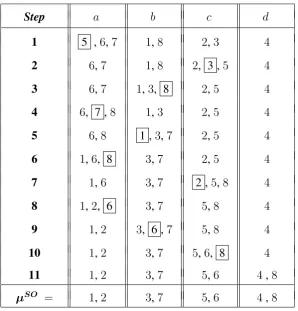
As shown in Table 1, the SOSM proposes to allocate a place in schoolato students
1 and 2; students 3 and7 are accepted by schoolb; students 5and 6 are placed at school c; and, finally, students 4and 8will attend schoold. A column in the table is devoted to each school. A row indicates the applications that each school
receives at this step. The students framed in a box are those whose applications
are refused, whereas the remaining students are tentatively accepted by the school.
The Student Optimal Compensating Market
As we mention in Section 4, a Placing Market is determined by the set of students,
S = {1,2,3,4,5,6,7,8}, and a preference profile,E, denoting, for each student, how she orders her “rivals” depending on her initial assignment, µSO. We
inter-pret the preferences determined by a student as her inclination to exchangethe place that µSO assigns to her with the other students. The construction of these
preferences is guided by the following two principles.
(a) A student participates in this market if she obtains a positive net profit from the exchange; and
(b) a student, when exchanging, tries to maximize her utility (i.e., she attempts to secure a place at the best school, according to her opinion of the
Step a b c d
1 5 ,6,7 1,8 2,3 4
2 6,7 1,8 2, 3 ,5 4
3 6,7 1,3, 8 2,5 4
4 6, 7 ,8 1,3 2,5 4
5 6,8 1 ,3,7 2,5 4
6 1,6, 8 3,7 2,5 4
7 1,6 3,7 2 ,5,8 4
8 1,2, 6 3,7 5,8 4
9 1,2 3, 6 ,7 5,8 4
10 1,2 3,7 5,6, 8 4
11 1,2 3,7 5,6 4,8
[image:31.595.139.438.138.450.2]µSO = 1,2 3,7 5,6 4,8
Table 1: The SOSM.
In the case of SOCE, a student orders two agents, other than her, who have been
assigned the same school by “reversing the school ordering” proposed by the pri-ority lists.
To illustrate how to compute the students’ preferences for exchanging,E, we will concentrate on student6. The process is as follows
(1) Provided that her preferred school is a, and µSO(a;P) = {1,2}, we note
that her two “tops for exchanging” are students1and2. Moreover, as1Pa2,
we have that
2E61.
places of which have been assigned to students3and7. We note that these
students will be placed in the third and fourth positions according toE6. As
3Pb7, it follows that
7E63.
(3) The third school in student6’s preference list isc, andµSO(c;P) ={5,6},
Principle(a)above indicates that
6E65.
For our purposes, once student6has established her own position onE6, we
do not need to continue describing how the remaining students are ordered.
Nevertheless, for the sake of completeness, we will also explain how E6
orders students4and8.
(4) µSO(4;P) =µSO(8;P) = d, and4P
d8. Therefore,
8E64.
Summarizing, the preferences for exchange exhibited by student6are
2E61E6 7E6 3E66E6 5E6 8E64,
or, equivalently,
E6 := 2, 1, 7, 3, 6, 5, 8, 4.
E1 := 7, 3, 1, 2, 6, 5, 8, 4
E2 := 6, 5, 2, 1, 8, 4, 7, 3
E3 := 6, 5, 3, 7, 2, 1, 8, 4
E4 := 4, 8, 7, 3, 6, 5, 2, 1
E5 := 2, 1, 5, 6, 8, 4, 7, 3
E6 := 2, 1, 7, 3, 6, 5, 8, 4
E7 := 2, 1, 7, 3, 8, 4, 6, 5
E8 := 7, 3, 6, 5, 8, 4, 2, 1
Therefore,SOCM(P) = (S,E), whereS ={1, . . . ,8}is the set of students andE is the preference profile described above.
The Tops Trading Cycle Rule
To continue with our illustrative example, we now compute the outcome of the
TTC rule when applied to the Student Optimal Compensating Market that was
previously described.
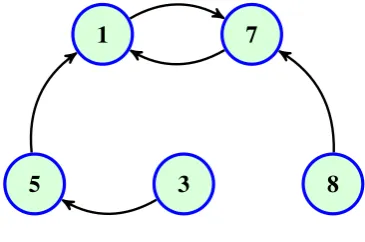
Step 1. At the first step, the set of students is S. To draw the next digraph, we proceed as follows. A node is assigned to each student. We draw an arc connectingsitoshif the latter is the top forEi.14
1 2
3 7
5 4
6
[image:33.595.176.414.499.618.2]8
Figure 1: TTC algorithm, first step.
Let us observe that the above digraph contains two cycles; the first includes
students2and6, and the second only contains student 4. Therefore, these
14
three students exit the market, and we can describe a “new market” that
includes studentsS2
={1,3,5,7,8}.
Step 2. At the second step, the set of students isS2
described above. We proceed in
a similar manner to that explained in the previous step and draw its
corre-sponding directed graph.
1
3
7
[image:34.595.205.388.245.366.2]5 8
Figure 2: TTC algorithm, second step.
There is clearly a cycle involving students1and7. Therefore,K(S2
) = {1,7}, and both students exit the market, allowing us to consider the residual market
S3
={3,5,8}.
Step 3. In this step, the set of remaining students isS3
. It is easy to see that there
one cycle containing student5. Therefore,K(S3
) ={5}andS4
={3,8}.
Step 4. Now student3forms a cycle, and henceK(S4
) ={3}andS5
={8}.
Step 5. SinceS5
is a singleton, we note thatK(S5
) = {8}andS6
= ∅. As each student is, at this point, involved in some cycle, the algorithm stops.
Therefore, the outcome of the Tops Trading Cycle, applied toSOCM(P), is
si 1 2 3 4 5 6 7 8
The Compensating Exchange mechanism
To conclude the process, we must move from the initial matchingµSO(P)to the
matching that results from the exchange of places suggested by the Tops Trading
Cycle rule. For instance, asT T C(1) = 7, then
µce(1;P) =µSO(7;P) = b.
Therefore, the outcome of the SOCE for this example is
si 1 2 3 4 5 6 7 8
µce(s
i;P) b c b d c a a d
C. A Proof for Theorem 17
To prove Theorem 17, let us consider a School Allocation problem,P = (≻;P), and letµSO(P)be its student optimal stable matching.
Let us observe that when describing the Student Optimal Compensating
Mar-ket, the preferences for exchange held by a student,si, such thatµSO(si;P)6=si,
verify that for any other studentsh,
shEisi ⇒µSO(sh;P) ≻i µSO(si;P).
By construction, the Tops Trading Cycle satisfies the requirement that, for each
Placing Market,(S, P), and anysi ∈Ssuch thatT T C(si; (S,E))6=si,
T T C(si; (S,E)) Eisi.
This implies that for each student,si,
µce(si;P) %i µSO(si;P). (4)
(a) If for some student,si,µSO(si;P) = si, then(≻, P)satisfies that
n >
m
X
j=1
qj, and
(b) If there is some school,cj, that has vacancies atµSO(P), i.e.,
µSO(cj;P) < qj,
then for each student,si,
µSO(s
i;P) %i cj.
To complete our proof, let us assume that µce(P) is not τ-fair. Taking into
ac-count equation (4)and Theorem 11, we note thatµce(P)should not be efficient.
Therefore, there should be a matching,µ, such that for each student,si,∈ S
µ(si) %i µce(si;P), and
there should be a student,sh, such that
µ(sh) ≻h µce(sh;P). (5)
Let S denote the set of students fulfilling Condition (5). By condition (4) and becauseµSO is equitable, we note that for eachs
i ∈ S, there is another student,
sh, inS such thatµ(si) =µce(sh;P). This finding implies thatsi’s preferences
for exchange satisfy the requirement that
sh Ei T T C(si;SOCM(P)). (6)
To obtain a contradiction, for each studentsi ∈S, we lett(si)denote the stage
at which it is determinedT T C(si;SOCM(P)). Without loss of generality, let us
assume that si ∈ Sis such thatt(si)≤ t(sk)for eachsk ∈S. By condition(5),
we note that in the digraph for staget(si), there is no arc fromsitoµce(si;P).
match-ing,µ, Pareto-dominatingµce(P). ⊡
D. A Proof of Theorem 23
To prove Theorem 23, let us consider a problemP ≡(≻;P), a studentsi ∈ Sand
preferences forsi,≻′i. LetP
′
≡ ((≻′
i,≻−i) ;P)be the problem obtained fromP
by replacingsi’s preferences.
Let us assume thatsimanipulates the SOCE rule atP via≻′i. We will see that
any set of preferences forsi containing≻iand≻′ifails to satisfy theβ-condition.
Note that if µSO(s
i;P) = si 6= µSO(si;P′), we have that µSO(si;P′) ≻i
µSO(s
i;P). This contradicts the non-manipulability of the SOSM (see, v.g., Roth,
1982). Therefore, sincesimanipulates, she is assigned a place in each matchings.
Let us remark the following three facts.
Fact 1. The manipulation hypothesis implies thatµce(s
i;P′)≻i µce(si;P);
Fact 2. by construction, we have thatµce(s
i;P)%i µSO(si;P); and
Fact 3. since SOSM is strategy-proof,µSO(s
i;P)%i µSO(si;P′).
Now, let us consider the following two cases, which exhaust all the possibilities.
Case 1. µSO(s
i;P) ≻i µSO(si;P′). Note that, this implies that µSO(si;P′) ≻′i
µSO(s
i;P). By facts 1 and 2, and transitivity we have that
µce(si;P′)≻i µSO(si;P)≻i µSO(si;P′); (7)
facts 1 and 3 imply thatµce(s
i;P′)6=µSO(si;P′). Therefore, by
construc-tion, we have thatµce(s
i;P′)≻′i µSO(si;P′). Transitivity yields that
µce(si;P′)≻′i µ SO
(si;P′)≻i µSO(si;P). (8)
Note that conditions (7)and(8) indicate that this agent admissible
Case 2. µSO(s
i;P) =µSO(si;P′). By fact 1, there should be some schoolcj such
that
cj ≻i µSO(si;P), andµSO(si;P)≻′i cj. (9)
Note that, otherwise, µSO(P) = µSO(P′
). Therefore, since the TTC is non-manipulable,µce(P)%
i µce(P′). Contradicting fact 1.
Therefore, sinceµce(s
i;P′)6=µSO(si;P), condition(9)implies that
µce(s
i;P′)≻′i µ SO(s
i;P)≻′i cj. (10)
To conclude, let us observe that conditions(9)and(10)are incompatible with the