Munich Personal RePEc Archive
Elegance with substance
Colignatus, Thomas
Samuel van Houten Genootschap
Elegance with Substance
Mathematics and its education designed for Ladies and Gentlemen What is wrong with mathematics education and how it can be righted
On the political economy of mathematics and its education
Thomas Colignatus
Colignatus is the preferred name of Thomas Cool in science. He is an econometrician (Groningen 1982) and teacher of mathematics (Leiden 2008).
Lawful exceptions excluded, nothing of this publication may be copied or published by means of print, photocopy, microfilm, electronics or otherwise, unless a written permit has been given by the lawful owners of the copyright, and this also holds for whole or partial reworkings.
The cover illustration has been taken from http://www.gutenberg.org/ebooks/24485, “A Floral Fantasy in an Old English Garden” by Walter Crane 184591915. This illustration is for the use of anyone anywhere at no cost and with almost no restrictions whatsoever; you may copy it, give it away or re9use it under the terms of the Project Gutenberg License at www.gutenberg.net
2nd
edition, August 7 2015
© T.H.A.M. Cool
http://thomascool.eu, cool at dataweb.nl
Supported by
Samuel van Houten Genootschap
Wetenschappelijk bureau van het Sociaal Liberaal Forum Scientific bureau of the Social Liberal Forum
The Hague
ISBN 978994625404593 Published by MijnBestseller.nl
Prologue to the 1
stedition in 2009
Our pupils and students are best treated as ladies and gentlemen with elegance and substance. Providing them with equal mathematics is our much valued objective.
Ideally mathematics would be perfect and unchanging and just be there to be discovered. Mathematics however is as much art as discovery. It is made. It is a creation, in the way that cavemen carved their scores in bones and that we create virtual reality with supercomputers. In the interaction between what we do and what we understand almost all of the weight is on what we do, which then imprints on our mind. It appears tedious and hard work to go a bit in the reverse direction, to even get where we are now, let alone develop a notion of perfection.
Given this fragile and historic nature of mathematics it should not come as a surprise that what we currently call mathematics actually appears, on close inspection, to be often cumbersome or even outright irrational. Clarity and understanding are frequently blocked by contradictions and nonsense that are internal to current mathematics itself. Who has a problem mastering mathematics should not be surprised.
Over the years, while teaching mathematics and writing my notes that now result in these pages, there were many moments that I felt frustrated and at times even quite annoyed about the straightjacket of current mathematical conventions. One is supposed to teach mathematics but it is precisely the textbook that blocks this prospect. For many pupils and students the goal is impossible from the outset not because of their lack of capability but because of awkward conventions that only came about in a historical process.
The flip side is that this is a Garden of Eden for didactic development. What is awkward can be hammered into something elegant. What is irrational can be turned rational and consistent. What is dark and nonsensical can be thrown out and replaced by clarity. There is beauty and satisfaction in redesign.
This didactic reconsideration also changes what we call ‘mathematics’. The interaction between what we do and what we understand shifts to a new equilibrium, a higher optimum at a more agreeable level for both students and teacher. It will still be mathematics since it can be recognized as mathematics. It will be stronger and more efficient mathematics too but it will no longer be the old one.
The criterion for change lies in elegance with substance. Elegance without substance creates a dandy. Elegance ought to signal substance. Mathematics concentrates on the elegance and specific fields of study like economics concentrate on the substance. But mathematics needs to have some substance of itself too. The criterion is tricky since some people see it in the present mathematical conventions too, where awkwardness A plus awkwardness B gives inconsistency C. However, we will compare the old ways with the suggestions of the new ways and let the criterion speak for itself. This should open some eyes. Otherwise we just stay in the Garden of Eden.
Prologue to the 2nd edition in 2015
This 2nd edition is almost the same as the 1st edition. Elegance with Substance (EWS) has a strong structure, a wealth of information, and not too many pages. It argues its case succinctly. This clarity will be lost when new issues are included.
The results from 2009 generally haven't changed. When developments in 200992015 supplement some of the results then a footnote explains where more can be found. Major new developments in 200992015 have been:
• Conquest of the Plane (COTP) (2011c) presents a proof of concept for EWS and creates a primer for a re9engineered course in mathematics for highschool or first year of higher education. Gill (2012) reviewed both EWS and COTP favourably and advised to read with an open mind. At the review site of the European Mathematical Society, Gamboa (2011) states about COTP: "Once the reader becomes familiar with the notations and the author style, he/she will enjoy the book. I am convinced that this work will help the students to recognize what they should know but they ignore, (...)"
• Foundations of Mathematics. A Neoclassical Approach to Infinity (FMNAI) (2015f) argues the case for having set theory and number theory in the highschool programme. A major deduction is that the transfinites by Georg Cantor are based upon ill9defined constructs, comparable to Russell's paradox, so that these can be eliminated. As a result the theory for the classroom is not as complex as commonly perceived.
Contents in brief
I. Introduction 13
II. Issues of notation 21
III. Opaque or confusing terms 35
IV. Breaking the chain of understanding 41
V. Like the stepmother in the fairy tale 47
VI. Redesigning mathematics itself 61
VII. Questions for evidence based education 69
VIII. Re(engineering the industry 73
IX. Beating the software jungle 75
X. Without time, no morality 81
XI. The derivative is algebra 89
XII. Neoclassical mathematics for the schools 97
XIII. A key insight in the didactics of mathematics 103
XIV. Residual comments 109
XV. Conclusions 115
Epilogue 117
Contents
I. Introduction ... 13
1. Natural limitations to a noble art... 13
2. As far as the mind can reach ... 13
For the record ... 13
Definition of econometrics ... 14
Beams of light (through a glass darkly)... 15
Understanding the main advice ... 15
3. An art and an industry... 16
The approach in this book ... 16
The industry... 17
Implementing change ... 18
4. Limitations to this study... 18
Setting, experience, anecdote, bias... 18
Limitations exist internationally ... 19
5. The order of discussion... 19
II. Issues of notation ... 21
6. The decimal point... 21
7. Brackets... 22
8. Brackets (2) ... 23
9. Fractions ... 24
10. The cult of the radical sign ... 26
11. Archi or Pi ... 27
12. Text, function, table and graph... 28
13. Verb versus noun... 29
14. Verb versus noun – square root... 30
15. Verb versus noun – division... 31
Definition of dynamic division ... 31
General application... 32
Subtleties... 32
Requirements ... 33
26. Ambiguous dice... 48
27. Mathematics and economics... 49
28. A shopping list on content ... 50
(a) Logic and set theory ... 50
(b) The axiomatic method ... 50
(c) Algorithms and computer programming... 52
(d) Use of language ... 52
(e) Theory of democracy and voting ... 53
(f) New subjects of the last two decades... 53
29. A shopping list on method... 54
(a) Dealing with developing brains ... 54
(c) Overall didactic awareness... 54
(c) Class and quality ... 56
(d1) Support and testing by computer – the problem ... 56
(d2) Support and testing by computer – a direction for solution... 57
VI. Redesigning mathematics itself ... 61
30. Introduction ... 61
31. A Logic of Exceptions (ALOE)... 62
32. Voting Theory for Democracy (VTFD)... 63
33. Trig rerigged (in COTP)... 64
34. The derivative (in COTP)... 66
35. Set theory, number theory and infinity (FMNAI) ... 67
36. A child wants nice and not mean numbers (CWNN) ... 68
VII. Questions for evidence based education... 69
37. What to test ? ... 69
38. Test questions... 69
39. Number sense... 70
40. Memory ... 71
VIII. Re(engineering the industry ... 73
Introduction ... 73
Goal ... 73
Governance ... 73
Finance ... 74
A Dutch experience... 74
IX. Beating the software jungle ... 75
The need for a common computer algebra language ... 75
The problem... 75
There is a good language available ... 75
The major policy questions ... 76
A suggestion done in 1999 ... 76
An analysis done in 2000... 77
Advance in 2009 from 199992000... 78
Comparing some costs ... 78
Wolfram Alpha and Google... 79
Managing the industry... 79
A caveat... 80
X. Without time, no morality ... 81
Introduction ... 81
Three traditional methods ... 82
Borda Fixed point ... 83
Relation to Saari’s work ... 84
Pareto ... 87
A note on cheating... 87
Conclusion... 88
XI. The derivative is algebra ... 89
Abstract ... 89
Introduction... 89
The old approaches ... 89
The algebraic approach ... 90
Stepwise explanation of the algebraic approach ... 90
Implications... 92
Students ... 92
The chain rule... 93
The derivative of an exponential function ... 93
Conclusion... 94
Appendix about 200992015... 95
XII. Neoclassical mathematics for the schools... 97
Introduction... 97
Fractions, but also division in general... 98
An outline... 99
A table ... 101
Conclusion... 101
XIII. A key insight in the didactics of mathematics ... 103
Introduction... 103
The didactic approach ... 103
It hinges on what counts as experience... 104
What we can assume and build upon... 104
Finding the proper dose and perspective... 105
The challenge ... 105
A missing link... 105
Co9ordinates and vectors... 106
The importance of motivation ... 106
XIV. Residual comments ... 109
Final conclusion ... 116
Epilogue... 117
Epilogue 2009 ... 117
Epilogue 2015 ... 119
Appendices ... 121
What is new in this analysis (in 2009) ? ... 121
What is new in this analysis (in 2015) ? ... 121
List of new notions and symbols ... 122
Abstract... 123
Summary... 123
Cover text in 2009 ... 124
What a mathematician might wish to know about my work ... 125
Abstract... 125
Introduction ... 125
A context of quality... 126
Standard ways versus re9engineering... 126
Mathematicians contribute to confusion... 127
Modesty ... 127
Little contact with mathematicians ... 127
Some original contributions... 128
Some abstracts ... 129
Parliament... 129
The economic and ecological crises ... 130
Conclusion ... 130
Literature... 131
I. Introduction
1. Natural limitations to a noble art
A distinction that comes natural to us is between empirical reality and abstract thought. The first is the subject of the empirical sciences, the latter the realm for mathematics and ideal philosophy. This distinction comes with the observation that mathematicians are little trained in empirical issues.
Our subject is the education in mathematics.
Didactics, and in particular the didactics of mathematics, deals with real pupils and students. Didactics requires a mindset that is sensitive to empirical observation – which is not what mathematicians are trained for.
2. As far as the mind can reach
Mathematics is a great liberating force. No dictator forces you to accept the truth of the Pythagorean Theorem. You are free to check it for yourself. You may even object to its assumptions and invent non9Euclidean geometry. Mathematical reasoning is all about ideas and deductions and about how far your free mind will get you – which is amazingly far.
But you have to be aware of reality if you say something about reality.
The education in mathematics is not without some empirical study. It is proper to recall the Van Streun (2006) In Memoriam of A.D. de Groot. It is a painful point however that such exceptions prove the rule.
With respect to logic and democracy, Colignatus (2007ab, 2008b), updated from 1981 / 1990, considers statements by mathematicians that have been accepted throughout academia and subsequently society on the basis of mathematical authority. It appears however that those statements mix up true mathematical results with interpretations about reality. When these interpretations are modelled mathematically, the statements reduce to falsehoods. Society has been awfully off9track on basic notions of logic, civic discourse and democracy. Even in 2007, mathematicians working on voting theory wrote a Letter to the governments of the EU member states advising the use of the Penrose Square Root Weights (PSRW) for the EU Council of Ministers. See Colignatus (2007c) on their statistical inadequacy and their misrepresentation of both morality and reality. Over the millenia a tradition and culture of mathematics has grown that conditions mathematicians to, well, what mathematicians do. Which is not empirical analysis. Psychology will play a role too in the filtering out of those students who will later become mathematicians. After graduation, mathematicians either have a tenure track in (pure) mathematics or they are absorbed into other fields such as physics, economics of psychology. They tend to take along their basic training in abstraction and then try to become empirical scientists – but within the framework of their basic training.
The result is comparable to what happens when mathematicians become educators in mathematics. They succeed easily in replicating the conditioning and in the filtering out of new recruits who adapt to the treatment. For other pupils it is hard pounding.
[image:15.482.102.335.410.560.2]My own training in mathematics, as a student of econometrics starting Autumn 1973, was with the students of mathematics, physics and astronomy. Thus I do not feel any shortcomings here. My mathematical results e.g. in Colignatus (2007ab) are quite nice even though not developed axiomatically. I have limited affection for pure mathematics but am aware of the hesitations on their part. At least I have the training not to claim more than can be proven, to distinguish fact and hypothesis. For me, however, this holds both in mathematics and about reality. For readers not familiar with the notion of econometrics, I can usefully replicate the diagram by Rijken van Olst, see Figure 1.
Figure 1. The Rijken van Olst diagram for econometrics
One of the beauties of a sound education in mathematics is that you learn to see that a good argumentation exposes the dependency on assumptions. Officially, mathematicians are aware of this. They are the first to admit “well, if you change one of the assumptions, of course you may get another result”. They will say the same, in reconstruction, for assumptions on reality, whether it is the stock market crash, ecological collapse, destruction of democracy, corruption of the subject of mathematical logic, or even mathematics education itself. If only that they would be aware of it sooner and that society would not be swayed so easily by their seeming competence.
On occasion there is a mathematician who is not only officially aware of mathematical shortcomings but who also goes a long way in developing answers. Writing this book got me to reading Krantz (2008) Through a Glass Darkly at arXiv again, and it was gratifying indeed. It is advised reading for proper digestion of this present book.
From his conclusions:
“So it may be time to re9assess our goals, and our milieu, and indeed our very lingua franca, and think about how to fit in more naturally with the flow of life. Every medical student takes a course on medical ethics. Perhaps every mathematics graduate student should take a course on communication. This would include not only good language skills, but how to use electronic media, how to talk to people with varying (non9mathematical) backgrounds, how to seek the right level for a presentation, how to select a topic, and many of the other details that make for effective verbal and visual skills. Doing so would strengthen us as individuals, and it would strengthen our profession. We would be able to get along more effectively as members of the university, and also as members of society at large. Surely the benefits would outweigh the inconvenience and aggravation, and we would likely learn something from the process. But we must train ourselves (in some instances re9train ourselves) to be welcoming to new points of view, to new perspectives, to new value systems. These different value systems need not be perceived as inimical to our own. Rather they are complementary, and we can grow by internalizing them.”
In such a future, didactics in mathematical education may come about more naturally. In the mean time however we are confronted with the current situation and the current stock of mathematicians. This is what this book is about.
Please do not understand me wrong. This is a book about the education in mathematics, not an evaluation of mathematics by itself and what they have done since Sumer 5000 years ago. We will not look into what mathematicians have done positively in all kinds of areas and neither will we look into what horrors the empirical sciences have wrought by applying inadequate math. These other issues are not relevant here. We will merely consider the current state of the education in mathematics. This book is about solutions to the problems that we find there.
This said, let us get down to business and consider education in mathematics. The subject is fascinating and enlightening. There is a Garden of Eden for all kinds of improvements and advancement indeed. It is liberating to see what causes the viscosity and to see what can be done about it.
3. An art and an industry
Mathematics is as much an ideal art as an industry. The art targets the intellectual jolt when an insight strikes the mind. The Pythagorean Theorem causes a sense of wonder. Alongside there is the industry of creation, application and teaching. Struik’s (1977) Concise history of mathematics clarifies that mathematics developed within society as all other arts and sciences. When this math gets taught there are similar influences. Ernest (2000) Why teach mathematics? recognizes at least five interest groups in the teaching of mathematics and uses these labels: Industrial Trainers, Technological Pragmatists, Old Humanists, Progressive Educators and Public Educators. His opening statement reads:
“First of all I want to argue that school mathematics is neither uniquely defined nor value9free and culture9free. School mathematics is not the same as academic or research mathematics, but a recontextualised selection from the parent discipline, which itself is a multiplicity (Davis and Hersh 1980). Some of the content of school mathematics has no place in the discipline proper but is drawn from the history and popular practices of mathematics, such as the study of percentages (Ernest 1986). Which parts are selected and what values and purposes underpin that selection and the way it is structured must materially determine the nature of school mathematics. Further changes are brought about by choices about how school mathematics should be sequenced, taught and assessed. Thus the nature of school mathematics is to a greater or lesser extent open, and consequently the justification problem must accommodate this diversity. So the justification problem should address not only the rationale for the teaching and learning of mathematics, but also for the selection of what mathematics should be taught and how, as these questions are inseparable from the problem.”
This book will consider the two faces of the ideal art versus the industry. Our subject is the education in mathematics but the ideal art will be guiding and it may be that we first have to change mathematics itself before we can adapt its education. Apparently this does not fit in easily with the Ernest categories.
there is no internet or that their students are more versatile than professors and can deal with both comma’s in textbooks and points in internet resources.
The organizational structure in the education in mathematics is somewhat Byzantine. There is a forest of governments, committees, mathematical associations, exam boards, textbook authors, institutes of education of teachers, journals, a self9created almost world government style International Commission on Mathematical Instruction (ICMI), and what have you. Attitudes range from ‘teaching to the test’ to the Ernest five groups. Each tree holds on to its roots in order to survive. Suggestions for redesign have to convince that forest. Most suggestions in this book may seem rather bold so that adoption will not be very likely. There is no alternative but to convince that forest. The following arguments and structure of argumentation will be used:
(1) To show that mathematics fails we do not require statistics but can look at the math itself. Officially we require a statistic that competing textbooks use the same math but for the sake of simplicity we trust that ICMI has had some success, and my small sample has not disproven this.
(2) A corner stone is that mathematics is man made. It is a building made over time such that all kinds of conventions have crept in. If we were to redesign the building anew, many of those conventions would be deleted. People living in that building – the mathematicians – will mostly not discover by themselves how strange those conventions can be. Others looking on from the outside – for example physicists and economists with mathematical training – can recognize them sooner.
(3) This book shows that redesign of math will result into better mathematics. Most cases presented here can be understood in principle by anyone with a highschool level of mathematics, and some may require a first year of higher education in a direction that uses mathematics but isn't a mathematics major.
(4) At the meta9level and by implication, this shows that there is something amiss with the current industry. Improvements are not easy to bring about and the price of current conventions and procedures is very high. Mathematics can be beautiful and contribute to confidence, competence and joy in life. If the mathematical industry does not serve its customers well, it fails its own stated objectives and may meet with public criticism.
Mathematicians will conventionally regard argument 3 as the only convincing one. They might be the first to recognize the improvements in mathematics and didactics presented here. Mathematical tradition clearly is an improvement from alchemy and astrology. Most people will also tend to let the professors and teachers decide on whether these items are improvements indeed. It is tempting to conclude that the system then works: an improvement is proposed, it is recognized, and eventually will be implemented. This approach however takes a risk with respect to potential future changes. With the present failure and analysis on the cause we should rather be wary of that risk. We’d better regulate the industry of mathematics education in robust manner.
It would be unwise to leave the restructuring of the industry to the mathematicians themselves. They are not in the position to look at themselves from the outside. They cannot ‘think out of the box’. Teachers and professors of mathematics can do their work with love and acuteness but they have not succeeded, internationally and jointly, to cleanse mathematics and the teaching of mathematics from cumbersomeness and irrationality. Instead, the math teachers, having been trained in their conventions, implement those conventions again and condition their students in the same. When students encountered problems and complained about them, they were not listened to and instead subjected to further conditioning. Mental anguish and even tears by damsels in distress carried no weight, mathematical convention was sacred and all blame was put onto the students and their supposed lack of mathematical capability.
Realism suggests that we have a system that actually works. Annually millions of students get their highschool diploma including some math, so apparently the system works to a high degree. Our advanced society could not exist otherwise. But, sobering, do graduates leave school with mathematics or is it only seeming ‘mathematics’ ? That it ‘works’ and that teachers of mathematics tend to be decent people is by itself no argument to neglect criticism. The evidence in this book carries some weight. Awkwardness and irrationality in ‘mathematics’ also have consequences for other subjects that use mathematics. We spill a lot of time and energy in education because of the state of mathematics. Many kids suffer. Those who pass their math exams actually are much stunted in their mathematical development. The economy suffers with such low development of mathematical knowledge, skill and attitude. It is rather impossible to quantify the loss and counterproductiveness.
Supposedly, as it is a problem that affects each nation, it would be a task for each national parliament to start the wheels of change. Parents are advised to write their representative. Parliament is not asked to determine the next digit of π but to rearrange the institutional setting so that our kids get math without pain.
The suggestion causes people to raise eyebrows. People elect parliament but seem to dislike it and not regard it as a useful place to resolve bottlenecks. The present situation is a chance for parliament to enhance its standing. Decisive action on the failure of mathematics education will set an example.
4. Limitations to this study
While mathematics has its limitations, this book suffers some too.
elementary level. But there is no joint responsibility and management of the whole column. Teachers at elementary schools appear to have problems with mathematics themselves. The Minister of Education allows a “Math C” profile level for their certification as teacher, i.e. a level with not very much of math. Hence, those elementary school teachers may tell their pupils that mathematics is very difficult and not worth your effort. While the situation in Holland is not our focus, the example clarifies that it is advisable to consider the whole industry and to keep an open mind for the subtle influences between the ideal art and that industry.
" !
Braams (2001), on the evaluation of research into K912 mathematics education: “A practicing scientist might think that reform efforts could, should, and probably would be guided by a respected body of research into what works and what does not, although within such a body of research there might still be significant differences in research focus, methodology and results. With that in mind I started looking for appropriate research, and this letter is a little report on my search. I’ll say right away that the outcome has been entirely negative. (P) To be sure, there are plenty of efforts in mathematics education research. Many of them provide results that are of anecdotal and perhaps of inspirational value. Many appear to be tightly linked to a particular implementation of some reform, limiting their scientific standing. It really looks as if all the recent United States efforts in education research have not produced a single respected comprehensive study of the kind outlined above, let alone a body of authoritative research that provides firm empirical guidance for mathematics pedagogy.
Fortunately we still have our common sense to guide mathematics education. Unfortunately (but it would take us too far afield to discuss it further here) present trends towards discovery9based learning and constructivist pedagogy seem as little rooted in mathematicians’ common sense as they are rooted in education research.”
With this in mind, I can usefully express that the method chosen here is logic. I draw information from my own experience and reading but, since this would be anecdotal indeed, all conclusions and advices are only based upon logic. And, OK, upon common sense.
I am aware of the Watkins (1995) paper on the US Follow Through evaluation, the Hattie (1999) meta9analyses in particular on the influences on student learning, the Anderson, Reder and Simon (2000) evaluation of applications and misapplications of cognitive psychology to mathematics education. Writing these lines I realize their dates. The point however is context awareness. While this book concentrates on what and how we are teaching when we are teaching mathematics, education is a rich context that will always have to be taken account of.
5. The order of discussion
same surprise. (Though you miss out on the surprise of having to rewrite this Introduction.)
This book has a didactic set9up. We already presented the main message. Now we get down to the evidence. We work from the small upwards to the more complex. The small issues should be fun and eye9opening. They prime the mind to become sensitive to the more complex. By allowing readers to digest the examples and arguments the overall reasoning has more chance to be understood.
The chapter on redesigning mathematics itself only gives summaries and then refers to the relevant sources elsewhere. However, the paper on derivatives has been rewritten and is now included as a new chapter of itself.
The first eight chapters number their paragraphs for easier reference to specific points. This introduction summarizes the book. A much shorter summary and condensed abstract are in the appendix, for backup.
II. Issues of notation
6. The decimal point
The decimal notation was invented by Simon Stevin (154891620) who aspired at clarity. He would be upset about what is done with his invention. For decimal marker, the British use the point and the French use the comma. The ISO standard followed the French but since 2006 points are accepted notably for texts in English, see Baum (2006). To allow either a comma or a point is a standard, of course, but actually somewhat loose.
This book uses English. Conventionally we would use the dot and be done with it. At issue now is however to consider the matter from the angle of elegance with substance. Let us avoid getting lost by French – British disputes and diplomacies and let us try to determine what we want.
In Europe we see that textbooks use comma’s, computers have to be set to comma’s, but internet resources in English will use the point. Pupils and students apparently learn how to deal with it (or fade from view). But it is an awkward situation and weak students suffer a needless burden. Perhaps legal documents require a single format and we have to teach students to use that format. But it is not clear why a course in mathematics should suffer the inability of the legal world to adopt a single notation. The best solution remains that the world adopts one notation and be done with it.
There is already a mathematical standard application for the comma. For a two9 dimensional point we use the notation {x, y}. This is clear for the point {2, 0} but it gets less clear for {2,5, 4,32} so that some start writing {2,5 ; 4,32}. English readers will not be familiar with these Byzantine consequences and it may open their eyes to the larger problem.
Hence it is best to use the decimal point.
7. Brackets
Brackets belong to the most important symbols. Consider (a + b)(c + d) if we did not have brackets. There is also the notation for a function (x). Thus a(x) could be both a function and a x P which is inconsistent (unless the function would be very specific and a would remain non9numeric).
Most students can learn to deal with context9dependency and most would guess that a(x) is a function. What about a(c + d) ? Is this a multiplication or a functional expression ? Some people might object “normally we don’t write sums in a function's argument, so your example of a(c + d) is a crafted and irrelevant exception”. But what about (x + h) – (x) leading to differential calculus ? Mathematicians should admit that they themselves are confused because of the ambiguity of a(c + d) and they are irrational when they don’t admit it.
Issues like these arose in the design of computer algebra languages. Computers are strict and require unambiguous input. The language Mathematica (my standard reference) chose to use straight brackets for functions, thus [x].
A standard reaction by mathematicians is (a) straight brackets are ugly, (b) it is only for computers. Hence, indeed, Mathematica later developed the “traditional form” such that the (hidden) input uses straight brackets for clarity while the display has round brackets. The proper answer is: (ad a) what is ugly is to a large extent a matter of convention, (ad b) people are much like computers. There is no difference in getting stucked. For consistent thought, people require unambiguity too which is something else than saying that they are computers.
When confronted with (x) people can do more than computers and work around corners. There is the hidden rule that letters like , g, h, - are conventionally used for functions so that the expression would be unambiguous. Or at one point a is defined to be a function so that a(x) can be recognized. It are rules like these that are not explicitly mentioned in textbooks but that students have to figure out if they want to pass. “Read carefully” the standard mathematician might say. The key point remains that this is exactly that: working around corners. It puts a burden on the weaker students to acquire that additional competence. They are told that mathematics would be clear and consistent, they are confronted with a clearly inconsistent notation, and when it gives them a hard time then they are told that they are themselves to blame.
8. Brackets (2)
Conventionally, the notation (x, y) can be used for the two9dimensional point and for the open interval from x to y. In Holland this ambiguity is solved by using <x, y> for the open interval. As [x, y] is the closed interval, in France ]x, y[ gives the open interval.
If (x, y) is a point then something can be said in favour of using (x, y) for the function on that point. Unfortunately this breaks down for the single dimension (x) and the other use of round brackets.
The straight brackets in [x, y] in Mathematica might cause a confusion with the closed interval. Hence Mathematica has the notation / object Interval[x, y] which is a bit inelegant. With function call [x, y] we might expect [x, y] to be used for the two9 dimensional point but instead Mathematica uses {x, y}. For this notation, Mathematica has an option to distinguish ordered (default) and unordered sets. Potentially there is a difference between [x, y] and [{x, y}].
We do not need to resolve these issues here. We merely indicate the problem of the consistent use of brackets and let us hope that an international committee finds a solution.
In this book we adopt Mathematica’s notation of the two9dimensional point {x, y}.
9. Fractions
There is the expression two/and/a/half or 2½ alongside the expression 2√2. The first is the addition 2 + ½ and the latter is the multiplication 2 * √2. A blank space is multiplication and thus there arises the following issue.
Try to spot when 2 times ½ = 1 turns into 2 plus ½ = 2½ . How large can the space be ?
2 ½ 2 ½
2 ½ 2½
2
1
2
2
1
2
x y x y
x y xy
Somewhat teasingly too this book will tend to write 2 ½ because I actually prefer a bit more space inbetween but clearly this would be confusing since it could read as 2 * ½. The improvement would be to consistently write 2 + ½ and to stop using 2½. In the same way we already write 2 + √2. In intermediate steps we would often use 5 / 2 rather than 2 + ½ but the latter is the best presentation of the end result.
This would fit not only with notation in general but also with the actual calculation, e.g. of 2½ * 1¼ = (2 + ½) (1 + ¼).
In computer languages xy stands for a single variable in the same way as 34 stands for a single number. Mathematical textbooks however can write a (b + c) = ab + ac where the latter are multiplications. It is better that they drop this habit and insert a blank space. For example, with multiplication ab and a = 3 and b = 4 children play by calculating 34 = 3 * 4 = 12 = 1 * 2 = 2.
Conversely, one can argue that the use of smaller fonts unambiguously indicates fractions, and that writing a number directly close up to the fractional line (which would anyway be normal for larger numbers) can unambiguously mean that this is addition. On this ground there is no need for change. The latter might be valid – as apparently people with mathematical ability learn to switch frames when we compare 2½ and 2√2.
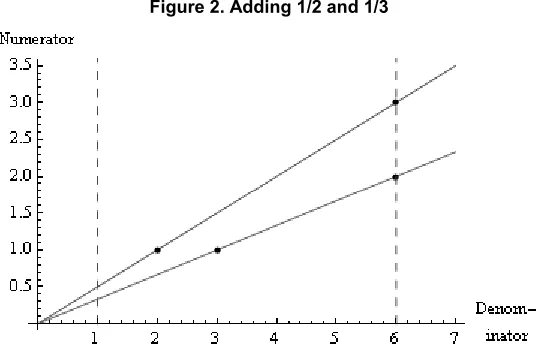
them can be done by taking a common multiple of steps, say 6. Extending the lines gives us 3/6 + 2/6 or 5/6 as the total. If we look at the vertical at 1 instead then we would get decimal fractions. Van Hiele has explained over the last fifty years that pupils at elementary school can already deal with vectors and co9ordinates. Who sees this display for dealing with fractions will tend to agree that we should not withhold it. Of course, the addition of slopes is different from the addition of vectors, and thus the pupils better grow aware that it matters what labels are on the axes.
Figure 2. Adding 1/2 and 1/3
PM 2. We might use a separate symbol for a fraction that has been simplified, as opposed to one that isn’t. Thus 2 + 4/6 might still be unfinished and 2 + 2/3 FIN or perhaps 2 ||9 2/3 would be the result that ‘definitely’ cannot be simplified further. Normally we would not use the latter as it is rather pedantic but it can be a tool in the communication between teacher and pupil when the topic of discussion is simplification. We might also write “Do 2 + 4/6” and "Done 2 + 2/3".
2015:
PM 3. COTP §15.3 has a discussion of proportion space.
PM 4. A better suggestion is to abolish fractions altogether, using 1 / x = xH, which results
into 2 + 2H as a fine notation. xH is pronounced as "per x" or sometimes "one per x". It
uses H = 91, the Harremoës operator, to be pronounced as "eta". See the weblog texts – included in BHRM (2015g).1
1
https://boycottholland.wordpress.com/2014/08/25/confusing9math9in9elementary9school/ https://boycottholland.wordpress.com/2012/04/01/english9as9a9dialect9of9mathematics/ https://boycottholland.wordpress.com/2014/08/30/taking9a9loss/
10. The cult of the radical sign
When it has been clarified that 2^2 = 4 then it is straightforward to explain that 2 = 4^(1/2), and subsequently develop exponents in general. This direct development of exponents is a clear and straightforward route. Students can use good practice on this. It takes time and energy to learn to write the exponent at the right height, fractions already were a bit difficult and the notion of this type of inverse has to sink in.
Instead, school mathematics has developed the cult of the radical sign.
The latin word for root was radix, it was abbreviated to r, this was written as √, and subsequently it got generalized into the p9radical sign . Teachers of mathematics apparently seem unable to imagine a life without this sign. Students are submerged in its use and tricks.
Apparently the apotheosis of this cult is that students are told that = xq/p. But we could have gotten there also via the direct route in the first paragraph, with the aside that
xq/p is sometimes written by some people as .
Admittedly, the square root sign is useful in two9dimensional geometry, notably with fast and clear labelling of the lengths of sides using the Pythagorean Theorem. And the notion of a ‘root’ is fine too. But apart from that it is clutter.
The radical sign has created a life of itself, outside its realm of usefulness, and with counterproductive results. For example, it is considered ugly or unconventional to write √(a + b) with brackets and subsequently a lot of time is spent in having the pupils extend the upper root line to the end of the expression under the root, with hopefully a small drop to indicate that the end has been reached. For example, the equivalence of p9roots and exponents does not sink in fast and students lose time in translating the one to the other, and trying to figure out whether this also means that the properties are transferred. Eventually, good students understand that the radical sign is merely a different way of writing fractions for exponents – but really, what is the mathematical insight ? What sense of wonder is this supposed to generate and how is this supposed to contribute to the motivation to learn more ?
11. Archi or Pi
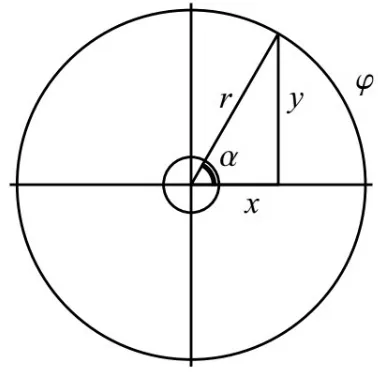
The mathematical symbol π (Greek “pi”) is defined on a circle as the ratio of the circumference to the diameter. This derives from ancient experience that the measurement of the diameter is very practical. In science and education the diameter has lost its relevance however, and it is the radius of the circle that matters.
Angles are commonly measured in 360 degrees or 2 π radians. Because of the distinction between diameter and radius, education suffers the perpetual factor 2.
It is useful to define Θ (Greek capital theta, pronounced as Archi from Archimede) as the ratio of the circumference to the radius. Thus Θ = 2 π.
For angles, we can take the plane itself as the unit of account. One turn around the circle is a better measure than 360 degrees.
The advantage of using Θ is twofold:
(1) It is easier to think in terms of whole circles and turns than half circles. As π radians are an angle of 180 degrees, or a half plane, it carries with it a notion of non9 completeness. Using Θ / 2 or 2H
Θ carries the notion of only a half turn. Indeed, the symbol π is taken from “perimeter” and it has succeeded only half.
(2) There is more outward clarity on the linkage with calculus. The integral of x is ½ x2 or 2H x2.
Thus with radius r the circle circumference is r Θ and its surface is ½ r2Θ or 2H r2 Θ.
Admittedly, when you look for it then the relationship from calculus can also be seen when using π but the advantage of Θ is that you don’t really have to look for it since it tends to stand out more by itself.
Independently, Palais (2001ab) came to the same view (see also his animated website 2).
Palais introduced the three9legged but this is bound to cause writing and reading errors, let alone confusion, and I remain with Θ.
Here it suffices to point out the mere benefits of using Θ. We will return to trigonometry later on when discussing the measurement of angles, see page 64.
PM 1. Some students confronted with 2 π have the tendency to complete this by applying the calculator and returning 2 * 3.14P = 6.28P With Θ it would be easier for them to
stop, and wonder whether the exact Θ is required or the numerical approximation. However, they will meet much of the same problem when they are confronted with Θ / 2
or 2H
Θ. Hence this issue must be dealt with separately.
PM 2. Rather write x Θ instead of Θ x. Current convention is to write 2 π r but there is advantage in recognizing Θ as an indication of the full turn as a unit of measurement.
2015:
PM 3. There is the tau9community who propose to use tau or τ = Θ = 2 π. Earlier I
considered this option too but rejected it because of the similarity with r, the symbol for the radius. This similarity will cause much confusion, especially in handwriting in exams. PM 4. There is an animation. 3
2 http://www.math.utah.edu/~palais/cossin.html 3
12. Text, function, table and graph
When exploiting the linkages between text, function, table and graph, the current convention requires an unnecessary switch in orientation.
For the graph, we use x for the horizontal axis and y for the vertical axis. For the table, convention puts x on top and y below (with no further explanation).
This layout of the standard table causes a switch in orientation with respect to the graph. Students have to glance from the numbers in the table to the graph, check values and, now, in addition, have to translate up to down and in reverse.
Why ? Merely because of the convention that text lines in a book run from the top of the page to the bottom of the page, and that for functions the x values cause the y values and hence come first. There isn’t more to it. But this thoughtless convention comes at a price. Young brains that have few memory places and that need to learn to compact their concepts and actions would be served with the same orientation.
[image:29.482.104.347.335.373.2]Also, the distinction between cause and effect does not fully correlate with the order of the lines on a page. It is more instructive to create a table that states cause and effect explicitly, see Table 1. Suggestion: try this on Figure 2.
Table 1. Improved layout of the table used to draw a function
Effect y = [x] [0] 2H P
Cause x 0 2 P
In addition, when a slope is determined with ∆y / ∆x then the current convention with x on top and y below causes another reorientation. The format in Table 1 retains the orientation of numerator and denominator.
13. Verb versus noun
To ride is a verb and ride is a noun. Riding is an activity and a ride is something completed, an abstraction of the activity. Clearly, a ride also implies an activity but there remains that subtle difference.
Computer programmers have noted this distinction early on. In the language Algol a statement “X := 5” means that variable X is set to the value of 5 while a statement “X = 5” would be a logical expression that evaluates to True iff X is 5. Earlier in history there was the distinction between the potential and actual infinite. Above, however, we saw that 2 + ½ was seen (also by teachers) not as the result itself but as an instruction to further simplify to 2½. Conversely we saw that students had to learn to recognize 2 π as a result
on itself instead of an instruction for continued calculation.
The distinction between verb and noun can be stated mathematically as the distinction between a procedure / algorithm and its outcome / result.
Mathematics is full of switches between verb and noun. It is a pity and also rather a shame that this is not pointed out didactically as frequently. As a teacher I noted that pupils and students have a hard time to deal with these switches. There are two conclusions. (1) The first is the general insight that educators in math must pay more attention in general to this distinction and how it affects learning by students. (2) The second is that it will help to introduce innovations at particular spots to support this. PM 1. Pierre van Hiele (1959) and Dina van Hiele9Geldof developed a theory of learning mathematics, by concrete, ordering and abstract levels:
“the process of learning proceeds through three levels: (1) a pupil reaches the first level of thinking as soon as he can manipulate the known characteristics of a pattern that is familiar to him/her; (2) as soon as he/she learns to manipulate the interrelatedness of the characteristics he/she will have reached the second level; (3) he/she will reach the third level of thinking when he/she starts manipulating the intrinsic characteristics of relations.” (FU wiki (2008))
Textbooks should better recognize the points where level jumps tend to occur or are required to occur. The verb / noun distinction is such a point. Sometimes the noun will be the abstract of the verb, sometimes in reverse. The individual learning process may differ from the reconstruction of a general process in more standardized terms.
PM 2. Independently, Gray & Tall developed this distinction into the idea of a ‘procept’. Tall (2002) seems to embed the ‘procept’ into the 2nd Van Hiele level:
“The Symbolic9Proceptual World of symbols in arithmetic, algebra and calculus that act both as PROcesses to do (eg 4+3 as a process of addition) and conCEPTs to think about (eg 4+3 as the concept of sum.)”
I have a small problem with this use of vocabulary, in that a concept is not necessarily static and may well be a process too. It is not necessary to limit the distinction between verb and noun to symbols only. It is not entirely clear whether it is really useful to use a new word “procept” to indicate that verbs and nouns are connected, and that processes hopefully give a result and that results tend to be created by processes. That said, the Gray & Tall idea remains important. It points to the phenomemon that mathematics can use deliberate vagueness in order to make efficient use of the same symbols.
14. Verb versus noun – square root
A key example is the square root, for example √2.
The equation x2 = 4 has two solutions, x = 2 and x = 92. At this stage in the curriculum, students are not aware of the distinction between a function (for each x there is a single y) and a correspondence (for each x there may be more y). It would be better if they were introduced to this distinction. The solution of x2 = 4 would be easier with the correspondence Do√ or ‘take the root‘ so that x2 = 4 solves into (x = Do√4) → (x in {2, 9 2}), the solution set. This inverse can be shown by mirroring x2 along the line y = x. In the current situation punching in √4 on the calculator looks like a procedure and the students get confused (a) between the noun / number and verb / procedure, and (b) between solving and simplifying. Students are inclined to take the square root of 4 and to write ‘solutions’ √4 = 2 and √4 = 92, which they check by squaring both sides. In mathematical convention this is false since √4 has to be a nonnegative number. √4 can be simplified to 2, and simplification is not solving. Thus √4 = 92 is a false statement. We can also write Sim√4 = 2 for the procedure of simplifying the square root of 4, to distinguish it from Do√4 → {2, 92}. Mathematica also has N[√x] to find a numerical value. For the instruction in the current situation it would help to write the solution of x2 = 4 as x
= √4 = 2 or x = 9√4 = 92. Curiously, this is not really done much. In some books we can see that functions [x] = x2 and g[x] = √x are discussed but with little discussion of their relation, and in other books there is more discussion but it tends to be confusing.
Currently the radical sign denotes the passive number and equation solving gives the active process. In itself it is a strong distinction. But expressions like “take the root” must then be avoided (which is somewhat difficult since roots are used).
PM 1. Students find it hard to distinguish between the number notion and the procedure that is available on their calculator. Mathematics teachers think that students are confused between exact and approximate results but here it would rather be the distinction between verb and noun. If you recognize √2 as information and stop seeing it as a command then there you are. See page 38 for the issue of approximation itself.
For exponents in general we would have DoExp[y, 1/n] so that there is a distinction between the noun / number 41/2 = 2 and the verb / process DoExp[4, 1/2] → {2, 92}.
15. Verb versus noun – division
Western mathematics had to wait till 1200 AD before the zero came from India via Arabia together with the Indian digits – where both “zero” and “cipher” are jointly derived from the Arabic “sifr” = “empty”. Indian numerals are easier to work with than Roman numerals, e.g. try to divide MCM by VII, yet this advance came with the cost that the zero caused a lot of paradoxes. Mathematics solved most problems by forbidding division by zero. However, there is also the issue of algebra.
Dijksterhuis (1990) suggests that the ancient Greeks did not develop algebra – and subsequently analytical geometry – since they used their alphabet to denote numbers. Thus α + α = β already had the meaning 1 + 1 = 2, whence it would be less easy to hit upon the idea to use α as a variable. We too would consider it strange to use e.g. 15 as a variable ranging over 9∞ to +∞. This explanation is not entirely convincing since the Greeks did use names like “Plato” or “Aristotle” and thus might have used a name to denote a variable – like “Variabotle” – though the letters in the name then should not again decode to a number. Notation clearly was one of the obstacles to overcome. Let us now assume that we are familiar with algebra and that someone announces the new invention of the zero.
Let us distinguish the passive division result from the active division process. In the active mode of dividing y by x we may first simplify algebraically under the assumption that x ≠ 0 while subsequently the result can also be declared valid for x = 0. This means extending the domain, i.e. not setting x = 0. The active notion would be a new concept. Denote it as y // x or (y xD) where the brackets are relevant to keep y and x together.
There is already an active notion (verb) in taking a ratio y : x. But a ratio is not defined for x = 0. Mathematicians will tend to regard division y / x as already defined for the passive result without simplification – i.e. defined except for x = 0. Others who aren’t professional mathematicians will tend to take y / x as an active process (and they might denote y // x for the passive result). All in all, it would not matter much, since we might continue to write y / x and allow both interpretations depending upon context. In that way the paradoxes of division by zero are actually explained, i.e. by confusion of approach or perspective.
To make this strict, let y / x be as it is used currently in textbooks, and let y // x = (y xD) be
the following process or program, called dynamic division:
y // x ≡ { y / x, unless x is a variable and then: assume x ≠ 0, simplify the expression y / x, declare the result valid also for the domain extension x = 0 }. Thus simplification only holds for variables but not for numbers. Thus x // x = 1 but 4 // 0 generates 4 / 0 which is undefined. Also x / x is standardly undefined for x = 0.
#
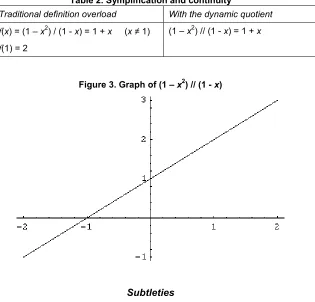
[image:33.482.82.397.190.492.2]There is no need to be very strict about always writing “//”. Once the idea is clear, we might simply keep on writing “/”. An expression like (1 – x2) / (1 9 x) would be undefined at x = 1 but the natural tendency is to simplify to 1 + x and not to include a note that x ≠ 1, since there is nothing in the context that suggests that we would need to be so pedantic, see Table 2. The current practice in teaching and math exams is to use the division y / x as a hidden code that must be cracked to find where x = 0 but it should rather be the reverse, i.e. that such undefined points must be explicitly provided if those values are germane to the discussion. Standard graphical routines also skip the undefined point, see Figure 3, requiring us to give the special point if we really want a hole.
Table 2. Symplification and continuity
Traditional definition overload With the dynamic quotient (x) = (1 – x2) / (1 9 x) = 1 + x (x ≠ 1)
(1) = 2
(1 – x2) // (1 9 x) = 1 + x
The first can be the great sin that creates such nonsense as 2 = 1, the second is only the application of the rules of algebra. In this case, x 9 x is a constant (0) and not a variable, so that simplification generates a value Indeterminate for both / and //.
Also a (x + x) / a would generate 2x for a ≠ 0 and be undefined for a = 0. However, the expression a (x + x) // a gives 2x, and this result would also hold for a = 0, even while it then is possible to write a = x 9 x = 0, since then it is an instant (and not presented as a variable).
Another conclusion is that calculus might use algebra and the dynamic quotient for the differential quotient instead of referring to infinitesimals or limits, see page 89.
$ %
III. Opaque or confusing terms
16. Logarithm versus Recovered Exponent
Around 1600, Simon Stevin created many terms in the Dutch language that better clarified the Greek and Latin phrases of then9traditional mathematics. For ‘mathematics’ he coined the Dutch word “wiskunde” – meaning the art of certainty, as ‘mathesis’ means ‘what we have learned’, which should not be something fickle. Nowadays, with probability theory and statistics, the Dutch would also need the word “giskunde” – the art of uncertainty. What anyhow remains is that it helps in education to use self/explanatory terms.
John Napier’s term “logarithm” (Log) is singularly opaque. My suggestion is to use the term “recovered exponent” (Rex). 4
With 103 the exponent 3 disappears into the result 1000, while it is recovered by the operation 10log[1000] = log[10, 1000] = 3.
Instead, we would write 10rex[1000] = rex[10, 1000] = 3.
PM 1. Current teaching practice is to use log[x] with base 10 and ln[x] with base . This reflects the phenomenon that it is cumbersome to continuously write the base. Indeed, some graphical calculators curiously don’t have log[b, x] but require using log[x] / log[b]. Didactically, though, it would be wise to start with rex[b, x] and continue writing the base. This helps students in realizing that the function is defined with respect to that base. Eventually they see themselves that it is cumbersome to continuously write the base and use the shorter rex[x] with default base .
PM 2. Dutch textbooks are prim on . It is only presented in grade 10 or 11. Compare this to the equally special number π that is introduced much earlier. I would suggest that there
remains a difference between being able to ride a bicycle and explaining how in terms of Newtonian physics. (See page 54+.)
2015:
PM 3. Exp and Rex might be written with upper case, notably for computer input, but human readers will prefer lower case.
4
17. National idiosyncracies
There are idiosyncracies that differ by nation and that cannot be discussed in general but only by example. Each nation would benefit however by cleaning up their clutter.
For example, in Holland, the expression 2 < 3 is translated inaccurately as “two is smaller than three” while the English language is accurate with “two is less than three”. The Dutch language at school confuses size with order. Dutch students get into problem when considering 9100 < 3 where 9100 clearly is less than 3 but not smaller in absolute size. The Dutch curiously have a good alternative. Do not say “twee is kleiner dan drie” but “twee is minder dan drie”. Historically it can be understood, since Dutch grandchildren are “kleinkinderen” which again expresses size rather than order. But it is equally clear that we better avoid this history.
Once I attended a class given by an English math teacher who explained how to distinguish the various polygons – triangle, square, etcetera – by counting their sides rather than vertices. Apparently this was not a didactic gimmick but he had survived his education himself by not knowing that the Greek gonos means corner. Quite likely the Greeks had already discovered that it may be didactically easier to count vertices anyway since the pointy bits stick out so clearly.
Perhaps it is an idiosyncracy of the English language that so many of the opaque Greek and Latin terms have survived. It causes great pride in the breasts of the Greek but it may not really help the English pupils. One may suppose that there have been English variants of Simon Stevin who haven’t had the impact and it likely would be very beneficial to overcome some needless conservatism here. Admittedly, English since William the Conqueror and William Shakespeare contains both the courtly French and the popular Anglo9Saxon which adds to the richness of the language. Mathematics in the English speaking world would benefit from using Shakespeare’s example and use more popular terms alongside the lofty phrases.
18. The vertex of a parabola
Sullivan (1999:496) defines the vertex of the parabola from the intersection of the parabola and its axis of symmetry. Angel (2000:594) has: “The vertex is the lowest point on a parabola that opens upward or the highest point on a parabola that opens downward”. The latter definition avoids the opaque terms concave (hollow seen from below, h9shaped) and convex (bulging seen from below, b9shaped).
Both definitions still take a risk on vertex. Mathematicians often grab a word from the language soup and stick it onto their own well9defined notions. It is dubious whether that is the right procedure. The vertex of a parabola is mathematically well9defined but the general notion might be a bit confusing. The English language itself is a bit ambiguous about what a ‘vertex’ means.
Hornby (1985) has:
“highest point; top; point of a triangle, cone, etc. opposite to the base”.
Hornby uses the adjective “highest” which suggests an orientation. This is not really the mathematical intention. The mathematical instruction and the normal English instruction are inconsistent. Sullivan’s students who consult Hornby might be lost. Angel’s students might look for the highest point also in a parabola that opens upward.
For the plural vertices Hornby refers to vertex, correctly implying e.g. that a triangle might have multiple highest points (notably when one angle is the base), but digressing from the mathematical usage that a vertex in general may be just a corner (or even be defined at liberty depending upon the subject).
Partridge (1979) has etymologically:
“L. uertex, ML v9, a whirl, e.g. a whirlpool, hence, app from a supposed whirling centre, the pole of the heavens, hence a summit (e.g. the crown of the head), the top or crest (P)”
All ambiguity can be solved by using the term “turning point”.
Dutch textbooks use the label “top” to indicate the vertex of a parabola. We can imagine indeed that a hat or cone has a top, whatever the orientation of the object. However, someone may hold the hat upside down, ask you to indicate the top, and thus trick you with the ambiguity. Dutch textbooks do not use the English distinction of opening upwards or downwards but put more emphasis on the orientation by using the distinction between ‘mountain’ and ‘valley’ parabolas. In Dutch highschool mathematical lingo there are valley parabolas that have a top – while everyone knows that only mountains have tops and valleys have bottoms. The Dutch thus do much worse than the English. Dutch math teachers and exam requirements succeed in mixing up two analogies without noticing that it creates lunacy and increased problems for their pupils. They must be applauded for their wish to avoid the terms concave and convex but they have not been sufficiently critical on how they did this.
It is advisable to follow Shakespeare and mix lofty language with the popular, so that we indeed can pick pieces from the language soup. But we have to remain critical in picking the right pieces to avoid confusing associations and conventions.
19. Perfection, exactness and approximation
One would hope that exactness would be an exact notion. Textbooks still can create some vagueness.
The popular story, true or false, is that Pythagoras thought that everything in the cosmos could be expressed in numbers and all numbers again in ratios (fractions), but was shown, by use of his very own theorem, that this does not hold for √2. It is a wonderful story since it shows the power of proof. That someone apparently got murdered for leaking the secret also shows human nature. The story clarifies that √2 is the exact number and that it can only be approximated, by fractions or decimals.
The standard story is also that fractions would be more exact than decimals. For example, 1/3 or 3H is more exact than 0.333P
Issues however get mixed up. The proper distinction is between = and ≈. Math textbooks persistently use the equality sign where they better use approximation. Let us observe: (1) The number 0.25 is just as exact as 25 100H and only written differently. The number
0.25 is not simplified to 4H but is simplified to a decimal form so that it is clearer in
relation to other decimal forms. For example 0.25 and 0.20 compare a bit better than 4H and 5H.
(2) If a = 3H + 1095 then 3H is only an approximation of a. Thus we cannot hold that 3H is
always the exact number.
(3) Obviously, 3H is an exact number seen just by itself. The approximation of a is an
exact number. And only a ≈ 3H.
(4) a ≈ 0.333 differs from a ≈ 0.333P with the necessity of approximation if a = 3H.
Students have a tendency to regard 0.333P as more exact or accurate than 3H, and
3.14P as more exact than π, likely since the digits better relay where the number is located on the real axis. This tendency is pervasive. This is not a simple issue but reflects the difference between engineers and pure mathematicians. An engineer will use √2 in intermediate steps, and rejoice when it can be eliminated to simplify a result, but when √2 turns up in the final answer then the engineer wants to know where it is at. Students with insecure mathematical skills will resort to piecemeal9engineering and use the calculator on √2 in intermediate steps as well.
20. Slope of a line: more words for the same
The inclination of a line can be measured by its angle or functions thereof, as we already know from trigonometry. The tangent or rise / run is a useful measure, especially when the line has a formula within a system of co9ordinates. Take two points on the line and then deduce that the coefficient of x is ∆y / ∆x which is that tangent. It can be mentioned that this particular form of the tangent is also called the difference quotient. Tangent and difference quotient are the same, this is called slope to distinguish it from angle, and to distinguish this oriented tangent from the general notion. The slope is also the average increase over an interval, or the rise / run, which average must be the same everywhere along the line.
The last paragraph uses different terms and aspects. However, while the above seems like a clear and straightforward approach, textbooks create a wilderness with different compositions and accentuations. Notably:
(a) slope, defined by Angel (2000:426): “The slope of a line is a ratio of the vertical change to the horizontal change between any two selected points on the line” (b) difference quotient, defined on itself as ∆y / ∆x
(c) average increase over an interval, as a general notion
(d) tangent, defined with a small drawn right triangle, as the ratio of the length of the opposite side (rise) to the length of the adjacent side (run)
(e) for Dutch textbooks: coefficient of direction, defined as the coefficient of x in the formula y = b x + c. Which is also the definition of ‘slope’ by Sullivan (1999).
We see the same terms arise as in the first paragraph above but with clear distinctions: (1) The idea that degrees could be used (as in polar co9ordinates) is not mentioned, (2) There is no link either to the known concept of the tangent in a non9directed right triangle, (3) The difference quotient is created out of the blue as a supposedly independent concept, (4) The latter may happen with the average increase as well, (5) There can be idiosyncracies like ‘coefficient of direction’, (6) These terms and properties can be used in all kinds of combinations, (7) Suddenly there can be an application with the picture of a traffic sign that warns about a "10% slope" in which the measure seems to be a percentage.
It was a discovery when the Morning Star appeared to be the Evening Star – i.e. both the planet Venus. This was a question on nature. It must be doubted whether multiplicity must be increased in the realm of the mind to provoke similar sensations of discovery. A richness in concepts can help un