T H E S Y N T A X A N D S E M A N T I C S O F U S E R - D E F I N E D MODIFIERS IN A
T R A N S P O R T A B L E N A T U R A L L A N G U A G E P R O C E S S O R
B r u c e W. Ballard Dept. of C o m p u t e r Science
D u k e University D u r h a m , N.C. 27708
A B S T R A C T
The Layered D o m a i n Class system (LDC) is an experimental natural language processor being developed at D u k e University which reached the prototype stage in M a y of 1983. Its primary goals are (I) to provide English-language retrieval capabilities for structured but u n n o r m a U z e d data files created b y the user, (2) to allow very c o m p l e x semantics, in terms of the information directly available f r o m the physical data file; a n d (3) to enable users to customize the system to operate with n e w types of data. In this paper w e shall discuss (a) the types of modifiers L D C provides for; (b) h o w information about the syntax a n d semantics of modifmrs is obtained f r o m users; a n d (c) h o w this information is used to process English inputs.
I I N T R O D U C T I O N
The Layered D o m a i n Class s y s t e m (LDC) is an experimental natural language processor being developed at D u k e .University. In this paper w e concentrate on the typ.~s of modifiers provided by L D C a n d the m e t h o d s by which the system acquires information about the syntax a n d semantics of user- defined modifiers. A m o r e complete description is available in [4,5], a n d further details on matters not discussed in this paper can be found in [1,2,6,8,9].
The L D C system is m a d e up of two primary c o m p o n e n t s . First, t h e
Ic'nowledge aeTui.~i2ion
c o m p o n e n t , w h o s e job is to find o u t a b o u t t h e v o c a b u l a r y a n d s e m a n t i c s of t h e l a n g u a g e to be u s e d f o r a n e w d o m a i n , t h e n i n q u i r e a b o u t t h e c o m p o s i t i o n of t h e u n d e r l y i n g i n p u t file. S e c o n d , t h e U s e r - P h a s eProcessor,
w h i c h e n a b l e s a u s e r to o b t a i n s t a t i s t i c a l reductions on his or her data by typed English inputs. The top-level design of the User-Phase processor involves a linear sequence of modules for scavtvtir~g the input a n d looking up each token in the dictionary; pars/rig the s c a n n e d input to determine its syntactic structure;translatiort of the parsed input into an
appropriate formal query; and finally queryprocessing.
. . .This research has b e e n supported in part by the National Science Foundation, Grants MCS-81-16607 a n d IST-83-01994; in part by the National Library of Medicine, Grant LM-07003; and in part by the Air Force Office of S c i e n t i f i c R e s e a r c h , G r a n t 81-0221.
The User-Phrase portion of L D C resembles familiar natural language database query systems such as INTELLECT, JETS. L A D D E R , L U N A R . PHLIQA, PLANES, REL, R E N D E Z V O U S , TQA, a n d U S L (see [10-23]) while the overall L D C s y s t e m is similar in its objectives to m o r e recent systems s u c h as ASK, C O N S U L , IRUS, a n d T E A M (see [24-319.
At the time of this writing, L D C has been c o m p l e t e l y c u s t o m i z e d f o r two f a i r l y c o m p l e x d o m a i n s . f r o m w h i c h e x a m p l e s a r e d r a w n in t h e r e m a i n d e r of t h e p a p e r , a n d s e v e r a l s i m p l e r o n e s . T h e c o m p l e x d o m a i n s a r e a 2 ~ a l gTz, d e s d o m a i n , giving c o u r s e g r a d e s for s t u d e n t s in a n a c a d e m i c d e p a r t m e n t , a n d a bu~di~tg
~rgsvtizatiovt
d o m a i n , c o n t a i n i n g i n f o r m a t i o n o n t h e floors, wings, c o r r i d o r s , o c c u p a n t s , a n d so f o r t h f o r o n e o r m o r e b u i l d i n g s . A m o n g t h e s i m p l e r d o m a i n s LDC h a s b e e n c u s t o m i z e d f o r a r e files giving e m p l o y e e i n f o r m a t i o n a n d s t o c k m a r k e t q u o t a t i o n s .II M O D I F I E R T Y P E S P R O V I D E D F O R
As s h o w n in [4]. L D C handles inputs about as complicated as
students w h o were given a passing grade by an instructor Jim took a graduate course f r o m
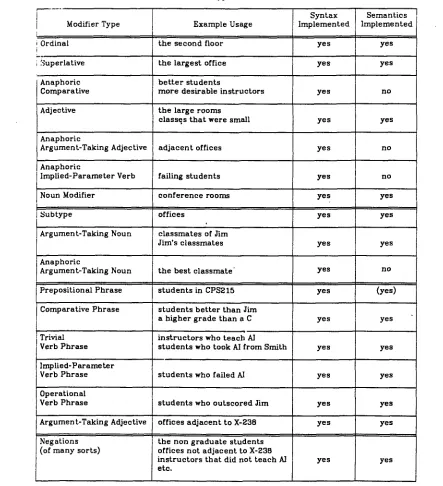
As suggested here, m o s t of the syntactic a n d semantic sophistication of inputs to L D C are due to n o u n phrase modifiers, including a fairly broad coverage of relative clauses. For example, if L D C is told that "students take courses from instructors", it will accept such relative clause forms as
students w h o took a graduate course from Trivedi courses Sarah took f r o m Rogers
instructors Jim took a graduate course f r o m courses that were taken by Jim
M o s t of t h e n a m e s we g i v e t o m o d i f i e r t y p e s a r e s e l f - e x p l a n a t o r y , b u t t h e r e a d e r will n o t i c e t h a t we h a v e c h o s e n t o c a t e g o r i z e v e r b s , b a s e d u p o n t h e i r semantics, as tr~Isial verbs, irrtplied p a r a ~ t e r verbs; a n d operational verbs. "Trivial" verbs, which involve n o semantics to speak of, c a n be roughly p a r a p h r a s e d as "be associated with". For example, students w h o take a certain course are precisely those students associated ~ith the database records related to the course. "Implied parameter" verbs can be p a r a p h r a s e d as a longer "trivial" verb phrase by adding a p a r a m e t e r a n d requisite noise words for syntactic acceptability. For
example, students w h o fai/a course are those students w h o rrmlce a grade of F in the course. Finally, "operational" verbs require an operation to be performed on one or m o r e of its n o u n phrase arguments, rather than simply asking for a c o m p a r i s o n of its n o u n phrase referent(s) against values in specified fields of the physical data file. For example, the students w h o oz~tscure Jim are precisely those students w h o Trtake a grade h~gher than the grade of Jirm At present, prepositions are treated semantically as trivial verbs, so that "students in AI" is interpreted as "students associated with records related to the AI
course".
T a b l e 1 - M o d i f i e r T y p e s A v a i l a b l e in LDC
M o d i f i e r T y p e E x a m p l e Usage
Syntax I m p l e m e n t e d
Semantics I m p l e m e n t e d
Ordinal the s e c o n d floor yes yes
3uperlative the largest office yes yes
Anaphoric better students
Comparative m o r e desirable instructors yes n o
Adjective the large r o o m s
classes that were small yes yes
Anaphoric
Argument-Taking Adjective adjacent offices yes n o
Anaphoric
Implied-Parameter Verb failing students yes n o
N o u n Modifier conference r o o m s yes yes
Subtype offices yes yes
Argument-Taking N o u n classmates of Jim
Jim's classmates yes yes
Anaphoric
Argument-Taking N o u n the best c l a s s m a t e yes n o
Prepositional P h r a s e students in C P S 2 1 5 y e s ( y e s ) Comparative Phrase students better than Jim
a higher grade than a C yes yes
Trivial instructors w h o teach AI
Verb Phrase students w h o took AI f r o m Smith yes yes
Implied-Parameter
Verb Phrase students w h o failed AI yes yes
Operational
Verb Phrase students w h o outscored Jim yes yes
Argument-Taking Adjective offices adjacent to X-238 yes yes
Negations the n o n graduate students
(of m a n y sorts) offices not adjacent to X-23B
instructors that did not teach M yes yes
[image:2.612.66.509.189.675.2]III KNOWLEDGE ACQUISITION FOR MODIFIERS
The job of t h e k n o w l e d g e a c q u i s i t i o n m o d u l e of LDC, c a l l e d " P r e p " in F i g u r e 1, is t o ' f i n d o u t a b o u t (a) t h e v o c a b u l a r y of t h e n e w d o m a i n a n d (b) t h e c o m p o s i t i o n of t h e p h y s i c a l d a t a file. T h i s p a p e r is c o n c e r n e d o n l y with v o c a b u l a r y a c q u i s i t i o n , w h i c h o c c u r s in t h r e e s t a g e s . In S t a g e 1, P r e p a s k s t h e u s e r to n a m e e a c h ent~.ty, o r c o n c e p t u a l d a t a i t e m , of t h e d o m a i n . As e a c h e n t i t y n a m e is g i v e n , P r e p a s k s f o r s e v e r a l s i m p l e k i n d s of i n f o r m a t i o n , a s in
E N T I T Y N A M E ? section S Y N O N Y M S : class
T Y P E (PERSON, N U M B E R , LIST, P A T T E R N , N O N E ) ? p a t t e r n
GIVE 2 OR 3 EXAMPLE NAMES: e p s S l . 1 2 , e e 3 4 . 1 NOUN SUBTYPES: n o n e
ADJECTIVES: l a r g e , s m a l l NOUN MODIFIERS: n o n e HIGHER LEVEL ENTITIES: c l a s s
LOWER LEVEL ENTITIES: s t u d e n t , i n s t r u c t o r MULTIPLE ENTITY? y e s
O R D E R E D ENTITY? yes
P r e p n e x t d e t e r m i n e s t h e c a s e s t r u c t u r e of v e r b s h a v i n g t h e given e n t i t y a s s u r f a c e s u b j e c t , a s in
A C Q U I R I N G V E R B S F O R S T U D E N T : A S T U D E N T C A N pass a course
fail a course
take a course f r o m a n instructor m a k e a grade f r o m a n instructor m a k e a grade in a course
In Stage 2, Prep learns the
rnorhological variants of
words not k n o w n to it, e.g. plurals for nouns, comparative a n d superlative forms for adjectives, a n d past tense a n d participle forms for verbs. For example,P A S T - T E N S E V E R B ACQUISITION
P L E A S E GIVE C O R R E C T E D F O R M S , O R HIT R E T U R N FAIL FAILED >
BITE BITED > bit
T R Y TRIED >
In S t a g e 3, P r e p a c q u i r e s t h e semantics of a d j e c t i v e s , v e r b s , a n d o t h e r m o d i f i e r t y p e s , b a s e d u p o n t h e following p r i n c i p l e s .
1. S y s t e m s w h i c h a t t e m p t to a c q u i r e complex
s e m a n t i c s f r o m relatively untrained u s e r s h a d b e t t e r r e s t r i c t t h e c l a s s of t h e d o m a i n s t h e y s e e k to p r o v i d e a n i n t e r f a c e to.
F o r t h i s r e a s o n , LDC r e s t r i c t s i t s e l f to a c l a s s of d o m a i n s [1] in w h i c h t h e i m p o r t a n t r e l a t i o n s h i p s a m o n g d o m a i n e n t i t i e s involve h i e r a r c h i c a l d e c o m p o s i t i o n s .
2. T h e r e n e e d n o t be a n y c o r r e l a t i o n b e t w e e n t h e type
of m o d i f i e r b e i n g d e f i n e d a n d t h e way in w h i c h its rr~eaTt/rtg r e l a t e s to t h e u n d e r l y i n g d a t a file.
For t h i s r e a s o n , P r e p a c q u i r e s t h e m e a n i n g s of all u s e r - d e f i n e d m o d i f i e r s in t h e s a m e m a n n e r b y p r o v i d i n g s u c h p r i m i t i v e s as id, t h e i d e n t i t y f u n c t i o n ;
va2, w h i c h r e t r i e v e s a s p e c i f i e d field of a r e c o r d ; vzzern, w h i c h r e t u r n s t h e size of i t s a r g u m e n t , w h i c h is a s s u m e d to be a set; s u m , w h i c h r e t u r n s t h e s u m of '.'-s list of i n p u t s ; aug, w h i c h r e t u r n s t h e a v e r a g e of i t s list of i n p u t s ; a n d pct, w h i c h r e t u r n s t h e p e r c e n t a g e of its list of b o o l e a n a r g u m e n t s w h i c h a r e t r u e . O t h e r u s e r - d e f i n e d a d j e c t i v e s m a y also be u s e d . T h u s , a " d e s i r a b l e i n s t r u c t o r " m i g h t be d e f i n e d a s a n i n s t r u c t o r w h o g a v e a g o o d g r a d e to m o r e t h a n h a l f h i s s t u d e n t s , w h e r e a " g o o d g r a d e " is d e f i n e d a s a g r a d e of B o r a b o v e . T h e s e two a d j e c t i v e s m a y b e s p e c i f i e d a s s h o w n below.
A C Q U I R I N G S E M A N T I C S F O R D E S I R A B L E I N S T R U C T O R P R I M A R Y ? section
T A R G E T ? grade
P A T H IS: G R A D E / S T U D E N T / S E C T I O N - F U N C T I O N S ? g o o d /id /pet P R E D I C A T E ? > 50
A C Q U I R I N G S E M A N T I C S F O R G O O D G R A D E P R I M A R Y ? grade
T A R G E T ? grade P A T H IS: G R A D E F U N C T I O N S ? val P R E D I C A T E ? > = B
As s h o w n h e r e , P r e p r e q u e s t s t h r e e p i e c e s of i n f o r m a t i o n for e a c h a d j e c t i v e - e n t i t y pair, n a m e l y (1) t h e pv-/.rn.ary ( h i g h e s t - l e v e l ) a n d ~c~rget [ l o w e s t - l e v e l ) e n t i t i e s n e e d e d t o s p e c i f y t h e d e s i r e d a d j e c t i v e m e a n i n g ; (2) a list of furtcticvts c o r r e s p o n d i n g to t h e a r c s on t h e p a t h f r o m t h e p r i m a r y to t h e t a r g e t n o d e s ; a n d f i n a l l y (3) a p r e d / c a t e to be a p p l i e d to t h e n u m e r i c a l v a l u e o b t a i n e d f r o m t h e s e r i e s of f u n c t i o n c a l l s j u s t a c q u i r e d .
IV UTILIZATION O F T H E I N F O R M A T I O N A C Q U I R E D D U R I N G P R E P R O C E S S I N G
As s h o w n in Figure i, the English-language processor of L D C achieves d o m a i n i n d e p e n d e n c e b y restricting itself to (a) a domain-independent. linguistically-motivated phrase-structure g r a m m a r [6] a n d (b) a n d the domain-specific files p r o d u c e d by the k n o w l e d g e acquisition module.
T h e simplest file is the pattern file, which captures the m o r p h o l o g y of domain-specific proper nouns, e.g. the entity type "room" m a y have values s u c h as X-238 a n d A-22, or "letter, dash. digits". This information frees us f r o m having to store all possible field values in the dictionary, as s o m e systems do, or to m a k e reference to the physical data file w h e n n e w data values are typed by the user, as other systems do.
T h e domain-specific d/ctlon~ry file contains s o m e standard terms (articles, ordinals, etc.) a n d also both root words a n d inflections for terms acquired f r o m the user. T h e sample dictionary entry
( l o n g e s t S u p e r l long ( n t m e e t i n g week))
I User
U s e r
.,
> P R E P
Pattern
Dictionary
C o m p a t
File
/ / // /
S C A N N E R
~I P A R S E R
F i l e
f
---*1 TRANSLATOR
Augmented
Phrase-Structured
Grammar
Macro
File
\
) RETRIEVAL i
T
Text-Edited
Data
[image:4.612.69.507.51.311.2]File
Figure 1 - Overview of LDC
i n t e g r i t y of a n o u n p h r a s e being built up, i.e. to a s s u r e all w o r d s in t h e p h r a s e c a n go t o g e t h e r on n o n - s y n t a c t i c g r o u n d s . This aids in d i s a m b i g u a t i o n , y e t avoids e x p e n s i v e i n t e r a c t i o n with a s u b s e q u e n t s e m a n t i c s module.
r e l a t e d to n e g a t i o n I n t e r e s t i n g l y , m o s t m e a n i n g f u l i n t e r p r e t a t i o n s of p h r a s e s c o n t a i n i n g " n o n " or "not" c a n be o b t a i n e d b y i n s e r t i n g t h e r e t r i e v a l r2.odule's Not c o m m a n d a t a n a p p r o p r i a t e p o i n t in t h e m a c r o b o d y f o r t h e m o d i f i e r in q u e s t i o n . For e x a m p l e ,
An o p p o r t u n i t y to p e r f o r m " n o n - l o c a l " c o m p a t i b i l i t y c h e c k i n g is p r o v i d e d for by t h e eompat
file, w h i c h tells (a) t h e c a s e s t r u c t u r e of e a c h verb, i.e. which p r e p o s i t i o n s may o c c u r a n d which e n t i t y t y p e s may fill e a c h n o u n p h r a s e "slot", a n d (b) which p a i r s of e n t i t y t y p e s m a y be linked by e a c h p r e p o s i t i o n . The f o r m e r i n f o r m a t i o n will have b e e n a c q u i r e d d i r e c t l y f r o m t h e u s e r , while t h e l a t t e r is p r e d i c t e d by h e u r i s t i c s b a s e d u p o n t h e s o r t s of c o n c e p t u a l r e l a t i o n s h i p s t h a t c a n o c c u r in t h e " l a y e r e d " d o m a i n s of i n t e r e s t [1].
Finally, t h e m a c r o file c o n t a i n s t h e m e a n i n g s of modifiers, r o u g h l y in t h e f o r m in which t h e y w e r e a c q u i r e d using t h e s p e c i f i c a t i o n l a n g u a g e d i s c u s s e d in t h e p r e v i o u s s e c t i o n . Although t h i s r e q u i r e d u s to f o r m u l a t e o u r own r e t r i e v a l q u e r y l a n g u a g e [3], having c o m p l e x m o d i f i e r m e a n i n g s d i r e c t l y e x c e u t a b l e by t h e r e t r i e v a l m o d u l e e n a b l e s us to avoid m a n y of t h e p r o b l e m s t y p i c a l l y arising in t h e t r a n s l a t i o n f r o m p a r s e s t r u c t u r e s to f o r m a l r e t r i e v a l queries• F u r t h e r m o r e , s o m e m o d i f i e r m e a n i n g s c a n b e derived by t h e s y s t e m f r o m t h e m e a n i n g s of o t h e r modifiers, r a t h e r t h a n s e p a r a t e l y a c q u i r e d f r o m t h e user• For example, if t h e m e a n i n g of t h e a d j e c t i v e "large" h a s b e e n given by t h e u s e r , t h e s y s t e m a u t o m a t i c a l l y p r o c e s s e s " l a r g e s t " a n d " l a r g e r t h a n ..." by a p p r o p r i a t e l y i n t e r p r e t i n g t h e m a c r o b o d y for "large".
A p a r t i a l l y u n s o l v e d p r o b l e m in m a c r o p r o c e s s i n g involves t h e r e s o l u t i o n of s c o p e ambiguities
s t u d e n t s who w e r e n o t failed b y R o s e n b e r g
m i g h t or m i g h t n o t be i n t e n d e d to i n c l u d e s t u d e n t s who did n o t t a k e a c o u r s e f r o m R o s e n b e r g . The r e t r i e v a l q u e r y c o m m a n d s g e n e r a t e d by t h e positive u s a g e of "fail", as in
students that R o s e n b e r g failed w o u l d be the s e q u e n c e
i n s t r u c t o r -- R o s e n b e r g ; s t u d e n t -> fail
so t h e q u e s t i o n is w h e t h e r to i n t r o d u c e "not" a t t h e p h r a s e level
n o t i i n s t r u c t o r = R o s e n b e r g ; s t u d e n t -> fail~
or instead at the verb level instructor = Rosenberg; not ~student -> fail]
REFERENCES
I. BaUard, B. A "Domain Class" approach to transportable natural language processing. Cogn~tio~ g~td /Yrczin Theory, 5 (1982), 3, pp. 269-287.
Ballard, B. a n d Lusth, J. An E n g l i s h - l a n g u a g e p r o c e s s i n g system that "learns" about n e w domains. AF~PS N¢~on~ Gomputer Conference, 1983. pp. 39-46.
Ballard, B. and Lusth, J. The design of DOMINO: a knowledge-based information retrieval processor for office enviroments. Tech. Report CS-1984-2, Dept. of Computer Science, Duke University, February 1984. Ballard, B., Lusth, J. and Tinkham, N. LDC-I: a
transportable, knowledge-based natural language processor for office environments. A C M Tt'~ns. o~ Off~ce / ~ - m a h ~ ~ystoma, 2 (1984), 1, pp. 1-25.
BaUard, B., Lusth, J. and Tinkham, N. Transportable English language processing for office environments. A F ~ ' Nat~mw~ O~m~uter Conference, 1984, to appear in the proceedings.
Ballard, B. and Tinkham, N. A phrase-structured grammatical formalism for transportable natural language processing, llm~r. J. Cow~p~t~zt~na~ L~n~ist~cs, to appear.
Biermann, A. and Ballard, B. Toward natural language computation. Am~r. ~. Com~ut=~mu=l ~g=iet~cs, 6 (1980), 2, pp. 71-86.
Lusth, J. Conceptual Information Retrieval for Improved Natural Language Processing (Master's Thesis). Dept. of Computer Science, Duke University, February 1984. Lusth, J. and Ballard, B. Knowledge acquisition for a
natural language processor. Cue,'ere*we o~ .4~t~-ieJ .~tetH@e~ws, Oakland University, Rochester, Michigan, April 1983, to appear in the proceedings.
I0. Bronnenberg, W., Landsbergen, S., Scha, R., Schoenmakers, W. and van Utteren, E. pHLIQA-1, a question-answering system for data-base consultation in natural English. / W t ~ s tecA, Roy. 38 (1978-79), pp. 229-239 a n d 269-284.
11. Codd, T. Seven s t e p s to RENDEZVOUS with t h e c a s u a l user. [n Do2~ Base M¢m,o, gem, en¢, J. Kimbie a n d K. Koffeman (Eds.), North-Holland, 1974.
12. Codd, T. R E N D E Z V O U S Version I: Aa experimental English-language query formulation system for casual users of relational data bases. IBM Research Report RJ2144, San Jose, Ca., 1978.
13. Finin, T., Goodman, B. and Tennant, H. JETS: achieving completeness through coverage and closure. Int. J. Conf. on A r t ~ j ~ / n ~ e / ~ i g e n c e , 1979, pp. 275-281.
14. Harris, L. U s e r - o r i e n t e d d a t a b a s e q u e r y w i t h t h e Robot natural language system. Int. J. M~n-M~ch~ne ~ d i e s , 9
(1977), pp. 697-713.
15. Harris, L. The R O B O T system: natural language processing applied to data base query. A C M Nct~ion~t C~rnference, 1978, pp. 165-172.
16. Hendrix, G. H u m a n engineering for applied natural language processing. /n~. $. Co~f. o~ .4~t~j~c~a~ ~¢tott@jev~e, 1977, pp. 183-191.
2. 3. 4. 5.
8.
7.
8. 9.
17. Hendrix, G., Sacerdoti, E., Sagalowicz, D. and Slocum, J. Developing a natural language interface to complex data.
ACM Tr(uts. on D=t~bsse ~l/stsrrts, 3 (1978), 2, pp. 105-147.
18. Lehmann, H. Interpretation of natural language in an information system. I B M $. _N~s. Des. 22 (1978), 5, pp.
560-571.
19. Plath, W. R E Q U E S T : a natural language question- answering system. I B M J: ~ s . Deo., 20 (1976), 4, pp. 326- 335.
20. Thompson, F. and Thompson, B. Practical natural language processing: the g E L system as prototype. In
A d ~ v t c e s ~t C o m ~ t e r s , Vol. 3, M. Rubinoff a n d M. Yovits, Eds., A c a d e m i c P r e s s , 1975.
21. Waltz, D. A n English language question answering system for a large relational database. Cowzm. A C M 21 (1978), 7, pp. 526-539.
22. Woods, W. Semantics and quantification in natural language question answering. In Advances ~,n Computers,
Vol. 17, M. Yovits, Ed., Academic Press, 1978.
23. Woods, W., Kaplan, R. and Nash-Webber, B. The Lunar 3L'iencos Natural Lar~w, ge ~tfov~rn~t~n ~Jstsm:
]~¢rrt. Report 2378, Bolt, Beranek and N e w m a n , Cambridge, Mass., 1972.
24. Ginsparg, J. A robust portable natural language data b a s e i n t e r f a c e . Cmlf. on Ap'1)lied Nc~t~ral L~znguage
P r o c e s s i n g , S a n t a Munica, Ca., 1983, pp. 25-30.
25. Grosz, B. TEAM: A transportable natural language interface system. Omf. o~ ~ p l i e d Nut, rat L~-tLags Processiz~, Santa Monica, Ca., 1983, pp. 39-45.
28. Haas, N. a n d Hendrix, G. A n approach to acquiring and applying knowledge. .~rst N;t. Cor~. o~
.~tell~qTence, Stanford univ., Palo Alto, Ca., 1980, pp. 235-
239.
27. Hendrix, G. a n d Lewis, W. Transportable natural-language interfaces to databases. Proc. 19th A ~ z ~ t M e e t ~ w of the
ACL, S t a n f o r d Univ., 1981, pp. 159-165.
28. Mark, W. Representation and inference in the Consul system. ~ t . Jo'i, nt Conf. on ~ct#,f~c'i~l [nteU{gence, 1981. 29. Thompson, B. a n d Thompson, F. Introducing ASK, a
simple knowledgeable system. Co~I. on AppLied Natu~zt L~tg1~zge i~rocsssing, Santa Monica, Ca., 1983, pp. 17-24. 30. Thompson, F. and Thompson, B. Shifting to a higher gear
in a natural language system. Na~-na~ CornF~ter Coexistence, 1981, 657-662.