R E V I S E D G E N E R A L I Z E D P H R A S E S T R U C T U R E G R A M M A R
E r i c S v e n R l s t a d 1
M.I.T. Artificial Intelligence Lab 545 Technology Square, 805
Cambridge, M A 02139
T h i n k i n g M a c h i n e s C o r p o r a t i o n 245 F i r s t Street C a m b r i d g e , M A 02142
A B S T R A C T
In this paper, I revise generalized p h r a s e s t r u c t u r e g r a m m a r ( G P S G ) linguistic theory so t h a t it is m o r e t r a c t a b l e a n d linguis- tically c o n s t r a i n e d . Revised G P S G is also easier to u n d e r s t a n d , use, a n d i m p l e m e n t . I provide a n a c c o u n t of topicalization, ex- plicative p r o n o u n s , a n d p a r a s i t i c g a p s in t h e revised s y s t e m a n d c o n c l u d e w i t h s u g g e s t i o n s for efficient p a r s e r design.
1 Introduction and Motivation
A linguistic theory specifies a computational process that assigns structural descriptions to utterances. This process requires cer- tain computational resources, such as time or space. In a descrip- tively adequate linguistic theory, the computational resources available to the theory match those used by the ideal speaker- hearer. The goal of this paper is to revise generalized phrase structure g r a m m a r ( G P S G ) so that its computational power cor- responds to the ability of the speaker-hearer.
T h e bulk of this paper is devoted to identifying what com- putational resources are used by G P S G theory, and deciding whether they are linguistically necessary. G P S G contains five formal devices, each of which provides the theory with the re- sources to model some linguistic phenomenon or ability. I iden- tify those aspects of each device that cause intractability and then restrict the computational power of each device to more closely match the (inherent) complexity of the phenomenon or ability it models. T h e remainder of the paper presents the new formal system and exercises it in the domain of topicalization, explica- tive pronouns, and parasitic gaps. I conclude with suggestions for efficient parser design and future research.
In m y opinion, the primary value of this work lies in the re- sult
(revised
G P S G , or R G P S G ) as well as in the methodology of using complexity analysis to improve linguistic theories. T h e methodology explicates h o w a tool of modern computer science can help us understand and improve theories of linguistic compe- tence. M o r e than that, complexity analysis forms the foundation of informed parser design. I feel R G P S G is of value both to lin- guists and computational linguists because it is more tractable and easier to understand, use, and implement. It can be effi- ciently implemented and appears to have better empirical cover- age than its G P S G ancestor.tThe author is eupported by a graduate fellowship from the IBM Corpora- tion. This research was supported in part by Thinking Machines Corporation and by NSF Grant DCR-85552543, under a Presidential Young Investigator Award to Profeuor Robert C. Berwick. I wish to thank Ed Barton for stylistic improvements and helpful discussion; Robert Berwick for support, critickm, and suggesting I pursue thk research; and Geoff Pullum for his patient help with GPSG theory.
2
E l i m i n a t i n g I n t r a c t a b i l i t y in G P S G
Ristad (1986a) examines the computational complexity of two components of the G P S G formal system (metarules and the fea- ture system) and shows h o w each of these systems can lead to computational intractability. Rlstad also proves that the uni- versal recognition problem for G P S G s is E X P - P O L Y hard, and intractable. 2 In another words, the fastest recognition algorithm for G P S G s can take more than exponential time.
These results m a y appear surprising, given G P S G ' s weak context-fres generative power. T h e y also raise some important computational and linguistic questions: w h y GPSG-Recognition is so difficult, what aspects of the G P S G formalisms cause in- tractability, and whether they are linguistically necessary. I be- gin with an outline of the G P S G formal system, as presented in Gazdar, Klein, Pullum, and Sag (1985), G K P S hereafter. Sub- sequently, I identify and remove the excess computational power provided by each formal device.
2 . 1 O v e r v i e w o f G P S G F o r m a l i s m s
F r o m t h e p e r s p e c t i v e of classic formal l a n g u a g e theory, a G P S G m a y be t h o u g h t of as a g r a m m a r for g e n e r a t i n g a c o n t e x t - f r e e g r a m m a r . T h e g e n e r a t i o n process begins w i t h i m m e d i a t e d o m - inance (ID) rules, w h i c h are c o n t e x t - f r e e p r o d u c t i o n s w i t h u n - ordered r i g h t - h a n d sides. A n i m p o r t a n t f e a t u r e of ID rules is t h a t n o n t e r m i n a l s in t h e rules are n o t a t o m i c s y m b o l s (for e x a m p l e , NP). R a t h e r , G P S G n o n t e r m i n a l s are sets of [.feature, feature-value] pairs. For e x a m p l e , IN +] is a [feature, feature-value] pair, a n d t h e set { IN ÷], IV - ] , [BAR 2] } is t h e G P S G r e p r e s e n t a t i o n of a n o u n p h r a s e . Next, m e t a r u l e s a p p l y to t h e ID rules, r e s u l t i n g in a n enlarged set of ID rules. M e t a r u l e s have fixed i n p u t a n d o u t p u t p a t t e r n s c o n t a i n i n g a d i s t i n g u i s h e d m u l t i s e t variable W in a d d i t i o n to c o n s t a n t s . If an ID rule m a t c h e s t h e i n p u t p a t t e r n u n d e r s o m e specialization of t h e variable W, t h e n t h e m e t a r u l e g e n e r a t e s a n ID rule c o r r e s p o n d i n g to t h e m e t a r u l e ' s o u t p u t pat- tern u n d e r t h e s a m e specialization of W. For e x a m p l e , t h e passive m e t a r u l e
V P ~ W, N P
• ~. (1)
VPIPAs] ---* W, ( P P I b y ] )
in the grammar which permits the passive category VP [PAS] to dominate just the other material from the original rule, together (optionally) with a PP[by] ~ (GKPS:59). In Ristad (1986a), the finite closure problem is used to determine the cost of metarule application. Principles of universal feature instantiation (UFI) apply to the resulting enlarged set of ID rules, defining a set of phrase structure trees of depth one (local trees). O n e principle of U F I is the head feature convention, which ensures that phrases are projected from lexical heads. Informally, the head feature convention is G P S G ' s ~-theory. Ristad (1986a) uses the eatego~j mem~ersA~p problem to determine, in part, the cost of mapping I'D rules to local trees. Finally, linear precedence statements are applied to the inst~ntiated local trees. LP statements order the unordered daughters in the instantiated local trees. The ulti- mate result, therefore, is a set of ordered local trees, and these are equivalent to the context-free productions in a context-free grammar. The resulting context-fres grammar derives the lan- guage of the GPSG.
The process of assigning structural descriptions to utterances consists of two steps in GPSG: the projection of ID rules to local trees and the derivation of utterances from nonterminals, using the local trees. Accordingly, formal devices may supply resources to either process.
2 . 2 T h e o r y of S y n t a c t i c F e a t u r e s
In current GPSG theory, syntactic categories (nonterminals) en- code linguistic relations as feature-value pairs. If a relation is true of two categories in a phrase structure tree, then the rela- tion will be encoded in every category on the unique path be- tween the two categories. T h e primary computational resource provided by the theory of syntactic features is polynomial space, primarily due to the large n u m b e r of possible syntactic categories arising from finite feature closure. Ristad (1986a) observes that finite feature closure admits a surprisingly large n u m b e r of pos- sible categories: 9(36"bT) where a is the n u m b e r of atomic-valued features and b the n u m b e r of category-valued features. In fact, there are more that 107:~ categories in the G K P S system.
Fortunately, the full power of embedded categories does not appear to be linguistically necessary because no category-valued feature need ever contain another, s In G P S G , there are three category-valued features: SLASH, which marks the path between a gap and its filler with the category of the filler; AGR, which marks the path between an argument and the functor that syn- tactically agrees with it (between the subject and matrix verb, for example); and WH, which marks the path between a ~#h-word and the minimal clause that contains it with the morphological type of the ~h-word. AGR will never contain SLASH because a functor (verb or predicate) will never select a gap or a constituent con- taining a gap as it's argument. Conversely, SLASH will never be required to contain AGR because such a category corresponds to % h e following imaginary (and rather weird) case: Suppose w e found a language in which finite verb phrases could be fronted over an unbounded domain provided that they were in the agree- ment form associated with third-person-singular N P controllers" (PuUum, personal communication). Similarly, because the value of ~ is the category of a wh- noun phrase, and because ~#~- nom- sLet f and g be any distinct category-valued features. I am arguing that although f may ~ppear inside g in some L~nguage, f will never be reqm'regto appear inside g.
inals never contain gaps, WH can never contain SLASH or AGR. In point of fact, no category embeddings appear in the G K P S gram- m a r for English, and it is difficult to see h o w they would appear in a G P S G for any other natural language.
T h e obvious revision, then, is unit feature closure: to limit category-valued features to containing only O-level categories. (0- level categories do not contain any category-valued features). I adopt this strongly falsifiable constraint in R G P S G . T h e depth of category-embedding is purely an empirical issue, and hence unit closure is not ad hoe. T h e other revision is primarily no- tational: any R G P S G feature f m a y assume the distinguished values noBind or unbound in addition to those values determined by p ( f ) . A noBSnd value indicates t h a t the feature may not re- ceive a value in an extension of the given category, while unbound indicates t h a t the feature does not currently have a value, and may receive one in extension.
2.3 I m m e d i a t e D o m i n a n c e / L i n e a r P r e c e d e n c e G P S G ' s I D / L P format models certain word order phenomena, such as the head parameter and some free word order facts. A n ID rule is a context-free production
Co -'* CI,C2 .... ,C~
whose left-hand side (LHS) is the mother category and whose right-hand side (RHS) is an unordered multlset of daughter cate- gories, some of which m a y be designated as head daughters. T h e L H S immediately dominates the unordered R H S in a tree of depth one (a local tree).
2.3.1 C o m p l e x i t y in I D / L P
ID rules significantly increase the time resources available to the GPSG derivation process in four related ways. First, a deriva- tion step is nondeterm/nistlc because a category may immediately dominate more than one RHS. Second, the derivation process may alternate between a derivation step involving the ID rules C --~ Ct [ ... I C~ that corresponds to an OR-transition (only one of k possible successors must yield a terminal string) and a derivation step involving an ID rule C ~ CI,C2,... ,Ce that corresponds to an AND-transition (all k successors must yield terminal strings). These two devices introduce lexical and struc- tural ambiguity. As is well-known, ambiguity is a central prop- erty of natural languages. Therefore, I consider this aspect of ID rules linguistically essential, and it will be retained in R G P S G .
Third, unrestricted null transitions in ID rules are a source of intractability because they allow G P S G s to generate enormous phrase structure trees whose yield is the empty string (see Ristad, 1986a). Thus, a parser that used such a g r a m m a r must nonde- terministically postulate elaborate phrase structure in between its input tokens. T h e indisputable unnaturalness of this ability motivates m e to greatly restrict null transitions in R G P S G .
Fourth, the multiset R H S of an ID rule contributes to a large space of local phrase structure trees: an ID rule with s a R H S of cardinality b can, if unconstrained by L P statements, correspond to b! ordered productions. In parsing practice, this can cause a combinatorial explosion in a context-free parser's state space (see Barton, 1985). In addition to causing nondeterrninism in
any G P S G - b a s e d parser, the multiset R H S confers on G P S G the ability to count nonterminals. T h e apparent artificiality of this device, as discussed in Barton, Berwick, and Ristad (1987:260- 261), will motivate m e to adopt a substantive constraint of short ID rules in R G P S G (binary branching, for example). 4
2.3.2 R e v i s e d I D / L P
R G P S G ID rules have exactly one m o t h e r and at least one head daughter. T h e heads are s e p a r a t e d notationally f r o m the n o n - heads by a colon, and a p p e a r to the left of the colon. T h e m o t h e r and all head d a u g h t e r s are implicitly specified for [NULL - ] . For example, the R G P S G headed ID rule 2 c o r r e s p o n d s to the G P S G ID rule 3.
v e - - , [SUBCAT 2] : 5'e (2)
Ve[NULL -] --* H[SUBCAT 2.NULL - ] , N , q (3) There is only one lexical element for the null string, and it is universal across all grammars:
X2 [SLASH X,~I, NULL +] l ""*
Co-subscripting indicates that the two X,~ categories must be identical in any legal projection of the rule, with the exception of the [NULL ÷] and SLASH specifications. This restricted ID rule format, w h e n coupled with a restriction on metarules that pre- vents them from affecting head daughters, prevents head daugh- ters from ever being erased in a R G P S G derivation. Thus, null transitions are effectively eliminated from R G P S G .
A n ordered production is an ID rule whose daughters are com- pletely linearly ordered, that is, a string of daughter categories rather than multisets of head and nonhead daughters. A n or- dered production is LP-occeptable if all L P statements in the R G P S G are true of it.
T h e R G P S G I D / L P formalism does not contain formal con- straints sufficient to guarantee polynomial-time recognition, al- though the linguistically justified use of short I D rules can render ID rules tractable, because I D / L P grammars with bounded rules can be parsed in time polynomial in the g r a m m a r si~.e, s
2 . 4 M e t a r u l e s
Metarules are lexical redundancy rules. Formally, they are func- tions that take le=ical ID rules--ID rules with a lexical head--to 'The binary branching constraint is independently motivated by the lln- guistic arguments of Kayne (1981) und others. In that work, Kayne argues
that the pnth from a governed category to its governor (for example, from an anaphor to its antecedent) must be unamblguou~--informally put, "an unambiguous path is a path such that, in tracing it out, one is never forced to m~.ke a choice between two (or more) unused branches, both pointing in the same direction" (Kayne 1981:146). The unambiguous path requirement sharply constrains fan-out in phra~ structure trees because n-ary branching, for n > 2, is only possible when none of the rt sister nodes must govern any other nodes in the phrase structure tree.
s~ the length bound for natural language graznmars is the constant b, then any ]I)/LP grammar G cffin be converted into a strongly-equivalent CFG G ~, of sise 0(IG I . b!) = $(IGI) by simply expanding out the constant number of linear precedence po~ibilitlee. In the GKP$ and RGPSG grammars for En- glish, b = 3 becau~ double object constrnctions ([g/us NP NP], for example) are atmigued a fiat, ternary branching structure. (I ignore the iterating coor- dination schema, which licenses rules with unbounded right-hand sides.) It is important, however, that the short rules reflect a genuine constraint and that the grammar does not use some other mechanism to get the effect of longer rules (feature instantiation, for example).
sets of lexical ID rules. See the G K P S passive m e t a r u l e above. T h e G K P S g r a m m a r for English also includes m e t a r u l e s for subject- aux inversion, extrapusition, and transitivity alternations. T h e complete set of ID rules in a G P S G is the m a x i m a l set t h a t can be arrived at by taking each m e t a r u l e and applying it to the set of rules t h a t did n o t themselves arise f r o m the application of t h a t metarule. T h i s m a x i m a l set is called the finite closure F C ( M , R) of a set R of lexical ID rules u n d e r a set At f of metarules.
2 . 4 . 1 C o m p l e x i t y o f M e t a r u l e s
Metarules can increase the time and space resources available to the derivation process by introducing null transitions and ambi- guity in ID rules and by increasing the space of ID rules m o r e t h a n exponentially. T h e y can also increase the cost of the projec- tion process itself: finite closure is nondeterministic ( N P - h a r d , in fact) because m e t s r u l e s are applied to ID rules nondeterministi- cally.
2 . 4 . 2 R e v i s e d M e t a r u l e s
Unrestricted null transitions are b o t h linguistically and c o m p u t a - tionally undesirable. Moreover, the ability of m e t a r u l e s to affect lexicai head d a u g h t e r s is in direct conflict w i t h their linguistic purpose: ato express generalizations a b o u t the s u b c a t e g o r i z a t i o n possibilities of lexical heads, n (GKPS:59) Unrestricted m e t a r u l e s can destroy the relation between a p h r a s e and its lexicai head, and thereby violate ~-theory. T h e first step in revising recta- rules is to restrict t h e m to on/y affect nonhead d a u g h t e r s in lexical ID rules. Because of this change, m e t a r u l e s c a n n o t alter the im- plicit [NULL o] specification on the head daughters. Therefore, once a category is expanded in a derivation, it must be lexlcal]y realized in the derived string. T h i s formal c o n s t r a i n t ensures t h a t the e m p t y string does not have elaborate p h r a s e s t r u c t u r e in R G P S G .
Metarule finite closure generates m a n y linguistically incorrect ID rules t h a t m u s t be excluded by o t h e r G P S G devices ( F C R s , for example). T h e G K P S g r a m m a r for English contains six meta- rules; o u t of a p p r o x i m a t e l y 1944 possible metarule interactions in principle, only two such interactions a p p e a r to be productive (passive followed by subject-aux inversion or slash t e r m i n a t i o n m e t a r u l e 1).6 Therefore, the second metarule restriction adopted by R G P S G is biclosure, instead o f finite closure, r
SGiven a set of ,~ metarules, the number of possible metarule interactions is the number of ways to pick n or less metarules from the set, where order matters and repetitions are not allowed. That number is given by the total number of possible koeslections from the a metarules, where k v-4ries from 0 (no metarnles apply) to ~ (any combination of all metaruies apply). Thus,
the n u m b e r of possible i n t e r a c t i o n s j'(n) is: ~ - ~ : o (b--,)l ~ b!-e). This k not the size of m e t a r u l e finite closure, because it does not consider the p o u i b i l l t y of a metarnle matching an I'D rule in more than one wuy.
2.5 P r i n c i p l e s o f U n i v e r s a l F e a t u r e I n s t a n t i a t i o n The ID rules obtained by taking the finite closure of the mete- rules on the ID rules are proiected to local phrase structure trees. Abstractly, this process establishes the connection between those relations encoded in ID rules (for example, domination, subcate- gorization, case, modification, and predication) and the nonlocal linguistic relations. Local trees are projected from ID rules by mapping the categories in a rule into legal extensions of those categories in the projected local tree.
Principles of aniverea/feature i n s t a n t i a t i o n (UFI) constrain this projection by requiring categories in a local tree to agree in certain feature specifications when it is possible for them to do so. For example, the head feature convention (HFC) requires the mother to agree with all head features that the head daughters agree on, if agreement is possible. The HFC expresses ~-theory in part, requiring a phrase to be the projection of its head. It also plays a central role in the GPSG account of coordination phenomena, requiring the conjuncts in a coordinate structure to all participate in the same linguistic relations with the rest of the sentence. The two other principles of UFI are the control agreement pr/nc/ple and the foot feature principle. The control agreement principle represenm the GPSG theory of predicate- argument relations; informally, it requires predicates to agree with their arguments (for example, verb phrases must agree with their subject NPs in English). The foot feature principle pro- rides a partial account of gap-filler relations in the GPSG sys- tem, including parasitic gaps and the binding facts of reflexive and reciprocal pronouns; it plays a role strikingly similar to that of Pesetsky's (1982) path theory and Chomsky's (1986) binding and chain theories, s Informally, the foot feature principle ensures t h a t certain syntactic information is not lost. ~Exceptional ~ fea- ture specifications are those feature specifications in an ID rule t h a t should agree by virtue of a principle of UFI, but are unable to without changing a feature specification inherited from the ID rule.
2.5.1 C o m p l e x i t y o f U ' F I
The three principles of UFI all cause intractability because they provide the derivation process with reusable space resources.
First, each principle of UFI can enforce nonlocal feature agree- ment in phrase structure. Ristad (1986b) shows how this causes NP-hardnees, when coupled with lexical ambiguity or null tran- sitions. A related source of intractability is that the projection of ID rules to local trees can create an astronomical space of local trees, which in turn increases parser search space. These two sources of intractability cannot be eliminated because they are essential to GPSG's account of linguistic agreement among aThe possibility of expreuing the control agreement and foot feature prin- ciples as local constI-sints on nonlocal relations ~llm out from the central role of c-command, or equivalently unambiguous paths, in binding theory. C-command k a local relation, in fact the primary source of locality in phrase structure (see Berwick and Wexler 1982). Similarly, the possibility of encoding multiple g-sp-filler relations in one feature specification of one category corresponds to the "no crossing ~ constraint of path theory. Peeet- sky (1982:556) compares the predictions of path theory and principles of UFI when the two diverge in cases of double extraction (for example, a probls~r~ thaf~ ] know ~vho i to [~ talk to s i about ell) from coordinate structures. He concludes that ithe apparent simplicity of the slash category solution fades when more complex cases are considered."
conjuncts and between predicates and their arguments, gaps and their fillers, and phrases and their lexical heads.
The use of exceptional feature specifications in these princi- ples allows a derivation to reuse the space resources provided by the ID rules and theory of syntactic features. In the reduction of Ristad (1986a), head features encode an alternating Turing machine tape. The HFC is used to transfer the tape contents for an ATM configuration Co (represented by the mother) to its immediate successors C1, C 2 , . . . ,Ck (the head daughters). The configurations Co, C1 . . . . , C t have identical tapes, with the crit- ical exception of one tape square. If the HFC enforced absolute agreement between the head features of the mother and head daughters, the polynomial space ATM computation could not be simulated in this manner.
2.5.2 Universal F e a t u r e I n s t a n t i a t i o n i n R G P S G
Principles of universal feature instantiation in R G P S G all pre- serve a simple invariant across all ID rules. T h e y are mono- tonic; that is, they never delete or alter existing feature spec- ifications. T h e head feature convention, for example, ensures that the mother agrees exactly with all head feature specifica- tions that the head daughters agree on, regardless of where the specifications c o m e from.
Principles of U F I are first applied to the ID rule output of metarule unit closure. After this initial application, each princi- ple always applies, governing the well-formedness of the ID rule extension relation. T h e resulting ID rules derive utterances in the language generated by the R G P S G .
H e a d f e a t u r e c o n v e n t i o n . The head feature convention en- forces the invariant t h a t the mother is in absolute agreement with all head features on which the head daughters agree. It also requires the BAR value on a head daughter to be less than or equal to the BAR value on the mother. H E A D contains exactly those features that must be equivalent on the mother and head daughters of every ID rule. 9
H E A D = {AGR, ADV, AUX, INV, LOC, N, N'FORM, PAS, PAST, PER, PFORM, PLU, PRD, V, VFORM}
C o n t r o l a g r e e m e n t p r i n c i p l e . The control agreement princi- ple (CAP)differs from the H F C in that it establishes equivalences (//nks) between the categories in an ID rule: w h e n two categories are linked in an ID rule, the two categories must be identical in any legal extension of that rule. Links are calculated immedi- ately after the H F C has applied to the ID rules for the first time; once a link is established in an ID rule, it cannot be changed or undone. I° T h e first part of the C A P calculates control relations between categories, while the second part of the C A P establishs °In order to properly account for feature inetantiation in the binary and Rerating coordination schemata, the binary head (BHEAD) features BAR, SUB J, SUBCAT, and SLASH are considered to be head features for the purposes of the HFC in all nonlexlcal, multiply-headed ID rules.
loin G I ~ s , only head feature specifications and inherited foot feature specificationJ determine the semantic types relewant to the definition of con- trol. RGPSG simplifies this by considering inherited feature specifications and only some head feature specifications. Alternatively, control relations could be calculated every time the H F C instantiates a feature specification.
links using the control relations. In all cases, linking is indicated by co-subscripting.
R G P S G control relations are calculated as follows. A predi- cate is a VP or an instantiation of XP[÷PRD] such as a predicate nominal or adjective phrase. The control feature of a category C~, where C~(BAR) 7 & 0, is SLASH if C~ is specified for SLASH; other- wise, it is AGR. Control is calculated once and for all immediately after the HFC has applied to the ID rules resulting from metarule unit closure.
Let f be the control feature of a category C,. T h e n 6', is controlled by C~ in a rule if and only if C I ( f ) = C2, 6'2 ~_ X2, and either the rule is Co -* C, : 6'2 (recall that 6'1 is the head daughter), or the rule is Co -'* Cs : CI,C2, and C0,CI _~ VP.
The RGPSG control agreement principle states: In an ID rule
r = Co - . e l , . . . , Ci : C # + ~ . . . C .
• If C~ controls Ck and fk is the control feature of C~, then Ck(f~) and C~ are linked.
• If there is a nonhead predicate C~ with no controller, then link C~(f~) and Co(fo), where f~ and f0 are the control features of C~ and Co, respectively.
In the theory of G K P S , the control agreement principle per- forms subject-verb agreement by enforcing a control relation be- tween the two daughters of the rule
5' --, H[-SUBJ], X~ In RGPSG, this rule must be stated as
S --* X ~ [-SUBJ,AGR X~] : X ~
if we wish to enforce the control relation between the two daugh- ters. Because control relations in R G P S G are static (never re- calculated), this control relation exists even if Xg ~ NP. Fortu- nately, no verb will ever be specified for [AGR AP] in the lexicon, and therefore any "questionable" control relations involving an X g other than N P are ignored at the lexical insertion level.
Foot feature principle. T h e foot feature principle (FFP) re- quires any foot feature specification instantiated on a daughter category to also be instantiated on the mother. T h e specifica- tion is identical to any instantiation of the same feature on other daughter categories. T h e F F P ensures that (1) the existence of inherited foot features on any category of an ID rule blocks instantiation of those foot features on any other component cat- egory of the rule, and (2) inherited foot features are equivalent across all component categories of the rule. This second condi- tion m a y be too strong.
Because the empty string can be dominated only by a cate- gory of the form <*[NULL ÷, SLASH a] in RGPSG, the F F P tries to ensure that every gap will have a unique filler. Unfortunately, it is impossible to truly guarantee recoverability of deletions in RGPSG, because the F F P can only locally constrain the rule- to-tree projection, and not the ID rules themselves. This sit- uation is unavoidable in the GPSG framework, simply because SLASH does not always mark the complete path between a gap and its filler in accepted G P S G analyses. The classic example
is the G P S G analysis of subject dependencies, where an S / N P is reanalyzed as a I/P, effectively deleting an N P gap in subject position. In G K P S , this operation is performed by slash termi- nation metarule 2 (GKPS:160-2): [SLASH N P ] only marks the path from the filler to the mother of the reanalyzed I/P. Another example is the G K P S (pp. 150-152) analysis of missing-object constructions such as John is e~y to please. In missing-object constructions, [SLASH N P ] only marks the path from the N P gap to the V ~ [ I N F ] / N P dominating to please, failing to continue through the A P easlt to please to the filler Job,. Many sweep- ing changes would be necessary before the F F P would be able to strictly enforce recoverability of deletions in RGPSG.
2 . 6 M a r k i n g C o n v e n t i o n s
Feature co-occurrence restrictions (FCRs) and feature specifica- tion defaults (FSDs) are explicit marking conventions used in the G P S G system both to express language-particular facts and to restrict the overgeneration of other formal devices (both metarule and feature closure}. F C R s and F S D s are restrictive predicates on categories, constructed by Boolean combination of feature specifications. All legal categories must unconditionally satisfy all FCRs. All categories must also satisfy all FSDs, if it is possi- ble to do so without violating an F C R or a principle of universal feature instantiation. For example,
F C R i: [INV ÷] D {[AOX +] A [VFORM FIN])
requires any category that bears the [INV ÷] feature specifica- tion to also bear the specifications [AUX ÷] and [VFORM FIN].
2.6.1 C o m p l e x i t y of M a r k i n g C o n v e n t i o n s
F C R s and F S D s both provide significant resources to the G P S G projection process. First, they allow the projection process to reuse the polynomial space provided by the theory of syntactic features, because they can establish equivalences between the fea- tures in a category C and the features in a category contained in C. This ability to apply across embedded categories vastly increases the complexity of the rule-to-tree projection. T o see w h y it is linguistically unnecessary, consider the role of embed- ded categories. A category-valued feature f expresses a nonlocal linguistic relation between a category C and the one or more cat- egories that bear the feature specification [f C]. Thus, in the linguistically relevant cases, every embedded category eventually ~surfaces" in phrase structure, where the marking conventions are free to apply. T h e one exception to this argument is F C R 13 in the G K P S g r a m m a r for English, which applies 'across' an embedded category.
F C R 13: [FIN, AGR NP] O [AGR NP[NOM]]
In R G P S G , marking conventions m a y not apply to or across em- bedded categories. T h e effect of F C R 13 is achieved in R G P S G by a combination of the simple default S D 2 in section 3.2.2 below and carefully written ID rules.
F C R s are used together, the G P S G must nondeterministically try all n featurs-value combinations.
Third, the process of applying F S D s to local trees is very complex, in part because it is not informationally encapsulated. Rather than simply considering the (existing) feature specifica- tions in each target category separately, F S D application is af- fected by the other categories in the ID rule, all principles of universal feature instantiation, and even FCRs.
2.6.2 S i m p l e D e f a u l t s i n R G P S G
There is no reason to believe t h a t marking conventions need be so powerful and unconstrained. The approach R G P S G takes is to virtually eliminate marking conventions. R a t h e r t h a n stating the internal constraints on categories explicitly (and redundantly), as FCRs do, RGPSG eliminates FCRs altogether. Instead, the constraints FCRs express are implicitly stated in the rest of the grammar - - in the way ID rules and metarules are written, for example. T h e sole explicit marking convention in R G P S G is the simple defauh (SD). Unlike FCRs and FSDs, SDs are construc- tive, easy to understand and computationally tractable. Each $D is applied (and may be understood) to each category inde- pendent of all other categories and RGPSG formal devices, in- cluding other SDs. $Ds are applied to ID rules immediately after the initial application of principles of UFI.
An SD contains a predicate and a consequent. The conse- quent is a list of feature specifications. The predicate is a Boolean combination of truth-values and feature specifications such t h a t if a category C bears or extends a given feature specification, t h a t feature specification is true of C, else false. If the predicate is true of a given category C in a rule and the consequent includes only u n b o u n d and unlinked features, then the feature specifica- tions listed in the consequent are instantiated on C. Each SD is applied simultaneously to every top-level category in every rule exactly once, in the order specified by the grammar. Consider the following SD:
S D I: if [SUBCAT] then [BAR 0]
If the target category C in a ID rule is specified for the SUBCAT feature, but unspecified for the BAR feature, then the S D wi|] force the feature specification [BAR 0] on C.
3 T h e R e v i s e d T h e o r y
In this section, I explain how the formal subsystems described above fit together. I begin by formally specifying the class of R G P S G s and the languages they generate. I conclude by trans- lating the GKPS analysis of topicalization, explicative pronouns, and parastic gaps to the R G P S G formal system.
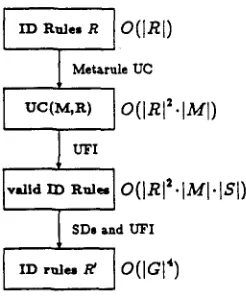
Figure 1 shows the internal organization of R G P S G . The set of ID rules R' defined by metarule unit closure, UFI, and SD application generates the language of the RGPSG as follows. If R' contains a rule A --. ~' with an extension A' --..1, t h a t satisfies all principles of UFI and is an LP-acceptable ordered production, then for any string of terminals a and nonterminals ~, we write aA'~ =~ a'Tt~. This is a derivation step. The language of an RGPSG contains all terminal strings t h a t can be derived, using
ro
s,~es R o(IRI)
I Metarule UC
vc(M,a)
O(iRi2.1Mi)
v-.d r~ R ~ . I O(IR?'IMI'ISl)
I SDe and UFI
m , , ~ . ~ O(IGt')
Figure I: This diagram shows internal organization of an R G P S G G with ID rules R, metarules M , and simple defaults S. The O-bounds show the effect of various formal devices on derived g r a m m a r symbol size.
the ID rules, from any extension of the distinguished s t a r t cate- gory. Let =~ be the reflexive transitive closure of =~. Then the language L(G) generated by G is
L(G) = { z I z e V~ and 3C • K[(C ~_ S t a r t ) ^ C =~ zl}
Ristad (1986b) proves t h a t universal recognition problem for R G P S G is NP-complete, a significant decrease in complexity from the EXP-POLY time hardness of GPSG-Recognition. xl In fact, of the more t h a n ten sources of intractability lurking in G P S G , only two remain in R G P S G - - lexical ambiguity and nonlocal feature agreement. Critically, these two sources of in- tractability in R G P S G appear to be linguistically essential.
3 . 1 E f f i c i e n t R G P S G P a r s i n g
Intractability in R G P S G arises from a particularly deadly com- bination of feature agreement and lexical ambiguity. Underspec- ification of categories in ID rules and metarules can be costly. This suggests t h a t limiting the number of head features or the scope of their agreement will mitigate the intractability. An ef- ficient recognition algorithm might approximate grammaticality by failing to transfer all head features through coordinate struc- tures (for example, letting them assume default values instead), or by aborting a parse in the face of excessive lexical or struc- tural ambiguity. Ef~cient parsing techniques based on partial enforcement of UFI are also possible. One such implementation, which propagates feature specifications b o t t o m up using Earley's algorithm, is in progress at Thinking Machines Corporation.
~This decrease in complexity ie significant from both theoretical and prac- tical perspectives. First, N'P-complete problems typically have good average time algorithms, while EXP-POLY problems do not. Next, the fastest rec- ognizer known for GPSGs can require double-exponential time in the worst case, while RGPSG has a simple exponential time recognizer. Finally, NP- complete problems have efficient witneeBes, while EXP-POLY hard problems do not. Thk means that RGPSG parses can always be verified efficiently, while GPSG parsee cannot, in gener~h
[image:6.612.396.519.91.239.2]Barton (1986) proposes a constraint-based computational so- lution to intractability in the two-level Kinuno morphological analyzer. Intractability arises from unbounded agreement pro- cesses in that system, and similar techniques based on constraint propagation m a y be adapted to create an e/~cient approz~mate parsing algorithm for R G P S G . Tuples of features would corre- spond to constraint-propagation nodes, while tuples of sets of fcature-values would correspond to node labels; features could receive multiple values in this implementation. Nodes would be connected by both R G P S G ID rules and principles of universal feature instantiation.
3 . 2 L i n g u i s t i c A n a l y s i s o f E n g l i s h
This section reproduces three of the more intricate linguistic anal- yses of G K P S in order to illustrate R G P S G ' s formalisms. T o reproduce their comprehensive analysis of English in toto would be a disservice to that work and is beyond the scope of this paper. Instead, Ristad (1986b) provides an R G P S G roughly equivalent to their G P S G for English; the reader should consult G K P S for the accompanying linguistic exposition. In all cases, co-subscripting indicates linking.
3.2.1 T o p i c a l l z a t i o n
T h e rule 4a e x p a n d s clauses and rule 4b introduces u n b o u n d e d dependency constructions (UDCs) in English.
a . S - - * X S [ s U B J -.AGR X2] : X ~
b. S --. X 8 [SUBJ *,SLASH X2] : X ~ (4) In both cases the X 2 nonhead daughter controls the head daugh- ter, and the control agreement principle links the value of the head daughter's control feature with the 3(2 daughter, creating the ID rules in 5.
a. S --* V P [ A G R X~x] : X~I
b. S [SLASH noBind] .~ S [SLASH X ~ ] : X ~ [SLASH noBind]t
(s)
In the following discussion, [3s] and [3p] abbreviate [PER 3, -PLU] and [PER 3.+PLU], respectively. Note that it is impossible to extract any constituent out of the X ~ daughter in 5b because the foot feature principle has forced [SLASH noBind] on the X ~ daughter and its mother. This explains the unacceptabihty of 6 in R G P S G , which is permissible in the theory of G K P S .* New York [[ t h e girl from - - ] [ we w a n t _ _ to succeed ]]
(s)
3.2.2 E x p l i c a t i v e p r o n o u n s
Now I account for the distribution of the explicative pronouns it and there in infinitival constructions on the basis of postulated ID rules and principles of universal feature instantiation (see G K P S , pp.115-121). T h e feature specification [AGR N P [ N F O R M all is abbreviated as + a below, where a is it, there, or NORM.
T h e R G P S G for English includes the ID rules 7, a. S --~ X 2 [-SUBJ,AGR X ~ : X2 b. V P --, [13] : VP[INF]
c. V P -.
[1£,]
: (PP[to]), VP[INF] (7) d. V P -. [17] : N P , VP[INF]e. V P [AGR 5"] --. [20] : N P
the simple defaults 8,
a. S D I: if [SUBCAT] then [BAR 0]
b. S D 8: ;f [+V,-N,-SUBJ] then [+NORM] (8) the extraposition metarule g,
X~ [AGR S] -., W
(9) X ~ [ + i t ; ] - . W , S
and t h e lexical entries 10. All other nouns are specified for [NFORM NflRM] by their lexical entries.
(it, N P [PRO. -PLU. NFORM it;] )
(there, N P [PRO, NFORM t;here] ) (I0) F r o m the ID rules in 7, R G P S G generates the following ID rules.
a. V P [AGRI] --~ V O [13.AGRI] : V P [INF,AGRI]
b. VP[AGRI] -~ VO[16,AGRI] : (PP[to]), VP[INF,AGRI] (11) T h e absence of a controlling category allows the C A P to link the AGR values of the mother and VP[INF] predicate daughter. T h e H F C then links the AGR values of the mother and lexical head daughter. S D 1 specifies the head daughter for [BAR 0], while S D 2 cannot affect the linked AGR values.
VP[AGRI NP[HORM]] --~ V0114.AGR, N P [ H O R M ] ] : V~[INF, AGR, NP[NORM]] T h e C A P and H F C operate identically as in 11, except that the
[+NORM] specification is inherited from the ID rule 7b and prop- agated through the rule by the C A P and H F C .
VP[AGR~ NP[NORM]] --. V0117,AGR2 N P [ H O R M ] ] : N P I , VP[INF, AGRt N P ]
(12)
T h e N P daughter controls its VP[INF] sister, and the C A P links the AGR value of the V P to its sister NP. S D 2 specifies the mother for [+NORM], and the H F C forces this specification on the head daughter.T h e rules 13 introduce [+it] and [+there] specifications. Note that 13a is the result of the extraposition metarule on the ID rule 7e.
a. V P [ + i t ] -* [20] : N P , S
b. V P [ + i t ] -~ [21] : ( P P [ t o ] ) , S [ F I N ] (13) c. V P [AGR N P [ * t h e r e . P L U ,~] } --* [22] : N P [PLU c~]
T h e rules in 13 m a y only expand the V P daughters of the ID rules 11 and 12 in a derivation (compare their AGR values). Thus, the g r a m m a r claims that explicative pronouns only occur in utterances generated using the rules in 13, in combination with the "extending" rules 11 and 12. This describes the following facts from G K P S , p. 120. I~
{It}
*There [continues [ to bother [ Lou ][ that Robin was chosen ]!! *Kim
(14)
*It
}
There [ appeared (to us) [ to be [ nothing in the park Ill
*Kim
(is)
{ }
Leslie [ believed *there [ to bother [ u= ] [ that Lee lied Ill
*Kim
(16)
{ ' }
We [
believed
there
[ to
be [no flaws in the argument HI
*Kim
(17)
3 . 2 . 3 P a r a s i t i c g a p s
Simple parasitic gaps, that is, those introduced in verb phrases by lexical rules, present no problem for R G P S G because the F F P demands all instantiations of SLASH on daughters to be equal to each other and equal to the SLASH instantiation on the mother.
VP/NP
vo
[13]
NP/NP
(18)
PP['to] /NP
Kim wondered which models
{ [ had sent [ pictures of _ _ ] [ to _ _ ]] }
Sandy [ had sent [ pictures of _ _ ] [ to Bill ]]
[ had sent [ pictures of Bill ] [ to E II
(19)
The F F P insists nonlexical heads be instantiated for SLASH if any nonhead daughter is, thereby explaining the unacceptability of 20 and the acceptability of 21.a . *
S/NP
NP/NP
v P
(20)
b. * K i m wondered which authors
[[ reviewers of E ] [ always detested sushi ]] a.
S/NP
NP/NP
VP/NP
(21)
b. K i m wondered which authors
[[ reviewers of ~ ] [ always detested ~ ] ] This analysis of parasitic gaps exactly follows the one presented in G K P S on matters of fact. These facts m a y be questionable, however. Some sentences considered acceptable in G K P S (for
example, Kim wondered which models Sandy had sent pictures of
to Bill and Kim wondered which authors reviewers of always de- tested) axe marginal for some native English speakers. Note that both sentences axe marked unacceptable in the GB framework because of subjacency violations.
It would be instructional to identify a~nd restrict the computa- tional resources provided by the formal devices in other linguistic theories (for example, lexical-functional grammar, government- binding theory, or morphological theory). Barton, Berwick, and Ristad (1987) explores the utility of complexity analysis in other linguistic domains, although the research strategy reported here is not the focus of that work.
5 R e f e r e n c e s
Barton, E., 1985. O n the complexity
of
I D / L P parsing.Compu-
tational
Linguistics 11(4):205-218.Barton, E., 1986. Constraint propagation in Kimrno systems.
Proceedings of
the ~4th Annual Meetingof
the Association forComputational
Linguistics. Columbia University, N e w York: Association for Computational LinguisticsBarton, E., R. Berwick, and E. Ristad, 1987.
Computational
Complczity and Natural Language. Cambridge, MA: MIT Press.Berwick, R. and K. Wexler, 1982. Parsing efficiency and c-
command. Proceedings of the First West Coast Conference
on Formal Linguistics. Los Angeles, CA: University of Cali- fornia at Los Angeles, pp. 29-34.
Chomsky, N.,
1986.
Knowledge of Language: Its Origins, Nature,and Use. New York: Praeger Publishers.
Gazdar, G., E. Klein, G. Putlum, and I. Sag, 1985. Generalized
Phrase Structure Grammar. Oxford, England: Basil Black- well.
Kayne, R., 1981. Unaznbiguous paths. In
Levels of Syntactic
Representation,
R. M a y and J. Koster, eds. Dordrecht: Foris Publications, pp. 143-183.Pesetsky, D., 1982. Paths and categories. Ph.D. dissertation, M I T Department of Linguistics and Philosophy, Cambridge, M A .
Ristad, E.S., 1986a. Computational complexity of current G P S G
theory. Proceedings of the 2~th Annual Meeting of the As-
sociation for Computational Linguistics. Columbia Univer- sity, N. ew York: Association for Computational Linguistics, pp. 30-39.
Ristad, E.S., 1986b. Complexity of linguistic models: a com- putational analysis and reconstruction of generalized phrase structure grammar. S.M. Thesis, MIT Department of Elec- trical Engineering and Computer Science, Cambridge, MA.
Shieber, S., 1986. A simple reconstruction of GPSG. Proceed-
ings of the 11th International Conference on Computational Linguistics. Bonn, West Germany, 20-22 August, 1986.
4
C o n c l u s i o n
This work is similar to that of Shieber
(1986)
in its attempt to reconstruct G P S G theory. Shieber, however, is concerned solely with creating a more easily implementable description of G P S G theory, rather than with changing the theory in a linguistically or computationally significant way.