UNDERSTANDING PRAGMATICALLY ILL-FORMED INPUT
FL Sandra Carberry Department of Computer Science
University of Delaware Newark, Delaware 19711 USA
ABSTRACT
An utterance may be syntactically and semant- Ically well-formed yet violate the pragmatic rules of the world model. This paper presents a context-based strateEy for constructing a coopera- tive but limited response to pragmatlcally ill- formed queries. Sug~estlon heuristics use a con- text model of the speaker's task inferred from the preceding dialogue to propose revisions to the speaker's ill-formed query. Selection heuristics then evaluate these suggestions based upon seman- tic and relevance criteria.
I INTRODUCTION
An utterance may be syntactically and semant- ically well-formed yet violate the prasmatlc rules of the world model. The system will therefore view it as "ill-formed" even if a native speaker finds it perfectly normal. This phenomenon has been termed "pragmatic overshoot" [Sondheimer and Weischedel,1980] and may be divided into three
classes:
[ I] User-specifled relationships that do exist in the world model.
[2]
not
EXAMPLE: "Which apartments are for sale?"
In a real estate model, single apart- ments are rented, not s o l d . However apart- ment buildings, condominiums, townhouses, and houses are for sale.
User-specified restrictions on the relation- ships which can never be satisfied, even with new entries.
EXAMPLE: "Which lower-level English courses have a maxim,-, enrollment of at most 25 students?"
In a University world model, it may be the case that the maxim,-, enrollments of
This material is based upon work supported by the National Science Foundation under grants IST- 8009673 and IST-8311400
lower-level English courses are constrained to have values larger than 25 but that such constraints do not apply to the current enrollments of courses, the maximum enroll- ments of upper-level English courses, and the maximum enrollments of lower-level courses in other departments. The sample utterance is pragmatically ill-formed since world model constraints prohibit the restricted relations specified by tbe user.
[3] User-specifled relationships which result in a query that is irrelevant to the user's underlying task.
EXAMPLE: "What is Dr. Smlth ' s home address?"
The home addresses of faculty at a university may be available. However if a student wants to obtain special permission to take a course, a query requesting the instructor's home address is inappropriate; the speaker should request the instructor's office address or phone. Although such utterances do not violate the underlying domain world model, they are a variation of pragmatic overshoot in that they violate the listener's model of the speaker's underlying task.
A cooperative partlc/pant uses the informa- tion exchanged during a dialogue and his knowledge of the domain to hypothesize the speaker's goals and plans for achieving those goals. This context model of goals and plans provides clues for inter- preting utterances and formulating cooperative responses. When pragmatic overshoot occurs, a human listener can modify the speaker's ill-formed query to form a similar query X that is both mean- ingful and relevant. For example, the query
"What is the area of the special weapons mag~azine of the Alamo?"
speaker to formulate a response that ~.%ght provide the desired information.
This paper presents a method for h a n d l i n g this first class of pragmatic overshoot by formu- lating a modified query X that satisfies the speaker's needs. Future research may extend thls technique to handle other pragmatic overshoot classes.
Our work on pragmatic overshoot processing is part of an on-going project to develop a robust natural language interface [Weischedel and Son-
d h e t m e r , 1983]. Mays[1980], Webber and
Nays[1983], and Ramshaw and Welschedel[1984] have suggested mechanisms for detecting the occurrence of pragmatic overshoot and identifying its causes. The ms.ln contribution of our work is a context- based strategy for constructing a cooperative but llm~ted response to pragmatically ill-formed queries. This response satisfies the user's per- ceived needs, inferred beth from the preceding dialogue and the ill-formed utterance. In partic- ular,
[i]
A context model of the user's goals and plans provides expectations about utterances, expectations that may be used to model the user's goals. We use e context mechanism [Carberry, 1983] to build the speaker's underlying task-related plan as the dialogue progresses and differentiate between local and global contexts.[23
Only alternative queries which mis~ht represent the user's intent or at least satisfy his needs are considered. Our bvDothesls is that the user'a lnferred plan,~ b y t h e c o n t e x t m o d e l ,
~Jtggg4Lt,~
substitution for the ZL ~ causln~ theovershoot.
II KNOWLEDGE R E P R E S ~ T A T I O N
Our system requires a representation for each of the following:
[i]
[2]
[3]
[,]
the set of dome/n-dependent plans and goals the speaker,s plan inferred from the preced- ing dialogue
the existing relationships among attributes and entity sets in the underlying world model the semantic difference of attributes, rela- tions, entity sets, and f u n c t l o n ~
Plans are represented using an extended STRIPS [Fikes and Nilsson, 1971] formalism. A plan can contain subgoals and actions that have associ- ated plans. We use a context tree [Carberry, 1983] to represent the speaker's inferred plan as constructed from the preceding dialogue. Nodes within this tree represent goals and actions which
t h e speaker has investlgated;these nodes are des- cendants of parent nodes representing higher-level goals whose associated plans contain these lower- level actions. The context tree represents the global context or overall plan inferred for the speaker. The focused plan is a subtree of the context tree and represents the local context or particular aspect of the plan upon which the speaker's attention is currently focused. This focused plan produces the strongest expectations for future utterances.
An entity-relationship model states the pos- sible primitive relationships among entity sets. Our world model includes a generalization hierar- chy of entity sets, attributes, relations, and functions and also specifies the types of attri- butes and the dome/ns of functions.
III CONSTRUCTING THE CONTEXT MODEL
The plan construction component is described in [Carberry, 1983]. It hypothesizes and tracks the changing task-level goals of a speaker during the course of a dialogue. Our approach is to infer a lower-level task-related goal frsm the speaker,s explicitly comaunlcated goal, relate it to potential h i ~ e r - l e v e l plans, and build the complete plan context as the dialogue progresses. The context mechanism distinguishes local and glo- bal contexts and uses these to predict new speaker goals from the current utterance.
IV PRAGMATIC OVERSHOOT PROCESSING
Once pragmatic overshoot has been detected, the system formulates a revised query QR request- ing the lnformatlon needed by the user. Our hypothesis is that the user's inferred plan, represented by the context model, suggests a sub- stitution for the proposition that caused the pragmatic overshoot. The system then selects from amongst these suggestions using the criteria of relevance to the current dialogue, semantic difference from the proposition in the user's query, and the type of revision operation applied to this proposition.
A. S u ~ s t i o n
The suggestion mechanism examines the current context model and possible expansions of its con- stituent goals and actions, proposing substitu- tions for the proposition causing the pragmatlc overshoot. This erroneous proposition represents either a non-exlstent attribute or entity set relationship or a function applied to an inap- propriate set of attribute values.
The suggestion mechanism applies two classes of rules. The first class proposes a simple sub-
atitution for an attribute, entity set, relation, or function appearing in the erroneous proposi- tion. The second class proposes a conjunction of propositions representing an expanded r e l a t l o n ~ i p path as a substitution for the user-specifled propositlo~ These two classes of rules may be used together to propose both an expanded rela- tionship path .and an attribute or entity set sub- stitution.
I. S i m D ~ - S u b s t i t u t i o n Rules
Suppose a student wants to pursue an indepen- dent study project; such projects can be directed by full-time or part-time faculty but not by faculty who are "extension" or "on sabbatical". The student might erroneously enter the query
"what is the classificatioD of Dr. Smith?" Only students have classification attributes (such as Arts&Science-1985, Engineerlng-1987); faculty have attributes such as rank, status, age, and title. Pursuing an independent study project under the direction of Dr. Smith requires that Dr. Smith's status be "full-time" or "part-time". If the listener knows the student wants to pursue independent study, then he might infer that the student needs the value of this status attribute and a n g e r the revised query
"What is the status of Dr. Smith?"
The suggestion mechanic, contains five simple substitution rules for handling such erroneous queries. One such rule proposes a substitution for the user-specifled attribute in the erroneous propositio~ Intuitively, a listener anticipates that the speaker will need to know each entity and attribute value in the speaker's plan inferred from the d o m a i n and the preceding dialogue. Sup- pose this inferred plan contains an attribute ATTI for a member of ENTITY-SETI, namely ATTI(ENTITY- SETI ,attribute-value), and that the speaker erroneously requests the value of attribute ATTU for a member entl of ENTITY-SETI. Then a coopera- tive listener might infer that the value of ATTI for entity entl will satisfy the speaker's needs, especially if attributes ATTI and ATTU are closely r e l a t e d .
The substitution mechanism searches the user's inferred plan and its possible expansions for propositions whose arguments unify with the arguments in the erroneous proposition causing the pragmatic overshoot. The above rule then suggests substituting the attribute from the plan's propo- sition for the attribute specified in the user's query. This substitution produces a query relevant to the current dialogue and may capture the speaker's intent or at least satisfy his needs.
2. ExDanded Path Rules
Suppose a student wants to contact Dr. Smith to discuss the appropriate background for a new
seminar course. Then the student might enter the query
"What is Dr. Smith's phone number?"
Phone numbers are associated with homes, offices, and departmental offices. Course discussions with professors may be handled in person or by phone; contacting a professor by phone requires that the student dial the phone number of Dr. Smith,s office. Thus the listener might infer that the student needs the phone number of the office occu- p i e d by Dr. Smith.
The s e c o n d class of rules handles such "miss- ing logical Joins". (This is somewhat related to the philosophical concept of "deferred ostenalon" [Qulne,1569].) These rules apply when the entity sets are not directly related by the user- specified relation R L U - - - but there is a path R in the entity relationship model between the entity sets. We call this path expansion since by finding the missing Joins between entity sets, we are constructing an expanded relational path.
Suppose the inferred plan for the speaker includes a sequence of relations
R1 (ENTITY-SETI ,~TITY-SETA) R2 ( ENTITY-SETA, ~ TITY-SETB) R3(ENTITY-SETB, ~TITY-SET2) ;
then the listener anticipates that the speaker will need to know those members of ~ T I T Y - S E T I that are related by the composition of relations RI ,R2,R3 to a member of EIqTITY-SET2. If the speaker erroneously requests those members" of ENTITY-SETI that are related by ~ (or alterna- tively RI or R3) to members of ~ T I T Y - S E T 2 , then perhaps the speaker really meant the expanded path RImR2*R3. The path expansion rules suggest sub- stituting this expanded path for the user- specified relation.
We employ a user model to constrain path expansion. This model represents the speaker's beliefs about membership in entity sets. If prag- matic overshoot occurs because the speaker misused a relation
R(ENTITY-SETI, ~TITY-SET2)
by specifying an argument that is not a member of the correct entity set for the relation, then path expansion is permitted only if the user model indicates that the speaker may believe the errone- ous argument is not a member of that entity set.
To limit the components of path expressions to those relations which can be meaningfully com- bined in a given context, we make a strong assump- tion: that the relations comprising the relevant expansion appear on a single path within the con- text tree representing the speaker's inferred plan. For example, suppose the speaker's inferred plan is to take C-$105. Expansion of this plan will contain the two actions
L e a r n - F r o m - T e a c h e r - In-Cl ass( SPEAKER, se c t i o n , faculty) such that Teach( faculty, section) Obtain-Necessary-Extra-Help( SPEAKER,
section, teaching-asslstant) such that Assists(teaching-assistant, section) The associated plans for these two actions specify respectively that the speaker attend class at the time the section meets and that the speaker meet with the section's teaching assistant at the time of his office hours. Now c o n s i d e r the utterance
"When are teaching assistants available?" A direct relationship between teachinE assistants and time does not exist. The constraint that all components of a path expression appear on a single path in the inferred task-related plan prohibits composing Assists(teachlng-asslstant,sectlon) and Meet-Time(sectlon, tlme) to suggest a reply con- sisting of the times that the CSI05 sections meet.
S. ~ ~ c h a ~ s m
The substitution and path expansion rules propose substitutions for the erroneous proposi- tion that caused the pragmatic overshoot. Three criteria are used to select frnm the proposed sub- stitutions the revised query, if any, that is most likely to satisfy the speaker's intent in making the utterance.
First, the relevance of the revised query to the speaker's plans and goals is measured by three factors:
[i]
A revised query that interrogates an aspect of the current focused plan is most relevant to the current dialogue.[2]
The set of higher level plans whose expan- sions led to the current focused plan form a stack of increasingly more general, and therefore less immediately relevant, active plans to which the user may return. A revised query which interrogates an aspect of an active plan closer to the top of this stack is more expected than a query which reverts back to a more general active plan.[33
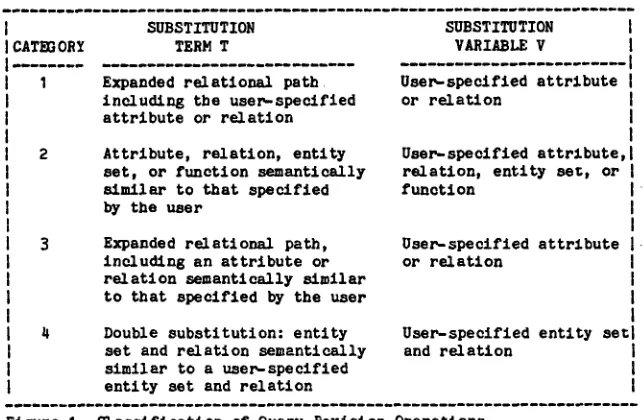
Within a given active plan, a revised query that investigates the single-level expansion of an action is more expected, and therefore more relevant, than a revised query that investigates details at a much deeper level o f e x p s n s i o n .Second, we can classify the substitution T-->V which produced the revlsed query into four categories, each of which represents a more signl- flcant, and therefore less preferable, alteration of the user's query (Figure I). Category I con- tains expanded relational paths R11P.?S... mRn such that the user-speclfied attribute or relation appears in the path expression. For example, the expanded path
Treats( Dr. BrOwn, patient) Wls- A s s i g n e d ( patient, room)
is a Category I substitution for the user- specified p r o p o s i t i o n
I s - A s s i g n e d ( Dr. Brown, rotz~)
SUBSTITUTION CATEGORY TERM T
Expanded r e l a t i o n a l p a t h i n c l u d i n g t h e user-specifled attribute or relation A t t r i b u t e , r e l a t i o n , e n t i t y s e t , o r f u n c t i o n s e m a n t i c a l l y s i m i l a r t o t h a t s p e c i f i e d by t h e u s e r
Expanded relational path,
including
an attribute orrelation semantically similar to that speclfled by the user Double substitution: entity set and relation semantically similar to a user-speclfled entity set and relation
SUBSTITUTION VARIABLE V
U s e r - s p e c l f l e d a t t r i b u t e o r r e l a t i o n
U s e r - s p e c i f i e d a t t r i b u t e , [ r e l a t i o n , e n t i t y s e ~ , o r f u n c t i o n
U s e r - s p e c i f l e d a t t r i b u t e o r r e l a t i o n
U s e r - s p e c i f i e d e n t i t y s e t [ and r e l a t i o n I
I
I
F i g u r e I. Classification of Query Revision Operations
[image:4.612.130.452.457.667.2]contained in the semantic representation of the query
"Which bed is Dr. Brown assigned?"
Category 2 contains simple substitutions that are semantically similar to the attribute, rela- tion, entity set, or function specified by the speaker. An example of Category 2 is the previ- ously discussed substitution of attribute "status" for the user specified attribute "classification" in the query
"What is the classification of Dr. Smith?" Categories 3 and 4 contain substitutions that are formed by either a Category I path expansion followed by a Category 2 substitution or by two Category 2 substltutlons.
Third, the semantic difference between the revised query and the original query is measured in two ways. First, if the revised query is an expanded path, we count the number of relations comprising that path; shorter paths are more desirable than longer ones. Second, if the revised query contains an attribute, relation, function, or entity set substitution, we use a generalization hierarchy to semantically compare substitutions with the items for which they are substituted. Our difference measure is the dis- tance from the item for which the substitution is being made to the closest common ancestor of it and the substituted item; small difference meas- ures are preferred. In particular, each attri- bute, relation, function, and entity set ATTRFENT is assigned to a primitive semantic class:
P R I M - C L A S S ( A T T R F E N T , CLASSA)
Each semantic class is assigned at most one immediate auperclass of which it is a proper sub- set :
SUPER( CLASSA, CL ASSB)
We define function f such t h a t
f(ATTRFENT , i+1) = CL~.SS if PRIM-CLASS( ATTRFENT, CLASSal )
a n d SUPER( CLA$Sal, CLASSa2) and SUPER( CLASSa2, CLASSaS)
and . . .
and SUPER( CLkSSal, CLASS)
If a revised query proposes substituting ATTRFENTnew for ATTRFENTold, then
semantl c#difference ( ATTRFEN Tnew, ATTRFEN Told) =NIL if there does not exist j,k such that
f( ATTRFEN Tnew, j) =f( ATTRFENTold, k) =mln k such that there exists j such that
f( ATTRFEN Tnew, j) =f( ATTRFEN Tol d, k) otherwise
An initial set is constructed conslstil~g of those suggested revised queries that interrogate an aspect of the current focused plan in the con- text model. These revised queries are particu- larly relevant to the current local context of the
dialogue. Members of this set whose difference measure is small and whose revision operation con- sists of a path expansion or simple substitution are considered and the most relevant of these are selected by measuring the depth within the focused plan of the component that suggested each revised query. If none of these revised queries meets a predetermined acceptance level, the same selection criteria are applied to a newly constructed set of revised queries s u g ~ s t e d by a higher level active plan whose expansion ied to the current focused plan, and a less stringent set of selection cri- teria are applied to the original revised query . ~et. (The revised queries in this new set are not immediately relevant to the current local dialogue context but are relevant to the global context.) As we consider revised queries suggested by higher level plans in the stack of active plans representing the global context, the acceptance level for previously considered queries is decreased. Thus revised queries which were not rated h i l l y enough to terminate processing when first suggested may eventually be accepted after less relevant aspects of the dialogue have been investigated. This relaxation and query set expansion is repeated until either an acceptable revised query is produced or all potential revised queries have been consldered.
V EX~.MPLF~
Several examples are provided to illustrate the suggestion and selection strategies.
[I] Relation o r Entity S e t Substitution "Which apartments a r e f o r sale?" In a real-estate model, single apart- ments are rented, not sold. However apart- ment buildings, condc~ini,-,s, townhouses, and houses are for s a l e . Thus the speaker's utterance contains the erroneous proposition
For-Sale(apar tment)
where apartment is a member of entity set APARTMENT.
If the preceding dialogue indicates that the speaker is seeking temporary living arrangements, then expansion of the context model representing the speaker's inferred plan will contain the posslble action
Rent( SPEAKER, apartment)
such that For-Rent(apartment) The substitution rules propose substituting relation For-Rent frc~ this plan in place of relation For-Sale in" the speaker's utterance.
expansion of the context model representing the speaker's inferred plan will contain the possible action
Purchase( SPEAE~B, apartment-building) where apartment-buildlng ls a member of entity set APARTmeNT-BUILDING. Purchasing an apartment b u i l d i n g necessitates that the b t t l l d i n g be f o r s a l e o r t h a t one c o n v i n c e t h e owner t o s e l l I t . Thus one e x p a n s i o n o f t h i s P u r c h a s e p l a n i n c l u d e s t h e p r e c o n d i t i o n
For-Sale(apartment-bullding)
The substitution rules propose substituting entity set APABT~NT-BUILDING from thls plan for the entity set A P A B T ~ N T in the speaker's utterance.
[2] Function Substitution
"What is the average rank of CS faculty?" The function AVEBAGE c a n n o t be a p p l i e d to non-numerlc elements such a s "professor". The speaker's utterance contains the errone- ous proposition
AVERAGE( rank, fn- value)
such that Department-Of(faculty,CS) and Bank( faculty, rank)
I f t h e p r e c e d i n g d i a l o g u e i n d i c a t e s t h a t t h e s p e a k e r i s e v a l u a t i n g t h e C~ d e p a r t m e n t , t h e n an expansion of the context model represent- l n g the speaker's lnferred plan wlll contain the possible action
Evaluate-Faculty( SPEAKER, CS)
The plan f o r Evaluate-Faculty contains the action
E v a l u a t e ( SPEAKER, a v e - r a n k )
s u c h t h a t ORDERED-AVE( r a n k , a v e - r a n k )
a n d Department-Of( faculty, CS)
a n d Bank( f a c u l t y , r a n k )
If a d o m a i n D of non-numeric elements has an
explicit ordering, then we can associate wlth each of the n dome.ln elements an lndex number between 0 and n-1 speclfylng its poaltlon in the sorted domain. The function ORDERED-AVE appearing In the speaker's plan operates upon non-numeric elements of such domains by cal- culating the average of the index numbers associated wlth each element instead of attempting t o c a l c u l a t e t h e a v e r a g e o f t h e e l e m e n t s t h e m s e l v e s . The s u b s t i t u t i o n r u l e s propose substituting the function ORDERED-AVE from t h e speaker's i n f e r r e d plan f o r t h e function AVERAGE in the speaker's utterance. ORDERED-AVE and AVERAGE are semantically similar functions so the difference measure for the resultant revised query will be emall.
[3] Expanded Relational Path
"when d o e s M l t c h e l m e e t ? "
A university model does not contain a relation m E T between FACULTY and T I ~ S . H ~ e v e r , faculty teach courses, present sem- inars, chair ooamlttees, etc., and courses, seminars, and committees meet at scheduled t i m e s . The s p e a k e r ' s u t t e r a n c e c o n t a l n s t h e e r r o n e o u s p r o p o s i t i o n
Meet- Tlme( Dr. Mt t c h e l , t i m e )
If the preceding dialogue indicates that the speaker is considering taking CSI05, then an expansion of the context model represent- ing the speaker's inferred plan will contain the action
Earn-Credi t- In-Sectl on( SPEAKER, section) such that Is-Sectlon-Of(section, CS105) Expansion of the plan for Earn-Credlt-ln- Section contains the action
L e a r n - F r o m - T e a c h e r - In-C1 a s s ( SPE AKEB, s e c t i o n , f a c u l t y ) s u c h t h a t Teach( f a c u l t y , s e c t i o n ) a n d t h e p l a n f o r t h l s a c t i o n c o n t a i n s t h e a c t i o n
At tend-Cl ass( SPEAKER, place, time) such that Meet-Plave(sectlon, place) and Meet- Time( section, time)
The two r e l a t i o n s T e a c h ( D r . ~ f l t c h e l , s e c t t o n ) a n d M e e t - T i m e ( s e c t i o n , t i m e ) a p p e a r on t h e • same p a t h i n t h e c o n t e x t m o d e l . T h e r e f o r e t h e p a t h e x p a n s i o n h e u r i s t i c s s u g g e s t t h e expanded relational path
Teach( Dr. Mi tchel, section) "Meet-Time( ae ctlon, time) as a substitution for the relation
Meet- Time( Dr. Mi tchel, time)
in the user's utterance. Only one arc Is a d d e d t o p r o d u c e t h e e x p a n d e d r e l a t i o n a l p a t h and it contains the user-specifled relation Meet-Time, so the difference measure for this r e v l s e d q u e r y l s small.
VI BELATED WORK
Erlk Mays[1980] discusses the recognition of p r a g m a t i c o v e r s h o o t a n d p r o p o s e s a r e s p o n s e c o n - talnlng a llst of those entity sets that are related by the user-speclfied relation and a llst of those relations that connect the user-speclfled entity sets. Houever he does not use a model of whether these pos~ibllltles are applicable to the user's underlying task. In a large database, such responses will be too lengthy and include too many irrelevant alternatives.
Kapl a n [ 1 9 7 9 ] , Chang[ 1 97 8] , and Sowa[ 1 976] have investigated the problem of missing Joins between entity sets. Kaplan proposes using the shortest relational path connecting the entity sets; Chang proposes an algorithm based on minimal spanning trees, using an a priori weighting of the arcs; $owa uses a conceptual graph (semantic net) for constructing the expanded relation. None of these present a model of whether the proposed path is relevant to the speaker's intentions.
VII LIMITATIONS ~ND FUTURE W O R K
Pragmatic overshoot processing has been implemented for a domain consisting of a subset of the courses, requirements, and policies for stu- dents at a University. Our system ass,s, es that the relations comprising a meaningful and relevant path expansion will appear on a single path w i t h i n the context tree representing the speaker's inferred plan. This restricts such expansions to those communicated via the speaker's underlying inferred task-related plan. However this plan may fall to capture some associations, such as between a person's Social Security Number and his name. This problem of producing precisely the set of path expansions that are meaningful and relevant must be investigated further. Other areas for future w o r k include:
[I] Extensions to handle relationships among more than two entity sets
[2] Extensions to the other classes of pragmatic overshoot mentioned in the introduction. [3] Extensions to detect and respond to queries
which exceed the knowledge represented in the underlying world model. We are currently assuming that the system can provide the i r2ormation needed by the speaker.
VIII CONCLUSIONS
The main contribution of our work is a context-based strategy for constructing a coopera- tive but limited response to pragmatically ill- formed queries. This response satisfies t h e
speaker's perceived needs, inferred both from the preceding dialogue and the ill-formed utterance. Our hypothesis is that the speaker's inferred task-related plan, represented by the context model, suggests a substitution for the proposition causing the pragmatic overshoot and that such suggestions then must be evaluated on the basis of relevance and semantic criteria.
ACKNOWLEDGMENTS
I would like to thank Ralph Weischedel for his encouragement and direction iD this research
and for his suggestions on the style and content of this p a p e r and L a n c e Ramshaw for many helpful discussions.
REFEREI~CES
1.
2.
3.
4.
5.
6 .
7 .
8.
9.
10.
11.
12.
Carberry, S., "Tracking User Goals in an Information-Seeking Environment", Proc. R ~ ~ . on Artificial Intelli~ence, Washing- ton, D.C., 1983
Chang, ~ L., "Finding M i s s i n g Joins for Incomplete Queries i n Relational Data Bases" IBM Res. Lab., RJ2145, San Jose, Ca., 1978 Fikes, R. E. and N. J. Nilsson, "STRIPS: A New Approach to the Application of Theorem Proving to Problem Solving", Artificial I g / _ ~ 2 , 1971
Kaplan, S. J. , "Cooperative Responses from a Portable Natural Language Data Base Query System", Ph.D. Dlsa., U n i v . of Pennsyl- vanla,1979
M a y s , L , "Failures in Natural Language Query Systems: Applications to Data Base Query Sys- tems", Proc. Nat. Conf. on Artificial I n t ~ , Stanford, 1980
Quine, W. V., "Ontologlcal Relativity" in Ontological ~@lativltv and Qther ~ , Columbia University Press, New York 1969 Ramshaw, L. A. end N. ~ Weischedel, "Problem Localization Strategies for Pragmatic Pro- cessing i n Natural Language Front Ends", Proe. of 9 ~ Int. Conf. on ComDutatlonal
~ , 1 984
Sondbeimer, N. K. and R. ~ Welschedel, "A Rule-Based Approach to Ill-Formed Input", Proo. 8th ~Jl~. Conf. on ~gmDutatlonal
~ g , 1980
Sowa, J. F., "Conceptual Graphs for a Data Base Interface", IBM Journal of Research and D . ~ , July 1 976
Thompson, B. H., "Linguistic Analysis of Natural Language Communication with Comput- ers", Proc. 8th Int. Conf. on Comouta- tlonal Lin~ulstics, 1980
Webber, B. L. and E. Mays, "Varieties of User Misconceptions: Detection and Correction", Proc. ~ Int. Joint Conf. on Artificial ~ t e l l i ~ e n c e , Karlsruhe, West Germany, August I 983