Viscous Sintering and Structural Stabilization of Amorphous B
4C Powder
Hiroshi Kimura
*Department of Mechanical Engineering, School of Systems Engineering, National Defense Academy, Yokosuka 239–8686, Japan
This article reports the pulsed electric current bulk synthesis and high-temperature X-ray diffraction structure of the amorphous B4C powder prepared by planetary ball milling. Solid state synthesized amorphous B4C shows two-stage structural relaxation characterized by a significant increase to 2.1 in relative integrated X-ray intensity of first amorphous diffraction peak with increasing temperature to 1573 K. Amorphous B4C can be consolidated, avoiding visible submicron sized pore without the need for additives; its temperature decreases 1473 to 1073 K by decreasing 2.5 to 1.0 mm in final sample height in combination with an increasing applied stress 100 to 120 MPa. For the amor-phous B4C, subjected to full structural relaxation; the rapid densification in heating can be fairly well expressed by an Arrhenius-type equation of Newtonian viscous flow, η = ηoexp(420 kJmol−1/RT) where η is the consolidation process viscosity. Progressive structural relaxation of amorphous B4C then is described as increase in viscosity constant (ηo) having a relationship of the form, ηo = ηooexp(−335 kJmol−1/RT). The density of the consolidated amorphous B4C is estimated at 2.02 Mgm−3 at the minimum, which is 0.8 of theoretical one for stoichiometric compound. The strain rate sensitivity for bulk amorphous B4C is determined to be a significantly low value of 0.043, characteristic of inhomo-geneous plastic flow in Berkovich dynamic indentation testing. [doi:10.2320/matertrans.M2017269]
(Received September 5, 2017; Accepted November 2, 2017; Published January 25, 2018)
Keywords: bulk amorphous ceramics, amorphous plasticity, high-temperature X-ray structure, pore-free consolidation, nanocrystallization
1. Introduction
Boron carbide (B4C) is well known to be one of the
hard-est materials, next only to diamond and cubic boron nitride, and is finding a widespread use in technological applications such as armor and neutron absorbing materials1). A critical
issue for conventionally processed B4C is how to overcome
intrinsic fabrication problems such as an extremely high sin-tering temperature of around 2600 K2) and difficulty of
near-net-shape forming due to less plastic flow. The current au-thor has synthesized the amorphous B4C powder via a solid
state reaction using planetary ball milling and attrition mill-ing3–5). The solid state synthesized amorphous B
4C with the
active surface has the potential for full densification at a sig-nificantly low temperature without the need for additives by employing pulsed electric current sintering6), analogous to
the case of the amorphous SiC powder7,8). Although
ad-vanced techniques such as millimeter wave sintering of com-mercialized B4C powder9), pulsed electric current sintering
of ball-milled powder10) and high-pressure spark plasma
sin-tering11) have been introduced in attempt to obtain
large-scale highly dense products using optimal additives, full densification has not yet been attained even at a customarily used high temperature. It is hoped that the instrumented pulsed electric current ceramic sintering method12,13) can
provide multi-variable control, taking advantage of viscous flow that ought to occur in ball-milled amorphous powder, for the pore-free bulk synthesis of amorphous or nanocrys-talline B4C with outstanding mechanical properties.
In the present investigation, pulsed electric current pres-sure sintering and high-temperature X-ray diffraction mea-surements of solid state synthesized amorphous B4C are
car-ried out, in order to provide a process control methodology of full densification with reference to structural stabilization.
2. Experimental Procedure
The amorphous B4C powder was synthesized by the
me-chanical milling of commercially obtained B4C compound
powder (purity of more than 99%, 0.007%Al, 0.002%Ca, 0.03%Fe, 0.02%Na and 0.01%Si, Kojundo Chemical Lab. Co., Ltd.) with a particle size of 0.5 μm, in a mono-vial type planetary ball mill (Fritsch P-6). The vessel and balls were made of silicon nitride {88%Si4N3, 12% (Y2O3, Al2O3, AlN
and TiO2)}. The disk rotation speed used was 10 s−1 and
both periods of milling time (tm) were 504 and 640 h. For
the amorphous powder synthesis without outer contamina-tion, a successive milling method was conducted, in which surface of balls and inner wall of vessel have been coated by B4C after several batch testing. In order to characterize the
high-temperature structure of the amorphous B4C powder,
X-ray diffraction combined with an isochronal heating tech-nique was performed under vacuum using Cu Kα radiation at a relatively high scan speed of 1 s−1. The as-milled
pow-der was placed on a platinum plate in a theta-theta diffrac-tometer equipped with a high-speed one dimensional detec-tor (Rigaku Ultima IV).
The amorphous B4C powder was packed into a cylindrical
shaped graphite die, and consolidated in a vacuum under ap-plied stresses of 20, 100 and 120 MPa in the temperature range 1073 to 2142 K using a thermo-mechanical processing system that allowed controls of the rectangular current pulse and the direct current heating14). For applied stresses of 100
and 120 MPa, the graphite die used had inner and outer di-ameters of 10 and 45 mm respectively. For an applied stress of 20 MPa, these diameters were 10.5 and 40 mm respec-tively, and the compact inside graphite die was wrapped with graphite foil. The temperature was measured using a thermocouple situated 2 mm away from the inner wall of the graphite die and corrected for the temperature profile across the radius of the die to deduce the temperature at the outer surface of the compact. The use of surface temperature as a true sintering temperature seems permissible for a less elec-tric conductive material, which is subjected to heat flow * Present address: Professor Emeritus, National Defense Academy
during resistance heating of a cylindrical carbon die and ex-hibits almost no temperature gradient throughout its cross-section. The temperature on the outer surface of cylin-drical graphite die was measured by thermography for high-temperature sintering with an applied stress of 20 MPa. The apparent displacement (Z ) was measured in real time using a linear displacement sensor, and was corrected for thermal expansion of the sample and both plungers to obtain the true displacement (Z). The relative density (D) was cal-culated from the equation D = Hf/(Zf − Z + Hf) where Hf and
Zf are the height and displacement of the full-density
com-pact, respectively. The sintering strain rate (ε˙ )15) is defined
by the following equation: ˙
ε=(1/D)(dD/dt) (1)
where t is the time. During heating, ˙ε was determined using the equation ˙ε = (1/D)(dD/dT)(dT/dt). Here, dD/dT was ob-tained from the relative density versus temperature curve16).
The microstructure of the surface of the consolidated B4C
was observed using an optical microscope. The weight and volume of the bulk B4C were measured and used to
deter-mine its density. The crystallite size (dc) was estimated by
the Scherer formula, dc = 0.9λ/(Bcosθ), where B is the X-ray
peak broadening at half-maximum, λ is the X-ray wave-length (0.1542 nm) and θ is the scattering angle. A Berkovich indenter equipped with a depth (d)-sensing sys-tem (Shimadzu Co., Ltd. DUH-201S) was employed to ob-tain plastic behavior of the consolidated B4C sample under a
constant applied load (P) of 1.963 N for a time period of 5 s after loading with a constant rate of 70 mNs−1. The
Berkovich hardness (DH115), measured with a triangular
py-ramidal indenter with a dihedral angle of 115 , is deduced from the following equation17)
DH115=P/24.56d2 (2)
3. Results
3.1 High-temperature X-ray diffraction
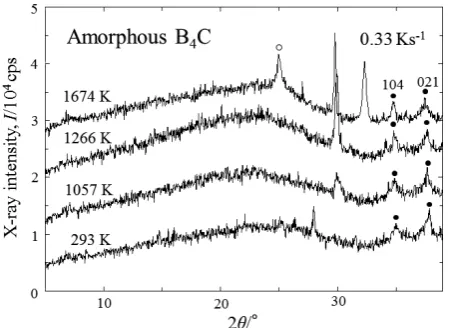
Figure 1 shows X-ray diffraction patterns for the amor-phous B4C powder, synthesized via dry ball milling for
640 h, at various temperatures while heating at a constant rate of 0.33 Ks−1. These measurements were taken in real
time in the temperature range 293 to 1673 K, and the 2θ range 5 to 55 at a constant scan speed of 1 s−1. The
as-milled B4C powder before heating was confirmed to be
mainly amorphous based on the first broad X-ray peak char-acteristic of a glass structure. Whereas, the remaining rhom-bohedral B4C was detected by small but definite X-ray peaks
associated with the (104) and (021) planes having a linear shift towards lower 2θ values due to thermal expansion as the temperature increased to 1674 K; the volume fraction was estimated to be less than 2 mass% by integrated peak intensity, following the formula for amorphization based on the first order chemical reaction3). The first amorphous peak
shows a large increase in integrated X-ray diffraction inten-sity (Ip) with increasing temperature, and concomitantly,
shifts to lower 2θ value at 1057 K and larger 2θ values in further heating up to 1674 K. Furthermore, when the tem-perature reached 1674 K, a clear nanocrystalline X-ray peak appeared around 25 , denoted as the open circle, indicating that nucleation of the metastable phase occurs via crystallization.
Figure 2 shows the X-ray diffraction pattern at room tem-perature for as-milled and annealed powder. This measure-ment was taken for the amorphous B4C powder heated to
1273 K at a relatively low rate of 5·10−2 Ks−1 after heating
to 873 K at a rate of 0.33 Ks−1. It was clearly confirmed that
isochronal annealing of the amorphous B4C powder at
1273 K causes an increase in integrated X-ray peak intensity relative to the as-milled powder with a shift to higher 2θ, af-ter reversible structural stabilization if any, in the avoidance of thermal expansion. Additionally, some small sharp X-ray peaks around 2θ of 30 appear and disappear upon heating as shown in Figs. 1 and 2; these are not identified as crystalline phases that are most likely to occur via occasional oxidation on the active surface of the amorphous B4C powder milled
with the vessel and balls used. The X-ray diffraction results as stated above reveal considerable structural stabilization during heating of the nanomechanochemically synthesized amorphous B4C powder from ambient temperature.
Fig. 1 High-temperature X-ray diffraction patterns while the amorphous B4C powder was isochronally heated to 1674 K at a constant rate of
0.33 Ks−1. Fig. 2phous B X-ray diffraction patterns at ambient temperature for the
[image:2.595.57.283.587.751.2] [image:2.595.311.542.591.763.2]3.2 Pulsed electric current bulk synthesis
Figure 3 shows the apparent displacement versus tempera-ture and time for an initial heating rate of 2.5 Ks−1 at an
al-most constant direct current (DC) of 1200 A, after first ap-plying rectangular pulses (RP) of 750 A and wave length 20 ms for 30 s, under an applied stress of 100 MPa. This measurement was taken in real time during consolidation of the amorphous B4C powder with a final sample height (hf)
of 2.49 mm. The amorphous B4C compact showed an
accel-erating increase in apparent displacement with increasing temperature from approximately 930 K. When the tempera-ture was held at 1523 K for the holding time (th) of
approxi-mately 1600 s, Z increased to the level for full-density amorphous B4C at around 800 s, and thereafter restarted to
increase monotonically due to shrinkage associated with the onset of nanoscale crystallization. Based on the true dis-placement, the amorphous B4C actually undergoes
densifica-tion at a lower temperature of less than 930 K.
Figure 4 shows the surface temperature and apparent dis-placement against time for an applied stress of 120 MPa. This measurement was taken in real time during direct cur-rent heating of the amorphous B4C powder with a higher
ini-tial rate of approximately 5 Ks−1 after applying rectangular
pulses of 790 A for 60 s in the case of the lowest hf of
1.017 mm, which is thought to result in a higher electric field and/or larger quasi-isostatic pressure6,13). The
amor-phous B4C showed an enhanced densification rate at a
tem-perature of around 1000 K and then attained full-density
during isothermal heating at 1073 K under a higher applied stress of 120 MPa. In addition, the amorphous B4C
under-went rapid shrinkage via neck formation14) by applying
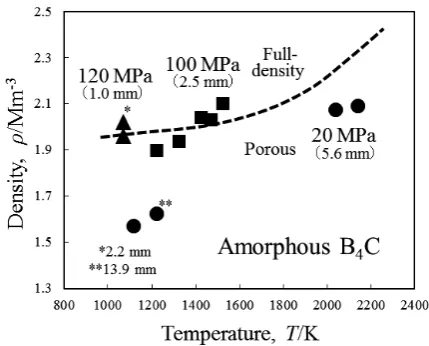
rect-angular electric current pulses at a temperature below ap-proximately 600 K. Further heating to 1000 K by DC led to monotonous densification during amorphous flow and struc-tural stabilization with a relative density of approximately 0.8, when taking the true displacement obtained by compen-sating a negative displacement by thermal expansion com-pensated as well as the case of Fig. 3. Figure 5 shows the density of the bulk B4C versus surface temperature, prepared
at applied stresses of 20, 100 and 120 MPa by pulsed elec-tric current sintering of the amorphous powder. The tem-perature necessary to obtain full densification of the amor-phous B4C powder decreased from 1473 to 1073 K with
decreasing final sample height from 5.6 to 1.0 mm in combi-nation with increasing applied stress from 100 to 120 MPa; these temperatures are significantly lower than approxi-mately 2600 K needed for conventional sintering2). In
addi-tion, the amorphous B4C under a lower applied stress of
20 MPa undergoes rapid shrinkage at around 1100 K, but do not attain full density at 2142 K. Then, for pore-free amor-phous B4C subjected to structural stabilization and partial
[image:3.595.49.291.431.559.2]crystallization, the minimum density, depicted by a dashed line, shows an increase with increasing temperature.
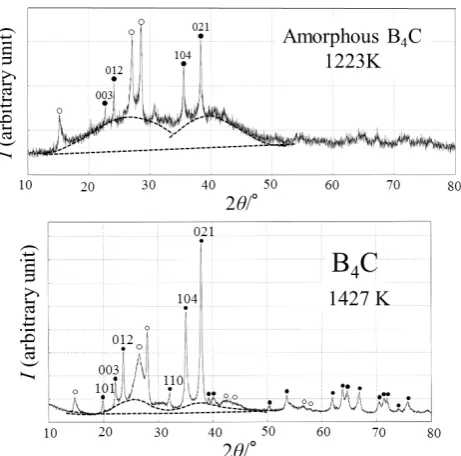
Figure 6 shows the X-ray diffraction patterns from the surface of the bulk amorphous B4C consolidated at (a)
1223 K and (b) 1427 K for 300 s. For the case of 1223 K, the pattern is mainly composed of first and second broad amorphous peaks, although some small crystalline peaks as-sociated with rhombohedra as indicated by solid circles can also be seen. Other sharp X-ray peaks, indicated by open circles, may be associated with metastable phase, as occa-sionally synthesized via ball milling or pulse sparking, ac-companying grain growth while sintering. On the other hand, the fully dense B4C consolidated at 1427 K clearly
ex-hibits X-ray broad peaks of a metastable phase synthesized during crystallization, as denoted by open circle, and re-maining rhombohedral peaks with increased intensity in ad-dition to residual amorphous peaks. The new metastable phase synthesized at 1427 K is suggested to be 12-atom
ico-Fig. 3 Apparent displacement for the consolidated amorphous B4C during dc heating with an initial rate of 2.5 Ks−1 as a function of temperature and time at 1523 K under an applied stress of 100 MPa.
Fig. 4 Surface temperature and apparent displacement versus time for the amorphous B4C compact under an applied stress of 120 MPa in the case of a final height of 1 mm when rectangular pulses is fed for 60 s and di-rect current is applied for heating up.
[image:3.595.318.533.579.752.2] [image:3.595.52.287.619.742.2]sahedra in rhombohedral unit cell of B4C, although structure
analysis and high-resolution transmission electron micros-copy is needed to confirm a firm conclusion. Its crystallite size is evaluated at approximately 5 nm by the amount of X-ray broadening of the peak around 26.6 , and volume fraction is estimated at 0.2 from relative integrated X-ray peak intensity. The remaining rhombohedra B4C with a
vol-ume fraction of 4.5 mass% for the milling time of 504 h then showed sharper X-ray peaks while integrated intensity kept constancy to 2142 K.
Table 1 summarizes the consolidation conditions used for pulsed electric current sintering of amorphous B4C powder,
including the diameter, height, aspect ratio and density of the cylindrical shaped sample and the crystallite size of metastable phase. The density of the pore free amorphous B4C is found to be 2.020 increasing to 2.102 Mgm−3 by
par-tial crystallization with a volume fraction of approximately 0.3; this value is 20% lower than 2.52 Mgm−3 typically
re-ported for conventionally processed rhombohedral B4C
compound, analogous to that the amorphous Al2O318,19) and
WO320) generally have 20–30% lower density relative to
their crystals. The low value of the covalent bond typed amorphous B4C is acceptable, when taking into account the
density of 1.8 to 2.1 and 1.73 Mgm−3 in the literature for
amorphous carbon and boron respectively. The metastable phase then shows a smooth decrease 30 to 3.6 nm, close to a threshold, in crystallite size with decreasing temperature 2142 to 1323 K.
3.3 Dynamical indentation
Figure 7 shows time-depth curves for the full-density amorphous B4C consolidated at 1073 and 1427 K in
Berkovich indentation testing under a constant load of 1963 mN. This measurement was taken from the initial depth (di) after loading up at a relatively high rate of
70 mN·s−1 without crack formation and stress-induced
amorphization21). Both amorphous B
4C samples show
smooth time versus depth curves for a period of time for 5 s. In particular, the amorphous B4C consolidated at 1073 K
showed lower di and larger time-dependence of indentation
[image:4.595.54.285.310.538.2]depth via plastic flow dp, calculated from the equation dp =
Table 1 Consolidation conditions for pulsed electric current sintering of amorphous B4C, including sample weight, diameter, height, ratio of diameter to height, density, crystallite size of metastable phase and milling time used for amorphization.
P/MPa T/K th/s W/g Φ/mm hf/mm Φ/hf ρ/Mgm−3 dc/nm tm/hour
20
2039
300
0.756 9.096 5.61 1.621 2.074 21
504
2142 0.75 9.096 5.51 1.651 2.091 30
1118 0.685 10 5.55 1.802 1.571
̶
1221 1.773 10 13.9 0.719 1.624
100
1223 0.365 10 2.45 4.082 1.897
640
1323 0.388 10 2.55 3.923 1.937 3.6
1427 0.354 10 2.21 4.525 2.039 5 504
1473 0.405 10 2.54 3.937 2.03 5.4
640
1523 1600 0.411 10 2.49 4.016 2.102 6.5
120 1073 180 0.16 10.105 1.017 9.936 1.962 ̶
1073 0.363 10.105 2.241 4.509 2.02
Fig. 7 Berkovich indentation depth against time under a constant load of 1963 mN for the amorphous B4C, consolidated at the temperatures of 1073 and 1427 K.
[image:4.595.362.492.374.547.2] [image:4.595.47.557.633.789.2]d − di, relative to those of partially crystallized B4C.
Figure 8 shows an optical micrograph of the surface of the amorphous B4C consolidated at 1427 K with a Berkovich
in-dent. The bulk amorphous B4C has no significant submicron
sized pores within the resolution of optical microscopy, and no cracks are observed at the corners of the sink-in triangu-lar pyramidal indent. Some straight scratches made by me-chanical polishing with sand papers with a diameter ranging from 0.3 to 9 μm are also seen at the shiny surface of the amorphous B4C as an indication of plastic flow. The
pro-jected area of an indent yields the permanent DH115 of 3.2
and 8.2 GPa, averaged over five measurements, for amor-phous B4C consolidated at 1073 and 1427 K respectively;
these values are significantly lower than the Vickers hard-ness of 30 GPa in the literature for rhombohedral B4C that is
a polycrystalline stoichiometric compound. The former DH115 results from a relatively low atomic packing fraction
of the amorphous B4C, when referring to that glassy B2O3,
having the density of 1.8 Mgm−3 that is lower than the value
of 2.46 Mgm−3 for crystal22), shows the Vickers hardness of
approximately 1.67 GPa23). Whereas, latter DH
115 yields the
high hardness of 28.2 GPa at the minimum for metastable second phase based on the mixture rule of the amorphous composite24).
4. Discussion
[image:5.595.328.523.402.547.2]4.1 Structural stabilization
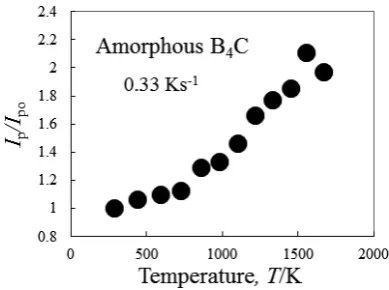
Figure 9 shows the relative integrated X-ray intensity (Ip/
Ipo) of the first amorphous X-ray peak versus temperature for
the amorphous B4C powder isochronally heated at a rate of
0.33 Ks−1. Here, I
po is the integrated X-ray peak intensity of
the as-milled amorphous powder. Ip/Ipo for the amorphous
B4C shows a large increase from 1.2 to 2.1 with an increase
in temperature from approximately 900 to 1560 K with in-creasing the temperature, after a slow increment at low tem-peratures. This high Ip/Ipo strongly indicates that the
as-milled amorphous B4C has a more disordered structure
relative to the rapidly melt-quenched, and consequently un-dergoes a large decrease of free volume at atomistic level in an isoconfigurate state, since Ip of the first amorphous peak
is generally ascribed to the average coordination number (N)
of nearest neighbors. Further increasing the temperature to 1673 K causes a decrease in Ip/Ipo by a decrease in
amor-phous volume during partial crystallization. Here, the struc-tural relaxation of the amorphous B4C can be definitely
di-vided by two regimes. The first-stage structural relaxation might be related to compositional short range ordering, when taking into account slightly increased N and almost constancy of the nearest neighbor distance (l) while heating. On the other hand, the second-stage structural relaxation may result from an increase in topological short range order-ing, having largely increased N and decreased l.
4.2 Viscous sintering
When the sintering strain rate (˙ε ) is used, the densification via Newtonian viscous flow in an amorphous solid16) is
given by
˙
ε=σeff/3η (3)
where η is the consolidation process viscosity and σeff is the
effective stress applied to the contact area between sintered particles. The σeff for a lower density compact with 0.64 <
D < 0.9 under isostatic pressing is given by σeff = σ(1 −
Do)/{D 2(D − Do)}, where σ is the applied stress and Do is
the relative density at the onset of consolidation. Figure 10 shows the process viscosity as a function of reciprocal tem-perature during pulsed electric current sintering of the
amor-Fig. 8 Optical micrograph of the surface of the fully dense amorphous B4C, consolidated at 1427 K under 100 MPa, with a Berkovich indent.
Fig. 9 Relative integrated X-ray peak intensity of the first amorphous peak for the solid state synthesized B4C powder versus temperature.
[image:5.595.63.274.596.761.2] [image:5.595.329.522.600.752.2]phous B4C under 100 MPa, as shown in Fig. 3. All of the η
values were below 1012 Pas at the glass temperature. For
amorphous B4C in an isoconfigurate state subjected to full
structural relaxation above 1323 K, η has good linearity in an Arrhenius typed plot, and so this dependence is given by the following equation:
η=ηoexp(Q/RT) (4)
where ηo is the viscosity constant, Q is the apparent
activa-tion energy for Newtonian viscous flow during pulsed elec-tric current sintering and R is the gas constant. The slope of logη/T −1 gives an accepted value of 420 kJmol−1 for the
level of Q in the supercooled liquid of B4C. For the
amor-phous B4C with hf = 1.02 mm, η is estimated at a lower
value of 2.2·109 Pas at 1044 K, indicating that densification
occurs via viscous flow under a higher electric field25).
Assuming that the equation η = ηoexp(420 kJmol−1/RT)
holds for the amorphous B4C subjected to accelerated
sec-ond-stage structural relaxation as has reported in mechani-cally alloyed amorphous Co79.5Nb15Zr5.526), the process
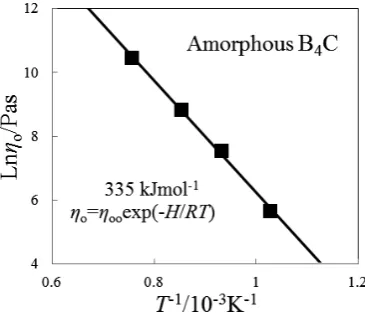
con-stant at each temperature is obtained by a parallel shift of the dashed straight line as depicted in Fig. 10. Figure 11 shows the process constant as a function of reciprocal temperature for amorphous B4C. The increase in ηo with increasing
tem-perature shows good linearity in an Arrhenius plot; so this dependence can be written as:
ηo=ηooexp(−H/RT) (5)
where ηoo is a constant and H is the apparent activation
en-ergy for second-stage structural relaxation. The value of H is determined to be 335 kJmol−1 for the amorphous B
4C. Then,
an increase in ηo relates to an increase in Ip based on the
lin-ear relationship between T and Ip/Ipo as shown in Fig. 9. In
other words, the increasing average coordination number gives rise to hardening of the amorphous B4C subjected to
progressive structural relaxation. The combination of eqs. (4) and (5) thus provides a base for process control by varying the applied stress, temperature, heating rate and sample height for full densification of the amorphous B4C in
the reference with structural stabilization.
For considerable densification at a lower temperature be-low glass transition as denoted in Figs. 3 and 4, non-Newto-nian flow ought to contribute as well as amorphous TiAl27);
look elsewhere for construction of the phenomenological law.
4.3 Microplasticiy
For the time-dependent indentation depth under the con-stant load, the plastic strain rate (˙ε p) is defined by
˙
εp=d(dp/d)/dt (6)
Then, when the term of true stress (σ115) in Berkovich
dy-namic indentation is used, the strain rate sensitivity (m) is given by
m=∂logσ115/∂log ˙εp (7) DH115 here is the measure of σ115. Figure 12 shows
logarith-mic σ115 as a function of plastic strain rate under a constant
load of 1963 mN for the amorphous B4C consolidated at
1073 and 1427 K. In this plot, one can see good linearity; therefore m is determined to be 0.043 for amorphous B4C
under constraint compression. This small value is character-istic of extremely inhomogeneous plastic flow in an amor-phous metals28,29) and nanocrystalline (ZrO
2)80(Al2O3)2030,31)
unlike viscous flow. Then, m for the amorphous B4C
sub-jected to accelerated structural relaxation and partial nano-crystallization at 1427 K decreases to 0.027, suggesting that the atomic packing fraction and rigidity affects the rate pro-cess involved in the inhomogeneous flow that ought to con-sist of collective motion of atoms.
Finally, note that the proposed bulk amorphous B4C
syn-thesis provides innovative plastic forming such as high-speed superplastic forging and machinability, together with the syntheses of nanoscale rhombohedra32), icosahedra cage
structure33) and nanoporus structure34) by post-sintering heat
treatments.
5. Conclusions
Solid state synthesized amorphous B4C powder is
con-firmed to undergo two-stage structural relaxation with a sig-nificantly high relative integrated intensity of 2.1 by high-temperature X-ray diffraction. The pore free amor-phous B4C can be prepared by the instrumented pulsed
elec-tric current sintering method; its densification is fairly well expressed by an Arrhenius-type equation of Newtonian
[image:6.595.337.520.604.752.2]vis-Fig. 11 Newtonian viscosity constant for the amorphous B4C subject to progressive structural relaxation as a function of reciprocal temperature.
[image:6.595.77.260.605.762.2]cous flow η = ηoexp(420 kJmol−1/RT). Then, for amorphous
B4C subjected to accelerated structural stabilization, ηo is
given by ηo = ηooexp(−335 kJmol−1/RT). The fully dense
amorphous B4C is found to have an approximately 20%
lower value of theoretical density of commercial rhombohe-dral compound. The Berkovich dynamic indentation of the amorphous B4C is used to obtain significantly low strain rate
sensitivity, via inhomogeneous flow, of 0.043 decreasing to 0.027 by metastable phase dispersed therein.
Acknowledgements
Thanks are due to Messrs. Kazuya Yamawaki and Hidehito Tagami, undergraduate students at the National Defense Academy, Japan for technical assistance during this investigation.
REFERENCES
1) F. Thevenot: J. Eur. Cera. Soc. 6 (1990) 205–225.
2) H. Lee and R.F. Speyer: J. Am. Ceram. Soc. 86 (2003) 1468–1473.
3) H. Kimura: Ceram. Trans. 203 (2009) 119–130.
4) H. Kimura: J. Japan. Soc. Powder Metall. 56 (2009) 546–554.
5) H. Kimura: Advances in Powder Metallurgy & Particulate Materials
8, (Metal Powder Industries Federation Princeton, 2011) pp.35–46.
6) H. Kimura: J. Japan. Soc. Powder Metall. 57 (2010) 769–778.
7) H. Kimura: 4th Pacific Rim Int. Conf. on Advanced Materials and Processing (PRICM4) (Japan Inst. Metals, Sendai, 2001) pp.163–166. 8) H. Kimura, K. Hanada and K. Ishigane: Mater. Sci. Forum 502 (2005)
211–216.
9) S. Mitsudo, S. Sano and T. Saji: J. Plasma Fusion Res. 84 (2008) 896–898.
10) Y. Kodera, N. Ishibashi, T. Imai, T. Yamamoto, M. Ohyanagi, U. A-Tamburini and Z.A. Munir: Ceram. Trans. 194 (2005) 101–111. 11) P. Badica, S. Grasso, H. Borodianska, S.S. Xie, P. Li, P. Tatarko, M.J.
Reece, Y. Sakka and O. Vasylkiv: J. Ceram. Soc. Jpn. 122 (2014) 271–275.
12) H. Kimura: Advances in Powder Metallurgy & Particulate Materials
12, (Metal Powder Industries Federation Princeton, 1999) pp.55–61.
13) H. Kimura: Ceram. Trans. 194 (2005) 251–262. 14) H. Kimura: J. Jpn Soc. Technol. 39 (1998) 18–23.
15) A.S. Lao and A.C.D. Chaklader: J. Am. Ceram. Soc. 55 (1972) 596–601.
16) H. Kimura: Philos. Mag. 73 (1996) 723–737.
17) P.-L. Larsspm and A.E. Giannakoulos: Int. J. Solids Struct. 33 (1996) 221–248.
18) G. Gutiérrez and B. Johansson: Phys. Rev. B 65 (2002) 104202.
19) I. Levin and D. Brandon: J. Am. Ceram. Soc. 81 (2011) 1995–2012.
20) M. S. Mattsson: Phys. Rev. B 58 (1998) 11015.
21) D. Ge, V. Domnich, T. Juliano, E.A. Stach and Y. Gogotsi: Acta Mater.
52 (2004) 3921–3927.
22) S. L. Phillips and D. L. Perry: Properties of Inorganic Compounds
Version 2.0, (Taylor & Francis Group, 1997).
23) J. Sehgal and S. Ito: J. Non-Cryst. Solids 253 (1999) 126–132.
24) H. Kimura, T. Masumoto and D.G. Ast: Acta Metall. 35 (1987) 1757–1765.
25) H. Kimura and K. Hongo: Mater. Trans. 47 (2006) 1374–1379.
26) H. Kimura, W.-N. Myung, S. Kobayashi, M. Suzuki, K. Toda and T. Yuine: J. Japan Inst. Metals 56 (1992) 833–841.
27) H. Kimura and Y. Shimoitani: J. Japan. Soc. Powder Metall. 58 (2011) 18–26.
28) H. Kimura and T. Masumoto: Philos. Mag. A 44 (1981) 1021–1030.
29) H. Kimura and T. Masumoto: Acta Metall. 31 (1983) 231–240.
30) H. Kimura: J. Japan. Soc. Powder Metall. 55 (2008) 502–508.
31) H. Kimura: Nanostructured Materials and Nanotechnology II,
Ceramic Engineering and Science Proceedings 29, (Wiley, 2008) pp. 93–105.
32) M. Winterer: Nanocrystalline Ceramics Synthesis and Structure (Springer-Verlag Berlin Heidelberg New York, 2002).
33) V. Dominich, S. Reynaud, R.A. Haber and M. Chhowalla: J. Am. Ceram. Soc. 94 (2011) 3605–3628.