Improving Learning and Inference in a Large Knowledge-base
using Latent Syntactic Cues
Matt Gardner, Partha Pratim Talukdar, Bryan Kisiel, and Tom Mitchell
Carnegie Mellon University 5000 Forbes Avenue Pittsburgh, PA 15213, USA
{mg1,ppt,bkisiel,tom.mitchell}@cs.cmu.edu
Abstract
Automatically constructed Knowledge Bases (KBs) are often incomplete and there is a gen-uine need to improve their coverage. Path Ranking Algorithm (PRA) is a recently pro-posed method which aims to improve KB cov-erage by performing inference directly over the KB graph. For the first time, we demon-strate that addition of edges labeled with la-tent features mined from a large dependency parsed corpus of 500 million Web documents can significantly outperform previous PRA-based approaches on the KB inference task. We present extensive experimental results val-idating this finding. The resources presented in this paper are publicly available.
1 Introduction
Over the last few years, several large scale Knowl-edge Bases (KBs) such as Freebase (Bollacker et al., 2008), NELL (Carlson et al., 2010), and YAGO (Suchanek et al., 2007) have been developed. Each such KB consists of millions of facts (e.g., (Tiger Woods, playsSport, Golf)) spanning over multiple relations. Unfortunately, these KBs are often incom-plete and there is a need to increase their coverage of facts to make them useful in practical applications.
[image:1.612.316.539.238.338.2]A strategy to increase coverage might be to per-form inference directly over the KB represented as a graph. For example, if the KB contained the follow-ing facts, (Tiger Woods,participatesIn,PGA Tour)) and (Golf,sportOfTournament,PGA Tour), then by putting these two facts together, we could potentially infer that (Tiger Woods, playsSport, Golf). The
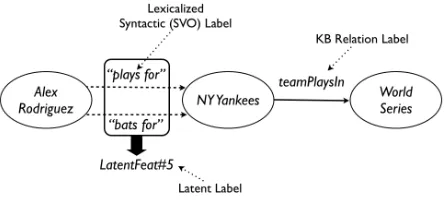
Figure 1: Example demonstrating how lexicalized syn-tactic edges can improve connectivity in the KB enabling PRA (Lao and Cohen, 2010) to discover relationships be-tweenAlex RodriguezandWorld Series. Edges with la-tent labels can improve inference performance by reduc-ing data sparsity. See Section 1.1 for details.
recently proposed Path Ranking Algorithm (PRA) (Lao and Cohen, 2010) performs such inference by automatically learning semantic inference rules over the KB (Lao et al., 2011). PRA uses features based off of sequences of edge types, e.g., hplaysSport, sportOfTournamenti, to predict missing facts in the KB.
PRA was extended by (Lao et al., 2012) to per-form inference over a KB augmented with depen-dency parsed sentences. While this opens up the possibility of learning syntactic-semantic inference rules, the set of syntactic edge labels used are just theunlexicalized dependency role labels (e.g., nobj, dobj, etc., without the corresponding words), thereby limiting overall expressitivity of the learned inference rules. To overcome this limitation, in this paper we augment the KB graph by adding edges with more expressive lexicalized syntactic labels (where the labels are words instead of
cies). These additional edges, e.g., (Alex Rodriguez, “plays for”, NY Yankees), are mined by extracting 600 million Subject-Verb-Object (SVO) triples from a large corpus of 500m dependency parsed docu-ments, which would have been prohibitively expen-sive to add directly as in (Lao et al., 2012). In order to overcome the explosion of path features and data sparsity, we derive edge labels by learning latent em-beddings of the lexicalized edges. Through exten-sive experiments on real world datasets, we demon-strate effectiveness of the proposed approach.
1.1 Motivating Example
In Figure 1, the KB graph (only solid edges) is dis-connected, thereby making it impossible for PRA to discover any relationship between Alex Rodriguez and World Series. However, addition of the two edges with SVO-based lexicalized syntactic edges (e.g., (Alex Rodriguez, plays for, NY Yankees)) re-stores this inference possibility. For example, PRA might use the edge sequence h“plays for”, team-PlaysIni as evidence for predicting the relation in-stance (Alex Rodriguez, athleteWonChampionship, World Series). Unfortunately, such na¨ıve addition of lexicalized edges may result in significant data sparsity, which can be overcome by mapping lexi-calized edge labels to some latent embedding (e.g., (Alex Rodriguez, LatentFeat#5, NY Yankees) and running PRA over this augmented graph. Using la-tent embeddings, PRA could then use the following edge sequence as a feature in its prediction models:
hLatentFeat#5, teamPlaysIni. We find this strategy to be very effective as described in Section 4.
2 Related Work
There is a long history of methods using suface-level lexical patterns for extracting relational facts from text corpora (Hearst, 1992; Brin, 1999; Agichtein and Gravano, 2000; Ravichandran and Hovy, 2002; Etzioni et al., 2004). Syntactic information in the form of dependency paths have been explored in (Snow et al., 2006; Suchanek et al., 2006). A method of latent embedding of relation instances for sentence-level relation extraction was shown in (Wang et al., 2011). However, none of this prior work makes explicit use of the background KBs as we explore in this paper.
Path Ranking Algorithm (PRA) (Lao and Cohen, 2010) has been used previously to perform inference over graph-structured KBs (Lao et al., 2011), and to learn formation of online communities (Settles and Dow, 2013). In (Lao et al., 2012), PRA is extended to perform inference over a KB using syntactic in-formation from parsed text. In contrast to these pre-vious PRA-based approaches where all edge labels are either KB labels or at surface-level, in this pa-per we explore using latent edge labels in addition to surface-level labels in the graph over which PRA is applied. In particular, we focus on the problem of performing inference over a large KB and learn la-tent edge labels by mining dependency syntax statis-tics from a large text corpus.
Though we use Principal Components Analysis (PCA) for dimensionality reduction for the experi-ments in this paper, this is by no means the only choice. Various other dimensionality reduction niques, and in particular, other verb clustering tech-niques (Korhonen et al., 2003), may also be used.
OpenIE systems such as Reverb (Etzioni et al., 2011) also extract verb-anchored dependency triples from large text corpus. In contrast to such ap-proaches, we focus on how latent embedding of verbs in such triples can be combined with explicit background knowledge to improve coverage of ex-isting KBs. This has the added capability of infer-ring facts which are not explicitly mentioned in text. The recently proposed Universal Schema (Riedel et al., 2013) also demonstrates the benefit of us-ing latent features for increasus-ing coverage of KBs. Key differences between that approach and ours in-clude our use of syntactic information as opposed to surface-level patterns in theirs, and also the ability of the proposed PRA-based method to generate use-ful inference rules which is beyond the capability of the matrix factorization approach in (Riedel et al., 2013).
3 Method
3.1 Path Ranking Algorithm (PRA)
In this section, we present a brief overview of the Path Ranking Algorithm (PRA) (Lao and Cohen, 2010), building on the notations in (Lao et al., 2012).
LetG= (V, E, T)be the graph, whereV is the set
v1, v2 ∈V andt∈T. LetR⊂T be the set of types predicted byPRA.Rcould in principal equalT, but in this paper we restrict prediction to KB relations, whileTalso includes types derived from surface text and latent embeddings. Letπ =ht1, t2, . . . , twibe
apath typeof lengthwover graphG, whereti ∈T
is the type of the ith edge in the path. Each such path type is also afeaturein the PRA model. For a given source and target node pair s, t ∈ V, let
P(s → t;π)be the value of the featureπ specify-ing the probability of reachspecify-ing nodetstarting from nodesand following a path constrained by path type
π. We approximate these probabilities using random walks. A value of0indicates unreachability froms
totusing path typeπ.
LetB = {π1, . . . , πm} be the set of all features
(path types). The score that relationrholds between nodesand nodetis given by the following function:
ScorePRA(s, t, r) =
X
π∈B
P(s→t;π)θrπ
whereθr
πis the weight of featureπin classr∈R.
Feature Selection: The set B of possible path types grows exponentially in the length of the paths that are considered. In order to have a manageable set of features to compute, we first perform a feature selection step. The goal of this step is to select for computation only those path types that commonly connect sources and targets of relation r. We per-form this feature selection by doing length-bounded random walks from a given list of source and tar-get nodes, keeping track of how frequently each path type leads from a source node to a target node. The most commonmpath types are selected for the set
B.
Training: We perform standard logistic regres-sion with L2 regularization to learn the weightsθrπ. We follow the strategy in (Lao and Cohen, 2010) to generate positive and negative training instances.
3.2 PRAsyntactic
In this section, we shall extend the knowledge graph
G = (V, E, T) from the previous section with an
augmented graphG0 = (V, E0, T0), whereE ⊂E0
andT ⊂T0, with the set of vertices unchanged. In order to get the edges in E0 − E, we first collect a set of Subject-Verb-Object (SVO) triples
D = {(s, v, o, c)}from a large dependency parsed
text corpus, with c ∈ R+ denoting the frequency of this triple in the corpus. The additional edge set is then defined as Esyntactic = E
0
− E =
{(s, v, o) | ∃(s, v, o, c) ∈ D, s, o ∈ V}. We
de-fine S = {v | ∃(s, v, o) ∈ Esyntactic} and set
T0 = T ∪ S. In other words, for each pair of directly connected nodes in the KB graphG, we add an additional edge between those two nodes for each verb which takes the NPs represented by two nodes as subjects and objects (or vice versa) as observed in a text corpus. In Figure 1, (Alex Rodriguez,“plays for”,NY Yankees) is an example of such an edge.
PRA is then applied over this augmented graph
G0, over the same set of prediction types R as be-fore. We shall refer to this version of PRA as PRAsyntactic. For the experiments in this paper, we collected|D|=600 million SVO triples1 from the entire ClueWeb corpus (Callan et al., 2009), parsed using the Malt parser (Nivre et al., 2007) by the Hazy project (Kumar et al., 2013).
3.3 PRAlatent
In this section we construct G00 = (V, E00, T00), another syntactic-information-induced extension of the knowledge graphG, but instead of using the sur-face forms of verbs in S (see previous section) as edge types, we derive those edges types T00 based on latent embeddings of those verbs. We note that
E⊂E00, andT ⊂T00.
In order to learn the latent or low dimensional em-beddings of the verbs in S, we first define QS =
{(s, o) | ∃(s, v, o, c) ∈ D, v ∈ S}, the set of
subject-object tuples in Dwhich are connected by at least one verb inS. We now construct a matrix
X|S|×|QS|whose entryXv,q =c, wherev ∈S, q=
(s, o)∈QS, and(s, v, o, c)∈D. After row
normal-izing and centering matrixX, we apply PCA on this matrix. LetA|S|×dwithd << |QS|be the low
di-mensional embeddings of the verbs inSas induced by PCA. We use two strategies to derive mappings for verbs from matrixA.
• PRAlatentc: The verb is mapped to
concatena-tion of the k2 most positive columns in the row inAthat corresponds to the verb. Similarly, for the most negative k2 columns.
1
Precision Recall F1
PRA 0.800 0.331 0.468
PRAsyntactic 0.804 0.271 0.405 PRAlatentc 0.885 0.334 0.485
[image:4.612.85.286.52.126.2]PRAlatentd 0.868 0.424 0.570
Table 1: Comparison of performance of different variants of PRA micro averaged across 15 NELL relations. We find that use of latent edge labels, in particular the pro-posed approach PRAlatentd, significantly outperforms
other approaches. This is our main result. (See Section 4)
• PRAlatentd: The verb is mapped to disjunction
of top-kmost positive and negative columns in the row inAthat corresponds to the verb.
4 Experiments
We compared the various methods using 15 NELL relations. For each relation, we split NELL’s known relation instances into 90% training and 10% testing. For each method, we then selected 750 path features and trained the model, as described in Section 3, us-ing GraphChi (Kyrola et al., 2012) to perform the random walk graph computations. To evaluate the model, we took all source nodes in the testing data and used the model to predict target nodes. We re-port the precision and recall (on the set of known tar-get nodes) of the set of predictions for each model that are above a certain confidence threshold. Be-cause we used strong regularization, we picked for our threshold a model score of 0.405, correspond-ing to 60% probability of the relation instance becorrespond-ing true; values higher than this left many relations with-out any predictions. Table 1 contains the results.
As can be seen in the table, PRAsyntactic on av-erage performs slightly worse than PRA. While the extra syntactic features are very informative for some relations, they also introduce a lot of spar-sity, which makes the model perform worse on other relations. When using latent factorization meth-ods to reduce the sparsity of the syntactic features, we see a significant improvement in performance. PRAlatentc has a 45% reduction in precision
er-rors vs. PRA while maintaining the same recall, and PRAlatentd reduces precision errors by 35%
while improving recall by 27%. Section 4.1 con-tains some qualitative analysis of how sparsity is re-duced with the latent methods. As a piece
0 0.1 0.2 0.3 0.4 0.5 0.6 0.7 0.8 0.9 1
0.1 0.2 0.3 0.4 0.5 0.6 0.7 0.8 0.9 1 PRA
PRAsyntactic PRAlatentc
PRAlatentd
0 0.1 0.2 0.3 0.4 0.5 0.6 0.7 0.8 0.9 1
0.1 0.2 0.3 0.4 0.5 0.6 0.7 0.8 0.9 1 PRA
PRAsyntactic PRAlatentc
PRAlatentd
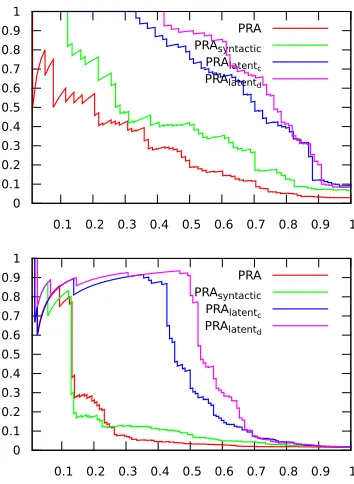
Figure 2: Precision (y axis) - Recall (x axis) plots for the relationscityLiesOnRiver(top) andathletePlaysForTeam
(bottom). PRAlatentd(rightmost plot), the proposed
ap-proach which exploits latent edge labels, outperforms other alternatives.
tative analysis, there were 908 possible path types found in the feature selection step withPRAon the relationcityLiesOnRiver(of which we then selected 750). For PRAsyntactic, there were 73,820, while PRAlatentc had 47,554 andPRAlatentdhad 58,414.
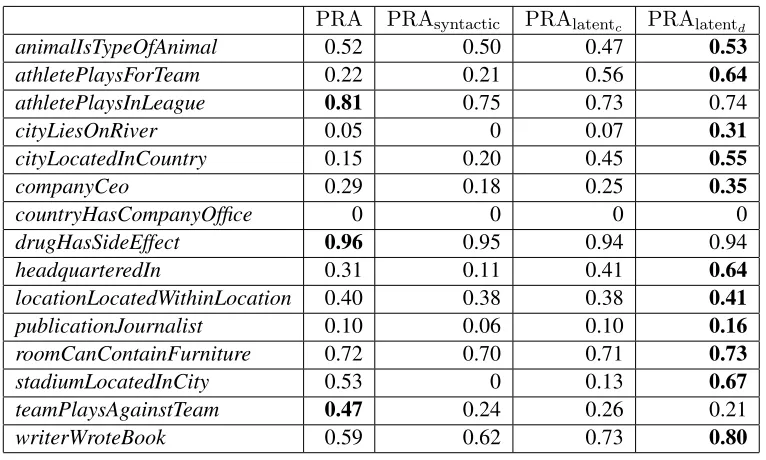
Table 2 shows F1 scores for each model on each relation, and Figure 2 shows representative Precision-Recall plots for two NELL relations. In both cases, we find that PRAlatentd significantly
outperforms other baselines.
4.1 Discussion
While examining the model weights for each of the methods, we saw a few occasions where sur-face relations and NELL relations combined to form interpretable path types. For example, in ath-letePlaysForTeam, some highly weighted features took the form ofhathletePlaysSport,“(sport) played by (team)”i. A high weight on this feature would bias the prediction towards teams that are known to play the same sport as the athlete.
[image:4.612.335.512.55.297.2]PRA PRAsyntactic PRAlatentc PRAlatentd
animalIsTypeOfAnimal 0.52 0.50 0.47 0.53
athletePlaysForTeam 0.22 0.21 0.56 0.64
athletePlaysInLeague 0.81 0.75 0.73 0.74
cityLiesOnRiver 0.05 0 0.07 0.31
cityLocatedInCountry 0.15 0.20 0.45 0.55
companyCeo 0.29 0.18 0.25 0.35
countryHasCompanyOffice 0 0 0 0
drugHasSideEffect 0.96 0.95 0.94 0.94
headquarteredIn 0.31 0.11 0.41 0.64
locationLocatedWithinLocation 0.40 0.38 0.38 0.41
publicationJournalist 0.10 0.06 0.10 0.16
roomCanContainFurniture 0.72 0.70 0.71 0.73
stadiumLocatedInCity 0.53 0 0.13 0.67
teamPlaysAgainstTeam 0.47 0.24 0.26 0.21
[image:5.612.114.497.52.282.2]writerWroteBook 0.59 0.62 0.73 0.80
Table 2: F1 performance of different variants of PRA for all 15 relations tested.
which is a supertype or subtype of the relation be-ing predicted. For instance, for the relation ath-letePlaysForTeam(shown in Figure 2), the highest-weighted features in PRA are athleteLedSport-sTeam (more specific than athletePlaysForTeam) and personBelongsToOrganization (more general than athletePlaysForTeam). For the same rela-tion, PRAsyntactic has features like “scored for”,
“signed”,“have”, and“led”. When using a latent embedding of these verb phrases,“signed”,“have”, and“led”all have the same representation in the la-tent space, and so it seems clear thatPRAlatentgains a lot by reducing the sparsity inherent in using sur-face verb forms.
For cityLiesOnRiver, where PRA does not per-form as well, there is no NELL relation that is an im-mediate supertype or subtype, and soPRAdoes not have as much evidence to use. It finds features that, e.g., are analogous to the statement “cities in the same state probably lie on the same river”. Adding lexical labels gives the model edges to use like“lies on”, “runs through”, “flows through”,“starts in” and“reaches”, and these features give a significant boost in performance toPRAsyntactic. Once again, almost all of those verb phrases share the same latent embedding, and soPRAlatentgains another signifi-cant boost in performance by combining them into a single feature.
5 Conclusion
In this paper, we introduced the use of latent lexi-cal edge labels for PRA-based inference over knowl-edge bases. We obtained such latent knowl-edge labels by mining a large dependency parsed corpus of 500 million web documents and performing PCA on the result. Through extensive experiments on real datasets, we demonstrated that the proposed ap-proach significantly outperforms previous state-of-the-art baselines.
Acknowledgments
References
Eugene Agichtein and Luis Gravano. 2000. Snowball: Extracting relations from large plain-text collections. InProceedings of the Fifth ACM conference on Digital libraries.
Kurt Bollacker, Colin Evans, Praveen Paritosh, Tim Sturge, and Jamie Taylor. 2008. Freebase: a collabo-ratively created graph database for structuring human knowledge. InProceedings of SIGMOD.
Sergey Brin. 1999. Extracting patterns and relations from the world wide web.
J. Callan, M. Hoy, C. Yoo, and L. Zhao. 2009. Clueweb09 data set. boston.lti.cs.cmu.edu.
Andrew Carlson, Justin Betteridge, Bryan Kisiel, Burr Settles, Estevam R Hruschka Jr, and Tom M Mitchell. 2010. Toward an architecture for never-ending lan-guage learning. InAAAI.
Oren Etzioni, Michael Cafarella, Doug Downey, Stan-ley Kok, Ana-Maria Popescu, Tal Shaked, Stephen Soderland, Daniel S Weld, and Alexander Yates. 2004. Web-scale information extraction in know-itall:(preliminary results). InProceedings of WWW. Oren Etzioni, Anthony Fader, Janara Christensen,
Stephen Soderland, and Mausam Mausam. 2011. Open information extraction: The second generation. InProceedings of IJCAI.
Marti A Hearst. 1992. Automatic acquisition of hy-ponyms from large text corpora. InProceedings of the 14th conference on Computational Linguistics. Anna Korhonen, Yuval Krymolowski, and Zvika Marx.
2003. Clustering polysemic subcategorization frame distributions semantically. InProceedings of ACL. Arun Kumar, Feng Niu, and Christopher R´e. 2013.
Hazy: making it easier to build and maintain big-data analytics. Communications of the ACM, 56(3):40–49.
Aapo Kyrola, Guy Blelloch, and Carlos Guestrin. 2012. Graphchi: Large-scale graph computation on just a pc. InProceedings of the 10th USENIX Symposium on Op-erating Systems Design and Implementation (OSDI), pages 31–46.
Ni Lao and William W Cohen. 2010. Relational re-trieval using a combination of path-constrained ran-dom walks. Machine learning, 81(1):53–67.
Ni Lao, Tom Mitchell, and William W Cohen. 2011. Random walk inference and learning in a large scale knowledge base. InProceedings of EMNLP. Associa-tion for ComputaAssocia-tional Linguistics.
Ni Lao, Amarnag Subramanya, Fernando Pereira, and William W Cohen. 2012. Reading the web with learned syntactic-semantic inference rules. In Pro-ceedings of EMNLP-CoNLL.
J. Nivre, J. Hall, J. Nilsson, A. Chanev, G. Eryigit, S. K¨ubler, S. Marinov, and E. Marsi. 2007. Malt-parser: A language-independent system for data-driven dependency parsing. Natural Language Engi-neering, 13(02).
Deepak Ravichandran and Eduard Hovy. 2002. Learning surface text patterns for a question answering system. InProceedings of ACL.
Sebastian Riedel, Limin Yao, Andrew McCallum, and Benjamin M Marlin. 2013. Relation extraction with matrix factorization and universal schemas. In Pro-ceedings of NAACL-HLT.
Burr Settles and Steven Dow. 2013. Let’s get together: the formation and success of online creative collabora-tions. InProceedings of CHI.
Rion Snow, Daniel Jurafsky, and Andrew Y Ng. 2006. Semantic taxonomy induction from heterogenous evi-dence. InProceedings of ACL.
Fabian M Suchanek, Georgiana Ifrim, and Gerhard Weikum. 2006. Combining linguistic and statistical analysis to extract relations from web documents. In
Proceedings of KDD.
Fabian M Suchanek, Gjergji Kasneci, and Gerhard Weikum. 2007. Yago: a core of semantic knowledge. InProceedings of WWW.