Joint Coreference Resolution and Named-Entity Linking
with Multi-pass Sieves
Hannaneh Hajishirzi Leila Zilles Daniel S. Weld Luke Zettlemoyer
Department of Computer Science and Electrical Engineering University of Washington
{hannaneh,lzilles,lsz,weld}@cs.washington.edu
Abstract
Many errors in coreference resolution come from semantic mismatches due to inadequate world knowledge. Errors in named-entity linking (NEL), on the other hand, are of-ten caused by superficial modeling of entity context. This paper demonstrates that these two tasks are complementary. We introduce NECO, a new model for named entity linking and coreference resolution, which solves both problems jointly, reducing the errors made on each. NECOextends the Stanford determinis-tic coreference system by automadeterminis-tically link-ing mentions to Wikipedia and introduclink-ing new NEL-informed mention-merging sieves. Linking improves mention-detection and en-ables new semantic attributes to be incorpo-rated from Freebase, while coreference pro-vides better context modeling by propagat-ing named-entity links within mention clus-ters. Experiments show consistent improve-ments across a number of datasets and ex-perimental conditions, including over 11% re-duction in MUC coreference error and nearly 21% reduction in F1 NEL error on ACE 2004 newswire data.
1 Introduction
Coreference resolution and named-entity linking are closely related problems, but have been largely stud-ied in isolation. This paper demonstrates that they are complementary by introducing a simple joint model that improves performance on both tasks.
Coreference resolution is the task of determining when two textual mentions name the same
individ-[Michael Eisner]1and [Donald Tsang]2announced the grand opening of [[Hong Kong]3Disneyland]4 yester-day. [Eisner]1thanked [the President]2and welcomed [fans]5to [the park]4.
Figure 1: A text passage illustrating interactions between coreference resolution and NEL.
ual. The biggest challenge in coreference resolu-tion — accounting for 42% of errors in the state-of-the-art Stanford system — is the inability to rea-son effectively about background semantic knowl-edge (Lee et al., 2013). For example, consider the sentence in Figure 1. “President” refers to “Donald Tsang” and “the park” refers to “Hong Kong Dis-neyland,” but automated algorithms typically lack the background knowledge to draw such inferences. Incorporating knowledge is challenging, and many efforts to do so have actually hurt performance, e.g. (Lee et al., 2011; Durrett and Klein, 2013).
Named-entity linking (NEL) is the task of match-ing textual mentions to correspondmatch-ing entities in a knowledge base, such as Wikipedia or Freebase. Such links provide rich sources of semantic knowl-edge about entity attributes — Freebase includes presidentas Tsang’s title andDisneylandas hav-ing the attribute park. But NEL is itself a chal-lenging problem, and finding the correct link re-quires disambiguating based on the mention string and often non-local contextual features. For exam-ple, “Michael Eisner” is relatively unambiguous but the isolated mention “Eisner” is more challenging. However, these mentions could be clustered with a coreference model, allowing for improved NEL through link propagation from the easier mentions.
We present NECO, a new algorithm for jointly solv-ing named entity linksolv-ing and coreference resolu-tion. Our work is related to that of Ratinov and Roth (2012), which also uses knowledge derived from an NEL system to improve coreference. How-ever, NECO is the first joint model we know of, is purely deterministic with no learning phase, does automatic mention detection, and improves perfor-mance on both tasks.
NECOextends the Stanford’s sieve-based model, in which a high recall mention detection phase is followed by a sequence of cluster merging opera-tions ordered by decreasing precision (Raghunathan et al., 2010; Lee et al., 2013). At each step, it merges two clusters only if all available information about their respective entities is consistent. We use NEL to increase recall during the mention detection phase and introduce two new cluster-merging sieves, which compare the Freebase attributes of entities. NECOalso improves NEL by initially favoring high precision linking results and then propagating links and attributes as clusters are formed.
In summary we make the following contributions:
• We introduce NECO, a novel, joint approach to solving coreference and NEL, demonstrating that these tasks are complementary by achiev-ing joint error reduction.
• We present experiments showing improved per-formance at coreference resolution, given both gold and automatic mention detection: e.g., 6.2point improvement in MUC recall on ACE 2004 newswire text and3.1point improvement in MUC precision the CoNLL 2011 test set.
• NECO also leads to better performance at named-entity linking, given both gold and au-tomatic linking, improving F1 from 61.7% to 69.2%on a newly labeled test set.1
2 Background
We make use of existing models for coreference res-olution and named entity linking.
1
Our corpus and the source code for NECOcan be down-loaded fromhttps://www.cs.washington.edu/ research-projects/nlp/neco.
2.1 Coreference Resolution
Coreference resolution is the the task of identifying all text spans (calledmentions) that refer to the same entity, forming mention clusters.
Stanford’s Sieve Model is a state-of-the-art coref-erence resolver comprising a pipeline of “sieves” that merge coreferent mentions according to deter-ministic rules. Mentions are automatically predicted by selecting all noun phrases (NP), pronouns, and named entities. Each sieve either merges a cluster to its single best antecedent from a list of previous clusters, or declines to merge.
Higher precision sieves are applied earlier in the pipeline according to the following order, looking at different aspects of the text, including: (1) speaker identification, (2-3) exact and relaxed string matches between mentions, (4) precise constructs, including appositives, acronyms and demonyms, (5-9) differ-ent notions of strict and relaxed head matches be-tween mentions, and finally (10) a number of syn-tactic and distance cues for pronoun resolution.
2.2 Named Entity Linking
Named-entity linking (NEL) is the task of identi-fying mentions in a text and linking them to the entity they name in a knowledge base, usually Wikipedia. NECO uses two existing NEL sys-tems: GLOW (Ratinov et al., 2011) and Wikipedi-aMiner (Milne and Witten, 2008).
WikipediaMiner links mentions based on a notion of semantic similarity to Wikipedia pages, consider-ing all substrconsider-ings up to a fixed length. Since there are often many possible links, it disambiguates by choosing the entity whose Wikipedia page is most semantically related to the nearby context of the mention. The semantic scoring function includes n-gram statistics and also counts shared links to other unambiguous mentions in the text.
GLOW finds mentions by selecting all the NPs and named entities in the text. Linking is framed as an integer linear programming optimization prob-lem that takes into account using similar local con-straints but also includes global concon-straints such as entity link co-occurrence.
• LetExemplar(c)be a representative mention of the clusterc, computed as defined below
• Letcjbe an antecedent cluster ofciifcjhas a mention which is before the first mention ofci • Letl(m)be a Wikipedia page linked to mentionmor∅if there is no link
• Letl(c)be a Wikipedia page linked to mentionExemplar(c)or∅if there is no link
1. Initialize Linked Mentions:
(a) LetMN EL={mi|i= 1. . . p}be the NEL output mentions,mi, each with a linkl(mi)
(b) LetMCR={mi|i= 1. . . q}be the mentionsmifrom coreference mention detection
(c) LetM ←MCR∪MN EL(Sec. 3.1)
(d) Update entity links for allm∈M and pruneM (Sec. 3.2)
(e) Extract attributes from Wikipedia and Freebase for allm∈M (Sec. 3.3)
(f) LetC←M be singleton mention clusters whereExemplar(ci) =mi,l(ci) =l(mi)
2. Merge Clusters:For every sieveS(including NEL sieves, Sec. 3.6) and clusterci∈C
(a) For every clustercj, j= [i−1. . .1](traverse the preceding clusters in reverse order)
i. NEL constraints: Prevent merge ifl(ci)6=l(cj)(Sec. 3.4)
ii. If all rules of sieveSare satisfied for clustersciandcj
A. ck←Merge(ci, cj), including entity link and attribute updates (Sec. 3.5)
B. C←C∪ {ck} \ {ci, cj}
3. Output: Coreference clustersCand linked Wikipedia pagesl(ci)∀ci∈C
Figure 2: NECO: A joint algorithm for named-entity linking and coreference resolution.
GLOW and WikipediaMiner, selecting only high confidence links.
3 Joint Coreference and Linking
We introduce a joint model for coreference resolu-tion and NEL. Building on the Stanford sieve ar-chitecture, our algorithm incrementally constructs clusters of mentions using deterministic coreference rules under NEL constraints.
Figure 2 presents the complete algorithm. The in-put to NECOis a document and the output is a setC of coreference clusters, with linksl(c)to Wikipedia pages for a subset of the clusters c ∈ C. Step 1 detects mentions, merging the outputs of the base systems (Sec. 3.1). Step 2 repeatedly merges coref-erence clusters, while ensuring that NEL constraints (Sec. 3.4) are satisfied. It uses the original Stan-ford sieves and also two new NEL-informed sieves (Sec. 3.6). NEL links are propagated to new clusters as they are formed (Sec. 3.5).
3.1 Mention Detection
In Steps 1(a-c) in Fig. 2, NECOcombines mentions from the base coreference and NEL systems.
LetMCR be the set of mentions returned by us-ing Stanford’s rule-based mention detection algo-rithm (Lee et al., 2013). Let MN EL be the set of
mentions output by the two NEL systems. NECO
creates an initial set of mentions,M, by taking the
union of all the mentions inMN EL and MCR. In practice, taking the union increases diversity in the mention pool. For example, it is often the case that MN EL will include sub-phrases such as “Suharto”
when they are part of a larger mention “ex-dictator Suharto” that is detected inMCR.
3.2 Mention Entity Links and Pruning
Step 1(d) in Fig. 2 assigns Wikipedia links to a sub-set of the detected mentions.
For mentions m output by the base NEL sys-tems, we assign an exact link l(m) if the entire mention span is linked. Mentions m0 that differ from an exact linked mentionm by only a pre- or post-fix stop word are similarly assigned exact links l(m0) =l(m). For example, the mention “the pres-ident” will be assigned the same link as “prespres-ident” but “The governor of Alaska Sarah Palin” would not be assigned an exact link toSarah Palin.
For mentionsm0 that do not receive an exact link, we assign aheadlinkh(m0)if the head word2mhas been linked, by settingh(m0) =l(m). For instance, the head link for the mention “President Clinton” (with “Clinton” as head word) will be the Wikipedia title ofBill Clinton. We use head links for the Relaxed NEL sieve (Sec. 3.6).
Next, we define L(m) to be the set
con-2
country president city area company state region location place agency power unit body market park province manager organization owner trial site prosecutor attorney county senator stadium network building attraction government department person origin plant airport kingdom capital operation author period nominee candidate film venue
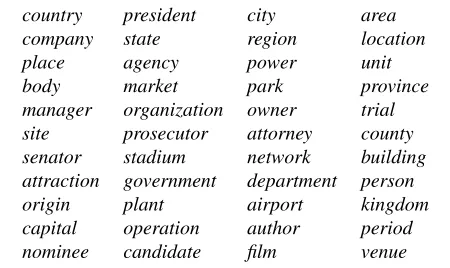
Figure 3: The most commonly used fine-grained at-tributes from Freebase and Wikipedia (out of over 500 total attributes).
taining l(m) and l(m0) for all sub-phrases m0 of m. We add the sub-phrase links only if their confidence is higher than the confi-dence for l(m). For instance, assuming ap-propriate confidence values, L(m) would in-clude the pages for {List of governors of Alaska, Alaska, Sarah Palin} given the mention “The governor of Alaska Sarah Palin.” We will use L(m) for NEL constraints and filtering (Sec. 3.4).
After updating the entity links for all mentions, NECO prunes spurious mentions that begin or end with a stop word where the remaining sub-expression of the mention exists inM. It also re-moves time expressions and numbers fromMif they are not included inMN EL.
3.3 Mention Attributes
Step 1(e) in Fig. 2 also assigns attributes for a mentionmlinked to Wikipedia page l(m), at both coarseandfine-grainedlevels, based on information from the Freebase entry corresponding to exact link l(m)or head linkh(m).
The coarse attributes include gender, type, and NER classes such asPERSON, LOCATION, and OR
-GANIZATION. These attributes are part of the
orig-inal Stanford coreference system and are used to avoid merging conflicting clusters. We use the Free-base values for these attributes when available. For instance, if the linked entity contains the Freebase typelocationororganization, we include the coarse type toLOCATION orORGANIZATION respectively. In order to account for both links to specific
peo-ple (Barack Obama) and generic links to positions held by people (President), we include the typePER
-SONif the linked entity has any of the Freebase types
person,job title, orgovernment office or title. If no coarse Freebase types are available for an attribute, we default to predicted NER classes.
We add fine-grained attributes from Freebase and Wikipedia by importing additional type information. We use all of the Freebase notable types, a set of hundreds of commonly used Freebase types, rang-ing from us president totropical cyclone and syn-thpop album. We also include all of the Wikipedia categories, on average six per entity. For example, the mention “Indonesia” is assigned fine-grained at-tributes such as book subject, military power, and olympic participating country. Since many of these fine-grained attributes are extremely specific, we use the last word of each attribute to define an addi-tional grained attribute (see Fig. 3). These fine-grained attributes are used in the Relaxed NEL sieve (Sec. 3.6).
3.4 NEL Constraints
While applying sieves to merge clusters in Figure 2 Step 2(a), NECOuses NEL constraints to eliminate some otherwise acceptable merges.
We avoid merging inconsistent clusters that link to different entities. Clusters ci and cj are incon-sistent if both are linked (i.e., both clusters have non-null entity assignments) and l(ci) 6= l(cj) or h(ci) 6= h(cj). Also, in order to consider an
an-tecedent clustercas a merge candidate, we require a pair of entities in the set of linked entitiesL(c)to be related to one another in Freebase. Two entities are related in Freebase if they both appear in a relation; for example,Bill ClintonandArkansasare related because Bill Clinton has a “governor-of” re-lation with Arkansas.
3.5 Merging Clusters and Update Entity Links
When two clustersci and cj are merged to form a
new cluster ck, the entity link information L(ck), l(ck), andh(ck)must be updated (Step 2 of Fig. 2). We setL(ck)to the union of the linked entities found inl(ci)andl(cj)and merge coarse attributes at this point.
[image:4.612.75.300.65.199.2]Exemplar(ck)that denotes the most representative mention of the cluster. Exemplar(c) is selected according to a set of rules in the Stanford system, based on textual position and mention type (proper noun vs. common). We augment this function by considering information from exact and head en-tity links as well. Mentions appearing earlier in text, proper mentions, and mentions that have ex-act or head named-entity links are preferred to those which do not. Given exemplars, we set l(ck) = l(Exemplar(ck))andh(ck) =h(Exemplar(ck)).
3.6 NEL Sieves
Finally, we introduce two new sieves that use NEL information at the beginning and end of the Stan-ford sieves pipeline in the merging stage (Step 2 of Fig. 2).
Exact NEL sieve The Exact NEL sieve merges two clusters ci and cj if both are linked and their links match,l(ci) = l(cj). For example, all men-tions that have been linked toBarack Obamawill become members of the same coreference cluster. Because the Exact NEL sieve has high precision, we place it at the very beginning of the pipeline.
Relaxed NEL sieve The Relaxed NEL sieve uses fine-grained attributes of the linked mentions to merge proper nouns with common nouns when they share attributes. For example, this sieve is able to merge the proper mention “Disneyland” with the “the mysterious park”, because park is one of the fine-grained attributes assigned toDisneyland.
More formally, let mi = Exemplar(ci) and mj = Exemplar(cj). For every common noun mentionmi, we mergeci with an antecedent
clus-tercj if (1)mj is a linked proper noun, (2) ifmi or
the title of its linked Wikipedia page is in the list of fine-grained attributes ofmj, or (3) if h(mj)is
re-lated to the head linkh(mi) according to Freebase
as defined above.
Because this sieve has low precision, we only allow merges between mentions that have a maxi-mum distance of three sentences between one an-other. We add the Relaxed NEL sieve near the end of the pipeline, just before pronoun resolution.
4 Experimental Setup
Core Components and Baselines The Stanford sieve-based coreference system (Lee et al., 2013), the GLOW NEL system (Ratinov et al., 2011), and WikipediaMiner (Milne and Witten, 2008) provide core functionality for our joint model, and are also the state-of-the-art baselines against which we mea-sure performance.
Parameter Settings Based on performance on the development set, we set the GLOW’s confidence pa-rameter to 1.0 and WikipediaMiner’s to 0.4 to assure high-precision NEL. We also optimized for the set of fine-grained attributes to import from Wikipedia and Freebase, and the best way to incorporate the NEL constraints into the sieve architecture.
Datasets We report results on the following three datasets: ACE-NWIRE, CONLL, and ACE-NWIRE-NEL. ACE-NWIRE, the newswire subset of the ACE 2004 corpus (NIST, 2004), includes 128 documents. The CONLL coreference dataset includes text from five different domains: broadcast conversation (BC), broadcast news (BN), magazine (MZ), newswire (NW), and web data (WB) (Pradhan et al., 2011). The broadcast conversation and broadcast news domains consist of transcripts, whereas magazine and newswire contain more standard written text. The development data includes 303 documents and the test data includes 322 documents.
We created ACE-NWIRE-NEL by taking a subset of ACE-NWIRE and annotating with gold-standard entity links. We segment and link all the expressions in text that refer to Wikipedia pages, allowing for nested linking. For instance, both the phrase “Hong Kong Disneyland,” and the sub-phrase “Hong Kong” are linked. This dataset includes 12 documents and 350 linked entities.
Method MUC B3 Pairwise
P R F1 P R F1 P R F1
Stanford Sieves 39.9 46.2 42.8 67.9 71.8 69.8 44.2 29.7 35.6
NECO 46.8 52.5 49.5 70.4 72.6 71.5 51.5 34.6 41.4
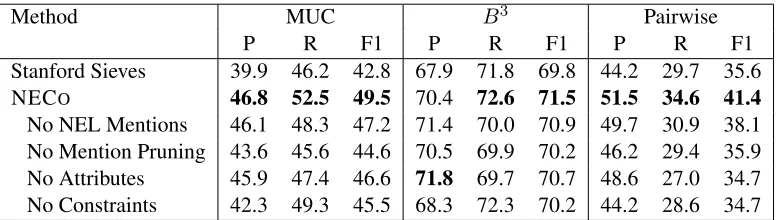
[image:6.612.113.504.62.172.2]No NEL Mentions 46.1 48.3 47.2 71.4 70.0 70.9 49.7 30.9 38.1 No Mention Pruning 43.6 45.6 44.6 70.5 69.9 70.2 46.2 29.4 35.9 No Attributes 45.9 47.4 46.6 71.8 69.7 70.7 48.6 27.0 34.7 No Constraints 42.3 49.3 45.5 68.3 72.3 70.2 44.2 28.6 34.7
Table 1: Coreference results onACE-NWIREwith predicted mentions and automatic linking.
coreference software for ACE2004 and using the CoNLL scorer for the CoNLL 2011 dataset.
5 Experimental Results
We first look at NECO’s performance at coreference resolution and then evaluate its ability at NEL.
5.1 Coref. Results with Predicted Mentions
Overall System Performance on ACE Data Ta-ble 1 shows NECO’s performance at coreference resolution on ACE- compared to the Stanford sieve implementation (Lee et al., 2013). The table shows that NECO has both significantly improved
precision and recall compared to the Stanford base-line, across all metrics. We generally observe larger gains in MUC due to better mention detection and the Relaxed NEL Sieve.
Contribution of System Components Table 1 also details the performance of four variants of our system that ablate various components and features. Specifically, we consider the following cases:
• No NEL Mentions: We discard additional mentions,MN EL, provided by NEL (Sec. 3.1).
This increasesB3 precision at the expense of recall. Inspection shows that some of the errors introduced by MN EL are actually due to cor-rectly linked entities that were not annotated as mentions in the dataset, but also some improp-erly linked mentions.
• No Mention Pruning: We disable the initial step of updating mention boundaries and re-moving spurious mentions (Sec. 3.2). As ex-pected, removing this step drops precision and recall significantly, even compared to the No NEL Mentions variant.
• No Attributes: Ablating coarse and fine-grained attributes (Sec. 3.3) drops F1 and re-call measures across all metrics. To under-stand this effect, note that NECO uses
at-tributes in two different settings. Updating coarse attributes tends to increase precision be-cause it prevents dangerous merges, such as merging “Staples” with the mention “it” in a situation when “Staples” refers to the per-son entityTodd Staples. Fine-grained at-tributes also help with recall, when merging a specific name of an entity with a mention that uses a more general term; for instance, “Hong Kong Disneyland” can be merged with “the mysterious park” because “park” is a fine-grained attribute forDisneyland. However, when fine-grained attributes are used, precision sometimes drops (e.g., when “president” might merge with “Bush” when it should really merge with “Clinton”).
• No NEL Constraints: Removing these con-straints (Sec. 3.4) drops precision dramatically leading to drop in F1. In the case of incor-rect linking, however, NEL constraints can af-fect recall. For instance, NEL constraints might prevent merging “Staples” with “Todd Staples” if the former were linked to the company and the latter to the politician.
Overall System Performance on CoNLL Data
We also compare our full system (with added NEL sieves, constraints, and mention pruning3) with the Stanford sieve coreference system on CoNLL data
3
MUC B3
Category: Method P R F1 P R F1
BC: NECO 62.1 64.7 63.4 69.8 57.8 63.2
BC: Stanford Sieves 60.9 65.0 62.9 69.2 58.0 63.1
BN: NECO 69.3 59.4 64.0 78.8 60.8 68.6
BN: Stanford Sieves 68.0 58.9 63.1 79.0 60.2 68.3
MZ: NECO 67.6 62.9 65.2 78.4 61.1 68.7
MZ: Stanford Sieves 66.0 63.4 64.9 77.9 61.5 68.7
NW: NECO 62.0 54.5 58.0 74.9 57.4 65.0
[image:7.612.162.452.61.200.2]NW: Stanford Sieves 60.0 54.2 56.9 75.3 57.0 64.9
Table 3: Coreference results on the individual categories of CoNLL 2011 development data. (BC=broadcast conver-sation, BN=broadcast news, MZ=magazine, NW=newswire)
MUC B3
Method P R F1 P R F1
Development Data
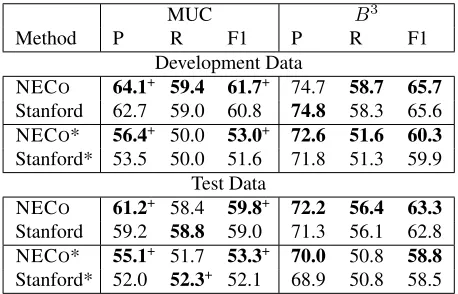
NECO 64.1+ 59.4 61.7+ 74.7 58.7 65.7 Stanford 62.7 59.0 60.8 74.8 58.3 65.6 NECO* 56.4+ 50.0 53.0+ 72.6 51.6 60.3 Stanford* 53.5 50.0 51.6 71.8 51.3 59.9
Test Data
NECO 61.2+ 58.4 59.8+ 72.2 56.4 63.3 Stanford 59.2 58.8 59.0 71.3 56.1 62.8 NECO* 55.1+ 51.7 53.3+ 70.0 50.8 58.8 Stanford* 52.0 52.3+ 52.1 68.9 50.8 58.5
Table 2: Coreference results on CoNLL 2011 develop-ment and test data, using predicted develop-mentions. Rows de-noted with * indicate runs using the fully automated Stan-ford CoreNLP pipeline rather than the predicted annota-tions provided with the CoNLL data. Given the relatively close results, we ran the Mann-Whitney U test for this table; values with the+ superscript are significant with p <0.05.
(Table 2). We ran NECOand the baseline in two set-tings: in the first, we use the standard predicted an-notations (for POS, parses, NER, and speaker tags) provided with the CoNLL data, and in the second, we use the automated Stanford CoreNLP pipeline to predict this information. On both the develop-ment and test sets, we gain about 1 point in MUC F1 as well as a smaller improvement inB3. Closer inspection indicates that our system increases pre-cision primarily due to mention pruning and NEL constraints. Due to the differences in mention anno-tation guidelines between ACE and CoNLL, perfor-mance on ACE benefits more from improved men-tion detecmen-tion from NEL. Moreover, the ACE
cor-pus is all newswire text, which contains more enti-ties that can benefit from linking. CoNLL, on the other hand, contains a wider variety of texts, some of which do not mention many named entities in Wikipedia.
To examine the performance of our system on the different domains covered by the CoNLL data, we also test our system on each domain separately (Ta-ble 3). We found NEL provided the biggest im-provement for the news domains, broadcast news (BN) and newswire (NW). These domains espe-cially benefit from the improved mention detection and pruning provided by NEL, and strong linking benefitted both precision and recall in these do-mains. We found that the magazine (MZ) section of the corpus benefited the least from NEL, as there were relatively few entities that our NEL systems were able to connect to Wikipedia.
5.2 Coreference Results with Gold Linking
Some of the errors introduced in our system are due to incorrect or incomplete links discovered by the automatic linking system. To assess the effect of NEL performance on NECO, we tested on a por-tion ofACE-NWIREdataset for which we hand-labeled correct links for the gold and predicted men-tions. “NECO+ Gold NEL” denotes a version of our system which uses gold links instead of those pre-dicted by NEL. As shown in Table 4, gold linking significantly improves the performance of our sys-tem across all measures. This suggests that further work to improve automatic NEL may have substan-tial reward.
[image:7.612.73.302.250.397.2]rea-Method MUC B3 Pairwise
P R F1 P R F1 P R F1
Gold Mentions
NECO+ Gold NEL 85.8 75.5 80.3 91.4 81.2 86.0 89.1 68.0 77.1
NECO 84.6 74.0 78.9 90.5 80.4 85.2 83.9 66.0 73.9
Stanford Sieves 84.5 72.2 77.8 89.9 77.7 83.4 89.9 57.3 68.1 Predicted Mentions
NECO+ Gold NEL 56.4 58.8 57.5 78.2 78.3 78.3 68.0 54.3 60.4
NECO 51.3 53.5 52.4 76.5 76.4 76.5 61.2 45.6 52.2
[image:8.612.115.499.62.199.2]Stanford Sieves 43.9 46.4 45.1 74.4 74.2 74.3 51.3 36.1 42.4
Table 4: Coreference results onACE-NWIRE-NELwith gold and predicted mentions and gold or automatic linking.
Method MUC B3 Pairwise
P R F1 P R F1 P R F1
NECO 85.0 76.6 80.6 87.6 76.4 81.6 79.3 56.1 65.8
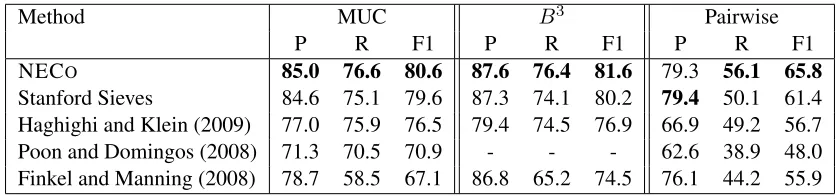
Stanford Sieves 84.6 75.1 79.6 87.3 74.1 80.2 79.4 50.1 61.4 Haghighi and Klein (2009) 77.0 75.9 76.5 79.4 74.5 76.9 66.9 49.2 56.7 Poon and Domingos (2008) 71.3 70.5 70.9 - - - 62.6 38.9 48.0 Finkel and Manning (2008) 78.7 58.5 67.1 86.8 65.2 74.5 76.1 44.2 55.9
Table 5: Coreference results onACE-NWIREwith gold mentions and automatic linking.
sons. First, it reduces the coreference errors caused by incorrect NEL links. For instance, gold link-ing replaces the erroneous link generated by our NEL systems for “Nasser al-Kidwa” to the correct Wikipedia entity. As another example, two men-tions of “Rutgers” will not be merged if one links to the university and the other links to their football team. Second, gold linking leads to better mention detection and better linked mentions. For instance, under gold linking, the whole mention, “The gover-nor of Alaska, Sarah Palin,” is linked to the politi-cian, while automatic linking systems only link the substring containing her name, “Sarah Palin.” Still, gold NEL cannot compensate for all coreference er-rors in cases of generic or unlinked entities.
5.3 Coreference Results with Gold Mentions
Many of the previous papers evaluate coreference resolution assuming gold mentions so we also run under that condition (Table 5) using ACE
-NWIREdata. As the table shows, with gold mentions our system outperforms Haghighi and Klein (2009), Poon and Domingos (2008), Finkel and Man-ning (2008) and the Stanford sieve algorithm across all metrics. Our method shows a relatively smaller
gain in precision, because this condition adds no benefit to our technique of using NEL information for pruning mentions.
5.4 Improving Named Entity Linking
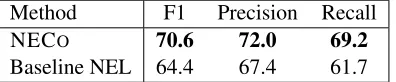
While our previous experiments show that named-entity linking can improve coreference resolution, we now address the question of whether coreference techniques can help NEL. We compare NECOwith a baseline ensemble4composed of GLOW (Ratinov et al., 2011) and WikipediaMiner (Milne and Witten, 2008) on our ACE-NWIRE-NEL dataset (Table 6). Our system gains about 8% in absolute recall and5%in absolute precision. For instance, our sys-tem correctly adds links from “Bullock” to the en-titySandra Bullockbecause coreference reso-lution merges two mentions. In another example, it correctly links “company” toNokia. Overall, there is a21%relative reduction in F1 error.
4
[image:8.612.96.516.230.328.2]Method F1 Precision Recall
NECO 70.6 72.0 69.2
[image:9.612.90.288.64.105.2]Baseline NEL 64.4 67.4 61.7
Table 6: NEL performance of our system and the ensem-ble baseline linker onACE-NWIRE-NEL.
5.5 Error Analysis
We analyzed 90 precision and recall errors and present our findings in Table 7. Spurious mentions accounted for the majority of non-semantic errors. Despite the improvements that come from NEL, a large portion of coreference errors can still be at-tributed to incomplete semantic information, includ-ing precision errors caused by incorrect linkinclud-ing. For instance, the mention “Disney” sometimes refers to the company, and other times refers to the amuse-ment park; however, the NEL systems we used had difficulty disambiguating these cases, and NECO of-ten incorrectly merges such mentions. Overly gen-eral fine-grained attributes caused precision errors in cases where many proper noun mentions were po-tential antecedents for a common noun. Although attributes such ascountryare useful for resolving a generic “country” mention, this information is insuf-ficient when two distinct mentions such as “China” and “Russia” both have thecountryattribute.
However, many recall errors are also caused by the lack of fine-grained attributes. Finding the ideal set of fine-grained attributes remains an open prob-lem.
6 Related Work
Coreference resolution has a fifty year history which defies brief summarization; see Ng (2010) for a recent survey. Section 2.1 described the Stanford multi-pass sieve algorithm, which is the foundation for NECO.
Earlier coreference resolution systems used shal-low semantics and pioneered knowledge extraction from online encyclopedias (Ponzetto and Strube, 2006; Daum´e III and Marcu, 2005; Ng, 2007). Some recent work shows improvement in coreference res-olution by incorporating semantic information from Web-scale structured knowledge bases. Haghighi and Klein (2009) use a rule-based system to extract fine-grained attributes for mentions by analyzing
precise constructs (e.g., appositives) in Wikipedia articles. Subsequently, Haghighi and Klein (2010) used a generative approach to learn entity types from an initial list of unambiguous mention types. Bansal and Klein (2012) use statistical analysis of Web n-gram features including lexical relations.
Rahman and Ng (2011) use YAGO to extract type relations for all mentions. These methods incor-porate knowledge about all possible meanings of a mention. If a mention has multiple meanings, ex-traneous information might be associated with it. Zheng et al. (2013) use a ranked list of candidate en-tities for each mention and maintain the ranked list when mentions are merged. Unlike previous work, our method relies on NEL systems to disambiguate possible meanings of a mention and capture high-precision semantic knowledge from Wikipedia cate-gories and Freebase notable types.
Ratinov and Roth (2012) investigated using NEL to improve coreference resolution, but did not con-sider a joint approach. They extracted attributes from Wikipedia categories and used them as fea-tures in a learned mention-pair model, but did not do mention detection. Unfortunately, it is difficult to compare directly to the results of both systems, since they reported results on portions of ACE and CoNLL datasets using gold mentions. However, our approach provides independent evidence for the benefit of NEL, and joint modeling in particular, since it outperforms the state-of-the-art Stanford sieve system (winner of the CoNLL 2011 shared task (Pradhan et al., 2011)) and other recent com-parable approaches on benchmark datasets.
Our work also builds on a long trajectory of work in named entity resolution stemming from SemTag (Dill et al., 2003). Section 2.2 discussed GLOW and WikipediaMiner (Ratinov et al., 2011; Milne and Witten, 2008). Kulkarni et al. (2009) present an elegant collective disambiguation model, but do not exploit the syntactic nuances gleaned by within-document coreference resolution. Hachey et al. (2013) provide an insightful summary and evalu-ation of different approaches to NEL.
7 Conclusions
Error Type Percentage Example
Extra mentions 31.1 The other thing Paula really importantis that they talk a lot about the fact ...
Pronoun 27.7 However , [all 3 women gymnasts , taking part in the internationals for the first time], performed well , because they had strong events and their movements had difficulty .
Contextual semantic
16.6 [The Chinese side] hopes that each party concerned continues to make constructive efforts to ...Considering the requirements of the Korean side , ... the Chinese government decided to ...
NEL semantic 13.3 The most important thing aboutDisneyis that it is a global brand. ... The subway to Disney has already been constructed.
Attributes 11.1 The Hong Kong government turned over to Disney Corporation [200 hectares of land ...]. ... this area has become a prohibited zone in Hong Kong.
Table 7: Examples of different error categories and the relative frequency of each. For every example, the mention to be resolved is underlined, and the correct antecedent isitalicized. For precision errors, the wrongly merged mention isbolded. For recall errors, the missed mention is surrounded by [brackets].
and weaknesses, we present a joint approach. We introduce NECO, a novel algorithm which solves the problems jointly, demonstrating improved per-formance on both tasks.
We envision several ways to improve the joint model. While the current implementation of NECO
only introduces NEL once, we could also integrate predictions with different levels of confidence into different sieves. It would be interesting to more tightly integrate the NEL system so it operates on clusters rather than individual mentions — after each sieve merges an unlinked cluster, the algorithm would retry NEL with the new context information. NECOuses a relatively modest number of Freebase attributes. While using more semantic knowledge holds the promise of increased recall, the challenge is maintaining precision. Finally, we would also like to explore the extent to which a joint probabilistic model (e.g., (Durrett and Klein, 2013)) might be used to learn how to best make this tradeoff.
8 Acknowledgements
The research was supported in part by grants from DARPA under the DEFT program through the AFRL (FA8750-13-2-0019) and the CSSG (N11AP20020), the ONR (N00014-12-1-0211), and the NSF (IIS-1115966). Support was also provided by a gift from Google, an NSF Graduate Research
Fellowship, and the WRF / TJ Cable Professor-ship. The authors thank Greg Durrett, Heeyoung Lee, Mitchell Koch, Xiao Ling, Mark Yatskar, Ken-ton Lee, Eunsol Choi, Gabriel Schubiner, Nicholas FitzGerald, Tom Kwiatkowski, and the anonymous reviewers for helpful comments and feedback on the work.
References
Amit Bagga and Breck Baldwin. 1998. Algorithms for scoring coreference chains. InInternational Confer-ence on Language Resources and Evaluation Work-shop on Linguistics Coreference.
Mohit Bansal and Dan Klein. 2012. Coreference se-mantics from web features. InProceedings of the 45th Annual Meeting of the Association for Computational Linguistics.
Hal Daum´e III and Daniel Marcu. 2005. A large-scale exploration of effective global features for a joint en-tity detection and tracking model. InProceedings of the Conference on Human Language Technology and Empirical Methods in Natural Language Processing.
Greg Durrett and Dan Klein. 2013. Easy victories and uphill battles in coreference resolution. In Proceed-ings of the Conference on Empirical Methods in Natu-ral Language Processing.
Jenny Rose Finkel and Christopher D. Manning. 2008. Enforcing transitivity in coreference resolution. In Proceedings of the 46th Annual Meeting of the Asso-ciation for Computational Linguistics on Human Lan-guage Technologies.
Ben Hachey, Will Radford, Joel Nothman, Matthew Hon-nibal, and James R. Curran. 2013. Evaluating entity linking with Wikipedia. Artificial Intelligence Jour-nal, 194.
Aria Haghighi and Dan Klein. 2009. Simple coreference resolution with rich syntactic and semantic features. In Proceedings of the Conference on Empirical Methods in Natural Language Processing.
Aria Haghighi and Dan Klein. 2010. Coreference res-olution in a modular, entity-centered model. In Hu-man Language Technologies: Annual Conference of the North American Chapter of the Association for Computational Linguistics.
Dan Klein and Christopher D. Manning. 2003. Accurate unlexicalized parsing. InProceedings of the 41st An-nual Meeting on Association for Computational Lin-guistics.
Sayali Kulkarni, Amit Singh, Ganesh Ramakrishnan, and Soumen Chakrabarti. 2009. Collective annotation of Wikipedia entities in Web text. InProceedings of the 2009 Conference on Knowledge Discovery and Data Mining.
Heeyoung Lee, Yves Peirsman, Angel Chang, Nathanael Chambers, Mihai Surdeanu, and Dan Jurafsky. 2011. Stanford’s multi-pass sieve coreference resolution sys-tem at the CoNLL-2011 shared task. InProceedings of the Conference on Computational Natural Language Learning.
Heeyoung Lee, Angel Chang, Yves Peirsman, Nathanael Chambers, Mihai Surdeanu, and Dan Jurafsky. 2013. Deterministic coreference resolution based on entity-centric, precision-ranked rules. Computational Lin-guistics, 39(4).
Dan Milne and Ian H. Witten. 2008. Learning to link with Wikipedia. InProceedings of the ACM Confer-ence on Information and Knowledge Management. Vincent Ng. 2007. Shallow semantics for coreference
resolution. InProceedings of the 20th International Joint Conference on Artificial Intelligence.
Vincent Ng. 2010. Supervised noun phrase coreference research: The first fifteen years. InProceedings of the 48th Annual Meeting of the Association for Computa-tional Linguistics.
NIST. 2004. The ACE 2004 evaluation planXPToolkit architecture.
Simone Paolo Ponzetto and Michael Strube. 2006. Exploiting semantic role labeling, Wordnet and Wikipedia for coreference resolution. InProceedings of the North American Association for Natural Lan-guage Processing on Human LanLan-guage Technologies. Hoifung Poon and Pedro Domingos. 2008. Joint
unsu-pervised coreference resolution with Markov logic. In Proceedings of the Conference on Empirical Methods in Natural Language Processing.
Sameer Pradhan, Lance Ramshaw, Mitchell Marcus, Martha Palmer, Ralph Weischedel, and Nianwen Xue. 2011. CoNLL-2011 shared task: modeling unre-stricted coreference in OntoNotes. InProceedings of the Fifteenth Conference on Computational Natural Language Learning: Shared Task.
Karthik Raghunathan, Heeyoung Lee, Sudarshan Ran-garajan, Nathanael Chambers, Mihai Surdeanu, Dan Jurafsky, and Christopher Manning. 2010. A multi-pass sieve for coreference resolution. InProceedings of the Conference on Empirical Methods in Natural Language Processing.
Altaf Rahman and Vincent Ng. 2011. Coreference res-olution with world knowledge. InProceedings of the 49th Annual Meeting of the Association for Computa-tional Linguistics: Human Language Technologies. Lev Ratinov and Dan Roth. 2012. Learning-based
multi-sieve co-reference resolution with knowledge. In Pro-ceedings of the Conference on Empirical Methods in Natural Language Processing.
Lev Ratinov, Dan Roth, Doug Downey, and Mike An-derson. 2011. Local and global algorithms for dis-ambiguation to Wikipedia. InProceedings of the 49th Annual Meeting of the Association for Computational Linguistics.
Marta Recasens and Eduard Hovy. 2010. Coreference resolution across corpora: languages, coding schemes, and preprocessing information. InProceedings of the 48th Annual Meeting of the Association for Computa-tional Linguistics.
Marc Vilain, John Burger, John Aberdeen, Dennis Con-nolly, and Lynette Hirschman. 1995. A model-theoretic coreference scoring scheme. InProceedings of the 6th conference on Message Understanding. Jiaping Zheng, Luke Vilnis, Sameer Singh, Jinho D.