Training a Log-Linear Parser with Loss Functions via Softmax-Margin
Michael Auli School of Informatics University of Edinburgh
Adam Lopez HLTCOE
Johns Hopkins University
Abstract
Log-linear parsing models are often trained by optimizing likelihood, but we would prefer to optimise for a task-specific metric like F-measure. Softmax-margin is a convex objec-tive for such models that minimises a bound on expected risk for a given loss function, but its na¨ıve application requires the loss to de-compose over the predicted structure, which is not true of F-measure. We use softmax-margin to optimise a log-linear CCG parser for a variety of loss functions, and demonstrate a novel dynamic programming algorithm that enables us to use it with F-measure, lead-ing to substantial gains in accuracy on CCG-Bank. When we embed our loss-trained parser into a larger model that includes supertagging features incorporated via belief propagation, we obtain further improvements and achieve a labelled/unlabelled dependency F-measure of 89.3%/94.0% on gold part-of-speech tags, and 87.2%/92.8% on automatic part-of-speech tags, the best reported results for this task.
1 Introduction
Parsing models based on Conditional Random Fields (CRFs; Lafferty et al., 2001) have been very successful (Clark and Curran, 2007; Finkel et al., 2008). In practice, they are usually trained by max-imising the conditional log-likelihood (CLL) of the training data. However, it is widely appreciated that optimizing for task-specific metrics often leads to better performance on those tasks (Goodman, 1996; Och, 2003).
An especially attractive means of accomplishing this for CRFs is the softmax-margin (SMM) ob-jective (Sha and Saul, 2006; Povey and Woodland, 2008; Gimpel and Smith, 2010a) (§2). In addition to retaining a probabilistic interpretation and optimiz-ing towards a loss function, it is also convex, mak-ing it straightforward to optimise. Gimpel and Smith (2010a) show that it can be easily implemented with a simple change to standard likelihood-based train-ing, provided that the loss function decomposes over the predicted structure.
Unfortunately, the widely-used F-measure met-ric does not decompose over parses. To solve this, we introduce a novel dynamic programming algo-rithm that enables us to compute the exact quanti-ties needed under the softmax-margin objective us-ing F-measure as a loss (§3). We experiment with this and several other metrics, including precision, recall, and decomposable approximations thereof. Our ability to optimise towards exact metrics en-ables us to verify the effectiveness of more effi-cient approximations. We test the training proce-dures on the state-of-the-art Combinatory Categorial Grammar (CCG; Steedman 2000) parser of Clark and Curran (2007), obtaining substantial improve-ments under a variety of conditions. We then embed this model into a more accurate model that incor-porates additional supertagging features via loopy belief propagation. The improvements are additive, obtaining the best reported results on this task (§4).
2 Softmax-Margin Training
The softmax-margin objective modifies the standard likelihood objective for CRF training by reweighting
each possible outcome of a training input according to its risk, which is simply the loss incurred on a par-ticular example. This is done by incorporating the loss function directly into the linear scoring function of an individual example.
Formally, we are given m training pairs (x(1), y(1))...(x(m), y(m)), where each x(i) ∈ X is drawn from the set of possible inputs, and each y(i) ∈ Y(x(i)) is drawn from a set of possible instance-specific outputs. We want to learn the K parametersθof a log-linear model, where eachλk∈
θ is the weight of an associated feature hk(x, y).
Functionf(x, y)maps input/output pairs to the vec-torh1(x, y)...hK(x, y), and our log-linear model
as-signs probabilities in the usual way.
p(y|x) = exp{θ
Tf(x, y)}
P
y0∈Y(x)exp{θTf(x, y0)} (1)
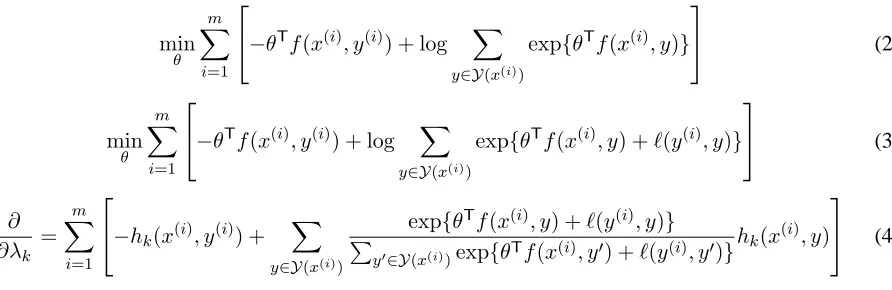
The conditional log-likelihood objective function is given by Eq. 2 (Figure 1). Now consider a function `(y, y0)that returns the loss incurred by choosing to outputy0when the correct output isy. The softmax-margin objective simply modifies the unnormalised, unexponentiated scoreθTf(x, y0)by adding`(y, y0) to it. This yields the objective function (Eq. 3) and gradient computation (Eq. 4) shown in Figure 1.
This straightforward extension has several desir-able properties. In addition to having a probabilis-tic interpretation, it is related to maximum margin and minimum-risk frameworks, it can be shown to minimise a bound on expected risk, and it is convex (Gimpel and Smith, 2010b).
We can also see from Eq. 4 that the only differ-ence from standard CLL training is that we must compute feature expectations with respect to the cost-augmented scoring function. As Gimpel and Smith (2010a) discuss, if the loss function decom-poses over the predicted structure, we can treat its decomposed elements as unweighted features that fire on the corresponding structures, and compute expectations in the normal way. In the case of our parser, where we compute expectations using the inside-outside algorithm, a loss function decom-poses if it decomdecom-poses over spans or productions of a CKY chart.
3 Loss Functions for Parsing
Ideally, we would like to optimise our parser towards a task-based evaluation. Our CCG parser is evalu-ated on labeled, directed dependency recovery us-ing F-measure (Clark and Hockenmaier, 2002). Un-der this evaluation we will represent output y0 and ground truth y as variable-sized sets of dependen-cies. We can then compute precisionP(y, y0), recall R(y, y0), and F-measureF1(y, y0).
P(y, y0) = |y∩y0|
|y0| (5)
R(y, y0) = |y∩y0|
|y| (6)
F1(y, y0) =
2P R
P +R =
2|y∩y0|
|y|+|y0| (7)
These metrics are positively correlated with perfor-mance – they are gain functions. To incorporate them in the softmax-margin framework we reformu-late them as loss functions by subtracting from one.
3.1 Computing F-Measure-Augmented Expectations at the Sentence Level
Unfortunately, none of these metrics decompose over parses. However, the individual statistics that are used to compute them do decompose, a fact we will exploit to devise an algorithm that computes the necessary expectations. Note that sincey is fixed, F1 is a function of two integers: |y∩y0|, represent-ing the number of correct dependencies in y0; and
|y0|, representing the total number of dependencies iny0, which we will denote asnandd, respectively.1 Each pairhn, dileads to a different value ofF1. Im-portantly, bothnandddecompose over parses.
The key idea will be to treatF1as a non-local fea-ture of the parse, dependent on valuesnandd.2 To compute expectations we split each span in an oth-erwise usual inside-outside computation by all pairs
hn, diincident at that span.
Formally, our goal will be to compute expecta-tions over the sentencea1...aL. In order to abstract
away from the particulars of CCG we present the al-gorithm in relatively familiar terms as a variant of
1
For numerator and denominator.
2
min
θ m
X
i=1
−θTf(x(i), y(i)) + log X
y∈Y(x(i))
exp{θTf(x(i), y)}
(2)
min
θ m
X
i=1
−θTf(x(i), y(i)) + log X
y∈Y(x(i))
exp{θTf(x(i), y) +`(y(i), y)}
(3)
∂
∂λk
=
m
X
i=1
−hk(x(i), y(i)) +
X
y∈Y(x(i))
exp{θTf(x(i), y) +`(y(i), y)}
P
y0∈Y(x(i))exp{θTf(x(i), y0) +`(y(i), y0)}
hk(x(i), y)
[image:3.612.90.536.56.201.2] (4)
Figure 1: Conditional log-likelihood (Eq. 2), Softmax-margin objective (Eq. 3) and gradient (Eq. 4).
the classic inside-outside algorithm (Baker, 1979). We use the notation a : A for lexical entries and BC ⇒ Ato indicate that categoriesB andC com-bine to form category A via forward or backward composition or application.3 The weight of a rule is denoted withw. The classic algorithm associates inside scoreI(Ai,j)and outside scoreO(Ai,j)with
categoryAspanning sentence positionsithroughj, computed via the following recursions.
I(Ai,i+1) =w(ai+1:A)
I(Ai,j) =
X
k,B,C
I(Bi,k)I(Ck,j)w(BC ⇒A)
I(GOAL) =I(S0,L)
O(GOAL) =1
O(Ai,j) =
X
k,B,C
O(Ci,k)I(Bj,k)w(AB⇒C)+
X
k,B,C
O(Ck,j)I(Bk,i)w(BA⇒C)
The expectation ofAspanning positionsithroughj is thenI(Ai,j)O(Ai,j)/I(GOAL).
Our algorithm extends these computations to state-split itemsAi,j,n,d.4 Using functionsn+(·)and d+(·) to respectively represent the number of cor-rect and total dependencies introduced by a parsing action, we present our algorithm in Fig. 3. The fi-nal inside equation and initial outside equation in-corporate the loss function for all derivations hav-ing a particular F-score, enablhav-ing us to obtain the
3
These correspond respectively to unary rulesA →aand bi-nary rulesA→BCin a Chomsky normal form grammar.
4
Here we use state-splitting to refer to splitting an itemAi,jinto many itemsAi,j,n,d, one for eachhn, dipair.
desired expectations. A simple modification of the goal equations enables us to optimise precision, re-call or a weighted F-measure.
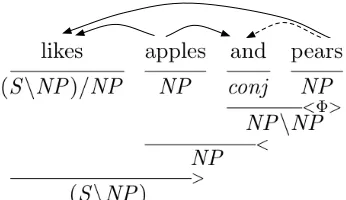
To analyze the complexity of this algorithm, we must ask: how many pairshn, dican be incident at each span? A CCG parser does not necessarily re-turn one dependency per word (see Figure 2 for an example), so dis not necessarily equal to the sen-tence lengthL as it might be in many dependency parsers, though it is still bounded byO(L). How-ever, this behavior is sufficiently uncommon that we expect all parses of a sentence, good or bad, to have close to L dependencies, and hence we expect the range ofdto be constant on average. Furthermore, n will be bounded from below by zero and from above bymin(|y|,|y0|). Hence the set of all
possi-ble F-measures for all possipossi-ble parses is bounded by
O(L2), but on average it should be closer toO(L). Following McAllester (1999), we can see from in-spection of the free variables in Fig. 3 that the algo-rithm requires worst-case O(L7) and average-case
O(L5)time complexity, and worse-caseO(L4)and average-caseO(L3)space complexity.
Note finally that while this algorithm computes exact sentence-level expectations, it is approximate at the corpus level, since F-measure does not decom-pose over sentences. We give the extension to exact corpus-level expectations in Appendix A.
3.2 Approximate Loss Functions
I(Ai,i+1,n,d) =w(ai+1:A) iffn=n+(ai+1 :A), d=d+(ai+1:A)
I(Ai,j,n,d) =
X
k,B,C
X
{n0,n00:n0+n00+n+(BC⇒A)=n}, {d0,d00:d0+d00+d+(BC⇒A)=d}
I(Bi,k,n0,d0)I(Ck,j,n00,d00)w(BC⇒A)
I(GOAL) =X
n,d
I(S0,L,n,d)
1− 2n
d+|y|
O(S0,N,n,d) =
1− 2n
d+|y|
O(Ai,j,n,d) =
X
k,B,C
X
{n0,n00:n0−n00−n+(AB⇒C)=n}, {d0,d00:d0−d00−d+(AB⇒C)=d}
O(Ci,k,n0,d0)I(Bj,k,n00,d00)w(AB⇒C)+
X
k,B,C
X
{n0,n00:n0−n00−n+(BA⇒C)=n}, {d0,d00:d0−d00−d+(BA⇒C)=d}
[image:4.612.102.507.70.314.2]O(Ck,j,n0,d0)I(Bk,i,n00,d00)w(BA⇒C)
Figure 3: State-split inside and outside recursions for computing softmax-margin with F-measure.
Figure 2: Example of flexible dependency realisation in CCG: Our parser (Clark and Curran, 2007) creates de-pendencies arising from coordination once all conjuncts are found and treats “and” as the syntactic head of coor-dinations. The coordination rule (Φ) does not yet estab-lish the dependency “and - pears” (dotted line); it is the backward application (<) in the larger span, “apples and pears”, that establishes it, together with “and - pears”. CCG also deals with unbounded dependencies which po-tentially lead to more dependencies than words (Steed-man, 2000); in this example a unification mechanism cre-ates the dependencies “likes - apples” and “likes - pears” in the forward application (>). For further examples and a more detailed explanation of the mechanism as used in the C&C parser refer to Clark et al. (2002).
available within the current local structure, similar to those used by Taskar et al. (2004) for tracking con-stituent errors in a context-free parser. We design three simple losses to approximate precision, recall and F-measure on CCG dependency structures.
Let T(y) be the set of parsing actions required to build parsey. Our decomposable approximation to precision simply counts the number of incorrect dependencies using the local dependency counts,
n+(·)andd+(·).
DecP(y) = X
t∈T(y)
d+(t)−n+(t) (8)
To compute our approximation to recall we require the number of gold dependencies, c+(·), which should have been introduced by a particular parsing action. A gold dependency is due to be recovered by a parsing action if its head lies within one child span and its dependent within the other. This yields a decomposed approximation to recall that counts the number of missed dependencies.
DecR(y) = X
t∈T(y)
[image:4.612.100.273.395.495.2]Unfortunately, the flexible handling of dependencies in CCG complicates our formulation ofc+, render-ing it slightly more approximate. The unification mechanism of CCG sometimes causes dependencies to be realised later in the derivation, at a point when both the head and the dependent are in the same span, violating the assumption used to computec+ (see again Figure 2). Exceptions like this can cause mismatches betweenn+ andc+. We setc+ = n+ wheneverc+ < n+to account for these occasional discrepancies.
Finally, we obtain a decomposable approximation to F-measure.
DecF1(y) =DecP(y) +DecR(y) (10)
4 Experiments
Parsing Strategy. CCG parsers use a pipeline
strat-egy: we first multitag each word of the sentence with a small subset of its possible lexical categories us-ing a supertagger, a sequence model over these cat-egories (Bangalore and Joshi, 1999; Clark, 2002). Then we parse the sentence under the requirement that the lexical categories are fixed to those preferred by the supertagger. In our experiments we used two variants on this strategy.
First is the adaptive supertagging (AST) approach of Clark and Curran (2004). It is based on a step function over supertagger beam widths, relaxing the pruning threshold for lexical categories only if the parser fails to find an analysis. The process either succeeds and returns a parse after some iteration or gives up after a predefined number of iterations. As Clark and Curran (2004) show, most sentences can be parsed with very tight beams.
Reverse adaptive supertagging is a much less ag-gressive method that seeks only to make sentences parsable when they otherwise would not be due to an impractically large search space. Reverse AST starts with a wide beam, narrowing it at each iteration only if a maximum chart size is exceeded. Table 1 shows beam settings for both strategies.
Adaptive supertagging aims for speed via pruning while the reverse strategy aims for accuracy by ex-posing the parser to a larger search space. Although Clark and Curran (2007) found no actual improve-ments from the latter strategy, we will show that
with our softmax-margin-trained models it can have a substantial effect.
Parser. We use the C&C parser (Clark and
Cur-ran, 2007) and its supertagger (Clark, 2002). Our baseline is the hybrid model of Clark and Curran (2007), which contains features over both normal-form derivations and CCG dependencies. The parser relies solely on the supertagger for pruning, using exact CKY for search over the pruned space. Train-ing requires calculation of feature expectations over packed charts of derivations. For training, we lim-ited the number of items in this chart to0.3million, and for testing, 1 million. We also used a more per-missive training supertagger beam (Table 2) than in previous work (Clark and Curran, 2007). Models were trained with the parser’s L-BFGS trainer.
Evaluation. We evaluated on CCGbank
(Hocken-maier and Steedman, 2007), a right-most normal-form CCG version of the Penn Treebank. We use sections 02-21 (39603 sentences) for training, tion 00 (1913 sentences) for development and sec-tion 23 (2407 sentences) for testing. We supply gold-standard part-of-speech tags to the parsers. We evaluate on labelled and unlabelled predicate argu-ment structure recovery and supertag accuracy.
4.1 Training with Maximum F-measure Parses
Condition Parameter Iteration 1 2 3 4 5
AST β(beam width) 0.075 0.03 0.01 0.005 0.001
k(dictionary cutoff) 20 20 20 20 150
Reverse β 0.001 0.005 0.01 0.03 0.075
[image:6.612.129.486.55.127.2]k 150 20 20 20 20
Table 1: Beam step function used for standard (AST) and less aggressive (Reverse) AST throughout our experiments. Parameterβis a beam threshold whilekbounds the number of lexical categories considered for each word.
Condition Parameter Iteration 1 2 3 4 5 6 7
Training β 0.001 0.001 0.0045 0.0055 0.01 0.05 0.1
k 150 20 20 20 20 20 20
C&C ’07 β 0.0045 0.0055 0.01 0.05 0.1
k 20 20 20 20 20
Table 2: Beam step functions used for training: The first row shows the large scale settings used for most experiments and the standard C&C settings. (cf. Table 1)
LF LP LR UF UP UR Data Util (%)
Baseline 87.40 87.85 86.95 93.11 93.59 92.63 91%
Max-F Parses 87.46 87.95 86.98 93.09 93.61 92.57 99%
[image:6.612.316.538.420.555.2]CCGbank+Max-F 87.45 87.96 86.94 93.09 93.63 92.55 99%
Table 3: Performance on section 00 of CCGbank when comparing models trained with treebank-parses (Baseline) and maximum F-score parses (Max-F) using adaptive supertagging as well as a combination of CCGbank and Max-F parses. Evaluation is based on labelled and unlabelled F-measure (LF/UF), precision (LP/UP) and recall (LR/UR).
effect. However, it does serve as a useful baseline.
4.2 Training with the Exact Algorithm
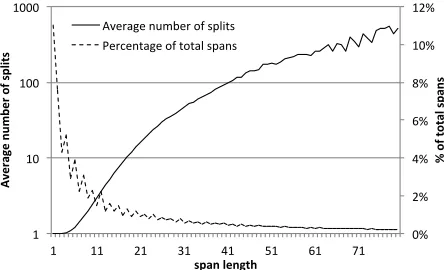
We first tested our assumptions about the feasibil-ity of training with our exact algorithm by measur-ing the amount of state-splittmeasur-ing. Figure 4 plots the average number of splits per span against the rela-tive span-frequency; this is based on a typical set of training forests containing over 600 million states. The number of splits increases exponentially with span size but equally so decreases the number of spans with many splits. Hence the small number of states with a high number of splits is balanced by a large number of spans with only a few splits: The highest number of splits per span observed with our settings was4888but we find that the average num-ber of splits lies at44. Encouragingly, this enables experimentation in all but very large scale settings.
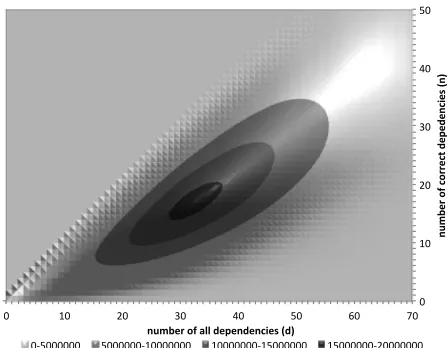
Figure 5 shows the distribution of nanddpairs across all split-states in the training corpus; since
0% 2% 4% 6% 8% 10% 12%
1 10 100 1000
1 11 21 31 41 51 61 71
%
of
to
ta
l s
pa
ns
Av
er
ag
e
nu
m
be
r o
f s
pl
its
span length Average number of splits Percentage of total spans
Figure 4: Average number of state-splits per span length as introduced by a sentence-level F-measure loss func-tion. The statistics are averaged over the training forests generated using the settings described in§4.
will have an opportunity to substantially modify the expectations, hopefully to good effect.
!" #!" $!" %!" &!" '!"
!" #!" $!" %!" &!" '!" (!" )!"
!"#
$%
&'()
'*
(&
&%
*+'
,%
-%
,%
!*
.%
/'
0!1'
!"#$%&'()'233',%-%!,%!*.%/'0,1'
!*'!!!!!!" '!!!!!!*#!!!!!!!" #!!!!!!!*#'!!!!!!" #'!!!!!!*$!!!!!!!"
Figure 5: Distribution of states withddependencies of whichnare correct in the training forests.
We next turn to the question of optimization with these algorithms. Due to the significant computa-tional requirements, we used the computacomputa-tionally less intensive normal-form model of Clark and Cur-ran (2007) as well as their more restrictive training beam settings (Table 2). We train on all sentences of the training set as above and test with AST.
In order to provide greater control over the influ-ence of the loss function, we introduce a multiplier τ, which simply amends the second term of the ob-jective function (3) to:
log X
y∈Y(xi)
exp{θTf(xi, y) +τ×`(yi, y)}
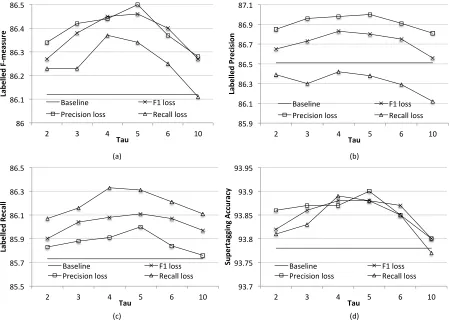
Figure 6 plots performance of the exact loss func-tions across different settings ofτ on various evalu-ation criteria, for models restricted to at most 3000 items per chart at training time to allow rapid ex-perimentation with a wide parameter set. Even in this constrained setting, it is encouraging to see that each loss function performs best on the criteria it op-timises. The precision-trained parser also does very well on F-measure; this is because the parser has a tendency to perform better in terms of precision than recall.
4.3 Exact vs. Approximate Loss Functions
[image:7.612.72.296.111.285.2]With these results in mind, we conducted a compar-ison of parsers trained using our exact and approxi-mate loss functions. Table 4 compares their perfor-mance head to head when restricting training chart sizes to 100,000 items per sentence, the largest set-ting our compuset-ting resources allowed us to experi-ment with. The results confirm that the loss-trained models improve over a likelihood-trained baseline, and furthermore that the exact loss functions seem to have the best performance. However, the approx-imations are extremely competitive with their exact counterparts. Because they are also efficient, this makes them attractive for larger-scale experiments. Training time increases by an order of magnitude with exact loss functions despite increased theoreti-cal complexity (§3.1); there is no significant change with approximate loss functions.
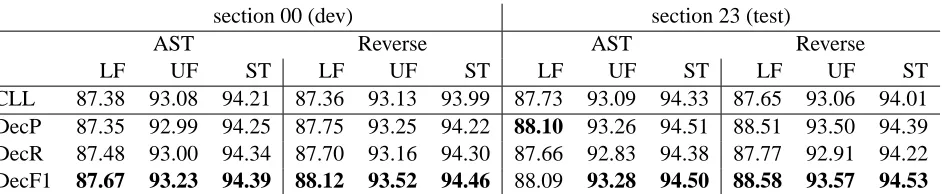
Table 5 shows performance of the approximate losses with the large scale settings initially outlined (§4). One striking result is that the softmax-margin trained models coax more accurate parses from the larger search space, in contrast to the likelihood-trained models. Our best loss model improves the labelled F-measure by over 0.8%.
4.4 Combination with Integrated Parsing and Supertagging
As a final experiment, we embed our loss-trained model into an integrated model that incorporates Markov features over supertags into the parsing model (Auli and Lopez, 2011). These features have serious implications on search: even allowing for the observation of Fowler and Penn (2010) that our CCG is weakly context-free, the search problem is equiva-lent to finding the optimal derivation in the weighted intersection of a regular and context-free language (Bar-Hillel et al., 1964), making search very expen-sive. Therefore parsing with this model requires ap-proximations.
distribu-!"# !$#
!%# !&#
'() '(*+) '(*,) '(*-) '(*.) '(*/)
,) -) .) /) () +0)
!"
#$
%%$
&'
()
*
$"
+,
-$
'
.",'
1"234563) 7+)4822) 9:3%52586)4822) ;3%"44)4822)
'/*<) '(*+) '(*-) '(*/) '(*=) '(*<) '=*+)
,) -) .) /) () +0)
!"#$
%%$
&'/-$0
1+123'
.",'
1"234563) 7+)4822) 9:3%52586)4822) ;3%"44)4822)
'/*/) '/*=) '/*<) '(*+) '(*-) '(*/)
,) -) .) /) () +0)
!"
#$
%%$
&'
4$
0"
%%'
.",'
1"234563) 7+)4822) 9:3%52586)4822) ;3%"44)4822)
<-*=) <-*=/) <-*') <-*'/) <-*<) <-*</)
,) -) .) /) () +0)
5,
6$
-7
"8
81
38
'90
0,
-"
0:
'
.",'
[image:8.612.82.532.85.407.2]1"234563) 7+)4822) 9:3%52586)4822) ;3%"44)4822)
Figure 6: Performance of exact cost functions optimizing F-measure, precision and recall in terms of (a) labelled F-measure, (b) precision, (c) recall and (d) supertag accuracy across various settings ofτon the development set.
section 00 (dev) section 23 (test)
LF LP LR UF UP UR LF LP LR UF UP UR
CLL 86.76 87.16 86.36 92.73 93.16 92.30 87.46 87.80 87.12 92.85 93.22 92.49
DecP 87.18 87.93 86.44 92.93 93.73 92.14 87.75 88.34 87.17 93.04 93.66 92.43
DecR 87.31 87.55 87.07 93.00 93.26 92.75 87.57 87.71 87.42 92.92 93.07 92.76
DecF1 87.27 87.78 86.77 93.04 93.58 92.50 87.69 88.10 87.28 93.04 93.48 92.61
P 87.25 87.85 86.66 92.99 93.63 92.36 87.76 88.23 87.30 93.06 93.55 92.57
R 87.34 87.51 87.16 92.98 93.17 92.80 87.57 87.62 87.51 92.92 92.98 92.86
F1 87.34 87.74 86.94 93.05 93.47 92.62 87.71 88.01 87.41 93.02 93.34 92.70
[image:8.612.74.552.507.629.2]section 00 (dev) section 23 (test)
AST Reverse AST Reverse
LF UF ST LF UF ST LF UF ST LF UF ST
CLL 87.38 93.08 94.21 87.36 93.13 93.99 87.73 93.09 94.33 87.65 93.06 94.01
DecP 87.35 92.99 94.25 87.75 93.25 94.22 88.10 93.26 94.51 88.51 93.50 94.39
DecR 87.48 93.00 94.34 87.70 93.16 94.30 87.66 92.83 94.38 87.77 92.91 94.22
[image:9.612.81.552.57.154.2]DecF1 87.67 93.23 94.39 88.12 93.52 94.46 88.09 93.28 94.50 88.58 93.57 94.53
Table 5: Performance of decomposed loss functions in large-scale training setting. Evaluation is based on labelled and unlabelled F-measure (LF/UF) and supertag accuracy (ST).
tion over supertag variables defined by a supertag-ging model, and the other is a distribution over these variables and a set of span variables defined by our parsing model.5 The factors communicate by pass-ing messages across the shared supertag variables that correspond to their marginal distributions over those variables. Hence, to compute approximate ex-pectations across the entire model, we run forward-backward to obtain posterior supertag assignments. These marginals are passed as inside values to the inside-outside algorithm, which returns a new set of posteriors. The new posteriors are incorporated into a new iteration of forward-backward, and the algorithm iterates until convergence, or until a fixed number of iterations is reached – we found that a single iteration is sufficient, corresponding to a trun-cated version of the algorithm in which posteriors are simply passed from the supertagger to the parser. To decode, we use the posteriors in a minimum-risk parsing algorithm (Goodman, 1996).
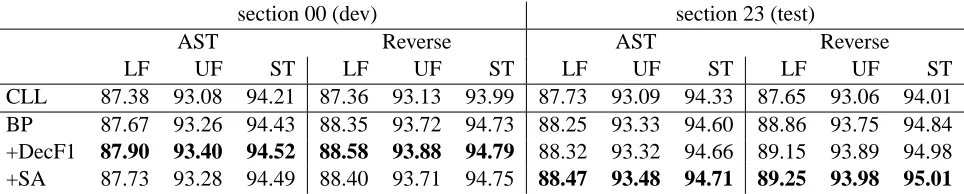
Our baseline models are trained separately as be-fore and combined at test time. For softmax-margin, we combine a parsing model trained with F1 and a supertagger trained with Hamming loss. Table 6 shows the results: we observe a gain of up to 1.5% in labelled F1 and 0.9% in unlabelled F1 on the test set. The loss functions prove their robustness by im-proving the more accurate combined models up to 0.4% in labelled F1. Table 7 shows results with au-tomatic part-of-speech tags and a direct comparison with the Petrov parser trained on CCGbank (Fowler and Penn, 2010) which we outpeform on all metrics.
5
These complex factors resemble those of Smith and Eisner (2008) and Dreyer and Eisner (2009); they can be thought of as case-factor diagrams (McAllester et al., 2008)
5 Conclusion and Future Work
The softmax-margin criterion is a simple and effec-tive approach to training log-linear parsers. We have shown that it is possible to compute exact sentence-level losses under standard parsing metrics, not only approximations (Taskar et al., 2004). This enables us to show the effectiveness of these approxima-tions, and it turns out that they are excellent sub-stitutes for exact loss functions. Indeed, the approxi-mate losses are as easy to use as standard conditional log-likelihood.
Empirically, softmax-margin training improves parsing performance across the board, beating the state-of-the-art CCG parsing model of Clark and Curran (2007) by up to 0.8% labelled F-measure. It also proves robust, improving a stronger base-line based on a combined parsing and supertagging model. Our final result of 89.3%/94.0% labelled and unlabelled F-measure is the best result reported for CCG parsing accuracy, beating the original C&C baseline by up to 1.5%.
In future work we plan to scale our exact loss functions to larger settings and to explore training with loss functions within loopy belief propagation. Although we have focused on CCG parsing in this work, we expect our methods to be equally appli-cable to parsing with other grammar formalisms in-cluding context-free grammar or LTAG.
Acknowledgements
section 00 (dev) section 23 (test)
AST Reverse AST Reverse
LF UF ST LF UF ST LF UF ST LF UF ST
CLL 87.38 93.08 94.21 87.36 93.13 93.99 87.73 93.09 94.33 87.65 93.06 94.01
BP 87.67 93.26 94.43 88.35 93.72 94.73 88.25 93.33 94.60 88.86 93.75 94.84
+DecF1 87.90 93.40 94.52 88.58 93.88 94.79 88.32 93.32 94.66 89.15 93.89 94.98
[image:10.612.75.557.58.155.2]+SA 87.73 93.28 94.49 88.40 93.71 94.75 88.47 93.48 94.71 89.25 93.98 95.01
Table 6: Performance of combined parsing and supertagging with belief propagation (BP); using decomposed-F1 as parser-loss function and supertag-accuracy (SA) as loss in the supertagger.
section 00 (dev) section 23 (test)
LF LP LR UF UP UR LF LP LR UF UP UR
CLL 85.53 85.73 85.33 91.99 92.20 91.77 85.74 85.90 85.58 91.92 92.09 91.75
Petrov I-5 85.79 86.09 85.50 92.44 92.76 92.13 86.01 86.29 85.73 92.34 92.64 92.04
BP 86.45 86.75 86.17 92.60 92.92 92.29 86.84 87.08 86.61 92.57 92.82 92.32
+DecF1 86.73 87.07 86.39 92.79 93.16 92.43 87.08 87.37 86.78 92.68 93.00 92.37
[image:10.612.73.299.557.638.2]+SA 86.51 86.86 86.16 92.60 92.98 92.23 87.20 87.50 86.90 92.76 93.08 92.44
Table 7: Results on automatically assigned POS tags. Petrov I-5 is based on the parser output of Fowler and Penn (2010); evaluation is based on sentences for which all parsers returned an analysis.
anonymous reviewers for helpful comments. We also acknowledge funding from EPSRC grant EP/P504171/1 (Auli); and the resources provided by the Edinburgh Compute and Data Facility.
A Computing F-Measure-Augmented Expectations at the Corpus Level
To compute exact corpus-level expectations for softmax-margin using F-measure, we add an additional transition before reaching theGOALitem in our original program. To reach it, we must parse every sentence in the corpus, associating statistics of aggregatehn, dipairs for the en-tire training set in intermediate symbolsΓ(1)...Γ(m)with
the following inside recursions.
I(Γ(1)n,d) = I(S0(1),|x(1)|,n,d)
I(Γ(n,d`)) = X n0,n00:n0+n00=n
I(Γ(n`0−,d1)0 )I(S (`) 0,N,n00,d00)
I(GOAL) = X n,d
I(Γ(n,dm))
1−d+2n |y|
Outside recursions follow straightforwardly. Implemen-tation of this algorithm would require substantial dis-tributed computation or external data structures, so we did not attempt it.
References
M. Auli and A. Lopez. 2011. A Comparison of Loopy Belief Propagation and Dual Decomposition for Inte-grated CCG Supertagging and Parsing. In Proc. of ACL, June.
J. K. Baker. 1979. Trainable grammars for speech recog-nition. Journal of the Acoustical Society of America, 65.
S. Bangalore and A. K. Joshi. 1999. Supertagging: An Approach to Almost Parsing. Computational Linguis-tics, 25(2):238–265, June.
Y. Bar-Hillel, M. Perles, and E. Shamir. 1964. On formal properties of simple phrase structure grammars. In Language and Information: Selected Essays on their Theory and Application, pages 116–150.
S. Clark and J. R. Curran. 2004. The importance of su-pertagging for wide-coverage CCG parsing. In COL-ING, Morristown, NJ, USA.
S. Clark and J. R. Curran. 2007. Wide-Coverage Ef-ficient Statistical Parsing with CCG and Log-Linear Models. Computational Linguistics, 33(4):493–552. S. Clark and J. Hockenmaier. 2002. Evaluating a
Wide-Coverage CCG Parser. In Proceedings of the LREC 2002 Beyond Parseval Workshop, pages 60–66, Las Palmas, Spain.
S. Clark. 2002. Supertagging for Combinatory Catego-rial Grammar. In TAG+6.
M. Dreyer and J. Eisner. 2009. Graphical models over multiple strings. In Proc. of EMNLP.
J. R. Finkel, A. Kleeman, and C. D. Manning. 2008. Feature-based, conditional random field parsing. In Proceedings of ACL-HLT.
T. A. D. Fowler and G. Penn. 2010. Accurate context-free parsing with combinatory categorial grammar. In Proc. of ACL.
K. Gimpel and N. A. Smith. 2010a. Softmax-margin CRFs: training log-linear models with cost functions. In HLT ’10: The 2010 Annual Conference of the North American Chapter of the Association for Computa-tional Linguistics.
K. Gimpel and N. A. Smith. 2010b. Softmax-margin training for structured log-linear models. Technical Report CMU-LTI-10-008, Carnegie Mellon Univer-sity.
J. Goodman. 1996. Parsing algorithms and metrics. In Proc. of ACL, pages 177–183, Jun.
J. Hockenmaier and M. Steedman. 2007. CCGbank: A corpus of CCG derivations and dependency struc-tures extracted from the Penn Treebank. Computa-tional Linguistics, 33(3):355–396.
L. Huang. 2008. Forest Reranking: Discriminative pars-ing with Non-Local Features. In Proceedpars-ings of ACL-08: HLT.
J. Lafferty, A. McCallum, and F. Pereira. 2001. Con-ditional random fields: Probabilistic models for seg-menting and labeling sequence data. In Proc. of ICML, pages 282–289.
D. McAllester, M. Collins, and F. Pereira. 2008. Case-factor diagrams for structured probabilistic modeling. Journal of Computer and System Sciences, 74(1):84– 96.
D. McAllester. 1999. On the complexity analysis of static analyses. In Proc. of Static Analysis Symposium, volume 1694/1999 of LNCS. Springer Verlag.
F. J. Och. 2003. Minimum error rate training in statistical machine translation. In Proc. of ACL, Jul.
J. Pearl. 1988. Probabilistic Reasoning in Intelligent Systems: Networks of Plausible Inference. Morgan Kaufmann.
D. Povey and P. Woodland. 2008. Minimum phone er-ror and I-smoothing for improved discrimative train-ing. In Proc. of ICASSP.
F. Sha and L. K. Saul. 2006. Large margin hidden Markov models for automatic speech recognition. In Proc. of NIPS.
D. A. Smith and J. Eisner. 2008. Dependency parsing by belief propagation. In Proc. of EMNLP.
M. Steedman. 2000. The syntactic process. MIT Press, Cambridge, MA.