Laughter and Topic Changes: Temporal Distribution
and Information Flow
Francesca Bonin
†‡, Nick Campbell
†, Carl Vogel
‡ Trinity College Dublin, Dublin 2, Ireland email:{boninf,nick,vogel}@tcd.ie† Speech Communication Lab, Centre for Language and Communication Studies School of Linguistic, Speech and Communication Sciences
‡Centre for Computing and Language Studies, Computational Linguistics Group School of Computer Science and Statistics
Abstract—Laughter is an important component of social inter-action that has attracted interest within conversational analysis. However, it is not universally accepted that laughs have a function in discourse structure. In this study we explore laughter in conversation in relation to topic changes trying to understand whether laughter can be considered as a signal of discourse structure, whether there is a recurrent pattern in laughter distribution with respect to topic changes, and whether laughter has a function in predicting topic changes. In order to answer these general questions, we investigate the laughter-topic change relation from two different points of view (timing and information flow), finding interesting regularities in laughter distributions. Thus, laughter has a function in discourse structure and, although not sufficient to predict a topic change in isolation, it can be an important indicator together with other sources of information.
I. INTRODUCTION
Laughter, as component of social interaction, has attracted interest within conversational analysis [6], [8]. While laughter can be expressed in different contexts, voluntary or involuntary [12], and diverse in function and degree of functionality [6], its timing is not random.1Understanding laughter as a reaction
to dialog content (when not in response to situations or events outside the dialog context in which it occurs), laughter has been studied in relation to preceding utterances [16]; however, it can also be understood in relation to utterances that follow, inasmuch as it provides a signal of topic completion.2 It is
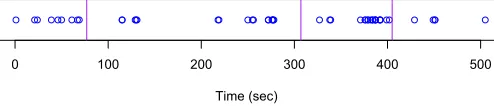
not universally accepted that laughter is signal of discourse structure; others have made the argument that filled-pauses do have a “symbolic function in discourse structure”, in contrast to laughing [15, p494]. However, if it is possible to find a relation between laughter and topic boundaries, it would be possible to interpret laughter as a signal in discourse structure. As a suggestive indication, we show in Fig. 1 approximately eight minutes of talk from conversations the rest of which are analyzed more deeply in the remainder of the paper.3
1The internal structure of laugh-constituting noise may well be random [1]. 2We accept distinctions made by others, for example [3], about the need to separate spontaneous laughter from its more conscious counterparts and think it is possibly the spontaneous laughter that is more linked to what has come immediately before than what follows in the very near future.
3The corpus records conversation in English, including non-native speakers of English, among five individuals over three sessions of approximately 1.5 hours each [2]. This corpus has been studied independently [9].
0 100 200 300 400 500
Laughs and Topic changes
Time (sec)
Laughter
Fig. 1. Laughter distribution over time. Circles represent laughter, vertical lines represent topic boundaries. (No other vocalization is plotted.)
Two observations are available: firstly, bundles of laughter can anticipate a topic change, but are not a reliable signal of topic change; conversely, when a topic has changed, laughs do not follow immediately. This segment of conversation is representative of the entire dataset.
We study the laughter-topic change relation from two differ-ent points of view: with respect to timing (whether recurrdiffer-ent patterns in the relation laughter distribution-topic changes exist, whether laughter is a reliable topic termination cue) and with respect to information content (whether laughter can be considered milestone of changes in the information flow).
From the timing point of view, others also approached this problem. In [4], [5] regularities have been analyzed in the occurrence of shared and not-shared laughter and their different conversational functions [4]. From a large collection of instances two persistent patterns are noted: shared laughter is often associated with topic termination and solo laughter with topic continuation. It has been observed that laughter invites reciprocal laughter [8]; however, Holt qualifies this with analysis of cases in which the listener seemingly refuses the laugh-invitation by continuing the topic with further in-formation, instead. Keeping in mind Holt’s analysis [4], [5], we explore a corpus of multiparty spontaneous chat (see§III) approaching the problem in two steps: analyzing the general distribution of laughter and then at a finer level distinguishing between shared laughter and solo laughter.
[image:1.612.321.568.244.297.2]flow or mutual affirmation of known information (such as com-ment on the weather at a bus stop). Others have shown deictic gesture to relate to known referents more than new entities in discourse [10], while at the same time, coinciding with the onset of conversational contributions [9]. Further, laughter has been analyzed as a sort of gesture [13]. Given that we are also analyzing laughter as a kind of milestone in conversation, it is relevant to compare measures of information content on either side of laughter, in relation to topic boundaries.
The focus of the present work can be summarized in two main lines of research: a temporal analysis of laughter distri-bution over the conversation with respect to topic boundaries, and a kind of quantitative analysis of the information content with respect to laughter and topic boundaries. In analyzing the timing of laughter we seek answers to these questions: (1) how is laughter distributed around topic boundaries? (2) is there evidence of the “shared laughter-topic
termina-tion” relation or of the “solo laughter-topic continuatermina-tion” relation, as articulated by [4]?
In content analysis we seek answer to this question:
(3) is there a well-motivated measure of information content which is different when measured between two sorts of periods: (a) the last laugh and the subsequent topic boundary (topic termination), and (b) the topic boundary (topic beginning) and the first subsequent laugh? The paper is structured as follow: Section II describes a set operational definitions that will be used in the following sections. In Section III, we describe a particular corpus of informal chat upon which we base the empirical analysis. Sec-tion IV addresses the temporal distribuSec-tion analysis, tackling questions (1), in IV-A, and (2), in IV-B and IV-C. Finally, Section V refers to the content analysis, tackling question (3), analyzing the information flow with respect to laughter and topic boundaries. Conclusions are drawn in Section VI.
II. OPERATIONAL DEFINITIONS
A. Definition of Topic
In order to approach the problem of topic change, we need to introduce one of the main issues of the topic segmentation literature: what a topic is. Many diverse definitions have been given while addressing the problem from different points of view and in different contexts. In linguistic literature topic has been addressed at two different levels: at sentence level [28], and at discourse level [29]. In the context of topic segmentation algorithms, topic has been mostly referred to at a discourse level, as segments of the discourse sharing coherent information (about the same thing [33]). However this definition is not the only one. Passonneau et al., [23], notice how topic can be interpreted also in terms of speakers’
intentions, and topic changes in conversations as changes
in the participants’ activities (information-giving, decision-making). In topic segmentation applications, topics have been seen as lexically coherent segments of the discourse, and topic changes as drops in such coherence, [26]. Arguello et al., [27], use a functional definition of topic, based on the satisfaction of
three criteria: it should be reproducible by manual annotators,4
it should not rely on domain-specific knowledge and, third, shifts in topic should be evident from surface characteristics of the language. For the present work, topic has been considered at a discourse level, and from the content point of view, as a section of conversation characterized by a coherent content (i.e.japanese restaurants, word meanings, tv shows, etc).
Many different topic segmentation algorithms have been developed; some are based on lexical cohesion as TextTiling [26] or in [30], some on clustering (with a binary approach on whether sentence boundary is or not a topic boundary) [31], others exploit discourse markers that provides clues about the discourse structure [32]. Understanding whether laughter has a function in the discourse structure plays a crucial role in the framework of those algorithm, as laughs could constitute an informative feature to boost topic segmentation efficacy.
B. Temporal analysis definitions
For temporal analysis, we idealize T-events as an instanta-neous points of conversational topic shift and identify them with the first contribution of the onset of the new topic. Further, we consider the laugh events in relation to T-events. Laughter and topic boundaries constitute milestones in con-versation. At first we are interested in any sort of laugh. Therefore, we discriminate the time spans between the last laugh in topic A and T-event (namely LT) and the T-event and the first laugh in topic B (namely TL) (Fig. 2).
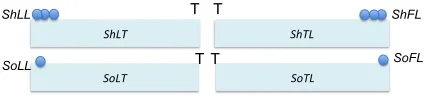
Secondarily we analyze, at finer level, the distinction be-tween shared and solo laughter and their relation with topic changes. In this case, the last solo (SO) and shared (SH) laughs prior to a T-event (named last-laugh or LL: SoLL or ShLL, respectively) and the first solo and shared laughs subsequent to a T-event (FL: SoFL, ShFL) are of particular interest among laughs.5 See Fig. 3. We denote the measure of this distance
between T-events and boundary laughs asµ.
In what follows we consider the differences betweenµ(LT) and µ(TL) as well as between µ(SoLT) and µ(ShLT), and betweenµ(SoTL) andµ(ShTL).
!"# "!#
T-event
LL FL
[image:2.612.317.555.521.575.2]Topic A Topic B
Fig. 2. Topic boundary neighborhood. LL and FL represent last and first laugh. LT and TL represent respectively a topic termination segment and a topic beginning segment.
Finally, since a conversation is characterized also by a dichotomous distinction between moments of topic continu-ation and moments of topic transition, we analyze the dis-tribution of laughter among those segments. We construct operational models of topic continuation segments, calling
!"#$% !"$#%
T T ShFL
T T
!&#$% !&$#%
SoFL ShLL
[image:3.612.67.281.56.104.2]SoLL
Fig. 3. Topic boundary neighborhoods with shared and solo last laughs (ShLL and SoLL) and shared and solo first laughs (ShFL and SoFL). ShLT, ShTL, SoLT, SoLT represent topic termination and topic beginning segments.
!"#
T-event
Topic A Topic B
!$#
T-event
!"# !$#
Fig. 4. Topic continuum vs topic transition segmentation
themwisegments, and topic transition segments, calling them
wo segments. We define these as follows (see Fig. 4):
• wisegments: the central half of each topic (blue in Fig. 4); • wo segments: the final quarter of one topic and first
quarter of the next topic (pink areas in Fig. 4).
The core of discussion of a topic may be expected to be found within a wi segment, but outside (ie. without) a wo
segment. By construction, wisegments do not include a topic transition within them, while wo segments do (and thus can be expected to include the talk that winds down one topic and commences another, including core content of both). Because they are in each case defined in relation to the duration of a sequential pair of topics, the construction is a rational decomposition of conversational flow into segments containing topic-core talk and segments containing topic transitions.
C. Linguistic content analysis definitions
Conversation is also constituted by much linguistic content which drives the information flow throughout the conversa-tion.6 Hence, we can analyze the before mentioned LT and
TL segments of the conversation with respect to their lexical richness. We refer to the lexical richness of LT and TL as Λ, respectivelyΛ(LT) andΛ(TL). For each T-event,t, we define Λ(LTt) with (4) andΛ(T Lt) with (5).
Λ(LTt)=T T R(LTt)/Length(LTt)
(4)
Λ(T Lt)=T T R(T Lt)/Length(T Lt)
(5)
In these equations, TTR is the Type-Token Ratio.7
III. CORPUS DESCRIPTION
The corpus, Table-Talk,8 was recorded at ATR in Japan.
As indicated above (note 3), the multi-modal corpus records conversation in English, including non-native speakers of
6Seemingly inevitably, linguistic content will also include digressions, and the total information flow in a conversation will include non-linguistic content about the empathetic and sympathetic states of the participants with respect to each other.
7For any segment, the total number of unique words divided by total number of words – the value for this footnote is 21
29for all words, 12
16on only content.
8http://sspnet.eu/2010/02/freetalk/ – last verified November 2012.
English, among five individuals over three sessions [2]. In order to collect as natural data as possible, neither topics of discussion nor activities were restricted in advance. The recordings were made in an informal setting over coffee. A more complete description of the corpus can be found in [19].
Speaker Shared Solo Total Laughs Total # turns
d 7 30 37 1581
g 13 17 30 420
k 67 127 194 1172
n 78 157 235 1580
y 76 141 217 1226
TABLE I
DISTRIBUTION OF LAUGHTER AMONG SPEAKERS
For this research, all three days have been used, for a total length of about 3h 30’, 31523 tokens and 5980 turns. Transcripts present a specific tag for laugh (@w), and report the start and end time of the laugh (unless inserted in a longer context). The total number of laughter is 713, counting shared and solo laughter. In this study, we defined shared laughter situations in which at least two speakers overlap laughing. Table I reports the amount of laughter, both solo and shared, per speaker. For the lexical analysis, the transcripts have been processed using the Stanford PoS Tagger [18]. This corpus has been studied independently [9] and its transcripts have also provided data for analysis of repetition in dialog [17].
IV. DISTRIBUTION OFLAUGHTER: TEMPORAL ANALYSIS
A. Temporal distribution of Laughter
The first analysis is meant to answer (1), and characterize how laughter is distributed over topic boundaries. We examine the left (LTs) and right sides (TLs) of topic boundaries consideringµ(LT) andµ(TL) (Fig. 2). As shown by Shapiro-Wilk test (p-value = 2.443e-15 and p-value = 1.624e-10), µ(LT) andµ(TL) are not normally distributed, hence the non-parametric wilcox test has been used for significance testing. We notice that LLs tend to occur at a shorter temporal distance from the T-event, than FLs: µ(LT) < µ(TL).9 The
temporal distance between the last laugh of a topic and topic boundary, is significantly shorter than the temporal distance between the topic boundary and the first laugh, and Fig. 5 shows this difference in distributions. The boxplot of the left shows the distribution of µ(LT), while the boxplot on the right shows the distribution ofµ(TL). Although limited to this corpus, an interesting finding emerges: laughter is more likely as the temporal distance from the topic boundary increases. This does not mean that laughter can be considered a topic termination cue, however, knowing that laughter is more likely to appear immediately before than immediately after a topic boundary suggests that laughter do have some function in the discourse structure and this could be a useful information when trying to automatically detect topic boundaries (cf. [11]).
[image:3.612.52.299.156.206.2]● ● ●
● ● ● ●
● ●
● ●
● ●
● ●
● ●
● ● ● ● ● ● ●
●
LT TL
0
50
100
150
[image:4.612.349.517.54.200.2]Segment length(sec)
Fig. 5. µ(LT)vsµ(T L)comparison
●
● ● ● ●
● ● ●
● ●
● ●
ShLL SoLL
0
50
100
150
Distance from T
−
e
[image:4.612.86.253.54.376.2]vent(sec)
Fig. 6. µ(ShLT)vsµ(SoLT)comparison: SH laughs tend to occur in proximity of topic boundaries
B. Shared Laughter and Topic Termination
Next we investigate whether shared laughter is related to topic termination in a stronger way than solo laughter, as in [4], and whether shared laughs contribute to development of topic termination sequences. Holt in [4] notes a clear distinction between shared laughter and solo laughter. According to her analysis, shared laughter is linked with topic termination: it cannot be considered as an independent topic-closing cue, but it may be a supplemental indicator of a topic closing when it occurs in a sequence that is already potentially termination relevant. In order to explore this statement in our corpus, we repeat the previous analysis ofµ(LT) vsµ(TL), distinguishing shared (SH) vs solo (SO) laugh. Since we are interested only in the topic termination section we focus on the topic boundary left neighborhood (µ(LT)). In Fig. 6 we can see the comparison between the µ(SoLT) and µ(ShLT): while in the median distance between SH laughter and T-event is about 4 sec, the median distance between SO and T-event is about 13 sec. One tail Wilcox test confirms a statistically significance difference among the means (p-value = 1.278e-06).
SH laughter, rather than SO, tends to occur near a topic termination, and seems to fall in the time-frame that Schegloff defines topic closing sequence [14]. Thus, we can argue
● ● ● ●
● ● ● ● ●
●
●
●
So in wi So in wo
0
2
4
6
Amount of SO in wi and w
o
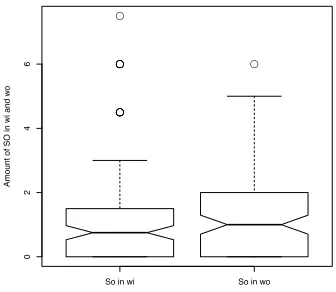
Fig. 7. SO Laughter distribution inwiandwosegments
(supporting Holt) that: given a topic termination, it is more likely to find a SH rather than a SO laughter in the topic closing sequence. Again, this does not mean that SH are sufficient to cue topic termination, but their presence can be a further indicator of a topic termination sequence.
C. Solo Laughter and topic continuation
The second statement in Holt’s analysis is the relation between solo laughter and topic continuation. Recalling the observation in [8], that laughter can invite reciprocal laughter, Holt interprets solo laughter as rejected invitations. She notices that those invitations are refused, when recipients want to add information and develop the topic. In order to investigate this, we analyze the distribution of solo laughter, exploring whether it is more likely to find a SO rather than a SH in relation with a topic continuation segment of the conversation. As mentioned in section II, we define wi and wo segments respectively topic continuation and topic transition segments. If solo laughs are related to topic continuation, we would expect more SO in topic continuation segments (wi) than in topic transition segments (wo); on the contrary, as shown in Fig. 7, we do not find a significant difference in the distribution of SO laughter among wi andwo sections (two tailed wilcox test p-value = 0.2805), where the left boxplot (distribution of SO inwi) and right boxplot (distribution of SO inwo) strongly overlap.
Moreover, we do not find any significant difference between the distribution of SH laughter and SO laughter with respect to this segmentation; our interpretation of this is that, wrt to our corpus, SH and SO can equally occur in the context of a topic continuation. Thus, there is no evidence of a particular relation SO laughter-topic continuation.
[image:4.612.87.256.58.200.2]● ● ● ● ● ● ● ●
● ●
● ● ●
● ●
● ●
● ●
● ●
LT TL
0.0
0.2
0.4
0.6
0.8
1.0
TTR/Length
Fig. 8. Λ(LT) vsΛ(TL)
we take into account the lexical variation index, using the type token ratio (TTR) measure, normalized over the length of the segment, as in (4) and (5). We calculate Λ() over LT and TL. This index yields a measure of the lexical variety of those conversation segments. Closed-class categories (function words) have not been taken into consideration; lexical variation has been calculated over nouns, verbs and adjectives.
Analyses result in two distributions: one showing the ten-dency of the lexical variety of all LT segments (Λ(LT)) in the conversation (lexical variety at topic termination) and one showing the tendency of the lexical variety of all TL segments (Λ(TL)), lexical variety at topic beginning. Comparing those distributions, we can notice a significant difference between Λ(LT) andΛ(TL):Λ(LT) tends to be higher thanΛ(TL), with statistical significance.10 Results are plotted in Fig. 8.
Surprisingly, segments of conversation representing topic termination sequences seem to have greater lexical variety than topic beginning segments. It seems counterintuitive for topic termination exchange segments to show higher lexical variety than topic beginning segments, although the latter introduce new topics (and accompanying terminology) into conversation. Results are consistent with a finer analysis in which we investigated the lexical variety of ShLT, ShTL, SoLT and SoTL (Λ(ShLT),Λ(ShTL),Λ(SoLT),Λ(SoTL)). In fact, it appears that all the topic termination segments (either introduced by a SH or by a SO) present more lexical variety than segments at topic beginning. Table II shows the alternative hypotheses (H1) accepted in one-tailed Wilcox tests, with corresponding p-values (ie., H0:Λ(LT)≤Λ(TL)). We propose two possible hypotheses that could illuminate this counterintuitive result.
The first hypothesis is related to the repetition phenomenon that occurs while the new topic is developing. As a new topic begins, the lexical alignment effect increases [22], since speakers tend to find, from the very beginning of a topic, a common lexicon; e.g, the excerpt in Fig. 9 represents the beginning of a topic in Table-Talk and, we can notice that each speaker is repeating the wordsKuraandsushi, establishing a common ground, before developing the topic. This alignment phenomenon influences the lexical variety results.
10One tail wilocox test, mu=0, alternative=g: p-value = 7.108e-06
y after that we went to Kura sushi y hum
n Kura sushi, yeah d Kura sushi
y just to have fun with, for foreigners they know sushi train
n Kura sushi is a kind of tourist, yeah y I know, I know yeah
n yeah d hum y but d maa maa
y the Sushi train?
n Kame sushi in Osaka is lovely!
Fig. 9. Example of topic onset (Kura Sushi)
The second hypothesis focuses on the topic termination segment. According to Schegloff [14, p186], topic-closing sequences are complex sequences composed of three turns that shift the conversation to the new topic. We have already noticed, in line with [4], that shared laughter can have a discourse function in these topic-closing sequences; however, there may be also other functional elements of the conversation that play a role in those sequences and that increase lexical variety. In other words, it could be possible that in closing a topic, participants add to the content, linguistic and non-linguistic elements which drive the conversation to the new topic. Future investigation will explore those phenomena.
Laugh-type Λ() P-Value H1 Shared Λ(ShLT)>Λ(ShTL) p-value = 1.116e-08 H1 Solo Λ(SoLT)>Λ(SoTL) p-value = 0.04584
TABLE II
ONE-TAILEDWILCOX TESTS BETWEEN DIFFERENTΛ()DISTRIBUTIONS
VI. CONCLUSIONS
In this study, we explored laughter and its functions in discourse with respect to topic changes from two points of view: temporal distribution and information content. In the former (questions (1) and (2) of §I), we were interested in understanding whether there is some sort of temporal relation between laughter and topic changes. In the latter (question (3) of§I), we were interested in understanding whether there was some sort of relation between laughter, topic changes and information flow: if there is a well-motivated measure of information content which is different when assessed between two sort of periods (topic termination and topic beginning).
conclude that laughter has, in this respect, a function in the discourse structure, a function that we believe, it is worth further investigation. In addition, we notice that solo laughter is equally distributed between topic continuation moments and topic transition moments; we do not find, in our corpus, a strong relation between solo laughter and topic continuation, contrary to the suggestion of [4].
With respect to (3), we found that lexical variety seems to differ consistently between the topic termination and topic beginning segments. However, it does not differ as expected: topic termination segments seems to have higher lexical variety that topic beginning segments. Two suggestions have been sug-gested in§V in order to explain this interesting phenomenon, and further investigation will explore those hypotheses. Further developments will also tackle the content distribution analysis using different lexical measures, and will develop the temporal distribution analysis with a survival analysis approach. We must also analyze other corpora, investigating how different sorts of laughter may have different discourse functions, merging linguistic and prosodic approaches.
Our work is at the intersection of the theories of communi-cation and informatics, approaching social interactions as the integration of different dimensions (linguistic content and so-cial interaction). Understanding the functional role of laughter in discourse structure requires such integration. Laughter is a communicative social signal in human to human communica-tion behaviors. We have argued that our analysis of the role and timing of laughter, sensitive to speech science and linguistic content analysis, may have interdisciplinary application in, for example, enhancing automatic topic segmentation for dialog (thereby enhancing augmented social intelligence within dia-log systems) by providing additional filters on candidate topic change points on the basis of behavioral effects identified. Interdisciplinary applications provide additional impetus to pursue this interdisciplinary theoretical exploration.
ACKNOWLEDGMENT
This work is supported by the Innovation Bursary of Trinity College Dublin (“Technology for Harmonising Interpersonal Communication”), the Speech Communication Lab at TCD, and by the SFI FastNet project 09/IN.1/12631.
REFERENCES
[1] J. A. Bea and P. C. Mariju´an, “The informational patterns of laughter,”
Entropy, vol. 5, no. 2, pp. 205–213, 2003.
[2] N. Campbell, “An audio-visual approach to measuring discourse syn-chrony in multimodal conversation data,” inProc. of Interspeech, 2009. [3] W. Ruch and P. Eckman, “The expressive pattern of laughter,” in
Emotion qualia, and consciousness, A. Kaszniak, Ed. Word Scientific Publisher: Tokyo, 2001, pp. 426–443.
[4] E. Holt, “The last laugh: Shared laughter and topic termination,”Journal of Pragmatics, vol. 42, no. 6, pp. 1513–1525, June 2010.
[5] E. Holt and P. Drew, “Figurative pivots: The use of figurative expres-sions in pivotal topic transitions,”Research on Language and Social Interaction, vol. 38, no. 1, pp. 35–61, 2005.
[6] P. Glenn,Laughter in Interaction, ser. Studies in Interactional Sociolin-guistics. Cambridge University Press, 2003.
[7] H. Hosoma, “Preliminary notes on the sequential organization of smile and laughter,” inJSAI, 2008, pp. 288–293.
[8] G. Jefferson, “A technique for inviting laughter and its subsequent accep-tance/declination,” inEveryday language: Studies in ethnomethodology., G. Psathas, Ed. Irvington Publishers: New York,NY, 1979, pp. 79–96. [9] K. Jokinen, “Gesture activity in communication,” inUniversal Access in Human-Computer Interaction, C. Stephanidis, Ed., 2009, pp. 537–546, Proc. of the 5th International Conference, UAHCI Springer LNCS 5615. [10] L. E. Kumpf, “Gesture, information flow and NP form,” inProc. of the Annual Meeting of the Berkeley Linguistics Society, vol. 27, 2001, pp. 393–404.
[11] S. Luz, “The nonverbal structure of patient case discussions in multi-disciplinary medical team meetings,”ACM Transactions on Information Systems, vol. 30, no. 3, pp. 17:1–17:24, 2012.
[12] M. F. M. Mendez, T. V. Nakawatase, and C. V. Brown, “Involuntary laughter and inappropriate hilarity,”The Journal of Neuropsychiatry and Clinical Neurosciences, vol. 11, pp. 253–258, 1999.
[13] S. G. Nichols, “Laughter as gesture: Hilarity and the anti-sublime,”
Neohelicon, vol. 32, no. 2, pp. 375–389, 2005.
[14] E. Schegloff,Sequence Organization in Interaction: Volume 1: A Primer in Conversation Analysis, Sequence Organization in Interaction: A Primer in Conversation Analysis. Cambridge University Press, 2007. [15] M. Swerts, “Filled pauses as markers of discourse structure,”Journal of
Pragmatics, vol. 30, no. 4, pp. 485–496, 1998.
[16] J. Vettin and D. Todt, “Laughter in conversation: Features of occurrence and acoustic structure,”Journal of Nonverbal Behavior, vol. 20, no. 2, pp. 93–115, 2004.
[17] C. Vogel and L. Behan, “Measuring synchrony in dialog transcripts,” in
Cognitive Behavioural Systems, A. Esposito, A. M. Esposito, A. Vin-ciarelli, R. Hoffmann, and V. C. M¨uller, Eds. Springer, LNCS 7403, 2012, pp. 73–88, (in press).
[18] K. Toutanova and C. D. Manning, “Enriching the knowledge sources used in a maximum entropy part–of–speech tagger,” inIn Proc. of the Joint SIGDAT Conference on Empirical Methods in Natural Language Processing and Very Large Corpora, 2000, pp. 63–70.
[19] K. Jokinen, “Gaze and gesture activity in communication,” inUniversal Access in Human-Computer Interaction. Intelligent and Ubiquitous Interaction Environments, C. Stephanidis, Ed. Springer Berlin / Hei-delberg, 2009, LNCS 5615, pp. 537–546.
[20] E. Douglas-Cowie, N. Campbell, R. Cowie, and P. Roach, “Emotional speech: Towards a new generation of databases,”Speech Communica-tion, vol. 40, no. 12, pp. 33 – 60, 2003.
[21] N. Campbell and R. Ohara, “How far can non-verbal information help us follow a conversation? preliminary experiments with speech-style and gesture tracking,” inProceedings of ATR Symposium on the Cross-Modal Processing of Faces and Voices. No laughing matter., 2005.
[22] S. Garrod and M. J. Pickering, “Why is conversation so easy?”Trends in Cognitive Sciences, vol. 8, no. 1, pp. 8 – 11, 2004.
[23] R. J. Passonneau and D. J. Litman, “Discourse segmentation by human and automated means,”Computational Linguistics, vol. 23, no. 1, pp. 103–139, 1997.
[24] A. Gruenstein, J. Niekrasz, and M. Purver, “Meeting structure anno-tation: Data and tools,” in 6th SIGdial Workshop on Discourse and Dialogue, 2005.
[25] T. Giv´on,Topic continuity in discourse: A quantitative cross-language study. John Benjamins Publishing Company, 1983, vol. 3.
[26] M. A. Hearst, “Texttiling: Segmenting text into multi-paragraph subtopic passages,”Computational Linguistics, pp. 33–64, 1997.
[27] J. Arguello and C. Ros, “Topic segmentation of dialogue,” inIn Proc. of the Workshop on Analyzing Conversations in Text and Speech, 2006. [28] K. Lambrecht,Information Structure and Sentence Form: Topic, Focus, and the Mental Representations of Discourse Referents, Cambridge Studies in Linguistics. Cambridge University Press, 1996.
[29] T. A. Van Dijk,Sentence Topic versus Discourse Topic. Mouton, 1981, pp. 177–194.
[30] J. Morris and G. Hirst, “Lexical cohesion computed by thesaural rela-tions as an indicator of the structure of text,”Computational linguistics, vol. 17, no. 1, pp. 21–48, 1991.
[31] J. C. Reynar, “An automatic method of finding topic boundaries,” in
ACL, 1994, pp. 331–333.
[32] L. Sidner and Grosz, “Attention, Intentions, and the Structure of Dis-course,”Discourse, vol. 12, no. 3, 1986.