Encoding Temporal Information for Time-Aware Link Prediction
Tingsong Jiang, Tianyu Liu, Tao Ge, Lei Sha, Sujian Li, Baobao Chang and Zhifang Sui
Key Laboratory of Computational Linguistics, Ministry of Education School of Electronics Engineering and Computer Science, Peking University Collaborative Innovation Center for Language Ability, Xuzhou 221009 China
{tingsong,tianyu0421,taoge,shalei,lisujian,chbb,szf}@pku.edu.cn
Abstract
Most existing knowledge base (KB) embed-ding methods solely learn from time-unknown fact triples but neglect the temporal informa-tion in the knowledge base. In this paper, we propose a novel time-aware KB embed-ding approach taking advantage of the hap-pening time of facts. Specifically, we use tem-poral order constraints to model transforma-tion between time-sensitive relatransforma-tions and en-force the embeddings to be temporally consis-tent and more accurate. We empirically eval-uate our approach in two tasks of link predic-tion and triple classificapredic-tion. Experimental re-sults show that our method outperforms other baselines on the two tasks consistently.
1 Introduction
Knowledge bases (KBs) such as Freebase (Bollacker et al., 2008) and YAGO (Fabian et al., 2007) play a pivotal role in many NLP related applications. KB-s conKB-siKB-st of factKB-s in the form of tripletKB-s (ei, r, ej),
indicating that head entity ei and tail entity ej is
linked by relationr. Although KBs are large, they
are far from complete. Link prediction is to predict relations between entities based on existing triplet-s, which can alleviate the incompleteness of cur-rent KBs. Recently a promising approach for this task called knowledge base embedding (Nickel et al., 2011; Bordes et al., 2011; Socher et al., 2013) aims to embed entities and relations into a continu-ous vector space while preserving certain informa-tion of the KB graph. TransE (Bordes et al., 2013) is a typical model considering relation vector as
trans-lating operations between head and tail vector, i.e., ei+r≈ejwhen(ei, r, ej)holds.
Most existing KB embedding methods solely learn from time-unknown facts but ignore the use-ful temporal information in the KB. In fact, there are many temporal facts (or events) in the KB, e.g., (Obama, wasBornIn, Hawaii) happened at August 4, 1961. (Obama, presidentOf, USA) is true since 2009. Current KBs such as YAGO and Freebase store such temporal information either directly or indirectly. The happening time of time-sensitive facts may indicate special temporal order of fact-s and time-fact-senfact-sitive relationfact-s. For example, (Ein-stein, wasBornIn, Ulm)happened in 1879,(Einstein, wonPrize, Nobel Prize)happened in 1922,(Einstein, diedIn, Princeton)occurred in 1955. We can infer the temporal order of time-sensitive relations from all such kinds of facts: wasBornIn→ wonPrize→
diedIn. Traditional KB embedding models such as TransE often confuse relations such as wasBornIn
anddiedInwhen predicting(person,?,location) be-cause TransE learns only from time-unknown facts and cannot distinguish relations with similar seman-tic meaning. To make more accurate predictions, it is non-trivial for existing KB embedding methods to incorporate temporal order information.
This paper mainly focuses on incorporating the temporal order information and proposes a time-aware link prediction model. A new temporal di-mension is added to fact triples, denoted as a quadru-ple: (ei, r, ej, tr), indicating the fact happened at
time tr1. To make the embedding space
compati-1t
ris the absolute beginning time when the fact is true, e.g., ”1961-08-04” for (Obama, wasBornIn, Hawaii).
ble with the observed triple in the fact dimension, relation vectors behave as translations between enti-ty vectors similarly as TransE models. To incorpo-rate temporal order information between pair-wise temporal facts, we assume that prior time-sensitive relation vector can evolve into a subsequent time-sensitive relation vector through a temporal tran-sition. For example, we have two temporal fact-s fact-sharing the fact-same head entity: (ei, ri, ej, t1) and (ei, rj, ek, t2)and the temporal order constraintt1< t2, i.e., ri happens before rj, then we propose the
assumption that prior relationriafter temporal
tran-sition should lie close to subsequent relationrj, i.e.,
riM ≈ rj, here matrix M captures the temporal
order information between relations. In this way, both semantic and temporal information are embed-ded into a continuous vector space during learning. To the best of our knowledge, we are the first to con-sider such temporal information for KB embedding. We evaluate our approach on public available datasets and our method outperforms state-of-the-art methods in the time-aware link prediction and triple classification tasks.
2 Time-Aware KB Embedding
Traditional KB embedding methods encode only ob-served fact triples but neglect temporal constraints between time-sensitive entities and facts. To deal with this limitation, we introduce Time-Aware KB Embeddingwhich constrains the task by incorporat-ing temporal constraints.
To consider the happening time of facts, we for-mulate a temporal order constraint as an optimiza-tion problem based on a manifold regularizaoptimiza-tion ter-m. Specially, temporal order of relations in time-sensitive facts should affect KB representation. Ifri
andrj share the same head entityei, andri occurs
beforerj, then prior relation’s vectorricould evolve
into subsequent relation’s vectorrj in the temporal
dimension.
To encode the transition between time-sensitive relations, we define a transition matrixM ∈ Rn×n
between pair-wise temporal ordering relation pair (ri,rj). Our optimization requires that positive
tem-poral ordering relation pairs should have lower s-cores (energies) than negative pairs, so we define a
temporal orderscore function as
g(ri, rj) =kriM−rjk1, (1)
which is expected to be a low score when the relation pair is in chronological order, and high otherwise.
To make the embedding space compatible with the observed triples, we make use of the triple set ∆and follow the same strategy adopted in previous methods such as TransE.
f(ei, r, ej) =kei+r−ejk1. (2)
For each candidate triple, it requires positive triples to have lower scores than negative triples.
The optimization is to minimize the jointscore function,
L= X
x+∈∆
X
x−∈∆0
[γ1+f(x+)−f(x−)]+
+λ X
y+∈Ω
ei,y−∈Ω0ei
[γ2+g(y+)−g(y−)]+
(3)
where x+ = (ei, ri, ej)∈ ∆ is the positive triple
(quad), x−= (e0i, ri, e0j)∈∆0 is corresponding the
negative triple. y+ = (r
i, rj)∈Ωei is the positive relation ordering pair with respect to(ei, ri, ej, tx).
It’s defined as
Ωei ={(ri, rj)|(ei, ri, ej, tx)∈∆τ,
(ei, rj, ek, ty)∈∆τ, tx< ty}, (4)
whereri andrj share the same head entityei, and y− = (rj, ri)∈ Ω0ei are the corresponding negative relation order pairs by inverse. In experiments, we enforce constrains askeik2 ≤1,krik2 ≤1,krjk ≤
1andkriMk2≤1.
The first term in Equation (3) enforces the resul-tant embedding space compatible with all the ob-served triples, and the second term further requires the space to be temporally consistent and more accu-rate. Hyperparameterλmakes a trade-off between
the two cases. Stochastic gradient descent (in mini-batch mode) is adopted to solve the minimization problem.
3 Experiments
Dataset #Rel #Ent #Train/#Valid/#Test #Trip. #Quad YG15k 10 9513 13345/1320/1249 15914 15914 YG36k 10 9513 29757/3252/3058 36067 15914
Table 1:Statistics of data sets.
3.1 Datasets
We create two temporal datasets from YAGO2 (Hof-fart et al., 2013), consisting of time-sensitive facts. In YAGO2, MetaFactscontains all happening time for facts. DateFacts contains all creation time for entities. First, to make a pure time-sensitive dataset where all facts have time annotations, we selected the subset of entities that have at least 2 mentions in
MetaFactsand DateFacts. This resulted in 15,914 triples (quadruples) which were randomly split with the ratio shown in Table 1. This dataset is denoted
YG15k. Second, to make a mixed dataset, we created
YG36kwhere 50% facts have time annotations and 50% do not. We will release the data upon request.
3.2 Link Prediction
Link prediction is to complete the triple (h, r, t) whenh,rortis missing.
3.2.1 Entity Prediction
Evaluation protocol. For each test triple with missing head or tail entity, various methods are used to compute the scores for all candidate entities and rank them in descending order. We use two metric-s for our evaluation ametric-s in (Bordemetric-s et al., 2013): the mean of correct entity ranks (Mean Rank) and the proportion of valid entities ranked in top-10 (Hit-s@10). As mentioned in (Bordes et al., 2013), the metrics are desirable but flawed when a corrupted triple exists in the KB. As a countermeasure, we fil-ter out all these valid triples in the KB before rank-ing. We name the first evaluation set asRawand the second asFilter.
Baseline methods.For comparison, we select trans-lating methods such as TransE (Bordes et al., 2013), TransH (Wang et al., 2014b) and TransR (Lin et al., 2015b) as our baselines. We then use time-aware embedding based on these methods to obtain the cor-responding time-aware embedding models. A model with time-aware embedding is denoted as ”tTransE” for example.
Implementation details. For all methods, we cre-ate 100 mini-batches on each data set. The
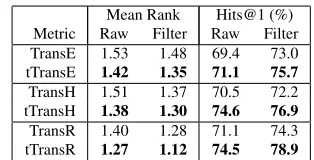
di-Mean Rank Hits@1 (%) Metric Raw Filter Raw Filter TransE 1.53 1.48 69.4 73.0 tTransE 1.42 1.35 71.1 75.7 TransH 1.51 1.37 70.5 72.2 tTransH 1.38 1.30 74.6 76.9 TransR 1.40 1.28 71.1 74.3 tTransR 1.27 1.12 74.5 78.9
Table 3:Evaluation results on relation prediction.
mension of the embeddingn is set in the range of {20,50,100}, the margin γ1 and γ2 are set in the
range {1,2,4,10}. The learning rate is set in the range {0.1, 0.01, 0.001}. The regularization hy-perparameter λis tuned in{10−1,10−2,10−3,10−4}. The best configuration is determined according to the mean rank in validation set. The optimal config-urations are n=100,γ1=γ2=4,λ=10−2, learning rate
is 0.001 and taking`1−norm.
Results. Table 2 reports the results on the test set. From the results, we can see that time-aware em-bedding methods outperform all the baselines on al-l the data sets and with aal-lal-l the metrics. The im-provements are usually quite significant. The Mean Rank drops by about 75%, and Hits@10 rises about 19% to 30%. This demonstrates the superiority and generality of our method. When dealing with s-parse data YG15k, all the temporal information is u-tilized to model temporal associations and make the embeddings more accurate, so it obtains better im-provement than mixing the time-unknown triples in YG36k.
3.2.2 Relation Prediction
Relation prediction aims to predict relations giv-en two giv-entities. Evaluation results are shown in Table 3 on only YG15K due to limited s-pace, where we report Hits@1 instead of Hit-s@10. Example prediction results for TransE and tTransE are compared in Table 4. For ex-ample, when testing(Billy Hughes,?,London,1862), it’s easy for TransE to mix relations wasBornIn
and diedIn because they act similarly for a per-son and a place. But known that (Billy Hughes, isAffiliatedTo, National Labor Party) happened in 1916, and tTransE have learnt temporal order that
wasBornIn→isAffiliatedTo→diedIn, so the regular-ization term |rbornT−raf f iliated| is smaller than
|rdiedT−raf f iliated|, so correct answerwasBornIn
Dataset YG15k YG36k
Metric RawMeanRankFilter RawHits@10(%)Filter RawMeanRankFilter RawHits@10(%)Filter
TransE 990 971 26.6 29.5 179 163 65.7 75.6
tTransE 235 233 35.4 36.1 60 55 76.1 82.8
TransH 986 966 25.7 28.0 174 158 65.3 77.8
tTransH 232 230 36.1 37.2 61 54 76.6 82.9
TransR 976 955 29.5 30.2 175 153 68.3 80.1
[image:4.612.116.496.53.218.2]tTransR 228 221 37.3 38.4 55 46 79.5 84.2
Table 2:Evaluation results on link prediction.
Testing quad TransE predictions tTransE predictions
(Billy Hughes,?,London,1862) diedIn,wasBornIn wasBornIn,diedIn (John Schoenherr,?,Caldecott Medal,1988) owns,hasWonPrize hasWonPrize,owns (John G. Thompson,?,University of Cambridge,1961) graduatedFrom,worksAt worksAt,graduatedFrom (Tommy Douglas,?,New Democratic Party,1961) isMarriedTo,isAffiliatedTo isAffiliatedTo,worksAt
Table 4:Example results of relation prediction in descending order. Correct predictions are inbold.
3.3 Triple Classification
Triple classification aims to judge whether an un-seen triple is correct or not.
Evaluation protocol. We follow the same evalua-tion protocol used in Socher et al. (2013). To create labeled data for classification, for each triple in the test and validation sets, we construct a correspond-ing negative triple by randomly corruptcorrespond-ing the enti-ties. To corrupt a position (head or tail), only entities that have appeared in that position are allowed. Dur-ing triple classification, a triple is predicted as posi-tive if the score is below a relation-specific threshold
δr; otherwise as negative. We report averaged
accu-racy on the test sets.
Implementation details.We use the same hyperpa-rameter settings as in the link prediction task. The relation-specific thresholdδris determined by
max-imizing averaged accuracy on the validation sets.
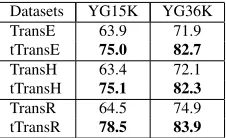
Results. Table 5 reports the results on the test set-s. The results indicate that time-aware embedding outperforms all the baselines consistently. Temporal order information may help to distinguish positive and negative triples as different head entities may have different temporally associated relations. If the temporal order is the same with most facts, the reg-ularization term helps it get lower energies and vice versa.
4 Related Work
Many models have been proposed for KB embed-ding (Nickel et al., 2011; Bordes et al., 2013; Socher et al., 2013). External information is employed to improve KB embedding such as text (Riedel et al.,
Datasets YG15K YG36K
TransE 63.9 71.9
tTransE 75.0 82.7
TransH 63.4 72.1
tTransH 75.1 82.3
TransR 64.5 74.9
[image:4.612.371.484.249.318.2]tTransR 78.5 83.9
Table 5:Evaluation results on triple classification (%).
2013; Wang et al., 2014a; Zhao et al., 2015), enti-ty enti-type and relationship domain (Guo et al., 2015; Chang et al., 2014), and relation path (Lin et al., 2015a; Gu et al., 2015). However, these methods solely rely on triple facts but neglect temporal or-der constraints between facts. Temporal informa-tion such as relainforma-tion ordering in text has been ex-plored (Talukdar et al., 2012; Chambers et al., 2014; Bethard, 2013; Cassidy et al., 2014; Chambers et al., 2007; Chambers and Jurafsky, 2008). This pa-per proposes a time-aware embedding approach that employs temporal order constraints to improve KB embedding.
5 Conclusion and Future Work
Acknowledgments
This research is supported by National Key Basic Research Program of China (No.2014CB340504) and National Natural Science Foundation of China (No.61375074,61273318). The contact author for this paper is Baobao Chang and Zhifang Sui.
References
Steven Bethard. 2013. Cleartk-timeml: A minimalist ap-proach to tempeval 2013. InSecond Joint Conference on Lexical and Computational Semantics (*SEM), Vol-ume 2: Proceedings of the Seventh International Work-shop on Semantic Evaluation (SemEval 2013), pages 10–14. Association for Computational Linguistics. Kurt Bollacker, Colin Evans, Praveen Paritosh, Tim
S-turge, and Jamie Taylor. 2008. Freebase: a collabo-ratively created graph database for structuring human knowledge. In Proceedings of the 2008 ACM SIG-MOD international conference on Management of da-ta, pages 1247–1250. ACM.
Antoine Bordes, Jason Weston, Ronan Collobert, and Yoshua Bengio. 2011. Learning structured embed-dings of knowledge bases. InConference on Artificial Intelligence, number EPFL-CONF-192344.
Antoine Bordes, Nicolas Usunier, Alberto Garcia-Duran, Jason Weston, and Oksana Yakhnenko. 2013. Trans-lating embeddings for modeling multi-relational data. InAdvances in Neural Information Processing System-s, pages 2787–2795.
Taylor Cassidy, Bill McDowell, Nathanael Chambers, and Steven Bethard. 2014. An annotation framework for dense event ordering. InACL.
Nathanael Chambers and Daniel Jurafsky. 2008. Un-supervised learning of narrative event chains. ACL, 94305:789–797.
Nathanael Chambers, Shan Wang, and Dan Jurafsky. 2007. Classifying temporal relations between events. In Proceedings of the 45th Annual Meeting of the A-CL on Interactive Poster and Demonstration Session-s, pages 173–176. Association for Computational Lin-guistics.
Nathanael Chambers, Taylor Cassidy, Bill McDowell, and Steven Bethard. 2014. Dense event ordering with a multi-pass architecture. Transactions of the Associ-ation for ComputAssoci-ational Linguistics, 2:273–284. Kai-Wei Chang, Wen-tau Yih, Bishan Yang, and
Christo-pher Meek. 2014. Typed tensor decomposition of knowledge bases for relation extraction. InEMNLP, pages 1568–1579.
MS Fabian, K Gjergji, and W Gerhard. 2007. Ya-go: A core of semantic knowledge unifying wordnet
and wikipedia. In16th International World Wide Web Conference, WWW, pages 697–706.
Kelvin Gu, John Miller, and Percy Liang. 2015. Travers-ing knowledge graphs in vector space. arXiv preprint arXiv:1506.01094.
Shu Guo, Quan Wang, Bin Wang, Lihong Wang, and Li Guo. 2015. Semantically smooth knowledge graph embedding. InProceedings of the 53rd Annual Meet-ing of the Association for Computational LMeet-inguistics and the 7th International Joint Conference on Natural Language Processing, pages 84–94.
Johannes Hoffart, Fabian M Suchanek, Klaus Berberich, and Gerhard Weikum. 2013. Yago2: A spatially and temporally enhanced knowledge base from wikipedia.
Artificial Intelligence, 194:28–61.
Yankai Lin, Zhiyuan Liu, and Maosong Sun. 2015a. Modeling relation paths for representation learning of knowledge bases. arXiv preprint arXiv:1506.00379. Yankai Lin, Zhiyuan Liu, Maosong Sun, Yang Liu, and
Xuan Zhu. 2015b. Learning entity and relation em-beddings for knowledge graph completion.
Maximilian Nickel, Volker Tresp, and Hans-Peter Kriegel. 2011. A three-way model for collective learning on multi-relational data. In Proceedings of the 28th international conference on machine learning (ICML-11), pages 809–816.
Sebastian Riedel, Limin Yao, Andrew McCallum, and Benjamin M Marlin. 2013. Relation extraction with matrix factorization and universal schemas.
Richard Socher, Danqi Chen, Christopher D Manning, and Andrew Ng. 2013. Reasoning with neural ten-sor networks for knowledge base completion. In
Advances in Neural Information Processing Systems, pages 926–934.
Partha Pratim Talukdar, Derry Wijaya, and Tom Mitchel-l. 2012. Acquiring temporal constraints between rela-tions. InCIKM.
Zhen Wang, Jianwen Zhang, Jianlin Feng, and Zheng Chen. 2014a. Knowledge graph and text jointly em-bedding. InProceedings of the 2014 Conference on Empirical Methods in Natural Language Processing (EMNLP)., pages 1591–1601.
Zhen Wang, Jianwen Zhang, Jianlin Feng, and Zheng Chen. 2014b. Knowledge graph embedding by trans-lating on hyperplanes. InProceedings of the Twenty-Eighth AAAI Conference on Artificial Intelligence, pages 1112–1119.