Natural Language Comprehension with the EpiReader
Adam Trischler
adam.trischler
Zheng Ye
jeff.ye
Xingdi Yuan
eric.yuan
Philip Bachman
phil.bachman
Alessandro Sordoni
alessandro.sordoni
Kaheer Suleman
k.suleman
@maluuba.com Maluuba Research Montréal, Québec, Canada
Abstract
We present EpiReader, a novel model for ma-chine comprehension of text. Mama-chine com-prehension of unstructured, real-world text is a major research goal for natural language pro-cessing. Current tests of machine comprehen-sion pose questions whose answers can be in-ferred from some supporting text, and evaluate a model’s response to the questions. EpiReader is an end-to-end neural model comprising two components: the first component proposes a small set of candidate answers after compar-ing a question to its supportcompar-ing text, and the second component formulates hypotheses us-ing the proposed candidates and the question, then reranks the hypotheses based on their esti-mated concordance with the supporting text. We present experiments demonstrating that EpiReader sets a new state-of-the-art on the CNN and Children’s Book Test benchmarks, outperforming previous neural models by a sig-nificant margin.
1 Introduction
When humans reason about the world, we tend to for-mulate a variety of hypotheses and counterfactuals, then test them in turn by physical or thought exper-iments. The philosopher Epicurus first formalized this idea in his Principle of Multiple Explanations: if several theories are consistent with the observed data, retain them all until more data is observed. In this pa-per, we argue that the same principle can be applied to machine comprehension of natural language. We propose a deep neural comprehension model, trained end-to-end, that we call EpiReader.
Comprehension of natural language by machines, at a near-human level, is a prerequisite for an ex-tremely broad class of useful applications of artificial intelligence. Indeed, most human knowledge is col-lected in the natural language of text. Machine com-prehension (MC) has therefore garnered significant attention from the machine learning research commu-nity. Machine comprehension is typically evaluated by posing a set of questions based on a supporting text passage, then scoring a system’s answers to those questions. Such tests are objectively gradable and may assess a range of abilities, from basic understand-ing to causal reasonunderstand-ing to inference (Richardson et al., 2013).
In the past year, two large-scale MC datasets have been released: the CNN/Daily Mail corpus, consist-ing of news articles from those outlets (Hermann et al., 2015), and the Children’s Book Test (CBT), consisting of short excerpts from books available through Project Gutenberg (Hill et al., 2016). The size of these datasets (on the order of105 distinct questions) makes them amenable to data-intensive deep learning techniques. Both corpora use Cloze-style questions (Taylor, 1953), which are formulated by replacing a word or phrase in a given sentence with a placeholder token. The task is then to find the answer that “fills in the blank”.
In tandem with these corpora, a host of neu-ral machine comprehension models has been devel-oped (Weston et al., 2015b; Hermann et al., 2015; Hill et al., 2016; Kadlec et al., 2016; Chen et al., 2016). We compare EpiReader to these earlier mod-els through training and evaluation on the CNN and
CBT datasets.1
EpiReader factors into two components. The first component extracts a small set of potential answers based on a shallow comparison of the question with its supporting text; we call this theExtractor. The sec-ond component reranks the proposed answers based on deeper semantic comparisons with the text; we call this theReasoner. We can summarize this
pro-cess as Extract → Hypothesize → Test2. The
se-mantic comparisons implemented by the Reasoner are based on the concept ofrecognizing textual en-tailment(RTE) (Dagan et al., 2006), also known as natural language inference. This process is computa-tionally demanding. Thus, the Extractor serves the important function of filtering a large set of poten-tial answers down to a small, tractable set of likely candidates for more thorough testing. The two-stage process is an analogue ofstructured prediction cas-cades(Weiss and Taskar, 2010), wherein a sequence of increasingly complex models progressively filters the output space in order to trade off between model complexity and limited computational resources. We demonstrate that this cascade-like framework is appli-cable to machine comprehension and can be trained end-to-end with stochastic gradient descent.
The Extractor follows the form of a pointer net-work (Vinyals et al., 2015), and uses a differentiable attention mechanism to indicate words in the text that potentially answer the question. This approach was used (on its own) for question answering with the Attention Sum Reader (Kadlec et al., 2016). The Extractor outputs a small set of answer candidates along with their estimated probabilities of correct-ness. The Reasoner forms hypotheses by inserting the candidate answers into the question, then esti-mates the concordance of each hypothesis with each sentence in the supporting text. We use these esti-mates as a measure of the evidence for a hypothesis, and aggregate evidence over all sentences. In the end, we combine the Reasoner’s evidence with the Extractor’s probability estimates to produce a final ranking of the answer candidates.
1The CNN and Daily Mail datasets were released together and have the same form. The Daily Mail dataset is signifi-cantly larger; therefore, models consistently score higher when trained/tested on it.
2The Extractor performs extraction, while the Reasoner both hypothesizes and tests.
This paper is organized as follows. In Section 2 we formally define the problem to be solved and give some background on the datasets used in our tests. In Section 3 we describe EpiReader, focusing on its two components and how they combine. Section 4 discusses related work, and Section 5 details our experimental results and analysis. We conclude in Section 6.
2 Problem definition, notation, datasets EpiReader’s task is to answer a Cloze-style question by reading and comprehending a supporting passage of text. The training and evaluation data consist of tuples(Q,T, a∗, A), whereQis the question (a se-quence of words {q1, ...q|Q|}), T is the text (a se-quence of words{t1, ..., t|T |}),Ais a set of possible answers{a1, ..., a|A|}, anda∗ ∈Ais the correct
an-swer. All words come from a vocabulary V, and
A ⊂ T. In each question, there is a placeholder
token indicating the missing word to be filled in.
2.1 Datasets
CNN This corpus is built using articles scraped
from the CNN website. The articles themselves form the text passages, and questions are generated syn-thetically from short summary statements that ac-company each article. These summary points are (presumably) written by human authors. Each ques-tion is created by replacing a named entity in a sum-mary point with a placeholder token. All named entities in the articles and questions are replaced with anonymized tokens that are shuffled for each(Q,T) pair. This forces the model to rely only on the text, rather than learning world knowledge about the en-tities during training. The CNN corpus (henceforth CNN) was presented by Hermann et al. (2015).
stan-dard LSTM language models already achieve human-level performance on the latter two. Unlike in the CNN corpora, named entities are not anonymized and shuffled in the Children’s Book Test (CBT). CBT was presented by Hill et al. (2016).
The different methods of construction for ques-tions in each corpus mean that CNN and CBT assess different aspects of comprehension. The summary points of CNN are a condensed paraphrasing of infor-mation in the text; thus, determining the correct an-swer relies mostly on recognizing textual entailment. On the other hand, CBT is about story prediction. It is a comprehension task insofar as comprehension is likely necessary for story prediction, but comprehen-sion alone may not be sufficient. Indeed, there are some CBT questions that are unanswerable given the preceding context.
3 EpiReader
3.1 Overview and intuition
EpiReader explicitly leverages the observation that the answer to a question is often a word or phrase from the related text passage. This condition holds for the CNN and CBT datasets. EpiReader’s first module, the Extractor, can thus select a small set of candidate answers by pointing to their locations in the supporting passage. This mechanism is detailed in Section 3.2, and was used previously by the At-tention Sum Reader (Kadlec et al., 2016). Pointing to candidate answers removes the need to apply a softmax over the entire vocabulary as in Weston et al. (2015b), which is computationally more costly and uses less-direct information about the context of a predicted answer in the supporting text.
EpiReader’s second module, the Reasoner, begins by formulating hypotheses using the extracted answer candidates. It generates each hypothesis by replacing the placeholder token in the question with an answer candidate. Cloze-style questions are ideally-suited to this process, because inserting the correct answer at the placeholder location produces a well-formed, grammatical statement. Thus, the correct hypothesis will “make sense” to a language model.
The Reasoner then tests each hypothesis individu-ally. It compares a hypothesis to the text, split into sentences, to measure textual entailment, and then ag-gregates entailment over all sentences. This
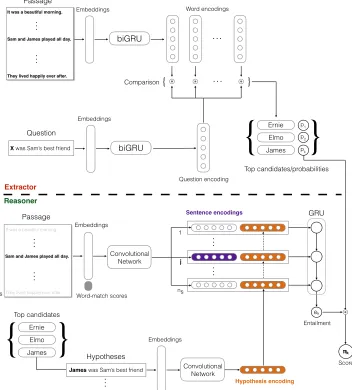
compu-tation uses a pair of convolutional encoder networks followed by a recurrent neural network. The convo-lutional encoders generate abstract representations of the hypothesis and each text sentence; the recurrent network estimates and aggregates entailment. This is described formally in Section 3.3. The end-to-end EpiReader model, combining the Extractor and Reasoner modules, is depicted in Figure 1.
Throughout our model, words will be represented with trainable embeddings (Bengio et al., 2000). We
represent these embeddings using a matrix W ∈
RD×|V|, whereDis the embedding dimension and |V|is the vocabulary size.
3.2 The Extractor
The Extractor is a Pointer Network (Vinyals et al., 2015). It uses a pair of bidirectional recurrent neural networks,f(θT,T)andg(θQ,Q), to encode the text passage and the question. θT represents the param-eters of the text encoder, andT ∈ RD×N is a
ma-trix representation of the text (comprisingN words),
whose columns are individual word embeddingsti.
Likewise,θQrepresents the parameters of the ques-tion encoder, andQ∈RD×NQis a matrix
represen-tation of the question (comprisingNQwords), whose columns are individual word embeddingsqj.
We use a recurrent neural network with gated recur-rent units (GRU) (Bahdanau et al., 2015) to scan over the columns (i.e. word embeddings) of the input ma-trix. We selected the GRU because it is computation-ally simpler than Long Short-Term Memory (Hochre-iter and Schmidhuber, 1997), while still avoiding the problem of vanishing/exploding gradients often encountered when training recurrent networks.
The GRU’s hidden state gives a representation of
the ith word conditioned on preceding words. To
include context from proceeding words, we run a
second GRU overT in the reverse direction. We
refer to the combination as a biGRU. At each step the
biGRU outputs twod-dimensional encoding vectors,
one for the forward direction and one for the back-ward direction. We concatenate these to yield a vector
f(ti)∈R2d. The question biGRU is similar, but we form a single-vector representation of the question by concatenating the final forward state with the final backward state, which we denoteg(Q)∈R2d.
}
{
{ }
biGRU Embeddings
X was Sam’s best friend
Comparison
Top candidates/probabilities Passage
Question
Ernie
James Elmo …
…
biGRU Embeddings
Word encodings
Question encoding
Sam and James played all day.
…
…
It was a beautiful morning.
They lived happily ever after.
p1 p2 pk
Convolutional Network
James was Sam’s best friend
Hypotheses
GRU
Top candidates
}
{
ErnieJames Elmo Sam and James played all day.
It was a beautiful morning.
They lived happily ever after.
…
…
Embeddings
Passage
Embeddings
Hypothesis encoding Sentence encodings
…
…
j
1
ns
Convolutional Network
ek Entailment
πk
Score
Extractor
Reasoner
Word-match scores 1
j
ns
[image:4.612.131.483.63.453.2]…
Figure 1:The complete EpiReader framework. The Extractor is above, the Reasoner below. Propagating the Extractor’s probability estimates forward and combining them with the Reasoner’s entailment estimates renders the model end-to-end differentiable.
using
si ∝exp(f(ti)·g(Q)), (1)
which takes the inner product of the text and question representations followed by a softmax. In many cases unique words repeat in a text. Therefore, we compute the total probability that wordwis the correct answer
using a sum:
P(w| T,Q) = X
i:ti=w
si. (2)
This probability is evaluated for each unique word in
T. Finally, the Extractor outputs the set{p1, ..., pK}
of theK highest word probabilities from 2, along
with the corresponding set ofK most probable
an-swer words{ˆa1, ...,ˆaK}.
3.3 The Reasoner
The indicial selection involved in gathering
{ˆa1, ...,ˆaK}, which is equivalent to a K-best
arg max, is not a continuous function of its inputs. To construct an end-to-end differentiable model, we bypass this by propagating the probability estimates of the Extractor directly through the Reasoner.
The Reasoner begins by inserting the answer can-didates, which are single words or phrases, into the
question sequence Q at the placeholder location.
point, we consider each hypothesis to have proba-bility p(Hk) ≈ pk, as estimated by the Extractor. The Reasoner updates and refines this estimate.
The hypotheses represent new information in some sense—they are statements we have constructed, al-beit from words already present in the question and text passage. The Reasoner estimates entailment
be-tween the statements Hk and the passage T. We
denote these estimates usingek =F(Hk,T), with
F to be defined. We start by reorganizing T into
a sequence ofNs sentences: T ={t1, . . . , tN} →
{S1, . . . ,SNs}, whereSiis a sequence of words.
For each hypothesis and each sentence of the text, Reasoner input consists of two matrices:Si ∈
RD×|Si|, whose columns are the embedding vectors
for each word of sentenceSi, andHk ∈ RD×|Hk|, whose columns are the embedding vectors for each word in the hypothesisHk. The embedding vectors
themselves come from matrixW, as before.
These matrices feed into a convolutional architec-ture based on that of Severyn and Moschitti (2016). The architecture first augmentsSiwith matrixM∈
R2×|Si|. The first row ofMcontains the inner
prod-uct of each word embedding in the sentence with the candidate answer embedding, and the second row contains the maximum inner product of each sen-tence word embedding with any word embedding in the question. These word-matching features were inspired by similar approaches in Wang and Jiang (2016) and Trischler et al. (2016), where they were shown to improve entailment estimates.
The augmentedSiis then convolved with a bank
of filtersFS ∈ R(D+2)×m, whileH
k is convolved with filtersFH ∈ RD×m, wheremis the convolu-tional filter width. We add a bias term and apply a nonlinearity (we use a ReLU) following the convo-lution. Maxpooling over the sequences then yields two vectors: the representation of the text sentence,
rSi ∈RNF, and the representation of the hypothesis,
rHk ∈RNF, whereN
F is the number of filters. We then compute a scalar similarity score between these vector representations using the bilinear form
ς=rTSiRrHk, (3)
whereR∈RNF×NF is a matrix of trainable
parame-ters. We then concatenate the similarity score with the sentence and hypothesis representations to get a
vector, xik = [ς;rSi;rHk]
T. There are more
pow-erful models of textual entailment that could have been used in place of this convolutional architecture. We adopted the approach of Severyn and Moschitti (2016) for computational efficiency.
The resulting sequence ofNs vectors feeds into yet another GRU for synthesis, of hidden dimension
dS. Intuitively, it is often the case that evidence for a particular hypothesis is distributed over several sentences. For instance, if we hypothesize thatthe football is in the park, perhaps it is because one sen-tence tells us thatSam picked up the football and a later one tells us thatSam ran to the park.3 The
Rea-soner synthesizes distributed information by running a GRU network overxik, whereiindexes sentences and represents the step dimension.4 The final hidden
state of the GRU is fed through a fully-connected layer, yielding a single scalaryk. This value repre-sents the collected evidence forHkbased on the text. In practice, the Reasoner processes allKhypotheses
in parallel and the estimated entailment of each is normalized by a softmax,ek∝exp(yk).
As pointed out in Kadlec et al. (2016), it is a strength of the pointer framework that it does not blend the representations that are being attended. Contrast this with typical attention mechanisms where such a blended representation is used
down-stream to make similarity comparisons with, e.g.,
output vectors.
Differentiable attention mechanisms (as in Bah-danau et al. (2015), for example) typically blend in-ternal representations together through a weighted sum, then use this ‘blend’ downstream for similarity comparisons. The pointer framework does not resort to this blending; Kadlec et al. (2016) explain that this is an advantage, since in comprehension tasks the goal is to select the correct answer among semanti-cally similar candidates and more exact matching is necessary. The reranking function performed by the Reasoner entails this advantage, by examining the separate hypotheses individually without blending.
3This example is characteristic of thebAbIdataset (Weston et al., 2015a).
3.4 Combining components
Finally, we combine the evidence from the Reasoner with the probability from the Extractor. We com-pute the output probability of each hypothesis,πk, according to the product
πk∝ekpk, (4)
whereby the evidence of the Reasoner can be inter-preted as a correction to the Extractor probabilities, applied as an additive shift inlog-space. We experi-mented with other combinations of the Extractor and Reasoner, but we found the multiplicative approach to yield the best performance.
After combining results from the Extractor and Reasoner to get the probabilities πk described in Eq. 4, we optimize the parameters of the full EpiReader to minimize a cost comprising two terms,
LE andLR. The first term is a standard negative log-likelihood objective, which encourages the Extractor to rate the correct answer above other answers. This is the same loss term used in Kadlec et al. (2016). It is given by:
LE = E
(Q,T,a∗,A)[−logP(a
∗| T,Q)], (5)
where P(a∗| T,Q) is as defined in Eq. 2, anda∗
denotes the true answer. The second term is a margin-based loss on the end-to-end probabilities πk. We defineπ∗as the probabilityπkcorresponding to the true answer worda∗. This term is given by:
LR= E (Q,T,a∗,A)
X
ˆ
ai∈{ˆa1,...,ˆaK}\a∗
[γ−π∗+πˆai]+
,
(6) where γ is a margin hyperparameter, {ˆa1, ...,ˆaK}
is the set ofK answers proposed by the Extractor,
and[x]+ indicates truncatingxto be non-negative. Intuitively, this loss says that we want the end-to-end probabilityπ∗for the correct answer to be at leastγ
larger than the probabilityπˆaifor any other answer
proposed by the Extractor. During training, the cor-rect answer is occasionally missed by the Extractor, especially in early epochs. We counter this issue by forcing the correct answer into the topKset while training. When evaluating the model on validation and test examples we rely fully on the topKanswers
proposed by the Extractor.
To get the final loss termLER, minus`2 regular-ization terms on the model parameters, we take a weighted combination ofLE andLR:
LER=LE+λLR, (7) whereλis a hyperparameter for weighting the rela-tive contribution of the Extractor and Reasoner losses. In practice, we found thatλshould be fairly large
(e.g., 10 < λ < 100). Empirically, we observed that the output probabilities from the Extractor of-ten peak and saturate the first softmax; hence, the Extractor term can come to dominate the Reasoner term without the weightλ(we discuss the Extractor’s
propensity to overfit in Section 5). 4 Related Work
The Impatient and Attentive Reader models were proposed by Hermann et al. (2015). The Attentive Reader applies bidirectional recurrent encoders to the question and supporting text. It then uses the atten-tion mechanism described in Bahdanau et al. (2015) to compute a fixed-length representation of the text based on a weighted sum of the text encoder’s output, guided by comparing the question representation to each location in the text. Finally, a joint representa-tion of the quesrepresenta-tion and supporting text is formed by passing their separate representations through a feed-forward MLP and an answer is selected by comparing the MLP output to a representation of each possible answer. The Impatient Reader operates similarly, but computes attention over the text after processing each consecutive word of the question. The two models achieved similar performance on the CNN and Daily Mail datasets.
Most of the details for the very recent AS Reader are provided in the description of our Extractor mod-ule in Section 3.2, so we do not summarize it further here. This model (Kadlec et al., 2016) set the previ-ous state-of-the-art on the CBT dataset.
During the write-up of this paper, another very re-cent model came to our attention. Chen et al. (2016) propose using a bilinear term instead of atanhlayer to compute the attention between question and pas-sage words, and also uses the attended word encod-ings for direct, pointer-style prediction as in Kadlec et al. (2016). This model set the previous state-of-the-art on the CNN dataset. However, this model used embedding vectors pretrained on a large external cor-pus (Pennington et al., 2014).
EpiReader borrows ideas from other models as well. The Reasoner’s convolutional architecture is based on Severyn and Moschitti (2016) and Blunsom et al. (2014). Our use of word-level matching was in-spired by the Parallel-Hierarchical model of Trischler et al. (2016) and the natural language inference model of Wang and Jiang (2016). Finally, the idea of formu-lating and testing hypotheses for question-answering was used to great effect in IBM’s DeepQA system forJeopardy!(Ferrucci et al., 2010) (although that was a more traditional information retrieval pipeline rather than an end-to-end neural model), and also resembles the framework of structured prediction cascades (Weiss and Taskar, 2010).
5 Evaluation
5.1 Implementation and training details
To train our model we used stochastic gradient de-scent with the ADAM optimizer (Kingma and Ba, 2015), with an initial learning rate of 0.001. The word embeddings were initialized randomly, draw-ing from the uniform distribution over[−0.05,0.05). We used batches of 32 examples, and early stopping with a patience of 2 epochs. Our model was imple-mented in Theano (Bergstra et al., 2010) using the Keras framework (Chollet, 2015).
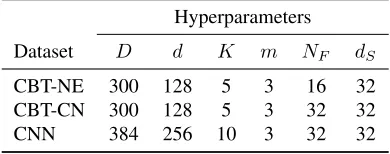
[image:7.612.329.524.127.204.2]The results presented below for EpiReader were obtained by searching over a small grid of hyperpa-rameter settings. We selected the model that, on each dataset, maximized accuracy on the validation set, then evaluated it on the test set. We record the best settings for each dataset in Table 1. As has been
Table 1: Hyperparameter settings for best EpiReaders. Dis the embedding dimension,dis the hidden dimension in the Extractor GRUs,Kis the number of candidates to consider,m is the filter width,NF is the number of filters, anddS is the hidden dimension in the Reasoner GRU.
Hyperparameters Dataset D d K m NF dS
CBT-NE 300 128 5 3 16 32 CBT-CN 300 128 5 3 32 32
CNN 384 256 10 3 32 32
done previously, we train separate models on CBT’s named entity NE) and common noun (CBT-CN) splits. All our models used`2-regularization at0.001, λ = 50, andγ = 0.04. We did not use dropout but plan to investigate its effect in the future. Hill et al. (2016) and Kadlec et al. (2016) also present results for ensembles of their models. Time did not permit us to generate an ensemble of EpiReaders on the CNN dataset so we omit those measures; how-ever, EpiReader ensembles (of seven models) demon-strated improved performance on the CBT dataset.
5.2 Results
CBT-NE CBT-CN
Model valid test valid test
Humans (context + query)1 - 81.6 - 81.6
LSTMs (context + query)1 51.2 41.8 62.6 56.0
MemNNs1 70.4 66.6 64.2 63.0
AS Reader2 73.8 68.6 68.8 63.4
EpiReader Extractor 73.2 69.4 69.9 66.7 EpiReader 75.3 69.7 71.5 67.4
AS Reader (ensemble)2 74.5 70.6 71.1 68.9
EpiReader (ensemble) 76.6 71.8 73.6 70.6
CNN
Model valid test
Deep LSTM Reader3 55.0 57.0
Attentive Reader3 61.6 63.0
Impatient Reader3 61.8 63.8
MemNNs1 63.4 66.8
AS Reader2 68.6 69.5
Stanford AR4 72.4 72.4
EpiReader Extractor 71.8 72.0 EpiReader 73.4 74.0
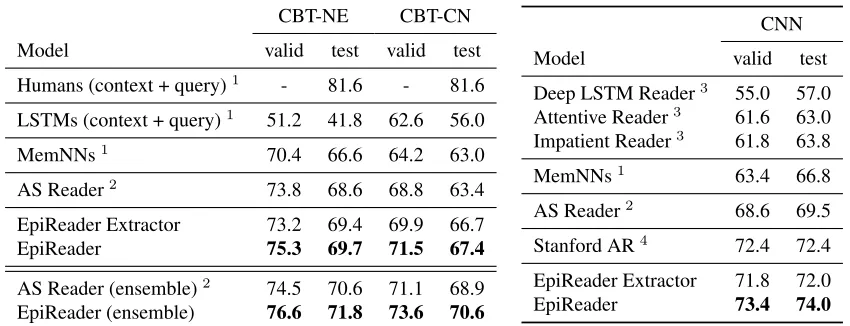
Table 2:Model comparison on the CBT and CNN datasets. Results marked with1are from Hill et al. (2016), with2are from Kadlec et al. (2016), with3are from Hermann et al. (2015), and with4are from Chen et al. (2016).
Ablated component Validation accuracy (%)
- 71.5
Word-match scores 70.3 Bilinear similarity 70.0
Reasoner 68.7
[image:8.612.94.519.59.222.2]Convolutional encoders 71.0
Table 3:Ablation study on CBT-CN validation set.
On CBT-CN our single model scores 4.0% higher than the previous best of the AS Reader. The improve-ment on CBT-NE is more modest at 1.1%. Looking more closely at our CBT-NE results, we found that the validation and test accuracies had relatively high variance even in late epochs of training. We discov-ered that many of the validation and test questions were asked about the same named entity, which may explain this issue.
5.3 Analysis
We measure the contribution of several components of the Reasoner by ablating them. Results on the validation set of CBT-CN are presented in Table 3. The word-match scores (cosine similarities stored in the first two rows of matrixM, see Section 3.3) make
a contribution of 1.2% to the validation performance, indicating that they are useful. Similarly, the bilinear similarity scoreς, which is passed to the final GRU
network, contributes 1.5%.
Removing the Reasoner altogether reduces our model to the AS Reader, whose results we have
reproduced to within negligible difference. Aside from achieving state-of-the-art results at its final out-put, the EpiReader framework gives a boost to its Extractor component through the joint training pro-cess. This can be seen by referring back to Table 5.2, wherein we also provide accuracy scores evaluated at the output of the Extractor. These are all higher than the analogous scores reported for the AS Reader. Based on our own work with that model, we found it to overfit the training set rapidly and significantly, achieving training accuracy scores upwards of 98% after only 2 epochs. We suspect that the Reasoner module had a regularizing effect on the Extractor, but leave the confirmation for future work.
Mr. Blacksnake grinned and started after him, not very fast because he knew that he wouldn't have to run very fast to catch old Mr. Toad, and he thought the exercise would do him good. …
“Still, the green meadows wouldn't be quite the same without old Mr. Toad.
I should miss him if anything happened to him.
I suppose it would be partly my fault, too, for if I hadn't pulled over that piece of bark, he probably would have stayed there the rest of the day and been safe.”
QUESTION:
“Maybe he won't meet Mr. XXXXX,” said a little voice inside of Jimmy.
EXTRACTOR: Toad
REASONER: Blacksnake
1.
18.
[image:9.612.74.295.57.212.2]21. 19. 20.
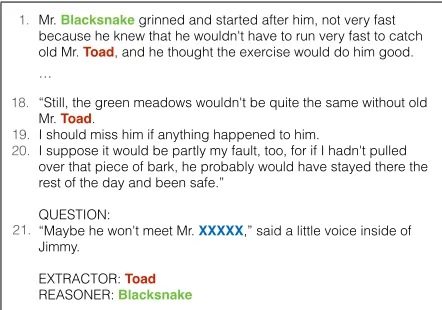
Figure 2:An abridged example from CBT-NE demonstrating corrective reranking by the Reasoner.
Table 3. This suggests that competitive performance may be achieved with other, simpler architectures for the Reasoner’s entailment system and this will be the subject of future research.
An analysis by Kadlec et al. (2016) indicates that the trained AS Reader includes the correct answer among its five most probable candidates on approxi-mately 95% of test examples for both datasets. We verified that our Extractor achieved a similar rate, and of course this is vital for performance of the full system, since the Reasoner cannot recover when the correct answer is not among its inputs.
Our results show that the Reasoner often corrects erroneous answers from the Extractor. Figure 2 gives an example of this correction. In the text passage, from CBT-NE, Mr. Blacksnake is pursuing Mr. Toad, presumably to eat him. The dialogue in the question sentence refers to both: Mr. Toad is its subject, re-ferred to by the pronoun “he”, and Mr. Blacksnake is its object. In the preceding sentences, it is clear (to a human) that Jimmy is worried about Mr. Toad and his potential encounter with Mr. Blacksnake. The Extractor, however, points most strongly to “Toad”, possibly because he has been referred to most re-cently. The Reasoner corrects this error and selects “Blacksnake” as the answer. This relies on a deeper understanding of the text. The named entity can, in this case, be inferred through an alternation of the entities most recently referred to. This kind alterna-tion is typical of dialogues, when two actors interact in turns. The Reasoner can capture this behavior because it examines sentences in sequence.
6 Conclusion
We presented the novel EpiReader framework for machine comprehension and evaluated it on two large, complex datasets: CNN and CBT. Our model achieves state-of-the-art results on these corpora, out-performing all previous approaches. In future work, we plan to test our framework with alternative models for natural language inference (e.g., Wang and Jiang (2016)), and explore the effect of pretraining such a model specifically on an inference task.
As a general framework that consists in a two-stage cascade, EpiReader can be implemented using a variety of mechanisms in the Extractor and Reasoner stages. We have demonstrated that this cascade-like framework is applicable to machine comprehension and can be trained end-to-end. As more powerful machine comprehension models inevitably emerge, it may be straightforward to boost their performance using EpiReader’s structure.
References
[Bahdanau et al.2015] Dzmitry Bahdanau, Kyunghyun Cho, and Yoshua Bengio. 2015. Neural machine trans-lation by jointly learning to align and translate.ICLR. [Bengio et al.2000] Yoshua Bengio, Réjean Ducharme,
and Pascal Vincent. 2000. A neural probabilistic lan-guage model. InAdvances in Neural Information Pro-cessing Systems, pages 932–938.
[Bergstra et al.2010] J. Bergstra, O. Breuleux, F. Bastien, P. Lamblin, R. Pascanu, G. Desjardins, J. Turian, D. Warde-Farley, and Y. Bengio. 2010. Theano: a CPU and GPU math expression compiler. InIn Proc. of SciPy.
[Blunsom et al.2014] Phil Blunsom, Edward Grefenstette, and Nal Kalchbrenner. 2014. A convolutional neural network for modelling sentences.
[Chen et al.2016] Danqi Chen, Jason Bolton, and Christo-pher D. Manning. 2016. A thorough examination of the cnn / daily mail reading comprehension task. In
Association for Computational Linguistics (ACL). [Chollet2015] François Chollet. 2015. keras. https:
//github.com/fchollet/keras.
[Ferrucci et al.2010] David Ferrucci, Eric Brown, Jennifer Chu-Carroll, James Fan, David Gondek, Aditya A Kalyanpur, Adam Lally, J William Murdock, Eric Ny-berg, John Prager, et al. 2010. Building watson: An overview of the deepqa project. AI magazine, 31(3):59– 79.
[Hermann et al.2015] Karl Moritz Hermann, Tomas Ko-cisky, Edward Grefenstette, Lasse Espeholt, Will Kay, Mustafa Suleyman, and Phil Blunsom. 2015. Teaching machines to read and comprehend. InAdvances in Neu-ral Information Processing Systems, pages 1684–1692. [Hill et al.2016] Felix Hill, Antoine Bordes, Sumit Chopra, and Jason Weston. 2016. The goldilocks principle: Reading children’s books with explicit memory repre-sentations.ICLR.
[Hochreiter and Schmidhuber1997] Sepp Hochreiter and Jürgen Schmidhuber. 1997. Long short-term memory.
Neural computation, 9(8):1735–1780.
[Kadlec et al.2016] Rudolf Kadlec, Martin Schmid, On-drej Bajgar, and Jan Kleindienst. 2016. Text under-standing with the attention sum reader network. arXiv preprint arXiv:1603.01547.
[Kingma and Ba2015] Diederik Kingma and Jimmy Ba. 2015. Adam: A method for stochastic optimization.
ICLR.
[Pennington et al.2014] Jeffrey Pennington, Richard Socher, and Christopher D Manning. 2014. GloVe: Global vectors for word representation.Proc. EMNLP, 12.
[Richardson et al.2013] Matthew Richardson, Christo-pher JC Burges, and Erin Renshaw. 2013. Mctest: A challenge dataset for the open-domain machine com-prehension of text. InEMNLP, volume 1, page 2. [Severyn and Moschitti2016] Aliaksei Severyn and
Alessandro Moschitti. 2016. Modeling relational in-formation in question-answer pairs with convolutional neural networks. arXiv preprint arXiv:1604.01178. [Taylor1953] Wilson L Taylor. 1953. Cloze procedure:
a new tool for measuring readability.Journalism and Mass Communication Quarterly, 30.
[Trischler et al.2016] Adam Trischler, Zheng Ye, Xingdi Yuan, Jing He, Philip Bachman, and Kaheer Suleman. 2016. A parallel-hierarchical model for machine com-prehension on sparse data. InProceedings of the 54th Annual Meeting of the Association for Computational Linguistics.
[Vinyals et al.2015] Oriol Vinyals, Meire Fortunato, and Navdeep Jaitly. 2015. Pointer networks. InAdvances in Neural Information Processing Systems, pages 2674– 2682.
[Wang and Jiang2016] Shuohang Wang and Jing Jiang. 2016. Learning natural language inference with lstm.
NAACL.
[Weiss and Taskar2010] David J Weiss and Benjamin Taskar. 2010. Structured prediction cascades. In AIS-TATS, pages 916–923.
[Weston et al.2015a] Jason Weston, Antoine Bordes, Sumit Chopra, and Tomas Mikolov. 2015a. Towards ai-complete question answering: A set of prerequisite toy tasks. arXiv preprint arXiv:1502.05698.