Deep Reinforcement Learning for Dialogue Generation
Jiwei Li1, Will Monroe1, Alan Ritter2, Michel Galley3, Jianfeng Gao3 and Dan Jurafsky1 1Stanford University, Stanford, CA, USA
2Ohio State University, OH, USA
3Microsoft Research, Redmond, WA, USA
{jiweil,wmonroe4,jurafsky}@stanford.edu, [email protected] {mgalley,jfgao}@microsoft.com
Abstract
Recent neural models of dialogue generation offer great promise for generating responses for conversational agents, but tend to be short-sighted, predicting utterances one at a time while ignoring their influence on future out-comes. Modeling the future direction of a di-alogue is crucial to generating coherent, inter-esting dialogues, a need which led traditional NLP models of dialogue to draw on reinforce-ment learning. In this paper, we show how to integrate these goals, applying deep reinforce-ment learning to model future reward in chat-bot dialogue. The model simulates dialogues between two virtual agents, using policy gradi-ent methods to reward sequences that display three useful conversational properties: infor-mativity, coherence, and ease of answering (re-lated to forward-looking function). We evalu-ate our model on diversity, length as well as with human judges, showing that the proposed algorithm generates more interactive responses and manages to foster a more sustained conver-sation in dialogue simulation. This work marks a first step towards learning a neural conversa-tional model based on the long-term success of dialogues.
1 Introduction
Neural response generation (Sordoni et al., 2015; Shang et al., 2015; Vinyals and Le, 2015; Li et al., 2016a; Wen et al., 2015; Yao et al., 2015; Luan et al., 2016; Xu et al., 2016; Wen et al., 2016; Li et al., 2016b; Su et al., 2016) is of growing inter-est. The LSTM sequence-to-sequence (SEQ2SEQ)
model (Sutskever et al., 2014) is one type of neural generation model that maximizes the probability of generating a response given the previous dialogue turn. This approach enables the incorporation of rich
context when mapping between consecutive dialogue turns (Sordoni et al., 2015) in a way not possible, for example, with MT-based dialogue models (Ritter et al., 2011).
Despite the success of SEQ2SEQ models in
di-alogue generation, two problems emerge: First, SEQ2SEQmodels are trained by predicting the next
dialogue turn in a given conversational context using the maximum-likelihood estimation (MLE) objective function. However, it is not clear how well MLE approximates the real-world goal of chatbot develop-ment: teaching a machine to converse with humans, while providing interesting, diverse, and informative feedback that keeps users engaged. One concrete example is that SEQ2SEQmodels tend to generate
highly generic responses such as “I don’t know” re-gardless of the input (Sordoni et al., 2015; Serban et al., 2016; Li et al., 2016a). This can be ascribed to the high frequency of generic responses found in the training set and their compatibility with a diverse range of conversational contexts. Yet“I don’t know”
is apparently not a good action to take, since it closes the conversation down.
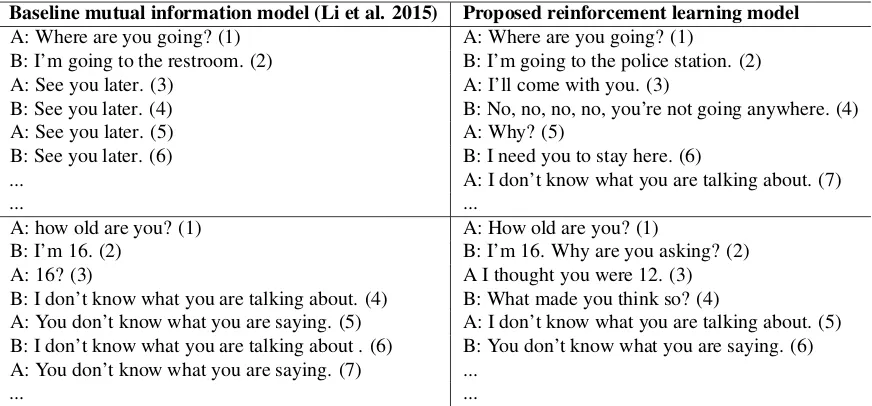
Another common problem, illustrated in the two sample conversations on the left of Table 1, is that the system becomes stuck in an infinite loop of repet-itive responses. This is due to MLE-based SEQ2SEQ
models’ inability to account for repetition. In exam-ple 2 (bottom left), the dialogue falls into an infinite loop after three turns, with both agents generating dull, generic utterances likei don’t know what you are talking aboutandyou don’t know what you are saying. Looking at the entire conversation, utterance (4) turns out to be a bad action to take because it offers no way of continuing the conversation.1
1A similar rule is often suggested in improvisational comedy:
https://en.wikipedia.org/wiki/Yes,_and...
Baseline mutual information model (Li et al. 2015) Proposed reinforcement learning model
A: Where are you going? (1) A: Where are you going? (1)
B: I’m going to the restroom. (2) B: I’m going to the police station. (2)
A: See you later. (3) A: I’ll come with you. (3)
B: See you later. (4) B: No, no, no, no, you’re not going anywhere. (4)
A: See you later. (5) A: Why? (5)
B: See you later. (6) B: I need you to stay here. (6)
... A: I don’t know what you are talking about. (7)
... ...
A: how old are you? (1) A: How old are you? (1)
B: I’m 16. (2) B: I’m 16. Why are you asking? (2)
A: 16? (3) A I thought you were 12. (3)
B: I don’t know what you are talking about. (4) B: What made you think so? (4)
A: You don’t know what you are saying. (5) A: I don’t know what you are talking about. (5) B: I don’t know what you are talking about . (6) B: You don’t know what you are saying. (6) A: You don’t know what you are saying. (7) ...
[image:2.612.89.525.57.260.2]... ...
Table 1: Left Column: Dialogue simulation between two agents using a 4-layer LSTM encoder-decoder trained on the OpenSubtitles dataset. The first turn (index 1) is input by the authors. Then the two agents take turns conversing, taking as input the other agent’s prior generated turn. The output is generated using the mutual information model (Li et al., 2015) in which an N-best list is first obtained using beam search based on p(t|s) and reranked by linearly combining the backward probability p(s|t), where t and s respectively denote targets and sources.Right Column: Dialogue simulated using the proposed reinforcement learning model. The new model has more forward-looking utterances (questions like “Why are you asking?” and offers like “I’ll come with you”) and lasts longer before it falls into conversational black holes.
These challenges suggest we need a conversa-tion framework that has the ability to (1) integrate developer-defined rewards that better mimic the true goal of chatbot development and (2) model the long-term influence of a generated response in an ongoing dialogue.
To achieve these goals, we draw on the insights of reinforcement learning, which have been widely ap-plied in MDP and POMDP dialogue systems (see Re-lated Work section for details). We introduce a neu-ral reinforcement learning (RL) generation method, which can optimize long-term rewards designed by system developers. Our model uses the encoder-decoder architecture as its backbone, and simulates conversation between two virtual agents to explore the space of possible actions while learning to maxi-mize expected reward. We define simple heuristic ap-proximations to rewards that characterize good con-versations: good conversations are forward-looking (Allwood et al., 1992) or interactive (a turn suggests a following turn), informative, and coherent. The pa-rameters of an encoder-decoder RNN define a policy over an infinite action space consisting of all possible
utterances. The agent learns a policy by optimizing the long-term developer-defined reward from ongo-ing dialogue simulations usongo-ing policy gradient meth-ods (Williams, 1992), rather than the MLE objective defined in standard SEQ2SEQmodels.
Our model thus integrates the power of SEQ2SEQ
systems to learn compositional semantic meanings of utterances with the strengths of reinforcement learn-ing in optimizlearn-ing for long-term goals across a conver-sation. Experimental results (sampled results at the right panel of Table 1) demonstrate that our approach fosters a more sustained dialogue and manages to produce more interactive responses than standard SEQ2SEQmodels trained using the MLE objective.
2 Related Work
Efforts to build statistical dialog systems fall into two major categories.
statisti-cal machine translation (SMT) problem. Sordoni et al. (2015) improved Ritter et al.’s system by rescor-ing the outputs of a phrasal SMT-based conversation system with a neural model that incorporates prior context. Recent progress in SEQ2SEQmodels inspire
several efforts (Vinyals and Le, 2015) to build end-to-end conversational systems which first apply an encoder to map a message to a distributed vector rep-resenting its semantics and generate a response from the message vector. Serban et al. (2016) propose a hierarchical neural model that captures dependen-cies over an extended conversation history. Li et al. (2016a) propose mutual information between mes-sage and response as an alternative objective function in order to reduce the proportion of generic responses produced by SEQ2SEQsystems.
The other line of statistical research focuses on building task-oriented dialogue systems to solve domain-specific tasks. Efforts include statistical models such as Markov Decision Processes (MDPs) (Levin et al., 1997; Levin et al., 2000; Walker et al., 2003; Pieraccini et al., 2009), POMDP (Young et al., 2010; Young et al., 2013; Gaˇsic et al., 2013a; Gaˇsic et al., 2014) models, and models that statisti-cally learn generation rules (Oh and Rudnicky, 2000; Ratnaparkhi, 2002; Banchs and Li, 2012; Nio et al., 2014). This dialogue literature thus widely applies reinforcement learning (Walker, 2000; Schatzmann et al., 2006; Gasic et al., 2013b; Singh et al., 1999; Singh et al., 2000; Singh et al., 2002) to train dialogue policies. But task-oriented RL dialogue systems of-ten rely on carefully limited dialogue parameters, or hand-built templates with state, action and reward sig-nals designed by humans for each new domain, mak-ing the paradigm difficult to extend to open-domain scenarios.
Also relevant is prior work on reinforcement learn-ing for language understandlearn-ing - includlearn-ing learnlearn-ing from delayed reward signals by playing text-based games (Narasimhan et al., 2015; He et al., 2016), executing instructions for Windows help (Branavan et al., 2011), or understanding dialogues that give navigation directions (Vogel and Jurafsky, 2010).
Our goal is to integrate the SEQ2SEQ and
rein-forcement learning paradigms, drawing on the advan-tages of both. We are thus particularly inspired by recent work that attempts to merge these paradigms, including Wen et al. (2016)— training an end-to-end
task-oriented dialogue system that links input repre-sentations to slot-value pairs in a database— or Su et al. (2016), who combine reinforcement learning with neural generation on tasks with real users, show-ing that reinforcement learnshow-ing improves dialogue performance.
3 Reinforcement Learning for Open-Domain Dialogue
In this section, we describe in detail the components of the proposed RL model.
The learning system consists of two agents. We use pto denote sentences generated from the first
agent and q to denote sentences from the second.
The two agents take turns talking with each other. A dialogue can be represented as an alternating se-quence of sentences generated by the two agents:
p1, q1, p2, q2, ..., pi, qi. We view the generated
sen-tences as actions that are taken according to a policy defined by an encoder-decoder recurrent neural net-work language model.
The parameters of the network are optimized to maximize the expected future reward using policy search, as described in Section 4.3. Policy gradi-ent methods are more appropriate for our scenario than Q-learning (Mnih et al., 2013), because we can initialize the encoder-decoder RNN using MLE pa-rameters that already produce plausible responses, before changing the objective and tuning towards a policy that maximizes long-term reward. Q-learning, on the other hand, directly estimates the future ex-pected reward of each action, which can differ from the MLE objective by orders of magnitude, thus mak-ing MLE parameters inappropriate for initialization. The components (states, actions, reward, etc.) of our sequential decision problem are summarized in the following sub-sections.
3.1 Action
An action a is the dialogue utterance to generate.
The action space is infinite since arbitrary-length se-quences can be generated.
3.2 State
A state is denoted by the previous two dialogue turns
[pi, qi]. The dialogue history is further transformed
described in Li et al. (2016a).
3.3 Policy
A policy takes the form of an LSTM encoder-decoder (i.e.,pRL(pi+1|pi, qi)) and is defined by its
param-eters. Note that we use a stochastic representation of the policy (a probability distribution over actions given states). A deterministic policy would result in a discontinuous objective that is difficult to optimize using gradient-based methods.
3.4 Reward
rdenotes the reward obtained for each action. In this
subsection, we discuss major factors that contribute to the success of a dialogue and describe how approx-imations to these factors can be operationalized in computable reward functions.
Ease of answering A turn generated by a machine should be easy to respond to. This aspect of a turn is related to its forward-looking function: the con-straints a turn places on the next turn (Schegloff and Sacks, 1973; Allwood et al., 1992). We propose to measure the ease of answering a generated turn by using the negative log likelihood of responding to that utterance with a dull response. We manually con-structed a list of dull responsesSconsisting 8 turns such as “I don’t know what you are talking about”, “I have no idea”, etc., that we and others have found occur very frequently in SEQ2SEQmodels of
con-versations. The reward function is given as follows:
r1 =−
1
NS X
s∈S
1
Ns
logpseq2seq(s|a) (1)
whereNSdenotes the cardinality ofNSandNs
de-notes the number of tokens in the dull responses. Although of course there are more ways to generate dull responses than the list can cover, many of these responses are likely to fall into similar regions in the vector space computed by the model. A system less likely to generate utterances in the list is thus also less likely to generate other dull responses.
pseq2seq represents the likelihood output by
SEQ2SEQ models. It is worth noting that pseq2seq
is different from the stochastic policy function
pRL(pi+1|pi, qi), since the former is learned based
on the MLE objective of the SEQ2SEQmodel while
the latter is the policy optimized for long-term future
reward in the RL setting.r1 is further scaled by the
length of targetS.
Information Flow We want each agent to con-tribute new information at each turn to keep the di-alogue moving and avoid repetitive sequences. We therefore propose penalizing semantic similarity be-tween consecutive turns from the same agent. Let
hpiandhpi+1 denote representations obtained from
the encoder for two consecutive turnspi andpi+1.
The reward is given by the negative log of the cosine similarity between them:
r2 =−logcos(hpi, hpi+1) =−log
hpi·hpi+1
khpikkhpi+1k
(2) Semantic Coherence We also need to measure the adequacy of responses to avoid situations in which the generated replies are highly rewarded but are un-grammatical or not coherent. We therefore consider the mutual information between the actionaand pre-vious turns in the history to ensure the generated responses are coherent and appropriate:
r3 = 1
Na
logpseq2seq(a|qi, pi)+ 1
Nqi
logpbackwardseq2seq (qi|a)
(3)
pseq2seq(a|pi, qi)denotes the probability of
generat-ing responseagiven the previous dialogue utterances
[pi, qi]. pbackwardseq2seq (qi|a)denotes the backward
proba-bility of generating the previous dialogue utterance
qibased on responsea.pbackwardseq2seq is trained in a
simi-lar way as standard SEQ2SEQmodels with sources
and targets swapped. Again, to control the influ-ence of target length, bothlogpseq2seq(a|qi, pi)and logpbackwardseq2seq (qi|a)are scaled by the length of targets.
The final reward for actionais a weighted sum of
the rewards discussed above:
r(a,[pi, qi]) =λ1r1+λ2r2+λ3r3 (4)
whereλ1+λ2+λ3 = 1. We setλ1 = 0.25,λ2 = 0.25andλ3 = 0.5. A reward is observed after the
agent reaches the end of each sentence.
4 Simulation
state-action space and learn a policypRL(pi+1|pi, qi)
that leads to the optimal expected reward. We adopt an AlphaGo-style strategy (Silver et al., 2016) by initializing the RL system using a general response generation policy which is learned from a fully su-pervised setting.
4.1 Supervised Learning
For the first stage of training, we build on prior work of predicting a generated target sequence given dia-logue history using the supervised SEQ2SEQmodel
(Vinyals and Le, 2015). Results from supervised models will be later used for initialization.
We trained a SEQ2SEQmodel with attention
(Bah-danau et al., 2015) on the OpenSubtitles dataset, which consists of roughly 80 million source-target pairs. We treated each turn in the dataset as a target and the concatenation of two previous sentences as source inputs.
4.2 Mutual Information
Samples from SEQ2SEQmodels are often times dull
and generic, e.g., “i don’t know” (Li et al., 2016a) We thus do not want to initialize the policy model using the pre-trained SEQ2SEQmodels because this
will lead to a lack of diversity in the RL models’ ex-periences. Li et al. (2016a) showed that modeling mutual information between sources and targets will significantly decrease the chance of generating dull responses and improve general response quality. We now show how we can obtain an encoder-decoder model which generates maximum mutual informa-tion responses.
As illustrated in Li et al. (2016a), direct decoding from Eq 3 is infeasible since the second term requires the target sentence to be completely generated. In-spired by recent work on sequence level learning (Ranzato et al., 2015), we treat the problem of gen-erating maximum mutual information response as a reinforcement learning problem in which a reward of mutual information value is observed when the model arrives at the end of a sequence.
Similar to Ranzato et al. (2015), we use policy gra-dient methods (Sutton et al., 1999; Williams, 1992) for optimization. We initialize the policy modelpRL
using a pre-trainedpSEQ2SEQ(a|pi, qi)model. Given
an input source[pi, qi], we generate a candidate list
A = {aˆ|aˆ ∼ pRL}. For each generated
candi-dateˆa, we will obtain the mutual information score m(ˆa,[pi, qi])from the pre-trainedpSEQ2SEQ(a|pi, qi)
andpbackwardSEQ2SEQ(qi|a). This mutual information score
will be used as a reward and back-propagated to the encoder-decoder model, tailoring it to generate se-quences with higher rewards. We refer the readers to Zaremba and Sutskever (2015) and Williams (1992) for details. The expected reward for a sequence is given by:
J(θ) =E[m(ˆa,[pi, qi])] (5)
The gradient is estimated using the likelihood ratio trick:
∇J(θ) =m(ˆa,[pi, qi])∇logpRL(ˆa|[pi, qi]) (6)
We update the parameters in the encoder-decoder model using stochastic gradient descent. A curricu-lum learning strategy is adopted (Bengio et al., 2009) as in Ranzato et al. (2015) such that, for every se-quence of lengthT we use the MLE loss for the first L tokens and the reinforcement algorithm for the
remainingT −Ltokens. We gradually anneal the
value ofLto zero. A baseline strategy is employed to
decrease the learning variance: an additional neural model takes as inputs the generated target and the initial source and outputs a baseline value, similar to the strategy adopted by Zaremba and Sutskever (2015). The final gradient is thus:
∇J(θ) =∇logpRL(ˆa|[pi, qi])[m(ˆa,[pi, qi])−b]
(7)
.. .
.. .
.. .
.. . m
How old are you?
I’m 16, why are you asking?
… …
…
…
I’m 16 Input Message
. . .
16?
I thought you were 12.
. . . . . . . . . Turn 1
p1,2
p1,3
Turn 2
q11,1 q1
1,2
q21,1 q2
1,2
q3 1,1 q3
1,2
.. .
.. .
.. .
…
…
…
Turnn
p1
n,1 p1
n,2 p1,1
p2n,1 p2
n,2
p3 n,1
p3
n,2
[image:6.612.92.527.59.238.2]encode decode encode decode encode decode
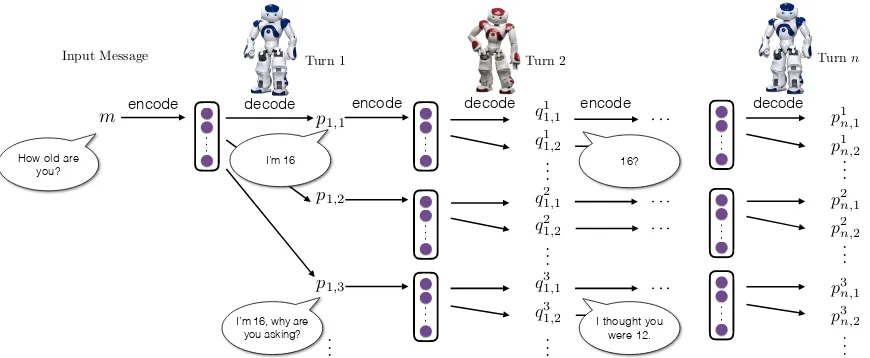
Figure 1: Dialogue simulation between the two agents.
Optimization We initialize the policy modelpRL
with parameters from the mutual information model described in the previous subsection. We then use policy gradient methods to find parameters that lead to a larger expected reward. The objective to maxi-mize is the expected future reward:
JRL(θ) =EpRL(a1:T)[
i=T
X
i=1
R(ai,[pi, qi])] (8)
where R(ai,[pi, qi]) denotes the reward resulting
from action ai. We use the likelihood ratio trick
(Williams, 1992; Glynn, 1990; Aleksandrov et al., 1968) for gradient updates:
∇JRL(θ)≈
X
i
∇logp(ai|pi, qi)
i=T
X
i=1
R(ai,[pi, qi])
(9) We refer readers to Williams (1992) and Glynn (1990) for more details.
4.4 Curriculum Learning
A curriculum Learning strategy is again employed in which we begin by simulating the dialogue for 2 turns, and gradually increase the number of simulated turns. We generate 5 turns at most, as the number of candidates to examine grows exponentially in the size of candidate list. Five candidate responses are generated at each step of the simulation.
5 Experimental Results
In this section, we describe experimental results along with qualitative analysis. We evaluate dialogue
generation systems using both human judgments and two automatic metrics: conversation length (number of turns in the entire session) and diversity.
5.1 Dataset
The dialogue simulation requires high-quality initial inputs fed to the agent. For example, an initial input of “why ?” is undesirable since it is unclear how the dialogue could proceed. We take a subset of 10 million messages from the OpenSubtitles dataset and extract 0.8 million sequences with the lowest likelihood of generating the response “i don’t know what you are taking about” to ensure initial inputs are easy to respond to.
5.2 Automatic Evaluation
Evaluating dialogue systems is difficult. Metrics such as BLEU (Papineni et al., 2002) and perplexity have been widely used for dialogue quality evaluation (Li et al., 2016a; Vinyals and Le, 2015; Sordoni et al., 2015), but it is widely debated how well these auto-matic metrics are correlated with true response qual-ity (Liu et al., 2016; Galley et al., 2015). Since the goal of the proposed system is not to predict the highest probability response, but rather the long-term success of the dialogue, we do not employ BLEU or perplexity for evaluation2.
Model #of simulated turns
SEQ2SEQ 2.68
mutual information 3.40
[image:7.612.86.285.56.111.2]RL 4.48
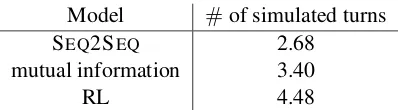
Table 2: The average number of simulated turns from standard SEQ2SEQ models, mutual
informa-tion model and the proposed RL model.
Length of the dialogue The first metric we pro-pose is the length of the simulated dialogue. We say a dialogue ends when one of the agents starts gener-ating dull responses such as “i don’t know”3or two
consecutive utterances from the same user are highly overlapping4.
The test set consists of 1,000 input messages. To reduce the risk of circular dialogues, we limit the number of simulated turns to be less than 8. Results are shown in Table 2. As can be seen, using mutual information leads to more sustained conversations between the two agents. The proposed RL model is first trained based on the mutual information objec-tive and thus benefits from it in addition to the RL model. We observe that the RL model with dialogue simulation achieves the best evaluation score.
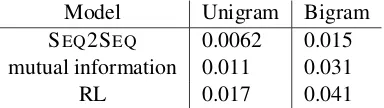
Diversity We report degree of diversity by calculat-ing the number of distinct unigrams and bigrams in generated responses. The value is scaled by the total number of generated tokens to avoid favoring long sentences as described in Li et al. (2016a). The re-sulting metric is thus a type-token ratio for unigrams and bigrams.
For both the standard SEQ2SEQmodel and the
pro-posed RL model, we use beam search with a beam size 10 to generate a response to a given input mes-sage. For the mutual information model, we first generate n-best lists using pSEQ2SEQ(t|s) and then
linearly re-rank them using pSEQ2SEQ(s|t). Results
are presented in Table 4. We find that the proposed RL model generates more diverse outputs when
com-Since the RL model is trained based on future reward rather than MLE, it is not surprising that the RL based models achieve lower BLEU score.
3We use a simple rule matching method, with a list of 8 phrases that count as dull responses. Although this can lead to both false-positives and -negatives, it works pretty well in practice.
4Two utterances are considered to be repetitive if they share more than 80 percent of their words.
pared against both the vanilla SEQ2SEQmodel and
the mutual information model.
Human Evaluation We explore three settings for human evaluation: the first setting is similar to what was described in Li et al. (2016a), where we employ crowdsourced judges to evaluate a random sample of 500 items. We present both an input message and the generated outputs to 3 judges and ask them to decide which of the two outputs is better (denoted as single-turn general quality). Ties are permitted. Identical strings are assigned the same score. We measure the improvement achieved by the RL model over the mutual information model by the mean difference in scores between the models.
For the second setting, judges are again presented with input messages and system outputs, but are asked to decide which of the two outputs is easier to respond to (denoted assingle-turn ease to answer). Again we evaluate a random sample of 500 items, each being assigned to 3 judges.
For the third setting, judges are presented with sim-ulated conversations between the two agents (denoted as multi-turn general quality). Each conversation consists of 5 turns. We evaluate 200 simulated con-versations, each being assigned to 3 judges, who are asked to decide which of the simulated conversations is of higher quality.
Results for human evaluation are shown in Table 5. The proposed RL system does not introduce a signifi-cant boost in single-turn response quality (winning 40 percent of time and losing 36 percent of time). This is in line with our expectations, as the RL model is not optimized to predict the next utterance, but rather to increase long-term reward. The RL sys-tem produces responses that are significantly easier to answer than does the mutual information system, as demonstrated by thesingle-turn ease to answer
setting (winning 52 percent of time and losing 23 percent of time), and also significantly higher quality multi-turn dialogues, as demonstrated by the multi-turn general qualitysetting (winning 72 percent of time).
Input Message Mutual Information Model RL
How old are you? I’m 16. I’m 16, why are you asking?
What’s your full name? I have no idea. What’s yours?
I don’t want to go home tonight. Really? Why?
Do you have any feelings for me? I don’t know what you are talking about. I don’t want to hurt your feelings. How much time do you have here? Not long enough. Sorry, sir. Ten seconds.
Shall we get started? Of course! Yes. We’ve got a lot of work to do here.
Do you play football? No, i don’t Yes. I love football!
We’d have to talk to him. I mean, he’s a good guy About what ?
[image:8.612.76.537.56.169.2]How come you never say it? Because I don’t want to hurt you. I don’t think it’s a good idea to say it.
Table 3: Sampled responses generated from the mutual information models and the proposed RL model.
Model Unigram Bigram
SEQ2SEQ 0.0062 0.015
mutual information 0.011 0.031
[image:8.612.91.283.203.257.2]RL 0.017 0.041
Table 4: Diversity scores (type-token ratios) for the standard SEQ2SEQmodel, mutual information model
and the proposed RL model.
Setting RL-win RL-lose Tie
single-turn general quality 0.40 0.36 0.24 single-turn ease to answer 0.52 0.23 0.25 multi-turn general quality 0.72 0.12 0.16 Table 5: RL gains over the mutual information sys-tem based on pairwise human judgments.
responses than the other baselines. We also find that the RL model has a tendency to end a sentence with another question and hand the conversation over to the user. From Table 1, we observe that the RL model manages to produce more interactive and sustained conversations than the mutual information model.
During error analysis, we found that although we penalize repetitive utterances in consecutive turns, the dialogue sometimes enters a cycle with length greater than one, as shown in Table 6. This can be ascribed to the limited amount of conversational his-tory we consider. Another issue observed is that the model sometimes starts a less relevant topic during the conversation. There is a tradeoff between rele-vance and less repetitiveness, as manifested in the reward function we define in Eq 4.
The fundamental problem, of course, is that the manually defined reward function can’t possibly cover the crucial aspects that define an ideal conversa-tion. While the heuristic rewards that we defined are amenable to automatic calculation, and do capture
A: What’s your name ? B: Daniel.
A: How old are you ?
B. Twelve. What’s your name ? A. Daniel.
B: How old are you ?
A: Twelve. What’s your name ? B: Daniel.
A: How old are you ? B ...
Table 6: An simulated dialogue with a cycle longer than one.
some aspects of what makes a good conversation, ideally the system would instead receive real rewards from humans. Another problem with the current model is that we can only afford to explore a very small number of candidates and simulated turns since the number of cases to consider grow exponentially.
6 Conclusion
We introduce a reinforcement learning framework for neural response generation by simulating dialogues between two agents, integrating the strengths of neu-ral SEQ2SEQ systems and reinforcement learning
for dialogue. Like earlier neural SEQ2SEQmodels,
Acknowledgement
We would like to thank Chris Brockett, Bill Dolan and other members of the NLP group at Microsoft Re-search for insightful comments and suggestions. We also want to thank Kelvin Guu, Percy Liang, Chris Manning, Sida Wang, Ziang Xie and other members of the Stanford NLP groups for useful discussions. Jiwei Li is supported by the Facebook Fellowship, to which we gratefully acknowledge. This work is par-tially supported by the NSF via Awards IIS-1514268, IIS-1464128, and by the DARPA Communicating with Computers (CwC) program under ARO prime contract no. W911NF- 15-1-0462. Any opinions, findings, and conclusions or recommendations ex-pressed in this material are those of the authors and do not necessarily reflect the views of NSF, DARPA, or Facebook.
References
V. M. Aleksandrov, V. I. Sysoyev, and V. V. Shemeneva. 1968. Stochastic optimization. Engineering Cybernet-ics, 5:11–16.
Jens Allwood, Joakim Nivre, and Elisabeth Ahls´en. 1992. On the semantics and pragmatics of linguistic feedback. Journal of Semantics, 9:1–26.
Dzmitry Bahdanau, Kyunghyun Cho, and Yoshua Bengio. 2015. Neural machine translation by jointly learning to align and translate. InProc. of ICLR.
Rafael E Banchs and Haizhou Li. 2012. IRIS: a chat-oriented dialogue system based on the vector space model. InProceedings of the ACL 2012 System Demon-strations, pages 37–42.
Yoshua Bengio, J´erˆome Louradour, Ronan Collobert, and Jason Weston. 2009. Curriculum learning. In Pro-ceedings of the 26th annual international conference on machine learning, pages 41–48. ACM.
SRK Branavan, David Silver, and Regina Barzilay. 2011. Learning to win by reading manuals in a monte-carlo framework. InProceedings of the 49th Annual Meeting of the Association for Computational Linguistics: Hu-man Language Technologies-Volume 1, pages 268–277. Michel Galley, Chris Brockett, Alessandro Sordoni, Yangfeng Ji, Michael Auli, Chris Quirk, Margaret Mitchell, Jianfeng Gao, and Bill Dolan. 2015. deltaBLEU: A discriminative metric for generation tasks with intrinsically diverse targets. InProc. of ACL-IJCNLP, pages 445–450, Beijing, China, July. Milica Gaˇsic, Catherine Breslin, Matthew Henderson,
Dongho Kim, Martin Szummer, Blaise Thomson, Pir-ros Tsiakoulis, and Steve Young. 2013a. Pomdp-based
dialogue manager adaptation to extended domains. In Proceedings of SIGDIAL.
Milica Gasic, Catherine Breslin, Mike Henderson, Dongkyu Kim, Martin Szummer, Blaise Thomson, Pir-ros Tsiakoulis, and Steve Young. 2013b. On-line policy optimisation of bayesian spoken dialogue systems via human interaction. InProceedings of ICASSP 2013, pages 8367–8371. IEEE.
Milica Gaˇsic, Dongho Kim, Pirros Tsiakoulis, Catherine Breslin, Matthew Henderson, Martin Szummer, Blaise Thomson, and Steve Young. 2014. Incremental on-line adaptation of pomdp-based dialogue managers to extended domains.In Proceedings on InterSpeech. Peter W Glynn. 1990. Likelihood ratio gradient
estima-tion for stochastic systems. Communications of the ACM, 33(10):75–84.
Ji He, Jianshu Chen, Xiaodong He, Jianfeng Gao, Lihong Li, Li Deng, and Mari Ostendorf. 2016. Deep rein-forcement learning with a natural language action space. InProceedings of the 54th Annual Meeting of the Asso-ciation for Computational Linguistics (Volume 1: Long Papers), pages 1621–1630, Berlin, Germany, August. Esther Levin, Roberto Pieraccini, and Wieland Eckert.
1997. Learning dialogue strategies within the markov decision process framework. In Automatic Speech Recognition and Understanding, 1997. Proceedings., 1997 IEEE Workshop on, pages 72–79. IEEE.
Esther Levin, Roberto Pieraccini, and Wieland Eckert. 2000. A stochastic model of human-machine interac-tion for learning dialog strategies. IEEE Transactions on Speech and Audio Processing, 8(1):11–23. Jiwei Li, Michel Galley, Chris Brockett, Jianfeng Gao, and
Bill Dolan. 2016a. A diversity-promoting objective function for neural conversation models. InProc. of NAACL-HLT.
Jiwei Li, Michel Galley, Chris Brockett, Georgios Sp-ithourakis, Jianfeng Gao, and Bill Dolan. 2016b. A persona-based neural conversation model. In Proceed-ings of the 54th Annual Meeting of the Association for Computational Linguistics (Volume 1: Long Papers), pages 994–1003, Berlin, Germany, August.
Chia-Wei Liu, Ryan Lowe, Iulian V Serban, Michael Nose-worthy, Laurent Charlin, and Joelle Pineau. 2016. How not to evaluate your dialogue system: An empirical study of unsupervised evaluation metrics for dialogue response generation. arXiv preprint arXiv:1603.08023. Yi Luan, Yangfeng Ji, and Mari Ostendorf. 2016. LSTM based conversation models. arXiv preprint arXiv:1603.09457.
Karthik Narasimhan, Tejas Kulkarni, and Regina Barzilay. 2015. Language understanding for text-based games using deep reinforcement learning. arXiv preprint arXiv:1506.08941.
Lasguido Nio, Sakriani Sakti, Graham Neubig, Tomoki Toda, Mirna Adriani, and Satoshi Nakamura. 2014. Developing non-goal dialog system based on examples of drama television. InNatural Interaction with Robots, Knowbots and Smartphones, pages 355–361. Springer. Alice H Oh and Alexander I Rudnicky. 2000. Stochastic language generation for spoken dialogue systems. In Proceedings of the 2000 ANLP/NAACL Workshop on Conversational systems-Volume 3, pages 27–32. Kishore Papineni, Salim Roukos, Todd Ward, and
Wei-Jing Zhu. 2002. BLEU: a method for automatic eval-uation of machine translation. InProceedings of the 40th annual meeting on association for computational linguistics, pages 311–318.
Roberto Pieraccini, David Suendermann, Krishna Dayanidhi, and Jackson Liscombe. 2009. Are we there yet? Research in commercial spoken dialog systems. InText, Speech and Dialogue, pages 3–13. Springer. Marc’Aurelio Ranzato, Sumit Chopra, Michael Auli,
and Wojciech Zaremba. 2015. Sequence level train-ing with recurrent neural networks. arXiv preprint arXiv:1511.06732.
Adwait Ratnaparkhi. 2002. Trainable approaches to sur-face natural language generation and their application to conversational dialog systems. Computer Speech & Language, 16(3):435–455.
Alan Ritter, Colin Cherry, and William B Dolan. 2011. Data-driven response generation in social media. In Proceedings of EMNLP 2011, pages 583–593. Jost Schatzmann, Karl Weilhammer, Matt Stuttle, and
Steve Young. 2006. A survey of statistical user simula-tion techniques for reinforcement-learning of dialogue management strategies. The knowledge engineering review, 21(02):97–126.
Emanuel A. Schegloff and Harvey Sacks. 1973. Opening up closings. Semiotica, 8(4):289–327.
Iulian V Serban, Alessandro Sordoni, Yoshua Bengio, Aaron Courville, and Joelle Pineau. 2016. Building end-to-end dialogue systems using generative hierar-chical neural network models. InProceedings of AAAI, February.
Lifeng Shang, Zhengdong Lu, and Hang Li. 2015. Neural responding machine for short-text conversation. In Proceedings of ACL-IJCNLP, pages 1577–1586. David Silver, Aja Huang, Chris J Maddison, Arthur Guez,
Laurent Sifre, George Van Den Driessche, Julian Schrit-twieser, Ioannis Antonoglou, Veda Panneershelvam, Marc Lanctot, et al. 2016. Mastering the game of go with deep neural networks and tree search. Nature, 529(7587):484–489.
Satinder P Singh, Michael J Kearns, Diane J Litman, and Marilyn A Walker. 1999. Reinforcement learning for spoken dialogue systems. InNips, pages 956–962. Satinder Singh, Michael Kearns, Diane J Litman,
Mar-ilyn A Walker, et al. 2000. Empirical evaluation of a reinforcement learning spoken dialogue system. In AAAI/IAAI, pages 645–651.
Satinder Singh, Diane Litman, Michael Kearns, and Mari-lyn Walker. 2002. Optimizing dialogue management with reinforcement learning: Experiments with the nj-fun system. Journal of Artificial Intelligence Research, pages 105–133.
Alessandro Sordoni, Michel Galley, Michael Auli, Chris Brockett, Yangfeng Ji, Meg Mitchell, Jian-Yun Nie, Jianfeng Gao, and Bill Dolan. 2015. A neural network approach to context-sensitive generation of conversa-tional responses. InProceedings of NAACL-HLT. Pei-Hao Su, Milica Gasic, Nikola Mrksic, Lina
Rojas-Barahona, Stefan Ultes, David Vandyke, Tsung-Hsien Wen, and Steve Young. 2016. Continuously learning neural dialogue management. arxiv.
Ilya Sutskever, Oriol Vinyals, and Quoc V Le. 2014. Sequence to sequence learning with neural networks. InAdvances in neural information processing systems, pages 3104–3112.
Richard S Sutton, David A McAllester, Satinder P Singh, Yishay Mansour, et al. 1999. Policy gradient methods for reinforcement learning with function approximation. InNIPS, volume 99, pages 1057–1063.
Oriol Vinyals and Quoc Le. 2015. A neural conversa-tional model. InProceedings of ICML Deep Learning Workshop.
Adam Vogel and Dan Jurafsky. 2010. Learning to follow navigational directions. InProceedings of ACL 2010, pages 806–814.
Marilyn A Walker, Rashmi Prasad, and Amanda Stent. 2003. A trainable generator for recommendations in multimodal dialog. InProceeedings of INTERSPEECH 2003.
Marilyn A. Walker. 2000. An application of reinforce-ment learning to dialogue strategy selection in a spoken dialogue system for email. Journal of Artificial Intelli-gence Research, pages 387–416.
Tsung-Hsien Wen, Milica Gasic, Nikola Mrkˇsi´c, Pei-Hao Su, David Vandyke, and Steve Young. 2015. Semanti-cally conditioned LSTM-based natural language gener-ation for spoken dialogue systems. InProceedings of EMNLP, pages 1711–1721, Lisbon, Portugal.
Ronald J Williams. 1992. Simple statistical gradient-following algorithms for connectionist reinforcement learning.Machine learning, 8(3-4):229–256.
Zhen Xu, Bingquan Liu, Baoxun Wang, Chengjie Sun, and Xiaolong Wang. 2016. Incorporating loose-structured knowledge into LSTM with recall gate for conversation modeling. arXiv preprint arXiv:1605.05110.
Kaisheng Yao, Geoffrey Zweig, and Baolin Peng. 2015. Attention with intention for a neural network conversa-tion model. InNIPS workshop on Machine Learning for Spoken Language Understanding and Interaction. Steve Young, Milica Gaˇsi´c, Simon Keizer, Franc¸ois
Mairesse, Jost Schatzmann, Blaise Thomson, and Kai Yu. 2010. The hidden information state model: A prac-tical framework for pomdp-based spoken dialogue man-agement. Computer Speech & Language, 24(2):150– 174.
Steve Young, Milica Gasic, Blaise Thomson, and Jason D Williams. 2013. Pomdp-based statistical spoken di-alog systems: A review. Proceedings of the IEEE, 101(5):1160–1179.